interceptors

Ukraine’s Newest USV Is A Super Sized Mothership Packed With Anti-Drone Interceptors

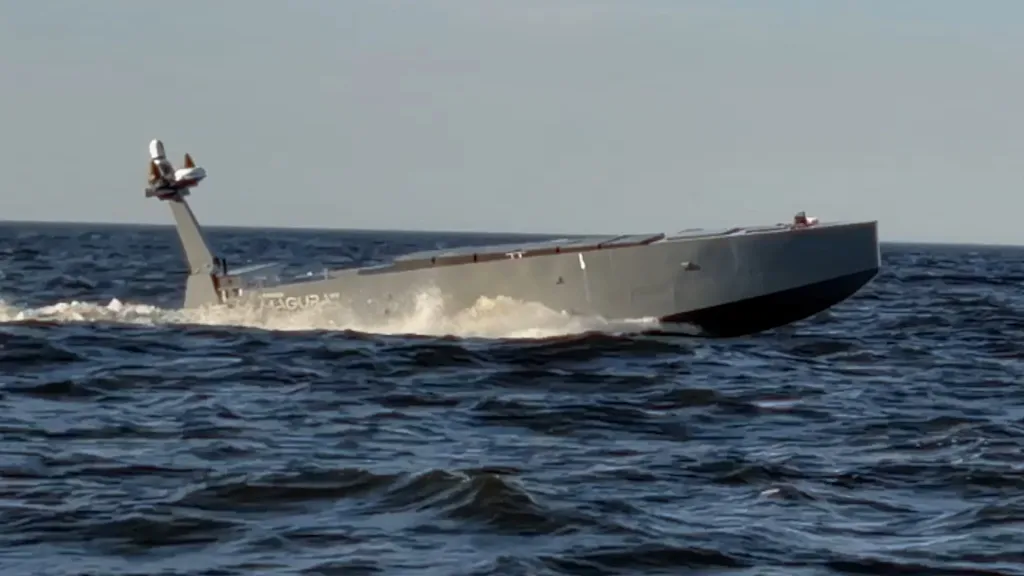
Ukraine’s combat-proven Magura family of uncrewed surface vessels (USV) has gained its largest member to date. The new MV11 is designed for open-ocean operations lasting up to a week and can carry payloads weighing up to 4,850 pounds (2,200 kilograms). The drone boat has so far been shown in one configuration, loaded with 18 small vertically launched Sting interceptors, turning it into a small floating counter-drone battery. Given its significant payload capacity and other capabilities, it could be utilized in other roles, too.

The Magura MV11 USV at speed. UFORCE capture

The MV11 made its public debut yesterday at Ukraine’s Independence Day parade in the country’s capital, Kyiv. The uncrewed air, ground, and maritime systems were the centerpieces of this event, underscoring the central place they now hold in the Ukrainian armed forces. The maritime portion of the parade, which took place along a section of the Dnipro River, featured additional members of the Magura family, as well as other USVs, including kamikaze types and ones armed with repurposed air-to-air missiles. A drone boat with a launcher for first-person-view (FPV) type aerial kamikaze drones and another with an array of small domed antennas (possibly tied to an electronic warfare system or for use as a communications node) were also present. Various types of aerial kamikaze drones, as well as uncrewed ground vehicles (UGV) armed with anti-tank guided missiles, automatic grenade launchers, and machine guns, were also showcased at the event.

The video below shows the various USVs, as well as other uncrewed platforms showcased at Ukraine’s Independence Day parade in Kyiv yesterday.

“We are proud to present the MV11 on Ukraine’s Independence Day. This is not just the largest naval drone – it is a platform that delivers multi-domain capability: a single carrier that transports and launches other unmanned systems far from shore, enabling operations across all domains,” Oleg Roginsky, CEO of UFORCE, said in a statement. “At UFORCE, we are focused on building the best capabilities for Ukraine and its allies who stand for freedom. We are confident the MV11 will become the foundation for many successful missions and for pushing the enemy back even further.”

UFORCE was founded in Ukraine, but has its main headquarters in London in the United Kingdom. It is often described as an uncrewed-focused defense conglomerate with several different enterprises operating under its umbrella. Many of its components are also located outside of Ukraine. For instance, the main design, research, and development bureau for the Magura family is located in Portugal.

As mentioned, the configuration the MV11 has been shown in so far, both at the parade yesterday and in other marketing material released by UFORCE, features a payload of 18 Sting interceptors. They are loaded individually in box-like launchers, which can also be employed in other domains, including mounted on trucks or positioned on the ground. Weighing roughly nine pounds, the Sting interceptor is an electrically powered quad-rotor system with a small explosive warhead. It makes heavy use of 3D-printed components, and each one has a reported cost of around $2,100.

The Ukrainian developer, Wild Hornets, says Sting can reach altitudes up to nearly 23,000 feet (7,000 meters) and has a maximum range of around 23 miles (37 kilometers), depending “on battery capacity, weather conditions, payload weight, and operator flight style.” Typical flying time is said to be shorter, and the system can be recovered for reuse if it does not intercept a target after launch. Sting has proven itself effective at intercepting Russian variants and derivatives of the Iranian-designed Shahed-136 one-way attack drone and other similar designs.

Sting is manually operated by a human controller via a wireless link. How this works exactly with the MV11 as the launch platform is unclear, and TWZ has reached out for more information. Wild Hornets has said in the past that the interceptors can be remotely operated from locations up to 2,000 kilometers away from the launch point via a user interface that can be installed on a laptop.

Wild Hornets 2,000 Km thumbnail

Wild Hornets 2,000 Km


What capabilities the MV11 has onboard to spot and track targets to begin with is also unknown. However, the USV does have a mast at the rear, and images available so far show it equipped with a camera turret, navigation radar, and two other horn-like antennas. The camera system could be used for target detection and tracking, as well as just to help with situational awareness. The additional antennas might allow for passive detection of aerial targets via their signal emissions, or serve some other purpose. As noted, Ukraine does already have USVs armed with traditional anti-air missiles, which the country has claimed to have used to successfully down Russian fixed-wing jets and helicopters.

A close-up look at the MV11’s mast. UFORCE capture

The MV11 also has a fixed-forward camera on top of the bow, which is a common feature on drone boats to aid general navigation. There are what appear to be a pair of rectangular satellite communications (SATCOM) terminals in the open main deck area, as well. A reliable SATCOM link would be key to linking the Sting interceptors with their operators.

With their own range and endurance, Sting-armed MV11s could offer Ukraine valuable forward-deployed counter-drone nodes out in the Black Sea and along other waterways. Being able to thin out groups of incoming Russian drones further away from their intended targets could help reduce the pressure on land-based forces, including more traditional surface-to-air missile batteries. It is well established at this point that Ukrainian air defense units are under heavy strain from Russia’s constant barrages of drones and missiles on targets across the country.

With a 4,850-pound (2,200-kilogram) payload capacity, the MV11 could easily be adapted to other roles. This could include launching groups of uncrewed aerial one-way attack drones at targets at sea or on land, or conducting direct attacks using other mounted weapon systems. These are capabilities that Ukraine has already demonstrated in real combat using smaller USVs.

MV11s could use their ample payload capacity in other ways, possibly including carrying sensor, electronic warfare, or communications packages. In a press release today, UFORCE said that the MV11 could be employed for more general surveillance and reconnaissance missions, as well as to support amphibious operations or transport cargo. In July, video emerged of Ukrainian forces using a smaller USV to land an armed UGV into a Russian-occupied area. While the exact outcome of that mission is still unclear, it did clearly serve as a proof-of-concept that could be a sign of things to come that could be further enabled by larger USVs.

On a more general level, the MV11 underscores the pace at which Ukraine continues to expand and evolve its uncrewed capabilities in the maritime, as well as air and ground domains. Other countries, including the United States, are taking notice and even moving to acquire Ukrainian-developed drone and counter-drone capabilities. Gulf Arab States have notably sought assistance from Ukraine in the wake of Iranian drone attacks this year. In that particular context, an MV11 loaded with Stings could be a very useful and lower-cost system for intercepting Shaheds and other one-way-attack drones heading across the Persian Gulf and the Gulf of Oman, especially when tied in with even a basic early warning network.

Now that the MV11 has been shown publicly, we could well see it in action soon as a counter-drone platform and/or in other roles.

Contact the author: joe@twz.com

Joseph is TWZ’s Deputy Editor, helping to oversee the site’s highly experienced and dedicated team, while also writing informative and impactful defense and national security content. He lives right in the thick of it in the Washington, D.C. area.


Source link

Russian strike sparks fire at Ukraine port; Zelenskyy seeks interceptors | Russia-Ukraine war News

Ukraine has reported an acute shortage of Patriot interceptors since the US went to war with Iran in February.

Russian forces have struck Ukraine’s Izmail port in southern Odesa, setting off a fire, authorities said, a day after Kyiv pounded Russia’s Novorossiysk port.

In a statement on the Telegram app early on Thursday, the Izmail Regional State Administration said Russian forces struck “port infrastructure”, causing damage and a fire.

Recommended Stories

list of 4 itemsend of list

It said emergency personnel were at the scene to extinguish it.

Izmail, close to the Romanian border, is home to Ukraine’s largest Danube port, handling grain and other commodities.

The attacks came as Ukraine’s President Volodymyr Zelenskyy told CNN that the country needs 5 percent of the United States’s Patriot interceptor missiles to get through the winter and 10 percent to destroy all of Russia’s ballistic projectiles.

Russia has recently been firing barrages at the Ukrainian capital, Kyiv, roughly once a week, killing civilians and damaging or destroying homes.

In one attack, Ukraine failed to intercept any of the 28 ballistic missiles launched at it.

Zelenskyy said Ukraine this year “had two and a half times less interceptors than we had in 2025”.

“Russia has two times more ballistic missiles per month than they had before,” he said. “This year, I’m asking American partners to sell me 5 percent of missiles [that] they have in their stocks.”

“If they sell us 5 percent, we will go through the winter and save people’s lives,” he added. “If they can sell us 10 percent, we will destroy all the Russians’ ballistic missiles. I have 1 percent.”

Ukraine has reported an acute shortage of Patriot interceptors since the US and Israel launched the war on Iran in February, diverting supplies of the advanced systems.

Ballistic missiles are much harder to intercept than cruise missiles or drones because they move faster and follow steep trajectories.

On Wednesday, Ukraine’s air force said it would stop publishing detailed figures on Russian ballistic missile strikes as Ukrainian forces struggle to intercept Russia’s heightened attacks.

The restrictions concern “the number of targets launched, shot down, suppressed or those that failed to reach their targets,” air force communications chief Yurii Ihnat said on Facebook. Real-time warnings would continue unchanged, he added, and the air force would keep providing generalised figures on Russian missile launches.

Last month, Russia fired more than 450 missiles at Ukraine, nearly 200 of them on ballistic trajectories.

Asked if the US had responded to his requests, Zelenskyy said he hopes that he gets the interceptors.

“From 1 percent to 5 percent, I have some months and millions [of] phone calls and anything else,” he said. “I do some things which I can’t even share. It doesn’t mean that it’s out of the law. But I can’t speak about it.”

Source link

Ukraine Getting License To Build Aster 30 Anti-Missile Interceptors

French President Emmanuel Macron says Ukraine is in line to get a license to produce Aster 30 missiles domestically. Aster 30 is the anti-air interceptor used in the SAMP/T surface-to-air missile system, examples of which are already in Ukrainian service. The Franco-Italian SAMP/T is often described as an analog to the U.S.-made Patriot, and both systems offer Ukraine vital anti-ballistic missile capability.

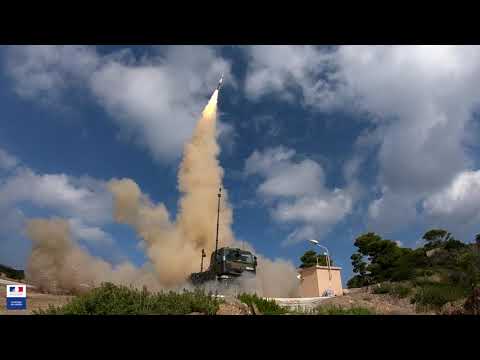
2018 – SAMP/T live firing by FASF in Le Levant thumbnail

2018 – SAMP/T live firing by FASF in Le Levant


Ukraine is still in desperate need of additional capacity to shoot down incoming Russian ballistic missiles, especially amid shortages of missiles for its Patriots. Just last week, U.S. President Donald Trump also said he would approve a license for Ukraine to domestically produce Patriot interceptors. Significant questions remain about the exact timeline for when Ukraine might begin domestic production of munitions for either system, along with a host of other factors that will need to be addressed, as TWZ just explored in detail after Trump’s announcement regarding Patriot.

The French President spoke alongside Ukrainian President Volodymyr Zelensky, British Prime Minister Keir Starmer, and German Chancellor Friedrich Merz at a press conference at the Coalition of the Willing summit today in Paris. A total of 25 world leaders were in attendance. At this event, the governments of Ukraine, Denmark, France, Germany, Italy, the Netherlands, Norway, Spain, Sweden, and the United Kingdom also announced the creation of an Integrated Anti-Ballistic Missile Coalition. The coalition will pool resources to develop new anti-ballistic missile defense capabilities.

“Earlier this afternoon [Ukrainian] President Zelenskiy and I agreed ​on a roadmap between our two countries, implementing what ​had been agreed in principle last November regarding ⁠our bilateral defense cooperation,” Macron said at a press conference today, per a translation of his remarks from Reuters.

This is set to include the license production of Aster 30, as well as AASM Hammer-series precision-guided bombs and SCALP cruise missiles. France has already supplied tranches of all three of these munitions to Ukraine. It’s also worth noting that Ukrainian forces have also received Storm Shadow cruise missiles from the United Kingdom, which are nearly identical to SCALP.

Macron also highlighted planned deliveries of SAMP/T and SAMP/T NG surface-to-air missile systems to Ukrainian forces, which are set to start at least later this year. The SAMP/T NG is an upgraded version of the baseline SAMP/T type, and is designed to offer an expanded engagement envelope, both in terms of altitude and maximum range, primarily through the inclusion of new radars. The French and Italian versions of SAMP/T NG differ in the exact radar used (the French Thales GF 300 or the Kronos Grand Mobile HP from Italy’s Leonardo). Improved Aster 30 variants are also in development. Ukraine currently has two baseline SAMP/T systems, one from France and the other from Italy.

Eurosam SAMP/T systems with ASTER missiles thumbnail

Eurosam SAMP/T systems with ASTER missiles


In addition, the French President talked about progress in Ukraine’s planned acquisition of French-made Rafale fighters, with the goal now being to deliver the first 16 of those aircraft in the 2028-2029 timeframe. You can read more about those plans, which were first announced last year, here.

The move by French authorities to allow Ukraine to produce Aster 30s domestically is particularly significant. Russian ballistic missiles, including ground-launched types and the air-launched Kinzhal, have and continue to present a threat that is especially difficult for Ukraine to manage. Ballistic missiles hurtle back to Earth at very high speeds in the terminal phase of flight, making them very challenging to intercept compared to other kinds of missiles, in general.

In recent years, Russia has also begun using ballistic missiles with enhanced maneuvering capabilities to make them even more difficult to knock down, even by more advanced air defense systems like Patriot. French Air Force Gen. Fabien Mandon, the chief of the French defense staff, claimed last year that SAMP/T was actually proving to be more effective than Patriot against Russian ballistic threats.

“We helped Ukraine by deploying missile and drone interception systems called the SAMP/T system,” Mandon said. “The Russians adapted the flight profiles of their most advanced missiles because they realized they were being intercepted by Ukrainian defenses. Today, the Patriot system is struggling to intercept them, but the SAMP/T is intercepting them.”

That being said, Ukraine still has more Patriot systems than SAMP/Ts, but both are in extremely high demand and short supply. The same goes for interceptors.

“Our warriors performed well today in intercepting drones and cruise missiles, but unfortunately not Russian ballistic missiles. And the reason is precisely the insufficient supplies of interceptor missiles,” Ukrainian President Zelensky wrote in a Ukrainian language post on X on July 6 after an especially heavy barrage on the capital Kyiv, according to a machine translation. “It is extremely important for the world, first and foremost America and our European partners, to emerge from the NATO summit in Ankara with strong decisions to support our air defense, and thus the protection of ordinary people’s lives. As long as missiles for ‘Patriots’ remain in the warehouses of allies, it only encourages Russia to continue ‘defeating’ residential buildings. The United States and Europe have enough power to stop this terror.”

Patriot and SAMP/T may offer important capabilities against other aerial threats, including Russia’s Zircon missile. Zircon is widely described as an air-breathing hypersonic cruise missile. However, the question has been raised recently about whether it might actually be a more traditional quasi-ballistic weapon.

At the same time, demand for higher-end surface-to-missile systems and anti-ballistic missile capability, and suitable interceptors, is growing across Europe and elsewhere globally. This is underscored by the announcement today of the new Integrated Anti-Ballistic Missile Coalition. This, in turn, reflects a similar surge in the development and fielding of ballistic missiles around the world, including by smaller countries and even some non-state actors. The conflict with Iran this year, as well as fighting with Iranian-backed Houthi militants in Yemen in recent years and the ongoing conflict in Ukraine, have only further driven home the growing capabilities and proliferation of ballistic threats.

This reality applies even to the U.S. military, where the Marine Corps is now looking to acquire an organic ballistic missile defense capability to reduce reliance on the Army to provide this support. For years now, TWZ has been calling attention to how the Army’s Patriot force is heavily strained due to constant demands and is simply not adequately resourced to meet the current operational needs. That service is working to address those shortfalls, but it will take years for those efforts to come fully to fruition.

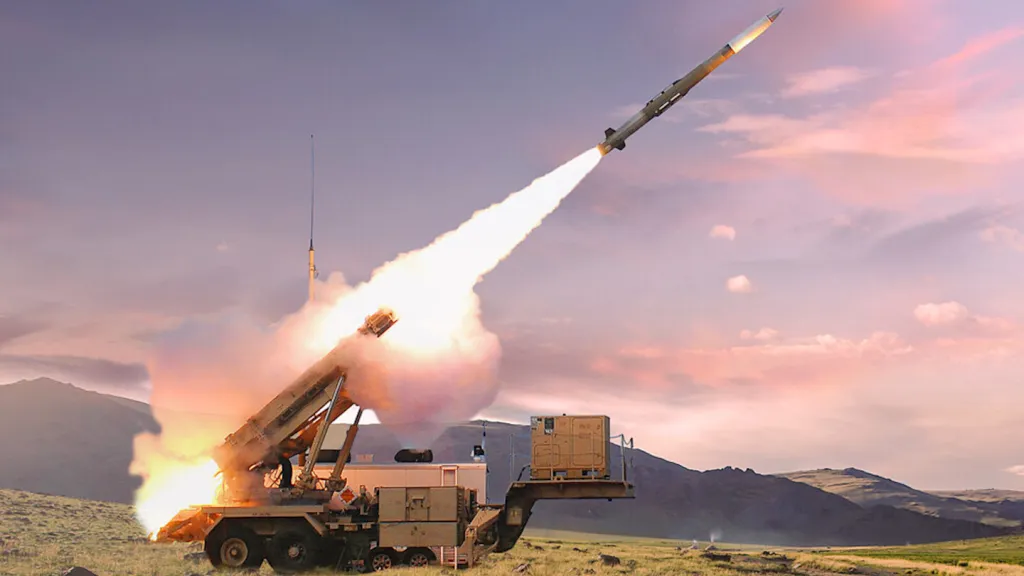
The PATRIOT Missile in Action thumbnail

The PATRIOT Missile in Action


So, for Ukraine, having its own domestic pipeline for an interceptor like Aster 30 would offer an immensely valuable hedge against shortages and delays elsewhere. For this particular missile, demand extends beyond SAMP/T operators, which also currently include Singapore. Warships in service with the navies of France, Italy, the United Kingdom (where it is part of the Sea Viper air defense system), and several other countries are also equipped to fire these interceptors.

HMS Daring tests Sea Viper missile | Royal Navy thumbnail

HMS Daring tests Sea Viper missile | Royal Navy


High demand for Patriot interceptors and full Patriot systems in Ukraine has already had negative downstream impacts on orders for other customers. Concerns have been raised about the sufficiency of U.S. military stockpiles as a result, something that has been further compounded by heavy U.S. and allied expenditures in recent fighting in the Middle East.

At the same time, there are still questions about how and when domestic production of Aster 30 or Patriot interceptors in Ukraine might begin, or when the first missiles might start being delivered. Higher-end anti-air missiles typically have production lead times measured in months, if not years. It will take some time for Ukraine just to finalize deals with the relevant defense contractors and establish a domestic production line. Where initial funding might come from is not entirely clear, either, though new financial aid from France and other countries could be a definite possibility. Ukraine might potentially be able to export some of the interceptors it produces, offering a badly needed economic boost for the country.

There is also an operational security question. Russia or other adversaries could gain valuable insights into the capabilities of SAMP/T or Patriot if they were to get their hands on full-up interceptors or even just critical subcomponents. There is already a certain danger taken in delivering more advanced missiles to a country at war. Even wreckage can be an intelligence gold mine for the enemy, depending on what is recoverable. Establishing a full domestic production line will require stockpiling of brand-new subsystems, as well as the sharing of at least some degree of intellectual property and manufacturing know-how. All of which increases the total number of potential risk vectors in a country that is, again, at war with its neighbor, which also happens to be a near-peer threat for the United States and others in the West.

Macron’s announcement about licensing Aster 30 production today does not address Ukraine’s critical immediate needs for more high-end interceptors to respond to incoming Russian ballistic missiles. At the same time, it does open up an important new path to keeping a steady supply of missiles for the Ukrainian military’s growing number of SAMP/T systems down the road. These are also capabilities Ukraine will need in the long-term, well beyond the current conflict, to help deter future aggression.

Contact the author: joe@twz.com
Joseph is TWZ’s Deputy Editor, helping to oversee the site’s highly experienced and dedicated team, while also writing informative and impactful defense and national security content. He lives right in the thick of it in the Washington, D.C. area.


Source link

Pentagon’s Ability To Supply Ukraine With More Patriot Interceptors Questioned By Congress

Concerned with Ukraine’s ability to protect itself from the onslaught of Russian missile and drone attacks, the Senate Armed Services Committee (SASC) is demanding to know if the Pentagon can increase deliveries of Patriot air defense system interceptors to that war-torn nation. This comes against the backdrop of extreme U.S. and allied demand on dwindling supplies of these weapons. 

As we have previously noted, between U.S. usage in recent Middle East conflicts and commitments to Ukraine and nearly 20 other nations, there have long been concerns about the supply of Patriot interceptors. Still, the Pentagon has maintained that it has sufficient supplies.

The U.S. Army is pressing defense contractors to come up with proposals for a new interceptor for the Patriot surface-to-air missile system with a unit cost under $1 million.
A Patriot air defense interceptor. (Lockheed Martin) Lockheed Martin

It is hard to say precisely how many Patriot interceptors remain in Ukraine’s stockpile, The New York Times recently noted

“The number is classified. At the end of June last year, there were as few as 16 in Ukraine’s arsenal,” the publication stated. Given the low supplies and constant Russian bombardment, Ukrainian President Volodymyr Zelensky has frequently requested additional interceptors from the U.S. and allies.

SASC said it “recognizes the importance of Patriot air defense systems and Patriot Advanced Capability-3 (PAC-3) interceptors in supporting Ukraine’s self-defense and notes continued concerns regarding interceptor availability, production capacity, and the impact of transfers on United States military readiness.”

“Accordingly, the committee directs the Secretary of Defense, in coordination with the Under Secretary of Defense for Acquisition and Sustainment, to submit a report to the congressional defense committees, not later than October 1, 2026, assessing the feasibility of increasing deliveries of PAC-3 interceptors to Ukraine,” its directive states.

We have reached out to the committee to find out which variant of the PAC-3 they are referring to. Lockheed Martin is boosting production of the more advanced current-generation Patriot PAC-3 Missile Segment Enhancement (MSE) interceptors and it is unclear how many of the other variants are still being made or are in U.S. stockpiles.

A Patriot Advanced Capability-3 (PAC-3) Cost Reduction Initiative (CRI) missile is launched during the recent successful Integrated Battle Command System (IBCS) flight test at White Sands Missile Range.
A Patriot Advanced Capability-3 (PAC-3) Cost Reduction Initiative (CRI) missile is launched during an Integrated Battle Command System (IBCS) flight test at White Sands Missile Range in 2021. (Darrell Ames) Darrell Ames

SASC wants the following information from the Pentagon:

  • “An assessment of current and projected Ukrainian requirements for PAC-3 interceptors over the next 12 months;”
  • “An assessment of the availability of PAC-3 interceptors from existing Department of Defense inventories for transfer to Ukraine and the impact of such transfers on United States military readiness and operational plans;”
  • “An evaluation of options to accelerate production of PAC-3 interceptors, including through multiyear procurement authorities, advance procurement, expanded supplier capacity, and other industrial-base investments;”
  • “An assessment of the feasibility of increasing annual PAC-3 interceptor production and the anticipated timeline for achieving such increases;”
  • “An identification of any statutory, regulatory, contractual, or supply-chain barriers to increasing interceptor deliveries to Ukraine;”
  • “An assessment of opportunities for allied and partner nations operating Patriot systems to contribute additional PAC-3 interceptors to Ukraine, including options for United States backfill arrangements;” and
  • “Recommendations for legislative or administrative actions that would enable increased interceptor deliveries to Ukraine while maintaining acceptable levels of U.S. military readiness.”

In addition, the committee said the secretary should “brief the congressional defense committees on the findings of the report, not later than 15 days after its submission.”

The Pentagon on Wednesday declined comment on the committee’s report, how many interceptors it has provided to Ukraine or whether it has the ability to increase that supply. We have reached out to Lockheed Martin as well and are awaiting a response.

Soldiers from the 11th Air Defense Artillery Brigade conduct a Patriot missile live-fire exercise at MacGregor Range near Fort Bliss, Texas, Aug. 23, 2025. The exercise is designed to validate crew proficiency, ensure equipment reliability, and send a clear message of deterrence to potential adversaries. (U.S. Army photo by Sgt. JaDarius Duncan)
Soldiers from the 11th Air Defense Artillery Brigade conduct a Patriot missile live-fire exercise at MacGregor Range near Fort Bliss, Texas, Aug. 23, 2025. (U.S. Army photo by Sgt. JaDarius Duncan) Sgt. JaDarius Duncan

TWZ recently addressed the supply of these munitions in a story about a new report from the Center for Strategic and International Studies (CSIS).

The report, on the severity of the depletion of U.S. advanced weapons stockpiles, found that current production PAC-3 MSE “is around the baseline rate of 650 interceptors per year, with half the deliveries going to the United States and the rest to allies and partners.” 

Under a contract with the Pentagon inked in January, Lockheed is committed to boosting Patriot annual production to 2,000.

“Because U.S. procurement in the last decade has averaged 225 missiles per year, deliveries from prior years will not be enough to fully replace expenditures,” CSIS cautioned. “For that, the United States will need to wait for the 3,203 Patriot missiles requested in the Army’s FY 2027 budget. These are projected to start delivery in May 2029.”

As we noted earlier in this story, in addition to the Patriot interceptors already provided to Ukraine, the U.S. used a large amount during the conflict with Iran defending its assets, as well as those of allies.

The CSIS report found that at the start of the war with Iran, “there were about 2,500 Patriot interceptors in the U.S. inventory,” though its accompanying chart does not specify which variant. “During the course of the conflict, between 1,060 and 1,430 Patriots were fired.” We don’t know what that tally includes, but we do know that PAC-2 and PAC-3 series interceptors have been employed in the latest conflict with Iran.

CSIS

Adding to questions about the ability to supply Ukraine with more Patriots, a top official from Lockheed Martin recently warned that the company cannot give U.S. allies any certainty over when they will receive interceptors despite plans to triple capacity, according to Financial Times.

Brian Dunn, vice president for strategy and business development of missiles and fire control, recently said that the company was working hard to scale up production of critical PAC-3 interceptor missiles amid a supply crunch exacerbated by the war in Iran. 

But in remarks to journalists at the ILA Berlin Air Show, “he sent a sobering message to American allies including Germany, Japan, Poland, the UAE and Saudi Arabia that operate the Patriot air defense system,” the publication reported.

Dunn said the extra capacity “is obviously going to be able to satisfy multiple user requirements in a faster timeline.” However, he added that Lockheed Martin does not “control what the allocation of those missiles is going to be. We can’t tell anybody where you’re going to be on that [priority list].

“Obviously there’s a lot of rhetoric coming right now from the Department of War . . . about how they’re going to reorder, reorganize, who’s going to get missiles first,” he continued. “We don’t control any of that.”

Dunn’s statements highlight concerns we raised long before and during Operation Epic Fury about the rapid expenditure of critical munitions and how that could affect a potential future fight against China. It also goes along with our reporting about the overall inadequacy of the U.S. Patriot force, an issue we have been highlighting for years.

Meanwhile, for Ukraine, the influx of new Patriot interceptors cannot come soon enough. Two nights ago, for instance, Russian forces launched 70 missiles and over 600 drones in a mass assault, according to the Kyiv Independent.

“Of the 34 ballistic missiles fired, 19 were aimed at the capital,” the publication noted.

You can see a video of one of those strikes below.

“Kyiv’s beleaguered Patriot batteries did a valiant job, intercepting 15 of them, along with five of the six 3M22 Zircon hypersonic cruise missiles launched in the attack,” the news outlet added. “Still, even layered defenses were stretched beyond the limit.”

Contact the author: howard@twz.com

Howard is a Senior Staff Writer for TWZ. He writes frequently about conflict, focusing heavily on the Middle East and Ukraine, and interviews with military and intelligence officials and industry leaders from around the globe. He lives near Tampa, Florida, home of U.S. Central Command, U.S. Special Operations Command.


Source link