Interactive

Massive 23,000 sq ft bowling alley with mini golf, beer pong, darts and ‘interactive’ playground to open in UK next week

A SPAWLING new bowling venue is set to open in a major UK city next week.

The 23,000 sq ft entertainment hub promises a range of late-night activities as well as a bar.

The exterior of a LANE7 entertainment venue at night, with purple and pink lighting reflecting off the glass facade and blurred figures of people walking by.
The premium bowling brand is set to open a brand new entertainment hub in the city centre Credit: Lane 7
Bowling alley with neon graffiti walls and glowing bowling balls.
The sprawling venue will host bowling alongside darts, pool and other activities Credit: Lane 7

Lane7, a boutique bowling brand, will open the doors to its brand new venue in Trinity Leeds on June 2.

The sprawling entertainment hub will feature 12 bowling lanes, alongside a range of late-night gaming options.

This will include darts, pool tables, beer pong, shuffleboard and a retro gaming arcade, as well as a mini-golf area.

An on-site bar will also serve a range of cocktails, craft beers and casual food options.

HIDEOUT

Beautiful ‘hidden oasis’ lake an hour from London that people want to keep secret


SPLASH OUT

Top UK waterparks mapped with spas, private cabanas & rollercoasters – from £5pp

Open until 1am on Friday and Saturday, and 12am the rest of the week, the games hub can also host late-night outings, corporate events and group celebrations.

Gavin Hughes, managing director at Lane7, said: “There’s been so much excitement about our arrival since we announced we were coming to Trinity Leeds – it feels like the city has already embraced us.

“Leeds is known for its incredible nightlife and we’re sure the arrival of Lane7 will be a big boost for the city’s leisure scene.”

The brand, first launched in 2013, is known as a premium, adult-focused activity bar that aimed to “reinvent” traditional bowling alleys.

Lane7 now has 18 venues across the UK, with another three set to open alongside Leeds, in Belfast, Glasgow and York.

Bowling starts from £10.50 per game, with the option to select a multi-games package from £13.

Source link

When are Hajj and Eid al-Adha 2026? A visual guide to the Muslim pilgrimage | Religion News

Nearly 2 million Muslims are preparing to embark on the annual Hajj pilgrimage to Mecca, which begins on May 25, following the sighting of the crescent moon in Saudi Arabia.

The Hajj is the largest annual gathering of Muslims from all over the world and a once-in-a-lifetime journey for many. It is also the fifth pillar of Islam.

Recommended Stories

list of 4 itemsend of list

In this visual explainer, we look at how Muslims perform the Hajj, including the key steps, rituals and preparations.

What is Hajj?

The Hajj is the annual pilgrimage to Mecca, Saudi Arabia. It is the fifth and final pillar of Islam, along with the declaration of faith (shahada), five daily prayers, obligatory charity (zakat), and fasting during the month of Ramadan.

The word comes from the Arabic root “h-j-j”, which means “intending a journey” or “to set out for a definitive purpose”.

It is obligatory once in a lifetime for all adult Muslims who are physically and financially able to undertake the journey.

Interactive_Hajj_2026_Five_Pillars

When is the Hajj performed?

The Hajj is performed between the 8th and 12th (or 13th) of Dhul-Hijjah, the 12th and final month of the Islamic calendar.

The timing falls roughly 70 days after the end of Ramadan, though this can vary slightly depending on the lunar cycle.

In 2026, the Hajj will take place from May 25 to May 27, but many pilgrims arrive in Saudi Arabia weeks before to prepare for the journey.

Because the Islamic calendar follows a lunar cycle, with months lasting 29 or 30 days, the Hajj shifts 10 to 12 days earlier each year in the Gregorian calendar.

Interactive_Hajj_2026_3-02-1779033341

Why do Muslims perform the Hajj?

Muslims believe that the Hajj is a direct commandment from God, as outlined in the Quran.

Prophet Muhammad’s “farewell pilgrimage” in 632 AD affirmed the steps in the 10th year of the Islamic calendar, and it is mentioned in the Quran nearly a dozen times.

The Hajj begins before pilgrims even enter Mecca.

The journey is a spiritual one, and it is considered to allow Muslims to seek forgiveness, purify their souls and demonstrate their submission to God.

How is the Hajj performed?

Muslims perform many rites and rituals during the five days of Hajj, which can be explained in the following steps.

Interactive_Hajj_2026_Rituals of Hajj

Day 1

Ihram: Entering the pilgrimage

Before entering Mecca, pilgrims enter a sacred state known as ihram. After making the intention to perform the Hajj, men change into two white garments and women wear modest attire. The basic clothing symbolises equality, humility, and unity before God, where differences of nationality, wealth, and status disappear.


Husin bin Nisan, center, with other worshippers, prepares to wear a special garb called "ihram," typically worn during hajj pilgrimage, prior to a hajj rehearsal in Tangerang, Indonesia, Monday, May 15, 2023. After spending more than three decades picking tips from motorists, the 85-year-old volunteer traffic attendant is finally realizing his dream to go to the Islamic holy cities of Mecca and Medina for hajj pilgrimage. (AP Photo/Achmad Ibrahim)
Husin bin Nisan, centre, with other worshippers, prepares to wear a special garb called ihram, typically worn during the Hajj pilgrimage, prior to a Hajj rehearsal in Tangerang, Indonesia [File: Achmad Ibrahim/AP Photo]


2. Tawaf: Circling the Kaaba

After entering Mecca, pilgrims circle the Kaaba – a cubic building at the Masjid al-Haram (Grand Mosque) that serves as the qibla, the direction Muslims face during prayer – seven times in a counterclockwise direction. This shared rhythm symbolises unity in the worship of the One God.

AP24163687893997-1779025568
Muslim pilgrims circle the Kaaba, the cubic building at the Grand Mosque, during the annual Hajj pilgrimage in Mecca, Saudi Arabia, on June 11, 2024 [Rafiq Maqbool/AP Photo]

Interactive_Hajj_2026_Kaaba

3. Sa’i: Walking between Safa and Marwah

Pilgrims can then perform the sa’i, a ritual of walking seven times between the hills of Safa and Marwa.

The ritual retraces the search for water in the desert valley of Mecca by Prophet Abraham’s (Ibrahim) wife, Hagar (Hajar), for their son, Ishmael (Ismail), before the Zamzam well emerged.

In Islamic tradition, this well has supplied pristine water in the arid desert for more than 4,000 years and continues to nourish pilgrims to this day.

SAUDI-RELIGION-ISLAM-RAMADAN
Muslim worshippers walk between the Marwa and Safa hills at the Grand Mosque in Saudi Arabia’s holy city of Mecca [File: Abdel Ghani Bashir/AFP]

Interactive_Hajj_2026_Zamzam

4. Mina: The tent city

Pilgrims then proceed to Mina, about 8km (5 miles) east of the Kaaba, where they will spend the night in prayer and reflection.

Mina is famously known as the “city of tents” due to the vast expanse of 100,000 white tents to house the millions of pilgrims.

AP22191439966011-1779026116
Tents for Muslim pilgrims fill the Mina tent camp during the Hajj, in Mecca, Saudi Arabia, on July 10, 2022 [Amr Nabil/AP Photo]

Day 2

5. Arafat: The central day of Hajj

On the second day of the Hajj, pilgrims arrive early at the plains of Mount Arafat, about 15km (9 miles) from Mina. They spend the afternoon in wuquf (standing) from midday to sunset, praying, and repenting.

Arafah is the most important ritual of the Hajj and symbolises a preview of the Day of Judgement. Muslims worldwide are encouraged to fast on this day and engage in prayer and reflection.

AP25156596193976-1779026190
Muslim pilgrims gather on top of the rocky hill known as the Mountain of Mercy, on the Plain of Arafat, during the annual Hajj pilgrimage near the holy city of Mecca, Saudi Arabia, on June 5, 2025 [Amr Nabil/AP Photo]

6. Muzdalifah: Sleeping under the open sky

After sunset, pilgrims travel to Muzdalifah, 9km (5.5 miles) away. There, they perform maghrib and isha prayers before collecting pebbles for the next day’s ritual.

SAUDI-RELIGION-ISLAM-HAJJ
Muslim pilgrims rest after arriving at Muzdalifah, before heading to Mina during the annual Hajj pilgrimage, on June 27, 2023 [Sajjad Hussain/AFP]

Day 3

On this day, Muslims from around the world celebrate the first day of Eid al-Adha, or the celebration of the sacrifice.

From the early hours of the morning, pilgrims perform a series of rituals, starting with walking back to Mina.

Muslim pilgrims walk on their way to cast stones at pillars in the symbolic stoning of the devil, the last rite of the annual Hajj, in Mina near the holy city of Mecca, Saudi Arabia, Friday, June 6, 2025. (AP Photo/Amr Nabil)
Muslim pilgrims walk on their way to cast stones at pillars in the symbolic stoning of the devil, the last rite of the annual Hajj, in Mina, near the holy city of Mecca, Saudi Arabia, on June 6, 2025 [Amr Nabil/AP Photo]

7. Stoning of the pillars

Pilgrims enter Mina, where they throw seven pebbles at the largest of three stone pillars. This ritual represents the stoning of the devil, which symbolises the rejection of Satan’s temptations.

Muslim pilgrims cast stones at pillars in the symbolic stoning of the devil, the last rite of the annual Hajj, in Mina near the holy city of Mecca, Saudi Arabia, Friday, June 6, 2025. (AP Photo/Amr Nabil)
Muslim pilgrims cast stones at pillars in the symbolic stoning of the devil, the last rite of the annual Hajj, in Mina near the holy city of Mecca, Saudi Arabia, on June 6, 2025 [Amr Nabil/AP Photo]

8. Sacrifice during Eid al-Adha

Pilgrims, or agents on their behalf, offer an animal sacrifice in remembrance of Abraham’s willingness to sacrifice his son in obedience to God.

9. Cutting or shaving hair

Men shave or trim their heads, and women cut a small portion of their hair. This symbolises spiritual renewal.

Muslim pilgrims have their heads shaven by barbers upon leaving Muzdalifah after throwing pebbles as part on the symbolic al-Aqabah (stoning of the devil ritual) at the Jamarat Bridge during the Hajj pilgrimage in Mina, near Saudi Arabia's holy city of Mecca on August 11, 2019. (Photo by FETHI BELAID / AFP)
Muslim pilgrims have their heads shaved by barbers upon leaving Muzdalifah, after throwing pebbles as part of the symbolic al-Aqabah (stoning of the devil ritual) at the Jamarat Bridge during the Hajj pilgrimage in Mina, near Saudi Arabia’s holy city of Mecca on August 11, 2019 [Fethi Belaid/AFP]

10. Main tawaf

Pilgrims return to Mecca to perform tawaf, circling the Kaaba, followed by sa’i, walking seven times between the hills of Safa and Marwa.

Muslim pilgrims walk around the Kaaba, the cubic building at the Grand Mosque, during the annual Hajj pilgrimage, in the Muslim holy city of Mecca, Saudi Arabia, Wednesday, June 4, 2025. (AP Photo/Amr Nabil)
Muslim pilgrims walk around the Kaaba, the cubic building at the Grand Mosque, during the annual Hajj pilgrimage, in the Muslim holy city of Mecca, Saudi Arabia, on June 4, 2025 [Amr Nabil/AP Photo]

Days 4 and 5

Pilgrims return to Mina and perform rami (stoning) of all three stone pillars on each day. Pilgrims who remain for an extra day repeat the stoning ritual at all three pillars once more.

Before leaving Mecca, pilgrims perform a final tawaf around the Kaaba, known as the tawaf al-wada or a “farewell tawaf”, signifying a spiritual farewell to the holy sanctuary.

How do Muslims mark the end of Hajj?

Muslims mark the end of the Hajj with Eid al-Adha, celebrated on the 10th of Dhul-Hijjah and lasting up to three days in many countries.

The day begins with a special prayer shortly after sunrise, as Muslims gather in mosques or open areas, wearing their finest clothes. The rest of the day is spent sharing meals, exchanging gifts, and visiting family and friends. The greeting “Eid Mubarak”, meaning “Blessed Eid,” is commonly exchanged.

Eid al-Adha also involves the ritual of animal sacrifice, known as Qurbani. Muslims who are able to do so sacrifice a sheep, goat, cow or camel, and the meat is divided into three parts: one for the family, one for relatives and friends, and one for those in need.

Interactive_Hajj_2026_WHEN_IS_EID

Source link

Strait of Hormuz blockade and other major naval sieges in modern times | US-Israel war on Iran News

The Strait of Hormuz, a narrow waterway once carrying roughly a fifth of the world’s oil and gas, remains effectively closed after the United States and Iran imposed competing blockades.

Naval blockades are one of the oldest weapons in warfare, requiring no ground troops or invasion, just the ability to cut off what an enemy needs to survive. These blockades have reshaped economies, societies and alliances across generations, sometimes with instant shockwaves, sometimes with effects only seen later.

Recommended Stories

list of 4 itemsend of list

From Israel’s ongoing siege of the Gaza Strip to blockades during World War I, here are some notable naval blockades in modern history:

Israel’s siege of Gaza (2007-present)

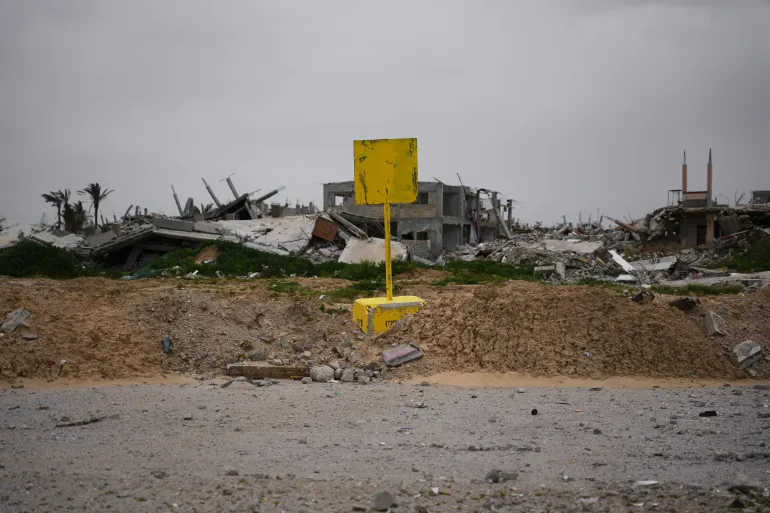
Gaza
A view of the severely damaged Gaza City port as fishermen work under difficult conditions due to Israeli attacks, March 8, 2025 [Hamza ZH Qraiqea/Anadolu]

Israel’s complete land, sea and air blockade of the Gaza Strip is one of the longest sieges in modern history.

Launched in 2007, Israel has limited the entry of goods and essential supplies, causing a prolonged humanitarian and economic crisis for the Strip’s 2.3 million people, who cannot travel freely.

Before Israel’s genocidal war on Gaza began in October 2023, fishermen were restricted to 6-15 nautical miles (11-28km) from shore, well below the 20-nautical-mile (37km) zone guaranteed by the Oslo Accords.

After 2023, with Israel’s policy of starving the population, fishermen have taken extreme measures to feed their families, leading to many being killed by Israeli fire.

Since 2008, several Freedom Flotilla vessels have attempted to break the Israeli blockade. Since 2010, all flotillas attempting to break the Gaza blockade have been intercepted or attacked by Israel in international waters.

On April 30, Israel raided 22 out of the 58 vessels in the most recent Global Sumud Flotilla campaign in international waters more than 1,000km (620 miles) from Gaza.

Blockade of Biafra (1967-70)

Biafra opinion piece
Nigerian troops entering Port Harcourt, after routing Biafran troops during the Nigerian Civil War [File: Evening Standard/Getty Images]

During the Nigerian Civil War, which began in July 1967, the Nigerian federal government imposed a land, sea and air blockade on the secessionist Republic of Biafra shortly after it declared independence.

The blockade led to widespread starvation, widely seen as a deliberate wartime strategy, transforming a territorial conflict into a global humanitarian crisis. Death tolls vary, but it is estimated that one to two million people died, the vast majority from hunger and disease rather than direct conflict.

The nearly three-year-long blockade ended with the Biafran surrender in January 1970.

Beira Patrol blockade (1966-75):

HMS Cleopatra's Wasp helicopter, No.463, encountered an engine failure at high altitude during the blockade on the Port du Beira in 1971. A crash landing occurred at sea and the aircraft was recovered. [File image.]
HMS Cleopatra’s Wasp helicopter encounters an engine failure at high altitude during the blockade on the Port du Beira in 1971; the aircraft was recovered after it crash-landed [File: 50tony Wikimedia Commons]

The Beira Patrol was a nine-year-long blockade by the British navy to prevent oil from reaching Rhodesia, present-day Zimbabwe, through the Mozambican port of Beira, enforced under United Nations sanctions following Rhodesia’s unilateral declaration of independence.

The blockade largely failed its strategic goal. Rhodesia continued receiving oil via South Africa and other Mozambican ports, which the UN resolution did not authorise the British navy to intercept.

Additionally, the cost to the United Kingdom was substantial. The operation tied up 76 naval ships over nine years, with two frigates required on station at all times.

The blockade ended in July 1975, when Mozambique’s newly gained independence from Portugal allowed it to credibly commit to blocking oil transit to Rhodesia, rendering the naval patrol redundant.

Cuban Missile Crisis ‘quarantine’ (1962)

Cuba missile crisis
A US official shows aerial views of one of the Cuban medium-range missile bases, taken in October 1962, to the members of the UN Security Council [File: AFP]

In October 1962, the US ordered a naval “quarantine” of Cuba after US U-2 spy planes discovered Soviet nuclear missile sites under construction on the island.

The US deliberately called it a “quarantine” rather than a blockade, which would have been legally an act of war, aiming to prevent the Soviets from bringing in more military supplies and to pressure them to remove the missiles already there.

The quarantine drew a line 500 nautical miles (920km) from Cuba’s coast, with US warships authorised to stop, search, and turn back any vessel carrying offensive weapons if necessary.

The crisis brought the world to the brink of nuclear war. The then-Soviet First Secretary Nikita Khrushchev called the blockade “outright piracy” and an act of aggression, and initially ordered ships to proceed. For several days, Soviet vessels steamed towards the quarantine line as the world watched.

The most dangerous phase of the standoff lasted 13 days. An agreement was reached in which the Soviets would dismantle their offensive weapons in Cuba in exchange for a US public declaration not to invade Cuba, and a secret agreement to remove US Jupiter missiles from Turkiye.

The naval quarantine was formally ended on November 20, 1962, after all offensive missiles and bombers had been withdrawn.

Blockade of Wonsan (1951-53)

Korean_War_bombing_Wonsan-1777774647
US B-26 Invaders dropped para-demolition bombs at supply warehouses and dock facilities at the Wonsan port in North Korea in 1951 [File: Wikimedia Commons]

During the Korean War, UN naval forces led by the US imposed a blockade of the North Korean port of Wonsan in February 1951, lasting nearly two and a half years.

It aimed to deny the North Korean navy access to the city, which was strategically significant for its large harbour, airfield and petroleum refinery.

The blockade was preceded by a dangerous mine-clearance operation in October 1950. North Korean forces had been well supplied by the Soviet Union and China with sea mines, and during the clearance, the sweepers USS Pledge and USS Pirate were sunk, killing 12 men and wounding dozens.

The operation successfully constrained North Korean and Chinese forces on the east coast, forcing them to divert thousands of troops and artillery pieces away from the front line. UN forces also captured several harbour islands, which strengthened the blockade’s grip on the port.

The blockade ended after 861 days with the signing of the Korean Armistice Agreement in July 1953. By that point, allied naval fire had almost levelled Wonsan.

US submarine blockade of Japan (1942-45)

Torpedoed_Japanese_destroyer_Yamakaze_sinking_on_25_June_1942-1777774700
The US sinking of the Japanese destroyer Yamakaze on June 25, 1942 [File: US Navy via Wikimedia Commons]

The US imposed a submarine blockade against Japan during the Pacific War.

The blockade began taking shape in 1942, combining US naval submarine attacks on merchant shipping with minelaying operations to cripple Japan’s war capabilities, disrupt shipping and cut off vital supplies such as food and fuel.

As an island nation, Japan was especially vulnerable, almost entirely dependent on imports of oil, rubber and raw materials. Its economy and military could not function without open sea lanes.

Over the course of the war, US submarines sank some 1,300 Japanese merchant ships and roughly 200 warships. By 1945, oil imports had effectively ceased.

Food imports collapsed, causing significant shortages and malnutrition across Japan by 1945, though the extent of civilian starvation is disputed.

After the US dropped atomic bombs on Hiroshima on August 6 and Nagasaki on August 9, 1945, Japan announced its surrender on August 15, bringing the blockade and the Pacific War to an end.

Blockade of eastern Mediterranean (1915-18)

Modern_Palestine_and_Syria_(5008479)-1777774750
World War I map shows modern Palestine and Syria, published in 1918 [File: Wikimedia Commons]

In August 1915, during World War I, the Allied forces imposed a blockade of the eastern coast of the Mediterranean to cut off military supplies and weaken the Ottoman Empire’s war effort.

The declared area ran from the intersection of the Aegean Sea and the Mediterranean Sea in the north to the Egyptian frontier in the south. The blockade was initiated by Britain and France, later assisted by Italy and other Allied powers.

The consequences were devastating. Military supplies, munitions, oil, food and medicine were all targeted. The food crisis was compounded by a locust plague in 1915 and a severe drought, contributing to severe famine across Lebanon and Greater Syria.

Reports suggest the famine led to 500,000 deaths by 1918, mostly civilians, with Mount Lebanon losing an estimated one-third of its population. Mass migration followed.

The blockade remained in place throughout the war and lifted only when Allied forces occupied Beirut and Mount Lebanon in October 1918.

Allied blockade of Germany (1914-19)

German_U-Boat,_U-35,_sinking_the_French_steamer,_Herault,_off_Spain,_1916_(32416175403)-1777774786
German U-35 submarine sinking the French steamer, Herault, in the Mediterranean, off Cabo San Antonio, Spain, June 23, 1916 [Courtesy of the Library of Congress]

The British navy began blockading Germany almost immediately after the outbreak of the war in August 1914.

The naval blockade extended from the English Channel to Norway, cutting off Germany from the oceans.

Britain mined international waters to prevent ships from entering the ocean, creating danger even for neutral vessels.

Germany responded by declaring the seas around the British Isles a “military area”, prompting Britain and France to ban all goods to and from Germany.

The blockade’s most devastating consequence was famine. The winter of 1916-17, known as the Turnip Winter, marked one of the harshest years in wartime Germany.

The blockade had cut off food and fertiliser imports, a failed potato harvest left little to fall back on, and a breakdown in food distribution compounded the crisis. It is estimated that between 424,000 and 763,000 civilians died from diseases related to hunger and malnutrition.

The blockade was not yet fully lifted until July 1919, after the Treaty of Versailles had been signed.

Source link

Global hunger report warns of rising malnutrition and famine risks | Infographic News

Famine was confirmed in two places in 2025 – areas of the Gaza Strip and Sudan – the first such dual confirmation since formal famine reporting began, according to the Global Report on Food Crises (GRFC) 2026.

The annual report, produced by a coalition of 18 humanitarian and development partners, found that acute food insecurity remained widespread in 2025.

Recommended Stories

list of 4 itemsend of list

Across 47 countries and territories experiencing food crises, 22.9 percent of their populations – or about 266 million people – experienced acute food insecurity last year, a marginal rise from 22.7 percent in 2024 but nearly double the 11.3 percent recorded in 2016.

INTERACTIVE_FAO_GLOBAL_REPORT_2025_APRIL23_2026-02-1777011588

The proportion of analysed populations facing acute hunger has now stayed above 20 percent every year since 2020. In absolute terms, the number of people affected has grown from 108 million in 2016 to 265.7 million in 2025, having peaked at 281.6 million in 2023.

The GRFC cautioned that the slightly lower headline figure compared with 2024 mainly reflects a reduction in the number of countries covered – from 53 to 47 – rather than any real decline in needs.


Famine, catastrophe and emergency

Famine – the most extreme classification under the hunger-monitoring Integrated Food Security Phase Classification (IPC) system – was confirmed in parts of the Gaza Strip and Sudan in 2025. The risk of famine remained in other areas of Gaza, Sudan and South Sudan, and those projections extended into 2026.

According to the IPC, famine is when:

  • At least 20 percent of households face extreme food shortages.
  • Acute malnutrition affects more than 30 percent of the population.
  • The death rate due to starvation or hunger-related causes exceeds two deaths per 10,000 people per day.
INTERACTIVE - Famine Gaza measurement
(Al Jazeera)

Six countries and territories had populations facing “catastrophic conditions”, or Phase 5, the highest level in the IPC’s classification of food insecurity. They numbered 1.4 million people, a more-than ninefold increase since 2016.

The Gaza Strip was the worst affected, with 640,700 people facing famine conditions, equivalent to 32 percent of its population, the highest share recorded globally. Sudan followed with 637,200 people, or 1 percent of its population.

Four other countries recorded catastrophic food shortages among specific groups of people: South Sudan – 83,500 (1 percent of the population), Yemen – 41,200 (0.1 percent), Haiti – 8,400 (0.1 percent) and Mali – 2,600 (0.01 percent).

Additionally, more than 39 million people in 32 countries were in Phase 4, or emergency conditions, representing 3.8 percent of the population analysed, a marginal increase from 2024.

INTERACTIVE_FAO_GLOBAL_REPORT_2025_APRIL23_2026-01-1777011625

Conflict remains the main driver of hunger

Conflict and violence were the primary drivers of acute food insecurity in 19 countries where 147.4 million people were affected. They represented more than half of those facing acute hunger globally.

Weather extremes were the primary driver in 16 countries, affecting 87.5 million people, while economic shocks led in 12 countries, with 29.8 million people affected.

Against that backdrop, humanitarian and development financing for areas facing food crises declined in 2025, falling back to levels last seen in 2016-2017, the report said.

As for 2026, the report said that based on a partial picture as of March, severity levels remain critical in multiple contexts. It added that the escalation of conflict in the Middle East exposes food-crisis countries to direct and indirect risks of global agricultural and food market disruptions.

A generation of malnourished children

An estimated 35.5 million children were acutely malnourished in 2025 across 23 countries experiencing nutrition crises, including just under 10 million with severe acute malnutrition, the most life-threatening form.

A further 25.7 million children suffered from moderate acute malnutrition. About 9.2 million pregnant and breastfeeding women were also acutely malnourished across 21 countries with available data.

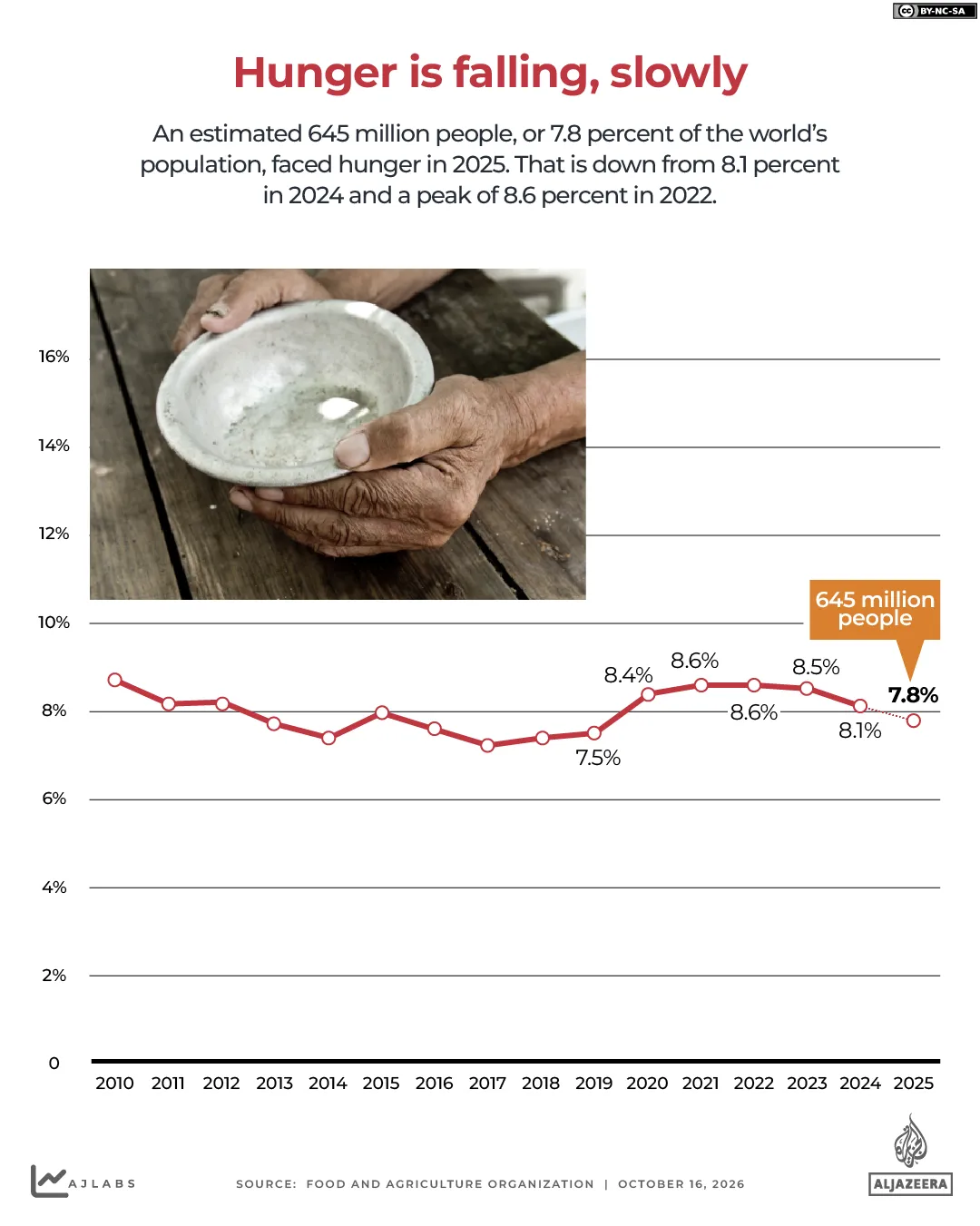
Interactive_WorldFoodDay_October16_2025-01-1760613556
(Al Jazeera)

Displacement is concentrated in food-crisis countries

The number of forcibly displaced people in the 46 countries covered fell slightly in 2025 to 85.1 million.

About 62.6 million of them were internally displaced across 34 countries, and 22.5 million were refugees and asylum seekers in 44 countries.

Without a sustained push to address the structural drivers of hunger, the world’s most fragile countries will continue to bear a disproportionate share of the global hunger burden well into 2026, the report concluded.

Source link

What is uranium enrichment and how quickly could Iran build a nuclear bomb? | US-Israel war on Iran News

United States President Donald Trump has claimed that a new nuclear deal being negotiated with Iran will be “far better” than the 2015 Joint Comprehensive Plan of Action (JCPOA), which the US withdrew from in 2018 during his first term.

On Tuesday, Trump extended the two-week ceasefire with Iran a day before it was set to expire, with hopes for a second round of talks in Islamabad, Pakistan.

Key among the US demands is that Iran stop all enrichment of uranium.

Iran has always insisted its nuclear programme is for civilian use only, such as for power generation, which requires uranium enrichment of between 3 percent and 5 percent. To build nuclear weapons, uranium needs to be enriched to 90 percent.

In this explainer, we visualise what uranium is, how it is enriched and how long it could take Iran to make a nuclear weapon.

What is uranium, and which countries have it?

Uranium is a dense metal used as a fuel in nuclear reactors and weapons. It is naturally radioactive and usually found in low concentrations in rocks, soil and even seawater. About 90 percent of the world’s uranium is produced in just five countries: Kazakhstan, Canada, Namibia, Australia and Uzbekistan. Reserves of uranium have also been found in other countries.

Uranium is extracted either by digging it out of the ground or, more commonly, through a chemical process that dissolves uranium from within the rock.

INTERACTIVE - update_Where is uranium found map nuclear-1776865649

Before it can be used as nuclear fuel, uranium is processed through several different forms, including:

  • Yellowcake: Mined ore is crushed and treated with chemicals to form a coarse powder known as yellowcake, which, irrespective of its name, is usually dark green or charcoal in colour, depending on how hot it has been treated.
  • Uranium tetrafluoride: Yellowcake is then treated with hydrogen fluoride gas, which turns it into emerald-green crystals known as uranium tetrafluoride or green salt.
  • Uranium hexafluoride: Green salt is further fluorinated to create a solid white crystal known as uranium hexafluoride. When heated slightly, this crystal turns into a gas, making it ready for enrichment.
  • Uranium dioxide: The gas is spun in a centrifuge machine, which chemically converts it into a fine, black powder.
  • Fuel pellets: The black powder is pressed to form black ceramic pellets, which can then be used in a nuclear reactor.

INTERACTIVE How uranium turns into fuel nuclear reactor-1776853142

How is uranium enriched?

Natural uranium exists in three forms, called isotopes. They are the same element, with the same number of protons but different numbers of neutrons.

Most naturally occurring uranium (99.3 percent) is U-238 – the heaviest and least radioactive – while about 0.7 percent is U-235 and trace amounts (0.005 percent) are U-234.

To generate energy, scientists separate the lighter, more radioactive U-235 from the slightly heavier U-238 in a process called uranium enrichment. U-235 can sustain a nuclear chain reaction while U-238 cannot.

To enrich uranium, it must first be converted into a gas, known as uranium hexafluoride (UF₆). This gas is fed into a series of fast-spinning cylinders called centrifuges. These cylinders spin at extremely high speeds (often more than 1,000 revolutions per second). The spinning force pushes the heavier U-238 to the outer walls, while the lighter U-235 stays in the centre and is collected.

A single centrifuge provides only a tiny amount of separation. To reach higher concentrations – or “enrichment” – the process is repeated through a series of centrifuges, called a cascade, until the desired concentration of U-235 is achieved.

INTERACTIVE - How does uranium enrichment work centrifuge_updated-1776865507

What are the different levels of uranium enrichment?

The higher the U‑235 percentage, the more highly enriched the uranium is.

Small amounts (3-5 percent) are enough to fuel nuclear power reactors, while weapons require much higher enrichment levels (about 90 percent).

The International Atomic Energy Agency (IAEA) considers anything below 20 percent to be low-enriched uranium (LEU), while anything above 20 percent is considered highly-enriched uranium (HEU).

Low enriched – less than 20 percent

  • Commercial grade – 3-5 percent: This is the standard fuel for the vast majority of the world’s nuclear power plants
  • Small modular reactors – 5-19.9 percent: Used in more modern reactors and advanced research reactors

Highly enriched – More than 20 percent

  • Research grade – 20-85 percent: Used in specialised research reactors to produce medical isotopes or to test materials
  • Weapons grade – above 90 percent: This is the level required for most nuclear weapons
  • Naval grade – 93-97 percent: Used in the nuclear reactors that power submarines and aircraft carriers

Depleted uranium, which contains less than 0.3 percent U‑235, is the leftover product after enrichment. It can be used for radiation shielding or as projectiles in armour‑piercing weapons.

How long does it take to enrich uranium?

The effort it takes to enrich uranium is not linear, meaning it is much more difficult to go from 0.7 percent natural uranium to 20 percent LEU than it is to go from 20 percent to 90 percent HEU. Once uranium reaches 60 percent enrichment, it becomes much quicker to reach 90 percent weapons grade.

The effort it takes to enrich uranium is measured in separative work units (SWU).

According to the IAEA, Iran is believed to have about 440kg (970lbs) of uranium enriched to 60 percent – enough to theoretically build 10 or 11 low-technology atomic bombs if refined to 90 percent.

fordo
The then-President Mahmoud Ahmadinejad inspecting the Natanz nuclear plant in central Iran, March 2007 [Handout/Iran President’s Office via EPA]

Ted Postol, professor emeritus of science, technology and international security at the Massachusetts Institute of Technology (MIT), told Al Jazeera that before the US attack on Iran’s nuclear facility at Fordow, the country had at least 10 cascades of 174 IR-6 centrifuges in operation – meaning 1,740 IR-6 centrifuges.

The IR-6 is one of Iran’s most advanced centrifuge models. The country also has tens of thousands of older centrifuges.

Little is known about the conditions of these centrifuges or the stocks of uranium hexafluoride, which are still believed to be buried underground.

Postol has calculated that Iran’s cascade of centrifuges could produce 900 to 1,000 SWUs annually.

“Getting from natural uranium to 60 percent enrichment, which Iran has already achieved, takes roughly five years, and about 5,000 SWUs using Iran’s cascades.”

“If I want to go from 60 to 90 percent, I only need 500 SWUs. So, instead of five years, [by] starting with the 60 percent here, this might take me four or five weeks. Because I am already very enriched,” Postol said.

Using an analogy of a clock, Postol explained: “Let’s say it takes seven minutes to get 33 percent enrichment, and then eight minutes to get to 50 percent enrichment. It only takes me one minute to get to total [90 percent] enrichment.”

INTERACTIVE - How long does it take to enrich uranium_updated-1776865509

How easy would it be for Iran to build a nuclear weapon?

Postol said Iran’s stockpile is held underground, meaning a military strike would not necessarily eliminate the nuclear threat.

A single centrifuge cascade capable of enriching weapons-grade uranium could take up “no more floor space than a studio apartment, making it easily hidden in a small laboratory”, he said, estimating the area at 60sq metres (600sq feet).

“A single Prius Compact Hybrid car can produce enough electric power to run four or more of these cascades at a time,” Postol added, meaning “Iran can covertly convert its 60 percent uranium into weapons-grade uranium metal”.

“What they have done is put themselves in a position where anybody who thinks about attacking them with nuclear weapons has to know that they could be sitting in those tunnels after such an attack, refining [and] enriching the final step they need to build atomic weapons and converting it to metal, and building a nuclear weapon, and that they have the means to deliver it,” Postol said.

“They would have all of the technical equipment they need to build the atomic weapons. And they have the missiles, which are also in the tunnels and can be manufactured in addition to what they already have. And the atomic weapon would not need to be tested, because uranium weapons do not need to be tested before they’re used.”

What does the NPT say about enrichment?

The Treaty on the Non-Proliferation of Nuclear Weapons (NPT), established in 1968, is a landmark international agreement aimed at preventing the spread of nuclear weapons and promoting peaceful uses of nuclear energy. Iran is a signatory to this pact.

The treaty supports the right of all signatories to access nuclear technology and enrich uranium for peaceful purposes, including energy, medical or industrial purposes, with precise safeguards to ensure it is not diverted to make weapons.

Under the NPT, nuclear-weapon states agree not to transfer nuclear weapons or assist non-nuclear-weapon states in developing them. Non-nuclear-weapon states also agree not to seek or acquire nuclear weapons.

Despite this, most nuclear powers are currently modernising their arsenals rather than dismantling them.

Most of the countries are signatories, except five: India, Pakistan, Israel, South Sudan and North Korea.

INTERACTIVE - Nuclear weapons NPT members-1776853134

What agreements has Iran made about its nuclear programme in the past?

In 2015, under the Obama administration, Iran struck a deal with six world powers — China, France, Germany, Russia, the United Kingdom and the US — plus the European Union, known as the JCPOA.

Under the pact, Tehran agreed to scale down its nuclear programme, capping enrichment to 3.67 percent, in exchange for relief from sanctions.

“The Iranians agreed to it, and they were following the treaty. There was no problem with the treaty at all, absolutely no problem,” Postol said.

“They were allowed to have 6,000 centrifuges, which, if they had natural uranium, they could probably build a bomb within a year if they were secretly using these centrifuges, but that was all under inspection. They were just simply going to enrich to 3.67 percent, which is for a power reactor. They’re allowed to do that by the Non-Proliferation Treaty.”

But in 2018, Trump pulled out of the deal, calling it “one-sided” and reimposing sanctions on Iran. Iran responded by eventually resuming enrichment at Fordow.

After the US killed Iran’s General Qassem Soleimani in January 2020, Tehran stated it would no longer follow the set uranium enrichment limits.

Former President Joe Biden made attempts to revive the deal, but it never came to fruition due to disagreements over whether sanctions should be lifted first or Iran should rejoin the JCPOA first.

Trump has repeatedly said Iran should not have the ability to produce nuclear weapons. It has been one of Washington’s red lines during talks with Iranian officials over the past year, and was also the central justification that Washington used when it bombed Iranian nuclear facilities during the 12-day US-Israel war on Iran last year.

In the current negotiations, Iran has said it is willing to “downblend” its 60 percent enriched uranium to about 20 percent – the threshold for low-enriched uranium. The process of downblending involves mixing stocks with depleted uranium to achieve a lower percentage of enriched U-235 overall.

“From the point of view of showing goodwill, I think it’s good, it shows that the Iranians are thinking of ways to address what the Americans claim are their concerns,” Postol said.

INTERACTIVE - TImeline of Iran nuclear programme JCPOA-1776853136

Which countries have nuclear weapons?

Nine countries possessed roughly 12,187 nuclear warheads as of early 2026, according to the Federation of American Scientists. Approximately two-thirds are owned by two nations – Russia (4,400) and the US (3,700), excluding their retired nuclear arsenals.

Some 9,745 of the total existing nuclear weapons are military stockpiles for missiles, submarines and aircraft. The rest have been retired. Of the military stockpile, 3,912 are currently deployed on missiles or at bomber bases, according to the Federation of American Scientists. Of these, some 2,100 are on US, Russian, British and French warheads, ready for use at short notice.

While Russia and the US have dismantled thousands of warheads, several countries are thought to be increasing their stockpiles, notably China.

The only country to have voluntarily relinquished nuclear weapons is South Africa. In 1989, the government halted its nuclear weapons programme and began dismantling its six nuclear weapons the following year.

Israel is believed to possess nuclear weapons, with a stockpile of at least 90. It has consistently neither confirmed nor denied this, and despite numerous treaties, it faces little international pressure for transparency.

INTERACTIVE - which countries have nuclear weapons-1776853140

Source link