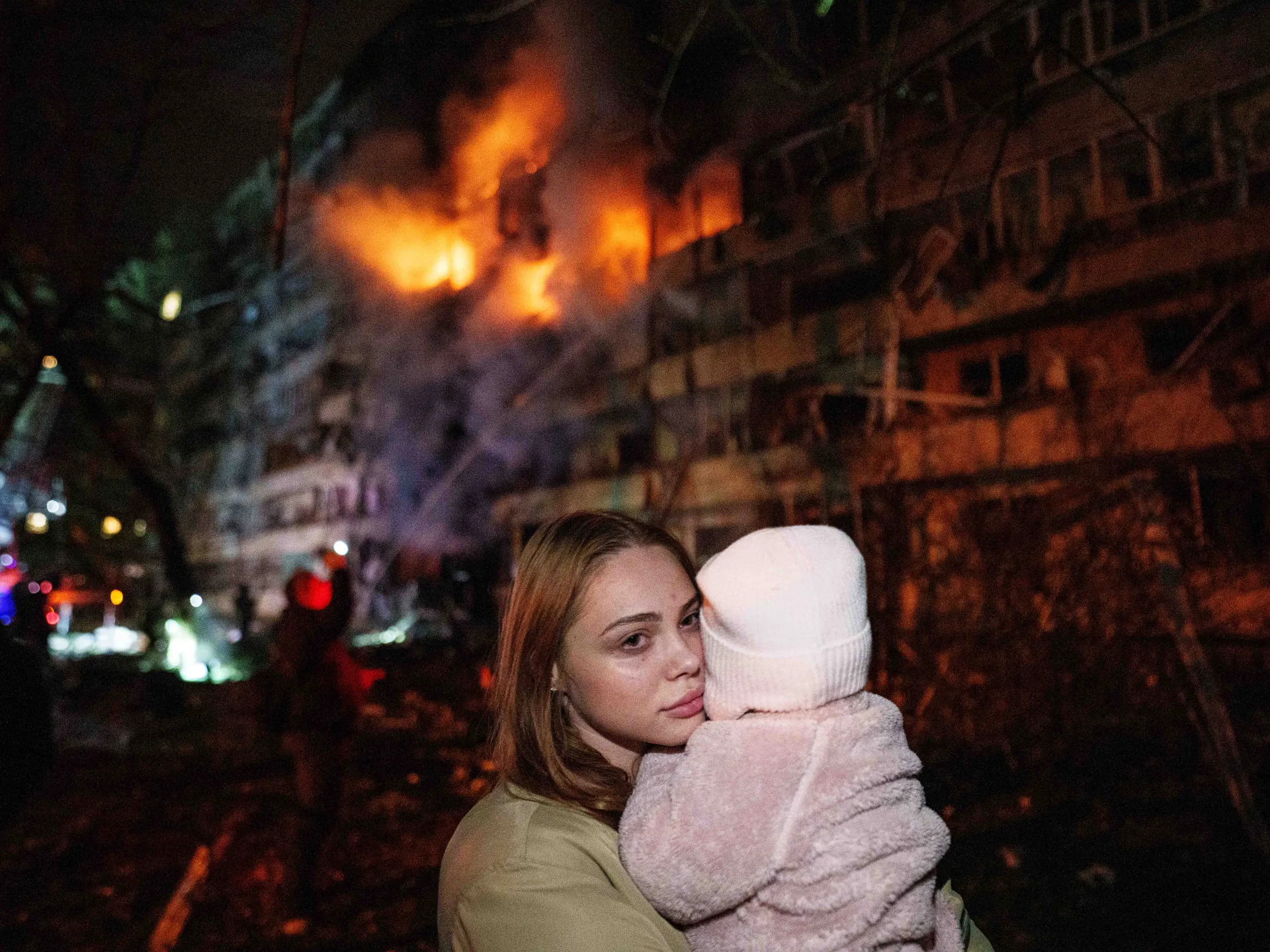
Kyiv, Ukraine – The supernova-like blasts of exploding Russian ballistic missiles are followed by thunderous thumps, shockwaves, fires and deaths – and the staccato of Ukrainian air defence systems.
This week’s nightly attacks on Ukraine that killed at least 15 and wounded dozens resembled hundreds of previous raids – with one exception.
Recommended Stories
list of 4 itemsend of list
The air raid sirens began howling just seconds before or after yet another wave of missiles struck apartment buildings, power plants and warehouses.
But Ukraine’s partners did not provide the country with intelligence data from NATO’s early-warning satellites, President Volodymyr Zelenskyy said on Monday, as tensions between Washington and Kyiv rise.
He did not name the United States and President Donald Trump has denied that Washington has stopped sharing intelligence.
The constellation of military satellites detects Russian ballistic missile attacks by the rockets’ thermal flames seconds after launch.
The warnings give Ukrainians up to 10 minutes – precious, life-saving time to sound air raid sirens and send emergency text messages to prompt evacuations to bomb shelters.
“That’s what helps prevent the killings,” Zelenskyy said.
Ukraine’s ground radars can only detect the incoming missiles as their speed ranges from 6,000 to 12,000km/h (3,730 – 7,260 miles per hour).
‘Trump pressures our president’
Despite Trump’s denial, Ukrainian observers have a simple yet harrowing explanation – the US president wants to help Republicans win more congressional seats in upcoming midterm elections by pressuring Kyiv into declaring an “energy ceasefire” with Moscow that would drive global oil prices down.
“Trump pressures our president, pressures Ukraine” as he strives to “get advantage by any means necessary in the election campaign,” Lieutenant-General Ihor Romanenko, former deputy head of Ukraine’s general staff of armed forces, told Al Jazeera.
The lack of intelligence data “significantly affects the effectiveness of air defence, we don’t have time to respond,” he said.
Without the satellite data, Ukrainian drones and missiles also “lose precision when striking targets deep in Russia,” he said.
On Sunday, Trump announced the ceasefire that envisages no mutual strikes on energy infrastructure – from Russian oil refineries and fuel depots to Ukrainian power and heating stations.
“Effective immediately, there is an ENERGY CEASEFIRE in the War between Russia and Ukraine. Both parties have agreed. Do not break it!” Trump wrote on social media.
Kyiv said the announcement was a surprise, while Moscow declined to say whether it backs the idea – and kept on hitting Ukraine’s energy infrastructure.
The pressure goes beyond the refineries as Trump wants to quickly reopen, arbitrate and complete peace talks between Kyiv and Moscow – even if they benefit the Kremlin.
“He needs peace talks to succeed. Ideally, it is a certain unblocking of the peace settlement process, when Kyiv shows more willingness to agree with Russia’s demands,” Kyiv-based analyst Igar Tyshkevych told Al Jazeera.
The pressure will continue until “Kyiv shows readiness for a compromise and concessions towards Russia,” he said.
Moscow “simply abuses” the pressure and the suspension of air raid warnings to escalate attacks on Ukraine, he said.
Kyiv’s ‘priority’: The destruction of oil refineries
The suspension of data-sharing was especially shocking, given that Kyiv did stop hitting Russian refineries for three days.
It was only on Wednesday that its drones attacked refineries in Saratov and Ryazan regions, said Russia’s Deputy Prime Minister, Aleksander Novak.
However, Kyiv’s focus on striking oil refineries is ineffective and counterproductive, another observer said.
“Kyiv’s strategic priority is still the destruction of oil refineries,” Nikolay Mitrokhin of Germany’s Bremen University, who has penned hundreds of authoritative analyses of the hostilities, told Al Jazeera.
However, Russia overcame the initial shock by transporting gas from refineries in Siberia and exporting it from neighbouring Belarus and Kazakhstan.
No economic collapse, massive joblessness or public protests followed the strikes, while Moscow continued its air raids, adding jet-powered drones that resemble cruise missiles and are hard to down with Ukraine’s existing air defence system, he said.
“What is the basis for Kyiv’s and its backers’ conviction that strikes on oil refineries and depots will lead to Russia’s strategic defeat before Ukraine is defeated? I don’t understand,” he said.
However, Ukrainian attacks on data centres, bridges and factories where drones are assembled are far more effective, he said.
Recent strikes on data centres of Russian online giant Yandex and the state-run Sberbank resulted in disruptions of services in Russia and even former Soviet republics where Yandex operates its online payment, food delivery and taxi services.
Trump “didn’t ask him to stop the war, to give away cities or stop striking Russian rears in general,” Mitrokhin said.
Kyiv has repeatedly reiterated that it was ready to start peace talks if they are preceded by a ceasefire, but Moscow wanted to continue ground assaults and air raids until the peace terms were finalised – which could take months or even years.
‘We’re ready for any turn of events’
On Wednesday, Ukraine’s drone czar accused Elon Musk’s SpaceX of throttling Starlink satellite terminals that are part of the military-grade Starshield system.
Serhiy Beskrestnov said that SpaceX abruptly and without any warning limited services for terminals placed on drones flying over 160km/h (100mph).
The limit affected crucially-important interceptor drones and followed Trump’s request, presidential adviser Serhii Sternenko said.
Musk said that the White House owns and controls the Starshield systems and that any limits on speed are decided by Trump.
Some military analysts warn that the limit may be followed by a total shutdown of Starlink for Ukraine that could damage the quality of all military communications.
“But we were getting ready for everything,” Andriy Pronin told Al Jazeera. “We already know it may happen, that’s why we’re ready for any turn of events.”
In September 2022, Musk secretly ordered engineers to switch off Starlink coverage in the Russia-occupied Kherson region, effectively thwarting Kyiv’s push to retake it, Reuters reported.
In 2023, Musk threatened to cut off Ukrainian military access to Starlink unless the US defence department took over the costs.
Later, the Pentagon, Poland and other European allies took over the costs.