inspiration

L.A. artist’s plush art inspiration: lottery tickets, fried chicken

Textile artist Jane Jauregui is expanding the boundaries of what plush figures can be, thinking beyond that pile of mass-produced, branded stuffies huddled atop a twin bed, crammed inside a toy chest, or dangling from a backpack strap.

True, in the nearly two decades that she’s been creating plush figures, she’s produced charmingly minimalistic foxes, cats and buffalo fit for a nursery. However, her latest work has been anything but child’s play.

A plush fried chicken bucket is one of Jane Jauregui's textile takes on beloved dishes.

A plush fried chicken bucket is one of Jane Jauregui’s textile takes on beloved dishes.

She launched her “soft sculpture” company, STFD, in 2024 with the intention of transforming her inner thoughts into plush form — no matter how outside the box those ideas may be. After all, why bring yet another teddy bear into the world when you can dream up a stuffed paintbrush trailing a splash of brightly colored felt “paint,” or a striped bucket filled with faux fried chicken?

In this series, we highlight independent makers and artists, from glassblowers to fiber artists, who are creating original products in and around Los Angeles.

“It stands for Stuff That Feeds Delight,” Jauregui said of the brand’s acronymic name. “The newer things I’m working on are more like display items, but you can absolutely touch them,” she explained. “I just started playing more with the idea of decor, aging it up a little bit more, and playing with the idea of how we can really elevate it.”

Take, for example, a plate of longsilog, the traditional breakfast meal her Filipina grandmother used to make for her. Inside the converted garage of the same Van Nuys house where she was raised, Jauregui whipped up a playful sausage-riceball-fried egg combo using a sewing needle, felt, embroidery floss and sherpa fleece, rather than pots and pans.

Moved by memories of her grandfathers, she created a collection of stuffed felt cigarette butts, complete with simulated ash made by zigzagging stitches.

“My Thai and Filipino grandpas were chain-smokers,” she said. “They passed away, and I just started thinking a lot about what would represent them. Cigarettes immediately came to mind.”

Jane Jauregui's home studio inside the converted garage of her childhood home.

Jane Jauregui’s home studio inside the converted garage of her childhood home.

Though she takes inspiration from her personal experiences, many of her plush figures strike a universal note. Most anyone born in the 20th century would take one look at her plush retro alarm clock radio and instinctively feel the urge to whack its elongated vinyl “snooze” button. The trompe l’oeil wood paneling (which she made by printing a wood-grain design directly onto dark brown fabric) and the red-tinted digital readout screen (the numbers are iron-on transfers) make it a dead ringer for those once-commonplace nightstand devices that predated smartphone alarms.

She first tried her hand at the craft about 18 years ago, after she and her husband, Sergio, couldn’t find the right gift for his newborn niece at famed New York City toy emporium FAO Schwarz.

“Everything was licensed, and I didn’t want any kind of IP [intellectual property],” she recalled. “I went home and said, ‘Well, I’m just going to sew something for her.’ Sergio was like, ‘But you don’t know how to sew, so that’s a little crazy.’ I said, ‘That’s OK, I’ll figure it out!’”

1

A plush hot dog.

2

An ashtray full of plush cigarettes, inspired by Jane Jauregui's grandparents.

1. A plush hot dog. 2. An ashtray full of plush cigarettes, inspired by Jane Jauregui’s grandparents.

Fortunately, she had a leg up when it came to picking up the new skill. Her father, a retired clothing designer and patternmaker, had introduced her to the inner workings of the garment industry from a young age.

“My dad would have full-time work five days a week, so there wasn’t a lot of time for him to teach me,” she said. “But when he would take freelance work home, I would sit in this garage with him. He had a big table, and I would sit there and watch him sew. It was just really how we spent time together.

“When I decided to start making plush, I remembered little things he would do, like how to walk a pattern — which is making sure the pattern pieces are matching — or how he would move the ruler. I would remember all of those things and put my own spin on it.”

Artist Jane Jauregui eschews watercolors and acrylics, preferring to "paint with plush."

Artist Jane Jauregui eschews watercolors and acrylics, preferring to “paint with plush.”

She started by making simple shapes like a stuffed orange, pear and an eggplant, working her way up to the finalized baby gift: a stuffed whale. By 2009, she’d completed enough plush produce to start selling at local pop-up markets under the business name Janie XY. Sergio, an artist in his own right, even constructed her first booth to resemble a fruit stand. Her first hit item was a baby rattle shaped like a chicken drumstick that was sold wrapped in cellophane, much like a meat-counter purchase. This time, her muse was her own infant niece.

For the record:

11:27 a.m. Oct. 7, 2026An earlier version of this article said Jane Jauregui’s daughter is 4 years old. She is 5.

All the while, she was holding down a full-time job creating window displays for Forever 21. She continued to build her squeezable empire in her off-hours, even as she transferred to corporate jobs at Mattel and Disney (for which she’s now a consumer products design manager), and became a mother. Taking a page from her father, she’s made her at-home workspace accessible to her 5-year-old daughter.

“She’s in here all the time,” she said. “I let her touch everything. What’s fun about the medium is you can’t break it. You can get it dirty, but she knows what to do. She’s really mature about it. She loves to clean the sewing machine — she’ll go in with a pin and pick out all the lint, and she’ll think that was a good day’s work. We want her to feel like part of the work because she is a part of it.”

Jane Jauregui's sewing machine, which her daughter likes to clean, in her home studio.

Jane Jauregui’s sewing machine, which her daughter likes to clean, in her home studio.

That said, Jauregui’s STFD creations aren’t necessarily made with the wee ones in mind. Consider her new pieces celebrating liquor stores, for which she converted items like lottery tickets and frothing beer cans into plush form.

“It’s something that we all take for granted,” she said of the ubiquitous neighborhood corner store. “You tend to turn your nose up at it, but it’s there for you all the time.”

She and her husband also pay homage to these unsung cultural hubs in the latest edition of their fledgling zine, which they’ve dubbed “a gallery you can hold.” Inside, photographs of the stuffed figures fill the pages, accompanied by written musings. (The one-of-a-kind featured items will also be available for purchase.) The series is the couple’s prescribed antidote to the social media doomscrolling they call “internet indigestion.”

Jane Jauregui's goal for the plush items she makes in her studio? Delight.

Jane Jauregui’s goal for the plush items she makes in her studio? Delight.

She’s also planning to explore plush Thai food in honor of Grandma’s Thai Kitchen, the Van Nuys restaurant her mother owned and operated for years. After treks to downtown L.A.’s Fashion District to find just the right materials, she’ll mock up clever riffs on julienned ginger and cilantro leaves. For her, there’s ample delight in those little details.

“STFD is really about giving myself permission to just do things that make me happy,” she said.



Source link

Philosophically, Bush Gets Inspiration From an Unlikely Guru

A little more than a year ago, on a muggy July day packed with political symbolism, Texas Gov. George W. Bush delivered his first major policy address as a presidential candidate at an Indiana church.

As the national press hung on every word, Bush sketched his vision of a kinder, gentler brand of conservatism, one in which the government would turn to religious groups for help serving the poor. The word “compassion” popped up 15 times in 20 minutes.

Watching from afar, proud as a parent at a high school graduation, was Marvin Olasky, the inspiration for Bush’s philosophy of compassionate conservatism and one of the most unlikely gurus ever to attract the attention of a potential world leader.

Olasky–ex-Communist, ex-atheist, born-again Christian–has become a savior of sorts among Republicans, who see in his theories a way to create small government with a big heart.

Former House Speaker Newt Gingrich first raised his national profile in 1995, suggesting that Olasky’s vision was a model for the future of the GOP.

Now, Olasky’s idea that religion can play a role in providing government social services has found special resonance with Bush, a fellow Texan and fervent Christian who wrote the foreword to Olasky’s most recent book, a paean to faith-based charities published last month.

Olasky believes the current wall between church and state must be broken down to let religions use tax money to help the poor. An alcoholic needing treatment could take a government voucher to an evangelical abstinence program, for instance. Or a taxpayer could donate money to help fund a Buddhist self-help center.

As Olasky’s influence has grown, the University of Texas journalism professor has become the political equivalent of a double-wide trailer in tornado country, attracting roaring controversy.

In recent months, civil rights groups have attacked his views on religion as a menace to the church-state wall. Feminists are outraged by comments they say show that Olasky believes women are secondary as leaders. And some Jewish groups were angered by a recent article in which Olasky attacked a group of conservative newspaper columnists, all of whom turned out to be Jewish.

Even some other conservatives have joined the chorus, saying Olasky’s work lacks intellectual rigor and stokes negative stereotypes of Christian conservatives.

“We are concerned that someone of this stripe has the ear of a presidential candidate who self-admittedly is not an intellectual,” said Ira Foreman, head of the National Jewish Democratic Council.

Anti-Semitism Issue Is Raised

Some of the attacks, especially those that hint at possible anti-Semitism, have angered Olasky, 50, who was raised Jewish and has praised the work of Hebrew charities in his books. Others he brushes off as misreadings that ignore his life’s work, which include more than 13 scholarly books and hundreds of articles.

But he’s not backing down from his philosophy, which he said in a recent interview would even let groups like Scientologists and Wiccans use taxpayer funds to deliver services to the poor, so long as the programs were voluntary and proven effective.

“My tendency is to be inclusive. That can include Wiccans and Scientologists. If people are going to get mad at me, then so be it,” Olasky said.

Olasky is almost amused by the fierceness of the attacks against him. After years of portrayals in the media as an obscure academic with an oddball story, he now appears as a powerful Svengali bending Bush to a radical agenda.

Olasky scoffs at the notion, downplaying his role as “a very occasional, very informal, very unofficial” advisor who hasn’t had contact with Bush this year.

Bush officials echo that assessment, continuing a recent pattern of distancing Bush from the controversies that have dogged Olasky.

“He’s an outside, informal advisor,” said Dan Bartlett, a Bush spokesman. Bartlett noted that Bush had contact with Olasky only twice, though both times proved significant.

One came in 1996, when Olasky helped lead a task force to figure out how Bush could implement faith-based programs in Texas. The second was in 1999, when he worked on another Bush task force to do the same thing, but on a national level as part of his run for the presidency.

Olasky’s journey to prominence has been a long, strange circumnavigation between ideological poles, from Marxist to church elder.

Born in Massachusetts, Olasky grew up in a Jewish home, attending Hebrew school and celebrating his bar mitzvah at 13.

But a year later, the intellectually precocious youth told his parents he was actually an atheist. By the time he entered Yale, Olasky was running toward the left at full tilt. He protested the Vietnam War. He staged a five-day hunger strike. By 1972, he signed up to become a card carrying member of the Communist Party USA.

Then one night, while reading a passage from Lenin, Olasky asked himself the sort of question that keeps college students up at night: What if Lenin is wrong? What if there is a God?

Olasky decided God deserved a second look and began a slow process that culminated with his conversion to Christianity in 1976. He and his wife began attending a conservative Christian church they picked out of the phone book and never looked back.

Gingrich Helps Put Olasky in Spotlight

In 1983, Olasky arrived at the University of Texas, where he taught journalism.

In 1992, he published “The Tragedy of American Compassion,” the product of research into turn-of-the-century nongovernmental charities and their effectiveness. After a few thousand sold, the book seemed destined for the dollar bin at Books-a-Million.

But then, a rising Republican powerhouse from Georgia–Gingrich–discovered Olasky’s work. In his first speech in 1995 as speaker of the House, Gingrich hailed Olasky in the same breath as Alexis de Tocqueville as models for the future of the GOP.

Olasky, suddenly, was a GOP darling: in demand on the morning talk shows, running a think tank with Arianna Huffington, and advising the 1994 Texas Republican gubernatorial candidate–Bush.

But the spotlight didn’t really begin to burn until the pitched primary season between Bush and Arizona Sen. John McCain.

In February, Olasky wrote an article accusing a group of conservative writers of being uncomfortable with Bush’s open embrace of religion. He implied they were “proselytes in the religion of Zeus”–a reference to a Tom Wolfe book.

As it turned out, all three writers were Jewish–which Olasky said he didn’t know at the time. Some Jewish organizations jumped on the seeming slight as an attack by a Christian conservative on Jews; others said they found no offense.

Olasky, himself a journalist who edits the Christian newsweekly World, smelled politics: “At least some of the people who are very partisanly motivated were trying to find ways of hurting Gov. Bush,” Olasky said.

Recently, Olasky’s writing has drawn scrutiny from women’s groups, in particular a passage from a 1998 religious newsletter interview in which he talked about the biblical tale of Deborah and Barak.

In the story, Barak says he will not go into war unless accompanied by Deborah, who was serving as a leader of Israel at the time.

“God does not forbid women to be leaders in society, generally speaking, but when that occurs it’s usually because of the abdication of men,” Olasky said. “As in the situation of Deborah and Barak, there’s a certain shame attached to it. I would vote for a woman for the presidency, in some situations, but again, there’s a certain shame attached. Why don’t you have a man who’s able to step forward?”

Women’s Groups Abhor Remarks

Olasky said the quote has been taken out of context and that he has no problem with a woman as president of the country or a corporation, though his own church forbids women to serve as elders.

That’s still not good enough for many women’s groups, who find Olasky’s statements offensive, no matter what the context.

“I hope he keeps talking and talking,” said Loretta Kane, a NOW vice president. “I hope he gets lot of media coverage saying he’s one of George W. Bush’s advisors.”

Source link

Contributor: Arts hubs like the Kennedy Center sustain the nation

Marc Bamuthi JosephGuest contributor 

Like any other building from 1971, or a democracy created in 1776, the Kennedy Center could use some attention and possibly some structural repair. But I was a vice president at that arts center in Washington, and I can tell you that maintenance is almost certainly not why it closed its doors last month.

Officially, it’s closed because a section of the Grand Foyer ceiling gave way in a storm, plaster crashing to the floor, and the building needed to be shut down for safety. The Justice Department itself has argued in court filings that there is no real emergency requiring the closure. The board, meanwhile, has approved a quarter-billion-dollar renovation plan, put together without competitive bidding, while the president muses openly about tearing the building down altogether if his own name isn’t affixed to it. This administration is effectively bulldozing arts infrastructure in an attempt to abolish an infrastructure of the imagination.

I watch all of this from the outside now. When the new “leadership” took over last year, my team and I were among the first let go. My department worked on free public programming, on creative equity, on cross-sector community development and on measuring the social impact of art. That we were among the first out the door probably tells you everything you need to know about who was put in charge of the place.

As an American, as an artist and as a former member of its labor force, I understand that the Kennedy Center is more than a building. It is a living memorial to a president who was taken from us too soon, a man who had the audacity to aim for the moon before the science existed to get us there. To honor that kind of visionary, this country built a center for the creative impossible, and gave it his name.

And true to that name, my job at the Kennedy Center was to investigate the correlation between the arts economy and the economy of civic aspiration. As a team, we believed that inspiration erodes apathy and yields empathy. The building is a container of federal infrastructure, but the arts that imbue the Kennedy Center make the argument that inspiration itself is part of the infrastructure of our democracy. An arts center is built to ask: “What are the conditions necessary to dream together in public?”

Who, if not artists, are the authors of the public imagination? When a baby is born, or your daughter gets married, do you read a piece of legislation to commemorate the occasion or do you quote a poem, or dedicate a song? Who, if not artists, might light the path to a post-fear economy?

So why invade an arts center? What could possibly be gained by shuttering a national citadel for creative excellence? How perverse that a president whose policies have underfunded education and the arts would gut a national sanctuary for curiosity, and then demand that his name be emblazoned on the shell of what was. This president has used executive orders to intimidate artists, banned writers and journalists, sabotaged arts education, created oppressive red lines within the National Endowment for the Arts and threatened philanthropic organizations that fund arts and culture, and then he turns around and wants his name on our national cultural center.

When I worked there, the Kennedy Center wasn’t perfect. No institution is. But the business was viable, the staff was talented and reliable, and the work we made together would, often enough, touch something close to the sublime. Our job, like those of so many arts workers across the country, was to activate creative magic in service of social cohesion and well-being.

This is what gets lost in the noise of storms and lawsuits and renovation budgets: Entertainment is everywhere, but inspiration is rare. Sometimes you are sitting in a dark theater with strangers and the right note gets struck, and you hear it with your ears but you feel it somewhere else entirely. In the gut and heart. And the person next to you, a stranger, feels it too, at the exact same moment. You can practically feel the room change. All that magic can happen in one theater, and the Kennedy Center has nine of them. If a solar panel uses the energy of the sun to power a building, an intentionally run theater can use the energy of its inspired audiences to power a city.

Art holds memory. It also holds the horizon, the sense of what a country could still become. Patriotism as enacted by the creative community takes the American experiment seriously enough to question, examine, remember what we’ve forgotten and catalyze collective American dreaming. That is what the Kennedy Center was named for: a president who dreamed of a country unafraid of beauty, unafraid of grace.

Thankfully, America’s creative labor force tirelessly stewards that sense of creative provocation and patriotic inquiry. It is alive everywhere, including in the work of individual artists such as Carrie Mae Weems or in the work of collectives such as For Freedoms and their “America, the Beautiful” initiative.

We, the chronically underwhelmed citizenry of the United States, can’t afford one less pillar of creativity. We should be fighting to reconstitute any and all artistic institutions with an eye toward an inspired future.

Marc Bamuthi Joseph, a spoken-word artist and actor, was vice president for social impact at the Kennedy Center.

Source link

Unrecognisable Jennifer Lopez takes inspiration from The Gentlemen’s Maya Jama as she steps out at fashion week

JENNIFER Lopez swapped her trademark super sexy red carpet glamour for a look straight out of The Gentlemen as she stepped out at fashion week.

The singer looked almost unrecognisable in a black velvet three-piece suit, complete with a crisp white shirt and tie, and a flat cap.

Jennifer Lopez looked almost unrecognisable in a black velvet suit and flat cap Credit: Getty
The singer paired her three-piece suit with a crisp white shirt, tie and knee-high boots Credit: Getty

The 57 year old finished the look with knee-high leather boots and dark lipstick, giving a nod to the country house style worn by Maya Jama in the Netflix drama.

Maya, who plays Aisha in series two, is regularly seen wearing a flat cap and tweed in the hit series.

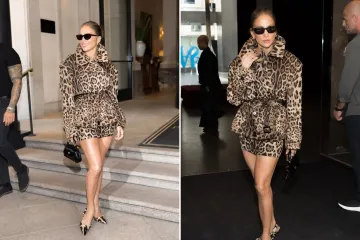
Earlier in the week, JLo rocked an altogether different look in Italy’s fashion capital, stepping out in head-to-toe leopard print.

She showed off her legs in a matching coat and skirt as she left her Milan hotel, finishing the outfit with dark sunglasses, heels and a black handbag. 

doing it right

J.Lo, 57, shows off endless legs in leopard print at Milan Fashion Week


LO CUT

Jennifer Lopez poses braless in minidress with Erling Haaland

Maya cuts a chic figure in a flat cap in the new series of The Gentleman
Jennifer Lopez was a vision in leopard print as she stepped out at Milan Fashion Week Credit: Getty

A flurry of A-listers and models have descended on the Italian city for the various fashion shows, parties and events taking over for the next few days. 

The star has been spending time in Italy with her family over the past few weeks before getting back to work with her latest fashionable appearance at Fashion Week.

But ahead of Milan, she managed to enjoy some sun with a summer spent in various places across Europe.

Jennifer enjoyed a road trip around Italy with her two children, 18-year-old twins Max and Emme.

The currently single star documented the trip with posts to Instagram – and even met footballer Erling Haaland during her travels. 

Source link