Millions lost power as Cuba’s fifth nationwide blackout of 2026 hit amid a US-imposed oil blockade.
Published On 14 Jul 202614 Jul 2026
Cuba’s national power grid has collapsed, plunging the island into its third nationwide blackout in less than 10 days and leaving approximately 10 million people without electricity.
The outage began around 11am local time (15:00 GMT) on Tuesday, when the country’s entire power grid went offline, according to the state-run electricity company, UNE.
Recommended Stories
list of 4 itemsend of list
“There has been a total disconnection of the electrical system,” Cuba’s Ministry of Energy and Mines said on social media.
The latest blackout comes as Cuba faces its worst economic crisis in decades, worsened by an oil blockade imposed by the United States that has deepened fuel shortages and pushed the island’s ageing power system to the brink.
US President Donald Trump imposed the blockade in January after the United States removed Venezuelan President Nicolas Maduro from power. Venezuela had long been Cuba’s main supplier of subsidised oil, and under US pressure, Mexico also halted fuel shipments to the island.
As of 2023, according to the International Energy Agency, Cuba was producing only about 40 percent of the oil it consumed, leaving it heavily reliant on imported fuel.
The Trump administration says the measures are intended to pressure Cuba’s communist government to hold democratic elections and release what it calls political prisoners.
The repeated blackouts have fuelled growing frustration across the island. Just a week ago, scattered protests broke out across Havana, with residents banging pots and pans and shouting “turn on the lights” as millions endured another prolonged outage. In both of last week’s blackouts, it took over 24 hours to restore power across the island.
Cuban authorities have struggled for months to keep the lights on as fuel shortages and an ageing electricity grid, much of it dating back to the 1960s and 1980s, leave the system increasingly prone to collapse.
Havana blames the crisis on the US fuel blockade, while Washington says Cuba’s communist government is responsible for the country’s deteriorating power system.
Speaking at a UN General Assembly debate on US sanctions last week, US Ambassador Michael Waltz said Cuba’s leaders were to blame for the electricity shortages.
“Change your ways and turn the lights back on for your people,” he said.
Following the passing of Qatar’s Father Emir Sheikh Hamad bin Khalifa Al Thani on Sunday, his solidarity with the Palestinian people remains one of the defining legacies of his leadership. He is being remembered not only as a regional statesman, but also as a steadfast ally of the Palestinian people and the only Arab leader to physically break the crippling siege on the Gaza Strip.
In October 2012, Sheikh Hamad visited the embattled Gaza Strip, six years after Israel imposed its crippling international blockade on the territory, following the 2006 Palestinian elections.
Accompanied by his wife, Sheikha Moza bint Nasser, and a high-level delegation, the emir bypassed the political isolation imposed on the enclave by Western powers and regional actors, leading to a massive official and popular reception.
The head of Hamas’s diaspora office, Khaled Meshaal, told Al Jazeera that the visit to the Strip means that “Jerusalem, Gaza and Palestine mourn him.”
“He was the first Arab and Muslim leader to visit Gaza, standing by its side with chivalry and magnanimity, as if officially announcing the breaking of the siege in its darkest circumstances,” Meshaal told Al Jazeera. “He was intelligent, brave and a man of principles.”
Ahmed al-Sheikh, a senior journalist, Arab affairs commentator and former news director at Al Jazeera Arabic Channel, said the Father Emir had ”a special kind of love for Palestine”.
“Has any other leader in the Arab world done that [visit to Gaza], except Hamad bin Khalifa?” al-Sheikh reflected in a recent interview.
”Why did he go to Gaza? It’s because he saw that everyone around Gaza is neglecting it”, he added.
The late Emir of Qatar greets people in Gaza City as he arrives for a cornerstone-laying ceremony at a Qatari-funded rehabilitation centre, October 23, 2012 [Hatem Moussa-Pool/Getty Images]
During that landmark visit, Sheikh Hamad announced an increase in Qatar’s reconstruction grant to the enclave from $254m to $400m, laying the foundation for vital housing, infrastructure and healthcare projects that benefited thousands of Palestinians.
Addressing crowds at the Islamic University of Gaza – which awarded him and Sheikha Moza honorary doctorates for their humanitarian efforts – he praised the resilience of the Palestinian people, while criticising the international community’s double standards.
Palestinian leaders and the former Emir arrive at a cornerstone-laying ceremony for a new residential neighbourhood called Hamad in Khan Younis, October 23, 2012 [Mohammed Salem-Pool/Getty Images]
Personal pain and the ‘spearhead’ of liberation
His commitment to the Palestinian cause predated the blockade on Gaza. In 1999, Sheikh Hamad became the first Gulf leader to visit the Palestinian territories since 1967, meeting with the late Palestinian President Yasser Arafat during a critical political impasse.
According to al-Sheikh, the emir viewed the Palestinian struggle through a deeply personal lens. When former Israeli Prime Minister Ariel Sharon besieged Arafat’s headquarters in Ramallah, the emir was profoundly pained. He told his aides that when Sharon attacked the Muqata’a, it felt as though he was attacking Qatar itself.
His connection to Palestine was coupled with a regret that he had never visited Jerusalem before its occupation in 1967, According to al-Sheikh, that prompted him to commission an extensive three-hour documentary on the holy city to capture its history and identity.
Rather than relying solely on international intervention, he believed in the agency of the Palestinian people and that they were the essential spearhead of their movement. “You will do the primary action and without this action there can be no liberation,” the emir once told al-Sheikh.
Defying regional consensus
This stance put him frequently at odds with the regional consensus. During Israel’s devastating 2008–2009 war on Gaza, deep divisions emerged among Gulf Cooperation Council (GCC) members over how to respond to the crisis.
Sheikh Hamad called for an emergency Arab summit in Doha, proposing a $250m reconstruction fund and a maritime corridor to bypass the blockade. He famously expressed his disappointment on live television about the lack of an Arab quorum for the emergency meeting. “God is sufficient for us and he is the best disposer of affairs.”
Some of Gaza’s most vital infrastructure projects before the outbreak of Israel’s genocidal war in October 2023 were the result of financial pledges made by Sheikh Hamad.
Qatar funded the rehabilitation of vital highways and the flagship Sheikh Hamad City in Khan Younis—a $58m public housing project with 53 modern apartment buildings for thousands of low-income families.
The former Emir with Hamas Prime Minister Ismail Haniyeh at a ceremony for a Qatari-funded rehabilitation centre in Gaza City, October 23, 2012 [Hatem Moussa-Pool/Getty Images]
Additionally, the Sheikh Hamad Hospital for Rehabilitation and Prosthetics, which officially opened in April 2019, became the territory’s premier facility for amputees and children with hearing impairments.
Israel’s genocidal war on Gaza has systematically erased much of the infrastructure Qatar helped finance during Sheikh Hamad’s leadership. Satellite imagery from May this year confirms that Hamad City and other areas in southern Gaza have been wiped from the map.
The Sheikh Hamad Hospital managed to resume its vital services last December, despite suffering direct attacks, severe shortages and the broader collapse of Gaza’s healthcare system. Operating the only CT scanner in northern Gaza, the hospital has even opened a new branch in the south to cope with a 225 percent increase in amputation cases.
Sheikh Hamad Hospital’s continued operations during the ongoing genocide in Gaza remain a tangible remnant of the late emir’s unprecedented efforts in the besieged enclave. His support for Gaza will remain for generations to come.
Palestinian children wave Qatari flags while waiting for the former Emir to arrive in Gaza City, October 23, 2012 [Hatem Moussa/AP]
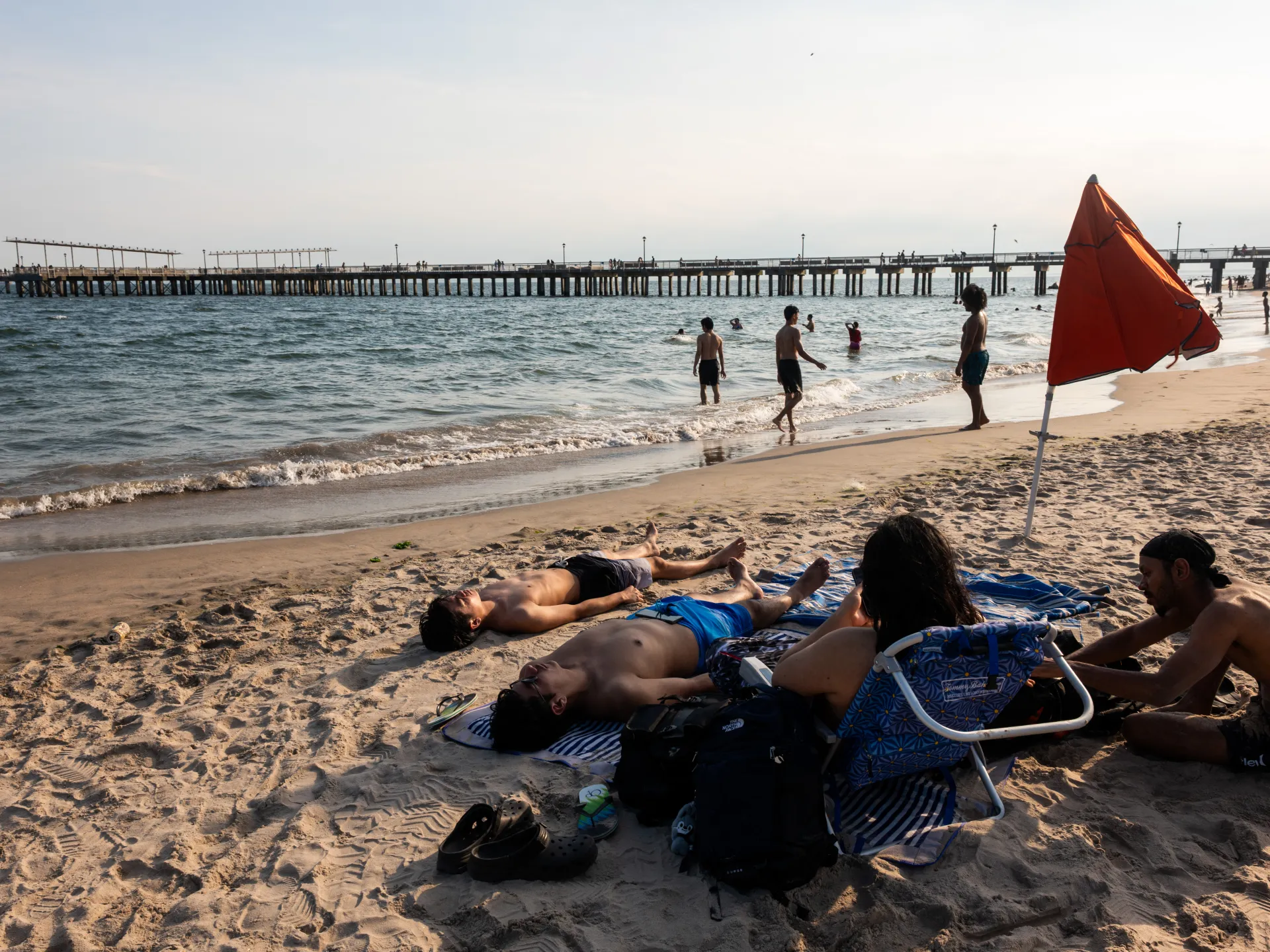
The United States is about to celebrate its 250th birthday, but as millions across the country prepare to gather this weekend for parades, concerts and festivals, an intense heat wave has settled over much of the eastern US.
Officials across the region are warning that the extreme heat could pose serious health risks over the Fourth of July weekend.
Recommended Stories
list of 3 itemsend of list
Here’s what you need to know about how the weather will affect the celebrations.
What is America’s 250th anniversary?
It has been 250 years since the United States adopted the Declaration of Independence on July 4, 1776. Unlike a typical Independence Day, this year’s celebrations are unfolding on a much bigger scale, capping years of preparation and planning.
Landing in the midst of a highly polarised moment in American politics, planning for the anniversary has also been contentious.
A decade ago, Congress tasked a bipartisan commission known as America250 with organising the celebrations.
But last year, US President Donald Trump issued an executive order to put his own “Freedom 250” planning committee in charge of many of the anniversary’s marquee events, including the Great American State Fair on the National Mall.
Initially, a variety of musicians were announced as performers for the fair, including country singer Martina McBride, the soul group The Commodores and the pop duo Milli Vanilli. But many withdrew in late May and early June over concerns over the fair’s affiliation with Trump.
Last week, in lieu of the performers, the US president delivered a speech to open the fair, billing himself as the “Number One Attraction anywhere in the World”.
He has also promised to mark the July 4 holiday in Washington, DC, with “the most spectacular TRUMP RALLY of them all”.
The Department of Labor building in Washington, DC, displays US flags on the eve of July 4th festivities [Joe Raedle/Getty Images/AFP]
What will celebrations look like across the country?
Among thousands of smaller, locally organised celebrations nationwide — including historical reenactments, picnics, concerts and fireworks displays — some of the highest-profile events include:
Washington, DC: Hundreds of thousands are expected to arrive in the city, where the Great American State Fair will be held along the National Mall, the 2.5 km (1.5 mile) promenade linking the US Capitol to the Washington Monument. It will feature state pavilions, food, live music and a Ferris wheel. Trump has also promised “the largest fireworks show in history.” Around one million people attended the fireworks display for the US’s bicentennial anniversary in 1976.
Los Angeles: As part of its America’s Block Party event, America250 will hold a benefit concert hosted by Queen Latifah, featuring artists such as Chris Stapleton, Maren Morris and the Smashing Pumpkins.
Philadelphia: The city where the Declaration of Independence was signed is hosting one of the country’s biggest commemorations, including the burial of a 400kg (900 pounds) time capsule, containing artefacts from across the country, meant to be opened at the next semiquincentennial in 250 years.
New York: More than 40 tall ships are expected to sail into New York Harbour with almost 20,000 sailors aboard, while more than 200 aircraft fly overhead.
Boston: Celebrations will include the annual Boston Pops Fireworks Spectacular — a free concert followed by a fireworks display — and a public reading of the Declaration of Independence from the balcony where it was first read aloud to Bostonians in 1776.
How will the heat affect celebrations?
Some celebrations are already being disrupted, with organisers forced to adapt to extreme heat.
On Friday, the Great American State Fair temporarily closed as temperatures reached over 39 degrees Celsius (102 degrees Fahrenheit) in parts of Washington, DC.
But the capital was not the only area affected by the extreme heat.
In Philadelphia, for example, officials announced that the Salute to Independence Semiquincentennial Parade was cancelled, after initially planning to shorten the route to mitigate heat-related risks.
A celebration in Pennsylvania’s Lower Windsor Township was also rescheduled for July 8, while in nearby Norristown, officials cancelled another parade, citing safety concerns.
The heat is also affecting transportation. Amtrak announced several train cancellations in the northeast region and warned that other trains could face delays due to high temperatures, which can affect railway infrastructure.
“Extreme heat can cause rail, bridge and overhead wires to expand,” it said in a statement on Thursday. “As a precaution, Amtrak may enact heat restrictions, which can require locomotive engineers to operate trains at lower speeds, resulting in potential delays.”
What will it actually feel like outside?
While air temperatures in cities such as Philadelphia and Boston are expected to reach around 38 degrees Celsius (100 degrees Fahrenheit), high humidity can make it feel significantly hotter.
That’s because humidity makes it harder for sweat to evaporate and cool the body. Weather agencies use the heat index, often called the “feels like” temperature, to estimate what people will actually be experiencing.
Experts also warn that cities can become even hotter than forecasts suggest as concrete, asphalt and steel absorb heat.
“The number on your phone may actually not reflect the true temperature profile that you’re going out into,” Vijay Limaye, a climate scientist at the Natural Resources Defense Council, told The Associated Press.
What precautions are officials taking?
Aside from changing or cancelling some Fourth of July events, cities across the eastern United States are rolling out broader measures to help people cope with the heat.
In New York City, for example, more than 200 teams of government workers and volunteers are checking on homeless residents and directing people to hundreds of cooling centres, including public buildings, mobile cooling vans and outdoor sites equipped with misting fans.
Mayor Zohran Mamdani urged people to stay inside and avoid “extraordinary temperatures”. He also asked residents to set their air conditioners to 26 degrees Celsius (78 Fahrenheit) to avoid straining the power grid.
Boston is offering residents free admission to several air-conditioned museums, while Providence, Rhode Island, has extended hours at public pools and water parks.
How can people stay safe?
The National Weather Service (NWS) recommends drinking a lot of water, even if you don’t feel thirsty, especially if you’re spending an extended amount of time outside and taking hourly breaks in shade or air conditioning.
Health authorities also urge people to occasionally check in on seniors and other vulnerable populations.
Alcohol can make dehydration worse, so experts also recommend limiting drinking during long outdoor events.
Signs of heat illness include cramping, rapid pulse, heavy sweating, hot red skin, dizziness, confusion, nausea and vomiting, according to the NWS. If you see any of those warning signs, seek medical attention immediately.
Grid operators warn the US heatwave could send electricity demand near record levels before the Fourth of July holiday.
Power grid operators in the United States are warning that a dangerous heatwave could put more strain on an electric grid already under pressure from surging energy consumption.
A stretch of extreme heat is expected to intensify across much of the central and eastern parts of the country this week, peaking from Tuesday through Thursday.
Recommended Stories
list of 3 itemsend of list
That heatwave is likely to continue through one of the busiest travel weekends of the year, as millions of Americans prepare for Fourth of July celebrations on Saturday.
Temperatures this week are forecasted to climb above 38 degrees Celsius (100 degrees Fahrenheit) from Boston to Washington, DC, pushing up demand for air conditioning.
The heatwave coincides with two major events on the US calendar. Saturday’s holiday marks the 250th anniversary of the US’s independence, and millions are expected to gather for barbecues, parades and fireworks.
The extreme temperatures also come as the FIFA World Cup has reached the knockout stage, with many host cities, including New York, Boston, Philadelphia and Washington, expected to feel the heat.
Humidity could push the heat index as high as 46 degrees Celsius (114 Fahrenheit) in some places, while overnight temperatures will offer little respite.
The US’s largest regional grid operator, PMJ Interconnection, is forecasting record summer electrical demand of 166.3 gigawatts for Thursday evening, surpassing the previous summer peak set two decades ago, in 2006.
The New York Independent System Operator (NYISO), the state’s grid operator, is also expecting electricity demand to approach record highs, while the Midcontinent Independent System Operator (MISO), which covers 15 states in the Midwest and South, could also see its peak demand record challenged.
Authorities at MISO say they will rely on PMJ for support in covering consumer needs.
In a May report, PMJ’s executives warned of a “fundamental mismatch between how fast demand is growing and how quickly new supply can be built and connected to the grid”.
New power plants, they said, now take twice as long to build and cost twice as much as they did a decade ago.
Meanwhile, there has been increasing pressure on electrical grids from new technology like data centres and electric vehicles.
In May, PMJ said hyperscale data centres were “adding load at an unprecedented pace”.
Experts say the artificial intelligence (AI) boom is colliding with climate change, with tools like ChatGPT, Gemini and Claude being processed in vast, energy-hungry data centres.
The most energy-intensive are the hyperscale facilities that require between 100 and 300 megawatts of electricity, enough to power hundreds of thousands of homes.
Many of those are concentrated in northern Virginia, which sits within PJM’s service territory and is widely described as the world’s largest data centre hub.
Researchers have also identified what they call a “data heat island effect”, finding that land surface temperatures around AI data centres rise by an average of 2 degrees Celsius (3.6 degrees Fahrenheit), with some locations seeing increases of up to 9 degrees Celsius (16.2 degrees Fahrenheit).
The National Weather Service in the US warns that long periods of extreme heat create significant stress on the body.
It has urged people to limit outdoor activity, stay hydrated and keep close to air conditioning or cooling centres.
A 2024 report from the Journal of the American Medical Association (JAMA) found that 21,518 deaths in the United States from 1999 to 2023 were heat-related.
The highest number came in the final year of the report’s analysis, 2023. That year, 2,325 people died from causes attributed to high temperatures.
As two powerful earthquakes hit Venezuela, west of Caracas, in quick succession on Wednesday, the country’s capital sustained extensive damage.
Authorities were continuing to search for people under the rubble of collapsed buildings on Friday as 235 people were confirmed to have been killed, with 4,300 more injured.
Here is more about why Caracas has sustained so much damage.
How badly damaged is Caracas?
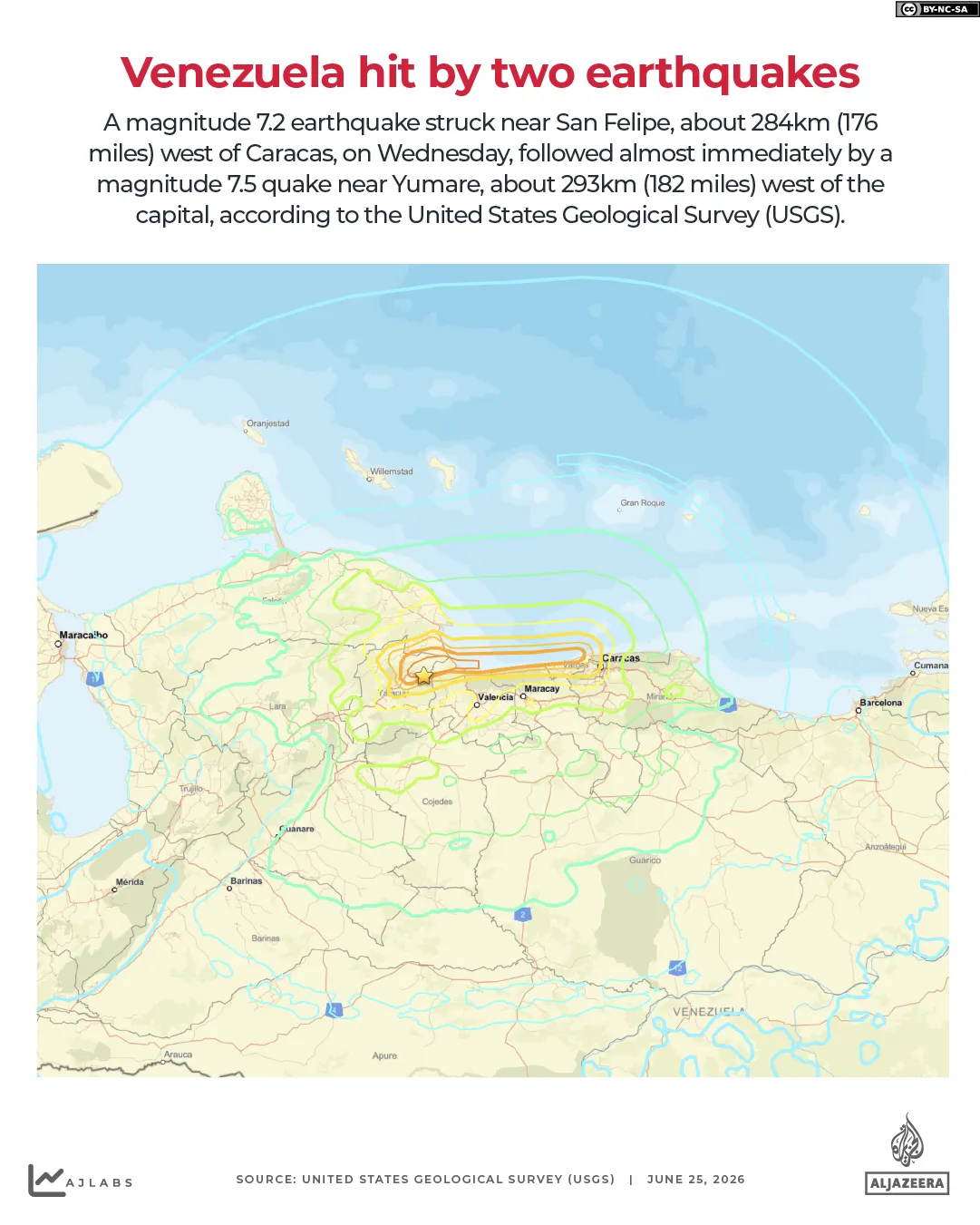
A magnitude 7.2 earthquake struck about 160km (100 miles) west of Caracas, followed less than a minute later by a magnitude 7.5 tremor, the strongest since 1900, according to the US Geological Survey (USGS).
Jorge Rodriguez, head of Venezuela’s national assembly and brother of interim President Delcy Rodriguez, said earlier in the day that 200 people had been trapped, with 250 buildings damaged or destroyed nationwide.
In Caracas and nearby coastal areas, at least eight hospitals, the headquarters of the Venezuelan Red Cross and the French embassy were among buildings reported to have been badly damaged.
Initial assessments released on Thursday put the estimated economic damage at between 1 and 7 percent of Venezuela’s $111bn gross domestic product (GDP). Authorities have not yet provided a separate estimate for losses in the capital.
However, the heaviest damage has been reported in Caracas itself, Al Jazeera’s Teresa Bo, reporting from Bogota in neighbouring Colombia, said on Thursday.
Public infrastructure was also heavily damaged, with acting President Rodriguez reporting power outages in Caracas.
Health Minister Carlos Alvarado said late on Thursday that 235 people had been confirmed dead at medical centres across Venezuela. He also told state media that about 4,300 people had been reported injured so far. Hundreds more are feared trapped or missing under the rubble.
How badly has the city been damaged in previous earthquakes?
This is not the first time Caracas has suffered heavy damage in an earthquake.
In 1812, a powerful earthquake roiled the cities of Merida and Caracas, killing about 30,000 people, according to the USGS. The tremors caused near-total destruction of Caracas’s colonial architecture, flattening homes, churches and public institutions.
In 1967, another earthquake hit the city, causing several high-rise buildings to collapse and killing 240 people.
(Al Jazeera)
Why has Caracas been so hard-hit?
Venezuela has a long history of devastating earthquakes because it is located along the boundary between the Caribbean and South American tectonic plates.
Caracas is also in a deep sedimentary basin, which amplifies the seismic waves from earthquakes, Vashan Wright, a geophysicist at the University of California in San Diego, told Al Jazeera.
Another reason Caracas is so vulnerable to damage from earthquakes is that its buildings and infrastructure are not specifically designed to withstand tremors and are often standing on insecure ground.
Al Jazeera’s Teresa Bo said the heaviest damage in Caracas occurred in the Altamira district, where emergency crews pulled survivors from the rubble of a 22-storey building while relatives searched for missing family members. Officials said they are still assessing the full extent of the destruction.
“For example, in the [hard-hit] area of Altamira in Caracas, many of the buildings that collapsed are built on sediments, and this makes them much more vulnerable to seismic waves,” Bo said.
“Also, there’s lots of informal housing in several areas across the country, and those types of buildings are not prepared to sustain very strong earthquakes,” she added.
Adequate urban planning and building codes, which incorporate seismic activity, require substantial funding, which Venezuela can ill afford as it has long been subject to heavy sanctions from the United States and other Western countries.
While some sanctions have been lifted since the US abducted former President Nicolas Maduro in a military strike on Caracas in January and he was replaced by Rodriguez, Caracas is still grappling with the effects of decades of underinvestment.
Another issue for Caracas is that at about 7.8km, the earthquakes were shallow, which means they were more destructive than deeper quakes of the same magnitude would have been.
In deeper earthquakes, much of the energy dissipates as it moves through layers of rock. By contrast, shallow ones release their energy closer to the ground, producing stronger shaking and greater damage in populated areas.
How many people live in informal housing in Caracas?
People living in informal housing are more at risk than others during earthquakes because low-cost, self-built housing structures, often built on hillsides and other slopes, are not resilient against tremors.
The slums in Caracas are known as barrios and are densely populated, lacking proper infrastructure. They comprise self-constructed housing or structures built with unreinforced cinderblocks or bricks, often without formal foundations or steel reinforcement, mostly on the mountainous hillsides surrounding the capital.
The lack of proper urban planning, coupled with construction on steep slopes, makes the barrios vulnerable to natural disasters.
While there is no official figure for the number of Venezuelans living in informal settlements in Caracas, academic estimates suggest they account for 40 to 50 percent of the city’s nearly five million residents.
According to the latest National Survey of Living Conditions (ENCOVI), about 55 percent of Venezuelans are living in poverty.
Which countries are better prepared for earthquakes?
Many parts of the world have adapted infrastructure with seismic engineering. Many earthquake-prone countries now plan and construct buildings with damage mitigation from tremors in mind.
Japan, one of the most quake-prone nations in the world, has strict building codes, which means many structures survive shaking that would devastate poorly built homes in parts of Indonesia or Central America. In most inland earthquakes, the majority of deaths and injuries are caused when poorly built structures collapse rather than by the shaking itself.
Japan has made enormous public investments in seismic research and has superior access to advanced engineering technologies like base isolation, which involves the installation of massive steel or rubber shock absorbers beneath the foundations of buildings.
This is why global deaths and destruction from earthquakes have reduced in the past decades. For instance, in 1556, the deadliest earthquake in recorded history in China’s Shaanxi killed about 830,000 people. In 2023, an earthquake hit northwestern China near the Shaanxi province, killing 127 people.
Critical infrastructure, such as water utilities, energy grids, healthcare systems, manufacturing plants, education platforms, and transport networks, have become primary targets of ransomware groups. In late April and early May 2026, for instance, Shinyhunters, a hacking group, breached Instructure, an education platform used by K-12 schools and universities across the US, and claimed for ransom. In the report published on CNN, the hacker group said it had breached 275 million personal data and had access to billions of private messages, an action that has affected thousands of schools, causing learning disruptions. Cybercriminals target critical infrastructure because downtime means communities don’t get access to essential services. So, operators or service providers have no option but to pay ransom to restore services quickly. Security gaps also influence the growth of these attacks. Too often, organizations focus on recovery efforts and ransomware encryption instead of prevention. This post highlights ways to prevent ransomware at its early stages, including the use of zero trust architecture and AI.
Promote Cybersecurity Awareness
Ransomware incidents start with malicious malware being injected into tech infrastructure. It then encrypts data and systems, restricting organizations any access to their operations until a ransom is paid. For these attacks to be successful, however, threat actors rely on social engineering attacks like spoofing and phishing, which target employees. An attacker will send a phishing email, impersonating an executive or trusted source like a bank to trick the victim into sharing credentials. Today’s spam emails, especially those generated by AI, are flawless, meaning staff can easily open and click on malware links without suspecting any threat. So, it’s crucial that employees receive adequate training on how to spot and respond to phishing texts or emails and malicious links.
Workers should also know how to generate hard-to-hack passwords. Weak passwords or using the same password for multiple accounts creates an entry point for ransomware. Encourage the use of password phrases, which are a string of unrelated, random words, symbols and numbers. For example, a password like purplegiraffesingstomorrow@17 prevents brute-force logins because a hacker will have a hard time guessing. Alongside passphrases, emphasize the importance of multi-factor authentication, where staff use two or multiple authentication methods to gain permission to accounts.
Enhance Threat Detection and Monitoring Systems
Detecting ransomware at its early stages helps prevent full encryption of sensitive data and infrastructure. And it entails identifying subtle behaviors of the threat, such as lateral movement across networks and devices, data exfiltration, and privilege escalation. Look out for unusual login or data access, increases in CPU usage, and abnormal network traffic to command-control servers. Modern attacks powered by AI and machine learning bypass legacy security systems by using legit utilities like PowerShell scripts and MimiKatz. So, check if there are attempts by script-based systems like PowerShell to inject suspicious code into running processes. Also, inspect if endpoints and firewalls are still running. Attackers often switch them off or configure settings without authorization to create a weak point for malware injection.
Note: lateral movement and zero-day variants aren’t always easy to spot. You need to integrate multiple security tools to detect and mitigate attacks. Use endpoint detection and response tools to catch harmful scripts and abnormal file access before all your data is encrypted. Take advantage of AI-assisted behavioral analytics to learn data access patterns, set a baseline for normal user behavior, and send alerts when there’s unusual or irregular file access patterns to protect against infostealers. Since infostealers act as the initial access for attack vectors, stopping them eliminates the entire kill chain. You can also reinforce your security measures by working with a 24/7 AI-centric SOC. These security experts don’t just distinguish legitimate logins from malware injections. They isolate the host to stop further compromise.
Network Segmentation and Zero Trust Framework
The goal of these two security measures is to limit a hacker’s ability to infect an entire network. Segmenting your networks entails dividing your networks into smaller, isolated sub-networks that make it difficult for cybercriminals to navigate critical network infrastructure. In a situation where a device is compromised, segmentation locks the attack within the specific zone, ensuring it doesn’t access databases or other sub-networks. What does zero trust entail and how does it mitigate ransomware? This tactic works on one strict principle: ‘never trust, always verify’. It doesn’t matter if you’re an authorized user or the devices you’re using are inside the organization. With zero trust in place, every access request is authenticated continuously. Also, users are granted permission to data and tools based on their roles to minimize privilege. Even if an attacker stole credentials, they would be limited to access systems. When combined, zero trust architecture and network segmentation strengthen an organization’s cyber safety strategies.
Hackers know that when they infect essential infrastructure with ransomware, victims will act fast to settle the ransom required to get encryption keys. But service providers shouldn’t wait until an attack has occurred to secure infrastructures. Prevention is the most effective strategy, and it revolves around simple hacks like educating workers about common threats and using strong pass phrases alongside MFA. By detecting threats, implementing zero trust, and network segmentation, organizations can minimize ransomware-related risks.
Weekly insights and analysis on the latest developments in military technology, strategy, and foreign policy.
In another indication of the growing military and economic importance of the Arctic, Russia and NATO are increasing their buildup of forces and facilities in the region. Recent media investigations found that Russia is constructing new bases near Finland to eventually house tens of thousands of troops while NATO on Saturday stood up a long-planned new battalion battlegroup. It is a force that will operate in Finland and Sweden as a deterrent against Russia.
While Russia remains totally bogged down and suffering high attrition in Ukraine with little chance of moving masses of troops to the Arctic at the moment, concern over the future has spurred NATO to bolster its presence along the Finnish border. Having moved to a wartime economy during the full-on conflict with Ukraine, Russia could leverage that in a post-Ukraine war future to threaten NATO’s borders.
A NATO official told us Friday morning that while the alliance assesses that the chances of a near-term conflict are low given the war in Ukraine, “Moscow could seek to expand westward into the Nordic and Baltic nations after a ceasefire with Ukraine.”
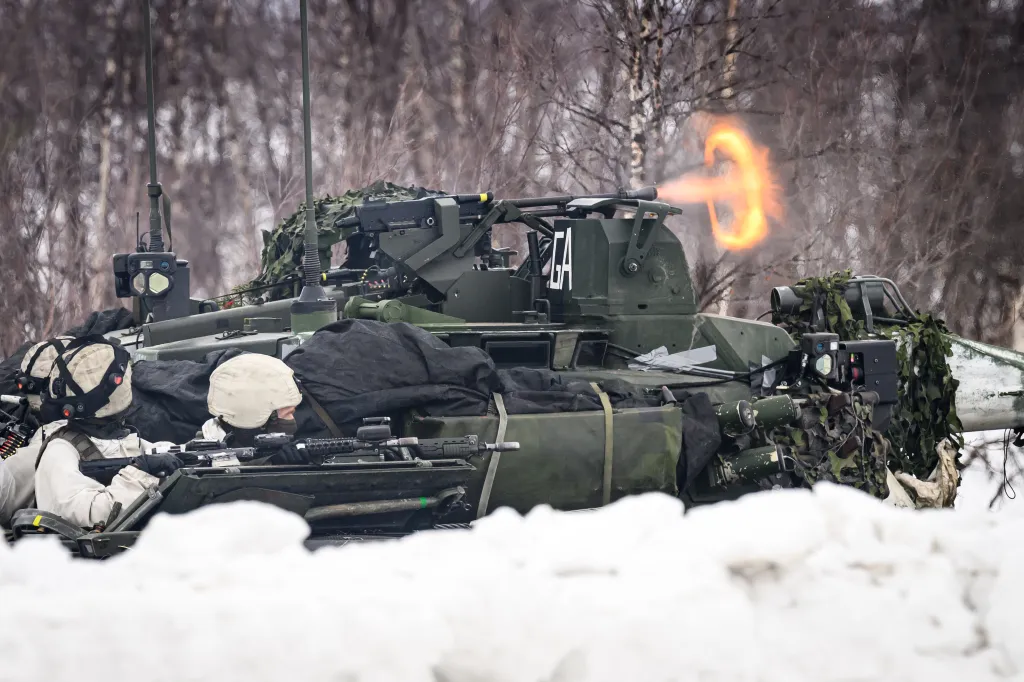
Swedish soldiers take part in training on the Finland/Norway border during the Nordic Response military exercise on March 09, 2024 in Kivilompolo, Finland. (Photo by Leon Neal/Getty Images) LEON NEAL
Russia appears to be investing in infrastructure in preparation of such a contingency. A joint report by several Nordic and Baltic media outlets published earlier this week has found that Russia is expanding military facilities along its borders with Norway and Finland to accommodate tens of thousands of new troops.
“New satellite images show that Russia is increasing its armament in [the] vicinity,” the report stated. “SVT, together with media partners in several countries, has examined how Russia is preparing for 80,000 soldiers… It is a threat that we should take seriously, says Thomas Nilsson, head of Sweden’s military intelligence service (MUST).”
The images “show new barracks for thousands of soldiers, long lines of military vehicles and ammunition storage,” the report further noted. “All winter, Russia has been building new military structures in several places on the other side of the Finnish border.”
“We expect to have 80,000 soldiers on our border and that can be compared to the fact that we previously had 20,000,” Finnish Army Chief Pasi Välimäki told the joint investigation.
A joint investigation by Nordic and Baltic media outlets found that these developments could enable Russia to deploy a force of up to 115,000 military personnel in the Northern European and Baltic regions. pic.twitter.com/ZiVpsP3fEz
A separate report by the Finnish Yle media outlet found that the Russians are expanding a base in the town of Novaya Vilga to hold as many as 6,000 Russian troops. It is located about 100 miles east of the Finnish border.
Breaking News: Where exactly is Russia building its massive new military garrison? 🛰️
“NATO has monitored a buildup of military infrastructure in Russia along NATO’s Eastern Flank, particularly along Finland’s border,” the NATO official told us earlier this week. “The real question is what becomes of the infrastructure? Will, for example, Russian troops now in Ukraine be relocated there after the war? It’s something we certainly need to consider, and we do.”
“That’s why NATO and nations are working to deliver real military capabilities to the alliance now, not five to ten years from now, which is so very, very important,” the official added.
A Swedish soldier takes part in a training exercise during the Nordic Response military exercise on March 09, 2024, in Kivilompolo, Finland. LEON NEAL
One of those efforts, as we noted earlier in this story, was stood up on Saturday, involving NATO’s two newest members.
NATO’s Forward Land Forces (FLF) Finland began operations in Finland and Sweden, according to the alliance. The FLF will include NATO’s newest multinational battlegroup, led by Sweden, “to support the defense of NATO’s northeastern flank.”
The establishment of FLF Finland places a Swedish battlegroup based in Boden, Sweden, and a Multinational Staff Element in Rovaniemi, Finland, under the command of the Supreme Allied Commander Europe (SACEUR) and NATO.
The NATO Forward Land Forces Finland (FLF) was established on June 6, 2026. (NATO Photo by OR-7 Dennis Sattler) MSgt OR-7 Dennis Sattler; DEU Army
“Sweden is contributing a battalion battlegroup that, together with a Multinational Staff Element in Rovaniemi, will form the core of FLF Finland,” NATO added. “The Swedish battalion battlegroup is prepositioned in Boden, with capacity to operate in the North Calotte and, where necessary, rapidly reinforce the presence in northern Finland. In 2026, Sweden’s contribution to FLF Finland will total around 600 personnel, with the option to expand to 1,200 personnel if needed.”
“This region is one of the most strategically significant and environmentally challenging areas in the world,” said U.S. Air Force Gen. and SACEUR Alexus G. Grynkewich. “FLF Finland, just like Arctic Sentry, will leverage NATO’s strength to defend our territory and ensure the Arctic and High North remains secure, especially considering Russia’s military activity and China’s growing interest there.”
Activated: NATO Multinational Battlegroup (FLF Finland)
The U.S. too is working to improve its presence and operations in the region. During last month’s SOF Week symposium in Tampa, Florida, the head of U.S. Northern Command (NORTHCOM) announced the formation of Nordic Bridge to “tie together” the work of U.S. European Command, North American Aerospace Defense Command (NORAD) and SACEUR.
Air Force Gen. Gregory Guillot provided no real details about Nordic Bridge at the time, so we reached out to NORTHCOM for additional details.
“The Nordic Bridge concept seeks to enhance Arctic integration between U.S. Northern Command and U.S. European Command and enhance cooperation between NORAD and NATO in order to expand domain awareness, strengthen deterrence, and improve interoperability,” a NORTHCOM spokesperson told us last month. “It envisions increased participation in each other’s training and exercises, increased data sharing (such as air pictures), deconflicting conferences to maximize personnel availability and participation, etc.”
Last month, Guillot visited Grynkewich “to discuss opportunities under this concept,” the NORTHCOM spokesperson told us.
U.S. Marine Corps Lance Cpl. Thomas Teague, a motor vehicle operator assigned to Combat Logistics Battalion 6, Combat Logistics Regiment 2, 2nd Marine Logistics Group, provides security for a convoy during offensive and defensive operations in Syndalen, Finland during exercise Freezing Winds 23 (FW23), Nov. 30, 2023. (U.S. Marine Corps photo by Lance Cpl. Christian Salazar) Cpl. Christian Salazar
All this is taking place, of course, against the backdrop of President Donald Trump’s frequent insistence that the U.S. subsume Greenland to provide better Arctic protection for the U.S. homeland. The issue reached a fever pitch earlier this year, causing a serious rift with NATO after the president threatened to invade the world’s largest island. You can read more about that in our story about the crisis here.
While there are no indications that the Arctic region is about to break out into open conflict, there are several indications that Russia, NATO and the U.S. are increasing preparations for such an eventuality.
The United States and Iran engaged in some of the most intense fighting overnight since all-out hostilities in the ongoing US‑Israeli war on Iran were halted with a Pakistan‑mediated temporary ceasefire on April 8.
A comprehensive peace agreement remains elusive as Iran and the US have exchanged a series of proposals and counterproposals in the weeks since that pause. After a string of smaller escalations, however, the US struck targets in Iran following the downing of a US Apache helicopter close to the Strait of Hormuz on Tuesday, and Iran retaliated by hitting US military bases in the Gulf.
The US military said it targeted communications and radar facilities. Iranian officials, however, said civilian infrastructure was also damaged, including two water reservoirs.
If correct, this is the first reported strike on civilian infrastructure in Iran in several weeks, but it comes at a time when Iran is facing a severe water shortage.
Which targets have been hit in Iran?
The US launched waves of attacks starting late on Tuesday following the downing of the helicopter in the Strait of Hormuz. The US described the attacks as “self-defence strikes” and a “proportional response to unjustified Iranian aggression”.
While an official US inquiry into what caused the helicopter to crash has yet to conclude, US President Donald Trump quickly blamed Iran, which he said had deliberately shot it down.
“I have just been informed by our Great Military that last night the Iranians shot down one of our highly sophisticated Apache Helicopters while patrolling over the Strait of Hormuz. There were two pilots involved, both are safe and uninjured,” Trump wrote on social media.
“Nevertheless, the United States must, of necessity, respond to this attack.”
Iran’s Islamic Revolutionary Guard Corps (IRGC) said US strikes, which hit targets including Sirik, Jask, Minab, Qeshm Island and the port of Bandar Abbas, had caused major damage to a telecommunications tower in the town of Sirik and destroyed two water reservoirs there.
Iran’s West Asia News Agency (WANA) news outlet reported on Wednesday, citing “available reports”, that two concrete water storage reservoirs in the Bamani district in the Sirik County of Hormozgan Province, in southern Iran, 1,012km (629 miles) from the capital, Tehran, had been hit in the US attacks.
The IRGC claimed attacks on US military bases in Bahrain, Kuwait and Jordan in retaliation.
Has the US hit Iran’s water infrastructure before?
Yes. On March 7, while missiles were flying across the region in an all-out war between Iran and the US-Israel, Iranian Foreign Minister Abbas Araghchi accused the US of striking a desalination plant on Qeshm Island off the coast of Iran in the Strait of Hormuz. The strike reportedly cut off the water supply to 30 villages.
“Water supply in 30 villages has been impacted. Attacking Iran’s infrastructure is a dangerous move with grave consequences. The US set this precedent, not Iran,” Araghchi wrote in an X post.
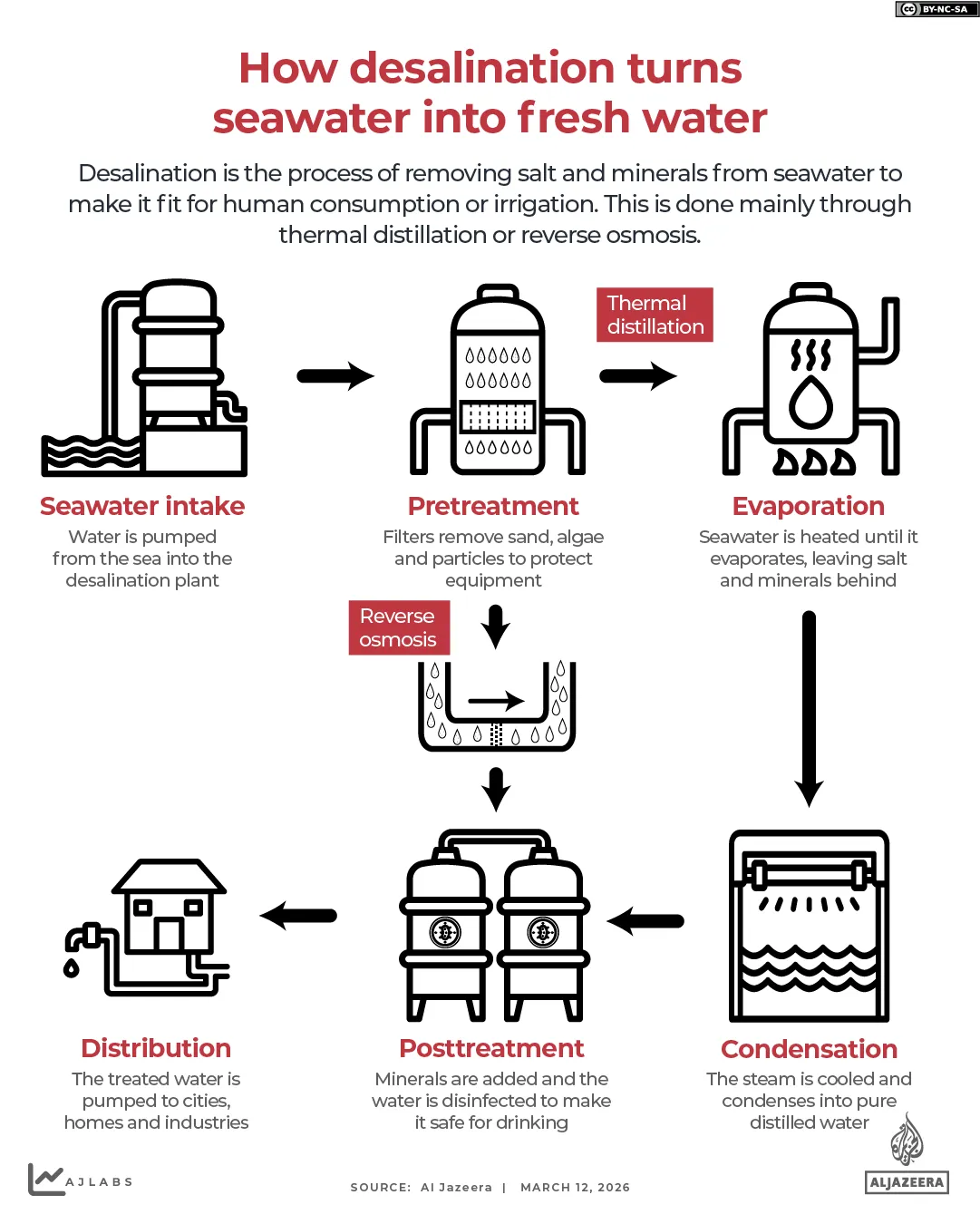
A desalination plant converts seawater into water suitable for drinking, irrigation and industrial use. These facilities are particularly critical in areas such as the Gulf, where freshwater is scarce.
[Al Jazeera]
Why is this significant?
The reservoirs that were struck provide drinking water to more than 20,000 residents in the city of Kouhestak and 10 surrounding villages. WANA reported initial estimates for damages amounting to $780,000 to $830,000.
Iran was already facing a multiyear drought and decline in precipitation before the US-Israeli war on Iran started. After years of poor agricultural practices and mismanagement, Iran’s main water supplies, including its reservoirs, rivers and groundwater reserves, continued to run dry.
According to Aqueduct data from the World Resources Institute, which tracks global water risk, Iran’s baseline water stress is classified as “extremely high” – meaning the country uses more than 80 percent of its renewable water resources in a typical year.
Last year marked Iran’s fifth consecutive year of drought. In November 2025, the water crisis was so dire that Tehran’s Amir Kabir Dam only held 8 percent of its capacity, while across the country, 19 major dams had run dry.
[Al Jazeera]
Is this a war crime?
Isa Bozorgzadeh, spokesman for Iran’s water industry, claimed the US strike on the water reservoirs is a war crime, WANA reported.
International humanitarian law classifies water infrastructure, including drinking water installations, treatment plants and pipelines, as civilian property which is not deemed a legitimate target during war.
The Berlin Rules on Water Resources, drafted by the International Law Association (ILA) and adopted in 2004, are a set of non‑binding international legal principles about how countries should use, share and protect water.
The Berlin Rules prohibit countries at war from destroying water installations “if such actions would cause disproportionate suffering to civilians”.