Nigeria Is Facing An Information War In Its Own Language
Two years ago, Bashir Muhammad received an invitation to attend a journalism summit in Niamey but declined. That decision, and the argument it provoked, told him everything he needed to know.
He runs one of the growing number of Hausa-language digital news platforms that have emerged across northern Nigeria in the past decade, serving local audiences that legacy English-language media have largely ignored. That profile made him a target. In 2024, Bashir was approached by Mariam Laouali – a woman known across West African Hausa media circles as Sarkin Abzin. She is a prominent Nigerien broadcaster and, as he would come to understand, a committed supporter of the military regime that had seized power in Niamey the previous year.
In July 2023, the military junta, led by General Abdurrahman Tchiani, overthrew the democratically elected President Muhammad Bazoum. The coup met with strong resistance from the international community, particularly the Economic Community of West African States (ECOWAS), under the leadership of Nigeria’s President Bola Tinubu. This led to severe diplomatic tensions between ECOWAS and the new military regime in Niger, culminating in threats of invasion from Nigerian leaders and ultimately the division of ECOWAS and the formation of the Alliance of the Sahel States (AES). While some diplomatic efforts have been restored, tensions remain, and the Niger Republic, supported by Russia and its AES allies, has been engaged in information efforts to attack ECOWAS countries, particularly Nigeria and Benin Republic. Bashir felt this approach could be part of the recruitment efforts.
The pitch sounded professional. Sarkin Abzin told him of a pan-African summit of Hausa-language journalists to be convened in Niamey. It was the first of its kind, according to her. She described it as an exercise in cross-border media cooperation and a chance for journalists from across the continent’s Hausa-speaking belt to build something together.
Bashir had questions, but he did not like the answers, so he declined.
Sarkin Abzin pushed back, insisting that he should consider it, but he became more suspicious. The conversation escalated. By the end, she was visibly frustrated. It ended there.
“She didn’t take it well,” Bashir told HumAngle, sitting in his home office while casually scrolling on his computer, searching for her Facebook page. “The way she reacted told you this wasn’t just about journalism.”
He was right. It was not all about journalism. The summit in Niamey was just bait. What Sarkin Abzin and her sponsors in the Niger Republic seemed to want was access to northern Nigeria’s forty million Hausa speakers and to exploit their grievances and distrust of Nigerian leaders.
Many Nigerians were consumed by anxiety and bitterness over the country’s dire economic pressures. Many also harboured deep anger toward their leaders – particularly President Bola Tinubu, against whom protests erupted in August 2024, during which some demonstrators raised Russian flags and called for a coup. For that reason, this was a country where recruiting the discontented would come easily, because the grievances were already there, waiting.
Pro-junta actors and AES-aligned influence networks have been weaponising TikTok’s virality to erode confidence in Nigerian democratic leadership, particularly targeting President Tinubu and the broader ECOWAS establishment.
Online influencers and sympathetic media outlets, including some based within Nigeria itself, have circulated claims accusing Nigerian politicians of backing insurgent networks and conspiring with foreign powers to destabilise the AES states.


The recruitment drive
Sarkin Abzin’s tour of northern Nigerian newsrooms and radio stations in 2024 was, in retrospect, the visible edge of something much larger. She moved through Kano, through the northwest, knocking on the doors of editors and station managers, carrying the same pitch: come to Niamey, meet your counterparts, and build solidarity. Several journalists, like Bashir, declined quietly. A general manager at a prominent radio station in Kano, who pleaded anonymity, told HumAngle that Sarkin Abzin had reached him, but that he had turned her down.
“Looking at the timing when there was a diplomatic rift between Nigeria and Niger, and the suspicion of foreign influence, I felt it was unwise to join,” he said.
However, not everyone had the luxury of that suspicion, or the will to act on it. Musa Abba (not real name), a journalist at a private radio station in Kebbi State, saw a conference invitation and a chance to connect with Hausa journalists beyond Nigeria’s borders. His station was invited and the managers nominated him. Accommodation and food were covered by the organisers. The journey, according to him, was arranged through the Nigerian Union of Journalists (NUJ), in a vehicle shared with other attendees and, notably, with some politicians and government officials who had also been invited.
What he found in Niamey, however, upended the premise of the invitation entirely.
He concluded that “it was a sophisticated plan to form Hausa journalists who will be promoting the Nigerien junta and anti-West sentiment across Hausa-speaking countries.”
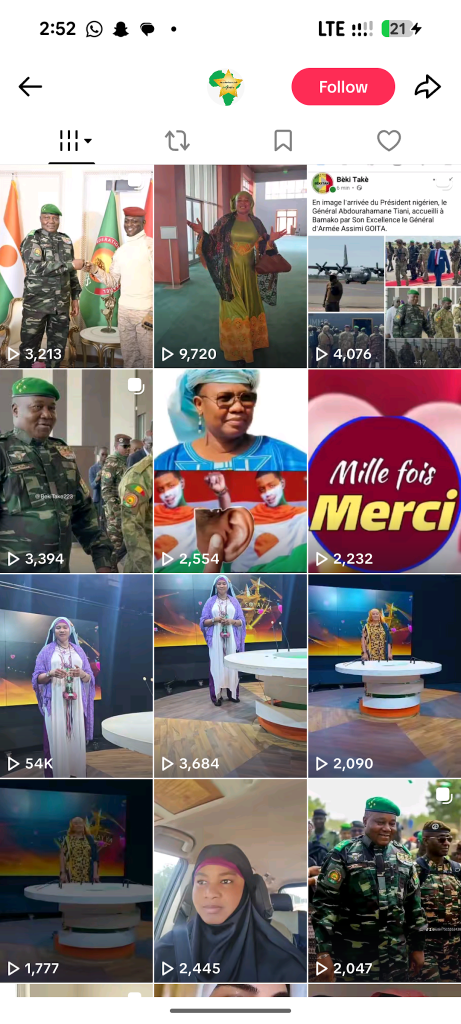
On her TikTok page, Sarkin Abzin does not hide her bias. She promotes Sahel juntas and specifically asks her followers to promote Tchiani.
In a social media exchange with Fati Niger, a Kannywood musician originally from the Niger Republic who had called for a return to democratic rule, Sarkin Abzin’s response betrayed her sentiments. “We don’t care about entertainment,” she mentioned in a TikTok video. What mattered, she said, was building their country and confronting those she described as “hypocrites and oppressors within the West,” as well as “hypocrites among us here, those in exile in every country in the world, including Nigeria, and those Nigerians who support the old system [of democracy] and do not stand behind these soldiers under Abdourahamane Tchiani.”
The summit Sarkin Abzin organised had state backing, institutional cover, and a well-hosted programme. It had everything, in other words, that a genuine journalism conference would have – except genuine journalism at its centre.
The irony is that the junta in Niger has been repressing and arresting journalists in the country. Moussa Ngom, Committee to Protect Journalists (CPJ)’s Francophone Africa representative, explained that “arrest and detention have become tools of choice for Nigerien authorities to try to control information they find undesirable.”
Human Rights Watch (HRW) reported that in October 2025 six journalists were arrested in Niamey – Moussa Kaka and Abdoul Aziz of Saraounia TV; Ibro Chaibou and Souleymane Brah from the online publication Voice of the People; Youssouf Seriba of Les Échos du Niger; and Oumarou Kané, founder of the magazine Le Hérisson – over their alleged role in circulating a government press briefing invitation on social media, criticising the introduction of the mandatory payment for “Solidarity Fund for the Safeguarding of the Homeland”, a form of security levy in Niger.
The conference that wasn’t
The organisation behind the summit, Kungiyar Yan Jarida Na Afrika Masu Magana Da Harshen Hausa or, in French, Résegu Africain des journalistes en langue Haoussa (Association of Hausa-speaking Journalists in Africa), was founded by Sarkin Abzin herself. She held a senior position at RTN, the Nigerien state broadcaster. Her organisation, she told prospective attendees, had the backing of the Nigerien government institutions.

Inside the hall at the Centre International de Conférences Mahatma Gandhi in Niamey, when the summit was opened on Aug. 24, 2024, the keynote speakers were not press freedom advocates, editors or media economists. They were politicians. Prime Minister Ali Lamine Zeine appeared as Tchiani’s representative, delivering a speech whose original French had been translated into Hausa. He spoke about Niger’s exit from ECOWAS as a show of sovereignty.
The junta had, by this point, accused ECOWAS countries, particularly Nigeria and Benin, of colluding with France to destabilise Niger and sabotage its economy- allegations that, according to independent fact-checkers, had no credible evidentiary basis but which had proven effective at consolidating domestic support by replacing accountability with external threat. The Niamey summit was the moment that the narrative was offered to Nigerian voices who could carry it home.
Among those who spoke was Hamza Almustafa, a Nigerian retired general and a politician who used the platform to denounce the West. Najaatu Muhammad, a prominent northern Nigerian political figure, delivered what several attendees described as the most incendiary address of the proceedings. She told her audience that the Nigerian federal government was conspiring to sever Niger from Nigeria – to cut through bonds of religion and culture that no colonial border had ever truly divided. Abuja, she suggested, served Paris and Washington before it served Kano or Sokoto.

“It was not really a journalists’ meeting,” Musa told HumAngle, “By the time the politicians started speaking, those of us who understood what was happening knew we had made a mistake.”
Sarkin Abzin’s organisation had achieved, in a single day, what overt propaganda rarely manages: it had placed legitimate reporters in a room and given the junta’s narratives the texture of a press conference. The journalists went to Niamey to cover something. They came back as part of it.
HumAngle reached out to Sarkin Abzin for comment. She did not respond.
The Hausa messages
The Niamey summit was not the opening move in this campaign.
On Christmas Day of 2024, General Tchiani sat before the cameras of Radio-Télévision du Niger and delivered what a casual viewer might have mistaken for a holiday address. Although French had been Niger’s official language, he spoke in Hausa – a lingua franca in both Niger and most of northern Nigeria, spoken by millions across West Africa.
His choice of language was deliberate. The message was not addressed to Niamey alone. It was addressed to Kano and other Hausa-speaking states, particularly in Northern Nigeria, where there is an already visible pro-Russian and anti-West sentiment, as reflected in 2024 when Russian flags were raised during a nationwide protest against insecurity and economic hardship.
The claims Tchiani made were engineered to sound verified. He alleged that France had paid Nigerian authorities to establish a military base in Borno State with the sole aim of destabilising Niger and its Sahel Alliance partners. He also accused France of supplying Boko Haram fighters in the Lake Chad basin with anti-aircraft weapons. He claimed that France and ISWAP had struck an agreement to establish a Lakurawa training camp in the Gaba forest near Sokoto, and that Nigerian leaders were aware. He named Nigerian security officials by name. He cited dates and operational specifics to express the grammar of verified intelligence, though deployed in the service of disinformation.
The hook embedded in the allegations was not entirely invented, which is precisely what made it effective. Nigeria’s Defence Headquarters had classified Lakurawa as a terrorist organisation with jihadist affiliations just weeks earlier, in November 2024. HumAngle’s own investigations had revealed the group had operated in the northwest for around six years, with local security authorities having previously and dangerously dismissed it as a harmless faction of herders from across the border. The name was already known. The fear was already settled. Tchiani simply attached a culprit to both.
In Sokoto and Zamafara, where communities had been facing terrorist violence for years, the allegation did not sound outlandish.
“People said, ‘We always knew France was behind this,’” a civil society worker in Kano who monitors social media, Muhammad Hamza, told HumAngle. “Tchiani just confirmed what they already believed.”
When BBC Hausa published testimonies refuting Tchiani’s claims, the reaction was contemptuous. “We know you won’t agree because you’re all on the same side,” one commenter wrote. “But we believe what he said. We have seen the signs.”
A survey conducted by HumAngle in Kano State found that 50 per cent of the respondents believed Tchiani’s claims, 30 per cent were undecided, and only 20 per cent rejected them outright. Many pointed to President Tinubu’s perceived closeness to France as a reason for suspicion.

One respondent, Abubakar Saidu, explained his reasoning, “President Tinubu has been close to France since he assumed power, and we all know that France can create terrorists to attack Niger due to their diplomatic fallout.”
Nuhu Ribadu, Nigeria’s National Security Advisor, had attempted to refute the claim, but it was unsuccessful. According to him, “Nigeria has never given its land to any foreign troops—not even Britain. When the [United States] requested a military base, we denied them, but Niger gave them.”
In a country with an audience that receives official rebuttals as confirmation of the original charge, its psyche could easily be captured. Nigerians didn’t believe Ribadu.
“This is the new reality of information warfare. It is no longer just about truth versus falsehood. It is about who controls the language in which truth is told. It is about who defines the enemy—and, ultimately, who is believed,” Kano-based security analyst Balarabe Ismail told HumAngle in April 2025.
Tchiani returned to the theme in June 2025, this time in a three-hour televised address delivered in Hausa, Zarma, and French, in which he again accused Nigeria of conspiring with France and the United States to sponsor terrorism, alleging a covert meeting in Abuja in December 2024 attended by CIA agents and Nigerian security officials who discussed arming groups targeting Niger.
The headquarters of disinformation
Analysts had already identified increased activity from disinformation networks affiliated with Russia in Niger following the coup in Niger.
According to a report by Al Jazeera, since the July 2023 coup, Niger had become the latest hotbed of disinformation in the Sahel, with social media inundated by false rumours, misleading videos, and manipulated audio clips. The template, according to the report, was borrowed from Mali and Burkina Faso, where Wagner-linked networks had deployed online assets, locally cultivated contacts, and Russian state media to produce a sustained information environment that preceded, accelerated, and then legitimised military takeovers. In Niger, the same playbook ran faster because the infrastructure was already warm.
Following the death of Wagner Group founder Yevgeny Prigozhin in 2023, these operations were absorbed into two successor structures: the Russian Africa Corps, which provides military presence on the ground, and the Africa Initiative news agency, connected to Russian intelligence services and overseen from Moscow. Africa Initiative is an upgrade and institutional legitimacy that Wagner never possessed. With press credentials, cultural programming, and regional language capacity, it successfully dressed influence as media development.
The three Alliance of Sahel States junta leaders — in Niger, Mali, and Burkina Faso — have converged around a shared political project. They launched a joint television channel to promote a unified narrative across their territories, a regional media infrastructure whose audience mandate extends explicitly beyond their borders — into the Hausa-speaking communities of northern Nigeria, who share language, faith, and enough legitimate frustration to make the narratives land without the need for fabrication in every detail.
Sarkin Abzin’s journalist recruitment initiative sits within this structure. The goal may not have been to turn Nigerian journalists into salaried agents but to create a class of northern Nigerian media voices who feel a degree of solidarity with the junta’s framing.
A security analyst who works on influence operations in West Africa and spoke to HumAngle on condition of anonymity offered some insight. “What Niger and Russia are doing is not complicated,” he said. “They are creating the conditions under which Nigerian citizens begin to see their own government as the enemy.”
The operation has not yet achieved its full objective. Bashir Muhammad’s refusal was one of the resistance points among others. Some journalists who attended the Niamey summit have since spoken, cautiously, about the gap between what they were promised and what they found. The WhatsApp group formed after the summit, according to Musa Abba, the journalist who attended, had almost collapsed.
“They promised to continue communicating via WhatsApp and to organise more summits in other countries, but more than a year later they said nothing and group members didn’t say anything either,” he said. Even Sarkin Abzin’s Facebook page is no longer active.
This article was produced by HumAngle with support from the African Academy for Open Source Investigations (AAOSI) and the African Digital Democracy Observatory (ADDO) as part of an initiative by Code for Africa (CfA). Visit https://disinfo.africa/ for more information.