Five days of clashes rock Tirana as students join a wider movement demanding Prime Minister Edi Rama’s resignation.
By AFP and The Associated Press
Published On 17 Oct 202617 Oct 2026
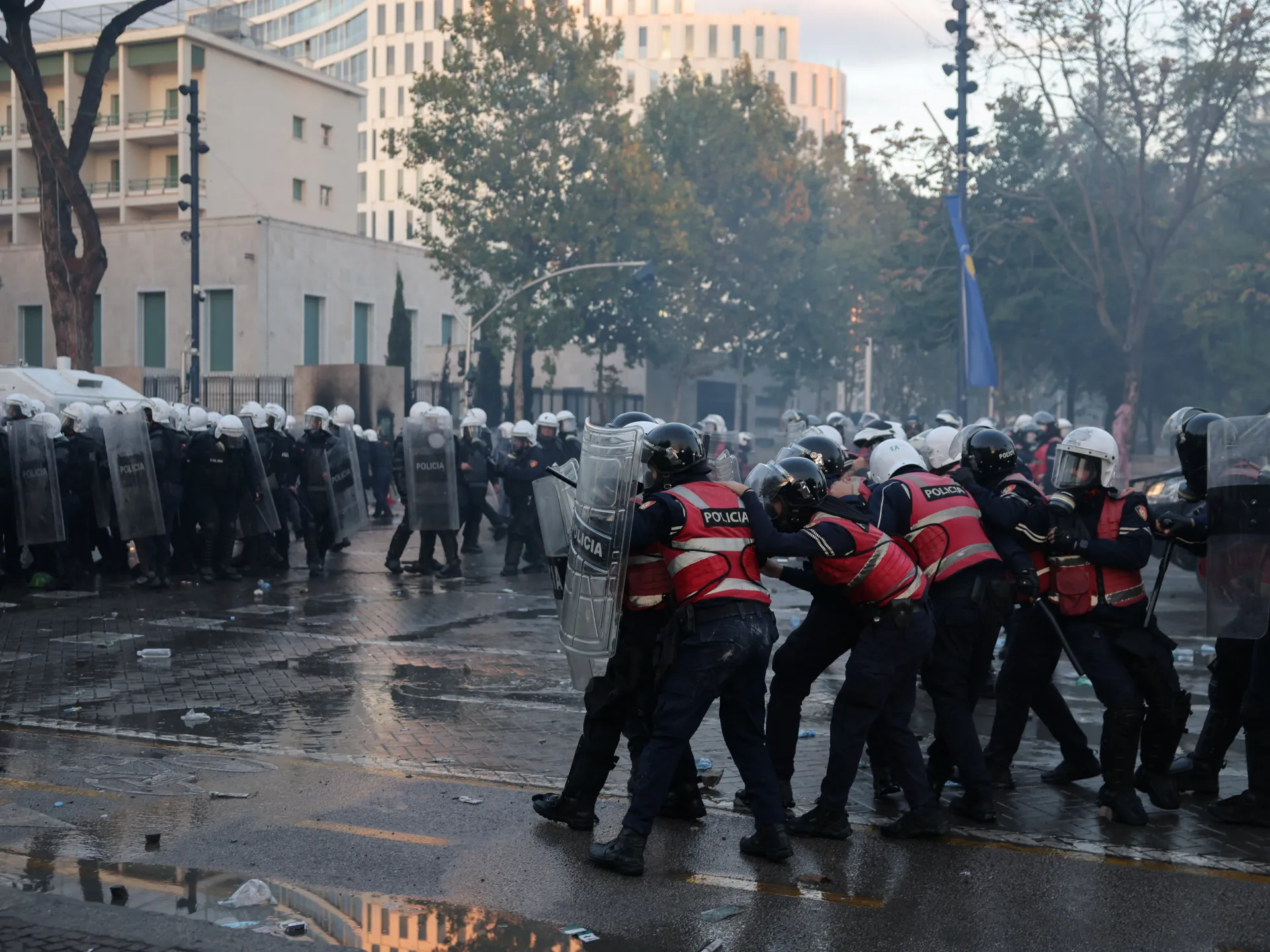
Police in Albania have fired rubber bullets at antigovernment protesters in the capital, Tirana, as violent clashes intensify over demands for Prime Minister Edi Rama to resign.
The clashes continued on Saturday for a fifth consecutive day after high school and university students joined a broader movement against Rama, whose governing centre-left Socialist Party has held power since 2013.
Recommended Stories
list of 2 itemsend of list
The unrest has brought growing anger over education, unemployment and alleged corruption into a wider confrontation with the government.
Protesters threw stones, petrol bombs and fireworks at police near Rama’s office and elsewhere in central Tirana.
Some set cars and rubbish bins alight, creating burning barricades across streets.
Police responded with tear gas, water cannon and baton charges as demonstrators pushed against security lines.
The AFP news agency reported that officers used rubber bullets for the first time since the demonstrations began.
National police chief Skender Hita confirmed their use at a news conference on Saturday, saying they had been deployed “in a limited manner”.
The Ministry of Health and Social Welfare said nine protesters and four police officers received medical treatment on Saturday.
Hita said 167 people had been arrested over five days of unrest, while 132 officers had been injured.
Seven police officers were also suspended pending investigations into allegations that they had exceeded their authority.
Rama, who is serving his fourth term and has refused to resign, visited businesses damaged during the unrest on Saturday. He promised to listen to students and protect their right to demonstrate, while warning against further destruction.
He also accused his conservative political opponents of encouraging the violence.
Growing discontent
The students have complained about expensive university fees, poor educational facilities and limited employment opportunities, alongside allegations of government corruption.
At the start of Saturday’s demonstration, protesters set fire to a suitcase and threw it into the Ministry of Education’s courtyard. AFP reported that the gesture symbolised their determination not to leave Albania in search of better opportunities.
“We are demanding our rights, our future and a better country,” journalism student Sinan Billa told AFP.
The student demonstrations have added to months of antigovernment rallies organised by the Flamingo movement, which began as a campaign against a luxury tourism development on Albania’s southern coast.
The project is linked to an investment company founded by Jared Kushner, the son-in-law of US President Donald Trump.
The movement has since widened its demands to include Rama’s resignation amid allegations of corruption against his government.
The unrest has also spread beyond Tirana. Local media reported that protesters in the coastal city of Durres damaged a post office and blocked roads with burning barricades, extending the confrontations beyond the capital.
Paris, France – Saturday is a day of many unknowns. That was how the French newspaper Le Monde described it as France braced for possible nationwide demonstrations bringing together high school students, trade unions and “yellow vest” activists.
The protests began in mid-September at a high school in the Paris suburb of Creteil, where students took to the streets over dilapidated buildings, overcrowded classrooms, teacher shortages and what they see as a deeply unequal education system.
Recommended Stories
list of 3 itemsend of list
Since then, the mobilisation has spread to thousands of “lycees”, or upper secondary schools, across the country. It is now beginning to reflect broader anxieties in a country grappling with a combination of fiscal pressures, economic stagnation and mounting social discontent.
Teachers, trade unions and university students have joined the movement.
On Saturday, some “yellow vest” activists – remnants of the participants in the grassroots cost-of-living protests that shook President Emmanuel Macron’s first term in 2018 – have also called on supporters to join the students.
“High school students are fighting for their future. Workers are fighting to earn a living from their labour. Retirees are fighting to preserve their dignity. Our paths may differ, but our concerns can converge,” Jerome Rodrigues, a prominent “yellow vest” activist, said in a video message released last week that called on people to join Saturday’s demonstrations.
Now France is waiting to see whether those calls will translate into a large, coordinated mobilisation.
Warlike injuries
Authorities have described the unrest as among the most violent in decades, saying more than 900 police have been injured since the start of the protests. But critics argued that although some demonstrators have engaged in violence, they represent a minority and the actions of a few risk overshadowing the grievances of the wider movement.
The government has also faced criticism over its response to the protests, including the detention of thousands of minors and the use of force against young demonstrators.
More than 6,700 children had been taken into police custody since mid-September, according to reports published this week.
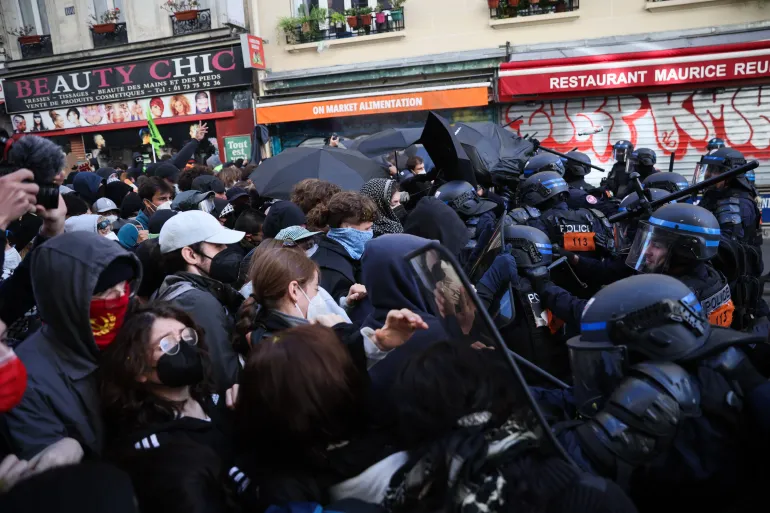
Protesters clash with police during a demonstration against the high cost of living, in Paris on October 17, 2026 [AFP]
Human rights lawyers said several teenage students have suffered warlike injuries.
Two cases have drawn particular attention: A 15-year-old lost his hand in the explosion of a stun grenade outside a school in the northern city of Lens, and a 16-year-old in western Tours lost his sight due to an injury caused by a rubber bullet.
There are fears of further clashes on Saturday.
“This is a moment of fatigue in the country,” Prime Minister Sebastian Lecornu said on Thursday. “We are in an atmosphere of perma-crisis: wars, inflation and issues surrounding purchasing power.”
The government has accused the far-left France Unbowed (LFI) party of inflaming the protests. The party has rejected the accusation.
While France suspended the use of stun grenades for the student demonstrations, Interior Minister Laurent Nunez said on Friday that he authorised police to use them in the event of what he called “urban violence”.
Nunez also said he is expecting a “fairly significant” turnout on Saturday.
Hundreds of protest sites
Calls on social media for members of past protest movements to join the current one have been made for weeks. The website 17octobregiletjaune.net, which tracks “yellow vest” actions, listed more than 1,750 planned protest locations across the country.
The government has tried to quell student anger by scrapping plans to increase some higher education registration fees and promising to deploy 3,000 substitute teachers to high schools. This week, it set up a national online survey for pupils to hear their concerns.
But Mathieu Roger-Lacan, a French literature teacher in a disadvantaged area and author of A Language of One’s Own, a book about the growing language gap, argued that these measures fail to address the deeper problem: an education system that struggles to provide equal opportunities.
“If you have a pool that is leaking, the answer should not be to put more water into it but to work on its structure – and that costs money too,” he said.
For Roger-Lacan, the problem is not simply how much France spends on education but how it distributes those resources.
A government report published this week said that 32 percent of the French education ministry’s budget for next year will go towards funding the pensions of retired civil servants.
Students are not only complaining about deteriorating school buildings and overcrowded classrooms but also expressing a deeper anxiety about their future.
For many, a diploma no longer feels like a guarantee of stable employment or social mobility. That concern is compounded by questions about the quality of education itself amid evidence of persistent weaknesses in French students’ academic performance.
In September, the Organisation for Economic Co-operation and Development (OECD) said that French 15-year-olds’ results in mathematics and reading had fallen to among their lowest levels on record.
“There is a gap between the diploma we give at the end of school, which is given to a huge part of the population, and the reality around us, which is that many of these young students have great difficulties even in writing French,” Roger-Lacan said.
Competing demands
The protests come at a very difficult time for the government, which is caught between demands for better-funded public services and the need to rein in France’s debt.
The government recorded a deficit of 152.5 billion euros ($171.3bn) last year, equivalent to 5.1 percent of France’s gross domestic product (GDP). By contrast, the European Union average is 3.1 percent.
Meanwhile, public debt ballooned to 115.6 percent of GDP, the third highest in the EU after Greece and Italy.
Lecornu’s proposed 2027 budget seeks to reduce the deficit through spending restraint and tax measures, including a freeze on public sector pay and limits on pension increases.
Whether the government can make those savings without deepening public anger is another question.
The debate touches a nerve in France, where the welfare state and access to public services remain central political issues.
Macron’s decision to raise the retirement age from 62 to 64 triggered months of mass demonstrations in 2023, exposing deep opposition to reforms that many saw as unfairly burdening workers.
Now as the government prepares its next budget, it faces the challenge of persuading the public that spending cuts and other savings are necessary without further eroding confidence in public institutions.
The political stakes are high. The budget bill will be debated in a deeply divided parliament as parties position themselves before the 2027 presidential election, which will mark the end of Macron’s presidency.
Judge fines government for failing to fund universities as protests over Milei’s cuts turn violent.
Reporting from Buenos Aires
Published On 16 Oct 202616 Oct 2026
“This cannot go on!” students shout during an assembly in the middle of the central hall of the University of Buenos Aires Exact and Natural Sciences building.
It is part of Argentina’s prestigious public university system.
Recommended Stories
list of 3 itemsend of list
The faculty’s central hall is covered with dozens of banners protesting President Javier Milei’s spending cuts. Students have called an assembly to announce the occupation of the university, a traditional form of protest in Argentina meant to raise public awareness and pressure the government.
They say they will take over the building for a day. Many students and professors here are concerned about the impact of Milei’s austerity policies on public universities and say the future of free higher education is at risk.
Students gather in protest at a university in Buenos Aires [Lagmi Chavez/Al Jazeera]
“Our best professors are leaving en masse. With salaries that cannot cover their basic needs, they are leaving for private universities,” Emiliano Gato, a physics student who is part of the group, told Al Jazeera.
“I dream of doing research and teaching at the public University of Buenos Aires. It’s a prestigious school. But now, with this austerity plan, I don’t know what will happen.”
Public universities in Argentina have become a major battleground of Milei’s austerity plan. Students and professors are protesting the lack of funding and the erosion of salaries, which they say is a major threat to the country’s public education.
Milei is implementing one of the harshest austerity plans in Argentina’s history.
Since taking office in 2023, he has laid off thousands of state employees, shut down ministries, reduced subsidies and cut government-funded programmes. The measures were meant to fight high inflation, which was a major problem in Argentina. Almost three years later, inflation has fallen to around 2 percent a month. Milei says his plan is going well.
“Argentina is growing at a remarkable pace. We have now recorded 27 consecutive months of sustained growth, and today the country is expanding at four times its historical rate. This growth is being felt across almost every sector of the economy,” said Milei during a recent visit to Washington.
Ripple effects
But not everyone agrees. His plan is also having a profound impact on public education, welfare plans for people with disabilities, pensioners and others who depend on state support. The opposition has tried to block many of Milei’s reforms.
Last year, Congress overturned presidential vetoes and approved two laws, one increasing funding for public universities and another declaring a disability emergency. But Milei’s government has refused to implement them, arguing that Congress failed to identify how they would be financed.
A federal judge has now begun fining the government 100,000 pesos (around $70) a day for failing to implement parts of the financing law, which requires Milei’s government to restore university salaries and student scholarships lost to inflation, regularly update budgets and provide funding for research, hospitals and infrastructure.
And that’s why thousands of people took to the streets on Thursday to demand that the government implement it. All around Buenos Aires, long columns of people blocked the centre of the city as they called for a general strike. Although the protest was meant to be peaceful, it soon turned violent. Police fired tear gas and rubber bullets as protesters threw rocks.
The plaza in front of Congress resembled a battleground. At least 25 people were detained, and several others were injured, including members of the security forces.
Maria Teresa de Jesus is a professor in the University of Buenos Aires chemistry department. She says she makes around $700 a month and it has become difficult to make ends meet. “I have come to this protest as a last resort. I am professor. I love teaching, doing research. I shouldn’t be here,” she told Al Jazeera. “Public education is crucial in this country, to make education accessible to all. And the government is ignoring it.”
Many in Argentina continue to support Milei’s economic plan. They are hoping the government’s plan to exploit the country’s vast natural resources will pay off and translate into more jobs, higher wages and improved living standards.
But many others have stopped believing and are prepared to raise the stakes. They accuse Milei’s government of protecting the interests of a privileged few while asking the rest of the country to bear the cost of his economic plan.
Thousands of protestors honor Maricarmen Abascal’s life, while tributes within parliament spark debate.
Published On 9 Oct 20269 Oct 2026
Thousands of Spaniards protested outside Spain’s parliament after the death of Maria del Carmen Abascal, the 87-year-old woman whose eviction ignited nationwide protests and sparked a snap general election.
Meanwhile, tributes to Abascal were debated within the legislature as lawmakers accused each other of exploiting the case ahead of the election.
Recommended Stories
list of 3 itemsend of list
Maricarmen Abascal died on Wednesday after being hospitalised for severe anxiety and exhaustion since her eviction on a stretcher from her Madrid home on September 23.
While in the hospital, she reached a deal to return to her home but died before she could return. No cause of death has been announced.
‘Killing someone’
“They killed her through heartbreak,” Diana, a demonstrator, told Al Jazeera. “Taking an 87-year-old woman out of her home after she had lived in the same house for 70 years, that is killing someone.”
Diana joined thousands of protesters outside Spain’s parliament.
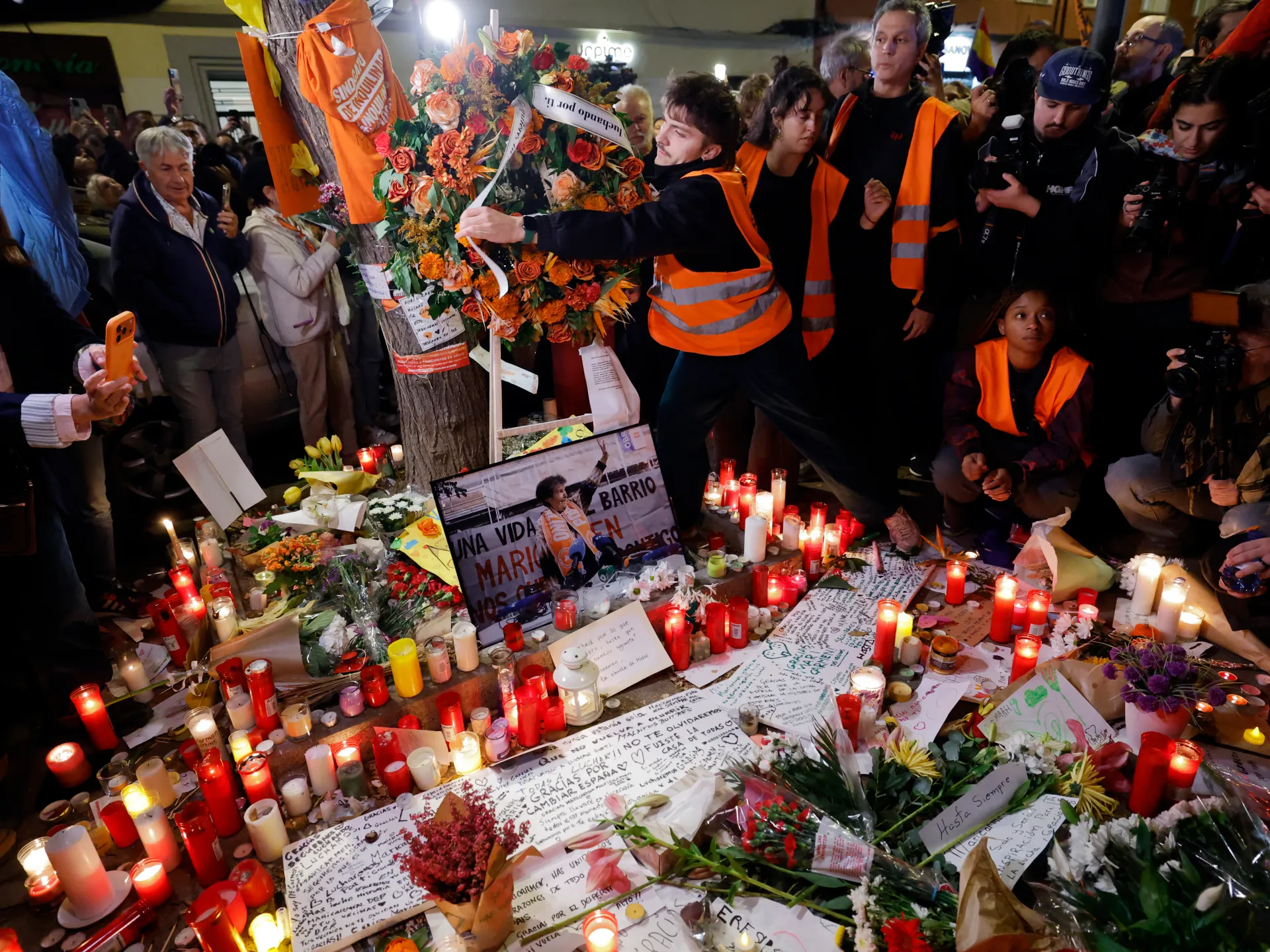
Outside Abascal’s building, mourners left flowers, candles, handwritten notes and children’s drawings.
“They’re not deaths; they’re murders,” protesters chanted as they walked from a protest camp in the central Puerta del Sol square to Abascal’s former home on Thursday.
Tributes in Spain’s legislature
Protests over home shortages and surging rents following her eviction prompted Socialist Prime Minister Pedro Sanchez to call a snap general election for November 29 after parliament failed to pass emergency housing measures.
Tributes to Abascal in the Madrid region’s legislature caused arguments as lawmakers accused each other of exploiting the case ahead of the election.
Alberto Nunez Feijoo, leader of the conservative opposition People’s Party (PP), accused Sanchez and the Socialists of trying to exploit the housing crisis for political gain ahead of the election.
“We will not allow this attempt to manipulate the emotions of the Spanish people; all of this has happened during their eight years in government. It won’t fly,” Feijoo said.
The PP, which holds absolute majorities in the Madrid regional and local assemblies, refused to observe a minute of silence in her honour. Instead, hard-left deputies staged one outside City Hall and gave Abascal a 60-second standing ovation during a tense debate in the regional assembly, while PP lawmakers remained seated with folded arms.
Left-leaning parties criticised conservatives for rejecting legislation in parliament aimed at curbing soaring rental prices.
Support for housing intervention
A survey carried out in June and published by state pollster CIS on Thursday found that 76.3 percent of Spaniards supported intervention in the market to guarantee access to housing, while 79 percent believed the right to housing should take precedence over treating homes as a market commodity.
Ombudsman Angel Gabilondo said addressing the housing crisis would require greater commitment from all levels of government.
He said his office was preparing a housing report and reiterated proposals to expand public housing, restrict tourist rentals, increase rent assistance and strengthen protections against evictions for vulnerable households.
Protests have continued across France for a third week as tens of thousands of school pupils and trade unionists have taken to the streets across many cities.
Students initially began boycotting classes in deprived areas of Paris on September 21 over teacher shortages and poor conditions, but protests have quickly morphed into a nationwide movement, with some of the largest demonstrations taking place on Tuesday.
Recommended Stories
list of 4 itemsend of list
School blockades have turned violent, with protesters accused of hurling items at police and officers allegedly responding forcefully using batons, tear gas and rubber bullets. In one case, a teenager lost his hand in a grenade explosion.
The mass demonstrations, which also coincided with a public sector strike over government budget plans last week, have presented another challenge for President Emmanuel Macron’s cash-strapped government ahead of next year’s elections, amid an ongoing fiscal crisis as government debt has rocketed in recent years.
Here’s what we know:
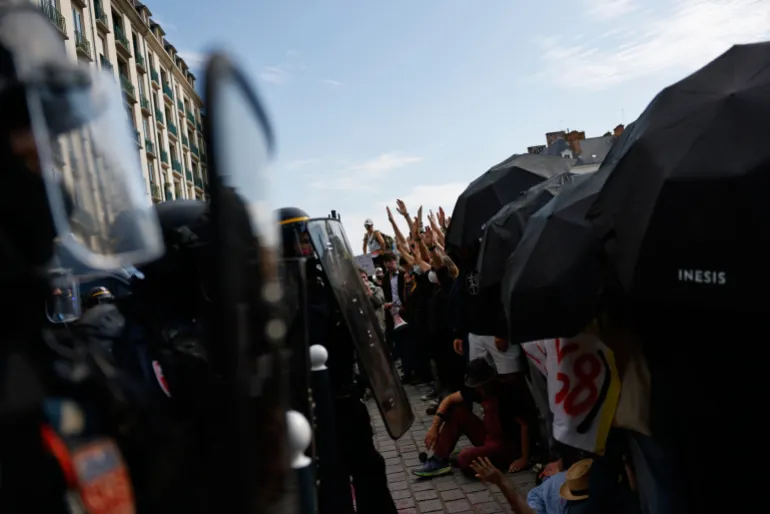
Riot police face students during a protest against under-resourced schools in Rennes, western France, on October 6, 2026 [Jeremias Gonzalez/AP]
What do protesters want?
Students have been protesting over what they say are poor conditions in France’s high schools – or lycees – especially in poorer areas. Protests have been held in Strasbourg, Bordeaux, Nantes, Marseille, Lyon and other towns and cities.
Students say absent teachers are not replaced, dilapidated school buildings are sometimes rodent-infested, there are inadequate tables and chairs, large class sizes and long classroom hours.
The intense heatwave which hit France in the summer exacerbated existing problems in neglected school buildings, which also suffer from a lack of air conditioning, school pupils say.
The protests have coincided with ongoing nationwide public sector strikes over a proposed 2027 cost-cutting budget that aims to achieve 54 billion euros ($61.3bn) in savings as Macron’s government races to bring a large public deficit under control.
Public sector staff and unions object in particular to a government plan to freeze salaries to save about two billion euros ($2.27bn).
Parents are also increasingly present at protests amid widespread anger about the police response to demonstrating minors.
But the protests are happening amid wider discontent over soaring fuel and commodity prices and reduced public spending under Macron.
Government officials have meanwhile accused political opposition groups and unionists of taking advantage of the student movement. Prime Minister Sebastien Lecornu accused political opponents last week of encouraging escalation.
What has happened so far?
At least 6,100 people had been arrested by early Tuesday, many of them under the age of 18, as police tactics come under intense scrutiny.
Serious injuries have also been reported.
A 15-year-old lost a hand in the northern city of Lens on Monday after he reportedly came into contact with a police stun grenade, which then exploded. Public prosecutors say investigations are ongoing into whether the youth actively picked up the grenade or if it landed on him.
Overall, at least 190 high school students have been injured, Education Minister Edouard Geffray said on Monday. On Sunday, he said 78 teaching staff had been injured, and 24 schools had been burned or ransacked.
Some 715 police officers have been injured, according to Interior Minister Laurent Nunez on Tuesday.
Officials said as many as 589 schools have been disrupted this week, down from 735 on Friday last week.
Rights groups, including Amnesty International, have criticised the use of force against minors amid media reports of students being hit with batons and rubber bullets, as well as sprayed with tear gas.
What happened on Tuesday?
Protesters again blockaded schools on Tuesday as thousands demonstrated over their demands.
Placard-waving crowds were reported in southern Marseille, eastern Strasbourg and other major cities.
In Paris’s 20th district, protesters outside the shut Helene Boucher lycee tipped over rubbish bins and bicycles and created a makeshift barricade, The Associated Press news agency reported. Parents, meanwhile, positioned themselves between the demonstrators and police to protect their children.
“They are our children. Teachers, parents, federations, we all share the same goal: the protection of children’s rights, and it is a legitimate right to demonstrate and to make demands,” said Emilia Sichili Suriam, one member of a parents’ association.
Interior Minister Nunez rejected criticism of the police on Tuesday, saying the response has been proportionate in “almost all cases”. He claimed that the protests were transforming into “riots”.
What does this mean for the French government?
These are only the latest in a series of high-profile protests that have marked Macron’s presidency and undermined his government’s reform efforts ahead of elections in April and May.
Macron will not run in next year’s elections, but his image and that of his government have no doubt been tainted by photos of police chasing students in the streets, France expert Jacob Ross, from the German Council on Foreign Relations (DGAP), told Al Jazeera.
“He is not taken seriously any more because many think of him as already out of government,” Ross said of Macron. “But this is still very significant for his government because it has become clear that they don’t have the capacity to calm things down. There’s clearly little fiscal room to manoeuvre.”
Macron’s terms have long been beset by political and financial instability. Successive prime ministers have faced difficulties in pushing through policies in the highly polarised National Assembly where Macron’s centrist Renaissance party and allied blocs lack a majority.
Critics have taken aim at Macron’s deeply unpopular austerity measures, which have seen drastically reduced government spending taking a toll on pensions and healthcare. Officials, however, have defended these policies amid rising debt following COVID-19-era spending.
On Sunday, Lecornu said the government had kickstarted initiatives to address the protesters’ demands and that a report was expected by the end of the month. He, however, added that Paris would not “yield an inch” to violence.
Meanwhile, frontrunner and opposition leader Marine Le Pen of the far-right National Rally party submitted a shadow budget on Tuesday promising 140 billion euros ($157.6bn) in cost savings by 2032 if elected next year.
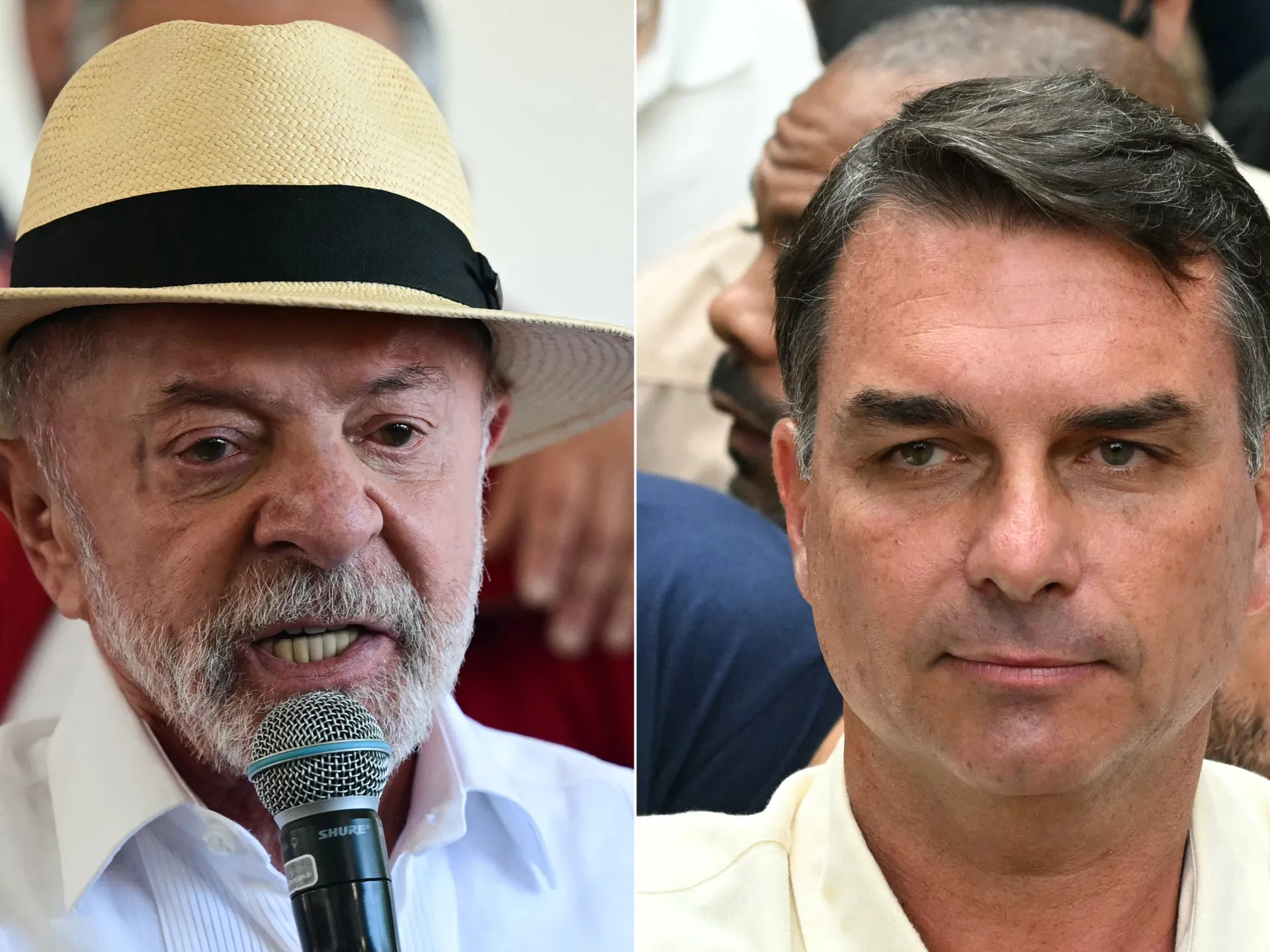
Brazil’s closely watched presidential election is heading to a second round between leftist President Luiz Inacio Lula da Silva and right-wing Senator Flavio Bolsonaro, prolonging a deeply polarised race with major implications for the country and the wider region.
Brazil’s electoral court confirmed on Sunday that the two candidates will advance to a run-off on October 25 after neither won the majority needed to secure the presidency outright, with Bolsonaro leading at 55.8 million votes to Lula’s almost 53.2 million.
Recommended Stories
list of 4 itemsend of list
Lula, 80, is seeking a fourth, non-consecutive term after a political career spanning nearly five decades.
Bolsonaro, 45, is the eldest son of former President Jair Bolsonaro and is trying to return his father’s right-wing movement to power, even as the former president serves a 27-year prison sentence for plotting a coup after losing the 2022 election.
The election comes at a pivotal time for Latin America’s largest economy. Brazilians are grappling with concerns over crime and the cost of living, while the country faces an increasingly tense relationship with the United States. The vote is also being closely watched across a region that has shifted sharply to the right in a series of recent elections.
While a second round was widely expected, the first-round result did not play out quite as pollsters had predicted.
Here are some of the key takeaways from the election so far.
Brazil is heading for another Lula-Bolsonaro run-off
With nearly 99 percent of votes reported, Bolsonaro had about 47 percent of valid votes, compared with 44.9 percent for Lula. Neither reached the 50 percent threshold needed to win in the first round.
That sets up another Lula-Bolsonaro showdown, four years after Lula narrowly defeated former President Jair Bolsonaro. This time, he will face the former president’s eldest son.
The race could be extremely close, as polling ahead of Sunday’s vote suggested Lula and Flavio Bolsonaro were roughly tied in a potential run-off.
That puts voters who backed one of the other 10 candidates in the first round at the centre of the fight for the presidency over the next three weeks.
Ronaldo Caiado and Renan Santos, who together received about 5.3 million votes, have previously said they will not endorse either candidate in the run-off.
Flavio Bolsonaro did better than polls suggested
Most polls leading up to election day predicted the race would be pushed into the second round, but had Lula finishing the first round ahead of Bolsonaro.
Instead, Bolsonaro emerged with a lead of two percentage points, raising questions about why the final polls underestimated his support.
On Sunday, Bolsonaro said the results showed that Brazilians want change.
Analysts told the Reuters news agency that Bolsonaro may have benefitted from “protest votes” from people who may have preferred another candidate but saw defeating Lula as the priority. Many had been expected to shift their support to Bolsonaro only in a second round, meaning this could have consequences for his support in three weeks.
“The protest vote foreshadows what is to come in the run-off,” political analyst Rafael Favetti told Reuters. “While this should benefit Flavio Bolsonaro now, his growth potential in the second round drops precisely because that support has already been front-loaded.”
After the results came in, Lula said the votes were “unexpected” but that he would come back stronger in the run-off.
“I admit, I was convinced I would win in the first round. The game is about to start. We are in extra time. In extra time, we will win over the Brazilian people,” the 80-year-old said.
The right had a strong night in Congress, too
Bolsonaro’s surprising performance in the first round was part of a broader show of strength for Brazil’s right.
Right-wing parties, led by Bolsonaro’s Liberal Party (PL), were performing strongly in both houses of Congress, with the PL on track to emerge as the largest force in the Chamber of Deputies and making gains in the Senate.
This included victories for other members of the Bolsonaro family, including former First Lady Michelle Bolsonaro, Flavio’s stepmother, who won a Senate seat in the Federal District, her first elected office.
His brother, Carlos Bolsonaro, was elected to the Senate in Santa Catarina.
The results show that the political movement built around former President Jair Bolsonaro – known as “bolsonarista” – remains a powerful electoral force, even with the former president barred from running himself.
“The fact that far-right candidates for the legislature have exceeded all expectations suggests a deeper popular grounding for the bolsonarista project than many expected,” Andre Pagliarini, an assistant professor of history and international studies at Louisiana State University and author of a book on Lula, told Al Jazeera.
“Millions of Brazilians right now evidently feel the right best reflects their values and vision for the future,” he added.
The congressional results matter beyond election night, too. Both houses were already dominated by conservative lawmakers, and a stronger right-wing presence could make it even harder for Lula to push through his agenda if he wins another term.
A Bolsonaro victory, meanwhile, could give him more room to pursue his own priorities, including his pledge to seek an amnesty for his father.
When Maduro was taken and arrested on January 3rd, many Venezuelans brought out the good stuff. The old bottle of rum or whiskey they’d been saving for a special occasion, believing the incursion would inevitably lead to the return of liberty in Venezuela. Nine months later, the “transition” has not been what most Venezuelans wanted. Hundreds of political prisoners were released, but that is not enough. A few laws are being reformed, but not the institutions that carry them out. Delcy remains in power despite no lawful statute allowing it nor any sort of popular mandate for her to be the head of the Venezuelan State.
Many who brought out the good whiskey have soured on the transition, or at the very least lost their shiny optimism. But the mistake was not just to believe in a future that now seems a bit naive, but to yearn for the return of a past which was the precursor to our current tragic state.
The quest for a more liberal society
Yes, we were better off before the 2000s, but we’ve never had a truly free society without clientelism or corruption. Chavismo may have perfected the art of corruption in Venezuela, but they certainly did not invent it. Venezuela, since its inception, has not been able to ameliorate the very Latin American issue of inequalities of power. We tend to forget about the problem during oil bonanzas. Everyone is doing better, right? Why worry? Then the oil price inevitably falls, the party stops, the lights turn on and we see the naked truth that we are in a horrible state of disrepair.
Many say that the Venezuelan problem is economic (lack of diversification or investment in non-oil industries), political (once high polarization and weak rule of law), or even cultural (a tendency towards el guiso). But within these lies a deeper philosophical issue: for a society that claims to love liberty and our libertadores as much as we do, we don’t actually understand what it takes to create a liberal society.
This is hardly a Venezuela-specific issue, but we are a unique case in that so much of our self-perception is based on the idea of a people who achieved freedom from the yoke of Spanish tyranny, only to then continue to liberate other countries in South America, making Simón Bolívar the most famous person in the history of the continent.
What room is there to become “more liberal” once all citizens are recognized by the law and there is universal suffrage?
To understand what it means to be a liberal society, perhaps it would be best to understand what it means to be a more liberal society. When the classical liberal revolutions of the 18th and 19th centuries took place, it was the divine right of kings that fell. The power was taken from an individual and shared amongst parliaments, which were at the time controlled almost exclusively by rich landowners (including our own first few republics). Still, this was unquestionably a redistribution of power from the individual to the few. It took a long time, but eventually this distribution of power from the one to the few became a distribution of power from the few to the many. Nowadays, democratic societies are expected to allow every single citizen to vote, but this is a reality that is younger than the oldest person alive today. When English supercentenarian Ethel Caterham in the UK was born in 1909, her mother would not have been allowed to vote.
Liberal societies today hardly even question the idea that all people should be equal in respect to the law and that we ought to have a voice in the decisions of our country through voting. So what room is there to become “more liberal” once all citizens are recognized by the law and there is universal suffrage?
It’s true that the distribution of power in liberal countries these days is much improved when compared to 100 years ago, but is it better than 50 years ago? The laws may say that all people are equal, but systems don’t seem to provide that result. Even in societies where they have nominally distributed power amongst all citizens, the power has not been really distributed amongst them nearly as well. Throughout the current Trump presidency, there have been a string of pardons for white-collar criminals who have paid patronage to Trump and his family, including the former president of Honduras convicted of drug trafficking, or a Venezuelan oligarch indicted for allegedly bribing a Puerto Rico governor.
This is a clear example of a two-tiered justice system in which if you put the right money in the right pockets, you get preferential treatment.
A post-WW2 recipe?
I use these examples to show that although there is nothing ontologically wrong with wealth inequality, especially if the rich earned that money honestly, in practice inequality in resources leads to inequality in power and inevitably abuse of that power. This is the state of Venezuela now, but it was also the state of Venezuela long before Chávez caught a whiff of power and what ultimately led a majority of voters to choose a murderer and traitor over the “democracy” that was in place.
The issue, after nearly three decades of chavismo, is that although they entered power on the basis of railing against resource and power inequalities, in the time since they’ve been in charge they’ve done nothing to ameliorate those same inequalities. The people in government have simply taken the seats of the previously corrupt politicians and become even more clientelist, leading to greater inequalities in power and resources than ever before (on top of just a generally poorer country).
The vast majority of Venezuelans can clearly see what chavismo is now, even many who used to vote for it. And though we are still not through with it, we ought to give serious consideration to what we want to replace it with. Do we want a return to bipartidismo and clientelism with high inequality? Just hoping that the price of oil rises so we can keep our population happy whilst oligarchs accrue more and more power? Or do we actually want to achieve the liberty we say we value so much?
We can imitate post-WWII States who decreased inequalities by taxing the incomes of extremely wealthy people at extremely high rates whilst maintaining a belief in free markets, property and the rule of law.
When we get rid of chavismo, we will have an even greater challenge ahead. We’ll have the challenge of rebuilding a country destroyed by decades of mismanagement, a country filled with people who have gotten their wealth by enchufándose into a corrupt system that has oppressed the voice of its people. And we’ll have to decide how we want to go about bringing back liberty. I suggest we act like the previous liberal revolutions we venerate, and distribute more power from the few to the many.
So what is the solution to power inequalities and resource inequalities?
Thankfully, there is no need to reinvent the wheel. We can copy the policies of post-WWII countries (US, Japan, France, UK, Germany, etc) who decreased inequalities in their countries by taxing the incomes of extremely wealthy people at extremely high rates whilst maintaining a belief in free markets, property and the rule of law. This has the added benefit of diversifying government incomes away from just oil revenue or sales taxes, which are regressive and hurt consumers and small businesses (I could go on and on about the economic benefits, but I’ll stick to the institutional ones here). I specify the post-WWII liberal societies here and not the communist ones, because although communist countries seek to ameliorate resource inequalities they end up increasing power inequalities which lead to just as much abuse, if not even more than hyper-capitalistic oligarchic societies.
But before we can consider which policies we ought to copy from which societies, we must adopt the attitudes and political beliefs which made those policies implementable in the first place.
The world, not just Venezuela, is at a crossroads between greater authoritarianism or greater liberalism. If we are leaders of liberalism in our continent, as we have historically perceived ourselves to be, then we ought to understand the nature of liberalism and how we ought to achieve it. If we do not have a vision of how to recreate our institutions and our general idea of what a liberal society even is, then we will surely return to the sad state we are in right now, even after we get rid of the kleptocrats sitting in Miraflores.
The solution is simple, but it’s not easy. Entrenched interests are just that; entrenched. But if the people of the country yearn for liberty and we manage to understand what it takes to attain it, then it can be done through hard work and dedication, as ultimately all worthwhile goals are achieved.
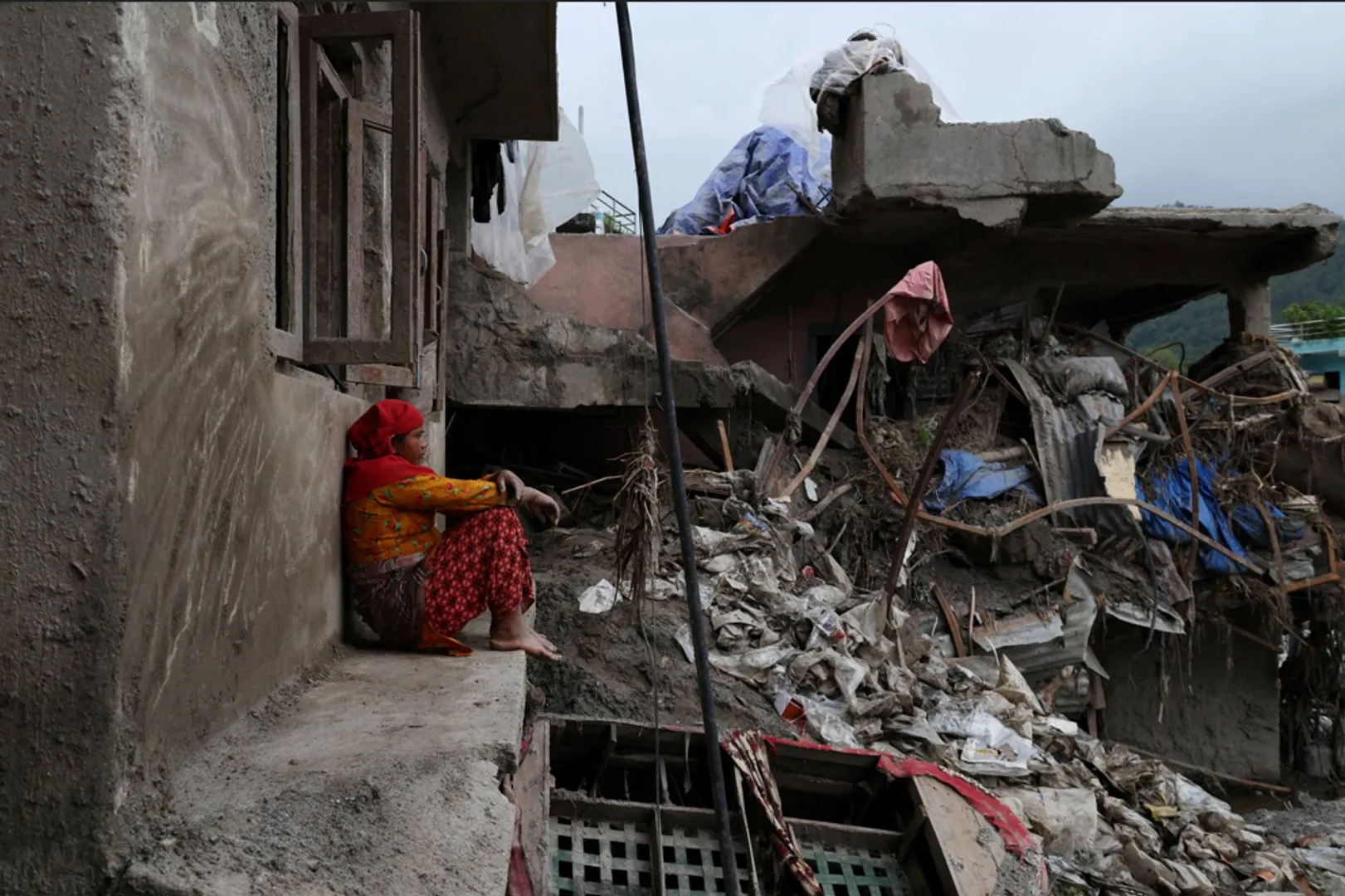
A month after catastrophic floods tore through Nepal, 5,285 people remain missing and more than 1,100 are still in holding centres. Fresh rains are now worsening conditions for displaced families living in temporary shelters, as the country faces a $4.78bn rebuilding bill.