SA Spotlight uses AI to summarize content published on Seeking Alpha. All summaries are reviewed by human editors prior to publication.
FabrikaCr/iStock via Getty Images
Specialty contractor Dycom Industries (DY) lost almost 13% of its value on Tuesday, even as it reported fiscal third-quarter results that topped the high end of its outlook. The stock traded at $190.36, down $28.01 on the day.
Dycom reported
Seeking Alpha’s Disclaimer:This article was automatically generated by an AI tool based on content available on the Seeking Alpha website, and has not been curated or reviewed by humans. Due to inherent limitations in using AI-based tools, the accuracy, completeness, or timeliness of such articles cannot be guaranteed. This article is intended for informational purposes only. Seeking Alpha does not take account of your objectives or your financial situation and does not offer any personalized investment advice. Seeking Alpha is not a licensed securities dealer, broker or US investment adviser or investment bank.
World leaders and delegates are gathering in Antalya, Turkiye, for COP31, the annual climate summit of the United Nations, which runs from November 9 to 20.
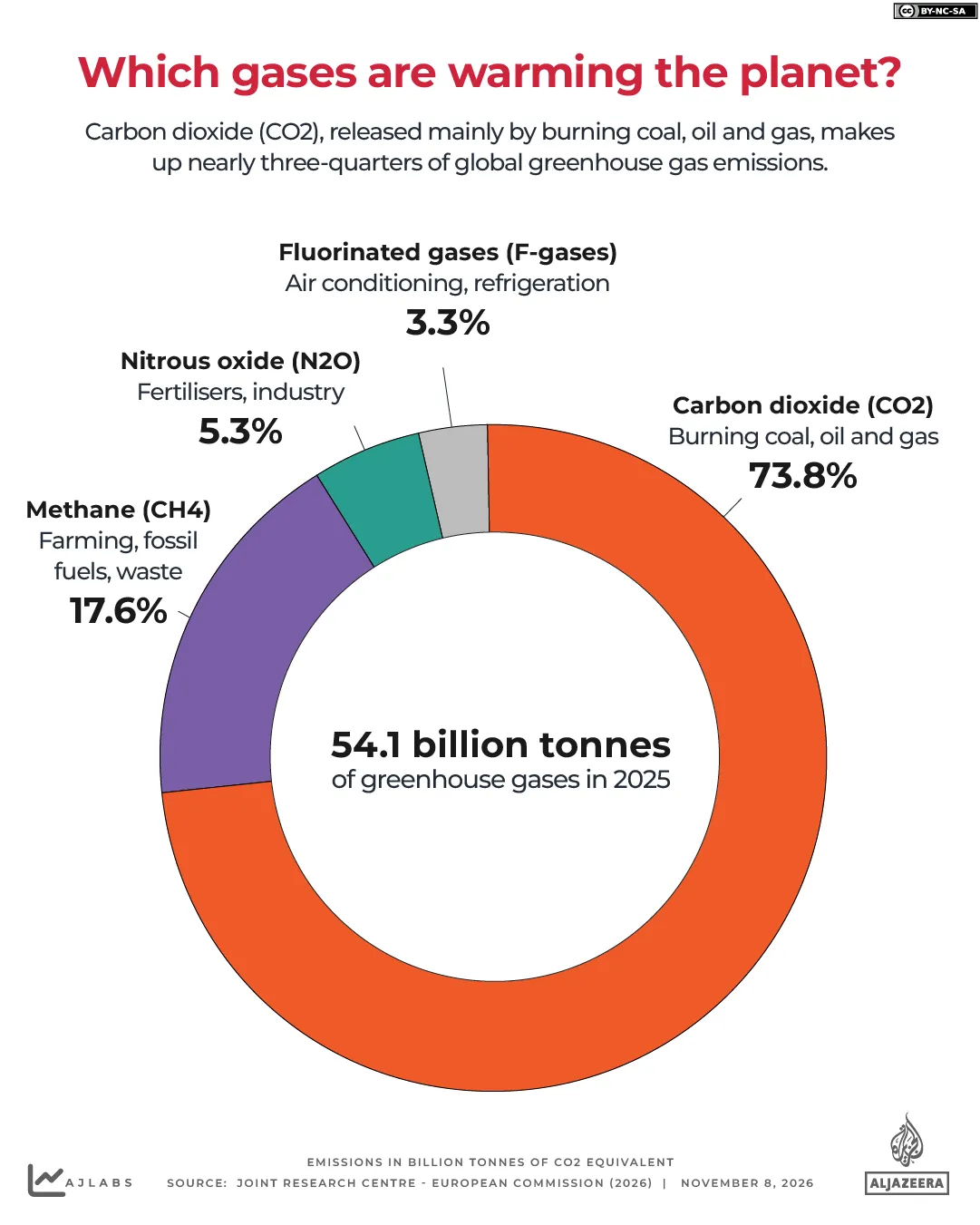
They meet as global emissions continue to climb. The world emitted 54.1 billion tonnes of greenhouse gases in 2025, 0.7 percent more than the year before and 68.5 percent more than in 1990, according to the latest figures from the European Commission’s Joint Research Centre (JRC) and the International Energy Agency (IEA).
Greenhouse gases, mainly carbon dioxide and methane, trap heat in the atmosphere, raising global temperatures and fuelling heatwaves, droughts, floods and other extreme weather conditions.
In this visual explainer, Al Jazeera breaks down which gases are warming the planet, which industries and countries emit the most, and how their emissions have changed over time.
Which gases are warming the planet?
Carbon dioxide (CO2) made up 73.8 percent of global greenhouse gas emissions in 2025. It is released mainly when fossil fuels such as coal, oil and gas are burned, while deforestation removes trees that would otherwise absorb it.
Methane (CH4) accounted for 17.6 percent of emissions that year, followed by nitrous oxide (N2O) at 5.3 percent and fluorinated gases (F-gases) at 3.3 percent.
Global CO2 emissions have risen by 76.3 percent since 1990, according to the JRC.
How is a warming planet affecting the world?
As these gases build up in the atmosphere, they trap more heat. In 2025, the heat stored in the world’s oceans reached its highest level on record, and the rate of ocean warming has increased sharply over the past two decades, according to the World Meteorological Organization (WMO).
Extreme weather has killed tens of thousands of people and forced millions from their homes in 2026, according to the WMO.
In Europe, heatwaves, droughts and wildfires between May and August caused more than 30,000 excess deaths, and 220,000 people were evacuated in France alone.
On August 26, a glacier collapse and the resulting flash flood in the Himalayas killed more than 1,500 people in Nepal along its border with China, while about 5,600 remain missing, according to the UN.
In June and July, Typhoon Bavi forced three million people to evacuate in China and killed 26 in the Philippines. Weeks later, severe Tropical Storm Maysak killed 171 people and caused more than $3bn in losses in China.
Earlier in the year, floods and windstorms across the western Mediterranean displaced more than 180,000 people in Morocco, while extreme cold and snow in North America killed 174 people.
The map below shows some of the most extreme weather events of 2026.
Where do the world’s emissions come from?
The world’s greenhouse gas emissions have more than doubled since 1970, rising from about 23 billion tonnes to 54.1 billion tonnes in 2025, according to the JRC.
The power industry, which generates electricity, is the largest source, producing nearly 30 percent of global emissions in 2025. Its emissions have roughly quadrupled since 1970, driven by soaring demand for electricity in fast-growing economies such as China and India.
Industry, including manufacturing and mining, is the second-largest source at 21 percent. This covers fuel burned in factories as well as gases released when producing cement, metals and chemicals. Industrial emissions climbed steeply in the 2000s as China’s manufacturing boomed.
Transport, including cars, shipping and aviation, is third at 16 percent.
Together, these three sectors produce about two-thirds of the world’s emissions. The rest comes from agriculture (12 percent), the extraction of coal, oil and gas (11 percent), buildings (6.6 percent) and waste (3.6 percent).
Global emissions have fallen only a handful of times since 1970, including in the early 1980s, after the 2008 financial crisis and during the COVID-19 pandemic in 2020. Each time, they rebounded.
Who are the largest emitters of greenhouse gases?
In 2025, the three largest emitters produced almost half of the world’s greenhouse gases. China emitted almost 16 billion tonnes (29.5 percent), the United States 6.02 billion tonnes (11.1 percent) and India 4.51 billion tonnes (8.3 percent).
The 27 countries of the European Union together accounted for 5.8 percent, followed by Russia (4.8 percent), Indonesia (2.5 percent), Brazil (2.4 percent) and Iran (2.1 percent).
International shipping and aviation, which fall outside any single country’s total, together produced 2.6 percent of global emissions, more than most countries.
It was not always this way. The Industrial Revolution of the 18th and 19th centuries drove up emissions first in the West, particularly in the United Kingdom and the US, as they built factories and moved to mass manufacturing. Global emissions then rose sharply after World War II and have more than doubled since 1970.
China’s emissions surged in the early 2000s as its economy boomed, and it overtook the US as the world’s largest emitter in the mid-2000s.
But measured over time, the picture changes. Since the mid-18th century, the US has produced 23.5 percent of all CO2 emissions, compared with 15.4 percent from China, according to the Global Carbon Budget.
Which industries drive each country’s emissions?
In China, the power sector is the largest source, producing 42 percent of the country’s almost 16 billion tonnes of greenhouse gases. Industry accounts for 31 percent and fuel production for 9.5 percent.
In September 2025, Chinese President Xi Jinping, for the first time, pledged to cut the country’s greenhouse gas emissions by 7 to 10 percent from their peak by 2035.
In the US, transport is the largest source at 29 percent, mostly from cars and trucks. The power sector accounts for 26 percent and industry for 14 percent.
In India, which still relies heavily on coal for electricity, the power sector produces 35 percent of emissions, followed by industry at 24 percent and agriculture at 19 percent.
Explore the table below to see which sectors produce the most greenhouse gas emissions in each country.
New Delhi, India – Both daughters of S Budhiraja live in the United States. Yet, when he and his wife head out to the market in Gurugram, a bustling business district on the outskirts of India’s capital, a young man walks beside them.
It is 26-year-old Roney Raju, their “hired grandson”.
Recommended Stories
list of 4 itemsend of list
Across Indian cities, a small but growing number of companies are now selling what families once took for granted: someone to take care of ageing people. Chores include taking them to the temple, sitting with them during a hospital visit, playing cards, or simply listening to them.
Some firms call such workers “children for hire”; others call them a “grandchild for rent”.
India, the world’s most populous country, is growing older quickly.
People over 60 made up 10.5 percent of its population in 2022, a demographic projected to nearly double to 21 percent by 2050, according to the India Ageing Report 2023 by the United Nations Population Fund (UNFPA) and the International Institute for Population Sciences.
That means about 347 million elderly Indians – a number almost equal to the entire population of the US, the world’s third most populous nation – will need specialised care by 2050.
Several Indian startups see the opportunity, with the Indian government estimating the senior care industry at about $7bn.
Raju, holding a master’s degree in social work, works for one such company in Gurugram. He has been looking after the Budhirajas for the last few months.
“I was comfortable with him from the get-go,” Budhiraja, who is in his 80s, told Al Jazeera. “I feel he understands me 200 percent.”
Raju describes the bond in the same vein. “Right now, he is family to me,” he said. The couple, he said, see him as “their proxy child, and much more than a service companion”.
The bond has deepened over the past months. When Budhiraja was admitted for surgery, Raju kept track of the doctors and the medicines. He would even call to check on them after his shift had ended.
Growing industry
Raju’s boss Gaurav Mittal says many clients actually come to treat their companions “like their own grandchildren”.
He charges 450 rupees ($5) an hour for 10 hours of service in a month, or 400 rupees ($4.5) per hour if it is 25 hours. Like a mobile phone recharge, unused hours are rolled over to the next month.
In a country with an average per capita income of about 220,000 rupees ($2,750) a year, Mittal’s service caters to a small minority of urban, financially secure families.
A companion visiting a Hindu temple with his client and her domestic help [Handout via Al Jazeera]
Mittal said the idea for his company came from home. After his father died four years ago, his mother had to leave their hometown and move in with him. She was sociable and had money to spend, but depended on family members to go anywhere.
“The world is not designed keeping the senior citizens as the central pillar,” Mittal said.
The idea for such startups, however, is not entirely new.
A 2017 report counted at least five startups offering young companions to seniors. In 2022, the late Ratan Tata of the Tata Group promoted a Mumbai-based startup whose tagline says: “Everything Grandkids Do!”
The companions who work for these companies undergo police verification before they start working for a senior person. Before working alone, they often shadow a senior staff member on home visits.
Most companions are trained in psychology, social work or hospitality.
Vinay Kumar works as a companion for a firm based in the southern city of Hyderabad.
“We are not just taskmasters, but we develop a relationship with our clients. We support them and spend quality time with them so that they don’t miss their close ones,” he told Al Jazeera. “They may still do, but we try.”
Lonely seniors
The 2023 United Nations Population Fund (UNFPA) report projects that older Indians will outnumber the country’s children by 2046. And many of these seniors are lonely.
In 2022, India conducted the Longitudinal Ageing Study, a national survey of more than 72,000 people. It found that 20.5 percent of middle-aged and older adults reported moderate loneliness, while 13.3 percent categorised their loneliness as severe.
Among people over 60 who lived alone, more than a third (37 percent) reported feeling lonely, the study found.
Globally, a study commissioned by the World Health Organization in 2025 found that loneliness affects one in six people and is linked to about 871,000 deaths a year.
Santosh Abraham, CEO of a Bengaluru-based startup founded in 2015, says while the children of elderly people are worried about medical emergencies or market errands, their parents mostly had a different concern.
“I am lonely, I don’t have anyone to talk to,” Abraham recalled one of his clients as saying. “I have done so much for my family and society; there is no recognition for it.”
Abraham said the most common request he gets is one that “nobody says out loud”.
“A senior calls us claiming to feel unwell. A care manager arrives, finds nothing wrong, and is then asked to sit and talk for an hour,” he said. “They just want company.”
Kumar said companions like him have to “understand their pain”.
“Most of the seniors who are living alone are very lonely. They want someone to play cards or indoor games with. Someone wants to go to a movie, or a temple, or parks, or attend local programmes,” he said.
Abraham said some seniors find a stranger easier to confide in. “With a companion, there is no baggage,” he told Al Jazeera.
For the young people doing the work, the line between their job and a relationship blurs quickly.
Raju says the visits to the Budhirajas are harder than office work. “Forming an emotional connection is never easy and is different each and every time,” he said.
Kumar, in Hyderabad, agrees. He said his clients often tell him about health problems that they hide from their children living in another city or abroad so as not to worry them.
He recalled a client who went from shutting the door on his face because he did not know English or Hindi to paying for his driving lessons and introducing him to people as his “god-gifted son”. When the man died in 2023, his son asked Kumar to perform the final rites alongside him.
Kumar once even cut short his 12-day marriage leave because one of his clients kept calling, asking him to come. “I genuinely feel these seniors are my own parents and grandparents,” he said.
‘Older person feels seen, heard, safe’
Others are more cautious about what the job demands.
Prashanth Reddy, founder of the Hyderabad-based company that Kumar works for, said companions must understand boundaries.
“Companions are there to provide support, not to replace doctors or mental health professionals,” he said.
Abraham agreed. He said he underlines one golden rule during his training sessions with aspiring companions: “Talk less and listen more.”
The children of such elderly people who buy the services of these companies say paying takes out the awkwardness of asking neighbours or relatives for help.
“When you pay for a service, you don’t have to feel like you’re asking someone for a favour,” says Vinnay K, a US-based software professional, who has been hiring a companion for his ageing mother for five years.
Shilpa Bandyopadhyay, assistant professor at Jindal Institute of Behavioural Sciences near New Delhi, told Al Jazeera that hiring a companion “should not automatically be interpreted as evidence that their families have failed”.
She said a growing demand for professional elderly care raises harder questions about a family-centric society like India’s.
“Do we recognise ‘companionship’ as a legitimate and continuing need of our older family members or see eldercare mainly as food, shelter, healthcare and physical help?” she asked.
She argued for “a more balanced ecosystem of ageing” that brings together families, community networks, accessible public spaces and affordable professional services, without romanticising traditional family structures or dismissing new ones.
“At the end of the day, the question isn’t who lives with an older person,” she said, but “rather whether the older person feels seen, heard, safe, valued, and meaningfully connected”.
Back in Gurugram, Budhiraja is asked how he would feel if Raju did not show up for work tomorrow.
“I will make sure he comes after finding out why he couldn’t come,” he said. “I need him. As you grow older, the needs are more.”