Indias

India’s youth have broken Modi’s spell | Opinions

The recent uprising of the youth in India might seem to have subsided after forcing Dharmendra Pradhan, the education minister of India, to resign. Still, he was never the true target of this historic youth revolt. The slogans, the placards, the irreverent digital art and the collective anger of the young were directed at one man alone: Narendra Modi.

There exists a pervasive prejudice among the intelligentsia that young Indians today are politically indifferent, consumerist and unconcerned with politics or the erosion of democratic norms. The events at Jantar Mantar have laid bare the shallowness of this assumption. The young harboured no illusions about the nature of this regime. They understood with absolute clarity that in the present constitutional setup, no minister possesses independent agency.

The Indian state today has been reduced to a single face, a single voice and an unyielding hub of authority: Narendra Modi. To demand the resignation of a minister, therefore, was not an administrative plea; it was a deliberate act to compel the supreme leader himself to yield.

Walking through Jantar Mantar, the protest site in central Delhi, occupied by thousands of young people for weeks, one could not escape this truth. What these young people achieved was nothing short of the iconoclasm of our times: the systematic demolition of the carefully curated, mythic public persona that this regime has spent a decade building as the sole visage of the nation.

What was most remarkable about this uprising was its radical decentralisation.

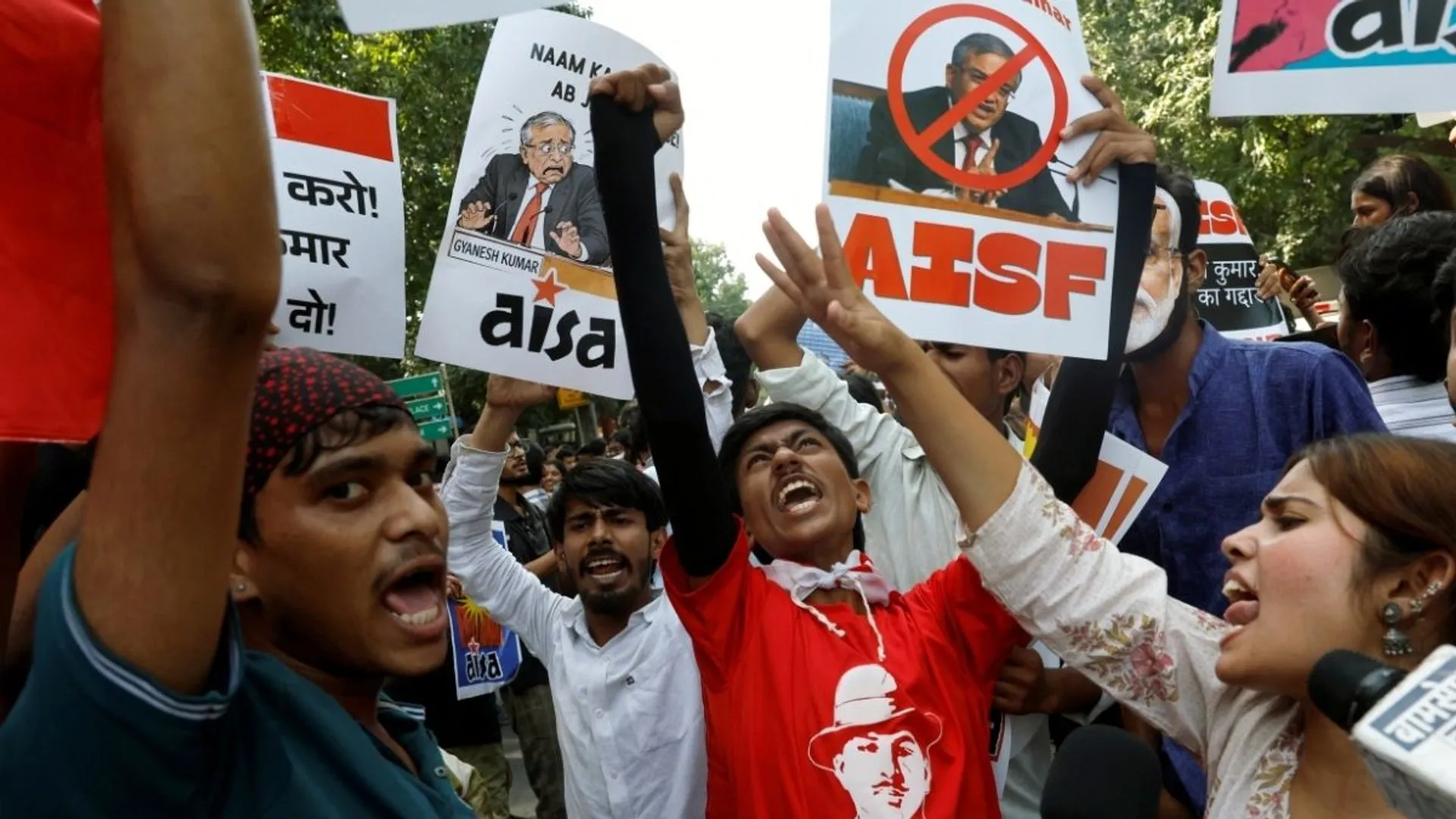
There were no high-budget, professionally printed banners. There was no vanguard organisation dictating the visual language of the protest or distributing uniform slogans for the benefit of television cameras. Scraps of cardboard, discarded paper and cheap marker pens sufficed. Each placard bore the unmistakable, authentic imprint of individual moral agency.

Yet, beneath this extraordinary heterogeneity, there remained an unwavering thematic unity.

Everything revolved around Modi.

The prime minister was mocked, caricatured and systematically stripped of the sacral aura that had been constructed around him for more than 10 years. In a matter of weeks, this generation transformed an imposing figure of state authority into a subject of collective laughter.

The young were outraged, above all, by the sheer, unbridled arrogance of power.

This uprising did not spring from material grievances alone; it arose from a profound sense of humiliation. The immediate symbolic spark was the deeply insensitive remark made by the chief justice of India, who publicly compared unemployed young people to “cockroaches”.

Coming after years in which the higher judiciary has increasingly appeared less like an independent guardian of the Constitution and more like an extension of executive power, the remark was understood as an articulation of the regime’s own contempt for its youth.

The formation of the “Cockroach Janta Party” (CJP) was an act of counter-humour born of deep injury. The already unfolding scandal over irregularities in the NEET examinations provided the movement with a concrete institutional focal point. The scandal became the occasion to demand accountability not just for a single test, but for an entire culture of governance.

The regime, meanwhile, suffered from its own hubris. It had persuaded itself that Indian society was thoroughly managed. Preoccupied with engineering electoral outcomes through the manipulation of rolls, managing parliamentary majorities through party defections, and consolidating its hold over state institutions, it failed to notice the quiet, gathering storm beneath the surface.

Those who possessed platforms, prestige and the power to shape public discourse were engrossed in celebrating the grand narrative of national glory. Television studios debated the nation’s civilisational destiny and its global standing. The mainstream press sang panegyrics to a “New India”. Scarcely anyone looked towards the young who found every avenue of mobility blocked. Their anxieties were rendered invisible because the state and its allied media did not consider them worthy of serious democratic attention.

Deprived of traditional spaces, they constructed their own. Their smartphones became their public square; social media platforms became their political assemblies; and satire became their primary democratic vocabulary.

The ruling ideology had convinced itself that the project of cultural hegemonisation was complete: once the majority was mobilised around a politics of religious identity and grievance against minorities, material realities would cease to matter. The aspirations, anxieties and dignity of an entire generation simply did not figure in this political imagination.

It was against this backdrop of institutional indifference that Sonam Wangchuk began his fast at Jantar Mantar. The government’s initial response was its standard weapon: calculated silence. As Wangchuk’s health deteriorated, the refusal to even acknowledge his presence generated profound moral outrage. Then came the fateful decision to forcibly remove him.

It proved to be a fatal miscalculation. The young perceived the treatment of Wangchuk as an insult to their own citizenship. What was done to him could be done to anyone who dared to stand up. His humiliation became their collective provocation. The response was immediate: Jantar Mantar was flooded by thousands of young bodies.

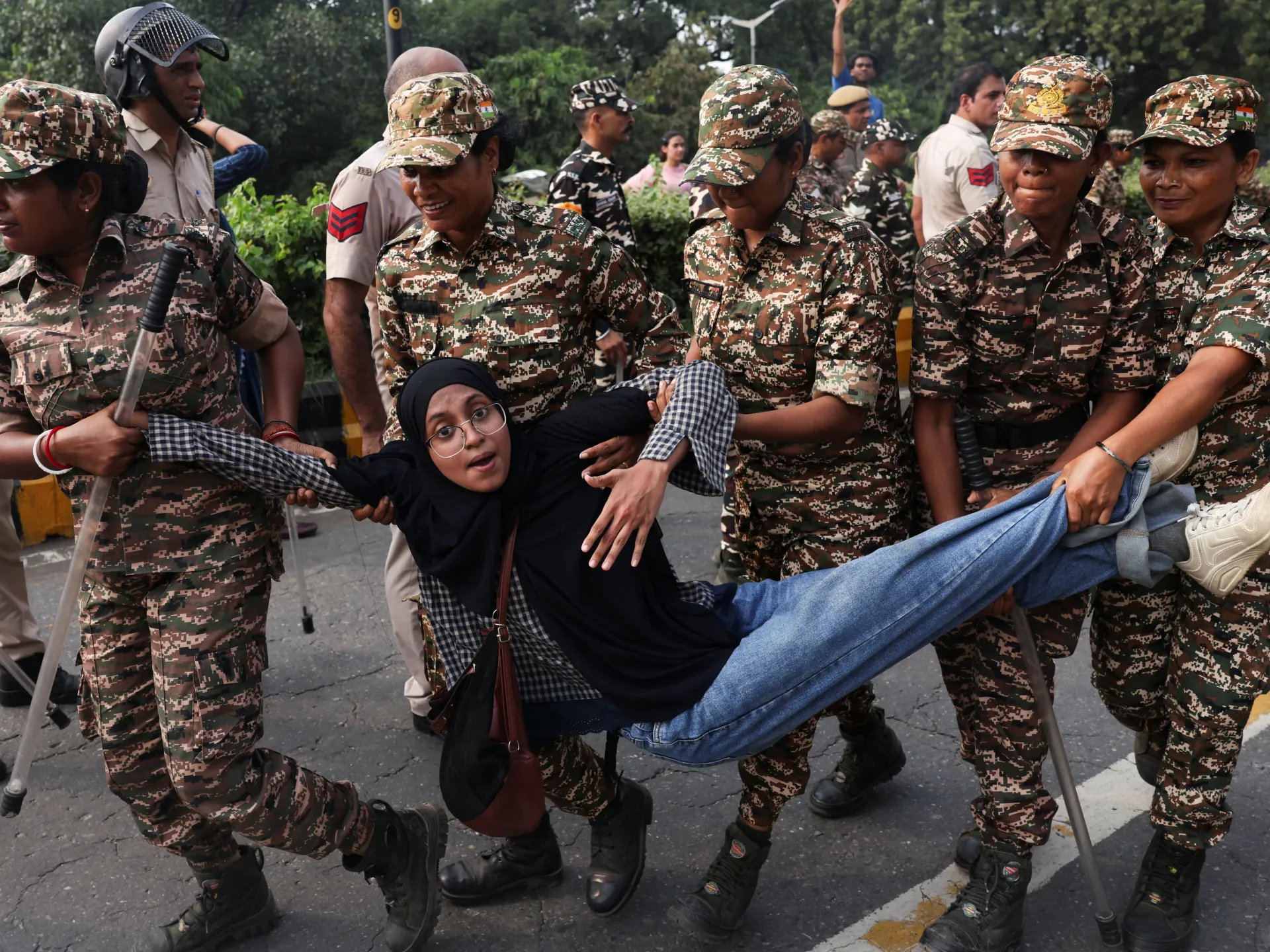
When the young marched towards parliament on July 20, the state relied on its familiar playbook: barricades, prohibitory orders and violent suppression. It had deployed these very methods against the anti-CAA protesters and the farmers’ movement. But this time, the internal mechanics of fear failed to operate. The blows they received did not shatter their spirit; they deepened their moral clarity.

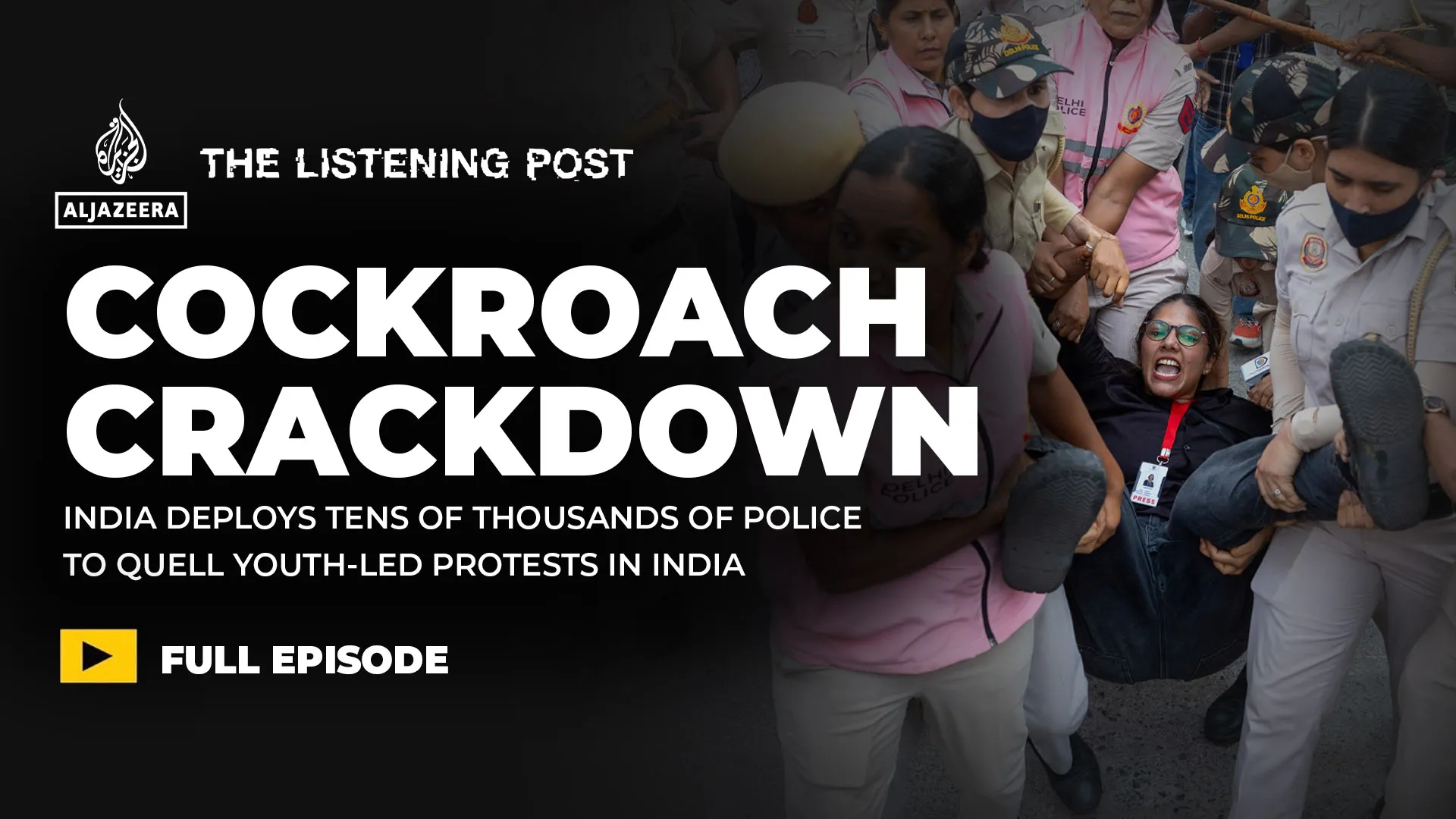
Their struggle was not merely about securing a policy change or extracting a routine administrative concession. They set out to breach that institutional arrogance. When the Delhi police rained blows on the protesters on July 20, beating young citizens with a ferocity typically reserved for enemy combatants, the protesters did not view those batons as the instruments of an indifferent police force. They recognised them as the direct expression of Narendra Modi’s political will.

Yet, fear failed to perform its intended historic function. Many returned to Jantar Mantar carrying their wounds like badges of honour. Some returned barefoot. Their injuries became symbols of moral persistence rather than reasons for retreat. Their resolve was remarkably simple: they would force Modi to sacrifice one of his own.

Crucially, the protesters refused to yield to the temptation of violence. Their weapons remained language, images and satire. Armed with their phones, they launched an unrelenting assault on the prime minister’s public image, the very asset he has guarded most fiercely throughout his political life. For the first time, Modi was drawn onto a battleground where he could not dictate the rules.

When the prime minister attempted to intervene directly on social media, addressing the youth as “friends”, the rebuttal was instant and devastating:

“We are not your friends.”

It was more than a clever slogan; it marked the psychological collapse of a carefully cultivated paternalistic relationship. For years, Modi had sought to speak directly to the populace, bypassing mediating institutions and independent media. The young rejected that calculated intimacy in a single sentence. The authority of the patriarch dissolved into the irreverence that a free people reserve for their elected officials. The spell of fear was broken.

The assault on Modi’s public image appears to have shaken the regime far more deeply than any routine electoral setback ever could. For more than a decade, his authority has rested not merely on the coercive power of the state, but on the illusion of invulnerability: an image of a leader who never retreats, never admits error and never compromises.

The movement had to be contained before the satire hardened into permanent collective memory and the laughter of the young became the common language of the republic.

Pradhan’s resignation must be read precisely in this light. It is not the sacrifice of a minister; it is a desperate attempt to construct a firewall around the prime minister himself. The government will undoubtedly frame this as evidence of its responsiveness and democratic sensitivity. But the young understand it differently. For them, the resignation is a political concession extracted from an authority that had run out of options.

Before arriving at this point, the state had exhausted its standard repertoire of delegitimisation. It ignored the movement, questioned its motives, accused the youth of being proxies for opposition parties and deployed its media networks to allege foreign plots. When these slurs failed to stick, it resorted to force. Having endured all of this, the young do not view the minister’s exit as an act of state benevolence; they see it as the reluctant admission of a defeat that could no longer be disguised.

Ordinarily, the vocabulary of victory and defeat should not dominate a constitutional democracy. A government is expected to listen to its citizens, not view them as adversaries to be crushed. Dissent is not treason. But when a state consistently treats criticism as hostility and peaceful protesters as enemies of the state, it transforms democratic dialogue into a confrontation. When that happens, it cannot complain if citizens celebrate its retreat as a democratic victory.

The ultimate significance of this movement lies in its moral and creative form. The young answered state coercion with speech, wit, art and an extraordinary mastery of contemporary cultural forms. Their elders have often lamented that a generation raised on short-form content lacks political depth and endurance. Jantar Mantar has demolished that patronising assumption.

The meme was elevated to a potent instrument of political resistance. Laughter accomplished what solemn political rhetoric often fails to do: it punctured fear, dismantled false authority and deprived power of the uncritical reverence upon which authoritarian politics depends.

Authoritarianism requires not just obedience, but awe. It survives as long as people believe the ruler is beyond challenge, beyond satire and beyond defeat. The young at Jantar Mantar refused to grant Narendra Modi that sacral status. They restored him to the position he must occupy in a constitutional republic: an ordinary, accountable political leader, subject to the scrutiny, criticism and satire of the citizenry.

The protest site at Jantar Mantar may now be empty. The barricades have been moved aside and the crowds have returned to their hostels, campuses and homes. But movements of this nature do not end when the physical space is vacated. The critique inaugurated on the streets will continue in countless quiet spaces: university libraries, rented rooms, bus rides and millions of illuminated screens. The language that has been discovered cannot easily be unlearned.

If this youth uprising leaves behind an enduring lesson for the republic, it is a simple, fundamental truth: democracy begins the moment a people recover confidence in their own voice.

The views expressed in this article are the author’s own and do not necessarily reflect Al Jazeera’s editorial stance.

Source link

India’s education minister resigns after massive youth-led protests

Supporters of the youth-led political movement Cockroach Janta Party celebrate the resignation of Education Minister Dharmendra Pradhan. Photo by Divyakant Solanki/EPA

July 25 (UPI) — India’s education minister resigned Saturday amid a scandal that led hundreds of thousands of young people and students to the streets in one of the country’s largest protests.

Demonstrations began in New Delhi in early June, after it came to light that answers to one of the country’s most prestigious college-entrance exams, taken by millions of students, had been leaked.

At least a dozen students died by suicide after the government announced they would have to retake the exam.

The protests, organized by the youth-led Cockroach Janata Party, swelled to hundreds of thousands of people across the nation early this week, forcing the hand of Prime Minister Narendra Modi‘s government.

“This is one of the most historic days for our country,” one protester, Rochelle Cope, told The Guardian. “For the first time in 12 years, someone from the government has been held accountable for wrongdoing. And it wasn’t political parties that did this — it was the people.”

The education minister, Dharmendra Pradhan, said in his resignation letter “the events of the past ten days have saddened me deeply.”

“During this period, individuals holding responsible positions also tried to mislead many students and create obstacles, which caused me deep anguish,” he said in a statement.

Pressure began to grow this week after police brutally cracked down against protesters, using tear gas and batons to clear them out.

Opposition leader Rahul Gandhi said he would raise the issue in India’s parliament, holding Home Minister Amit Shah “directly responsible for the violence inflicted.”

“He authorized the firing on our students, authorized the use of lethal weapons, and authorized the use of pellet guns against them,” Gandhi told the BBC. “That’s a fundamental issue.”

Modi’s government announced late Saturday that the education ministry would be assigned to Pralhad Joshi, who’s already the minister for consumer affairs, food and public distribution, as well as new and renewable energy.

Following the education minister’s resignation, leaders for the protests instructed the crowd to disperse.

“All our demands have been accepted, so we request the protesters to withdraw immediately and return home peacefully,” Saurav Das, a spokesperson for the Cockroach Janata, told reporters.

Source link

India’s youth protesters are fighting Modi with irreverent humour and memes | Social Media News

India’s young protesters are mocking their government. And the jokes are landing.

As thousands of demonstrators take to the streets in the Indian capital, they are waging a parallel campaign online, flooding social media with memes, parody videos and self-deprecating jokes.

Recommended Stories

list of 4 itemsend of list

In doing so, they are also beating Narendra Modi – the powerful but image-conscious prime minister – at his own game.

A protester holds a placard with the message "Every Joke is a Tiny Revolution" during a demonstration demanding educational reforms as part of the Cockroach Janta Party's ongoing protest movement in New Delhi, India on July 23, 2026.
A protester holds a placard during a demonstration in New Delhi, on July 23, 2026 [Verda Sabzwari/AP]

Modi built his political brand through social media. Now protesters are using that same platform to mock his administration, ridicule pro-government television news coverage, transform confrontation with police into viral content and seize control of the online narrative.

The campaign has taken the protests demanding accountability and education reforms beyond the streets, broadening its reach and intensifying pressure on a government wary of appearing to yield to a rapidly growing youth movement.

Strava streaks and Subway Surfers

The “Cockroach” movement’s digital campaign has been largely powered by humour.

Clashes with police have become viral content. Videos showed protesters joking about keeping their Strava streaks alive — a reference to the fitness tracking app used by runners — as they ran from police baton charges.

Others edited footage of themselves dodging police barricades to mimic the popular endless runner mobile game Subway Surfers.

Some women have borrowed influencer culture, posting “get ready with me” videos before marches and “fit check” posts featuring helmets, goggles and other homemade protest gear. Other protesters have created spoof videos mocking pro-government television anchors and their dramatic style of broadcasts that have labelled the protesters “anti-national” and “foreign-funded conspirators”.

A protester holds a placard with a portrait of Indian Prime Minister Narendra Modi draped in a saree, a traditional garment for women in India, during a demonstration as part of the Cockroach Janta Party's ongoing protest movement in New Delhi, India on July 23, 2026.
A protester holds a placard with a portrait of Modi draped in a saree, a traditional garment for women in India, during a demonstration in New Delhi, India on July 23, 2026 [Verda Sabzwari/AP]

Several protesters spoke to The Associated Press on the condition of anonymity for fear of reprisals from authorities.

One 25-year-old protester said the memes are more than comic relief; they are a way of coping. She sees them as a generational trait.

Unlike older generations, who learned to endure hardship, hers has little patience for “simply putting up with it,” she said.

“If our phone data runs out, we can’t even bear that. So we’re definitely not going to tolerate this,” she said, referring to Monday’s police crackdown on protesters in the capital.

‘We find speeches boring’

The street protests erupted a month ago, fuelled by anger over a string of exam scandals, including the illegal sharing of entrance exams for the national medical programme.

Young people say the scandals have jeopardised their futures and eroded trust in the education system. They blame Education Minister Dharmendra Pradhan, who resigned on Saturday.

But the demonstrations have expanded into wider anger over government accountability, spreading to other cities.

Much of that expansion has been driven by the Cockroach Janta Party (CJP), a satirical group that started the movement two months ago. Through memes, humour and satire, it has given younger Indians a new way to express their frustration with the government and helped turn a single-issue campaign into a broader youth movement.

A protester holds a placard with a portrait of Prime Minister Narendra Modi along with the text "Can't See Your Democracy, My Lashes are Too Long" during a demonstration as part of the Cockroach Janta Party's ongoing protest movement in New Delhi, India on July 23, 2026.
A protester holds a placard with a portrait of Modi along with the text “Can’t See Your Democracy, My Lashes are Too Long” during a demonstration in New Delhi, India, on July 23, 2026 [Verda Sabzwari/AP]

At the main protest site in New Delhi, that influence was hard to miss.

Some protesters marched in Spider-Man masks and Batman costumes, carrying tongue-in-cheek placards. Other protest signs echoed the irreverent tone of social media, with memes and pop culture references woven into the demonstrations.

One poster featuring the education minister asked: “When will AI take his job?” Another captured the movement’s spirit with the slogan: “Every joke is a [tiny] revolution.”

Some slogans and posters took on an overtly profane and risque tone. A 23-year-old student said the protesters were simply speaking the language of their generation.

“We find speeches boring, we are the summary generation. We have a habit of consuming things in a short span of time, so we are using the same ways to put our message across,” she said.

Jokes now target Modi

For Modi, who is entering his 13th year in office, the protests present an unusual challenge.

His image is built on strength and decisiveness, but he risks alienating young people if he responds too forcefully. Nearly half of India’s population is under 25, making young voters one of the country’s most influential electoral groups.

A protester holds a placard with a portrait of Indian Prime Minister Narendra Modi and the text loosely translated as "Open the Door Friends, I Bring Bad Times" during a demonstration demanding educational reforms as part of the Cockroach Janta Party's ongoing protest movement in Pune, India on July 24, 2026.
A protester holds a placard with a portrait of Modi and the text loosely translates as “Open the Door Friends, I Bring Bad Times”, at a protest in Pune, India on July 24, 2026 [AP]

But the protests have broken a longstanding taboo: mocking Modi himself.

Jokes about Modi were rare during earlier protests, when his government was criticised for suppressing dissent. But now, even he has become a target of taunts.

Modi’s gestures, pauses and mannerisms have been turned into viral edits that turn his own words into political jokes.

When Modi released a late-night, selfie-style video on Thursday addressing the protesters, he promised swift legal action against those responsible for leaking academic or job exams.

But many internet users edited the clip with parody voiceovers and references to his past promises they said had gone unfulfilled.

Protestors take part in a demonstration demanding educational reforms as part of the Cockroach Janta Party's ongoing protest movement in New Delhi, India on July 23, 2026. (AP Photo/Verda Sabzwari)
Protesters take part in a demonstration in New Delhi, India, on July 23, 2026 [Verda Sabzwari/AP]

One video went particularly viral.

Modi’s original address began with him referring to the protesters as “friends”. A parody video kept that opening, and abruptly cut to three young girls staring into the camera and responding: “No, we are not.”

A 21-year-old student said there is no better way to challenge Modi than by using social media that helped build his political brand.

“We are just answering him in his language,” he said.

Source link

India’s Youth Protest Leaders Hold Government Talks

Leaders of India’s youth-led “Cockroach” movement are set to hold talks with government representatives on Friday in an effort to resolve a growing political crisis triggered by national examination paper leaks. Despite the dialogue, protest leaders have made clear that nationwide demonstrations will continue until their key demands, including the resignation of Education Minister Dharmendra Pradhan, are met.

The negotiations come after activist Sonam Wangchuk ended a 26-day hunger strike overnight, raising hopes of a possible breakthrough in the weeks-long standoff that has brought tens of thousands of young protesters to the streets of New Delhi.

The movement has become the biggest youth-led challenge to Prime Minister Narendra Modi since he first took office in 2014. Opposition parties have backed the protesters’ demands and disrupted the ongoing monsoon session of parliament, turning the issue into one of the most significant political crises of Modi’s third term.

Government and Protest Leaders Prepare for Talks

Representatives of the self-styled Cockroach Janta Party (CJP), which emerged from an online satirical movement into a nationwide protest campaign, will meet government ministers at a neutral venue.

Stay ahead of the geopolitical week.

MD Briefing delivers expert analysis across five global fronts — the Indo-Pacific, energy, geoeconomics, European security, and the Middle East — every Monday morning. Free.

CJP spokesperson Saurav Das said the movement hoped the government would engage seriously with protesters’ concerns.

“We hope that the government comes with an open mind and listens to the people of this country who have been on the streets for so long,” Das told reporters. “We will explain our demands in greater detail, and we hope the government will respond positively.”

However, he stressed that negotiations would not halt the movement.

“We are not backing out,” Das said. “Real change begins at the grassroots, and that is exactly what we intend to continue.”

Education Minister’s Resignation Remains Central Demand

While the government has indicated its willingness to continue discussions, protesters insist accountability must begin with the removal of Education Minister Dharmendra Pradhan.

Thousands gathered again at Delhi’s Jantar Mantar protest site on Thursday, where demonstrators vowed to remain until Pradhan resigns.

“We will continue protesting until Dharmendra Pradhan is removed,” protester Sudesh Singh said. “If we stop now, we compromise the future of millions of students.”

The demonstrations were sparked after authorities cancelled the National Eligibility cum Entrance Test (NEET), India’s highly competitive medical entrance examination, following the discovery that question papers had been leaked. Nearly two million students were affected by the cancellation, triggering widespread anger over repeated failures in India’s examination system.

From Online Satire to National Movement

The Cockroach Janta Party began as an online satirical campaign involving only a few hundred young supporters. It rapidly evolved into a nationwide movement after the examination scandal, attracting millions of followers on social media and drawing large crowds to protests across the country.

Monday’s march toward parliament saw tens of thousands of protesters defy restrictions before clashes broke out with police, who used tear gas and batons to disperse demonstrators.

Further confrontations occurred on Wednesday night when more than 10,000 people gathered in central Delhi.

Analysts say the movement reflects broader frustrations among India’s youth over limited employment opportunities, repeated examination scandals and declining confidence in public institutions.

Security Tightened Across the Capital

Authorities have significantly increased security measures around the protests.

The Delhi Metro Rail Corporation announced that 17 metro stations in central Delhi would remain closed again on Friday, marking the third major shutdown of the capital’s transport network this week.

Mobile internet services around the protest area were also disrupted, with Reuters journalists reporting patchy connectivity throughout Friday morning.

Officials say the restrictions are necessary to maintain public order, though protesters argue they are intended to suppress demonstrations.

Prime Minister Narendra Modi announced on Thursday that his cabinet would consider legislation aimed at strengthening punishment for those responsible for examination paper leaks.

The proposed amendments would seek faster prosecutions and tougher penalties for individuals involved in leaking examination papers.

Protest leaders, however, argue that stricter punishments alone will not solve the problem.

They say systemic reforms are needed to restore confidence in India’s examination process and prevent future leaks before they occur.

Political Stakes Continue to Rise

The protests have quickly evolved from a dispute over examination integrity into a broader political challenge.

Opposition parties, led by the Congress Party, have embraced the movement’s demands, seeing an opportunity to pressure Modi’s Bharatiya Janata Party (BJP) ahead of several important state elections scheduled for next year, including contests in Uttar Pradesh, Gujarat and Punjab.

Political analysts warn that the growing movement could reshape India’s political landscape if the government fails to address the concerns of young voters, who form a crucial part of the BJP’s electoral base.

The protests have also been accompanied by an unprecedented surge in online criticism, memes and satire targeting Modi, reflecting what observers describe as diminishing public hesitation to openly challenge one of India’s most influential political leaders.

Friday’s talks may provide the first opportunity for both sides to de-escalate the crisis, but with demonstrations set to continue regardless of the outcome, pressure on the government is unlikely to ease in the near term.

With information from Reuters.

Source link

‘Televising our revolution’: India’s Gen Z flips Modi’s social media game | Protests

New Delhi, India — She darted through a sprinting crowd, running from a cloud of tear gas just above her head. Her eyes stung so badly she could barely see, yet she filmed the chaos on her phone.

“I saw policemen brutally beating up unarmed girls and peaceful children,” said Avanshika Singh, who has been turning up for student protests that shut down the national capital, demanding the education minister’s resignation.

On her return home, the 18-year-old put together a rough cut from the chaos and captioned it on Instagram: “Today, we rang Parliament’s doorbell and ran.”

The march to the Indian parliament on July 20 against serial examination paper leaks brought the nation’s capital to a standstill as tens of thousands of protesters occupied central roads leading to the country’s corridors of power. More than 100 students were injured in a crackdown by police, operating under the direct instructions of Prime Minister Narendra Modi’s government.

But since then, Indian internet has turned into a relentless reel of police excesses: shaky smartphone footage, rapid-fire edits pulsing to hip-hop tracks, and a tidal wave of memes and expletives.

“This is the only thing anyone is talking about. If nothing, we are televising our revolution,” Singh, a teenager, told Al Jazeera, standing amid a sea of protesters choking Parliament Street on Wednesday. “The entire country today feels the sting of batons and tear gas with us.”

Twelve years ago, Modi rode to power and pioneered in many ways, leveraging social media platforms to reach the masses. Today, Gen Z is flipping his Hindu majoritarian party’s dominance on social platforms, weaponising against it the very tools the Bharatiya Janata Party has long relied on.

“Hating Modi is cool on the internet now, after years of criminalising dissent,” she said, before bursting into slogans: “Uncle Modi, go back, go back.”

A woman holds a sanitary pad with a slogan in solidarity with India’s Cockroach Janta Party protests held at Jantar Mantar in New Delhi, which demand the resignation of Education Minister Dharmendra Pradhan over exam paper leaks, in Kolkata, India, on July 22, 2026
A woman holds a sanitary pad with a slogan in solidarity with India’s Cockroach Janta Party protests held at Jantar Mantar in New Delhi, which demand the resignation of Education Minister Dharmendra Pradhan over exam paper leaks, in Kolkata, India, on July 22, 2026 [Sahiba Chawdhary/Reuters]

Evidence of police excess

After the July 20 demonstrations against the government’s handling of paper leaks, the police denied all the protesters’ allegations and media reports of excess force in the crackdown.

But by then, social media was flooded with evidence, recorded by the protesting students.

A New Delhi police officer thrusting a baton on a female protester’s back; usage — potentially by a paramilitary force that was deployed alongside the police — of lethal pellet guns, for the first time in the national capital; a mother crying and pleading with dozens of police officials; another officer slapping and chasing unarmed students; police officers wearing Meta glasses; law enforcement agents planting a damaged car outside a protest strip; and footage where an officer casually trips the students running from tear gas.

No sight escapes the cameras at the Jantar Mantar protest strip, where thousands of protesters keep recording round the clock. The visuals from July 20 have prompted protests across India, in cities like Mumbai, Bengaluru, Patna, Lucknow and Aizawl.

The Cockroach Janta Party, a political pressure group that has been leading the students’ protest, has said the demonstrations would continue “peacefully” until three demands are met. They want Dharmendra Pradhan, the education minister, to resign; for the Modi government to assure that no criminal cases would be pursued against protesters; and for compensation of about $105,000 for families of students who died by suicide due to exam paper leaks and cancellations.

Niharika Soni, a 19-year-old, stood among the thousands-strong crowd that occupied Parliament Street on Wednesday, distributing water bottles to protesters. She did not take part in the July 20 march and did not care much about it either.

Then, the visuals appeared on her feed.

“My mother and I cried for two hours, watching the videos together at home,” she said, adding that her mother has been a staunch supporter of PM Modi.

“We hugged each other and come here every day now,” she added, now holding her mother’s hands, as part of a human chain, ready to confront government forces if attacked.

A supporter of India’s Cockroach Janta Party (CJP) sits on the ground as he rests during ongoing protests, two days after thousands of protesters marched towards parliament demanding the resignation of Education Minister Dharmendra Pradhan over examination paper leaks, at Jantar Mantar in New Delhi, India, on July 22, 2026
A supporter of India’s Cockroach Janta Party (CJP) sits on the ground as he rests during ongoing protests, two days after thousands of protesters marched towards parliament demanding the resignation of Education Minister Dharmendra Pradhan over examination paper leaks, at Jantar Mantar in New Delhi, India, on July 22, 2026 [Anushree Fadnavis/Reuters]

‘Leaking any responsibility’

It is also a meme fest on the Indian internet.

Protesters pose, mock and tease police personnel stationed near the protest site. Some offer flowers to them while reminding them that the officers only offered baton hits.

A stroll through the protest site and nearby roads is like scrolling an Instagram feed: posters and graffiti now line central New Delhi.

Even when they speak, protesters use language riddled with smart one-liners and mockery of the government.

“This government is leaking any responsibility towards the youth of this country,” Ipshita Gulyari, a 20-year-old, told Al Jazeera. Modi, she said, had messed with the “wrong generation”.

“There is a lot of arrogance in him — and, you know, teenagers do not tolerate that, bro.”

Another duo carried the popular Japanese manga One Piece, a symbol adopted by Gen Z protest movements worldwide. A group of friends donned fictional superhero costumes from Marvel’s Avengers: Spider-Man, Iron Man and Hulk, sitting together on police barricades, looking onto Parliament Street.

“We, the Gen Z people, are born on and for the internet. We were using Instagram before I could read a clock,” said Gulyari.

Mainstream television news channels friendly to Modi have faced accusations of not covering the protests adequately. But young people like Gulyari rely increasingly on independent small publications, and, even more, on social media.

“Gen Z is taking it lightly, being funny about it, because humour is our coping mechanism,” said 18-year-old Yashvi Kumar, a friend of Gulyari at the protest.

“In the middle of all chaos, somewhere we decided that to rebel, we need to find a way that unites us. The memes are uniting us.”

On the other hand, social media posts put up by the BJP are spammed by thousands, calling for the minister to resign.

Supporters of India’s Cockroach Janta Party (CJP) take shelter at a protest site, two days after thousands of protesters marched towards parliament demanding the resignation of Education Minister Dharmendra Pradhan over examination paper leaks, at Jantar Mantar in New Delhi, India, on July 22, 2026
Supporters of India’s Cockroach Janta Party (CJP) take shelter at a protest site, two days after thousands of protesters marched towards parliament demanding the resignation of Education Minister Dharmendra Pradhan over examination paper leaks, at Jantar Mantar in New Delhi, India, on July 22, 2026 [Anushree Fadnavis/Reuters]

Flipping the game

In 2014, Modi was among the first world leaders to understand and leverage social media to take his narrative to the masses. The Congress party, now in opposition, was trounced by Modi’s BJP in national elections that year, and has long struggled to keep up with the BJP’s social media dominance.

But with years in power, as India slid in multiple democratic indices, Modi’s government faced mounting accusations that it was criminalising dissent, with several critics jailed for years without a trial.

Modi’s party also mobilised extensive resources in the last decade in its so-called IT Cell, where a bunch of anonymous accounts, or creators friendly to the government, dox, troll and delegitimise social media criticism.

It is fitting, therefore, analysts say, that the biggest challenge Modi has faced on the streets stems from an online joke. After India’s chief justice casually likened the youth to “cockroaches” and “parasites”, the resulting fury led to the formation of the Cockroach Janta Party.

Before the Cockroach movement, “there was an undercurrent of memes from anonymous accounts, masked people, mocking the government,” said Anurag Minus Verma, a cultural critic and author of The Great Indian Brain Rot.

“In a post-ironical world, anything said with irony travels faster — and irony becomes a central feature of the internet during this kind of protest,” he said. “The pent-up anger found a channel at Jantar Mantar, allowing youth to do their thing, speak in their language.”

The most remarkable turnaround for Verma, he said, has been the unmasking of critics at the protest, where demonstrators ridicule and mock Modi, erasing the fear.

Verma argued that the Modi government had crushed and criminalised protests by labelling them anti-nationals and breaking them into sections. “The Gen Z protesters already identify themselves ridiculously enough: they are cockroaches,” he said. “It becomes a single identity — and that becomes easier to penetrate the virality zone.”

“Some are recreating the popular memes from Nepal, Bangladesh and Hong Kong uprisings,” he told Al Jazeera. “The criticism and hate directed at Modi in the capital is not only acceptable now, but even cool.”

Modi, in a tacit acknowledgement of the power of the social media wave that’s against his government, on Thursday morning offered his first comments on the student protests — on X.

“Nothing is more important than the welfare and future of our youth!” he wrote, before mentioning that his government had set up fast-track courts to punish those behind the paper leaks.

But the CJP’s leader Abhijeet Dipke was quick with his riposte on X.

Playing on Modi’s own words, overlaid on a photo of Education Minister Pradhan, Dipke wrote: “Hi, my name is Nothing”.

Source link

India’s ‘cockroach’ protest movement halts marches after police violence | Protests News

Leaders of the movement say they will continue campaigning but will not stage another march through New Delhi.

Leaders of India’s “cockroach movement” say they will continue to protest against the government but will refrain from further rallies through the streets of New Delhi because of concerns about the safety of their supporters after a violent police response when more than 10,000 people tried to march to parliament.

“We will not march again because the police will hurt the youth again,” Cockroach Janta Party (CJP) founder Abhijeet Dipke said at a news conference on Tuesday.

Recommended Stories

list of 4 itemsend of list

He said 150 protesters were wounded by police who fired tear gas and beat activists with canes and batons during Monday’s march.

The movement will continue to demand the resignation of Education Minister Dharmendra Pradhan, who it said must be held accountable for flaws in the education system.

The movement emerged after a leak of exam papers that forced 2.2 million aspiring doctors to retake their exams, reportedly contributing to at least 12 students dying by suicide. The CJP is calling for compensation of 10 million rupees ($104,000) for each family of the students who took their own lives after the leak.

“We won’t stop. Pradhan has to be sacked,” the CJP’s Ashutosh Ranka said.

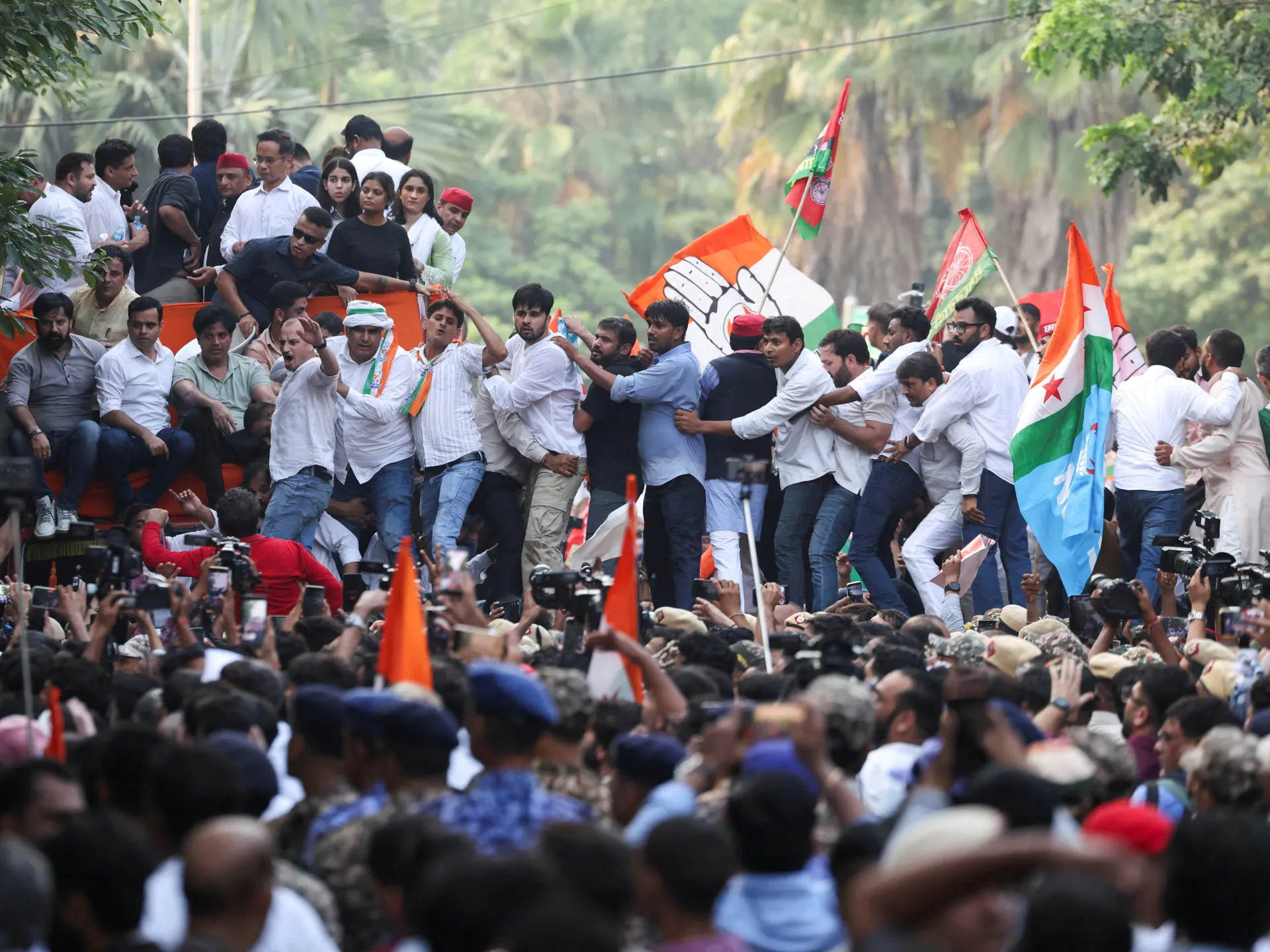
⁠Opposition leaders Rahul Gandhi and his ⁠sister Priyanka along with members ⁠of their Indian National Congress party, staged a protest outside Prime Minister Narendra ‌Modi’s house, videos shared by the party showed on Tuesday.

“We have marched to PM ⁠Modi’s house to ⁠demand answers from him for the brutalities against ⁠young students yesterday,” ⁠Rahul Gandhi posted ⁠on X.

The rights group Amnesty International said in a statement late on Monday that the police action showed “how peaceful dissent is being suppressed in India.”

“They beat us black and blue, and they damaged our protest site,” Sahil Singh, a protester from the northern state of Uttar Pradesh, told the Reuters news agency. “We want accountability to be set with Pradhan’s resignation.”

The number of protesters who marched on Monday was larger than expected, partly due to widespread anger after veteran 59-year-old activist Sonam Wangchuk, who has been on hunger strike for three weeks in solidarity with the CJP, was seized by police and hospitalised against his will.

The Delhi ⁠High ⁠Court ruled on Tuesday that Wangchuk could be moved ⁠from a government hospital to a private healthcare facility after his ⁠wife petitioned the court, alleging he was being held in “illegal detention”, the legal news website Bar and Bench ‌said.

About 200 protesters gathered at the CJP protest site at Jantar Mantar in central New Delhi on Tuesday morning, chanting slogans under a monsoon drizzle.

Paramilitary personnel continued to patrol central parts of India’s capital, and barricades were restricting traffic.

Cockroach Janta Party protesters try to neutralise a tear gas shell fired by police as they try to march towards India’s Parliament in New Delhi on July 20, 2026
Cockroach Janta Party protesters try to neutralise a tear gas shell fired by police as they try to march towards India’s Parliament in New Delhi on July 20, 2026 [Prakash Singh/AP Photo]

Delhi police said nearly 180 people – 60 protesters and 118 security and police personnel – were injured in Monday’s clashes. Police also said 70 protesters were detained and legal action would be initiated against them.

Multiple videos of Monday’s clashes show police attacking protesters, but no footage has emerged of any violence by the marchers.

The CJP and its supporters remain hopeful that they may change the status quo. A representative said on Monday that a federal minister had promised the government would consider their demands.

On Tuesday, Parliamentary Affairs Minister Kiren Rijiju said: “I think when the talks are going on in a right direction, the atmosphere should not be vitiated.”

The CJP’s campaign initially began online with viral satirical memes mocking the government, and it quickly amassed millions of followers on social media. It has since morphed into a movement able to mobilise thousands on the streets, as Monday’s march demonstrated.

After the chief justice of India’s Supreme Court likened some unemployed young people to “cockroaches”, the protesters adopted the insult as the name of their movement.

Source link

India’s Capital Markets Brace for Blockbuster NSE IPO

India’s primary bourse preps a landmark IPO alongside Jio, testing markets amid a global slowdown.

India’s National Stock Exchange (NSE) has filed for an initial public offering with the Securities and Exchange Board of India, in what is expected to be one of the most consequential listings in the country. 

The official filing document revealed that a ceiling of nearly 149 million shares, each with a face value of 1 rupee (about one U.S. cent), is being offered. The NSE is India’s primary bourse and the leading market infrastructure company in the Indian capital markets. 

Its IPO has been a long-awaited event, providing major investors — including the State Bank of India, the country’s largest public-sector bank; Singapore’s global investment firm Temasek; and Canada’s Pension Plan Investment Board — with an opportunity to monetize their stakes. 

Formed by large Indian financial institutions, the NSE has attracted investors from global financial institutions and individual investors, has more than 35,000 individual shareholders, and has created long-term value. 

India’s IPO boom in recent years has sharply waned, with the Iran conflict a significant geopolitical headwind for deal flow. 

This is reflected internationally, according to S&P Global, which reported in a recent report that IPOs worldwide have fallen to their lowest level since the height of the COVID-19 pandemic. During the first quarter of 2026, completed global IPO transactions fell to 294, compared with 451 in the final quarter of last year. 

A Definitive Market Test

Market sentiment in India may be shifting as IPOs on the NSE, including those of its largest telecom operator, Jio Platforms, are underway, with Jio Platforms having filed a draft prospectus for a public flotation. 

The NSE IPO is entirely an offer for sale proposal, where investors may reallocate funds to their headquarters on a global scale after raising liquidity and reducing NSE stakes. 

“NSE, along with JIO Platform’s IPO, will not only showcase the depth of India’s capital markets but also the confidence of global and domestic investors in India’s markets,” said Sanjay Doshi, head of KPMG India’s financial services advisory.

Shareholders earned handsome returns, and some may have made more than 10 times their investment in a company that has adopted technology since its inception, he added.

Ajay Shamdasani is a contributing writer based in Hong Kong.

Source link

Stealing from the gods: India’s Ram Temple hit by corruption scandal | Religion News

New Delhi, India – Brajesh Kumar climbs three floors every evening to sit in solitude on the rooftop terrace of his house overlooking the Ram Temple in Ayodhya in northern India’s Uttar Pradesh.

Over decades, the 65-year-old has seen the once-sleepy town metamorphose into the biggest flashpoint of the Hindu majoritarian movement, championed by Prime Minister Narendra Modi’s Bharatiya Janata Party (BJP). Where the temple stands used to be the site of the 16th-century Babri Mosque, but in 1992 a Hindu mob tore it down, sparking religious riots that killed nearly 2,000 people across the country, mostly Muslims.

Two and a half years ago, Modi presided over the consecration ceremony of the new temple, devoted to the Hindu god Ram. Many Hindus believe Ram, the god worshipped as an epitome of righteousness, was born there.

To Hindu devotees like Kumar, the temple – despite the controversy and deaths that defined its birth – brought a sense of serenity.

Until recently.

For the past month, the temple has been embroiled in allegations that those entrusted with its management have instead embezzled donations worth potentially millions of dollars that the site attracted from devotees.

“We have been betrayed [by the management], who have looted our faith, nothing less,” Kumar told Al Jazeera. “Left to them, they will sell us all one day in the name of religion and stuff their own pockets.”

The allegations have led to police investigations, arrests and political fallout that could shape elections in India’s most populous state that are only months away.

ram temple
People celebrate the opening of the temple of the Hindu god Ram in the northern town of Ayodhya in a street in New Delhi, India, on January 22, 2024 [Anushree Fadnavis/Reuters]

Ayodhya’s can of worms

Since its inauguration, the Ram Temple has been among the top religious sites in India, attracting millions of Hindu devotees.

An independent trust, the Shri Ram Janmabhoomi Teerth Kshetra Trust, manages the shrine. Although it is outside the purview of the government, its executive members wield political influence, and some of them come from the Rashtriya Swayamsevak Sangh, the ideological wellspring of the BJP.

The corruption allegations first surfaced this month after Mahipal Singh, a former supervisor of the trust’s accounting team, publicly called out irregularities. Al Jazeera could not reach him for comment.

After a public uproar, Akhilesh Yadav, a former chief minister of Uttar Pradesh from the opposition Samajwadi Party, picked up the issue, alleging that millions of rupees in donations had gone missing.

The mounting pressure pushed the state government, ruled by the BJP, to form a three-member investigation team, which has submitted a report on the alleged misappropriation of donations.

Although the content of the report has not been made public, the state police registered a criminal case and have arrested at least eight people, including those involved in counting cash and valuable offerings at the temple.

More devotees have come forward since, seeking the whereabouts of their valuables, including silver bricks and gold jewellery and artefacts, that they had handed over to the trust’s executives.

On Friday, the trust’s longstanding general secretary, Champat Rai, stepped down with other high-profile trustees. The allegations have been particularly damning for Rai, who has been a central figure in the movement for the Ram Temple.

But it has done little to cool down the tensions in the state, where thousands of devotees, including some BJP supporters, feel cheated.

ram temple
The Ram Temple is illuminated after its inauguration in Ayodhya on January 22, 2024. [Adnan Abidi/Reuters]

‘Cunning thieves running Ram Temple’

Santosh Dubey was among those tried for tearing down the Babri Mosque in 1992. He has never shied away from his role and instead has flaunted it.

After the mosque’s demolition, Dubey waited for a final verdict about what was to happen to the site from the courts, where both sides fought bitterly for decades. In 2019, the Supreme Court awarded the site to Hindus – even though it deemed the destruction of the mosque illegal. The top court gave a piece of land to Muslims outside Ayodhya to build a new mosque. In 2020, Dubey and others accused of roles in demolishing the mosque were acquitted — the court cited a lack of adequate evidence.

If those verdicts felt like vindication to Dubey, the alleged embezzlement at the temple has enraged him.

“This corruption causes me deep anguish, a pain that words cannot express,” Dubey told Al Jazeera, speaking from Ayodhya. “All I can say is that nothing less than the death penalty would suffice for them.”

“Cunning, dishonest and ruthless thieves are running the Ram Temple, and they have created such an atmosphere of fear that no one is willing to speak out against them,” he said.

Dubey said the government will struggle to ignore the anger among devotees because the episode batters the BJP’s narrative that it is a saviour of the Hindu faith.

This is not the first time that the temple trust has been the subject of controversy. In 2021, the trust allegedly bought land at highly inflated prices using public donations.

BJP spokespeople refused to comment on the recent allegations when Al Jazeera reached them.

ram temple
Indian Prime Minister Narendra Modi (with his arms outstretched) and Uttar Pradesh Chief Minister Yogi Adityanath (just to the left of Modi) show the BJP symbol during a roadshow as part of an election campaign in Varanasi, India, on May 13, 2024 [Adnan Abidi/Reuters]

‘Impact on upcoming election’

Devotees of the temple and critics of the government are accusing authorities of attempting a cover-up.

Opposition leader Yadav described the state government’s initial handling of the case as “suspicious”. “The government is arresting the counting staff while shielding the big fish who orchestrated the structural rot,” Yadav said while demanding transparency in the investigation.

Karpatri Maharaj, a prominent Hindu seer associated with the Ram Temple movement, told Al Jazeera that the government is using junior employees as scapegoats and arresting them.

Uttar Pradesh, India’s most populous state, is led by the firebrand Hindu monk-turned-politician Yogi Adityanath, who is often seen as a potential successor to Modi within the RSS-led Hindu majoritarian movement known as Hindutva.

Modi’s party lost a significant base in the state in the 2024 national elections when the BJP fell short of a majority, forcing it to rely on allies’ support to stay in power.

For the BJP, which has long used the campaign for the Ram Temple as a central political plank, the new controversy could prove a challenge before elections in Uttar Pradesh scheduled for early next year, political analyst Rasheed Kidwai said.

“It would have a massive negative impact on the BJP if more religious leaders came forward to speak on this,” Kidwai told Al Jazeera. “This is not something that would be forgotten because it is a matter of faith, and the state chief comes from a religious order himself.”

The episode carries broader lessons, he said: Pandering to religious emotions and fanning divisions can bite back. “What has been benefitting the BJP in these years can also cause immense damage,” Kidwai said.

Babri Demolition
Hindus shout and wave banners as they celebrate the destruction of the 16th century Babri Mosque in Ayodhya on December 6, 1992 [Douglas E. Curran/AFP]

Source link

Myanmar and India’s Strategic Calculus: Pragmatism Over Idealism

Authors: Dr Soumyodeep Deb & Aung Kyaw*

Myanmar’s president Min Aung Hlaing is currently on a 5-day state visit to India on the invitation of Indian prime minister Narendra Modi. This is his first foreign visit after the recent election where he was elected as the new president of Myanmar. However, the elections that brought him to power were not democratic in nature. Therefore, “Min Aung Hlaing is not Myanmar’s legitimate president,” as noted by Mercy Chriesty Barends, a member of the Indonesian Parliament and chairperson of the ASEAN Parliamentarian on Human Rights. He oversaw a campaign of widespread crimes against his own people after masterminding a bloody coup that toppled a democratically elected government. As a result, APHR has asked India to condemn Min Aung’s government as undemocratic and illegal. Thus, the question of why India, which claims to be the largest democracy in the world, is dealing with an undemocratic administration that is accused of violating its own citizens’ human rights emerges.

The idea of democracy and human right violation had been India’s central position during the 1988 military coup in Myanmar. The Indian government had cut ties with the then military junta. India’s idealistic position had sidetracked India-Myanmar relations and led China to occupy the strategic sphere in India’s immediate neighborhood. Chinese investment and trade with Myanmar grew exponentially with the junta purchasing military hardware worth $1 billion from Beijing in 1989 one of the largest weapons deals in Myanmar’s history. This had led China to exert its influence on Myanmar. For Beijing the geo-strategic location of Myanmar having access to the Indian Ocean was of strategic interest. Enhancement of Chinese influence in Myanmar had a security implication for India as China used Myanmar to train major northeastern Indian insurgent groups like NSCN, ULFA etc. Thus, India’s rupturing of relationship with Myanmar after 1989 on idealistic grounds led China to exploit major gain at India’s immediate neighborhood.

This had led India to recalibrate its strategy towards Myanmar post the 2021 coup when India took a more pragmatic stand. The Indian ministry of external affairs had categorically pointed that any development in Myanmar has implications for India so India’s policy must serve its strategic interest. Therefore, we have seen India engaging both the military junta and the ethnic armed groups trying to balance its ties with both the parties. Since the coup India has been providing steady military assistant to the junta in form of military hardware and spares. It has also engaged the various ethnic armed groups by sending officials across the border and by inviting some of the groups to New Delhi for a conference. This makes it very evident that rather than maintaining the moral superiority of democracy, India is striving to further its strategic interests. The support to the rebel groups like the Arakan Army (AA) which controls a major part of strategic Rakhine state. After seizing control of majority of the state the Arakan Army pushed the initiative to have dialogue with the military junta. The AA had always held the ambition of having greater strategic autonomy in the Rakhine state. Thus, India’s engagement with the AA by sending government officials over to Myanmar signals that it wants to have strategic relation with the AA as that would enhance its influence and uphold India’s economic and trade ambitions. 

For India, the geographical location of Myanmar holds a great strategic significance. It shares a 1,693 kms of border and is seen as India’s gateway to the ASEAN. This had led India to invest heavily on major infrastructure projects in Myanmar. The Kaladan Multimodal Transit Corridor and Sittwe Port are two of India’s largest projects in Rakhine and Chin state of Myanmar. This project is seen to give India’s landlocked northeastern states access to Myanmar’s Sittwe port. This project is also seen as a counter to China’s Kyaukphyu Port at the Rakhine state. This has made the relation with Arakan Army of geo-strategic importance. The other major project that India is working on is to physically connect itself ASEAN via the India-Myanmar-Thailand trilateral highway. This project would give India land access to the two ASEAN states which can further be expanded to other nations like Vietnam. Although the projects are currently stalled due to the civil war, India is working with both the ethnic armed groups and the government to safeguard and fast-track the projects.

Thus, the recent visit of Min Aung Hlaing to India shows that India has chosen pragmatism over idealism. New Delhi has kept itself away from the nature of democracy in Myanmar and is trying to engage based on strategic interest. During the press briefing the Indian foreign sectary had pointed that India’s engagement with Myanmar is not based on Myanmar’s internal political arrangement. India does not want to disengage based on internal political dynamics as history has shown that other powers which has no interest in democracy would eventually take the advantage. This statement although has not mentioned China but was directed towards it. Therefore, the visit led to the signing of various agreements and MOUs between both the states. Myanmar has also reiterated that it won’t allow its territory to be used against anti-India activities. The recent advancement by the Myanmar Army is further leading it to consolidate its power and capture grounds. With the new conscript law, it can funnel additional troops to keep its advancement. Further being supported by Russia, China and India the firepower of the junta is superior to the rebel forces. This has also led India to recalibrate its Myanmar policy by engaging the current powerful junta and strategic rebel forces like the AA in Rakhine state.

Therefore, it can be argued that the growing India-China competition has made India move its Myanmar strategy towards pragmatism from idealism. Unlike in 1988 when India lost its strategic foothold to China in Myanmar due to its idealistic stand, the situation has now altered as the competition grows. But as a democracy, India must tread carefully on this fine line and bring up important issues of human rights and democracy in Myanmar.

Bio: Aung Kyaw is a recent graduate from Lingnan University majoring in Global Development and Sustainability and minor in Sociology. His research interests are politics of southeast asia, peace and conflict studies, social development, social issues in southeast asia. kyawkyawaung@ln.hk

Source link

As ILO convention turns 30, India’s home-based workers demand equal rights | Labour Rights News

New Delhi, India – On a searing hot afternoon in a dense working class neighbourhood of the Indian capital, Shehnaz Bano sits on the dilapidated floor of her one-room home, deftly stitching pieces for a new leather jacket.

To make each piece – a sleeve, a front or back panel or a shoulder yoke – the 38-year-old mother of two teenage sons spends hours, but is paid a mere 100 rupees (about $1) for each piece.

Recommended Stories

list of 4 itemsend of list

“Imagine if I was a regular employee and I did the same work for the same hours, but on a factory floor. I would have been paid more, right?” Bano asked.

“Just because I work from home, I don’t get equal pay or rights.”

That is because Bano, like nearly 260 million others across the world, is a home-based worker (HBW) – people employed to produce goods or services in or near their homes. The HBWs are part of what is referred to as the global informal economy. Such a form of employment is characterised by low wages, denial of workers’ rights, lack of social security or established hours of work, or paid leave.

The HBWs are also a highly-feminised workforce, with nearly 57 percent being women, according to a 2024 estimate by Women in Informal Employment: Globalising and Organising (WIEGO), a United Kingdom-based global research organisation focused on improving conditions for the working poor, especially women, in the informal economy.

On this day 30 years ago, however, an effort was made to change the condition of the HBWs – with little success so far.

The International Labour Organisation (ILO), a United Nations’ body, during a conference at its headquarters in Geneva, Switzerland, adopted the landmark “Convention 177”, or the Home Work Convention on June 20, 1996, recognising HBWs at the same level as traditional wage earners.

It was the first comprehensive call to set an international standard for the HBWs. The convention called upon ILO members to adopt and implement policies that promote equality of treatment between HBWs and other wage earners.

Convention 177 officially came into force on April 22, 2000.

However, only 13 countries have ratified it so far and none from South Asia. That is despite Asia and the Asia-Pacific regions accounting for the largest concentration of HBWs, as well as being the hub of global fashion and manufacturing supply chains.

Renana Jhabvala was in the room in Geneva – along with hundreds of government and non-government delegates – when the home-based worker Convention was adopted.

As a member of the Self Employed Women’s Association (SEWA), a prominent Indian trade union of women workers, the 73-year-old activist was at the ILO’s International Labour Conference (ILC), and still remembers the exhilaration and optimism in the room.

“Discussions had gone on for nearly 21 days, but none of us knew whether the Convention would get adopted or not. We were all in a really big hall at the ILC… There was a majority in the final vote and the Convention got passed,” she told Al Jazeera.

But labour rights activists, experts and labour economists say a lack of recognition of the HBWs despite three decades of adopting the ILO convention has deepened structural inequalities among the workers, especially in a developing country like India.

According to them, the HBWs, especially women, remain largely “invisible” to the policymakers, while they are forced to work for inadequate wages under unsafe and exploitative working conditions.

“Convention 177 has been instrumental in recognising home work as ‘real work’ and home workers as workers entitled to labour rights,” Deepa Bharathi, a senior specialist of gender and non-discrimination at ILO’s Bangkok-based Decent Work Team, emailed Al Jazeera.

“In South Asia, home-based work is often embedded in complex subcontracting arrangements, making employment relationships difficult to identify and regulate. Challenges in labour inspection, gaps in data and the invisibility of home workers in policy frameworks have also slowed progress,” Bharathi said in response to a question on the low ratification of the Convention, particularly in South Asia.

With most home-based workers in the region being women, their work is often seen as an extension of household responsibility, Bharathi said. “This undervaluation, combined with broader gender inequalities, has been a significant barrier to ratification and implementation,” she added.

When asked about the ILO’s priorities for strengthening the Convention’s implementation, Bharathi said: “For women home-based workers in particular, the focus must remain on visibility, fair pay, social protection, safe working conditions, access to training and childcare and a stronger collective voice.”

‘I cannot go out and work’

Bano lives in New Delhi’s Kapashera area, a settlement of mainly migrant workers on the city’s southwestern edge whose name literally translates to a “cotton settlement” in English. The area is known for its cotton and leather garment manufacturing units.

In its congested alleys lie buildings that rent out single room units to informal worker families. In one such room lives Bano with her sons and her husband who works as a lift operator in an upscale mall in Gurugram, a business district housing several Fortune 500 companies on the outskirts of New Delhi.

India home-based workers
The leather panel of a jacket that Bano is working on in New Delhi, India [Anuja/Al Jazeera]

Bano epitomises the arc of a typical HBW in India. She began working as a beedi (a tiny, hand-rolled cigarette) roller in her village in neighbouring Uttar Pradesh state’s Azamgarh district. After marriage, she joined her husband in New Delhi and took to stitching leather jacket pieces from home.

The move from her rural employment as a beedi roller to a piece-rate worker in the city did not change her continuing precarious situation: long hours, irregular work, low wages and work that leaves her eyes strained and fingers aching.

She is paid barely one dollar for her work on each piece of a leather jacket that is sold in a foreign market for $200 or more – more than double Bano’s average monthly income. Moreover, to cut costs and maximise profit, the contractors often split such work among several workers.

“Only those who are in distress do this kind of work. We have rent, bills, grocery and school fees to pay. How much will my husband do alone?” Bano told Al Jazeera.

The HBWs fall into two categories: own account workers with direct access to markets and piece rate workers who are usually employed through intermediaries. Bano belongs to the latter, which is considered more vulnerable due to low and arbitrary piece rate payments.

In another corner of Kapashera, Sangeeta Devi, 30, puts the final touches – buttoning, repairing, finishing – before the garments she makes return to the factories.

She is doing all this inside an 8×8 foot (2.4m) room, where her family of six, including four schoolchildren sleep, eat, work and study. She cooks, cleans and even bathes in the same room.

“I cannot go out and work because then who will take care of my children?”

“On any given day, there are 100 pieces of clothing in this tiny room. Each time, I have to keep them aside while doing household chores,” the migrant worker from Bihar, one of India’s poorest states, told Al Jazeera.

Sangeeta Devi gets a dollar for every 100 garment pieces she completes.

“I really want to do a job where I can work easily from home, take care of my children and get paid well. I don’t know if that’s even possible,” she told Al Jazeera.

Her neighbour, Putul Devi, does similar work and earns about $20 a month.

“I have been cooking on firewood because of high fuel costs. And when it rains, I don’t know what to save from spoiling – the firewood or the cloth pieces that I bring home,” she told Al Jazeera.

India home-based workers [Anuja/Al Jazeera]
Putul Devi at her home in New Delhi, India [Anuja/Al Jazeera]

Shalini Sinha, home-based work sector specialist at WIEGO, said female HBWs in India face “continued invisibility” even after three decades of recognition of their work.

“Home continues to be seen as a place of habitat and not as a place of work,” Sinha told Al Jazeera.

“There is also the broader issue of women’s economic work not being adequately recognised in labour discourse when it is done from home. It is often seen as an extension of her care work,” she added.

From an Indian perspective, said Sinha, there is an “urgent need for better statistics and a dedicated policy or law for home-based workers, which still does not exist”.

Elizabeth Khumallambam, who works for Community for Social Change and Development (CSCD), an NGO that works with women HBWs in Kapashera, said a social security code introduced in India in 2020 mentions HBWs, but “no one knows” how it will be implemented on the ground.

Introduced as part of India’s labour reform laws, the code consolidated nine social security-related laws into a single framework to ensure social security protection for all workers, including those in the unorganised sector.

“Frankly, for us the challenge begins at making workers understand the value of their own work. Many don’t consider this as work and so they do not think it needs due rights and protection,” Khumallambam told Al Jazeera.

Alakh N Sharma, a labour economist and director at New Delhi-based non-profit, the Institute for Human Development, said there is a “bias in the system”, due to which women’s work is being left behind in statistics and official counting.

According to him, technology-aided counting, probing questions and sensitivity among investigators, could help in addressing the statistical blind spot.

“Safety concerns, mobility constraints and social norms – all these factors stop women from joining formal workplace-based employment. But the single biggest reason is often care work responsibility, particularly childcare,” Sharma told Al Jazeera.

In 2022, Sandosh Kumar P, a Communist Party of India (CPI) parliamentarian moved a legislation aimed at the welfare of the BHWs, but the parliament did not take it up for discussion.

In December 2024, India’s ministry of labour and employment was again asked in parliament whether it has an official assessment of the HBWs, and if it was proposing to enact a law on them. It replied that the Code on Social Security 2020 provides social security to the unorganised workers, including the HBWs. It also said the government has created a national database of such workers.

Looking back at the 30 years since the historic recognition of HBWs, Jhabvala said she did not view such Conventions or laws from the lens of success or failure.

“It is like a weapon, a tool of change. If we want to fight, this option is available,” she said.

Source link

The World Cup cicada: India’s rare insect on a four-year clock | Environment

The final journey

“By mid-June it is over,” Evansis says.

The mature cicadas, dark-shelled and spent, begin flying towards the Umrong River in large numbers and drop into the rapids. The river fills with them. Along the banks, dead cicadas collect against wet stones and bamboo roots, their wings plastered flat by the current.

Locals call it niangtaser suicide. Hajong offers a simpler explanation: Cicadas are naturally drawn to sound and movement, and the fast-moving river may trigger that instinct in their final hours.

For the fish below the surface, it is a feast. For the forest above, closure.

The journey that began four years earlier beneath the ground ends in the same river that separates Livi’s home from the sanctuary.

Not everyone has watched that cycle for as long as Kewstar Majaw.

At 92, he has witnessed more emergences than almost anyone alive in the village. He served in the Indian Army. He loves watching football. And every four years, without fail, he waits for his noisy visitors.

For Kewstar, the passing of the cicadas has become another way of measuring life. World Cups came and went. Governments changed. Forests retreated. But every four years, if the rains arrived on time and the bamboo still held, the forest sang.

As a boy, he would follow his parents into the forest carrying bamboo containers, the sound reaching them before the insects came into view. In those days, the niangtaser was everywhere. Behind houses. In the trees along village paths. Young ones, mature ones – the forest floor was alive with them.

The chorus was so loud, he recalls with a laugh, that people stuffed cotton into their ears to bear it.

The insect did not need to be searched for. It found you.

Kewstar sits quietly for a moment. At his age, he has watched the forest retreat, the bamboo thin, and the chorus fade with each passing emergence. The insect that once appeared on his doorstep now requires a torch and a walk in the dark to be found.

“It was everywhere,” he says softly. “Now you have to go looking for it.”

In a few weeks, the cicadas will disappear beneath the earth once more,  keeping time in darkness until the cycle begins again. By the next emergence, another football World Cup will be under way somewhere else in the world.

Whether Saiden’s forests will still sing with them depends on what survives until then.

Source link

India’s fertility rate falls below replacement level: Why it matters | Demographics News

India’s fertility rate has for the first time fallen below the level needed to stop the population from shrinking, raising concerns about future labour shortages and an ageing society.

For decades, India has seen rapid population growth. According to government statistics, including the Sample Registration System (SRS) Statistical Report — the country’s largest demographic survey — India has had a falling fertility rate for some years, but the reproduction rate remained high enough to keep the population growing.

Recommended Stories

list of 3 itemsend of list

The latest SRS report, released last month by India’s Office of the Registrar General and Census Commissioner, said that India’s Total Fertility Rate (TFR) had dropped to 1.9 children per woman – lower than the benchmark level of 2.1 needed to keep the population stable in the long run. TFR is the average number of children that a woman is expected to have in her lifetime. In the 2000s, India’s TFR was around 3.3 births per woman.

So, what is behind reduced fertility? Why does it matter and what are the consequences?

Here’s what we know:

What has led to the falling fertility rate ?

For decades starting in the 1970s, Indian governments and policymakers have tried to battle what they argued was overpopulation — too many people, and too few resources to manage for what was then a relatively poor nation.

Many top-down government initiatives — including a brief controversial effort to forcibly sterilise people in the 1970s — aimed to control India’s population.

Despite that, by 2019, India’s Prime Minister Narendra Modi was still warning of a “population explosion”.

But by 2022, the first signs that India was about to tip over into uncharted territory: The National Family Health Survey released data suggesting that India’s TFR was falling fast, across communities. Yet a year later, India surpassed China to become the world’s most populous nation — and the trend of a declining fertility rate was swamped by the headlines of a 1.5 billion population.

Now, latest survey suggests that the prospect of a shrinking population might be more imminent than policymakers had planned for.

Experts say better access to education and contraceptives are among key factors behind the falling fertility rate — along with the increased costs of bringing up children.

“Total fertility rate often drops when more women in society have access to education, contraceptives and more agency in decision-making in households,”  Dipa Sinha, a development economist who works on social policy in India, told Al Jazeera. “It also drops when the economy becomes expensive so raising children also becomes expensive.”

She said there’s another reason too.

As infant mortality reduces, the desire to have more children also decreases. According to the latest SRS report, India has recorded a significant decline in infant deaths from 30 per 1,000 live births in 2019 to 24 deaths per 1,000 live births in 2024.

These factors also correlate almost perfectly with the differential levels of fertility rates across the country.

According to the May demographic survey report, India’s poorest states, such as Bihar in northern India with the lowest levels of education and high infant mortality rates, also recorded the highest fertility rate in the country at 2.9, followed by 2.6 in Uttar Pradesh.

By contrast, India’s capital New Delhi — with among the highest levels of education and lowest infant mortality rates — registered the lowest fertility rate, with an average of 1.2 births per woman. Southern states such as Tamil Nadu and Kerala, with among the best health and education systems in India, recorded a rate of 1.3.

“A lot of studies on regional development in India from the early 80s have revealed that states in the South have developed faster with respect to both the economy and women’s status in society. So these reasons have contributed to the lower fertility rate,” Sinha said.

What are the consequences of a falling fertility rate?

In 2005, India’s population entered a stage called ‘demographic dividend’, a phase when the proportion of a country’s working age population (15-64 years) is higher than the number of old people and children who are not in the labour force. According to the UNFPA, India’s demographic dividend is expected to last until 2055.

Japan, Singapore and Hong Kong entered this phase in the 1960s and rapidly became developed economies. China entered this phase in the 1980s and — coupled with economic reforms — rapidly rose as an economy. Today it’s the world’s second-largest economy.

In India too, the demographic dividend has helped propel the economy. But millions remain unemployed and — as with China — India is far from a developed economy.

Now, with a declining fertility rate, India might not be able to reap the benefits of a demographic dividend, experts are cautioning, because of a shrinking workforce and a rapidly ageing population.

“If there are fewer children born, then in about 30 to 40 years, India will have more older people who cannot participate in the labour force as much, posing a challenge to the country’s workforce,”  Sinha said.

What is the politics behind India’s population data?

The widely varying fertility rates in different parts of the country mean that northern states — which already have higher populations — will in coming years be home to an ever-increasing share of India’s population.

Southern states have already in recent years been complaining that the Indian federal government — especially under Modi — are being “punished” with fewer funds, Sinha said. Modi’s Bharatiya Janata Party (BJP) has historically struggled to make major political inroads in southern India, though it has made gains in recent years.

Now, “the distribution of financial resources by the country’s government to state governments” could become an even bigger political flashpoint, she suggested. Later this year, India’s government will introduce a policy in parliament called “delimitation”, which will assign seats to each state according to population figures based on the subcontinent’s new census that began earlier this year and conclude in 2027.

“When delimitation comes into effect, there is a fear that the share of southern seats in the Parliament will reduce,” Sinha added.

Moreover, India’s ruling BJP has long stirred the stereotype that Muslims in India are producing more children than Hindus — fanning fears among Hindus that Muslims might some day overtake them as the majority faith in India. The Hindu far-right has been urging Hindus to have more kids. In February, Rashtriya Swayamsevak Sangh (RSS) chief, Mohan Bhagwat, urged Hindu couples to have at least three to four children to prevent the community’s long-term societal decline.

In reality, the Muslim population of India was 13 percent in the last census in 2011. Government data shows that the Muslim fertility rate has been falling faster than in any other religious group, India, including Hindus. The fertility rate among Muslims fell from 4.41 to 2.36 between 1992 and 2021, while it dropped from 3.3 to 1.94 for Hindus.

The latest survey further suggests that India’s fertility rate is falling sharply across faiths.

Is India responding to its declining fertility rate?

While the Indian government has not yet announced a nationwide policy to tackle its falling fertility rate, individual states have been trying to encourage people to have more children.

Last month, the southern Indian state of Andhra Pradesh said families will receive 30,000 rupees ($314) for the birth of a third child and 40,000 for a fourth child ($418). According to the SRS data, Andhra Pradesh’s total fertility rate is 1.4.

States such as Goa in the west and Karnataka and Telangana in the south have introduced state-funded IVF centres for first-time parents, encouraging people to have more children.

Sinha said the Indian government should respect people’s individual reproductive choices and support them.

“It is important for countries like India to develop a public policy based on its demographic structure and future needs. So if we are going to be an ageing population, then we have to be ready to help a lot of old people,” she said. The country needs “a policy now which guarantees that they have better healthcare, pensions and social security in old age”.

Which other countries in Asia have seen dramatic fertility rate declines?

Other Asian countries such as China, Taiwan and South Korea are also experiencing fast-falling fertility rates.

According to the World Bank, China’s 1.0 fertility rate is well below the 2.1 replacement level.

Taiwan’s interior ministry said earlier this year that its total fertility rate is around 0.86 and likely to fall below that.

The United Nations says South Korea’s rate is approximately 0.75 children per woman – the lowest worldwide.

Source link

India’s Zee Entertainment signs World Cup 2026 broadcast deal with FIFA | World Cup 2026 News

Zee will broadcast the 2026 and 2030 World Cups and the 2027 Women’s World Cup among 39 FIFA tournaments until 2034.

FIFA has struck a deal with India’s Zee Entertainment to broadcast the World Cup in the country, ending a months-long ⁠⁠standoff over the tournament’s availability in one of the last major markets where rights remained unsold.

While the financial terms of the package – signed on Monday – were not disclosed, FIFA reportedly sought about $100m for the 2026 and 2030 tournaments before ‌‌slashing its asking price to $60m.

The deal gives Zee a toehold in India’s sports broadcast market, where the Reliance-Disney joint venture JioStar holds rights ranging from the Indian Premier League (IPL) cricket tournament to the English Premier League football.

It covers 39 FIFA events over eight years through 2034, including ‌‌the ‌‌Women’s World Cup in 2027, according to a joint statement from FIFA and Zee.

Shares ⁠⁠of Zee were about 7 percent higher on the day ⁠⁠after the announcement.

The agreement came just 10 days before the tournament kicks off on June 11 across the United States, Canada and Mexico.

Last month, experts told Al Jazeera that the kickoff times for the majority of the matches are the biggest concern for Indian broadcasters since many games will be played at odd hours for the Indian audience, with a 10-12 hour time difference between the host cities and the South Asian nation.

Only 14 out of the total 104 World Cup games will begin before midnight for fans in India.

The final will be held in New Jersey on July 19, beginning at 19:00 GMT, which will be 12:30am on July 20 in India. By comparison, 98.4 percent of matches at the 2018 World Cup started before midnight, and 82.5 percent at the following edition in Qatar.

Karan Taurani, executive vice president at investment firm Elara Capital, sees TV as a “struggling” medium in India.

“When you have these kinds of sporting events, effectively it is mostly digital that is monetising and raising big money,” Taurani told Al Jazeera. “That is a big reason why no one’s showing interest in the FIFA World Cup.”

Taurani explained that cricket leads the sports economy market in India.

“Only a small fraction of people who watch the Indian Premier League will watch the FIFA World Cup,” he said, adding that an even smaller fraction tune in past midnight to watch a match.

Viacom18 paid ⁠⁠about $60m for rights to the 2022 ⁠⁠World Cup, which was hosted in Qatar in time zones far more favourable for Indian audiences. Most of this year’s matches will be screened late at night in India due to the ‌‌time difference, something that dampened broadcaster appetite and complicated FIFA’s sales efforts.

Source link

India’s Gen Z ‘Cockroach Party’ is going viral | Politics

NewsFeed

A satirical political movement called the ‘Cockroach Janta Party’ has gone viral in India after Chief Justice Surya Kant compared unemployed youth to “cockroaches”. The movement taps into growing frustration over unemployment, inflation and living costs under Narendra Modi’s government, gaining more than 22 million Instagram followers in just six days.

Source link

India’s Tata and Dutch giant ASML sign semiconductor deal during Modi visit | International Trade News

Prime Minister Narendra Modi says his talks with the Dutch PM also focused on expanding cooperation in defence and security.

India’s Tata Electronics has signed a deal with Dutch technology giant ASML to build a major semiconductor plant in western India, as Prime Minister Narendra Modi visited the Netherlands during his European tour.

The agreement, announced on Saturday, will support the development of Tata’s semiconductor facility in Dholera, Gujarat – Modi’s home state.

Recommended Stories

list of 4 itemsend of list

ASML, Europe’s largest technology company by market value, manufactures advanced lithography machines used to produce high-end microchips found in products ranging from mobile phones to cars.

The Dutch company said it would help “establish and ramp up” production at the plant by supplying its cutting-edge chipmaking tools.

Tata Electronics plans to invest $11bn in the facility, which is expected to manufacture chips for artificial intelligence, the automotive industry and other sectors.

ASML chief executive Christophe Fouquet said the company saw “many compelling opportunities” in India’s growing semiconductor industry.

“We are committed to establishing long-term partnerships in the region,” Fouquet said in a statement.

The deal comes as India and the Netherlands move to deepen economic ties, with New Delhi seeking foreign technology and investment to boost manufacturing and create jobs.

The European Union has increasingly viewed India – the world’s most populous country and one of its fastest-growing economies – as a key future market.

During his visit, Modi held talks with Dutch Prime Minister Rob Jetten and met King Willem-Alexander.

“My conversations with Prime Minister Rob Jetten were extensive and covered a wide range of topics,” Modi wrote on X.

“One of them was defense and security. I spoke about the possibility of drawing up an action plan for the defense industry as quickly as possible. We can also collaborate in sectors such as space travel, maritime systems, and maritime security.”

Modi also addressed members of the Indian diaspora and is expected to inspect centuries-old Chola copper plates being returned to India by Leiden University.

Indian and Dutch officials are also discussing a more flexible visa arrangement for Indian students and workers in the Netherlands.

Modi will next travel to Sweden for talks with Prime Minister Ulf Kristersson focused on trade, innovation and green technology cooperation. The visit marks his second trip to the country since attending the first India-Nordic summit in 2018.

Source link

‘Hegemonic power’: How Modi’s BJP won India’s Bengal for the first time | Elections

New Delhi, India – Seema Das, a househelp in New Delhi, took on a two-day journey to reach her village in India’s West Bengal state, changing trains to make sure she got home in time to vote in provincial elections.

Das had previously always voted for the All India Trinamool Congress (TMC) party under Chief Minister Mamata Banerjee, a centrist political force that has been in power in the eastern Indian state since 2011. But this time, she said, her mother-in-law had convinced her that “Didi” – a nickname for Banerjee, which translates to elder sister in Bangla  – “favours Muslims”.

Das, a Hindu, added: “Didi has lost the track and only appeases Muslims to stay in power.”

That’s an accusation that Prime Minister Narendra Modi’s Hindu majoritarian Bharatiya Janata Party has long levelled against the TMC, which emphasises religious pluralism and the protection of minority rights. But for 15 years, Banerjee and her party have ruled the state of more than 90 million people, even as the BJP gained ground in a state where it had traditionally been a marginal player.

On Monday, that changed. Modi’s party won West Bengal. Early results from elections to the state’s legislature – which were held in April, but votes were counted on May 4 – show that Modi’s well-oiled election machinery is poised to deliver a thumping majority for the BJP in a state that its ideological founder was from, but that it has never won before. By 4:30pm India time, the BJP had won or was leading in 200 out of the state’s 294 seats, where its previous best performance was 77 seats in 2021. Banerjee’s TMC, meanwhile, was leading or had won just 87 seats.

The West Bengal elections were among five whose results were declared on Monday. In the southern state of Tamil Nadu, actor C Joseph Vijay threw up a surprise, defeating dominant parties to win with his upstart TVK party; in its neighbouring state of Kerala, the Congress party – the largest national opposition party – beat a coalition of left parties. A BJP-led alliance won the self-administered territory of Puducherry, once a French colony. And in the northeastern state of Assam, Modi’s party returned to power with a sweeping majority.

Yet it is the outcome in West Bengal that analysts say is by far the most consequential of the results that were declared on Monday, with the BJP walking the trails of religious polarisation and leveraging underlying anti-incumbency to win, experts told Al Jazeera.

bengal
Chief Minister of West Bengal and Chairperson of All India Trinamool Congress, Mamata Banerjee (C), greets her supporters during a rally before the second phase of the legislative assembly elections in Kolkata on April 27, 2026 [Dibyangshu Sarkar/AFP]

Inside Banerjee’s bastion in East

Banerjee founded the TMC in 1998, breaking with the Congress party, disillusioned with its refusal to frontally take on a coalition of communist parties that had ruled West Bengal since 1977.

Rising from a humble background, the lawyer-turned-student-activist-turned-politician finally defeated the communists to win the state in 2011. Since Modi became prime minister of India in 2014, she emerged as a key challenger to the BJP – framing her politics, especially her defence of Bengal’s Muslims, as an act of opposition to Hindu majoritarianism.

She also launched a series of women-centric welfare schemes and pushed back against controversial land acquisition projects sought by big industry.

“There is visible support for Mamta and she remains popular, but there is anti-incumbency against the TMC machinery, and people were not happy with their interference in everyday life,” said Rahul Verma, an election observer who teaches politics at the Shiv Nadar University in Chennai.

He added that the BJP also ran a better-managed campaign this time, noting that he is not “shocked” by the results. “It was a difficult election for the BJP, but not impossible.”

To Verma, “there was a corridor available to them [in West Bengal], and one can now say everything aligned in a way to produce this outcome for them.”

Verma emphasised that “without serious anti-incumbency, West Bengal would not have gotten this kind of result.”

Nearly 68.2 million people voted in the election, or about 92.93 percent, a record high for the state.

Banerjee’s party failed to “offer anything new to the voters and to beat strong anti-incumbency sentiments against it”, said Praveen Rai, a political analyst at the Centre for the Study of Developing Societies, in New Delhi.

“The party system had turned hostile towards the people who did not subscribe to their ideology,” he argued, adding that “the TMC failed to read the growing resentment against economic deprivation and aspirational needs of the common people.”

Rai added that the loss in West Bengal also weakens Banerjee’s hopes of emerging as a national challenger for Modi’s job.

But the implications of the result extend beyond Banerjee, he said. The BJP’s win, and the TMC’s dramatic defeat, would “decrease the political capital of [all] the parties opposed to [Modi]”.

That’s a major shift from two years ago. In the 2024 national elections, Modi’s party had fallen short of a majority, leaving it reliant on allies’ support for survival. The election wins on Monday “offset the electoral setback” suffered in the national vote, Rai said.

“It substantially increases the national standing of Modi’s leadership and extends the hegemonic power of the party [BJP] to govern India,” Rai told Al Jazeera.

bengal
A voter shows her inked finger after casting her ballot during the second and final phase of West Bengal Legislative Assembly elections in Kolkata on April 29, 2026 [Dibyangshu Sarkar/AFP]

‘BJP ran on Hindu-Muslim polarisation’

Neelanjan Sircar, a senior fellow at the Centre for Policy Research in New Delhi, who travelled across West Bengal before the polls, told Al Jazeera that his team identified “a big urban-rural gap among voters’ preferences”.

“We found urban men are very polarised,” he added. “In Bengal, the Muslim population is disproportionately rural, and given the levels of polarisation, the result ended up in a big difference for the BJP.”

Historically, election analysts have argued that due to the BJP’s Hindu majoritarian politics, the party did not stand a chance of winning West Bengal. More than a quarter of the state’s population is Muslim. “That has, of course, not turned out to be true, something we did pick during our research,” Sircar said.

The BJP has not shied from projecting itself as the party of Hindu voters.

Suvendu Adhikari, leader of the BJP in the state and potential chief minister candidate, said, “There has been a Hindu consolidation [of votes].”

He claimed, however, that many Muslims also did not vote for Banerjee’s TMC like earlier, and got swayed towards the BJP. It is impossible to verify the claim until the Election Commission of India (ECI) has released details of the vote count, expected in the next few days.

“I want to thank every Hindu Sanatani who cast their votes in favour of the BJP,” Adhikari said, referring to Banerjee’s TMC as a “pro-Muslim party”. Sanatan Dharma is an endonym for Hinduism.

For the BJP, the win in West Bengal is also deeply symbolic: Shyama Prasad Mukherjee, who founded the Bharatiya Jana Sangh – the forerunner of the BJP – in 1951, was from the state.

Al Jazeera reached out to TMC spokespersons but has not received any response.

SIR
Election officials count votes of the West Bengal state legislative assembly elections, inside a counting centre in Kolkata, India, May 4, 2026 [Sahiba Chawdhary/Reuters]

Pre-poll voter revision in spotlight

Before the polling in West Bengal, the ECI carried out a so-called revision of its electoral rolls through a Special Intensive Revision (SIR), which authorities have conducted in more than a dozen states so far.

The exercise in West Bengal controversially removed more than nine million people – nearly 12 percent of the state’s 76 million voters – from the voting list, snatching their right to cast a ballot in the elections.

Nearly six million of them were declared absentee or deceased, while the remaining three million were unable to vote because no special tribunals could hear their cases in the short timeframe available before the elections.

Banerjee’s TMC and other opposition parties in several states have called out the discrepancies in the revision of the voter list, accusing the ECI of siding with Modi’s BJP. Right activists and observers believe that the exercise disproportionately disenfranchised Muslims before the election.

Banerjee also appeared before India’s Supreme Court, challenging the “opaque, hasty, and unconstitutional” revision process. The top court did not restore the voting rights of millions affected but directed the ECI to publish a list of affected voters.

“Once the question of whether ‘I should be on the voter list’ became the dominant question for vulnerable populations, it’s not politics as usual,” said Sircar. “The level of polarisation that the voter revision caused is something that people outside the state do not really grasp.”

The Modi government also deployed 2,400 companies of paramilitary troops to West Bengal for the elections – a record for such provincial votes. The federal government claimed this was to assist election officials in carrying out the exercise without fear of political violence.

But the TMC and other opposition parties argued that the forces served to intimidate – or influence – voters.

“The heavy presence of security forces could have also created a favourable situation for the BJP,” argued Verma, of Shiv Nadar University. “Those who might be fence sitters and might have been afraid of TMC’s machinery on the ground were moved by this.

“There is no doubt that the trust level between opposition parties in India and the Election Commission of India is very low,” added Verma.

However, the analysts who spoke with Al Jazeera, including Sircar and Verma, agreed that the voter revision exercise alone could not have delivered such a decisive victory for the BJP – and that it reflects several other factors, including anti-incumbency and religious polarisation.

Still, analysts said, Banerjee will likely not go out without a fight.

In her first reaction to the vote counting, Banerjee addressed her party workers in a video statement, calling all workers and leaders not to leave vote-counting booths until the last ballots are counted.

“It’s a total forceful use of central forces to oppress the Trinamool Congress everywhere, breaking offices, and forcibly occupying them,” she said. “We are with you. Don’t be afraid. We will fight like the cubs of a tiger.”

Those aren’t empty warnings, Sircar said. “We are definitely in for drama.”

Source link

Thousands in India’s Manipur mark three years since ethnic clashes began | Newsfeed

NewsFeed

Thousands of protesters gathered in India’s northeastern Manipur state to mark three years since ethnic violence erupted in May 2023 between the majority Meitei and minority Kuki-Zo communities. The conflict, driven by disputes over land and political power has killed nearly 260 people and displaced around 60,000.

Source link