Indian

‘Won’t back down’: Indian student protesters return after police crackdown | Protests News

New Delhi, India – Blood spots on the walls, overturned barricades, shattered mirrors and sandals strewn across the road. A scarf here, broken glasses and a torn shirt there lie as remnants of the chaos that took over the Indian capital.

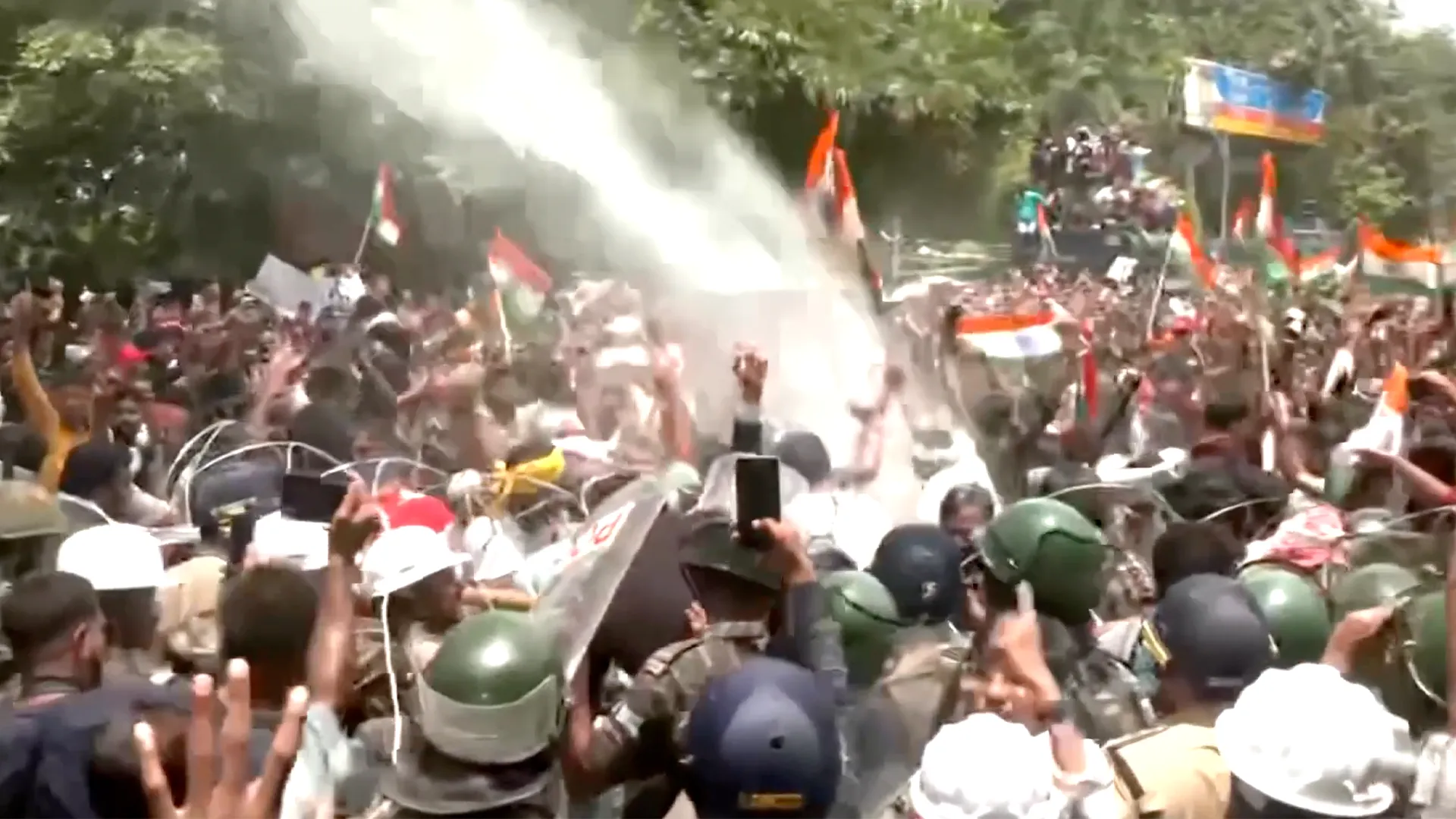
The heart of New Delhi – Parliament Street and Connaught Place, a colonial-era square – bears the imprint of Monday’s police crackdown on thousands of protesters, most of them students, who had shut down the capital, demanding that Education Minister Dharmendra Pradhan resign.

A swarm of protesters reached parliament’s doorstep before retreating as the police tear-gassed them. More than 100 students were injured.

“I still cannot believe my eyes that I’m in Delhi,” said Anshul Dev, an 18-year-old who grew up in the capital. “Part of it is because tear gas still stings,” he added, bursting into laughter with his group of friends. One of them had both legs bandaged.

“This government, whom our elders voted to power, is treating us like terrorists and criminals,” Dev said. “This is our country, and we are reclaiming it from their hateful politics. We are here to break the spell.”

Anger among India’s youth, the world’s largest Gen Z cohort, has been simmering for the past two months over a string of compromised entrance exams that affected millions of students. In some cases, exam papers were leaked; in others, students who sought copies of their answer scripts found that they had been wrongly graded. More than 20 students died by suicide, many citing the paper leaks.

Prime Minister Narendra Modi has not addressed the protests, even as he appeared smiling on Monday in parliament, barely metres away from demonstrators at one point.

Analysts said the student protests face formidable obstacles before they can extract concessions from Modi’s government. Yet the protests, the government’s refusal to hold any of its own accountable and the crackdown have also embellished a charge that the prime minister has long faced from critics and opposition parties – that although he is elected democratically, he behaves like an autocrat.

Tear gas spreads around protesters in New Delhi on July 20, 2026
Tear gas spreads around protesters in New Delhi on July 20, 2026 [Anushree Fadnavis/Reuters]

‘Protests will continue’

After dark on Monday, Abhijeet Dipke – the leader of the Cockroach Janta Party (CJP), a political pressure group that called the march – returned to a torn-down stage at the CJP’s main protest site near Jantar Mantar, an 18th-century observatory that is now an important location for protests.

“This barbaric Delhi police has beaten up our students and comrades. We are heartbroken,” he said, addressing about 2,000 protesters who stayed back after the crackdown. “We will continue to resist and demand accountability from the government. We will not back down until Dharmendra Pradhan resigns.”

Dipke told the protesters that the Delhi police “brutally cracked down to crush our hopes” that Pradhan would resign. “It was only our first call to march,” he said. “There will be more. Do not lose hope.”

Volunteers began to pick up rubbish, tie a tent together and sweep the road at the Jantar Mantar site. This is where more than 100 protesters from student unions have been sleeping for nearly a month to join Sonam Wangchuk, a prominent activist, on a hunger strike to seek the minister’s resignation.

The police also rampaged through these student unions’ tarpaulin tents and belongings on Monday.

The movement gained momentum last week after the police forcibly removed Wangchuk from the protest site and restricted him to a government-run hospital, where he remains. His family and the CJP have called it “illegal detention”, but the Delhi High Court has refused immediate relief.

Wangchuk, 59, broke his hunger strike before the march on Monday; however, later he said he would be at it again after “seeing the brutality” against “peacefully protesting students”.

The Delhi police have filed at least five criminal cases against protesters related to violence, stone-throwing and vandalism during the march.

CJP founder Abhijeet Dipke speaks to protesters injured in New Delhi on July 21, 2026
CJP founder Abhijeet Dipke speaks to protesters injured in New Delhi on July 21, 2026 [Arun Sankar/AFP]

Meeting with government a ‘waste of time’

Before the march, CJP leaders said the government reached out for talks.

As thousands of demonstrators assembled in New Delhi, two CJP spokespeople met JP Nadda, India’s health minister, to convey the movement’s three demands: Pradhan’s immediate resignation, Wangchuk’s discharge from hospital and compensation of nearly $105,000 for the families of those students who died by suicide.

However, they were disillusioned by sunset. “It was a waste of our time,” said Ashutosh Ranka, a CJP spokesperson. “We were made to wait for four hours, and the minister met us for 10 minutes.”

Nadda said he met with the spokespeople “in a cordial atmosphere”, adding that he “requested all the protesters to end their sit-in and assist the administration in restoring normalcy”.

Some students have been calling for the decentralisation of the protests, so they could move beyond the CJP to demand accountability from the government.

And political analysts who spoke with Al Jazeera said maintaining the credibility of the CJP’s leadership remains one of the biggest immediate hurdles for the movement in the face of an unprecedented crowd turnout for the march.

A CJP supporter poses next to a protest message in New Delhi after the police crackdown on July 20, 2026
A CJP supporter poses next to a protest message in New Delhi after the police crackdown on July 20, 2026 [Sajjad Hussain/AFP]

Confronting a ‘strong man’

Since the police forcibly removed Wangchuk from the protest site, the movement and demonstrators have called on Modi to resign. Slogans targeting the prime minister reverberated through central New Delhi on Monday.

The large number of protesters “is itself a big challenge to the prime minister”, said Nilanjan Mukhopadhyay, an author and Modi biographer.

As of now, he told Al Jazeera, “Modi has decided to continue with his instinctive response of not giving any concessions to protesters and continuing to project himself as a strong man with completely unshakeable will.”

The biographer added that the prime minister, who has been in power since 2014, “does not care before crushing a protest or using brute force until it cuts through his voting constituencies”.

“They will go by their gut response of a crackdown. Modi would not want to emerge from this with a bloody nose,” he added, “despite a lot of anger among youth, which shows the undercurrent of anti-incumbency.”

The simmering anger found a vent as Gen Z rallied behind a joke, the Cockroach Janta Party, after India’s chief justice equated government critics and unemployed youth to “cockroaches” and “parasites”.

Memes, online rants and students taking photos in front of police have flooded the internet in India, where they expressed anguish and took digs at the police crackdown.

Meghnad S, a YouTuber, was among the crowd of thousands in front of the Indian Parliament on Monday.

“It was insanity, and the crowd was really riled up due to police actions. It was cruel,” he told Al Jazeera from the protest site on Monday night. “But movements are always messy. This is very difficult to control. We are all cockroaches, after all. And we are still swarming here.”

By Tuesday morning, the crowd had packed the site yet again. The cockroaches had returned.

CJP supporters march towards parliament on July 20, 2026
CJP supporters march towards parliament on July 20, 2026 [Adnan Abidi/Reuters]

Source link

Indian police attack Cockroach Janta Party’s parliament march | Corruption News

NewsFeed

Police used batons and tear gas to disperse protesters as tens of thousands of people joined the Cockroach Janta Party’s march on parliament in New Delhi. Protesters have been demanding the resignation of India’s Education Minister Dharmendra Pradhan following exam scandals that have triggered nationwide outrage.

Source link

Indian cricket board to review T20 team’s ‘bad phase’ after England defeats | Cricket News

India slumped to a nine-wicket defeat in the fourth T20 against England, following a 2-0 series whitewash in Ireland.

India’s cricket board will review the T20 team’s performance after a dismal run that saw the world champions lose successive series in Ireland and England, a top official said.

India slumped to a nine-wicket defeat in the fourth T20 against England on Thursday, handing the hosts an unassailable 3-0 lead with one match remaining after the opener was washed out.

Recommended Stories

list of 4 itemsend of list

The loss was India’s fifth straight defeat, following a 2-0 series whitewash in Ireland last month.

The Board of Control for Cricket in India (BCCI) will meet to discuss the reasons for the team’s performance after the England tour ends on July 19, secretary Devajit Saikia said on Friday.

“The BCCI is currently observing the performance of the Indian T20 team which has not been up to the mark in the ongoing series against England,” Saikia, who is in Edinburgh for the annual conference of the International Cricket Council, told the news agency AFP in a phone interview.

“We will have a review meeting with the core members of the team to discuss what went wrong in England.”

India, who lifted the T20 World Cup in March, have endured a dramatic dip in form. On Thursday, they managed 158-7 in Bristol, a target England chased down with nine wickets and more than six overs to spare.

The defeat came days after India were dismissed for just 76 in Nottingham, suffering their heaviest T20 loss by a margin of 125 runs.

Saikia described the slump as a temporary setback.

“This is not something abnormal and can happen in international cricket. We consider it as a purely bad phase,” he said.

India, coached by Gautam Gambhir, has been without pace spearhead Jasprit Bumrah and all-rounder Hardik Pandya because of workload and injury-management concerns.

Teenage batting sensation Vaibhav Sooryavanshi, handed his long-awaited debut aged 15, has struggled to make an impact, with scores of 14, 13 and 15 in his three innings.

The teams meet in the fifth and final T20 in Southampton on Saturday before a three-match ODI series.

Source link

5 killed in Indian Air Force cargo plane crash during training

Five people died Saturday when an Indian Air Force cargo plane crashed during training. Image courtesy of UPI

June 13 (UPI) — Five Indian Air Force personnel are dead after a transport plane crashed during training in Assam, officials said Saturday.

“The Indian Air Force deeply regrets the loss of five personnel in the An-32 accident at Jorhat, Assam. Sqn Ldr Prashant Singh, Flt Lt Shubham Kumar, Sgt Jitendra Sharma, Agniveervayu Khemaram Kumawat and Agniveervayu Danish Alam made the supreme sacrifice in the line of duty. IAF extends its deepest condolences to the bereaved families and stands firmly with them in this hour of grief,” the Indian Air Force posted on X.

Assam is in the northeastern part of the country.

“Crash site management and initial enquiries are on at this time,” the Air Force said. It added that an investigation to find the cause of the crash is underway.

India’s air force operates a fleet of about 105 AN-32 aircraft, Al Jazeera reported.

President Donald Trump speaks to reporters about restoring commercial fishing access to areas of the Pacific during a signing ceremony in the Oval Office of the White House on Thursday. Photo by Jim Lo Scalzo/UPI | License Photo

Source link

Indian PM Modi meets Myanmar military gov’t leader in New Delhi | Narendra Modi News

India says it will continue engaging with Myanmar after Prime Minister Narendra Modi spoke with Min Aung Hlaing, the leader of the country’s military government, in New Delhi.

Indian Foreign Secretary Vikram Misri told reporters on Monday that India’s policy is “not intended to be a commentary on the internal political arrangements” in Myanmar and that New Delhi believes engagement is the best way forward.

Recommended Stories

list of 3 itemsend of list

Western nations have sought to isolate Myanmar’s military rulers since they overthrew the elected government of Aung San Suu Kyi in a 2021 coup that triggered a crackdown on opponents and a brutal civil war.

The conflict began when the country’s army leader, Min Aung Hlaing, ousted the government and detained civilian leaders, including Nobel Peace Prize laureate Aung San Suu Kyi.

Some critics and human rights groups have said Min Aung Hlaing’s visit to India risks lending legitimacy to the military-backed government.

“We have always proceeded on the principle that sustained dialogue is what is important,” Misri said, adding that isolating Myanmar would be counterproductive.

“History has shown that disengagement doesn’t give us any results that are better than engagement.”

The visit is Min Aung Hlaing’s first to India since he was sworn in as president in April following an election that critics say was designed to cement his hold on power. His last visit to India was in 2019, when he served as Myanmar’s military chief.

He arrived in India on Saturday, first in the eastern state of Bihar, with a visit to the Buddhist pilgrimage site of Bodh Gaya, where believers say that the Buddha attained enlightenment.

India shares a 1,643-kilometre (1,020-mile) border with Myanmar and a maritime boundary in the Bay of Bengal.

epa13008316 Indian Prime Minister of India Narendra Modi (R) with Myanmar President Min Aung Hlaing (L) prior to their meeting at Hyderabad House in New Delhi, India, 01 June 2026. Myanmar's President Min Aung Hlaing is on a five-day state visit to India. EPA/RAJAT GUPTA
Narendra Modi (right) with Min Aung Hlaing (left) prior to their meeting at Hyderabad House in New Delhi [Rajat Gupta/EPA]

Strategic partnership

Myanmar is also strategically important to India’s security interests. The two countries have cooperated on border security and intelligence sharing to combat armed rebel groups.

Modi and Min Aung Hlaing did not address the media after their meeting, as usually occurs after most bilateral talks involving visiting heads of state or government in New Delhi.

But Misri said the two leaders discussed trade, defence and security cooperation, border management, and regional issues, with talks also focusing on expanding economic and technology ties. He said both sides agreed to deepen collaboration across sectors, including trade, energy and critical minerals, and to accelerate major connectivity projects.

Min Aung Hlaing is expected to hold talks with business representatives during his five-day visit, and will travel to the financial hub, Mumbai.

Bilateral trade was $1.95bn in 2025-2026, according to New Delhi.

The leaders also discussed cooperation against cybercrime and human trafficking, issues that have affected thousands of Indians lured to scam centres in the region.

Misri said India and Myanmar have worked together to rescue more than 2,400 Indian nationals over the past 18 months.

Resistance groups formed after the 2021 coup have captured swaths of Myanmar. Others sought out and fought under the leadership of ethnic armies in exchange for training and weapons with which to fight the military.

These resistance groups, known as the People’s Defence Force (PDF), nominally operate under the leadership of the National Unity Government (NUG), a shadow government formed by Myanmar lawmakers removed by the military coup.

Zin Mar Aung, the foreign minister of the NUG, wrote a letter to Subrahmanyam Jaishankar, the minister of external affairs for India, on May 28, expressing concern about the visit.

“Since the military coup of 2021, which overturned the democratic will of the people, Myanmar has endured prolonged conflict, instability, and immense humanitarian suffering,” she said.

“India has long championed democratic governance, the rule of law, and regional stability. We therefore urge the Government of India to weigh carefully the broader implications of formal engagement that may normalise or legitimise military rule in Myanmar.”

Source link

Pakistan announces shooting down 77 Israeli-made Indian drones – Middle East Monitor

Pakistan announced on Friday that it had shot down 77 Israeli-made attack drones launched by India, in the latest escalation between the two sides following exchanged attacks.

This was announced by Military spokesman Ahmed Sharif Chaudhry during a press conference addressing developments in the military situation in the region, according to the local newspaper Dawn.

Chaudhry confirmed that the death toll from Indian attacks had risen to 33, while the number of injured had reached 62. He accused India of “deliberate attacks and targeting civilian areas.”

Responding to Indian allegations that Pakistani aircraft had been shot down or that Pakistan had carried out attacks inside India, Chaudhry said, “India should present the wreckage of at least one aircraft if its claims are credible.”

He revealed that the Pakistani army had not lost any of its people in the clashes between the two countries, despite the casualties among its ranks.

READ: US President Trump claims India, Pakistan have fought over Kashmir for 1,500 years

Chaudhry sent a message to India, saying, “If you enjoy our response, we will meet your requests at a time, place, and means of our choosing.”

He continued, “We are prepared for all eventualities. If they decide to continue escalation, let them know that we are the ones who will finish what they started.”

On Thursday, Indian media reported that Pakistan had carried out strikes targeting ammunition depots on the Indian side of Jammu and Kashmir. The Pakistani Foreign Ministry later denied this, asserting that allegations of attacks in the Pathankot and Srinagar areas were “baseless.”

It is worth noting that on 6 May, India launched missile strikes targeting what it described as ‘terrorist hideouts” inside Pakistani territory, in retaliation for a deadly attack on 22 April in the Pahalgam district that killed 26 people.

According to New Delhi, its strikes targeted nine militant sites, while Islamabad said the strikes hit six civilian sites, killing 33 people and wounding 62 others.

Pakistan also announced that it shot down 5 Indian warplanes during the attack, a claim that has yet to be confirmed by Indian authorities.

OPINION: The Indo-Pak war: recklessness and diversion in the service of pharaohs 

Source link

The huge Indian palace in the middle of the Cotswolds

A TINY village in the Cotswolds is home to a huge Indian-style palace – and you can easily visit it.

Sezincote House, which calls itself “India in the Cotswolds,” is a 200-year-old estate in the village of Sezincote near Moreton-on-Marsh.

There’s an Indian-style house right in the middle of the Cotswolds that most people don’t know exists Credit: Alamy
Sezincote House is near Moreton in Marsh and dates back more than 200 years Credit: Alamy

Follow The Sun’s award-winning travel team on Instagram and Tiktok for top holiday tips and inspiration @thesuntravel. 

Said to have been inspired by the Taj Mahal, it was created by Colonel John Cockerell who returned to the UK with money from the East India Company.

The house, designed with Hindu and Muslin architecture seen in Rajasthan, was created by his brother Samuel who was an architect.

Works started in 1805 and completed two years later, before being restored again after World War II.

Read more on the Cotswolds

WATER BEAUTY

‘Cotswolds Venice’ cottage visited by a Kardashian gets a £50k makeover


A-MOO-ZING

I stayed at the Cotswolds-esque hotel that shares outdoor spa with Highland cows

It was even to have then inspired another famous Indian building – the Brighton Pavilion – after The Prince Regent visited in 1807.

It is now thought to be the only surviving building of its kind in Western Europe.

The house is still family run, who also run the nearby farm as well.

Across the 3,500 acres is the Mogul palace, as well as temples, gardens and pools.

You can also have some tea and cake at the Orangery Tearoom.

Just make sure to keep your phone in your pocket when exploring inside the house – still being privately owned, photos are not allwoed inside.

Previous tourists have praised its unique designs, with one saying: “The setting is absolutely stunning – from the moment you arrive, the house and grounds feel like stepping into another world.”

There are set opening times for the house throughout the year, usually from May to September, and only from Wednesday to Friday (along with some bank holidays).

Visits to the house need to be booked ahead, costing £15 for adults and £9 for kids.

This also includes access to the garden, but if you only want to visit that part, you don’t need to prebook and it is instead open from March to October.

Tickets are also cheaper, being £9 for adults and £3 for kids.

For something even more special, they even host a limited number of weddings every summer.

Other UK hotels we love

*If you click on a link in this box, we will earn affiliate revenue.

The Queen at Chester Hotel

This historic hotel has welcomed the likes of Charles Dickens and Lillie Langtry through its doors. Rooms have richly-patterned carpets with super soft bed linen and premium toiletries in the bathroom. Go for a superior room for extra goodies including bathrobes and snack boxes.

BOOK HERE

The University Arms Hotel, Cambridge

This Cambridge hotel is in the ideal spot, within walking distance to bars, shops and hotspots like the university colleges and Parker’s Piece. The inside couldn’t be prettier, with huge stained glass windows, grand chandeliers, and rooms with enormous clawfoot bath tubs.

BOOK HERE

You can also stay in Sezincote with some converted farmhouses and cottages nearby.

Also in the UK is Shri Swaminarayan Mandir, or the Neasden Hindu Temple, in London.

Said to be the largest Hindu temple outside of India, some have even called it one of London’s seven man-made wonders.

Want to see India for yourself? We went on an Intrepid tour of four famous cities in India – here’s what we thought.

You can’t take pictures inside but you can of the gardens Credit: Alamy
You can visit the house from May to September although you need to prebook Credit: Alamy


Source link

India Must Leverage Indian Ocean Security Mechanisms to Protect Its Strategic Interests

Authors: Rahul Mishra & Harshit Prajapati

The US-Israel conflict with Iran dragged almost every country into a phase of energy insecurity. While Iran’s neighboring countries are directly affected by the armed conflict, immediate regions too have not remained insulated from the ongoing conflict. For India, the conflict has demonstrated the implications of getting caught in the crossfire of a conflict in its vicinity. Two particular incidents—the US sinking of the Iranian warship IRIS Dena in the waters off the coast of Sri Lanka (just 40 nautical miles away) and the reported firing of two ballistic missiles towards the joint UK-US base at Diego Garcia in the Indian Ocean—serve as a grim reminder about a conflict spiraling in India’s maritime backyard in the Indian Ocean Region (IOR).

For decades, the Indian Ocean region has remained largely peaceful, away from any direct impact of a conflict in a neighboring region or any major power conflict with a regional impact. The two above-mentioned incidents highlight the need for littoral states of the IOR to have a regional security mechanism to deal with any crisis in the region in a more cohesive and coordinated fashion. Being one of the major stakeholders in the region, it is incumbent upon India to foster meaningful and substantial cooperation with IOR littoral states through regional mechanisms such as the Colombo Security Conclave (CSC) and the Indian Ocean Naval Symposium (IONS). It would be a timely exercise to strive to move beyond non-traditional security cooperation mechanisms to protect the shared maritime space, especially during such conflicts.

The sinking of IRIS Dena in the IOR when it was returning to its home after participating in the International Fleet Review and multinational exercise MILAN, hosted by India, serves as a major strategic lesson to countries of the region. Since the International Fleet Reviews are an acknowledgement by the regional and global peers of the host country’s sovereignty and maritime supremacy in its neighborhood, the sinking of an Iranian warship does not augur well for India’s claim as a net security provider or preferred security partner in the IOR.

Additionally, Iran’s launch of two ballistic missiles, which failed to strike the designated target, towards the Diego Garcia base, reflects the risk of a distant war reaching India’s maritime backyard. The 2025 decolonization agreement between the UK and Mauritius enabled the transfer of the Chagos archipelago, including Diego Garcia Island, to Mauritius; however, the UK retained access to the Diego Garcia military base for 99 years. Thus, in the event of a conflict, Diego Garcia, as the joint UK-US base, may become a target, thereby drawing the war into the Indian maritime backyard. With the escalating conflict with Iran, Hezbollah, and the Houthi rebels, the possibility of repetition of such an incident cannot be ruled out.

During the Cold War, India and the IOR countries endeavored to halt the foreign military presence in the IOR, as illustrated by the UNGA Resolution 2832 of 1971, which sought to establish the Indian Ocean Zone of Peace (IOZOP). However, the regional countries failed to implement the declaration because of resistance from the major powers. In 2016, India attempted to revive implementation of the 1971 resolution but failed to garner significant attention from the IOR countries, putting aside any major power.

Rather than seeking IOZOP through restrictions on foreign military presence, India should strengthen its naval capabilities, especially its intelligence, surveillance, and reconnaissance (ISR) platforms. Earlier, in 2018, India envisioned a 200-ship fleet by 2027; however, in 2026, the goal was revised to a 200-plus-ship fleet by 2035. Despite the induction of new platforms, this goal seems ambitious, as older platforms retire faster than new ones are inducted, especially given the constrained budget allocation to the Indian Navy.

A sizable portion of India’s submarine fleet is aging. The current force comprising Russian-origin Kilo-class submarines and German-origin Type 209 submarines has been in service for decades and is set to retire soon. Although the induction of nuclear-powered ballistic missile submarine Aridhaman in April 2026 and Arighaat in August 2024 strengthened India’s nuclear triad, the pace of induction of conventional submarines remains lagging. Project 75I, aimed at developing advanced diesel-electric submarines, was originally set in motion in 2007; however, its deal with the manufacturer—a German firm—has yet to be signed.

Earlier, it was planned that India would expand its fleet of long-range maritime reconnaissance Boeing P-8I aircraft from 12 to 28. But then the plan to expand the fleet to 28 P-8I aircraft was reduced to 20-22 due to constrained spending. Additionally, the Indian Navy only possesses 15 MQ-9B high-altitude, long-endurance (HALE) drones.

Therefore, if India needs to entrench its position as a preferred security partner in the IOR and realize its vision of Security and Growth for all in the Region (SAGAR)—upgraded to Mutual and Holistic Advancement for Security and Growth Across Regions (MAHASAGAR) in 2025—in the IOR, then it needs to support its normative framework with military capabilities.

Given India’s lack of naval capabilities—across all three mediums (air, surface, and undersea)—to conduct persistent surveillance of the enormous IOR (spanning more than 70 million square kilometers), India should collaborate with littoral countries to conduct surveillance in the IOR through regional mechanisms such as the CSC and the IONS. Presently, cooperation in these forums is largely limited to countering non-traditional security threats, such as piracy, trafficking, maritime disasters, etc. Challenges such as differing threat perceptions, disparity in naval capabilities, and a lack of regional consciousness hinder meaningful and substantial cooperation.

However, if the littoral countries of the IOR seek to avoid getting caught in the crossfire of a distant conflict, such as the present one, they need to move beyond non-traditional security cooperation to develop a common understanding of how to protect the shared maritime space in the IOR, especially during such conflicts. India, being the most militarily equipped country in the IOR, should take the lead in forging the collaborative efforts to conduct persistent surveillance in the IOR, as maritime wars do not respect geographical boundaries.

Source link