independent

The UK town with high street filled with independent shops that looks just like the Cotswolds

This charming town offers all the charm of the Cotswolds without the crowds

The Cotswolds might be one of Britain’s most recognisable countryside escapes, but its popularity can make a summer visit feel very different from the peaceful rural holiday many tourists picture when they visit. The area is famous for its charming villages, cobbled streets and of course, its traditional stone cottages – but this fame is a double edged sword.

It might make the area famous – but it also means that the Cotswolds are frequently swarmed by tourists. For anyone hoping to enjoy a slower-paced weekend, battling through crowds can quickly take the shine off a trip. Luckily, you don’t have to give up the quintessentially British village experience altogether.

There are plenty of gorgeous places in the UK to explore that don’t involve doing battle with crowds. In fact, one place offers all the beauty of the famous Cotswolds, including the iconic stone cottages and flower boxes – but you don’t have to spend your holiday dodging crowds.

Travel experts at Parkdean Resorts have revealed this North Yorkshire town as the perfect Cotswolds dupe.

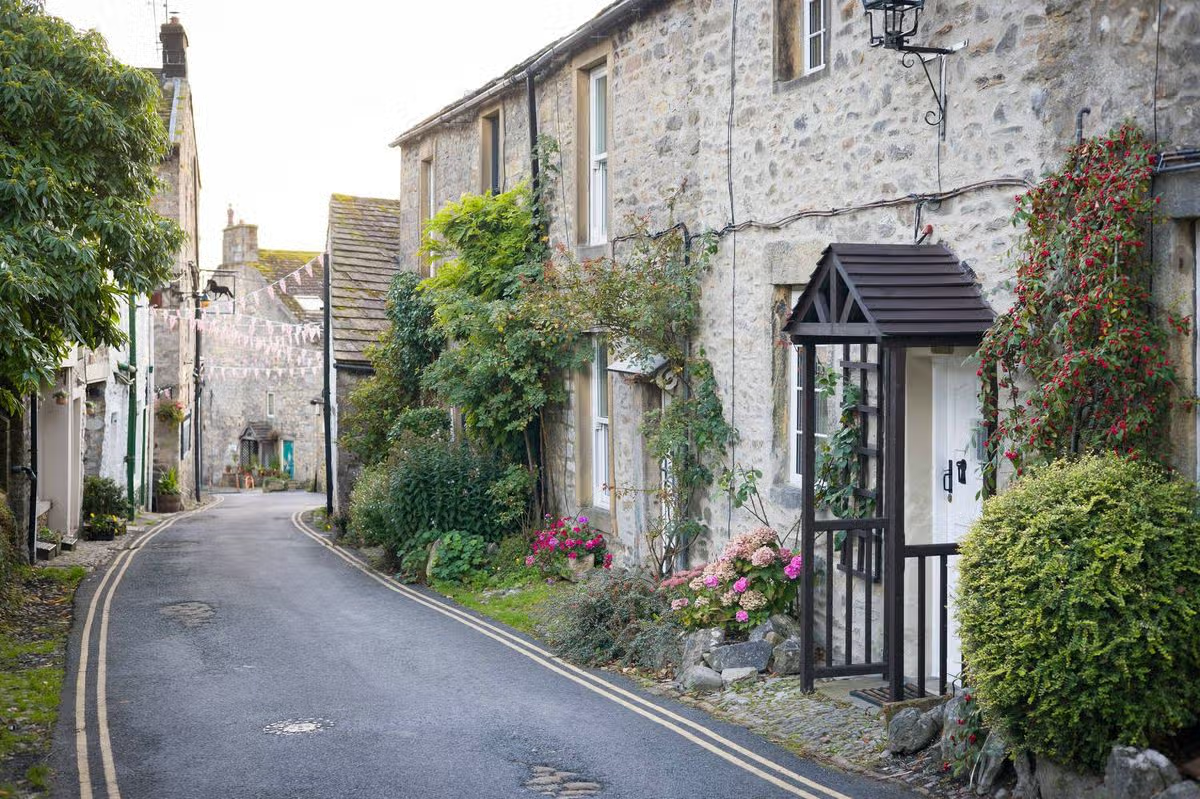
Set in the Yorkshire Dales, it has a traditional cobbled centre surrounded by some of the country’s most impressive countryside. The village square is a natural starting point, with independent businesses and places to eat clustered around its historic streets.

It’s got all the stone cottages, the flower boxes and historic pubs just like the Cotswolds – but you won’t find it teeming with tourists. This charming village is so beautiful it was picked as the main filming location for the fictional village of Darrowby in All Creatures Great and Small.

It’s Grassington in North Yorkshire – and it’s the perfect place to explore for a weekend.

The high street is packed with independent shops where you can pick up home made art and jewellery as well as delicious sweet treats and books.

Grassington is particularly appealing for tourists who want their break to combine sightseeing with walking. Rather than spending the day squeezing through a packed tourist centre, visitors can explore the village before heading out into the surrounding Dales.

If Yorkshire doesn’t tickle your fancy, the experts at Parkdean Resorts do have another destination that they think gives Cotswolds charm without the crowds.

Rye in East Sussex is another destination that rewards visitors who are prepared to look beyond the usual summer hotspots.

The town is packed with historic streets and distinctive old buildings, while independent shops and places to eat make it easy to spend a leisurely day exploring without needing a packed itinerary.

Its biggest advantage, however, could be its location.

Rye provides easy access to the Sussex coast, meaning a short break can include both an atmospheric old town and a day by the sea. Visitors can explore the historic centre in the morning before heading towards the beaches and coastline nearby.

It’s an appealing option for anyone who can’t decide between a countryside escape and a seaside break.

Source link

Don’t tell this California lawmaker the GOP won the redistricting push

One thing Anne Smull, a retired feedstore owner, was looking forward to on election day was voting for the man who currently represents her in Congress, conservative Rep. Kevin Kiley. Now she can’t.

That’s because California Democrats sliced Kiley’s district six ways as payback for Republican redistricting in Texas and elsewhere. The chunk of the district that Smull, who identifies as a conservative, lives in is now grafted onto an overwhelmingly Democratic seat based in the state’s wine country.

During a recent lunch at a cafe in Lincoln, a onetime agricultural town that has morphed into a bedroom community on the edge of Sacramento’s exurban sprawl, Smull was heartbroken to hear she can no longer vote for Kiley.

“He believes in the same things I do,” Smull said. “It feels sneaky and underhanded.”

Republicans started the redistricting competition. Democrats might finish it

Democratic voters in several other states know how Smull feels.

President Trump last year told GOP-controlled states to redraw their maps before this year’s midterm elections to increase the number of winnable seats for Republicans in order to help the party hold on to the U.S. House. The effort was turbocharged by a U.S. Supreme Court decision in the spring of this year that neutralized a key provision of the Voting Rights Act and cleared the way for Republicans to redraw more seats across the South that had elected Black Democrats.

Democratic-leaning and heavily minority communities from Texas to Tennessee have been split into multiple congressional districts that dilute the Democratic vote by stretching deep into conservative areas.

In the future, it is likely that more Republican voters in other states will go through what Smull and other conservatives in Northern California are facing. Democrats in Maryland, New York, Illinois and other strongholds have pledged to retaliate in time for the 2028 elections and split Republican-leaning districts the way their California counterparts did Kiley’s.

Democrats have been hindered nationally by stricter rules against partisan line-drawing in their states, but California showed a way around that. California Democrats won voter approval last year to redraw the state’s congressional map, originally made by an independent commission, and formed five new Democratic-leaning seats.

‘We have zero voice,’ says voter angry at the Democratic drive for a new political map

Kiley’s is one of them. The reworked political lines led the two-term congressman to leave the Republican Party and run as an independent in the slightly Democratic-leaning district that now includes his home.

He spoke out against partisan gerrymandering, even unsuccessfully trying to force the Republican-led House to allow a vote on a bill to ban mid-decade redistricting.

“We’ve seen partisan divisions really spin out of control in really harmful ways, and I think Exhibit No. 1 is the redistricting wars,” Kiley recently told a group of voters in the suburb of Citrus Heights.

Democrats contend Kiley’s party switch is purely a political trick to survive in a more liberal district. They note that he still caucuses with House Republicans and has voted for many of the GOP’s priorities, including Trump’s sweeping budget and tax cut bill last year, and that political organizations run by House Republicans are spending money to back his reelection.

Even some of Kiley’s supporters think the election was a factor in the congressman’s decision to become an independent.

“My original thinking was he did it because of redistricting — maybe it’d help him get reelected,” said John Coburn, a 68-year-old retired business owner, at the Citrus Heights event.

Coburn is furious at the Democrats’ redistricting and hopes Kiley wins. Coburn does not care that they did it in retaliation for Texas, where Republicans at Trump’s directive revised that state’s map to carve out up to five new winnable conservative seats.

“I don’t care about Texas, I live in California,” Coburn said, adding that “40% of the state is Republican, and we have zero voice. Zero. It’s not how our Founding Fathers intended.”

For Democrats in the district, a rare political opportunity

In an interview, Kiley said his switch to independent was no political gambit. If he wanted to stay in the House, he argued, he could have had an easier time staying in the GOP, moving to a more conservative district that included parts of his old one and running in a Republican primary there.

“I could have gone there and run and played the same game these other politicians are playing,” he said.

Kiley said that he is caucusing with Republicans to avoid losing his seats on committees and that in the next Congress he will try to change rules so independent members do not lose committee seats because they do not caucus with one of the two major parties.

Among his backers, he noted, is onetime Democratic presidential hopeful Andrew Yang, a former technology entrepreneur who co-founded a centrist party for independents.

The Democrat running against Kiley, former state Sen. Richard Pan, scoffs at his rival’s newfound independent status.

“He was a MAGA champion when he first ran for Congress, and now he’s trying to say ‘I’m not,’” Pan told a crowd at a senior community in Roseville, referring to Trump’s “Make America Great Again” movement.

Earlier that day, Pan swung by the Placer County Democratic Party office, tucked away on the second story of a brick shopping arcade in Lincoln’s compact downtown.

Placer is a Republican county that stretches from the Sacramento suburbs to the northwestern shores of Lake Tahoe. The entire county is in Kiley’s current district, but it will be divided among three districts in the new map.

Kathleen Crawford, chair of the county Democratic Party, was enthusiastic about the county getting carved up.

“It’s worth it, because we have an opportunity to get Democratic representation, which has been missing from our county,” Crawford said. “I’ve been here 15 years, and this is my first real opportunity to elect a Democrat.”

A never-ending cycle that cuts out ‘the little people’

Lincoln’s downtown is flanked by fruit, vegetable and flower farms, as well as new subdivisions. The community and its neighboring suburbs have become a destination for people fleeing the San Francisco Bay Area’s housing prices. That has helped change the once solidly conservative area into a political battleground where skilled mapmakers can draw winnable seats for Democrats.

Ed Church, a 61-year-old risk manager, was eating lunch at Simple Pleasures cafe in Lincoln when he contemplated Kiley’s shift. A Democrat, Church has not been a Kiley fan and he was bemused by the congressman’s move.

“If that’s how he’d been initially and not so MAGA, I probably could have supported him,” Church said of Kiley’s independent status. Now Church, as a Lincoln resident, is in a purely Democratic district and will not have a say in Kiley’s fate in November. His main criteria in the election will be “who’s going to stand up to Trump?”

Across the street at a gun store, Wesley Johnson, 43, who considers himself a conservative independent, said he was dispirited by the state’s redistricting.

“I feel Northern California is not represented fairly,” Johnson said. “San Francisco, Sacramento and Los Angeles control everything.”

He acknowledged Republicans were doing the same thing in states they controlled and said he did not know how it could stop.

“You’re just cutting out the little people,” Johnson said.

Riccardi writes for the Associated Press.

Source link

UK’s ‘cheapest city break’ has £79 hotels, independent shops and epic nightlife

If you’re looking for an inexpensive weekend away in autumn, you don’t need to go far, as this UK city has been named the cheapest for a budget-friendly break and it’s packed with history and culture

Autumn can be an excellent time for a weekend away, and if you’re looking forward to exploring some cities in the cooler weather, then you might want to consider some hidden gems in the UK.

Research carried out by ticket sellers SeatPick has shown the best UK cities for a budget friendly concert weekend, but you don’t need to have plans to see a gig to enjoy the top destination. There are plenty of historic and cultural sites to enjoy, and its famous for its buzzing nightlife.

Newcastle upon Tyne took the top spot to be crowned the UK’s cheapest city break, beating Liverpool into second place and Birmingham into third. Gilad Zilberman, CEO at SeatPick said: “Newcastle combines a vibrant nightlife with one of the UK’s most affordable city-centre accommodation.

“With average hotel prices of just £79 per night, a walkable centre and plenty of bars and restaurants close to major venues, it’s one of best-value cities for turning a concert into a weekend away.”

One of Newcastle’s most iconic sights is the Gateshead Millennium Bridge, and it’s worth visiting at night when its lit up to get the best photos. At weekends, visit the Quayside Sunday Market for a relaxed day walking along the waterfront with food stalls and arts and crafts.

The 12th century Newcastle Castle is also a major landmark. Walk through the rooms and enjoy immersive experiences that bring its past to life before heading to the roof for panoramic city views. Another place to see the city from above the rooftops is from Grey’s Monument. Climb 164 steps up the narrow winding staircase, but be warned, it’s not for the claustrophobic or those who get tired after a couple of flights of stairs.

You might prefer to stay on the solid ground of Grey Street, enjoying the historic vibes of its Georgian architecture, exploring colourful art galleries, or simply sitting in one of its many international restaurants, classic pubs, or stylish bars. You’ve also got major shopping streets and centres just a short walk away, with lots of independent stores among high street favourites.

Newcastle also has a lively cultural scene, and in the evening you can enjoy performances at the Victorian-era Tyne Theatre & Opera House, or the contemporary Northern Stage which has performances from Shakespeare to family-friendly shows. The city is also famous for its nightlife, its compact centre making it easy to go out without spending a fortune in taxis. Popular areas for nights out include Collingwood Street, sometimes known as the The Diamond Strip because of its stylish bars and Bigg Market which has inexpensive and vibrant clubs.

Of the second place choice, Gilad said: “Liverpool combines a thriving music scene with one of the UK’s best-value city breaks. Its compact city centre means fans can explore the Royal Albert Dock, Bold Street and the Cavern Quarter before heading to the M&S Bank Arena or nearby venues without relying on taxis for longer journeys.” While Birmingham was praised for its “excellent transport links and a compact city centre”.

Have a story you want to share? Email us at webtravel@reachplc.com

Source link

Trump remains unpopular, but Republicans back him on immigration

Immigration remains a stronger issue for President Trump than the economy or Iran among Republican voters, according to a new poll, even after three people were killed in encounters with Immigration and Customs Enforcement agents within a week in July.

But Trump’s immigration approach is unpopular among Americans overall, the new survey from the Associated Press-NORC Center for Public Affairs Research found. Only 39% of U.S. adults approve of his performance on immigration, a decline from 49% at the beginning of his second term.

About 8 in 10 Republicans continue to approve of how Trump is handling immigration. That’s a slight decline from the beginning of his second term, when about 9 in 10 Republicans approved, but his support on the issue within his base has been mostly stable since last summer despite a chaotic year of immigration enforcement actions including several shooting deaths.

Republicans are also more likely to approve of how Trump is handling immigration than the economy or Iran. In just the last month, GOP voter approval of Trump’s handling of Iran dropped slightly in AP-NORC polling.

The poll found that about half of U.S. adults say Trump has “gone too far” on deporting immigrants living in the U.S. illegally. That number also has remained steady for more than a year, despite multiple immigration crackdowns that deployed federal law enforcement to large cities and at least 10 deaths involving encounters with immigration officers since the mass deportation campaign began. Republicans are much less likely to say Trump has overstepped in his immigration enforcement actions.

Overall, Trump’s popularity has fallen since he took office last year, but the findings highlight the relatively muted impact of the last year’s aggressive immigration enforcement on his public standing. That’s a contrast with views of his handling of Iran, where he’s seen more recent signs of slippage, even among supporters.

Partisan divide

Americans remain divided on whether Trump has overstepped on immigration.

About half of U.S. adults say Trump has “gone too far” when it comes to restricting legal immigration, in line with the last time the question was asked in February. Roughly half — 47% — say Trump has exceeded his authority when it comes to deporting immigrants living in the U.S. illegally. In each case, about 3 in 10 say Trump’s actions have been “about right,” and closer to 2 in 10 say he hasn’t gone far enough.

Few Republicans — about 2 in 10 or fewer — say he’s “gone too far” on deporting immigrants in the country illegally or restricting legal immigration.

Most Americans, however, say he’s gone too far when it comes to using traffic stops to find and arrest immigrants living in the U.S. illegally — a practice that was at the center of two recent ICE shootings in Texas and Maine — and when it comes to sending federal immigration agents into U.S. cities. Republicans were also less likely to see these as oversteps.

James Leatherman, a 68-year-old Republican from San Antonio, is generally supportive of Trump’s handling of the presidency and backs him on immigration in particular.

“You cannot come in here illegally — you’re breaking the law,” he said.

More Americans disapprove than approve of the way ICE is enforcing immigration laws. About half of Americans “strongly” or “somewhat” disapprove of the agency’s approach, while roughly 3 in 10 “strongly” or “somewhat” approve. There’s a wide partisan split, though: About 6 in 10 Republicans approve of ICE’s approach, compared with about 2 in 10 independents and just 4% of Democrats.

Eric Coursen, 76, an independent from Chincoteague, Va., agrees with the president that there were problems with the immigration system that needed to be addressed. He said doesn’t believe in “open borders,” but he’s deeply opposed to how the administration has been enforcing immigration law.

“It’s like taking some bread when you’re hungry, and you take it, you’re going to shoot that person rather than just, you know, get them for theft?” he said. “It’s just overkill.”

Poor marks on economy

About 3 in 10 U.S. adults, 32%, approve of how Trump is handling the economy. That’s down from 40% at the start of his second term, and marks a shift from his first presidential term when the economy was a relatively strong issue for Trump.

During Trump’s first term, his lowest approval on the economy was 40% in December 2017. Now, his rating is well below that.

Roughly 7 in 10 Republicans — 69% — approve of how Trump is handling the economy. That’s roughly in line with the share who approve of how he’s handing the presidency, but it’s slightly below the 78% who approved early in Trump’s second term.

Leatherman, despite his support for Trump, said he’s feeling the pinch of higher prices in his budget. “I almost have to go to the bank to get a loan before I go grocery shopping,” he said.

About 7 in 10 U.S. adults describe the nation’s economy as “very” or “somewhat” poor, in line with April. Republicans are more optimistic, with about 6 in 10 saying that the economy is doing well, compared with about 2 in 10 independents and roughly 1 in 10 Democrats.

Healthcare remains a weak issue

Healthcare never has been a strong issue for Trump. Unlike with immigration and the economy, a clear majority of U.S. adults has disapproved of Trump’s performance on healthcare across both terms. That hasn’t changed in the new poll, which found that only about 3 in 10 Americans approve of how Trump is handling healthcare, in line with when the question was last asked in December.

He’s experienced a rebound on the issue among his own supporters since late last year, though. Roughly 71% of Republicans now approve, compared with 59% in the December poll.

That shift comes as Democrats kicked off 100 days until the midterm elections last week, with leaders saying they’ll focus on healthcare cuts, in addition to the cost of living and the war in Iran. Democrats and independents continue to overwhelmingly disapprove of Trump’s handling of healthcare.

The AP-NORC poll of 1,165 adults was conducted July 23-27 using a sample drawn from NORC’s probability-based AmeriSpeak Panel, which is designed to be representative of the U.S. population. The margin of sampling error for adults overall is plus or minus 3.7 percentage points. The margin of sampling error is plus or minus 6 points for Republicans overall and plus or minus 5.4 points for Democrats overall.

Thomson-Deveaux, Sanders and Catalini write for the Associated Press.

Source link

England’s ‘most underrated’ town is home to thriving high street and independent shops

The picturesque town is dubbed the ‘Jewel of the Weald’ and boasts award-winning wineries

If you’re after a UK destination to visit that’s away from the usual tourist trail, look no further than this underrated town. Like many British market towns, this spot has seen businesses come and go, but it has generally remained resilient thanks to tourism and its emphasis on independent retailers.

New cafés, salons and professional services have continued to open in recent years, helping maintain a lively town centre despite the wider challenges facing UK high streets. Its high street is often described as one of the most attractive market-town high streets in Kent.

Rather than being dominated by chain stores, it has retained a strong independent character, with a broad, tree-lined layout that makes it feel more like a promenade than a conventional shopping street.

When it comes to independent shopping you’ll find boutiques, gift shops, bookshops, galleries, jewellers, delicatessens, cafés and specialist retailers alongside a handful of familiar national brands. This mix has helped the town remain a shopping destination for both locals and visitors.

Walking along the high street today, you’ll pass several historic landmarks, including St Mildred’s Church, whose origins date back to the 12th century and the 1792 Town Hall, an elegant Georgian building.

Kent town

Nicknamed the “Jewel of the Weald” by locals, the picturesque town of Tenterden in Kent is easily accessible and boasts arts and folk festivals, restaurants and award-winning wineries and historic architecture.

Although the population is only around 8,200, Tenterden serves a much wider rural area. People from dozens of surrounding villages come into town for shopping, healthcare, banking and cafés, so it often feels busier than its size would suggest.

For a relatively small place, Tenterden has a busy calendar. Annual events include:

  • May Fair
  • Folk Festival
  • Christmas Market
  • Classic car gatherings
  • Steam railway events
  • Food and drink festivals

Many of these take place on or around the high street, making it the perfect spot for locals and visitors to get together.

History

One of Tenterden’s most fascinating stories is its unexpected maritime past. Although the town now lies several miles inland, it was once closely connected to the sea.

During the Middle Ages, ships could sail up the River Rother to the nearby port of Small Hythe, which became an important centre for shipbuilding.

Over time, the river silted up and the coastline gradually shifted, leaving Tenterden inland.

The Kent & East Sussex Railway is one of Britain’s best-loved heritage railways and an integral part of Tenterden’s character.

Stretching 17 km between Tenterden Town and Bodiam, the line takes passengers for “a nostalgic journey” through the scenic Rother Valley to view a 14th-century structure, Bodiam Castle, which is regarded as “one of the best loved and best known castles in England”.

Combining rich railway history with some of the finest countryside in Kent and East Sussex, it remains one of the region’s most popular visitor attractions.

The town is home to Chapel Down Winery, which provides tours and tastings of its award-winning wines, ciders, and spirits, according to WorldAtlas. The town also regularly plays host to arts and crafts fairs and folk festivals, amongst them a free-entry community festival taking place this summer.

Tenterden is a popular base for exploring both Kent and East Sussex, and within 20 minutes, you can also reach:

  • Rye
  • Romney Marsh
  • Bodiam Castle
  • Great Dixter
  • Sissinghurst Castle Garden
  • Camber Sands

Source link

Guyana to launch independent inquiry after ferry disaster kills 53

Guyana Prime Minister Mark Anthony Phillips said an independent inquiry will be established “as early as possible” to determine what happened before the MV Barima departed and whether operating procedures were followed. File Photo by Nathalia Aguilar/EPA

July 22 (UPI) — Guyana will establish an independent commission of inquiry into the country’s deadliest maritime disaster after the sinking of the MV Barima left at least 53 people dead.

Meanwhile, authorities continued rescue and recovery operations while investigating discrepancies in the ferry’s passenger manifest and possible safety violations.

The MV Barima, an 87-year-old ferry operating between Georgetown and the remote community of Port Kaituma, capsized Saturday night after issuing a distress signal, Authorities described it as the worst maritime disaster in Guyana’s history.

Prime Minister Mark Phillips said Wednesday the independent inquiry will be established “as early as possible” to determine what happened before the vessel departed and whether operating procedures were followed.

Investigators will also examine how discrepancies in the passenger manifest occurred, how cargo was handled, whether the emergency response was adequate and whether violations of maritime regulations occurred, according to Guyana’s Department of Public Information.

“I can assure you, yes, we will have a commission of inquiry and people will be held responsible based on the outcome, the results and the recommendations of that commission of inquiry,” Phillips said.

Authorities now believe about 179 people were aboard the ferry when it capsized, despite the official manifest listing 116 passengers and 17 crew members, Phillips said.

He cautioned against drawing conclusions about possible overloading or operational failures before investigators complete their work, but did acknowledge discrepancies between the official records and the estimated number of passengers.

Phillips said the commission also will recommend reforms to strengthen maritime safety, improve ferry operations and help prevent similar disasters.

The announcement comes as search and recovery operations entered a new phase. President Mohamed Irfaan Ali said Wednesday that authorities planned to begin raising the wreck using specialized flotation equipment to improve access for rescue and recovery teams, according to the Department of Public Information.

Ali said additional divers and technical personnel were joining the operation, which includes the Guyana Defence Force Coast Guard, police, civilian volunteers and private-sector partners. He ssaid seabed mapping technology provided with support from ExxonMobil had located the ferry resting on its starboard side, allowing engineers to plan a recovery effort.

“We have not ruled out rescue just yet,” Ali told relatives of those still missing during a late-night briefing, according to the Department of Public Information.

Authorities said 76 people have been rescued since the accident, while dozens remain unaccounted for.

Separate criminal and administrative investigations also remain underway.

Earlier this week, officials confirmed that the ferry’s captain and mate tested positive for marijuana after the accident. Maritime personnel responsible for the vessel’s operations were placed on administrative leave pending the outcome of the investigation, according to the Department of Public Information.

Source link

Donald Trump removes final members of independent US election commission | US Midterm Elections 2026 News

The dismissals leave the federal election body vacant as Trump presses for broader changes to US voting rules.

President Donald Trump has removed the last remaining members of an independent federal commission that helps support United States elections, leaving the bipartisan body with no sitting commissioners.

The White House confirmed the news on Friday, with only months to spare before November’s midterm elections.

Recommended Stories

list of 3 itemsend of list

“The President, and head of the Executive Branch, reserves the right to remove individuals that may not be totally aligned with the important task of securing America’s elections,” the White House said in a statement.

It added that the administration had been “working across all agencies and local partners to safeguard elections from fraud and abuse” in the run-up to the midterms.

The decision concerns the Election Assistance Commission (ECA), an independence office created by Congress in 2002 to support state and local election officials. Among its duties are creating non-binding election guidelines, certifying voting systems and maintaining the national mail voter registration form.

Four commissioners typically helm the agency. But on Thursday, the two Democratic appointees — Thomas Hicks and Benjamin Hovland — were fired by email, according to the news agency Reuters.

The lone remaining Republican, Christy McCormick, resigned. A fourth commissioner, Republican appointee Donald Palmer, had already left in April.

The commission is required by law to be made up evenly of Democrats and Republicans, and it was put in place to help after the disputed 2000 presidential election.

Trump’s decision to fire the remaining commissioners has further raised concerns that he may seek to intervene in the upcoming midterm elections, which will decide control of Congress for the rest of his term.

Under the US Constitution, election administration is the responsibility of the state, not the federal government.

The Election Assistance Commission had previously declined to implement part of Trump’s March 2025 executive order that called upon it to require proof of citizenship on the national mail voter registration form.

A federal judge later blocked that part of that executive order, ruling the president had exceeded his authority. Trump has appealed the ruling.

Voters are already required to affirm their citizenship before voting, as non-citizen voting is illegal in the US. Instances of non-citizen voting are rare.

The firings are the latest in a broader effort by the president to reshape how elections are conducted.

The Trump administration has pushed to tighten vote-by-mail rules and threatened to withhold some federal funding from states that refuse to adopt new election requirements. Many of those efforts have been challenged in court.

Earlier this week, the administration also sent out letters warning election officials that they could face prosecution if they fail to remove noncitizens from voter rolls.

Trump has defended the actions as necessary to protect election integrity. He has repeatedly claimed that his loss to Democrat Joe Biden in the 2020 election was the result of fraud, a claim not backed by evidence.

The latest firings come after the US Supreme Court last month expanded the president’s power to fire members of independent agencies, even without cause.

The court ruled six to three in Trump’s favour, arguing that “neither Congress nor the courts may saddle” the president with executive-branch leaders he does not approve of.

The president is allowed by law to appoint replacements to the commission. It is not yet clear whether Trump plans to nominate replacements or leave the seats vacant.

Source link

I visited charming hidden ‘village’ full of busy independent shops — not the Cotswolds

Just 35 minutes from London’s Victoria station lies a charming neighbourhood bursting with independent shops.

When Brits picture stunning and historic spots across the UK, places like the Cotswolds, Edinburgh, Somerset, and York typically spring to mind, renowned for their enduring appeal, charming streets, and centuries-old buildings.

Yet despite boasting a wealth of heritage, London’s neighbourhoods rarely feature in discussions about the nation’s most enchanting locations. Our capital is enormous and brimming with hidden treasures.

As a native South Londoner, I hardly venture up North, but just 35 minutes from Victoria station sits a charming neighbourhood nestled between Finsbury Park and Wood Green that feels like travelling back through the decades, complete with cobbled lanes, vintage and independent retailers, and an impressive 19th-century clock tower.

Here’s why Crouch End deserves a spot on your must-visit list.

What sets Crouch End apart?

My favourite part of exploring this neighbourhood was discovering all the independent retailers, which have remained bustling thanks to the local community. From organic health shops that have traded since 1986 to a florist, garden centre, and pet emporium open seven days a week, there’s a varied selection of outlets on every street.

According to Hornsey Town Hall, “Crouch End is a captivating neighbourhood that exudes a bohemian charm unlike any other in London. With its quirky character, artistic flair, and vibrant community, living in Crouch End offers a unique and enriching experience.”

They added: “Crouch End is often affectionately referred to as ‘a village within the city,’ and for good reason. Despite being only a few miles away from the bustling heart of London, this neighbourhood feels worlds apart.”

I particularly enjoyed browsing fashion boutiques such as Rhoda, which displays original creations from local and international designers and stocks trinkets, mugs, jewellery, ceramics, and more. The shop has been trading since 1998 and was established by three sisters.

A statement on its website read: “Our store is a labour of love and a testament to the power of meaningful connections. Our passion for curating unique fashion and heartfelt gifts led to the establishment of our shop, and we’ve been spreading the joy ever since.”

The neighbourhood is also renowned for its dining and leisure scene. Just a brief stroll through the suburb reveals bakeries, pubs, restaurants, and cafés – you’re truly spoilt for choice in Crouch End.

I’d suggest popping into Sourdough Sophia for a delectable sweet indulgence in a stunningly decorated setting. I sampled a scrumptious Baileys-filled croissant and a decadent hot chocolate.

Crouch End boasts a vibrant creative energy, drawing artists, writers, musicians, and actors for generations. The ArtHouse Crouch End, situated in a former Salvation Army Hall, serves as a local cultural centre, while pubs and venues throughout the area host a dynamic blend of up-and-coming and established live music.

During a visit in early June, I stumbled upon Crouch End’s annual festival, reportedly one of the UK’s largest independent community festivals, taking place at Hornsey Town Hall in the neighbourhood’s centre.

It was established to unite local creatives and celebrate the community and the arts. I have never witnessed a neighbourhood come together so harmoniously and happily to champion and recognise their area.

A brief history of Crouch End

Crouch End began life as a modest rural settlement at the crossroads of ancient pathways, deriving its name from a wooden cross that once stood where the Clock Tower now sits.

It remained predominantly agricultural for centuries until the railway arrived in late 1867, triggering swift expansion. New housing, retail outlets and enterprises transformed the district into a flourishing Victorian suburb and, by the close of the 19th century, Hornsey’s commercial centre.

The iconic Clock Tower, still standing today, was erected in 1895 to commemorate local reformer Henry Reader Williams, symbolising Crouch End’s evolution. More than 130 years on, it remains the neighbourhood’s most recognisable landmark and the focal point of the local community.

Why is the area so hidden?

Crouch End no longer has a railway station, with no underground tube or overground trains serving it. The nearest stations are Finsbury Park, Archway, Hornsey, and Crouch Hill.

According to Ham High, “The line never quite achieved its potential in terms of passenger numbers.” They added: “In the mid-1930s, a plan was devised to incorporate the track and stations into London Underground’s Northern Line.

“Work on electrification was started but then halted early in the Second World War and subsequently abandoned. A peak-hours-only service was maintained using locomotives and rolling stock almost as old as the stations – but that simply staved off the inevitable, and Crouch End and the handful of other stations on the line closed to passenger traffic in July 1954.”

Crouch End may not be on the typical tourist trail, but those who stumble upon it tend to fall head over heels for it. American travel blogger, A Lady in London, paid the area a visit and shared: “Crouch End is one of my favourite under-the-radar London neighbourhoods.

“It has lots of independent shops and restaurants, vibrant streets, and great views of London. East of Highgate and south of the Alexandra Palace, it stays incognito partly because it’s not really on the tube.”

Yet beyond its delightful, characterful appeal, locals cherish the area for its close-knit, welcoming community spirit that looks out for one another — a quality that’s genuinely hard to come by in the capital.

Speaking to long-term resident Judith Abbs, who has called the area home for a number of years, she said: “We thought we knew Crouch End quite well before we moved here five years ago. But one wonderful surprise has been how many friendly people we meet.

“My husband is disabled, and a passing stranger often stops to ask if they can help. It really has a strong community feel.”

Source link

Supreme Court: Trump may fire heads of independent agencies, but not the Federal Reserve

The Supreme Court on Monday gave President Trump new power to fire the heads of most independent agencies created by Congress — but not the Federal Reserve.

Chief Justice John G. Roberts Jr. announced two opinions, one of which bolstered the president’s power as the chief executive and a second which said this authority did not extend to the Federal Reserve board.

The first was a 6-3 decision that had the support of five conservatives, while the second had a 5-4 majority that included the three liberals.

Roberts, a former White House lawyer, has long been skeptical of independent agencies whose officials may wield regulatory power in conflict with the views of the president.

Since the 1880s, however, Congress has at times created independent agencies led by a bipartisan board of experts. In 1935, a unanimous Supreme Court had upheld these multi-member boards and commissions.

But Roberts and the court overturned that precedent and declared it conflicts with the executive power of the president.

“Our Constitution creates three branches, but only one President,” he wrote. “To discharg[e] the duties of his trust, the President must have the assistance of officers he can trust. … Subordinates who exercise the President’s power are subject to removal by him. Then, and only then, can they remain accountable to the President, and the President to the people.”

The decision upholds Trump’s firing of Rebecca Slaughter, one of two Democratic appointees on the five-member Federal Trade Commission.

Rebecca Slaughter leaves the Supreme Court in December.

The Supreme Court upheld President Trump’s firing of Rebecca Slaughter, a Democratic appointee to the Federal Trade Commission.

(Graeme Sloan / Bloomberg / Getty Images)

In dissent, Justice Sonia Sotomayor said that the ruling “distorts the structure of government to fit the majority’s theory of unitary, total executive control. The result is a President who emerges with far greater power than ever before. It is a power, however, that neither the People, nor Congress, nor the Constitution bestowed upon him.”

Under what has been dubbed the “unitary executive” theory, the court’s conservatives believe the president’s executive power in Article II of the Constitution overrides Congress’power in Article I to write the laws and structure the government.

The departments and agencies of the federal government exist only because Congress created them by law.

But in the second opinion, the court blocked Trump’s bid to fire Fed Governor Lisa Cook, an appointee of President Biden.

Roberts said the central bank dates back to the nation’s founding, and Congress created the Federal Reserve Board in line with “our Nation’s tradition of central banking protected from political interference.”

Trump tried to fire Lisa Cook in a social media post, he said.

But “the Federal Reserve’s Governors do not serve at the President’s pleasure — they instead serve staggered 14-year terms, and may be removed only ‘for cause’,” he wrote.

Justice Brett M. Kavanaugh cast a crucial vote to support the Fed’s independence. He said he joined the majority because it “confirms the longstanding historical practice and understanding that the Federal Reserve is an independent agency whose Governors enjoy for-cause removal protection consistent with Article II of the Constitution.”

The court did not finally decide on Cook’s case, except to say she deserved due process of law. She could not be fired without a hearing and evidence, the court said.

The setback for independent agencies came as no surprise, however.

Even prior to Trump’s election, Roberts has insisted agency officials must be accountable and under the control of the president.

Last year, the justices blocked lower court rulings that would have reinstated agency officials who were fired by Trump.

For most of American history, however, it had been understood that Congress had the power to structure the government and to create semi-independent agencies to carry out specific tasks like regulating railroad rates or the money supply.

These agencies and commissions were led by a bipartisan board of experts who were appointed with a fixed term. They could be fired only for cause, not because of a political disagreement with the president.

The Supreme Court upheld these multi-member commissions in 1935 on the grounds their work was more legislative and judicial than simply enforcing the law.

But the court’s current conservative majority has contended these commissions and boards wield executive authority and are therefore, subject to direct control by the president.

In creating such bodies, Congress often was responding to the problems of a new era.

The Interstate Commerce Commission was created in 1887 to regulate railroad rates. The FTC, the focus of the court case, was created in 1914 to investigate corporate monopolies.

The year before, the Federal Reserve Board was established to supervise banks, prevent panics and regulate the money supply.

During the Great Depression of the 1930s, Congress created the Securities and Exchange Commission to regulate the stock market and the National Labor Relations Board to resolve labor disputes.

Decades later, Congress focused on safety. The National Transportation Safety Board was created to investigate aviation accidents, and the Consumer Product Safety Commission investigates products that may pose a danger. The Nuclear Regulatory Commission protects the public from nuclear hazards.

Typically, Congress gave the appointees, a mix of Republicans and Democrats, a fixed term and said they could be removed only for “inefficiency, neglect of duty or malfeasance in office.”

Slaughter was first appointed by Trump to a Democratic seat and was reappointed by Biden in 2023 for a seven-year term.

Source link

I visited gorgeous UK market teeming with independent shops

This Devon market town’s unique blend of independent shops, bohemian culture and charming eateries

Living in London, life can feel rather frenetic at times. I adore city living, but I do make an effort to escape at least a few times each year to properly switch off.

One of my favourite spots I’ve discovered is renowned for its relaxed atmosphere and delightful high street.

Totnes is a market town in Devon, celebrated for its artistic community and flourishing bohemian spirit. It also boasts, in my view, one of the finest high streets in Britain.

If you begin at the lower end of the street, you can cross the bridge spanning the River Dart and really absorb the character of the town from there.

During the summer months, the town is adorned with vibrant bunting, and small vessels glide across the water, reports the Express.

There’s verdant riverside greenery, and the town buzzes with energy. Once you’ve crossed the bridge, pop in for a coffee at The Curator – the first of countless independent shops scattered along the high street.

The coffee is excellent, and they offer a wonderful range of pastries if you fancy settling in for a spot to eat – though don’t overdo it, there’s plenty more to discover.

The high street meanders gently uphill and is flanked by hundreds of independent boutiques, charity shops and tea rooms.

Further up the high street, there’s the Cornish Bakery, which fills the air with the mouthwatering savoury aroma of pasties.

They cater for everyone – even my vegan brother discovered something he adored. As the high street sweeps round to the left, you’ll come across Butterworth’s Vintage Co — a compact yet impressive second-hand shop stocking everything from knitwear to workwear and even vintage magazines.

Once you’ve had a good rummage through the shelves, you might fancy a swift pint or another bite to eat — and you’re in luck.

Just a short stroll from Butterworth’s sits The Bull Inn — a stunning pub boasting an extensive organic food menu, along with nine rooms available should you need somewhere to rest your head.

The highlight for me at The Bull Inn is its delightful garden, where you can unwind in the sunshine and watch the world go past. Tucked just across the carpark, and much like the rest of the town, it’s frequently adorned with gorgeous bunting.

On a sunny day, it really is hard to beat — and if you’re anything like me, you’ll be more than ready to take the weight off your feet after all that retail therapy along the high street.

Source link

AP-NORC poll shows where Trump has lost support with independents

Independents have grown increasingly unhappy with President Trump during his second term, a new AP-NORC polling analysis finds, particularly those without a college degree.

The analysis from researchers at The Associated Press-NORC Center for Public Affairs Research shows that while about half of independents without a college education had a positive view of Trump around the 2024 election, his approval with that group fell to about one-quarter this spring. That shift has erased the large education gap that existed among independents in the months before Trump took office for his second term, with independents now holding similarly negative views of the president regardless of their level of education.

The analysis was conducted by aggregating nearly two dozen AP-NORC polls conducted between July 2024 and April 2026, allowing for a deeper look at how support for Trump changed during several distinct periods, including the last six months of 2024, the first 100 days of Trump’s presidency, the summer of 2025 when the One Big Beautiful Bill passed, last fall’s government shutdown and the beginning of the Iran war.

The compiled polling shows a steady decline among independents throughout Trump’s second term. His standing has also dropped among several small but important groups that moved toward him in the 2024 presidential election, including Black and Hispanic independents.

More Americans than ever consider themselves independents, and they are among the groups that shifted toward Trump in the 2024 presidential election. Any erosion in that support could signal trouble for Trump and Republicans headed into the midterm elections, which are often seen as reflection of how voters feel about their governing party.

Tafari Torres, a senior research associate at NORC who co-authored the analysis, noted that while Democrats’ and Republicans’ views of Trump have held largely steady in his second term, independents’ opinions are still moving.

“Independents are, broadly, the people who are reacting to the events and dropping in their support,” he said.

Dramatic declines during Trump’s first 100 days

Trump’s return to the White House was in part fueled by independent voters who saw him as the stronger candidate on key issues like the economy. The new analysis, which looks at Trump’s favorability and presidential approval ratings, shows that once he took the helm, their views quickly soured.

Independents without a college degree had a much more positive view of Trump than college-educated independents did during and shortly after the 2024 election, but that shifted in the first few months of his term. Positive views of Trump among independents without a college degree fell from 48% in the months before he returned to office to 31% in polling conducted during Trump’s first 100 days back in office. Those warm views declined even further, to about one-quarter, during the government shutdown and the early months of 2026.

Only about 3 in 10 college-educated independents, by contrast, had a positive view of Trump before he returned to office, making their drop to about one-quarter much less dramatic.

“The decline among no-college independents was steeper and it was greater than the slight decline in college independents,” said Sean Collins, a research associate at NORC who co-authored the analysis. “That was surprising, especially given, when you think of Trump’s coalitions, those without college degrees is usually one of the ones that that stands out.”

Hispanic, younger independents grow disenchanted

Americans without a college degree have long been a key part of Trump’s coalition. But Trump also won in 2024 by making gains among groups that tend to support Democrats, including Hispanic adults.

About 4 in 10 independent voters — 42% — voted for Trump in 2024, up from 37% in the 2020 presidential election. Independent voters without a college degree were a little more likely to back Trump over former Vice President Kamala Harris in the last election, according to AP VoteCast, and Hispanic independents were about evenly split between the two.

The picture looks much bleaker for the president now.

Nearly half of Hispanic independents — 46% — saw Trump favorably in the polling conducted around the presidential election. His approval among these adults dropped quickly in his second term, falling as low as 15% during last fall’s government shutdown before landing around one-quarter in the spring.

Younger independents also became less supportive of the president, while independents age 60 and older remained mostly stable. Other AP-NORC polling has pointed to Trump losing ground among younger Republicans over inflation concerns and Hispanic Americans growing increasingly discontented.

“The gains Trump appeared to make during the election, I don’t know if they’re sticking around. He’s experienced some significant shifts among those people,” Torres said. “From our research, they don’t appear to be permanent gains.”

The economy is frustrating many independents

Polling suggests that the economy is at the root of many Americans’ frustrations with Trump, including independents.

About half of independents who supported Trump in 2024 said inflation was the single most important factor for their vote, AP VoteCast found, and most expressed high levels of concern about the cost of food and gas.

More than a year into Trump’s second term, inflation remains high, fueled by gas prices that remain elevated as the Iran war continues. An AP-NORC poll conducted in April found that about 3 in 10 independents were “extremely” or “very” concerned about being able to afford groceries in the last few months, and a similar share were worried about being able to afford gas.

The analysis found that Americans’ views of the U.S. economy tend to align with their view of the president. Those with negative views of the country’s economy tended to have negative views of Trump, and about 8 in 10 independents described the U.S. economy this spring as poor.

The latest AP-NORC polling from May found that only about 3 in 10 independents approve of how Trump is handling the economy, in line with the roughly 3 in 10 who said that at the beginning of his second term. The April poll found only about 1 in 10 independents — 12% — approved of how Trump was handling the cost of living.

This AP-NORC analysis of 4,836 independents was conducted over 21 AP-NORC surveys, blocked into five time periods before and during President Donald Trump’s second term. Independents are classified as panelists who do not select that they identify with or lean toward either the Democratic or Republican Party.

Sanders writes for the Associated Press.

Source link