independent voter

Democrats are the wild card in House race between two SoCal Republicans

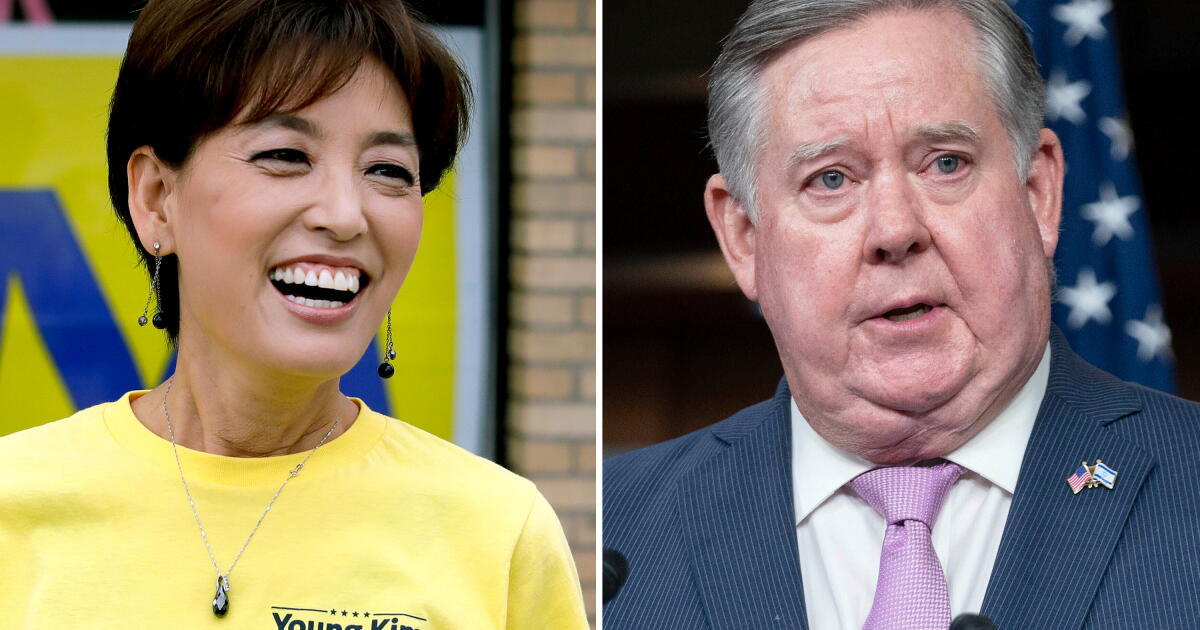
Democratic and independent voters could play the spoiler in a battle between two Republican incumbents vying for a solidly red congressional seat in Orange and Riverside counties.

Thanks to redistricting, Reps. Ken Calvert of Corona and Young Kim of Anaheim are pitted against one another in Congressional District 40, a newly redrawn territory that consolidates Republican voters in an area stretching from Mission Viejo, Rancho Santa Margarita and Anaheim Hills in Orange County to Woodcrest, Menifee and Murrieta in Riverside County.

Democratic leaders remade the district map as part of an overall effort to boost their party’s numbers in the U.S. House of Representatives after President Trump cajoled Texas into carving out districts more favorable to Republicans.

While considered deep red, District 40 still claims many Democratic and independent voters who could help sway the outcome.

“The question is, who are the Democrats going to support?” said Jon Fleischman, former executive director of the California Republican Party. He expects about half of the Democrats to not vote at all.

Self-identifying conservatives make up 33% of the district compared with liberals’ 27%, according to the Public Policy Institute of California. More independents lean Democratic (36%) than Republican (16%), according to the institute.

Democrats, so far, seem less than enthusiastic about their choices.

“I don’t care who wins in the 40th,” said Orange County Democratic Party Chair Florice Hoffman, who skipped voting in the race. “They’re both two bad choices, so I will not spend any time telling Democrats to go out to vote for either one of them.”

Kim may cast herself as a collaborative politician but if you look at her record, “she’s not any better than Ken Calvert. They both ran as 100% Trump — and really that’s how she votes,” said Hoffman, who lives in Orange.

Calvert topped the June primary, earning 35% to Kim’s 21%. Democrat Esther Kim-Varet came in third with 17%, followed by several Democrats and an independent.

Calvert, 73, retained about half of his constituents in the redrawn district. Kim, 64, kept about a third of hers.

Americans 4 Security PAC, which has spent more than $6 million backing Calvert, sent out fliers highlighting Trump and Kim’s ties, the Orange County Register reported. One mailer quoted Trump thanking Kim, while another announced: “Young Kim 100% pro-Trump.”

Political experts said these mail pieces are intended to dissuade Democrats from backing her.

With polls showing Democrats likely to take back the House, Los Angeles political consultant Jorge Flores said Kim’s reputation for working with others could help her among Democrats and independents deciding between two conservatives.

“Whether she convinces voters that she’s actually the right choice, I think it’s a steeper climb,” said Flores, who worked with the independent candidate in the primary.

The Democratic Party branches in Orange and Riverside counties make no mention of the race in their official endorsement guides.

Kim and Calvert are similar when it comes to backing Republican policies, Fleischman said, noting that both support Trump and have voted together about 95% of the time.

He described Young as someone who tries “to put together coalitions” while Calvert is “set in his ways.”

“Young probably has a better case to make to [Democrats], but it’s just too hard to tell,” said Fleischman.

A general election with two Republicans facing each other in a House seat is highly unusual. It’s a product of the state’s “jungle primary,” which advances the top two candidates, regardless of party, and Proposition 50, the voter-approved ballot measure that allowed the new congressional district lines.

Elected in 1992, Calvert is the longest-serving member of California’s Republican delegation in Congress.

Kim, known as a prolific fundraiser, was elected in 2020. She’s raised $10 million in direct donations, compared with Calvert’s $7 million.

Calvert sits on the House Appropriations Committee, where he chairs the Defense Appropriations Subcommittee. The Americans 4 Security PAC attacking Kim counts two executives from Miami-based Palantir, whose software is used by the U.S. military, among its donors.

Before the primary, Kim stripped her campaign website of “America first” branding and references to Trump.

Chris Pack, a Kim spokesperson, said last month that she was “proud of her work with President Trump to deliver results for Southern California,” arguing the campaign’s messaging is focused on Calvert’s record.

In a social media post this week, Kim hammered Calvert as a career politician. She supports legislation banning members of Congress from trading stocks, wants to enact term limits and portrays herself as a pragmatist.

“What kind of Republican do you want representing you?” Kim said in a recent NBC4 interview.

Calvert’s campaign, meanwhile, labels Kim a RINO, or Republican in name only, a pejorative used to describe a disloyal conservative. She co-sponsored legislation to censure Trump after the Jan. 6, 2021, attack on the U.S. Capitol, although Democrats widely viewed the move as a slap on the wrist.

Calvert’s campaign has pointed to Kim’s 2021 vote with Democrats to repeal a Trump-era rule that rolled back methane-emissions regulations.

Calvert, who appeared this week at a rally in Murrieta alongside Republican gubernatorial candidate Steve Hilton and Assemblymember Carl DeMaio (R-San Diego), labels himself a consistent conservative.

“People know exactly where I’m at,” he recently told Spectrum News. “I haven’t changed a bit in the 30 years, and so I’ll continue to give people the kind of common sense governance that they deserve.”
Source link

With Senate majority up for grabs, candidates fight for ‘kingmaker’ voters

With the midterm elections just over three weeks away, the fight for control of the U.S. Senate is intensifying in battleground states, as Democrats push into red regions and Republicans pour money into key contests.

Campaigns are entering a crucial stretch for persuading the independent voters who will probably determine outcomes in swing races. Nearly all of the most competitive Senate races are in states with significant swaths of people unaffiliated with either major party — the “kingmakers” in these high-stakes midterms, said Jeremy Gruber, an independent-voting expert.

“Independent voters are going to be deciding this election in every respect,” said Gruber, senior vice president of Open Primaries, an organization that advocates for states to open primary elections to unaffiliated voters.

The urgency around courting nonaligned voters has been on display at recent debates, in ads flooding the airwaves and in the campaign money pouring into key states. For Republicans, it has become an effort to put distance between themselves and President Trump; for Democrats, it’s often a rhetorical shift toward the center and away from the far left.

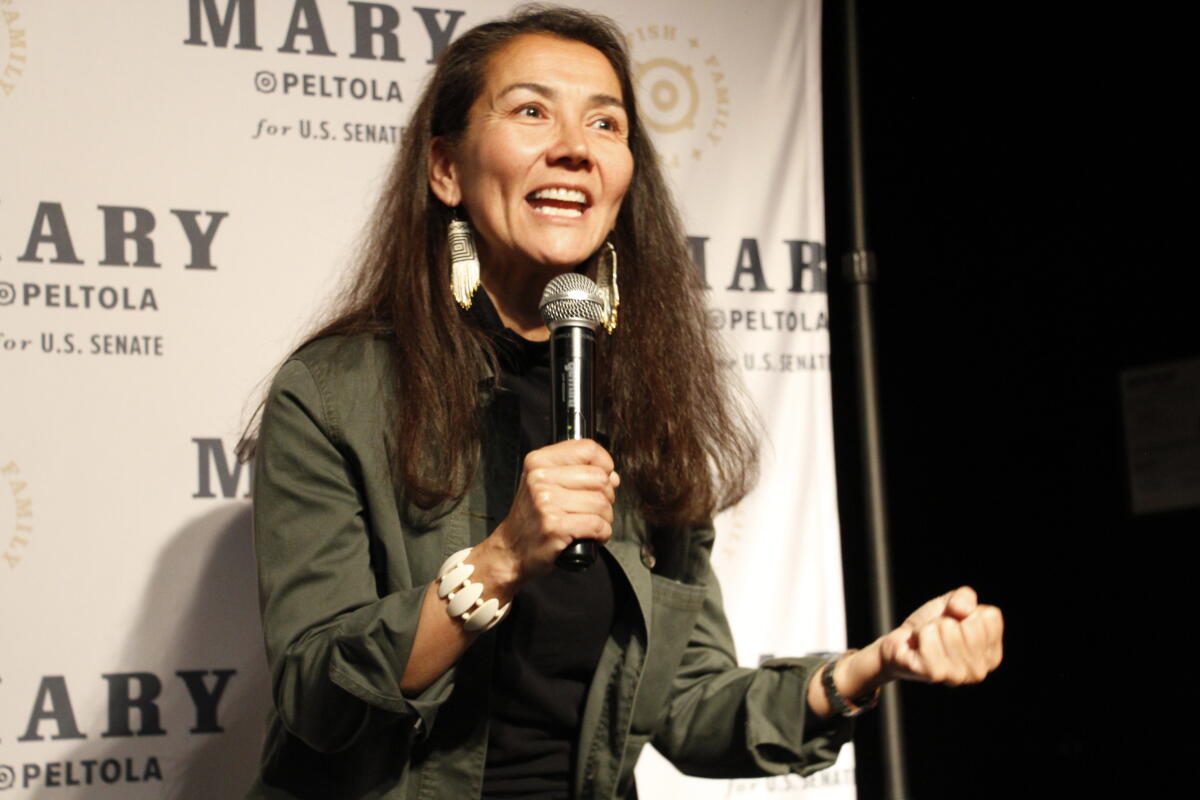
In Iowa, Republican Ashley Hinson used a Wednesday night debate to emphasize her willingness to break with Trump. In Kansas, Democrat Adam Hamilton is circulating a video in which he describes himself as both liberal and conservative. In Alaska, a GOP-backed ad blitz launched last week aims to persuade voters that Democrat Mary Peltola isn’t independent-minded.

Mary Peltola, a Democrat running for the U.S. Senate seat in Alaska, addresses supporters at an election watch party

Mary Peltola, a Democrat running for the U.S. Senate seat in Alaska, addresses supporters at an election watch party on Aug. 18 in Anchorage.

(Mark Thiessen / Associated Press)

Though many unaffiliated voters have made up their minds, those who remain undecided will begin making decisions soon, as mail ballots go out and early voting begins in some states.

“For Republicans who are running behind and are looking at a potentially devastating midterm election performance, what they really need to do is target the independents who lean Republican,” said Karen Kedrowski, an Iowa State University political scientist. “For Democrats in some place like Iowa … what they need to do is make it seem safe [to independents] to vote for a Democratic candidate.”

Unaffiliated constituents have long been key to victory in swing states, particularly where races are traditionally decided by small margins. They have been viewed as particularly persuadable this year, as public dissatisfaction with Trump’s economic policies puts the votes of swing voters who backed him in 2024 up for grabs.

Forecasters predict that Democrats are on track for the House majority and could hold a majority of gubernatorial seats for the first time since 2010. Though Senate control remains a toss-up, Democrats’ chances are viewed by forecasters to have significantly improved since the summer.

A set of New York Times/Siena polls reported last week showed Democratic candidates for the Senate ahead in Texas, Michigan, Alaska and Ohio and neck-and-neck in Kansas and Iowa — all states Trump carried in 2024. Republicans, meanwhile, are feeling increasingly bullish about their chances in Maine, New Hampshire and Minnesota, all states that went blue in the last presidential election.

Republicans hold a significant fundraising advantage, however, and party donors are pouring money into key races, hoping the spending can cut into the Democrats’ edge. By September’s end, GOP advertisers had more than doubled their spending compared with August, outstripping Democrats, according to tracker AdImpact. Among the nine Senate races considered the tightest by forecasters, Republicans have outspent Democrats in all, AdImpact reported.

But on Friday, the Cook Political Report, a leading election forecaster, moved 18 House races in Democrats’ direction, saying that heavy ad spending by Republicans has not begun to move the needle in their favor.

Democrats view themselves as in their “strongest position yet” to win the majority, Sen. Kirsten Gillibrand (D-N.Y.), who chairs the Democratic Senatorial Campaign Committee, said in a statement last week.

“In this final stretch of the election, Democrats will continue to vigorously campaign and fight for every vote across the expanded map,” Gillibrand said.

Republicans are confident about their ability to persuade voters in key states, said Bernadette Breslin, a spokesperson for the National Republican Senatorial Committee.

“Republicans will defend the Senate majority across key battlegrounds that have trended reliably red,” Breslin said, “with candidates like Mike Rogers [in Michigan] and Roger Marshall [in Kansas] winning over independents by exposing their Democratic opponents’ radical, unaffordable agendas.”

Along with the decisions of independent and swing voters, the midterm outcomes could also hinge on the level of turnout within each party, analysts say. If a portion of the party faithful stay home in a given place — for instance, disillusioned conservatives in Kansas or frustrated Black Democrats in Michigan — that could swing individual races, analysts said.

The number of independent voters reached a record high this year, with 45% of American adults identifying as political independents in Gallup polling. Equal shares identified as Republicans and Democrats, 27% for each party. The trend is partly driven by majorities of millennial and Gen Z voters choosing to be unaffiliated with either party, according to Gallup research.

Such voters make up a majority in Alaska and between 30% and 40% of all registered voters in Maine, Iowa, New Hampshire, North Carolina and Ohio. They account for about 29% in Kansas and about 16% in Texas and Michigan, according to state data compiled by the Independent Voter Project.

Across recent polls, independent voters have favored Democrats and expressed dissatisfaction with Trump. In a late September poll from Emerson College Polling, 66% of independents said Trump has done worse than expected during his second term in office.

Democratic U.S. Senate candidate James Talarico listens at a food drive in Dallas

State Rep. James Talarico, Democratic U.S. Senate candidate, listens at a food drive at the Frederick Douglass Human Services and Justice Center on Sept. 9 in Dallas.

(Julia Demaree Nikhinson / Associated Press)

In Texas, Democrat James Talarico led Republican Ken Paxton among independents by 32 points in a September poll by Texas Public Opinion Research. The Democratic candidate in Ohio, Sherrod Brown, led Republican Sen. Jon Husted by 27 points among independents in a CNN poll released Thursday.

In Kansas, where the Senate race has become unexpectedly close amid economic-driven anger with Trump, disapproval of the president’s performance among independents appears to be rubbing off on incumbent Sen. Roger Marshall, the Republican seeking reelection.

Fifty-two percent felt unfavorably toward Marshall and 62% disapproved of Trump’s performance, according to a recent Emerson College/Nexstar poll.

In those battleground red states, that creates a tough fight for both parties, analysts said. With control of the Senate hanging in the balance, candidates are duking it out in fundraising and on the campaign trail to win every last vote.

“Both campaigns are raking in ridiculous amounts of money … and they’re spending every penny because [they] have to,” said Wichita State University political science professor Alexandra Middlewood, referring to the Kansas Senate race. “We see that they’re really going to have to fight it out all the way to the end.”

Debates are another tool for candidates to reach independent voters, said Corwin Smidt, a political science professor at Michigan State University.

Democrat Abdul El-Sayed, left, and Republican Mike Rogers meet in a Michigan Senate debate Thursday night in Grand Rapids.

Democrat Abdul El-Sayed, left, and Republican Mike Rogers meet in a Michigan Senate debate Thursday night in Grand Rapids.

(Paul Sancya / Pool Photo)

In Michigan, where the Senate candidates sparred in their first debate Thursday evening, Rep. Mike Rogers, the Republican Senate nominee, has distanced himself from Trump twice in recent weeks, first calling for an end to the war in Iran and then releasing an ad last week denouncing the tariffs against Canada. Democrat Abdul El-Sayed, meanwhile, announced a rally with former President Obama, an appeal to mainstream voters.

“They’ve got to try to both win over people who have been paying attention, but also introduce themselves to the ones who haven’t been paying attention,” Smidt said.

Winning unaffiliated voters can require a tightrope walk for candidates who are faced with the dual tasks of appealing to their party base while persuading independent constituents.

In the final stretch of the campaign, candidates seeking independent votes should telegraph a willingness to admit their party’s flaws and an understanding that voters are turned off by partisan rhetoric, said Chad Peace, legal strategist at the Independent Voter Project, which advocates for open primaries.

“They have to communicate to those folks and try to meet them where they’re at,” Peace said. “[Independents] want the campaigns of persuasion, they don’t want to hear you tell me how bad the other candidate is.”

And, Gruber said, they want to be engaged with, not ignored.

“Independent voters,” he said, “are going to be responding to those candidates and parties that actually talk to them.”

Source link