include

USAF Widens Lower-Cost Cruise Missile Effort To Also Include Glide Bombs

The U.S. Air Force is seeking options for a new unpowered 500-pound air-launched glide bomb as part of a new ‘spiral’ to its Extended Range Attack Munition (ERAM) program. The service has already been acquiring two different lower-cost jet-powered cruise missiles under ERAM, including batches of these munitions for Ukraine. Adding glide bombs to the mix could create additional streams of even cheaper weapons that still offer valuable extended reach.

The Air Force Life Cycle Management Center’s Stand-In Strike division (AFLCMC/EBI) put out a request for information (RFI) for what it is currently calling Extended Range Attack Munition Glide (ERAM Glide) on Monday. AFLCMC/EBI also put out a separate RFI for additional powered ERAM options.

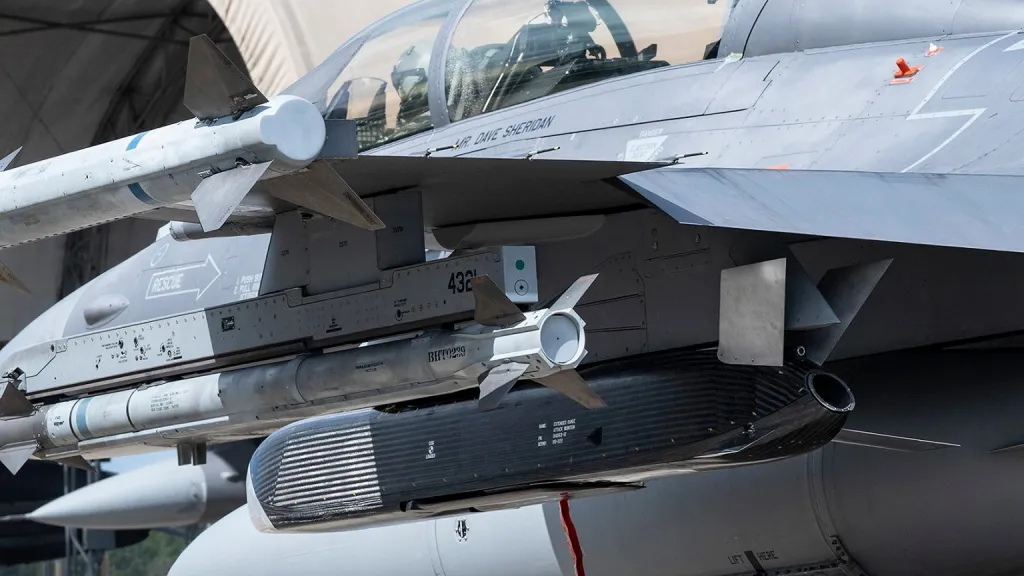
The Rusty Dagger lower-cost cruise missile, seen here under the wing of a US Air Force F-16 during a test, is one of two munitions the service has already been acquiring under the ERAM program. USAF

For ERAM Glide, a “500lb class weapon desired, with the equivalent warhead with approximately 105lbs of explosive and associated fuzes,” according to the contracting notice. The warhead has to be “capable of blast / frag / and limited penetration effects.”

For navigation, proposed munitions have to use “M-Code GPS with a CRPA [Controlled Reception Pattern Antenna] antenna capable of operating in a GPS degraded environment,” the notice adds. It does not call for any particular form of guidance in the terminal phase.

However, ERAM Glide munitions will need to have an accuracy of “CEP [Circular Error Probable] 50 w/in 10m both in non-EMI (Electromagnetic Interference) and high EMI environments (includes GPS degraded).” This means they hit, on average, within 10 meters, or approximately 33 feet, of the specified impact point at least 50 percent of the time. This also happens to be the stated accuracy requirement in the original ERAM RFI put out back in 2024.

A sequence of images showing a Rusty Dagger munition hitting a target during a test. USAF

The ERAM Glide contracting notice notably does not include a range target, but does specify “glide ratio of at least 10:1, and >15:1.” When it comes to unpowered glide munitions, range is especially dependent on the speed and altitude of the launch platform. Tactics like toss bombing can also help extend the reach of glide munitions even when the launching aircraft starts at a lower altitude.

The Air Force is also looking for munition designs that are already at a high level of developmental and production maturity for ERAM Glide.

There are potentially relevant munitions in production today in the United States. A prime example is Boeing’s Joint Direct Attack Munition-Extended Range (JDAM-ER). The JDAM-ER is really more of a kit that turns various types of unguided bombs into the ‘warheads’ for the resulting precision-guided munitions. JDAM-ER builds on the basic JDAM concept by adding a pop-out wing kit that allows the weapons to glide out to a maximum range of around 45 miles (72.4 kilometers) depending on the aforementioned launch factors. A standard JDAM can also glide, but only for around 15 miles (24 kilometers) at most, according to the Air Force. JDAM-ER kits are available in 500-, 1,000-, and 2,000-pound-class flavors.

DST | The Joint Direct Attack Munition – Extended Range (JDAM-ER) | Andrew Snowden thumbnail

DST | The Joint Direct Attack Munition – Extended Range (JDAM-ER) | Andrew Snowden

There are other glide bomb options on the open market in the U.S. and elsewhere globally today, as well. This includes the SPICE family from Israel’s Rafael and the French AASM 250 Hammer, among others. However, many of them are smaller than the 500-pound-class weapons the Air Force is seeking for ERAM Glide.

The GBU-39/B Small Diameter Bomb (SDB), examples of which are seen here, is another example of a glide bomb in production today. However, it is also a 250-pound-class munition. USAF

For ERAM Glide, prospective vendors might also put forward unpowered derivatives of lower-cost cruise missiles. Eliminating the need for an engine and fuel to power it could free up additional space and weight for larger warheads or other payloads, or just lower overall weight. Reduced weight could, in turn, translate to extended glide range. Developing an unpowered variation of an existing design could also offer sustainment and manufacturing benefits, as well as reduce unit costs. There might even be a possibility for a modular design that can be readily configured for powered or unpowered use.

As already mentioned, the Air Force is already acquiring two lower-cost cruise missile designs through ERAM. These are the Rusty Dagger from Zone 5 Technologies (now a subsidiary of Norwegian defense company Kongsberg) and CoAspire’s Rapidly Adaptable Affordable Cruise Missile (RAACM). Zone 5 and CoAspire are already developing extended-range variants and derivatives of their respective designs for air- and surface-launched applications through two other U.S. military programs called Low-Cost Containerized Missile (LCCM) and Consolidated Affordable Ordnance System (CHAOS).

CoAspire’s original RAACM lower-cost cruise missile design, in front, together with the extended-range RAACM-ER, behind. CoAspire

ERAM, as well as CHAOS, are also heavily focused on providing lower-cost extended-range strike options to allies and partners. Ukraine was notably the first known recipient of munitions through ERAM. At the same time, the ERAM effort, and its subsequent spirals, have also been feeding into the Family of Affordable Mass Missiles (FAMM) program for the U.S. Air Force’s own use. ERAM Glide could similarly help provide additional munition streams for the U.S. military, as well as for export.

A 2025 US Air Force briefing slide showing the parallel relationship between FAMM and ERAM, as well as other lower-cost munition efforts. USAF

Overall, the broadening of the ERAM program to include ERAM Glide speaks to growing demand within the U.S. military, and elsewhere globally, for enlarged and more diversified supply chains for munitions. The Air Force alone plans to acquire 28,000 lower-cost cruise missiles in multiple different configurations over the next five years through FAMM.

The war with Iran, as well as other crises around the Middle East in recent years, together with the conflict in Ukraine, have made clear that just stockpiling munitions ahead of a major fight is not enough. There also have to be realistic mechanisms to readily replenish those inventories, and do so in a cost-effective manner.

There has already been an explosion globally in the development of lower-cost air- and surface-launched cruise missiles for programs like ERAM. Many of these designs also blur the line between traditional cruise missiles, longer-range one-way-attack drones, and decoys. As noted earlier, the Air Force has also put out a call for new powered ERAM designs as part of the latest spiral to the program.

As these trends continue to grow, the Air Force is now looking to expand the ERAM program to include both powered and unpowered munitions.

Contact the author: joe@twz.com

Source link

A decade of Lajee Celtic: The Palestinian club whose fans include Cantona | Football News

London, United Kingdom – Nearly 200 people packed into Edami, a small Lebanese bakery in east London, to celebrate a decade of Lajee Celtic, a grassroots sports club based in a Palestinian refugee camp in the occupied West Bank.

What began as a football project has grown into an international symbol of solidarity.

Recommended Stories

list of 4 itemsend of list

In London, the room was filled with Palestinian flags, the aroma of Edami’s freshly baked manousheh, and Lajee Celtic shirts – which have been worn by celebrities, including football icon Eric Cantona and the actor Hannah Einbinder.

Martin, a Lajee Celtic organiser, travelled down from Glasgow for the celebration in September. He first visited Aida Camp, in the occupied West Bank, more than 10 years ago, a trip he described as life-changing.

“I don’t think anyone would really have expected that the project would have been as successful as it’s been,” said Martin, who requested to be identified by his first name. “But Celtic is a unique football club with its foundation, its Irish identity, the diaspora community, its universal support and then the values, which tie so much of that together.”

Celtic fans support the project that is thousands of miles away [Courtesy of Lajee Celtic]

The relationship between Aida Camp, where Lajee is based, and Celtic supporters developed over years.

Mohammed al-Azzeh, director of the Lajee Centre, which provides services to the youth of the camp, remembers how it all began.

“We’d built up relationships with friends from Scotland and Ireland who had visited Palestine, and then in 2012, I travelled to Glasgow for the first time. We started to have conversations about creating a football academy,” he recalled.

By 2015, the idea was taking shape when a group of footballers from the camp travelled to Belfast to play a game.

Then came the 2016 Champions League draw. Celtic were paired with Israeli side Hapoel Be’er Sheva.

Supporters ignored warnings that displaying Palestinian flags could result in a fine. As the teams emerged, the stadium was transformed into a sea of Palestinian flags, an action led by Celtic ultras, the Green Brigade.

UEFA subsequently fined Celtic.

The Green Brigade responded by launching the Match The Fine For Palestine campaign. Not to pay the fine, but to support Palestinian organisations, including with the formation of a football academy in Aida Camp.

For al-Azzeh, it was a turning point.

“The support and solidarity shown in that game was really a pivotal moment,” he said. “And that’s what ultimately led to Lajee Celtic becoming what it is today.”

A boxing programme was launched at Lajee Celtic in 2025 [Courtesy of Lajee Celtic]

The team has brought together young Palestinians from villages around Bethlehem, refugee camps and communities in Hebron and Jerusalem.

“It means a lot, for us as Palestinians, to be in one place and meeting each other,” al-Azzeh said. “It becomes about more than just playing football.”

Lajee Celtic is competing in organised football for the first time. The club had been due to enter the Palestinian league three years ago, but the competition was cancelled when Israel’s genocidal war in Gaza began. Now, despite restrictions on movement between Palestinian cities and the wider disruption to football, the club has entered the Thousand Martyrs Cup, named after the 1,014 athletes killed in Gaza since October 2023.

Bassil Mikdadi, journalist and founder of Football Palestine, said that international reach has given Lajee Celtic a significance beyond the club itself.

“Lajee Celtic is a blueprint for ways in which fans of European clubs can directly support those on the ground in Palestine. It’s connective tissue,” he said.

For Martin, the popular shirts are more than merchandise.

“When people buy these shirts, they do so knowing that the money is funding football, sports and general youth development in Palestine. And then when the same people wear these shirts, whether they’re in Glasgow or London or New York, they’re each making their own individual solidarity action.”

The project provides a football academy and summer clubs for children, including many from refugee camps [Courtesy of Lajee Celtic]

Lajee Celtic created a link between clubs and communities inside Palestine and supporters and campaigners abroad.

“It has this kind of cross-cultural, cross-border solidarity,” he said.

That connection has become increasingly important as Palestinian football has struggled to continue since the genocide in Gaza.

For Mikdadi, the survival of grassroots clubs is essential: They are the groundwork for the national team.

“The success of the Palestinian national team in recent years … the base of that success has always been players provided by clubs in the West Bank and Gaza,” he said.

The club’s ambitions stretch beyond football. It has expanded into sports such as boxing and table tennis, while creating opportunities for young Palestinians across Palestine and the diaspora.

“Fundraising campaigns come and go all the time. But when you create a football club and when you have that sort of tangible idea at the heart of it, then you are creating a journey,” said Martin.

Mohammed al-Azzeh recalled a meaningful memory on a beach in Cape Town, South Africa, where the team played two friendlies in 2025.

Samir al-Amir, a coordinator with Lajee Celtic, had spent more than 19 years in Israeli prisons. When he travelled with the team to South Africa, it was the first time he had been able to leave the walls and checkpoints of the West Bank.

Al-Azzeh remembers watching him on the beach.

“He was acting like a young boy because it was the first time seeing the sea,” he said. “Without Lajee Celtic, I’m not sure Samir would have ever had that opportunity. That illustrates why the project is so important,” he said.

Source link