illegal

Arab News | UK to introduce import ban on goods from illegal Israeli settlements, Miliband says

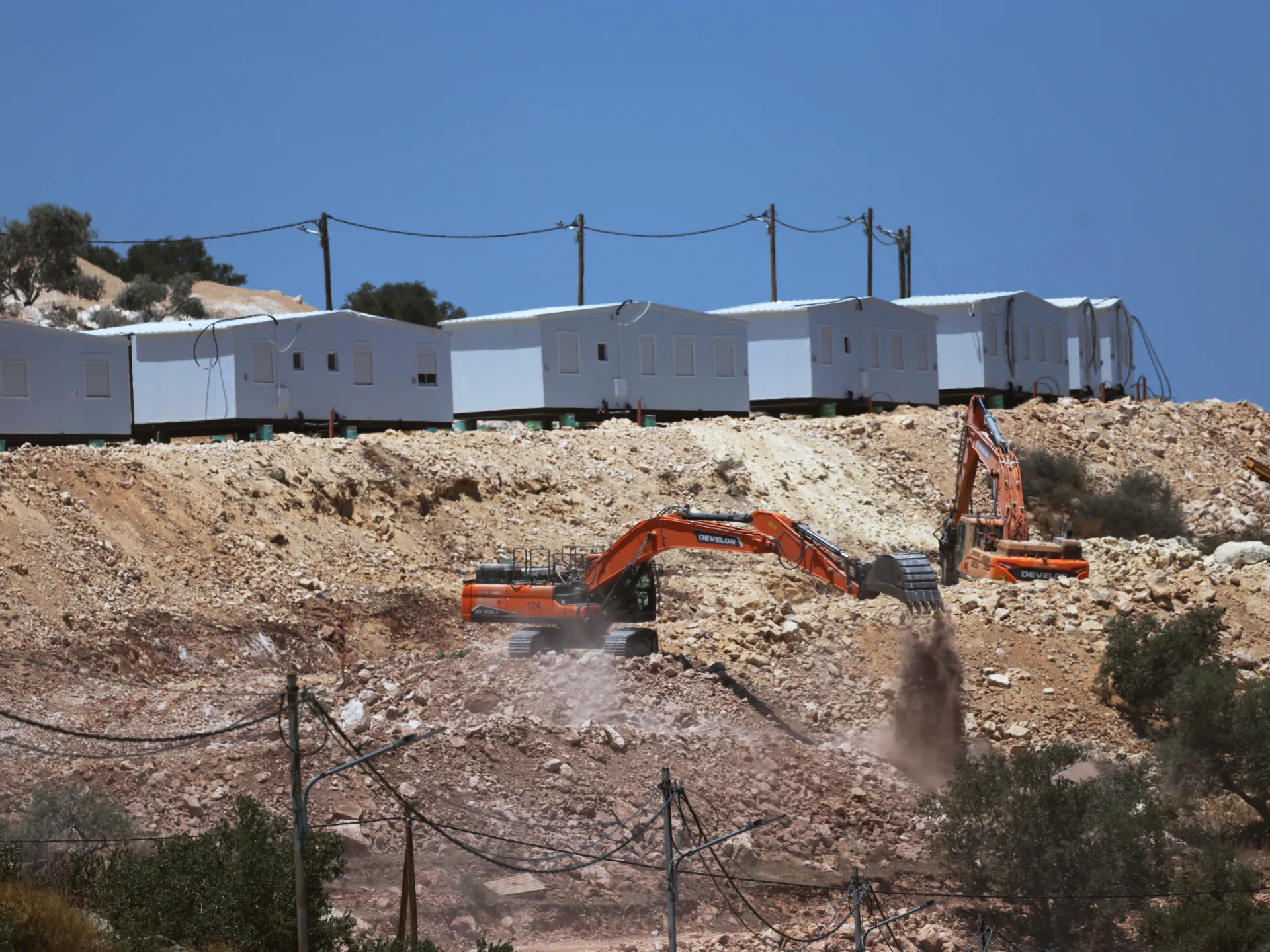
LONDON: The UK government is banning trade with Israeli settlements in the occupied West Bank, where it says “settler terrorists” are carrying out ethnic cleansing of Palestinians.

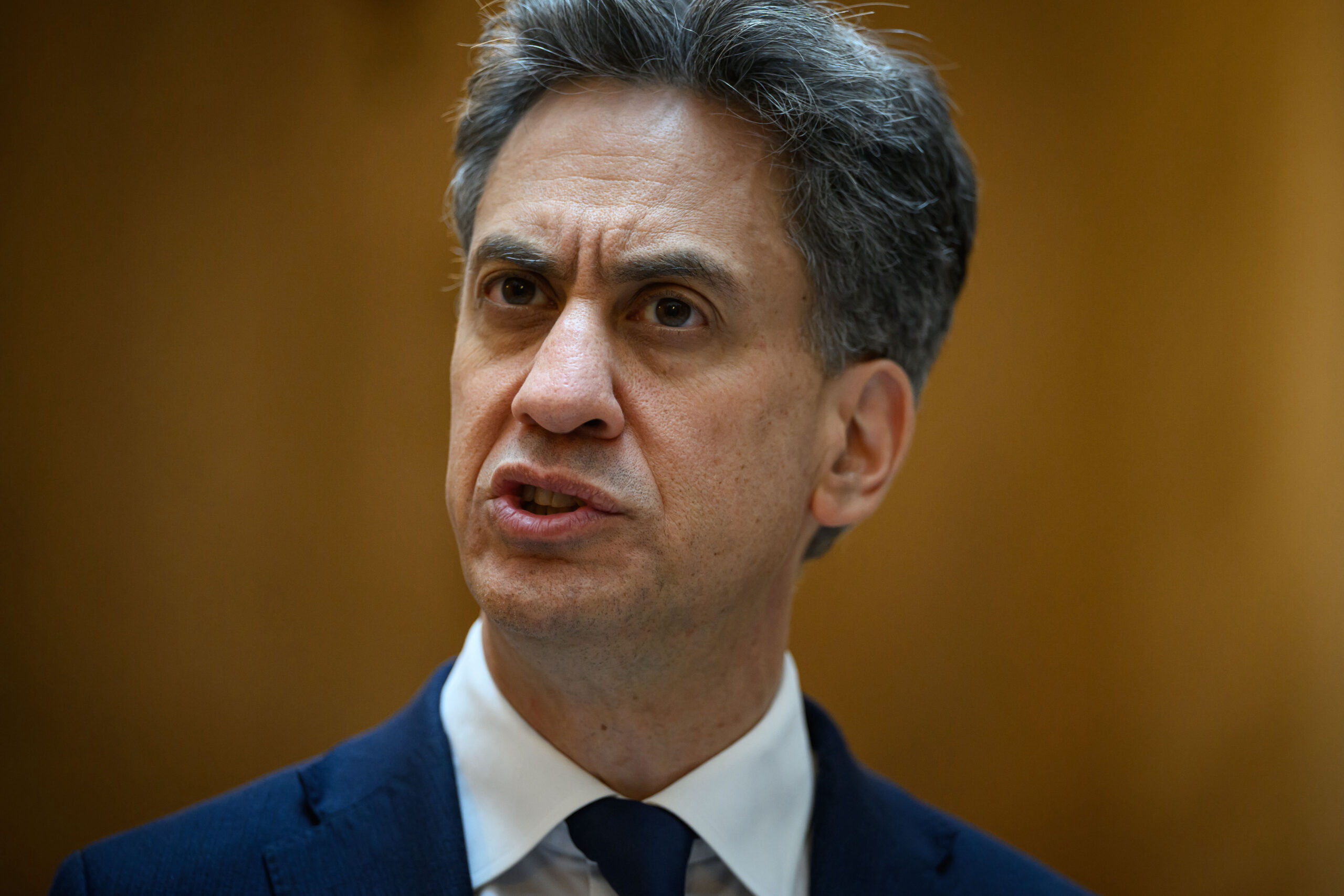
Foreign Secretary Ed Miliband says the UK will ban imports of all goods from the settlements, and some services including financing, construction, infrastructure, real estate and advertising for settlements.

In a toughening of its stance against Israel’s occupation, Miliband told lawmakers in the House of Commons that the government was acting to preserve the chance of a two-state solution.

Developing…

Source link

State Puts New Edge on Immigration Debate : Border: Residents increasingly see illegal influx as a source of California’s woes. Pressure for action grows.

America, the Land of Immigrants, has always been ambivalent about just what that mantle should mean, but that ambivalence has taken on an edge. The middle ground has shifted, decidedly to the right.

And California, characteristically, is ahead of the trend.

Now, when liberal Sen. Barbara Boxer suggests that National Guard troops be stationed along the southern border, only immigrant-rights activists are publicly aghast. When Gov. Pete Wilson says the Constitution should be changed to deny citizenship to U.S.-born children of illegal immigrants, a Field poll shows that half of all Californians like the idea.

“This is a state of siege in California,” says an observer from Washington, immigration expert Demetrios Papademetriou of the Carnegie Endowment for International Peace.

“There is an enormous bombardment out there. There is always something new about immigration. One’s senses get bombarded every day, which is the worst possible moment for trying to make fundamental decisions regarding immigration. I am delighted that they will be made in Washington, rather than California.”

Yet California is where the Immigration and Naturalization Service estimates 52% of all illegal immigrants live, where dueling studies constantly argue the benefits and costs of the immigrant mix, and where, increasingly, many see an immigration apocalypse born of neglect.

Even the membership of the Sierra Club is in the midst of an emotional debate about whether to take a public stand on the hot button topic of the day.

“It’s not as simple as clean air, or like pollution, where less is better,” said Executive Director Carl Pope.

But millions of other Americans seem to have made up their minds. The polls say most Americans believe illegal immigration is out of control, that the country has too many immigrants, illegal or otherwise, and that this is very bad news for the economy and for our national quality of life.

Every day, Americans are clamoring that something should be done. So everyone from the President of the United States to the president of the local homeowners association is offering suggestions.

Hire more Border Patrol agents and get them equipment that works. Issue tamper-proof identity cards. End taxpayer-funded medical care and schooling for anyone in the country illegally. Seize the assets of employers who hire illegal immigrants. And get serious, finally, about welfare fraud. The list goes on.

“Under bold, centrist political leadership, California could have been avoided,” said Dan Stein, executive director of the Federation for American Immigration Reform, or FAIR, the grandfather of a growing family of groups calling for a moratorium on immigration.

“What is happening in California is the direct result of the isolated and removed nature of immigration policy decisions in Washington.”

Many call this brouhaha a backlash against immigrants, scapegoating during an economic recession and a shortsighted repudiation of the principles that made America great.

Others call it unadorned common sense.

“If you set your table for five people in your home and then 15 people show up unexpectedly, you aren’t prepared, and you’ve got problems,” said Fred Vines, a retired state policeman who lives with his wife, a teacher, on Los Angeles’ Westside.

“We’re billions in the hole,” he said. “This has never happened before. It’s got to be overpopulation. You’ve got people coming here who shouldn’t be here.

“Put up a Berlin Wall!” cried Vines, an African-American who denies that racism has anything to do with his get-tough stand. He says that any fool can see it: Immigration is bringing this country down.

*

The organizers of this night meeting of Citizens for Action Now, an 18-month-old immigration reform group in Orange County, have called for more folding chairs to accommodate an overflow crowd of about 60 mostly middle-aged, mostly white citizens or legal immigrants.

Barbara Coe, a police records clerk and co-director of the group, has made a point of emphasizing the legal immigrant component to the newcomers in the room.

It is not immigrants the group is against, she says, but illegal immigrants. She stressed that racism has no place here.

“We decided that the only way we are literally going to save our heritage is to put the focus on the illegal alien problem,” she said.

Early arrivals at the meeting talk among themselves. A middle-aged woman tells of the “marauders” who take over the streets at night. A man who lives and works in Santa Ana, the county seat that is now 70% Latino, says of the city: “It’s gone! It’s gone!”

Before everyone stands to recite the Pledge of Allegiance, sheets of blue cards are passed around. Citizens for Action Now, part of the 15-member California Coalition for Immigration Reform, asks its members to carry the cards with them and leave them in businesses such as restaurants, “where it seems fairly apparent” that illegal immigrants are employed.

“Stop the Invasion! Close our Borders NOW! Deny benefits to ILLEGAL ALIENS NOW! Defeat GATT/NAFTA NOW!” read the cards, which leave a space for the sender’s name and address.

The evening’s guest speaker, William E. Dannemeyer, the former Orange County congressman considering another U.S. Senate bid, arrives to detail his controversial, and unsuccessful, legislative efforts to stem the immigrant flow.

But during the question and answer session after his remarks, members of Citizens for Action Now intimate that Dannemeyer, who was one of the most conservative lawmakers on Capitol Hill, hadn’t been tough enough.

One woman told Dannemeyer: “I feel desperate that the battle is lost.” Another man detailed his inspection of Israel’s border defense system, praising that country’s swift actions to thwart enemy incursions.

“If we can go to the moon, are you going to tell me we don’t have the technology to do what this little country Israel can? That’s baloney!”

The room erupts in applause.

*

Immigrant rights groups say they have heard such sentiments before, only they are hardly blase.

They are afraid that the angry, frustrated public mood might translate into laws that will codify discrimination and divert attention from more onerous economic problems in favor of an easy target: the illegal immigrant without a vote. They warn of a rise in hate crimes.

“We in the immigrant rights community are on the defensive right now,” concedes Roberto Lovato, who heads the Central American Refugee Center in Los Angeles. “We are not being sought out for solutions.”

At a recent news conference in Downtown Los Angeles, Latino community leaders displayed enlarged copies of stories that appeared in the Los Angeles Times from the 1930s to the present. The idea was to trigger a public deja vu .

“Ousting of Aliens Will Be Speeded,” read a headline from 1931. “Government Maps War on Wetbacks,” said another from 1954, and in 1971: “Illegal Alien Growing Peril to U.S. Worker.”

The last offering, “Wilson Urges Stiff Penalties to Deter Illegal Immigrants,” was from the week before.

“We know well in our community that this is a historical cycle,” says Arturo Vargas, vice president of the Mexican American Legal Defense and Educational Fund.

Indeed, during the 19th Century, the state Legislature imposed special taxes on Mexican miners, and the state’s Workingmen’s Party rallied around the slogan, “The Chinese Must Go.” During the Great Depression, and again in 1954, hundreds of thousands of Mexicans were sent home.

Yet, cyclical or not, the country’s anti-immigrant mood seems unlikely to cool on its own. Based on a mix of fact, myth and fear, feelings run deep. Ambivalence–and contradictions–thread through it all.

The restaurant busboy might be admired for his willingness to work hard for little pay. But the faceless mass of illegal immigrants is threatening our way of life.

Although it is true that, as a percentage of the population, immigration levels today are a third of what they were during the peak years of 1900-20, the numbers are about the same. And those numbers–about 10 million legal and 3 million to 5 million illegal immigrants over the past decade–seem huge.

This is especially true during economic hard times, or perhaps, as immigrant rights group suggest, when people consider who the new immigrants are. Unlike the immigration boom at the turn of the century, more than 90% of the latest immigrant tide comes from the Third World.

Bottom line: The United States takes in more immigrants than the rest of the world combined. And people here are wondering out loud if America has not done enough.

Consider this reaction from homemaker and mother Ellie Kiefer, who recently moved from her Burbank home of 11 years to Simi Valley: “They are just letting them come in. If it was something very positive, starting nice businesses, or really trying or something, that might be different.

“But the crime is getting worse, there are more gangs. The killings. It’s ridiculous. That’s one of the reasons I’m so sick of it.”

Or this from a middle-aged African-American woman who works as a teaching assistant in the Los Angeles Unified School District: “We have to go back to school to speak their language. That’s not fair. And I have to pay for it out of my own pocket. If you are born here in the United States, and you speak English, you have to adjust to them. I don’t think that’s fair.”

Lucy Bermudez, a Philippine-born nurse who just left heavily immigrant Panorama City for Ventura County, says: “I waited for 15 years to become a citizen. It’s unfair of the illegal ones. They are just popping in.”

For Spanish-speaking shopkeeper Maria Elba Miranda, who emigrated illegally from El Salvador 13 years ago, the burning issue is security, and fear. “I’ve noticed a change in the type of people coming, even from my own country,” she said.

“There are just too many people here. . . . I remember when I came, I was really scared, timid, just looking for work, but now they come here looking for trouble.”

On the same Los Angeles street where Miranda lives and works, immigrants openly hawk fake green cards for $50. If you want a phony Social Security card, they can arrange that too. And to the untrained eye, all the documents look good.

“What we do is help people work, not like those guys, they’re the ones who should be deported,” says a 17-year-old nicknamed Orejas, or Ears, who arrived illegally from Mexico six months ago.

Orejas points across the street at the “bad immigrants” to distinguish himself and his friends from their ilk. Go to them, he says, if you want to buy drugs.

*

The INS estimates, conservatively, that about 3.2 million illegal immigrants now live in the United States. Most of these migrants–up to 70% of them from Mexico–arrived after the estimated 3.7 million others who have taken advantage of the amnesty provision of the 1986 Immigration Reform and Control Act.

Although that law is widely acknowledged to have ended life in the shadows for many immigrants, it has failed to stop the illegal flow. To wit: the control part of the act has become a joke:

Thousands of mandated Border Patrol jobs remain unfilled. Employer sanctions are rarely enforced. And states such as California complain bitterly that Washington does not reimburse them for services to illegal immigrants whose entry the federal government should have blocked.

Such a situation has led many to believe that no sooner do illegal immigrants cross the border than they end up on the dole. In fact, undocumented immigrants are legally ineligible for almost all public benefits other than maternity and emergency medical care under Medi-Cal or Medicaid, and some prenatal care.

But because of the thriving market in counterfeit documents, fraud appears to be widespread.

Moreover, U.S.-born children of illegal immigrants are also entitled to all citizenship benefits, such as the fast-growing Aid to Families With Dependent Children program, and like foreign-born children, free education through the 12th grade.

And beyond the costs vs. revenue debate that is the subject of academic debate, residents of areas with large immigrant populations say they feel the impact of the newcomers in more personal ways.

An African-American police officer married to a Mexican immigrant says the couple’s two children are enrolled in a Los Angeles public school that is 90% Latino, “so my kids have a hard time.”

“The teachers are spending all this time on the Spanish,” he said. “So it slows down my kids. So I’m moving mine to a private school.”

Puerto Rican Miguel Rodriguez, 35, of Carson recently recovered from a car accident and went back to reclaim his welding job.

“They told me they didn’t have anything,” he said. “They hired a couple of guys, Latinos who don’t speak any English, who will take less. They’re making $8 an hour. I was making $13. . . . It kind of pisses me off.”

And from Lanie Wong, 65, a mother of five grown children and a daughter of Chinese immigrants, there is this: “It bothers me that the illegals think they can outsmart our system. They brag. It doesn’t affect me, personally. But it’s the principle.”

*

Felix Martinez, a 43-year-old father of four, and his friend, Milton Monterosa, 41, a father of two, have arrived hours early for an appointment at a Los Angeles office of the state Economic Development Department. They have gone months without work and are hoping for a lead on a job.

Like hundreds of thousands, perhaps millions of others, Martinez, of Mexico City, and Monterosa, from San Salvador, overstayed their entry visas and slipped unnoticed into the underground economy that traditionally welcomed illegal immigrants with abundant, low-paying jobs.

Under the amnesty granted to illegal immigrants residing in the country before 1982, both men legalized their status, but the American dream escapes them still.

“My friend and I were just talking,” Martinez says. “Los Angeles has fallen down so much. Before, there used to be a lot of work. Things were good. Now the situation is desperate. There is no work. There is nothing.”

Monterosa just nods.

“On the one hand, I think it’s good that immigrants come to this country,” Martinez goes on. “But, you know, I’m in this position. I can’t condone more people coming. I tell my brothers, everybody. They say, ‘Oh, the streets are paved with gold there. There is a lot of work. I’m coming.’ I tell them: ‘There is no work. Why should you come to suffer? Don’t come.’ ”

Inside the unemployment office, Los Angeles-born Lawrence Cush, 31, is also waiting for a lead. He says he has prepared himself for a good job with a college education and experience as a PBX operator at the Ambassador Hotel.

But he has been out of work since 1985.

“I feel in competition with the immigrants,” he says. “Everyone should speak English, but they don’t. . . . I applied for a job at Continental Cable and they told me that I had all the qualifications but that I didn’t get hired because I didn’t speak Spanish.”

Cush is on welfare. He is looking for a job that pays at least $8 an hour “so that I could make $17,000-$20,000 a year, and that’s not that much. That way I could do my part to support my family.

“I’m not going to take the minimum wage,” he said.

Outside, Martinez speaks in Spanish: “I have these desperate nights where I hug my knees together in bed and pray to God for a miracle, to send me a job, any job, a gardener, a cook, whatever. I’m not talking about some fancy job in an office, a secretary.

“I’ll take anything.”
Source link

UK has billions in contracts with firms tied to illegal Israeli settlements | Occupied West Bank News

At least 17 companies linked to illegal Israeli settlements in the occupied West Bank hold United Kingdom public-sector contracts worth more than 2.1 billion pounds ($2.85bn), an Al Jazeera investigation reveals.

The findings come as more than 140 UK Labour MPs are calling on the government to ban trade with illegal Israeli settlements, a move Prime Minister Andy Burnham is considering.

Recommended Stories

list of 4 itemsend of list

Our analysis of procurement records, company filings and corporate disclosures found that businesses named by the United Nations over their involvement in illegal Israeli settlements – and companies those businesses ultimately own or control as subsidiaries – have secured contracts across the British public sector, including in areas such as road maintenance, transport, emergency services and driving licensing.

“Evidence is growing that the UK may be in breach of its international obligations … by continuing to contract with entities identified by the UN as providing assistance of this sort,” Stephen Humphreys, professor of international law at the London School of Economics, told Al Jazeera.

Data compiled by public procurement analysts Tussell, and shared with Al Jazeera, shows the 17 companies and entities hold 125 public-sector contracts with a combined award value of 2.129 billion pounds ($2.89bn).

Companies owned by Motorola Solutions, the United States technology and communications giant, account for more than 1.7 billion pounds ($2.3bn) of the total – the vast majority through its British subsidiary Airwave Solutions. Other contracts we reviewed are held by firms within four other corporate groups including Heidelberg Materials, a German multinational building materials company; the French engineering group Egis; the Spanish train manufacturer CAF and Chinese conglomerate Fosun.

A report by the United Nations Human Rights Office identifies the five corporate groups as involved in business activities related to illegal Israeli settlements.

Heidelberg Materials’ Israeli subsidiary owns a quarry on Palestinian land in the occupied West Bank, while Motorola is embedded in the security infrastructure of illegal settlements. Egis and CAF are involved in Jerusalem’s expanding light-rail network – a project activists say entrenches Israel’s control by integrating settlements into the city while further fragmenting Palestinian neighbourhoods.

Fosun International, whose subsidiary Breas Medical receives UK public money, also owns the controversial Israeli cosmetics manufacturer Ahava, which operates in the Mitzpe Shalem illegal settlement in the occupied West Bank. Civil rights groups, including the Palestinian Solidarity Campaign in the UK, decry Ahava as a firm that is “complicit” in the theft of Palestinian land and livelihoods.

Meanwhile, violence is escalating in the occupied West Bank.

In July 2024, the International Court of Justice found Israel’s continued presence in the occupied Palestinian territory unlawful and said it must end “as rapidly as possible”. The court also placed obligations on other states “not to render aid or assistance in maintaining the situation created by Israel’s illegal presence in the Occupied Palestinian Territory”.

That raises questions over Britain’s continued commercial relationships with the companies identified in Al Jazeera’s investigation, observers said.

‘UK government is propping up apartheid’

Humphreys believes that Britain may also be failing to meet its legal obligations by “failing to launch its own investigation into their activities, with a view to preventing them if necessary”.

The UK has also warned businesses against bidding for construction tenders in illegal settlements.

“Businesses should not consider bidding for construction tenders,” a government statement issued this month said, warning of “legal and reputational consequences” and the risk of involvement in “serious breaches of international law”.

Former Labour leader Jeremy Corbyn said Al Jazeera’s findings expose a contradiction between the UK’s stated position and its economic ties.

“Quite simply, the UK government is propping up apartheid,” Corbyn told Al Jazeera. “Every day, the UK deepens its complicity in Israel’s economy of occupation and, in turn, Israel’s economy of genocide.”settler attacks

The Cabinet Office told Al Jazeera that individual public authorities make decisions to exclude suppliers case-by-case for each contract. It said public procurement in the UK should not be used to boycott suppliers linked to other countries unless formal UK sanctions, embargoes or restrictions are in place.

Here’s what we found about some of the companies involved in settlement trade:

Motorola Solutions: Tech embedded in illegal settlements

The UN identifies Motorola in connection with two settlement-related activities: the “supply of security services, equipment and materials to enterprises operating in settlements” and the “provision of services and utilities supporting the maintenance and existence of settlements, including transport”.

Al Jazeera contacted the Motorola Solutions group for comment but received no response.

It is the largest beneficiary of UK public money that we investigated.

Motorola’s subsidiaries are entrusted with providing communications equipment to the emergency services in the UK. The largest contract identified by Al Jazeera is held by Airwave Solutions, a Motorola subsidiary. The Home Office awarded Airwave an extension worth 1.562 billion pounds ($2.13bn) to provide the secure communications network used by police, fire and ambulance services across England, Scotland and Wales. Motorola Solutions UK separately holds contracts worth 123.9 million pounds ($170m), including a 36.5-million-pound ($49.8m) Ministry of Defence contract for Airwave radios, accessories and airtime.

Five companies now ultimately controlled by Motorola Solutions Inc – Airwave Solutions Ltd, Motorola Solutions UK Ltd, CRFS Ltd, 3TC Software Ltd and Noggin IT Ltd – hold 91 active UK public-sector contracts worth 1.726 billion pounds ($2.3bn), according to the latest Tussell data.

Motorola Solutions Inc and its Israeli subsidiary, Motorola Solutions Israel Ltd, were included when the UN Human Rights Office first published its database of businesses involved in specified settlement-related activities in 2020. Both remain in its latest version.

Official records provide a glimpse of how the company’s technology has been embedded in settlements.

Tenders from Mateh Binyamin Regional Council and the municipal corporation of Ariel, both illegal settlements, show Motorola command-and-control technology being used in security and surveillance infrastructure.

Motorola equipment has also been bought by the Israeli Civil Administration, the military body through which Israel administers civilian affairs in the occupied West Bank.

In 2005, the UN reported that Motorola supplied surveillance systems to settlements including Hebron, Karmei Tzur and Bracha.

Motorola’s relationship with the Israeli authorities continues today. An Israeli government procurement document obtained by Al Jazeera shows Motorola Solutions Israel was awarded a 25.5-million-shekel ($8.7m) contract in May 2026 to maintain approximately 19,000 police radios and provide encryption licences until April 2028.

Heidelberg Materials: A controversial quarry on occupied land

The UN has listed Heidelberg Materials over the commercial use of natural resources in occupied Palestinian territory.

In Britain, five Heidelberg Materials companies hold 25 public-sector contracts worth 184.79 million pounds ($252m). Almost all of that – 179.03 million pounds ($244m) – is held by Hanson Quarry Products Europe Ltd. Its contracts include 60 million pounds ($81.9m) from Westmorland and Furness Council for road surfacing and highway works between 2024 and 2027, and a 50-million-pound ($68.3m) surfacing maintenance contract with Somerset Council.

Its Israeli subsidiary, Hanson Israel, owns the Nahal Raba quarry, south of Qalqilya in the West Bank. The quarry sits on land belonging to the Palestinian villages of az-Zawiya and Rafat, according to Who Profits.

An official Civil Administration planning notice reviewed by Al Jazeera shows a proposal was approved to expand the site.

Who Profits, a group that researches links between the private sector and the economy in the Israeli-occupied territories, said the approval was granted on May 28, 2025.

Heidelberg told Al Jazeera that in 2023, Hanson Israel “ceased all activities at the Nahal Raba quarry and the associated asphalt plant and ready-mix concrete plant”, adding that only security personnel are present on site.

Egis: Selling transport infrastructure that supports settlements

French engineering group Egis provides another type of connection via transport infrastructure linking illegal Israeli settlements in occupied East Jerusalem with the rest of the city.

The UN lists Egis in connection with the “provision of services and utilities supporting the maintenance and existence of settlements, including transport”.

Egis’s own material shows that its involvement in Jerusalem’s expanding light-rail network continues today, with the company website advertising a job for an engineering expert based in Jerusalem on its light-rail projects.

A general view shows Jerusalem's light rail tram as it passes by the old city's walls in Jerusalem November 13, 2014. If there has been a constant target of Palestinian attacks during weeks of unrest in Jerusalem, it is the city's Light Rail, a sleek tram that snakes through downtown, past the ancient walls of the Old City, symbolically uniting the Jewish West and the Arab East, an area Israel captured in a 1967 war. Launched in 2011, the project was hailed as a piece of infrastructure that would transform the city, bringing Israelis and Palestinians closer through shared public rail transport. While in some ways that has happened, the past few months have torn that cosmopolitan picture apart. Picture taken November 13, 2014. REUTERS/Ronen Zvulun (JERUSALEM - Tags: TRANSPORT POLITICS CIVIL UNREST TPX IMAGES OF THE DAY)ATTENTION EDITORS: PICTURE 01 OF 26 PICTURES FOR WIDER IMAGE STORY 'RIDING THE FINE LINE'
SEARCH 'TRAM RONEN' FOR ALL IMAGES
A general view shows Jerusalem’s light rail tram as it passes by the old city’s walls in Jerusalem November 13, 2014 [Ronen Zvulun/Reuters]

Jerusalem Transportation Master Plan procurement documents from 2017 also identify Egis Rail as its general consultant, responsible for supervising and coordinating planning and design work on the Blue and Green lines.

Jerusalem’s light rail crosses into occupied East Jerusalem and links illegal Israeli settlements there with West Jerusalem. UN reports have described the railway as “additional infrastructure serving the illegal settlement network” and said it further isolates occupied East Jerusalem from the rest of the occupied West Bank.

Egis told Al Jazeera it “formally expressed its disagreement with this inclusion” in the UN database.

In Britain, five companies and entities controlled by Egis hold six public-sector contracts worth 133.60 million pounds ($182.4m). Almost the entire amount comes from a single contract, with the Driver and Vehicle Licensing Agency awarding Egis Projects UK Ltd a 133.23-million-pound ($181.9m) contract for enforcement services across Britain. Egis businesses also hold UK public contracts, including Galson Sciences, Helios Technology, Egis Transport Solutions and architecture practice WestonWilliamson+Partners.

CAF: Constructing project to continue into 2027

Spanish train manufacturer CAF is also involved in Jerusalem’s light-rail network. The company has disclosed that the 1.8-billion-euro ($2.10bn) Jerusalem project was awarded in 2019 to TransJerusalem J-Net Ltd, a firm owned 50 percent by CAF and 50 percent by Israeli construction business Shapir.

CAF said the project includes construction of the Green Line and extension of the existing Red Line, “which partially run through East Jerusalem”. The construction phase is expected to continue until 2027.

The UN identifies CAF over the “supply of equipment and materials facilitating the construction and the expansion of settlements” and the “use of natural resources, in particular water and land, for business purposes”.

Al Jazeera contacted CAF for comment but received no response.

Meanwhile, CAF has an extensive relationship with Britain’s public sector, including supplying trams for one of the country’s major urban networks. The West Midlands Combined Authority awarded CAF an 83.5-million-pound ($114m) contract for a new generation of trams for the West Midlands Metro. The contract runs until December 2027, according to Tussell data.

Fosun: Owner of a cosmetics company accused of excavating Dead Sea mud in occupied territory

Chinese conglomerate Fosun International is identified by the UN under the category covering the commercial use of natural resources, particularly water and land.

Its connection to the occupied West Bank centres on Israeli cosmetics manufacturer Ahava Dead Sea Laboratories. Fosun itself announced in April 2016 that it had agreed to acquire Ahava for 290 million shekels ($76.8m).

Fosun’s subsequent statutory reporting recorded Ahava as 99.46-percent owned.

A European Commission statement in 2018 said Ahava “does have operations in the settlement Mitzpeh Shalem, located in Occupied Territories”.

According to the Quaker-founded organisation, American Friends Service Committee (AFSC), repeated site visits confirmed that Ahava’s former factory in the illegal Mitzpe Shalem settlement remained operational as of 2026.

The group said Dead Sea mud was excavated in the occupied Palestinian territory and initially processed at the site before being transferred to Ein Gedi for further production.

In Britain, Breas Medical, which is ultimately owned through Shanghai Fosun Pharmaceutical by Fosun International, holds two public-sector contracts worth 1.29 million pounds ($1.76m). Fosun International is the controlling shareholder of Shanghai Fosun Pharmaceutical.

Al Jazeera contacted Fosun for comment but received no response.

Source link

Why is Israel building new illegal settlements? | Israel-Palestine conflict News

Israel opens construction bids for new illegal housing units in the occupied West Bank.

Illegal under international law, Israeli settlements in the occupied West Bank have been expanding for decades.

The right-wing government of Prime Minister Benjamin Netanyahu has fast-tracked the establishment of new ones.

Recommended Stories

list of 4 itemsend of list

The policy aims to tighten Israel’s hold on the occupied West Bank and block the creation of a contiguous Palestinian state.

With just months to go until the elections, the government has opened bids for the construction of 1,200 illegal housing units. It has also ignored international criticism of the planned illegal settlement, known as E1.

Some Western countries are threatening sanctions if Israel goes ahead. But would that make a difference?

Presenter: James Bays

Guests:

Ammar Hijazi – Ambassador and head of the Palestinian Mission to the Netherlands

Alon Pinkas – Former Israeli ambassador and consul general in New York

Source link

Israeli settlers pitch tents for new illegal outpost in occupied West Bank | Israel-Palestine conflict News

Israeli settlers have erected tents for a new illegal settlement outpost near Ramallah in the occupied West Bank, as separate groups of settlers have besieged the village of Qusra for a week.

Settlers pitched tents in the Wadi Zeytun area near the village of Umm Safa, northwest of Ramallah, on Sunday in an attempt to establish a new settlement outpost, said Al Jazeera’s Tharwat Shakra.

Recommended Stories

list of 3 itemsend of list

Reporting from Ramallah, she said settlers also began establishing a separate outpost in the village of Burqa on the same day.

If a new outpost is established, the number of outposts surrounding the two neighbouring villages will rise to six, said the Palestinian news agency Wafa, which also reported the encroachment in Wadi Zeytun.

Settlers have seized roughly 4,700 of Umm Safa’s 4,800 dunams (about 470 of 480 hectares, or 1,160 of 1,186 acres), and 10,000 of Burqa’s 12,000 dunams (1,000 of 1,200 hectares, or 2,471 of 2,965 acres), according to Shakra.

Meanwhile, in the Ras al-Ain area of the village of Qusra, south of Nablus, an Israeli settler siege on three families has entered a second week, with 15 Palestinians, including two children, besieged in their homes.

Israeli soldiers rotated their positions and erected a tent in front of residents’ homes after spending the previous two days dismantling one that settlers had tried to put up there, Shakra reported. Municipal crews later restored electricity and water lines to the besieged families.

In separate incidents on Sunday, Al Jazeera reporters in the West Bank said settlers attacked a Palestinian home in the town of Beit Imrin, north of Nablus, and detained those inside. Israeli forces then arrived and arrested nine people from the house before withdrawing. Soldiers also blocked Palestinian Red Crescent teams from reaching the area and confiscated the keys to ambulances and medical-relief vehicles, Shakra reported.

There were also attacks in the Nab’a al-Kaabneh community near Taybeh, Shakra said, and an attempted raid on a home in Turmus Aya, both in the Ramallah district. Attacks in Hebron’s al-Jaabari neighbourhood left Palestinians injured, including some by gunfire, according to the Palestinian Red Crescent.

The Palestinian Prisoner’s Society told Al Jazeera that Israeli forces have escalated arrests in towns where illegal settler outposts have been established, targeting residents who confront the attacks.

Israel using settlers ‘to advance ethnic cleansing’

Israeli settler violence and the ongoing siege of three Palestinian homes in Qusra should be understood as part of Israel’s decades-long rule of “impunity”, which has now reached a “climax”, said Francesca Albanese, the United Nations special rapporteur on the occupied Palestinian territory.

Speaking to Al Jazeera on Sunday, she said Israel has no right to carry out military incursions on Palestinian territory and is instead obligated to protect civilians from military action. Israeli officials, however, appear to be collaborating with settlers rather than restraining them, she said.

“Israel has outsourced coercion to the settlers and is using them to advance ethnic cleansing,” Albanese said. “This is a crime… This is utter terrorism; these settlers should be investigated and prosecuted.”

She said that while Israel’s endgame may be “ethnic cleansing”, it is using “war crimes, crimes against humanity and acts of genocide as the means to continue the Nakba” – the catastrophic ethnic cleansing and forced displacement of Palestinians in 1948, during the creation of Israel.

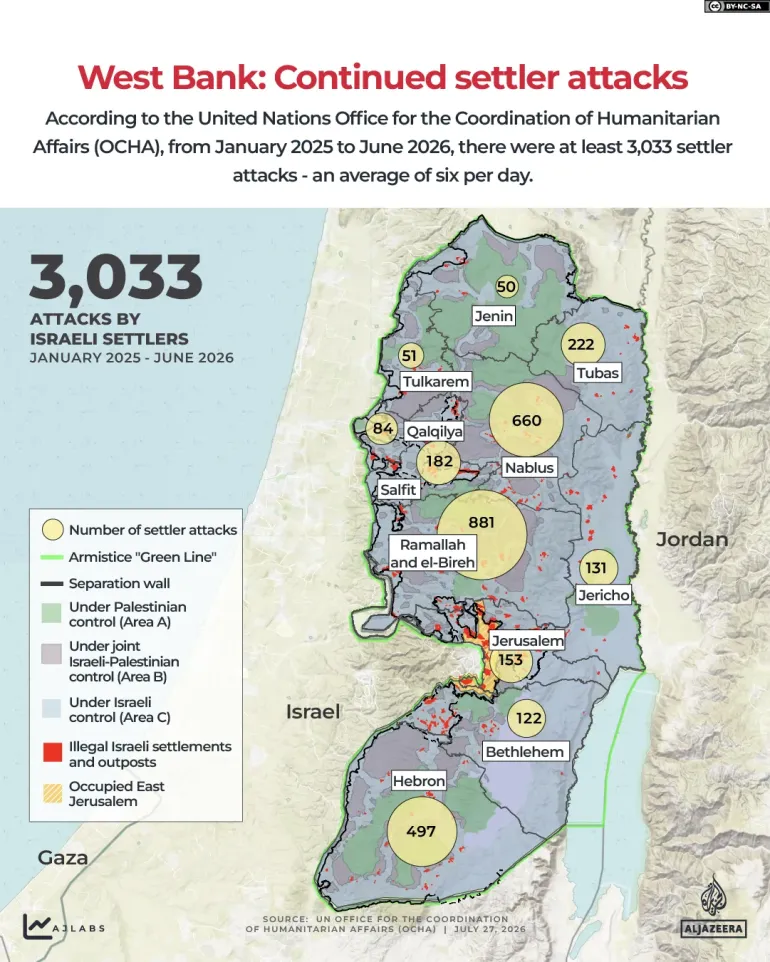
Mustafa Barghouti, the secretary-general of the Palestinian National Initiative, told Al Jazeera the situation in the West Bank was “extremely dangerous”, saying settler groups were carrying out “an average of 30 attacks every day” as they “spearhead” a campaign to seize land and displace Palestinians.

Barghouti said the goal of the campaign was “annexation and displacement”, and called for Arab and international pressure on Washington to halt Israeli actions in the occupied West Bank as well as Gaza.

Israeli attacks in the West Bank have intensified since Israel launched its genocidal war on Gaza in October 2023, according to Wafa. About 750,000 Israeli settlers live in 156 illegal settlements and 360 illegal outposts across the occupied West Bank and occupied East Jerusalem.

The UN recognises Israeli settlements in the occupied Palestinian territory as illegal under international law.

Source link