ice officer

Those caught in Trump immigration dragnet seek millions for raids, shootings, trauma

Last June 16, armed immigration agents broke the locks to forcibly enter an Oxnard auto body shop. Juan Carlos Ramirez, a U.S. citizen, filmed as they arrested his father.

Then the agents pepper-sprayed Ramirez, slammed him onto the hoods of two vehicles, punched his face and kneed him in the side, according to a legal claim he later filed against the federal government.

Local attorney Vanessa Valdez denounced Ramirez’s arrest at an Oxnard City Council meeting the next day. The following month, Valdez found herself in a similar situation when agents raided the cannabis company Glass House Farms.

Despite identifying herself as a legal observer, she said, agents — or possibly National Guard — deployed tear gas and shot her six times with rubber bullets. She ran and then, unable to see, crawled on all fours to escape.

Vanessa Valdez leans on a railing.

Vanessa Valdez, a Ventura-based attorney, has filed a claim against the federal government, alleging she was hit with tear gas and six rubber bullets during the Glass House Farms raid last July.

(Christina House / Los Angeles Times)

“They were just shooting aimlessly, it seemed like,” she said. “I thought maybe they had fractured a rib because that’s how painful it was. I couldn’t sleep face down for three weeks.”

Ramirez and Valdez are among the dozens of U.S. citizens and immigrants who are seeking financial compensation for damages they say they suffered during President Trump’s immigration dragnet. For Valdez, that includes the cost of hospital visits, lost wages as she recovered, anxiety medication and seeing a therapist.

After reviewing public accounts and legal documents and interviews with more than a dozen lawyers and immigrants, The Times found that claimants from across the country are seeking at least $260 million.

In a statement, Homeland Security spokesperson Lauren Bis wrote that ICE officers are held to the highest professional standard and receive regular training. Bis said that when agents are faced with danger, they use their training to protect themselves and the public.

“The pattern is NOT of law enforcement using force. It’s a pattern of violent agitators attacking our law enforcement,” she wrote.

Asked about Valdez, Bis said law enforcement deployed chemical irritants including pepper balls, but not rubber bullets, after agitators attempted to breach the perimeter at Glass House Farms. She said Ramirez refused officer’s commands and physically attacked them, so they pepper-sprayed him in self-defense.

Lawyers who are experts in tort claims said the bureaucratic process is lengthy and complex, and any damage award would likely be lower than what a claimant is seeking.

Still, seeking redress through the Federal Tort Claims Act is one of the few legal remedies available for those seeking financial compensation for deaths, physical injuries, emotional trauma, unlawful detention or property damage caused by federal employees.

The number of claims is expected to rise.

Federal agents, some wearing street clothes and some wearing uniforms and protective gear, stand together.

Federal agents, some wearing street clothes and some wearing uniforms and protective gear, form a defensive line against hundreds of protesters outside the Metropolitan Detention Center in Los Angeles on Jan. 30.

(Allen J. Schaben / Los Angeles Times)

In recent months, advocacy organizations have prepared practice advisories for attorneys interested in filing tort claims, and law groups across the country have begun holding training sessions on the process.

“There is no question in my mind that a lot of people — hundreds, thousands — have been harmed significantly and will be legally entitled to large damages payouts, which are going to come from the federal government,” said Jonathan Feinberg, a Philadelphia-based attorney.

Feinberg, who specializes in cases involving excessive use of force by police and abuses of detained immigrants, is president of the board of directors for the National Police Accountability Project, which focuses on law enforcement misconduct.

“We’re going to be talking about Minneapolis in 2030,” he added.

Before they can sue in federal court, individuals must first request a review by the agency that they say is responsible, such as Immigration and Customs Enforcement or Customs and Border Protection. The agency has six months to respond and deny the claim or offer a settlement.

If the agency doesn’t respond or denies a claim, the claimant can then file suit.

Unlike civil rights lawsuits, in which juries decide the verdict, in tort cases, judges make that call. Only the agencies are named as defendants, not individuals.

The Times reviewed the claims of nearly 80 people filed since the start of 2025. The vast majority remain in the review stage. Lawyers anticipate most will not be settled, unleashing a flood of lawsuits starting this summer.

Federal law since 1871 has established that people can sue state and local officials for violating their constitutional rights. But the law left out federal actors.

One hundred years later, the Supreme Court allowed for damages lawsuits against federal officials who violate a person’s civil rights, though decisions in recent years have substantially narrowed that ability.

Democrats in California are pursuing legislation that would make it easier for residents to seek financial damages for constitutional violations committed by federal agents. Similar laws were already enacted in Maryland, Illinois and Connecticut, though the Trump administration has sued to block the latter two.

But there is a different route — tort claims.

Tort cases can be difficult to win, in part because the government can claim a “discretionary function exception,” which shields the agency from liability when the situation involves a policy-driven judgment call.

“So that’s what a lot of plaintiff’s lawyers are really anxious about, that the Trump administration is going to say, ‘Well, we’ve got our own immigration policies. Of course a lot of people disagree with them, but the statute is designed to give us the right to make those policy judgments,’” said Benjamin Zipursky, a Fordham University law professor who studies torts.

“Now, if I were the plaintiff’s lawyer, I would say, ‘Yeah, but shooting somebody in cold blood because you’re just mad about their political views, and they’re not really threatening your life at all — that’s not a policy judgment,’” he said.

The law office of John Burris, an Oakland-based attorney who represented Rodney King after he was severely beaten by Los Angeles police officers in 1991, has taken on damages clients in Minnesota. He said he anticipates filing around 80 tort claims stemming from the immigration enforcement actions there.

A sign amid flowers says "MN is greater than ICE."

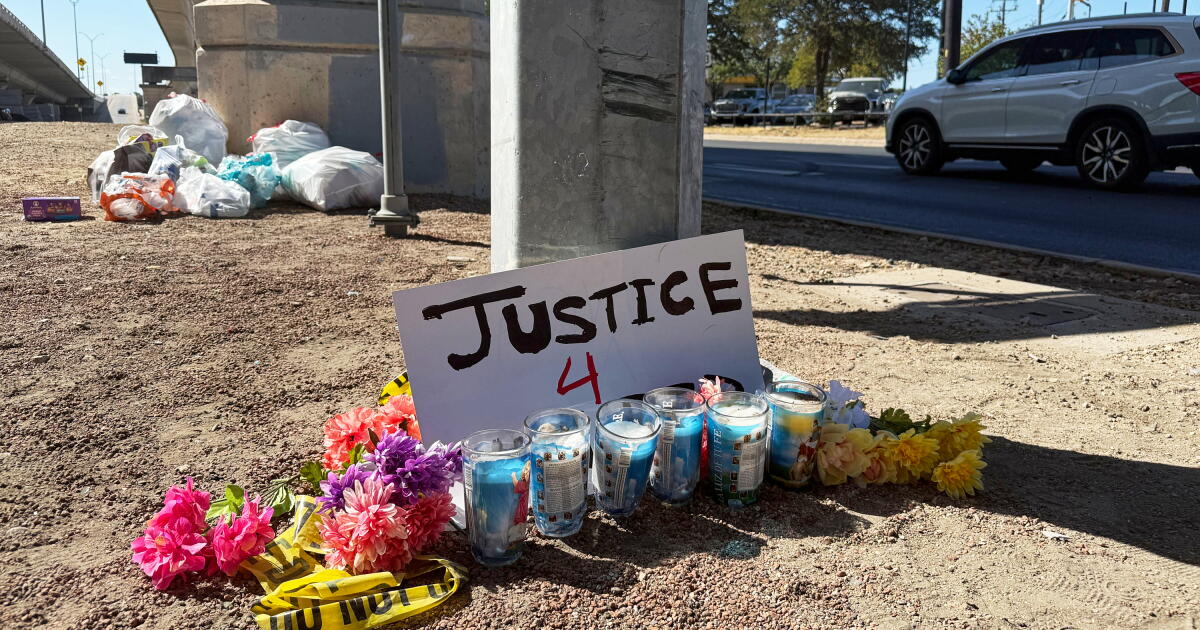
A memorial for Renee Good at the location where she was fatally shot in Minneapolis.

(Eric Thayer / Los Angeles Times)

Burris said the experience has given him flashbacks to the period before King’s beating and the subsequent protests over police brutality, when officers felt they could act with impunity.

“There’s 1779798656 a more fundamental understanding that bad stuff does happen,” he said. “Everyday people are not as willing as they once were to just accept a police officer’s perspective.”

Public disapproval over immigration enforcement rose after federal immigration agents in Minneapolis shot and killed two 37-year-old U.S. citizens, Renee Good, a mother of three, and Alex Pretti, an ICU nurse, in separate incidents.

Other deaths took place before the Minnesota operation: 23-year-old Ruben Ray Martinez, who was killed by an ICE agent in Texas who fired repeatedly through the open window of his car; Keith Porter, 43, who was killed in Los Angeles by an off-duty ICE agent after shooting his gun into the air on New Year’s Eve; and Jaime Alanis Garcia, 57, who fell 30 feet from atop a greenhouse while fleeing agents at the Glass House Farms site in Camarillo.

Lawyers for the families of Good, Martinez and Garcia confirmed they are pursuing tort claims. Lawyers for the other families did not respond to requests for comment.

Additional highly publicized cases have also resulted in tort claims: Marimar Martinez, who was shot five times by a Border Patrol agent in Chicago; Mahmoud Khalil, the Columbia University student and Palestinian rights activist who spent 104 days detained after the administration labeled him a national security threat; Aliya Rahman, a disabled woman on her way to a doctor’s appointment in Minneapolis who blacked out at a detention facility after ICE agents detained her.

New claims appear to be filed weekly. Seventeen men, women and children who were detained in a military-style raid at a Chicago apartment complex filed claims this month seeking about $5 million each.

In many of the cases, Bis said, the claimants impeded or assaulted agents. Pretti’s death remains under investigation, she said.

Willy Wender Aceituno stands in a parking lot.

Willy Wender Aceituno stands in the parking lot where he was arrested last November by ICE agents in Charlotte, N.C.

(Jesse Barber / For The Times)

Willy Wender Aceituno was already a plaintiff in a class-action lawsuit filed by the ACLU of North Carolina challenging the policy allowing warrantless immigration arrests after he was stopped twice in a span of minutes by immigration agents last November. In March, he also submitted a tort claim.

Aceituno is a Honduran-born U.S. citizen who voted for Trump. On the day he was arrested, a group of masked agents checked his identification and left. Aceituno then filmed as a second group surrounded his red truck.

“If you break it, you will pay for it,” he tells them in Spanish seconds before one agent smashes the window with a baton. “Why did you do that, sir?”

Aceituno suffered cuts when agents threw him to the ground, which was covered in shattered glass. They placed him in an SUV with other detainees and drove him around Charlotte, N.C., before releasing him, still bleeding, more than 2 miles from his vehicle.

The moment brought back Aceituno’s childhood memory of watching his father be arrested by the Honduran military and disappeared.

“I remember they broke down the door, entered, put him in handcuffs and threw him to the ground,” he said. “I thought, ‘It’s happening again.’ To see the other Hispanics in the car made it feel like this is racial persecution. This is about skin, not criminality.”

Bis, the Homeland Security spokesperson, said Aceituno acted erratically, escalated the situation and refused to comply with officers’ commands.

Lawyers said many people, especially immigrants, who have viable claims have chosen not to pursue them out of fear of being targeted for deportation. Some were deported before they could sue.

“Even now, our clients wake up some days thinking, ‘What am I doing suing the federal government?’” said Iván Espinoza-Madrigal, executive director of the Massachusetts-based Lawyers for Civil Rights. “You have to have a lot of courage to be able to stand up against an administration that has put a bull’s-eye on you and that has targeted you based on your identity.”

Others have turned to mutual aid or online fundraisers to pay for medical bills or to repair property damage. On the website GoFundMe, donation campaigns describe shattered car windows, broken limbs, head trauma and mounting bills.

Some damage can’t be fully recompensated, Espinoza-Madrigal added.

Protesters hold signs reading "Deportations Put Lives At Risk."

Members of the Haitian community hold signs in support for the extension of Temporary Protected Status during a rally last month in Miami.

(Carl Juste / Miami Herald / Getty Images)

One of the organization’s clients is Jose Pineda, a Salvadoran man with Temporary Protected Status. A year ago, Pineda was stopped by ICE officers on his way to work in East Boston as a landscaper. They wouldn’t accept his Social Security and work authorization cards as proof enough that he was not deportable, and detained him without explanation, according to his tort claim.

So Pineda spent nearly two days in a holding cell at the ICE Boston Field Office with around 50 other people. He couldn’t sit or sleep and received minimal water and food.

Bis said agents “briefly questioned” Pineda because he matched the description of the subject of an operation, and that he was released after being identified.

When he was released, the claim alleges, his documents were returned but $600 in cash that he was saving to pay rent was not. The incident left him with frequent headaches, anxiety and memory loss, and exacerbated his gastritis. His absence from work resulted in a demotion from lead foreman to an assistant role.

“Whenever I drive, if someone stays behind me for three, four or five minutes, I start to imagine that it’s them again,” he said in an interview.

Pineda’s arrest also caused recurring nightmares that leave him shouting and thrashing around in bed. Out of fear that he could inadvertently harm his wife, they now sleep in separate beds.

Source link

Minnesota county charges ICE officer in nonfatal shooting during Trump’s immigration crackdown

A Minnesota prosecutor on Monday announced charges against an Immigration and Customs Enforcement officer in the nonfatal shooting of a Venezuelan man during the Trump administration’s crackdown in the state.

The officer, Christian Castro, is charged with four counts of second-degree assault and one count of falsely reporting a crime in the Jan. 14 shooting of Julio Cesar Sosa-Celis, Hennepin County Atty. Mary Moriarty said at a news conference. A warrant was issued for his arrest.

“Mr. Castro is an ICE agent, but his federal badge does not make him immune from state charges for his criminal conduct in Minnesota,” Moriarty said, adding that Sosa-Celis never posed a threat. “There is no such thing as absolute immunity for federal officers who commit crimes in this state or any other.”

A federal officer shot Sosa-Celis in the thigh after he and another officer chased a different man to the apartment duplex where the man and Sosa-Celis lived. Moriarty said both Sosa-Celis and the other man were legally in the U.S.

Federal authorities initially accused Sosa-Celis and Alfredo Alejandro Aljorna of beating an officer with a broom handle and a snow shovel during the incident. But a federal judge later dismissed the charges, and federal officials opened an investigation into whether two immigration officers lied under oath about what happened.

Minneapolis last month released video of the incident captured from a distance by a city-owned security camera.

Department of Homeland Security and Justice Department officials didn’t immediately respond to emails seeking comment. Homeland Security previously said that lying under oath is a “serious federal offense” and that making false statements could result in an officer being fired or prosecuted.

The administration sent thousands of officers to the Minneapolis and St. Paul area as part of President Trump’s national deportation campaign. Homeland Security, which oversees ICE, called Operation Metro Surge its largest immigration enforcement operation ever and deemed it a success.

But tensions mounted during the weekslong campaign, and the shooting deaths of U.S. citizens Renee Good and Alex Pretti by federal officers provoked mass unrest and questions about officers’ conduct.

Hennepin County, which includes Minneapolis, has been conducting investigations into multiple incidents and filed charges last month against an ICE agent for alleged actions while on duty.

Minnesota leaders and the Trump administration have since clashed over which has the authority to investigate and prosecute officers for conduct while on duty. The Trump administration has suggested that Minnesota officials don’t have jurisdiction.

State officials have said they don’t trust the federal government to investigate itself or hold officers accountable.

“There’s no modern precedent for what happened to the people here in Minnesota,” Moriarty said Monday. “So it requires a lot of us to dig in and look at ways to hold people accountable that we probably never thought we would be looking at in our careers.”

Hennepin County continues to investigate Good’s and Pretti’s killings and sued the administration in March over access to evidence in the two cases, as well as in the case involving Sosa-Celis. Although Moriarty hasn’t charged anyone in either killing, she has said she’s confident her office’s investigations will bring transparency, even if not criminal prosecution.

Fingerhut and Sullivan write for the Associated Press. Fingerhut reported from Des Moines, Iowa.

Source link

While ICE cracked down on L.A. protests, Marines were told to use force as ‘last resort’

Before being deployed to Los Angeles during anti-ICE protests last summer, U.S. Marines were given 12 rules for engaging with protesters, and Rule 1 was clear: Force “of any kind” was allowed only as a last resort.

If force were used, the rule stated, it “should be the minimum necessary to accomplish the mission.”

That detail is among 178 pages of federal documents released by the Marine Corps to the nonprofit watchdog group American Oversight through the Freedom of Information Act and shared exclusively with The Times.

The documents paint a thorough picture of how Marines prepared to deploy in Southern California, where they stood alongside National Guard members and agents with the Department of Homeland Security.

The documents also illuminate a glaring contrast between the training of Marines and that of immigration agents, who have been accused repeatedly of using unnecessary force against peaceful protesters, bystanders and immigrants during enforcement operations.

“Ironically, I would’ve felt much safer with Marine engagement than with DHS because of the depth of training,” said Ryan Schwank, a former instructor for Immigration and Customs Enforcement recruits at the ICE Academy within the Federal Law Enforcement Training Center in Georgia.

Schwank is a whistleblower who resigned in February after revealing that the Trump administration had slashed immigration officer training. After reviewing the documents obtained by American Oversight, he said the training given to Marines on crowd control was “significantly more in-depth and longer than training given to an ICE officer, even under the best of circumstances.”

A ICE agent walks through tear gas that was fired to push protesters back

An ICE agent walks through tear gas that was fired to push protesters back during a raid on Atlantic Boulevard in the city of Bell on June 20, 2025.

(Genaro Molina / Los Angeles Times)

The Department of Homeland Security did not respond to questions and instead pointed to a February news release that said training has not been cut back and that new hires receive additional training after leaving the academy.

“ICE law enforcement officers are trained to use the minimum amount of force necessary to resolve dangerous situations to prioritize the safety of the public and our officers,” said Lauren Bis, a department spokesperson. “Officers are highly trained in de-escalation tactics and regularly receive ongoing use of force training.”

Schwank noted that the Marines and ICE officers came to Southern California with different objectives: As protectors of people and property, the Marines had a more limited, reactive mission, while ICE officers were charged with making arrests, a confrontational role.

“We’re giving [ICE officers] less training on it and fewer refreshers than the Marines are getting and yet we’re putting them in a situation where they’re taking the more confrontational actions to where they’re more likely to have to make split-second decisions,” Schwank said.

For most of history, he added, ICE agents detained people who were already in the custody of another law enforcement agency. He said ICE was never meant to act as riot police.

“The real fundamental problem isn’t ICE agents using force,” Schwank said. “It’s ICE agents using force in an environment they are not trained for.”

The training of Marines, and the lead-up to their deployment, is outlined in the documents reviewed by The Times.

On June 6, a commanding general emailed other generals to say that “national-level leadership” had directed Marines to assume an “alert posture” and be ready to support the Los Angeles Police Department, Los Angeles County Sheriff’s Department and ICE officers who were already responding to civil unrest in downtown Los Angeles.

The Marines would safeguard federal facilities and thus “protect lives and property through the restoration of civil order,” the email said.

The Trump administration directed 4,200 California National Guard soldiers and 700 Marines to Southern California starting June 7.

Marines push back anti-ICE protesters in front of the Federal Building

Marines push back anti-ICE protesters in front of the Federal Building during a “No Kings Day” in downtown Los Angeles last June.

(Carlin Stiehl / Los Angeles Times)

First, though, they needed to be trained.

The five-day course reviewed use-of-force policies, less-lethal weapons and handling of civil disturbances.

Overall, the 12 rules emphasized safety, urging Marines to be reasonable, to de-escalate tensions and to avoid confrontations with individuals who posed no threat.

Marines could use non-deadly force, if necessary, to control a situation or protect themselves or other federal personnel, and deadly force “only when all lesser means have failed.”

“Exercise due regard for the safety of innocent bystanders when using any type of force,” the rules state.

Schwank said there is no equivalent to the Marines course at Homeland Security. When he left the academy in February, he said, “there was no crowd control training, period.”

Crowd control was briefly added to the curriculum in 2021 for experienced law enforcement officers, he said, but it was later removed. ICE recruits may also have gotten lessons on crowd control after leaving the academy and joining their respective field offices, he said.

When Schwank left the agency, a six-hour class called “Public Order Public Safety” was in development for the 2026 curriculum, according to documents he provided to Congress. Homeland Security did not respond when asked if the class had started.

“I wouldn’t assume that any of the ICE officers on scene in L.A. had received any sort of actual crowd control class,” Schwank said. “They might have gotten a one-to-two-hour PowerPoint slideshow, but that would’ve been it.”

Marine Col. Beth R. Smith confirmed that the entire 2nd Battalion 7th Marines received academic and practical training before deploying to Los Angeles.

Managing civil disturbances has been an issue for Homeland Security since at least 2021, according to an audit conducted by the agency’s internal watchdog review of a 2020 deployment to Portland, Ore.

That year, President Trump mobilized federal power against the protests that spilled into Portland streets after the murder of George Floyd by a Minneapolis police officer. Trump sent 755 Homeland Security agents to defend federal property in what would come to be seen as a dry run for much larger operations of his second term.

Two vehicles, one in flames

A protester damages a Waymo vehicle at Los Angeles Street and Arcadia Street in L.A. on June 8, 2025.

(Robert Gauthier / Los Angeles Times)

Nested on rooftops, agents launched chemical weapons against protesters. Ground forces fired less-lethal rounds at point-blank range and forced participants into unmarked vans without explanation.

The audit by the Homeland Security inspector general found that only seven of 63 officers reviewed had received any level of riot and crowd control training. Some officers told investigators that they needed additional training, and many “questioned their involvement in the operation” due to the lack of preparation.

”Without the necessary policies, training, and equipment, DHS will continue to face challenges securing Federal facilities during periods of civil disturbance that could result in injury, death, and liability,” the audit concluded.

As of spring 2025, Homeland Security records show, the department had not corrected the training failures flagged in the audit years earlier.

Schwank agreed that the concerns raised in the inspector general’s report were never addressed.

Liz Hempowicz, deputy executive director of American Oversight, said the Marine Corps’ emphasis on de-escalation and on using force only as a last resort stands in stark contrast to what happened on the ground in Los Angeles with immigration agents.

The practices outlined in the documents “differ from positions taken by senior DHS leadership, whose separate internal communications revealed a mindset that appeared far more encouraging of violence,” she said.

Internal Homeland Security emails also obtained by American Oversight revealed that the agency’s lead attorney said federal agents in Los Angeles should have “just started hitting the rioters and arresting everyone that couldn’t get away.”

“These records underscore that the difference between disciplined restraint and unnecessary harm can come down to the tone set at the top — and when that tone shifts toward hostility, the human cost can be devastating,” Hempowicz said.

Jennifer Kavanagh, director of military analysis at Defense Priorities, a military research group, said that for Homeland Security, the issue is partly a training deficiency and partly a cultural shift against agent accountability.

“Trump talks about ‘the enemy within’ — this is what he’s talking about,” she said. “To some at DHS, the enemy within is all immigrants, it’s cartels — it’s also groups that are protesting the government.”

Conversely, the Marines’ documents emphasized personal liability and responsibility. For example, one page said that “if you either use more force than is necessary, or respond with DEADLY-force to a NON-deadly threat — You will likely lose your right to self-defense, and you will be viewed, under the law, as the ‘Aggressor.’”

Marines were told to immediately report anyone violating the 12 rules of engagement.

The high level of training for Marines shows that command considered the optics of military personnel harming or even killing civilians, Kavanagh said. But just because the deployment worked out last year doesn’t make it a good idea in the long run, she said.

Kavanagh, alongside Gov. Gavin Newsom, Mayor Karen Bass, and LAPD Chief Jim McDonnell, opposed the military deployments to Los Angeles last year, maintaining that Marines are trained for foreign combat, not domestic crowd control.

“I see these deployments as a recipe for disaster,” she said.

Schwank said ICE’s training touches on personal liability but not in as much depth. Last fall, Stephen Miller, Trump’s deputy chief of staff, said ICE officers “have federal immunity in the conduct of your duties, and anybody who lays a hand on you or tries to stop you or tries to obstruct you is committing a felony.”

On the ground in Los Angeles, ICE agents and other local law enforcement fired a range of less-lethal weapons at protesters, such as pepper balls, hard foam rounds or canisters delivering flash-bang grenades and tear gas.

At a June 12 protest, a federal agent shoved freelance journalist Anna Sophia Moltke to the ground, causing sprains on her left arm and leg and deep scrapes to her hip and knee that have since scarred. She was carrying a camera, she said, and wore clear press credentials and a helmet that said “PRESS.”

“I remember distinctly there being no violence at all until police and ICE showed up,” she said. “We saw them firing rubber bullets into the crowd. People started running away. I was halfway turned around when they started rushing the crowd, and a tall, 6-foot-4 masked man used both hands to push me onto the concrete.”

Moltke said she recalled a large group of protesters gathered near the Marines stationed at the northern end of the detention center, just before police and ICE swept through and forced her to the ground. To her knowledge, she said the Marines remained at their post and didn’t participate in street skirmishes.

Source link