An Israeli attack on the al-Mawasi camp in Khan Younis has killed several people, including a mother and her child. More than one hundred tents belonging to displaced Palestinians were also destroyed.
AN ICONIC music festival will host its final line-up this summer – after more than 18 years of hosting performers.
This marks a blow for residents as the county’s biggest festival comes to an end.
Sign up for the Showbiz newsletter
Thank you!
Busted have been one of the big-name acts that have performed at the festivalCredit: WireImageThe summer staple regularly drew in crowds of up to 25,000Credit: Alamy
Nottingham’s Splendour festival will run for a final weekend next month, as the festival is set to be closed permanently.
The decision comes after organisers said they faced challenges within the current festival market, and have struggled to manage “the cost of staging events”.
Launched in 2008, Nottinghamshire’s biggest festival hosted a number of well-known performers throughout its run, including the likes of Noel Gallagher and Calvin Harris.
It regularly drew in crowds of up to 25,000, and had expanded into a two-day event in 2022.
Now, the final show will take place from July 18 to 19 in Wollaton Park, with The Wombats, Primal Scream and Snow Patrol performing as headline acts.
George Akins, DHP Family managing director, said: “Like many independent festivals, Splendour has had to navigate a very different landscape in recent years, with the cost of staging events rising sharply at the same time as household budgets have come under pressure and the festival market has become much more crowded.
“After a lot of careful thought, we feel the right thing to do is to make this year a proper celebration of everything Splendour has meant to Nottingham and give it the send-off it deserves.”
Local artists, including Nottingham act Jake Bugg, had often used Splendour as a springboard for their careers.
To mark the final edition, organisers launched a two-for-one ticket offer on general admission day tickets.
Akins added: “Thanks to everyone for your loyalty and support over the years, we couldn’t have done it without you.”
Weekly insights and analysis on the latest developments in military technology, strategy, and foreign policy.
Oman and the U.N. International Maritime Organization (IMO) are sharpening up their plan to evacuate hundreds of ships still stuck in the Persian Gulf since Iran closed the Strait of Hormuz after being attacked by the U.S. and Israel on Feb. 28. The move comes as shipping traffic in this strategic chokepoint is increasing amid tense ongoing peace negotiations between the U.S. and Iran. However, there is still a very long way to go and many challenges, including the possible presence of mines, to overcome before transits reach pre-war levels.
“The Sultanate of Oman based on its responsibilities toward the Strait of Hormuz, and its importance to the global economy, and in accordance to its continued commitment to the international law and the law of the sea to ensure freedom of navigation in the strait without imposing any tolls, in line with the outcomes and efforts reached by the United States and Islamic Republic of Iran…has worked in coordination with the International Maritime Organization (IMO) to provide vessels with the option of a temporary maritime corridor defined by the coordinates announced by IMO and Omani authorities. Ships willing to transit must coordinate with IMO,” Oman’s Maritime Security Center stated Wednesday on X.
“This large-scale operation will be carried out in close cooperation with Iran, Oman, all other coastal States in the region, the United States and the maritime industry,” according to the IMO.
The Sultanate of Oman, in coordination with IMO is providing a shipping transit corridor in the Strait of Hormuz. pic.twitter.com/6MVVLmVjRN
— مركز الأمن البحري| MARITIME SECURITY CENTRE (@OMAN_MSC) June 24, 2026
IMO on Wednesday issued additional guidance to what it is calling an “evacuation” plan and noted that there are two routes for ships transiting the Strait. The northern route, close to the Iranian shoreline, is controlled by the Islamic Republic of Iran while the southern route, along the Oman coastline, is coordinated with U.S. authorities.
Regardless of which route ships prefer, IMO is cautioning them to “remain in their current position and await further instructions.”
Vessels have to wait to “allow safe sequencing, avoid congestion, and mitigate risks related to mines and degraded navigation conditions,” IMO added. “Movements will only begin once vessels are contacted through the coordinated mechanism involving IMO, UKMTO, and MICA Center, followed by coastal State coordination.”
As for current mine clearance operations, CENTCOM would not offer details about how they are being carried out.
“I won’t go into specifics for operational security reasons,” Navy Capt. Tim Hawkins, CENTCOM’s spokesman, told us Wednesday morning. “We’ve been at this for a number of weeks and we’re making progress, as demonstrated by the safe passage currently available to commercial vessels and enabling traffic flow to pick up.”
All this comes after tensions surrounding the Strait erupted again last week, with the Islamic Revolutionary Guard Corps saying it was being closed again after Israeli attacks on Lebanon and CENTCOM maintaining it was open.
Trump on Wednesday took to Truth Social to dispel what he claims are inaccurate media accounts about the Strait.
“Iran has informed the U.S. that, despite troublemaking Fake News reporting to the contrary, there are ‘NO TOLLS, NO INSURANCE COSTS, & NO OTHER CHARGES OF ANY KIND BEING SOUGHT OR RECEIVED BY IRAN ON SHIPS TRAVELING THE STRAIT OF HORMUZ,’” Trump proclaimed. “If this is false information, negotiations would end, immediately!”
Trump: Iran has informed the U.S. that, despite troublemaking Fake News reporting to the contrary, there are “NO TOLLS, NO INSURANCE COSTS, & NO OTHER CHARGES OF ANY KIND BEING SOUGHT OR RECEIVED BY IRAN ON SHIPS TRAVELING THE STRAIT OF HORMUZ.” If this is false information,… pic.twitter.com/3bYur1t71o
TWZ cannot independently confirm any of these statements; however, ship tracking organizations on Wednesday say commercial vessels have been transiting the Strait at increasing rates, though far from what they were before the war.
“Vessel activity through the Strait of Hormuz has rebounded sharply across two consecutive weekends, pointing to a clear shift in traffic patterns through one of the world’s most critical maritime chokepoints,” the MarineTraffic website stated on X Wednesday. “According to #MarineTraffic data and Kpler data, confirmed crossings rose from 32 vessels between 12–14 June to 93 vessels between 19–21 June, an increase of 61 crossings week-on-week.”
The biggest change came on Saturday, MarineTraffic noted, “when crossings jumped from 3 to 42 compared with the previous weekend. The recovery has been supported by recent diplomatic developments and a temporary OFAC general license, which has helped ease immediate compliance uncertainty around approved Hormuz transits until 21 August.”
When it comes to oil, at least 20 tankers carrying 35 million barrels have exited the Persian Gulf through the Strait of Hormuz since the U.S. and Iran agreed to open the sea lane, according to data provided by Kpler.
Strait of Hormuz traffic remains active, but recovery stays cautious
Confirmed vessel activity through the Strait of Hormuz remained steady on 23 June, with 31 verified crossings recorded across commercial and energy-linked vessels. According to #MarineTraffic data, west-to-east… pic.twitter.com/dz3o9OWRJx
Still, two major shipping companies we spoke with remain cautious about transiting the Strait.
Maersk referred us to a statement they gave TWZ last week saying that the announcement about the U.S.-Iran Memorandum of Understanding “is a welcome and positive development, but publicly available details are still limited, and it is too early to assess how it will impact logistics and maritime operations in the Middle East. At this stage, there are no changes to our operations in the region.”
On Wednesday, a company spokesman told us Maersk still has five ships stuck in the Persian Gulf.
Hapag-Lloyd is also taking a wait-and-see attitude.
“Our vessels are ready for a transit, but we will only sail through the Strait of Hormuz when it is safe to do so,” a company spokesperson told us, declining to say how many ships it still has in the Gulf.
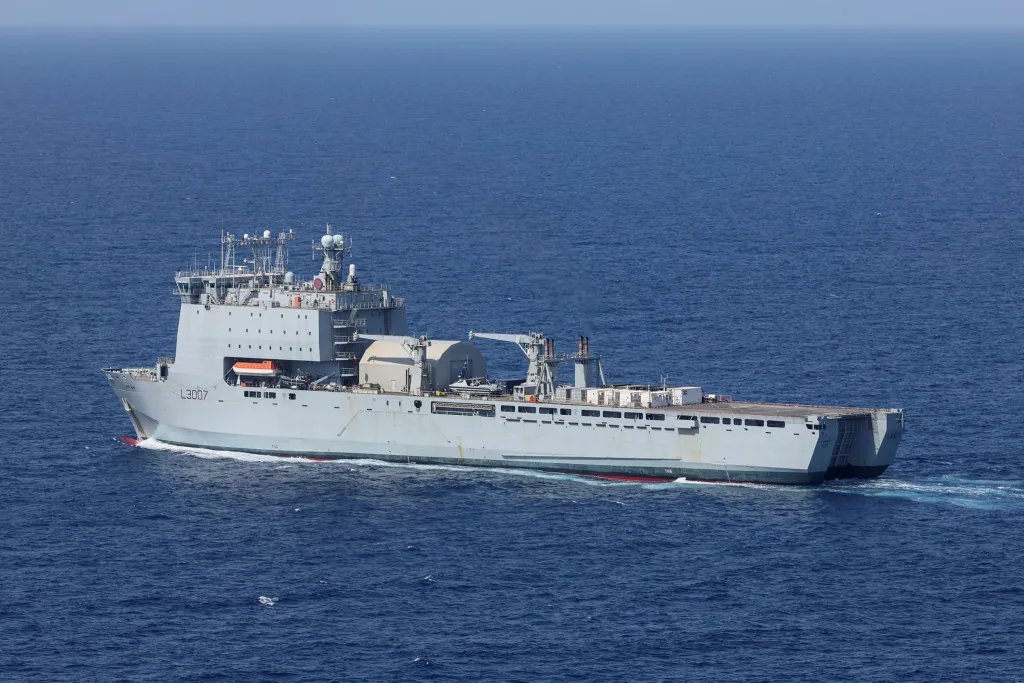
Meanwhile, the Royal Navy’s RFA Lyme Bay and two German warships have transited the Red Sea in case they are needed to help remove mines from the Strait of Hormuz. The Lyme Bay, “now configured as an Afloat Forward Support Base for mine countermeasures, transited the Suez Canal on 19th June and then passed south through the Red Sea,” the Royal Navy (RN) noted.
Royal Navy
The ship carries uncrewed surface vessels (USVs) with towed sonar arrays and AI automatic target recognition that can “filter and refine vast amounts of data allowing operators to speed up the process of classifying and neutralizing mines,” according to the RN.
Lyme Bay also has “Video Ray Defender-Viper portable mine disposal submersibles, capable of locating, identifying and destroying mines.”
There are also mine warfare, diving and explosive ordnance disposal specialists on board to assist the mine clearance mission.
Royal Navy Ariadne uncrewed surface vessels (USV). (Royal Navy)
Lyme Bay was accompanied by the German command and support ship FGS Mosel and minehunter FGS Fulda.
However, those vessels “detached from the task group on 23 June to head for Djibouti for resupply and further preparation,” according to Navy Lookout, an independent publication focusing on the Royal Navy. “They currently operate under the European Union mission Operation Aspides, which has the sole aim of defending merchant shipping against Houthi attacks in the Red Sea.”
We have reached out to the German Bundeswehr and Aspides for additional insights.
Amid the renewed flow of traffic through the Strait, oil prices have plummeted in recent days. As of Wednesday morning, Brent Crude was trading at just under $74 a barrel, according to OilPrice.com. That’s down from a high of more than $114 per barrel at the height of U.S.-Iran tensions in early May.
U.S. crude oil inventories fell by 6.1 million barrels last week, pushing stockpiles to 412.1 million barrels—7% below the five-year average. Despite the bullish draw, oil prices fell sharply as traders focused on easing Middle East supply risks. #Oil#CrudeOil#EIA…
How long oil prices continue to fall is an open question as the U.S. and Iran continue to express disagreements over the terms of a final Iran-U.S. peace deal following the MoU signed last week.
In addition to the aforementioned confusion over the status of the Strait, there is ongoing discord over whether Iran has agreed to allow inspection of its nuclear facilities. Trump and the International Atomic Energy Agency (IAEA) both say Iran has agreed to let inspectors in while the Iranians say that isn’t the case.
President Trump said Iran agreed that it will “never have a nuclear weapon” during his visit to a Pennsylvania’s Mack Truck facility on Tuesday. He also said “19 million barrels of oil flowed out of the Strait of Hormuz” on Monday, which he said is “the most oil in the history of… pic.twitter.com/ycsILtZRpq
Meanwhile, both sides have issued bellicose threats against the other as the often acrimonious negotiations for what is essentially an extension of the ceasefire continue.
As we have noted in the past, there is tremendous global and domestic pressure on Trump not to resume the war. The world economy is only beginning to recover from rising oil prices while Trump’s Republican party faces a midterm election in November made challenging by the unpopularity of this conflict. In addition, forces have now been deployed for many months and will have to be rotated out in the coming weeks.
Regardless, while getting vessels finally out of the Persian Gulf is still a priority, when robust two-way transits will return is still unclear, which will be critical to stabilizing the situation economically and geopolitically.
The clock is running down on the most consequential deadline the crypto sector has faced in Europe.
ADVERTISEMENT
ADVERTISEMENT
From the start of July, the transitional window under the Markets in Crypto-Assets Regulation (MiCA) closes for good, and companies that have not secured authorisation must either stop serving European customers or wind down altogether.
MiCA is the EU’s first comprehensive law for the crypto industry, bringing exchanges, brokers and digital wallet providers under the kind of formal oversight that has long applied to banks and other financial firms.
It replaces a fragmented mix of national rules with a single rulebook spanning all 27 member states: a company licensed in one EU country earns a “passport” to operate across the bloc, but in return it must meet standards on how much capital it holds, how it is run, how it safeguards customers’ funds and how it prevents money laundering.
“What emerges is a genuine single market replacing the old patchwork of 27 national regimes,” Yamal Kalaf, co-founder of MiCAR Whitepapers Europe, which advises crypto businesses on MiCA authorisation, told Euronews.
Since the core rules took effect at the end of 2024, existing operators have been allowed to keep operating under older national registrations, but that concession was temporary.
Crypto firms need European licences but many are behind
The scale of the looming shake-out is striking.
According to the European Securities and Markets Authority (ESMA), which confirmed in April that there would be no extension, only around 210 firms had obtained full authorisation by May, out of more than 1,200 that previously held national crypto registrations across the EU.
That points to a conversion rate of well under a fifth, leaving the vast majority of the old market without a licence as the cut-off arrives in a few days.
Speaking to Euronews, Roshan Dharia, CEO of distressed-investment firm Echo Base, explained that “the low conversion rate suggests that a meaningful portion of the market has concluded that obtaining and maintaining a MiCA licence is not economically viable within its current operating model.”
National regulators have warned that firms operating beyond the deadline without the new licence face enforcement action. France’s markets watchdog has also cautioned that continuing without authorisation could expose companies to criminal prosecution.
ESMA has told unlicensed providers to prepare orderly wind-downs, including transferring customer assets to authorised platforms or self-custody wallets, and to notify clients in advance so they can move funds safely.
“What we will see after 1 July is a smaller, more institutional market with real passporting. That is not a market in retreat. That is a market growing up,” Miguel Zapatero, Head Counsel at Crossmint, told Euronews.
Crossmint is a crypto infrastructure provider whose licensed rails let developers build wallets, custody and payment products.
A market reshaped around licensed rails
Plenty of familiar names have already cleared the bar.
Coinbase has been authorised in Ireland and Kraken in Ireland and Luxembourg. At the same time, the banking app Revolut secured its licence from Cyprus’s regulator late last year, allowing it to offer crypto services across the EU.
For these firms, the new rules promise a reward as unlicensed rivals retreat, the survivors stand to absorb their departing customers.
“MiCA is a genuine regulatory identity shift, not a registration exercise,” Gal Arad Cohen, partner at law firm S. Horowitz & Co, told Euronews.
The most prominent casualty so far may be Binance, the world’s largest crypto exchange.
According to Reuters, which cited two people familiar with the matter, Binance is set to lose permission to serve EU clients because its licence application to Greece’s market regulator, the Hellenic Capital Market Commission, is poised to be rejected.
Without approval in any member state, the exchange would be unable to operate across the bloc from July onwards.
Speaking to Euronews, Patrick Mollard, CEO at Fipto, a blockchain-based payments company for businesses, referred to the Binance case by stating that “scale earns you no shortcut to a licence, and that is precisely the point.”
Binance has pushed back, saying it has worked constructively with regulators for 18 months and believes its application met MiCA’s requirements. The company added that it understood the Greek authority had completed its review and found the filing compliant.
The company has promised a further update before 30 June.
The episode has also reputedly taken on a political dimension.
French crypto publication The Big Whale reported, citing unnamed sources, that ECB President Christine Lagarde had opposed Binance’s bid for a Greek MiCA licence.
Euronews could not independently verify the report, and neither the ECB nor the Greek government has publicly commented on the allegations.
The Big Whale also reported that Binance is exploring a potential MiCA application in France after the setback in Greece, a claim that neither Binance nor French regulators have publicly confirmed.
Binance did not immediately respond to a request for comment from Euronews.
A shake-out for smaller crypto firms
Beyond the biggest names, the deadline is expected to push smaller crypto apps and brokers towards licensed custody providers. Rather than building their own MiCA-compliant systems, many are likely to rely on authorised firms to hold customer assets.
“We will see consolidation and transfer of clients as the deadline will not be met by all currently operating entries,” Floortje Nagelkerke, partner at law firm Norton Rose Fulbright, explained to Euronews.
The result, analysts suggest, will be a smaller, more concentrated European market, with fewer players, higher barriers to entry and a clear advantage for those holding a licence, but stronger consumer protections.
“People who hold crypto in the EU after 1 July will, on balance, hold it on safer rails,” Miguel Zapatero, Head Counsel at Crossmint, concluded.
June 23 (UPI) — Acting Attorney General Todd Blanche announced Tuesday that 455 people have been charged in a variety of healthcare fraud schemes totaling $6.5 billion.
Blanche held a press conference to discuss what he called the “2026 national healthcare fraud takedown.” He said 455 people have been charged since June 8 across 56 U.S. attorney’s offices and 45 states and territories.
“These individuals participated in healthcare fraud schemes involving more than $6.5 billion in false claims submitted to Medicare, Medicaid and other healthcare programs,” Blanche said.
Blanche highlighted some of the indictments, including one of a corporate executive in Arizona who was charged for being involved in a $1 billion fraud scheme involving wound grafts.
“This alleged scheme cost Medicare over $1 million per patient,” Blanche said. “In total, our indictment charges 11 defendants for over $2 billion in fraudulent claims in connection to alleged wound care schemes.”
Blanche adds that the money fraudulently claimed in these schemes was used to purchase “multi-million-dollar homes,” cars, jewelry and the construction of a $4.6 million seaside hotel on in the Philippines.
“We’re taking back the money, the luxury cars, the jewelry, and these alleged fraudsters will face justice,” Blanche continued.
Blanche said nine task forces, 57 U.S. attorney’s offices and 41 state attorney general’s offices partnered to investigate healthcare fraud schemes.
Blanche also announced the creation of the West Coast Strike Force and the deployment of more federal prosecutors to bring charges against 295 defendants in Medicaid fraud cases.
President Donald Trump presents a Medal of Honor to Tom Ripley on behalf of his father, John W. Ripley, during a Medal of Honor award ceremony in the East Room of the White House on Thursday. Photo by Aaron Schwartz/UPI | License Photo
A TINY island off the coast of Wexford could make for one of Ireland’s most spectacular summer day trips.
The breathtaking Saltee Islands are just a two-hour drive from Dublin — with a short ferry ride from Kilmore Quay bringing visitors straight to Great Saltee.
Sign up for the Travel newsletter
Thank you!
The Saltee Islands is ideal for a summer day outRazorbills, puffins and gulls can all be spotted at the brilliant bird sanctuary
The islands are famed for their incredible wildlife, with puffin-watching a must for anyone visiting during the summer months.
Day trippers can spend around three-and-a-half hours exploring the stunning island, spotting seabirds, seals and dramatic coastal views.
And with return ferry tickets costing €40 for adults, it could be the perfect seaside escape to kick off the summer.
The islands are located just 5km off Kilmore Quay in Co Wexford — and a 20-minute ferry trip is all it takes to get there.
Fabulous views across the seaCredit: Design Pics RF – GettyA black backed seagull with three chicks spotted on the Saltee Islands
Parking is available at Kilmore Harbour in the free public car park.
However, the little harbour is a busy spot during the summer months.
Visitors are advised to leave plenty of time to get to Kilmore Quay as parking spaces can be limited.
The ferry service picks visitors up at the top of the harbour in Kilmore Quay, beside the boat launching slip.
It brings passengers straight to Great Saltee, as permission to visit Little Saltee cannot be granted due to hazardous landing conditions.
But visitors can only access the island during certain hours each day.
Day trippers are allowed on the island between 11am and 4.30pm, and anyone landing on a boat outside these times will be asked to leave.
The popular Saltee Ferry is a daily service that runs from April to October every year.
A return ticket costs €40 for adults and €20 for children under 12.
Each ferry can carry up to 12 passengers at a time.
Visitors are advised to arrive at the ferry gate ten minutes before the trip.
A smaller transfer boat will meet the ferry just off the shore of the island.
It picks passengers up and brings them on the final part of the journey to Great Saltee.
Once you arrive, you will be given approximately three-and-a-half hours to explore the mesmerising island.
The ferry crew will give you an exact time to be back at the landing area for the return trip to Kilmore Quay.
The ferry trip can be booked in advance online at salteeferry.com.
The Saltee Islands are known as the most famous bird sanctuary in Ireland — and puffin-watching is a must on any trip there.
Puffin season is predominantly between May and June.
There are plenty to spot, so make sure to take lots of pictures.
One visitor said: “The trip of a lifetime. There were hundreds of puffins just a short stroll from the boat. If you sit quietly they’ll wander around you.”
But Discover Ireland chiefs have warned that the puffin population is in a dangerous position, and visitors are advised to keep their distance to avoid disturbing the wonderful birds.
As well as the magnificent puffins, the island is also home to an array of seabirds, from gannets and gulls to Manx shearwaters.
While exploring the picturesque island, you might also come across some friendly sea creatures.
Grey seals are known to breed around the Saltee Islands.
It is one of the very few places in eastern Ireland with a seal population.
Up to 120 animals are present in autumn and up to 20 pups are born annually.
The seals can regularly be spotted resting on the rocks around the island.
The Saltee Islands are among the most ancient islands in Europe.
As long ago as 3,500 to 2,000BC, people were living on the islands.
In December 1943, the Saltees were purchased privately by the late Prince Michael the First.
Since his death in January 1998, the islands have been owned by his five sons and one daughter.
Permission for people to visit the island was granted by the family in recent years — but visitors are asked to respect the island.
When the family is in residence, a flag will be flying at the house — which visitors are asked not to approach.
No one is allowed to stay or camp at the historic spot, but there is no admission fee for a day trip to the island.
But island chiefs have issued a major warning to visitors.
They said: “Please do not approach the nesting birds closer than six metres.
“The footfall is having a devastating effect on the bird population. Should visitors see photographers not obeying the signs, please explain to them that they are killing the birds and to use their lens instead of their feet.
“If things do not improve with the bird population due to the current footfall, we will be forced to close the island to visitors.”
Hundreds of Bolivian residents are braving near-freezing temperatures to queue for affordable chicken in La Paz, due to more than a month of food shortages.
Spiked prices and protester blockades have affected access to food and medical supplies in the capital.