‘VisionQuest’: Everything to know before watching the Marvel show
The last time audiences saw Vision, the reconstructed synthezoid was flying off into the distance, and we didn’t know when we’d actually see him again. But he’s finally back.
Premiering Tuesday on Disney+, “VisionQuest” brings Vision (Paul Bettany) back into the spotlight — along with a few of his closest inorganic friends — as he tries to figure out his identity and understanding of humanity. Along the way, he’ll encounter a bounty hunter (Todd Stashwick) and a teenager that just might be his son (Ruaridh Mollica), sort of. It’s a long story.
Created by Terry Matalas, “VisionQuest” is set to wrap up the story set into motion by the 2021 series “WandaVision.” The Marvel Cinematic Universe’s first-ever streaming series saw a grief-stricken Wanda magically manifest a happy life for herself and Vision as newlyweds and, eventually, new parents. But that happiness wasn’t meant to last since the actual Vision was gone.
A lot has changed in the MCU since the conclusion of “WandaVision,” so here’s a quick refresher to get you up to speed for everything you need to know before watching “VisionQuest.”

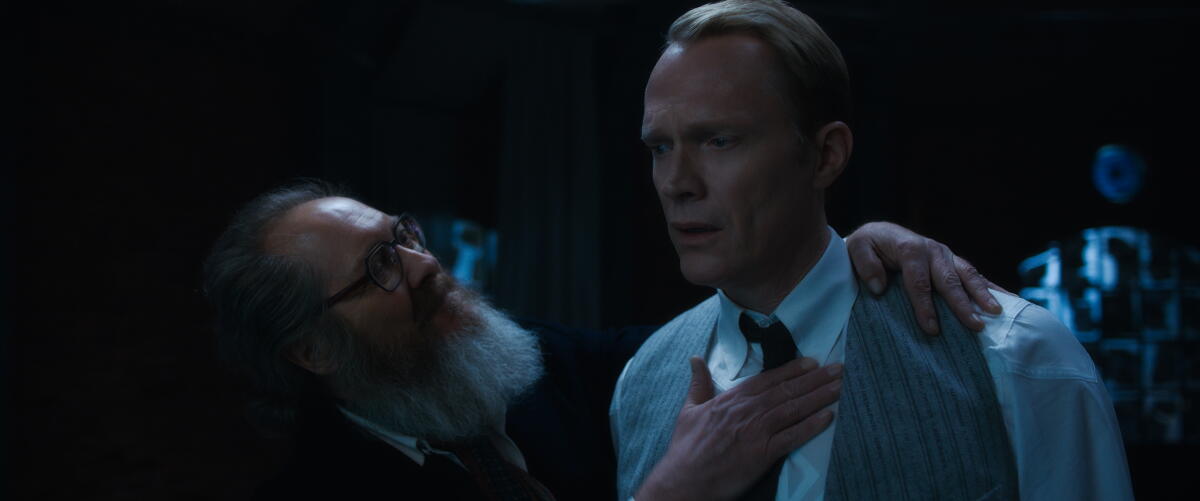
Ultron (James Spader), left, and Vision (Paul Bettany) in “VisionQuest.”
(Marvel)
What is ‘VisionQuest’ about?
Set some time after the events of “WandaVision,” “VisionQuest” will follow Vision as he tries to sort through his understanding of his identity and humanity. The former weapon of mass destruction has been in hiding for some time, but a bounty hunter tracks him down and disrupts his quiet life before also discovering a young man who appears to be Vision’s son.
When was the last time we saw Vision?
Audiences last saw Vision at the end of “WandaVision.” The monochromatic version of the former Avenger had been rebuilt without his memories to be a sentient weapon, but during a showdown with his magically created double, he regained them. He then flew off into the unknown to figure out what having access to these memories means for him.
What happened to Wanda?
After undoing her hex that let her live out a version of a happily ever after with Vision, Wanda had to watch him and their kids — twin boys Tommy and Billy Maximoff — disappear. Her story continues in the 2022 movie, “Doctor Strange in the Multiverse of Madness,” where she taps into some dark magic in order to find a way to reunite with her boys somewhere in the multiverse for another attempt at that happy life. But she’s a bit overzealous and things take a (villainous) turn for the worse before she ultimately sacrifices herself and is crushed by a mountain.

Thomas Shepherd (Ruaridh Mollica) in “VisionQuest.”
(Marvel)
What happened to Wanda and Vision’s kids?
Audiences learned in the 2024 series, “Agatha All Along,” that although Billy and Tommy’s physical forms disappeared when Wanda undid her hex at the end of “WandaVision,” their souls remained. Instead of crossing over into the afterlife, Billy, the magically inclined twin, transferred his soul into the body of William Kaplan, a teenager who had just been involved in a fatal car crash. Billy, now inhabiting the body of and living as William, was then able to use his powers to help Tommy’s soul find a new body to inhabit. At the end of “Agatha,” Billy and his magical mentor, Agatha, headed off to search for Tommy.
Who else is in this show?
Joining Vision in his “VisionQuest” adventures are an array of other AIs created by Tony Stark — all of which essentially now reside inside of Vision’s head. Most of these programs did not have physical forms in their original MCU incarnations, but appear in human form within the world inside Vision’s mind.
J.A.R.V.I.S. (James D’Arcy) is the AI assistant that Stark originally created to help manage his home and office as well as his Iron Man suit. His core programming was used to make Vision during “Avengers: Age of Ultron” (2015). F.R.I.D.A.Y. (Orla Brady) is the AI assistant that was created to take over J.A.R.V.I.S.’ duties afterward.
E.D.I.T.H. (Emily Hampshire) was created by Stark to help manage his company’s security and defense systems and was connected to his glasses. These glasses were passed on to Peter Parker in “Spider-Man: Far From Home,” before they were acquired by the film’s villain for his nefarious plot.

F.R.I.D.A.Y (Orla Brady), J.A.R.V.I.S. (James D’Arcy), U (Johnathan Sayer) and D.U.M.-E. (Henry Lewis) appear human in Vision’s mind in “VisionQuest.”
(Marvel)
D.U.M.-E. (Henry Lewis) and U (Jonathan Sayer) were a pair of arm robots that helped Stark in his workshop. All of these AI have specific roles and responsibilities within Vision’s home in his mind.
Another resident within Vision’s head is Ultron (James Spader), the misanthropic genocidal AI originally created by Stark and Bruce Banner to help save humanity. He tried to delete J.A.R.V.I.S. during the events of “Age of Ultron,” which led to the creation of Vision, so their dynamic is a bit complicated.
Also set to appear on the show is Mollica’s Thomas Shepherd, an older incarnation of one of Wanda and Vision’s magically created sons who had disappeared when the hex enveloping Westview was undone.
What do I need to watch before watching ‘VisionQuest’?
“VisionQuest” has been touted as the conclusion of the “WandaVision” trilogy, which also includes “Agatha All Along.” The events of “WandaVision” appear to be most central to “VisionQuest’s” story, though.
Those who’d like to see Vision and Ultron’s story from the very beginning should add “Avengers: Age of Ultron” to their queue. Fans who want to delve more into Vision and Wanda’s love story can also check out “Captain America: Civil War” (2016) and “Avengers: Infinity War” (2018) — with the latter adding more context to Vision’s current state of being. Those who want to see what happened to Wanda after “WandaVision” should also watch “Doctor Strange in the Multiverse of Madness.”