After surging troops to the border, U.S. military showcases a quieter Rio Grande
ROMA, Texas — Standing on a high bank of the Rio Grande, Army Lt. Col. Ray Richards points to a stretch of river that was, until recently, one of the busiest spots for illegal border crossings from Mexico.
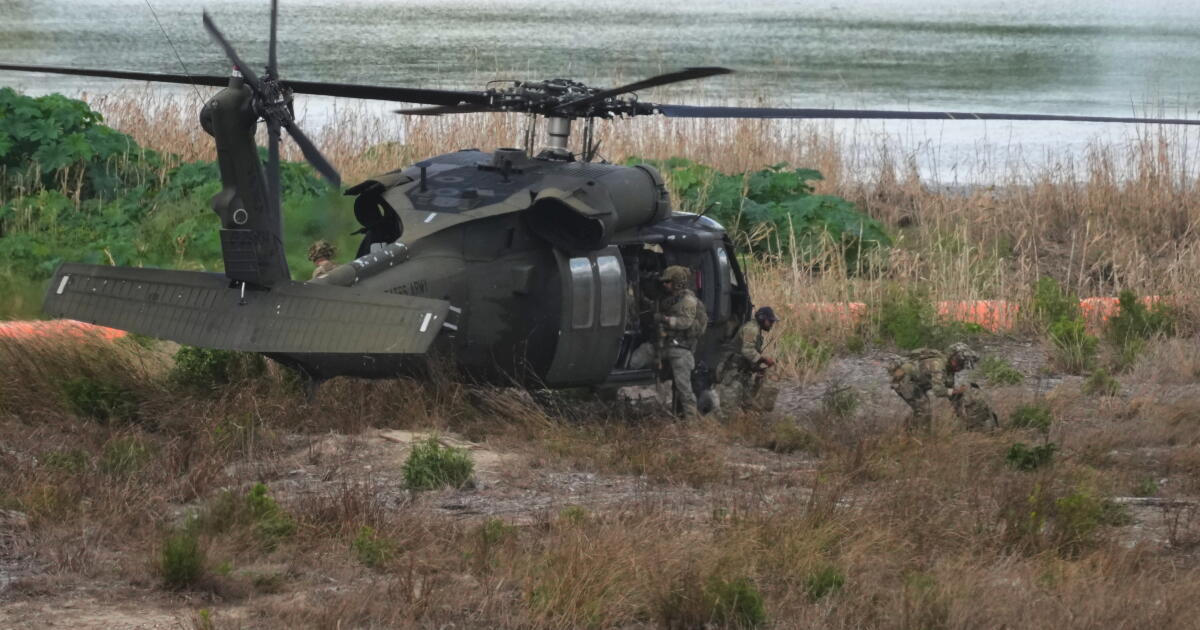
But on a recent afternoon, the area is quiet. American soldiers gather at a border monitoring post in Roma, Texas, where an infantry vehicle with camouflage netting sits between houses. A Blackhawk helicopter drops soldiers onto an island in the river, while U.S. Border Patrol agents breeze by on fan-propelled boats.
“At any given time, there would be multiple rafts full of people trying to get to this side,” Richards said of the area before U.S. forces made it a priority last year.
The Army has been inviting reporters to the Rio Grande Valley as it deploys hundreds more soldiers to the region this month by shifting some of the thousands of troops already serving along the 2,000-mile border. U.S. officials said the troop surge follows signs of elevated activity from drug cartels and has been accompanied by increased cooperation from the Mexican military. The U.S. Coast Guard said it recently encountered gunfire from the Mexican side of the river, prompting the Americans to fire back.
In this small patch at the southern edge of the United States, a slow saga is playing out — a curious mix of policing, policy and politics.
Some question a troop surge just weeks before midterm elections
While Republicans face increasing headwinds because of President Trump’s unpopularity, persistently high prices and the fallout from the war in Iran, border security has remained a relative bright spot in Trump’s polling numbers, with about half of Americans saying they approve of his performance there.
But some experts have questioned the need for such a large military presence. They suggest it’s less about effective strategy and more about political theater.
Illegal crossings have plummeted due in large part to asylum restrictions that began before Trump returned to the White House. Meanwhile, a large percentage of the fentanyl, cocaine and heroin seized along the border was being smuggled in cars and trucks passing through checkpoints, not the areas in between.
David Shirk, a University of San Diego political science professor, said the Trump administration wants to remind voters it’s been very aggressive on border security.
“I don’t dispute there’s some benefit to having personnel in areas at risk for people smuggling and drug trafficking,” Shirk said. “But the vast majority of that is now happening at ports of entry.”
Dessa Bergen-Cico, a professor of public health at Syracuse University who studies drug trafficking, said street prices for cocaine and fentanyl are still low, suggesting the drug flow remains unimpeded.
But Army Maj. Gen. Curtis Taylor, who commands the military’s southern border task force, said the work has been vital and effective, particularly for targeting human trafficking.
The moral argument for the Army’s mission is “dismantling this marketplace of human trafficking that is bringing people into the border,” Taylor said. “An added benefit of that is there’s an awful lot of drugs moving with that human trafficking.”
Efforts to secure a former epicenter of illegal crossings
Roma, a city of about 10,000 people, lacks a border wall in some places because homes sit close to the steep slopes along the Rio Grande. Directly across the water is Miguel Alemán, a town in the Mexican state of Tamaulipas that’s been plagued by decades of cartel violence. From Roma, it’s a football field’s distance across the river at best and much less in some places.
In 2021, Roma became a center of illegal crossings when thousands of families and unaccompanied children arrived each day to seek asylum. Border crossings fell sharply after President Joe Biden introduced severe asylum restrictions in 2024 and dipped after Trump suspended asylum at the border.
After Trump returned to the White House in January 2025, the Army and Coast Guard expanded operations to back up the Border Patrol, which remains the lead agency for border security. The Army now commands some 8,000 U.S. troops along the entire border, while the U.S. Coast Guard and Texas law enforcement have brought in more personnel.
Army officials said people still try to cross into Roma despite multiple obstacles. A barrier of strung-together buoys, each the size of a hay bale, stretched along the river. Concertina wire lined the U.S. river bank, while a surveillance blimp hung in the sky. A river island was recently cleared of trees that hid people trying to cross.
Army Sgt. Nathaniel Decker said he recently saw people on three rafts set out from the Mexican side at dusk. He reported to Border Patrol that one group had cleared the buoys. They were eventually caught by a house in Roma.
Mexico also has sent more troops
The U.S. has stopped many of the drones used by the cartels to surveil the border and ferry drugs, by electronically jamming or capturing them or shooting them down with a laser.
The U.S. has gotten better at tracking them and coordinating with Mexican officials to locate the drones’ operators. But some still get across.
“We have reduced a lot of the flights,” said Richards, the Army lieutenant colonel, who has deployed with the Massachusetts Army National Guard. “But in the middle of the night, those drones can fly into the U.S. airspace, and that’s a true threat to any soldier on the ground.”
Under pressure from Trump, Mexican President Claudia Sheinbaum has cracked down more heavily on crime than her predecessors. Mexico this month sent 500 National Guard and military officers to Tamaulipas as part of a coordinated effort with the U.S. to prevent drug and human trafficking.
Mexico’s deployment “is based on intelligence gathered regarding the movements of criminal groups,” a federal official in Mexico told The Associated Press, speaking on condition of anonymity because he was not authorized to comment on the matter.
As part of the operation, the Mexican Army is using two UH-60 helicopters, drones and anti-drone equipment.
The U.S. Coast Guard has also boosted patrols on the Rio Grande, bringing in more than 300 personnel in October of last year. While assisting Border Patrol in trying to apprehend someone attempting to enter the U.S. illegally, the Coast Guard encountered gunfire from the Mexican side of the water near Garceno, Texas, the service said in a statement. The Americans returned fire. None were hurt.
U.S. Coast Guard Cmdr. Jeff Miller wouldn’t give additional details about the exchange of gunfire, except to say the personnel are “working in a very challenging environment” and are authorized to use force to protect themselves.
On a recent patrol, the scene along the river was quiet. A Coast Guard boat armed with machine guns motored along the greenish water. Two men fished from a small boat. A privately funded border wall, made from galvanized steel, lined the American side. In Mexico, there was a park with soccer goal posts, homes and a woman waving.
A Coast Guardsman driving the boat, who declined to give his name, said he’s seen kids on the Mexican side get excited as if a fire truck were passing. Others have offered the Americans cold beer. Some have reacted with offensive gestures.
Joel Garcia, Border Patrol’s acting deputy chief patrol agent for the Rio Grande Valley, said the agency has proof that U.S. operations have been effective based on the amount of drug seizures, the number of people apprehended and decreasing traffic within certain areas.
“Border security, when done right, if we have truly secured the line, should be boring,” he added. “It should look as if no one is crossing and nothing is happening.”
Finley writes for the Associated Press. AP writers Fabiola Sánchez and Megan Janetsky in Mexico City contributed to this report.