In Philippe Caland’s semi-autobiographical 2003 film “Hollywood Buddha,” his mother, Huguette Caland, plays herself. Wearing her signature white smock, inscribed with a flurry of painted swirls, circles, letters and cross-stitches, the Lebanese artist makes precise gray-blue lines on a canvas spread across her dining room table as her son laments a fickle movie industry.
Filmed in her Venice home, the scene, her three children agree, was true to life. Caland worked constantly: on stretched canvas, on fabric folded in her lap, on a children’s menu, on the wall of her kitchen, or the sleeve of her smock. Whatever was at hand.
“Of course it could be frustrating,” said her daughter Brigitte, an elegant, soft-spoken scholar of Semitic languages who has managed Caland’s estate since her death in 2019.
Brigitte Caland, right, and Charley Caland — the daughter and granddaughter of the Lebanese-born painter, sculptor and fashion designer Huguette Caland — stand in Caland’s former L.A. home and studio.
(Robert Gauthier / Los Angeles Times)
Sitting in that very home, which Caland had built in 1997, Brigitte recalled the many times her mother invited her over only to continue working as they talked. “I’d go to leave, and she’d put the canvas away, beg me to come back, and as soon as I did, she’d start painting again.” Still, from early on, Brigitte understood the compulsion as evidence of her mother’s resolve. “She had this incredible drive to create.”
“Huguette Caland: A Life in a Few Lines,” opening Sunday at the Hammer Museum, traces that relentless drive across nearly 150 paintings, drawings, sculptures, garments and tapestries. Organized by the Museo Nacional Centro de Arte Reina Sofía in Madrid in collaboration with the Deichtorhallen Hamburg, the show comes to Los Angeles as the largest Caland survey in the country to date. Spanning five decades and installed chronologically, it features work from the 26 years she spent immersed in Venice’s creative community even as her practice was largely ignored.
It was Caland’s generous hospitality and boisterous wit that made her custom château a gathering place for a vibrant Westside art circle. Ed Moses, who lived around the corner, visited several times a week; Larry Bell, Frank Gehry, Robert Wilhite and others joined her for long meals and even longer parties. Her work surrounded them, and her studio, the grandest space in the house, stood open just beyond the living room. Yet her guests remained uninterested. “No one,” Brigitte said, “would walk the 10 steps.”
Huguette Caland in Stone Doorway, France, 1970.
(Huguette Caland Estate)
Curator Hannah Feldman sees that tension as central to Caland’s California years. “Instead of supporting and bolstering her as a creative in their midst, she became their salon host,” she said. The lack of recognition, Feldman argues, reverberates through Caland’s heavily impastoed portraits of Moses and her enigmatic late abstractions such as the rectilinear paintings in the “Silent Letter Series.”
“To draw a line is a way to contain one’s emotion, one’s anger, one’s anguish,” wrote Caland of her challenging relations with fellow artists in “Sketchbook 2” (1990-91). “My lines tell the story of my life, of people encountered along the path, people I loved, and found and even lost.”
Caland is perhaps best known for her cheeky, erotic paintings of fulsome body parts and for a biography too often reduced to cliché: the libertine daughter of Lebanon’s first post-independence president who left her husband and children in Beirut to pursue an art career in a less repressed Paris.
Huguette Caland, “Self-Portrait in Smock,” 1992
(Huguette Caland Estate)
Feldman hopes the exhibition, which spans fine-line drawings of entangled lovers and radiant topographical tapestries, will complicate that familiar account. “There’s joy, and there’s sex,” she said, “but there’s also pathos, vulnerability. The search for autonomy is not an easy one; it comes with conflict, strife.”
Caland’s freedom was no doubt hard-won. She first picked up a brush as a married mother of three in her thirties, and only after her father’s death. In her first painting, alternately titled “Soleil rouge” and “Cancer” (Red Sun/Cancer) (1964), hazy concentric circles gather in a crimson orb at the center of the monochromatic plane. Simultaneously a tumor and a light source, the refulgent motif holds grief and release.
Soon after, Caland enrolled in art classes at the American University of Beirut, relinquished much of her constricting couture wardrobe, and adopted a uniform of loose, flowing kaftans, which she would later turn into works of art in their own right. Archival photographs show a glamorous Caland arriving at an event in a floor-length garment bearing painted breasts, a belly button and a triangle of curly pubic hair.
Huguette Caland, “Bribes de corps,” 1973
(Huguette Caland Estate)
Caland moved to France in 1970, leaving her children (then 15, 13 and 12) in Beirut with their father, a French-Lebanese lawyer named Paul Caland. In paintings from that decade, Caland’s imagery of bodies swell, split, meld and dissolve. In “Enleve ton doigt” (Remove Your Finger) (1971), lipstick-red lips receive a pale finger reaching out from a crush of fantastical profiles; two years later, in “Self-Portrait” (Bribes de corps), Caland dispersed a sensual body across a pale pink field interrupted at the lower edge by a slight, shadowed cleft — either buxom cleavage or buttocks.
The distance from her children produced another kind of line: text. Philippe recalled receiving illustrated letters almost every week, filled with drawings, doodles and notes of affection. Most of these were later destroyed when the family house was bombed during the Lebanese Civil War of 1975. “I always knew my mother loved me,” Philippe said. “The family was not torn apart. She took a break, and in the end made a home for us in Paris, where we all landed when the war was raging.”
After the death of her lover, Romanian sculptor George Apostu, whose rough-hewn wood sculptures still populate the house’s patio, Caland’s children encouraged yet another departure. Her eldest son, Pierre, a businessman and former Olympic swimmer, paid for a stay at a friend’s Venice bed-and-breakfast, all but forcing his grieving mother out of Paris and to sunny L.A. Her initial reluctance gave way to affection. The light, arid climate and mountains sloping into the sea reminded her of Lebanon. “She liked that California land sounded like Caland,” Brigitte said.
Huguette Caland works at her home and studio in Venice, date unknown.
(Huguette Caland Estate)
After making Venice her primary residence, Caland collaborated with architect Neil Kaufman on the design for her enclosed château. Its towering, mostly unbroken face and narrow swimming pool suggested a rampart and a moat, but behind the concrete exterior, Caland eliminated every door save the guest bathroom. Long vertical windows opened onto a courtyard shaded by a sprawling olive tree. Art crowded the steep stairwell; it accumulated on scattered plywood and Formica tables and unraveled across the kitchen in an intricate mural composed of tessellated marks that recall Byzantine mosaics and tatreez, a form of traditional Palestinian embroidery.
“There was no distinction for her,” Brigitte said, between the home and the studio, art and life. Caland once described her “very, very mixed media” as including “every single exchange, a look, a smile, a brief encounter.”
That original interior survives in “Hollywood Buddha” and archival photographs. Philippe now lives in the house with his family, and although the concrete exterior remains intact, the rooms and the courtyard have been remodeled around their own aesthetics and routines. Along with the technicolor mural, Caland’s singular sensibility persists in scattered drawings, a bouquet of her preferred 30-inch paintbrushes and a pair of stiff-backed pews. Her presence, too, is felt in the people who now inhabit the space, like her granddaughter Charley, 25, whose easy warmth recalls qualities long ascribed to the matriarch.
The former Venice home and studio of the Lebanese-born painter, sculptor and fashion designer Huguette Caland. The home is still occupied by Caland’s family and no longer looks how it did when she was alive, but her spirit lives on in small details.
(Robert Gauthier / Los Angeles Times)
When the Hammer selected Caland for “Made in L.A. 2016,” the honor brought some measure of the local attention that had long eluded her. “If you had to pick one critical turning point for her career,” Pierre said, “it was the inclusion of her work in that show.” For the family, the coming survey fulfills one of her long-held ambitions.
“She told me, ‘Live your life day by day and plan it on a thousand years,’” Philippe said. Only later did he understand that the advice described her own life. “Today, her work is here,” he added. “She continues with it.”
Huguette Caland, “Le grand bleu,” 2012.
(Huguette Caland Estate)
The final painting in the exhibition, an oceanic large-format canvas titled “Le Grand Bleu” (The Great Blue) (2012), once hung high above the central hearth in the Venice house. Surrounded by undulating circles, spots and stripes, red-roofed Lebanese abodes and white-masted schooners traverse an unsettled horizon line. From the dining table below, where a young Charley often helped her grandmother fill blank planes with delicate dots, Caland could look up and see how far her line had taken her.
Reporters from CNN, MS NOW and Politico have been denied White House access after Donald Trump banned the three outlets. The organisations say the move infringes First Amendment protections for a free press and restricts access based on coverage.
Reporters from CNN, MS NOW, and Politico were denied access to White House after Trump calls news outlets ‘fake news’.
Journalists from CNN, MS NOW and Politico have been barred from entering the White House and have had their press credentials deactivated or confiscated, as United States President Donald Trump’s ban on the three news organisations took effect.
Journalists were turned away from the grounds on Saturday after Trump announced on Friday that CNN, MS NOW and Politico would be barred from the White House, accusing the outlets of reporting what he called “fake news”. Trump has said other outlets could also face bans.
Recommended Stories
list of 3 itemsend of list
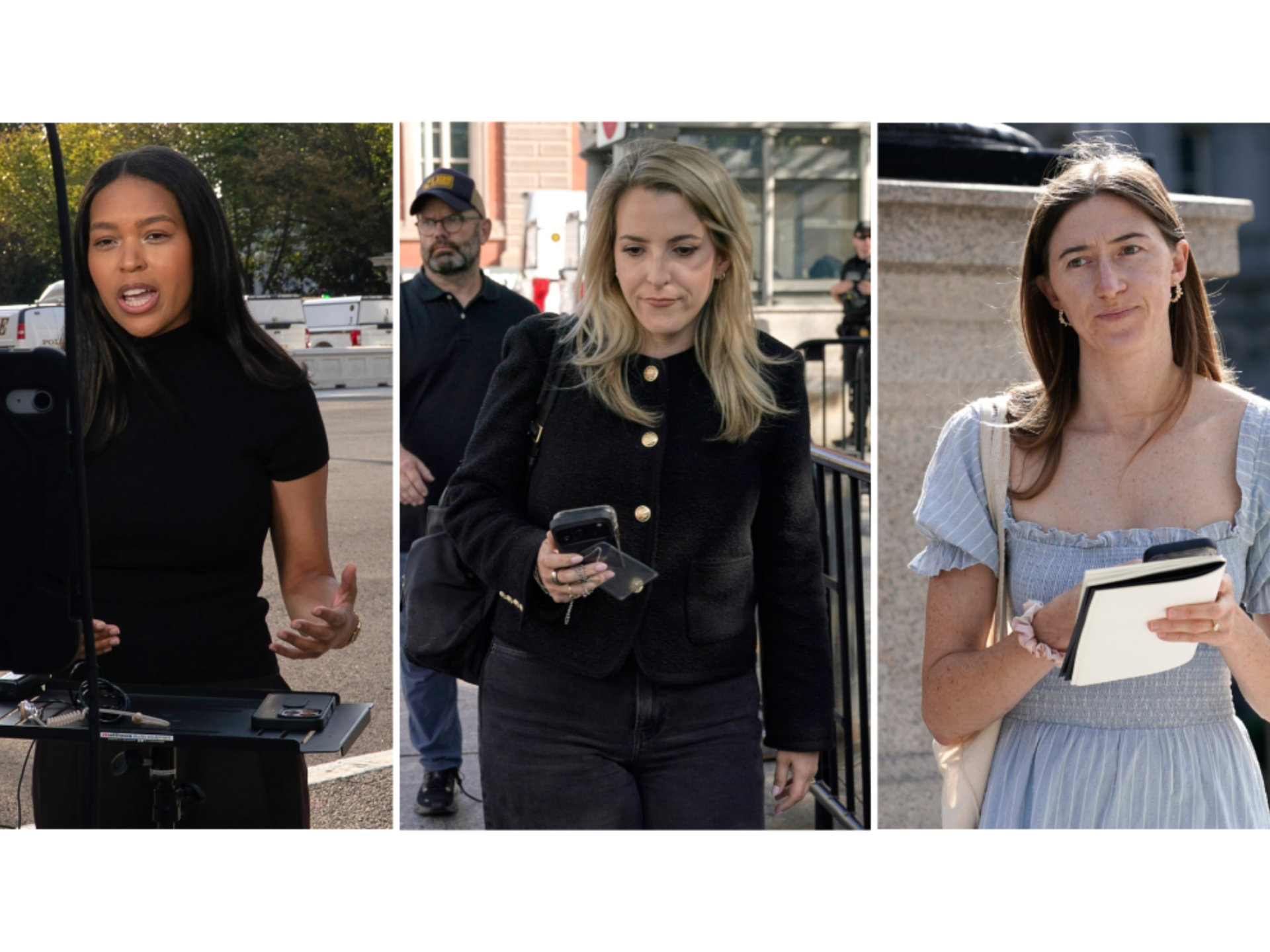
CNN White House reporter Betsy Klein and MS NOW White House correspondent Akayla Gardner both reported on air that they had been denied access. Gardner said an officer confiscated her badge after telling her it had been disabled and that the decision was “above him”. An MS NOW photographer also had their badge disabled, she said.
Politico reporter Cheyenne Haslett was subsequently turned away, with Politico saying the Secret Service denied her entry and confiscated her White House access pass.
“A few minutes ago, our colleague Cheyenne Haslett attempted to enter the White House to do her job as a POLITICO reporter,” the news organisation said. “Secret Service denied her entry to the complex and confiscated the pass that allows her access to the White House.”
“We stand by her and all reporters here covering the White House,” Politico added. “As we said yesterday, we will vigorously defend our First Amendment rights.”
“The White House belongs to the American people and the decisions made inside are funded by our tax dollars,” MS NOW said in a statement. “MS NOW intends to take any and all steps necessary to defend our First Amendment rights and the essential role of independent journalism in our democracy.”’
CNN media analyst Brian Stelter called the move “a direct threat to press freedom in the United States”.
“It’s so much bigger than CNN,” Stelter said. “This is a free speech test in America.”
The White House Correspondents’ Association said Trump had described “his own planned action as a ‘ban on the free press’”, and said constitutional press protections do not depend on whether a president approves of a news organisation’s coverage.
The ban is the latest in a series of confrontations Trump has had with news organisations during his first and second term.
In 2025, his administration restricted Associated Press access to the Oval Office and presidential travel after the agency declined to adopt the administration’s preferred name, “Gulf of America”, for the Gulf of Mexico. That case remains ongoing.
A key precedent is a 1977 federal appeals court ruling, Sherrill v Knight. The court found that once the White House establishes press facilities for credentialed journalists, access cannot be denied arbitrarily or for less than compelling reasons. It also said journalists denied credentials must receive notice of the factual basis, an opportunity to respond, and a final written explanation.
It is not yet clear what legal recourse CNN, MS NOW or Politico may pursue, or how courts would apply Sherrill to the administration’s decision to revoke existing credentials.
Al Jazeera’s Alan Fisher reported from Washington, DC, on Friday that Trump’s ban will likely be challenged soon.
“The United States has the First Amendment [of its Constitution] that says the government cannot restrict access to this sort of thing,” he said.
Press freedom advocates are watching closely.
Jameel Jaffer, executive director of the Knight First Amendment Institute at Columbia University, said in a news release that the move raises constitutional concerns.
“If President Trump means to expel these news organizations from the White House press pool, his action is doubly unconstitutional because the press pool is a ‘public forum’ under the First Amendment, which means the president can’t exclude journalists from it on the basis of their viewpoints,” Jaffer said.
The fight over access could now become a broader test of the limits on the White House’s ability to control which journalists can cover the administration.
“It’s difficult to imagine a more blatant violation of the First Amendment than Trump banning news outlets from the People’s House for criticizing the government,” said Seth Stern, chief of advocacy at the Freedom of the Press Foundation. “It’s also hard to imagine a dumber move.”
NEW YORK — Journalists from three major news organizations — CNN, MS NOW and Politico — were denied access to the White House on Saturday morning, with reporters from the two cable networks both going live to report they’d been barred following a ban imposed by President Trump.
The actions escalated Trump’s long-running efforts to restrict news coverage by journalists he finds objectionable, and is the latest test of 1st Amendment protections in the United States. Trump said Friday he would ban all three organizations because of their coverage — which he called “fake news.”
Politico said its White House reporter Cheyenne Haslett was denied entry to the White House and had her badge confiscated Saturday. The announcement came shortly after the turning away of MS NOW and CNN journalists.
Editor in chief Jonathan Greenberger said in a statement to the Politico newsroom: “We stand by her and all reporters here covering the White House. … We will vigorously defend our First Amendment rights.”
CNN and MS NOW have issued similar statements.
“We will not be deflected from our duty to hold the government and other public bodies to account,” CNN said. The statement was shown on the air before senior White House reporter Betsy Klein began to report on her ban.
Journalists from three major news organizations — MS NOW, CNN and Politico — were denied access to the White House on Saturday morning.
(Graeme Sloan / Getty Images)
MS NOW said in a statement that it stands behind its journalists. “The White House belongs to the American people and the decisions made inside are funded by our tax dollars,” the network said in a statement Saturday. “MS NOW intends to take any and all steps necessary to defend our First Amendment rights and the essential role of independent journalism in our democracy.”
In his second term, Trump and his administration have upped the ante and punished certain media outlets, both in the courtroom and through regulatory action. Trump has also lashed out at individual reporters in person or over social media, sometimes in strikingly personal terms.
Turned away, badges confiscated
Both CNN White House reporter Betsy Klein and MS NOW reporter Akayla Gardner went on the air to report they’d been banned from entering the White House.
Network correspondents are usually present on the weekends when the president is in Washington or at nearby Camp David. Trump is at the presidential retreat in Maryland this weekend.
Gardner was turned away and her entry badge confiscated, she said. She noted she had walked through two gates successfully, but once she got to where her badge needed to be scanned, an officer told her it was disabled and asked her to hand it over. He said the decision “was above him,” she reported. An MS NOW producer was able to get in, but a photographer’s badge was also disabled, Gardner said.
CNN Senior White House Reporter Betsy Klein, left, walks to the White House, Saturday.
(Jose Luis Magana / Associated Press)
Klein, senior White House reporter at CNN, also said her badge had been deactivated.
CNN media analyst Brian Stelter called the move “a direct threat to press freedom in the United States.”
“It’s so much bigger than CNN,” Stelter said. “This is a free speech test in America.”
Continued attacks on press freedom
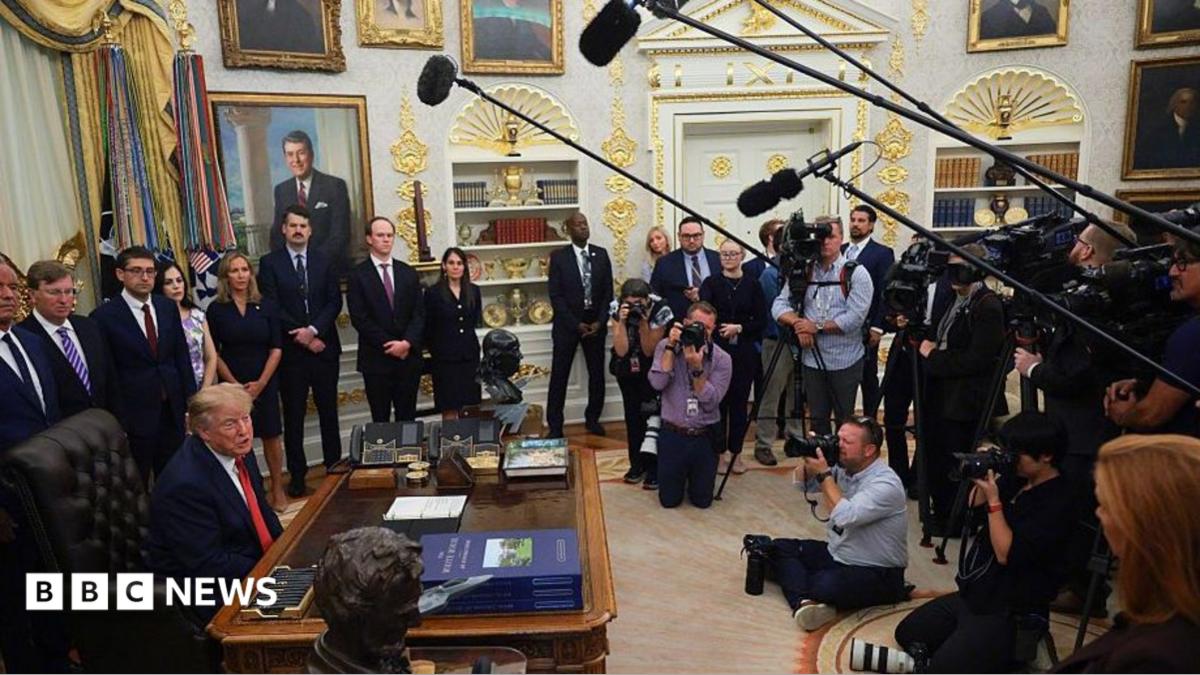
The president wrote on his social media site Friday that effective immediately, “I am banning” CNN, MS NOW and Politico “from the White House as a result of their constant ‘reporting’ FAKE NEWS!” Minutes later, speaking at an event in the Oval Office, Trump was asked to explain his statement.
“Because they’re fake news,” he said. “You get so tired of reading and seeing fake news. When you look at CNN, it’s just fake. That’s why their ratings are no good. When you look at MS NOW … , it’s fake news.”
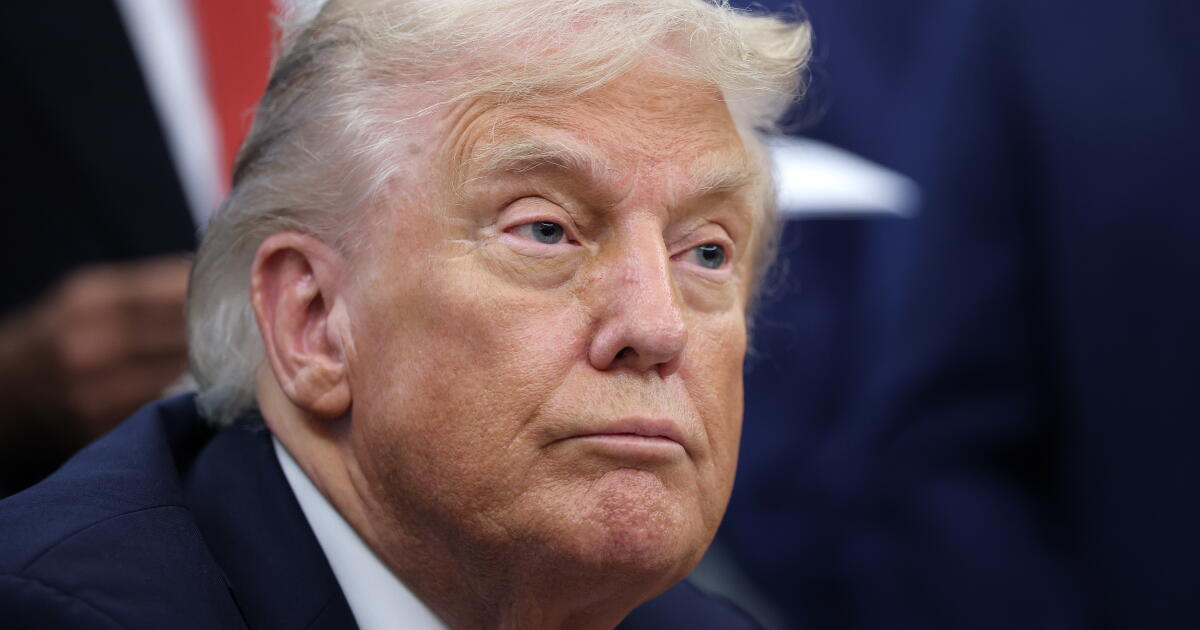
President Donald Trump arrives at the Ellipse before departing the White House on Friday. Trump hosting a MAGA fundraiser at his private club in Sterling, Virginia, before spending the weekend at Camp David.
(Chip Somodevilla / Getty Images)
“And when you look at Politico … the stories they wrote are fake. So there’s a lot of news and there may be others to join them, and maybe they can get better,” he said. “But our country has to have honest news.”
The move follows the president’s decision last year to bar Associated Press reporters from the Oval Office, Air Force One and other events in retaliation for the news outlet’s decision not to follow his lead in changing the name of the Gulf of Mexico, which lies partially in Mexican and other waters. The AP said that it would note when appropriate that Trump had ordered it renamed the “Gulf of America.”
The AP filed suit and the case is ongoing. Since returning to office, Trump has pursued other legal action against a variety of outlets, including the New York Times, the Wall Street Journal and the BBC. His administration is also involved in a long-simmering confrontation involving ABC over renewal of its broadcast licenses.
CNN and MS NOW journalists have been denied access to the White House after US President Donald Trump announced he was banning the outlets.
An MS NOW reporter and a photographer tried entering the White House grounds on Saturday morning, but their badges would not scan and an officer confiscated them, the outlet reported.
CNN also said Saturday morning that one of its reporters was denied access and had her badge seized.
Trump said on Friday he was barring MS NOW, CNN, and Politico – three major US media outlets – from the White House, accusing them of writing “fiction or lies” about his administration. Press freedom advocates called the move “unconstitutional”.
“The officer asked me to hand over my badge. He said that it was disabled,” MS NOW reporter Akayla Gardner said. “I asked why I was not able to get inside. He said it was above him.”
Gardner added that while her and her colleague’s badges were disabled, an MS NOW producer was still able to scan her badge to get in, though she was not given an explanation as to why the producer’s badge still worked.
CNN reporter Betsy Klein said a Secret Service agent told her her badge had been deactivated.
An MS NOW spokesperson said in a statement that the White House “belongs to the American people and the decisions made inside are funded by our tax dollars”.
“MS NOW intends to take any and all steps necessary to defend our First Amendment rights and the essential role of independent journalism in our democracy.”
It was not clear whether Politico reporter were at the White House on Saturday. Following Trump’s ban, all three outlets have spoken out against the decision, accusing Trump of violating their constitutional rights to free speech and freedom of the press.
“We have a right under the US Constitution to do our reporting without hindrance or interference from the government and this ban is an illegal assault on this fundamental right,” CNN said.
In his announcement, Trump did not mention specific stories or reporting from the three outlets that prompted the move, but later said “it’s really just cumulative stories over the last few years”.
Trump added that there “may be others to join them”, but has not given a directive banning additional news outlets. When later asked by a reporter what he meant by others to come, Trump responded: “Others to come in terms of fake news? Well, you know, the New York Times is fake news, the Washington Post is fake news.”
Several groups dedicated to the freedom of the press have called out Trump’s White House ban as illegal and unconstitutional.
A major group that provides legal services to the media – the Reporters Committee for Freedom of the Press – said it expected Trump’s ban to be struck down quickly by the courts because it was “flatly unconstitutional”.
“The First Amendment is clear that once the White House invites in some journalists, it can’t ban others because it doesn’t like their reporting,” said Bruce Brown, president of the Reporters Committee for Freedom of the Press, which provides legal services to the media.
It’s the latest in a series of moves by the administration to target media outlets Trump says are critical of him, including legal action against US and international outlets like The New York Times, The Wall Street Journal, and the BBC.
Some of the lawsuits have resulted in media organisations agreeing to pay multimillion dollar settlements. Trump’s lawsuit against the BBC is ongoing.
Additional reporting from Bernd Debusmann Jr and Max Matza.
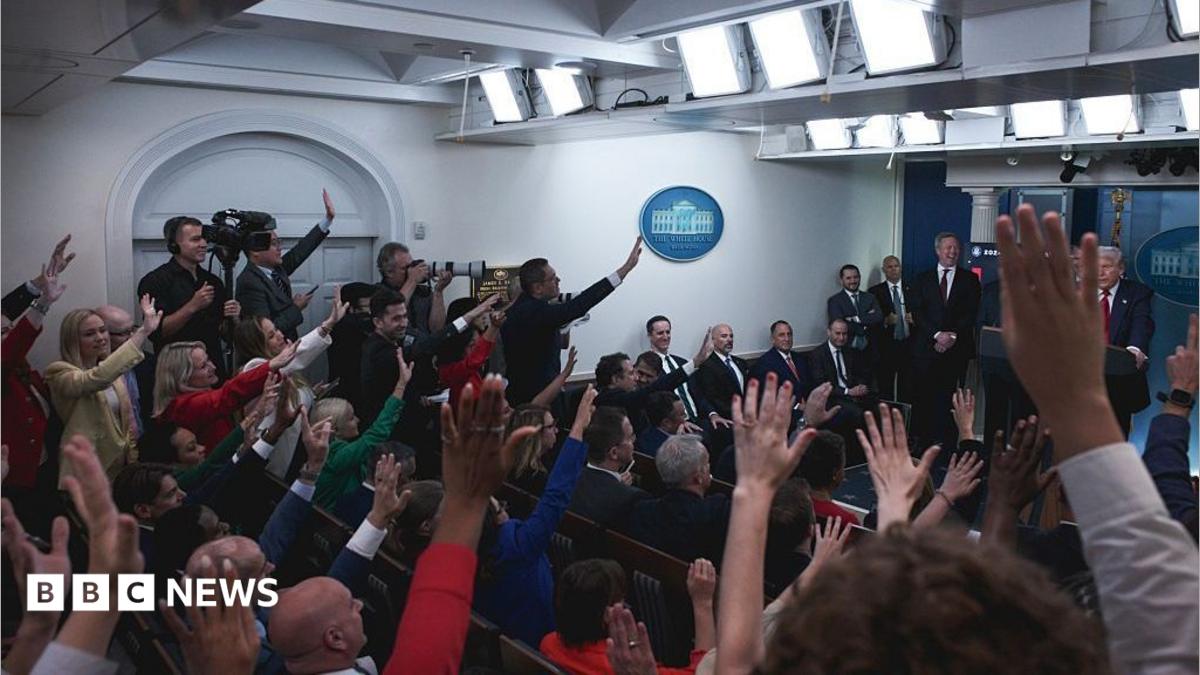
Since returning to office in January 2025, Trump and administration officials have repeatedly clashed with members of the White House press corps. In his second term, Trump has also moved to bring conservative bloggers, influencers and other media into the press room, arguing it is necessary to provide diverse perspectives to the American public.
In February, the White House announced it was taking control of the press pool which has access to Trump and had for more than a century been managed by the White House Correspondents’ Association.
The same month, the administration moved to bar Associated Press (AP) reporters and photographers from spaces where access is limited, such as the Oval Office or Air Force One, because of the outlet’s usage of the term “Gulf of Mexico” instead of “Gulf of America”.
AP swiftly filed a lawsuit and the case remains ongoing.
The president has frequently clashed with reporters in the Oval Office on Air Force One and during White House events, often referring to them as “fake news” and “rude”.
In his first term, Trump also banned CNN correspondent Jim Acosta from the White House, although his credentials were restored after CNN sued.
CNN is one of only five US news outlets that film video for the pool. The pool refers to an outlet or reporter sharing material from a presidential event with other media outlets. The BBC contributes to the White House radio pool.
The announcement was immediately criticised by leading advocacy organisations for freedom of the press.
In a statement on Friday afternoon, the Knight First Amendment Institute at Columbia University said that “with so many courts having ruled against him on exactly this point, you’d think President Trump would have learned this lesson by now”.
“If President Trump means to expel these news organizations from the White House press pool, his action is doubly unconstitutional because the press pool is a ‘public forum’ under the First Amendment, which means the president can’t exclude journalists from it on the basis of their viewpoints,” said the institute’s executive director, Jameel Jaffer.
A major group that provides legal services to the media – the Reporters Committee for Freedom of the Press – said it expected Trump’s ban to be struck down quickly by the courts because it was “flatly unconstitutional”.
“The First Amendment is clear that once the White House invites in some journalists, it can’t ban others because it doesn’t like their reporting,” said the group’s president Bruce Brown, calling the potential ban “textbook viewpoint discrimination”.
The Freedom of the Press Foundation also said it was illegal, adding: “It’s also hard to imagine a dumber move”.
Trump “has been retaliating against the press for years, but it hasn’t helped him,” it said, saying “these outrageous attacks only demonstrate how scared he is of an informed public”.
Trump has pursued legal action against a number of US and international news outlets, including The Wall Street Journal, The New York Times and the BBC.
Some of the lawsuits have resulted in media organisations agreeing to pay multimillion dollar settlements. Trump’s lawsuit against the BBC is ongoing.
President Trump announced Friday he intends to ban CNN, MS NOW, Politico and other news outlets from covering the White House, his strongest threat yet against a free press.
In a statement on Truth Social, Trump attacked the the reporting of the three outlets which he described as “FAKE NEWS!”
“Media Outlets shouldn’t be able to constantly write or report FICTION and LIES when they’re covering the President of the United States of America,” Trump said.
How a ban would be enacted remains to be seen. In 2018, the White House tried to ban journalist Jim Acosta, then working for CNN, but a court ordered that his press credential be restored.
Trump has stepped up his attacks on the press during his second term. Federal Communications Commissioner Brendan Carr has threatened the broadcast licenses of outlets Trump dislikes. Carr has called for a review of ABC’s TV licenses, which the Walt Disney Co.-owned network is challenging in court.
After the post circulated, Trump held a press briefing from the Oval Office to discuss drug pricing. According to the pool reporter, no journalist was removed from the press room.
Trump was asked about the Truth Social post. He responded by further attacking the three outlets. He did not cite any specific report that led to his call for a ban.
“I dislike dishonest press,” he said.
Trump’s remarks generated an an immediate outcry from press freedom groups.
“It’s difficult to imagine a more blatant violation of the First Amendment than Trump banning news outlets from the People’s House for criticizing the government,” Seth Stern, chief of advocacy at Freedom of the Press Foundation, said in a statement.
“It’s also hard to imagine a dumber move. The historically unpopular president has been retaliating against the press for years, but it hasn’t helped him.”
The US president insists media outlets report ‘fiction and lies’ as he enforces new bans on White House access.
Published On 18 Sep 202618 Sep 2026
United States President Donald Trump has announced that, effective immediately, CNN, MS NOW and Politico are banned from the White House.
On Friday, Trump posted on social media his displeasure with the media outlets’ coverage of his administration.
“I am proud to announce that, effective immediately, I am banning Fake News CNN, MSNOW … from the White House as a result of their constant “reporting” FAKE NEWS!” Trump wrote.
“Media Outlets shouldn’t be able to constantly write or report FICTION and LIES when they’re covering the President of the United States, the Trump Administration, or the United States of America. Other Fake News Media Outlets to follow.”
Speaking to reporters later on Friday at the White House, Trump said the outlets “purposely write negative news.”
“You get so tired of reading and seeing fake news,” he told reporters in the Oval Office. “They purposely write negative news, and they do that because they want to try and diminish the Republicans and a Republican administration. And honestly, we’ve done a fantastic job.”
Asked why he is taking the action now, Trump said it is because of the news organizations’ “cumulative” coverage.
Al Jazeera’s Alan Fisher reported from Washington that Trump’s ban will likely be challenged soon.
“The United States has the First Amendment [of its Constitution] that says the government cannot restrict access to this sort of thing,” he said.
“Other presidents have been angry at press coverage before. Lyndon B Johnson used to rail about it. Richard Nixon wondered whether or not he could ban certain people from the White House as well,” he said. “At every point, they were told it’s not a good look.”
While in office, Trump has repeatedly criticised the press for what he says is unfair coverage and has even verbally targeted reporters for their reporting.
The ex-Oklahoma state trooper’s nomination had stalled in the Senate as ICE faced growing scrutiny over its operations.
By Reuters and The Associated Press
Published On 18 Sep 202618 Sep 2026
The White House has withdrawn the nomination of former Oklahoma state trooper Lance Schroyer to lead United States Immigration and Customs Enforcement (ICE), without giving a reason for the decision.
The withdrawal was announced on Thursday. Schroyer, a senior adviser to Homeland Security Secretary Markwayne Mullin, was nominated by President Donald Trump in June but had yet to receive a hearing before the Senate Homeland Security and Governmental Affairs Committee.
Recommended Stories
list of 1 itemend of list
Republican Senator Rand Paul of Kentucky, who chairs the committee, had refused to hold a hearing until the Department of Homeland Security (DHS) provided information he had requested about civilian deaths during ICE enforcement operations.
“I don’t have a concern with who the nominee was. I had asked them to give me an update on the internal investigation into civilian deaths,” Paul told The Associated Press news agency.
Paul said he had intended to hold a hearing on Schroyer’s nomination but learned that it had been withdrawn when the White House made the decision public.
ICE remains under scrutiny
Schroyer had little experience in immigration and had not previously worked at ICE or led a major law enforcement agency. Two US officials told the Reuters news agency when he was nominated that he had been a surprise choice for the position.
When announcing Schroyer’s nomination in June, Trump said on Truth Social that he had “firsthand experience getting Illegal Aliens OFF our streets” and called on the Senate to confirm him “IMMEDIATELY”.
The withdrawal comes as ICE remains under scrutiny over its enforcement operations as the Trump administration carries out its immigration crackdown.
Critics have raised questions about how the agency has recruited and trained officers as it rapidly expanded its workforce. Federal immigration officers have also shot and killed multiple people during enforcement operations, including two US citizens in Minneapolis earlier this year.
ICE arrests have continued to increase, reaching nearly 51,000 in August, the highest monthly total of Trump’s second administration.
ICE has not had a Senate-confirmed director since 2017. David Venturella is serving as acting director after Todd Lyons resigned earlier this year.
The White House has not indicated when it might announce another nominee to lead the agency.
The White House has withdrawn President Donald Trump’s nominee to lead Immigration and Customs Enforcement (ICE) after a Republican senator joined Democrats in opposing his confirmation.
Richard Schroyer was serving as a senior aide to the secretary of Homeland Security when Trump picked him to lead the immigration enforcement agency in June.
The White House withdrew his nomination on Thursday in a short memo, which did not explain the decision. The BBC has contacted the White House for comment.
Republican Sen Rand Paul had stalled the nomination as he pressed for more information about ICE and Border Patrol shootings that killed two Americans in Minneapolis in January.
Schroyer had worked with the Oklahoma Highway Patrol for 29 years, and also served in the US Marines. He is a close ally of Homeland Security Secretary Markwayne Mullin, whose department oversees ICE and other immigration and border agencies. His selection by Trump was seen as a surprise given his lack of experience overseeing such a large law enforcement agency.
The position is one of many that needs to be confirmed by the US Senate. Schroyer’s nomination did not manage to make it to a full Senate vote and had stalled in the Senate’s Homeland Security committee.
ICE has not been led by Senate-confirmed leader since 2017 and instead has had a host of temporary chiefs. It is currently led by David Venturella, a former private prison executive, after Todd Lyon announced his departure from the top job in April.
The withdrawal on Thursday marks a defeat for Trump and Mullin, as the White House continues Trump’s campaign pledge to lead the largest deportation effort in US history.
Paul, who serves as chairman of the Senate Homeland Security Committee, said he would not advance the nomination to a full vote until the White House provided more information about the Minneapolis killings.
National protests took place earlier this year following the deaths of Renee Good and Alex Pretti in Minneapolis.
Both US citizens, the two were protesting when they were fatally shot in separate confrontations with ICE agents in January.
One of the promises that helped Trump take the White House in 2024 – cracking down on illegal immigration – has now divided voters going into the congressional midterm elections less than two months from now.
At the same time, Representative Maria Elvira Salazar, a Republican from Florida, is warning that the crackdown could cause many of the Hispanic voters who supported him to turn their backs on the party when they go to the polls in November.
“Mr. President, some of your immigration enforcement efforts have gone too far,” she said in an advertisement filmed outside the White House that was released on Thursday. “Be careful what your advisers are telling you about immigration policy. The same Hispanics who helped you get to the White House in 2024 feel betrayed today.”
WASHINGTON — The unprecedented spate of mid-decade redistricting for the U.S. House has changed the congressional districts for one-tenth of Americans and significantly altered the makeup of at least one-fifth of districts, according to a new study.
A report by Protect Democracy found that 34.8 million people — about one in 10 Americans — now live in a different district than they did during the 2024 election cycle. And about one-fifth of all Americans now live in a district where more than a quarter of voters are new to the district compared with the last election cycle.
The findings display the stark overhaul that partisan redistricting fights kicked off by President Trump last year have caused for Americans across the country. The new congressional maps are increasingly drawn in ways that favor partisan politics over factors like geography and shared communities. That raises concerns among scholars about how the country’s hyperpolarized politics are affecting American democracy.
“If this trend continues, it really brings into question whether or not elected officials are really representing their constituents anymore, or if the voters are being randomly picked by mapmakers to squeeze out partisan advantage,” said Ben Raderstorf, a policy advocate at Protect Democracy and one of the paper’s co-authors.
The bare-knuckled partisan redistricting battle for the House began when Trump urged the Republican-controlled legislature in Texas, the second most populous state, to redraw its congressional map to help the party. The highly unusual plan prompted an immediate response from California, the most populous state, which held a successful referendum to tilt its map toward Democrats.
Other states followed, and Republicans are positioned to potentially gain nine seats because of redistricting.
The Protect Democracy report warns that such partisan tactics reduce faith in American elections generally and insulate incumbent lawmakers from public opinion. That can make political organizing more difficult, the report cautioned, potentially worsening the country’s already highly polarized politics. Both parties may also enter a “doom loop” where they embrace more aggressive and frequent redistricting efforts to avoid ceding any ground to their rivals.
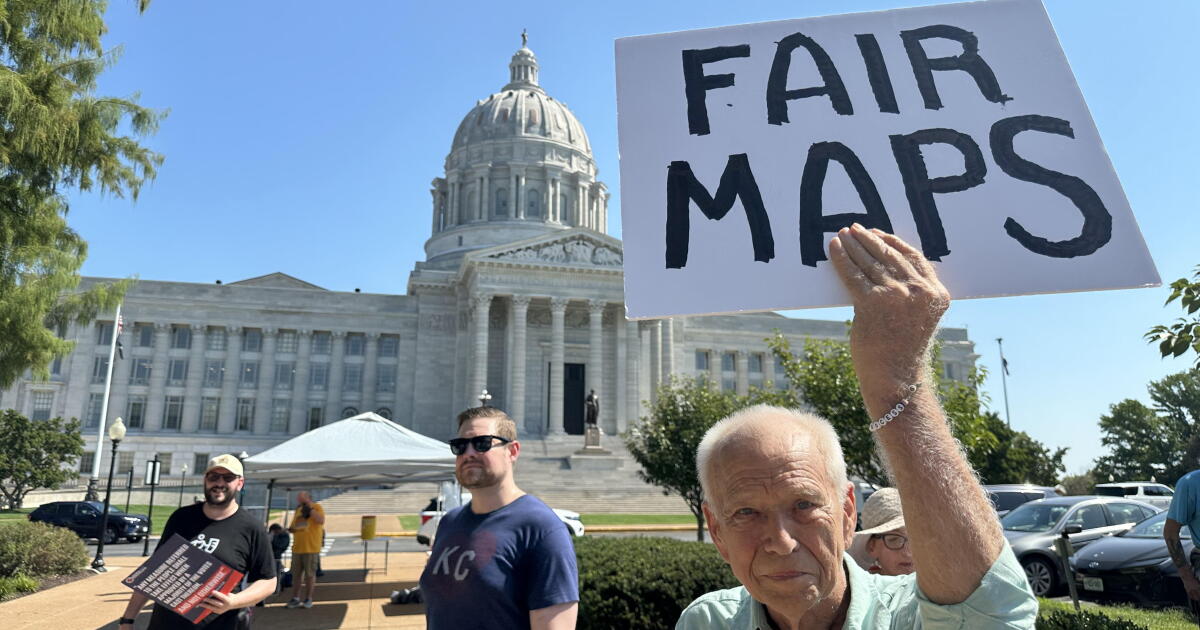
In some states such as Missouri, the mid-decade redistricting has created confusion for voters about which district they live in and which candidates will appear on their November ballot. After conflicting lower court rulings, the U.S. Supreme Court last week blocked new Missouri districts backed by Trump that had been used in the primary, leaving the state to revert to its previous districts for the general election.
The report concludes with a call for new electoral structures the authors believe would eliminate the potential downsides of partisan redistricting, like proportional representation or a formal truce between the parties to implement nonpartisan districting plans.
Nine states already use nonpartisan commissions to draw congressional district lines but those provisions have limits. California, for instance, suspended its nonpartisan maps with a referendum last year in response to Texas’ redistricting measures.
Such remedies would face long odds in Congress and statehouses, but scholars believe there are few other avenues to turn down the temperature in the partisan redistricting fights.
“This is only going to get worse until somebody stops it,” Raderstorf said. “The logic of gerrymandering points inevitably towards maximalist partisan advantage on both sides. There is no off-ramp other than reform. It is the only way to break the cycle.”
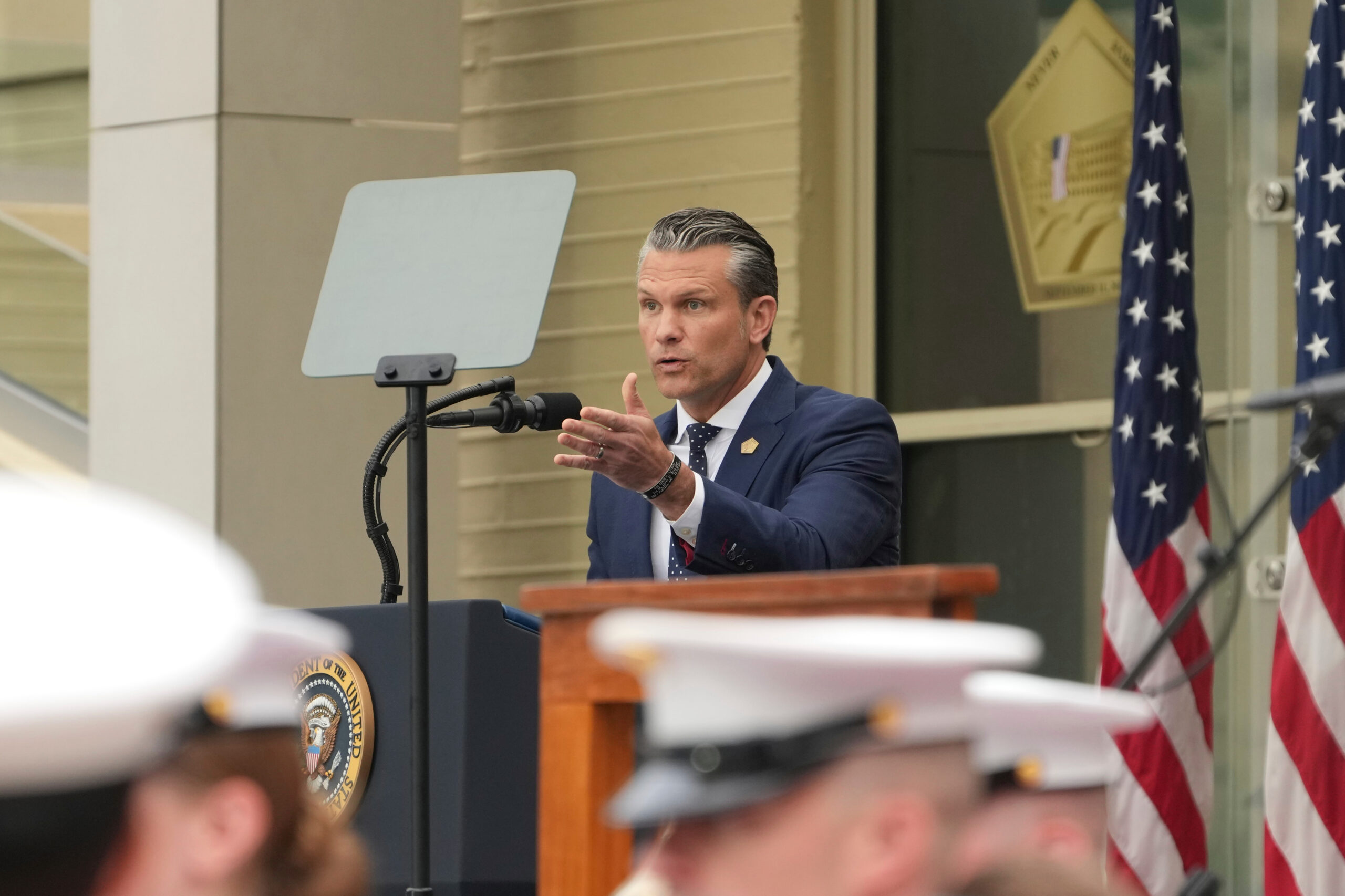
DUBAI: The US House of Representatives has gone into an early recess without voting on a Republican lawmaker’s bid to impeach Defense Secretary Pete Hegseth over the US’ war on Iran.
House Speaker Mike Johnson sent lawmakers home on Wednesday, ending the chamber’s scheduled business a day early and delaying action on a resolution by Republican Rep. Thomas Massie that accuses Hegseth of conducting military operations against Iran without congressional authorization.
The move comes as President Donald Trump said on Wednesday that the seven-month war on Iran was “hopefully” nearing its end and that Tehran wanted to reach a deal.
Trump is also expected to meet GCC leaders on the sidelines of the UN General Assembly in New York, with discussions expected to include the conflict and its aftermath.
Massie, a Kentucky Republican and longtime critic of the administration’s Iran policy, introduced eight articles of impeachment against Hegseth on Tuesday.
He accused the defense secretary of violating the War Powers Resolution by continuing hostilities against Iran without congressional authorization, as well as other alleged abuses of power related to US military operations.
Massie had sought to force a vote in the House within two legislative days. His resolution was therefore left pending after Johnson ended the House’s session early.
Massie condemned the decision, accusing Johnson of avoiding a debate over the US military campaign.
“I’m trying to stop a war,” Massie said from the House floor on Wednesday, while criticizing the speaker for sending lawmakers home.
Johnson defended the House’s record and dismissed Massie’s impeachment effort as a “stunt,” saying the chamber had completed its legislative work.
The early recess also comes after the House voted this week on a separate war powers measure concerning the Iran conflict, with several Republicans joining Democrats in backing efforts to rein in the administration’s military authority.
The House is now expected to return after the November midterm elections, leaving Massie’s impeachment resolution and other pending legislation unresolved.
WASHINGTON — The House approved a resolution Wednesday holding billionaire Leon Black in contempt of Congress, referring the matter to the Department of Justice after he defied the Oversight Committee’s subpoenas in its investigation into disgraced financier Jeffrey Epstein.
The action was swift and without a formal vote, and now leaves it to the Justice Department to decide whether to seek criminal prosecution. Black has refused to respond to the subpoenas’ requests to appear and to turn over any potential nondisclosure agreements involving the investigation into Epstein.
Republicans and Democrats from the Oversight Committee joined in a bipartisan effort to advance the resolution forward.
“No one is above the law,” Rep. James Comer (R-Ky.), the Oversight Committee chairman, said in a statement. “We will continue to seek transparency for the American people and justice for survivors in our investigation of the federal government’s handling of the Jeffrey Epstein and Ghislaine Maxwell criminal cases.”
California Rep. Robert Garcia, the panel’s top Democrat, called the vote “an important step toward justice and accountability.”
Black’s lawyers have denounced the Oversight Committee’s pursuit of the former head of a private equity firm as an abuse of congressional power. They said he “had no knowledge of any of Epstein’s heinous conduct.”
“The Committee has continued to insist on looking for information that does not exist,” attorneys Susan Estrich and Aaron Cutler said in a statement. They called the action “politically motivated” and have sued the committee and asked the Office of Congressional Conduct to open a probe into Comer’s tactics.
“This an outrageous action that ignores the facts and the truth about Mr. Black,” they said.
Epstein investigation churns in Congress
Black is the latest among several prominent figures, including former President Clinton and Bill Gates, who have been asked to appear as part of the Oversight Committee’s long-running probe of Epstein. Survivors of Epstein’s alleged sexual abuse have told personal stories of being young women in a trafficking enterprise organized by Epstein and his colleague Maxwell.
In June, Black did appear for a voluntary interview at the committee. Lawmakers said later that he refused to answer their questions about the nondisclosure agreements.
The committee issued two subpoenas seeking to compel Black to produce the NDAs and to appear for a deposition July 16. The committee said it had accommodated Black’s request to delay the deposition to Sept. 3, but he refused to appear.
On Tuesday the Oversight Committee voted unanimously to approve the contempt recommendation, sending it to the full House.
Black co-founded the private equity firm Apollo Global Management and stepped down in 2021 during the fallout over his ties to Epstein. Lawmakers have alleged that Black paid Epstein $180 million during their years-long relationship.
A 2021 review commissioned by Apollo found that Black paid Epstein $158 million from 2012 to 2017, after Epstein pleaded guilty in 2008 to soliciting prostitution from a minor. The review said the payments were for “bona fide tax, estate planning and other related services.”
DES MOINES, Iowa — Two House Republicans in battleground Iowa districts, including one who recently campaigned alongside Defense Secretary Pete Hegseth, changed their position on an Iran war powers resolution, joining with Democrats and a few other dissident members of their party in an attempt to halt President Trump’s ability to continue military action without congressional approval.
The shift reflects the political pressure on Republicans before midterm elections that will decide control of Congress. The war remains unpopular and has led to soaring fuel prices.
Reps. Zach Nunn and Mariannette Miller-Meeks voted for the resolution with five other Republicans on Tuesday after previously voting against it.
“With the negotiating window closed, sustained combat operations now require congressional authorization,” Nunn, an Air Force veteran, posted on social media. “I will not support another open-ended war.”
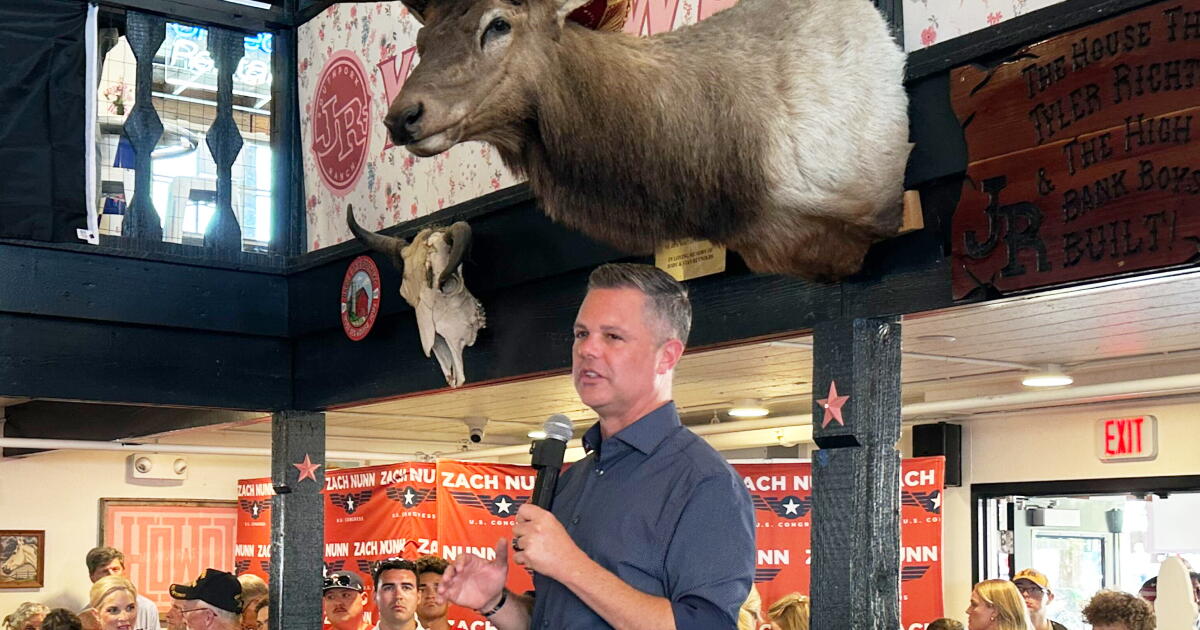
Nunn campaigned with Hegseth last month in Iowa, and the Pentagon chief had lauded Nunn as an ally who didn’t need any last-minute, late-night phone calls from Trump to persuade him to support the president’s agenda.
“Zach Nunn is not a 3 a.m. congressman,” Hegseth said at a fundraiser for Nunn during the Iowa State Fair. “He’s willing to take the tough votes to do the right thing on behalf of our war fighters.”
Nunn is up against Sarah Trone Garriott in November’s election.
Miller-Meeks, an Army veteran, said in a statement the president needs to present a plan to Congress and the public showing how the war ends so “we can focus on bringing our soldiers home and lowering prices.”
“Americans do not want another forever war,” she said. “I will not vote to keep our soldiers in an open-ended war, with Iowans paying too much at the pump.”
She faces a reelection rematch against Christina Bohannan, whom she has defeated twice before.
Eighteen U.S. service members have died in the war with Iran. Two are from Iowa, and one used to live in Iowa.
National polling indicates that the Iran war remains unpopular with Americans overall. Only about 3 in 10 U.S. adults approved of Trump’s handling of Iran in a July AP-NORC poll, and a September New York Times/Siena poll found that most likely voters, about 6 in 10, think Trump’s decision to go to war with Iran was the wrong one.
Tuesday’s House vote was the third time lawmakers voted to end the war in Iran. The margin was similar to earlier efforts, with a few more Republicans joining all Democrats in voting to bring an end to the conflict.
In addition to Nunn and Miller-Meeks, retiring Rep. Nancy Mace of South Carolina joined Republican Reps. Tom Barrett of Michigan, Warren Davidson of Ohio, Brian Fitzpatrick of Pennsylvania and Thomas Massie of Kentucky in voting for the resolution.
Rep. Ashley Hinson, who represents northeast Iowa but is running to replace retiring Sen. Joni Ernst, voted against the resolution.
Republicans have been optimistic that Iowa will remain a red state, but the competitive races have gotten attention even from the White House. Trump visited suburbs of Des Moines in January and dispatched Vice President JD Vance in May to campaign for Nunn.
After Hegseth campaigned with Nunn, a group of over 400 former national security officials filed a complaint asking for an investigation into whether the secretary violated the Hatch Act, which restricts political activities by federal officials.
Hegseth’s office did not immediately respond to a request for comment.
Catalini and Fingerhut write for the Associated Press. Catalini reported from Morrisville, Pa.
WASHINGTON — For a third time, the U.S. House has voted to end the war in Iran, approving a war powers resolution that would halt President Trump’s ability to continue military action without congressional approval.
The roll call late Tuesday, 220-204, was similar to earlier efforts this summer, with a few more Republicans joining all Democrats voting to bring an end to the conflict. None of the resolutions have made it to the president’s desk, where Trump would almost certainly veto the measure.
“Remember when Donald Trump said that this war would last just a few weeks?” said Rep. Seth Moulton, D-Mass., who served as a Marine during the Iraq War and pushed the resolution forward.
He said it’s time for Congress to “actually ask tough questions, as the Constitution directs us to do, rather than be subservient to another warmongering administration.”
Republican Rep. Brian Mast of Florida, the chairman of the House Foreign Affairs Committee, questioned which military resources Democrats would want to remove from the region where he said Iran remains a threat.
Mast said Trump is against “forever wars, and that is what he is ending” — the decades of hostilities from Iran.
“They are a continuous ongoing threat to the United States,” Mast said. “Enough is enough.”
Last war powers vote before the midterms
The action is likely the last House vote on the Iran war ahead of the midterm elections, where the conflict overseas is playing a substantial role in the political campaigns. The war that Trump launched Feb. 28 has dragged, with on-again, off-again deadly missile strikes being exchanged and causing havoc in the region for nearly seven months.
Lawmakers are heading home at the end of the week to campaign nearly full-time, with less than 50 days to go before the elections that will determine control of Congress as Democrats try to wrest power from Republicans.
Voters are confronting high prices, particularly for gas at the pumps, as the conflict disrupts the flow of oil resources through the vital Strait of Hormuz.
The Congressional Budget Office said Tuesday that the war has cost more than $38 billion, as of Aug. 1, and is projected to be costing between $2 billion and $3 billion monthly, depending on the intensity of the fighting. The budget office projected inflation will be 0.5 percentage points higher than expected heading into 2027 due to the war.
Trump himself had promised not to involve the U.S. in foreign wars when he won a second term in the White House, and his actions against Iran are weighing on the Republican Party that controls the House and Senate. Most Americans say the war in Iran has not been worth fighting, according to an AP-NORC poll in July.
In the previous House actions, four Republicans voted to halt the war in Iran, but that number rose to seven in Tuesday’s war powers vote, including GOP lawmakers from battleground Iowa, Rep. Zachary Nunn and Rep. Mariannette Miller-Meeks, and retiring Rep. Nancy Mace of South Carolina.
They joined GOP Reps. Tom Barrett of Michigan, Warren Davidson of Ohio, Brian Fitzpatrick of Pennsylvania and Rep. Thomas Massie of Kentucky voting in favor of the war powers resolution, with all Democrats.
War powers being put to the test
Congress has tried repeatedly to alter the trajectory of the war against Iran, but efforts to limit the Trump administration’s military action remain a longshot so long as the president is able to fend off or veto the measures.
The House first approved a war powers resolution in June, and followed up with another one in July, all seeking to halt U.S. action in Iran. The Senate on its 10th try also approved a war powers resolution to end the conflict, but GOP senators quickly reversed course the next day after Trump berated them during a closed-door lunch.
While the Constitution gives Congress the authority to declare war, it also gives the president authority as the commander in chief to engage in some military actions. The War Powers Act, created in the aftermath of the Vietnam conflict, sought to put a more specific time limit on the president’s power, requiring congressional approval for sustained military actions after 60 or 90 days.
House Speaker Mike Johnson acknowledged at a press conference Tuesday the need to bring gas prices down.
But the Republican speaker said he believes the Iran conflict is entering a “new phase” as allies step up to help stabilize the region. When that happens, he said, “you’re going to see, as the president said, anytime gas prices will go down again, the cost of groceries will as well.”
Johnson said Trump expects the shift after the election, and the speaker added, “I’d love it to happen today.”
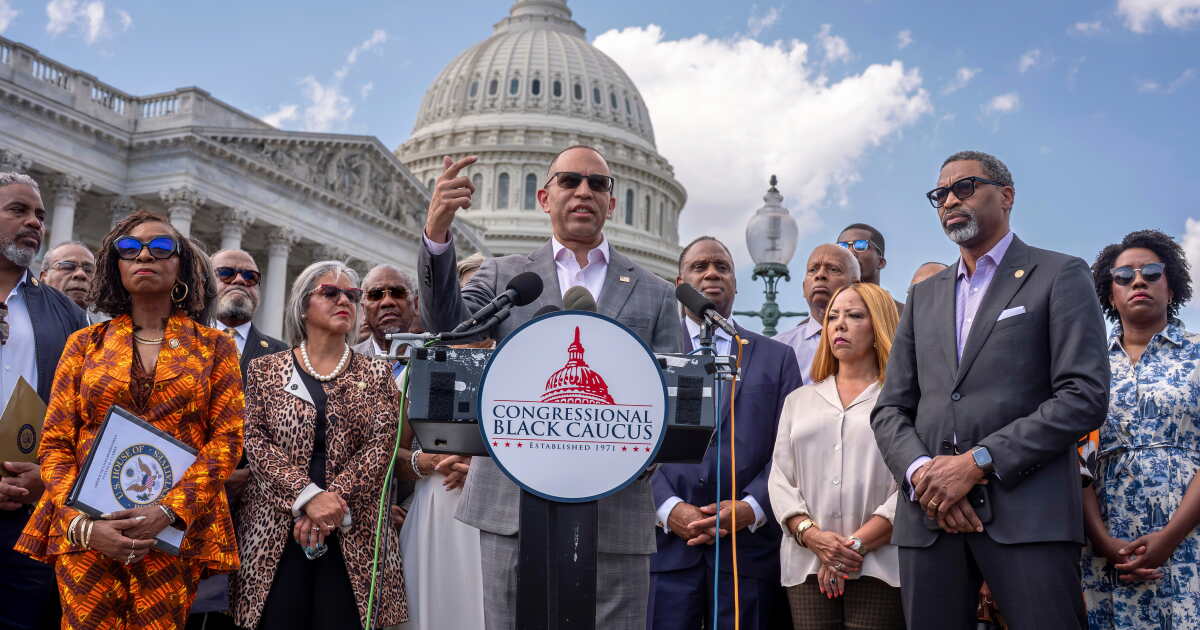
WASHINGTON — A nonprofit run by Black federal lawmakers launched a multimillion-dollar effort Tuesday to engage lower-propensity voters in key districts in the midterm elections, following years of dissatisfaction over traditional efforts to reach such voters.
The Congressional Black Caucus Institute’s “SO VOTE” campaign will seek to register and mobilize young voters, as well as voters in majority-Black and rural communities, across the South, Midwest and West. The campaign involves partnerships with dozens of local organizations, the institute said, with in-person and online outreach to voters often sidestepped by major political campaigns.
“For decades, as far as I can remember, there are those of us who have always complained about the fact that neither party spends the significant and requisite time with Black and brown and poor and rural communities,” said Marcia Fudge, a former Democratic congresswoman from Ohio who served as the secretary of Housing and Urban Development during the Biden administration.
“So we finally decided to take it upon ourselves to do something that we didn’t think anybody else in the industry was doing,” said Fudge, who is spearheading the new effort alongside former Black Caucus colleagues.
Effort blends old tactics with new technologies to boost turnout
Voter engagement efforts will cover outreach across Georgia and Mississippi, as well as target voters in 16 congressional districts that are likely to determine control of the House.
Instead of traditional television advertising, the campaign will convene local civic groups and houses of worship, as well as fraternities and sororities. The effort will also use some now-widespread techniques in political campaigns, such as geotargeting online ads and partnerships with local content creators for audiences who mainly receive their news online.
While the voter engagement efforts are officially nonpartisan, the Black Caucus’ targeted races are in many regions where Black voter turnout could prove key to whether a Democratic candidate prevails in closely divided House districts. Cedric Richmond, a former Louisiana Democratic congressman who served as a senior adviser to President Joe Biden, said the effort would focus on repeatedly engaging voters in rural communities who feel alienated from Democratic campaigns.
“If you’re not happy with the way things are going, then voting is part of the solution, but it takes constant communication,” Richmond said.
The Black Caucus’ institute has raised about $1 million for the campaign, primarily from individual donors, and plans to spend at least $4.5 million in the midterm election cycle.
Campaign responds to GOP redistricting and disappointing turnout in the past
The new outreach effort follows years of disappointment and frustration among some in the Black Caucus at the broader Democratic Party’s efforts to court Black, rural and younger voters.
Rep. Jim Clyburn, an influential South Carolina Democrat who decried the lackluster voter turnout in the 2024 election, said the campaign “allows us to put to practice that which we have been proposing, and we have never had the resources to do it. But this year we do.”
The effort is also a response to Republican-led redistricting efforts in multiple states, said Rep. Bennie Thompson, a Mississippi Democrat.
“These Southern states are trying to minimize Black political participation and ultimately Black political strength,” he said. “So what we have to do is take that low-propensity voter and elevate their participation so they become an additional voice to be reckoned with.”
For a third time, the US House approved a war powers resolution, halting Trump’s ability to continue military action.
For a third time, the US House has voted to end the war in Iran, approving a war powers resolution that would halt President Donald Trump’s ability to continue military action without congressional approval.
The roll call late Tuesday, 220-204, was similar to earlier efforts this summer, with a few more Republicans joining all Democrats voting to bring an end to the conflict.
Seven House Republicans backed the resolution, including three voting in favour for the first time.
Iowa congressman Zach Nunn, a Republican, explained his vote saying that “with the negotiating window closed, sustained combat operations now require congressional authorization.”
“I will not support another open-ended war,” Nunn said.
None of the resolutions has made it to the president’s desk, where Trump would almost certainly veto the measure.
Republican Representative Brian Mast of Florida, the chairman of the House Foreign Affairs Committee, questioned which military resources Democrats would want to remove from the region where he said Iran remains a threat.
Mast said Trump is against “forever wars, and that is what he is ending” – the decades of hostilities from Iran.
“They are a continuous ongoing threat to the United States,” Mast said. “Enough is enough.”
The run-up to the midterms
The action is likely to be the last House vote on the Iran war ahead of the midterm elections, where the conflict overseas is playing a substantial role in the political campaigns. The war that Trump launched on February 28 has dragged on, with on-again, off-again deadly missile strikes being exchanged and causing havoc in the region for nearly seven months.
Lawmakers are heading home at the end of the week to campaign nearly full-time, with fewer than 50 days to go before the elections that will determine control of Congress as Democrats try to wrest power from Republicans.
US war on Iran
The US war on Iran is worsening inflation and straining the country’s munitions stockpiles, a report from the nonpartisan Congressional Budget Office (CBO) has found.
The report, released on Tuesday, found that the cost of the six-month war has reached $38bn and is expected to rise by $3bn per month. The war is projected to increase inflation by 0.5 percentage points in the first three months of 2027.
Trump himself had promised not to involve the US in foreign wars when he won a second term in the White House, and his actions against Iran are weighing on the Republican Party that controls the House and Senate.
Most Americans say the war in Iran has not been worth fighting, according to an AP-NORC poll in July.
Previous war resolutions
Congress has tried repeatedly to alter the trajectory of the war against Iran, but efforts to limit the Trump administration’s military action remain a long shot so long as the president can fend off or veto the measures.
The House first approved a war powers resolution in June, and followed up with another one in July, both seeking to halt US action in Iran. The Senate on its 10th try also approved a war powers resolution to end the conflict, but Republican senators quickly reversed course the next day after Trump berated them during a closed-door lunch.
While the Constitution gives Congress the authority to declare war, it also gives the president authority as the commander-in-chief to engage in some military actions. The War Powers Act, created after the Vietnam conflict, sought to impose a more specific time limit on the president’s power, requiring congressional approval for sustained military actions after 60 or 90 days.
WASHINGTON: For a third time, the US House has voted to end the war in Iran, approving a war powers resolution that would halt President Donald Trump’s ability to continue military action without congressional approval.
The roll call late Tuesday, 220-204, was similar to earlier efforts this summer, with a few more Republicans joining all Democrats voting to bring an end to the conflict. None of the resolutions have made it to the president’s desk, where Trump would almost certainly veto the measure.
“Remember when Donald Trump said that this war would last just a few weeks?” said Rep. Seth Moulton, D-Mass., who served as a Marine during the Iraq War and pushed the resolution forward.
He said it’s time for Congress to “actually ask tough questions, as the Constitution directs us to do, rather than be subservient to another warmongering administration.”
Republican Rep. Brian Mast of Florida, the chairman of the House Foreign Affairs Committee, questioned which military resources Democrats would want to remove from the region where he said Iran remains a threat.
Mast said Trump is against “forever wars, and that is what he is ending” — the decades of hostilities from Iran.
“They are a continuous ongoing threat to the United States,” Mast said. “Enough is enough.”
Last war powers vote before the midterms
The action is likely the last House vote on the Iran war ahead of the midterm elections, where the conflict overseas is playing a substantial role in the political campaigns. The war that Trump launched Feb. 28 has dragged, with on-again, off-again deadly missile strikes being exchanged and causing havoc in the region for nearly seven months.
Lawmakers are heading home at the end of the week to campaign nearly full-time, with less than 50 days to go before the elections that will determine control of Congress as Democrats try to wrest power from Republicans.
Voters are confronting high prices, particularly for gas at the pumps, as the conflict disrupts the flow of oil resources through the vital Strait of Hormuz.
The Congressional Budget Office said Tuesday that the war has cost more than $38 billion, as of Aug. 1, and is projected to be costing between $2 billion and $3 billion monthly, depending on the intensity of the fighting. The budget office projected inflation will be 0.5 percentage points higher than expected heading into 2027 due to the war.
Trump himself had promised not to involve the U.S. in foreign wars when he won a second term in the White House, and his actions against Iran are weighing on the Republican Party that controls the House and Senate. Most Americans say the war in Iran has not been worth fighting, according to an AP-NORC poll in July.
In the previous House actions, four Republicans voted to halt the war in Iran, but that number rose to seven in Tuesday’s war powers vote, including GOP lawmakers from battleground Iowa, Rep. Zachary Nunn and Rep. Mariannette Miller-Meeks, and retiring Rep. Nancy Mace of South Carolina.
They joined GOP Reps. Tom Barrett of Michigan, Warren Davidson of Ohio, Brian Fitzpatrick of Pennsylvania and Rep. Thomas Massie of Kentucky voting in favor of the war powers resolution, with all Democrats.
War powers being put to the test
Congress has tried repeatedly to alter the trajectory of the war against Iran, but efforts to limit the Trump administration’s military action remain a longshot so long as the president is able to fend off or veto the measures.
The House first approved a war powers resolution in June, and followed up with another one in July, all seeking to halt U.S. action in Iran. The Senate on its 10th try also approved a war powers resolution to end the conflict, but GOP senators quickly reversed course the next day after Trump berated them during a closed-door lunch.
While the Constitution gives Congress the authority to declare war, it also gives the president authority as the commander in chief to engage in some military actions. The War Powers Act, created in the aftermath of the Vietnam conflict, sought to put a more specific time limit on the president’s power, requiring congressional approval for sustained military actions after 60 or 90 days.
House Speaker Mike Johnson acknowledged at a press conference Tuesday the need to bring gas prices down.
But the Republican speaker said he believes the Iran conflict is entering a “new phase” as allies step up to help stabilize the region. When that happens, he said, “you’re going to see, as the president said, anytime gas prices will go down again, the cost of groceries will as well.”
Johnson said Trump expects the shift after the election, and the speaker added, “I’d love it to happen today.”
ITV will air some dramatic scenes on Big Brother just a couple of days into the series
Frankie struggled to hold back the tears(Image: ITV)
The emotions are already too much for some housemates.
One Big Brother star broke down in tears as they spoke about the real reason they have joined up for the ITV reality series. Chaos is also set to erupt in dramatic scenes airing tonight (September 15).
Fans have been teased about what to expect in the upcoming episode. It comes as more than a dozen new housemates moved into the famous residence to spend up to eight weeks as part of the unique social experiment.
However, despite being in there for less than 48 hours, it is clearly proving too much for some. The first morning in the house has already seen one star break down in tears.
Viewers tuning in will see Frankie, Johanne and Pauline are in the bathroom during a cryptic conversation. Frankie said: “I ain’t slept one bit. I feel like I went from a really big high to a really big low last night. Quick and all, the turnaround was weird. I went from high to straight low…”
Pauline asked: “But what caused that though?” Frankie hinted: “Oh, to be fair, like, I’ve come on here for various reasons. I know why, I need to get that sorted. Once that’s sorted…”
Johanne responded: “You’re so top secret with that. Everybody when you ask them like why did you come on it’s just like simple answer.”
Frankie explained: “Do you know what it is, I don’t want to… like I’ll be honest, I come on cause I was like… I don’t want to get upset though man.”
Try ITVX Premium free for a week
This article contains affiliate links, we will receive a commission on any sales we generate from it. Learn more
ITVX Premium offers exclusive ad-free content that can be streamed on-demand and on the go, with everything from Hollywood blockbusters to bingeable British box sets.
An annual plan costs £59.99 – equal to £4.99 per month – after a seven-day free trial.
Johanne said: “Your answer, it must be very complicated… You okay?” Frankie then struggled to hold back tears and puts his hand to his face, as he wiped his eyes.
Looking on, Pauline said: “Oh gosh.” They both asked if he is ok as Pauline reassuringly told him: “Frankie don’t. If you don’t want to disclose it, you don’t have to, you know.”
While Johanne offered: “Or if you need to disclose it and you need someone to talk to, you can.” It’s not yet known if Frankie does reveal the truth behind his motives but he confessed: “I knew it was gonna hit me but I didn’t think it’d hit me early. It’s hit me straight away…”
He also stated: “It has to be done, I have to face myself. I can’t run forever, do you know what I mean?” Meanwhile, later in the house there is a heated exchange between Johanne and Rochelle.
While some housemates attempted to play a game, it went too far. As part of it, Charlotte asked Johanne: “Who annoys you the most?”
Johanne replied: “Rochelle. It’s gonna be the same thing. She asked me who annoys me the most and I said Rochelle. I mean every answer, who do I like least, who annoys me the most. It’s gonna be her.”
Rochelle quipped: “Ditto… You’ve got a real f****** problem. You’ve only been here one day.” To which Johanne retorted and repeated the phrase: “You’re my f****** problem.” The argument continued and resulted in some of their fellow housemates stepping in to try and calm the situation.
Big Brother continues tonight at 9pm on ITV2 and streaming on ITVX.
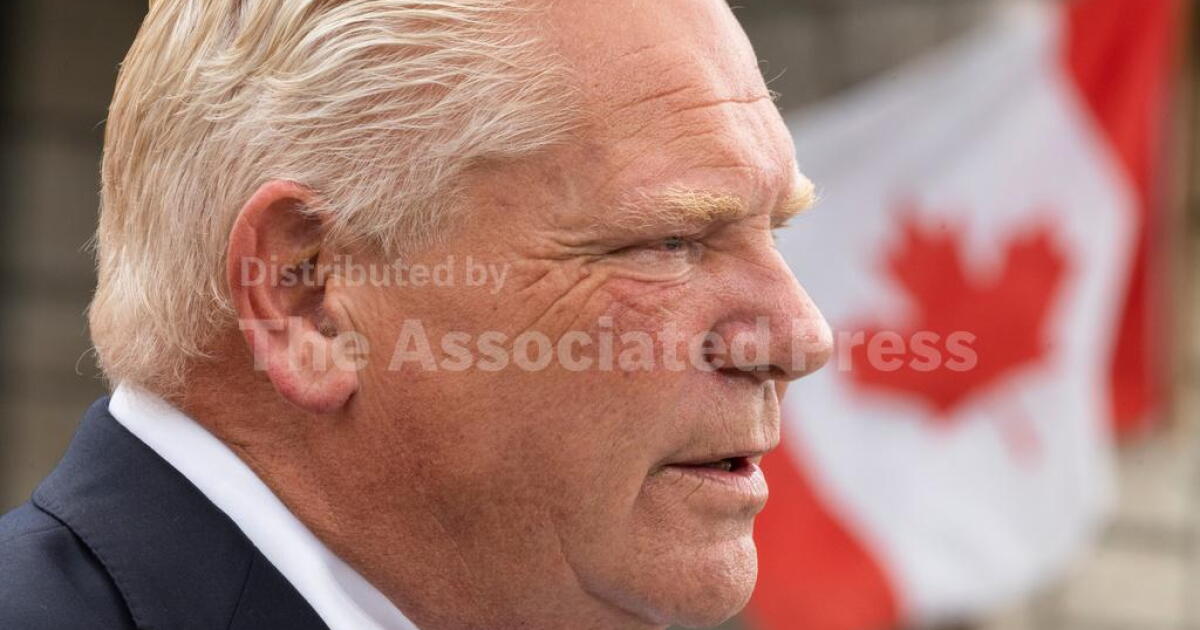
TORONTO — Ontario Premier Doug Ford said Thursday he hopes President Trump’s Republicans lose both the House and Senate in the midterm elections, saying voters should punish Trump politically for his escalating trade war with Canada.
“Hopefully he’s going to lose the Senate. He’s going to lose Congress. I hope so, and hold him accountable,” Ford said. “But we’ll see how that goes. We aren’t going to interfere in the U.S. election.”
Ford has emerged as one of Trump’s most outspoken Canadian critics, accusing him of trying to strip industry out of Ontario and move it south of the border as the two trade personal insults and threats.
Ford’s comments came two days after Washington escalated the dispute by banning some Canadian dairy products and motorcycles and most alcoholic beverages after Canadian retaliatory tariffs took effect on about $20 billion in U.S. goods. Trump also moved to shut Canadian products out of large, long-term U.S. government contracts.
“He’s not reliable at all,” Ford said. “He could make a deal today and then change his mind. And we’ve seen that over and over again.”
Still, Ford said he believes Trump wants an agreement before the midterms and that Canada should return to negotiations as soon as possible.
“I truly believe President Trump wants a deal before the midterms,” Ford said. “I could be wrong, but I think it’s best that we sit down and get a deal.”
Last year, Trump abruptly ended trade talks with Canada after Ford’s Ontario government aired an anti-tariff television ad in the United States using former President Ronald Reagan’s criticism of tariffs.
The feud repeatedly has turned personal. In an interview with the Associated Press last month, Ford mocked Trump for keeping a portrait of Reagan near his desk while pursuing tariffs the former president had criticized, saying Reagan would be “throwing up on him from the picture if he knew what was going on.”
Trump described him as “the less charismatic, intelligent, and overall unimpressive brother of the late, great, Rob Ford.”
Trump also signed an executive order directing the U.S. government to refer to Lake Ontario as “Lake America,” a name Canada does not recognize.
Ford said Thursday that Trump unintentionally strengthened Canada by forcing it to reduce its dependence on the United States.
“The only two good things Donald Trump has ever done for Canada,” Ford said, were that “he woke us up” and “he united the country like I’ve never seen before.”