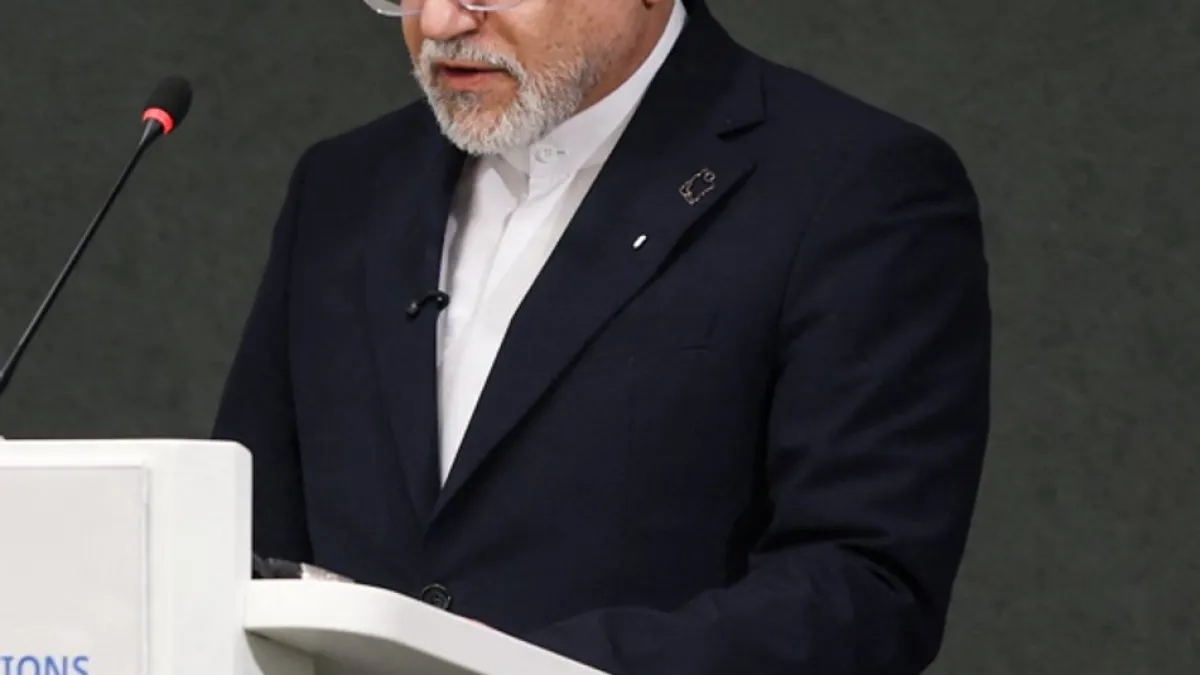
Iran’s Foreign Ministry says reopening the strait has been its main goal, while the US continues to focus on nuclear talks.
Published On 4 Oct 20264 Oct 2026
The Strait of Hormuz is going to remain closed until the United States accepts Tehran’s seven-day plan to reopen the waterway, Iran’s top negotiator and parliament speaker has said.
Iranian state-linked news agency Nournews, quoting Mohammad Bagher Ghalibaf, reported on Sunday that Washington made “some proposals through a mediator” days after the US replied to Iran’s diplomatic proposal.
Recommended Stories
list of 4 itemsend of list
The US should know “that the era of wasting time and dictating unilateral demands is over”, Ghalibaf said, adding Iran’s position remains “clear and definite”.
He emphasised that “the Strait of Hormuz will not open until our seven conditions based on the Islamabad memorandum are met”, and that Iran is “present on the military battlefield and will confront them with new surprises”.
He added that Iran was neither “excited” nor “intimidated” by the latest US proposals and would “both fight and negotiate”.
US President Donald Trump ruled out an Iranian proposal to reopen the Strait of Hormuz last week, hours after Iran put forward a roadmap to reopening the strait, through which one-fifth of global oil and natural gas is shipped during peacetime.
Last month, Trump threatened to “annihilate” Iran in his speech on the floor of the United Nations General Assembly (UNGA).
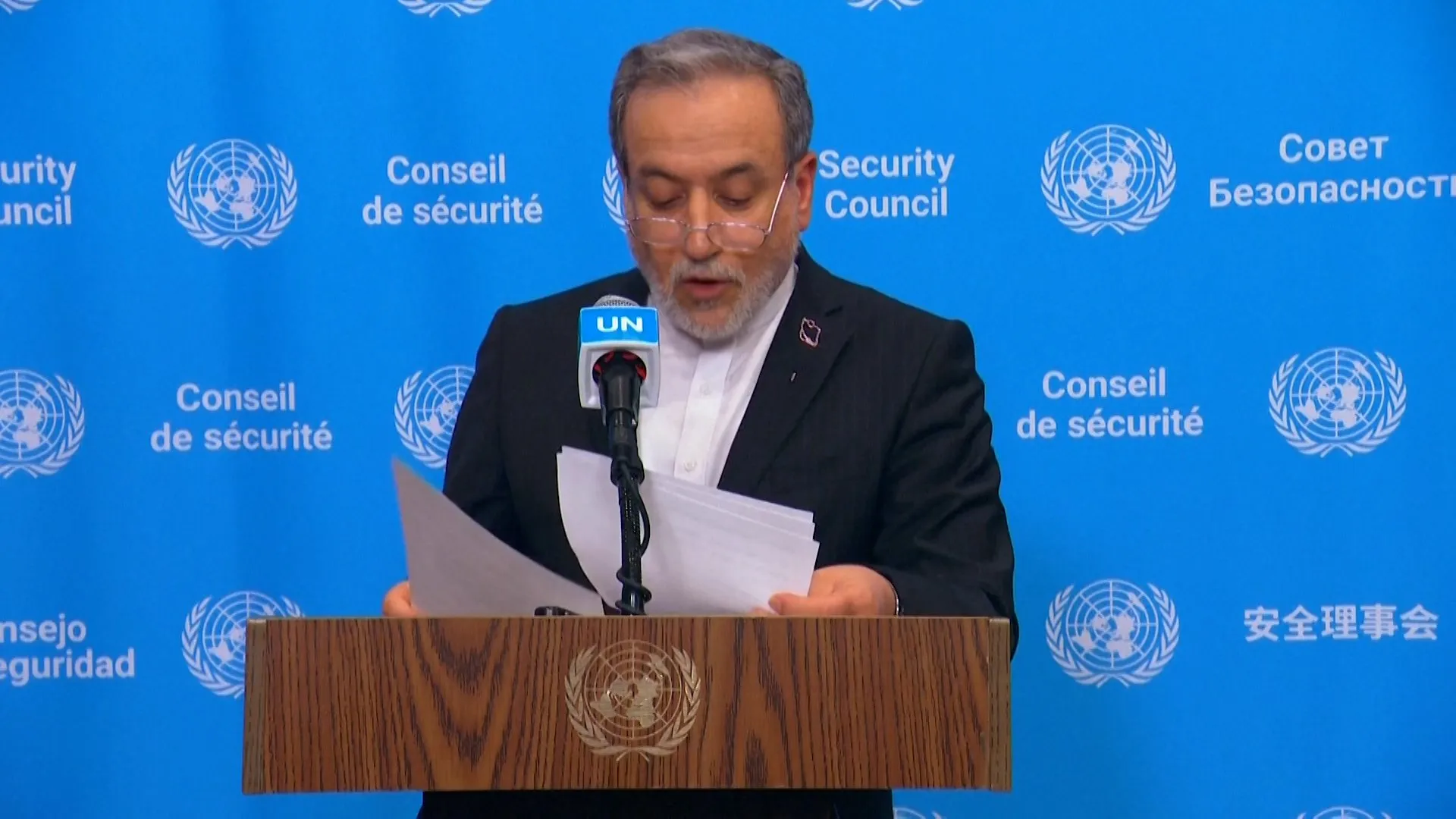
On Sunday, Iranian Foreign Minister Abbas Araghchi also said Iran is “serious about finding diplomatic solutions just as we are serious about defending ourselves”.
Speaking to foreign ambassadors and diplomats in Tehran, Araghchi said Iran had clearly explained its conditions for reopening the strait and that Tehran hoped Washington would choose diplomacy and accept its proposal.
However, Araghchi warned that if the US takes military action again, Iran is “more prepared than before and will take whatever action is necessary to defend ourselves”.
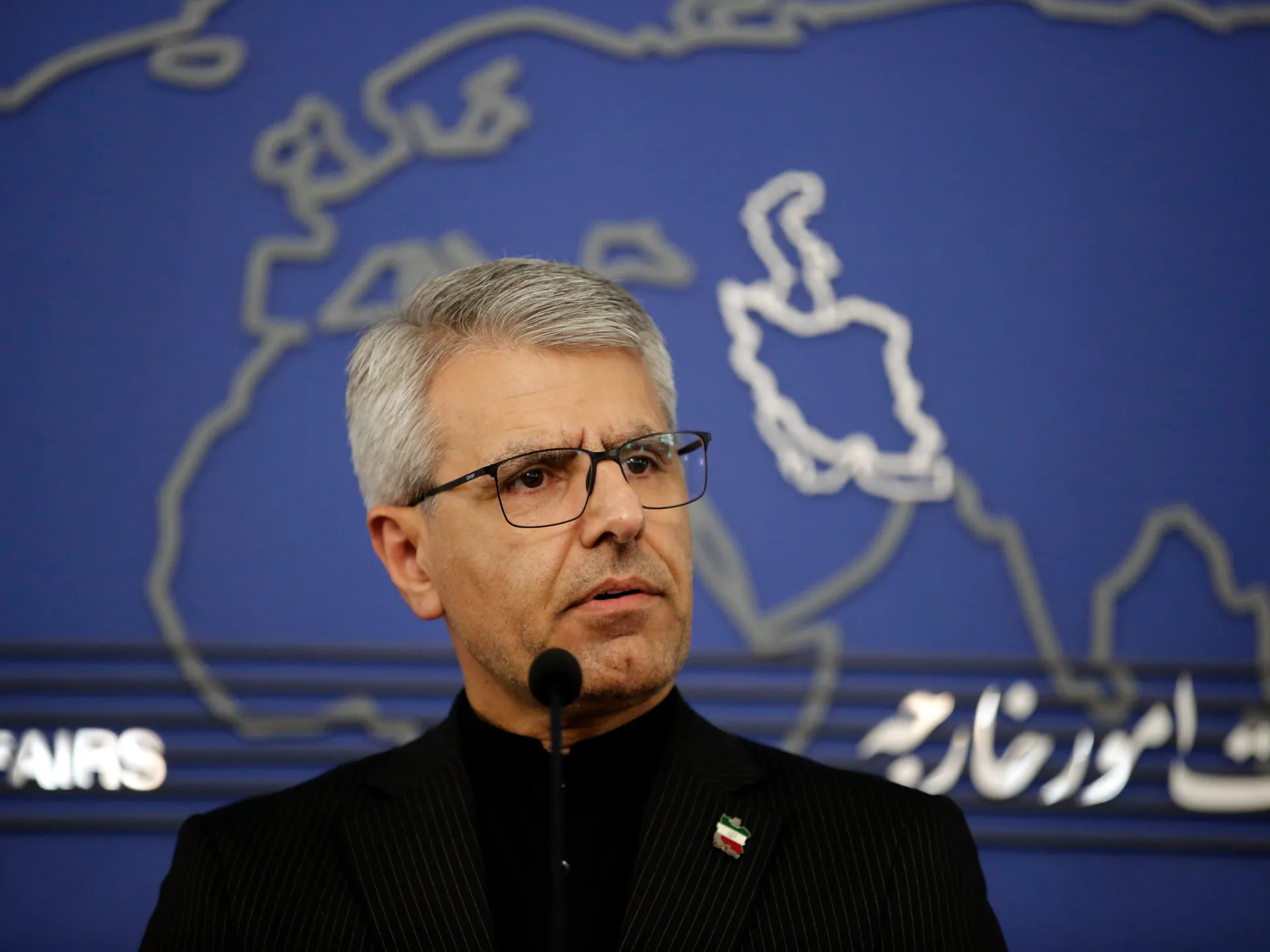
Iranian Ministry of Foreign Affairs spokesman Esmaeil Baghaei added that Tehran used the UNGA platform last month to provide world leaders with its position on ending the US-Israel war on Iran.
He said the US has continued to focus on nuclear talks, while reopening the strait has been Iran’s main goal.
“We are at this stage mainly focusing on the strait, and our principal concern is to reach a solution and to have peace and stability restored within this waterway,” Baghaei said.
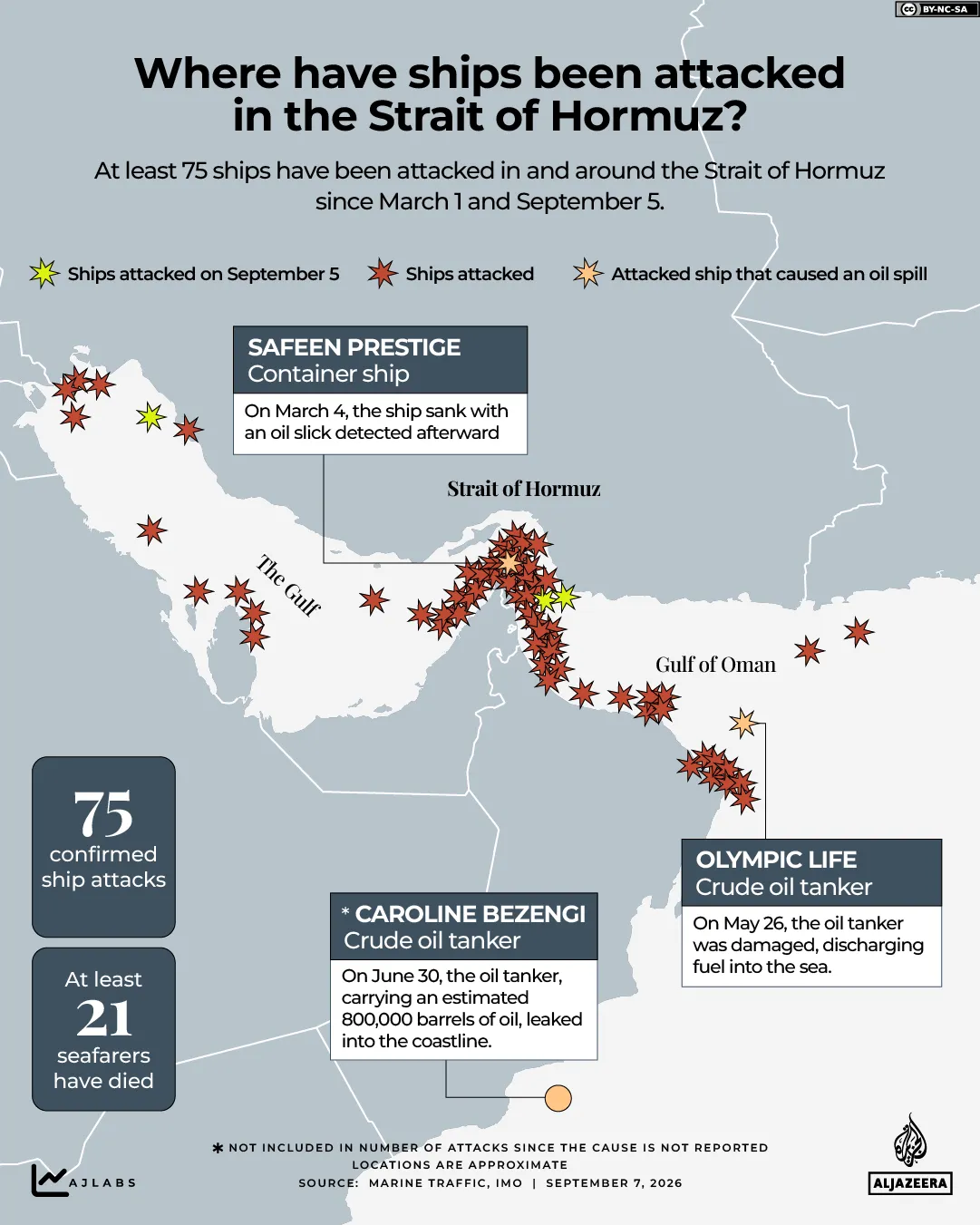
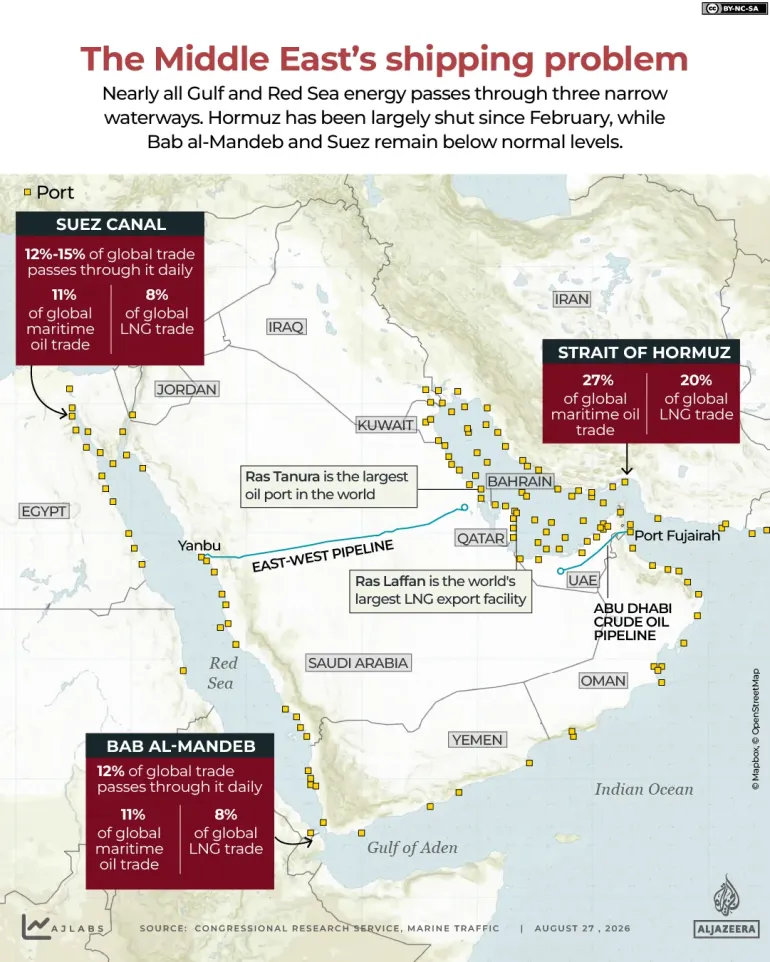
The Strait of Hormuz has been largely blocked and disrupted for more than seven months, since the US and Israel launched strikes on Iran on February 28, driving one of the worst maritime shipping disruptions in decades.
About one-fifth of global oil and natural gas is shipped through the Strait of Hormuz during peacetime, as the US-Israel war on Iran has created several trade chokepoints [File: Al Jazeera]
As Iran and the United States work with mediators to end seven months of hostilities, the reality in the Strait of Hormuz is shifting in ways that could prove to be a game-changer in ongoing negotiations.
According to the latest data from tanker-tracker websites, traffic through the key waterway has been steadily increasing, with some estimates putting oil and petroleum flow through the Strait of Hormuz at nearly 80 percent of what it was before the US-Israeli war on Iran began on February 28.
Recommended Stories
list of 3 itemsend of list
This could dent Iran’s leverage in reaching a favourable deal for itself in its attempts to end the fighting, which has seriously hampered its already heavily sanctioned economy, amid the US blockade of Iranian ships and ports.
Despite that, experts believe it would be a mistake to think normality in the Strait of Hormuz is imminent, or that Iran will fold easily despite growing economic hardship.
“The fact that oil is getting through the Strait of Hormuz is encouraging, but flows are not yet regarded as completely secure or guaranteed, particularly while the wider conflict remains unresolved,” Susannah Streeter, chief investment strategist at Wealth Club, told Al Jazeera.
Moreover, oil prices remain high globally, including in the US, where President Donald Trump faces a crucial midterm election that could see his party swept away in both houses of Congress.
Tanker insurance costs also remain elevated and energy flows through Hormuz are still far from secure, suggesting Iran’s leverage may be weakening rather than disappearing.
Oil flows through Hormuz recovering
The latest data from commodity analytics firm Kpler points to a significant recovery in oil exports from the Middle East.
Crude exports reached an estimated 16.328 million barrels per day (bpd) in September – their highest level since the war began in late February, the firm reported this week.
Flows through the Strait of Hormuz itself were expected to reach about 9.719 million bpd during the month. Saudi Arabia has driven much of the increase, with its exports rebounding from 2.446 million bpd in August to about 5.4 million bpd in September.
Kpler said Middle East crude exports have recovered to just under 80 percent of their pre-war level. But the figures remain about 3.2 million bpd below the 19.513 million bpd exported in February.
The data also does not include ships crossing Hormuz with their tracking systems switched off, meaning actual traffic could be higher.
Prior to the war, an estimated 120-140 vessels crossed through the waterway daily, roughly half of them oil tankers moving approximately 20 million barrels per day. At the height of the fighting, traffic through the waterway collapsed to as few as two tankers a day after Iran in effect closed the strait in retaliation for US-Israeli attacks.
Is Iran losing leverage?
The rebound in oil flow presents a challenge for Tehran. Iran has sought to use its ability to disrupt the Strait of Hormuz – one of the world’s most important energy chokepoints – as leverage against Washington’s military and economic pressure.
But if large volumes of oil can continue moving through the strait while Iran itself remains under a US naval blockade, Tehran’s bargaining power could diminish.
Iran, however, rejects any assessment that its control over the strait is slipping.
Islamic Revolutionary Guard Corps spokesperson Hossein Mohebbi on Tuesday said the ability of vessels to transit the waterway with US assistance did not mean Hormuz had returned to normal.
Oil prices are another indication that Iran has not lost all of its leverage.
Villagers stand near plastic containers at a fuel station to fill their water pumps, as India faces rising oil prices, in Halvad, Gujarat, India [File: Amit Dave/Reuters]
Brent crude fell 2.6 percent to $102.59 a barrel on Tuesday as traders focused on recovering Middle East exports. But it was still heading for a roughly 13 percent gain in September.
Chris Beauchamp, an analyst at IG, said markets were beginning to incorporate evidence of recovering flows but remained wary about how durable that recovery would be.
“It takes time for evidence to filter through to markets,” Beauchamp said. “Oil prices came off yesterday as the narrative began to take hold, and should continue to fall.”
But he said concerns persisted over whether the US protection system could withstand a renewed barrage of Iranian missiles and drones.
Streeter of Wealth Club said the market still had a geopolitical risk premium built into crude prices, despite the improving flows.
“Insurance costs for tankers also remain elevated because of the perceived risks of operating in the region, adding to the cost of transporting crude even as more ships make it through the waterway,” she said.
Moreover, Streeter warned that crude figures tell only part of the story. Flows of refined fuels, particularly diesel and gasoline, remain constrained, while damage to infrastructure has placed additional pressure on energy supply chains, she added.
There is another vulnerability, the investment strategist pointed out. Countries including the US have relied heavily on strategic oil reserves to cushion the impact of the disruption and help contain prices.
“With those stockpiles now significantly depleted, there is a thinner buffer if there is another disruption, which is helping to keep a floor under crude prices,” Streeter added.
‘Economic war’ on Iran
There is little doubt that economic pressure on Iran is intensifying, potentially increasing Tehran’s incentive to reach an agreement.
Official data from the Statistical Center of Iran earlier this month showed gross domestic product (GDP) contracting 10.1 percent year on year between March 21 and June 20, while the crucial oil and gas sector shrank 26.4 percent.
Iran has also been battling high inflation and a plunging currency as the US blockade constrains oil exports and foreign currency earnings.
Twelve-month average inflation reached 69.9 percent earlier in September, while the rial had fallen beyond 2.2 million to the US dollar in early September.
People shop at Tajrish Bazaar in northern Tehran, Iran [File: Abedin Taherkenareh/EPA]
In August, the US announced a fresh economic pressure campaign against Iran, promising to target Tehran’s financial interests across the world.
Mohammad Eslami, a research fellow at the University of Tehran, told Al Jazeera that Iran was facing an “economic war” alongside the military conflict.
“There is a US blockade of the Strait of Hormuz, which affects Iran’s revenues from oil exports and other products such as petrochemicals, which are important to Iran’s economy,” Eslami said. “As a result, Iran’s dollar revenues have been affected by the blockade.”
But he cautioned against judging Iran’s economy solely through the value of its currency.
“The exchange rate is a very important indicator, but it is not the only measure for explaining what is happening or the difficulties and challenges facing Iran’s economy,” Eslami said, adding that Iran has faced US economic pressure for “five decades”.
Can a deal be reached?
Despite the military and economic pressure, negotiations have not collapsed.
At the United Nations General Assembly last week, Tehran and Washington engaged in three hours of indirect talks, as US special envoys Steve Witkoff and Jared Kushner met with Iranian Foreign Minister Abbas Araghchi.
President Trump later described the encounter as “very good” and “very productive.”
Iran also proposed a seven-day roadmap under which the Strait of Hormuz could be reopened and normal maritime traffic restored if Washington meets Tehran’s conditions, a plan Trump categorically rejected.
Those conditions included ending the naval blockade on Iran, easing sanctions and releasing frozen Iranian funds.
However, on Wednesday, Reuters news agency reported that Araghchi had received US feedback on the proposal through Qatari mediators.
An official briefed on the talks said the main disagreement now centred on the sequencing of measures rather than the components of the plan.
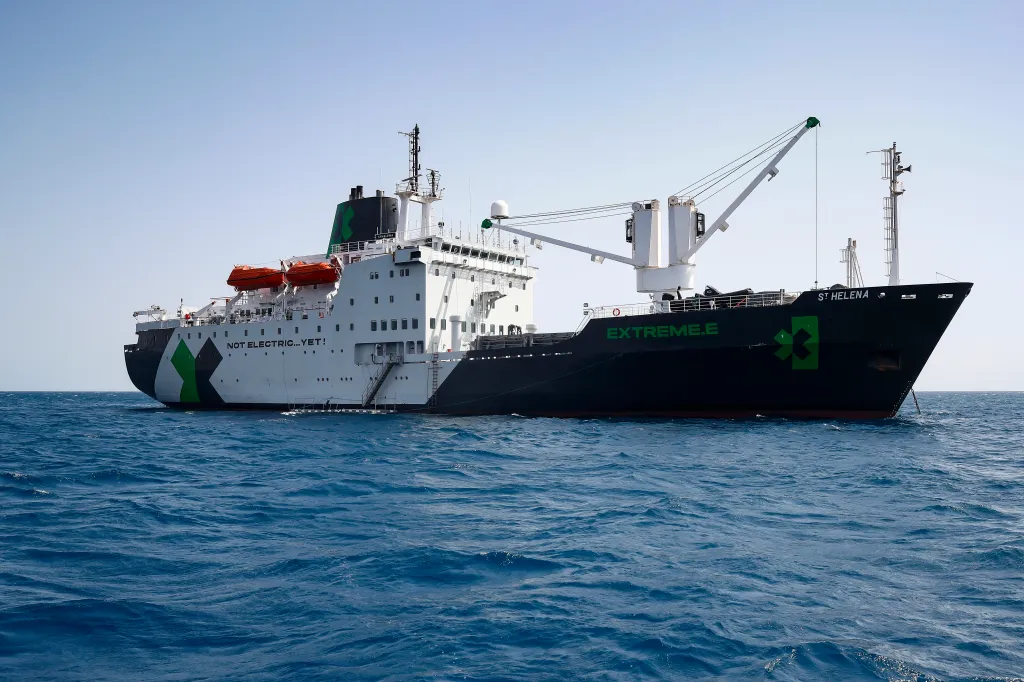
On Sunday, NBC News reported that Marines were injured during an Iranian cruise missile attack while transiting the Strait of Hormuz on Sept. 14. The network’s sources said the Marines were not on a U.S. Navy ship, but they did not identify which vessel they were on. However, a former Royal Mail vessel that at one point was being converted into a floating armory stands out as a strong possibility.
While much remains unclear about the Sept. 14 incident, there was only one vessel known to have been struck that day, according to the United Kingdom Maritime Trade Operations (UKMTO) and a maritime security official we spoke with. The ship was eventually identified by several maritime media outlets as the M/V St. Helena. Again, the St. Helena’s involvement remains unconfirmed, but the ship’s interesting background is of particular note.
The St Helena logistics ship during the Saudi Arabia on March 30, 2021. Photo by Colin McMaster
“Eight U.S. Marines were injured two weeks ago when an Iranian cruise missile attacked the ship they were operating on in the Strait of Hormuz,” NBC reported, citing three U.S. officials. “The Marines were not seriously injured, but they sustained smoke inhalation and possibly traumatic brain injuries, as they had symptoms of concussions, such as headaches, the officials said.”
“The Marines, seven of them enlisted and one officer, all returned to duty soon after the Sept. 14 attack, the U.S. officials said,” according to the network. “The officials said the Marines were operating as part of a battalion landing team during the Iranian anti-ship cruise missile attack.”
TWZ cannot independently confirm that Marines were on board the St. Helena or that they were injured. We reached out to the Pentagon and U.S. Central Command (CENTCOM) for more information. The Pentagon referred us to CENTCOM, and CENTCOM declined comment.
The incident took place amid an uneasy truce between Iran and the U.S. broken up by sporadic Iranian attacks on ships transiting the Strait of Hormuz. At the same time, the U.S. military is enforcing a blockade on Iranian ships, during which it has struck several for trying to bypass that effort as well as in retaliation for Iranian attacks on shipping. Negotiations between Washington and Iran have ebbed and flowed, and U.S. President Donald Trump is once again mulling a choice between continuing talks or renewing large-scale attacks.
As we noted earlier in this piece, after the vessel was struck, several maritime industry trade publications identified it as the St. Helena.
“Iran has attacked a historic former British Royal Mail passenger ship in the Strait of Hormuz,” TradeWinds News reported on Sept. 15, a day after the incident. “Maritime security sources identify the 6,800-gt St Helena (built 1989) as the latest vessel to be hit by an ‘unknown projectile’ in the war-torn waterway. The attack was reported late on Monday, according to UK Maritime Trade Operations, which cited a ‘verified source’ for the incident without identifying the vessel.”
Aerial view of the St Helena transport ship in the sea off Porto Pino during the Sardinia on July 4, 2022. Photo by Sam Bagnall
“UKMTO has received a time late report of an incident within the Strait of Hormuz,” the organization reported on Sept. 15, citing an incident that took place a day earlier. “A verified source has reported that a vessel has been struck by an unknown projectile.”
“There is no reported damage or environmental impact,” UKMTO added. “Authorities are investigating.”
According to Lloyd’s List, the ship was being operated by the Ambrey maritime security firm at the time it was struck. Ambrey declined to comment.
Shipping expert Sal Mercogliano and open-source investigator Tom Bike were among those suggesting the St. Helena could have been the vessel at the heart of the NBC report.
So piecing together the evidence it appears that the US may have converted St Helena into a armed merchant cruiser.
The Marines looked at putting Armed Guards on board commercial ships three years ago as reported by @USNINews.
— Sal Mercogliano (WGOW Shipping) 🚢⚓🐪🚒🏴☠️ (@mercoglianos) September 28, 2026
Exactly what the St. Helena was doing at the time it was struck is unclear; however, the ship has had a very unusual past.
The vessel entered into service in 1990 and “sailed between Cape Town, South Africa and Saint Helena and Ascension Islands, carrying both passengers and cargo, some of which was Royal Mail, earning her the rare RMS designation,” according to Cruise Arabia and Africa.
The St. Helena was Britain’s last working postal ship, according to Maritime Executive. After it was retired in 2018 because it was no longer needed for that function, things got really interesting.
Two different organizations took over the vessel, including, as we noted earlier in this story, a company that was planning to use it as a floating armory in the Middle East.
“Renamed MNG Tahiti, the 103-meter (340-foot) ship is being readied by her new owner MNG Maritime to become a floating armory working in the Gulf of Oman,” Maritime Executive wrote on April 22, 2018. “She will deliver security guards and weapons to vessels sailing through the region and is expected to be operational in her new role in the next few months.”
It is unclear what happened to that plan. However, two years later, an off-road racing series called Extreme E said that it “secured exclusive use of the former Royal Mail ship in 2018.” After that, the ship underwent “an extensive refurbishment process, which has included total overhaul of steelwork, engines, generators, propellers, interior and cabin space, and more, making it not only fit for purpose, but also as efficient as possible ahead of its new mission.”
Aerial view of the St Helena transport ship in the sea off Porto Pino during the Sardinia on July 4, 2022. Photo by Sam Bagnall
The ship was “specifically designed to transport all the infrastructure and equipment the Extreme E needs for their race weekends,” the organization stated. The plan was to have the ship serve “as its freight and logistics hub due to her versatility and ability to carry and unload a mixture of cargo, like all 10 of the championship’s ODYSSEY 21’s [electric off-road racecar], as well as team members and guests. This was also fit with a Science Laboratory so research can be conducted enroute to the race locations.”
On Sept. 17, 2024, the St. Helena was put up for sale, according to Horizon Ship Brokers. The current ownership is unclear. We reached out to Horizon Ship Brokers for more details.
Horizon Ship Brokers
Last year, the saga of the St. Helena took a new turn. A company called Terra Nova Expeditions chartered the vessel for Antarctic cruises, but those plans were scrubbed last month because the vessel was stuck in the Persian Gulf and was no longer available for the Antarctic sailing season.
While we can’t confirm that Marines were onboard when St. Helena was hit, Marines have been training for this exact mission set. USNI News reported in 2023 that a “force of 100 Marines, newly trained by Navy personnel,” stood ready “to respond, if ordered, to provide armed security aboard foreign commercial ships transiting the Strait of Hormuz.”
Those Marines were members of the 26th Marine Expeditionary Unit (MEU) embarked on the three-ship Bataan Amphibious Ready Group (ARG), USNI added at the time.
It is unclear if those plans are still in place and if Marines in the region have actually been ordered to provide armed security for foreign vessels sailing through or near the strait. Regardless, Marines could be quickly trained to take on this mission set and have drilled for ship boarding and searches for years, especially special operations and specially-tasked units. CENTCOM declined to comment when we asked if there are U.S. personnel embarking on commercial ships transiting the Strait of Hormuz.
At the same time, it is possible that the unique attributes of St. Helena made it a convenient host ship for sea base operations for U.S. forces in the region specifically for this crisis. Adapting commercial vessels for exactly this purpose has a long history around the Strait of Hormuz, as it was a central facet of the Tanker Wars during the 1980s, that saw U.S. forces operate from barges in the region. Today, commercial vessels remarkably similar to St. Helena operate in similar roles, especially in support of special operations and interdiction operations.
The special mission ship U.S. Motor Vessel Kellie Chouest steams in the Caribbean Sea while participating in a passing exercise (PASSEX), with the Dominican Republic Navy and USS Billings (LCS 15) Oct. 24, 2021. Kellie Chouest is deployed to the U.S. 4th Fleet area of operations to support Joint Interagency Task Force South’s mission, which includes counter-illicit drug trafficking missions in the Caribbean and Eastern Pacific. Photo by Petty Officer 2nd Class Austin C
Once again, we have no idea what the ship’s mission was at the time of the incident and if Marines were simply helping it transit safely out of the Persian Gulf or something more, but the attack did expose the fact that individual Marines are more involved with activities in this tumultuous body of water than it may seem.
Amid the worsening global energy crisis triggered by the US-Israel war on Iran, European countries, desperate for alternative energy supplies, trade routes and partnerships, have looked across the Mediterranean for solutions.
As a result, governments across North Africa have started to reassess their strategic value. Algeria is in an especially strong position as an established gas supplier, while Egypt can offer infrastructure, refining capacity and access through the Suez Canal.
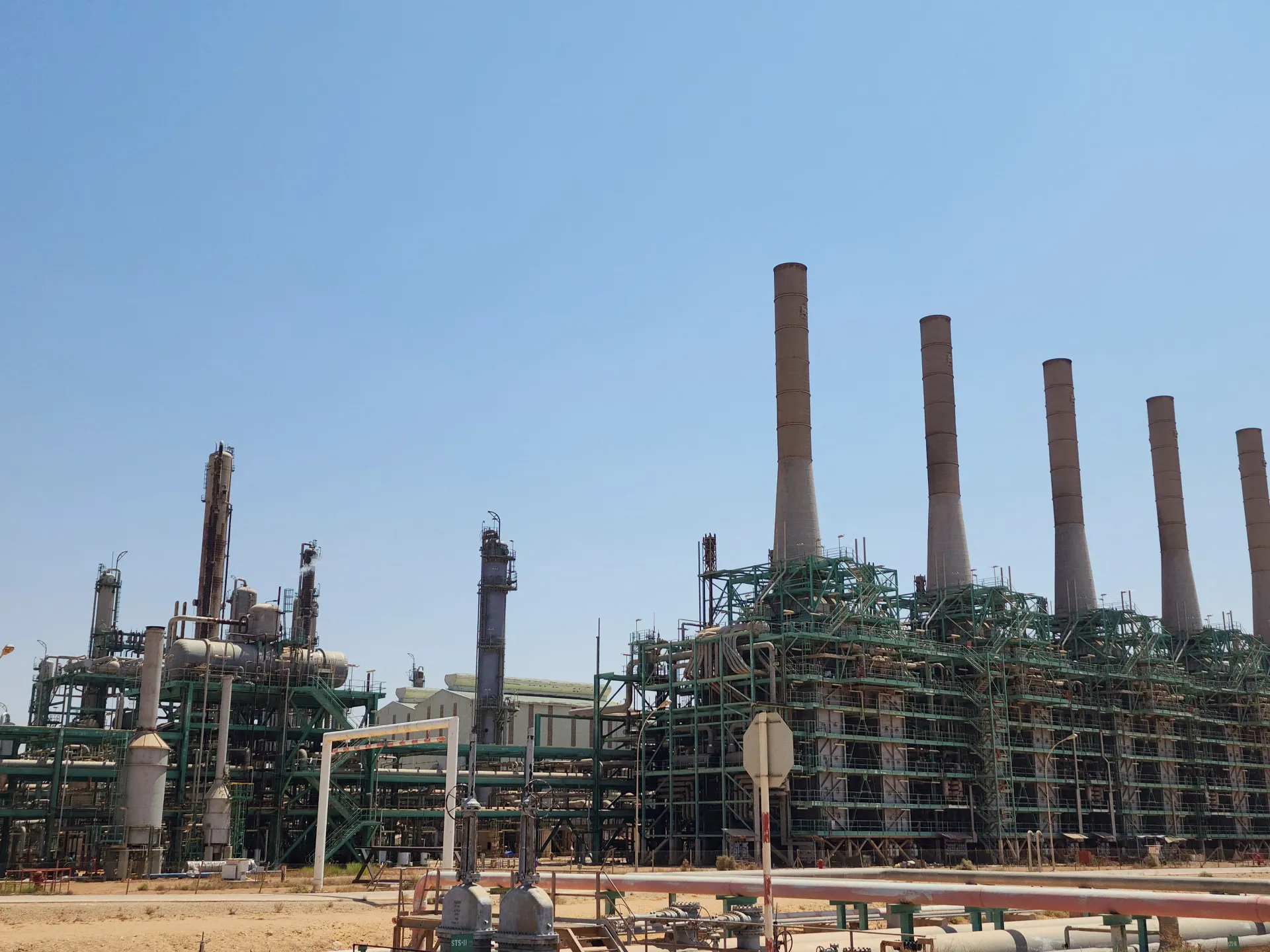
Libya has also seen its strategic value increase. It has around 48 billion barrels of proven oil reserves, the largest in Africa, and produces 1.5 million barrels of oil per day. It also has substantial natural gas reserves.
Its oil reaches international markets through the Mediterranean, while the Greenstream gas pipeline connects its Mellitah complex directly to Europe.
Libya cannot replace the Gulf in terms of oil and gas exports, but it can become a major player in diversification efforts not just in Europe but elsewhere in the world. The challenge the country faces is how to take full advantage amid structural constraints and insecurity.
Energy insecurity at home
Libya is simultaneously a major energy exporter and an energy-insecure state. Although the country possesses vast oil and gas resources, Libyans experience regular electricity blackouts due to an inefficient domestic energy system.
More than 70 percent of Libyan gas production is consumed domestically, mostly for electricity generation. Production has struggled to meet both domestic needs and export commitments. Gas exports consequently fell year on year from around 200 billion cubic feet in 2019 to 35 billion in 2025, the lowest export levels in 22 years.
At the same time, the country is flaring at least 200 billion cubic feet of gas annually due to underdeveloped infrastructure. Gas that could generate electricity, support industry or increase exports is instead being wasted.
The International Monetary Fund has estimated Libya’s total energy subsidy burden at around $17bn, equivalent to roughly 35 percent of GDP – one of the largest in the world.
Much of these funds go into subsidising imported refined fuels, as domestic refining capacity is largely underdeveloped and cannot meet demand.
The domestic energy situation is compounded by political fragmentation, institutional disputes and periodic disruptions to production due to conflict.
Increasing exports without addressing these problems risks improving energy security abroad while neglecting it at home, and that is a recipe for more instability in an already fragile nation.
Opportunity or trap?
The global energy crisis triggered by the Iran war is surely a major opportunity for Libya to increase its revenues from hydrocarbons. But it also carries a risk.
As I pointed out during the 5th meeting of the Mediterranean Energy Experts Circle earlier this month, greater demand for Libyan oil and gas could reinforce the economic model the country has struggled to escape from for decades: producing hydrocarbons, exporting them, distributing the revenues and postponing structural reform.
This model does not allow Libya to capture the full economic potential of its resource wealth. It keeps the Libyan state stuck in the all too familiar “resource curse”, which promotes economic stagnation and inefficiency.
That is why when taking advantage of heightened demand for energy, it is crucial that Libya uses the proceeds to transform its energy system.
That means capturing flared gas, modernising electricity generation and transmission, expanding domestic refining where economically viable, reforming subsidies, investing seriously in renewable energy and participating in sustainable regional energy cooperation.
Libya’s National Sustainable Energy Strategy aims to have 22 percent of electricity generation from renewable sources by 2035, an ambitious target that requires major positive shifts in security and governance conditions. Increased revenue flows can help jump-start the process.
Another important consideration is how the country should approach heightened foreign interest. Libya’s first major oil and gas licensing round since 2007 was concluded in February, with the US’s Chevron, Italy’s Eni, QatarEnergy, Spain’s Repsol, Hungary’s MOL, Nigeria’s Aiteo, and Türkiye’s TPAO securing new licences.
Commercial and geopolitical interests are rarely completely separate in energy. For Libya, this creates bargaining power—if managed coherently by the Libyans. Rather than becoming an arena in which external actors compete for individual assets and relationships, Libya could use diversified partnerships to attract investment and technology while reducing dependence on any single partner.
From energy exporter to Mediterranean energy hub
The transformation Libya seeks should not be confined to its borders. Its strategic objective should be to become an integral player in a Mediterranean energy hub by expanding cooperation with neighbouring states and leveraging existing production capacities and infrastructure.
To Libya’s east, Egypt has a large electricity system and significant refining and processing capacity. To its west, Tunisia provides access towards the wider Maghreb and increasingly towards European markets. Libya sits between them with enormous hydrocarbon resources, considerable solar potential and existing energy connections with both neighbours.
Important steps have already been taken to deepen regional energy integration. In January, Egypt and Libya signed an energy cooperation agreement covering exploration and the development of crude-oil refining. The two countries are also discussing the construction of an 800km pipeline connecting Tobruk to Alexandria. The project is worth $1bn and would carry Libyan crude directly to Egyptian refineries.
Libya and Tunisia are also expanding cooperation. Earlier this month, the Libyan-Tunisian company Joint Oil opened an international licensing round covering around 3,000 square kilometres of shared offshore acreage and development of the cross-border Zarat oil and gas discovery. Formal awards are expected by the end of April 2027.
The risk here is that expanded cooperation could develop into dependence. How to avoid that is the lesson Libya can learn from the Strait of Hormuz crisis. The country still needs sufficient domestic electricity, refining and production capacity to protect itself. Regional integration should add alternatives rather than create new vulnerabilities: more markets, more electricity connections, more processing options and more export routes.
The objective should therefore be specialisation, connectivity and redundancy all achieved in the right sequence depending on needs and conditions.
A moment for strategic redesign
The Iran war has given Libya something potentially more valuable than temporarily higher hydrocarbon prices: renewed strategic relevance. But greater strategic relevance does not automatically make the country a more reliable energy partner.
Converting the former into the latter requires a radically different approach not just to the domestic oil and gas industry, but also to overall economic development and regional geopolitics.
Libya must use this moment to pursue strategic redesign: to increase production while recovering wasted gas, improve electricity infrastructure, develop refining and renewables, strengthen regional connections and cooperation, and use competition among international partners to attract investment.
Libya already has the resources and the geography to become an even bigger player in the energy market. The question is whether it can build the rest.
The views expressed in this article are the author’s own and do not necessarily reflect Al Jazeera’s editorial stance.
Tehran, Iran – Hours after US President Donald Trump rejected a diplomatic solution put forward by Iran to reopen the Strait of Hormuz, explosions were heard in the waterway, according to Iranian media.
Reports of blasts near southern Iran’s Qeshm Island in the Strait of Hormuz suggested that multiple antiship missiles and drones were fired at vessels transiting the waterway against Tehran’s wishes.
Recommended Stories
list of 4 itemsend of list
While Iranian authorities did not confirm any attacks in the Strait of Hormuz that day, shipping continues to be attacked in the waters, including an Indian cargo ship last week, which killed a sailor.
The Islamic Revolutionary Guard Corps (IRGC) maintains that the strait is closed to any ship that does not coordinate with Iranian authorities. On Sunday afternoon, it released video of what it said was a second US underwater drone seized this month.
Tehran has issued instructions to shipping companies transiting the Strait of Hormuz to use a temporary route approved by Iranian authorities and pay relevant fees. But it has also said the strait will not fully reopen until the US blockade on Iranian ports ends.
Iran’s Persian Gulf Strait Authority announced on Saturday that it would blacklist any shipping charterer company which orders crews to use routes it considers to be unauthorised.
It also published what it described as an apology from an unnamed shipowner blaming commercial pressure from its charterer for trying to pass through the strait.
Washington still insists that its warships are successfully guiding oil tankers out of the strait via a different route. US Energy Secretary Chris Wright told Fox News on Sunday that the “running average” of crude oil in transit was nearly 13 million barrels per day.
A September 19 operational update by US Central Command claimed that its forces had helped move more than one billion barrels of crude out of the Gulf over roughly two months.
The US military also says its forces have redirected 122 commercial vessels to enforce the naval blockade of Iran’s ports, halting all Iranian crude exports.
Tehran has claimed that the US is providing false information regarding Strait of Hormuz traffic to project control over the key waterway. Shipping has been severely disrupted since the US and Israel started their war on Iran on February 28.
Andreas Krieg, associate professor at King’s College London, said Iran’s strategy of launching maritime attacks has spread the economic costs of the conflict beyond its borders.
While Iran has suffered economically from war damages, the US naval blockade and sanctions, it would be a mistake “to assume that reaching that threshold produces submission”.
“The next Iranian move is therefore likely to be an attempt to increase the pain experienced by the Gulf rather than simply absorb further American pressure,” Krieg said.
“That could mean more aggressive vessel interdictions in Hormuz, attacks on energy infrastructure, greater Houthi pressure around Bab al-Mandeb and pressure from Iranian-aligned groups against alternative Saudi export routes. We are already seeing how pressure on Hormuz, the Red Sea and Saudi infrastructure can interact.”
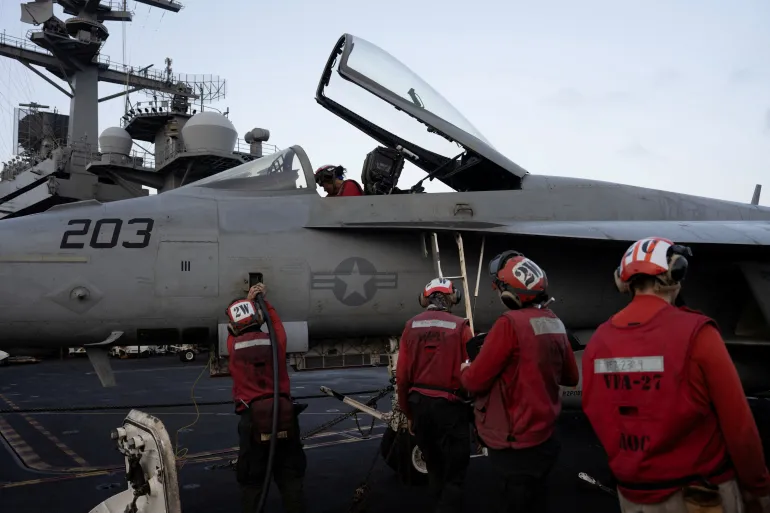
The flight deck of the USS George Washington aircraft carrier in the Arabian Sea, September 11, 2026 [Ed Ou/Reuters]
More escalation on the way
At the United Nations General Assembly in New York, Iran projected a message of defiance while also proposing to reopen the Strait of Hormuz within a week if its seven conditions were met.
They included lifting the blockade on Iran, the release of frozen Iranian funds and an end to attacks on all fronts, including Israel’s assault on Lebanon. The demands mostly amounted to a return to the June memorandum of understanding between the US and Israel.
Tehran has added that reopening the strait must be undertaken through a bilateral arrangement already finalised with Oman, the only other country with territorial waters in Hormuz.
US President Donald Trump told reporters he rejected the offer, but Iran’s Foreign Minister Abbas Araghchi said on Sunday they were adamant about the conditions and would await an official response through mediators, such as Pakistan, Qatar and Oman.
Abolfazl Shekarchi, chief spokesman of the Iranian armed forces, warned that if the US further intervenes in the Strait of Hormuz, “it will get slapped”.
“The Americans have no way out other than withdrawing from the West Asia region. The sooner they leave, the fewer losses they will incur and the region will certainly become safe after that,” he said.
Iranian army spokesman Mohammad Akraminia said conditions were deteriorating so badly for the US that it might launch another “military aggression” on Iran.
Krieg said that as the US moves to isolate Iran via sanctions, Tehran, unable to respond with mutual financial measures against Washington, will be forced to rely on continued coercion in the Strait of Hormuz.
“The most likely level remains controlled attrition rather than an immediate return to the massive air campaign of the opening months,” Krieg said.
“Over the coming weeks, I would expect further attacks or attempted attacks on tankers, US-enabled shipping and regional infrastructure, followed by limited US strikes against IRGC maritime assets, coastal missile positions, drones or vessels involved in those operations. That tit-for-tat cycle has already re-emerged around Hormuz.”
Iran says it’s still waiting for an official response from the US on its proposal to reopen the Strait of Hormuz within seven days. Iran’s foreign minister Abbas Araghchi made the comments shortly after President Donald Trump said he had rejected the plan.
US President Donald Trump has rejected Iran’s latest proposal to reopen the Strait of Hormuz to shipping. Speaking to reporters at the White House, Trump insisted Tehran was attempting to strike a deal because “the money isn’t coming in” under an American naval blockade.
United States President Donald Trump has rejected a roadmap submitted by Iran to open the Strait of Hormuz within a week.
“I reject their proposal,” Trump told reporters outside the White House on Saturday, before departing for Tennessee by helicopter.
Recommended Stories
list of 3 itemsend of list
Iranian Foreign Minister Abbas Araghchi said on Friday that Tehran formally submitted a seven-day roadmap to the US via mediator Qatar, and was awaiting Washington’s response.
“It appears as though the proposal is dead in the water,” said Al Jazeera’s Mike Hanna, reporting from Washington, DC.
Trump was “privately sceptical” that Tehran would meet his demands, and reportedly told aides that he expects a renewed bombing campaign on Iran after the November US midterm elections, The Wall Street Journal reported, quoting unnamed US officials.
“President Trump has vacillated between extreme optimism, saying that ‘talks are going well’ to ‘I want to annihilate Iran’,” Hanna said about the recent diplomacy between Washington and Tehran.
“There is no consistency in terms of the [Trump] administration’s reaction,” he said.
But “the one thing that has been made clear by President Trump is that he is content to stay in the status of limbo”, Hanna added, despite concerns from much of the American public that the Iran conflict is turning into another “never-ending war”.
The Strait of Hormuz, a waterway key to the world’s oil supply, is central to the conflict between the US and Iran, which is at an impasse after nearly seven months, though new mediation efforts took place this week.
Earlier in the week, Araghchi held talks with Trump’s envoy Steve Witkoff, and previously set out conditions for ending the war and reopening the vital shipping channel.
On Friday, the top Iranian diplomat said: “Iran has conveyed to the United States, through Qatar, a concrete seven-day plan. If the necessary conditions are met, the strait can be reopened, and normal maritime passage restored within seven days.”
He was speaking at the United Nations in New York, where he and other senior Iranian officials were attending the General Assembly.
Under the plan, Washington would lift its naval blockade of Iranian ports, waive sanctions on Iranian oil sales, release an estimated $12bn in frozen Iranian assets and observe a ceasefire covering the region, including Lebanon and Yemen.
“The choice now rests with the United States. Iran does not accept coercion, threats or intimidation, and Iran will not surrender its sovereign rights under pressure,” Araghchi had said.
On Saturday, Iranian President Masoud Pezeshkian told Al Jazeera that Tehran no longer trusts negotiations with the US after previous rounds of talks were followed by attacks and sanctions.
“We have no trust in the American side and do not know on what basis an understanding can be reached with it,” said Pezeshkian, who was also in New York for the UNGA.
He denied that Iran was responsible for blocking the Strait of Hormuz, saying the US “closed the routes before us”. He described the closure as “a natural response when routes are cut off to Iran”.
The Iranian president said the crisis could be resolved through negotiations rather than force, and that the waterway would reopen to commercial shipping if talks ended the war.
Iran will reopen the Strait of Hormuz within seven days, but the choice now rests with the US, says Iranian Foreign Minister Abbas Araqchi who spoke from the United Nations. The plan is based on the previously-agreed-upon Memorandum of Understanding (MOU) brokered in June.
Iran says it has put forward a plan to the United States to reopen the Strait of Hormuz within seven days, as Qatar passes messages between the two countries at the United Nations General Assembly in New York.
Speaking on the sidelines on Thursday, Iran’s Foreign Minister Abbas Araghchi said the timetable could begin as soon as Washington accepted the proposal.
Recommended Stories
list of 4 itemsend of list
Both sides have described the indirect contact facilitated by Qatar in New York positively, but neither has indicated any diplomatic breakthrough as the war approaches its seven-month mark.
Analysts have told Al Jazeera a firm peace deal remains unlikely, with Iran still wanting to follow the approach set out in an earlier agreement, which would give it and Oman a main role in managing the strait before moving on to discussing terms for a broader peace deal.
For its part, the US, which has claimed to be “in total control” of the Strait of Hormuz, wants Iran’s nuclear programme to be the subject of discussions straight away.
Iran has previously made clear that it will not engage with broader peace talks, including addressing the issue of its nuclear programme, until the US naval blockade of its ports in and around the Hormuz strait is lifted, sanctions are repealed and the US provides a guarantee of an end to strikes, among other conditions.
Here’s what we know.
What has Iran proposed?
Araghchi told reporters in New York that Iran had presented its plan to the US through intermediaries. “If certain conditions are met, the Strait of Hormuz would be open on the end of the seventh day and [peace] talks would restart,” he said.
He did not give details but said the proposal resembles the June 17 memorandum of understanding (MoU) signed by Iran and the US, which briefly eased the conflict before breaking down. “The moment they accept this plan, from the next day, this timetable can start, and after seven days, the strait will be open,” he said.
Under the June agreement, Iran undertook to allow ships to pass through the strait without paying tolls for 60 days – that was the period of time given for peace talks to take place. But the MoU left open what would happen after that period.
Araghchi did not say whether the same arrangement formed part of his new proposal. Nor did he spell out what Washington would have to do before the seven-day timetable began, how either side would verify those steps, or what rules would govern shipping once the strait reopened.
It is highly unlikely Iran would be offering to cede control of the Strait of Hormuz, analysts say.
Urban Coningham, a research fellow at the Royal United Services Institute, told Al Jazeera that Tehran is unlikely to receive the sanction relief it has previously demanded and, therefore, sees the strait as its primary ticket to helping it recover from the war economically.
“Hormuz is a clear Iranian red line,” he told Al Jazeera. “The Iranians will not get reparations for the war, so control of the strait is the only way they can recover economically. I cannot see them backing down from that.”
[Al Jazeera]
Why does the June agreement matter?
The MoU signed in June set out an immediate halt to military operations on all fronts, including in Lebanon, where Israel has launched strikes and occupied part of the country, and triggered a 60-day period for negotiations on a lasting peace settlement. It included US waivers for Iranian oil exports and provisions to restore maritime traffic through the strait.
It deferred other issues, including the future of Iran’s enriched uranium stockpile, to broader peace talks.
But the agreement unravelled the following month amid renewed confrontation over shipping routes through the strait.
Coningham told Al Jazeera that Iran’s latest proposal follows this earlier model: “Open the strait within seven days, then start talks on the nuclear file.”
But “the US does not want to compartmentalise the issues, it wants them discussed as one package”, he said.
How else does this new proposal place pressure on the US?
Coningham also sees a political calculation in making the offer publicly at the UN as Americans contend with high fuel prices. “By explicitly saying this may be the only chance before the midterms, Iran is putting pressure on Trump over oil and gas prices and the strait,” he said. “It is a tactic to put more pressure on the US.”
The strait, which runs between Iran and Oman, is a vital route for oil and gas exports from the Gulf. Disruption to shipping has driven up energy prices far beyond the region, giving both governments an economic reason to reach an agreement despite their differences.
With the US midterm elections approaching, a deal to get it reopened could give Trump a chance to bring down fuel prices before voters go to the polls – potentially giving the Republican Party a much-needed electoral boost before the midterms.
Trump has presented the electoral calculation differently, however. In his address to the General Assembly on Tuesday, he accused Iran of waiting to see how his Republican Party performs in November and predicted a deal would happen after the vote. He also threatened to “annihilate the Islamic Republic” if there was no agreement.
Trump claimed the election did not affect his own decision-making on Iran: “The only thing that does is that Iran will never have a nuclear weapon.”
That leaves an open question about whether the prospect of lower energy prices is enough to persuade his administration to accept Iran’s proposed order of talks. Coningham doubts it. “Trump is prepared for this to go on through the midterms,” he said. “The same problem remains where the proposal does not answer questions about the nuclear file.”
Where do broader US-Iran peace talks stand?
Araghchi met US envoy Steve Witkoff and Trump’s son-in-law Jared Kushner on Tuesday in talks mediated by Qatar. The Iranian foreign minister described the exchange as productive and said messages continued to pass between the sides.
US Secretary of State Marco Rubio said it would be wrong to describe the meeting as a major breakthrough, however.
Burcu Ozcelik, a senior research fellow for Middle East security, told Al Jazeera that the major blockage for Washington and Tehran is that each is making different assumptions about how much pressure they can exert on the other. The Trump administration is unlikely to revive the failed MoU, she said, because it assesses its naval blockade and tighter sanctions as working.
“The US appears to believe it can wait this out until Tehran is prepared to make meaningful concessions,” Ozcelik said.
“But Iran remains defiant despite indications that it is hurting economically.”
The United States and Iran have engaged in hours of indirect talks through mediators on the sidelines of the United Nations General Assembly (UNGA) in New York, but accounts differed over whether officials from the two countries met directly.
US special envoy Steve Witkoff said mediators had “shuttled between” the American and Iranian delegations throughout Tuesday.
Recommended Stories
list of 4 itemsend of list
“Today, on the sidelines of the United Nations General Assembly, we engaged in lengthy talks with the Iranian delegation through the mediators, who shuttled between the two sides throughout the day,” Witkoff said in a post on X.
“They successfully completed a round of discussions that we hope will prove constructive and promising. The mediators will continue their work.”
US President Donald Trump gave a more direct account, saying Witkoff and Jared Kushner had held a three-hour meeting with Iranian officials.
“They had a very good meeting, a very productive meeting,” Trump told reporters at the UN, adding that he believed there was “a lot of momentum” towards an agreement. Trump later said talks were continuing and that he believed a settlement would eventually be reached.
Al Jazeera’s Kimberly Halkett, reporting from Washington, said Trump’s initial comments had created confusion over who had participated. She said the White House later clarified that Trump had not attended and that Witkoff and Kushner represented the US side.
Al Jazeera’s Tohid Asadi, reporting from Tehran, said state media had confirmed a meeting between Iranian Foreign Minister Abbas Araghchi and Witkoff after weeks without direct contact.
“This latest meeting was held at the request and insistence of the American side, and was aimed at conveying Iran’s messages and conditions, particularly around reopening the Strait of Hormuz,” Asadi reported.
Iranian state media said those conditions included lifting the US naval blockade, releasing frozen Iranian assets and ending the war on what Tehran describes as the “resistance” fronts.
Asadi also reported that an Iranian security source told Al Jazeera there could be room for further diplomatic engagement if Washington met Iran’s conditions and commitments.
The contacts came after a senior Iranian official told the Reuters news agency that Tehran’s delegation in New York had full authority to pursue diplomacy and described the UN gathering as a “golden opportunity” for Washington to return to negotiations.
The official said Iran had submitted its latest proposal to Washington through mediators on September 16 and that details of a possible agreement to end hostilities could be discussed in New York.
The official also said Iran could reopen Hormuz within seven days if the US eased military pressure and lifted its blockade of Iranian ports.
Regional powers push for de-escalation
The indirect talks have been accompanied by a broader diplomatic effort involving the Gulf and other regional states.
Qatar said it was working with Pakistan to reduce tensions between Washington and Tehran, safeguard freedom of navigation through the Strait of Hormuz and promote regional stability.
Qatar’s Prime Minister and Foreign Minister Sheikh Mohammed bin Abdulrahman bin Jassim Al Thani also met Araghchi in New York on Tuesday.
Qatar’s Ministry of Foreign Affairs said they discussed developments in the region, efforts to de-escalate tensions and ways of creating conditions for dialogue.
Oman has also been involved in maritime diplomacy over the waterway, having previously discussed maritime arrangements with Tehran aimed at facilitating navigation through the strait.
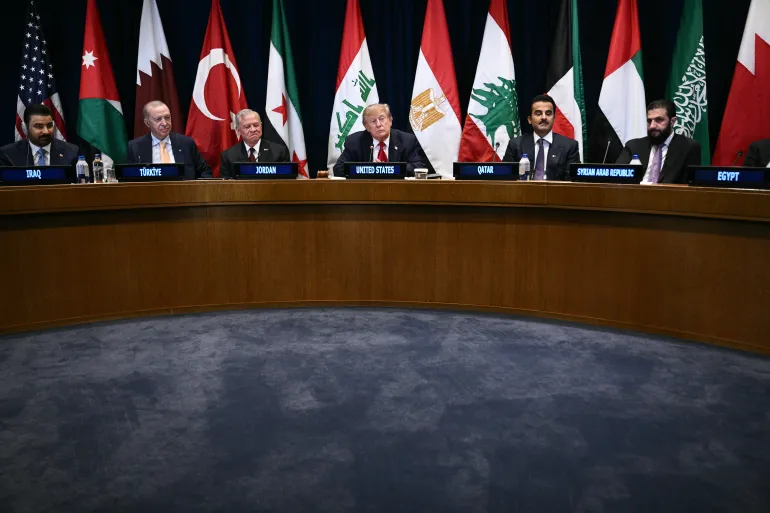
Trump also met leaders and senior officials from Gulf Cooperation Council states, Turkiye, Jordan, Syria and Iraq on Tuesday to discuss Iran and regional security.
Reuters reported that a Qatari proposal for a common security framework involving Iran and Gulf states was among the issues under consideration, with one regional source saying Tehran was reviewing it.
Qatar has not made the proposal public.
US President Donald Trump attends a multilateral meeting on the sidelines of the 81st UN General Assembly in New York with leaders and senior officials from Arab countries and Turkiye on September 22, 2026 [Brendan Smialowski/AFP]
Talks follow Trump’s warning
The indirect talks came hours after Trump used his UNGA address to combine the possibility of an agreement with another warning of military escalation.
Trump said he faced a “big decision” between reaching a deal that would allow Iran to rebuild and moving to “annihilate the Islamic Republic”. He also said Washington had previously offered Tehran “full economic cooperation” in return for ending its nuclear programme and what the US describes as Iranian support for terrorism.
Iran’s General Staff of the Armed Forces and Khatam al-Anbiya Central Headquarters responded in a statement carried by Iranian media, describing Trump’s threats as evidence of “strategic weakness” and saying Iran was ready to deliver “more severe, crushing, and unpredictable blows” in response to further attacks.
US officials have repeatedly suggested that negotiations were making progress following the collapse of the June memorandum of understanding. In early August, Trump said the sides had reached parameters for a possible agreement and later described talks over Hormuz as “moving along nicely”, although significant differences remained. Earlier this month, he again said he hoped the war was “towards the end”.
Tehran continues to condition the reopening of the Strait of Hormuz on the US easing military pressure and lifting its blockade of Iranian ports, while Witkoff said mediators would continue their efforts following Tuesday’s mediated exchanges.
South Korea will continue efforts to facilitate talks between Washington and Pyongyang.
Published On 18 Sep 202618 Sep 2026
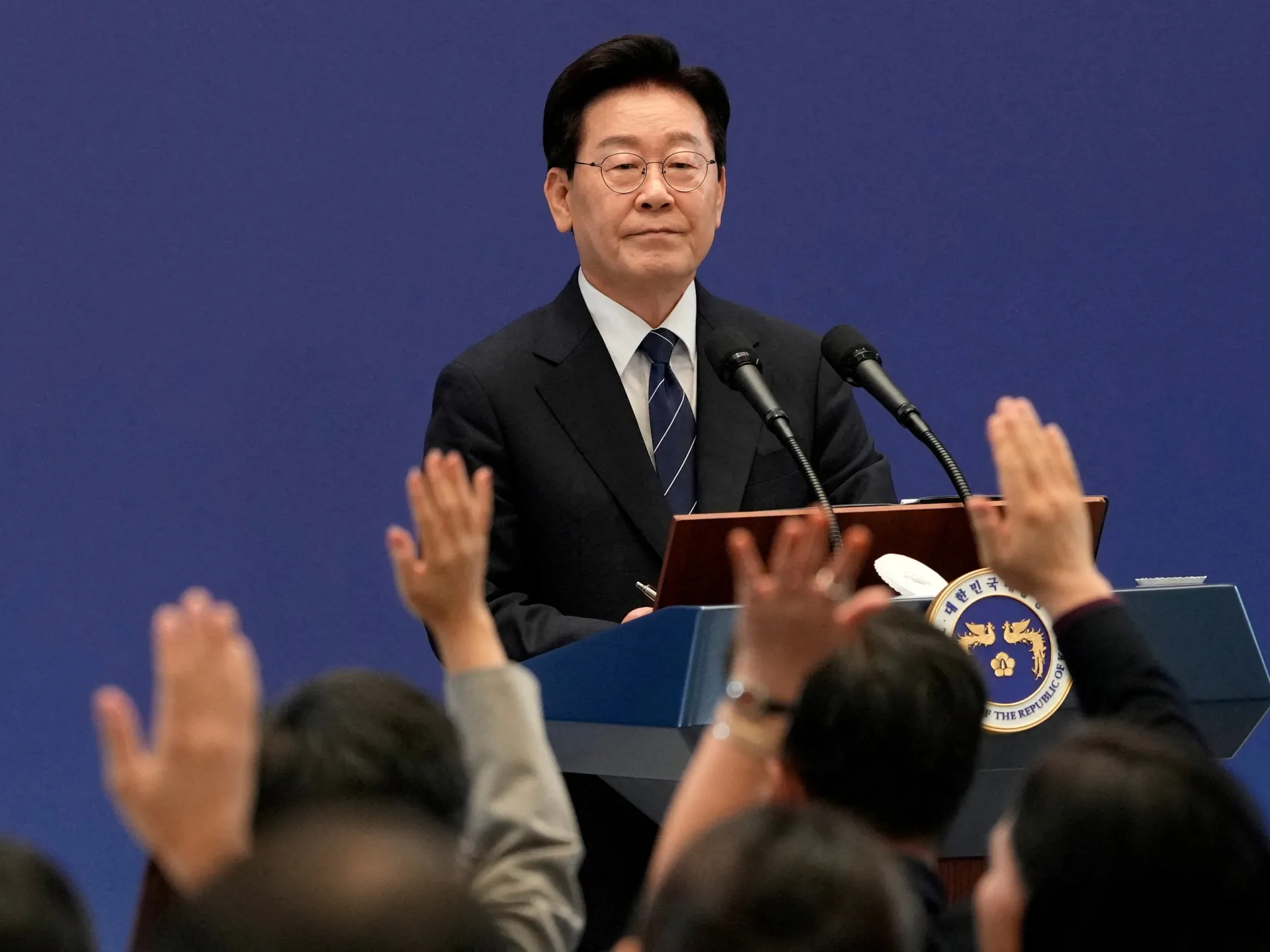
South Korean President Lee Jae Myung said on Friday that United States President Donald Trump wants dialogue with Pyongyang and confirmed Seoul will not be deploying troops to intervene militarily in the Iran war.
“Trump clearly wants dialogue with North Korea,” Lee said on Friday.
Recommended Stories
list of 3 itemsend of list
He added that while such talks are uncertain, they are not impossible.
South Korea was continuing “preliminary coordination efforts” to facilitate dialogue between North Korea and the US.
“The resumption of North Korea-US dialogue would be far easier than resuming inter-Korean dialogue,” he said, according to South Korean news agency Yonhap.
Trump, seeking to revive the bond he claims to have forged with North Korean leader Kim Jong Un in his first term, said he plans to meet Kim later this year.
The US president said it was important to “get along” with Kim, adding that Pyongyang now had 57 “very powerful” nuclear weapons.
Seoul has assessed that Pyongyang has about 80-120 nuclear warheads.
North Korea, which has secured critical backing from Russia in recent years, did not clearly respond to Trump.
Inter-Korean relations reached a high in 2018 but deteriorated after talks between Kim and Trump collapsed in February 2019.
On Thursday, a court in Seoul ordered North Korea to pay roughly $32.5m for blowing up the Inter-Korean Liaison Office building in 2020. The office was intended to improve relations on the peninsula but was destroyed amid rising tensions between the neighbours.
South Korea is working to strengthen relations with other regional partners. The first-ever presidential summit between Seoul and five Central Asian states was held on Wednesday, aiming to establish deeper economic engagement with the Russian-allied countries.
South Korea will not dispatch troops
Despite growing pressure from the US, Lee reiterated three times that South Korea will not deploy troops to the Strait of Hormuz.
“Let it be clear. There will be no dispatch of troops that will lead to involvement in a conflict. There will be no engagement or involvement in war,” Lee said.
The South Korean government found itself at odds with large parts of Korean society as protests broke out in recent weeks opposing a potential deployment of South Korean military assets to the Strait of Hormuz.
Lee added that South Korea will “carry out the minimum necessary activities” to protect its own merchant ships and oil shipping routes.
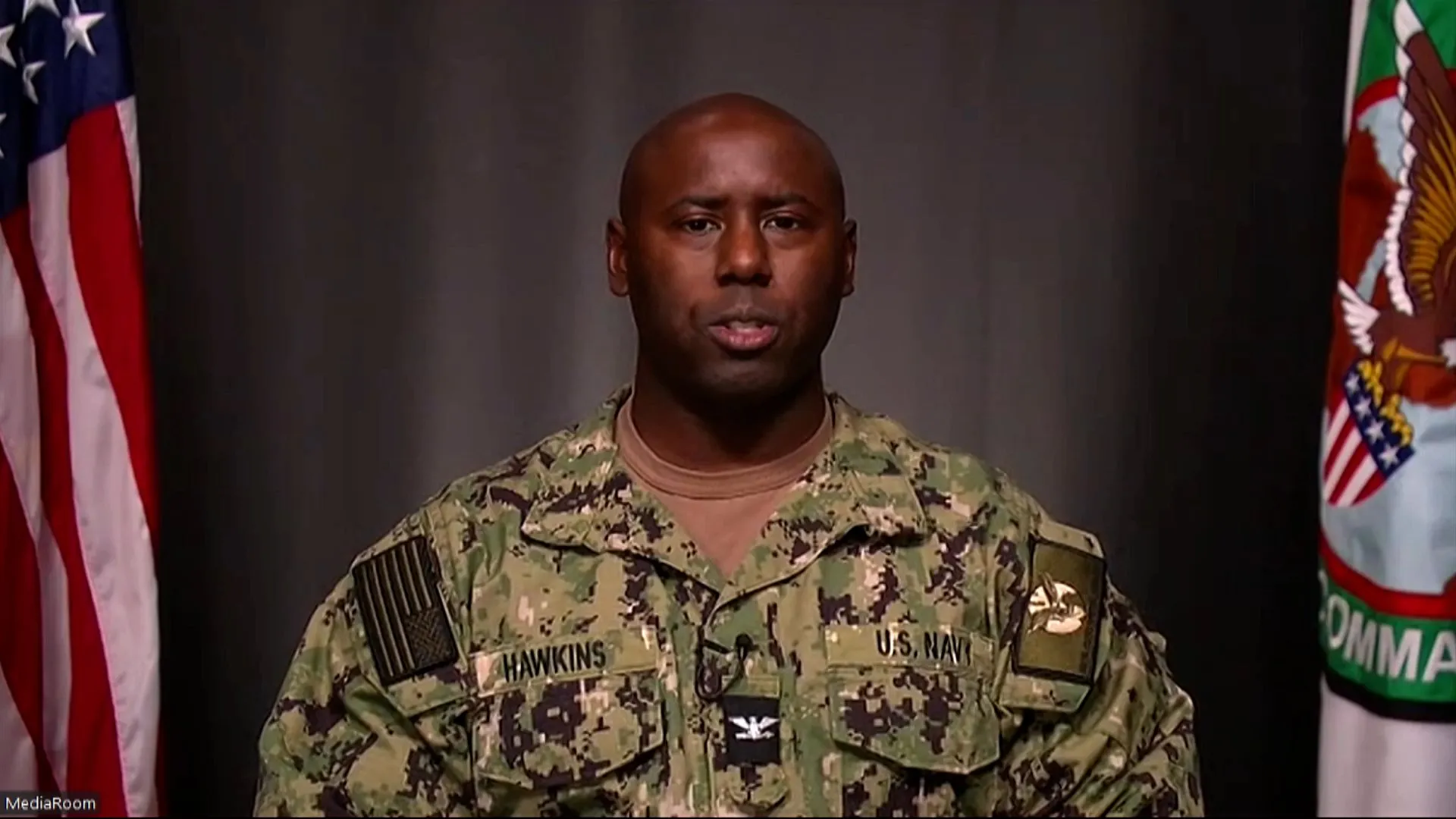
The spokesman for US Central Command has told Al Jazeera its blockade of the Strait of Hormuz is ‘highly effective’. Captain Tim Hawkins says Iran does not control the waterway and that 900m barrels of oil have passed through the strait since May.
WASHINGTON — A bold military push by Iran and its proxies to create a choke hold on global oil supplies has once again caught the Trump administration off guard, threatening a market shock and a steep political backlash in the U.S. midterm elections.
A drone attack on Saudi Arabia’s most crucial pipeline, which siphons crude oil from the Persian Gulf to the Red Sea to bypass the Strait of Hormuz, has led to the line’s closure, potentially taking 4% of the world’s supply off the market.
And a lightning advance by Iran-backed Houthi rebels along Yemen’s Red Sea coast threatens commercial traffic through the Bab el-Mandeb Strait, second only to Hormuz in its importance to regional shipping.
The strikes put the Trump administration in a newly precarious position less than two months until the November midterms. President Trump’s military advisors have warned him that any retaliation could lead to a further depletion of critically low U.S. munition stockpiles, endanger American personnel in the field and risk escalation that could spiral out of Washington’s control.
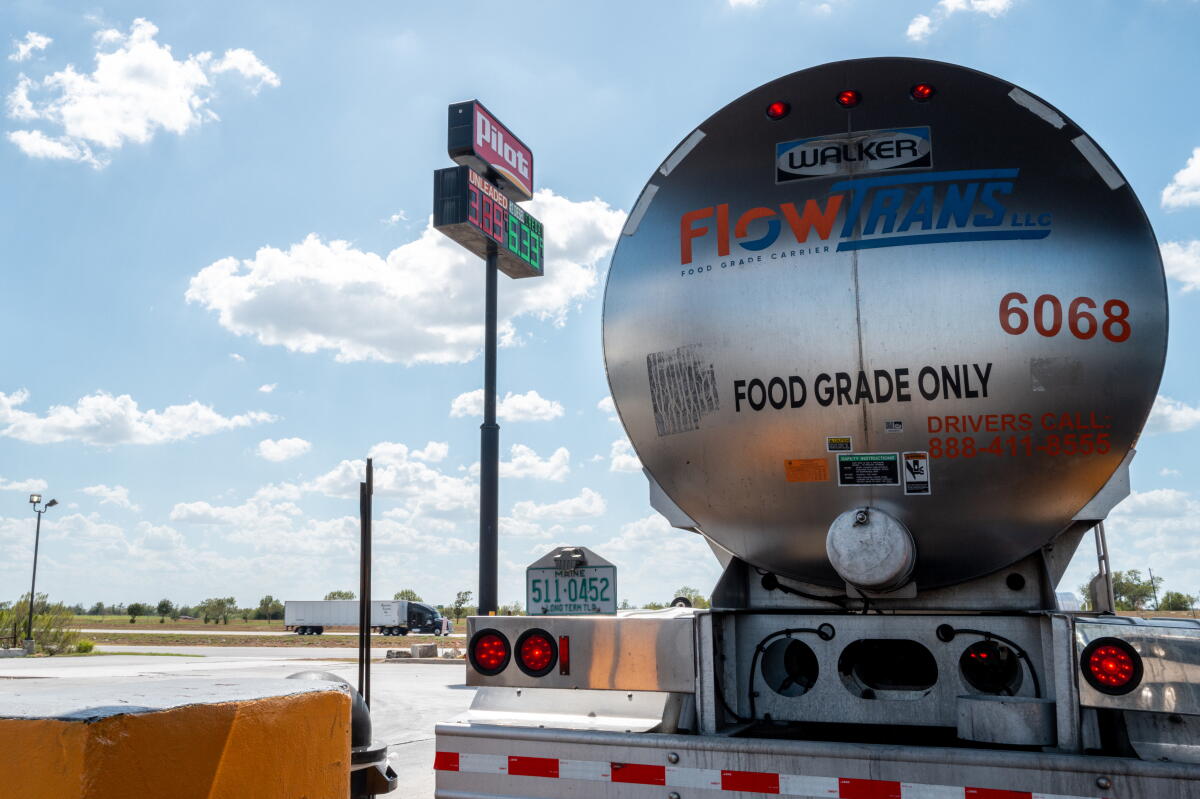
A semi prepares for departure from a Pilot fuel station Monday in Buda, Texas.
(Brandon Bell / Getty Images)
On Tuesday, the global price of oil topped $107 a barrel — the first time in U.S. campaign history that an incumbent president has faced rising pump prices at this stage of an election.
The Iranian strikes come as Europe and the United States are facing increased energy needs entering the fall and winter months, and as Ukrainian attacks on Russia’s energy infrastructure have surged, pushing diesel prices up to record highs.
Signs are emerging that the latest attacks could trigger an acute market panic, with Brent crude buyers paying a steep premium for early delivery — an indication that the industry fears an impending supply crisis.
“I fear there is a considerable risk of much higher gas and diesel prices in the weeks to come,” said Michael O’Hanlon, director of research of the foreign policy program at the Brookings Institution.
“No one is quite sure how to predict the fuel markets,” he added, “but the military dynamics are seriously worrisome.”
Last week, Trump told reporters that the Iranian government is “desperate to try and affect the election” and could be trying to keep oil prices elevated to hurt Republican prospects.
“Right after the election, oil prices are going to be tumbling downward,” Trump said. “I think it’s going to take a little bit longer than the midterm.”
Traders work on the floor of the New York Stock Exchange on Monday morning.
(Michael M. Santiago / Getty Images)
Polls have found that likely voters are prioritizing the economy far beyond any other policy matter going into the fall election season, with a New York Times poll published Tuesday showing voters trusting Democrats to handle the economy more than Republicans.
“There’s no quick fix,” said Simon Henderson, the director of the Washington Institute’s Gulf and Energy Policy program. “The main question is whether it is a big shock to the oil market or just another more minor shock. The answer depends on whether the damage to the East-West pipeline cable is repaired quickly.”
Region on edge
The latest Iranian campaign threatens Saudi Arabia’s economic core, straining a long-standing alliance built on robust U.S. defense of Riyadh’s vital interests.
The attack on the East-West oil pipeline originated in Iraq, where Iran continues to operate proxy militias, according to government officials in Riyadh and Baghdad. Saudi Arabia agreed not to retaliate militarily against targets on Iraqi soil, temporarily staving off a regional conflagration.
While the Iraqi militia group denied involvement, it also praised the Houthi advance in Yemen and the militants’ “ongoing battlefield victories against Saudi forces.”
Israel has been providing Saudi Arabia with intelligence to help thwart further attacks, using American military intermediaries, according to Israeli media reports.
Active combat in the war between Iran and the United States eased after a ceasefire was brokered in June. While that truce collapsed in July, the two sides have opted for asymmetric tactics over the resumption of direct attacks, with the United States maintaining a full naval blockade of Iranian ports.
The Trump administration has since focused instead on targeting Iran’s economic partners with aggressive secondary sanctions, seeking to further pressure Tehran into a meaningful peace agreement. But negotiations have failed for months to get back off the ground.
When he first launched the war in February, Trump projected the mission would last roughly six weeks. He said the goal of the U.S. operation was to incapacitate Iran’s ballistic missile program, its navy and its nuclear program.
Trump was warned ahead of the war by his joint chiefs of staff that Iran could attempt to close the Strait of Hormuz in response. But he dismissed the threat, anticipating Tehran would quickly back down from a direct confrontation with the United States.
More than six months on, Iran’s ballistic missiles continue to pressure U.S. defense systems across the Middle East. Traffic through the Strait of Hormuz remains disrupted and discussions on Iran’s future nuclear work have broken down. In private, Trump administration officials fear the war could drag through the remainder of the president’s term.
Tehran, Iran – Another attempt to clinch a deal between Iran and Oman to restore some traffic to the Strait of Hormuz has been set back by a lack of regional consensus on the future of the waterway.
Officials from Iran, Iraq and the Gulf Cooperation Council (GCC) nations – minus objecting Bahrain – were scheduled to meet in Oman’s port city of Salalah on Monday to confer on new temporary routes in the Strait of Hormuz amid Tehran’s ongoing hot-and-cold war with the United States.
Recommended Stories
list of 4 itemsend of list
On Sunday night, the region’s officials announced the postponement of the meeting, without giving a new date. None of the stakeholders gave any indication that the postponement was directly linked to recent Houthi and Iraqi militia attacks on Saudi Arabia.
However, Iran’s Ministry of Foreign Affairs said Saudi objection was the reason for the postponement, without providing further details.
US media outlets Axios and CNN reported that Saudi Arabia had submitted amendments to the Iran-Oman proposal for Hormuz because it had concerns that the wording would establish a new status quo which would be unacceptable to Riyadh.
It comes days after Saudi Arabia shut down its critical East-West oil pipeline – the kingdom’s key route for energy exports – after drone attacks in the area originating from Iraq. US President Donald Trump said these attacks were likely conducted at Tehran’s behest.
Saudi Arabia has also faced repeated attacks by the Houthis, who took control of Yemen’s Red Sea coast over the weekend.
Hours after the Salalah meeting was postponed, the Saudi civil defence issued alerts for Abha, Khamis Mushait, Jazan and Najran in southern and western parts of the kingdom. The Houthis claimed to have fired dozens of ballistic missiles and drones at military facilities in Khamis Mushait, in retaliation for air strikes across Yemen, which it blames on Saudi Arabia.
With continued disruptions to the passage of vessels through the strait, Iran has signalled that it intends to continue pursuing the bilateral agreement with Oman over Hormuz, which it said was finalised last month.
“In consultation with Oman, in the next step, we will make a decision on how to announce or register the agreement,” Ministry of Foreign Affairs spokesman Esmaeil Baghaei told reporters during a weekly news conference on Monday.
When the two countries initially advanced the bilateral deal, Trump threatened to bomb Oman if it “gets in the way” of US talks with Iran.
Ali Vaez, deputy director of the Middle East and North Africa programme at the Crisis Group, told Al Jazeera that Tehran wants to use its leverage over Hormuz for regional legitimacy – and ultimately to pressure the US.
“The broader the regional buy-in, the harder it becomes for the US to dismiss the arrangement as an Iranian diktat,” he told Al Jazeera.
GCC states, suffering from a sharp decrease in energy receipts, want ships moving and their economies insulated from a war they neither started nor can end. But Vaez said Washington is unlikely to lift the blockade on Iran even if the region blesses the arrangement between Muscat and Tehran.
“[The US] will find it much harder to sustain a policy that its own partners increasingly see as perpetuating the crisis,” Vaez said
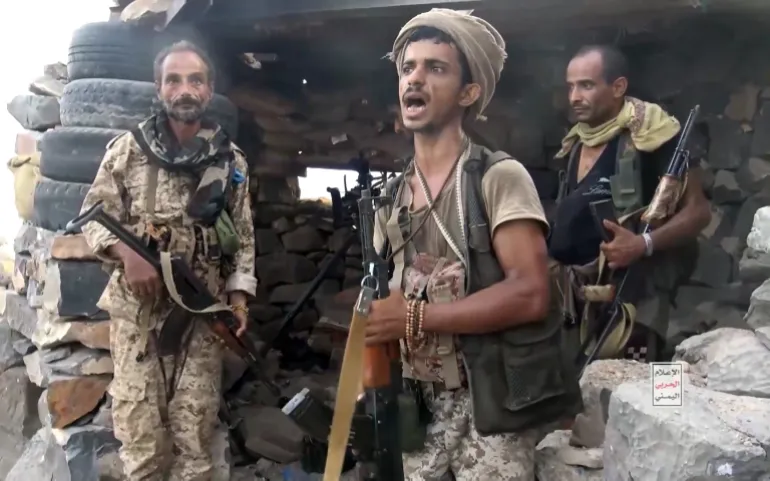
Houthi fighters stand guard at a seized camp during an offensive in the port city of Mocha, Yemen [Handout/Houthi Military Media Centre via EPA]
Temporary entry and exit
The Omani-Iranian planned agreement envisions temporary entry and exit routes for commercial vessels in the strait, with Tehran repeatedly stating that this would not mean that the Strait of Hormuz has reopened.
Iran and Oman are the only two countries with territorial waters in the Strait of Hormuz. The proposed inbound corridor reportedly goes through Iranian waters, while the outbound corridor mostly passes through Omani waters, with small parts still in Iranian territory.
During Monday’s scheduled meeting, Iran and Oman were supposed to share precise maps and discuss the details of the routes with GCC members Saudi Arabia, the United Arab Emirates, Qatar and Kuwait, and Iraq, which is outside the bloc. The deal could reportedly include voluntary tolls to fund navigation, environmental protection and search-and-rescue operations.
Bahrain, which has borne the brunt of Iranian attacks since the US-Israel war on Iran started at the end of February, said it would not participate in the forum since it would amount to “appeasement”. The Tasnim news outlet, affiliated with Iran’s Islamic Revolutionary Guard Corps (IRGC), claimed Israel pushed Bahrain to refuse participation.
How does Yemen fit in this picture?
The latest diplomatic movement comes after days of explosive developments in Yemen, when the Houthis, officially known as Ansar Allah, essentially took control of the Bab al-Mandeb strait and the Red Sea after a lightning offensive against government forces.
Thomas Juneau, assistant professor in the Graduate School of Public and International Affairs at the University of Ottawa, said the Houthi advances represent a significant gain for Iran. Its Yemeni allies’ position in the Red Sea offers Iran an important new bargaining chip in future negotiations with the US.
“The Houthis are not a simple arm of Iranian foreign policy. They operate largely based on their own interests, and do not take and execute Iranian commands,” he told Al Jazeera. “But Houthi and Iranian interests are largely, if not always fully, aligned. They cooperate closely on the basis of those shared interests.”
Juneau sees the ability for Iran and the Houthis to potentially partially block traffic in the Strait of Hormuz and the Bab al-Mandeb – two of the world’s most crucial maritime bottlenecks – would give them tremendous influence over the global economy, and thus the US.
The Houthis are trying to seize the opportunity to “institutionalise the de facto reality of their veto on maritime traffic” in the southern Red Sea and replicate partial Iranian success in doing the same in the Strait of Hormuz, Juneau said.
Iran has stressed that their allies’ gains in the Red Sea cannot be separated from the Saudi-led blockade and attacks on Houthi areas in Yemen since 2015.
“We know very well that continued war between Islamic countries in the region only has one winner, and that winner is no one but the Zionist regime, which is after persisting tensions and conflict in our region and between Islamic countries,” Iranian spokesperson Baghaei said.
Foreign Ministry spokesperson Esmaeil Baghaei says Iran does not interfere in Yemeni affairs.
Published On 14 Sep 202614 Sep 2026
Iran says a planned meeting with officials from Gulf states to discuss the Strait of Hormuz has been postponed due to “events unfolding in Yemen”.
Ministry of Foreign Affairs spokesperson Esmaeil Baghaei, addressing a news conference on Monday, said Oman and Iran “have taken a joint decision aimed at arriving at a responsible” approach to the management of the strait.
Recommended Stories
list of 3 itemsend of list
He said the meeting, scheduled to take place in Oman, would have been an “opportunity to demonstrate the significance of these decisions”.
“Had this meeting took place, it would have been a very suitable opportunity [to discuss the new policy]. I do not believe any responsible country would accept in any shape, way, or form to be dictated to or be subjected to pressure from any outside forces,” he said.
The Strait of Hormuz, which falls in Iran and Oman’s territorial waters, has been effectively blocked by Tehran amid the US-Israel war on the country.
Baghaei said Iran has “no relations whatsoever with what is unfolding in Yemen”, adding Tehran does not interfere in its affairs. He added that Saudi Arabia requested the postponement of the meeting.
Tensions between Saudi Arabia and Yemen have escalated since July, when Houthis, who control large parts of Yemen, declared a naval blockade on their northwestern neighbour. Clashes escalated last week as Houthis seized the port of Mocha, tightening their control over the Bab al-Mandeb strait.
Attacks on shipping
Meanwhile, Iran’s Islamic Revolutionary Guard Corps (IRGC) said on Monday that its forces had intercepted and destroyed an advanced MQ-1 drone over the Strait of Hormuz.
In a statement carried by the semi-official Tasnim news agency, the IRGC said it intercepted the drone using a new aerospace defence system.
Regarding an attack on an Iranian commercial vessel on Sunday that killed one person, Baghaei said two Pakistani citizens working on board were also injured.
The United States and Israel “continue to target security” in the Gulf, he added.











![[Al Jazeera]](https://i0.wp.com/occasionaldigest.com/wp-content/uploads/2026/09/INTERACTIVE-MIDDLE-EAST-iran-hormuz-shipping-aug-27-2026-1787815800-1788488337.webp?w=640&ssl=1)