hopes

Ukraine Tests New Missile In Hopes Of Leading To Low Cost Patriot Alternative

Tests of Ukraine’s new FP-7.X missile could pave the way to a cheaper and more plentiful, albeit far less capable, alternative to the U.S.-made Patriot air defense system effectors. A recent uptick in Russian missile and drone attacks against Ukraine, combined with a critical shortage of Patriot interceptors, underscores the need for more robust air defenses, especially with anti-ballistic missile capabilities. The development parallels a similar program in the United States, which seeks a drastically lower-cost interceptor for the Patriot system.

A video showing a test launch of an FP-7.X missile was published yesterday by its manufacturer, Fire Point, also responsible for the FP-5 Flamingo cruise missile and a series of long-range one-way attack drones. Fire Point’s chief technology officer Iryna Terekh described the depicted test as a “fully controlled maneuvering flight” conducted “just the other day.” The pink-painted missile recalls the early Flamingoes, and now seems to have been adopted as something of a company trademark.

The FP-7.X missile is planned as the stepping-stone toward the productionized Freyja missile, which is primarily intended to provide Ukraine with its first homegrown anti-ballistic missile defense system. While ballistic missile threats are being prioritized here, the system would be equally able to defend against a variety of crewed aircraft threats, as well as drones and cruise missiles.

“No matter how unrealistic and ambitious this goal may sound today, we are exerting all possible and impossible efforts to make it a reality as soon as possible, so that Ukraine can close its skies on its own,” Terekh wrote.

Back in April, Fire Point’s co-founder and chief designer Denys Shtilierman told Reuters that the company was aiming to develop an anti-ballistic missile with a unit cost of less than $1 million.

A rendering of the FP-7 surface-to-surface ballistic missile on which the FP-7.X missile is based. Fire Point

“If we can decrease it to less than $1 million, it will be … a game changer in air defense solutions,” Shtilierman said. “We plan to intercept the first ballistic missile at the end of 2027,” he added, apparently referring to the aim to field the Freyja system by that date.

This compares to a unit price of approximately $5.3 million for each example of the most modern and highly capable PAC-3 MSE variant, which is one of the types provided to Ukraine. This figure comes from the Army’s latest proposed budget for the 2027 Fiscal Year. This is up from a historical average of around $4 million for each one of these missiles. These munitions also take years of lead time to produce, meaning that managing limited stocks is a big challenge.

Fire Point has developed the FP-7.X missile on the basis of the previous FP-7 surface-to-surface ballistic missile, a weapon with a range of around 124 miles, and a warhead of approximately 331 pounds. Deriving an anti-ballistic missile from a ballistic missile is an unusual move, but Fire Point will hope that the commonality should accelerate the process.

As it stands, Ukraine’s anti-ballistic missile capabilities are strictly limited. It relies heavily upon the Patriot, batteries and components of which have been provided by Germany, the Netherlands, and the United States.

When the Patriot began to arrive in 2023, it provided Ukraine with an enhanced long-range, high-altitude engagement capability that was previously only offered, to a lesser degree, by Ukraine’s S-300s, with their depleting stocks of missiles. Importantly, the Patriot also brought an anti-ballistic missile capability, something that was previously only provided by the small number of Ukrainian S-300V1 systems, and even those don’t come anywhere close to the Patriot in this regard.

Providing somewhat similar capabilities to the Patriot is the SAMP/T, a joint Franco-Italian SAM system, which has also been supplied to Ukraine, but only in limited numbers. Overall, the SAMP/T is limited simply by the fact that it is produced in relatively small numbers.

As for the Patriot, this has claimed notable successes and high-profile victims in Ukrainian hands. However, as Russia has adapted its ballistic missiles, specifically adding enhanced maneuvering capabilities, the effectiveness of the U.S.-made system has been reduced.

A screen capture of a Ukrainian Air Force video shows images of three Russian helicopters and two Russian fighters painted on the side of a Patriot air defense battery. Defense Industry of Ukraine image

According to Shtilierman, the Patriot system often requires two or three air defence missiles, each costing several million ​dollars, to bring down a ballistic projectile. This is a mismatch that Fire Point also hopes to address with the Freyja.

It is notable that the U.S. Army is currently also pressing defense contractors to come up with proposals for a new interceptor for the Patriot system with a unit cost under $1 million, as you can read more about here. Whether by design or coincidence, U.S. Army Maj. Gen. Frank Lozano, the Army’s Portfolio Acquisition Executive for Fires (PAE Fires), included a rendering of the FP-7.X in a recent LinkedIn post, as seen below, to illustrate a notional low-cost interceptor.

The latest development comes as Ukraine’s political and military leaders continue to warn about critical shortcomings in the country’s air defense capabilities. As well as expending the missiles it already has, the United States has reportedly suspended further Patriot deliveries to Ukraine because of concerns over the state of its own stockpile.

Ukrainian President Volodymyr Zelensky has repeatedly urged U.S. President Donald Trump and members of Congress to provide additional missiles for its Patriot systems, warning that Ukraine faces a severe air defense shortfall.

Yesterday, Zelensky said that Ukrainian officials have one week to finalize outstanding legal, financial, and technical issues related to the purchase of additional Patriot systems.

Zelensky said that a political agreement to buy the systems has already been reached, but the process has stalled.

Ukraine’s ambassador to the United States, Olha Stefanishyna, added that Kyiv is prepared to finance additional Patriot systems and interceptor missiles if Washington agrees to deliver them.

Ukrainian personnel remove camouflage netting from a Patriot launcher, which is loaded with missile canisters associated with older interceptors like the PAC-2-series. Ukrainian Air Force

Commander-in-Chief of the Armed Forces of Ukraine Oleksandr Syrsky also recently pointed to Ukraine’s lack of sufficient modern air defense systems and interceptor missiles.

Clearly, continued Russian missile and drone strikes are putting a heavy strain on Ukraine’s air defenses.

Plugging the gaps with the Freyja system would make a lot of sense, providing a locally developed and manufactured solution to the problem, provided that the technical hurdles can be overcome.

Even so, the deadline of the end of 2027 is very ambitious for such a project.

With that in mind, Ukraine is also looking to foreign support for the Freyja program.

Earlier this year, Fire Point confirmed it was in talks to get European and Middle Eastern companies onboard the program. With various nations struggling to meet their air defense needs amid the demands of the conflicts in Ukraine and the Middle East, investing here could also bring dividends.

This photograph shows parts of long-range drones stored in a workshop of the Fire Point company which manufactures FP-1 deep-strike drones and FP-2 strike drones in an undisclosed location in Ukraine on January 29, 2026, amid the Russian invasion of Ukraine. (Photo by Serhii Okunev / AFP via Getty Images)
Parts of long-range drones stored in a workshop of the Fire Point company at an undisclosed location in Ukraine on January 29, 2026. Photo by Serhii Okunev / AFP SERHII OKUNEV

Shtilierman told Reuters in April that he was awaiting government approval for an investment in Fire Point by a Middle Eastern conglomerate, which would provide a major boost to Freyja and other programs, including longer-reaching ballistic missiles.

In terms of European companies, Shtilierman mentioned his interest in collaborating on radar, missile target-seeking, and communications systems. He named Hensoldt, Saab, and Thales as potential suppliers of radar solutions, an area where Fire Point lacks expertise.

Fire Point has also previously described the Freyja interceptor being fitted with an infrared imaging seeker for the terminal phase, as well as a semi-active radar homing seeker from Diehl Defence of Germany.

Few details are available about the launch system, other than reports of a lightweight, mobile launcher of domestic origin.

Globally, there is a clear demand for alternatives to the increasingly hard-to-source Patriot, especially for anti-ballistic missile defense.

A video shows a PAC-2 in a test against a Lance ballistic missile:

MIM-104C Patriot PAC-2 vs. Lance TBM thumbnail

MIM-104C Patriot PAC-2 vs. Lance TBM


Ukraine’s combination of battlefield experience, rapid innovation, and low-cost defense technologies could put it in a good position to fill the gap. Even if the Freyja ends up with a significantly lower kill rate per missile than the Patriot, if it is far cheaper, that would be less of a problem.

At the same time, it remains unclear if Fire Point is able to fulfil the promises it has made in terms of output. In the past, the company has said it aims to build at least seven of its Flamingo cruise missiles per day, for a total of 2,555 built annually. To reach this target, the firm might need to call upon foreign partnerships to help expand its production capacity. The same would likely be the case for Freyja. By way of comparison, in 2024, Lockheed Martin produced more than 500 PAC-3 MSEs, with a plan to increase this to 600 in 2025.

A video of the Flamingo cruise missile in action:

Випробувальний пуск ракети “Фламінго" thumbnail

Випробувальний пуск ракети “Фламінго”


One unknown factor in this is the possibility that Ukraine and/or NATO allies in Europe might obtain additional licenses for local production of Patriot missiles. Zelensky wants Patriot production in Ukraine and has said he has been discussing it with the United States. Still, while these might address the production capacity issues for the weapons, it would still be a more expensive solution than what Fire Point is proposing and it would take years to realize any output.

For now, the FP-7.X appears to be an early-stage technology demonstrator, and turning it into the operational Freyja interceptor by 2027 will require overcoming massive technical and logistical hurdles — as well as holding off Russian air attacks in the meantime.

However, the program reflects a broader trend in Ukraine’s wartime defense sector: rapidly developing indigenous capabilities to fill critical gaps left by limited and/or unreliable foreign supplies. If Fire Point can translate its ambitions into a viable anti-ballistic missile system, Ukraine could gain not only a more sustainable means of defending its skies, but also a potentially attractive export alternative in a global market increasingly hungry for affordable air defense solutions.

Contact the author: thomas@thewarzone.com

Thomas is a defense writer and editor with over 20 years of experience covering military aerospace topics and conflicts. He’s written a number of books, edited many more, and has contributed to many of the world’s leading aviation publications. Before joining The War Zone in 2020, he was the editor of AirForces Monthly.


Source link

French Open 2026 results: Matteo Berrettini ‘tired of retiring’ after injury ends Roland Garros hopes

Berrettini’s only previous retirement from a Grand Slam match was at the 2023 US Open.

He also made an early exit from the 2021 ATP Tour Finals because of an abdominal injury, while last season he had to pull out midway through matches in Madrid and Rome in the run-up to the French Open.

But the former world number six, who had missed the previous four French Opens because of injury problems, is determined to take the positives from reaching a seventh Grand Slam quarter-final in his first outing at Roland Garros since 2021.

Now ranked 105th, he added: “I have to take the good stuff that I did in this tournament, because a few weeks ago or a few days ago, it would have been crazy to think about me in the quarter-finals, and so I’ll try to go back home with a smile on my face.

“It’s going to be tough but that’s how I like to approach these two weeks, and of course I’m disappointed, I’m sad, but I’m also proud of the way I fought through this tournament.”

Speaking on court after his win, Arnaldi said: “You never wish for someone to end the tournament like this.

“He did an amazing tournament. I am sorry for him and I hope he recovers because soon it is the grass and he is going to be very tough to play.”

Arnaldi, ranked 104th in the world, is the lowest-ranked male player to reach a French Open singles semi-final since Filip Dewulf did so in 1997 when ranked 122nd.

He will play another Italian, 10th seed Flavio Cobolli, on Friday for a place in Sunday’s final.

Source link

Markets rally amid hopes of US-Iran deal | US-Israel war on Iran News

Markets betting a deal will reopen the Strait of Hormuz and soothe the deep global economic uncertainty cast by the closure of the vital oil & gas route.

The United States stock market has been hovering near record highs and oil prices have plunged amid new hope that a ceasefire deal between the US and Iran is close.

The rally came on Wednesday as negotiations continued between Washington and Tehran, with markets betting that a deal would reopen the vital Strait of Hormuz, easing oil and gas supply concerns and soothing the deep uncertainty afflicting the global economy.

Recommended Stories

list of 3 itemsend of list

Oil prices declined sharply after Iran’s state broadcaster said it had obtained a preliminary document outlining a framework for a potential deal.

The price of US crude fell 5.5 percent to settle at $88.68, while Brent crude, the international oil benchmark, decreased to $92 after prices traded above $100 last week.

The report suggested that Iran would allow traffic through the strait at pre-war levels within 30 days. It added that the US would lift its naval blockade on Iranian ports.

Prices remained subdued even after the White House dismissed the report as a “complete fabrication”.

The S&P 500 rose 0.1 percent and added to its all-time high set the day before. The Dow Jones Industrial Average was up 243 points, or 0.5 percent, with an hour remaining in trading, and the Nasdaq composite was 0.1 percent higher.

Wednesday is far from the first time markets have rallied amid reports of a possible end to the war, only to slump once more as negotiations fail to deliver a resolution.

However, the strength of the current surge reflects statements over the past week that suggest the two parties may be closer than ever to reaching a deal.

President Donald Trump said during a cabinet meeting on Wednesday that US officials were not yet satisfied with the agreement, “but we will be”.

“I think they’re starting to give us the things that they have to give us,” he said. “And if they do, that’s great, and if they won’t, then the man on my left will have to finish them off,” he said, pointing at Defense Secretary Pete Hegseth.

Sticking points

It remains unclear whether the two parties have come to an understanding on the major sticking points, including the fate of about 440 kilogrammes (970lbs) of highly enriched uranium; Iran’s nuclear infrastructure, which the US has long insisted it wants to see dismantled in its entirety; Tehran’s ballistic missiles and its support for armed groups in the region.

It is also not clear whether a halt in hostilities in Lebanon would be part of a deal. Iranian officials have repeatedly said that any agreement would have to include that. However, Prime Minister Benjamin Netanyahu this week ordered the Israeli military to step up its attacks against Hezbollah.

There are also questions on whether Washington would agree to lift its sanctions against Iran and release millions in frozen assets.

Source link

European Shares Slip as US Strikes on Iran Dampen Peace Deal Hopes and Push Oil Higher

European shares edged lower on Tuesday as hopes for an imminent de-escalation in the Middle East conflict faded following fresh U.S. strikes on Iran, triggering renewed geopolitical uncertainty across global financial markets.

The pan-European STOXX Europe 600 Index slipped 0.2% to 630.33 points by 0833 GMT, retreating from gains that had recently pushed it close to record levels.

On Monday, the index had closed at its highest level since late February, briefly coming within 1% of an all-time high on optimism that diplomatic progress could soon ease tensions in the region.

That momentum quickly reversed after renewed military action and comments from U.S. Secretary of State Marco Rubio, who said negotiations with Iran could take “a few days,” tempering expectations of a near-term resolution.

Oil Prices Jump as Hormuz Risks Return to Focus

Global energy markets reacted sharply to the escalation, with Brent crude rising more than 3%, reigniting inflation concerns across energy-importing economies, particularly in the euro zone.

The market remains highly sensitive to risks surrounding the Strait of Hormuz, a critical global shipping route through which a significant share of the world’s oil flows.

Analysts warned that any sustained disruption in the region could deepen inflationary pressures just as central banks weigh their next policy moves.

Airlines and Autos Under Pressure

Travel and transport-related stocks were among the biggest losers in Tuesday’s session.

Airlines including Lufthansa and Ryanair fell 1.4% and 0.7% respectively, reflecting investor concerns that higher fuel costs could squeeze margins.

Luxury and automotive stocks also came under pressure after Ferrari dropped sharply following the unveiling of its first fully electric vehicle.

The decline was compounded by a broader sell-off in the European autos sector, which fell 1.6% as investors reassessed competition risks from Chinese EV manufacturers and weakening global demand trends.

Market Sentiment Balances War Risk and Policy Signals

Despite renewed volatility, some investors noted that markets remain partially supported by expectations that diplomacy could still stabilize the situation.

One portfolio manager at Franklin Templeton said markets were reacting cautiously because investors believe a potential agreement could still restore stability in the Strait of Hormuz and normalize energy flows.

However, uncertainty around timing and scope continues to limit upside momentum in equities.

Inflation and Central Bank Policy Back in Focus

Attention is now shifting toward upcoming inflation data across major euro zone economies and the United States, which will help shape expectations for future monetary policy.

European Central Bank policymaker Yiannis Stournaras signaled that any persistent inflation overshoot would require a cautious shift toward tighter policy.

Market pricing currently suggests at least two further 25-basis-point interest rate moves before year-end, according to LSEG data.

Corporate Movers: Winners and Losers

While broader markets weakened, some stocks moved against the trend.

Kingfisher rose 2% after maintaining its full-year profit guidance, easing concerns about demand softness in the home improvement sector.

However, the overall tone remained risk-off as investors continued to weigh geopolitical escalation against macroeconomic uncertainty.

Analysis

The latest pullback in European equities reflects a familiar pattern: markets oscillating between hopes of geopolitical de-escalation and fears of renewed conflict risk in the Middle East.

The key transmission channel remains energy. With Europe heavily dependent on imported oil and gas, any disruption involving Iran or the Strait of Hormuz immediately feeds into inflation expectations, bond yields, and corporate earnings outlooks.

At the same time, equity markets had recently been pricing in a relatively optimistic scenario in which diplomatic talks would gradually stabilize the region. That positioning left stocks vulnerable to abrupt reversals when military developments resurfaced.

Sectoral divergence also highlights how uneven the impact of geopolitical shocks can be. Energy-sensitive sectors such as airlines and autos are under pressure, while defensive or domestically oriented companies remain relatively insulated.

The broader question for markets is whether this marks a temporary setback in diplomatic momentum or a deeper breakdown in expectations for a negotiated settlement. If tensions persist, volatility in oil markets is likely to remain the dominant driver of global equity sentiment in the near term.

With information from Reuters.

Source link

World Cup broadcast hopes boosted in India as Zee Entertainment in talks | World Cup 2026 News

Broadcasting rights for FIFA World Cup 2026 in India have been at a deadlock only weeks ahead of June 11 kickoff.

India’s Zee Entertainment is in talks with FIFA to stream and broadcast the 2026 World Cup in the country, the ⁠company said in a statement.

The announcement on Tuesday, which provided no financial details, comes ⁠as talks between a Reliance-Disney joint venture and the football body are at a deadlock, just weeks before the tournament kicks off on June 11.

Recommended Stories

list of 4 itemsend of list

FIFA, which had initially sought $100m for broadcast rights for the 2026 and 2030 World Cups in India, was last looking for no less than about $60m, the news agency Reuters had reported.

The expected amount still far exceeds the $20m offered by Reliance-Disney, led by ⁠billionaire Mukesh Ambani’s Reliance.

Sony also held talks but decided not to make an offer for FIFA rights for India.

⁠FIFA has concluded agreements with broadcasters in more than 180 territories ⁠globally, it said previously.

Zee ⁠Entertainment disclosed its talks with FIFA as part of its launch of Unite8 Sports, a dedicated portfolio of sports channels ‌to strengthen its sports offerings to consumers.

India accounted for 2.9 percent of the global linear TV ‌reach ‌of the Qatar World Cup in 2022, trailing only China in overall engagement figures, with more than 745 million fans following the action across all media platforms in the country, according to figures released by FIFA.

In television viewing numbers, India was among the top 10 countries – ahead of World Cup participants Germany, France and England – with nearly 84 million viewers.

Source link

Are men OK? Actor Jena Malone genuinely hopes so on a beguiling new album

If, god forbid, there’s a natural disaster in L.A. in the near future, Jena Malone might be one of your first responders.

“I’ve been studying Community Emergency Response Team training,” the actor-musician, 41, said, drinking coffee in the living room of her home overlooking pomegranate trees and a canyon in northeast L.A. “Whether it’s fire management or building a neighborhood tool shed, it’s less important for me to hit career milestones now than to transform how I live on this planet. Let’s build something where we’re all taking care of each other’s needs through mutual aid.”

Those are galvanizing priorities from Malone, who’s led generationally beloved films like the sci-fi noir “Donnie Darko,” played the axe-chucking Johanna Mason in two “Hunger Games” tentpoles and recently co-starred in the lesbian bodybuilding revenge flick “Love Lies Bleeding.” For almost as long, she’s also made experimental folk and electronic records that toy with avant-garde noise and quietly poignant songwriting.

This is a wild time in L.A. for anyone concerned about the city and its culture industries, and Malone is deeply invested in both. Just before the release of her new Netflix series, the Duffer Brothers-produced “The Boroughs,” she’s released her first album in nearly a decade. “Flowers For Men” is an effects-shredded, future-primitive record, written after the birth of her son upended her obligations — and expectations — toward the men in her life and the world they’ll inherit.

“It changed everything,” Malone said, about raising a son. “I grew up learning to thrive and mask in masculine spaces. Grind culture is a masculine toxicity that I inherited and indoctrinated myself in. But parenthood offers you this opportunity to burn your entire life down in sacrifice to finding out what’s real. I had no idea what it was to be a man. All of my ideas burned down and not much was being raised back up.”

For millennial film fans, Malone’s been a consistently compelling, trust-anything-she’s-in actor since her child-star turn in 1997’s “Contact.” Few embody a tortured, beguiling Americana quite like her.

“The Boroughs” — a high-profile follow-up to “Stranger Things” from the masters of unreality, created by Jeffrey Addiss and Will Matthews — has a stacked cast that includes Alfred Molina, Geena Davis and Bill Pullman, set amid a bucolic retirement community under supernatural threat. A ragtag group of Duffer Brothers misfits teaming up to fight off eldritch horror might be the last safe bet in television.

Yet that’s also how Malone feels about the current climate of Hollywood — a once-stable neighborhood fending off malign forces. Institutional consolidation and retreat, spiraling costs, technological upheaval — they all add to a creeping sense that an era is over, and worse is coming.

“Film is in such a delicate transition. I think that where music was 20 years ago, film is now,” she said. “It’s like being on an elevator where every floor is on fire. A lot of the things that I loved about it no longer exist, even if what I love about it is still wildly potent. My stress levels go down and my creativity goes up when I’m building a world that does not rely on the film industry, even though it’s my main love.”

That feeling called her back to music on “Flowers For Men,” arriving nine years after her last LP. The ego-shattering experience of giving birth in 2016 and raising a son prompted reflections about what men’s inner lives were really like, and she wanted to write about them.

“I was raised by two moms, and I had this strange aspiration to become the dad,” Malone said, laughing. “I was the breadwinner of my family then. But being a parent was all brand-new to me. I kept seeing my father in him, my grandfather, these older relationships with men. It was asking me to look at him with curious, childlike eyes.”

“Flowers For Men” was written from a sincere curiosity about mens’ strictures, bad influences and better aspirations. To inhabit someone else’s life, she had to sound different, too.

Actor and musician Jena Malone in Los Angeles, CA on May 5, 2026.

“Film is in such a delicate transition. I think that where music was 20 years ago, film is now,” Malone said. “It’s like being on an elevator where every floor is on fire. A lot of the things that I loved about it no longer exist, even if what I love about it is still wildly potent.

(Evan Mulling/For The Times)

The most prominent instrument on the album is its layers of vocal treatments. Malone has a lovely natural voice — intimately whispered, with hints of ‘70s country rock. But here she douses it in pitch-shifted digital acid, like a late 2000s R&B record dropped in the pool at the Joshua Tree Inn.

It’s an uncanny combo, but its lends modern melancholy to “Barstow,” which has the narrative structure of a Townes Van Zandt banger but is corroded with bleary effects. “Create In Your Name” has a Billie Eilish-worthy late-night murk, with lyrics so devotional they almost sound consumptive. “Disaster Zones” is all blown-out ambience, and the LP closes on a showstopping cover of John Prine’s classic “Angel From Montgomery.”

“I just love that a man wrote a song where the first line is ‘I’m an old woman,’” Malone said. “As a female songwriter, it gives me so much permission. Now all the doors are open. If I was to give flowers to all of the different men that have touched or changed things that deserve celebration, John Prine would be one of them.”

That idea — celebrating men for the good they’re capable of — felt transgressive enough today that it cohered the album for her. But it also came with questions about how romantic partnership fit into her life. Settling into motherhood, she read up on relationship anarchy — which she sees as not abiding by tiers of connection. She bought books on ethical nonmonogamy (“Sex at Dawn” was a big one) to learn how other lives were not just possible, but maybe even more fulfilling.

(Perhaps this was not a stretch from an actor who played the wild child Lydia Bennet in “Pride and Prejudice.”)

“I had been under this societal understanding that hierarchical love, placing one partner above everything else, was the ultimate romantic expression. I could name hundreds of movies that brought that up,” she said. “But while I’m learning to take care of this child, I’m realizing that self-love is one of the most important parts of this equation. I need to have expression, some work in life that felt like another love. And then my family, and how important friends were. And all of a sudden there’s no world where I would just have one love, not even just romantic love.”

Actor and musician Jena Malone in Los Angeles, CA on May 5, 2026.

“I had been under this societal understanding that hierarchical love, placing one partner above everything else, was the ultimate romantic expression. I could name hundreds of movies that brought that up,” Malone said. “But while I’m learning to take care of this child, I’m realizing that self-love is one of the most important parts of this equation. I need to have expression, some work in life that felt like another love.

(Evan Mulling/For The Times)

“Flowers For Men” is, in her way, a bargain with that contradiction — to love men deeply, but never put them above all else, even as she got engaged to her partner, actor Jack Buckley, earlier this year.

She’s still sorting out how to present this album live. She said she’s a fan of the Dead City Punx model of renegade shows in forgotten corners of L.A. Maybe as the city seems to fall apart, she’ll find a leafy park or the back of a dingy bar that’s the right home for these strange, lonely yet hopeful songs.

“I want someone to walk into the bathroom and be like, ‘Whoa, why is there a woman singing to me?’” Malone said. “I like the idea that art makes you a little uncomfortable and you don’t have the previously held expectations to know how to hold it.”

Source link

Virginia Supreme Court strikes down Democrats’ redistricting plan, dimming party’s midterm hopes

The Virginia Supreme Court on Friday struck down a voter-approved Democratic congressional redistricting plan, delivering another major setback to the party in a nationwide battle against Republicans for an edge in this year’s midterm elections.

The court ruled that the state’s Democratic-led legislature violated procedural requirements when it placed the constitutional amendment on the ballot to authorize the mid-decade redistricting. Voters narrowly approved the amendment April 21, but the court’s ruling renders the results of that vote meaningless.

“This violation irreparably undermines the integrity of the resulting referendum vote and renders it null and void,” the court said in its opinion.

Democrats had hoped to win as many as four additional U.S. House seats under Virginia’s redrawn U.S. House map as part of an attempt to offset Republican redistricting done elsewhere at the urging of President Donald Trump. That ruling, combined with a recent U.S. Supreme Court decision severely weakening the Voting Rights Act, has supercharged the Republicans’ congressional gerrymandering advantage heading into this year’s midterm elections.

Legislative voting districts typically are redrawn once a decade after each census to account for population changes. But Trump started an unusual flurry of mid-decade redistricting last year when he encouraged Republican officials in Texas to redraw districts in a bid to win several additional U.S. House seats and hold on to their party’s narrow majority in the midterm elections.

California responded with new voter-approved districts drawn to Democrats’ advantage, and Utah’s top court imposed a new congressional map that also helps Democrats. Meanwhile, Republicans stand to gain from new House districts passed in Florida, Missouri, North Carolina, Ohio and Tennessee. They could add even more after the U.S. Supreme Court’s ruling in the Voting Rights Act case, which has prompted some other Republican states to consider redrawing their maps in time for this year’s elections.

Virginia currently is represented in the U.S. House by six Democrats and five Republicans who were elected from districts imposed by a court after a bipartisan redistricting commission failed to agree on a map after the 2020 census. The new districts could have given Democrats an improved chance to win all but one of the state’s 11 congressional seats.

Under the Demcoratic-drawn map, five districts would have been anchored in the Democratic stronghold of northern Virginia, including one stretching out like a lobster to consume Republican-leaning rural areas. Revisions to four other districts across Richmond, southern Virginia and Hampton Roads would have diluted the voting power of conservative blocs in those areas. And a reshaped district in parts of western Virginia would have lumped together three Democratic-leaning college towns to offset other Republican voters.

The state Supreme Court’s seven justices are appointed by the state legislature, which has toggled back and forth between Democratic, Republican and split control over recent years. Legal experts say the body doesn’t have a set ideological profile

The case before the court focused not on the shape of the new districts but rather on the process the General Assembly used to authorize them.

Because the state’s redistricting commission was established by a voter-approved constitutional amendment, lawmakers had to propose an amendment to redraw the districts. That required approval of a resolution in two separate legislative sessions, with a state election sandwiched in between, to place the amendment on the ballot.

The legislature’s initial approval of the amendment occurred last October — while early voting was underway but before it concluded on the day of the general election. The legislature’s second vote on the amendment occurred after a new legislative session began in January. Lawmakers also approved a separate bill in February laying out the new districts, subject to voter approval of the constitutional amendment.

Judicial arguments focused on whether the legislature’s initial approval of the amendment came too late, because early voting already had begun for the 2025 general election.

Attorney Matthew Seligman, who defended the legislature, argued that the “election” should be defined narrowly to mean the Tuesday of the general election. In that case, the legislature’s first vote on the redistricting amendment occurred before the election and was constitutional, he told judges.

An attorney for the plaintiffs, Thomas McCarthy, argued that an “election” should be interpreted to cover the entire period during which people can cast ballots, which lasts several weeks in Virginia. If that’s the case, he told justices, then the legislature’s initial endorsement of the redistricting amendment came too late to comply with the state constitution.

In January, a judge in rural Tazewell County, in southwestern Virginia, ruled that lawmakers failed to follow their own rules for adding the redistricting amendment to a special session last fall. Circuit Judge Jack Hurley Jr. also ruled that lawmakers failed to initially approve the amendment before the public began voting in last year’s general election and that the state had failed to publish the amendment three months before the election, as required by law. As a result, he said, the amendment is invalid and void.

The Virginia Supreme Court placed Hurley’s order on hold and allowed the redistricting vote to proceed before hearing arguments on the case.

Lieb writes for the Associated Press.

Source link

Oil price plunges back below $100 on hopes of U.S.-Iran peace deal

A gas station in South Africa displays the latest prices for petrol and diesel after they hit a record high on Wednesday despite global oil prices plunging back below $100 a barrel on hopes of a deal to end the war in Iran. Photo by Kim Ludbrook/EPA

May 6 (UPI) — Global oil prices fell sharply and financial markets rallied Wednesday after U.S. President Donald Trump paused a military operation to reopen the Hormuz Strait to commercial shipping to give advanced peace talks with Iran a chance to deliver “a complete and final deal.”

Falls in Brent crude of more than $10 a barrel to $99, American crude by $13 to $92 a barrel and rallies in Asian stock markets overnight that fed into Europe when bourses opened there failed to feed through to U.S. gas prices, which jumped 5 cents a gallon to their highest level of the war.

AAA motor club figures showed a national average of $4.54 for a gallon of petrol and $5.67 for diesel, meaning drivers were paying 53% and 51% more than before the war started on Feb. 28, with the caveat that fuel price adjustments normally lag crude oil price movements by several days.

The White House believes a draft one-page, 14-point memorandum of understanding to end the war and create a structure for more in-depth nuclear talks could succeed in breaking the deadlock, two U.S. officials and two other sources said.

An Iranian foreign ministry spokesman confirmed to CNBC that Iran was in receipt of the U.S. proposal and was “evaluating it.”

The Trump administration anticipates Iran will give its response with regard to the most critical elements of the plan in the next two days and although nothing has been finalized it was being seen as significant because it was the closest the sides had been to a deal since the beginning of the war.

However, Trump also appeared ambivalent, saying Wednesday it was “perhaps” too big of a stretch to believe Iran would take the deal and threatening to order the U.S. military to restart its airborne offensive against the country if it didn’t.

Analysts said investor confidence was boosted mainly by the fact the cease-fire was holding and signs that the economy was nowhere near as badly affected by the war as feared.

“This helped oil prices to come back down again and ease fears about a renewed escalation, with investors a bit more hopeful that an extended stagflationary shock would be avoided,” Deutsche Bank wrote in a note.

It added that investor confidence was also bolstered by new U.S. economic data showing among other positive indicators, that job vacancies declined less than anticipated in March, saying the numbers “cemented the case that the conflict’s wider economic impact was still fairly muted.”

“This helped oil prices to come back down again and ease fears about a renewed escalation, with investors a bit more hopeful that an extended stagflationary shock would be avoided,” they added.

Hopes were also riding on the possibility China would prevail on visiting Iranian foreign minister Abbas Araghchi to persuade Iran to uphold the current truce with the United States, so as not to throw a wrench into Trump’s visit to Beijing on May 14, the first by any U.S. president in almost a decade.

China is one of Iran’s largest customers for its oil exports.

President Donald Trump speaks before signing a proclamation inside the Oval Office at The White House on Tuesday. The memorandum is set to restore the Presidential Fitness Test Award, a competitive school-based fitness program last seen under the Obama administration. Photo by Tom Brenner/UPI | License Photo

Source link

Seoul shares shoot up nearly 6.5 pct to over 7,300 on chip rally, Mideast hopes; won rises

Employees take part in a ceremony at the trading room of Woori Bank in Seoul on Wednesday to celebrate the benchmark KOSPI closing at an all-time high of 7,384.56. Photo by Yonhap

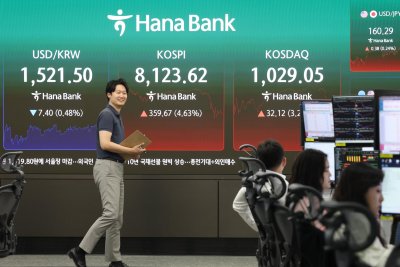
South Korean stocks shot up nearly 6.5 percent Wednesday, extending a record-breaking run to top the 7,300-point mark, driven by a semiconductor rally and optimism for a potential peace deal in the Middle East. The local currency also strengthened against the U.S. dollar.

The benchmark Korea Composite Stock Price Index (KOSPI) added 447.57 points, or 6.45 percent, to a fresh record high of 7,384.56.

It marked the second-largest daily gain in terms of points following 490.36 points reached on March 5.

Trade volume was heavy at 984.4 million shares worth 58.2 trillion won (US$40 billion), with losers outnumbering winners 199 to 677.

Foreigners bought 3.1 trillion won worth of local shares, while institutions and individuals dumped a net 2.3 trillion won and 571.2 billion won, respectively.

Overnight, U.S. President Donald Trump said he would pause operations to escort ships through the Strait of Hormuz as part of efforts to reach a final agreement with Iran.

The KOSPI opened 2.25 percent higher to surpass the landmark 7,000-point threshold for the first time and extended the gains throughout the session.

The main index has been on a bullish run in recent months, surpassing the 5,000-point mark in late January and topping another milestone of 6,000 points in February.

After recouping its losses in March following the outbreak of the U.S.-Iran war in late February, the KOSPI breached the 7,000-point level on continued optimism over the artificial intelligence (AI) boom and hopes for the reopening of the key waterway.

“Global tech giants’ strong performances and the strengthened value chain for AI data centers boosted the AI-related shares,” Lee Kyung-min, an analyst at Daishin Securities, said. “In particular, the market’s top-three shares of Samsung Electronics, SK hynix and SK Square led the rally.”

Top-cap Samsung Electronics surged 14.41 percent to close at 266,000 won, pushing its market capitalization above 1.5 quadrillion won and becoming the second Asian company to surpass the $1 trillion milestone after Taiwan Semiconductor Manufacturing Co.

SK hynix soared 10.64 percent to 1.6 million won, and AI investment firm SK Square jumped 9.89 percent to 1.1 million won.

Hanmi Semiconductor, a chip manufacturing company, rose 4.37 percent to 394,500 won, and LG Electronics vaulted 8.17 percent to 154,900 won.

However, shipbuilding and defense shares dropped. Major shipyard HD Hyundai Heavy Industries fell 4.71 percent to 648,000 won, and defense giant Hanwha Aerospace lost 2.18 percent to 1.4 million won.

Leading biotech firm Samsung Biologics declined 0.34 percent to 1.48 million won, and top mobile carrier SK Telecom backtracked 1.95 percent to 95,500 won.

The Korean won was quoted at 1,455.1 won against the U.S. dollar at 3:30 p.m., up 7.7 won from the previous session.

The quotation marks the highest since February 27, when the currency closed at 1,439.7 to the greenback.

Copyright (c) Yonhap News Agency prohibits its content from being redistributed or reprinted without consent, and forbids the content from being learned and used by artificial intelligence systems.

Source link

Why Deandre Ayton is pivotal to Lakers’ hopes against the Thunder

Can the Lakers beat the Thunder?

From Broderick Turner: Lakers center Deandre Ayton bounced across the court after practice Monday wearing all black, his chains swaying, his mood jovial as he approached the media to talk about his role in the Western Conference semifinals.

His spirits were high for what lies ahead for the Lakers as they prepared to face the best team in the NBA, the defending champion Oklahoma City Thunder.

Lakers coach JJ Redick said the play of his center “changes our ceiling the most.”

Simply put, Ayton’s high-level of play will be paramount for the Lakers when they begin the best-of-seven series Tuesday night in Oklahoma City.

“Everything has been pretty solid, just staying in my role and just doing more in my role,” Ayton said. “This is the playoffs, so everybody can do more, everybody has another level. And this is the second round coming in, so I think we all deserve that little bit of increase of confidence from what we’ve done so far and the outcome from the adversity we’ve faced.

“I feel like that’s where we are right now and I think that’s what’s motivating me, as well, coming into these games. Just seeing, listening and being dialed in and seeing the results of it.”

Continue reading here

NBA playoffs schedule

Lakers poll

Who will win the Lakers-Thunder series? Click here to vote in our survey.

Go beyond the scoreboard

Get the latest on L.A.’s teams in the daily Sports Report newsletter.

Lakers playoff schedule

Second round
All times Pacific

Tuesday at Oklahoma City, 5:30 p.m., NBC/Peacock
Thursday at Oklahoma City, 6:30 p.m., Prime Video
Saturday at Lakers, 5:30 p.m., ABC
Monday at Lakers, 7:30 p.m., Prime Video
*Wed., May 13 at Oklahoma City, TBD
*Saturday, May 16 at Lakers, TBD
*Monday, May 18 at Oklahoma City, TBD

*-if necessary

Dodgers win, but Ohtani is slumping

From Maddie Lee: It was the perfect time for Shohei Ohtani to step up to the plate. The Dodgers’ offense was rolling again, ready to make a statement with a third-inning rally against the Astros. They loaded the bases and turned over the batting order.

Then Ohtani chased a sinker off the plate and chopped a slow bouncer to Astros third baseman Isaac Paredes, giving Paredes an easy play at second. A far departure from the eye-popping exit velocities that Ohtani’s swing usually produces, the run-scoring grounder was soft enough to avoid a double play.

In the Dodgers’ 8-3 win Monday against the Astros, Ohtani’s hitless streak stretched to five games, his longest such skid since 2022, when he also went five games without a hit (May 24-28).

Manager Dave Roberts had planned to have Ohtani pitch and hit Tuesday. But during Monday’s game, he decided to change course. Ohtani will just pitch Tuesday.

Continue reading here

How a former top Dodgers prospect became an advisor to four U.S. presidents

Dodgers box score

MLB standings

Angels lose again

Munetaka Murakami hit his 14th homer and Miguel Vargas also went deep as the Chicago White Sox beat the Angels 6-0 Monday night.

Murakami’s two-run blast in the fourth inning kept the Japanese rookie tied with New York Yankees slugger Aaron Judge for the major league lead in home runs. Murakami also hit his first double of the season in the sixth, singled and scored in the eighth, finishing three for four with two RBIs and three runs scored.

Davis Martin gave up five hits in seven shutout innings, with 10 strikeouts and no walks. He improved to 5-1 and lowered his ERA to 1.64. The right-hander escaped his only jam in the seventh, getting Josh Lowe to fly to deep center with runners on first and third.

Continue reading here

Angels box score

MLB standings

Ducks lose Game 1 to Vegas

From Kevin Baxter: T-Mobile Arena sits just off the Las Vegas Strip, not far from a faux Manhattan skyline, a pyramid and a casino made to look like a castle.

The line separating illusion from reality can be a thin one in Sin City, where the Ducks opened the second round of the playoffs Monday intent on proving their first-round victory over the Edmonton Oilers was more than a facade. It didn’t go well, with Brett Howden’s goal early in the second period and Ivan Barbashev’s tiebreaking tally late in the third period giving the Vegas Golden Knights a 3-1 victory in the best-of-seven series.

Mitch Marner added an empty-net goal with six seconds to play to end any hope of a Ducks comeback. Mikael Granlund scored for the Ducks with six minutes left in the game.

But the game turned on what the Ducks thought was a missed icing call just ahead of Barbashev’s goal, which came 65 seconds after Granlund tied the score.

“Clearly I disagreed with the call. Clearly it was icing,” Ducks coach Joel Quenneville said. “That was the play for me. We had just scored. It was a huge call. And an easy call.”

Continue reading here

Ducks summary

NHL playoffs schedule

Ducks playoffs schedule

Second round
All times Pacific

Monday at Vegas, 6:30 p.m, ESPN
Wednesday at Vegas, 6:30 p.m., TNT, truTV, HBO MAX
Friday at Ducks, 6:30 p.m., TNT, truTV, HBO MAX
Sunday at Ducks, 6:30 p.m., ESPN
*Tuesday, May 12 at Vegas, TBD, ESPN
*Thursday, May 14 at Ducks, TBD, TNT, truTV, HBO MAX
*Saturday, May 16 at Vegas, TBA, ABC or ESPN

*-if necessary

This day in sports history

1908 — 34th Kentucky Derby: Arthur Pickens aboard 66-1 chance Stone Street wins in muddy track conditions; 2:15.20 slowest Derby in history.

1934 — Cavalcade wins the Kentucky Derby by more than three lengths over Discovery. It’s his third victory in less than two weeks.

1951 — 77th Kentucky Derby: Conn McCreary aboard Count Turf wins in 2:02.6.

1966 — The Montreal Canadiens beat the Detroit Red Wings 3-2 to win the Stanley Cup in six games.

1969 — The Boston Celtics beat the Lakers 107-102 in the seventh game to win the NBA championship for the 10th time in 11 years. Player-coach Bill Russell and Sam Jones retire as players.

1969 — Milwaukee Bucks sign #1 NBA Draft pick, star UCLA center Lew Alcindor.

1973 — Secretariat, ridden by Ron Turcotte, wins the Kentucky Derby with a record time of 1:59.2. Secretariat beats Sham by 2½ lengths and goes on to win the Triple Crown.

1990 — 116th Kentucky Derby: Craig Perret aboard Unbridled wins in 2:02.

1993 — Canisius beats Niagara 11-1 in softball to set an NCAA Division I record with 34 straight wins.

2001 — Monarchos wins the Kentucky Derby carrying Jorge Chavez across the finish line in 1:59 4-5, only two-fifths of a second off the track record set by Secretariat en route to the Triple Crown in 1973. Monarchos finishes a dominating 4¾ lengths over Invisible Ink.

2007 — Street Sense, ridden by Calvin Borel, roars from next-to-last in a 20-horse field to win the Kentucky Derby by 2 1-2 lengths over Hard Spun.

2007 — Floyd Mayweather Jr. beats Oscar De La Hoya in one of the richest fights. Mayweather, with superb defensive skills and superior speed, wins a 12-round split decision and the WBC 154-pound title in his first fight at that weight. The sellout crowd of 16,200 at the MGM Grand Garden in Las Vegas sets a record $19 million gate.

2012 — I’ll Have Another catches Bodemeister down the stretch and pulls away in the final furlong to win the Kentucky Derby. Jockey Mario Gutierrez, riding in his first Derby, guides the 3-year-old colt to a 1½-length victory in front of a Derby-record crowd of 165,307.

2012 — English FA Cup Final, Wembley Stadium, London (89,102): Chelsea beats Liverpool, 2–1; Didier Drogba scores winner for Blues’ 7th title.

2013 — LeBron James is the overwhelming choice as the NBA’s Most Valuable Player. The Miami star gets 120 of 121 first-place votes, giving him the award for the fourth time.

2017 — Corey Perry scores 6:57 into the second overtime after the Ducks rally from a three-goal deficit in the final minutes of regulation, completing a spectacular 4-3 comeback win over the Edmonton Oilers. Rickard Rakell scores the tying goal with 15 seconds left in regulation to cap a stunning sequence of three goals in just over three minutes, all with goalie John Gibson pulled for an extra attacker.

2018 — Justify splashes through the slop to win the Kentucky Derby by 2½ lengths, becoming the first colt in 136 years to wear the roses after not racing as a 2-year-old. The colt that began his racing career in February improves to 4-0 and gives trainer Bob Baffert his fifth Derby victory. Jockey Mike Smith earns his second Derby victory as the 5-2 favorite in the field of 20.

Compiled by the Associated Press

This day in baseball history

1904 — Cy Young of the Red Sox pitched a perfect game against the Philadelphia Athletics, beating Rube Waddell 3-0. Having pitched nine hitless innings in two previous efforts, he ran his string of hitless innings to 18.

1917 — Ernie Koob of the St. Louis Browns pitched a no-hitter against the Chicago White Sox for a 1-0 win in St. Louis.

1925 — Manager Ty Cobb of the Detroit Tigers hit three homers, a double and two singles against the St. Louis Browns.

1925 — Shortstop Everett Scott of the New York Yankees was benched, ending his streak of 1,307 consecutive games played that started while playing for the Boston Red Sox. Scott, who gave way to Pee Wee Wanninger, had the longest playing streak before Lou Gehrig.

1933 — Pepper Martin of the St. Louis Cardinals hit for the cycle and scored four runs in a 5-3 win over the Philadelphia Phillies.

1939 — Sam Chapman of the Philadelphia Athletics hit for the cycle in a 10-5 win over the St. Louis Browns. Chapman completed the cycle with a single in the ninth.

1955 — Brooklyn Dodgers rookie Tom Lasorda makes his first major league start as he he throws three wild pitches in one inning, tying a major league record. After his pitching career, Lasorda will enjoy far more success as a Hall of Fame manager.

1962 — Bo Belinsky of the Los Angeles Angels beat the Baltimore Orioles 2-0 with a no-hitter at Dodger Stadium. Belinsky struck out nine and walked four.

1975 — The Oakland Athletics release pinch-runner Herb Washington, ending his unusual major league career. Curiously, Washington played in 105 major league games without batting, pitching, or fielding. He collected 31 stolen bases and scored 33 runs.

1978 — Pete Rose became the youngest and 14th player with 3,000 hits when he singled against Montreal’s Steve Rogers at Cincinnati’s Riverfront Stadium.

1980 — National League president Chub Feeney suspended Pittsburgh’s Bill Madlock for 15 days and fined him $5,000 for shoving his glove in the face of home plate umpire Gerry Crawford.

1999 — Colorado became the first team in 35 years and the third this century to score in every inning in a 13-6 win over the Chicago Cubs. The last time a team scored in all nine innings was also at Wrigley Field, when St. Louis beat the Cubs on Sept. 13, 1964.

2000 — St. Louis Cardinals first baseman Mark McGwire hits the longest home run in the 30-year history of Cinergy Field, but the 473-foot shot is not enough as Ken Griffey, Jr.’s home run leads the Cincinnati Reds past St. Louis, 3-2.

2003 — Matt Stairs of the Pittsburgh Pirates hits a home run off Houston Astros pitcher Wade Miller which is estimated at 461 feet, making it the longest in the history of Minute Maid Park.

2004 — Mike Piazza set a major league mark for homers as a catcher, hitting No. 352 in the New York Mets’ 8-2 victory over the San Francisco Giants.

2004 — Roger Clemens of the Houston Astros moves past Steve Carlton for second place on the strikeouts list with his 4,137th in Houston’s 6-2 win over the Pittsburgh Pirates.

2006 — At Citizens Bank Park, Omar Vizquel of the San Francisco Giants plays his 2,302nd game at shortstop, catching Cal Ripken, Jr. for third-most all time. Vizquel is now behind Hall of Famers Luis Aparicio (2,581) and Ozzie Smith (2,511). He will eventually pass both.

2015 — Bartolo Colon became the first pitcher in at least 100 years to beat the same opponent with seven different teams, stopping Baltimore once again and leading the New York Mets to a 3-2 win over the Orioles.

2018 — In pitching a perfect 9th inning in a 6-5 win against the Rangers, Craig Kimbrel of the Red Sox becomes the 29th man to record 300 saves. He is the youngest to reach the mark at 29 (Francisco Rodriguez was 31) and has needed the fewest games, 494 (Mariano Rivera had done so in 537 games) and save opportunities (330, compared to 335 for Joe Nathan) to do so.

Compiled by the Associated Press

Until next time…

That concludes today’s newsletter. If you have any feedback, ideas for improvement or things you’d like to see, email me at houston.mitchell@latimes.com. To get this newsletter in your inbox, click here.

Source link