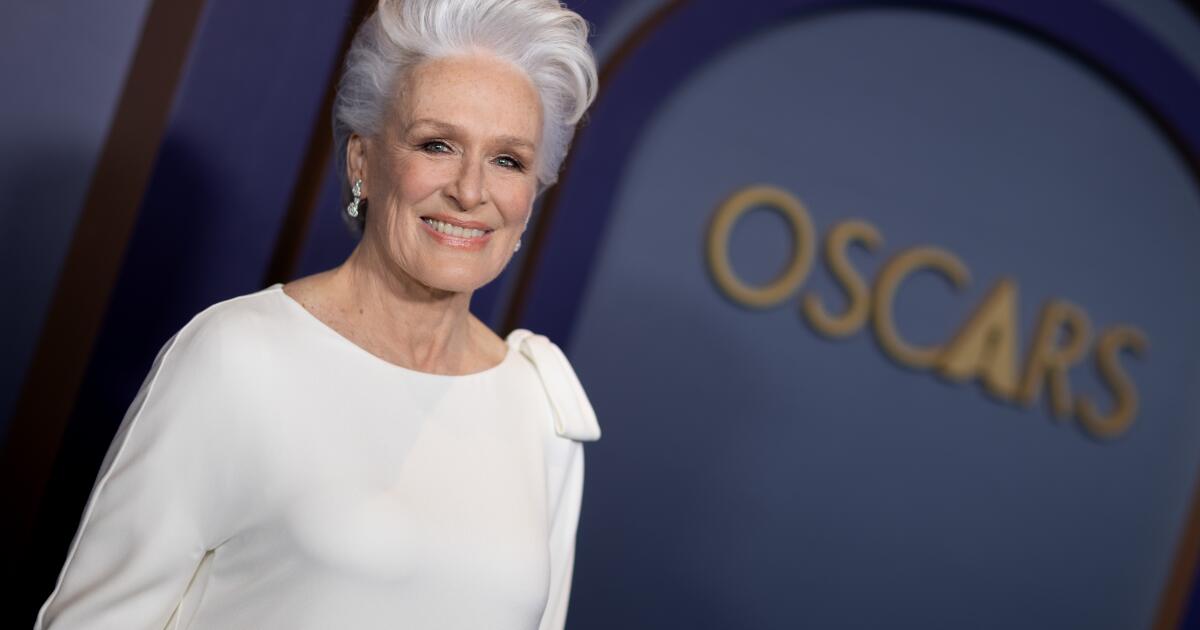
After decades spent shaping modern movies without ever taking home a competitive Oscar, actor Glenn Close and director Ridley Scott will finally receive statuettes from the Academy of Motion Picture Arts and Sciences this fall.
The academy announced Wednesday that Close and Scott will receive honorary Oscars at this year’s Governors Awards alongside pioneering animator Floyd Norman, while producers Christine Vachon and Pamela Koffler, co-founders of Killer Films, will receive the Irving G. Thalberg Memorial Award.
The annual Governors Awards, launched in 2009, recognize lifetime achievement and significant contributions to filmmaking and the motion picture industry. The Thalberg Award honors producers whose bodies of work reflect consistently high-quality motion picture production.
Unlike the competitive Oscars handed out during the telecast, the honorary prizes are presented at a separate ceremony attended by film industry figures, academy members and awards season contenders.
Close, 79, one of the most acclaimed actors of her generation, has received eight Oscar nominations over her career, including for “Fatal Attraction,” “Dangerous Liaisons,” “Albert Nobbs” and “The Wife.”
Scott, 88, the architect of “Alien” and “Blade Runner,” whose striking visual style helped define modern blockbuster filmmaking, has scored nominations for directing “Thelma & Louise,” “Gladiator” and “Black Hawk Down,” while also earning a best picture nomination for “The Martian.”
The 90-year-old Norman, who began working at Disney in the 1950s, became the studio’s first Black animator, contributing to films including “Sleeping Beauty,” “The Jungle Book” and “Robin Hood.” His career has spanned more than six decades.
Vachon and Koffler have been central figures in American independent cinema for decades, backing such films as “Boys Don’t Cry,” “Far From Heaven,” “Carol,” “First Reformed” and “Past Lives,” the last of which earned them their first best picture nomination in 2024.
The honors will be presented Nov. 15 at the Ray Dolby Ballroom at Ovation Hollywood during the academy’s 17th Governors Awards ceremony.
The leading candidates for mayor fanned out across Los Angeles this weekend to make their final cases to voters ahead of Tuesday’s hotly contested primary election.
An energized Mayor Karen Bass galvanized crowds of labor union workers sporting union merch Saturday. “Four more years!” crowds chanted as a slew of local and state Democratic heavyweights joined the incumbent.
City Councilmember Nithya Raman spent the day dashing between local restaurants and bars in an old-school yellow Scout convertible to meet with business owners and her supporters.
Meanwhile, former reality TV personality Spencer Pratt hosted a block party in Baldwin Village with barbecue food, free merch and American-flag lawn chairs — although he spent much of the event off to the side, listening to the concerns of Black residents.
Recent polls have placed Pratt and Raman within striking distance of Bass, who had enjoyed a comfortable lead for much of the campaign. A recent survey, co-sponsored by The Times, had Bass at 26%, Raman at 25% and Pratt at 22% — with a roughly 3% margin of error in either direction and 10% of voters undecided.
The top two candidates in Tuesday’s jungle primary will advance to a November runoff, unless one candidate manages to garner over 50% of the vote.
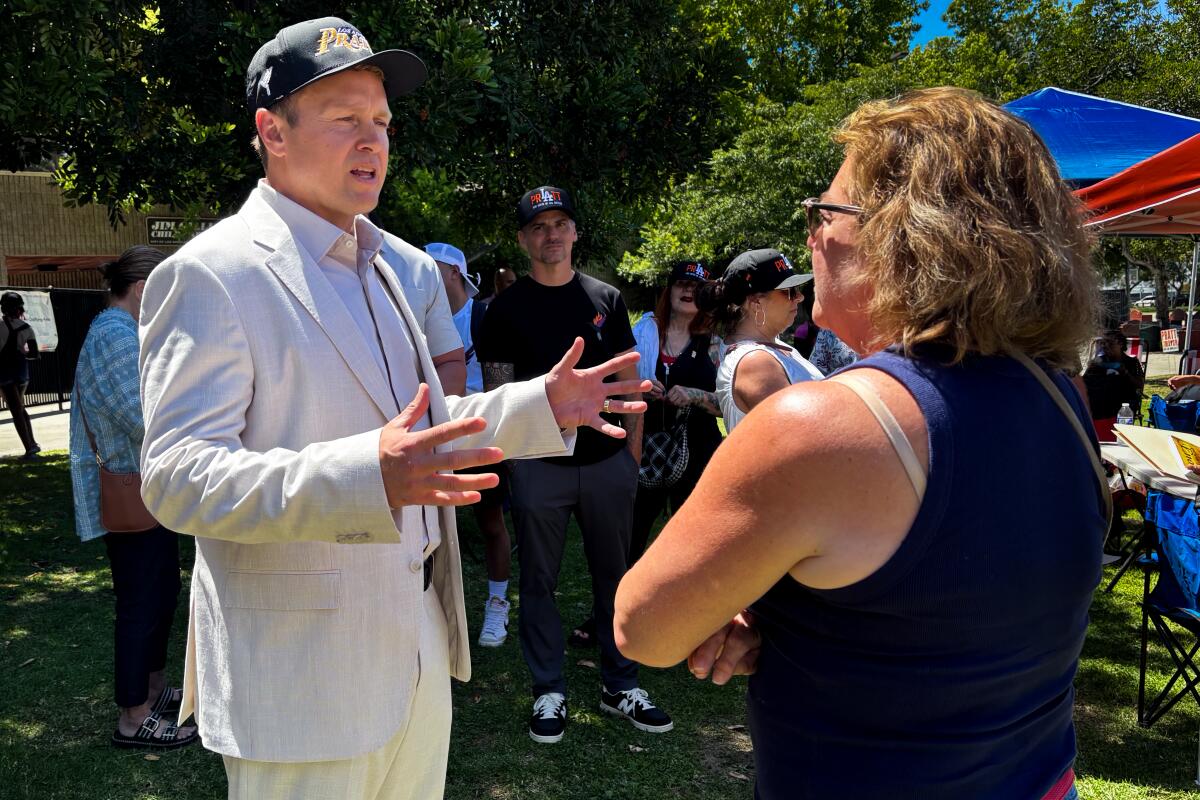
Mayoral candidate Spencer Pratt speaks with Diane Waterhouse, a caregiver and Westchester native, about homelessness and drug addiction at a campaign event Saturday in Baldwin Village. “We just talk about it like, ‘oh it’s Skid Row, that’s just where the drug addicts are.’ No, there’s communities, there’s kids, there’s people that work there, businesses,” Pratt said.
(Noah Haggerty / Los Angeles Times)
“I believe God moves mountains; I believe that you can get that 51% on that Tuesday,” Diane Waterhouse, a 60-year-old caregiver, told Pratt at his Baldwin Village event.
On the lawn of Jim Gilliam Park on Saturday, supporters from across the city chanted Pratt’s name, took selfies in front of black campaign vans with his hummingbird logo and ate cookies decorated with his face as kids raced around on scooters and played with the handful of dogs attending.
But Pratt — who had spent the morning at the West Los Angeles Animal Shelter speaking with animal welfare advocates — headed toward the nearby recreation center to talk with residents away from the cameras.
“Most people that come here and want our vote — we give y’all our vote; we’re still living like this. Nothing changes,” Erica Helon, a 40-year-old bus driver, told Pratt in one of the most tense moments of the event.
Pratt, wearing a beige suit and a hat with his name stylized like the L.A. Lakers logo, emphasized he was in South Los Angeles to listen and wasn’t even asking residents for their votes. He pulled Helon aside and gave her his personal phone number so they could talk more.
“I’m here because I want to be a voice for the community,” he said at one point. “I’m here because I don’t know what I don’t know.”
Helon, who is still undecided, left the event open-minded on Pratt.
“I would love to see what he’s going to do for this city,” she said.
Los Angeles mayoral candidate Nithya Raman joins a group photograph during a campaign stop Sunday with SevaSphere volunteers after preparing meals for people experiencing homelessness at Oaks Kitchens.
(Kayla Bartkowski / Los Angeles Times)
Raman, who has made publishing detailed policy plans a staple of her campaign, spent Saturday meeting with local restaurant owners after recently dropping a policy plan for small businesses.
Around sunset, the yellow convertible pulled up to Lowboy Bar, an Echo Park staple. Raman, sporting a Japanese Dodgers hat and a rainbow City Council fanny pack, joined campaign staff for drinks at tables covered in “Nithya Raman for Mayor” pins.
A few young Angelenos, starting out their nights in trendy getups, recognized Raman and stopped by to chat and take pictures.
“I’ve lived in L.A. for 12 years. It’s a very, very important city to me,” said Ryan Bergeron, a 35-year-old who works in marketing and does art on the side.
Bergeron, who is on the Echo Park neighborhood council, hopes Los Angeles can serve as a “beacon in an otherwise scary time in the country” as it tackles affordability, the housing crisis and sustainability issues.
As for Raman, “I’ve seen her as a councilmember and been really proud of that,” Bergeron said. When she announced her candidacy for mayor, “It felt like everything really clicked.”
Mayor Karen Bass and Councilmember Monica Rodriguez attend the Los Angeles Democratic Party and Avance Democratic Club Carne Asada Tour, a community event held Saturday at the Yosemite Recreation Center. Avanceis one of the country’s largest Latino Democratic clubs.
(Karla Gachet / For The Times)
Bass, conversely, wound down after a day of union rallies by eating tacos at the Yosemite Recreation Center’s picnic tables in Eagle Rock with several local politicians, including Councilmember Monica Rodriguez and county Democratic Party Chair Mark Ramos.
California Atty. Gen. Rob Bonta and L.A. County Sheriff Robert Luna had joined Bass earlier in the day. Although Luna missed out on the picnic, he still enjoyed several tacos in his car.
Come Sunday, Raman, wearing jeans and a chartreuse cardigan, was greeting bike riders at a Sawtelle coffee shop and speaking to a phone bank group at UCLA.
“It is absolutely essential to making sure that our little campaign, without all the political machine behind us, without MAGA millions behind us, that our vision of Los Angeles still manages to get out to the people, and your work today is an essential part of that,” Raman told a group of United Auto Workers-represented graduate students from multiple nearby universities.
She had several other appearances scheduled for the rest of the day, including lunch with a group of Korean American Democrats in Koreatown, Encinofest, a block party in Silver Lake and a visit to Boyle Heights.
“There seems to be increasing awareness about the race and excitement about the issues,” Raman told The Times. “It’s been really exciting to see people engaging and feeling positive about the city’s future.”
About two dozen students spoke to potential voters associated with UAW and urged them to mark Raman’s name on their ballots by Tuesday.
Stephanie Wert, a 30-year-old psychology graduate student at UCLA and head steward for UAW, said the phone bank could determine whether Raman’s campaign would survive the week.
“This vote is going to be decided on the margins, and so I think we could really make the difference that pushes her to the runoff,” Wert said.
Bass peeked around the back doors of a supporter’s Venice home Sunday afternoon to cheers from several dozen supporters at an intimate event. Speaking over small snack plates and beverages, many said they saw real improvements in the homeless populations around their neighborhood during Bass’ tenure as mayor.
Tatiana Barhar, a Venice resident for over 30 years, said she saw in real-time an “extreme” homelessness problem get better during Bass’ term, thanks to her Inside Safe program. “I want to support her,” she said. “I think there’s a lot more she can do.”
Bass spoke of 1960s-level crime rates, thousands of unhoused people pulled off the street into housing and efforts to build up Hollywood during her time as mayor. “We got a lot to do,” Bass said. “We have such a bright future in the nation’s second-largest city, and I hope that you will continue to be there with me as we win.”
Pratt’s moves on Sunday remained more elusive. His campaign emphasized he was hoping to have intimate moments with L.A. communities, instead of a media and influencer frenzy like some of his previous, more widely publicized events.
One of those more intimate moments was a community event in a Latino neighborhood near downtown L.A. on Sunday morning. Pratt had spent Thursday in New York for some national media interviews to “get the message to as many people as possible.”
CLOVIS, Calif. — In the waning days before California’s primary election, the two top Republicans running for California governor delivered closing arguments in front of a friendly Central Valley audience Friday evening.
Hilton criticized Newsom’s new $20-million program to provide free diapers for families of newborn babies, referring to the outgoing governor as “the great loaded diaper of California himself.”
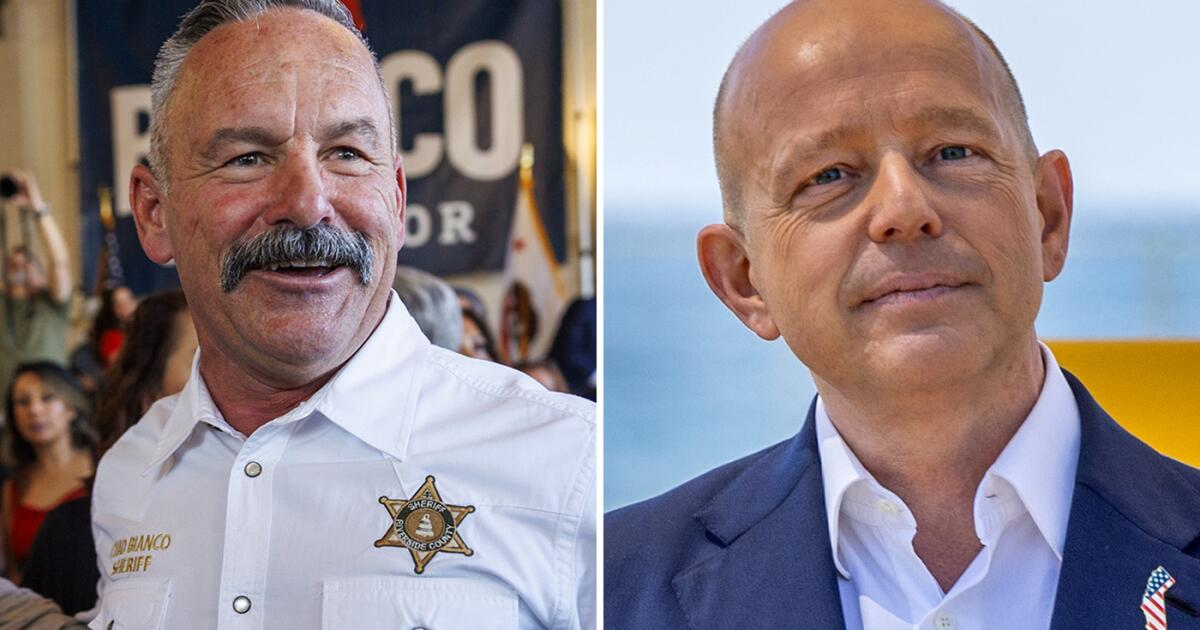
Earlier this year, Hilton and Bianco topped the governor’s race polls as a packed field of Democrats split many of the state’s liberal voters. Under California’s “jungle primary” system, where the top two candidates advance from the primary to the general election regardless of political affiliation, that led to fleeting hope among Republicans that the two candidates could shut Democratic candidates out of the November election.
“That idea was always a fantasy,” Hilton wrote in an op-ed published in the New York Post earlier this week in which he urged Bianco to drop out of the race “for the sake of the state we both love.”
“Steve, it is time for you to drop out,” Bianco retorted in a video posted to social media soon after. “In no world, no world does Steve Hilton beat a Democrat in November.”
After winning an endorsement from President Trump in early April, Hilton has steadily outpaced Bianco in polls. A poll commissioned by the California Democratic Party released last week showed Hilton leading the field with support from 22% of likely voters, followed by Democrat and former Biden Cabinet member Xavier Becerra with 21%. Bianco was at 10%, down from 15% in a previous poll conducted two weeks prior.
Still, Bianco, the two-term sheriff of California’s fourth most populous county, is a favorite of many Republicans in the state and won more support from delegates during the party’s recent endorsing convention than Hilton, though neither reached the necessary 60% to win the party backing.
While the two candidates have needled each other with personal digs and insults throughout much of the campaign, they appeared to set that energy aside during the Clovis forum and even traded some compliments. Hilton praised “sheriffs like Chad who actually understand what public safety looks like” while Bianco acknowledged that his opponent “should be very proud” to have Trump’s endorsement.
State Sen. Shannon Grove (R-Bakersfield), who moderated the more than 90-minute event, praised their “extraordinary civility” before she pressured each to commit to backing whichever Republican makes it through the June 2 primary — or if they both advance, continue to focus on policy debates over attacks.
The forum was hosted by the Fresno County & City Republican Women Federated as part of a fundraiser and dinner honoring the upcoming 250th anniversary of the nation’s founding. About 450 attendees were served dishes inspired by presidential favorites including sirloin steak for Theodore Roosevelt, a chopped salad from Chasen’s, a favorite Los Angeles eatery for Ronald Reagan, and a chocolate pie with cherry vanilla ice cream for Trump.
The Central Valley stretches from Bakersfield to Redding and is home to some of the nation’s most lucrative farmland. It also includes the heart of California oil country in Kern County. Yet residents feel largely neglected by statewide politicians who are more drawn to the ample votes and wealthy donors in Southern California and the Bay Area.
“We are the breadbasket of the world but we’ve been overlooked for too long,” said Andrea Shabaglian, a vice president of the Fresno Republican women’s group. “When gubernatorial candidates come here to sit down and listen to our communities, they realize that a stronger Valley means a stronger California.”
Though he lost California handily to former Vice President Kamala Harris in the 2024 election, Trump dominated in the state’s midsection. Even in Fresno County, where the Republican forum was held, Trump beat Harris by a four percentage point margin despite Democratic voters slightly outnumbering Republicans.
“We need a Republican in office because California is a mess. I mean, anybody with common sense can see that,” said LuAnne Pinedo-Madden, a retiree living in the Sierra foothill community of Coarsegold who listed transgender girls being allowed to compete in girls’ sports and government corruption as her top concerns.
Pinedo-Madden said she was “pretty sure” she had decided which of the Republican candidates to vote for but declined to say whom. “I feel that if we don’t get a Republican in office, we’re looking at moving” to Utah, Idaho or Nevada, she said. “We can’t take this anymore.”
Bianco and Hilton spoke about their plans to improve public safety, small businesses, homeowner’s insurance and water management, a crucial issue for the conservative-leaning owners of vast swaths of California’s agricultural heartland.
Signs along the major highways that straddle California’s Central Valley proclaim that “Food grows where water flows” and criticize Newsom for allowing water to flow into the ocean instead of capturing and storing more of it for farming.
Both of the GOP candidates described their visions for the state, which include building new dams and raising existing ones to store more water.
“We don’t have the water problem. We have a water management problem,” Bianco said before falsely arguing that “we get more water every single year than any other state in the country” and that California has “never, ever, ever been in a drought.”
“The water will be flowing to our farmers, the oil will be flowing to our refineries, the forests will be managed, the timber will be harvested” and used to build new single-family homes, Hilton said. “We’ve got the best weather, we’ve got the best people, we’ve got the best farmers, we’ve got everything we need to make this place amazing, except a good governor. Very soon we’ll have that as well.”
Though a Republican governor would likely face a hostile Legislature intent on blocking many priorities, Bianco and Hilton both promised sweeping cuts and cutbacks of state agencies. Both pledged on Friday to replace every member of the state’s parole review board, which drew criticism in February when it granted elderly parole to a man convicted of 16 counts of kidnapping and child molestation in 1999.
“California criminal justice is absolutely broken and it was forced upon us in the name of reform. What I’m going to do is make it a crime to hear the word reform again, because we lost track of what that word even means,” Bianco said.
He also pledged to eliminate laws and environmental regulators often blamed for slowing housing development: the California Environmental Quality Act, the California Coastal Commission and the state Air Resources Board.
Though his opponent has the coveted Trump endorsement, Bianco argued that it will hurt Hilton’s chances of winning the general election. The Republican president has never been popular in deep-blue California; just 25% of adults in the state approved of Trump’s performance according to a February survey by the Public Policy Institute of California.
“Steve should rightfully be proud of being endorsed by President Trump [but] we have to actually realize, is that a good thing in California? It’s a good thing in this room,” Bianco said as the crowd cheered at the mention of the president’s name. “We have to realize strategically that President Trump ran three elections in this state, and he lost 60-40 in all three of them.”
The Riverside sheriff argued he is “the only person that can actually sway Democrats to vote for a Republican across party lines on a public safety platform.”