Molly-Mae Hague and Tommy Fury with their daughter BambiCredit: InstagramMolly showed off their bedroom transformationCredit: Instagram/MollyMaisonThe couple opted for a more metallic and charcoal colour paletteCredit: Instagram/MollyMaison
Since then Molly-Mae has completely renovated the home, including redoing the master bedroom.
The TV star took to her dedicated remodelling Instagram account, Molly Maison, to show off the bedroom transformation.
Gone were the warm cream and brown tones, in favour for a more cool grey aesthetic.
Molly-Mae replaced the wooden four-poster bed with a standard double bed and giant leather headboard, behind which sat a wall-to-wall mirror.
She also replaced the shell inspired circular ceiling fixture with a more sleek metallic and glass version.
At the other end of the room, Molly-Mae removed the inset arched shelves and cabinets for two floor-to-ceiling mirrors which sat on either side of the new, darker fireplace.
Molly-Mae also removed the TV from above the cream and black veined marble fireplace and replaced it with a stunning piece of artwork.
Two grey chaise lounges sat on either side of the room, replacing the cream one-seater armchairs that were there before.
Even the old bedroom was gorgeous, Molly explained why she felt the need to overhaul it completely.
“There was absolutely nothing wrong with the space before but because we’re planning to be here for a long time, we really wanted to make it feel completely like us… you all know how much I love my neutral, calming spaces,” she wrote.
Molly-Mae explained that they redid their bedroom because they planned to be there a long timeCredit: Instagram/MollyMaisonMolly-Mae aid she loved neutral toneCredit: Instagram/MollyMaison
“I honestly couldn’t be happier with how it’s turned out… I’m so excited to keep making more special updates to our new home.”
Molly-Mae and Tommy are parents to daughter Bambi, three, and are set to welcome their second child in a matter of weeks.
The Maebe founderrecently revealed they had already chosen the name for their second child, and promised it would be just as unusual as their first.
“I think we’re pretty much set on a name now, which is crazy. Also just can’t wait for everyone to hate it, obviously it’s a different name – we were never gonna call our baby just an ordinary name, that was never going to happen,” Molly-Mae said on her recent YouTube vlog.
“I’ve only ever heard of one other baby being called this name.”
She added “Can’t wait for everyone to literally probably dislike it and be like ‘da f***?’, but yeah, it was never gonna be an ordinary name guys lets be honest.”
Molly-Mae is pregnant with her second babyCredit: Instagram
HOLLY Willoughby is turning up the heat — as she plans to install a sauna at her £8million London home.
The TV host, 45, has been researching fancy brands and asked her 8.1million Instagram followers about the health benefits of classic and infrared units.
Sign up for the Showbiz newsletter
Thank you!
Holly Willoughby is turning up the heat — as she plans to install a sauna at her £8million London homeCredit: GettyHolly has been researching fancy brands and asked her 8.1million Instagram followers about the health benefits of classic and infrared unitsCredit: GettyHolly’s sauna search comes as prepares a comeback on YouTube with an edgier imageCredit: Getty
Mum-of-three Holly and her telly producer husband Dan Baldwin, 50, bought the six-bedroom home in South West London last year.
Her sauna search comes as the ex-This Morning host and former golden girl of ITV shuns traditional broadcasters and prepares a comeback on YouTube with an edgier image.
A source recently told The Sun: “Charli XCX might think she’s the original Brat girl, but Holly will give her a run for her money.”
She appeared to put her band’s woes to one side as she posed for pictures with her longtime friend Holly.
Baby Spice got into the spirit of things by donning a pair of Mickey Mouse ears as well as a tie with the famous character on it.
She looked chic in a white shirt tucked into a pair of straight leg jeans and a cream wool coat.
Emma wore her blonde locks straight and opted for a subtle make-up look.
Meanwhile, Holly wore a black t-shirt tucked into jeans with a black coat and some brown boots.
She too got into the Disney spirit with a set of ears as the two put on their widest smiles for photos.
The two women have been firm friends for several years and are often spotted socialising with their group of friends, including Melanie Blatt and Christine Lampard.
The ex-This Morning host and former golden girl of ITV is shunning traditional broadcastersCredit: GettyA source recently told The Sun: ‘Charli XCX might think she’s the original Brat girl, but Holly will give her a run for her money’Credit: Getty
If you grew up in the ‘70s or ‘80s, your vision of suburban America probably looks a lot like South Pasadena. There’s good reason. The picturesque town on the western edge of the San Gabriel Valley was often used as a backdrop in films like “Halloween,” “Pretty in Pink” and “Back to the Future” (the street where George McFly, Lorraine and Biff lived is actually Bushnell Avenue).
Today in South Pasadena, you’ll still find this idyllic Anytown USA landscape — but with a twist: Along with verdant parks, Craftsman bungalows and tree-lined streets, the city gleams with cool new developments like the recently opened Sid the Cat Auditorium, an all-ages live music venue in a converted 1930s elementary school; the always-packed Cannonball from chef Matt Molina; L.A.’s first nonalcoholic bottle shop Burden of Proof and a high-tech head spa imported from Japan. Add on a walkable downtown and a bustling Thursday night farmers market and it’s easy to see why so many Angelenos are drawn to this increasingly hip community.
Get to know Los Angeles through the places that bring it to life. From restaurants to shops to outdoor spaces, here’s what to discover now.
“So few pockets of L.A. County are actually great for families and that’s what makes South Pas so compelling,” said my friend Tom, who moved to the area after having a baby two years ago. “Plus, it has light-rail.”
Located six miles from downtown L.A., South Pasadena was marketed as a “garden community” when it was founded in the late 19th century. New residents were promised homes with flowering vines and sweet-smelling gardens, all just a short cable car ride away from a bustling metropolis.
“It was that early promise of suburbia,” said Becky Nicolaides, a historian and author of the book “The New Suburbia: How Diversity Remade Suburban Life in Los Angeles After 1945.” “When it was incorporated, there weren’t cars, so the town was built to be walkable.”
But that peaceful facade hid an ugly truth. Like many suburbs in the L.A. area, the town’s officials put race restrictive covenants into place soon after its founding, making it illegal for residents to sell property to people of color.
Those covenants became illegal in 1948, but the town continued to discourage people of color from living within its boundaries for several more decades. That began to change in the 1960s and South Pasadena has diversified, particularly over the past decade. In recent years, town leadership has taken steps to acknowledge its racist past.
Now, even as a new energy permeates, the city continues to lean into its early suburban history. The town is just 3.4 square miles, but it encompasses 100 acres of parks and playgrounds as well as 21,000 trees. There’s an old-fashioned pharmacy where parents have taken their kids for a phosphate soda (or just a regular old milkshake) for over 100 years and volunteers from the community still decorate a float for the Tournament of Roses each year, just as they have since 1911.
And though its historic Red Car trolleys have been discontinued for decades, today it’s still a comfort to take the Metro home from work at the end of a long day and enjoy the peace and quiet of this pastoral suburb, just like its founders did more than a century ago.
What’s included in this guide
Anyone who’s lived in a major metropolis can tell you that neighborhoods are a tricky thing. They’re eternally malleable and evoke sociological questions around how we place our homes, our neighbors and our communities within a wider tapestry. In the name of neighborly generosity, we may include gems that linger outside of technical parameters. Instead of leaning into stark definitions, we hope to celebrate all of the places that make us love where we live.
Our journalists independently visited every spot recommended in this guide. We do not accept free meals or experiences. What L.A. neighborhood should we check out next? Send ideas to guides@latimes.com.
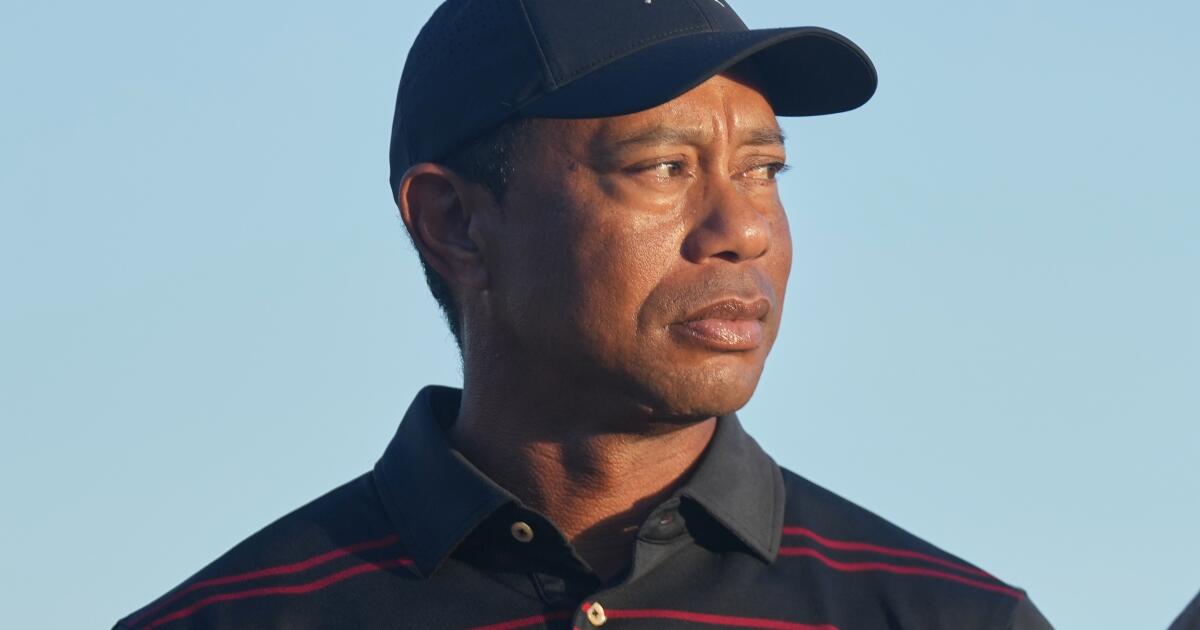
Shortly after his attorney entered a plea of not guilty, Tiger Woods announced he will seek treatment “to prioritize my well-being and work toward lasting recovery.”
The golf legend was arrested Friday on suspicion of DUI with property damage and refusal to submit to a urinalysis stemming from a rollover crash near his home on Jupiter Island, Fla. Hydrocodone pills were found in his pocket and a sheriff’s deputy noted in the arrest affidavit that Woods had bloodshot eyes and dilated pupils and was “sweating profusely” while performing field sobriety tests.
Attorney Douglas Duncan appeared in Martin County, Fla., court Tuesday, waived arraignment on Woods’ behalf, entered not guilty pleas on the two misdemeanor charges and requested a trial by jury.
“I know and understand the seriousness of the situation I find myself in today. I am stepping away for a period of time to seek treatment and focus on my health. This is necessary in order for me to prioritize my well-being and work toward lasting recovery.
“I’m committed to taking the time needed to return to a healthier, stronger, and more focused place, both personally and professionally. I appreciate your understanding and support, and ask for privacy for my family, loved ones and myself at this time.”
Although he hadn’t committed to playing, Woods had been toying with returning to competition for the first time since 2024 at next week’s Masters at Augusta National Golf Club, where he has won five championships.
Now he won’t even make an appearance, let alone play. Woods was scheduled to attend the opening of “The Patch,” a municipal golf course in Augusta that he helped redesign. He also was expected to attend the annual Champions Dinner on April 7.
“Augusta National Golf Club and the Masters Tournament fully support Tiger Woods as he focuses on his well-being,” Masters chairman Fred Ridley said in a statement. “Although Tiger will not be joining us in person next week, his presence will be felt here in Augusta.”
Woods, 50, last competed on the PGA Tour in July 2024 when he missed the cut at the Open Championship, posting an 8-over 79 and 6-over 77 at Royal Troon. It marked his third consecutive missed cut in a major that year.
Widely considered the greatest golfer of all time, Woods has amassed 82 PGA Tour wins, including 15 majors. He has competed sporadically the last four years because of injuries, but has become an increasingly important figure off the course, serving as chairman of the PGA Tour’s Future Competition Committee and serving on the tour’s Enterprises Board, Policy Board and Player Advisory Council.
When arrested Friday, Woods was asked if he had any medical conditions. He replied that he has had seven back surgeries and at least 20 leg operations.
He also has had several car accidents.
Around Thanksgiving 2009, a report that Woods had been in a car accident near his home erupted into a major scandal involving allegations of affairs. It resulted in Woods’ divorce from Elin Nordegren, the mother of his children.
In 2021, Woods was seriously injured in a rollover crash near Rancho Palos Verdes the morning after the Genesis Invitational, which he hosted at Riviera Country Club. He had to be extricated from the wreckage of the Genesis GV80 SUV that he was driving
Woods underwent “a long surgical procedure” on his lower right leg and ankle, according to a statement he released. Doctors inserted a rod into his leg and placed screws into his foot and ankle.
A store run by Mega MGC Coffee, which reportedly bid for Home Plus Express. Photo by MGC Global
SEOUL, April 1 (UPI) — South Korean discount chain Home Plus said Tuesday that a court has begun to review the sale of its neighborhood grocery store chain, Home Plus Express.
Home Plus, which is under receivership, said the court started the procedure of selecting a preferred bidder after receiving reports from its sales adviser, Samil PricewaterhouseCoopers.
“Prior to the March 31 deadline, multiple companies were confirmed to have participated in the bidding process to acquire Home Plus Express,” the firm said in a statement.
Home Plus did not disclose further details, including the number of bidders and their identities.
However, Mega MGC Coffee has reportedly presented a bid for Home Plus Express. The budget coffee chain, which is owned by MGC Global, operates nearly 4,000 stores across South Korea.
Both MGC Global and Home Plus declined to confirm the reports.
Following unsuccessful attempts to sell Home Plus as a single entity, the divestment of Home Plus Express has emerged as a key pillar of its rehabilitation plan. The unit generated $730 million in revenue in 2024.
The Express division has a network of almost 300 stores and most of them are located in high-density urban areas. Home Plus also runs more than 100 large-format outlets.
In 2015, South Korea’s leading private equity fund, MBK Partners, purchased Home Plus from Tesco in a landmark $5 billion deal. In recent years, the retailer has struggled amid pandemic-related disruptions and the rise of e-commerce giants.
Since early last year, MBK Partners has tried to dispose of Home Plus to little avail. As a result, the company has shifted its focus to the sale of Home Plus Express.
NASHVILLE — The crews of two AH-64 Apache helicopters that hovered next to Kid Rock’s swimming pool while he clapped and saluted Saturday have been suspended from flying pending an investigation of their actions, a U.S. Army spokesperson said Tuesday.
The suspension is a discretionary, but not unusual, step when an investigation is underway, Maj. Montrell Russell said.
“The Army has confirmed that on March 28, two Apache helicopters from the 101st Combat Aviation Brigade at Fort Campbell conducted a flight in the Nashville area that has attracted public and media attention,” according to a statement from the Army on Tuesday. The Army is reviewing “the circumstances surrounding the mission, including compliance with relevant FAA regulations, aviation safety protocol, and approval requirements.”
Kid Rock, an entertainer who is an outspoken supporter of President Trump, told WKRN-TV on Monday that it’s not uncommon for helicopters from nearby Ft. Campbell to fly near his home. He said he is a big supporter of the military and he’s performed for troops overseas in Afghanistan, Iraq and other countries.
“I think they know this is a pretty friendly spot,” he said. He noted that at Thanksgiving he was at Ft. Campbell, a sprawling Army base on the Tennessee-Kentucky border, with Vice President JD Vance. “I’ve talked to some of these pilots. I’ve told them, ‘You guys see me waving when you come by the house?’ I’m like, ‘You guys are always welcome to cruise by my house, any time,’” he said.
Kid Rock posted two short videos Saturday on social media. Each shows a helicopter hovering alongside his swimming pool while the entertainer claps, salutes and raises his fist in the air. One post included a caption by Kid Rock disparaging Democratic California Gov. Gavin Newsom, a frequent Trump critic.
In the videos, Kid Rock stands next to a replica of the Statue of Liberty and a sign by the pool that reads, “The Southern White House.” His home on a hill overlooking Nashville was built to resemble the White House.
The helicopters were on a training mission when they stopped by Kid Rock’s house, said Maj. Jonathon Bless, public affairs officer for the 101st Airborne Division. The helicopters also flew over a “No Kings” protest against Trump in downtown Nashville, but Bless said their presence had nothing to do with the protest.
Kid Rock said he thought it was “really cool” that they stopped to hover at his house.
“If it makes their day a little brighter for their service to our country, protecting us, I think that’s a great thing,” he said.
Asked about possible repercussions for the crews, he said, “I think they’re going to be all right. My buddy’s the commander in chief.”
TAKE That’s Howard Donald has revealed he is selling off his beloved campervan home for a FIVE figure sum, and said that ‘it saddened” him to part with it.
Take That’s Howard Donald is selling off his beloved campervanCredit: Instagram/@howarddonaldThe singer wants a whopping £50K for the VW camperCredit: Instagram/@howarddonaldThe cosy van has been restored to look like an original VWCredit: Instagram/@howarddonaldThe star has been in Take That since the early 90s – and has earned a lot of money thanks to thisCredit: Getty
The minted star, who has made his millions from touring and making records with Take That, is now giving fans the opportunity to snap up the luxury motor.
For £50K, Howard‘s loyal followers can buy the campervan from him.
The star shared the news on Instagram with a slew of pics of the cosy looking vehicle.
In one snap, Howard is seen standing next to the campervan, as he got ready to say goodbye to it.
Among the collection, the singer owns a Mercedes-Benz G63 AMG, which he uses to drive his family, a 1970 Mercedes-Benz 280SE Cabriolet, and a 1959 Chevrolet Brookwood.
Howard previously revealed he believes he has around 17 supercars – but that he finds it hard to store them all.
The Take that star has an eye-watering car collectionCredit: Rex FeaturesTake That were the biggest boyband in the 90sCredit: Getty
The star told the Fuelling Around podcast in 2023: “It’s come to a point where you’re trying to put them in other people’s garages and you’re thinking, “No, it’s too ridiculous’.”
At the time he said that he was planning to sell some of his cars to pay for his children’s education.
“One day, it’ll come to the crunch where Take That probably will stop eventually, and then you think, ‘I’m going to have to sell one of my cars’,” the star said.
He joked: “I really hate my kids for that, though.”
Howard shot to fame in the early 90s as one of the five original members of Take That.
Howard has built up a fortune thanks to his long career as a popstar – seen here in the 90sCredit: Getty
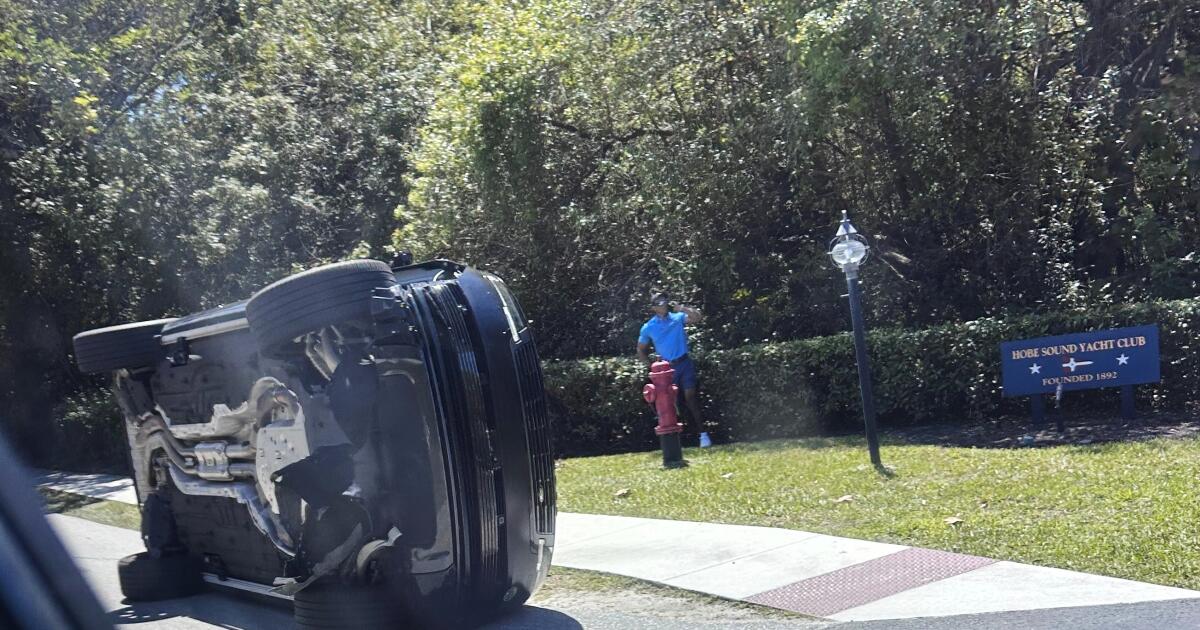
Tiger Woods failed field sobriety tests after crashing into another vehicle last week, and had bloodshot eyes and two hydrocodone pills in his pants pocket, according to a probable cause arrest affidavit released Tuesday.
Woods, 50, told investigators he did not notice the vehicle in front of him had slowed because he was looking at his cell phone and changing the radio station, the affidavit said. His Land Rover rolled onto its side after hitting a Ford-F150 pickup truck pulling a small trailer.
The prescription opioid pills were found during a search after his arrest on suspicion of driving under the influence, causing property damage and refusal to submit to a lawful test. Woods told deputies he had taken prescription medications earlier that day.
The accident and arrest occurred Friday afternoon near Woods’ home on Jupiter Island, Fla. Although Woods appeared impaired, he told deputies he had not consumed alcohol, which Martin County Sheriff John M. Budensiek said was confirmed by a breathalyzer test.
“Our DUI investigators came to the scene here, and Mr. Woods did exemplify the signs of impairment,” Budensiek said.
A Martin County Sheriff deputy noted that Woods had bloodshot and glassy eyes and extremely dilated pupils, according to the affidavit. Woods also was “sweating profusely” while performing field sobriety tests.
Asked if he had any medical conditions, the 82-time PGA Tour champion replied that he has had seven back surgeries and at least 20 leg operations. He was wearing a compression sleeve over his right knee.
“Woods’ movement was lethargic and slow,” sheriff’s deputy Tatiana Levenar wrote in the report. “While walking, I observed Woods limping and stumbling to the right.
“I asked Woods if he was able to perform tasks such as walking and lifting his leg. Woods advised he has a limp and his ankle seizes while walking.”
The affidavit also noted that “Woods had hiccups during the entire investigation.”
The crash is the fourth major incident involving Woods behind the wheel since 2009. When he was arrested on suspicion of driving under the influence in May 2017, Woods was found to have five drugs in his system, including hydrocodone and Dilaudid. Woods checked into a rehab clinic shortly thereafter and completed treatment.
Around Thanksgiving 2009, a report that Woods had been in a car accident near his home erupted into a major scandal involving allegations of affairs. It resulted in Woods’ divorce from Elin Nordegren, the mother of his children.
In 2021, Woods was seriously injured in a rollover crash near Rancho Palos Verdes the morning after the Genesis Invitational, which he hosted at Riviera Country Club. He had to be extricated from the wreckage of the Genesis GV80 SUV he was driving
Woods underwent “a long surgical procedure” on his lower right leg and ankle, according to a statement he released. Doctors inserted a rod into his leg and placed screws into his foot and ankle.
German Chancellor Friedrich Merz, right, and Syrian President Ahmed al-Sharaa attend a joint press conference during their meeting at the Federal Chancellery in Berlin on Monday, where they announced a goal of 80% of Syrian refugees who fled the country during its 14-year-long civil war to return home. Photo by Filip Singer/EPA
March 30 (UPI) — The chancellor of Germany and president of Syria on Monday said that their goal is for 80% of Syrian refugees who have fled there to return home in the next three years.
With few details offered, Chancellor Friedrich Merz and President Ahmed al-Sharaa set an ambitious goal for the majority of the roughly one million people there who sought asylum from the bloody civil war in Syria, The BBC reported.
Merz and Sharaa met Monday to discuss the return of Syrian refugees, while noting they have been a boon to Germany and are not being kicked out.
“Looking ahead over the next three years — as Sharaa has expressed his hope — around 80% of Syrians currently residing in Germany are expected to return to their home country,” Merz said during a press conference.
Sharaa thanked Merz and the country for welcoming Syrians during the civil war and said the country is “proud that Syrians have learned very quickly how to contribute to society.”
He said that his government is working with the German government to “establish a ‘circular’ migration model” that would allow Syrians to contribute to the reconstruction of Syria without abandoning the lives they have build in Germany.
Sharaa led forces that pushed former Syrian dictator Bashar al-Assd to flee the country in late 2024 after they captured Damascus. His administration is now working to reconstruct and unify the country after 14 years of civil war there.
At the press conference, Merz and Sharaa said that overall conditions in Syria have “fundamentally improved,” a point which German politicians have been debating since the new Syrian president took over, Deutche Weille reported.
A child stands atop an abandoned tank while opposition fighters spread out to areas previously controlled by Assad’s regime in the liberated areas of Daraa, in northern Syria, on December 17, 2024. Photo by Fadel Itani /UPI | License Photo
Within the first 72 hours of a 26-day game, “Survivor 50,” featuring 24 veteran players, had already delivered feuding, anguish and heartbreak. Legendary rivals Ozzy Lusth and Benjamin “Coach” Wade appeared to bury the hatchet, only for their conflict to reignite soon after. Kyle Fraser was forced out due to injury, and Jenna Lewis-Dougherty, who competed in both the show’s inaugural season and “All-Stars,” was the first person voted out after more than two decades away from the game.
Yet there were also moments of nostalgia, connection and excitement as returning players arrived on the beach, grateful to be part of the show’s landmark 50th season.
This raw display of humanity has kept the show’s torch burning for over 25 years. “‘Survivor’ is built on a timeless idea because human nature doesn’t change,” says Jeff Probst, the host, executive producer and showrunner of the reality competition series. “It’s essentially behavioral psychology in the wild.”
Back in Fiji’s Mamanuca Islands for “Survivor 50: In the Hands of Fans,” the show has added a novel element. Fans were given a say in key decisions, voting online to shape production and game mechanics, from choosing tribe colors to requiring castaways to earn rice and supplies instead of receiving them at the start.
“What a great twist,” says Wade in an interview over Zoom. “‘In the Hands of Fans’ transforms the game. Instead of it being, ‘They are playing,’ it’s ‘We are playing.’”
Though he was disappointed to be deprived of staples upon his arrival, he smiles and says that if he were watching at home rather than competing, he also would have wanted players to start with nothing.
Singer-songwriter and “Survivor” superfan Zac Brown coooked and performed for contestants on the show.(Robert Voets/CBS)
“Survivor” has also leaned into its famous fan base this season, bringing in self-proclaimed superfans, including Grammy-winning singer-songwriter Zac Brown — who appeared in Episode 4 as a reward for a winning tribe for whom he spearfishes, cooks and performs. The show also nods to Billie Eilish via the Billie Eilish Boomerang Idol featured in the season premiere. The game piece was handpicked by the Oscar- and Grammy-winning pop star — whose 2022 song “TV” references “Survivor” — and accompanied by a letter in which she outlined its instructions.
But Mike White, creator of “The White Lotus,” represents the show’s most intertwined cultural crossover. He drew inspiration for his hit HBO series from “Survivor” and cast several former tribemates in cameos. “Survivor 50” also features “The White Lotus” Easter eggs.
Returning to the franchise for the first time since he finished as runner-up in 2018, in the Season 50 premiere he says, tearfully, “There are times in ‘White Lotus’ where I’m so fried … it’s a 129-day shoot, but I look back on my ‘Survivor’ experience, and I’m like, ‘Dude, I did that and I can do this.’” Yet White’s hard-won resilience couldn’t protect him from being voted out in a blindside in Episode 4, proving that fame offers no immunity.
And that is the point. At its core, “Survivor” is about watching people from all walks of life dropped into a remote, unforgiving landscape where they must outwit, outplay and outlast one another for a $1 million prize — hungry, exhausted and sore, roasting in the blazing sun or shivering through rainstorms, and enduring grueling physical competitions. They must cooperate with the very people they’re competing against. And as alliances form and fracture, each day grows more fraught.
Former “Survivor” contestants Mike White, left, and Quintavius “Q” Burdette in Season 50.
(Robert Voets/CBS)
“It’s very simple but very deep,” Probst says. “The goal is not to get voted out, but the strategy in achieving that goal is infinite, so the game’s easy to understand, but it’s impossible to master. That’s why it’s so much fun to watch. You’re constantly asking yourself, ‘What would I do?’”
It’s one thing to ask from the comfort of home, but another to live it out, and on national television to boot, says Wade. Coach “When you step on that beach, the stakes are so much higher,” he explains. “Nobody really thinks about the million dollars. They’re thinking about surviving, not getting voted off.”
“Most people would be able to do it,” he continues. “But what you’d realize is what happens to your character and your facade when you’re deprived of everything — food, comfort, reaching out to your friends and having a support system that you know and trust. When you strip all of that away, this stops being a game, and your character will be forged, revealed or shattered.”
A four-time player, Season 23 runner-up and 2015 Survivor Hall of Fame inductee, Coach is one of the show’s most legendary figures. Known as the Dragon Slayer, he’s often shown meditating, praying, waxing philosophical, and pontificating on nobility, integrity and honor. His grandiose persona rubbed many the wrong way early on, earning him a villain label.
Reflecting on his legacy, Wade partly blames the edit but acknowledges he often took himself too seriously, was arrogant, and tried too hard to be larger than life, yet he stresses his authenticity. “The way I look, dress and talk — I’m polarizing,” he says. “That’s who I am in my real life, so that’s who I am out there.”
Probst affirms that what you see is what you get. “Coach shows up authentically every day,” he says. “He wears his mythology on his sleeve and has it tattooed on his body. When he pulls back his hair into a ponytail and quotes Magellan, that’s Coach: ‘I’m the guy with quotes about war and victory and fearlessness and courage. That’s actually who I am.’”
This season, Wade calls himself “Coach 4.0,” but Probst remains skeptical. “Every time he plays, Coach refers to himself as the new version of Coach,” Probst says. “But the minute he starts talking, everybody thinks the same thing: ‘Coach, you may have some more maturity and life experiences now that you’re married and have kids, but you’re exactly the same.’”
That’s not a critique of Coach. After observing more than 750 players over 25 years, Probst believes, “We are capable of much more than we think we are, and simultaneously, at our core, we generally are who we are. It doesn’t mean you can’t change or become a better version of yourself, but you’re going to have some core instincts.”
Benjamin “Coach” Wade in “Survivor 50.” (Robert Voets/CBS)
Coach in 2011’s “Survivor: South Pacific,” the show’s 23rd season. (Monty Brinton/CBS)
The show’s unflinching exploration of human nature traces back to visionary British television producer Charlie Parsons. He conceived the social experiment based on a combination of his curiosity about people, the influence of “Lord of the Flies” and “Robinson Crusoe,” and his boarding school experience.
“It was an all-boys school and quite a competitive place, so there was an element of survival in that,” Parsons says over Zoom. “It wasn’t a bad experience, but if you’re 13 and you’ve never lived away from home before, it can be quite a wrench to live for a month at a time away from your parents. On one occasion I called my parents and said, ‘Will you rescue me?’ And they didn’t.”
In 1988, Parsons turned his concept into “The Castaways,” a three-part documentary for a magazine-style television program he was showrunning.
Several years later, he was approached by Disney’s Buena Vista Productions to make an American version of a successful British morning show he created. When that didn’t pan out, he pitched what would eventually become “Survivor,” developing it with Buena Vista in hopes of selling it to ABC.
But, he says, the radical concept didn’t fit neatly into existing TV genres, and the network balked. “It’s difficult to imagine, but back in the ‘90s this idea of reality TV basically didn’t exist,” Parsons says. “Television was reasonably siloed … ABC took a long time deciding because they could see that there was something about it, but in the end they passed.”
In 1997, however, the concept found immediate success in Sweden with “Expedition Robinson,” leading to expansion in more Scandinavian countries.
The leap to America required a new alliance. During Parsons’ development process with Buena Vista, he’d met fellow British TV producer Mark Burnett at a party in Los Angeles where he’d told him about the reality competition format he was building. Burnett then called every six months pressing to produce it until Parsons finally agreed to grant him the American licensing rights.
“Mark had an incredible energy and presence, which meant that he could go and sell the s— out of it,” Parsons says. “He could persuade the networks to take a risk on something risky.”
Even so, as Burnett relayed in a comprehensive 2010 Television Academy interview, he faced a difficult pitching process. But after every major network passed, he re-approached CBS, where then-CEO and President Les Moonves was game to try original programming during summertime when reruns caused dwindling viewership. But when Moonves commissioned a pilot, Burnett said a stand-alone episode was too costly and couldn’t capture the show’s slow-burn endgame.
Instead, he proposed a sponsorship model built on integrating products into the game, pitching the value of a castaway using a branded cellphone to call home, or the desperation for a slice of pizza and a beer. After Burnett secured corporate sponsors, Moonves greenlighted “Survivor.”
Though firmly embedded in the culture today, “Survivor” was revolutionary when it debuted May 31, 2000, quickly becoming a cultural phenomenon. The Season 1 finale averaged 51.7 million viewers, surpassing both the Academy Awards and Grammys that year. Time magazine featured Lewis-Dougherty on its late June 2000 cover, and “The Late Show With David Letterman” featured a “Survivor”-themed Top 10 list presented by the show’s 16 castaways.
From its exotic location to the now-iconic buffs, “Survivor” established a world all its own, complete with a unique lexicon of immunity challenges, tribal council and Probst’s signature catchphrase, “The tribe has spoken.” As the enduring face of the show, Probst is central to its legacy, earning four Emmys for his role as host.
But even Probst’s survival wasn’t guaranteed. About 15 years ago, the relentless travel and schedule left him so depleted that he briefly quit the show. A few months of rest, however, allowed him to reevaluate. “It really was, ‘I don’t know if I have anything left in my tank to bring to the game.’ That might be what partly influenced Mark to make me showrunner even faster,” Probst says. “I needed to be more of a storyteller on this show.”
The cast of “Survivor” Season 1, standing from left: Ramona Gray, Dirk Been, Gretchen Cordy, Richard Hatch, Sonja Christopher, Susan Hawk, Kelly Wiglesworth, Sean Kenniff, B.B. Andersen and Rudy Boesch. Seated from left: Gervase Peterson, Jenna Lewis, Joel Klug, Stacey Stillman, Greg Buis and Colleen Haskell.
(Monty Brinton/CBS)
He’s quick to note the show’s collaborative ethos, however. “The term ‘showrunner’ is pretty misleading at this point. We make this as a team,” Probst says. Under his stewardship, “Survivor” is more cinematic, reimagined through the lens of Joseph Campbell’s “The Hero’s Journey,” and family friendly. Probst also notes the necessity of continually evolving game design, creating unexpected twists and advantages to keep players on edge and never knowing whom to trust.
The pandemic brought changes as well. With production shut down amid a world in turmoil, Probst felt “Survivor” needed more levity. When filming resumed, due to the 14-day quarantine requirement, back-to-back seasons were shot and the format was shortened from 39 days to 26. The faster-paced “New Era” that began with Season 41 also coincided with CBS’s 2020 diversity mandate requiring at least 50% of the cast to be nonwhite, and Probst dropped his longtime catchphrase “Come on in, guys” in favor of more inclusive language.
By Season 45, in keeping with Probst’s narrative-driven vision, the previously hourlong episodes expanded to 90 minutes.
Television habits have also changed since viewers once dissected tribal council proceedings at the office the next morning. Streaming breathed new life into “Survivor,” with younger viewers discovering it during the pandemic, while its cross-generational appeal keeps it a broadcast powerhouse. The Season 50 premiere drew 9.1 million viewers across live broadcast and delayed streaming, and in the weeks leading up to the launch, viewers revisited older seasons, boosting streaming numbers ahead of the anniversary.
According to Mitch Graham, CBS executive vice president of alternative programming, “Survivor” ranks No. 1 in the coveted 18 to 49 demographic, and the Season 50 launch generated the biggest social media engagement in the franchise’s history.
Even as the reality TV landscape has grown crowded, Probst remains unfazed. “It’s a show like no other,” he says. “It’s adventure, survival, strategy, interpersonal relationships, social politics. … This multi-layered storytelling gives it durability because any given week you have no idea what you’re going to watch.”
Meanwhile, as Season 50 continues to unfold, no one knows who will be crowned “Sole Survivor” on May 20 in Los Angeles, the show’s first live finale since 2019. But rest assured, by then they’ll have revealed exactly who they are.
Cops have dropped an investigation into a raid at the home of model and TV star Danielle LloydCredit: Getty ImagesDanielle shared a tour of her new property with fansCredit: InstagramDanielle and husband Michael were out celebrating Halloween when they were alerted to a break-in at their homeCredit: Instagram/Missdlloyd
We told how Danielle, 42, was at a Halloween party with husband Michael O’Neill and her five children when she watched the raid in real time on a security app on her phone.
“They will be aghast to discover police have dropped the probe, as convictions would have brought peace of mind.
“But they have moved home now — and security at their new place is tougher than ever.”
The professional gang took just 90 seconds to smash through the back door of Danielle’s home in October 2023.
They were then in the house for one minute and 26 seconds as they dashed straight to a bedroom and stole a jewellery box and designer handbags worth £100,000.
West Midlands Police said: “We carried out a number of enquiries but weren’t able to identify a suspect.”
It is feared the burglary gang are from South America and have fled the country.
Danielle with Michael and her five childrenCredit: Instagram
FT. WORTH — In the city that Jim Wright represented for 34 years, the House Speaker’s resignation Wednesday prompted fear, sorrow and anger at Republicans.
“Anybody who knows anything of the American political process knows the loss of the speakership is a major loss for this area,” said Mayor Bob Bolen, whose city has long counted Wright as a major asset in attracting defense jobs.
Officials said it may be impossible to rebuild the political power or match the economic gain the region enjoyed from Wright’s 34-year tenure and his leadership in the Democratic Party.
“We just lost our right arm in Ft. Worth,” state Rep. Doyle Willis, who represents the city in the Texas House, said in Austin. “I think he got a dirty Republican deal. I think they were after him, and they finally got him.”
In Wright’s 12th Congressional District, people gathered around televisions in an electronics shop to watch his resignation speech.
“I think it’s horrible,” Lynn Bratcher said. “He’s the only one I could call on for help when I needed help. . . . He’s the only one that has ever really done anything for anyone for Texas.”
March 27 (UPI) — Federal officials arrested a man accused of plotting to firebomb the Brooklyn, N.Y., home of Palestinian activist Nerdeen Kiswani, the Justice Department announced Friday.
Alexander Heifler, 26, faces one count of unlawful possession of destructive devices and one count of making destructive devices. The Hoboken, N.J., man allegedly constructed Molotov cocktails he planned to throw at Kiswani’s home.
Kiswani is the co-founder of the group Within Our Lifetime, a New York City-based organization supporting Palestinians.
A complaint from the Justice Department said Heifler was charged as a result of an undercover operation by the New York Police Department. He was arrested Thursday night.
NYPD Commissioner Jessica Tisch confirmed the NYPD’s involvement in the investigation in a post on X.
“Our undercover officer identified and tracked the threat — first online and then in person — allowing us to disrupt the planned attack, take Heifler into custody, and ensure that no one was harmed,” she wrote.
“This is exactly how our intelligence and counterterrorism operation is designed to work — a sophisticated apparatus built to detect danger early and prevent violence before it reaches our streets.”
Kiswani said she won’t “stop speaking up for the people of Palestine” despite the alleged plot.
“For months, Zionist organizations like Beta and politicians like Randy Fine have encouraged violence against my family and me,” she wrote on X. “I will have more to say as additional details come to light.”
British holidaymakers in Tenerife admit they have “booked early flights home” recently. A specific issue seems to have impacted their holidays over the past few weeks
12:05, 27 Mar 2026Updated 12:06, 27 Mar 2026
Brits in Tenerife admitted to booking early flights home (stock image)(Image: Gabriel Mello via Getty Images)
UK holidaymakers visiting a beloved travel hotspot say they’ve been “booking early flights home” after their breaks were disrupted by an unexpected issue. While many jet off abroad hoping to bask in the sunshine, unwind and enjoy some well-deserved rest, things don’t always go according to plan – no matter how much we’d like them to.
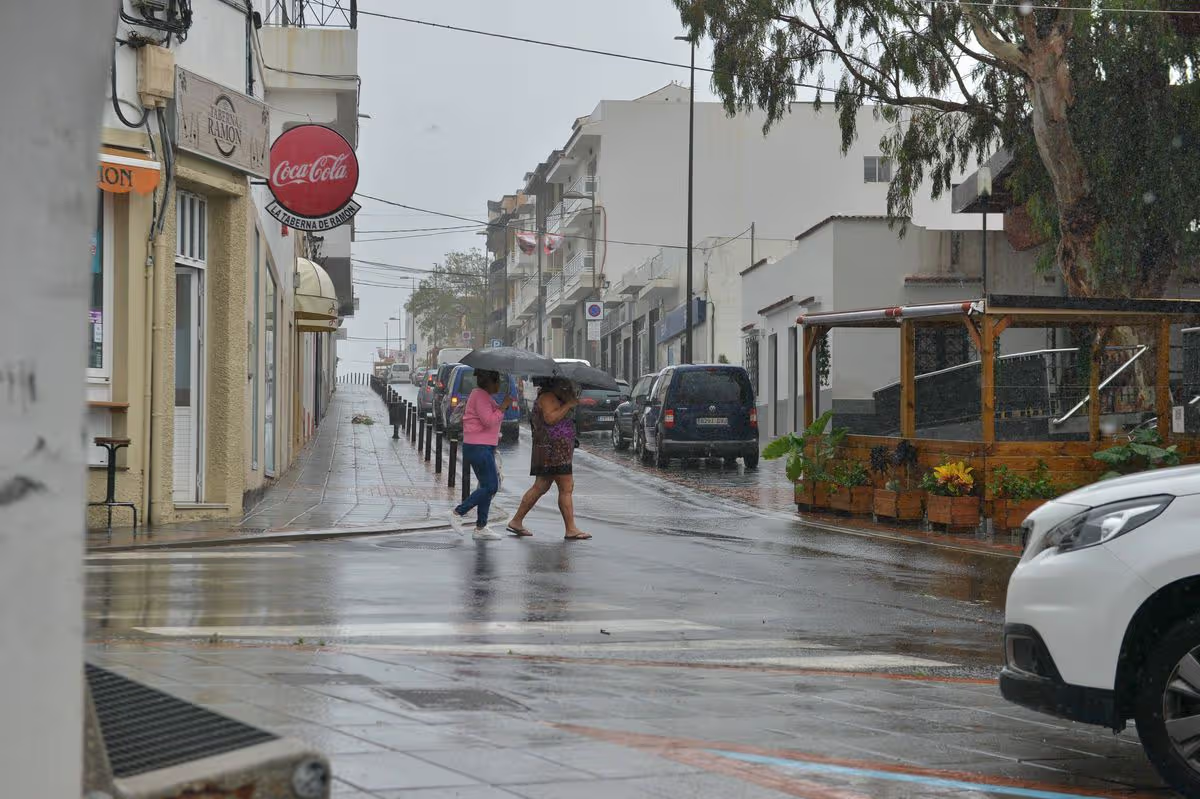
Brits in Tenerife recently discovered this first-hand, with some suggesting their holidays were “ruined” due to an unlikely problem. A string of videos have gone viral on TikTok, with visitors expressing their frustration after trips to the destination over recent weeks, catching many completely off guard.
A man, known online as Gazza, posted a video of his recent getaway, stating: “Come here every year and this is the first bad downpour experience.” He also described the weather as “brutal” for four days due to the relentless rainfall.
The clip has since racked up thousands of views, sparking hundreds of responses. It appears many fellow travellers have encountered similar situations.
Content cannot be displayed without consent
One commented: “Had wind, clouds and cold one year for four days out of the seven. Never went back.” Another added: “I was there last week and got an early flight home.”
Gazza responded to this remark, saying: “Was debating it too.” While a third chimed in: “I just got back. It was mental.”
A further user wrote: “It’s been almost a week!!! Everywhere/everything closed!!!” While another remarked: “That’s pretty unlucky. I would feel gutted.”
Others, however, claimed to have had a wonderful time during their visit, with some reporting an entirely different experience.
One holidaymaker shared: “It’s heaven. Chill.” Another added: “Here at the moment and not that bad. People need to chill out.”
Someone else also weighed in with: “Still rather be there than here. It’s the getting away that matters.”
What’s actually been going on?
While heavy rainfall is uncommon in Tenerife during March, a powerful storm has recently battered the Canary Islands. Storm Therese is reported to have wreaked havoc on the Canary Islands, particularly Tenerife and La Palma, with an unexpected mix of heavy rain, 100 km/h (62 mph) winds and even snowfall at high altitudes.
Authorities confirmed it was amongst the most devastating storms to strike the archipelago in over 10 years, which may well explain why so many visitors encountered such dreadful weather during their stays.
The silver lining, however, is that conditions appear to be on the mend. Current forecasts predict sunny spells over the coming days, with temperatures potentially reaching highs of up to 26 degrees, which could explain why some travellers have recently reported a marked improvement in the weather.
One visitor said: “It’s sunny now.” Another wrote: “I’m just back yesterday. Was there for a week. We had a ball even with the storm and rain.”
The home of Sean “Diddy” Combs’ son Christian “King” Combs and his girlfriend, Raven Tracy, was the target of what police said was a burglary attempt Thursday morning.
The pair were in Bali when police were summoned to their Porter Ranch home Thursday morning, according to a source familiar with the incident. Neighbors called police around 12:45 a.m. after they heard what they believed were shots fired in the 11900 block of Churchill Way in the affluent San Fernando Valley neighborhood. According to law enforcement, the commotion was actually a window being smashed near the rear patio of the $3-million residence.
King Combs, the 27-year-old rapper, model and son of disgraced music mogul Sean “Diddy” Combs, lives at the 5,400-square-foot property with Tracy, a 32-year-old influencer and fashion entrepreneur.
Images of at least two people were captured on security cameras, a law enforcement source told The Times. It’s unclear whether Combs and Tracy were targeted, or if the suspects were casing homes in the area. When police arrived, all suspects had fled the area. Police investigators told Fox 11 that nothing was stolen.
A source close to Combs told The Times that this was the second recent break-in attempt at the property. The first occurred during Sean “Diddy” Combs’ trial in the summer.
The attempted break-in is the most recent in a string of high-profile home invasions, although it is unclear whether the incidents are related. Earlier this month, “Real Housewives of Beverly Hills” star Rachel Zoe’s Bel-Air mansion was broken into while she was out of town.
The reality TV personality and fashion designer was in Las Vegas for the opening of the Wynn’s ultra-exclusive social club Zero Bond. Zoe is a close friend of club founder Scott Sartiano.
According to TMZ, Zoe’s alarm company received an activation alert and swiftly called local police. Officers responded and spotted two male suspects leaving the property, one of whom the outlet said was taken into custody.
In August, “All Night Long” crooner Lionel Richie was home when a man broke into his Beverly Hills residence around midnight. According to NBC4 Investigates, police responded to a 911 call and searched the neighborhood, finding a suspect blocks away. A 38-year-old man was arrested on suspicion of residential burglary.
Law enforcement sources told the outlet that security cameras at Richie’s home picked up images of the suspect, who entered the home but was spooked by an alarm.
• The Academy Awards will move from the Dolby Theatre to L.A. Live in downtown Los Angeles beginning in 2029 under a new agreement with AEG that runs through 2039.
• The shift to L.A. Live will place the ceremony within a larger, campus-style complex, allowing the red carpet, show, press operations and post-show events to be staged in a more centralized footprint with increased capacity.
• The move will coincide with the Oscars’ shift to YouTube, part of a broader reset for the ceremony as it looks to expand its global reach after years of declining television viewership.
The Oscars are leaving Hollywood — or at least Hollywood Boulevard.
Beginning in 2029, the Academy Awards will move from the Dolby Theatre, their home for nearly a quarter century, to L.A. Live in downtown Los Angeles, the Academy of Motion Picture Arts and Sciences and AEG announced on Thursday. The ceremony will be held in the theater currently known as the Peacock Theater, which is expected to be renamed before the Oscars arrive as part of a new naming rights deal.
The new agreement runs through 2039. Discussions about the move have been underway for the last couple of years, according to people familiar with the planning who were not authorized to speak publicly.
The change in venue comes as the Oscars are also moving away from their traditional home on broadcast television. Earlier this year, the Academy announced that the ceremony will begin streaming live worldwide on YouTube in 2029, ending a five-decade run on ABC.
Since 2002, the show has been closely associated with Hollywood Boulevard, where the red carpet runs alongside the Walk of Fame and, for one night a year, the area becomes the symbolic center of the film industry. The Dolby Theatre sits at the corner of Hollywood and Highland, inside a retail and entertainment center near the TCL Chinese Theatre and the El Capitan.
L.A. Live offers a more centralized, campus-style setting, with venues and event spaces clustered together. The complex is adjacent to Crypto.com Arena and the Los Angeles Convention Center and is part of a larger sports and entertainment district developed and operated by AEG that regularly hosts concerts, sporting events and awards shows, including the Emmys and the Grammys. AEG has recently proposed adding a new hotel, residences and additional entertainment space to the complex, part of a longer-term expansion of the site.
In some ways, the move out of the Dolby is less a break than a return: The ceremony was staged for years in downtown L.A. at the Dorothy Chandler Pavilion and at the Shrine Auditorium before settling at the Dolby.
At the Oscars’ new home, the red carpet, ceremony, press operations and post-show events can all be staged within a compact footprint that includes the adjacent JW Marriott hotel and its ballroom. The theater itself is expected to undergo upgrades to its stage, sound and lighting systems, allowing it to be configured more specifically around the show. The move is also expected to increase capacity, a growing consideration as the academy’s ranks have expanded significantly in recent years, now numbering more than 11,000 members.
At the Dolby, space has long been tight. Each year, multiple blocks of Hollywood Boulevard are shut down for days at a time, rerouting traffic and turning the area into a heavily secured zone — conditions that were even more restrictive this year with security tightened further amid the war in Iran, including a one-mile police buffer around the theater.
The Academy had been looking for a venue that offered greater control over how the show is staged, including how the audience is arranged and how the room is used for both the broadcast and the live event. The new venue is expected to provide more room for press areas, green rooms and backstage operations, along with upgraded technical infrastructure for staging the ceremony.
Early design renderings released by the academy suggest that, for viewers at home, the Oscars may not look all that different. The stage retains the sweeping, curved proscenium that has defined the Dolby Theatre era, suggesting a similar visual approach at a larger scale, with expanded screen space and a more immersive ceiling design.
For both the academy and AEG, which owns and operates the complex, the appeal is in keeping everything in one place — arrivals, ceremony, the Governors Ball and afterparties — rather than spreading events across multiple locations. The setup also creates new opportunities for hospitality and sponsorship tied to the broader campus.
“L.A. Live was built to host the moments that define culture and there is no greater global stage than the Oscars,” said Todd Goldstein, AEG’s chief revenue officer. “Together, we will create an environment that celebrates creativity, honors excellence and delivers an unforgettable experience for movie fans everywhere.”
Taken together, the changes amount to a significant reset for the Oscars, which have seen their audience decline from more than 40 million viewers in the late 1990s to 17.9 million this year, down 9% from the previous year. Moving to YouTube offers a way to reach a broader, more global audience at a time when traditional television viewership has declined.
The Oscars will remain at the Dolby through the 100th ceremony in 2028 before making the transition the following year.
“For the 101st Oscars and beyond, the Academy looks forward to closely collaborating with AEG to make L.A. Live the perfect backdrop for our global celebration of cinema,” Academy Chief Executive Bill Kramer and President Lynette Howell Taylor said in a statement.
Imagine cutting the cost of accommodation on your next holiday to about £5 a day. You can have a whole house, rather than just a bedroom. And you can go almost anywhere in the world and stay as long as you like, within reason. Welcome to house swapping.
You’re sceptical, I know. I was, too. Our terrace house was too small. Too overflowing with stuff. The 1980s kitchen was too old (and battered). We aren’t in a nice enough neighbourhood. Who would want to stay here? Lots of people, it turned out.
Our first swap was with a pair of retired Australian judges who had lived in the UK decades before. They came to our house first and, over a cup of tea and cake in our living room, we talked about where to find a good pint and the best fish and chips locally, as well as mastering the idiosyncrasies of how to run our dishwasher. They told us about their favourite local parks (warned us about snakes) and when to put out the bins, before we headed for our month-long stay at their house in Perth. It’s these conversations and connections that really make house swapping special.
Yes, we have stayed in some truly extraordinary homes. There was a house in Florida where we watched rocket launches while lounging in the pool; a clapboard cottage with a hot tub in the Stockholm suburbs; and a swanky five-bedroom villa in the south of France that we shared with friends. We couldn’t have afforded any of these if it were not for house swapping. In fact, the swaps themselves are free, but I pay $235 (£177) a year to use Home Exchange, a house swap booking platform, which works out at about £5 a night for the 35 or so nights I used it last year.
Rory Boland and family on a house swap holiday in New York. Photograph: Rory Boland
The greatest pleasure, however, is in the genuine relationships forged. Through the messages exchanged before and during the swap, friendships are created. You become, however briefly, part of each other’s lives. We have swapped pets and cars, and watered plants along the way. For a week, we became passionately involved in helping pick a summer school for our Basque guests’ kids. Warm welcomes are universal. We’ve had olive oil from the garden grove of a house in Greece and marmalade from Seville. In return, guests at our house can expect to find sparkling wine from Kent, Essex jam and a pile of Cadbury chocolate bars to try – French guests are big fans of the Crunchie.
Even in challenging moments we found friendship, such as when our shower sprang a leak and rained all over the dining table. We had to arrange an emergency repair via video call with our Spanish guests, an Albanian plumber and a UK insurer, all while frantically looking for a reliable phone signal in the countryside. The babel of languages resulted in a tube of silicone being applied and both parties leaving five-star reviews.
I won’t go back to hotels. I have saved tens of thousands of pounds over the past five years, but what has really hooked me is the interactions with hosts and guests that make my holidays more fulfilling. It’s like having a friend everywhere you go.
Q&A – Everything you need to know
Will I be comfortable house swapping? If you’re precious about the things in your home or anxious about someone sleeping in your bed, a swap is not for you. Likewise, if spending the last day of your holiday cleaning is a deal-breaker.
How do I house swap? For some sites, you pay a flat annual membership fee (£100-£200) to use a booking platform with thousands of homes. I use Home Exchange because it verifies member identities and offers some guarantees such as damage, theft and cancellation protection. Kindred is a smaller and generally more expensive rival, focused on upmarket homes. Instead of locking you into membership, it charges variable service and cleaning fees.
How does it work? Classic swaps are simultaneous; you exchange houses on the same dates. But non-direct swaps are also allowed via a points system: you are awarded credits for stays at your house, which you can then spend to stay somewhere else.
What about scams and safety? Everyone on Home Exchange is a host and a guest, so there is a high degree of trust. Most swaps don’t involve money, so scams are rare. The only exception is a cleaning fee, payable when the stay is at an end. If you’re asked for money in advance, it’s a scam.
The Home Exchange website. Photograph: Home Exchange
How do I pick my accommodation? This is time-consuming. The website looks similar to Airbnb, where you filter by availability, destination and the type of property you want, but you need to match with a host, too. Hosts and guests both have ratings from previous stays, but some people still like to phone or video call before agreeing to an exchange. Then once the exchange is agreed, there are messages to organise the swap and answer questions such as how to use the cooker or where the bedding is. Many hosts prepare a house manual. Cancellations are rare but do happen, usually due to illness in our experience. The one time it happened to us, Home Exchange helped us find a new host in the same city, and it will pay for a hotel in a true last-minute emergency.
Do I need to own a luxury house? No. If you have a pool, hot tub or luxurious mansion, you will certainly get more offers, but flats and smaller houses near popular UK destinations (whether that’s Edinburgh, or the Dorset coast) do just as well. Most houses, like ours, are completely ordinary.
Do I need to put my stuff in storage? Clear a few drawers, perhaps a wardrobe, for guests, and that’s it. Most of the houses on Home Exchange are family homes.
What about cleaning? You do need to scrub that oven and clean that grout. Cleanliness expectations are high (and should be agreed upfront). We usually spend much of the last day of our holiday cleaning, and return to find our own house absolutely sparkling. Some hosts give you the option of paying a cleaner.
And DIY? One of the fringe benefits of house swapping is that it has made us look after our house a little better. Sticky door handles and dripping taps need to be dealt with.
What if I break something? We have broken small things, as have our guests; usually this is simply forgiven. Put more precious items away. For more expensive items, such as a TV or screen door, house swap platforms usually offer a level of cover, but you should make sure you have home insurance.
Will my home insurance cover my house swap? Ask. Some insurers offer no cover, others offer it for a certain number of exchanges, or you may need to buy a bolt-on. House swapping is still relatively unusual, so persevere to get a clear answer. Insurers that cover holiday lets, such as Pikl, are also useful.
Are there legal restrictions? Because no money is exchanged, house swapping is not restricted in the same way as Airbnb and similar services – except in Amsterdam, where only reciprocal swaps are allowed (so no paying with points). You do need to check visa rules if looking after someone’s pet – some countries (such as the US) may view this as providing a service and in breach of a visitor visa.
As the United States-Israeli war on Iran rages on, schools across Israel have been closed, cultural venues shuttered and large gatherings cancelled under police orders.
Dissent against the war, if there is much at all, has little chance of being aired.
Recommended Stories
list of 4 itemsend of list
A few demonstrations against the war, such as those staged by the Israeli-Arab activist group Zazim, still flicker through central cities, but they do so under heavy supervision, with officers warning crowds to disperse when sirens sound or when assemblies grow beyond what commanders deem safe.
The effect is a public sphere constrained less by decree than by the constant threat hanging overhead.
“Kids aren’t going to school, while employers are insisting their parents go to work,” Zazim’s co-founder and executive director, Raluca Ganea, says. Everyone is too overwhelmed by the daily grind to voice any dissatisfaction, she adds.
“We’re enduring multiple missile attacks daily, which means people aren’t sleeping. It’s like a manual for tyrants. It’s how you suppress protest or opposition and it’s working so far,” she added.
“We’ve attempted a couple of protests, but people are just too tired to engage,” Ganea says of Zazim’s efforts to resist the war. “It’s not so much that people are telling you that you can’t so much as protesting becomes impossible when a missile attack could happen at any time.”
Support for the war on Iran has remained strong in Israel, a fact borne out by polls. But as exhaustion grows and resentment builds over having their fates decided by often distant leaders such as Israeli Prime Minister Benjamin Netanyahu and US President Donald Trump, who have shown little investment in their welfare, the societal fractures that came to define the war on Gaza are almost inevitable, she warns.
“It’s depressing,” she says. “The only response people have is to feel helpless when their fate is in the hands of people like Trump and Netanyahu, who really don’t care about them.”
Those who have put their heads above the parapet to object openly to the war are shunned anyway, as 19-year-old Itamar Greenberg knows only too well. People spit at him in the street.
“It comes in waves,” he says of the criticism he faces for his opposition to the war on Iran on the streets of his hometown, near Tel Aviv. “Sometimes they follow me, shouting ‘traitor’ or ‘terrorist’.”
Itamar is clear enough that he isn’t a terrorist, though he seems ready to accept the label of traitor if it means halting the war on Iran.
“At my university, everywhere, they say my opposition to the war on Iran is somehow crossing a red line. For instance, because of the [danger to the Israeli] hostages, some people could understand opposition to the genocide on Gaza, but opposing the war on Iran, the great evil, is somehow too much,” he says.
Emergency personnel work next to a damaged car at a site following Iranian missile barrages in central Israel, amid the US-Israel conflict with Iran, in Tel Aviv, Israel [Ronen Zvulun/Reuters]
Rising censorship
Across Israel, journalists and activists like Itamar describe a pervasive atmosphere of self-policing and censorship that, they say, has left people less informed about the consequences of the war than the citizens in Iran, whom many in their media encourage them to pity.
In a country largely unified against a threat that, for generations, politicians have told them is existential, criticism, dissent or opposition is, for the majority, beyond the pale.
This way of thinking is baked into Israeli society. The systems employed by the country’s military censor today to curtail media reporting predate the establishment of Israel in 1948.
Furthermore, new wartime restrictions on what can and cannot be broadcast of the Iranian missile barrages targeting Israel, where they land and what damage they have done – introduced on March 5 – mean these largely go entirely unreported, Israeli journalists say.
Reporting on the new media restrictions in mid-March, the Israeli magazine +972 documented one instance when journalists were permitted to report on debris that had hit an educational facility, but did not mention the actual strike by an Iranian missile, which had successfully hit its intended target nearby. Nor were they allowed to examine the site.
In another case reported by +972, journalists photographing damage to a residential block said they were approached by a man they believed to be linked to a security agency. He asked police to stop reporters from recording the real target of the attack, which was located behind them. The police officer replied that the journalists would not have noticed that site at all had it not been pointed out, since the visible destruction was concentrated on the civilian building.
The censorship, which had been growing more relaxed in recent years, had been tightened once more during the current war, Meron Rapoport, an editor at +972’s sister paper, Hebrew language Local Call, told Al Jazeera, “We don’t really know what is being or with what explosives,” he said, “The IDF [Israeli army] announcements always refer to strikes being on ‘uninhabited areas,’ which is peculiar, because there aren’t that many uninhabited areas in Tel Aviv. It’s a very compact city.”
Indeed, Iran has launched multiple missiles at Tel Aviv, some of which have resulted in damage and injuries – either by the missiles themselves or by debris falling following interception. Most recently, on Tuesday, missiles triggered air raid sirens in the city, where gaping holes were ripped through a multistorey apartment building.
Israel’s Magen David Adom emergency medical service said: “Six people were lightly injured at four different sites.”
“It’s curious,” Rapoport says. “Israeli commentators are always saying how the Iranian public has no real idea how badly they’re being hit. The irony is that they probably have a better idea of how hard Israel is being hit than most Israelis.”
One of the drone overflights took place earlier this month at Barksdale Air Force Base in Louisiana, home of B-52 Stratofortress bombers and nuclear weapons storage facilities, and a key part of the airborne leg of America’s nuclear triad. Another was at an unspecified installation last month, the commander of U.S. Northern Command mentioned in recent written testimony for the Senate Armed Services Committee (SASC). Both situations took place after the U.S. began bombing Iran in a campaign that has included B-52, B-1 Lancer and B-2 Spirit bombers. It is unknown at this point if there is a connection, however, as we have frequently reported, the military is highly concerned about drones operating with near impunity over its facilities. In addition to interfering with flights and their potential use as weapons, drones can surveil and map the electronic emissions throughout a base, gaining insight into vulnerabilities. They can also photograph key areas and operations, providing additional valuable intelligence for any adversary.
One of these incidents spurred NORTHCOM to deploy its new counter-drone fly-away kit, designed to give installation commanders the ability to detect, quantify, and defeat small drones that they cannot defend against on their own. We’ll discuss that in greater detail later in this story.
A B-52 Stratofortress from the 5th Bomb Wing taxis at Minot Air Force Base, N.D., Oct. 26. 2025. The U.S. Northern Command Counter-small Unmanned Aerial System fly-away kit, seen in the foreground, and operators were rapidly deployed to the North Dakota base as part of an exercise to demonstrate the command’s ability to quickly support installation commanders experiencing a drone incursion. (Department of War photo by John Ingle) John Ingle
The incursions at Barksdale began the week of March 9, a spokesperson for the 2nd Bomber Wing at the base told us, offering few details about what happened beyond saying “we are working closely with federal and local law enforcement agencies to investigate these incursions.”
The incident sparked a shelter-in-place order lifted later that day.
According to ABC News, a confidential briefing document dated March 15 stated that the “drones came in waves and entered and exited the base in a way that may suggest attempts to ‘avoid the operator(s) being located,’” the network reported. “Lights on the drones suggested the operators ‘may be testing security responses’ at the base.”
“Between March 9-15, 2026, BAFB Security Forces observed multiple waves of 12-15 drones operating over sensitive areas of the installation, including the flight line, with aircraft displaying non-commercial signal characteristics, long-range control links and resistance to jamming,” the document stated. “After reaching multiple points across the installation, the drones dispersed across sensitive locations on the base.”
The document added that more drone incursions could be expected and that they “pose a significant threat to public safety and national security since they require the flight line to be shut down while also putting manned aircrafts already inflight in the area at risk.”
It is not publicly known if there have been any additional incursions since the document was issued. Base officials declined to tell us.
A U.S. Air Force B-52H Stratofortress aircraft assigned to the 2nd Bomb Wing sits on the flightline at Barksdale Air Force Base, Louisiana. (U.S. Air Force photo by Senior Airman Laiken King) Senior Airman Laiken King
Another incident took place at an unspecified location in February as the U.S. was beginning to attack Iran.
“In the early hours of Operation EPIC FURY last month, a deployed [fly-away kit] successfully detected and defeated sUAS operating over a strategic U.S. installation,” Air Force Gen. David M. Guillot, the commander of NORTHCOM, explained in a written statement to SASC on March 19.
Guillot did not say which base or provide any other details. On Tuesday, a NORTHCOM spokesperson declined to specify which base Guillot was referring to but confirmed there were multiple incursions and personnel used the flyaway kit’s “jamming protocol.”
“We will not name the base nor the type of installation where our Flyaway Kit is deployed in order to preserve operational security,” NORTHCOM added. “Specifically, connecting the Flyway Kit to a specific base can potentially illuminate that base’s vulnerabilities to an adversary. Additionally, by confirming a specific Counter-small Unmanned Aircraft System (C-sUAS) platform, we would potentially give an adversary an advantage in circumventing our C-sUAS capabilities at that location.”
So far, NORTHCOM has only one fly-way kit, but more should be delivered “in the Spring of 2026,” Guillot added in his written statement.
The kit currently deployed is produced by Anduril. The company describes it as a “rapidly deployable, modular, and battle-tested counter-UAS system designed to detect, track, identify, and defeat Group 1-3 drones.” It uses Anduril’s Pulsar system for radio-frequency detection and electromagnetic effects to jam radio signals controlling drones. There are also drone-on-drone interceptors. You can read more about that in our story about the system here.
While Guillot offered scant details in his written testimony, he provided some additional insights into the military’s efforts to counter drones over the homeland. His command is tasked with coordinating those efforts.
“We’ve seen an increase from last year in the number of detections over military installations over the course of the year.,” he said in response to a question from Sen. Eric Schmitt (R-MO), who represents Whiteman Air Force Base, home of B-2s used in Epic Fury. “Some of that might be due to the fact that we have more detection capability now than we did in the past, and then our ability to defeat them has improved. Whereas a year ago, almost every one that was detected was not defeated, now about a quarter of the ones that we detect we’re able to defeat. I pay particular attention to Whiteman and other strategic bases, whether submarine silos or aircraft, and work very closely with Admiral [Richard. A] Correll at STRATCOM to make sure that either through the services or through our own capabilities at NORTHCOM, we are protecting those vital locations from UASs.”
Northcom, Southcom Commanders Testify Before Senate Armed Services Committee 03.19.2026
Whiteman declined to comment about whether that base has seen any drone incursions, citing operational security concerns.
That these latest drone flights took place in the wake of Epic Fury is alarming. Iran’s drone capabilities loom large in the mind of U.S. intelligence even here in the homeland. Also, it’s worth noting that B-52s at Barksdale sit almost entirely out in the open and, with just 76 of these airframes available across the force, they are extremely valuable assets and thus potentially very high-value targets. This is especially true since there are just a few that could be regenerated if any are lost. Moreover, Stratofortresses are expected to provide a large portion of U.S. conventional and nuclear aerial strike capabilities for decades to come.
We have been warning about the threat to American aircraft on flightlines from even the lowliest of drones for many years. These warnings have taken on new urgency after last year’s Ukrainian near-field attacks on Russian long-range aviation, dubbed Operation Spider Web. This operation alone suddenly turned what were once theoretical nightmares into very real possibilities.
We will continue to monitor this situation and provide updates when warranted.
INFLUENCER Lydia Millen has revealed she’s finally snapped up her dream home after a six-year search just as her “fake accent” was exposed.
The controversial ‘poshfluencer’, who was recently accused of putting on a more well-spoken voice, shared the exciting news with her millions of followers.
Sign up for the Showbiz newsletter
Thank you!
Lydia Millen has unveiled her new home after a six year searchCredit: InstagramLydia and her husband set their hearts on the Norfolk coastCredit: InstagramLydia recently admitted to polishing her accent for her contentCredit: Instagram
Lydia posted a series of coastal snaps from her new property in Norfolk.
The 36-year-old opened up about the long journey in a heartfelt caption as she prepares to add another property to her portfolio.
Writing rather than speaking to her followers, she penned: “We bought a new home.
“Six years ago we began our search, first in the Cotswolds, and then after a trip to Cley-next-the-Sea where we completely fell in love with the Norfolk coast, our search moved there.
“We looked for something special but never quite found it.
“Until October, when I stumbled across a 200-year-old fisherman’s cottage. And last week, we finally completed.”
Even modest cottages on the Norfolk coast can fetch £300,000, while prime properties soar past £1million.
The new coastal bolthole marks a lifestyle shift for Lydia and Ali, who have long documented their countryside life online.
The crumbling cottage is expected to undergo a full-scale transformation, with fans already anticipating a series of renovation updates across her social platforms.
Lydia explained: “It needs everything. Heating, rewiring, kitchen, bathroom, windows. A full renovation.
“But one day hollyhocks will grow in the front garden again, and Paul’s Himalayan musk roses will ramble their way back across the flint and brick facade.”
Lydia has bought a cottage on the Norfolk coastCredit: InstagramProperties on the Norfolk coast can fetch well over £1 millionCredit: Instagram
Lydia has previously revealed she owns multiple properties, all mortgage-free, explaining she “doesn’t like having debt”.
The influencer has faced backlash in recent months, with some fans accusing her of not being entirely truthful about her roots.
Born in Watford, Hertfordshire, Lydia has spoken openly about growing up in a council house with her mum after her parents split.
She has previously said she “flunked” her GCSEs before training as a beauty therapist.
Before finding fame online, Lydia also spent seasons working in Ibiza.
Her social media career took off after moving to the countryside, where she spotted a gap in the market for aspirational British lifestyle content.
However, critics have claimed she has “reinvented” herself including adopting a more polished speaking voice.
Responding to one follower who asked why she had changed the way she speaks, Lydia said: “Because I just don’t see why I shouldn’t?
“I value being well spoken, and I know it also helps my international audience.”
Now a social media powerhouse, Lydia shares her idyllic country lifestyle with 1.6million Instagram followers, 1.4million on TikTok and more than one million YouTube subscribers.
The TikTok star is married to Ali Gordon, whom she met on Instagram in 2012.
The pair tied the knot in December 2017 at Aynhoe Park in Oxfordshire and are now thought to be worth around £10million.
Watford girl Lydia has undergone quite the transformationCredit: Lydia MillenLydia is married to fellow influencer Ali GordonCredit: Getty
Afroman has emerged victorious from an invasion of privacy and defamation case filed against him by seven members of Ohio’s Adams County Sheriff’s Office over mocking videos and social media posts the rapper put out after a failed 2022 raid on his home.
“We did it, America! Yeah, we did it! Freedom of speech! Right on! Right on! Yeah! God bless America!” the 51-year-old rapper, born Joseph Foreman, shouted outside the courthouse after the Wednesday evening verdict as supporters rallied behind him. In the clip, under a white fur coat, he was rocking the same American flag shades and red, white and blue suit and tie he had worn on the stand Tuesday.
Four deputies, two sergeants and a detective with the Adams County sheriff filed the lawsuit in March 2023, seeking to reclaim any money the rapper made from what they said was unauthorized use of their likenesses. The group wanted nearly $4 million in damages. Foreman used footage from the raid in videos for songs including “Lemon Pound Cake” to make money to pay for the damage done to his home during the raid, when his front gate was broken down and his front door smashed in.
The plaintiffs said in their lawsuit that the posts and videos caused them “humiliation, ridicule, mental distress, embarrassment and loss of reputation” and made it difficult to do their law enforcement work.
At trial, all seven plaintiffs testified about the harassment they had suffered because of the rapper’s music and videos. One, Deputy Lisa Phillips, had her gender identity called into question in Foreman’s videos and social media posts. She cried on the stand as a video suggesting she enjoyed sex with other women was played for the court.
The jury apparently agreed with the argument that the sheriff’s officers were acting in a public capacity during the raid and therefore were not shielded from criticism of their behavior.
“No reasonable person would expect a police officer not to be criticized. They’ve been called names before,” defense lawyer David Osborne said in closing arguments for the rapper and comedian, known for his breakout 2000 hit, “Because I Got High.”
In 2022, the sheriff’s team was acting on a warrant showing probable cause that drugs and drug paraphernalia would be found on the property and alleging that trafficking and kidnapping had happened there. No evidence of a crime was found, and no charges were filed.
Foreman wasn’t home during the raid but was able to see at least part of it via a video recorded by his ex-wife and footage captured on his home security system before law enforcement turned off those cameras. He said on the stand that the raid traumatized his children, who were 10 and 12 at the time.
“The whole raid was a mistake. All of this is their fault,” Foreman testified Tuesday. “If they hadn’t wrongly raided my house, there would be no lawsuit, I would not know their names, they wouldn’t be on my home surveillance system, and there would be no songs, nothing.”
Foreman also defended his right to use the raid footage as fodder for his work.
“After they left, I had the right to kick the can and to do what I had to do to repair the damage they brought to my house. Yes, I did,” he testified. “I have freedom of speech. I’m a rapper. I entertain.”
Foreman discussed his reaction to the lawsuit with local station WCPO Channel 9 in 2023. “From the first 10 seconds, I was offended. I was appalled. I was like ‘What?’ Then I started laughing,” he said. “These guys with their rifles are crying about my comedy songs.”
Meanwhile, as the jury deliberated Wednesday, an entirely different Adams County Sheriff’s Office was feeling online heat linked to the trial: the office in Colorado’s Adams County.
“The Adams County Sheriff’s Office has received a flood of social media comments, DMs, and phone calls about the #Afroman defamation trial,” the Colorado department said on X. “It’s clear this is important to a lot of people. There’s just one small issue: that’s the ACSO in Ohio. We are the ACSO in #Colorado. Different states, same name.”
Storm Therese is battering the Canary Islands with heavy rain, 100km/h winds and significant snowfall, with over 40 flights cancelled and schools closed across the islands
Samantha Bartlett Assistant Editor, Social News
10:41, 21 Mar 2026
Storm Therese is currently battering the Canary Islands (stock image)(Image: Europa Press News, Europa Press via Getty Images)
Storm Therese is currently wreaking havoc on the Canary Islands, particularly Tenerife and La Palma, with an unusual mix of heavy rain, 100 km/h (62 mph) winds, and significant snowfall at high altitudes. Authorities have declared a full-scale emergency in Tenerife, labelling it as one of the most severe storms to batter the archipelago in over a decade.
Spain‘s meteorological agency, AEMET, has issued several alerts that will remain active throughout the weekend. Orange (high risk) warnings have been dispatched for northern Tenerife and parts of La Palma due to wind gusts reaching 90–100 km/h and heavy rainfall. Concurrently, yellow warnings are in place across all seven islands for rain, thunderstorms, and choppy seas with waves reaching up to 6 metres (20 feet).
Unusually for this time of year, significant snowfall has also blanketed Mount Teide and surrounding peaks above 1,800–2,000 metres.
Content cannot be displayed without consent
The storm has led to widespread cancellations and safety closures across the islands. Over 40 flights were cancelled or rerouted by Friday, March 20, primarily at Tenerife North and South airports. Travellers are advised to check their flight status via Flightradar24 or their airline.
Schools and universities in Tenerife, Gran Canaria, and several other islands were shut on Thursday and Friday, whilst key roads, including access to Teide National Park and the TF-445 to Punta de Teno, are closed due to ice and snow.
Major international events such as the Tenerife Bluetrail 2026 race have been cancelled or postponed.
Providing an update on the weather situation on Friday (March 20), one Tenerife resident known as @theknightstrider1 on TikTok took to the platform to share details with his 115,000 followers.
The car hire and bar owner, who is based in Playa de las Américas, was heard saying: “A little weather update for you then, it’s raining… it’s pretty grim and it’s gone really overcast as well.
“The rain showers are on and off, we haven’t really had any rain until now. It was okay this morning, but yeah it is raining. The current temperature’s around 18 degrees, not too cold but the umbrella’s are out, people are sheltering and it’s really not that nice.”
Content cannot be displayed without consent
He added: “Bear in mind, you might get caught in the rain, have a brolly with you. Maybe some of the rain macs as well if you’ve got any, if not buy some because it’s on and off.”
One person wrote: “Weather’s been awful the last three days, can’t wait to go home.”
Whilst another added: “Arrive tomorrow, packed a brolly.”
A third chimed in: “This makes me so happy as someone who was going to go this week and changed to last week! Phew.”
Whilst a fourth asked: “Why is it every time it’s sunny in the UK it rains in Tenerife?”
Another resident of the Canary Islands also posted a weather update on TikTok from Santa Cruz de Tenerife, captioning the clip, ‘Rain, wind and choppy ocean. Flights cancelled and diverted. Flooding in El Médano and roads closed. The storms Theresa and Samuel are hitting Canary Islands.’
He then said in the video: “Here if your weather update from Tenerife South on Friday March 20th, 2026. The two storms – Theresa and Samuel – are hitting the Canary Islands with force.
“As you can see here, we have quite a lot of waves here in the Troya area of Las Americas. The storms have caused quite a few incidents on the island, we have had 11 flights cancelled yesterday, 10 flights have been cancelled during the day today.
“We have had quite a few flights deviated to other airports as well and we have had ferries that have been cancelled because of the conditions out on the see.”
He explained the temperature was currently hovering around 19 degrees and there had been some rain which was “coming and going” along with overcast skies.
Are flights from the UK to Tenerife being cancelled?
Yes, flights from the UK to Tenerife are currently experiencing cancellations and significant disruptions due to severe weather from Storm Therese.
As of Saturday, 21 March 2026, authorities in Tenerife have declared an island-wide emergency due to extreme conditions including heavy rain, strong winds, and rare snowfall over high ground.
Over 36 flights were cancelled earlier this week, with further disruptions reported today. While many cancellations involve inter-island services, several international flights have been diverted or cancelled due to poor visibility and high winds.
Currently, the most affected airport is Tenerife North (TFN), which has seen the greatest impact, though Tenerife South (TFS) – where most UK flights land –is also experiencing delays and some rerouted services.
Conditions are expected to remain hazardous through Saturday, with a gradual improvement predicted for Sunday, 22 March.
Major airlines serving the UK to Tenerife route, such as Ryanair, easyJet, Jet2, and TUI, are urging passengers to check their flight status before heading to the airport
If your flight is cancelled, contact your airline immediately to discuss rebooking or refund options.