One Yorkshire pier was once dubbed the “unluckiest pier in the world” after a series of disasters saw numerous ships crash into the structure during its short life
Isobel Pankhurst Audience Writer
14:14, 03 Apr 2026
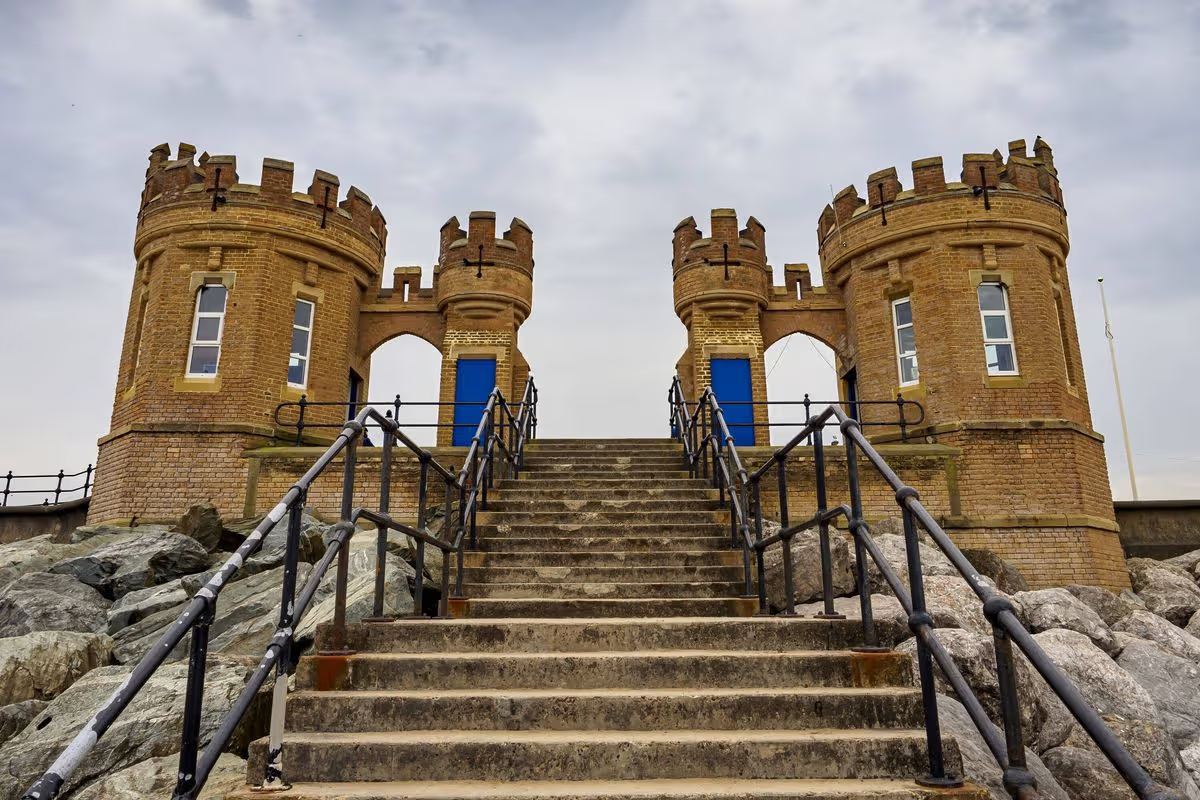
All that remains of the pier are two towers(Image: Getty)
A tiny seaside town in Yorkshire was once home to what became known as the world’s most cursed pier. During the Victorian era, piers emerged as a must-see attraction for seaside visitors, prompting the construction of one in the town of Withernsea.
Built between 1875 and 1877, Withernsea Pier had a remarkably brief existence, shutting down by 1893 and being completely demolished by 1903. Today, all that remains on the site are the striking castellated pier towers, which lead down towards the beach.
The pier’s fleeting lifespan was the result of a series of catastrophic incidents, earning it the notorious title of the “unluckiest pier in the world”, with multiple vessels smashing into the structure throughout its operational years.
The pier’s unfortunate saga began during construction in 1875, when a crane gave way, crushing and killing a 17-year-old boy.
Then in 1877, a fierce storm loosened sections of the construction, which subsequently plunged into the sea, destroying one strut and warping girders. This setback delayed the pier’s official opening and required £200 worth of repairs.
The calamities continued, and on October 28, 1880, a devastating North Sea storm saw two vessels plough into the pier. Fishing boat Jabaz struck the pier and went down, claiming the lives of four sailors in the tragedy.
Meanwhile, a coal barge named Saffron slammed into the pier, tearing a 150-180 foot gap through its centre. That same night, the storm obliterated the nearby Hornsea Pier and sent another vessel crashing into Redcar Pier.
Three years later, on March 6 1883, another storm hit and washed away part of the pier, including the section that had been hit by the Saffron years earlier.
The ill-fated pier would then suffer yet another blow, when the fishing vessel Genesta came crashing into it on October 20 1890, destroying more than half of the structure in the process.
On this occasion, there was just one casualty, the captain of the ship, while the crew were luckily rescued from the sea.
What little remained of the pier was damaged even further on March 22, when the Henry Parr ploughed into it during a violent storm, leaving just 50 feet of the structure standing.
It came as little surprise when the remaining section was declared unsafe, and the last remnants were torn down by 1905.
In more recent times, proposals to reconstruct the structure were drawn up, backed by funding from the East Coast Communities Fund, the NationalLottery and local fundraising efforts.
In January 2020, the cost of rebuilding was put at £8 million, though the plans were ultimately shelved in 2023 after East Riding Council concluded they were “no longer viable.”
While the ambition to restore the pier has been abandoned, the distinctive castle towers still stand to this day, leading visitors down towards the seafront.
FANCY a day at the theme park over Easter? Well, how about two days out for the price of one?
Drayton Manor has launched a brand-new offer for the month of April where visitors can buy one ticket and return again at no extra cost.
Sign up for the Travel newsletter
Thank you!
You can go to Drayton Manor twice for the price of one ticket in AprilCredit: AlamyYou can go on all the rides again at no extra costCredit: Alamy
Fans of the theme park in Tamworth won’t want to miss its newly launched free return deal.
If you buy a standard day ticket between now and April 19, 2026, you can return for no extra cost on or before April 30, 2026.
From just £29.50, guests can go on more than 50 rides and attractions at the park – and then do it all again before the end of April for free.
Drayton Manor has plenty of thrilling rollercoasters, as well as family-friendly rides, and a zoo with over 500 animals like red pandas, bears, reptiles and birds of prey.
The theme park is the only one in Europe with a dedicated area for Thomas the Tank Engine.
Thomas Land has lots of attractions including a rollercoaster, water ride, drop tower and of course train rides with Thomas, Percy and Rosie.
Throughout the Easter holidays, until April 19, is a Care Bear takeover with character meet-and-greets.
At the end of the day, there’s even a Care Bears end-of-day show on the lake.
In 2024, Drayton Manor opened its Wild West themed world called Frontier Falls.
Inside is a new rollercoaster called Gold Rush where visitors are whisked away in a runaway mining cart.
It’s the first of its kind in the UK to have a backward launch into an outdoor gravity track.
The rollercoaster has a two-minute ride time, with Drayton Manor claiming it to be the longest track length for a family coaster in the country.
Drayton Manor has Europe’s only Thomas LandCredit: Drayton Manor
This Spanish hotel is right next to a huge theme park with over 40 attractions…
*If you click on a link in this box, we will earn affiliate revenue
Hotel Best Punta Dorada, Salou
The Spanish resort is a popular destination near PortAventura World, a theme park with over 40 attractions and huge rollercoasters. It’s also close to sandy beaches like Platja de Llevant, and the scenic Camí de Ronda coastal walk. The hotel itself has an outdoor swimming pool to enjoy, as well as two bars along with evening entertainment and shows.
The awards were organised by ThemeParks-UK.com, and winners were announced after a series of votes made by 330,000 members of British public along with scores from expert judges.
Drayton Manor scooped up the award for Best Value Theme Park.
It also came in second place for Best (Large) Theme Park for Families, and for Best Theme Park for Toddlers.
Drayton Manor came in first place for Best New Accessibility Initiative, and third for Best Use of IP in an Attraction.
Serious food poisoning cases for UK tourists at popular travel hotspots revealed
People eating abroad are being told to take precautions after a study showed the places most likely to get food poisoning(Image: Getty)
All UK travellers and tourists planning a trip abroad have been issued a warning by health officials after a new study showed high levels of food poisoning hitting some popular resourts. A study from Cambridge University found 13 destinations in particular having higher odds of people contracting serious food poisoning such as Shigellosis, Salmonellosis, and Giardiasis.
The Foreign Office-backed Travel Health Pro website this week issued an alert warning people to take precautions, especially when travelling to popular destinations outside the EU – although some hotspots there were flagged up in the report too.
Travel Health Pro said: “All UK travellers and tourists planning a trip abroad are reminded to follow good food and water hygiene advice. This study shows that visiting countries outside of the EU, and to high-risk areas which had low water, sanitation and hygiene scores, increases the risk of infections that can cause stomach upset, like diarrhoea or vomiting.
Between 1 July and 15 October 2023, a rise in stomach bugs was reported in travellers returning to England from popular holiday destinations, including Egypt, Mexico, Tunisia and Turkey. Many of these travellers stayed in all-inclusive tourist resorts. The study also suggests the true number of infections is likely to be higher, as it only counted cases diagnosed in travellers after they returned home.”
Destinations where high levels of food poisoning were detected in UK tourists are:
Egypt
Mexico
Tunisia
Turkey
Jamaica
Dominican Republic
Cape Verde
Morocco
India
Pakistan
Thailand,
Greece
Spain
The study said: ”Thirteen destinations were associated with higher odds of becoming a case, of which the highest odds were reported for Egypt, Mexico, Tunisia, and Turkey, with the odds of illness in travellers to Egypt 23 times higher than those visiting France.
“For those travelling to low-risk destinations, eating undercooked meat or fish, eating meat or fish purchased from local restaurants and airports, drinking purified water, and swallowing water from environmental water sources (rivers, lakes, sea, and swimming pools) were all found to be associated with higher odds of illness. In high-risk destinations, eating foods consumed on trips or excursions, swallowing water from environmental sources, drinking fruit juice or smoothies, and eating foods from hotel buffets were all associated with higher odds of being a case.”
Travel health pro this week urged people to take these steps:
Practice good food and water hygiene at all times, even in high-end, all-inclusive resorts.
Wash your hands often, including before eating or preparing food, after using the toilet, after changing nappies and before and after sex.
Eat recently prepared food that is fully cooked and served piping hot.
Where there is no clean water supply, drink only bottled or boiled tap water (this includes brushing your teeth).
Always avoid ice in your drinks.
Avoid fresh fruit that you have not peeled yourself and salads not washed with bottled or boiled water.
Avoid swallowing water from ponds, lakes and untreated swimming pools.
If you become ill abroad:
Drink plenty of ‘safe’ fluids, such as bottled water, or tap water that has been boiled and cooled, and use oral rehydration solutions so that you do not become dehydrated.
Get early medical advice if you are at greater risk of complications from gastrointestinal infections, this includes babies/young children, older adults, pregnant women and people who are immunosuppressed or have ongoing health conditions.
Seek medical help if symptoms (such as diarrhoea and vomiting) last more than a few days or are not improving.
Wash contaminated clothes or bedding on a hot wash and clean toilets, taps and door handles regularly.
Avoid using swimming pools if you have a stomach bug. Take children on regular toilet breaks and check nappies often. If you have been told you have cryptosporidium do not use a swimming pool for 2 weeks after your diarrhoea has stopped.
OUR Spotlight On column gives you the low-down on what to see and do in some of the most popular holiday destinations – as well as some unsung areas.
This week we are doing a deep dive on Piraeus, a small but certainly not insignificant port city within Athens, Greece.
Sign up for the Travel newsletter
Thank you!
Athens is much better to visit off seasonCredit: AlamyThe city has so much to do when there are fewer crowdsCredit: AlamyOf course The Parthenon is a mustCredit: Alamy
The Greek city is one to avoid in the summer – last year it hit 42C, a record high.
But Travel Writer Jonathon Samuels explains: “Athens is the perfect Greek city for an all-year-round mini-break, with lots to see and do.
“We began with an evening stroll around Athens’ oldest neighbourhood, Plaka.
“With narrow pedestrianised lanes, tourist shops and tavernas, it’s no surprise that the area is heaving in summer, but we had plenty of space to breathe and enjoy glimpses of The Acropolis in peace.
“For an even less crowded view, head to 360 Cocktail Bar where you can soak up not just the city’s sacred rock but views of the pastel-coloured buildings below, too.
“Look for the little funicular railway at the end of Plutarch Street which takes you through the hill to the summit.”
Here are some of our other top tips.
MUST SEE/DO
As a port city in one of the most history-rich cities in the world, Piraeus has some stories to tell.
And no place tells them better than the Hellenic Maritime Museum which delves into the maritime traditions of the region.
It only costs around £1.50 to enter and visitors can be wowed by ancient maps, flags and old school weaponry that was once used on the seas.
HIDDEN GEM
Margaro is a pokey restaurant loved by locals, but less-known by tourists.
The interior may be bland and simple (think plastic tables and basic wooden chairs), but the food is anything but.
You won’t need a menu as this third-generation family fish joint only serves a few basic dishes: fried shrimp, fresh fish such as mullet or bream and langoustines, all accompanied by a classic and hearty Greek salad.
There are no reservations, so just follow the queues of local down the back streets from the port.
You’ll be paying a fraction of the cost you would in main tourist spots, but for some of the best Greek food you’ve ever sampled.
BEST VIEW
Nest Rooftop Bar & Bistro at The Alex Hotel is the place to go, especially at sunset.
Set just a few metres back from the ocean, visitors can sip on cocktails while soaking up panoramic views of Saronic Gulf, with ferry boats and yachts on the water, and the sun-drenched terracotta roof tops of surrounding buildings.
RATED RESTAURANT
Pushing the boat out? Well this is the right place to do that – for a number of reasons.
The Michelin-starred Varoulko Seaside, in Mikrolimano marina, is a dream for seafood lovers.
Diners can tuck into traditional Greek flavours using modern culinary techniques – dishes like catch of the day come with fennel, orange and bearnaise sauce.
BEST BAR
Greek wine has soared in popularity in recent years and is now in the same league as some the finest wines in the world.
So if you’re keen to sample the best, a visit Paleo Wine Store is a must.
The cosy and sophisticated bar is housed in a former warehouse and serves excellent grape tipples.
If you’re unsure of what to order, staff are always happy to help. The setting is extremely cool, with industrial-style decor, long wooden tables and shelves stacked high with bottles.
HOTEL PICK
It’s not just its excellent rooftop (mentioned above) that makes the 4* Alex Hotel standout.
The bright and airy space has a modern Greek feel to it with stone-coloured furnishings and simplistic interiors. It’s well-located for exploring the region too, offering easy access to both the city and the sea.
The rooftop restaurant serves British favourites such as pizza, pasta and burgers, as well as more sophisticated dishes including sea drum ceviche and tuna tartare.
If you think people can be disgusting inside planes, flight attendants can confirm they’ve seen things that could well make you rethink how you fly and if you ever want to hop onto a plane again
Many flight attendants list tray tables as some of the grossest parts of a plane
Flight attendants are no strangers to weird experiences – especially seeing as they spend hours with hundreds of people every day. But in between nice interactions and friendly exchanges are moments that are memorable for all the most disgusting reasons.
Travel + Leisure has featured a video that asked cabin crew about their best behind-the-scenes insight into plane life, and some interviewees reminisced on shocking incidents – including some that show just how unhygienic planes can be.
Joy, a flight attendant of six years, told the story of the worst thing she’s witnessed mid-flight: “The grossest thing I’ve seen is someone putting their feet up on a tray table.”
But it gets worse: “I’ve actually had someone stand up, their pants fall down, and they have sat back down in the seat without pulling their pants back up – on the seat. It gets cleaned in between the flights. Fine. But bare naked bum…”
She also commented on one common habit she sees: “Please don’t let your toddler go to the lavatory barefoot. There’s pee everywhere in there. It’s not your living room. It’s not – this is a plane. It’s not your house. It’s not your couch.”
Another air steward, Luke, detailed his process of getting his plane seat ready to use. He approaches his seat with Clorox wipes and gives it a good going over, from top to bottom, making sure to thoroughly clean the tray table as well.
Besides these reports of unsavory incidents, the aviation workers mentioned certain moments that they hoped would prompt passengers to reflect on their behavior on flights, since small mistakes can impact both staff and passengers’ experiences.
Amara, who has been working in the industry for three years, said passengers are often keen to tell her that they know how things should be done on a plane, because they regularly fly.
However, often these passengers are the most troublesome and end up doing annoying things like taking phone calls in mid-air.
After four years of experience, Jorge highlighted the biggest mistake he sees passengers regularly making. For him, it’s assuming that flight attendants will help passengers lift a bag into the bins above the seats. On most airlines, they are forbidden from doing so due to the physical risk it would pose to them.
If you realise too late that you went slightly overboard with packing, the crew can arrange for them to be checked in instead, Jorge added.
Recently a flight attendant told eShores about the little lies that they tell passengers, for their own good.
“When a business class passenger asks for a coffee on a night flight, I’ll make a decaf coffee just so that they can fall asleep,” they said.
But that’s not the sole untruth passengers might encounter. Aircraft cabins are notoriously frigid, yet should you request the attendants warm things up slightly, you might well be misled.
They admitted: “When passengers ask to have the temperature of the cabin turned up, we lie and say yes, we will turn it up, but really we don’t because we get warm walking around.”
BROCKWELL Lido has been saved just days after its operator went into administration.
The popular lido in Herne Hill that’s open year-round, which also has an on-site gym and café, has been taken over by the local council.
Sign up for the Travel newsletter
Thank you!
Brockwell Lido has been saved after its operator went into administrationCredit: AlamyThe art deco lido has been open since the 1930sCredit: Alamy
Brockwell Lido has been open since 1937, but there were fears that it would close when its operator Fusion Lifestyle went into administration on April 1, 2026.
However, Lambeth Council has already stepped in to take control of the outdoor pool, gym and café.
It confirmed that it will transfer to its in-house leisure service called Active Lambeth from July 1, 2026.
Luckily for keen swimmers, there will be no interruption and the lido will continue to be open to the public.
It’s a very popular south London lido and attracts nearly 200,000 visitors during the peak summer season.
The swim spot was even crowned the ‘Best Lido in Britain’ by the AA in 2025, based on its popularity, reviews, value, and other factors.
Last year, it was also named the ‘Best Lido in London’ by Time Out.
Brockwell Lido opened in the 1930s with the aim of creating an “oasis in the city” for locals, many of whom cannot afford a holiday, according to its website.
The unheated 50-metre lido is on a Grade II-listed site and is open throughout the year.
During the winter when the water is at its coldest there are two sauna pods so visitors can warm up after their swim.
Under Fusion Lifestyle’s operation, tickets were priced at £9.50 for an adult swim and £6 for juniors.
Brockwell Lido also has a gym, outdoor space for sunbathing and an on-site café which serves up hot and cold drinks, and sourdough pizzas.
Brockwell Lido welcomes thousands of people during the summerCredit: Alamy
Just one month later, the decision was reversed by the executive committee of Teignbridge Council.
The 25-metre outdoor pool first opened in the 1970s and opens seasonally, usually having its debut in May half-term.
It has partial opening hours in June and July and then opens full time during the summerholidays.
The pool is heated and holds various swim sessions, from public to fun sessions, as well as activities like aqua fit and aqua circuits.
Check out one of our favourite seaside towns in Devon…
*If you click on a link in this box, we will earn affiliate revenue
Sidmouth, Devon Take a trip to Sidmouth on the Jurassic Coast and wander down Jacob’s Ladder to its pretty shingle beach. Make sure to walk along the promenade and check out the independent shops and boutiques. Stay at the four-star Harbour Hotel for sea views and traditional afternoon tea from £135 per room.
This unique Airbnb offers an out of this world experience. Not only do you sleep inside a UFO, even going to the loo takes you on a sci-fi adventure thanks to the TARDIS-shaped toilet
This article contains affiliate links, we will receive a commission on any sales we generate from it. Learn more
The Spodnic UFO is a one-of-a-kind stay(Image: Airbnb/Melin Mabes)
If you’re driving through the countryside in Pembrokeshire and spot what looks like an alien aircraft that has landed on Earth, don’t panic. You’re not about to get abducted by aliens, but you may have just stumbled across a unique Airbnb.
Tucked down a narrow country road near the Welsh village of Templeton is the Melin Mabes glamping site. It offers three unique experiences in the middle of the countryside: a traditional caravan, a treehouse, and the oddest option, the Spodnic UFO. Once featured on George Clarke’s Amazing Spaces, this galactic-themed experience is set in a small fibreglass building that the owners bought on eBay.
The ‘UFO’ started life as a structure built for London’s 2012 Olympics and used to house generators, and when the owners picked it up off the auction site, they added their own touches to create a unique staycation spot. Now you can book a stay via Airbnb or the Melin Mabes website.
Inside, the pod has been completely transformed with silver walls, sci-fi memorabilia and lots of fun touches. It features a double bed and a set of bunk beds, so four guests can share the space, alongside an inflatable alien.
At the centre of the pod is a ladder that leads to a platform with a glass dome. From here, you can use a telescope for a spot of stargazing or enjoy views of the Welsh countryside. Outside, there’s a kitchen area under cover that includes a fridge, cooker, and running water, as well as a table and chairs.
But perhaps the most fun feature is the bathroom, which is set within a replica TARDIS box. It has a private shower, toilet, and sink, so you don’t have to deal with morning queues at a shower block.
Next to the Spodnic, you’ll also find a private hot tub and outdoor shower, and the outside space is enclosed, so you can also bring your furry friends and let them run around.
This unusual Airbnb is just a few minutes from the village, where you’ll find a cosy pub and some cottages. Just down the road is the Folly Farm Adventure Park and Zoo, a wholesome family-friendly attraction that has fairground rides, a small zoo, a farm, and adventure play activities such as toy diggers. Folly Farm also offers accommodation such as lodges and glamping, and guests get unlimited free attraction entry during their stay.
About a 15-minute drive away is Saundersfoot Beach, a long sandy Blue Flag beach that has clear, shallow waters, making it popular with families on sunny days. At one end is a working harbour, where you’ll see small boats coming in, and there’s a historic lighthouse you can visit. Just steps from the harbour, you can enjoy freshly-caught seafood in one of the many local restaurants.
Have a story you want to share? Email us at webtravel@reachplc.com
Customers of Center Parcs resorts have said they “could cry” after the holiday park chain announced it would no longer be offering a popular service from the end of May
The service has been removed from all Center Parcs sites
Center Parcs has scrapped a popular service at its resorts, prompting criticism from families.
The holiday park chain has announced it is no longer offering a crèche service for those aged between three months and three years of age.
By the end of next month, visitors to Center Parcs will not have the option to pay around £30 for a three-hour creche service for their children.
A spokesperson for Center Parcs told the Mirror: “At Center Parcs, we’re always looking to review and evolve the guest experience. We have made the decision to remove the crèche activity from our breaks, to reflect guest feedback and limited demand for this particular activity.
“Crèche sessions are one of more than 20 activities available within our Activity Den and our other activities will continue to run as normal. We’re developing new activities for children of all ages, with the aim of creating even more engaging experiences for families to enjoy together at Center Parcs.”
Customers who are due to visit a Center Parc resort in the coming months discovered that they could no longer book crèche slots from June.
One parent wrote on a Center Parcs Facebook page: “We go to Longleat for a week in June and bookings opened today for our break. We’re going with our three children and will be celebrating my birthday while we’re there. I had planned to book a much-needed child-free trip to the spa with my husband and planned to put the children in the kids clubs and our two-year-old in the crèche so we could go together. However, the crèche is unavailable for booking?? I could cry.”
Another lamented: “We’ve been to Center Parcs loads of times over the years and the crèche is such a godsend.”
Prior to the decision to close it, Center Parcs explained what the crèche offered. “Crèche is a colourful interactive environment for children from 3 to 23 months and 24 to 35 months old. Here, they are encouraged to take part in a variety of structured activities to help them develop and learn, guided by our experienced carers. Location: Activity Den. Duration: 180 minutes or 120 minutes. Activity available at all villages.”
One happy customer described the staff in the crèche as “friendly and professional.”
In other Center Parcs news, work has begun on a new site in the Scottish Borders. The £450 million holiday resort is expected to generate approximately 1,200 jobs.
The new forest will comprise multiple tree species and other plant life, establishing an environment abundant in biodiversity and teeming with wildlife.
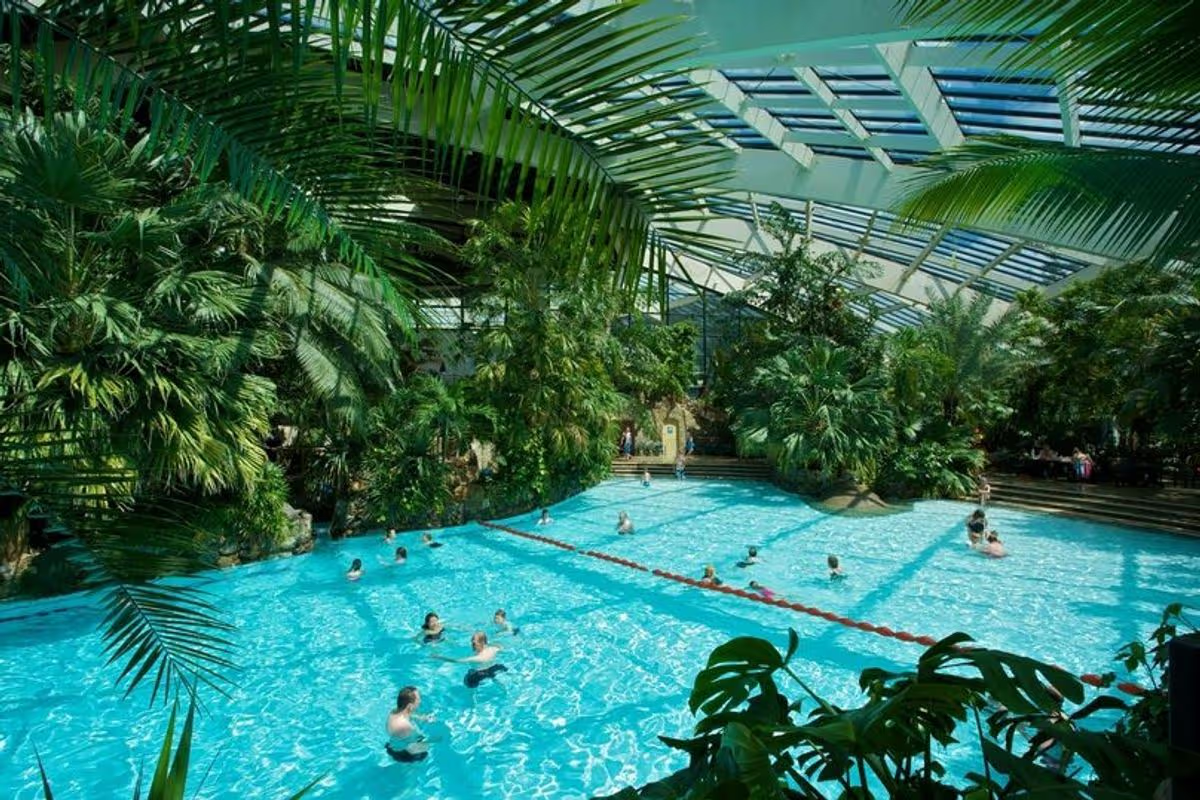
The Center Parcs Scottish Borders development will feature 700 lodges and flats, a Subtropical Swimming Paradise mirroring those at existing sites, retail outlets and dining venues in the village hub, plus an Aqua Sana Forest Spa nestled within the woodland. Virtual tours and 3D renderings show numerous amenities positioned along the waterside.
EVEN more Brits will get to explore the delights of Montego Bay as Virgin Atlantic is upping its flight offerings.
Thousands more seats are being added to the airline’s schedule very soon making it much easier for holidaymakers to enjoy Jamaica’s sun and sea.
Sign up for the Travel newsletter
Thank you!
Montego Bay in Jamaica has beautiful beaches and highs of 30C year-roundCredit: AlamyVirgin Atlantic is upping its flights to Montego Bay to once a day from June 2026Credit: Alamy
Jamaica is one of the Caribbean‘s most popular islands welcoming around 2.5million visitors every year.
Thanks to its natural beauty and incredible weather – it’s a hit with Brits too.
Currently there are just four flights a week, but from June 1 there will be daily flights between the airports – meaning there will be over 15,000 more seats.
One-way tickets in June with Virgin Atlantic start from £444.
These daily flights which take on average 10 hours and 15-minutes will end on October 24, 2026.
Montego Bay on north-west coast of Jamaica is the capital of the parish of Saint James and is one of the most popular tourist spots on the island.
Of course Brits flock there for its great weather and beautiful bays like Doctor’s Cave Beach.
It’s considered one of the most beautiful in the country with white sand and bright turquoise waters.
Aside from sunbathing and paddling, snorkelling is popular too as swimmers are likely to spot parrotfish, turtles, and small sharks.
Other top-rated beaches in the area include Cornwall Beach, Walter Fletcher Beach and Dead End Beach.
For those who want to explore island life, head to the Hip Strip which is filled with local restaurants, bars, shops, and there’s plenty of nightlife too.
Check out some of our favourite Caribbean holidays…
*If you click on a link in this box, we will earn affiliate revenue…
Hotel Capriccio Mare, Dominican Republic
Facing the calm, crystal waters of the Caribbean Sea, Hotel Capriccio Mare looks like a bright white island villa. The hotel’s position on Bavaro’s coastline is perfect for exploring the popular resort town of Punta Cana. Whether it’s strolling the sands to grab a fresh coconut with a straw, or venturing out on a catamaran trip to Saona Island, this dreamy Caribbean resort is not one to miss.
This friendly, family-run hotel is a slice of Caribbean paradise. This hotel sits smack-bang on a sugar-white beach with warm turquoise waters. Enjoy both the beaches of Barbados and its plethora of rum bars – there are about 1,500 of them on the island.
Set on the quiet side of St Kitts’ Frigate Bay, the boutique Sugar Bay Club offers superb value and wonderful views of the Atlantic Ocean. Staff are on hand to assist with island tours, from catamaran cruises to scenic railway excursions.
Amazing Antigua has 365 beaches – one for every day of the year – as well as a fascinating history. This resort in Falmouth Harbour is perfect for exploring the beautiful local area, including Pigeon Point, Nelson’s Dockyard and English Harbour.
Other activities around Montego Bay include scenic bamboo rafting tours on the Martha Brae River which head through the rainforest.
Around an hour away from Montego Bay is Dolphin Cove where there are dolphin experiences and dolphin spotting in natural lagoons.
Back on land, the Rose Hall Great House is another attraction tourists flock to.
It’s a restored 18th-century Georgian mansion and former sugar plantation.
The historic house museum offers tours throughout the day to visitors wanting to learn more about the former owner, the White Witch of Rose Hall.
When it comes to Jamaica, the best months to visit are December through to April when it is at its warmest at around 30C.
During this time it’s mostly dry with low humidity.
You’ll be able to spot dolphins around Montego BayCredit: Alamy
Here’s another Caribbean island to visit with floating bars…
For more on the Caribbean, the islands of Turks and Caicos is rising in popularity due to the conflict in the Middle East – Deputy Travel Editor Kara Godfrey visited in 2024 and reveals more on the beautiful destination…
She said: “One of the main draws are the stunning beaches – so beautiful in fact they are often named some of the best in the world.
“I spent my jet-lagged mornings walking the length of Grace Bay, with powder soft sand and quiet sunrises. Even in the evening they were just as beautiful with pink sunsets ending the day. And there is not just one, but two floating bars.
“One of the most popular is Captain Oak’s Tiki Bar, which has even welcomed celebs such as Drake and Jake Harlow Tourists have to pay $20 (£15.10) to get there by boat or jet ski.
“Otherwise there is the more vibey Noah’s Ark, which has a floating dance floor as well as sea swings.”
Passport holders have been told to act in April if they want to avoid spending more money. Failing to do so could lead to people facing more expensive travel fees this summer
09:35, 03 Apr 2026Updated 09:36, 03 Apr 2026
Passport holders have been urged to act this month (stock image)(Image: Maksims Grigorjevs via Getty Images)
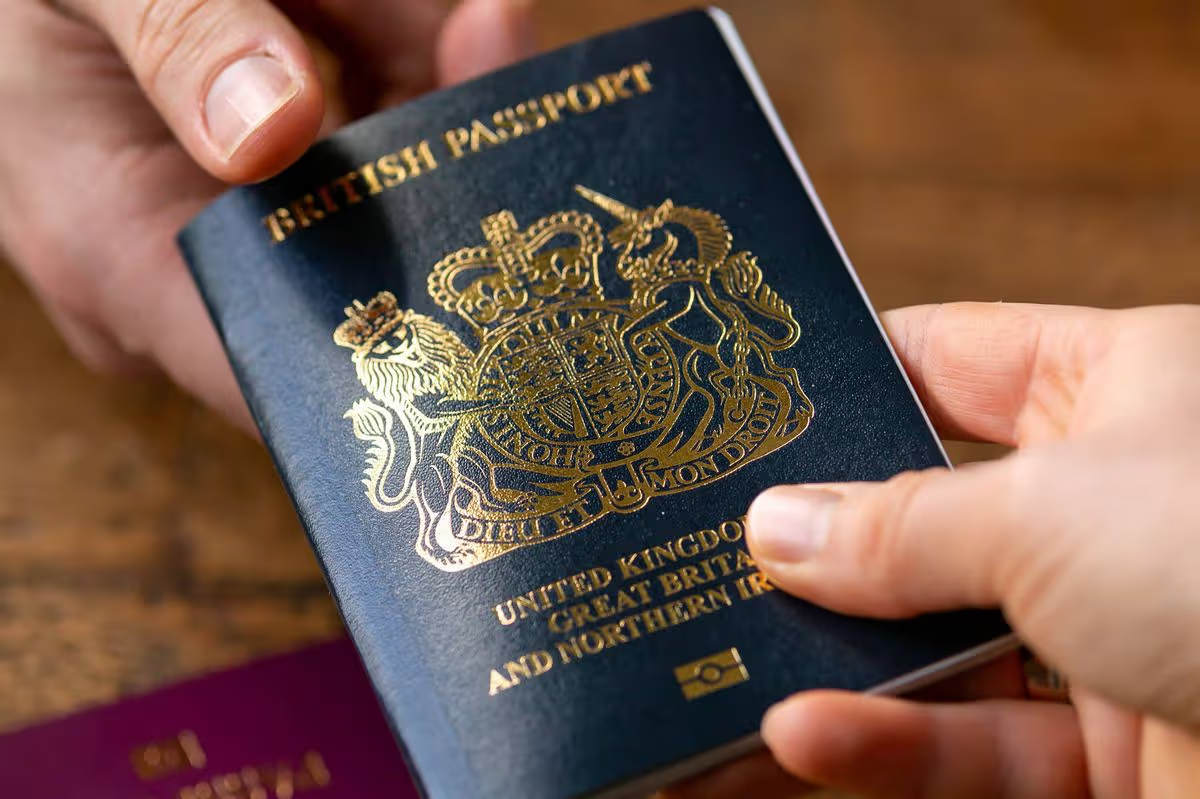
UK passport holders are being urged to take action in April as a costly change is about to come into effect. Whether you’re planning a holiday now or in the future, it’s essential you take note if you want to sidestep a heftier bill.
This is because a change coming into force from April 8 could affect how much you’re forking out to travel. Acting before this deadline could mean you’re able to board a flight at a cheaper rate, which is welcome news when virtually everything else seems to be getting pricier by the day.
The advice was recently brought to the public’s attention by Simi, known as Miss Personal Finance on TikTok, where she laid out everything people need to be aware of. She regularly shares a wealth of useful money saving tips online.
In the clip, Simi said: “From April 8, the cost of getting a passport in the UK is set to increase by 8%. This means that an adult online passport will be going over the value of £100 for the first time.
“The UK Home Office stated that the increase of these costs is to reduce reliance on taxation funding, while covering the cost to produce the passports.”
Content cannot be displayed without consent
Following the video, viewers claimed “everything is going up”; nevertheless, those who fail to act promptly when renewing their passports will find themselves facing steeper fees to travel.
According to the UK Government website, there are several key points to be aware of.
These include:
The price for a standard online application made from within the UK will rise from £94.50 to £102 for adults and from £61.50 to £66.50 for children
As well as this, postal applications will rise from £107 to £115.50 for adults and from £74 to £80 for children
The fee for a premium service (one day) application made from within the UK will jump from £222 to £239.50
There will also be changes to prices for overseas applications which are detailed on the website
Why is it happening?
According to the government website, there are several reasons behind the fee increases. It explains: “The new fees will help the Home Office to continue to move towards a system that meets its costs through those who use it, reducing reliance on funding from general taxation.
“The government does not make any profit from the cost of passport applications. The fees contribute to the cost of processing passport applications, consular support overseas, including for lost or stolen passports and the cost of processing British citizens at UK borders.”
If you need to renew your passport, applicants have been urged to apply well in advance of any travel plans. You can complete this online.
In 2025, where no additional information was needed, it’s reported 99.7% of standard applications from the UK were completed within three weeks or less.
It can be difficult to choose which class to go for when booking Eurostar. Recently, I tried Plus, and while it was a pleasant experience, here’s why I think it’s not worth the money
09:06, 03 Apr 2026Updated 09:06, 03 Apr 2026
‘I went on both Eurostar Standard and Eurostar Plus to find out how they compare’
Eurostar offers a fast and efficient way to get from London to the continent, and if you’re doing a day trip or a short break, it can be much more time-efficient than flying.
When you choose your Eurostar train time, you’ll usually be presented with three fare options: Standard, Plus, and Premier. Recently, I took two trips in the space of a week, one on Standard and one on Plus to see how the two classes compare. With Plus tickets often costing double, triple, or even quadruple the cost of a Standard ticket, is it worth the upgrade?
I took the Eurostar Standard from London to Lille, which at just 90-minutes is the shortest journey from London St Pancras. I managed to pick up tickets for £35 one-way in a flash sale, so going to Lille was cheaper than visiting many UK cities by train.
Standard
Standard is a no-frills service. You get a luggage allowance of two bags up to 85cm long on routes to and from London, plus a small item such as a handbag and laptop bag. There are no weight or liquid limits like you’d find on planes, although you do need to heft your bags up and down the steep train steps, so keep that in mind before stocking up on wine at the supermarché.
There are two rows of two seats, which are comfier than most UK trains and have headrests and footrests. Impressively, Standard tickets are flexible up to an hour before departure, so if your travel plans change you can swap your ticket for no fee. You simply pay the difference for your new fare.
Seats come with a power outlet, and you technically get access to WiFi, although on all my journeys, this barely worked, so bring a book. Once settled in, we had some snacks and the journey flew by, and we stepped off the train into the centre of Lille ready for a city break.
Eurostar Plus
A few days later, I tried the Eurostar Plus, this time on a journey from London to Paris. The journey through St Pancras station is exactly the same, you don’t get access to a priority queue, lounge, or boarding, so you don’t really notice the difference until you board. Luggage allowances and rules around flexibility are also the same as Standard class.
The carriages are also very similar to Standard, except with one less seat in a row, so you have two seats on one side and single seats on the other. The single seats seemed popular with business travellers who quickly whipped out their laptops, although with the patchy WiFi, I’m not sure how much work they got done.
Unfortunately, I think I had bad luck with this train: half the toilets were out of order, and the other half were less than pleasant. I had to wobble my way up and down the aisles with a child in tow, trying to find a loo.
The main upgrade on Plus is that you get breakfast or a light meal, plus a choice of drinks, including wine and beer. Dishes are served cold, so they tend to be salads with chicken or fish or pasta dishes. My salmon and lentils were tasty enough, but about on par with what you’d get in Marks and Spencer at the station.
The staff on Eurostar Plus are also extremely friendly and helpful, and it was nice to sit back and be served a meal with wine and coffee on a well-presented tray. But is it worth the upgrade?
However, I will admit that the Plus carriage did have a slightly calmer, more business-like vibe, so if you’re on the way to an important meeting, it might be worth the money. Likewise, if you’re traveling alone and don’t want to risk ending up with a chatty neighbour, the thought of booking a single seat might appeal.
Otherwise, take your own sandwich and save your Euros for when you arrive at your destination.
Have a story you want to share? Email us at webtravel@reachplc.com
This European city has been crowned the world’s best destination for food lovers
Isobel Pankhurst Audience Writer
08:26, 03 Apr 2026
This city has been named the best destination for foodies(Image: Getty)
One European city has been crowned the ultimate travel destination for food lovers. A new study by Titan Travel examined cooking class availability, ratings, pricing, and worldwide search demand, concluding that the Italian city of Florence reigns supreme for gastronomically-inspired getaways.
Florence wasn’t the only Italian gem to feature on the list either, with Italy dominating all three top spots: Palermo claiming second place and Bologna taking third. Rome then tied for fourth alongside Portuguese capital Lisbon, with Venice, Brussels and Barcelona all sharing fifth place.
Researchers discovered that Florence boasts a staggering 213,300 culinary experiences, encompassing 231 cooking classes, 74.5% of which hold a four-star rating or above.
And depending on when you book, Skyscanner has flights to Florence starting from just £31.
Weighing in on the growing trend of foodtourism, and how it has become an increasingly significant factor for holidaymakers when planning their trips, Cassie Stickland, Product Manager at Titan Travel, said: “Today, travellers want to do more than just see the sights.
“They want to really experience a destination. Food is such a fantastic way to do that, because it connects you directly to local life and tradition. Taking a cooking class abroad allows you to do something, learn something, and return with a valuable skill.
“When planning your 2026 travels, look for tours that include a hands-on cooking experience. The best ones start with a market visit to get ingredients and end with you sitting down to enjoy what you’ve created.
“The most rewarding experiences tend to come from local chefs and family-run kitchens, where you’ll not only learn recipes but hear the stories behind them.”
World’s best cities for food
1. Florence, Italy
2. Palermo, Italy
3. Bologna, Italy
4. Lisbon, Portugal and Rome, Italy
5. Brussels, Belgium, Barcelona, Spain, and Venice, Italy
SEMANA Santa – also known as Holy Week – is the biggest religious festival celebration across Spain.
During a recent trip to the country, I experienced this nationwide event after staying in a local town and was left stunned how different it was to our Easter.
Sign up for the Travel newsletter
Thank you!
Semana Santa is the biggest religious celebration across SpainCredit: Martha GriffithsIt starts on Palm Sunday and carries on in the days leading up to Easter and I was lucky enough to be thereCredit: Martha Griffiths
Starting on Palm Sunday (March 29 this year) the days leading up to Easter see towns and cities hosting long, dramatic processions.
While cities like Seville and Malaga are famous for their huge crowds of tourists and locals, I discovered the tradition feels much more authentic in a small town.
Oliva, in the Valencian region, is usually calm and laid back, especially compared to Spain’s tourist hotspots.
But during this Holy Week, the town is transformed as the streets I had walked down earlier that day were transformed at night.
Huge ornately decorated floats (pasos) were carried by ‘cofradías’, or brotherhoods made up or local religious groups, including neighbours, families and friends.
The procession started in baited silence, even from the kids.
It was then that the drums began, with haunting brass create a sombre tone.
Hooded figures, or ‘nazarenos’ emerged from the darkness as they moved in unison, with costumes typically only revealing the eyes (designed to make it about the faith rather than the person underneath).
While it certainly sounded eerie, I had never seen anything like it and was swept into the atmosphere along with everyone around me.
I felt like I was part of the local community, as the smaller towns are less focused on making them tourist-friendly.
There are so many other events also on during the week. For example, at 4am on Good Friday, locals climb the nearby mountain barefoot while carrying the floats.
Seeing the small-town community coming together at this hour, sacrificing sleep and comfort showed just how deeply Semana Santa runs here.
But as the week unfolds, the mood slowly shifts from mourning to celebration.
Sweets are thrown in the streets on Easter Sunday, celebrating the resurrection – a definite highlight for the local kids.
Food plays a massive role during Easter traditions, with their pastries stealing the spotlight.
At 4am on Good Friday, locals began their ascent up the nearby mountain, barefoot and carrying religious floatsCredit: Martha GriffithsAs part of the festival, towns have a long processions with live musicCredit: Martha GriffithsThe celebrations also involve traditional pastries, such as Mona De Pacuas – soft, brioche-like breads covered in chocolates and creamCredit: Martha Griffiths
Mona De Pascua – soft, brioche-like breads covered in chocolates and cream – are everywhere.
Traditionally gifted by godparents to children on Easter Sunday, they remain a staple throughout Semana Santa.
Bakeries are filled with them all week and sharing one feels like another way the town comes together to celebrate.
Experiencing it in such a small town away from the tourists and city spectacles is incomparable to just reading about it.
The elaborate floats, music and outfits make it an unforgettable experience – and certainly more of a celebration than the Brits eating hoards of chocolate instead.
I went in curious and came out completely blown away. It was unlike any Easter I have experienced in the UK.
Vichy is not on everyone’s radar as a must visit French town, but it really is a delight to spend a few days in. I discovered it while on a bicycle trip around central France, and its famous waters did wonders for my tired legs and muscles. Vichy is a historic spa town famous for its spring waters and its art nouveau and belle époque architecture. A thriving cultural scene means that, whenever you visit, you’ll find concerts, theatre, opera and exhibitions, especially at the town’s opera house and the iconic Grand Casino. Vichy is also a shopper’s paradise, with more than 500 boutique shops in the heart of the town. When all that shopping and walking has worked up a thirst, taste the famous Vichy waters for free at Hall des Sources (listed on the Accidentally Wes Anderson website). The city is easy to explore on foot or by bike, with riverside paths along the Allier River, pretty neighbourhoods with pastel-coloured villas, and plenty of outdoor cafes. Being there felt like witnessing a Renoir or Matisse painting coming to life before my eyes. Nicoletta
Canals, lakes and flowers in Savoie
Chanaz in south-east France is perfect for a boating trip. Photograph: Hilke Maunder/Alamy
Chanaz on the north-western edge of the Savoie is a picturesque village I love to visit in summer. One the best little trips is to rent a canoe or electric boat and glide along the Canal de Savières to the Lac du Bourget. The village boasts colourful flowers, old narrow streets, cycling lanes, and some of the best ice-cream I’ve ever tasted. There are plenty of affordable accommodation options around the Lac du Bourget, and many more villages to explore in the area. Juliette B
Profile
Readers’ tips: send a tip for a chance to win a £200 voucher for a Coolstays break
Show
Guardian Travel readers’ tips
Every week we ask our readers for recommendations from their travels. A selection of tips will be featured online and may appear in print. To enter the latest competition visit the readers’ tips homepage
–
The ‘most beautiful kilometre in France’ is in Normandy
The beach at Jullouville. Photograph: Only France/Alamy
Avoid the crowds and see the wonder of Mont-Saint-Michel from another angle, the Falaises de Champeaux (Champeaux Cliffs), with a view much admired by General Dwight Eisenhower in the second world war after he had set up an allied HQ in nearby Jullouville. The half-hour car journey from Granville to medieval Genêts takes you through the old-fashioned and unspoilt seaside village resorts, cafes and restaurants of Saint-Pair-sur-Mer, Jullouville, Carolles, and before you reach the delightful village of Saint-Jean-le-Thomas, you can take in the panoramas of the “most beautiful kilometre in France”. Dee
Modernism and glass in Provence
Fernand Léger National Museum. Photograph: Andrei Antipov/Alamy
The Fernand Léger National Museum in Biot, near Antibes, is one of our favourite places to spend an afternoon. The temporary and permanent displays of Léger’s modernist works are interesting, but it’s the stunning exterior and calm surrounding grounds that are really special. To make the most of your time, La Verrerie de Biot is a two-minute drive away. Here you can watch free glass-blowing demonstrations and browse the glass creations in the shop. Rowan De Saulles
Walking in the shadow of Robert Louis Stevenson, Massif Central
The Chemin de Stevenson Trail is on the route the great author took in 1878 with a donkey. Photograph: Hemis/Alamy
Last August I walked the southern half of the Chemin de Stevenson (designated the GR 70) – a 140-mile footpath in the Cévennes that follows the route taken by Robert Louis Stevenson in 1878 with his recalcitrant donkey, Modestine. I averaged 15 miles daily, hiking along rocky trails and woodland paths. Accommodation comprised basic hostels, each about €50 a night; one had lodged RLS 147 years previously. I ate dinner at local bistros; breakfast came from boulangeries. I met a few fellow hikers but was mostly accompanied only by the words from Stevenson’s account, Travels with a Donkey, as I tried to match his footsteps to my own. The full route crosses four departments: Haute-Loire, Ardèche, Lozère and Gard. Jane
Leonardo’s resting place on the Loire
A room at Clos Lucé, last resting place of Leonardo da Vinci. Photograph: Tuul and Bruno Morandi/Alamy
Amboise, a delightful small town on the Loire, boasts three chateaux. The most imposing is the Château Royal d’Amboise, home to Francis I, who lent a spare chateau, the Clos Lucé, to Leonardo da Vinci for the last three years of his life (1516–19). It is the Clos Lucé that delights the most, with its full-sized mock-ups of Leonardo’s designs dotted around the park, while models of other inventions are displayed in the cellars. Leonardo’s bedroom, kitchen and atelier are all reproduced in their original rooms. Leonardo’s last resting place is a dedicated chapel in the Château Royal – the Chapel of Saint-Hubert. The third chateau, Gaillard, is renowned for its Renaissance landscape architecture and gardens. Pete Mitchell
Cycling between Normandy pools
An art deco pool at Deauville, built in the 1920s. Photograph: Huart Remy/Alamy
I took my vintage Raleigh Chopper on the night ferry from Newhaven to Dieppe and cycled the Normandy coast with essentials packed in a small bag. I stopped at Honfleur, Deauville, Caen and Mont-Saint-Michel and enjoyed swims in Trouville’s art deco lido, Deauville’s beautiful seawater Olympic pool, the tidal sea pools at Saint-Pair-sur-Mer and Granville. The superb Les Bains de Dieppe has sadly had to permanently close since my visit because of structural problems. I used trains when the weather was bad and to get back to Dieppe. Victorie
Provence in the frame
During photography festival Rencontres d’Arles the town hosts work at dozens of locations. Photograph: Paul Quayle/Alamy
Base yourself in Arles during the long summer for Les Rencontres d’Arles (6 July-4 October), when cutting-edge photography fills an eclectic mix of venues: romanesque churches, cloisters, the town hall, shady parks and even a Monoprix warehouse, all within easy walking distance. There’s accommodation to suit all budgets, including many in old Arlésienne homes. Between exhibitions, trace Van Gogh at the Starry Night Café and along the canal towards the Bridge at Arles, or climb the Roman arena for wide Provençal views. In September Camargue rice festival with its tractor-pulled floats, music and rice flung like panto sweets is also great fun to visit. Stephen Edwards
A dash of Tuscany in Pays de la Loire
Clisson is known for its Italian-inspired architecture. Photograph: Margouillat Photos/Getty Images
I caught my first glimpse of Clisson while visiting nearby Gétigné. There is simply no mistaking you are south of the Loire here. It’s a delightfully surprising town in the muscadet wine region with a distinctly Mediterranean feel where terracotta roofs and ochre tones abound. On a hot summer’s day, be transported from Loire-Atlantique to Tuscany thanks to the Italianate-style architecture and sweeping views from the castle towards Domaine de la Garenne Lemot. Umbrella pines serve to accentuate the town’s characteristic ambience and tucked away on a charming sidestreet is one truly remarkable leaning specimen. Richard Arnott
Winning tip: Canoeing in Nouvelle-Aquitaine
The rivers of the Corrèze department are ideal for canoeing. Photograph: Herve Lenain/Alamy
Corrèze, a rural department in the Nouvelle-Aquitaine, has lakes, gorges, sleepy farming hamlets and furry brown cows. It is a peaceful place even in the middle of August. We followed a switchback road to Smile Kayak, rented canoes, stuffed waterproof barrels with baguettes, beers and cheeses, and were delighted to find we had the gorge to ourselves. We paddled along the river where the Dordogne and Diège converge, watching red kites wheeling overhead and shattering the silence by shouting for echoes. Cath Fischl
Brocklands Adventure Park in Cornwall had attractions including a bowling alley, bumper boats, crazy golf and animals. But it closed in 2007 and has been left abandoned
07:00, 03 Apr 2026Updated 08:57, 03 Apr 2026
The old park even has fruitful kiwi trees(Image: StreetZips/YouTube)
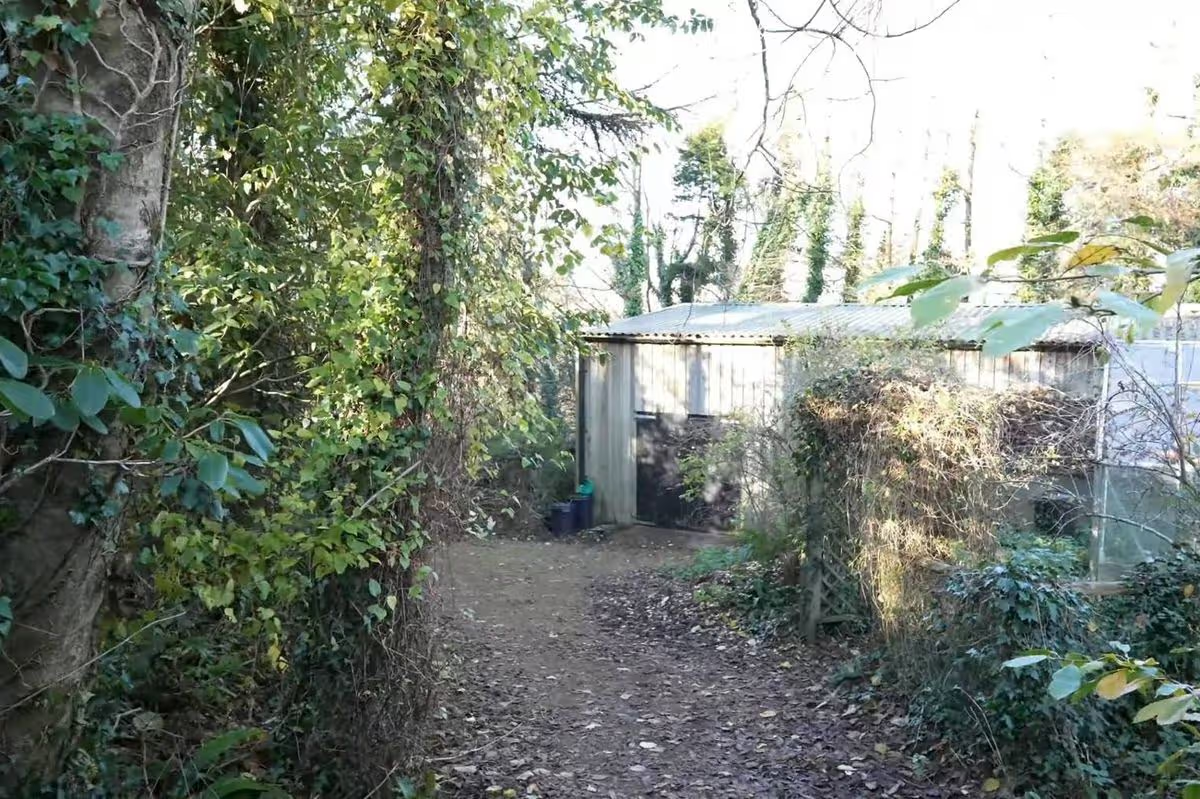
A once-thriving and vibrant adventure park teeming with wildlife and laughing youngsters now stands eerily abandoned, left to decay.
Brocklands Adventure Park was a beloved attraction in Kilkhampton. The venue welcomed guests from 1977 until it shut down in 2007.
The park garnered multiple accolades after being established by Dennis and Sue Vanstone. During its heyday, it attracted 50,000 visitors each season, having evolved from a modest tea room and shop into a comprehensive leisure destination.
It grew into an expansive complex featuring playgrounds, attractions, animal enclosures and wildlife programmes.
In 1987 it rebranded as Pixieland Funpark. By 1990 the venue had added a 15-inch gauge miniature railway, pony rides, trampolines, and an all-weather playground.
In March 1997, further expansion saw the launch of Pip’s Place, a new restaurant accommodating 200 diners, reports Cornwall Live.
Subsequently there were additional features including a ten-pin bowling alley, archery centre, crazy golf, quad biking, bumper boats, and a mega tube slide.
Creatures from across the animal kingdom called it home. Visitors could encounter rabbits, ducks, iguanas, snakes, parrots, and a raccoon.
In 2000, the park was rechristened Brocklands Adventure Park, signalling its evolution into theme-park territory.
Despite its popularity, the park tragically shut its doors in 2007 when the owners retired. Today, vegetation and undergrowth have overrun the formerly bustling structures.
Wandering through the deserted park and stumbling upon an old archery range, the Youtube channel Street Zips said: “There are soap dispensers, we found a bow and arrow in here.
“There’re drawers here, we’ve got plugs and fuses – and smart plugs – one of the things that go on your wrist to stop you getting whacked by the bow.
“Listen-listen – can you hear it? Yeah like a rat is it – I heard a squeak. The rustiness of the drawers are really cool as well. You would pay a fortune for that for a movie set piece. “
They also discovered boxes for trapping rats, saying: “They’ve obviously got an infestation of something here. That’s a serious trap isn’t it. There’s some spring on that.”
The urban adventurers came across a kiwi tree still bearing fruit. Peering into what they believed was an old animal enclosure, they discovered posters of creatures to look out for in the taxidermy exhibition made “only of roadkill.”
They even spotted old pheasant feathers scattered across the floor.
Fast forward to 2021, a planning proposal was submitted to convert a key building into a two-bedroom home, and by 2023, planning permission was granted to construct five homes on the site.
The steel structure will be repurposed into a two-bedroom dwelling. The planning application reads: “The site comprises part of the former visitor attraction known as Brocklands Adventure Park, which closed in 2007 and contained a range of attractions split across two sites (separated by West Street).
“These attractions included 15in gauge railway, ponds, slides, pony ride track, trampolines, quad biking, bouncy castle, bumper boats, bowling alley, indoor multi-activity centre and refreshment facilities.
“The proposal involves converting the existing steel frame building to form a two-bedroom dwelling.”
This handy map tool allows you to calculate the percentage of the world you’ve seen by selecting all the countries you’ve visited.
Travellers admit they compare how many countries they’ve visited with other people(Image: Getty Images)
Ever wondered how much of the world you’ve really seen? Use this handy tool to find out. By selecting all the different countries you’ve ever visited, it’ll work out a percentage of the world you’ve managed to explore and how many continents you’ve covered. It’ll also tell you how your stats compare against other travellers, and will show your footprint on the globe.
A poll of 2,000 travellers revealed 43% enjoy comparing the number of destinations they’ve visited abroad with others. Reasons for mentioning their ‘country count’ include wanting to impress others with their worldliness and sense of adventure, get others to think ‘that’s more than me’ or to see them as someone ‘loaded’ with money.
Of those who mention their country count, more than four in 10 (44%) will casually raise the subject in general holiday chatter, while 38% will jump at the chance to name a nation they’ve visited the second someone else mentions it.
It also emerged 34% of travellers consider their list of countries visited ‘as a bit of a badge of honour’ and a fifth feel ‘quietly superior’ to those who have been to fewer nations.
A spokesperson from travel insurance specialist Staysure, which commissioned the research and tailors policies for people with health conditions, said: “Travelling abroad is exciting and the memories made with friends and family can last forever.
“So, it’s not surprising people love talking about where they’ve been and comparing the number of countries they’ve visited. Sharing experiences is something we all love to do and it’s great to be able to inspire others to visit somewhere new.
One in 10 attempt to sound better travelled than they really are by counting countries they visited as a child in their list. And some go as far as including an airport layover or counting a day trip as a full visit. But four in ten described other people discussing how well-travelled they are as ‘annoying’.
Find out how much of the world you’ve actually seen with this new tool
New Zealand (24%), Japan (23%) and Australia (18%) were at the top of respondents’ wish lists, along with Iceland, Sweden and Switzerland. While Canada was nearly twice as popular as a future destination than the United States (17% versus 8%).
The average traveller has been to seven countries by the time they’re 30 – this number nearly doubles to 15 by the time they reach the age of 60. However, it also emerged 56% of those polled wish they were better travelled.
On average, respondents said their travel peaked at age 34, while 44% admitted their trips abroad have generally decreased as they’ve gotten older.
Four in 10 consider it important that their list of countries visited keeps growing, with those with a set goal aiming to tick off 30 individual countries. To do this, 56% would consider a multi-destination holiday such as a cruise.
Staysure’s spokesperson added: “Our customers often share where they’ve been and where they’re planning to go next.
“It’s good to know people are dreaming big and want to keep ticking off their dream destinations. Although technically correct to do so, would you include a layover in your country list if you’d not set foot outside the airport?
“Wherever people choose to travel, having the right cover and financial protection in place helps them keep ticking countries off their list making the whole experience more enjoyable and worry-free.”
Airlines are becoming stricter with cabin bag regulations, scrutinising the size and weight of passengers’ luggage. If your baggage exceeds the permitted dimensions or weight, you could be hit with hefty last-minute fees.
For example, easyJet warns: “We check cabin bag sizes before you board. If your cabin bag is bigger than the maximum size allowed or if you bring a large cabin bag to the departure gate without the correct seat selection or without one pre-booked for your flight, it won’t be able to go in the cabin. We’ll have to check it into the aircraft hold and charges will apply.”
Given these stricter check-in rules, it’s crucial to familiarise yourself with your airline’s baggage allowances. Here’s what some of the most popular airlines permit.
Ryanair
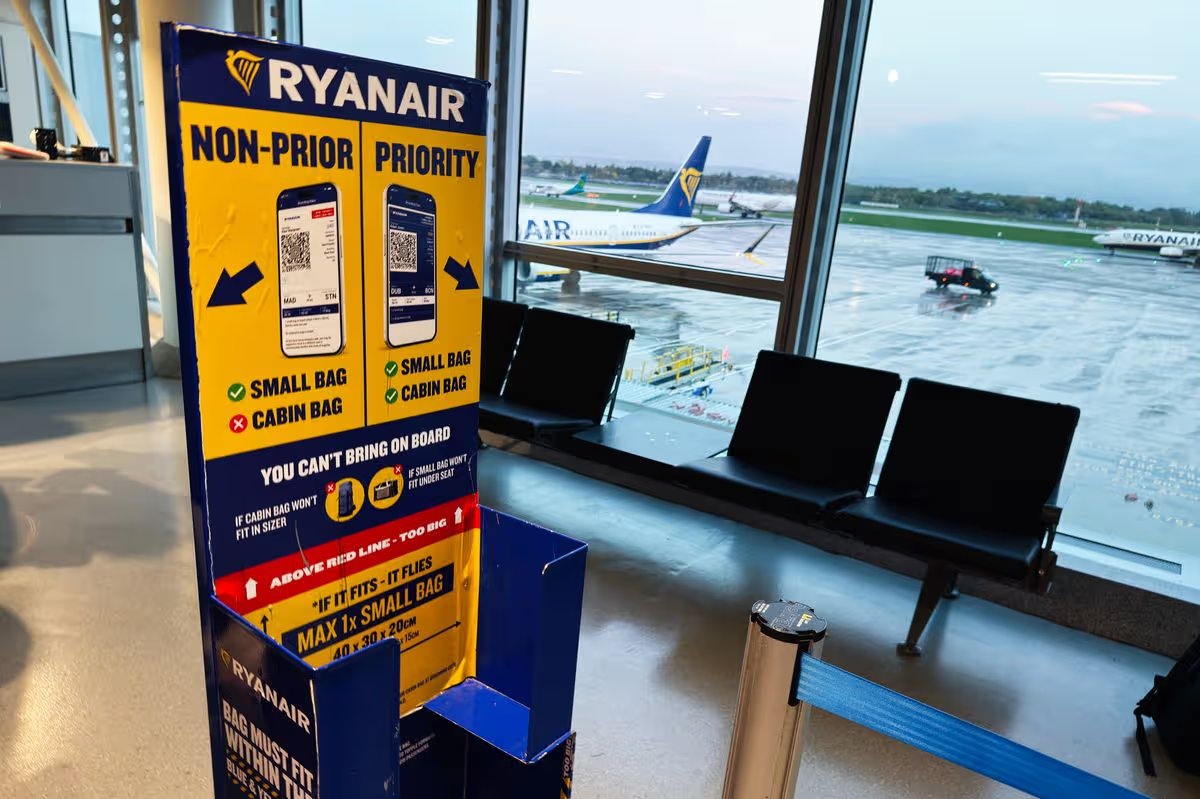
If you’re flying with Ryanair, “all fares include one small personal bag (40 x 30 x 20 cm) that must fit under the seat.”
You can add extra options like Priority boarding with a second 10kg cabin bag, checked bags of 10kg, 20kg (up to 3), or 23kg (1 allowed). Infants have no cabin allowance but may bring a 5kg baby bag and two baby equipment items free, it confirms.
Ryanair Cabin Baggage
Priority & 2 Cabin Bags: This allows you to carry a small personal bag (40 x 30 x 20 cm), which must fit under the seat in front of you and a 10kg bag (55x40x20cm) onboard, to be stored in the overhead locker. It also allows you to board the plane first using the Priority Boarding queue at the gate.
Ryanair Checked Baggage
10kg Check-in Bag: If you wish to check in a bag, you can add a 10kg Check-in Bag to your booking. Bags must be dropped at the airport check-in desk before security and will be placed in the aircraft hold.
20kg Check-in Bag: If you require a larger baggage allowance, you can add a 20kg Check-in Bag to your booking. Passengers can purchase up to 3 checked bags of 20kg on their booking.
23kg Check-in Bag: If you require an even larger baggage allowance, you can add a 23kg Check-in Bag to your booking. Passengers can purchase up to 1 checked bags of 23kg on their booking.
Ryanair Infant Baggage
Ryanair allows you to carry 2 items of baby equipment free of charge per child, to make your journey as seamless as possible. There is no cabin bag allowance for an infant (aged 8 days to 23 months inclusive). However, it allows a baby bag up to 5kg (dimensions: 45 x 35 x 20 cm) for babies travelling on an adult’s lap.
Jet2
Passengers flying with Jet2.com can bring a small under-seat bag, like a handbag or laptop bag, up to 40 x 30 x 20 cm, to fit under the seat in front of them.
The airline also confirms: “On all our Jet2.com flights, each passenger has a 10kg hand luggage allowance included as standard (excluding infants). You can also bring one small under-seat bag onboard (such as a handbag or laptop bag) as long as it fits under the seat in front of you.”
Passengers are permitted one free cabin bag, provided it weighs no more than 10kg and measures within 56 x 45 x 25 cm – including wheels and handles. If you are travelling with little ones, “you can bring along a collapsible pushchair, car seat and/or travel cot free of charge.”
British Airways (BA)
Another popular airline, British Airways, confirms that if you have no checked baggage, the following applies.
Handbag
1 handbag
Max dimensions of 40 x 30 x 15cm (16 x 12 x 6in)
Must easily fit under the seat in front of you
May contain essentials like medication, mobile phones, other electronic devices and passports
Guaranteed in the cabin
Cabin bag
1 cabin bag
Max dimensions of 56 x 45 x 25cm (22 x 18 x 10in) – including wheels and handles
You must be able to lift your cabin bag into the overhead compartment unassisted
No valuables, electronics or essential medicines
May need to go in the hold
You can also use the airline’s baggage calculator here. You need to enter your flight details, including your departure and arrival airports, travel class, departure date, and ticket issue date.
It cautions: “The weight of your bag as well as the number of bags you are allowed may be different when travelling on flights operated by our partner airlines, even if you are booked under a BA flight number. These are also called code-share flights, and the operating airline will be named in your itinerary.
“If a journey with connecting flights includes ‘BA’ and other airline codes, such as ‘AA’ or ‘IB’, your baggage allowance is generally determined by the airline that operates the longest flight in your itinerary.”
easyJet
Airline easyJet has confirmed that all passengers “can bring one small under-seat cabin bag per person on board for free.”
It adds: “It can be a maximum size of 45 x 36 x 20 cm (including any handles and wheels) and must be kept under the seat in front of you. Your bag can weigh up to 15kg, but we do ask that you’re able to lift and carry it yourself.”
The airline says passengers can bring a large cabin bag (up to 56 x 45 x 25 cm, including handles and wheels) if they book it for their flight. “Every customer who books a large cabin bag can also enjoy the benefit of Speedy Boarding”, easyJet says.
It continues: “If you’re an easyJet Plus member or customer who has booked an Inclusive Plus fare, you can also bring a large cabin bag on board (in addition to your small cabin bag) as part of your membership or fare benefits.
“Please note that the maximum number of cabin bags available per person is two; one small cabin bag for all customers and one large cabin bag for customers if it’s included with their fare or membership benefits or where they have paid to add one to their booking.”
The large cabin bag must follow these rules:
Maximum size 56 x 45 x 25 cm (including any handles and wheels)
Includes items like a trolley case and larger rucksack, but please check dimensions
Needs to fit in an overhead locker
Maximum weight 15kg. You need to be able to lift and carry the bag yourself
The airline recommends passengers purchase all their bags online, as it’s more economical and helps avoid airport charges.
THERE’S no place like London’s neighbourhood of Chelsea, or is there?
With a plethora of high-end shops and cafés, one destination in Norfolk has earned itself the nickname of ‘Chelsea-on-Sea’, and it’s one of the poshest spots in the area.
Sign up for the Travel newsletter
Thank you!
Burnham Market in Norfolk is called the county’s Chelsea-on-SeaCredit: AlamyIt’s full of independent shops and high-end restaurantsCredit: Getty
The destination in question is Burnham Market, a beautiful 17th-century village in the north of the county.
It’s considered the ‘Chelsea‘ of the area because of how posh it is – in fact, Burnham Market even made it onto the list of Britain’s poshest villages by The Telegraph in 2024.
While doesn’t have the King’s Road, or the Saatchi Gallery, Burnham Market does have over 30 independent shops and boutiques around the green.
It’s also got small galleries and top restaurants.
Travel Reporter Jenna Stevens, who hails from Norfolk, gives us more of an insight into the posh town.
She said: “I grew up just a few villages away from Burnham Market, the fancy seaside destination dubbed Chelsea-on-Sea.
“Everything here centres around the village high street, lined with premium pubs, shops and boutiques on either side.
“Here you’ll find the famous Gurneys Fish Shop, where it’s well worth picking up some homemade fishcakes to take home. You’ll also find posh coastal-themed clothing and interior decor shops like Barefoot Living, Joules and Jack Wills.
“And when you’re done shopping, you can stop for a coffee and a toastie in the trendy Scandi Coffee Co.
“You’ve also got your pick of fancy restaurants here. Michelin star-rated restaurant Socius is the kind of fine-dining spot you’d book to celebrate a special occasion.
“Or, The Hoste Arms is a posh pub with rooms, where you can slink off to a cosy bed after dining on moules marinière or local venison.
“Approaching spring and summer, head a couple minutes down the road to Burnham Overy Staithe, where you’ll find the best secret spot for paddle-boarding along the coast.
“Wander through wild marshland down to the shore, and you’ll see some of the calmest and shallowest waters, perfect for a paddle. And here you’ll see some incredible sunsets.”
For more places to stay in Norfolk, check out Old Hunstanton…
*If you click on a link in this box, we will earn affiliate revenue.
Old Hunstanton, Norfolk This town has some of the best beach walks beside striped limestone cliffs, a Victorian lighthouse and 13th century ruins. The beach has golden sands with rolling dunes and colourful beach huts, backed by a pretty pinewood forest. Stay at a beachfront hotel from £100 per room.
The Railway Hotel has its own cosy converted carriageCredit: Google maps
For anyone who wants to visit, there are lots of beautiful hotels and B&B’s to hunker down in.
But one of note is The Railway Hotel which, as you might have guessed, has railway links.
It was originally the Old Station Master’s House, but has been beautifully refurbished into an eight room hotel.
For train fans, the most impressive room is The Carriage which was used as a train carriage up until 1952, and sits on the former station platform.
The Carriage has been restored and still maintains its look from its train days – it even has its original copper sink.
However, it’s got all the mod cons, from a rainfall shower to a drinks cabinet, Nespresso machine and a Smart TV.
It can be booked from £145 per night.
Holkham Beach is just a 15-minute drive from Burnham MarketCredit: Getty
While Burnham Market isn’t a seaside town, it really isn’t far from the coastline.
Just a 15-minute drive away is Holkham which has a beach that’s considered one of the best in the country.
The seaside spot has great reviews on Tripadvisor with a rating of 4.6 out of 5.
Holkham Beach, often called the jewel of the north coast due to its long stretch of golden sand, is also dog-friendly, has lifeguard services and a beach car park.
It’s café, The Lookout, even has binoculars for its customers so they can look at the local wildlife while enjoying snacks and drinks.
The city could be an affordable option for those who want to work from home or start a remote business, as it’s more affordable than some of the surrounding areas, and offers access to beautiful countryside
Remote workers looking for a new home should consider this city(Image: Mike Kemp/In Pictures via Getty Images)
A city in the south west that offers affordable housing, a pretty centre, and easy access to the countryside for lunchtime walks has been named the UK’s best place to start a remote business.
A study that looked at factors including rent prices, number of post offices, business survival rates, and other information useful for remote workers identified Gloucester as the top place to work from your laptop.
The Roman city topped the list, compiled by payment provider Dojo, narrowly beating Norwich and Southampton. Carlisle and Swansea.
The average private rent in Gloucester came in at £1,069 in January 2026, and three-bedroom homes can be bought for under £200k according to Rightmove listings. The city has a five-year start-up survival rate of 43% thanks to local support networks, meaning entrepreneurs have a better chance of their business succeeding in this area.
Gloucester’s Forum in the Kings Quarter is one example of projects being run by the council to support local businesses. A multi-million-pound regeneration scheme has seen co-working spaces and offices open in the area, so if you get bored with homeworking, you can rent a desk.
Best Cotswolds holiday cottage deals
This article contains affiliate links, we will receive a commission on any sales we generate from it. Learn more
The Cotswolds is famous for its rolling hills, honey-coloured villages and quintessential English charm. Sykes Cottages has a wide range of places to stay, starting from £38 per night.
Just a short walk away is Gloucester Quays, another area of the city that has been given a complete makeover. Once an industrial wasteland, it has been turned into a pleasant waterfront promenade full of shops, restaurants and cafés, perfect for a lunchtime walk.
Around 88% of the Gloucester area also has access to ultrafast broadband – over 100 Mbps – a practical consideration that many homeworkers need to take into account.
If you’re just passing through the city, there’s plenty to see. Visit Gloucester Cathedral, a grand, imposing building that dates back to the 11th century and is the resting place of King Edward II. History buffs will also love the National Waterways Museum on the docks, where they can see vintage narrowboats up close and a replica lock.
Nature in Art is also worth a visit. Set in the grounds of a 17th-century mansion, this unique art trail includes paintings, sculptures, and many unique works.
Perhaps best of all, Gloucester is set within the Cotswolds, an area of outstanding natural beauty made up of rolling green hills, meadows, and charming traditional villages. You’re just a short drive away from country walks and cosy pubs to explore after work or at weekends.
Visit Haresfield Beacon just south of the city, a walk that combines woodland and grassland, with a one-mile circular walk that enjoys beautiful views. WWT Slimbridge is nearby on the banks of the River Severn. This wetland wildlife reserve includes flocks of flamingos, pretty swans, and mischievous otters, which can be seen in their natural habitat. The best way to see it is on a canoe safari. Grab a paddle and follow the trails to see wetland creatures up close.
Have a story you want to share? Email us at webtravel@reachplc.com
HOLIDAYMAKERS could get stuck abroad this summer as up to 10 per cent of flights face cancellation if the Strait of Hormuz remains closed, Ryanair boss Michael O’Leary warned.
And the budget airline kingpin said that holidaymakers should book as soon as possible to avoid paying far higher prices.
Sign up for the Travel newsletter
Thank you!
The fresh warning comes as family’s look ahead to the summer holsCredit: GettyIf the new war in the Middle East continues, holidaymakers could face serious disruptionCredit: Getty
The price of jet fuel has skyrocketed since the outbreak of the US-Israeli war with Iran, which has left the vital shipping route of the Strait of Hormuz blocked.
Speaking to ITV News, the airline chief revealed that between five and 10 per cent of flights in May, June and July could be cancelled if the Strait remains closed.
The Ryanair chief explained: “We have aircraft that are based at 95 airports across Europe.
“And we’ll have to cancel routes at whichever airport where the fuel company advises us they’re short of jet fuel at, say, Malaga Airport or Athens Airport.
“It’ll be those kind of decisions. And we’ll get very little notice – we’ll be told, I think, within five or seven days.
“So we will then be looking around and we will be trying to ground one or two aircraft and minimise inconvenience for customers. But it’s going to be difficult, it’s going to be challenging.”
O’Leary admitted that some holidaymakers may get stuck abroad due to flight cancellations, but noted that airlines have a responsibility to get you home.
He said: “Now, you won’t get compensation because it’s clearly beyond the airline’s control, but we will – and in Ryanair’s case we have lots of flights on a daily basis – we will re-accommodate you and get you back.
“You might be stuck for a day or two, but if you’re staying within Europe, you should be reasonably confident.”
Asked if it would be a “gamble” to book a summer holiday, O’Leary admitted “life is a gamble”.
He continued: “I think we’re looking at the risk of five or 10 per cent of cancellations in June or July, but 90 to 95 percent of flights will still operate.
“So, I think you’re really not taking much of a gamble. I would be much more concerned if you delay your booking, that actually you and your family will be paying much higher prices if you get to May, June, or July.”
The blame for any cancellations should be laid at the feet of the US President, not the airlines, the Irish airline boss added.
He added: “There doesn’t seem to be any exit plan at all. But we are where we are, blaming Trump is not going to get us anywhere.”
O’Leary said that this would be an “unknown scenario” for the airline industry and that “the sooner this war is over, the better”.
The new comments from the airline boss come after he said yesterday that jet fuel supplies could be disrupted as soon as May due to the new crisis in the Middle East.
Speaking toSky News, the airline chief revealed that whileRyanairis “reasonably well hedged” on 80 per cent of its fuel, the company is being forced to shell out nearly double for the remaining 20 per cent.
O’Leary confirmed the airline is paying around $150 (€130) a barrel for the unhedged portion of its supplies.
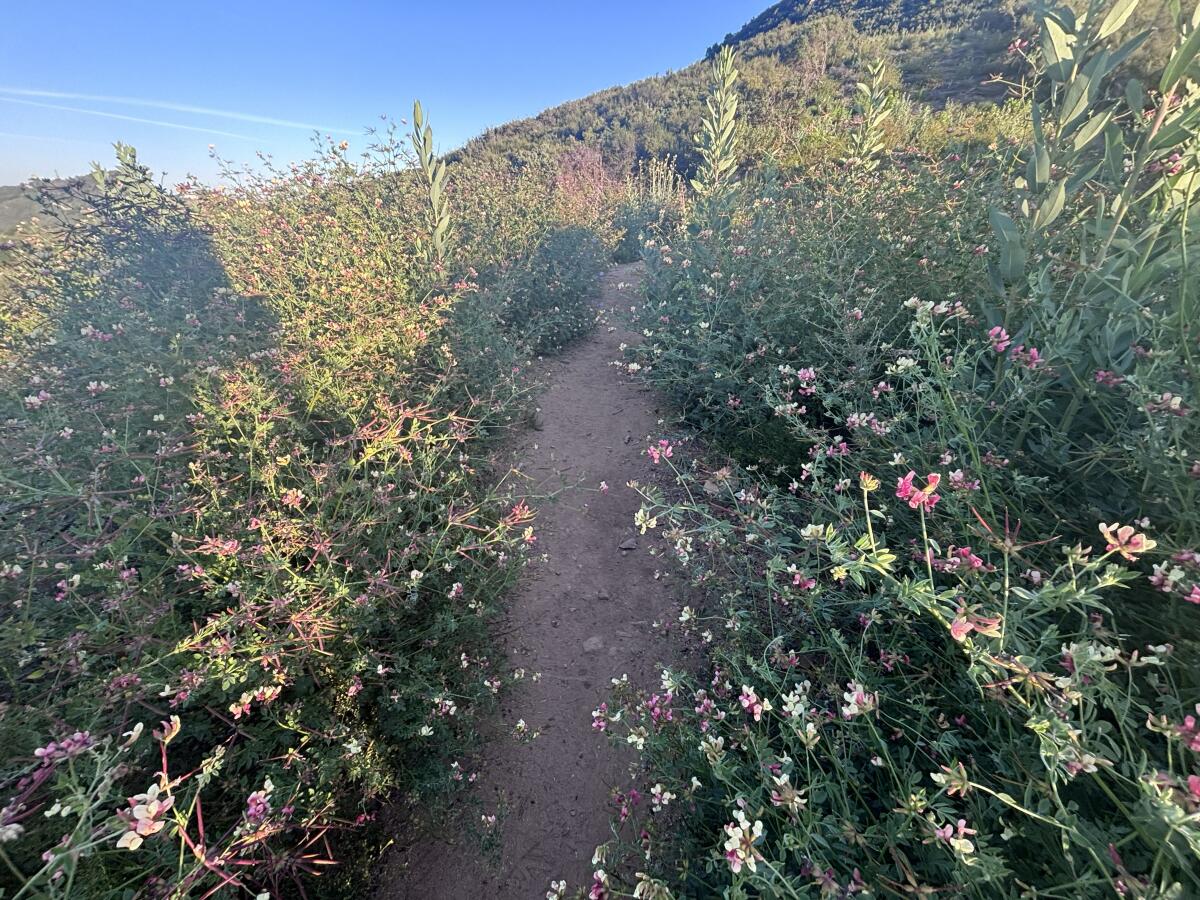
I went to the Santa Monica Mountains on the hunt for wildflowers.
I was nervous. What if I found absolutely nothing? I’d used data collected by plant lovers during previous blooms and checked on iNaturalist, a citizen science app, about where wildflowers had recently been noticed to discern where I’d be most likely to find blooms.
But, even then, I knew the unusual spring heat wave that prompted some wildflowers to bloom early could have also killed them. I knew the heat had already zapped the bright orange beauties at the Antelope Valley California Poppy Reserve. What if I’d already missed this annual springtime magic?
You are reading The Wild newsletter
Sign up to get expert tips on the best of Southern California’s beaches, trails, parks, deserts, forests and mountains in your inbox every Thursday
By continuing, you agree to our Terms of Service, which include arbitration and a class action waiver. You agree that we and our third-party vendors may collect and use your information, including through cookies, pixels and similar technologies, for the purposes set forth in our Privacy Policy such as personalizing your experience and ads.
It was with this level of eagerness and anxiety I recently entered the Santa Monica Mountains. I feel more than lucky to have discovered a resplendent rainbow of native plant blooms.
I hope you also witness this abundance on the three trails below. L.A. is forecast to have more springtime rain, and you know what they say about April showers!
If not, though, I want to underscore that regardless of their foliage, each hike offers its own unique adventure, one I’d take in any season.
Chaparral bird’s-foot trefoil blooms in thick patches throughout the Saddle Peak Trail.
(Jaclyn Cosgrove / Los Angeles Times)
1. Saddle Peak via Backbone Trail
Distance: 3.3 miles out and back Elevation gained: About 860 feet Difficulty: Moderate Dogs allowed? No Accessible alternative:Inspiration Loop Loop ADA Trail at Will Rogers State Historic Park
This 3.3-mile route to Saddle Peak takes hikers up a lush hillside with sweeping views of the nearby Calabasas Peak, the San Fernando Valley and, toward the top, the Pacific Ocean. Visitors will observe a landscape that features not only a diversity of wildflower species but also ancient sandstone formations.
You’ll start your hike by parking on the side of Stunt Road, a winding paved street with sharp turns popular among cyclists and drivers of very fast sports cars. There is limited parking here, so it’s good to either arrive early or hike this trail on a weekday. Additionally, the parking area on the side opposite the trailhead is near a steep drop-off so take good care if parking there.
The Saddle Peak Trail features multiple stretches where wildflowers grow close to the trail.
(Jaclyn Cosgrove / Los Angeles Times)
The trailhead sits just south of the road and is well-marked with large signs, including one that warns you that smoking, bicycles and dogs are prohibited on the trail. (Apologies to your cigar-loving circus canine.)
You will first take the short Stunt Road connector trail about 0.2 miles before bearing left, or east, onto the Backbone Trail to Saddle Peak. You’ll immediately start noticing wildflowers.
Chaparral bird’s-foot trefoil, clockwise, mini lupine, purple nightshade, showy penstemon, golden yarrow and large-flowered phacelia.
(Jaclyn Cosgrove / Los Angeles Times)
I have dubbed myself a “lupine freak” because of my obsession with this genus of plants — not because I enjoy howling at the moon once a month — and I paused just a third of a mile into this trail. “You look like a tiny little lupine,” I said to the short plant with purplish blue petals near my right foot. Turns out it was indeed a miniature lupine!
This would be the first of many delights. Within a half mile on the trail, I’d already spotted golden yarrow, bush poppy, purple nightshade and black sage abundant with purple blooms. And canyon sunflower covers substantial portions of this trail. This suggests the trail burned in recent years, as canyon sunflower is a fire follower.
There’s also a fair amount of California sagebrush, which you can run your fingers along and smell its delicious aroma (which I think smells like spicy Italian salad dressing).
The view from a bench at a lookout point near the Saddle Peak Trail in the Santa Monica Mountains.
(Jaclyn Cosgrove / Los Angeles Times)
As I hiked onward, I started to feel like Julie Andrews in “The Sound of Music” because the hills really were alive! I squinted at one plant I had no memory of seeing, a pink and green plant with bright pink and lemon chiffon-colored petals. Had I finally stumbled upon one of California’s rare, threatened or endangered plants?
I was so eager to Google this floral mystery. Later, I learned it’s a not-so-rare (but oh-so-beautiful) chaparral birdsfoot trefoil. It grew thick throughout the second leg of this trail, a real visual feast!
I briefly hiked through a lull where the trail was beautiful but not bursting with colors outside green and brown. Then, I came around another corner to find more trefoil, large-leaf phacelia and showy penstemon, which would be a great native plants-inspired drag performer name.
A massive sandstone rock wall along the Saddle Peak trail.
(Jaclyn Cosgrove / Los Angeles Times)
Very suddenly, after staring at plants for more than an hour, I looked up and realized I’d reached the massive ancient boulders. I watched as white-throated swifts dived in and out of the rock’s pockets where it might be considered tafoni (maybe!). Fun fact: These birds use “their saliva to glue a little cup of twigs and moss to the vertical wall” to build their nests, according to Cornell Lab of Ornithology.
You’ll take a few well-maintained sets of rock steps up, also navigating some rocky and, at times, somewhat washed-out portions of the trail. Take good care to look before you reach toward a rock for leverage so you don’t end up grabbing a danger noodle (read: snake).
About 1.3 miles in, you will crest a hill and be greeted with gorgeous views of the deep-blue ocean. From here, you can continue up to Saddle Peak, which features more massive rock formations.
I hiked over to a bench at an overlook point just past a few (invasive but pretty) Spanish broom plants. Here, I took stock of the day, savoring both the burrito I packed and the good day I’d had. I don’t know whether anyone would label it “super,” but I found myself chuckling over simply calling it a superb bloom.
The Musch Trail in Topanga State Park.
(Jaclyn Cosgrove / Los Angeles Times)
2. Backbone Trail to Musch Trail Camp
Distance: 2 miles out and back (with option to extend via a loop back) Elevation gained: About 200 feet Difficulty: Easier end of moderate Dogs allowed? No Accessible alternative: Musch Trail road, a 0.6-mile out-and-back trek on a paved path from the parking lot
This two-mile, out-and-back jaunt through Topanga State Park takes you through lush meadows and chaparral where you’ll be near destined to spot wildflowers and wildlife.
To begin your hike, you’ll park at Trippet Ranch and pay to park before heading out. The Musch Trail starts in the northeast corner of the lot. You’ll take the paved path just 1/10 of a mile before turning east onto the dirt path, the Backbone Trail.
Caterpillar scorpionweed with southern bush monkeyflower nearby, clockwise, purple owl’s clover, canyon sunflower, dodder over black sage, California poppy and western blue-eyed grass.
(Jaclyn Cosgrove / Los Angeles Times)
The ranch was originally called Rancho Las Lomas Celestiales by its owner Cora Larimore Trippet, which translates to “Ranch of Heavenly Hills.” You’ll find, as you hike through those hills covered in oak trees, black sage, ceanothus and more, that the name still rings true today.
I also spied significant blooms of orange-yellow southern bush monkeyflower, canyon sunflower, golden yarrow, a species of Clarkia, light purple caterpillar scorpionweed and exactly one blooming California poppy plant (just past the pond).
A mile in, you’ll arrive at Musch Trail Camp, a small campground with picnic tables and log benches. As you pause, listen to the songs of the birds. California quail, Anna’s hummingbird and yellow-rumped warbler are commonly spotted. Stay quiet enough, and you might just spot a mule deer, desert cottontail or gray fox. On a recent visit, I went to refill my water bottle at a spigot next to the camp, only to discover a Southern alligator lizard lounging in the path.
From the trail camp, you can either turn around or continue northeast to Eagle Rock, which will provide panoramic views of the park. From Eagle Rock, many hikers take Eagle Springs Fire Road to turn this trek into a loop. Regardless of which path you take, please make sure to download a map beforehand.
As the sun sets, golden light blankets the hillsides in Leo Carrillo State Park.
(Jaclyn Cosgrove / Los Angeles Times)
3. The Willow Creek and Nicholas Flats Trails
Distance: 1.9 miles with an option to extend Elevation gained: About 630 feet (excluding extension) Difficulty: Moderate Dogs allowed? No Accessible alternative:Sycamore Canyon Road
This 1.9-mile loop is a mostly moderate jaunt connecting two popular routes in Leo Carrillo State Park. As a bonus, you can head over to the beach after your hike, either to cool down, explore the tide pools or both!
To begin, you’ll park at Leo Carrillo State Park. An all-day pass is $12, payable to the ranger at the gate or via the machine in the parking lot. Once parked, you’ll head northeast to the trailhead. You’ll quickly come to a crossroads. Take the Willow Creek Trail east to officially start your hike.
You’ll gain about 575 feet in a mile as you traverse the Willow Creek Trail. I took breaks along the way to gaze at the ocean, watching surfers bobbing on their boards and a kite surfer trying to gain traction. You might spot coast paintbrush and California brittlebush, a flowering shrub that features yellow daisy-like flowers, on the path, along with several lizards.
California poppies growing amid invasive weeds, left, Coulter’s lupine and longleaf bush lupine observed in Leo Carrillo State Park last May.
(Jaclyn Cosgrove / Los Angeles Times)
A mile in, you’ll come to a junction in the trail where you have three-ish options. You can continue west to a branch of the Nicholas Flat Trail that will take you a mile back down to the parking lot. You can head south onto an ocean vista lookout point (which, though steep, I highly recommend). Or you can turn north onto another branch of the Nicholas Flat Trail.
I did a combination, hiking 235 feet up the lookout path, where I had one of those “Wow, I get to live here” moments. The ocean was varying shades of blue, from turquoise to cerulean to cobalt. I could clearly see in all directions, including about eight miles to the east to Point Dume. I was, once again, amazed to be alone in a beautiful place in a county of 10 million people.
Once I finished at this awe-inspiring point, I headed north onto the Nicholas Flat Trail, taking it about 2.3 miles — and about 1,100 feet up 🥵 — through laurel sumac and other coast sage scrub vegetation into the Nicholas Flat Natural Preserve. Along the way, keep an eye out for deerweed covered in its orange and yellow flowers along with scarlet bugler (which hummingbirds love). Other common sights here include Coulter’s lupine and small patches of California poppies.
If you start this hike early enough in the day, you can simply trek back to your car and change into your swimsuit for an afternoon at the beach. And if the tide is out, you might also be able to walk around the tide pools. You could hang out in the same day with both lizards and starfish, and even spy an endangered bumblebee on the trail and an octopus at the beach.
Please, go have yourself a remarkable Southern California day!
3 things to do
A person takes in the sunset on the beach in Venice.
(Michael Blackshire / Los Angeles Times)
1. Watch the sunset with new friends in Venice Sunset Club L.A. will host a free community gathering at 6:15 p.m. Thursday at Venice Beach. Guests will meet in front of Fig Tree (431 Ocean Front Walk #2402) before setting up camp on the nearby beach to watch the sunset together. Learn more at the club’s Instagram page.
2. Take a peaceful jaunt in L.A. L.A. for the Culture Hiking Club will host an adventure at 10:30 a.m. Saturday through Griffith Park. The group will take a 2.6-mile hike that includes the Ferndell Nature Trail. Afterward, guests will hang out at the Trails Cafe near the trailhead. Register at eventbrite.com.
3. Find a new kind of ‘dume’ scrolling in Malibu California State Parks needs volunteers to help remove invasive plants from 9 a.m. to noon Saturday at Point Dume. Park workers will guide participants on removing weeds while cultural resource staff will teach volunteers about the ecological and cultural importance of the site. Register at eventbrite.com.
The must-read
The Griffith Park Pool has remained fenced in and closed for six years, but there are plans now to renovate and reopen the pool.
(Gina Ferazzi / Los Angeles Times)
Who is ready to take a dip at the Griffith Park historic swimming pool? That might become a reality by July 2029. Times staff writer Christopher Reynolds wrote that city officials aim to give the facility at Riverside Drive and Los Feliz Boulevard, which dates to 1927, a three-year, $40-million facelift. The new design will feature two new pools and rehabilitate the site’s pool house. Officials closed the pool in early 2020 amid COVID-19 shutdowns and later discovered when they tried to refill it that the pool wouldn’t hold water.
I cannot wait to take a hike and then a swim at the same public park!
Happy adventuring,
P.S.
Are you ready to transition from hiking around native wildflowers to planting them? Come meet experts from the Theodore Payne Foundation and the California Native Plant Society at the L.A. Times Plants Booth during The Times’ Festival of Books at USC on April 18 and 19. If you sign up for the L.A. Times Plants newsletter, you’ll receive Jeanette’s Mix, a special packet of sunflower and California poppy seeds named for our beloved L.A. Times plants writer Jeanette Marantos, who died in February. I am volunteering at the booth on April 18 and would love to meet you!
For more insider tips on Southern California’s beaches, trails and parks, check out past editions of The Wild. And to view this newsletter in your browser, click here.
FAMILIES have been left gutted after Center Parcs confirmed they were scrapping a popular service at the resorts.
The company previously offered a creche service for kids between three months and three years, for up to three hours.
Sign up for the Travel newsletter
Thank you!
Center Parcs is scrapping one of their popular servicesCredit: Alamy
Costing around £30 a session, it has since confirmed that this will no longer be offered at any of the resorts by the end of next month.
Customers with upcoming bookings have discovered they can no longer book their kids in if their holiday is after the end of May, with the option removed across all of Center Parcs’ UK sites.
One frustrated parent said on a Facebook Center Parcs group: “I had planned to book a much needed child free trip to the spa with my husband and planned to put the children in the kids clubs and our 2 year old in the crèche so we could go together.
“However the crèche is unavailable for booking? I could cry.”
Others explained why they had found the creche so helpful.
One said: “We used the crèche for my youngest who wasn’t old enough for any activities so us parents and the older two could do the treetop adventure together.”
Another added: ” We used the crèche whilst my husband and I did a couples hour in the spa.
“If we have the money for the holiday, we can choose to spend it on the crèche and have an hour to ourselves.”
A third said: “It’s only three hours and provides the adults of the holiday with maybe just a lunch of hot uninterrupted food together as it’s their holiday too.
“We all need a break sometimes.”
The creche was the only activity where parents could leave children aged under three, although they had to stay on-site.
Activities for older children that do not require a parent to accompany them are still on offer, such as Wizard Academy (3+) and Chocolate Chef’s Academy (3+).
Center Parcs said it is developing new activities for children of all ages to be enjoyed by families together.
A spokesperson told The Sun: “At Center Parcs, we’re always looking to review and evolve the guest experience.
“We have made the decision to remove the crèche activity from our breaks, to reflect guest feedback and limited demand for this particular activity.
“Crèche sessions are one of more than 20 activities available within our Activity Den and our other activities will continue to run as normal.
“We’re developing new activities for children of all ages, with the aim of creating even more engaging experiences for families to enjoy together at Center Parcs.”
It’s not the only changes at the parks in recent years.