Passengers should act now before flights get more expensive
Steffan Rhys Deputy Content Hub Director
10:35, 29 Mar 2026Updated 10:40, 29 Mar 2026
The cost of air passenger duty goes up on Wednesday
Passengers thinking of booking flights from the UK should book before Wednesday if they want to avoid an imminent cost increase. Air passenger duty (APD) is going up on April 1, making flights more expensive. As the duty forms part of the cost of each airline ticket, carriers say the adjustment is likely to result in higher fares on some routes, Majorca Daily Bulletin reports.
The amount of air passenger duty per person depends on several things, including ticket class and how far the country’s capital city is from the UK. The amount goes up significantly if you sit in anything but basic economy and if you fly to a country whose capital is more than 2,000 miles away from London.
Travel expert Simon Calder explains that the levy “is unique to the UK and a topic of much controversy”. He adds: “Chancellor Rachel Reeves has imposed an above-inflation increase from April 1, 2026 and one in line with the retail prices index a year after that. By the summer of 2027, a family of four flying premium economy to Orlando will pay over £1,000 in tax for leaving the UK in anything better than basic economy.”
Four different categories of destination
UK domestic flights
Band A: Countries where capital city is 2,000 miles or less from London — this covers all of Europe
Band B: Capital city is 2,001-5,500 miles from London — includes most long-haul destinations
Band C: Capital city is over 5,500 miles from London — includes Bangkok, Singapore, Hong Kong, Tokyo, Buenos Aires and Australia.
What are the rates?
From April 1, 2026, they will all rise to the following:
UK domestic: £8 (economy) or £16 (anything but economy)
Band A: £15 or £32
Band B: £102 or £244
Band C: £106 or £253
Before April 1, 2026 the rates are as follows:
UK domestic: £7 or £14
Band A: £13 or £28
Band B: £90 or £216
Band C: £94 or £224
So you can see, the increases are not huge but could add significant costs to the price of a holiday for a family of four to somewhere that is more than 2,000 miles away.
APD does not apply to children under 16 travelling in basic economy but is payable for all children over two travelling in premium classes.
How much APD will I pay?
A family of four with childrenbetween two and 15 will pay the following APD from April 1, 2026:
UK: £16 in basic economy, £64 in premium economy or better.
Europe: £30 or £128
Most long-haul destinations: £204 or £976
Ultra-long-haul destinations: £212 or £1,012
But a family of four with children aged 16 and over will pay the following APD from April 1, 2026:
UK: £32 in basic economy, £64 in premium economy or better
Europe: £60 or £128
Most long-haul destinations: £408 or £976
Ultra-long-haul destinations: £424 or £1,012
As you can see, the year-on-year increases are not that significant for shorter flights, but can add up more if you are taking older children on longer flights. But if you feel that you want to save every pound possible, if you get your flights booked before Wednesday then you’ll save on APD.
IN our trusty motorhome, my family and I have gone across much of Europe – but somehow never quite made it to Germany.
Perhaps that was because of my ill-fated attempts at learning German at school, which lasted little more than a term.
Sign up for the Travel newsletter
Thank you!
I explored the ‘Bavarian Alps’ by motorhome with fairytale castles and storybook villages my kids lovedCredit: GettyMarcus’s rental camperCredit: Supplied
But keen to head off the beaten path, we loaded up our Bailey of Bristol Adamo XL-DL and headed for the Bavarian Alps.
Of course, there was the slight worry of “what if it’s not as good as where we usually go?”. Spoiler alert: The Bavarian Alps are brilliant.
And they are a region — and part of a culture — with so much to offer the whole family.
The drive to get there was a little longer than we are used to.
However, much to my children’s delight, stop-off point Lech Camping coincided with a visit to Legoland Germany, providing all manner of brilliant rides and attractions.
It was also the perfect contrast to what awaited us in the mountains.
Our base was Via Claudia Camping, set on the edge of Lake Lechsee in the Allgau region, which gave us easy access to attractions and impressive views of the mountains.
But the mountains would have to wait, because first on the list was a visit to one of Germany’s most famous castles.
Perched dramatically on a prominent hill, and surrounded by dense pine forests, Neuschwanstein Castle is, quite simply, magical.
With its towers, turrets and whimsical balconies straight out of a fairytale, you feel Rapunzel herself would have been right at home here.
The kids at Legoland GermanyCredit: Supplied
That was followed by the charming village of Oberammergau, recommended by our campsite receptionist as the best example of something truly Bavarian.
Here you get Luftlmalerei — the centuries-old tradition of painting murals on the exterior walls of houses — giving the village the air of a living storybook.
Our own tale from the village came in the most unlikely of circumstances.
Walking down a small cobbled street, we noticed a vending machine set into the wall.
Half expecting our children to request some sort of chocolate bar, we were surprised to see it wasn’t filled with the usual confectionery.
Instead, it was stuffed with every manner of German sausage imaginable.
The restaurant on Wank mountainCredit: Supplied
It made shopping for dinner easy and I got to tell my joke about German sausages, which the children insist is the wurst.
Talking of silly humour, I had to giggle at the name of the mountain we were headed to for hiking: Wank (pronounced Vank).
Anyone who has hiked with younger children will know they can be fascinated by every stick, rock and oddly shaped pine cone.
So our pace was on the slow side, but it let us appreciate the beauty of the mountains that surrounded us.
Despite frequent stops to play, rest and satisfy the children’s curiosity, we eventually made it to the top and the traditional summit cross found on Alpine peaks.
Our final reminder of why we should never have left it so long to venture into Germany came courtesy of lake Eibsee, lying at the foot of Germany’s tallest peak, the mighty Zugspitze.
The mountain for hiking: Wank (pronounced Vank)Credit: Supplied
Not even moody skies and the threat of rain could dampen our spirits as we set off, us on foot and the children on their bikes, on the 8km trail that heads around the shore of the lake, with the glacier-clad Zugspitze towering over us.
From fairytale castles and storybook villages with sausage vending machines, to majestic mountains and alpine lakes, Bavaria had surprised us at every turn.
And as we savoured a final sunset in the mountains, it left us with one lingering question: When are we coming back to Germany?
GO: BAVARIAN ALPS
GETTING THERE: Marcus got a ten per cent discount on his Le Shuttle crossing from Folkestone to Calais, booking through the Caravan and Motorhome Club.
Return fares for a motorhome plus family of four from £370 in May.
Experts say families could save more than £100, though Ryanair disagrees
09:08, 29 Mar 2026Updated 09:13, 29 Mar 2026
Ryanair has disputed the claims(Image: turbo83 via Getty Images)
Passengers flying with Ryanair are being encouraged to follow several steps to reduce costs on their journeys, though the airline has responded by dismissing the advice as “fake news”.
Consumer champion platform Which? claimed its research revealed travellers may have been spending more than necessary. Last month, Which? suggested families could potentially save over £100 on their next Ryanair flight by simply disregarding the airline’s “recommended” fare option. When arranging a summer journey from London to Alicante for a family of four, Ryanair promoted its “Regular” fare as the “ideal” selection.
But opting for this choice would have cost £59 more than picking the “Basic” fare and adding the identical seats and luggage manually later during the booking process, Which? claimed. The article continues: “If our family decided that we could get by with four cabin bags instead of the eight included in Ryanair’s ‘Regular’ fare, then we could reduce the fare by £163 from Ryanair’s recommendation.
“The Regular fare comes with priority boarding, carry-on luggage and free standard seat selection included, but on around 30 checks over the past two years we’ve only once found it cheaper. We looked at 15 flights to a range of locations in February 2026 and only once was the Regular ticket cheaper, even if we wanted all those extras.”
Ryanair has made its feelings on Which?’s findings abundantly clear. A spokesperson for the airline told Sky News: “This is more fake news from Which? Thankfully no one reads, or takes any notice of Which’s fake recycled news articles or your spurious ‘advice’, as our traffic growth from 200 million to 208 million passengers in 2025 proves.”
THERE are plenty of beautiful islands around Greece, but you might not have heard of Andros.
It’s the second-largest island in the Cyclades and is considered to be one of the most beautiful, and underrated.
Sign up for the Travel newsletter
Thank you!
Andros is the second-largest island in the CycladesCredit: AlamyBeaches on the island look like they’re in the Caribbean, like Zorkos BeachCredit: Alamy
Andros has it all, with mountain landscapes, beaches with bright blue waters, lush greenery with waterfall trails, and a town classically painted in Greece‘s blue and white.
Visitors arriving by ferry will first come to Gavrio, on the northwest coast which historically was a fishing village.
Now it’s a lot busier and vibrant with plenty of tavernas, bars and hotels – however this isn’t the capital of the island.
An hour’s drive away from Gavrio is Chora, which literally means ‘main village’.
One visitor who blogged about their recent trip named Verde as a top place to grab a bite there.
Their top tip was to taste the Miss Pink cocktail, which is a mix of champagne, lime and grapefruit.
When it comes to drinks, on Andros, you can pick up a glass of wine from €3 (£2.60).
Along with its pretty village to explore, the real gems of this island are the beaches that are dotted along the coastline.
There are beautiful beaches too with white sands and bright blue seas.
One of the most popular north of Chora is called Zorkos Beach, which is also one of the island’s biggest.
One visitor said: “One of the best beaches I have visited in general in my life! Incredible waters, clear and a very quiet place even though it has a beach bar there!”
Another added: “Zorkos beach is just fantastic! Clean water and a very relaxed atmosphere. Perfect place to escape and enjoy the sea without a lot of people. We will definitely visit again.”
Other popular spots include Vitali Beach on the north eastern side of the island.
The beach is always fairly empty as it’s secluded and can only be accessed by a narrow dirt track – so it’s recommended to get there by motorbike or jeep.
Another spot which has crystal clear waters is Tis Grias to Pidima Beach, which has a huge rock stack off its shore.
The beach can be reached via a dirt road and steep trail, but lots of visitors say it’s worth a visit thanks to its beautiful views.
A glass of wine in Greece can cost as little as £2.50Credit: AlamyPithara Waterfalls is considered a ‘hidden paradise’Credit: Alamy
Heading inland, one popular activity for tourists on Andros is hiking to its waterfalls.
One of the easiest trails that takes around 10-minutes is to the Pithara Waterfalls, which is dubbed a ‘hidden paradise’ in Apikia.
Visitors say there’s enough water for a small swim, along with plenty of pretty viewing points from above the falls.
For those staying on the island, some hotels cost as little as £36 per night, which you can find on Booking.com.
The Ostria Hotel & Apartments has an outdoor pool, and is a few minutes walk away from Gavrio.
On Airbnb, pretty apartments start from £67 per night.
This one in Chora is within walking distance to the sea, as well as restaurants, bars, cafes, museums and art galleries.
When it comes to getting to the island, Brits will have to fly to Athens, which in May can be done for £25 with Ryanair.
From there, take a ferry across to the island which can be as quick as one hour with Seajets (with tickets from £30).
Ryanair has stopped flying to the popular holiday destinationCredit: Getty
From today – March 29, 2026 – all services to and from the Azores – which are famous for their stunning beaches and vibrant greenery – have been stopped.
The move means six different routes have been scrapped, impacting approximately 400,000 passengers who visit the islands annually.
The airline previously pointed to a 120 per cent rise in air traffic control charges and the introduction of a new travel tax as the breaking points.
Ryanair’s CCO Jason McGuinness said: “We are disappointed that the French airport monopoly ANA continues to raise Portuguese airport fees to line its pockets, at the expense of Portuguese tourism and jobs – particularly on the Portuguese islands.”
As costs continue to climb, the airline stated it had no choice but to move its planes to cheaper airports elsewhere in Europe.
McGuinness added: “As a direct result of these rising costs, we have been left with no alternative other than to cancel all Azores flights from 29 March 2026 onwards.”
The region – located about 950 miles from mainland Portugal – has lost direct low-fare links to London, Brussels, Lisbon and Porto.
The nine volcanic islands are known for having unspoiled beauty, which includes vibrant green hills and black sandy beaches.
British Airways still flies to the islands seasonally, with direct flights from London Heathrow to Ponta Delgada and Terceira.
The Azores is famous for its stunning beaches and vibrant greeneryCredit: Getty
A Canadian woman who moved to the UK with her partner and three children recently paid a visit to a charity shop where she noticed several differences between the stores here and in her home country
Jess Flaherty Senior News Reporter
08:05, 29 Mar 2026
A Canadian woman noticed some big differences when she visited a charity shop in the UK (stock image)(Image: Nick David/Getty Images)
A Canadian woman currently living in the UK has shared the key differences she noticed when perusing charity shops here as opposed to the “thrift stores” in her home country.
Many people from the United States and Canada relocate to the UK and quickly come to realise that despite sharing the same language, there’s plenty of cultural quirks and differences. This seems to be the case for Jaclyn Walton, who swapped life in North America for England with her partner and their three children.
The mum has praised many aspects of life in the UK, from the school curriculum involving swimming lessons to the “beauty and history” that’s rife, as well as the football opportunities for her son.
She also spotted the different terms used commonly over here, like “sweets” instead of her native “candy” and “holiday” instead of the Canadian term, “vacation”.
Recently, Jaclyn took to Instagram to share a video of herself exploring a small charity shop here in the UK. Over the top of the footage, she narrated her thoughts: “Come with me to a British charity shop – it’s like a thrift store in Canada but here they call them charity shops as the sales help raise funds for charity.
“The differences I notice in Canada and the UK is the culture around charity shops. In the UK, it’s common, easy to pop in, take a look, and pretty normal.
“In Canada, you’re either a thrifter or you’re not. In the UK, like almost everything else, it’s smaller; these little shops with this type of selection.”
She went on: “In Canada, they have small ones like this but you also immediately think of big ones like Value Village where you have aisles and aisles upon selection.”
Content cannot be displayed without consent
Back to her thoughts on UK charity shops, Jaclyn concluded: “These shops often have volunteers working here as well.”
In the comments section, Jaclyn added: “I didn’t love thrift stores in Canada but I do enjoy looking around here… maybe I just wasn’t in my thrifting era yet.
“I feel like with all the history in England, I am looking for a beautiful find.”
Fellow Instagram users were keen to share their thoughts. One said: “I think the difference in the UK is that people donate old stuff and the charity sells it for money.
“A thrift store is a kind of recycling centre where you can sell old stuff like books, which the operator cleans up and resells for a profit.”
Another said: “I never went in charity shops until I developed a book habit! I can now never resist popping int. My hometown is blessed with eight charity shops.
“One in particular is so nicely set out that you would think it is new items only. I look at clothes now and have bought some really lovely items. I’m definitely a thrifter now!”
A third commented: “You can find some really good stuff a charity shops in affluent areas. Try places like in the Cotswolds like Chipping Norton.” And a fourth added: “Love it.”
A YouTuber who moved from her home town in the USA to the UK has talked about her experiences of relocating across the pond, and how her new home treats its citizens
An American has talked about the big differences between the US and UK (stock)(Image: Getty)
A woman who moved from the United States to the UK has talked about the main differences between her old life and her new life.
Mindy Hickson, who posts about her experiences on YouTube channel The Hickson Diaries, said there are seven ways in which living in the UK has provided what she describes as “the simple life”.
Mindy alluded to the fact that the way Americans have been told to live is not necessarily the only way to live. She said: “Growing up in the US we’re indoctrinated into believing that success looks like a specific set of things.”
Said things that could be suggestive of a cultural mistruth, Mindy said, included owning a massive house, two big SUVs, and a having a salary that keeps climbing
Mindy added: “We’re taught if you don’t have those things you’re failing….But honest when you step outside of the US bubble you do actually start to see exactly what they mean when Europeans say things like, ‘Americans are rich in things, but extremely poor in time’.”
Mindy noted that she feels like the UK offers a safety net for people who have suffered through struggles in their lives.
In the first of her seven comparisons, she said that in the USA, there’s “this low level background of anxiety that hums in your brain 24/7. It’s the fear that one bad day…it can take away everything that you’ve built”.
Whilst Mindy acknowledged the NHS isn’t perfect, she concluded: “Nobody here in the UK is losing their house because they got sick.”
Mindy then compared isolation in the USA to the UK’s community spirit, explaining the concept of spaces where Britons could exist without spending a lot of money. She said the UK has “places where you can just exist around other people without having to spend a lot of money, pay a cover charge or have an over abundance of stimulation”.
When it came to the workplace, Mindy said she felt that the UK doesn’t weaponise productivity in the same way, and that employers have greater respect for allowing people to rest after finishing work for the day. In contrast, she said that having a break in the USA is often seen as a “weakness”.
Mindy’s fourth piece of evidence that the “simple life” in the UK is better than that of the USA is due to dignity in ageing.
She pointed out that the UK tends to look after its retirees and pensioners better by giving them things such as free bus passes to help them get around major cities.
Fifth on her list was the food. Mindy touched on how food is much less processed in the UK. She also said there is a different mentality, that eating well doesn’t mean eating more, but meant eating high quality food instead.
Mindy additionally praised the UK as she feels Britons make more thoughtful purchasing choices.
She said this is because companies don’t deliver products every two hours, and that the UK system forces people to be “more intentional” about their choices. As a result, Mindy said she’s stopped buying things “just to fill a void”.
Mindy’s final and seventh statement she felt supported her claim that UK citizens have a better way of life came down to safety.
Whilst the UK is not bereft of crime, she talked about how she felt less anxious, that she didn’t have to check the exits as she walked into a building or venue, and that she felt less on edge.
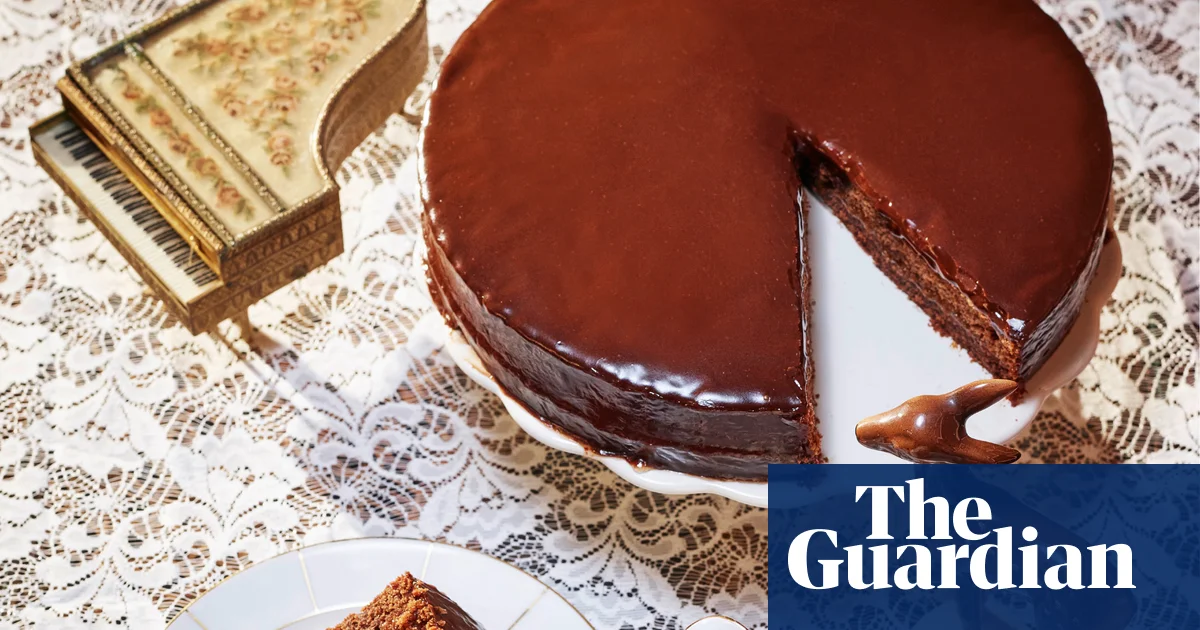
I’m on a tram on Vienna’s Ringstrasse as towering facades, columns, statues and domes drift past, each more ornate than the last. Here, the State Opera; there, the Austrian parliament, built in the Greek neoclassical style.
As I gawp, I shove cake in my mouth. After all, Vienna isn’t just the city of music, or lavish architecture. Thanks, in part, to its centuries-old coffeehouse culture, it’s also one of Europe’s finest pastry destinations. Cake (or more precisely, torte, kuchen or Mehlspeisen) has its own day here – “Sweet Friday”, the most delicious of Catholic customs, when meat dishes are replaced with sweets. I have been introduced to it via the medium of Marillenknödel – apricot dumplings.
It’s my first visit to Vienna, my boyfriend Wolfi’s home city. The priority is checking out the old neighbourhood and making a good first impression on his granny. Always keen to fit in, I have identified the national obsession and offered to test Austria’s most famous cake: Sachertorte.
According to legend, it was created in Vienna in 1832 by the 16-year-old apprentice chef Franz Sacher for Prince Metternich. It went on to great acclaim and sparked a decade-long cake war.
In the 1950s, the Hotel Sacher and Demel pastry shop battled over the torte’s trademark, thanks to Franz’s son Eduard, who had refined the recipe while working at the Demel, then offered it on the menu when he opened the Hotel Sacher in 1876.
In 1963, an out-of-court agreement stipulated that the Sacher could market their version – with a layer of apricot jam below the icing and another between the sponges – as the original. The Demel could market theirs as the “Eduard-Sacher-Torte” – featuring one layer of apricot jam below the icing. A big fight about jam, for good reason.
These days, Sachertorte is often decried as dry and overhyped for tourists. Blame that on infantile modern tastes – overindulgent “death by chocolate”, endless cronut-style hybridisations. I’m a fan of the Sachertorte: dark chocolate sponge covered in fondant, tangy apricot jam, whipped cream on the side. It has no need to shout. But is it just for tourists? As I ponder, a call comes from Wolfi’s gran, inviting us for Sunday lunch.
Anna, 82, a Klimt devotee and string enthusiast (she played in her youth), is Vienna born and bred. “For dessert,” she announces, “Sachertorte.” It is a local cake! I’m swiftly corrected. “It’s not a cake! A torte is a torte.” Immediately recognising her superior judging potential, I recruit Anna into my testing team.
Photograph: Education Images/Universal/Getty
First stop is Stephansplatz, with its stunning gothic cathedral. Nearby is the unmissable Aïda shopfront, a riot of pink. It is billed as the world’s first coffee shop chain. Inside, there’s neon-pink lettering on pink walls, pink lighting, staff dressed head-to-toe in pink. The atmosphere is chaotic – a group of Germans complain about seating and Wolfi manages to lose a euro in the pay turnstile to the loos.
We opt for takeaway. The torte, unforgivably, comes without cream (€1 extra, in a pink pot). We retreat to the shadow of Stephansdom. Smooth chocolate icing, jammy layers. Looks good. I bite. The sponge is … dense. I’m glad of the cream. It’s on the dry side. Anna concurs: “The pores are too close and small.” €6.10 (takeaway),4.5/10
Photograph: Hemis/Alamy
The smell of Kaiserschmarrn (pancake) is strong in the bustling Demel patisserie and the queue snakes up the stairs to the cafe. It’s going to be another takeaway. I’m disappointed to find creased icing on the torte, but happier on first bite. It’s far superior to Aïda – moist, with a fruity tang. I look again. What I see is shocking. Two layers of apricot jam, one under the icing and one in the middle! What’s going on? I check Demel’s website. “A thin layer of apricot jam sandwiched between two layers and beneath the chocolate glaze.”
Evidently, they have updated their recipe. I hope I don’t spark a sticky lawsuit because I don’t blame them: the extra jam is welcome. “It’s a bit too sweet,” Anna counters. “The cake is not fluffy or airy enough,” she concludes, severely. €8 (takeaway),5.5/10
Photograph: Xinhua/Alamy Live News
We are swept to a snug booth in an elegant panelled room, all 1920s mirrors and Thonet chairs. The room design muffles chatter, but snatches of Viennese dialect indicate plenty of locals. Snowflakes fall prettily outside the window.
We order Melange (for the sake of argument, a cappuccino) and one Sachertorte. “With three spoons,” the waiter offers, “if the ladies will allow.” I’d heard Viennese waiters were renowned for perfectly honed sarcasm and slight disdain; I wasn’t expecting next-level charm. These guys have a timeless quality, like smooth magicians – utterly hypnotic.
The coffee comes in dainty porcelain and I focus on the (“lactose free”) torte. A wee bit thin on the jam, but the fondant is thick and fudgey, with a decent sponge. I browse newspapers on the old Zeitungshalter(traditional wooden paper rack), trying not to be influenced by my surroundings – and then get giddy in my marking. €8.10, 8.5/10
Photograph: Mark Glassner
Coffeehouse culture has evolved through this social enterprise – a “granny cafe” set up to combat loneliness and supplement the pensions of senior bakers. Genius. These places have been taken to the city’s heart, judging by the stream of fashionable youngsters coming through the doors. It’s lively, with a cosy retro vibe.
But forget the feelgood factor; we’re here to judge their “Sachertorte master”, Mr Johannes, 72. Things start well when Wolfi declares the Melange the best he’s had in Vienna. Now to the torte. Oh my. It delivers and then some. The apricot jam is fairly oozing, the chocolate icing almost caramel-like with a velvety sheen (made with untraditional-but-delicious butter and cream). It’s one of four he baked fresh today. A delicious bargain! €6, 8/10
Photograph: Vienna Slide/Alamy
Across from the beautiful Staatsoper (Vienna State Opera), Hotel Sacher is as plush as you’d hope: red velvet, white marble, gold relief. Tourists queue in the cold to get in (book to avoid this fate). The handsome torte arrives complete with seal. The thickest-yet layer of chocolate fondant holds everything nicely in place. Orderly. An excellent balance of fruity jam and rich sponge that also manages to be light.
The internet is awash with complaints that the Sacher’s torte is dry. I can’t agree, but agree it’s overpriced. “More airy than all the rest,” declares Anna. “With every bite,” she proclaims, “we know we are in the Sacher.” We chat about the archduke Otto von Habsburg wandering the hotel naked at the turn of the 20th century. Lots of history; lavish surroundings; technically, the best torte we’ve tried (one of 1,000 produced daily) – but something is lacking. I miss the heart of the Vollpension and old-world elegance of the Landtmann. €10.50, 8/10
An anonymous family member (it’s Auntie Linda!) tips me off to a budget option “better than Hotel Sacher’s” that’s available in the supermarket. Nothing beats an underdog winning the taste test, so we thaw out this frozen Sachertorte in anticipation. Not this time. But it’s good. Fruity and moist, decent ganache. More chocolate cake than Sachertorte, I’d venture, but a highly competitive price point. About €1 a slice, 5.5/10
If kids were in charge on holiday they would eat dessert before mains, go treasure hunting – and have a giant water fight. A poll of 1,000 children aged 6-12 revealed their ideal getaway, which would include eating three ice creams a day, using bikes or scooters as their go-to form of transport and playing board games every night.
One in five would play hide and seek with their family, 14% would indulge in a pyjama day and 40% would spend all day in the pool. When it comes to locations, 93% of youngsters want to stay at a holiday park, with 72% of them saying they are fun places with lots of activities to keep them entertained.
The study was commissioned by Sykes Holiday Cottages, which has unveiled a competition to appoint two youngsters as its resident Directors of Fun, created to place kids at the centre of holiday planning.
The playful job ad specifies entrants must be spontaneous, have a big imagination and bring enthusiasm to every day, and applicants can share their perfect holiday itineraries until 30th April 2026 to win the chance to make them come true.
James Shaw, spokesperson for the staycation specialist said: “It’s always interesting to see what kids would do if they were in charge of the whole holiday – and it turns out it would be pretty fun for everyone else too.
“While there’s plenty of excitement around things like unlimited ice cream and activities, what really stands out is how much they value simply spending time together.
“That’s why we wanted to bring children back into the heart of holiday planning with this competition, recognising that their ideas of a great break are often less about packed schedules and more about being with the people around them.”
Over half (51%) of the youngsters surveyed said their favourite aspect of being on holiday was spending time with family and for over a third (35%) it’s meeting other kids their age.
Eight out of ten confessed they’d like to take control of a family holiday, with leading the way in order to do the activities they want (63%), instructing their relatives what to do (41%) and feeling like an adult (40%) the top three reasons.
The research via OnePoll.com also discovered 19% feel like holiday parks are a home away from home, with popular forms of entertainment such as swimming, adventure playgrounds and arcade games making it ideal accommodation.
James Shaw added: “Holidays should give families the chance to properly switch off, reconnect and enjoy shared experiences all in one place.
“What’s striking is how much children value the freedom to shape their own days – whether that’s choosing activities, exploring, or just having unstructured time to play.
“That’s where settings like holiday parks come into their own, offering a mix of flexibility and variety that lets every family member make the most of their time away.”
THE TOP 10 THINGS KIDS WOULD DO ON HOLIDAY IF THEY WERE IN CHARGE:
I dropped in on a bustling village that fringes a busy roundabout – and every corner leads you to beautiful green spaces
Beautiful scenery surrounds the ’roundabout’ village – and the shops are amazing(Image: Katie Oborn)
While I thoroughly enjoy residing in the city of Plymouth, I equally relish the opportunity to regularly escape the hustle and bustle to find somewhere I’m enveloped by woodland and birdsong. I recently discovered a destination offering respite from urban life – and it’s an ideal “traditional” location with several thriving independent retailers alongside excellent walks and scenery.
Being based in Plymouth means I’m generally spoilt for choice when it comes to escaping the concrete and cobbles of city life. Within easy reach is the South West Coast Path, stunning beaches or coves, plus numerous other small towns and villages to discover in the rest of Devon or neighbouring Cornwall.
I recently paid a visit to a village situated right on Plymouth’s edge, and it’s an underrated treasure of a destination. Yelverton, particularly the Yelverton Roundabout area, is straightforward to reach (I travelled there by bus) and it boasts a flourishing collection of shops plus beautiful countryside in every direction.
This well-loved village sits on the outskirts of the city. I appreciated the journey, travelling through Plymouth, then, abruptly, the urban landscape was left behind, giving way to Roborough Down.
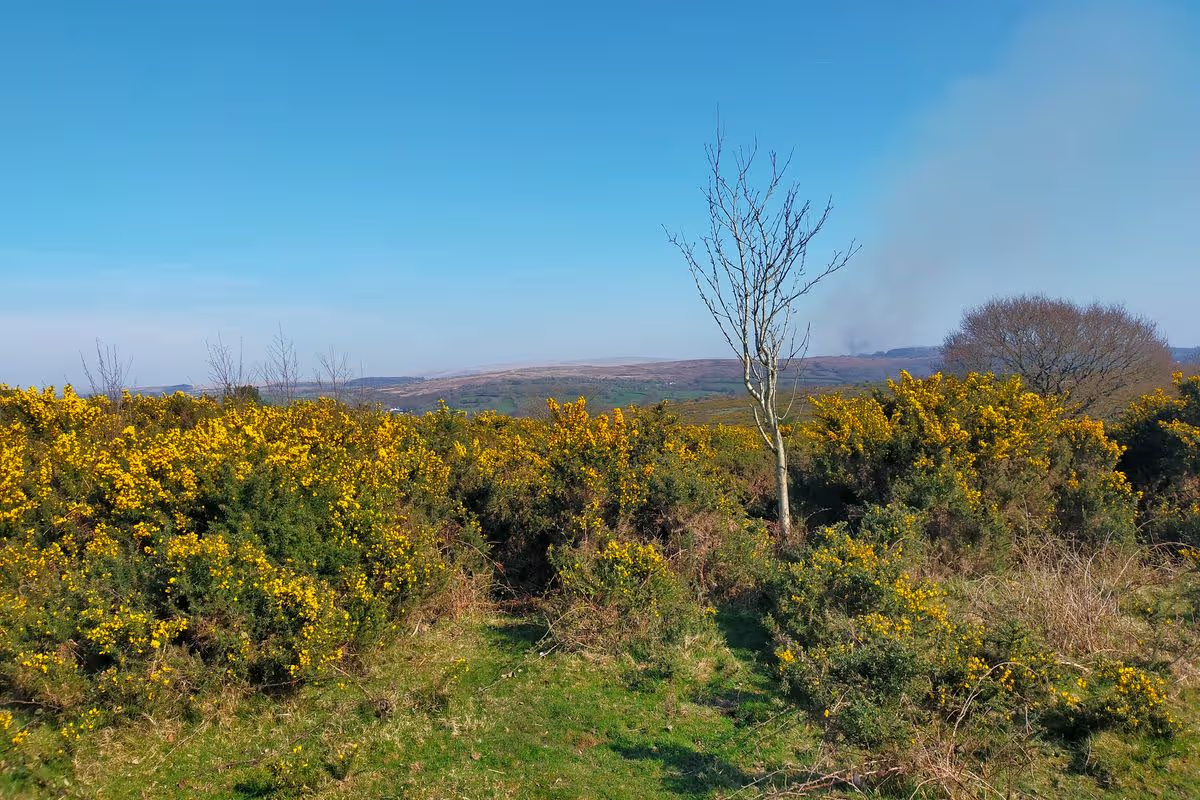
After crossing the heath, golden with gorse and scattered with Dartmoor ponies, you encounter the Yelverton Roundabout – and this spot even has its own Facebook page with more than 7,000 followers, reports Plymouth Live.
Now, having spent several hours there, I can understand why it’s so beloved. Yelverton village has preserved its village character despite housing developments emerging around it over the years.
The locals were welcoming, and the independent shops and businesses offer something truly special, including a proper butcher’s, a deli, a cafe, a gift shop, and plenty more. Even the Post Office is packed with useful and intriguing items.
There’s also a classic red telephone box still standing at Yelverton Roundabout, directly across from the picturesque church on the green.
My first stop was the Dartmoor Bakery, a brief stroll from the roundabout over at Leg O Mutton Corner on Roborough Down.
I sampled a savoury swirl with honey-garlic roasted tomatoes and brie, and it was absolutely delicious. I enjoyed it while sitting on a bench that was “erected in 1968” by the Yelverton District Residents Association, in “memory of Winston Churchill”.
Afterwards, I wandered across to the shops and green space beside the roundabout, where I chatted with three residents, Belinda Gardiner and husband-and-wife duo Ian and Liz Marshall.
Ian revealed there’s a “thriving set of shops” around the Yelverton Roundabout, and while they’ve “changed over the years” they remain all “really well used”.
The three residents reflected that overall, though, since the 1980s, the area has altered “very little” despite there being “more cars” and a “few more surrounding houses”.
“We’ve also lost two pubs”, Ian noted, “the Leg O Mutton pub and the Devon Tors hotel are gone, but we still have The Rock Inn, which is great and well used”. The three residents described it as a marvellous place to call home, boasting abundant wildlife, including owls and bats, excellent walking and cycling trails, alongside “a reliable bus route” connecting passengers to Plymouth or Tavistock every 20 minutes.
I then ventured into Hearn’s Dartmoor Butchery and Meatbox, a sizeable independent establishment offering an impressive selection of locally-sourced meats.
Behind the counter, a staff member was preparing some particularly appetising-looking pasties, and I was also delighted to discover a vegetable stall within the premises.
I chatted with proprietor Richard Hearn, aged 40, who has practised butchery for over two decades. He’s also a devoted local and “sixth-generation” farmer’s son.
Richard shared: “I love it, the customers, the trade, I wouldn’t do anything else, it’s what I know. We push the local side of things, purchasing a lot of the meat from a farm in Meavy.
“I first worked here aged 22, then eventually started it up as my own business, the customers are fab, friendly and smiley – and it’s a slower pace of life here than Plymouth.”
Equally flourishing enterprises neighbour Hearn’s Dartmoor Butchery, including the highly-rated gift shop, Cards and Moor, characterised as a “beautiful shop full of treasures” by patrons.
I stopped by for a browse, and it’s certainly brimming with charming gifts, cards and some delightful-looking Easter goodies. I’ll undoubtedly remember these Yelverton retailers when I need to purchase a birthday present or another gift.
Residents informed me that this thriving cluster of shops is “getting busier”, and everyone I encountered was courteous and welcoming, with the area buzzing with activity.
Another outstanding shop, The Larder Yelverton, is an absolute must-visit if you find yourself in the area, offering a selection of unique cheeses, Cornwall-made pottery, and much more. I can’t wait to return.
Henry Smith, aged 46, is one of the proprietors of The Larder Yelverton, the deli which opened its doors in September 2020. Since then, the distinctive store has proved a hit, with its cheese selection proving particularly popular amongst locals and visitors alike.
Henry told me: “It’s a nice area to live and work in, it’s the people, and it’s so great to see the community supporting all the shops here.
“We have a lot of regulars along with walkers, cyclists, visitors and people on holiday – we even had a celebrity visit the shop yesterday.
“The only slight issue is parking and traffic flow in the area at times, but it’s great that it’s free to park for up to 2 hours at the Yelverton Roundabout.”
Debra Dewinne was enjoying lunch at another flourishing establishment in the same location, Scarlet’s Kitchen. Having relocated to the area a few years ago, Debra spoke highly of the local bus service, while acknowledging that traffic congestion can occasionally pose a problem in Yelverton.
“The car park is always full”, she said, “but it’s a sign that the shops are well supported here”.
Nearby, you’ll also find Ochre Hair Lounge, The Rock Inn and a host of other independent businesses at The Rock Complex on Dousland Road, just a short stroll from the other shops.
Despite being a modest cluster of shops and businesses, it’s undeniably a flourishing area; Yelverton Roundabout has almost everything you could need, it’s fair to say.
Also speaking to us was parish councillor and local resident Alastair Cunningham, an Independent Councillor on West Devon Borough Council representing Buckland Monachorum Ward.
On the subjects of parking, planning notices and traffic concerns, he said: “Our parish council meetings are open to anyone local; if people have any issues or problems they’d like to discuss, they can come along.”
Cllr Alastair noted that notices of these meetings are displayed on the noticeboard next to the red telephone box.
He went on to say: “It’s a good area to live in, there’s a lot of community, and the village halls and businesses are thriving here. The people and the shops are great; people tend to pick up their litter here, but we also have volunteer litter pickers.
“The butchers transformed the area, and we’re really lucky to have the community we’ve got in Yelverton. It’s a unique and traditional area.”
Travellers are being caught out by new rules at certain UK airports, as people are reminded to check their airport’s regulations before flying to prevent upset and delays
People are being caught out by the new airport rules (stock image)(Image: Getty)
As of January, passengers flying from certain UK airports can now carry up to two litres of liquids in their hand luggage, replacing the long-standing 100ml limit, thanks to new CT scanners. In a statement, Heathrow Airport said: “Passengers travelling through all terminals at Heathrow no longer need to remove liquids or electronics from their hand luggage, or juggle plastic bags at security.
“The UK’s hub has become the largest airport in the world to fully roll out next-generation CT (computed tomography) security scanners – a move that promises faster queues, less stress and a smoother start to journeys for millions of travellers.”
UK airports that have ditched the 100ml rule
Belfast International
Belfast City
Birmingham
Bristol
Edinburgh
London Gatwick
London Heathrow
However, the change has not been rolled out across every airport – with many still sticking to the 100ml rule and requiring liquids to be removed and placed in clear plastic bags.
UK airports still enforcing the 100ml rule
Aberdeen
Bournemouth
Cardiff
East Midlands
Glasgow International
Glasgow Prestwick
Inverness
Isle of Man
Leeds Bradford
Liverpool
Luton
London City Airport
Manchester
Newcastle
Newquay
Norwich
Southampton
Southend
Stansted
Teesside
Exemptions still apply for essential medicines, baby food, and milk, as well as special dietary requirements.
Travellers are being urged to check their departure airport’s rules before flying – especially ahead of the busy Easter holidays – to avoid delays or having items confiscated at security.
Reacting to the change, one traveller flying from Gatwick Airport wrote on Reddit: “Makes the journey just that little bit less stressful. Leave everything in your bag – laptop too.”
Another added: “Edinburgh is the same, which is really handy.”
A third explained: “This is because a new generation of scanners is being rolled out that allows more liquids and means you don’t have to remove laptops – but only a few airports have them so far.”
However, not everyone is convinced.
One user said: “This change is useless until all major airports follow suit. It’s fine on the way out, but if your return airport still has the old rules, you end up throwing things away. It also causes confusion, especially when different London airports have different rules. It should be all or nothing.”
Another added: “I’ve been travelling with just carry-on for years now and wouldn’t go back. There’s something freeing about not carrying full-size toiletries when you only need a small amount.”
A ribbon may seem like the easy choice to help you find your bag among a sea of luggage, but one airport worker says there’s a reason why this hack isn’t recommended. Here’s what you can do instead.
This common hack can cause issues with your bags(Image: Getty Images)
If you were to rank the most stressful parts of flying, then finding your luggage at the carousel would no doubt come near the top.
You wait and wait for the luggage belt to start up, and once it does, there’s a huge rush of people grabbing their cases, many of which look strikingly similar. That’s why there are so many hacks out there to help you ensure your suitcase stands out from the dozens of others on the conveyor.
A common hack is to take a colourful piece of ribbon and tie it around a handle, which means when it’s coming down the belt, you can spot it among the other similarly coloured cases.
However, according to one airport worker, using this hack with ribbon, string, or any other dangly item could be a bad idea, and could even delay your luggage pickup even further.
John, who works at Dublin Airport, previously spoke to RSVPLiveabout why travellers should avoid the hack, saying: “Ribbons that people tie onto their suitcases to help identify them can cause issues with the bag being scanned in the baggage hall.
“If the bag can’t be scanned automatically it can end up in manual processing, which could mean your bag doesn’t make it to the flight”.
As well as interfering with scanning systems, ribbons and other items can also get stuck in the conveyor belt’s machinery, which means the entire carousel could automatically come to a stop, delaying everybody’s bags.
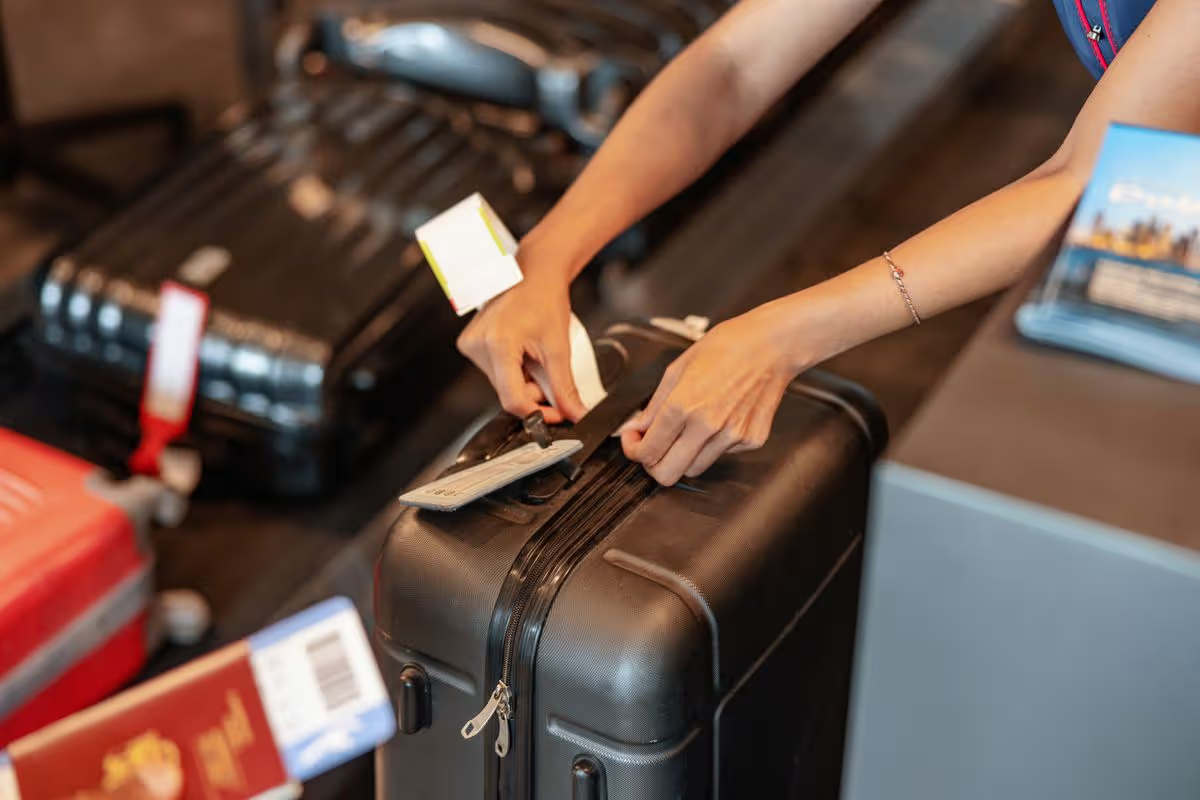
Old airline stickers and tags from previous flights can also cause issues according to John. Machines may not know which barcode to scan, causing delays, or it could even mean your luggage is sent to the wrong destination.
If you want to personalise your case to make it stand out from the crowd, use a colourful luggage strap, add some coloured tape around a handle, or add a distinctive sticker so you can spot it on the carousel.
Luggage covers are another option for checked bags. These covers slip over your suitcase and are available in bright colours and prints, or even personalised options. As a bonus, these covers can help to protect the exterior of your case from damage when being handled. You can also opt for waterproof covers, so if your luggage is left on a trolley in the rain or is close to a leak, the contents won’t be damaged.
Airport workers have also warned that the colour of the case that you choose is important. Black suitcases are the most common choice for travellers, but they’re the most likely to be lost or stolen.
Finding a black suitcase can also be incredibly difficult. Many lost property offices will be full of suitcases of the exact same type and colour, making it less likely you’ll be reunited with your bag.
Have a story you want to share? Email us at webtravel@reachplc.com
More and more Gen Zs and Millennials are hiring UK holiday homes in order to dress up together, away from the scrutiny of their parents, partners and society at large
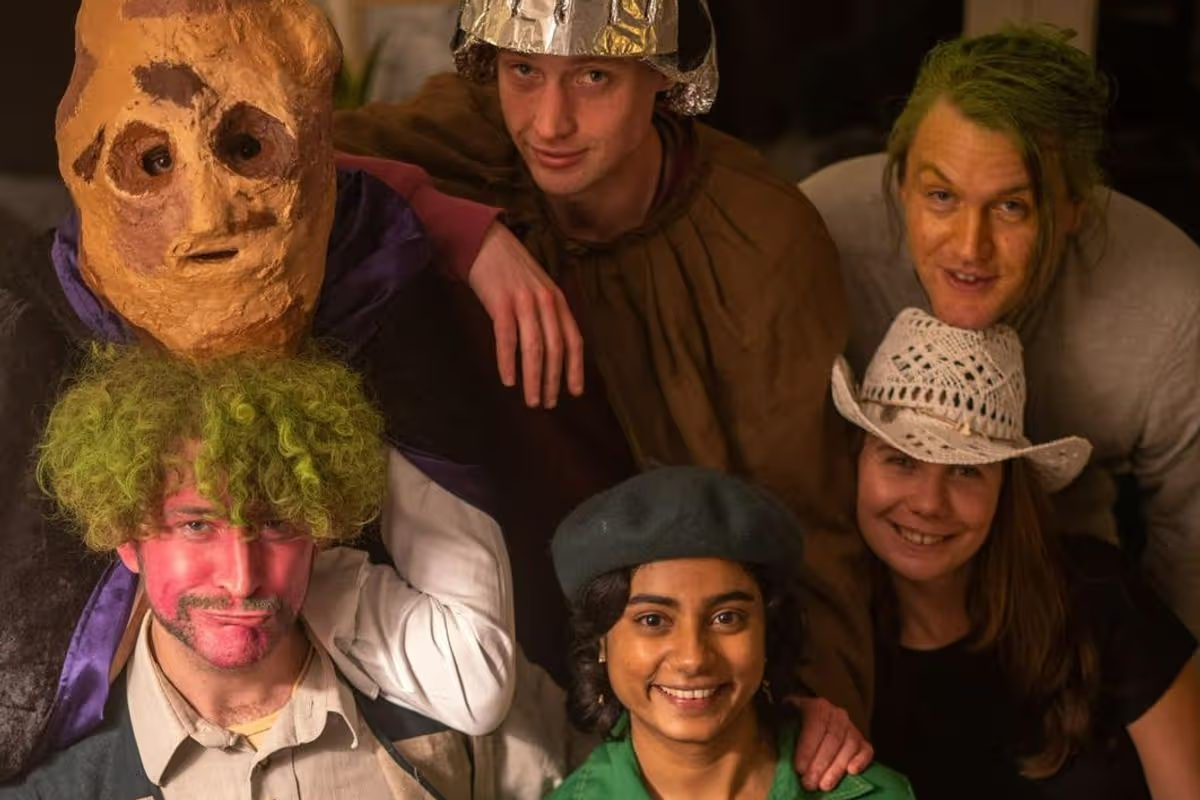
More and more Gen Zs and Millenials are dressing up on holiday(Image: Georgia Johnson)
“It’s difficult playing at your house. You’re trying to get in the mood to slay a vampire, and then someone’s boyfriend comes in to get a snack.”
It’s a problem we’ve all had. Or at least, those of us who are among the growing number of British Dungeons and Dragons players who are swapping sunbeds in Lanzarote for a cottage in the Lake District, and trading their piña colada for a couple of D4s and an orc costume.
Driven by “cosy crime” hits such as The Traitors and Agatha Christie adaptations, one in four Brits and half of Gen Z have booked a staycation specifically to host a murder mystery, games night, or TV-themed weekend with friends or family, according to an exclusive cottages.com study.
An early adopter of this trend is young Millennial Georgia Johnson, who has just celebrated a decade of leaving the boyfriends behind in London and heading to somewhere secluded to roll dice.
“We’ve been to Valencia twice, a place in Kent, a friend’s house in Bath and up to the Lake District,” the North London DnD player explained.
For Georgia and her costume-clad pals, getting away from it all really helps to set the mood.
“One time, we knew we were going to have a fortune telling, so we put out loads of tarot cards and dice and had a candlelit session,” she explained.
“Cottages.com has spooky castles and chapels you can stay in, and a button that shows you a nearby pub. Generally, you get up, DnD, have lunch at a pub, come back, more DnD, then around midnight it can get a bit silly and hazy. At the moment, we are playing Curse of Strahd, which is modelled on Dracula. We are hoping to go to Whitby to finish the game. We want candles lit and spooky music.”
For the uninitiated, it’d be easy to overlook the ubiquity of role-playing games like DnD, or consign them to the ‘80s fad bin’ only recently revived by a starring role in Stranger Things.
In fact, they’ve been growing in popularity for years and continue to reach new peaks. 52 years after its invention, DnD has 13.7 million active players. One study suggests that interest in tabletop role-playing games has increased by roughly 85% since 2020. This purple patch extends to Nottingham-based Warhammer, which was worth £4.7bn at the end of 2024.
For many gentler souls, such games are a fantastic way of expressing oneself creatively. Among Georgia’s clan is Ben, an office worker during the week who dons a moustache and becomes “officer of the post” Derbert Clifton-Brown at the weekend.
He is joined by creative Kash, who has purchased ears specifically designed for people of colour, and Oliver, who likes to paint himself green.
Before the crew started travelling to play, Georgia’s mum walked in on them in the act. “She said she would’ve rather found us having an orgy,” the 33-year-old said.
Another great RPG lover is James Mackenzie-Thorpe. Not only has he travelled across the UK to enjoy weekend sessions with his friends, but he has also brought dozens of DnDers to a unique tourist attraction.
“My first day working at Kents Caverns I heard some colleagues talking DnD. I asked if I could play, but there was no work group. Later on, I woke up from a dream and thought I should write an adventure set in the caves. So I wrote it and played it with a group of five, in the caves. It went really well. Then another group. Then we decided to do it for the public. Now, for three years, I’ve run DnD in the cave for the general public,” James explained.
Kents Caverns are a network of prehistoric caves in Torquay, Devon, that lie beneath the hotel that inspired Fawlty Towers. James takes tours by day and hosts quests by night.
And he puts a lot of effort into it, paying for maps to be professionally painted and bringing rechargeable lanterns to light up the skull-lined caves.
“It’s been a tremendous amount of fun. You never know what you’re going to get with each group. We’ve had people travelling from Cornwall and Somerset. One group had been playing with each other online during Covid. They had never met in real life before they came and played with me in the caves. They booked an Airbnb and stayed together,” he said.
For James, the real joy of DnD comes in seeing people express themselves freely, which traveling to a cottage or heading underground can help some do.
“We have a young member who has been four or five times to play in the caves. They’re non-binary and are just starting to come to terms with that. To see everyone really take that person in hand, to really help that person come out of their shell, it makes me really proud,” he said.
CHANNEL Springwatch and immerse yourself in a nature reserve, says writer Mia Lyndon.
THE PAD
Each of the shepherd’s huts have their own pond and mini wetlandCredit: Mikal Ludlow PhotographyInside the huts are charmingly decoratedCredit: Mikal Ludlow Photography
You’ll be able to call kingfishers, cranes and thousands of other beautiful birds your neighbours here.
Sign up for the Travel newsletter
Thank you!
Tucked inside Slimbridge Wetland Centre, just half an hour’s drive south of Gloucester, are five shepherd’s huts, each with their own pond and mini wetland, and sleeping between two and four people.
We spotted rabbits and foxes from our snug digs among the 100 acres of lush landscape, plus every hut is kitted out with a vintage-style oven, waterfall shower (with excellent water pressure, FYI) and spacious decking.
Owl-shaped curtain hooks and a cuddly mallard doorstop only add to the charm.
EXPLORE
Marvel at starling murmurationsCredit: James Lees / WWT
Make the most of your unlimited access to the wetland centre and feed wildfowl on Swan Lake, before bobbing along on an hour-long canoe tour, £10 per person, to get closer to diving ducks and water voles.
Or hunt down egrets, stalks and grass snakes with the help of friendly driver Chris on a Wildlife Safari – £5 per adult, £3.50 per child (wwt.org.uk).
Find yet more stunning views at Miserden Gardens and wander past elegant topiary, lush fruit trees and herds of roaming deer in this exquisite 17th-century walled garden. Entry costs £12 and under-16s are free (Miserden.org).
Meanwhile, thronging with vibrant indie stores, quaint Stroud is a short drive away.
Pop into the buzzy Malthouse Collective for two storeys of vintage clothes, hand-poured candles and fab local art (Themalthousecollective.co.uk), then hit Made In Stroud for pretty pottery and jewellery (Madeinstroud.co.uk).
Alongside a sweet miniature railway, Stroud’s Stratford Park is home to the Museum In The Park – check out local artefacts, oil paintings and even a Gloucestershire Stegosaur fossil. Entry is free (Museuminthepark.org.uk).
REFUEL
Swan about Stroudwater CanalCredit: Getty ImagesHave a bite to eat at Woodruff cafeCredit: Woodruff cafe/Instagram
Hunker down with a tasty (and very generous) Full Monty English brekkie, £13, at The Tudor Arms, which sits beside the Gloucester And Sharpness Canal and is just a 10-minute stroll from your bed (Thetudorarms.co.uk).
For a laid-back yet impressive dinner, hike over to The George Inn for dishes such as succulent venison steak with chocolate and red wine sauce, £25, followed by tangy home-made blackcurrant and orange cheesecake, £7 (Quality-inns.co.uk).
Or gaze across rolling valleys at The Bell Inn at Selsley, while tucking into fluffy smoked Hereford cheese croquette, £19, and warming cinnamon milk pie, £9.
Don’t miss the Romanian Calusari white, £6.50 a glass – it’s zippy, fresh and absolutely delicious (Thebellinnselsley.com).
Elsewhere, there are cosy cafes aplenty in Stroud, but the irresistible ginger and date crumble cake, £3.90, at buzzy Woodruffs helps it reign supreme (Woodruffsorganiccafe.co.uk).
CORNWALL isn’t short of cracking coastal escapes, but the newly-renovated Pedn Olva is a step above the rest, not just because of its rooms but its excellent pub grub, too,
Here’s everything you need to know.
Sign up for the Travel newsletter
Thank you!
Pedn Olva is a cosy pub with 27 roomsCredit: Pedn OlvaThe hotel sits on a craggy cliff several metres above the choppy St Ives seaCredit: Pedn Olva
Where is Pedn Olva?
Its name translates to Lookout on the Headland in old Cornish – a rather accurate description of its perch, a craggy cliff several metres above the choppy St Ives sea in Cornwall.
Guests can park for free in a nearby car park above the hotel – they will need to collect a slip to display in their car window from the hotel reception.
What’s it like?
Inspired by the windswept patch of coast it sits on, Pedn Olva in Cornwall has buckets of coastal character.
It’s first and foremost a cosy St Austell Brewery pub, but the 27 boutique rooms mean you can hunker down for the night.

Each of them looks as if they have been carved into the rockface, all with views of the ocean and the flickering lights of the town centre a short distance across the water.
What are the rooms like?
Extremely well thought out.
A property can look sleek and stylish but if the basics haven’t been mastered then everything else becomes redundant – that’s certainly not the case here.
There’s every tea imaginable from camomile to berry and decaf, while USB ports have been conveniently placed next to the bed and hooks on the walls make efficient use of the cosy space.
Next time I’ll be bringing my dog who can stay in selected rooms for an extra £15 per night.
The restaurant is a popular dining spot in its own rightCredit: Pedn OlvaClassic by-the-sea dishes star on the menuCredit: Supplied
What is there to eat and drink?
The restaurant is a popular dining spot in its own right.
Classic by-the-sea dishes star on the menu such as golden ale and chilli pickled cockles and grilled buttery scallops, served in their shells.
I jazzed up my classic fish and chips by swapping out the chunky fries for Pedn Olva’s famous crabby fries, which come with hunks of white crab meat and a thermidor sauce.
Wash it down with a local ale and make sure to try the chocolate and stout cheesecake – subtly bitter and indulgently creamy.
What else is there to do?
Superb, friendly service is what takes this place a notch above the rest.
All rooms come with a large and sturdy tote bag that guests can take with them for the day, while an in-room mini telescope meant that I could take advantage of our seafront position and gaze up at the stars.
Most of the rooms sleep just two, but there is a family room that sleeps four.
The hotel’s great locations makes it ideal for a family break and there’s a fair distance between the restaurant area and rooms meaning you’re unlikely to get disturbed at night.
Is there access for guests with disabilities?
Due to Pedn Olva’s cliffside perch, mobility issues are likely to struggle.
The car park is only reachable via a set of stairs and the higgledy piggledy nature of the building means guests may find it challenging getting into and out of some rooms.
Looking for a place to stay? For more hotel inspirationclick here.
Rooms are extremely well thought outCredit: Pedn Olva
AS a veteran showbiz reporter, I’m used to free- flowing champagne, egomaniacal celebrities and all-round general excess.
So who knew a Caribbean cruise could beat any A-lister party?
Sign up for the Travel newsletter
Thank you!
The Sun’s Clemmie Moodie took a Caribbean Cruise aboard the 5,200-guest Arvia as a cruise virginCredit: P&OMake a splash at the on-deck poolCredit: Simon KennedyActivities such a mini-golf are also availableCredit: Simon Kennedy
Drawing back the curtains every morning, before me was a beautiful new backdrop. Different every day, and every day seemingly more stunning. No need for Instagram filters.
Not even Paul Daniels in his prime could have mustered up such magic. Stepping aboard the 5,200-guest Arvia as a cruise virgin, I really did not know what to expect.
Yet absolutely everything on board this P&O Cruises ship — don’t, whatever you do, call it a “big boat” as I did — confounded all expectations.
I had thought, wrongly, I’d be the youngest onboard. How foolish of me.
From singletons enjoying rum-tasting at 11am to older couples, married 55 years and still finding conversational titbits over the lunch table, my gang included a 22-year-old influencer and a 57-year-old rocker in the shape of Blur’s Alex James (who played a stunning sundowner set one evening).
Also on board were more than 2,000 crew. Which goes some way to explaining the pristine levels of both cleanliness and hospitality.
Each cabin is serviced with a personal “butler” who caters for any whim.
With 30 bars and restaurants on board, endless shops, a gym, spin studio, spa, cinema, four pools and an uber-cool jazz club, you could spend a year on board and yet not repeat the same day twice.
Arvia is also utterly vast.
My Garmin watch tells me I average 15,000 steps a day simply from milling around, getting lost and exploring. On the days we moored up, this rocketed to well over 20,000
You’ll never be bored with this level of entertainmentCredit: suppliedHop off the cruise to wander sunsoaked streetsCredit: supplied
The whole mooring bit, naturally, being the very point of a cruise. So after landing in Barbados, we sailed overnight and I awoke in Martinique.
Here, we jumped in a taxi and drove 50 minutes to a Club Med hotel for a day of sunbathing at the picturesque beach club.
Surrounded by turquoise seas and an Insta-worthy backdrop — certainly the influencers among us including ex-Towie star Lydia Bright and MIC’s Ollie Locke were very happy — we enjoyed a rosé-fuelled lunch.
That evening we had dinner at one of the speciality restaurants, Keel and Cow.
The elevated gastro-pub diner may cost a little extra but it is just a little — from £3.50 for a starter of potted chicken and bacon rillette to a melt-in-the-mouth fillet steak for £15.50 that came with chunky chips, onion rings, grilled mushroom and tomato, roasted garlic and an iceberg lettuce wedge with sour cream and bacon crumb — and was well worth the extra cost.
The next morning, I rise early to check the gym. With machines overlooking the gently rolling Caribbean seas, treadmill running, for once, becomes a pleasure, not a pain.
It has everything one might need, plus a full timetable of classes ranging from stretching and Pilates to spin and weights.
As anyone who knows me knows, breakfast is very important to me. I judge places by their fast-breaking offerings. Thankfully, breakfast thrilled.
Clemmie samples some wine onboardCredit: supplied
The Horizon buffet had all the options for a quick brekkie and you could enjoy table service in the main Meridian and Zenith dining rooms.
But it was the 6th Street Diner, an American-themed eatery, that nailed the breakfast brief (think waffles, over-easy eggs, bacon and maple syrup, washed down with endless coffee.)
While there are plenty of included options for dining, it was great to have such a choice if you wanted to spend a little extra. There’s even an extensive room service menu that offers a club sandwich for about £4.
Another joy was sailing around the Caribbean but still only paying in pounds onboard for everything from a beauty must-have in the shops to a drink at the bar.
The biggest jolt of the week, however, came as I went to log on to the wi-fi for the week — £150! Apparently it’s something to do with satellites and lots of other technical jargon, but with my day job kicking off — thank you, Brooklyn Beckham — I had no option but to log in.
Thankfully, P&O offers some great options to buy all-inclusive packages in advance that cost from £49 a day. The Classic includes alcoholic and soft drinks as well as essential wi-fi for browsing and credit towards speciality dining depending on the length of your cruise.
The Deluxe includes a wider range of posh spirits, craft beers and cocktails as well as fast wi-fi for streaming and video calls plus enhanced dining credit.
I’ll know better on my next cruise.
Blur’s Alex James took to the wavesCredit: supplied
Our next port of call was St Kitts and after we sailed in admiring its verdant hills, off I trotted on a catamaran excursion.
What a day. The pinnacle to the most incredible day’s sailing — one accompanied by a banging Nineties soundtrack and copious amounts of champagne — was a spot of snorkelling before a lobster salad lunch.
That evening we had an incredible dinner at Epicurean, the ship’s fine-dining eatery.
After another day at sea, it was time for another highlight: a speedboat to private island White Bay, off the British Virgin Islands – the stuff of Robinson Crusoe dreams. I really did feel like I’d stepped out on to a movie set.
The Sunset bar proved my favourite way to unwind after another busy-busy day of sunbathing, eating, drinking and experiencing all the tropical delights of the Caribbean.
Forget those red carpets — you can give me a blue sea all day long.
GO: Caribbean Cruise
GETTING / SAILING THERE: P&O Cruises has 14-night Caribbean cruises onboard Arvia from £1,649pp. Includes flights from selected UK airports, full-board, children’s clubs and entertainment.
Departing the UK on February 26, 2027, the cruise sails to and from Barbados and calls at Martinique, St Kitts, Tortola, St Maarten, Antigua, St Lucia and Grenada. See pocruises.com.
DEVON is one of the most popular counties in the UK to visit for a staycation – so when looking at where to explore it can be hard to find somewhere that only locals know about.
Nestled within the coastline, between Dawlish and Torquay, you’ll find Babbacombe.
Sign up for the Travel newsletter
Thank you!
Babbacombe Downs in Devon is a hidden gem on the coastCredit: AlamyThere are two beaches you can head to, below the sandstone cliffsCredit: Getty
While it is often skipped for its larger neighbours on the English Riviera, Babbacombe deserves a spotlight of its own.
What used to be just a humble fishing village in the 16th century, has turned into a much-loved local gem.
In records, the area was previously known as ‘Babbecumbe’ meaning ‘Babba’s Valley’ and by 1775 there were only a few cottages littered across the area.
In the late 19th century, John ‘Babbacombe’ Lee survived three attempts to hang him at ExeterPrison for a murder he had committed in Babbacombe.
He became known as ‘the man they could not hang’ and has become a story told by locals.
In the Victorian era, the region grew in popularity for tourists as it was recognised for its dramatic cliff scenery.
The small town is home to Babbacombe Beach, which is made up of shingle and sits below the towering red cliffs that form Babbacombe Downs.
One recent visitor said: “Babbacombe Beach is a very peaceful, attractive place; the views from the top of the cliff are stunning.”
At Babbacombe Downs, you’ll find a promenade which is thought to be the highest in England, boasting amazing views across the bay.
And from there you can head to Oddicombe Beach, by walking down a picturesque lane – but be warned it is rather steep.
Alternatively, you can catch the funicular down to the beach.
One recent visitor said: “Oddicombe beach is a wonderful suntrap with a micro climate of its own.”
If with little kids, I would recommend taking the Babbacombe Cliff Railway, which has been operating for 100 years, this year.
The funicular runs from Babbacombe Downs to Oddicombe Beach, which neighbours Babbacombe Beach.
Babbacombe is also home to a funicular which is 100 years old, this yearCredit: Alamy
The Babbacombe Cliff Railway was built in 1926 and over that time has shuttled hundreds of holidaymakers to and from Oddicombe Beach.
The funicular did have to close for some time though between 1941 and 1951 due to wartime restrictions.
The carriages were later replaced in the early 2000s and painted in the original maroon and cream colours, with Torbay’s coat of arms on either side.
I remember as a child using the 200-metre cliff railway, with it feeling like stepping back in time, as if I was entering a part of history that I had been learning in school.
Nothing quite compares to the views either, the steepness of the track nestled between red sandstone and grey Devonian limestone 73metre-high cliffs means you can see the beach below with nothing disturbing the picture.
Because the railway and beaches below are hidden in the cliffside, not many tourists know about it.
It’s also away from the main hubbub of the main towns on the coastline.
If you’re wanting somewhere special to eat, head to Babbacombe Bay Cafe.
They serve freshly made toasties with salad and warming cups of tea that are ideal after being buffeted by the coastal winds.
You can also take a walk to the high street, which is about three minutes from the Downs.
Also in Babbacombe, you can head to Bygones which has a full-scale replica of a Victorian high streetCredit: Alamy
One place to visit here is Bygones, a museum with a full-scale replica Victorian street.
The museum has over 2,000 artefacts to discover and your four-legged friend can even join you on a visit.
Tickets cost from £13.95 per adult and £9.75 per child.
Spread across four acres, visitors can feel like a giant as they explore hundreds of scenes depicting British life, including iconic landmarks.
I used to visit once or twice a year growing up and particularly remember going at Christmas when all of the park’s models become covered in ‘snow‘.
The attraction has a sense of humour too, great for keeping parents entertained.
For example, there’s an ‘unaffordable housing development’ and a celebrity mansion with the Mutant Ninja Turtles and The Incredibles family playing in the garden.
Also nearby is Babbacombe Model Village, which features models of iconic London landmarksCredit: Alamy
Included in your admission ticket, you also get the chance to watch a film in the attraction’s 4D cinema.
It was always a laugh being jolted around in your seat as puffs of air and water were sprayed at you.
Every Friday evening from April to October, the whole park is illuminated with multi-coloured lights as well.
Tickets cost £21.95 per adult and £17.95 per child.
If you are looking for somewhere to stay, there are several options.
For example, you could stay at the Babbacombe Palms Guest House from £65 per night.
Fancy something a little more luxury? Then opt for the Cary Arms Hotel and Spa costing from £195 per night.
THE price of holidays has skyrocketed in recent weeks, partially due to the rising cost of fuel.
But even in the school holidays, your summer getaway doesn’t have to break the bank as we’ve found some incredible deals to the top tourist destinations.
Hotel Club Jandia Princess is a family-friendly mega resort bookable from £498ppCredit: TUI
We’ve scoured the internet to find the best resorts you can stay in for less this summer, and the best part is, they don’t compromise on comfort, location or activities.
Many of these resorts are set smack-bang on the beach, and each price is calculated with an all-inclusive package, meaning there’s no need to spend any extra cash on dining out.
Here are 20 of the best all-inclusive resorts to escape to this summer, with top picks from the Greek islands, Ibiza, Tenerife and more.
Magic Cristal Park, Benidorm
Magic Cristal Park is a top pick for a Benidorm break, especially with its ‘ultra all-inclusive’ offer.
While the standard all-inclusive is already generous, this upgrade includes premium drinks and even a beachfront brunch.
Plus, if you’re staying for four nights or more, you’ll get a range of excursions thrown in for free.
You can choose from the Medieval Magic Robin Hood Challenge, the Princesses and Knights show, and a trip to a live magic show.
And if you stay for at least seven nights, you’ll even get entry to Terra Natura Animal Park and Aqua Natura Water Park included.
This all-inclusive paradise is a massive win for families who want an action-packed holiday without the extra costs that come with excursions.
TUI offer a 5-night stay from 17 August, including return flights from Glasgow from £490pp.
AQI Aqua Mirage Club, Marrakech, Morocco
With its own water park, wave machine and a selection of slides, this resort in Morocco‘s Marrakech is loved by families.
This sprawling resort lets you soak up the North African sunshine with a much more spacious, out-of-town feel than the smaller hotels in the city centre.
This resort has everything you’ll need for your summer holiday in one spot.
You can spend days tackling the on-site waterpark with its own water castle, or hitting the tennis, basketball and volleyball courts.
When it comes to food and drink, the all-inclusive buffet is a real international spread. Food ranges from traditional tagines to grilled meats and refreshing salads.
And if you want to dive into the famous buzz of Jemaa el-Fnaa Square, this hotel offers a free shuttle service, with the city’s vibrant souks just 20 minutes’ away.
TUI offer a 5-night stay from 30 July, including return flights from London Stansted from £551pp.
AQI Aqua Mirage Club in Marrakech provide a free shuttle bus into the city for guestsCredit: Shutterstock
Sol Tenerife
Playa de las Américas is Tenerife‘s undisputed capital of fun, and this hotel puts you right on its front porch.
The volcanic shoreline of Playa de Troya is just four minutes away, while the Veronicas Strip begins almost exactly where the hotel grounds end.
This resort is ideal for those who want to jump between a sun lounger and a dance floor without needing a taxi in between.
With August temperatures averaging a reliable 28C to 31C, there’ll be plenty of sunbathing opportunities – plus you can count on the three onsite pools to cool down.
The all-inclusive offer includes a constant rotation of international dishes at the buffet, plus a poolside bar with extra snacks and drinks.
For a change of scenery, Siam Park is a seven-minute drive away, offering some of the country’s most thrilling water slides.
Loveholidays offer a 5-night stay from 24 August, including return flights from Glasgow Prestwick from £499pp.
Playa de las Américas in Tenerife is home to beautiful beaches and the ever-popular Siam ParkCredit: Getty
Corona Roja Aparthotel, Gran Canaria
This budget-friendly base sits in Gran Canaria’s ever-popular Playa del Ingles.
This resort offers comfortable apartments with kitchenettes, but the all-inclusive option means you can skip the cooking and stick to the buffet restaurant and poolside bar.
Playa del Ingles is a hit with Brits for its combination of golden beaches, buzzing nightlife, and watersports ranging from parasailing to sunset cruises.
The main Playa del Ingles beach boasts nearly two miles of flat, golden sands that are perfect for families, whilst the nearby Maspalomas has a desert-like landscape with rolling dunes.
And with all-inclusive, week-long summer stays for less than £400pp, this is a great-value spot for those who want to be close to the action.
On the Beach offer a 7-night stay from 15 July including return flights from Bournemouth from £360pp.
Gran Canaria’s Playa del Ingles is known for its near two-mile long beach and vibrant nightlifeCredit: Getty
Globales Montemar, Ibiza
Globales Montemar sits on a quieter side of Ibiza, meaning you can soak up the island’s stunning natural beauty away from the party crowds.
Tucked away behind a pine-covered hillside, this resort feels like a real island escape, offering both hill and sea views.
Here you’re just a 10-minute stroll from a stunning, horseshoe-shaped bay where the waters are clear, calm and shallow.
The resort itself is all about easy-going family fun. There’s a large pool that curves around the resort, surrounded by plenty of sunbeds, plus a kids and families-only zone.
You can fill your boots at the buffet restaurant, which serves up a mix of local and international dishes, and grab a midday snack or an ice cream from the poolside bar.
It’s an excellent choice if you want to experience Ibiza in a family-friendly spot surrounded by stunning scenery.
TUI offer a 5-night stay from 25 July, including return flights from London Stansted from £505pp.
Globales Montemar in Cala Llonga, Ibiza shows a quieter, scenic side to the party islandCredit: TUI
Archipel Monastir, Tunisia
This glamorous Tunisian hotel offers everything from luxurious spa treatments and a hammam, to an exciting sports programme including tennis, volleyball and archery.
Plus, it’s fit for families, with spacious and comfortable rooms and suites which house up to four beds.
The coastal city of Monastir is ideal for those who like to take in the local history on holiday, with a medina, fortress and ancient ruins to explore.
There’s plenty of impressive sights like the preserved Ribat of Monastir, as well as the grand marble patterns and domes of the Habib Bourguiba Mausoleum.
And Monastir isn’t short of beautiful beaches, either. The Archipel Monastir hotel sits directly on a golden beach, so you’re just steps away from a swim in the Mediterranean Sea.
On the Beach offers a 7-night stay from 1 July including return flights from Bristol from £370pp.
Archipel Monastir in Tunisia is close to fascinating historical sites, and is just steps from the seaCredit: On the beach
Clover Magic Park Beach, Alanya, Antalya, Turkey
This four-star Turkish resort offers jam-packed all-inclusive holidays that are pretty hard to say no to.
Sat smack-bang on the beach in Antalya‘s Konakli, this resort has all the family summer holiday essentials: a giant pool, water slides, plus evening entertainment and nightclub access for the grown-ups.
Here you can help yourself to an extensive buffet breakfast, various international options at lunch and dinner, and plenty of poolside drinks and snacks.
Outside of the resort, Konakli offers boat trips to Turtle Beach, plus the exciting Alanya Aquapark is just a 15-minute drive away.
Loveholidays offer a 5-night stay from 9 August, including return flights from Edinburgh from £419pp
Clover Magic Park Beach Alanya in Antalya, Turkey has water slides that kids will loveCredit: Love Holidays
Rodos Star, Rhodes, Greece
Perched on a hill with views over the Aegean Sea, this family-run hotel is highly rated for its welcoming atmosphere.
Families make use of the outdoor pool and kids’ pool, and enjoy settling down to evening entertainment three times a week – including live music, Greek dancing and disco nights.
Rodos Star is just a five-minute walk from the traditional village of Afandou, one of the largest in Rhodes.
This pretty village is full of traditional beachfront tavernas, as well as plenty of shops selling handmade souvenirs.
And if you prefer pebble beaches that won’t leave you coming home with sand in your pockets for weeks, you’re in luck.
Here you’re close to the pebbled portion of the four-mile long Afandou Beach with the typical turquoise waters that make the Greek islands famous.
TUI offer a 7-night stay from 16 August including return flights from Glasgow from £770pp.
Rodos Star is situated in Afandou, one of the largest villages in RhodesCredit: TUI
Blue Sea Interpalace, Tenerife
This four-star hillside retreat in Tenerife consistently rates high among families.
It’s a challenge for kids to get bored here when there’s mini golf, a kids club, an outdoor playground and a packed evening entertainment programme to pick from.
There are 234 rooms in this resort, each of which come with all the necessary amenities such as air-con, flat-screen TVs and a minibar.
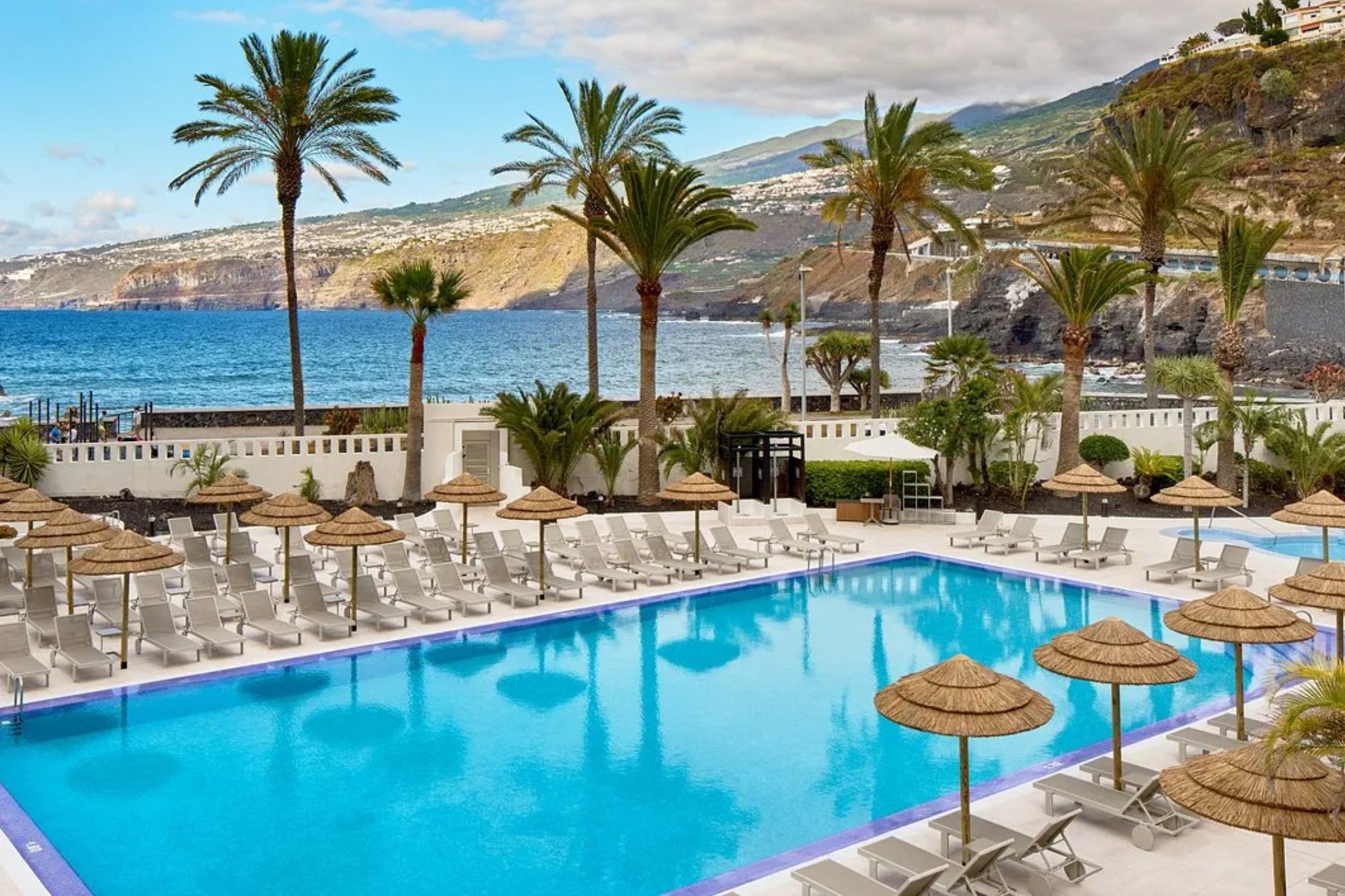
The rest of the resort also has that classic all-inclusive holiday in the Canaries feel – with a large outdoor pool surrounded by loungers, a big buffet restaurant and several sports courts.
Head out into the local area of Puerto de la Cruz to explore volcanic black sand beaches, stroll its picturesque harbour and discover the ruins of an 18th century fort.
Loveholidays offer a 5-night stay from 15 August, including return flights from Edinburgh from £449pp.
Blue Sea Interpalace is in Puerto de la Cruz, a part of Tenerife with black sand beachesCredit: Love Holidays
Selenium Hotel, Antalya, Turkey
The Selenium Hotel in sunny Antalya is the perfect base for those who want to be in the heart of the action with plenty of activities.
There’s water sports galore down on the seafront, with diving, water-skiing, jet-skiing, pedal boats and banana boats ready and waiting for you to take a spin.
Plus, you can also explore nearby coastal paths by bicycle or horse back, both of which can be arranged by the hotel. There’s also a golf course 20 minutes’ drive away in Belek.
Equally, if you’re just after a fly and flop kind of holiday, this hotel is suitable for you, too.
There’s a pool with plenty of parasols and loungers to lay back and relax on, as well as a sand beach just a few minutes walk away.
On the Beach offer a 7-night stay from 1 July including return flights from London Gatwick from £375pp
Antalya in Turkey is known as the capital of the ‘Turquoise Coast’Credit: Getty
Hotel Club Jandia Princess, Fuerteventura
If you’re looking for a family mega-resort just steps from the beach and boasting toasty 27C to 30C July temperatures, this pick in Fuerteventura is the one for you.
The huge resort is perched right above the stunning Playa de Esquinzo, so you’re never more than a short stroll from the water.
Hotel Club Jandia Princess is set up like a small village, with low-rise buildings scattered among palm trees and six different swimming pools.
Stays here are all about variety: entertainment spans from DJ nights to bingo and live sports screenings, whilst the wide range of sports on offer include water polo, rifle shooting and shuffleboard.
There are plenty of unique things to do in the local area, too, such as meeting goats at the nearby farm and going whale-watching on local catamaran trips.
TUI offer a 5-night stay from 21 July, including return flights from Bournemouth from £498pp.
Hotel Club Jandia Princess is a short walk from Playa de Esquinzo, a quiet, golden beachCredit: TUI
MIX Peymar, Majorca
Set just steps from the sea in sunny S’Illot, Majorca, the MIX Peymar hotel is a stunning choice for couples and families alike.
Spend days soaking up rays on the beach of Platja de S’Illot, or splashing around in the hotel’s outdoor pool and dedicated kids’ pool.
And with temperatures in S’Illot averaging a scorching 32C in August, you’ll certainly want to take a dip to cool off.
When things cool down in the evenings, there are plenty of shops, bars and restaurants to enjoy within walking distance.
Plus the pretty promenade and and Blue Flag beaches of resort town Cala Millor are only a five-minute drive away.
Loveholidays offer a 5-night stay from 2 August, including return flights from Glasgow Prestwick from £479pp.
MIX Peymar in Majorca is located practically on the shores of Platja de S’Illot beachCredit: Love Holidays
TUI SUNEO Lagomonte, Majorca
TUI SUNEO Lagomonte is a Majorcan resort that delivers something you don’t see every day.
This hotel’s standout feature is a mini private island with its own pool and bar in the middle of the lake beside the main building.
The rest of the resort feels modern, spacious, and built for easy-going family getaways.
There’s a massive main pool with a dedicated zone for kids, plus sports like darts, aerobics, table tennis and aqua gym classes to keep you entertained during the day.
Plus the all-inclusive buffet here is a real winner, serving up classics like pancakes and English breakfasts, through to freshly-grilled meats and fish at dinner time.
When you fancy a change of scenery, a free shuttle bus will whisk you down to a golden stretch of Alcudian beach in minutes.
TUI offer a 5-night stay from 13 August, including return flights from Glasgow Prestwick from £434pp.
TUI SUNEO Lagomonte in Majorca has a miniature island with its own pool and bar on the resortCredit: TUI
Hotel Terramar Calella, Costa Brava
If you’re after a Costa Brava break that puts you in the prime spot for both beach days and buzzy nights out, Hotel Terramar is your best bet.
The location is the real winner here, putting you right between the popular promenade and the golden sands of Platja Gran, the area’s largest beach.
Days here look like morning sea swims, followed by afternoons spent lazing by the pool and sunset drinks at a local bar.
But because this is an all-inclusive stay, there’s no need to spend money on food and drink outside of the hotel if you don’t want to.
Meals are included, plus the Cafe Bar is stocked with drinks and snacks.
And with a lively atmosphere and bars stocked with local spirits, it’s a great-value base for a straightforward bucket-and-spade break.
On the Beach offer a 7-night stay from 22 July including return flights from Bristol from £545pp.
Lloret de Mar is one of the most popular beaches in Costa Brava, and this Clipper hotel is right nearbyCredit: Love Holidays
Ereza Apartamentos Los Hibiscos, Lanzarote
This adults-only escape to Lanzarote is the perfect pick for couples.
These apartments are clean and bright, but the pool area is the real winner here – with a sun deck ideal for a peaceful afternoon with a book and cocktail in hand.
Even though it’s an apartment complex, you can still go all-inclusive. Here, you get the best of both worlds: a self-contained base with all the amenities, plus your meals, snacks and drinks thrown in.
The complex sits in Puerto del Carmen, where popular beaches Playa Grande and Playa Pocillos offer access to the sapphire waters of the Atlantic.
There’s plenty to do here, including scuba diving and jet skiing stations along the seafront, as well as a bustling Friday market at market square Plaza Varadero.
Plus, the nearby promenade Avenida de las Playas is packed with pubs, bars and clubs to dance the night away.
Loveholidays offer a 5-night stay from 3 July including return flights from Edinburgh from £349pp.
Ereza Apartamentos Los Hibiscos is an adults-only option in sunny LanzaroteCredit: Love Holidays
Sun Club El Dorado, Majorca
For an all-inclusive Majorcan getaway that won’t blow the budget, Sun Club El Dorado is a top choice.
Tucked away from the busy tourist strip, this is a top choice for a more secluded escape with breathing room to soak up the scenery.
But this quieter location doesn’t lack in things to do. Here you can spend your morning on the tennis courts or having a go at archery, before cooling off in one of the three massive pools.
If you bring the kids along, the onsite water slide and non-stop entertainment will be sure to keep them busy.
And after a full day of being active, you can head to the buffet to fill your plate and soak up those sunset views.
Loveholidays offer a 5-night stay from 24 August including return flights from Edinburgh from £419pp.
Sun Club El Dorado in Majorca offers a secluded slice of the paradise on the Balearic IslandCredit: Love Holidays
Aes Club Hotel, Dalaman, Turkey
If you’re wanting to swap the busy beachfront resorts for more of a pretty rural getaway, Aes Club Hotel in the Turkish village of Ovacik is a standout choice.
Tucked away near the base of Mount Babadağ, this hotel swaps the busy seafront for a peaceful mountain landscape.
Although if you fancy a sea swim, you’re only a short (and free) shuttle bus ride away from the Blue Lagoon of Oludeniz.
This hotel has a sleek pool area for all-day lounging, a spa for a proper Turkish scrub, and an entertainment programme that runs from day through to night.
Whether you want to enjoy the peace and quiet of the mountains, or head out into nearby Hisarönü for drinks and dancing, this is a brilliant Turkish base for a bit of me-time.
TUI offer a 7-night stay from 13 August including return flights from Aberdeen from £765pp. This deal includes one free child’s place.
Aes Club Hotel sits at the base of a mountain in the Dalaman area of TurkeyCredit: TUI
Apartamentos LIVVO Morromar, Lanzarote
These apartments in Lanzarote‘s Matagorda come with kitchenettes, cosy seating areas, plus your choice of balcony or terrace.
Each spacious apartment can sleep up to four people, making an ideal choice for small groups seeking an easy-going sun holiday.
There’s two large, heated outdoor pools in the apartment complex to enjoy, plus a kids club, playground, games room, and both an evening and daytime entertainment schedule.
Three meals a day are served in the buffet restaurant, while the pool bar opens from midday onwards for snacks, and even a late breakfast if you’ve had a lie-in.
The apartments are just a 10-minute walk from the closest beach in Matagorda, where calm waters lap over soft, golden sands.
TUI offer a 7-night stay from 13 August including return flights from Glasgow from £603pp.
Apartamentos LIVVO Morromar is an ideal choice for group holidays to LanzaroteCredit: TUI
El Pueblo Tamlelt, Agadir, Morocco
Set in 11 acres of tropical gardens and just steps from the beach, El Pueblo Tamlelt is a slice of Moroccan paradise.
The resort is just 15 minutes from the airport, so you can soon be on a sun lounger shortly after landing.
And with temperatures reaching 30C in July, Agadir is a reliable pick for summer sun.
The resort has 363 modern rooms, all featuring a balcony or terrace overlooking the grounds or the sea.
Plus when you go all-inclusive, you’ll enjoy three buffet meals a day, as well as snacks like pizza and burgers at the poolside bar.
If you want to get out and explore the area, Agadir centre is a 10-minute drive away.
Or you can head to the Agadir Oufella Ruins for panoramic views of the city from an impressive mountain-top fortress.
On the Beach offer a 7-night stay from 1 July including return flights from Manchester from £355pp.
You can expect temperatures up to 30C if staying at El Pueblo Tamlelt in the summerCredit: On the beach
Clipper Affiliated by FERGUS, Lloret de Mar
The centrally-located Clipper Affiliated by FERGUS is a practical and comfortable base to explore Costa Brava’s coastal treasure.
From here, it’s only a nine-minute walk to Lloret de Mar beach, which is a mile in length and popular with Brits for its lively atmosphere.
This laid-back hotel has a sun-soaked pool area with a snack bar made for lazy afternoons, plus rooms that provide a clean, simple retreat after a day of exploring.
And with a stress-free all-inclusive package, you can fill up on burgers, chips and salad at the buffet – and save your euros for the local boutiques.
You’re only a two-minute walk away from the Old Town of Lloret de Mar, where narrow streets dotted with bars lead to the lively Town Hall Square.
Loveholidays offer a 5-night stay from 2 August including return flights from Leeds Bradford from £379pp.
HAVE you ever dreamed of becoming a famous Olympian?
It might be out of reach for most of us mere mortals.
Sign up for the Travel newsletter
Thank you!
I visited the Italian ski resort that once hosted the Winter Olympics – and you can pretend to be an Olympian yourselfCredit: SuppliedClub Med celebrated its 75th anniversary last yearCredit: Supplied
But at one resort in Italy, you can feel pretty close to it — especially if you’re skiing alongside one of Britain’s greatest Olympic snowboarders.
I joined two-time Winter Games star and World Cup winner Jamie Nicholls on the slopes of the dreamily named Milky Way (Via Lattea) ski area in the Italian Alps.
The snowy realm played host to the stars of the Turin Winter Olympics in 2006 and you can feel like a hero as you ski off from the original starting huts of the giant slalom or downhill black runs.
Remnants of the Games can be seen everywhere from the former bobsled track — a giant concrete cobra now disused and frozen in time — to the vertigo-inducing ski jump, as well as the downhill slopes.
The main athletes’ village — now a four-star hotel — dominates the village of Sestriere, from where more than 400km of pistes stretch all the way to Montgenevre in France.
I was staying at a smaller former athletes village in Pragelato, which is now owned and run by the all-inclusive holiday giant, Club Med.
It is the company’s only village concept, with the many chalets housing 350 rooms and surrounding a main hotel building to give it a cosy feel.
Club Med celebrated its 75th anniversary last year and the mantra from its founder, Belgian Gerard Blitz, is: “The purpose of life is to be happy. The place to be happy is here. The time to be happy is now.”
The always smiling, helpful and friendly staff try their best to make this true every day.
Every evening, a show including music, dancing and theatre is performed for both children and adults in the main bar, and the partying goes on long into the night.
Sun man Alex WestCredit: SuppliedEvery evening, a show including music, dancing and theatre is performed for both children and adults in the main barCredit: Supplied
Club Med was the original all-inclusive holiday company and packages include ski passes, ski lessons and all food and drink from a main buffet restaurant serving delicious local pasta, meats and cheeses, as well as a pizza trattoria and a fine dining option.
And what is exceptional about Club Med Pragelato is that it also has four restaurants on the mountain where you can eat out and drink for free as part of your package.
This means you can make the most of your day’s skiing as you don’t have to trek back to your hotel for lunch.
Olympian Jamie is a convert and regularly takes his family — wife Jenny and their two young daughters, Lily and Rosie.
He said: “It’s just very easy. You don’t have to think — everything is done for you.
“You drop the kids off at the kids’ club, they get them dressed, they get their ski boots on, they get them off to ski school . . . it’s no faff for you.
“They really put the kids at ease. They’re very energetic, very fun, so it takes their mind off them leaving their parents.
“My eldest has always been a bit scared of doing stuff on her own, but they are really good at making sure that they feel happy and OK.
“They’re very flexible in terms of when you want to pick your kids up after ski school.
“You can go and eat lunch with them and then bring them back, or you could just leave them there the whole day at the kids’ club.
What is exceptional about Club Med Pragelato is that it also has four restaurants on the mountainCredit: Unknown
Access to the slopes is also simple — just a one-minute walk to the cable car up the mountain. The skiing at Pragelato offers everything from beginners to the most hardcore advanced.
Avalanche kits are also available for those who want to do some of the endless back-country woodland routes and mountain-top off-piste adventures.
Ski lessons are included for free and there is a kids’ club all day and in the evening so you can enjoy supper in peace.
And while the children are being entertained, the adults can slip off to the spa for a massage and to chill and repair tired limbs in the hammam steam bath and sauna.
With so much included, the price is definitely not cheap.
In fact, you might need some of that Olympic gold and silver to afford a family holiday here.
However, if you value the stress-free convenience, it’s definitely worth it.
Some of that Olympian spirit could even rub off on you and who knows, your dreams of becoming an Olympian might just come true.
GO: ITALIAN ALPS
GETTING / STAYING THERE: Seven nights all-inclusive at Club Med Pragelato Sestriere is from £2,005pp including all-inclusive food and drink, lift pass and ski lessons as well as flights from Gatwick on January 10, 2027 and transfers.
To book, go to clubmed.co.uk/r/pregelato-sestriere/w or call 03453 676767.
There are multiple hotels in the village to choose from. One of the most popular is the Giethoorn Old Art Hotel.
With rooms starting from £70, guests can even rent boats to take to the water themselves.
Another is Hotel Giethoorn, where guests can get a very authentically Dutch breakfast with fresh bread and toppings like hagelslag(which are chocolate sprinkles), cheese, or sliced meats.
No cars are allowed in the village, but it can be navigated by foot, or via boats – of which there are many.
These vary from large tour boats which you can hop on, or if you fancy being a captain yourself, self-navigated Whisper Boats can be hired out, as can Sloops, from €17.50 (£15.23) per hour.
Anyone taking the wheel doesn’t need a boating licence, just to be over the age of 16.
There are rules though, and one is that if you’re navigating your own boat and come across a tour boat – you must move out of the way as they have a VIP pass.
Like on the tube, there’s a certain side to stick to, and this is the right.
And anyone on the water cannot be too noisy – there are water police around.
Those wanting to avoid the water, or wanting to see the village at a different angle, can see it by foot.
There are around 180 narrow wooden bridges across the water and from here you can see more of the village’s pretty thatched cottages.
The village is usually quite busy with tourists and is a popular daytrip destination from the city of Amsterdam.
For those who want to stay a little longer without the crowds, the village tends to be quieter after 4pm.
If you fancy a similar experience but with fewer crowds, the nearby village of Dwarsgracht is also navigated via canals but is considered much-less busy than Giethoorn.
To explore both is possible as the villages are just a 10-minute cycle apart.
Why limit yourself to one beautiful, romantic Italian city when you can pack two into the same break and see, discover, enjoy and eat twice as much?
This article contains affiliate links, we will receive a commission on any sales we generate from it. Learn more
A tale of two cites: how to cover Milan and Venice in one romantic city break(Image: Getty)
Italy has so many fascinating cities to explore and it’s incredibly easy to hop between them, and that’s exactly what I found out on a dual-destination interrail trip to Milan and Venice, reports Abby Wells
With its biannual fashion weeks and designer shops galore, Milan is known as the fashion capital of the world – and as something of a seasoned shopaholic, I was looking forward to discovering its glamorous side. Our base while in Milan was Avani Palazzo Moscova, a historic hotel in the Porta Nuova district that housed the city’s first railway station back in 1840.
Its rooms are chic and modern, with everything you need for a comfortable stay.
A number of experiences can be booked through the hotel, helping to make your stay an unforgettable one. First up for us was a two-hour tour of the city in a vintage Fiat 500, during which our driver, Milan-born Federico, took us to places you wouldn’t normally see.
One hidden gem was Villa Invernizzi, a serene oasis in the middle of the bustling city where you can catch a glimpse of flamingos roaming in the gardens. It was great fun whizzing around with the car’s sunroof open, and a must to get a feel for the city.
The next day we had a personalised cosmetics experience at City Lab Cosmetics, where we got to make our own lipstick. Here experts help you discover a shade suited to your skin colour, and you get to choose the finish, formula, scent and even the shape of your lipstick, and see it being made from scratch in the lab – a unique experience.
Then, finally, we got to do some shopping, courtesy of an expert-led tour around some of Milan’s best vintage boutiques. It started with the bargain ones, where I picked up a gorgeous little black bag for five euros, before finishing in a more upmarket store filled with Chanel dresses and Gucci bags (sadly out of my price range).
All the sightseeing certainly helped me work up an appetite and the food I had in Milan was delicious. I mainly stuck to the Italian staples of pasta and risotto. Avani Palazzo Moscova’s restaurant specialised in fish, but our tiramisu, made at the table, was a particular highlight.
Another restaurant definitely worth a visit is Osteria del Gambero Rosso, barely a five-minute walk from the hotel and where the friendly atmosphere made for a really special evening.
Fitting Venice into the same trip
Then it was on to our next stop, Venice, a speedy and easy two-hour train ride away. We walked out of the station to a postcard-worthy view of the canal in all its glory, with gondolas and water taxis going up and down the waterways. It felt like walking onto a film set.
A short walk away was our hotel, Avani Rio Novo Venice, which is tucked away in a sought-after neighbourhood where Venetians actually live, away from the main tourist drag. Here I enjoyed kicking back and enjoying the views of the canal through my room’s floor-to-ceiling windows.
How to cover the classic sights of Venice
As it was my first time in Venice, a gondola ride was top of my hit list and it didn’t disappoint. Our gondolier was lovely, happily entertaining us with facts and answering all our questions. One top tip is to make sure you have cash on you, as it’ll often mean you pay a bit less – and the more of you there are, the cheaper it is. As in Milan, the Avani hotel here can book various experiences to show off the best of Venice.
First, we paid a visit to Lunardelli Venezia, a workshop specialising in making wooden furniture and objects. Here we saw the intricate processes behind creating the exceptional designs and also had a go at crafting a piece ourselves.
The hotel also arranged a water taxi to the interconnecting Murano islands, an area known for its glass-making workshops.
The one we visited even supplies beads for Milan Fashion Week. Here we learnt to make our own beads to take home as a one-of-a-kind souvenir. I couldn’t wait to wear mine on a necklace.
Another must-visit in Venice is St Mark’s Square and we made our way there through narrow alleys and over the historic Rialto Bridge, which crosses the Grand Canal at its narrowest point. Obviously popular, it was very busy, but getting to St Mark’s Square as the sun was setting had a magical feel.
Both of these iconic cities exceeded all my expectations, and the country’s excellent rail network makes city-hopping a smart option when planning your next Italian escape.
A travel enthusiast has praised the unique and picturesque town as looking straight out of a fairytale with its colourful thatched cottages and an all-year Christmas shop
Alice Sjoberg Social News Reporter
07:30, 28 Mar 2026
The town has been praised by its cute and colourful old cottages (stock image)(Image: Getty Images)
While we all love our home comforts, sometimes it’s nice to get away and discover somewhere new. And this picturesque town might be the perfect destination for a spring getaway.
With a plethora of travel options available to reach other countries or destinations within the UK, deciding where to go can be a challenge. However, one travel enthusiast named Dani, from London, has recently sung the praises of a charming UK town that looks almost as if it’s out of the pages of a fairytale.
Dani frequently shares her favourite hidden gems discovered during her UK travels with her 13,100 followers on Instagram, where she goes by the handle ‘dani.inlondon’. One of her latest travel spots seemed as if it had leapt right off the pages of a storybook.
“Fairytale cottages, an all-year Christmas shop, and a place that feels straight out of Beauty and the Beast… this is Shanklin,” Dani wrote at the beginning of the caption for her video post about the town on the Isle of Wight.
Content cannot be displayed without consent
In the video, Dani can be seen meandering through the quaint, winding streets of the town, which are lined with old, yet vibrant cottages boasting thatched roofs making up most of the high street, including the Christmas shop she mentioned.
There are also numerous routes to explore, with some leading down to the sea, while others take you to cafes and restaurants where you can savour a meal while admiring the stunning landscape.
“You’ve got the beach just down the road, the famous Shanklin Chine to explore, and so many little spots to stop for coffee or cream tea along the way,” Dani elaborated.
She continued: “If you’re looking for the perfect spring getaway that feels a bit different, this is definitely one to add to your list.”
And Dani wasn’t alone in her sentiment, as the comment section of the video quickly filled with users expressing their surprise and delight about the Isle of Wight town.
“What a cute place,” one person wrote, while another remarked: “Aww this place is so gorgeous, absolutely beautiful.”
A third person said: “Ohh such a cute place, looks amazing.”
How to get to Shanklin
If you’re keen to visit this enchanting town, there are several ways to reach it. You could opt for a drive down to Portsmouth Harbour, followed by a 20-minute ferry ride to the Isle of Wight. Upon arrival at Ryde Pier Head, simply continue the 20-minute drive down to Shanklin.
If driving isn’t your prefered mode of transport, you can also catch a train directly to Portsmouth Harbour. This makes it easy for you to access the ferry, which will be included in the train fare if you book your journey directly to Shanklin.
Upon reaching Ryde, simply make your way to the train station for the final part of your trip, a 22-minute train ride to Shanklin.