holidaymakers

British Airways ticket price warning amid fuel crisis as holidaymakers on alert

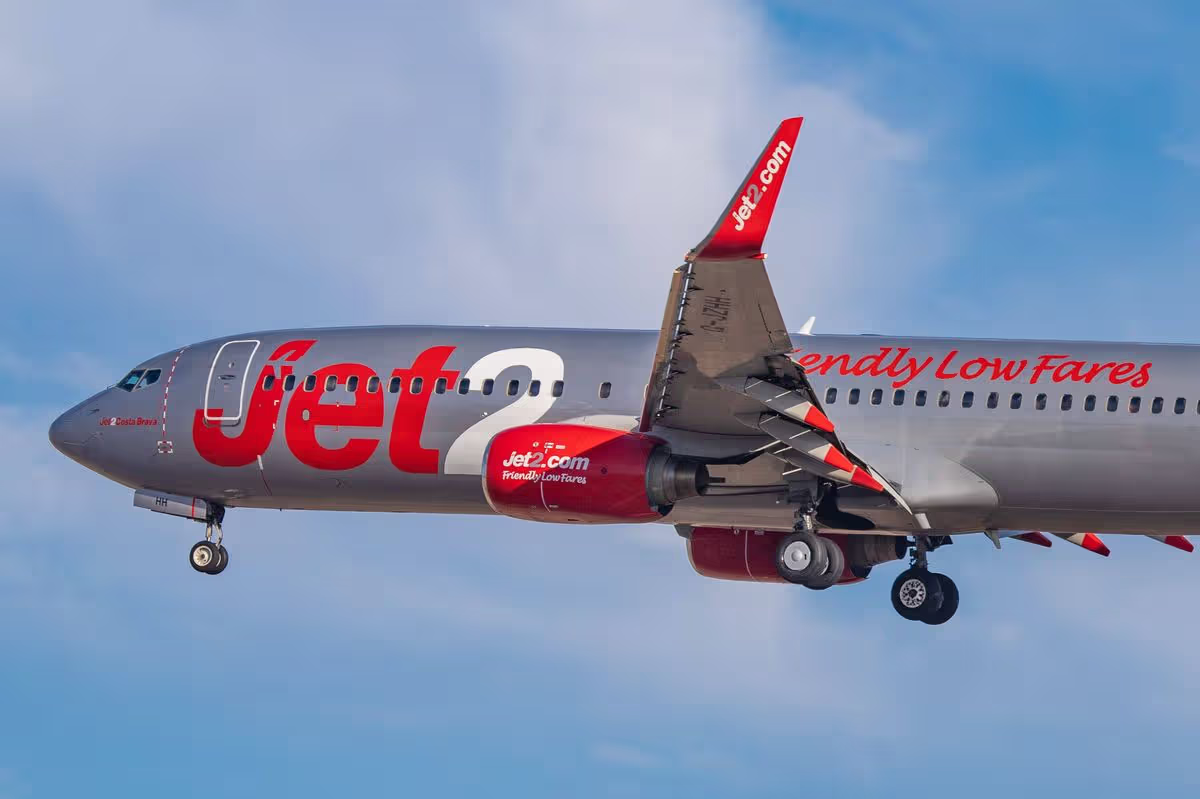
The comment from the owner of BA comes after Jet2 said it would not introduce surcharges on any booked flights or holidays to cover cost increases

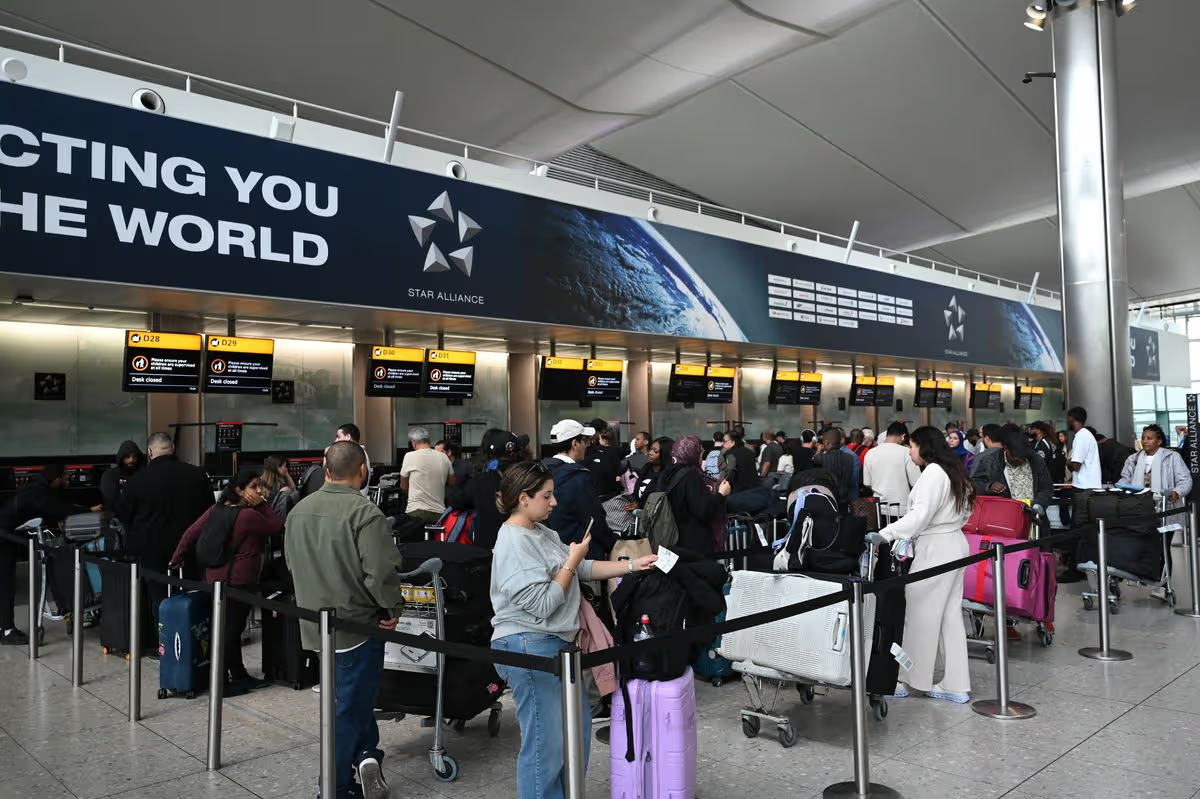
The parent company of British Airways has cautioned that airfares are set to climb as the closure of the Strait of Hormuz, triggered by the Iran conflict, has caused oil prices to surge dramatically.

International Airlines Group (IAG) announced on Friday that the ongoing Middle East crisis will push up the cost of flights to account for soaring jet fuel prices.

Airlines routinely purchase a portion of their fuel in advance at fixed rates to shield themselves from price fluctuations, a strategy commonly referred to as “hedging”.

Despite this, IAG warned that it remained “not immune” to the wider consequences of the Middle East conflict. The group insisted it had yet to experience any disruption to its jet fuel supply, amid growing concerns over potential future shortages as a result of the ongoing hostilities.

READ MORE: RAF fighter jets shoot down Russian drones over Ukraine as Putin launches attacksREAD MORE: Iran war live: Trump claims Tehran ‘making an offer’ as US team heads for talks

The government is “closely monitoring” fuel stocks as airlines brace themselves for possible shortages, with oil tankers still unable to navigate the Strait of Hormuz. It has also emerged that airports are set to make it simpler for airlines to cancel flights without jeopardising their allocated take-off and landing slots, should fuel shortages prevent them from operating. The Department for Transport (DfT) announced that airlines will no longer be obliged to adhere to the “use it or lose it” rule at UK airports, whereby carriers must utilise at least 80% of their allocated slots during a season in order to retain them for the following year. “Airport Coordination Limited, the independent body that manages slot allocation at UK airports, has updated its guidance so that airlines will not lose their slots if fuel shortages prevent them from flying,” the DfT statement confirmed.

“Airlines can now apply for an exemption from the ‘use it or lose it’ rule in these circumstances.”

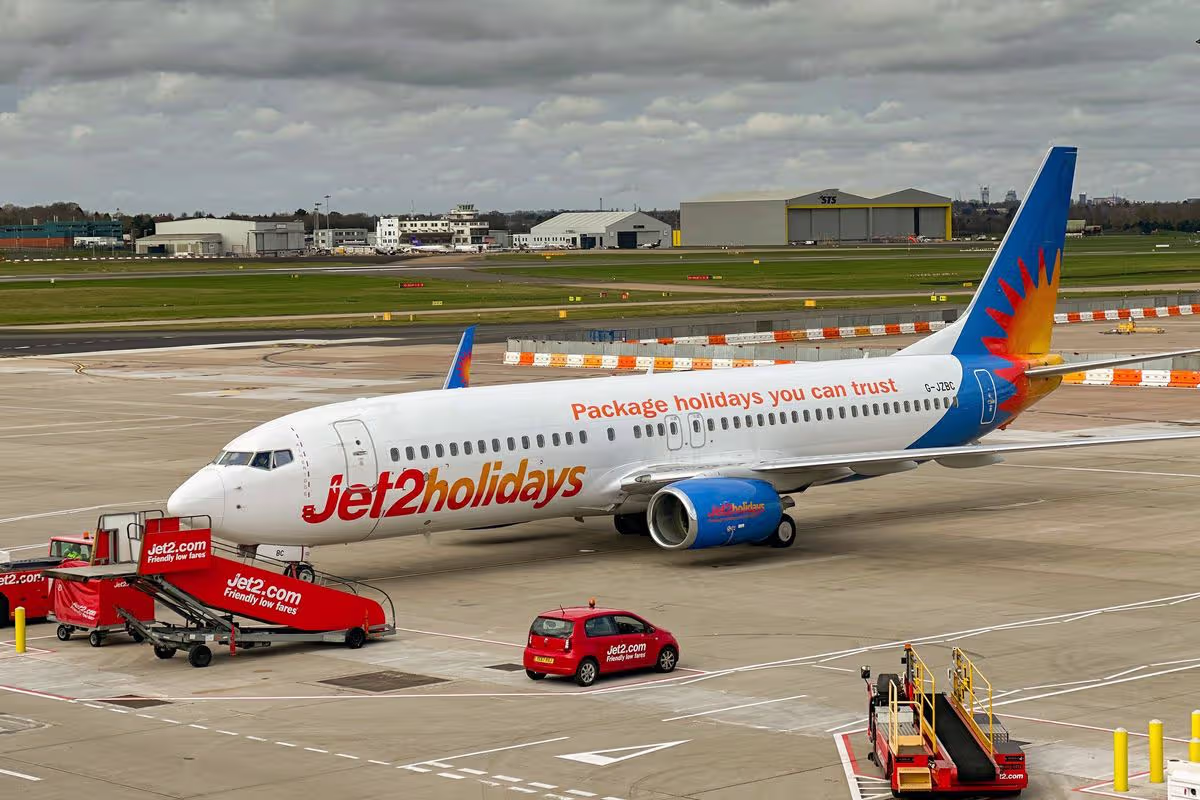
Meanwhile, Jet2 has revealed it will not be imposing surcharges on any previously booked flights or holidays to offset rising costs, reassuring customers that the price they book is the price they will pay.

The policy covers all flights and holidays booked through any channel, whether online, via the mobile app, contact centre or through an independent travel agent. Steve Heapy, CEO of Jet2 said: “Holidaymakers should have every right to book their hard-earned break in the sun, without worrying about being hit with additional costs, and they can have that complete assurance when they book a flight or holiday with Jet2. As a result of today’s announcement, customers booking with Jet2 know that they are locking in their price without additional cost surprises later and we strongly believe that is the right thing to do by them. Ahead of a busy summer this is yet more evidence of why, on top of our incredible holidays and award-winning customer service, nothing beats a Jet2holiday.”

Source link

National Trust to shut more than 130 properties across UK in blow to holidaymakers

NATIONAL Trust is set to close more than 130 holiday cottages due to falling profits.

The charity said it would cut the properties from its books – with most set to go on the rental market later this year.

Brockhampton Estate, a National Trust property, features a cottage next to a pond, surrounded by gardens with flowers and trees.
A total of 137 National Trust properties will be closed as holiday lets Credit: Alamy
Bird How, Cumbria, a stone cottage with a dark green door and white-paned windows, surrounded by green grass and stone walls, with mountains in the background.
Bird How in Cumbria is one of the holiday lets due to be closed Credit: National Trust

The conservation charity owns more than 500 holiday cottages across the UK – but it is planning on closing down 137 of them this year.

It is understood that most of the cottages will be repurposed as homes and put on the rental market later in the year, according to The Telegraph.

The Trust has not yet issued a list of which properties will be closed and when.

But it is thought the remote Bird How, located on a rough farm track in the Lake District’s Eskdale Valley, is among the many properties earmarked to shut.

LET’S GO

My fave UK town is the perfect alternative to Cornwall and has a new rainforest


STEAM AHEAD

All-night trains to major UK airport and city centre are launching next month

Elsewhere in the area, the Trust confirmed to local publication, Cumbria Crack, that it would close six holiday lets in the county.

This comes after the charity experienced a challenging financial period, after it was revealed its investment portfolio had lost millions in recent years.

Membership numbers have also plummeted – declining by 120,000 in the past two years.

Now, it has decided to cull some of its holiday let portfolio to alleviate local housing shortages and “deliver a greater financial return for the organisation”.

A National Trust spokesman confirmed 137 of their cottages would be “repurposed”.

They told The Telegraph: “We have reviewed our holiday accommodation to ensure all holiday cottages are financially sustainable.

“As a result, 137 holiday cottages will be repurposed, with most becoming long‑term rented homes that support local housing needs.”

The decision was “not easy” but was necessary to ensure the Trust could continue its “mission”, they added.

Source link

Holidaymakers urged to leave these popular items at home or risk airport delays

A skincare expert has shared which beauty products are likely to cause problems at airport security due to hand luggage liquid rules – and how to avoid any hold-ups

With summer getaways fast approaching, countless holidaymakers are gearing up to travel overseas. As skincare continues to surge in popularity, many will be packing their creams and serums – yet skincare specialists are cautioning that transporting these products can prove more complicated than anticipated.

Experts at Landys Chemist have outlined the key ways skincare items can cause issues at airport security.

Skincare specialist Rhysa Phommachanh explained: “Many travellers are now packing full skincare routines in their hand luggage, but it can be confusing knowing which products are allowed. As a general rule, if a product can be spread, rubbed, or sprayed, it will usually fall under airport liquid restrictions.”

For instance, numerous skincare products nowadays appear as jellies, balms and sticks.

All of these are classified as liquids by airport security, as are sheet masks and eye patches.

Failing to adhere to airport security regulations could result in travel disruptions or having your belongings seized.

To conserve luggage space, travellers sometimes transfer larger items into smaller containers to meet requirements.

Nevertheless, these unidentified containers can prompt queries at security and trigger manual inspections, which can prove time-consuming.

It’s also probable that any pressurised containers such as facial mists, setting sprays or spray sunscreens will require manual examination and slow down security lines.

It is crucial to familiarise yourself with the regulations at each airport you pass through, as updated liquid rules are gradually being introduced across the country.

Restrictions may vary from one airport to another, so ensure you are fully aware of the specific guidelines before you board your flight.

When it comes to skincare, a minimalist approach often yields the best results.

As reported by the Express, Rhysa said: “A more simplified approach tends to work best for long-haul travel.

“Basic essentials such as lip balm, a lightweight moisturiser, or a facial mist are usually more than enough to maintain hydration without overwhelming the skin barrier.”

Source link

EU gives UK holidaymakers flight cancellations update in new statement on April 22

‘Unfortunately, it’s very likely that many people’s holidays will be affected, either by flight cancellations or very, very expensive tickets’

The EU has issued a warning that Europe faces a “very serious crisis” as aviation fuel supplies begin to dwindle due to the conflict in Iran, and holidaymakers may need to alter their summer travel plans.

“Unfortunately, it’s very likely that many people’s holidays will be affected, either by flight cancellations or very, very expensive tickets,” Dan Jorgensen, the EU energy commissioner, told Sky News. “Even if we do everything we can do, if the jet fuel is not there, then it’s not there.”

Jorgensen added: “[Currently] it is primarily a crisis of prices and not yet a crisis of supply, but unfortunately we cannot be sure to prevent a crisis of supply, especially on jet fuel in the future, if the crisis continues.”

The International Energy Agency has cautioned that significant supply problems could emerge within the next five to six weeks.

Airlines are already implementing measures to curb demand: the Lufthansa Group, among Europe’s largest airline operators, has confirmed the scrapping of 20,000 flights over the coming months. Meanwhile, other carriers are hiking ticket prices on long-distance routes to offset rising fuel costs.

“If we had peace tomorrow and the Strait of Hormuz opens, I think we will manage without that happening, but I have to say that even in the best-case scenario, the price crisis will still last for quite some time,” Jorgensen warned.

“Gas infrastructure has been ruined to a degree that will take years to rebuild and this means for months and maybe years yet we will see much higher prices than we had before this crisis started.”

The head of Italy’s Civil Aviation Authority told Sky News that people should consider spending their summer holidays in their home countries.

“In the past petrol prices have reached and exceeded more than $100 without any significant side effects on air travel but this time, the psychological effect is having a destructive effect on passengers,” Pierluigi di Palma warned. “It is best to recommend holidays nearby, rediscovering beautiful places in our country. “For those who still want to risk taking a long trip, it’s a good idea to consider special insurance that can provide reassurance regarding a guaranteed refund in the event of a delayed or cancelled flight.”

READ MORE: Spanish airport shuts for five weeks from tomorrow – Ryanair flights cancelledREAD MORE: EasyJet, Jet2, Ryanair, TUI send stark warning about summer holidays 2026

The EU has unveiled a raft of measures aimed at curbing the impact of the energy crisis, including proposals to accelerate the rollout of renewable energy sources and incentives for households to install clean energy solutions such as heat pumps and solar panels. The bloc is also pushing member states to slash tax on electricity, in a bid to encourage more motorists to make the switch to electric vehicles.

A group representing British Airways, easyJet, Jet2, Loganair, Ryanair, TUI, UPS and Virgin Atlantic has given a stark warning to ministers about holidays this summer. According to ITV News, Airlines UK has told passengers, ‘you can forget your holidays’ according to Good Morning Host Susanna Reid.

The letter, which has gone to ministers and the Civil Aviation Authority, calls on the government and officials to change the rules to bring down passenger duty, allow more night flights, and also to scrap compensation for cancelled or delayed flights.

Presenter Susanna said: “You can forget about your summer holidays. That is the stark warning issued to some air passengers hoping to fly abroad this year. With the war in Iran doubling the price of jet fuel, airlines say they face having to increase fairs or cut flights altogether.”

Co host Ed Balls added: “UK operators are now calling on the government to bring in emergency measures. In a confidential letter seen by ITV News, they’re asking for help to protect fuel supplies, reduce taxes on tickets, and waive strict rules. on compensating passengers.”

ITV said airlines are urging the government to step in to protect business travel, holiday flights and freight operations from the economic fallout of the war in the Middle East. A confidential briefing document submitted to ministers and the aviation regulator, the Civil Aviation Authority, seen by ITV News, warns that if the disruption “continues or worsens,” airlines will be forced to cut flights and push up fares.

The document, from Airlines UK, which represents British Airways, easyJet, Jet2, Loganair, Ryanair, TUI, UPS and Virgin Atlantic, warns that jet fuel costs have doubled, with fuel accounting for around a third of airline operating costs.

Correspondent Nick Dixon said: “Airlines are now at the stage where they are monitoring their reserves of jet fuel very carefully, very closely. There’s no indication just yet of any immediate cancelled flights or fuel shortages, but the airlines clearly need a backup plan in the longer term. And they are pushing for that. Now, some of the airlines have already taken steps. Lufthansa, the European airline, has cancelled thousands of its short-haul flights in an effort to conserve jet fuel. EasyJet, Virgin Airlines, as well as others, have expressed a lot of concern about the coming weeks.

“Virgin Atlantic has cancelled one of its long-haul routes. EasyJet has said, really, beyond the next few weeks into mid-May, they’re not entirely clear on what they will do for jet. Let’s just take a look at what the airlines are asking from the government in this letter that you mentioned.”

In terms of the changes the airlines want, he said: “So firstly, they want to relieve or reduce air passenger duty to help bring down the cost of travel generally and holidays during this period. Allow for nighttime flights to keep things moving if the schedules are disrupted, and also to scrap compensation for cancelled or delayed flights caused by fuel shortages. All of that, of course, would have a huge impact. on passengers.

“What most passengers want to know is, will my holiday flight be affected? It may well be that if the airlines win concessions from the government, we start to see some tactical flight cancellations of what would otherwise be loss-making departures. Well, the Department for Transport has said that it’s continuing to work with fuel suppliers, with airlines, and international counterparts on our contingency emergency planning to ensure that people keep moving and businesses are supported while the conflict is ongoing. But it’s all quite vague really at the moment and very concerning for passenger passengers who have either spent hundreds if not thousands on flights or are looking to plan uh trips throughout the summer.”

Source link

Egypt holidaymakers look up from sunbeds and are floored by what they see

Many holidaymakers like lazing around the pool and soaking up the rays when on an Egypt break. But tourists in one resort got more than they bargained for when they were relaxing by the pool in their resort

Egypt is a top holiday destination amongst Brits, with approximately one million British nationals visiting the the country each year. The destination known for its diverse blend of ancient history, world-class marine activities and year-round winter sun. However, as well as exploring, many holidaymakers like lazing around the pool and soaking up the rays when on an Egypt break. But tourists in one resort got more than they bargained for when they were relaxing by the pool in their resort.

Paolito Entertainment, which puts on hotel and resort entertainment, shared a video of some baffled holidaymakers in Egypt being greeted by someone dressed as Monster’s Inc character Michael Wazowski.

The ‘green monster’ was seen jumping on some people’s sunbeds as they tried to ignore him.

Next to him was also someone dressed as fictional character Cheburashka.

They captioned the post: “Hotel-style entertainment done right.”

Content cannot be displayed without consent

The post racked up 178,000 likes as many admitted they would find it amusing.

One person called it ‘their dream’, while someone else added: “I wish this would happen to me.”

However, other people weren’t so keen.

“That looks terrifying,” admitted one person, while another said: “They don’t look very entertained.”

A third confessed: “Don’t want to know who is inside there.”

While someone else asked: “What the heck Cheburashka doing out there?”

As of April, 2026, the UK Foreign, Commonwealth & Development Office (FCDO) considers major tourist destinations in Egypt safe to visit, but maintains strict warnings for specific border and desert regions.

Areas advised against travel

The official FCDO advice for Egypt warns against:

North Sinai Governorate: All travel due to ongoing security operations and the risk of terrorism.

Egypt-Libya Border: All travel within 20km of the border (except for El Salloum, where only essential travel is advised).

Western Desert: All but essential travel to the area west of the Nile Valley and Nile Delta (except for major sites like Luxor, Qina, Aswan, Abu Simbel, and the Faiyum Governorate).

Northern South Sinai: All but essential travel beyond the St Catherine-Nuweibaa road, excluding coastal areas.

Ismailiyah Governorate: All but essential travel to areas east of the Suez Canal.

Safe tourist destinations

The FCDO does not currently advise against travel to the primary tourist hubs, including:

Cities: Cairo, Alexandria, Luxor, and Aswan.

Red Sea Resorts: Sharm el-Sheikh, Hurghada, and Marsa Alam.

Source link