holidaying

Simon Calder issues urgent warning to holidaying Britons this month

Travel expert Simon Calder has urged anyone with a summer holiday booked to check their passport validity before travelling to the EU

Travel expert Simon Calder has issued a stark warning to anyone planning to head abroad this June, July and August. Countless Britons are eagerly counting down the days to their summer getaways during the peak travel season.

Yet Simon has urged everybody to carry out a crucial check before setting off, in order to avoid “wrecked holidays”. He explained that “thousands upon thousands” of travellers have already been caught out and missed their long-awaited breaks.

He took part in a discussion on BBC Radio 2, where one holidaymaker revealed he had been turned away at the boarding gate before his flight.

James Luton had been due to fly to Portugal last week to celebrate his 50th birthday, but was denied boarding at the airport gate because his passport had been issued more than 10 years ago — despite not having expired.

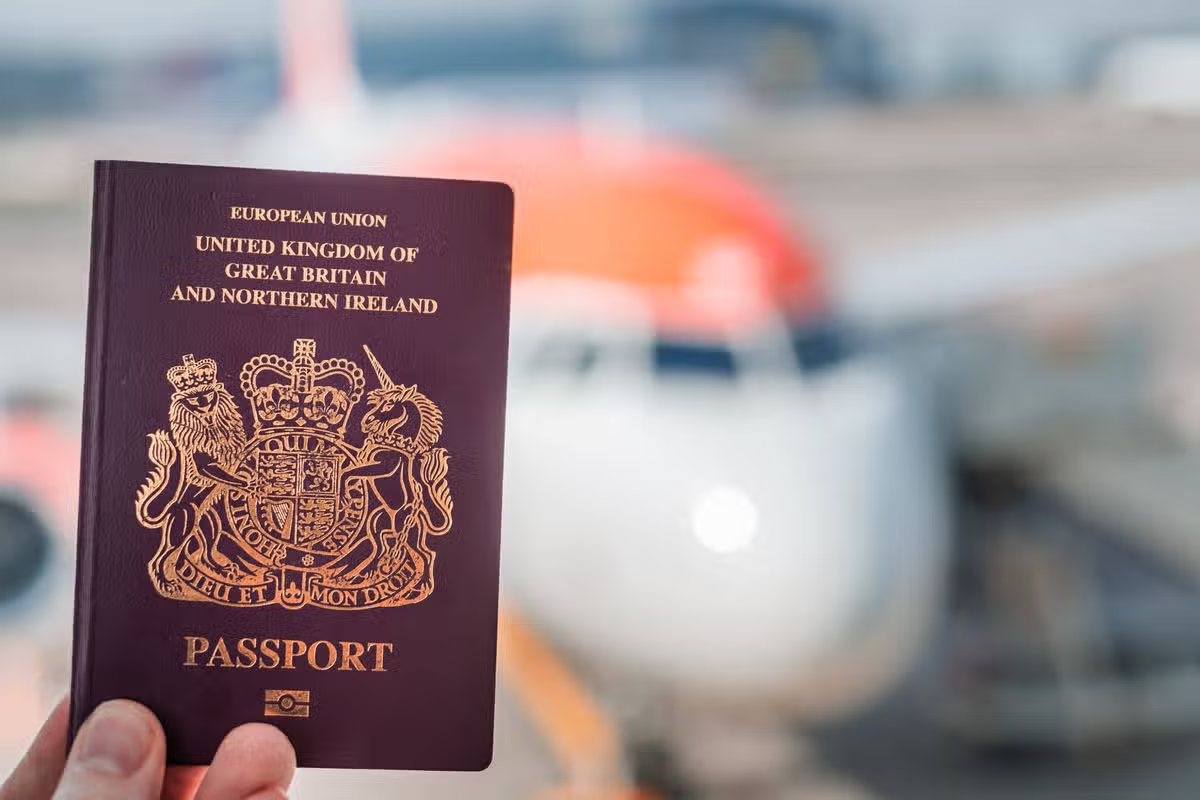
Britons travelling to EU or Schengen area destinations cannot hold passports that are older than 10 years upon arrival at their holiday destination. The passport must also remain valid for a minimum of three months beyond the date you intend to return home.

Simon appeared on the programme to implore everyone with holidays booked to check their passports before it’s too late. He said: “Unfortunately, he [James] is just one of thousands upon thousands of people who have fallen foul of this.

“As we speak, there will be people who have headed to the airport, and the same thing happened to them. It is just absolutely miserable.”

Simon urged: “You must remember, if you are going to the EU apart from Ireland, you cannot have a passport older than 10 years on the day you enter. It is the only part of the world that cares about when your passport is issued.

“Everywhere else only cares about the expiry date. Please, if you are going away in June, July and August please check that your passport is going to comply.

“Has it had its 10th birthday on the day you plan to go away, and has it got at least three months left on the date you plan to leave? That way, we can hopefully avoid too many more wrecked holidays.”

Prior to 2018, passports could stay valid for up to 10 years and nine months.

This was due to unused months from old passports being transferred to new ones, but this practice was scrapped in 2018.

The issue predominantly impacts those with burgundy passports, since anyone holding a blue passport obtained it in 2020 or afterwards.

It’s still advisable to verify children’s blue passports, as these are usually only valid for five years.

Source link

Brits holidaying this summer need this essential hack for modern travel

Happy woman taking a selfie with her phone at the beach, making a peace sign.

BRITS are jetting away in record numbers, but landing abroad to a shock mobile phone bill can instantly ruin your holiday vibe.

Thankfully, savvy travelers are dumping traditional setups for a clever digital alternative powered by Swiss tech pioneer Yesim.

A happy couple stands at a railway station, looking at a smartphone while waiting for their train.
eSIMs make staying connected while abroad easy aaaffordable

Yesim eSIM – claim exclusive 15% discount with code: GETYESIM15

Why is traditional roaming outdated?

Ever since Brexit, major UK mobile providers have reintroduced painful daily fees just to use your standard phone data in Europe.

Big networks like EE and Vodafone hit travellers with charges up to £2.75 a day, which easily scales up to nearly £100 for a family holiday in Spain.

Worse still, traditional roaming ties your phone to a single local network provider, meaning your data speeds will completely tank if that specific partner has weak signal.

You also face the terrifying risk of automatic out-of-bundle charges if you accidentally slip past your hidden data allowance while streaming or video calling.

What are travel eSIMs and how do they work?

An eSIM is a clever digital microchip already baked directly into modern iPhones, Samsung Galaxies, and Google Pixel devices.

While the physical chip is built into your phone, a travel eSIM is a dedicated service that lets you download a cheap, temporary data profile over the air.

You simply install the profile at home while having a cuppa, and the internet connection automatically kicks in the very second your flight lands abroad.

Best of all, your primary UK SIM card stays completely active in parallel, meaning you can still receive emergency calls and crucial banking verification texts on your usual number.

What is Yesim, and how does it work?

Swiss tech brand Yesim is an industry pioneer making mobile connectivity a seamless, budget-friendly digital service.

Operating for seven years with over 800 partner operators, Yesim provide unstoppable coverage across 200 world destinations.

However, two terms are often confused in the market, and understanding the difference matters.

What is an eSIM?

An eSIM is simply the hardware: a microchip built into modern smartphones that allows profiles to be downloaded remotely, but it doesn’t guarantee lower prices or reliable connections abroad.

What is a travel eSIM?

A Travel eSIM, however, is the complete service ecosystem built around that chip.

It provides an app for choosing plans, 24/7 customer support, automatic connection to the strongest network, and transparent, fixed pricing.

That service layer is what you are actually paying for.

Why choose Yesim?

Yesim delivers that exact ecosystem, offering tailored data options for every holiday style, backed by multi-lingual support with a rapid six-minute average response time.

First-time users can even test the network with a 500MB trial plan for just £0.45.

To get started, check your phone’s compatibility on their website and install the profile via the app.

  • Sun readers can score an exclusive 15% discount right now by using the promo code GETYESIM15 – claim here

Why you should consider a travel eSim for your next trip?

Unlike network providers that lock you into one signal, travel eSIMs like Yesim seamlessly switch in the background to whatever local network is strongest.

They offer total cash predictability by forcing you to look at the exact data limit, pricing, and expiry period before you spend a single penny.

Whether you need a quick 5GB chunk for a week in Turkey, or a Global Package (80+ countries) or Global Plus Package (140+ countries) for backpacking across South America, you choose a plan tailored perfectly to your trip.

For trips with unpredictable routes, the Pay & Fly plan offers a flexible pay-as-you-go model available in more than 170 countries.

You can even safely use your smartphone as a personal hotspot to share the internet with your tablet, laptop, or the rest of the family.

The Yesim app utilises switchless connection technology to automatically connect to the strongest network from over 800 partner operators globally.

The brand’s Multiple eSIMs feature allows you to manage connectivity for several devices from a single account.

The main app owner can share eSIM profiles with family members or colleagues without needing to install the app on every device.

Source link

Brits holidaying in Canary Islands given ‘truth’ about getting to airport early

British holidaymakers travelling to the Canary Islands have been warned to arrive at the airport three hours early due to severe border control delays caused by the EU’s Entry/Exit System (EES), with some travellers reporting waits of up to two and a half hours at passport control

British tourists heading to the Canary Islands are now being advised to reach the airport three hours in advance, mainly due to serious border control hold-ups caused by the EU’s Entry/Exit System (EES).

The rollout of the new biometric border infrastructure has sparked enormous queues – occasionally stretching to three hours – at popular holiday airports such as Gran Canaria Airport and Tenerife South. Airlines and travel specialists have issued these firm warnings to stop British and non-EU passengers from missing their return flights.

Under the EU’s digital border scheme, non-EU travellers (including British passport holders) must complete facial recognition scans and fingerprinting at border control.

Technical glitches and the considerable time needed to process each passenger have severely clogged passport control lanes.

The Canary Islands accommodate vast numbers of UK passengers. When several flights depart for non-Schengen destinations simultaneously, the local infrastructure becomes rapidly overwhelmed.

Spanish airport operator Aena officially requires a three-hour arrival window as standard procedure for all non-Schengen flights (which covers all flights returning to the UK).

Airlines such as Wizz Air have firmly reinforced the three-hour recommendation. Nevertheless, passengers should be mindful of a practical obstacle: many baggage drop and check-in desks at Canary Island airports do not open until precisely two hours before departure. Airlines continue to recommend arriving early to ensure you’re at the head of the queue the moment check-in desks open, enabling you to clear security and head straight to the congested passport control gates.

A travel expert based in the Canary Islands has now shared his thoughts on the 3-hour airport warning in a recent video.

Mr TravelON (real name David Gainford) is a well-known travel and media content creator on TikTok, recognised for his candid, lively vlogs and live streams centred on holidays in the Canary Islands (including Lanzarote, Tenerife, and Gran Canaria).

The influencer, who commands 192,000 followers, took to his account this week to offer his perspective on the guidance.

Gainford stressed in his clip that passengers travelling with luggage may be unable to check in three hours before departure as the desk may not yet be open. However, he suggested that many airlines are looking to address this by opening earlier.

He also pointed out that those who have booked a package holiday with TUI or Jet2 can count on these companies to ensure they reach the airport on time.

“It’s their responsibility to get you from your hotel and accommodation to the airport on time,” he said.

“So sit back, chill out, relax, and let your rep tell you what time you’re getting picked up.

“Yes, it might be an hour earlier.”

He noted that independent travellers not using a tour operator should ‘probably get to the airport three hours early’. The travel expert also warned that massive queues at airports could be likely, as travellers arriving at the airports have given conflicting accounts.

“Some are reporting two or two-and-a-half hour’s wait, it really does depend on how may flights land at that time,” he said.

The video has garnered over 180 likes as Canary Island holidaymakers hunt for information.

Numerous viewers flocked to the comments to share their own experiences, with one individual stating: “I got to Lanzarote airport 3 hours early last month and had to wait a hour for the gate to open.”

Meanwhile, another remarked: “Arrived in Lanzarote last month no issues on arrival but leaving to fly back to the UK was awful, we arrived early just in case, went to gate 6 done what we needed to once our gate number came up we headed over, that was where the issues began, you had to go through the machines again and there was only three machines.”

Yet a third responded: “We landed in Lanzarote last night and we were lucky, 10 minutes from getting off the plane to arriving at the bus stop. EES was ok, no queue and the luggage was waiting for us as we came through.”

One commenter summarised the situation by saying: “Better to be safe than sorry, it’s a nightmare at certain times.”

When contacted, a representative of the Ministry of the Interior commented: “The Entry Exit (EES) border control system has been fully operational in Spain since April 10th and is being implemented as initially planned, with positive results to date, and no significant incidents have occurred.”

The Cuerpo General Policía Canaria (CGPC) has also been contacted for comment.

The guidance emerges after renowned travel publisher Fodor’s has placed the Canary Islands — singling out Tenerife and Lanzarote in particular — on its 2026 “No List” back in November last year.

The publication cautioned responsible travellers to reconsider visiting, citing a severe housing crisis, gridlocked traffic, and water shortages brought on by overcrowding.

Source link