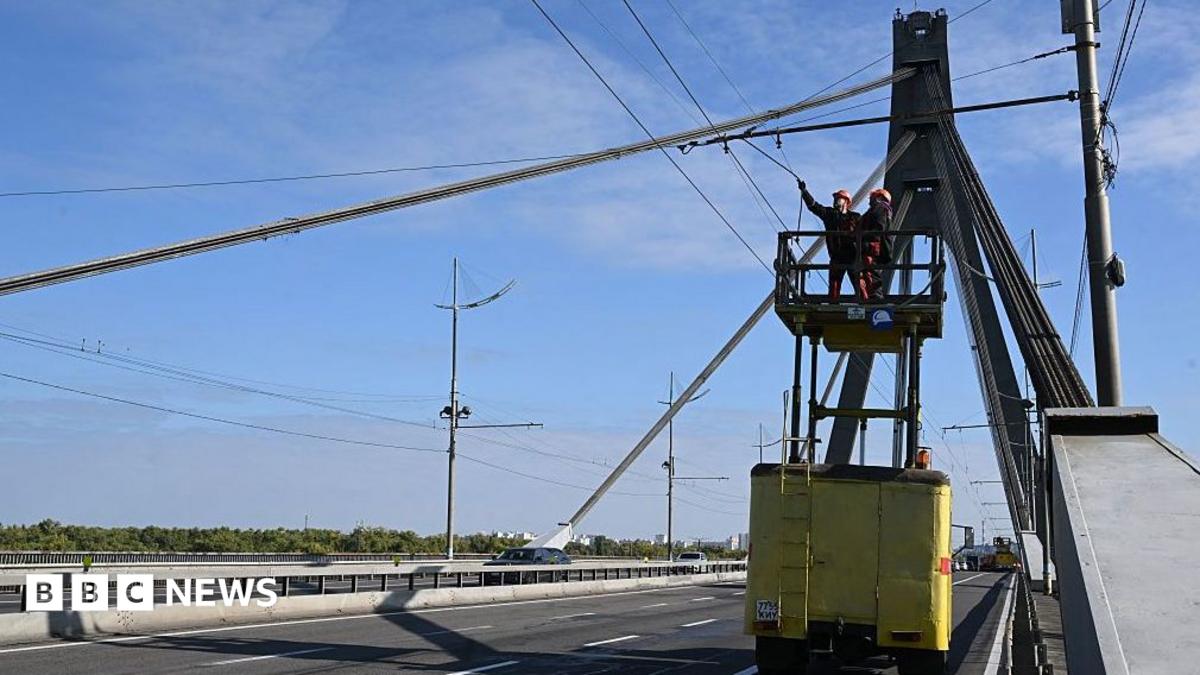
After the Pivdennyi Bridge was attacked, passengers described how dust from a blast wave entered their carriage through the ventilation system.
Ukrainian President Volodymyr Zelensky said Putin had decided that there were “no rules now” when attacking Ukraine.
In an interview with the Financial Times, he said: “The Russians have failed to occupy us. So now they are carrying out massive attacks and mass killings.”
He added: “They want to destroy our bridges… our data centres, the internet, mobile networks, hospitals, kindergartens, schools, universities – everything. They want people to flee their cities.”
Putin on Thursday insisted that Russia’s attacks on Ukrainian economic targets were a direct response to Ukraine’s strikes on Russia’s oil refineries and its ships in the Black Sea.
“Now from every direction we’re receiving calls ‘let’s stop’. But they started it,” Putin said after a wide-ranging speech at the Valdai foreign policy forum.
The Kremlin leader admitted Kyiv had “got some results” from its refinery attacks and Russia had lost about 1% of its GDP. Ukraine maintains it began attacking Russian oil infrastructure because it helps the Kremlin finance the war.
Russia has targeted Ukrainian energy infrastructure, ramping up attacks every winter since Putin launched a full-scale invasion in February 2022.
Rising goods and fuel costs are cited as key factors in the sharp drop in consumer confidence.
Published On 29 Sep 202629 Sep 2026
United States consumer confidence has fallen to its lowest level since 2014, just over one month before the congressional midterm elections.
Consumers pointed to higher costs for goods and services as the primary reason for the decline, according to The Conference Board, which released its monthly report on Tuesday.
Recommended Stories
list of 4 itemsend of list
“The Consumer Confidence Index deteriorated notably in September, following two prior months of softening,” Dana M Peterson, chief economist at The Conference Board, said in a release announcing the report.
Consumers pointed to higher prices at the pump as one of the driving factors. The average price for a gallon (3.78 litres) of petrol has jumped 37 cents over the past month, according to the American Automobile Association (AAA), which tracks daily petrol prices. The average price stood at $4.45 on Tuesday, compared with $4.08 a month ago.
“Oil and gas prices in particular rose to new heights, reflecting September’s surge in fuel costs. Comments about war/conflict eased this month but remained elevated,” Peterson said.
The consumer confidence report comes a day ahead of a key inflation report that the Federal Reserve uses to gauge the state of inflation, the personal consumption expenditures (PCE) index, which was up 3.7 percent in June from a year earlier.
The US central bank raised interest rates for the first time in three years earlier this month, driving up costs of credit cards and car and bank loans. It is set to make another decision on interest rates at its October 27-28 meeting, putting pressure on Republicans as consumer sentiment tumbles across political affiliations.
Consumer confidence fell among all political affiliations, according to the report, the second-to-last major consumer confidence reading before the midterm elections, which will determine the balance of power in Washington, DC.
US consumers think the Democratic Party would handle the economy better than their Republican counterparts, with 42 percent saying Democrats would do a better job compared with 34 percent for Republicans, according to a recent Marist poll.
US markets are only slightly lower as the trading day comes to a close. The tech-heavy Nasdaq closed down 0.08 percent, the Dow Jones Industrial Average declined 0.2 percent and the S&P 500 was down 0.1 percent.
One month on from their year anniversary, people saw Noel walk into their home to find Harvey’s belongings in a bag and a photograph of them torn up on the floor. A clip from the episode was shared on Channel 5’s Instagram, which showed Millie kicking Harvey out.
As Millie explained, she had told Harvey they were ‘through’, her husband told the cameras he had gone back to his mum’s house as she told him to leave their home.
Elsewhere in the snippet, it showed mum Sue trying to help the pair reconcile as she called in an expert in family dynamics.
The clip on Instagram was captioned: “Millie kicks Harvey out after reaching breaking point. But when Sue brings in an expert and some home truths hit hard, will Harley finally change his ways?” However, it wasn’t long before people commented on the snippet of the episode, with many issuing the same complaint.
One person said: “This whole show is more and more staged.” As another added: “Never watched something so scripted and set up. Absolutely ridiculous. What are the chances Noel was with the camera crew and the photo was placed in the middle of the floor in the most obvious ripped up pile?”
Someone else wrote: “So staged now. I liked watching it a few years ago.” While a fourth added: “Love this programme, but it’s getting more like a soap opera these days. Can tell things are set up for the cameras… saying they are moving house. Which never happened. Millie’s door was left open, and a ripped photo was on the floor. So fake.”
Although one person defended the programme, adding: “It may be more scripted and edited, but the storylines aren’t fake if that’s what you’re suggesting. Not sure why a programme affects you so much.”
As another shared: “I love this. Well done to the Radfords for actually supporting even though he’s not their kid, what a beautiful support system Millie and he have, and what a beautiful thing to do for your grandkids! Just amazing parenting and support, thank you!!”
During the episode, it showed the pair make amends as Millie and Harvey have recently welcomed their fourth baby into the world. She shared the news on social media this week, telling viewers they had a little boy called Cooper-Jax
22 Kids and Counting is available to watch on Sundays on Channel 5 at 8pm
International crude oil prices climbed further on Tuesday morning amid uncertainty over US-Iran talks, as hopes of reopening the Strait of Hormuz, a waterway crucial to oil shipments, faded.
ADVERTISEMENT
ADVERTISEMENT
Hopes that Middle East tensions would ease were dashed at the weekend when Donald Trump rejected Iran’s offer of a seven-day truce.
Mediators are working with the US and Iran on a deal to end the fighting and reopen the Strait of Hormuz, officials told the Associated Press. The disruption to shipping through the waterway has affected global trade and added to inflation.
Iran has proposed reopening the strait if the US lifts its blockade of Iranian ports and eases sanctions, among other conditions. Washington says any deal must also address Iran’s nuclear programme. Officials said the two sides disagree over the timing of concessions and who should act first.
Brent crude, the international benchmark, gained nearly 2% and traded above $107 a barrel early Tuesday, well above its price of roughly $72 a barrel in late February before the Iran war.
US West Texas Intermediate crude rose 1.8% to more than $94 a barrel.
High oil prices have renewed inflation concerns and expectations that the Federal Reserve will raise interest rates again next month. Government bond prices have fallen as a result, pushing yields to multi-year highs.
The benchmark 10-year US Treasury yield rose above 5.27% on Monday, its highest level in 19 years, following a rise of nearly half a percentage point through September. Yields rise when bond prices fall, and this month’s sell-off is the heaviest in two years.
The US two-year yield has risen even further, climbing by more than 0.57 percentage points this month to nearly 5%. In Europe, Germany’s benchmark 10-year bond yield reached 3.62%, its highest level since June 2009.
Government bond yields help set borrowing costs across the economy, from mortgages to company loans. As yields rise, governments, businesses and households face higher costs, while stocks can become less attractive to investors.
In Japan, a 40-year government bond auction drew its strongest demand since 2020 as relatively high yields attracted investors, according to Bloomberg.
Stock markets also struggled after all three main Wall Street indexes fell on Monday.
In Europe, Tuesday’s open showed a mixed reaction.
The Euro Stoxx 50 was flat in early trading while the broader pan-European Stoxx 600 traded 0.2% higher.
The UK’s FTSE 100, Italy’s FTSE MIB, Spain’s IBEX 35 and the Netherlands’ AEX all traded between 0.1% and 0.2% higher than their Monday close.
However, France’s CAC 40 and Germany’s DAX 30 both dropped about 0.5%.
Over in Asia, Japan’s Nikkei 225 lost 1.3%, South Korea’s Kospi declined 0.9% and Hong Kong’s Hang Seng dropped 0.6%. Hong Kong-traded shares of Shein fell 11.7% after the online retailer reported a 67% fall in quarterly adjusted net profit from a year earlier.
The Shanghai Composite was little changed following a report from China’s official Xinhua News Agency late Monday that its State Council had discussed ways to make economic policies more effective.
Australia’s S&P/ASX 200 was down more than 0.1% by early morning in Europe.
Australia’s central bank raised its key interest rate by 0.25 percentage points to 4.6% on Tuesday, a 15-year high, as rising oil prices fuelled inflation. The Reserve Bank said higher fuel costs were pushing up prices across the economy, while growth and inflation had been stronger than expected.
The US dollar edged up to 157.42 Japanese yen from 157.39 yen. The euro fell to $1.1362 from $1.1371.
Gold remained near $4,160 after steep losses on Monday, as expectations of further rate rises weighed on the metal, which pays no interest.
Investors are also awaiting key US inflation and jobs data this week that could influence the Fed’s next decision. Markets are pricing in another rate rise at the end of October.
Full list of outbreaks as Foreign Office-backed Travel Health Pro website revealed scores of new cases, including some deaths
12:57, 28 Sep 2026Updated 13:05, 28 Sep 2026
One in 150 people infected with WNV develop a more serious, potentially fatal illness(Image: Getty)
A ‘potentially serious’ infection outbreak has been reported in 16 European countries, sparking warnings about taking preventative measures. New figures released by the Foreign Office-backed Travel Health Pro website show that in 6 countries there have been serious numbers in the last month – including a number of deaths.
West Nile virus (WNV) is a type of flavivirus (like dengue or Zika) that can cause a potentially serious infection in humans and is spread by mosquitoes. Most people infected with WNV do not any have symptoms or experience a very mild illness and fully recover. If symptoms are present, they are usually mild; a flu-like illness with fever, headache, muscle pain and a red, bumpy rash.
However, about one in 150 people infected with WNV develop a more serious, potentially fatal illness, with a high fever, severe headache, neck stiffness, confusion, muscle weakness, trembling, convulsions and coma. Meningitis (inflammation of the protective lining surrounding the brain and spinal cord), encephalitis (brain inflammation) or acute flaccid paralysis (weak/floppy limbs) can also occur.
Latest outbreaks:
In 2026, up to 23 September, 4 locally acquired human cases of West Nile virus has been reported in Germany. Cases have been reported from Berlin, Leipzig Kreisfreie Stadt and Rhein-Pfalz-Kreis.
44 cases of West Nile virus, including 5 deaths, have been reported in the Netherlands. Cases have been reported from South Holland, Utrecht, North Holland, North Brabant, Gelderland and Overijssel provinces.
In France 117 cases of West Nile virus have been recorded in Provence-Alpes-Cote d’Azur, Occitanie, Ile-de-France, Auvergne-Rhone-Alpes, Nouvelle-Aquitaine, Pays de la Loire and Centre-Val de Loire.
North Macedonia has seen 69 locally acquired human cases of West Nile virus have been reported in North Macedonia, in 5 areas.
Up to 23 September, 2 locally acquired human cases of West Nile virus have been reported in Kosovo and 91 locally acquired human cases of West Nile virus have been reported in Romania, across 22 areas.
The European Centre for Disease Prevention and Control’s latest update shows that 86 areas affected by West Nile virus (WNV) have been identified in 16 countries across Europe. These are Italy, Greece, Romania, France, the Netherlands, Serbia, Spain, Croatia, North Macedonia, Belgium, Hungary, Austria, Germany, Kosovo, Albania and Cyprus.
Travel Health Pro said: “Some people, including older travellers, those with long term health problems and anyone with a weakened immune system (immunosuppression) are more at risk of getting seriously ill.
“There is no specific drug or treatment for WNV infection. Supportive care in a hospital is essential for people with severe WNV. While a bite from an infected mosquito is the commonest way to catch WNV, there are rare reports of non-mosquito spread, including during a blood transfusion or organ transplant.”
The only way to reduce the risk of getting infected is by avoiding mosquito bites as much as possible.
Key points to reduce insect and tick bites:
Avoid areas of stagnant or standing water, where mosquitoes are likely to breed.
Keep to footpaths and avoid long grass when walking to avoid tick bites.
Check body for ticks after outdoor activity and remove them promptly
Wear loose-fitting clothing, with long sleeves, long trousers, tucked into socks.
Clothing can be sprayed or impregnated with insecticide or purchased pre-treated to reduce biting through clothing
Use insect repellents on exposed skin
In areas with vector-borne diseases, use air conditioning where available or sleep in screened accommodation, under a mosquito net impregnated with insecticide.
Insecticide vaporisers can be used to inhibit mosquito bites and mosquito coils can be used outdoors (they are not recommended indoors).
For those staying long-term in areas with vector-borne diseases it is possible to reduce mosquito breeding sites around the home by removing any pools of water in ditches, plant pots, gutters, drains and rubbish collected in the area.
Diesel prices have hit an all-time high of 199.18p per litre, according to the motoring organisation RAC, as the war in the Middle East continues to push up the cost of fuel.
Petrol prices are also still rising, with a litre currently costing 174.13p.
Over the past seven months, the Iran war has severely disrupted the production and transportation of wholesale oil across the region, causing the price of fuels made from oil to surge.
RAC said diesel prices had entered “uncharted territory” and served as a reminder of “just how exposed the UK is to events occurring far away”.
Finley Tapp has been hit by backlash after he slammed a florist for a £20 bouquet they made him – dubbing it ‘pathetic’Credit: finley__tapp/ InstagramThe florist hit back at Finley for negatively posting about a small business, and filming in their shop without consentCredit: The Flower Boutique
But Finley was left unhappy with the bouquet he was given by the local florist he visited – admitting it was smaller than he expected.
Recording himself, the reality star told his 984K followers: “I’m not being funny, right, I’m just in the back of the car after getting some flowers.
Sign up for the Showbiz newsletter
Thank you!
“Since when does £20 get you that? I thought I was going to walk out of there with a big bouquet of flowers.
“Oh well, it’s the thought that counts… that’s pathetic.”
Finley bought the flowers for his other half to celebrate her return to work after becoming a mumCredit: instagram / finley tappThey welcomed son Austin at the beginning of the year
The comment didn’t set well with the florist, who has now responded with a statement.
Taking to their own page, The Flower Boutique in Woburn Sands wrote: “Recently we served an influencer (unbeknownst to us) with almost 1 million followers. They came into our shop and requested a £20 bouquet.
“They made no complaint in the shop when the received their flowers and took them away happily. However, they then made a video of their bouquet, deeming it ‘pathetic’.”
The florist went on to list things they think are pathetic – including filming staff without consent and bashing small businesses.
They concluded: “The moral of the story… don’t attack a small business on social media because at the heart of it is a real person. Real people. A family.
“(And also, sometimes the flowers aren’t pathetic… sometimes it’s the £20 budget)”.
Finley also received a wave of backlash in the comments of his post, with many slamming him for his comments on the flowers.
Investors shrug off AI safety concerns and Iran war, sending market to a new peak.
Published On 23 Sep 202623 Sep 2026
Wall Street’s Nasdaq stock exchange has hit an all-time high, shrugging off concerns about AI safety risks, sky-high tech valuations and the energy shock caused by the United States’ war on Iran.
The Nasdaq Composite index, which is dominated by US tech giants such as Nvidia, Apple and Microsoft, rose 0.45 percent on Tuesday, taking its gains to date this year to more than 17 percent.
Recommended Stories
list of 4 itemsend of list
The Nasdaq 100, a narrower index that tracks 100 top companies, jumped 0.82 percent.
The S&P 500, the most popular measure of the overall US stock market, closed essentially flat.
Monolithic Power Systems, a Florida-based manufacturer of power circuits, and Canadian e-commerce company Shopify led the gains, surging 8.1 percent and 7.1 percent, respectively.
Micron Technology, one of the world’s top three memory chip makers along with South Korea’s SK Hynix and Samsung Electronics, rose 5 percent.
Chip giant Nvidia, the world’s most valuable company, gained 0.7 percent, while Apple edged up 0.2 percent.
Meta Platforms, which soared 11.4 percent on Monday on excitement surrounding its new AI assistant Muse, dropped 0.63 percent.
Major Asian stock markets opened higher on Wednesday, with Japan’s benchmark Nikkei 225 and South Korea’s Kospi up about 1.4 percent and 0.1 percent, respectively, in morning trading.
Hong Kong’s Hang Seng Index opened lower, falling more than 0.7 percent during the morning trade.
Oil prices were largely flat on Tuesday, after falling more than 3 percent the previous day amid improving oil flows out of the Gulf and hopes of renewed diplomacy between Washington and Tehran.
Futures for Brent crude, the international benchmark, were trading at $99.18 a barrel as of 01:00 GMT.
US President Donald Trump on Tuesday told reporters that US officials held a “very good” meeting with their Iranian counterparts on the sidelines of the United Nations General Assembly in New York, hours after using his address to the session to warn that he could “annihilate” Iran if Tehran did not agree to a deal on the war.
Trump, whose war on Iran is nearing the seven-month mark, said US and Iranian officials would hold another round of talks in the “very near future”.
Jay Goldberg, a senior analyst at Seaport Research Partners in San Francisco, said signs of diplomatic progress between the US and Iran had refocused investor attention on the potential of AI to generate profits after years of multibillion-dollar investments.
“We have been searching for a clear consumer use case to justify the AI spend, and many see Muse as just that product,” Goldberg told Al Jazeera.
“Personally, I think Muse is just a step in the right direction; there will be better products – probably soon – but Muse is one of those things that are so useful they get investors excited about AI prospects again,” Goldberg said.
Katie Price put her marriage breakdown to one side as she celebrated her pals engagementCredit: Instagram/Lewis NichollsThe TV personality enjoyed a boozy night out in Worcester on ThursdayCredit: lewisjnicholls/ Instagram
Tonight, Katie appeared in good spirits as she joined her friends for a boozy night out.
Katie flashed a big smile alongside celebrity interviewer pal Lewis Nicholls and Mike Turner.
Sign up for the Showbiz newsletter
Thank you!
He shared a photo of the trio and wrote: “Reunited to celebrate our engagement with Katie tonight,” with a red love heart emoji.
Katie was seen beaming as she held a glass of bubbly in her hand while joining her friends at Bank House Hotel Worcester.
Katie confessed that she still loves Lee – despite everythingCredit: ITVThe telly star revealed the signs that finally made her open her eyesCredit: wesleeeandrews/instagram
“I love the man I met. I can’t take it. I was stupid to fall for him. It’s really sad.”
Katie also admitted she believes her ex loves her too, saying: “I do believe he did.
“I think he’s got himself in such a situation… where he copy and pastes what he says to women… I do believe he’s fallen for me.”
Katie then revealed the signs that finally made her open her eyes.
She said: “For example, one of the rings he bought me he said was worth £72,000. So I thought I’d better get it insured.
“So I took it into a shop and got it cleaned to get it insured. When they gave it back to me I said, ‘How nice are the diamonds?’
“They said, ‘They’re really good lab diamonds. They were grown in a lab. The ring is probably only worth about five grand’. Do you know how embarrassed I was?”
On the latest episode of her podcast The Katie Price Show, Katie held up her hand to sister Sophie, 36, and said: “I’m still wearing my ring but on the other hand because I love the ring.
“I’ve taken Lee out of [my Instagram] bio now. Enough is enough now, it gets to a point where you can tolerate so much…
“I did what I had to do. It doesn’t matter what people say about whoever I’m with. I have to do what I need to do.
“If there are things that I question, that’s for me to find out myself to make my decision. Things haven’t added up and I’m not happy about them. He is still in prison and I haven’t spoken to him.”
The ‘Old Lady of Threadneedle Street’ has chosen to wait, though not unanimously.
ADVERTISEMENT
ADVERTISEMENT
The Monetary Policy Committee voted by a majority of six to three on Thursday to leave borrowing costs unchanged, with the dissenting trio pushing for a quarter-point increase to 4%.
The decision puts the Bank of England at odds with the Federal Reserve and the European Central Bank, both of which have tightened within the past week.
Despite holding, the central bank expects the situation to worsen before it improves.
Inflation “is likely to rise further over coming quarters,” the committee said, pointing to crude and refined energy prices that have climbed again since its last meeting and remain “more volatile and higher than pre-conflict.”
Watching for second-round effects
The case for holding rests on what has not yet happened.
“There has been little evidence so far of material second-round effects in price and wage-setting,” the statement read, meaning expensive energy is not yet feeding into broader wages and prices.
However, that reprieve may be temporary.
The risk of such effects “is greater the longer higher energy prices persist or are more volatile,” the committee warned, adding that risks to the inflation outlook are “tilted to the upside, and more so than at the time of the July Monetary Policy Report.”
Brent crude and UK wholesale gas prices have risen 36% and 78% respectively since July, with Brent at $106 a barrel and gas at 207 pence per therm on 14 September.
Refinery pressures have kept crack spreads, the gap between refined fuel prices and crude, well above pre-conflict levels.
Economic activity has held up slightly better than expected, while a soft labour market and the higher borrowing costs households and businesses have faced since the conflict began should bring inflation down over time.
A crowded week for central banks
The Fed raised its benchmark on Wednesday to a range of 3.75% to 4%, its first increase since 2023 and a unanimous decision, while signalling more to come.
The ECB lifted its deposit rate to 2.5% last week.
The sequence concludes on Friday with the Bank of Japan, where markets expect a hike.
That would leave the Bank of England as the only major central bank to have stood still this week, though on Thursday’s evidence not by much.
Investors in Europe took the Federal Reserve rate hike in their stride.
ADVERTISEMENT
ADVERTISEMENT
Both the Euro Stoxx 50 and the broader pan-European Stoxx 600 traded over 0.6% higher at the start of Thursday’s session.
France’s CAC 40, Germany’s DAX 30, Italy’s FTSE MIB, Spain’s IBEX 35, the Netherlands’ AEX and Switzerland’s CH20, all traded between 0.2% and 0.7% higher than their Wednesday close.
The UK’s FTSE 100 led the pack and rose more than 1%.
Carmakers and industrials led the Paris index, with Renault gaining more than 2%, Stellantis 1.6% and Schneider Electric 1.3%. Technology went the other way, with Dassault Systèmes falling 2.4%.
The calm followed a rougher session in New York, where the Dow Jones Industrial Average closed 1.2% lower on Wednesday and the S&P 500 fell 0.4%, while the Nasdaq was broadly flat.
Asian markets were mixed overnight with Tokyo’s Nikkei 225 rising 0.2%, Seoul’s Kospi gaining 0.9%, while Hong Kong’s Hang Seng lost 0.7% and the Shanghai Composite 0.4%.
Reactions were “pretty much expected since the rate hike was also in line with market expectations”, said Lorraine Tan, director of equity research for Asia at Morningstar, adding that the Iran war is likely to keep pressure on inflation.
A stronger US dollar and higher yields
The more consequential moves were in currencies and bonds.
The US dollar climbed to its highest in seven weeks against a basket of major currencies, lifted by the jump in short-dated Treasury yields that followed the decision.
The euro was trading around $1.146, down 0.5% from Wednesday’s open.
A stronger US dollar makes European exports more competitive in American markets, but it also raises the cost of anything priced in dollars, which includes oil and gas, which compounds Europe’s energy bill at a difficult moment.
In bond markets, the two-year Treasury yield, the maturity most sensitive to rate expectations, jumped to around 4.72% from 4.67% before the decision, holding near that level on Thursday.
The 10-year sat close to 5%, reflecting both the war-driven energy shock and mounting investor concern about American government debt.
Traders now fully expect another rate hike by December and put the odds of a move as soon as October at around 50%. Goldman Sachs became one of the first major Wall Street banks to forecast consecutive hikes, reversing its previous view that this month’s move would be the only one.
Attention turns next to the Bank of England, which announces its decision later on Thursday and is expected to hold rates steady, and to the Bank of Japan on Friday, where a hike is anticipated.
CAPE TOWN, South Africa — The Trump administration has announced that it will impose travel bans on officials it claims are responsible for discrimination against whites and other minority groups in South Africa.
U.S. Secretary of State Marco Rubio said Tuesday he would revoke U.S. visas or reject visa applications from foreign nationals found to be responsible for, or complicit in, enacting or enforcing laws and policies that allow for uncompensated land seizures, race-based discrimination and the incitement of violence against minority ethnic and racial groups in South Africa.
“The United States will not allow such behavior to go unchecked,” Rubio said in a statement. “These actions directly undermine peace, economic stability, and the rule of law, and they are incompatible with the pillars of America’s foreign policy.”
The South African government has strongly rejected U.S. allegations of discrimination against whites, calling the claims made by the administration since President Trump returned to office last year baseless and a result of misinformation.
It’s the latest U.S. move to sanction South Africa
Rubio did not identify any officials who would be targeted with the travel restrictions, though a lobby group for minority whites in South Africa has previously called for the U.S. to sanction officials of the African National Congress party, the party of South African President Cyril Ramaphosa and the largest in South Africa’s Parliament.
It’s the latest move by the Trump administration to sanction South Africa over its claims that whites, and especially the Afrikaner group, are being discriminated against by their Black-led government. Afrikaners are descended from mainly Dutch and French colonial settlers who first came to South Africa in the 17th century. They were at the heart of South Africa’s previous apartheid system of racial segregation.
There are approximately 4.5 million white people in South Africa’s population of 62 million, which also includes whites with British or other heritage.
The Trump administration casts South Africa as anti-white
The U.S. has cited a contentious South African law that allows for the expropriation of unused private land without compensation in some circumstances, affirmative action policies that advance opportunities for Blacks and others, and a small number of violent crimes against white farmers as evidence of a larger anti-white stance in South Africa.
The Trump administration has also strongly criticized South Africa’s move to accuse U.S. ally Israel of genocide against Palestinians in Gaza, in a highly emotive case at the United Nations’ top court. Israel vehemently denies that allegation.
South Africa asks the U.S. to respect its sovereignty
South African Foreign Minister Ronald Lamola said Wednesday that some of the domestic policies that the U.S. had branded as discriminatory were designed to address the injustices of apartheid and hundreds of years of colonial rule before that, when Black people were stripped of their rights.
“South Africa respects that the United States may hold differing views on certain policy measures and their implementation. … The people of South Africa likewise respect the right of the American people to develop legislation that addresses their own circumstances,” Lamola said in a statement. “We expect that the same respect will be accorded to the people of South Africa, as the principle of sovereignty requires.”
The U.S. says more sanctions will follow
The U.S. has enforced a series of other sanctions against South Africa during Trump’s second term for purported anti-white and anti-American policies. They include barring South African officials from meetings of the Group of 20 economic bloc this year in the U.S., and phasing out aid for South Africa’s HIV treatment program.
The U.S. has also launched a refugee program for Afrikaners and other whites, claiming baselessly that they are victims of a humanitarian emergency in South Africa.
The U.S. says the sanctions are because South Africa has not changed its policies, and warned of more to follow.
“This visa restriction policy is only the first step in a series of escalatory measures that will show America’s firm resolve in this matter,” the official U.S. Ambassador to South Africa account posted on X, referring to Rubio’s visa announcement.
Imray writes for the Associated Press. AP writer Matthew Lee in Washington contributed to this report.
WASHINGTON: The six-month-old US war against Iran has cost $38 billion so far and that amount is projected to rise by $3 billion a month, Congress’ nonpartisan bookkeeper reported on Tuesday, as the Trump administration searches for ways to end the conflict and reopen the vital Strait of Hormuz.
The war is expected to increase inflation by 0.5 percent in the first three months of 2027, according to the Congressional Budget Office accounting, which totaled expenses through August 1.
The mounting costs have strained US munitions stockpiles and driven up energy prices, raising concerns about the country’s ability to respond to other potential conflicts and adding pressure on an already stretched federal budget.
The cost was close to the $37.5 billion that Defense Secretary Pete Hegseth reported at a Senate hearing on July 21.
The budget office said the majority of the costs stem from the rapid drawdown of munitions, estimating that it could take five years to replenish US stockpiles. Reuters reported in August that the US had used “virtually all” of its long-range precision missiles during the war.
The Department of Defense did not cooperate with congressional financial auditors, CBO reported.
Representatives from the White House and Department of Defense did not immediately respond to requests for comment.
The inquiry was conducted at the request of the top Democrat on the US House of Representatives Budget Committee, Brendan Boyle of Pennsylvania.
“Donald Trump’s disastrous war in Iran has already taken the lives of brave American servicemembers and left others wounded,” Boyle said in a statement.
“Beyond that human toll, this nonpartisan CBO report makes clear that the war has also cost American taxpayers tens of billions of dollars and counting, while continuing to drive up costs.”
Eighteen US military service members have died in the Iran war.
The report did not include costs of recent strikes on commercial vessels in the Strait of Hormuz and attacks on US military installations in the region. It also did not factor in the borrowing expenses associated with financing the war, which could add tens of billions of dollars to the total cost.
IMPACT ON US READINESS
The CBO accounting found the war could have sprawling consequences for the US defense posture and the domestic economy.
The deficit in critical munitions, including missile interceptors, risks hampering the Pentagon’s response in the event of another major conflict, such as potential hostilities involving China and Taiwan, CBO said.
At the July hearing in the Senate, Hegseth pleaded for nearly $90 billion emergency funding legislation to restock munitions supplies.
“Without these funds, we face critical shortfalls,” Hegseth said.
Energy shocks caused by attacks in the Strait of Hormuz — the narrow waterway through which roughly 20 percent of the world’s oil traveled before the war — and on energy facilities in neighboring Gulf countries have sharply increased prices for consumers and global producers.
The rising cost of the war also threatens to weigh on deteriorating US fiscal health. The nation’s total public debt surpassed $40 trillion in August.
Trump regularly contrasts the Iran war with the US invasions of Iraq and Afghanistan that followed the September 11, 2001, attacks.
The eight-year US war in Iraq, which involved more than 100,000 ground troops at its peak, cost $2 trillion, Reuters reported. The two-decade-long US conflict in Afghanistan, which also involved more than 100,000 troops at its most intense, cost $2.3 trillion, according to Brown University’s Costs of War project.
Turn on a radio between 1978 and 1987 and you were sure to hear Journey — any of the more than two dozen sumptuous yet muscular rock hits that shaped young America’s ideas about love, inspiration and wanting it the way you need it. Four decades later, the band’s music is still everywhere, including television, social media and streaming platforms like Spotify, where Journey has more monthly listeners than Bruce Springsteen, U2 or Bob Dylan. Yet Saturday night the group will bring what it’s calling its farewell tour to Crypto.com Arena — a capstone (at least if the band is to be believed) to a long career full of twists and turns.
Indeed, domination was hardly a given when guitarist Neal Schon and keyboardist Gregg Rolie — both of whom had played with Carlos Santana — formed Journey as a kind of jazzy proto-jam band in San Francisco in 1973. But with the addition a few years later of singer Steve Perry, the group found its gloriously dramatic sound and began racking up hits one after the next (though critics were rarely kind). Perry eventually quit, which took the wind out of Journey’s sails until Schon discovered an uncanny soundalike from the Philippines, Arnel Pineda, on YouTube; he’s helped the band get back into arenas and the occasional stadium even as Schon and keyboardist Jonathan Cain, who replaced Rolie in 1980, have battled each other in court over financial matters.
Got all that? To try to make sense of Journey’s path, I’ve ranked all 25 of the band’s hits that have charted on Billboard’s Hot 100, starting with the worst and ending with the best. Hold onto that feeling — it goes on and on and on and on.
25. ‘Walks Like a Lady’ (peaked at No. 32 in July 1980)
Some are born to sing the blues, as Perry once observed — just not Perry himself, who chews his way through this corny come-on like an overserved uncle at the Hard Rock Cafe. Nice showcase for Rolie’s organ work, though, on one of the last Journey singles he played on before leaving the band.
24. ‘Just the Same Way’ (peaked at No. 58 in May 1979)
Rolie and Perry tag-teaming lead vocals is not a form of democracy I’d vote for.
23. ‘After the Fall’ (peaked at No. 23 in August 1983)
Safe? Sterile? Soulless? Look, the haters can’t always be wrong.
22. ‘Too Late’ (peaked at No. 70 in January 1980)
“Before your time has run astray / You’ve got to try to get away.”
21. ‘Anytime’ (peaked at No. 83 in July 1978)
After overseeing Queen’s first few albums, producer Roy Thomas Baker turned his attention to Journey (and to the Cars); this midtempo number from the “Infinity” LP offers a credible approximation of Queen’s trademark stacked vocal harmonies.
20. ‘The Party’s Over (Hopelessly in Love)’ (peaked at No. 34 in April 1981)
Three platinum plaques in less than two years — for “Infinity,” “Evolution” and “Departure” — meant that Journey had no choice but to drop a live record, “Captured,” at the top of 1981. (It went platinum by Christmas.) As extra consumer bait, the double album closed with this new studio cut built around a killer Schon lick (and not much else).
19. ‘Good Morning Girl’/‘Stay Awhile’ (peaked at No. 55 in September 1980)
Phantom of the roller rink.
18. ‘Why Can’t This Night Go On Forever’ (peaked at No. 60 in May 1987)
Propelled by the success of his debut solo album — not to mention his appearance on the smash all-star “We Are the World” — Perry assumed greater control of Journey’s sound for 1986’s synthed-up “Raised on Radio,” which spawned no fewer than five singles, ending with this slightly lugubrious ballad. Yet the takeover came with a cost: By the end of 1987, the band had entered a hiatus that would last nearly a decade.
17. ‘Still They Ride’ (peaked at No. 19 in July 1982)
Listen to how nimbly Perry maneuvers some very tricky intervals.
16. ‘When You Love a Woman’ (peaked at No. 12 in December 1996)
Journey reunited for 1996’s “Trial by Fire,” which brought the band its only Grammy nomination (and which might feature the ghastliest album cover in music history). If the members knew that rock had changed dramatically while they were away, they didn’t show it in the LP’s romantic lead single: “When You Love a Woman” — a chart-topper for three weeks on Billboard’s adult contemporary tally — clearly sought to pick up where “Open Arms” and “Faithfully” had left off.
15. ‘Girl Can’t Help It’ (peaked at No. 17 in November 1986)
Wonder what Perry and Huey Lewis talked about between takes on “We Are the World.”
14. ‘Be Good to Yourself’ (peaked at No. 9 in May 1986)
“Karate Kid”-core.
13. ‘Only the Young’ (peaked at No. 9 in March 1985)
More “Karate Kid”-core, in this case released first as a song by Patty Smyth’s band Scandal; Journey’s version later wound up alongside Madonna’s “Crazy for You” on the soundtrack to “Vision Quest.”
12. ‘Wheel in the Sky’ (peaked at No. 57 in May 1978)
Before Perry came aboard in 1977, Journey spent a few months with Robert Fleischman as lead singer — long enough for Fleischman to co-write the group’s first Hot 100 entry, not so long that he got to sing it on the record.
11. ‘Any Way You Want It’ (peaked at No. 23 in April 1980)
Ooh, baby, hold tight.
10. ‘Suzanne’ (peaked at No. 17 in August 1986)
Easily Perry’s most unhinged vocal performance.
9. ‘Send Her My Love’ (peaked at No. 23 in November 1983)
A luscious and melancholy white-soul song that I’d bet Phil Collins admired back in the day — and that Justin Bieber would probably flip for now.
8. ‘Lovin’, Touchin’, Squeezin’’ (peaked at No. 16 in October 1979)
Inducting Journey into the Rock & Roll Hall of Fame in 2017, Train’s Pat Monahan belted the na-na-na outro of the band’s first Top 40 hit as he made his case for the group’s excellence. “They didn’t even need lyrics — that’s how badass this band is,” he pointed out. Still, let’s not gloss over the appealing perversity of starting a song this horny the way Perry does: “You make me weep and want to die.”
7. ‘Lights’ (peaked at No. 68 in September 1978)
Dodgers fans can delight in the fact that Perry originally wrote this paean to San Francisco — an anthem taken up at one time or another by every Bay Area pro sports team, including the Giants — about the lights going down and the sun shining on … Los Angeles. (Swap out “the bay” for “L.A.”) Maybe that’s why “Lights” has always felt to me like a precursor to the Red Hot Chili Peppers’ “Under the Bridge.”
6. ‘Separate Ways (Worlds Apart)’ (peaked at No. 8 in March 1983)
[Listens to “Eye of the Tiger” once.]
5. ‘I’ll Be Alright Without You’ (peaked at No. 14 in February 1987)
Shout out to future “American Idol” judge Randy Jackson, who joined Journey for “Raised on Radio” and proceeded to lay down the slinkiest, sultriest, funkiest bass line the band had ever known.
4. ‘Don’t Stop Believin’’ (peaked at No. 9 in December 1981)
Believin’ in what, exactly? The genius of Journey’s most-streamed track on Spotify (with more than 2.9 billion plays) is its use of concrete images to advance a pretty mysterious narrative. We’ve all stood under a streetlight; we all know the smell of wine and cheap perfume. Yet everybody’s midnight train is going to a different anywhere.
3. ‘Open Arms’ (peaked at No. 2 in February 1982)
Famously — and fortuitously — rejected by a former bandmate of Cain’s as “sentimental rubbish,” “Open Arms” was perhaps just waiting to be embraced by Perry, who sings it with the wounded gusto of a man well acquainted with regret. In a poetic twist, Journey’s highest-charting hit was blocked from No. 1 by the J. Geils Band’s “Centerfold,” in which the heartbroken narrator goes laughing all the way to his bed.
2. ‘Who’s Crying Now’ (peaked at No. 4 in October 1981)
The first of three Top 10 singles from 1981’s 10-times-platinum “Escape,” this immaculate R&B jam imagines an alternate dimension where Perry and Cain hear Earth, Wind & Fire’s “After the Love Has Gone” and decide to form a new group with David Foster. Except Perry remembers the song as a high point for Schon: “You know the guitar outro from ‘Who’s Crying Now’?” he asked a New York Times reporter in 2003. “I fought for that because I knew no DJ would cut that song off with Neal’s guitar wailing at the end of it. It was too brilliant.”
1. ‘Faithfully’ (peaked at No. 12 in June 1983)
It wasn’t the first rock ballad about life on the road — and it definitely wasn’t the last — but “Faithfully” might be the most emotionally generous: “Loving a music man ain’t always what it’s supposed to be,” Perry tells his lady, grounding the song in the experience of those who leave and those left behind; later, he envisions their reunion with such tenderness — “I’ll get the joy of rediscovering you” — that you know he’s already decided to take off again.
Olivia Attwood has hit back after being accused of lying about her booze brandCredit: InstagramThe savvy businesswoman launched her canned cocktails this summerCredit: olivia_attwood / instagram
However, there had been some criticism of her involvement, after Olivia called the company her “baby”.
But not taking this lying down, the successful businesswoman has now hit back and set the record straight.
Sign up for the Showbiz newsletter
Thank you!
“My brand, Savano, my baby. It was acquired by my partners, it existed as Tom Savano, and then with me, we relaunched it,” Olivia told her fans in her latest Instagram video.
“We remarketed it, we renamed it, we repackaged it, and we developed signature flavours. For example, my Moscow Mule. Guys, do you even understand how many Moscow Mules I had to drink to get that right? And it’s perfect.”
Olivia revealed how she is a majority stakeholder in the booze brandCredit: Instagram/SavanoIt comes after Olivia and her boyfriend Pete were a huge success at the NTAs this weekCredit: Getty Images for The NTA’s
The new couple went down a storm when they presented an award at the glitzy bash, marking their first live TV appearance together.
CORON, Philippines: The bodies of passengers killed in a ferry fire off the Philippines arrived at a port near the resort town of Coron, Palawan on Saturday morning, as the country’s coast guard warned the death toll of 35 would grow.
AFP watched tents being set up to accept 30 bodies brought from the M/V June Aster, which ran aground near the tourist hotspot after a fire erupted Wednesday evening and tore through the vessel “in seconds”.
Coast guard spokeswoman Noemie Cayabyab told a Saturday press conference the remains would be turned over to police forensic investigators for “proper disposition and identification” before allowing local authorities to inform family members.
“Currently, we are focused on the retrieval, and after that we will proceed with the investigation,” she said, confirming the bodies had been found in the ship’s economy accommodation area.
Police investigators were seen arriving at the port shortly after the press conference ended.
Asked how many bodies remained aboard the ship, she said authorities would provide an update later in the day.
Cayabyab told AFP on Friday evening that the first transfer had been capped at 30 bodies due to the capacity of the patrol vessel transporting them and that additional cadavers remained on the ferry.
Five others had been confirmed dead in the immediate wake of the fire.
Photos released by the coast guard showed rows of body bags being placed into a small ship alongside men in hazmat suits.
Thirty passengers and 13 crew have so far been rescued, while 54 people remain unaccounted for.
On Friday, Cayabyab had told a radio station the fire had begun in the cargo hold, then tore through the ship within seconds.
“From the time that they heard the loud explosion, the appearance of smoke, and then fire. It spread very quickly,” she said of survivors’ accounts.
“Everything happened in seconds,” she said, adding that those who made it off the ship had not even had time to put on life jackets.
‘Lost hope’
Myra Cabilan told AFP she had flown to Coron to find her missing brother, 40-year-old Rammel Gonzaga, who had taken the ferry from Manila on a business trip with his brother-in-law.
“His wife had just given birth a month ago. He was so happy he was given a daughter,” Cabilan said, fighting back tears.
“At dawn, I still believed he survived. But he’s still missing. I have lost hope.”
Hundreds of people desperate for news about the incident have taken to leaving comments on the Facebook page of a local mayor, searching for relatives, friends and even a dog.
The ferry’s manifest listed 134 crew and passengers, but two had not boarded, according to the coast guard. The ferry was also carrying goods, an electric vehicle, a pickup truck, and motorcycles.
The archipelago nation of 116 million has a long history of disasters involving the inter-island ferries that ply its seas.
Many rely on cheap and poorly regulated boats and ships for transport between the country’s more than 7,000 islands, despite regular accidents.
In January, a triple-decker ferry carrying more than 340 people sank off the southern Philippines, killing at least 52 people.
The M/V Trisha Kerstin 3 sank along nearly the same route where 31 people died in 2023 after a fire broke out aboard the Lady Mary Joy 3 ferry.
On Thursday, the company that owns the M/V June Aster, Atienza Interisland Ferries Inc, said it was fully cooperating with the investigation.
THIS is the scary moment a Ryanair plane’s wingtip hit the ground as it came into land at Dublin Airport.
A passenger filmed the moment the plane lurched to the right and suffered a “minor wingtip impact” during a rough landing yesterday morning.
The jet’s wingtip came ever so close to scraping along the groundCredit: Social Media CollectThe plane performed a go-around after the aborted landing (stock image)Credit: Alamy
The Boeing 737 Max, which took off from Bologna just after 8am came in to land at Dublin at 10.45am.
As it touched down on the runway, the plane tumbled onto its right-hand side.
Sign up for the Travel newsletter
Thank you!
Shocked passengers watched as the wing tips of the plane brushed against the runway.
Recognising the danger of the dodgy landing, the Ryanair pilots immediately brought the engines up to full power to perform a go-around.
This is where a plane aborts its landing attempt and flies in a loop around the airport to try again.
The two pilots were able to guide the plane safely onto the ground about 15 minutes later.
In a statement, Ryanair described the incident as a “minor wingtip impact”.
A spokesperson told us yesterday: “On landing in Dublin this evening (10 Sept) Ryanair flight FR9457 from Bologna suffered a minor wing tip impact.
“The aircraft landed safely and all passengers offloaded normally.
“Our engineers are now repairing this wing tip and the aircraft is expected back into service tomorrow morning (11 Sept).”
It comes as Ryanair boss Michael O’Leary came under fire for “shameful” comments he made describing other airlines as “high-fare rapists”.
TheRyanairchief landed himself in hot water ahead of his budget airline’s annual general meeting inDublin yesterday.
The billionaire businessman, 65, claimed rising air travel prices at other airlines would see passengers switch to Ryanair, before doubling down on his claims.
In response, Labour’s Laura Harmon urged the notorious motormouth to engage with organisations like the Rape Crisis Centre, and to apologise for his “shocking” language.
The senator fumed: “Michael O’Leary must apologise for the comments he made in advance of Ryanair’s annual general meeting in Dublin.
“The casual use of the word ‘rapist’ to describe the prices of his competitors is deeply shocking and could be traumatising for any survivor of sexual abuse.
“We should have a zero-tolerance approach to sexual violence. In recent years, due to the tireless work of activists and the bravery of survivors of sexual violence who have shared their stories, Ireland has taken a strong stance in support of survivors.
“It is shameful to see O’Leary diminish the real experience of these survivors in such a way.”
Harmon continued: “Every week brings shocking new statistics and stories about the levels of domestic and sexual violence against women in our country.
“Reports conducted by organisations like the National Women’s Council of Ireland often detail the systemic challenges victims of domestic violence are faced with when they look for help – through the courts and the legal system, and through first responders like the Gardai.
“Having O’Leary make such ignorant comments only adds to this. I would urge him to come out and apologise today, and commit to informing himself about the real trauma of sexual violence.”
Fianna Fail’s Lorraine Clifford-Lee also condemned O’Leary’s comments as “a new low” for the Ryanair CEO.
THE Netherlands has ground to a halt today due to a staff strike – and it is affecting public transport across the country.
It has also impacted Eurostar routes with all trains to two popular cities completely cancelled today.
A nationwide walkout of public transport will affect Eurostar todayCredit: Getty Eurostar has had to cancel around 25 trains today to Amsterdam and RotterdamCredit: Getty
The strike is being held by the country’s largest trade union for staff who operate public transport – the walkouts started at 2am and will end at 2am tomorrow.
As a result, Eurostar has been forced to cancel its routes to Amsterdam and Rotterdam – of which there are usually around 25.
Sign up for the Travel newsletter
Thank you!
Around 25 direct and indirect routes usually go to Amsterdam and Rotterdam from St Pancras, but none are running today.
“No national or international trains will be able to run on the Dutch network on that day. There will also be some disruption on the evening of Tuesday 08 September and the morning of Thursday 10 September.
“If you’re due to travel with Eurostar, you can check whether your journey is affected by the strike on our live train info page. We’ve also contacted all affected passengers whose contact details we have. If you have a connecting journey, please get in touch with the relevant train company for more information.
“We know how important your travel plans are and we’re sorry for the disruption this strike will cause.
“If your Eurostar train can no longer serve your departure and/or arrival station, you can choose one of the following options:
• Exchange your booking for free to travel in the same travel class at a different time or date. It only takes a minute to rearrange your trip.
Eurostar is offering affected customers different options to travel later on or get a refundCredit: Getty
• Cancel your booking and get a refund. You’ll receive a refund for the value of your ticket but not for any booking or exchange fees. We’ll process your request within 28 days.
“You have three months from the date you were due to travel to claim your preferred option.
“Thank you for your patience and understanding. We apologise again for the disruption to your journey.”
Due to the early hours of the strike ending, services on Thursday morning could be affected too with several Eurostar journeys in showing as ‘Not available’.
In Amsterdam, metros, trams, buses and ferry services have been suspended.
In Rotterdam, the metros, trams, buses are suspended as well, and in The Hague, trams and buses are not running.
A Eurostar spokesperson told Sun Travel: “Following the national public transport strike on Wednesday 9 September 2026 from 2AM until the 10th of September at 2AM in the Netherlands, no Eurostar trains will be able to run on the Dutch network on Wednesday.
“Affected passengers have been notified and can obtain a reimbursement or change their tickets free of charge. We apologise for the inconvenience.
“Trains on the other Eurostar routes are running normally.”
Folk singer Ray LaMontange was treated for heat-related dehydration after collapsing onstage during a weekend performance amid triple-digit heat in Nashville.
On Saturday, the 53-year-old toppled to the side while performing his popular track “Jolene” in front of a sold-out,crowd at Ryman Auditorium, according to recorded fan footage.
There were reports that LaMontagne had lost his place earlier in his set when performing “Hannah,” per Consequence. According to the National Weather Service, temperatures in the Nashville area reached a high of 101 degrees.
Later that night, LaMontagne’s management released a statement through his Instagram stories, sharing that the Grammy winner was in “good hands with local EMS” and that he was being treated for “heat-related dehydration.”
LaMontagne returned to the stage the following night, performing at the Louisville Palace in Kentucky, where he made no mention of the incident.
Last month, the Americana singer — best known for tracks “You Are the Best Thing” and “Hold You in My Arms” — had kicked off his 20th anniversary tour.
The tour is named after his 2004 debut album, “Trouble,” which is platinum certified in both the United States and United Kingdom; though the album reached only No. 164 on the Billboard 200 chart, it hit No. 5 on the U.K. Albums chart.
Known for his gruff vocals, LaMontagne first came to the scene in the early aughts as a timid troubadour. The New Hampshire-born, Utah-raised artist was once a former shoe factory worker from Maine whose singer-songwriter journey began when he woke up one morning to Stephen Stills’ “Treetop Flyer” on his clock radio.
All nine of LaMontagne’s albums — with the exception of his independently released 2024 LP, “Long Way Home” — have charted in the Billboard 200.
LaMontagne will continue on with his Trouble tour — which features special guest the Weather Station — through Oct. 3, closing out at New York City’s Beacon Theatre.
European CFOs must adjust as the region’s biggest pension buyer of long-dated debt cuts back.
This article appears in the September 2026 issue of Global Finance Magazine.
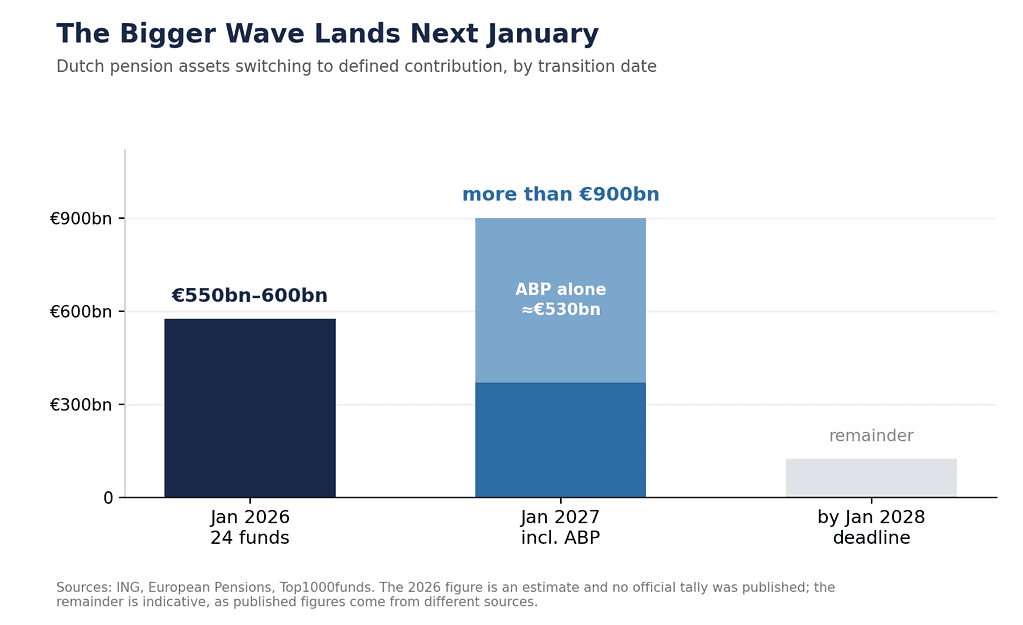
The Netherlands pension system is beginning to reduce one of Europe’s most reliable sources of demand for long-dated debt as a broad regulatory shift changes how Dutch pension funds manage their assets and liabilities. ING Groep NV estimates that nearly €600 billion ($699 billion) of assets have already been affected by the change, with more than €900 billion expected to follow early next year.
Under the old defined-benefit pension system, Dutch funds were required to hedge the interest-rate sensitivity of long-term pension liabilities by using long-dated bonds and swaps to match assets with payments extending decades into the future. Under the new defined-contribution model, which became law in 2023, that liability matching requirement has been significantly reduced, allowing funds to carry less duration and scale back their long-term hedges, resulting in less structural demand for the longest-dated debt and swaps.
For European CFOs, this could mean a higher premium for 20-, 30- and 50-year borrowing as companies and governments compete for a smaller pool of long-duration investors.
The change “should reduce structural demand for long-end duration assets and support curve steepeners over the long-term horizon,” wrote Sara Adjir, senior vice president and portfolio manager, and Jeroen van Bezooijen, account manager, at Pacific Investment Management Co., in a research note. They expect the impact will be mostly concentrated in 50-year swaps, but will also be felt in the demand for 20- and 30-year euro swaps and government bonds, including German and Dutch debt.
Deadlines
The Netherlands runs Europe’s largest pension system, with roughly €1.6 trillion in assets, and every fund must complete the switch by January 2028. Dutch pensions have long dominated the market for European long-dated debt, holding around €88 billion of interest-rate swaps maturing beyond 25 years at the end of last year, roughly a quarter of the total.
The first major wave of the transition came on Jan. 1, when 24 funds converted, among them the healthcare scheme PFZW and the metals scheme PMT, with an estimated €550 billion to €600 billion of pension assets between them. Analysis by the Netherlands central bank shows that Dutch pensions bought almost €34 billion net of swaps maturing inside 25 years while selling more than €12 billion of longer-dated ones.
The bigger test, however, comes when more than €900 billion of pension assets is scheduled to convert on Jan. 1, with the Dutch civil service scheme ABP accounting for about €530 billion of that.
The shift does not mean long-dated Dutch debt is suddenly becoming illiquid or even hard to sell: “Overall, we still see strong demand for our 30-year bond. Remember, we are AAA,” said Saskia van Dun, director of the Dutch State Treasury Agency.
Sovereign Issuers Adjust
Data indicates that sovereign borrowers are already adjusting to the change.
The share of Netherlands government bonds sold at maturities beyond 10 years fell from 42% at the start of 2025 to 31% by the third quarter, according to the Organization for Economic Co-operation and Development (OECD), which calls the constraint on long tenors structural. The OECD expects eurozone debt agencies to sell a record €1.35 trillion of medium- and long-term bonds this year into that thinner pool of demand.
For European finance chiefs, however, times are changing. For two decades, long-dated bond demand was unusually deep and predictable. As it recedes, the shifting cost of locking in 20 or 30 years of funding could become a live question.
Thomas Monteiro is a contributing writer based in Spain.
HANFORD, Calif. — Darian Orduno bounced her baby boy on her chest, looking down at his thick black hair and bright eyes. What might pollution from a data center do, she wondered, to his growing lungs?
That question had brought Orduno, 25, to a community meeting opposing a possible data center here, and her fears, she said, likely would influence her vote in the midterm election too.
“I just had him, and now it’s concerning if he’s going to be able to grow up here,” Orduno said, or “if I’m going to have to relocate.”
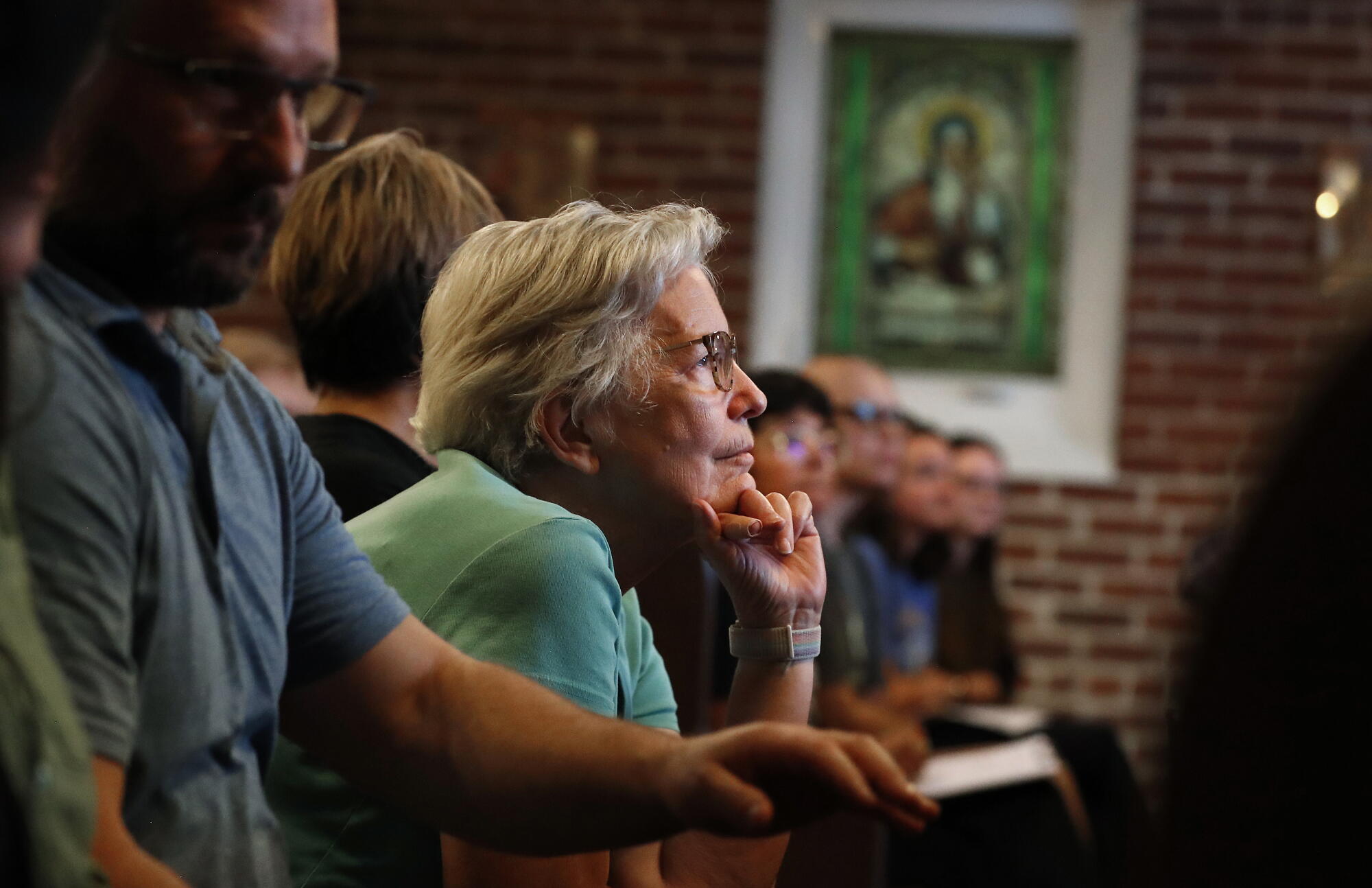
As about 100 residents filed into a church for the meeting in late August, under a Central Valley sky hazy with air pollution, many shared the same worries — that a facility pitched for the local fairgrounds could further worsen the area’s air quality and strain its water supply.
Barbara Castle listens to speakers during a town hall meeting on a possible small-scale data center in Hanford.
Nationwide, such concerns are fueling a backlash to data centers from both the left and the right as tech companies flood the country with thousands of proposals for the facilities in nearly every state from California to Maine.
Data centers have become an unusually bipartisan flash point in the midterm elections, as candidates race to delineate policy platforms and respond to public opinion. The issue stands to influence swing voters and motivate turnout at the polls.
Here in the 22nd District, home to the state’s most competitive congressional race, how significantly the issue will affect voters’ decisions remains to be seen. But one thing is clear: Anxiety about data centers is mounting.
“It’s a national concern, it’s now a state concern, and now it’s bled into the local concern,” Hanford Mayor Mark Kairis said. “It’s a very emotionally charged issue right now.”
Residents in Hanford who oppose data centers say they are worried about the region’s air and water quality, concerns echoed by rural communities across the country.
Demand for data centers, which house the computer systems powering artificial intelligence and the internet, has surged as AI use has ballooned. As of April, more than 1,500 new data centers were in development across the United States, according to a Pew Research Center analysis, largely in rural areas.
The centers require intense cooling, which often demands high water and power use and creates the potential to affect the environment and to pass on utility costs to consumers. But they power technology that is becoming increasingly integrated into American business. They also create jobs, though with limitations.
Democrats see the data center uproar as fitting into their affordability messaging, and candidates generally agree data centers should be regulated, though their positions vary on how aggressively. For Republicans, whose party has backed AI innovation, responding to worsening public opinion has been trickier — particularly given President Trump’s championing of AI and data centers.
Vice President JD Vance on Thursday acknowledged negative polling on data centers but framed the issue as a question of American industrial dominance, saying the country can’t shy away from development. Earlier in the week, Trump asserted that the only reason communities should reject data centers is if they want to be “backwards and poor.”
The public may see data centers as a physical manifestation of AI advancement in general, said Camille Crittenden, executive director of the Center for Information Technology Research in the Interest of Society, a University of California research center. Opposing data centers offers people a way to vent their broader concerns about the technology’s increasing dominance.
Priest Luke Martinez expresses concerns during the community meeting .
“This is a very specific focal point for a general anxiety about AI,” she said. “People see these data centers, and they’re thinking, ‘AI’s going to take my job.’”
The backlash from residents in the Central Valley to the possibility of even a small-scale data center demonstrates how acutely the issue has put many Americans on edge.
“It really is terrifying,” said Lucy Gomez, 57, of Hanford, a retired teacher. “I feel like we’re being guinea pigs when we don’t want to be.”
Increasing influence
Community anger about the facilities has prompted close attention from California lawmakers, who passed legislation in Sacramento on Monday to regulate energy use by the data center industry and impose other requirements.
California is home to the third-most data centers of any state, though it has experienced a relatively smaller new boom because of its high electrical prices and other factors. Still, 54 new facilities were in the works for the state as of April, according to Pew.
Hanford Councilwoman Kimber Regan speaks with Mayor Mark Kairis during the meeting. Hanford’s zoning ordinances do not allow data centers, but the city does not have jurisdiction over the county fairgrounds site where Global Stack is evaluating its proposal.
In Georgia and Pennsylvania, New York and Texas, Nevada and Virginia, the issue has become hot-button in elections at all levels. Ads about data centers run on the airwaves in states with key congressional races. Gubernatorial candidates jockey over it; both New York Gov. Kathy Hochul, a Democrat, and Texas Gov. Greg Abbott, a Republican, put temporary moratoriums on new data centers.
A memo from the Republican senatorial campaign arm underscored how critical the question was becoming last month, when it warned AI companies that data centers could be the deciding issue in the close race between Ohio GOP Sen. Jon Husted and former Sen. Sherrod Brown, his Democratic challenger.
Data centers “are the anchor hanging around Husted’s neck,” said the memo, which was firstobtained by Axios. “If he loses and data centers get the blame, politicians across the country will take notice — and they will not go near the next one.”
Sixty-one percent of Americans would oppose a data center being built where they live, a late August poll by the Economist and YouGov found.
Though Democrats and independents were more likely to oppose the centers, 47% of Republicans also said they would oppose it, and 52% of people who voted for Trump in 2024 said they believed construction of a new data center would increase their electrical bills.
Data centers encapsulate existing concerns among red and blue voters across the nation and in California about their quality of life and the influence of major tech companies, said Sonoma State University political science professor David McCuan.
“California has a lot of communities that have been struggling and trying to find a way forward, and the data center debate captures those voters’ frustrations,” McCuan said.
Political winds
The historic Bastille, which served as Kings County’s jail and sheriff’s office from 1897 until 1964, stands tall next to the courthouse in Hanford’s Civic Center Park.
The idea for a center on the Kings County fairgrounds is part of a broader pitch by developer Global Stack USA to boost the state’s emergency infrastructure by installing small-scale data centers, helipads and parking garages at fairgrounds around the state.
Global Stack Chief Executive Dan Kang said the goal was strengthening the state’s emergency response capabilities while helping fairgrounds financially. The company’s early materials envisioned operating 70 sites by 2030.
The company has not made any formal proposals, but in Kings and Tulare counties, the issue caught attention after fair officials agreed to allow Global Stack to evaluate their sites. The idea also prompted some residents to voice opposition in Ventura County last month.
The facilities would include what’s known as an edge computing data center, which typically is much smaller than traditional data centers and which Global Stack says would require lower utility use and no municipal water connection.
Concerns about water and energy use by data centers are legitimate, said Shaolei Ren, a UC Riverside engineering professor who studies AI. Centers like the one proposed by Global Stack do not guzzle water the way larger ones do, but they still can use extra power or generate air and noise pollution, Ren said.
In Kings County, the project potentially could benefit the fairgrounds as a long-term revenue source, said Dena Rizzardo, chief executive of the fair board, a state entity that would have final say over any proposal. Because fairgrounds are state property, local and county officials don’t have jurisdiction.
Kang said he is committed to working with local communities to ensure “any path forward reflects local needs and California’s broader resilience priorities.”
In the district’s congressional race, which could help decide control of the House in November, Democratic nominee Randy Villegas said he has been getting questions about data centers from voters. Last month, he released a set of policy points and called for a data center moratorium of at least a year to give Congress time to pass regulations.
Democratic congressional candidate Randy Villegas urged meeting attendees to lobby federal lawmakers to pass legislation regulating data centers.
“The advancement of technology … should not be an excuse to throw our communities under the bus,” Villegas said at the Hanford meeting, where he addressed the friendly crowd without identifying himself as a congressional candidate. A College of the Sequoias professor, he is attempting to unseat Republican Rep. David Valadao.
Valadao, in a statement to The Times, said data center construction requires a “responsible approach” that includes local input and ratepayer protections.
“Data centers play an important role in our economy and national security, but Central Valley families are already facing high electric bills and concerns about our water supply,” Valadao said. He did not answer questions about the proposal in Hanford.
Several attendees at the Hanford meeting, who ranged from Gen Z to elderly, said the issue would affect their midterm votes, though most said they already were leaning to the left.
Gomez, the retired teacher, was not happy with either party but planned to vote for Democrats because she viewed them as taking more action to protect public health than Republicans.
Ember Gomez listens to speakers while her father, Filiberto, looks on during the meeting. Filiberto Gomez said he was concerned a data center would affect children’s health.
Courtney Hawkins, 40, said the data center issue “absolutely” would carry weight in his votes.
“I believe that AI is good for propelling technology in general,” Hawkins said, “but I don’t believe we should be pursuing it without regulations and at the cost of the environment.”
The U.S. Central Command (Centcom) said that its forces struck three Iranian oil tankers on Saturday after Iran launched ballistic missiles towards two of its Navy warships, signaling the latest retaliatory strikes between the parties this week.