
history

Friday 20 February Malaysian Declaration of Independence Day in Melaka

Malaya’s independence began after the signing of the Malayan Independence Treaty signed by Tunku Abdul Rahman Putra Al-Haj on 8 February 1956 at Lancaster House, London to represent the Malayan government with Alan Lennox-Boyd, Secretary of the British Colonies on behalf of the British government.

The delegation, known as the Merdeka Entourage, was joined by four representatives of the ruling government and four representatives of the Malay Rulers who managed to obtain British approval to formally grant independence to Malaya on 31 August 1957 after three weeks of negotiations.

After achieving the country’s independence through negotiations, the Merdeka entourage returned to Malaya from London on 16 February 1956 and arrived in Singapore at midnight on 19 February 1956.

Tunku Abdul Rahman had decided not to return to Kuala Lumpur the next day, instead deciding to stop by Malacca first to announce the date of independence of Malaya.

On the next day on February 20th 1956, history was created in Melaka when the Merdeka group left for Melaka and arrived at Batu Berendam Airport by boarding a Malayan Airways plane and was greeted with great fanfare by various levels of society.

The Merdeka entourage was paraded by a group of youths on motorbikes along with dozens of cars accompanying Tunku Abdul Rahman’s entourage and Tunku stopped by to rest at Tan Cheng Lock’s house in Klebang before continuing on to Padang Banda Hilir (now Dataran Pahlawan).

The much-anticipated historic moment of the people who flooded Padang Banda Hilir finally arrived when Tunku Abdul Rahman announced according to the agreement reached in London which decided that the Federation of Malaya would officially achieve independence on 31 August 1957.

Upon finishing the speech, Tunku chanted “Merdeka” three times and simultaneously with the announcement, shouts and chants of independence thundered in the sky of Padang Banda Hilir, Melaka with joy and gratitude.
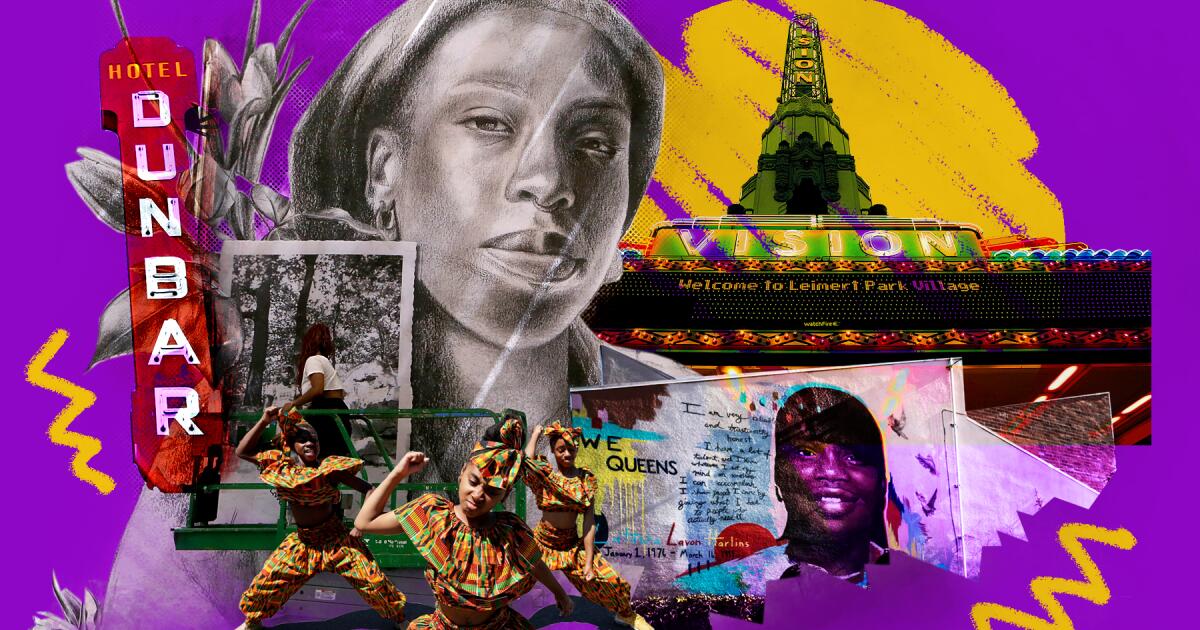
South L.A. just became a Black cultural district. Where should the monument go?

p]:text-cms-story-body-color-text clearfix”>

For more than a century, South Los Angeles has been an anchor for Black art, activism and commerce — from the 1920s when Central Avenue was the epicenter of the West Coast jazz scene to recent years as artists and entrepreneurs reinvigorate the area with new developments such as Destination Crenshaw.

Now, the region’s legacy is receiving formal recognition as a Black cultural district, a landmark move that aims to preserve South L.A.’s rich history and stimulate economic growth. State Sen. Lola Smallwood-Cuevas (D-Los Angeles), who led the effort, helped secure $5.5 million in state funding to support the project, and last December the state agency California Arts Council voted unanimously to approve the designation. The district, formally known as the Historic South Los Angeles Black Cultural District, is now one of 24 state-designated cultural districts, which also includes the newly added Black Arts Movement and Business District in Oakland.

Prior to this vote, there were no state designations that recognized the Black community — a realization that made Smallwood-Cuevas jump into action.

“It was very frustrating for me to learn that Black culture was not included,” said Smallwood-Cuevas, who represents South L.A. Other cultural districts include L.A.’s Little Tokyo and San Diego’s Barrio Logan Cultural District, which is rooted in Chicano history. Given all of the economic and cultural contributions that South L.A. has made over the years through events like the Leimert Park and Central Avenue jazz festivals and beloved businesses like Dulan’s on Crenshaw and the Lula Washington Dance Theatre, Smallwood-Cuevas believed the community deserved to be recognized. She worked on this project alongside LA Commons, a non-profit devoted to community-arts programs.

Beyond mere recognition, Smallwood-Cuevas said the designation serves as “an anti-displacement strategy,” especially as the demographics of South L.A. continue to change.

“Black people have experienced quite a level of erasure in South L.A.,” added Karen Mack, founder and executive director of LA Commons. “A lot of people can’t afford to live in areas that were once populated by us, so to really affirm our history, to affirm that we matter in the story of Los Angeles, I think is important.”

The Historic South L.A. Cultural District spans roughly 25 square miles, situated between Adams Boulevard to the north, Manchester Boulevard to the south, Central Avenue to the east and La Brea Avenue to the west.

Now that the designation has been approved, Smallwood-Cuevas and LA Commons have turned their attention to the monument — the physical landmark that will serve as the district’s entrance or focal point — trying to determine whether it should be a gateway, bridge, sculpture or something else. And then there’s the bigger question: Where should it be placed? After meeting with organizations like the Black Planners of Los Angeles and community leaders, they’ve narrowed their search down to eight potential locations including Exposition Park, Central Avenue and Leimert Park, which received the most votes in a recent public poll that closed earlier this month.

As organizers work to finalize the location for the cultural district’s monument by this summer, we’ve broken down the potential sites and have highlighted their historical relevance. (Please note: Although some of the sites are described as specific intersections, such as Jefferson and Crenshaw boulevards, organizers think of them more as general areas.)

Source link

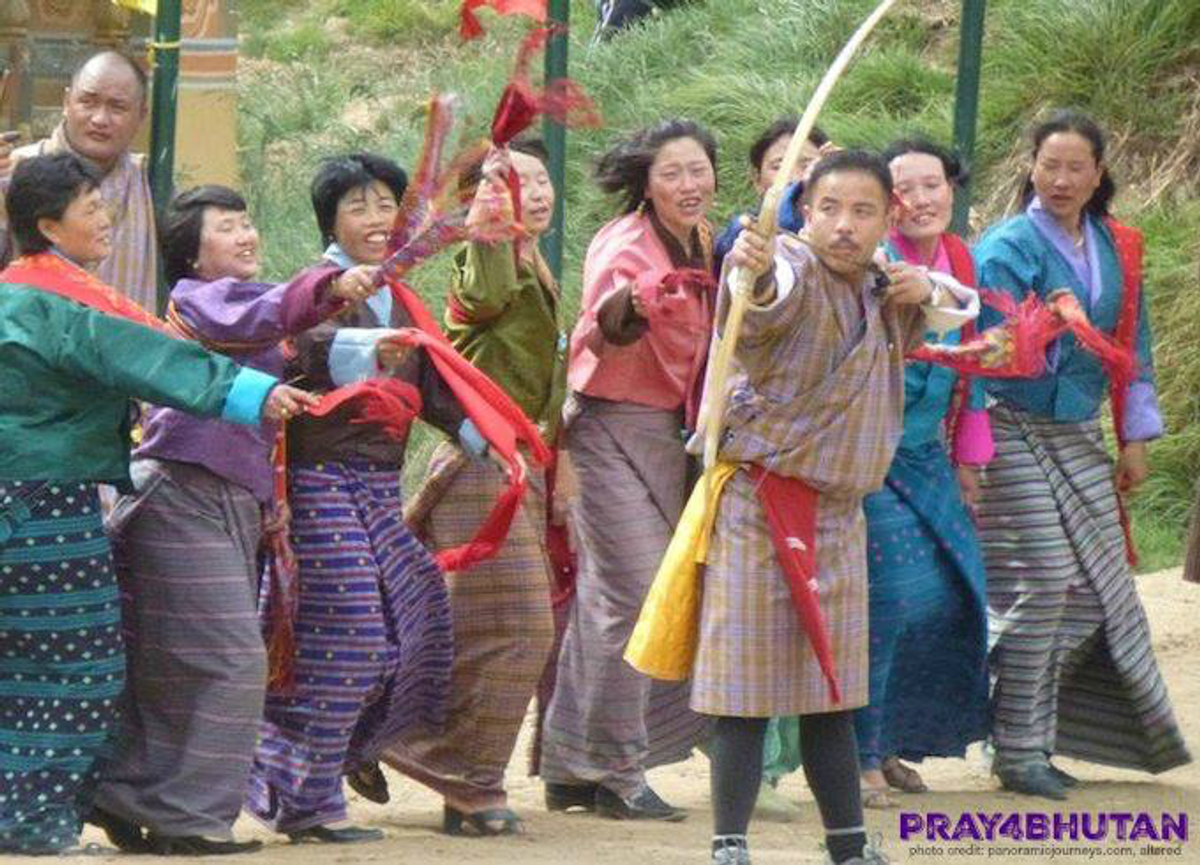
Thursday 19 February Losar in Bhutan

Losar means New Year (lo – year, sar – new) in Tibetan. It is the most important festival in the Tibetan calendar.

The origins of Losar can be traced back to pre-Buddhist period and the Bon religion and was most likely celebrated to mark the winter solstice. To mark the beginning of the end of Winter, festivities included offering large quantities of incense to the local spirits and deities. When the region converted to Buddhism, the date was shifted by Buddhist monks to match up with their lunar calendar.

The Tibetan New Year period lasts for fifteen days, with the first three days and New Year’s Eve being the main celebrations

On Tibetan New Year’s Eve, a custom is making a special noodle dish called guthuk. In the dish are dumplings with different ingredients inside them. Finding a certain ingredient is a light-hearted omen for the coming year. Finding a white coloured ingredient such as rice or salt is considered a good omen; finding a pebble means good luck; finding a chilli means the person is talkative and finding a black ingredient means you have are ‘black-heated’. Interestingly, in some European Christmas customs, finding coal in your presents means the same thing.

On Tibetan New Year’s Eve, the monks do a protector deities’ puja (ceremony) to drive out evil spirits. and begin preparations for the Losar celebrations.

On the first day of the new year, people rise early and place water and offerings on their household altars to ensure a good harvest.