UCLA Health expansion raises costs and concerns
On television, ads for UCLA Health show up behind the Dodgers’ home plate and in the background when Justin Herbert, the Chargers’ quarterback, speaks after a game.
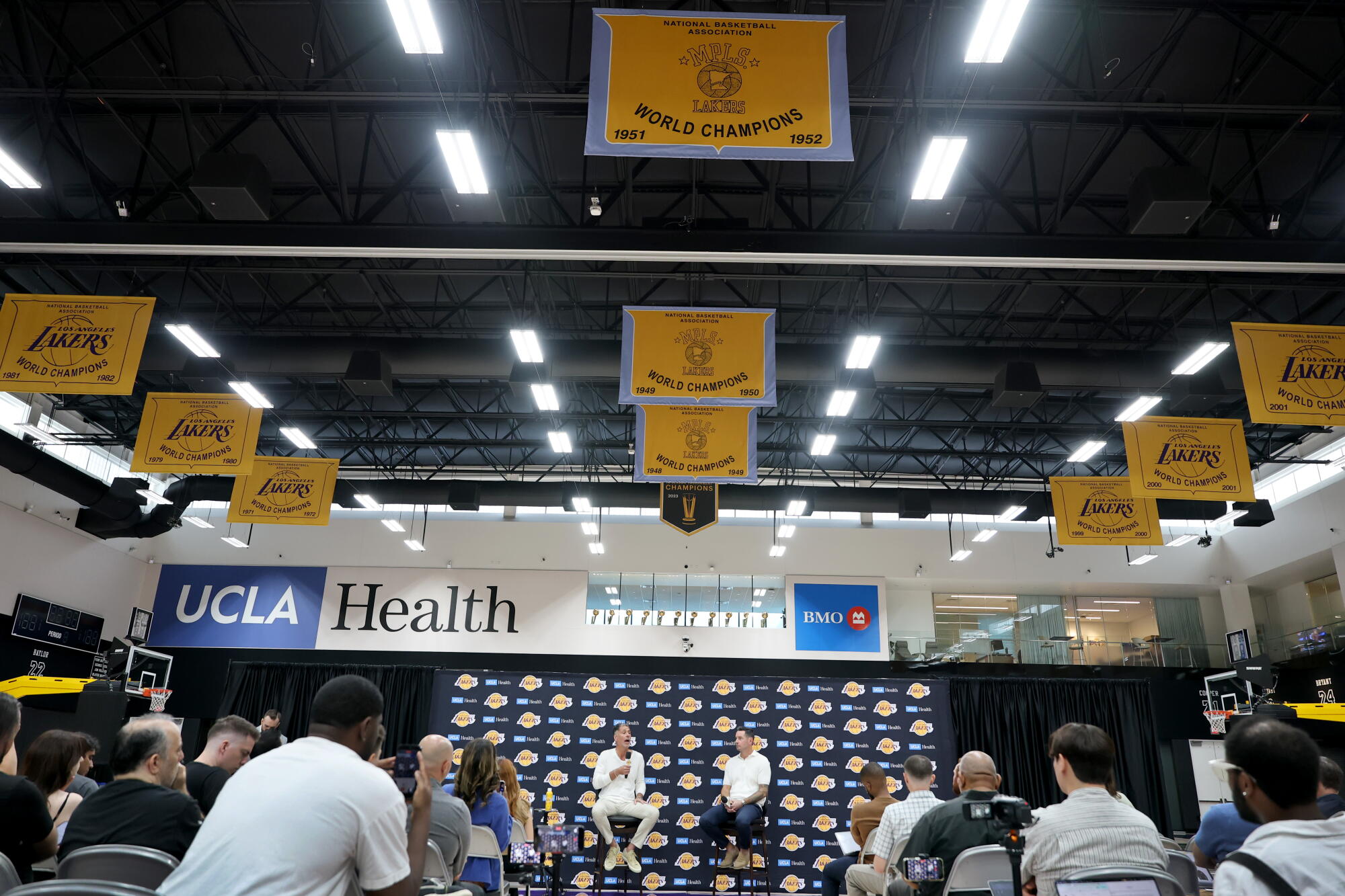
At the Lakers’ training facility, the health system’s logo appears on the court and throughout the building, under a marketing partnership that cost the university tens of millions of dollars.
The ads are part of the public university health system’s strategy to increase the number of Southern Californians using its providers at its fast-growing number of clinics and hospitals.
University officials say its expansion to five hospitals and 300 clinics — up from 150 locations a decade ago — has given more Southern Californians access to its academic medicine.

Lakers championship banners hang from the rafters and trophies are on display in an office overlooking the news conference as Lakers general manager Rob Pelinka, left, speaks while Lakers coach JJ Redick listens at the UCLA Health Training Center in El Segundo.
(Allen J. Schaben/Los Angeles Times)
Last year, the system’s clinics and hospitals recorded 4.2 million outpatient visits — more than five times the number in 2015.
“As a public institution, we’re trying to make sure that patients within our community have access to care,” said Dr. Robert Cherry, UCLA Health’s chief medical and quality officer. “That’s the primary and overriding concern, because there’s an acute demand for our services.”
Yet healthcare economists point to repeated studies showing that hospital consolidation — where health systems expand, take over competitors and hire more of a region’s physicians — has become a leading driver of escalating health costs and insurance premiums, while doing little to raise the quality of care.
Glenn Melnick, a USC professor of healthcare finance, has documented how hospital consolidation in Northern California caused health costs to escalate. He said the mergers and acquisitions have continued, including with UCLA Health and other hospital systems in Southern California. UCI Health acquired four community hospitals in 2024.
One consequence, Melnick said, is surging insurance premiums for employers, which leave companies with little money for wage increases, while employees end up paying more for their health insurance and out-of-pocket medical costs.
“We’re now, I think, at a breaking point,” he said.
UCLA executives said the aim of the expansion was not to increase revenues the health system receives from commercial insurers. And they say they don’t believe UCLA Health is large enough to influence health costs.
“We actually represent only a small fraction of the inpatient capacity, physicians, clinics and resources available across the large and complex healthcare market in L.A.,” said Johnese Spisso, UCLA Health’s president, in an interview.
Nonetheless, the system’s expansion and its other recent financial decisions have led to protests by some of the university’s own staff and faculty, who point out the new clinics have been added mostly in wealthier neighborhoods, including Malibu and Montecito, where the majority of families have commercial insurance.
None of its clinics are in South or East Los Angeles, where more residents are covered by Medi-Cal, the state program for low-income people.

Cameron Carr during a news conference at the UCLA Health Training Center in El Segundo.
(Arwen Clemans/Los Angeles Times)
University of California system officials say Medi-Cal’s reimbursements are so low that they don’t cover the cost of care at the state’s five UC medical centers. Those losses, they say, must be covered by charges to those with commercial insurance.
Last month, dozens of medical residents and interns protested outside a UC Regents board meeting after UCLA Health failed to renew a Medi-Cal contract that had covered thousands of low-income patients. The doctors waved signs with slogans “Corporate Greed” and “Keep UCLA Health public.”
Dr. David Schriger, UCLA professor emeritus of emergency medicine, said that given the mission of the state’s public university, he questioned why the expansion had not included neighborhoods such as South Central L.A.
“The public should be making these decisions,” Schriger said. “It should not be at the whim of some executives.”
Santiago Munoz, UCLA Health’s chief strategy officer, said officials don’t consider neighborhood income levels when deciding where to open clinics. Instead, he said, the system has been adding clinics along freeways running north and south.
“We’re staying close to the 405 and the 101 because driving to locations in Los Angeles is inevitable, and it’s very difficult to get to Westwood,” he said.
Munoz noted that UCLA had recently leased a 20,000-square-foot space for a clinic in Inglewood, has locations in downtown Los Angeles, and provides physician services at two of L.A. County’s public hospitals.
“We are trying to go to where patients are,” Munoz said.
Worries about crowding
Nurses at the university’s flagship hospital Ronald Reagan UCLA Medical Center in Westwood say the expansion has created crowding that has caused what they describe as an ongoing, daily crisis in the emergency room.
Patients coming from the 300 clinics for hip replacements, heart surgeries and other procedures at Ronald Reagan often wait one or two days in the emergency department until beds become available upstairs in the hospital, according to UCLA officials.
To accommodate those patients who’ve been admitted but don’t have a room, the hospital has installed dozens of beds in what was once the emergency department’s waiting room and in adjacent spaces. That has forced people waiting for emergency care into a large white tent outside, which was put up during the COVID-19 pandemic.
“How do you do a good exam in a tent? It just doesn’t work,” said Dianne Sposito, a nurse who works in the emergency department. “I feel patients are in grave danger right now. Accidents are bound to happen.”

LeBron James has fun with his daughter, Zhuri, as son, Bronny, looks on during a G League game at UCLA Health Training Center in El Segundo.
(Wally Skalij/Los Angeles Times)
A university spokesperson said the system has “extensive strategies to keep patients safe and decompress our emergency departments.”
At the September Regents committee meeting, Spisso, UCLA Health’s president, told board members that the system needs to add as many as another 400 hospital beds so that newly-admitted patients no longer have to wait.
For months, rumors have circulated that UCLA will soon buy Providence St. John’s Health Center in Santa Monica, which would make the university the only hospital operator in that city. UCLA bought the city’s other hospital in 1995.
UCLA officials declined to say whether they were talking about acquiring the hospital. “We’ve found it’s best not to talk about discussions we may or may not be having unless or until we have something to announce,” Phil Hampton, a university spokesperson, said in a statement.
Consolidation hikes costs
The California Health Care Foundation found in a 2021 study that hospital markets were reaching “monopoly levels” in many of the state’s counties. The consolidation was increasing prices with “little to no improvement in quality” of care, the report said.
The study also detailed how physicians often change their referral and prescribing patterns after their practices are acquired by hospitals, sometimes requesting imaging or other procedures that are not needed.
Melnick, the USC professor, noted that when UCLA acquires physician practices and “re-designates them as hospital-outpatient departments,” the clinics can begin billing insurers for an additional “hospital facility fee” for routine office visits, imaging and minor procedures.
He added that insurers often consider UCLA as a “must-have” network, allowing it to negotiate higher reimbursement rates. When the insurer folds UCLA’s new hospitals and clinics into their plan, he said, it often agrees to raise rates at the newly-acquired providers to match what UCLA is receiving as an academic system. Patients get the same care, he said, “but there is a new name on the door.”
Munoz said that UCLA Health was adding facility fees to some bills, including for imaging, but not for physician care. “We’re running a fairly lean operation in the community when it comes to physician services and not collecting the facility fees that others are,” he said.
More income from patient charges
UCLA is not the only hospital system expanding in the L.A. region. For example, Cedars Sinai has also been adding clinics and buying hospitals.
Price data shows that insurers and patients often pay more for care at UCLA Health and Cedars.
Anthem, Southern California’s largest commercial insurer, this year is paying $20,265 to UCLA for a total knee replacement at Ronald Reagan, according to data gathered by Serif Health, a San Francisco firm that collects data from hospitals and insurers. That price is 9% higher than last year and doesn’t include physician fees, the implanted device or anesthesia.
Anthem pays Cedars more than twice as much for a knee replacement, according to Serif’s data, while it pays Providence St. John’s 22% less. Cedars’ current negotiated reimbursement is $42,559 — an increase of almost 17% over last year.
University executives said that because UCLA Health is an academic health system it provides a high volume of complex care that is more costly than care at non-academic hospitals.
UCLA’s expansion strategy has been financially successful, according to the health system’s annual report.
Last year, UCLA Health operating revenues grew by nearly 20% to more than $5 billion. After paying for expenses, its operating income was $793 million, a margin of almost 16%. That compares to the median operating margin of 1.5% for 45 academic medical centers across the country, according to a 2024 study by McKinsey & Company.
UCLA officials said the operating margin was not a good comparative measure because it doesn’t include a $496-million transfer to the university’s medical school to cover other operations including the training of physicians.
“Education, research, and clinical care are all part of our mission and our responsibilities to really train that next generation of healthcare professionals,” Spisso said.
Expansion continues
The university is now spending nearly $300 million to renovate a 170,000-square-foot building that sits on nine acres near Los Angeles International Airport. Purchased in 2024, the campus’ many offerings will include a sports medicine institute with physical therapy and advanced imaging, as well as an ambulatory surgery center with 10 operating rooms.
The university also plans to soon open a new 119-bed psychiatric hospital in L.A.’s Mid-Wilshire neighborhood. The facility was once the 204-bed Olympia Medical Center, where most patients were Black, Latino and underinsured. Olympia shut down after the university purchased it in December 2020.
The renovated hospital allows UCLA to relocate and expand the 74-bed Resnick Neuropsychiatric Hospital, which is currently on the fourth floor of Ronald Reagan Medical Center.
“We have patients waiting for mental healthcare so we made a $650-million investment in this new facility,” Spisso said. “We will probably lose around $50 million a year just operating it, but we saw it as one of the most underserved areas.”
UCLA then plans to add 103 beds to Ronald Reagan by renovating its fourth floor, increasing the medical center’s capacity by 23% to ease the overcrowding.
In 2024, the university bought the 260-bed West Hills Hospital and Medical Center in the San Fernando Valley from HCA Healthcare.
Last month, Spisso told the Regents committee that the hospital, now known as UCLA West Valley Medical Center, and its surrounding clinics, were making more money than officials had expected.