health insurance

Best place for Brits to retire abroad in 2026 – sun and affordable living

The Retirement Abroad Index 2026 has ranked 20 countries across five key areas including healthcare, cost of living and visa accessibility – and the results may surprise you.

While you might be drawn to these sunny spots for a holiday, have you ever considered they could be the perfect place to spend your retirement?

As Brits approach retirement age, plenty contemplate purchasing a property in well-loved retirement havens such as Spain and France, but there are warmer, more affordable locations that could offer greater advantages, according to the latest figures.

The Expatriate Group, a specialist provider of international health insurance serving expats and retirees globally, has published The Retirement Abroad Index for 2026. The study assessed 20 countries, evaluating them across five crucial categories, including healthcare, visa accessibility, health insurance requirements, cost of living, and community and integration.

Drawing from these essential factors, it’s evident which destinations emerged as frontrunners for retirees and which have fallen in the rankings, with some surprising contenders.

Lee Gerry, director of Expatriate Group, said: “Retiring abroad has never been more achievable, but the decisions that matter most – healthcare access, visa routes, and the reality of day-to-day costs – are often the least well understood.”

“This index is designed to cut through the noise and give people an honest, data-led picture of where the real opportunities are.”

The top destination for retirement, according to the index, was the Philippines, with a Special Resident Retiree’s Visa that ranks among the most accessible globally. It requires a fixed deposit of roughly £11,000 for those receiving a pension.

What’s more, it achieved impressive marks for affordability and anticipated integration, which, combined with its tranquil beaches and stunning scenery, makes it an idyllic spot to enjoy your retirement years.

The second choice is perhaps less of a shock, as it’s certainly more familiar to Brits, though still not typically considered the top pick: Thailand.

The nation boasts several well-established and vibrant cities, each providing a flavour of its rich culture, but most prominently, Bangkok, Chiang Mai and Phuket all feature internationally recognised private hospital networks.

Thailand secured a perfect 20 out of 20 on the scoring index, excelling in the healthcare category alongside Spain and France. Regarding visas, their Non-Immigrant O-A Visa demands coverage of at least $100,000, approximately £74,000, per policy, per year, as a visa requirement.

The third country, which may surprise some retirees, is Colombia, offering one of the most straightforward retirement visa routes among the 20 destinations and, remarkably, achieving a cost of living score of 18 out of 20.

According to their findings, the report indicates a retired couple can generally enjoy a comfortable lifestyle in Medellín, the capital of Colombia, on roughly £1,000 to £1,500 per month. In contrast to most British cities, it boasts reliably warm weather and possesses a lively atmosphere that’s difficult to match elsewhere.

Portugal emerged as the first European nation to feature on the list as an ideal spot to spend your golden years, claiming fourth place. Joint fifth went to Sri Lanka and South Africa, while Malaysia and the UAE shared sixth position, before Mexico secured a solid seventh spot.

While Spain continues to be among the most favoured destinations for British retirees, it didn’t appear until eighth on the list, achieving 18 out of 20 for healthcare, though it was let down by the cost of living and visa complications.

It also shares eighth place with Indonesia, which is cherished for its relaxed way of life and renowned for its strong emphasis on wellness culture. Packed with stunning beaches and particularly attracting visitors to Bali, it has climbed to the top of countless people’s bucket lists as a must-visit destination.

Coming in at number nine is Panama, followed by Qatar. Panama has made headlines in recent years for its ‘Pensionado’ programme, which offers a generous range of discounts designed to make retirement far more affordable.

The scheme also requires retirees to demonstrate a lifetime income of just £738 or so per month, with an extra £184 for each dependant.

Due to several countries sharing identical scores, the top 10 is actually made up of 13 nations in total. These are:

  • Philippines
  • Thailand
  • Colombia
  • Portugal
  • Sri Lanka
  • South Africa
  • Malaysia
  • UAE
  • Mexico
  • Spain
  • Indonesia
  • Panama

Source link

How much do the Dallas Cowboys Cheerleaders get paid?

The Dallas Cowboys Cheerleaders secured a significant boost to their salaries last season, but how much are they actually paid?

They still don’t get nearly as much as the Dallas Cowboys football players.

America’s Sweethearts: Dallas Cowboys Cheerleaders are back on screens this week with a thrilling third instalment of Netflix’s hit docuseries.

Each seven-episode season of the show created by Greg Whiteley chronicles the latest NFL season as both rookie and seasoned cheerleaders compete for a spot on the 36-strong squad.

The newcomers are guided by director Kelli Finglass, head choreographer Judy Trammell and a number of cheerleading veterans who have performed for DCC for up to six years running.

After the first season premiered on Netflix back in 2024, many viewers were shocked by how little the cheerleaders were paid compared to NFL players.

This led to a push for higher pay, spearheaded by a number of veteran cheerleaders, that played a major role in America’s Sweethearts’ second season. But was the dispute successful? And how much are they paid now?

How much are the Dallas Cowboys Cheerleaders paid?

Despite the Dallas Cowboys being valued at over $10 billion (£7.45 billion) at the time, their cheerleaders reportedly only earned between $15 and $20 an hour (£11.18 – £14.90) for practice and $500 (£372) per game before the 2025 season.

This all added up to a salary of around $75,000 (£55,890) a year for cheerleaders who made the squad, according to reports from NBC Boston.

However, this itself was an increase from even lower pay just a few years previously, following historical dissatisfaction with the cheerleaders’ wages.

In 2018, former Dallas Cowboys cheerleader Erica Wilkins successfully sued the organisation, leading to a 2019 settlement that bumped up wages from $8 (£5.96) an hour to $12 (£8.94) an hour. Game day pay was also increased from just $200 (£149) to $400 (£298).

During the 2024-25 season depicted in the Netflix documentary’s second outing, the DCC squad was still unhappy with their income as many of them would have to take on second jobs to make ends meet.

Plus, even the Dallas Cowboys’ newest players were earning around ten times more than veteran cheerleaders, with salaries for rookies starting at $750,000 (£558,900) and veterans at $850,000 (£633,460). Quarterback Dak Prescott is the team’s highest earner, with a current average salary of $60 million (£44.75 million) a year after signing a $240 million (£178.83 million) four-year contract.

Throughout the 2024-25 season, the Dallas Cowboys Cheerleaders held meetings to discuss the issue of pay and even considered staging walkouts during games, though this ultimately didn’t happen.

Jada McLean, who played an instrumental role in securing the squad’s new pay deal, told TIME magazine: “We didn’t want to let people down who were so excited to see the cheerleaders after supporting us through the first season of our television show.”

Watch Netflix hits like Beef season 2 for free

This article contains affiliate links, we will receive a commission on any sales we generate from it. Learn more
Oscar Isaac and Carey Mulligan

from £15

Sky

Get the deal here

Sky is giving away a free Netflix subscription with its new Sky Stream TV bundles, including the £15 Essential TV plan. This lets customers watch live and on-demand TV content without a satellite dish or aerial and includes the new season of Beef.

In the final episode of America’s Sweethearts season two, four-year veteran Megan McElaney announces the squad has secured a “life-changing” salary increase of a staggering 400 percent, with cheerleaders reportedly earning around $75 (£55.89) per hour. Veteran cheerleaders can now earn around $150,000 (£111,770) a year.

However, the cheerleaders’ exact salaries are not disclosed in the series and there has been some dispute over whether the 400 percent figure is accurate.

Veteran Reece Weaver disclosed on the Unplanned podcast last November that the increase was “more like 300 percent”, though maintained the team is still “so grateful with the outcome”.

“I really don’t know all the behind-the-scenes on how it all works out, but what I can say is that it has been such an improvement and a very big increase [over] what we have seen in the past,” she added.

Importantly, the increase does not include a flat fee for game appearances, which Weaver says is a “huge improvement”, and the job has remained part-time and does not include health insurance for cheerleaders.

America’s Sweethearts: Dallas Cowboys Cheerleaders season 3 is available on Netflix.

Source link

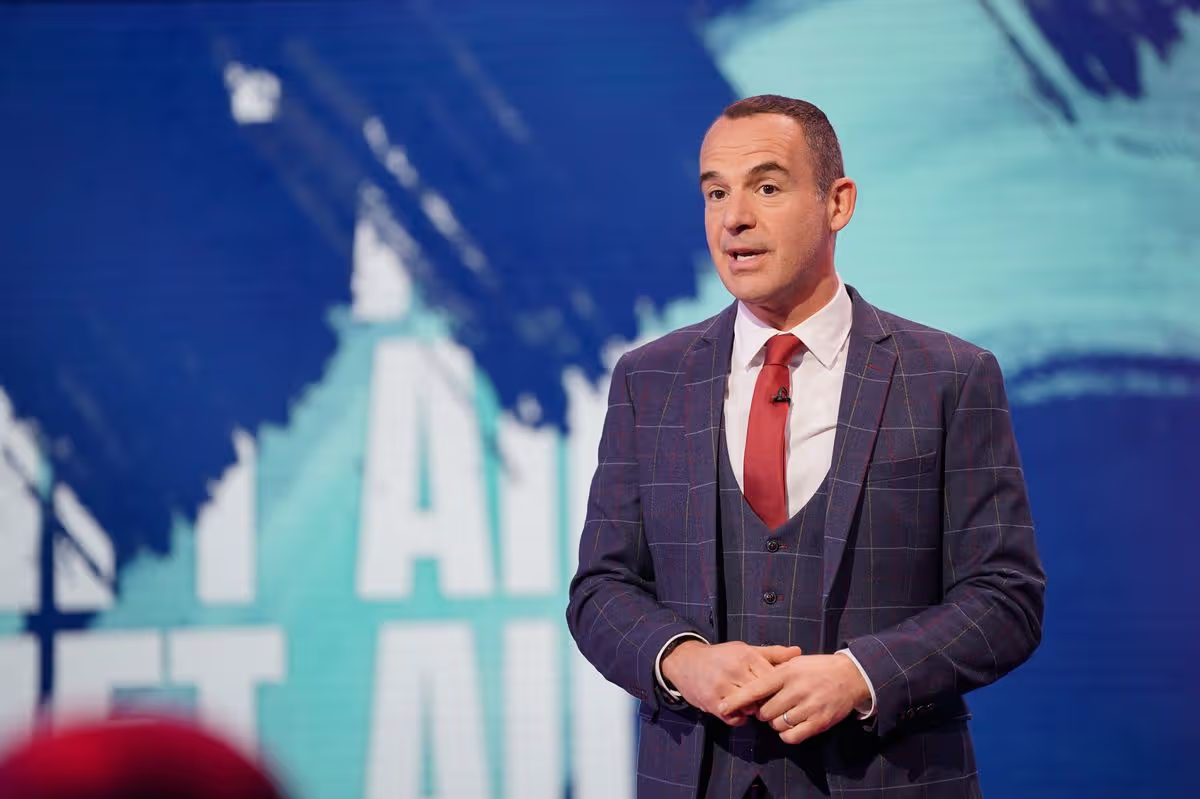
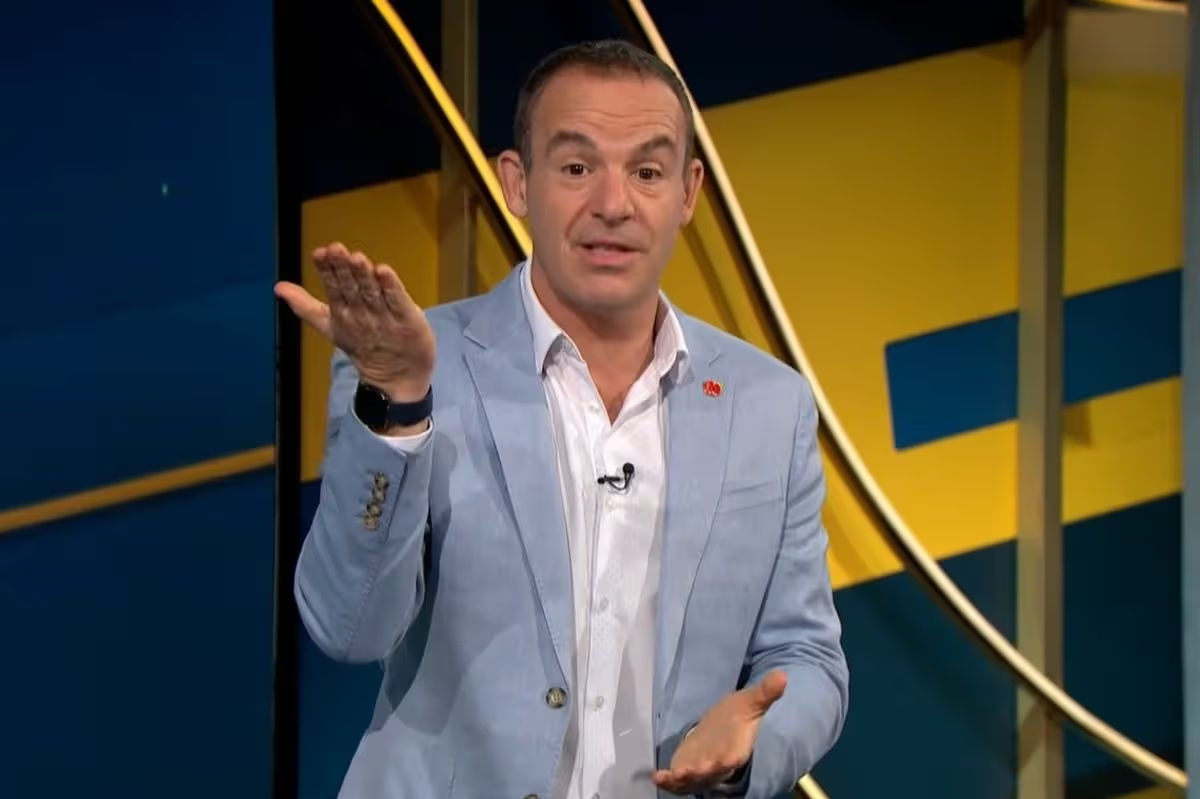
Martin Lewis ‘vital document’ advice for 2million people heading to Europe

You need to check if your paperwork is still valid for Spain, France, Portugal, Greece, Italy and other destinations

Martin Lewis’s MoneySavingExpert has issued urgent advice for anyone travelling to Europe this summer, as more than two million people will see a key document expire before they head off. MoneySavingExpert.com has a holiday warning for anyone visiting countries including France, Spain, Portugal, Greece and Italy.

Martin’s team has urged holidaymakers to check if their European Health Insurance Card (EHIC) or Global Health Insurance Card (GHIC) is still valid, as 1,285,250 GHICs and 926,954 EHICs are set to expire this year. The EHIC is being replaced by the new Global Health Insurance Card (GHIC). These cards are totally free to get and they give you access to state-run hospitals or GPs in EU countries for the same price as a local.

They last for up to five years, and the final EHICs issued after Brexit are expiring this year. The MSE newsletter reads: “These cards give access to state-run hospitals or GPs in EU countries for the same price as a local – so if it’s free for them, it’s free for you.”

You need to check your card for the expiry date, and apply for a new one if necessary.

The team said: “You’ll need to get a new card – it’s now called a GHIC (as it’s been rebranded a ‘Global’ card, though in essence still covers mostly the same European countries).” However, MSE also warned people not to fall for websites that charge you for these cards.

MSE said: “Never pay to get an EHIC or GHIC. It is always free, beware shyster sites trying to charge you for ‘fast tracks’ or other stuff, that’s nonsense. See how to safely get a free GHIC.” If you have an existing EHIC, it remains valid until the expiry date runs out – after this, you’ll need to apply for a GHIC card.”

The NHS explains: “The UK Global Health Insurance Card (GHIC) lets you get necessary state healthcare in the European Economic Area (EEA), and some other countries, on the same basis as a resident of that country. This may be free or it may require a payment equivalent to that which a local resident would pay.

“The UK GHIC has replaced the existing European Health Insurance Card (EHIC). If you have an existing EHIC you can continue to use it until the expiry date on the card. Once it expires, you’ll need to apply for a UK GHIC to replace it.

“The ‘Global Health Insurance Card’ (GHIC) and its predecessor, the EHIC, give access to state-run hospitals or GPs, mainly in European countries, for the same price as a local. So if they don’t pay, you don’t either. Over two million expire this year, check yours.”

A UK GHIC is free, and you can apply through the NHS website. The NHS advises avoiding unofficial websites, which may charge an application fee. People can apply for a new card up to nine months before their current card expires.

The NHS says: “Every member of your family needs their own card. You can add your spouse, civil partner and children to your application when you apply. You must enter your own details first and apply for any additional cards when prompted.”

Source link

Martin Lewis’ MSE issues Europe travel warning to ‘over two million’ people

MoneySavingExpert has shared important safety advice for holidaymakers

MoneySavingExpert (MSE) has issued a travel warning to millions of people. Founded by journalist and broadcaster Martin Lewis, MSE regularly posts consumer advice for Brits. In the latest Money Tips Email, the experts offered advice for anyone booking holidays.

In the email, the team told readers: “Summer is coming, and if you’re booked to go away and haven’t got your insurance yet, you need to do it NOW, today, straight away!” As the experts pointed out, booking travel insurance as soon as you book your holiday offers the maximum protection, including cover if something happens that prevents you from travelling.

Before setting off, it’s also advised to get a Global Health Insurance Card if you’re travelling to Europe. In the alert, MSE revealed that over two million cards are expected to expire this year. As a result, millions could miss out on the benefits if they don’t renew ahead of upcoming holidays.

The UK Global Health Insurance Card enables holidaymakers to access healthcare without paying more than a local resident would while travelling in the European Economic Area.

The NHS explains: “The UK Global Health Insurance Card (GHIC) lets you get necessary state healthcare in the European Economic Area (EEA), and some other countries, on the same basis as a resident of that country. This may be free or it may require a payment equivalent to that which a local resident would pay.

“The UK GHIC has replaced the existing European Health Insurance Card (EHIC). If you have an existing EHIC you can continue to use it until the expiry date on the card. Once it expires, you’ll need to apply for a UK GHIC to replace it.”

While people are advised they should also take out travel insurance, it could help you avoid paying the excess if you need medical treatment during your trip. MSE said: “Going to the EU? Ensure you’ve a valid (free) GHIC/EHIC – over 2m expire this year.

“The ‘Global Health Insurance Card’ (GHIC) and its predecessor, the EHIC, give access to state-run hospitals or GPs, mainly in European countries, for the same price as a local. So if they don’t pay, you don’t either. Over two million expire this year, check yours.”

A UK GHIC is free, and you can apply through the NHS website. The NHS advises avoiding unofficial websites, which may charge an application fee. People can apply for a new card up to nine months before their current card expires.

The NHS says: “You can apply for a UK GHIC if you’re a resident in the UK. You can also add your family members to your application when you apply.”

Source link

Foreign Office Spain vaccine advice for all UK tourists

Spain is the most popular destination for UK holidaymakers

Anyone planning a trip to Spain should act eight weeks before travelling, according to the latest Foreign Office advice.

The Foreign, Commonwealth and Development Office (FCDO) provides advice for travel to more than 220 countries and territories across the globe, covering everything from entry requirements and safety risks to health precautions and regulations. The FCDO recommends that those heading to Spain check the most up-to-date vaccination advice at least eight weeks before they set off, and find out where to get their vaccines and whether any fees apply.

Holidaymakers are directed to the Spain page on the TravelHealthPro website, which states: “Travellers [to Spain] should be up to date with routine vaccination courses and boosters as recommended in the UK. These vaccinations include for example measles-mumps-rubella (MMR) vaccine and diphtheria-tetanus-polio vaccine.”

It’s worth noting, however, that there are no certificate requirements for entry into Spain. Those visiting Spain are also urged to ensure their tetanus jabs are up-to-date.

TravelHealthPro guidance adds: “Travellers should thoroughly clean all wounds and seek medical attention for injuries such as animal bites/scratches, burns or wounds contaminated with soil.” TravelHealthPro also recommends that all holidaymakers make sure they have sufficient travel insurance.

It adds: “If visiting European Union (EU) countries, carry an European Health Insurance Card (EHIC) or a Global Health Insurance Card (GHIC) as this will allow access to state-provided healthcare in some countries at a reduced cost, or sometimes for free.

“The EHIC or GHIC, however, is not an alternative to travel insurance.”

Source link

About 8% of the country lacked health insurance in 2025, new data shows. That could rise next year

The proportion of Americans without health insurance held steady at around 8% of the population in 2025, according to new findings from the U.S. Centers for Disease Control and Prevention.

The national survey results, released Thursday, show the all-ages uninsured rate has stayed significantly down from where it was several years ago, but the ranks of the uninsured could soon expand as the Trump administration’s sweeping changes to the health landscape begin to take hold.

Massive changes to Medicaid, the government’s safety-net health program for low-income Americans, passed into law last year could result in 10 million more uninsured individuals over a decade, according to Congressional Budget Office estimates.

And the expiration this year of certain Affordable Care Act subsidies — which had offset premium costs — is also contributing to reduced participation in marketplace health programs. Around 5 million fewer people are expected to enroll in those plans in 2026 compared with 2025, according to the healthcare research nonprofit KFF.

The government has multiple programs for tracking Americans’ insurance status, which can give different numbers depending on factors like timing and question wording. Many researchers consider the U.S. Census Bureau to be “the official scorekeeper,” said David Howard, an Emory University health policy and management professor.

But the CDC survey results tracks closely with that, and they offer the first complete data for all of 2025 — the first year of President Trump’s second term in office.

The Trump administration has sought to expand access to low-premium catastrophic health insurance plans and lower drug prices for Americans who don’t have health insurance. It has also suggested that projected insurance enrollment declines indicate a drop-off of fraudulent and ineligible enrollees, rather than eligible Americans.

Although the share of insured and uninsured stayed roughly the same in 2025 as the year before, the number of uninsured grew by about 800,000 — 300,000 of them children. The growth of the overall U.S. population helps explain that.

The survey results also suggest a possible increased insured rate among Hispanic Americans. But that may in part reflect the effects of the Trump administration’s immigration crackdown, if uninsured members of that group left the country, Howard said.

Most Americans 65 and older have health insurance through the federal Medicare program. It’s different for younger Americans, many of whom are covered through a patchwork of public and private insurance programs.

The percentage of Americans under 65 who were uninsured rose in the 1980s, 1990s and early 2000s — from 12% in 1980 to more than 18% in 2010. It fell following passage of the Affordable Care Act in 2010, which expanded Medicaid programs and enacted measures to make affordable health insurance available to more people.

By 2016 it dropped nearly to 10%, before rising to 11 to 12% during Trump’s first administration, according to historical survey data from the CDC’s National Center for Health Statistics.

The COVID-19 pandemic saw the rate of uninsured fall again, as a result of government policies put in place to preserve coverage as people faced disruptions related to the pandemic. The rate hit an all-time low in 2023, falling below 9%.

It’s not clear yet how big the increase in uninsured Americans will be this year, but experts agree it will likely rise in the coming years as a result of changes to the Affordable Care Act and Medicaid.

“The decisions being made now — in Congress, state legislatures and state Medicaid agencies — will determine what happens next,” Nancy Brown, chief executive officer of the American Heart Association, said in a statement Thursday.

“Policymakers should act immediately to protect and expand access to affordable coverage, strengthen Medicaid and maintain pathways that make coverage and care accessible,” she said. “Without deliberate action, including reversing dramatic cuts to coverage, uninsured rates will continue to rise, putting quality health care further out of reach.”

Stobbe and Swenson write for the Associated Press.

Source link