A guide to camping at Channel Islands’ Prisoners Harbor Campground
It was a Thursday evening, and I was performing Gloria Gaynor’s 1978 hit “I Will Survive” for my audience of three on an ocean pier as we waited for the partial lunar eclipse.
As we shimmied to ‘70s hits via a Bluetooth speaker, I boasted about winning a talent competition in my tiny town thanks to my rendition of the disco classic. “We need to see these dance moves!” a fellow camper proclaimed.
Somehow, we had this island all to ourselves.
This was one of several memories I made last week when I traveled to Santa Cruz Island in Channel Islands National Park to stay at Prisoners Harbor Campground on its opening night. When the National Park Service announced that reservations would open Aug. 18, I spent 11 hours that day refreshing the page, waiting for my chance. At last, site No. 1 was mine.

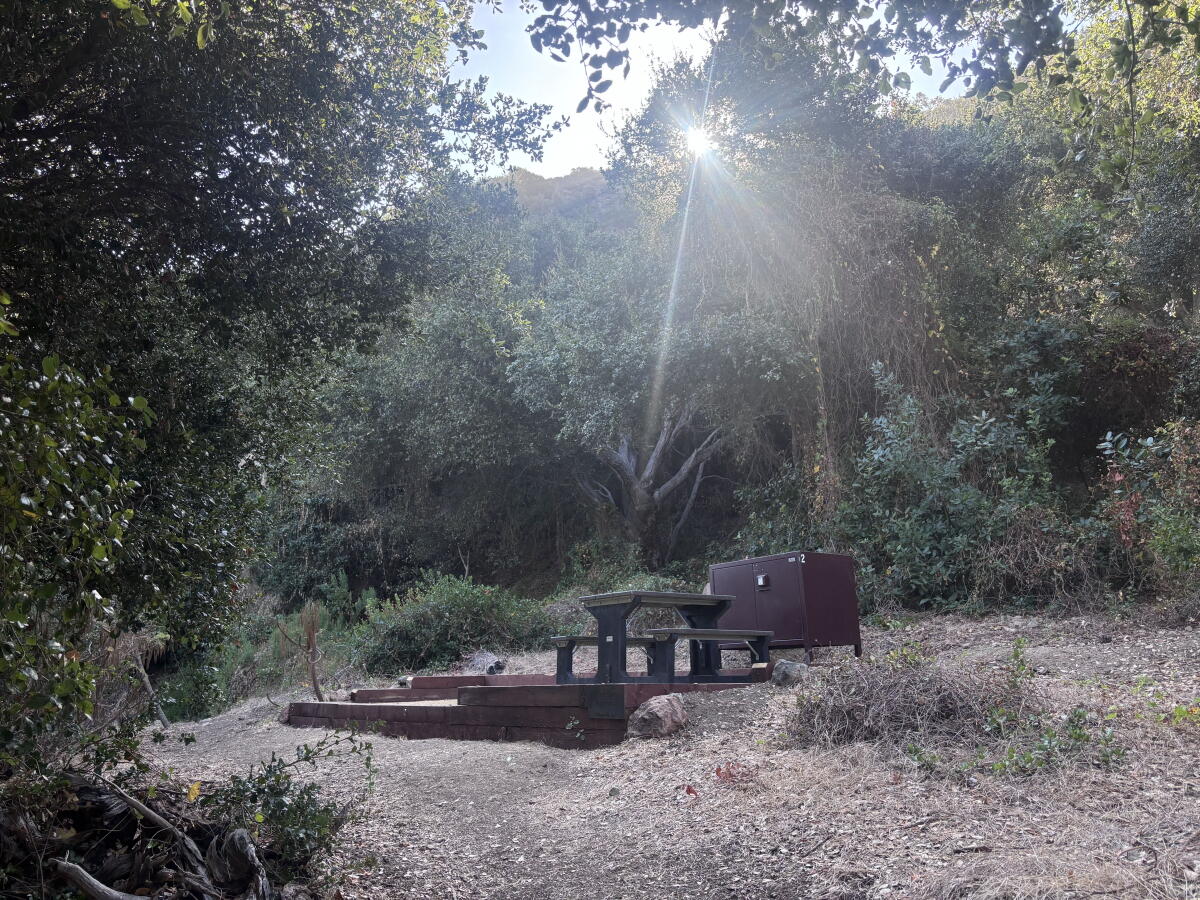
Campsite No. 2 at the Prisoners Harbor Campground on Santa Cruz Island.
(Jaclyn Cosgrove / Los Angeles Times)
In this edition of The Wild, I lay out how you can create your own memories at this quiet campground on a lesser traveled side of Santa Cruz Island. I will explain how to book your site and ferry, what to pack and what you can do while on the island.
Step 1: Book your campsite ⛺
Prisoners Harbor Campground is a small, rustic campground open year-round on Santa Cruz Island, the largest island in California. Although the National Park Service lists the campground as having six sites, it technically has seven. Reservations can be made for $15 a night through Recreation.gov.
Prisoners Harbor Campground is about a 13-mile hike southwest from Scorpion Canyon Campground, the popular 31-site spot where most folks visiting the island camp. Unlike Scorpion Canyon, Prisoners Harbor does not have any water on site and is a more DIY experience. There are also fewer tours and experiences led by outfitters on this side of the island.

The map of Prisoners Harbor Campground.
(Jaclyn Cosgrove / Los Angeles Times)
Each campsite at Prisoners Harbor has a dirt-packed tent pad, a picnic table and metal food storage containers that everyone called “fox boxes,” as the island fox is the largest land predator on the island (and will absolutely steal your food, and maybe your shoes).
From the pier, you’ll walk about one-fifth of a mile on a mostly flat dirt road, passing the brick Prisoners Harbor warehouse and two pit toilets. You will cross the Cañada del Puerto, which was dry during our visit but can swell to 3 feet and become impassable, according to the park service.
I was pleased to find that site No. 1 is tucked away in the campground’s northern corner. It is shaded by oak trees and surrounded by thick brush, offering privacy and the feeling like you exist only in this one little corner of the world.
Site No. 2 is on the path to site No. 1 and isn’t presently bookable on Recreation.gov. (I’m guessing the park service will remedy that soon, as the site exists and is ready for campers!)

The shaded campsite No. 6 at Prisoners Harbor Campground.
(Jaclyn Cosgrove / Los Angeles Times)
Sites No. 3, 4, 5 and 6 are all positioned in a row on the southwestern corner of the campground. Similar to site No. 1, site No. 6 is tucked under thick tree canopy. I think it’s probably shaded for most, if not all, of the day. Sites No. 3, 4 and 5 also have some shade.
Site No. 7 is the accessible campsite and has a ramp leading up to it. It is fairly exposed, appearing to have the least amount of shade and privacy. It is closest to the pit toilet, though, which also has a ramp leading up to it.
As I was getting ready for bed, I noticed the soothing sound of ocean waves. My friend Christine was already cozy inside the tent, and I asked her if she’d turned on an ambient soundtrack on her phone to fall asleep. “No, that’s just the ocean!” she said.
Step 2: Book your ferry ⛴️
There are only two ways to get to Santa Cruz Island: Take a private boat or, the more popular route, book a ferry through Island Packers, leaving out of Ventura Harbor.
A roundtrip ferry to Prisoners Harbor costs $72 for children ages 3 to 12, $96 for campers ages 13 to 54, $91 for those 55 and older. It is also $91 for members of the U.S. military.
Upon booking your ferry, you must read the rules that Island Packers emails to you. I cannot stress that enough. There are weight limits (i.e. no single item may weigh more than 45 pounds) and limitations about what you’re allowed to bring. That said, it’s all fairly easy to follow — like not packing your water or fuel inside your bag, as those both are packed in specific places on the boat.

Christine, a friend of The Wild, paddles along the coastline of Santa Cruz Island near Prisoners Harbor.
(Jaclyn Cosgrove / Los Angeles Times)
Step 3: Plan out what you’d like to do on the island 🚣😎
With Prisoners Harbor being more of a DIY experience than Scorpion Canyon, one of the most important things you can do is plan ahead and book your activities at least a full day — ideally a few days — before your trip.
I knew I wanted to try snorkeling, but I don’t own gear — yet. Thanks to a recommendation from Island Packers, whose staff graciously answered all my questions, I contacted Ventura Dive and Sport to see what was doable. Owner Zach Cantrell was helpful and accommodating, setting me up with everything I needed, including a 7-mm wetsuit that made me feel like an actual marine mammal thanks to my ability to float while wearing it. Cantrell also made it easy to return my gear since the ferry was returning after his shop was closed.
Outside of snorkeling, you can also rent a kayak through Channel Islands Kayak Center. Or you can bring your own kayak, keeping in mind that Island Packers has specific rules around which kayaks you’re allowed to bring. You should also take a look at the National Park Service’s safety guidance regarding the risks of ocean kayaking.

The hike along Navy Road offers nice views of ocean and mountain ranges on the mainland.
(Jaclyn Cosgrove / Los Angeles Times)
You can also swim near the Prisoners Harbor pier, but you should keep in mind:
- The beach here is not sandy, but rather covered with rocks of varying sizes; pack swim shoes to protect your feet
- The waves can get choppy, so make sure not to swim alone
- There are stingrays in the area, so enter the water doing the stingray shuffle
- There are sea urchins on some rocks in the area, so watch out for those as well, as their sting also hurts
On the island, there’s, of course, hiking. There are two trailheads at Prisoners Harbor:
- The 4-mile out-and-back Pelican Bay hike, a challenging trek that traverses along the coastline, offering seemingly endless views of the area, before ending at the bay and Tinkers Harbor, another spot where you can swim and snorkel; The hike is on Nature Conservancy land, an environmental nonprofit that owns 76% of the island, and the conservancy requires that you sign a waiver and only traverse the hike when an Island Packers staffer is present on the trail.
- A hike along Navy Road that you can take to the backcountry Del Norte campground, or to a variety of other spots on the island, should you pack a paper map or download a map before your trip.
Christine and I had originally planned to check out the Pelican Bay hike on Friday morning, but then a kind island visitor said we could borrow their kayaks for free. That was an irresistible offer.
I’ve kayaked several times on rivers and in lakes but never on the ocean, so I wanted to be fairly cautious. We paddled northwest along the island’s coast, taking in the island’s jagged rocky cliffs. We spotted what appeared to be a small sea cave but agreed it wasn’t a good idea to explore without a guide who knows the island. You should always be ready on any adventure to check in with yourself and your travel companions about your skill and comfort levels. If the reason you’re wanting to do something is really just “FOMO,” ask yourself if it should instead be a “NO-GO.” (Yes, I just made that up.)

Kayakers leave out of Scorpion Anchorage on Santa Cruz Island.
(Jaclyn Cosgrove / Los Angeles Times)
I saw repeatedly on the National Park Service website that the island’s weather conditions can change rapidly, including while out on the kayak. Christine was out front and noted the wind was picking up. We swiftly paddled back, carried in part by the waves, which pushed our kayaks along in a similar sensation to surfing. I quickly fell in love with that feeling!
Despite the campground being fully booked, there were only two other campers during our trip — retired educators and travel besties Kim Eaton and Annemarie Lee, both of Riverside. They’d visited the Channel Islands multiple times, including Anacapa, Santa Rosa, San Miguel and had made previous trips to Santa Cruz, and they’d always wanted to do the Pelican Bay hike.
We were all on the island when it was particularly hot and humid, so the duo chose to go halfway and turn around.

The cloudy night sky, as seen from the Prisoners Harbor pier.
(Jaclyn Cosgrove / Los Angeles Times)
“The views were beautiful,” Eaton said, noting how clearly they could see the rugged coastline and waves. “We saw you guys kayaking!”
“The color of that ocean is beautiful,” Lee added.

Rocky outcroppings near Scorpion Anchorage.
(Jaclyn Cosgrove / Los Angeles Times)
Step 4: Plan what you’ll pack, including all your water
Everything you pack in, including your trash, you must pack out. There is no food for purchase, and there is no water at Prisoners Harbor, so you must bring whatever you plan to use for drinking and other purposes. I brought 4 gallons, and Christine packed 2. As I said, it was pretty hot, and we left the island with about a gallon and a half left.
I didn’t realize coolers were allowed. Nearby in campsite No. 4, Kim and Annemarie not only had a cooler but large ice cubes they’d frozen specifically for the trip, which last longer thanks to their size. “So if you like your cocktails, you’ll have ice” for multiple days, Kim said.
Step 5: Don’t miss the boat!
Island Packers requires campers to check in an hour before the boat leaves.
I left my home just before 6 a.m., picked up Christine and boogied to Island Packers, parking just before 8 a.m. Parking at Ventura Harbor is free Monday through Thursday, and $10 for a full-day pass Friday through Sunday and on major holidays.
After checking in, we worked with Island Packers staffers to load our gear onto the boat. I also thankfully had time to buy a four-shot latte next door at Freedom Coffee. Island Packers has several items for sale in their gift shop, including waterproof phone cases and other items you might have forgotten at home.
As you board the boat, make sure you remember wherever you tuck your return ticket. Our departure time from the island was 4:15 p.m. Friday, which gave us the better part of the day to explore.

An island fence lizard rests on a log at campsite No. 1, scoping out the new visitors to its island.
(Jaclyn Cosgrove / Los Angeles Times)
Step 6: Have fun!
Full of motion-sickness drugs and glee, we boarded the boat. I tried to keep my expectations low for what we’d see on the trip to the island. I’ve been on three whale watching excursions out of Long Beach, including once when we didn’t see any whales.

A bottlenose dolphin swims alongside the Island Packer boat on its journey to Santa Cruz Island.
(Jaclyn Cosgrove / Los Angeles Times)
However, shortly into our trip, our boat was visited by bottlenose dolphins that swam next to us. As we neared Scorpion Anchorage to drop off the passengers day-tripping and camping there, we saw so many common dolphins, it felt like an organized and official welcoming celebration.

A humpback whale near the coastline of Santa Cruz Island.
(Jaclyn Cosgrove / Los Angeles Times)
But the real magic happened shortly before we docked at the Prisoners Harbor pier when our captain Pancho spotted at least one (maybe two) humpback whale. We paused for a bit to take in the majestic animal’s movements. Christine and I agreed it was easy to see how sailors believed in sea monsters, given how otherworldly the humpback’s body appears as it slithers in and out of the water.
Before leaving for the island, I’d read about how the island foxes will approach you while you’re eating, and that they’ll come into your campsite to try to snag your food. We didn’t have that experience, thankfully, as the campground is so new, and the animals aren’t used to people being there yet.
These tiny canines remained rather elusive — until just before we left. We were headed to the restroom when I gasped. An island fox, about the size of a large house cat, was busy foraging for food in the leaves. It made me happy to see it act naturally, rather than begging us for human food.

An island fox roots through leaves in pursuit of a meal.
(Jaclyn Cosgrove / Los Angeles Times)
The fox cautiously walked a few feet past us on its journey for bugs and other snacks. It was a last bit of island magic before we left.
Although the beauty and biodiversity of the island is a major reason to visit, I carried something else with me back to the mainland, though. To a person, everyone was kind to each other. Prisoners Harbor, through its simple design, offers you the opportunity to move slower, notice more and just enjoy life in a way that’s harder to do when you have cellphone service.
For those looking for a simple escape near L.A., Prisoners Harbor Campground is that and so much more. Late-night karaoke is not required — but highly recommended.

3 things to do

Declan Beck, left, his brother Colson and friend Dayna Monbello visit Malibu Creek State Park near Calabasas.
(Mel Melcon / Los Angeles Times)
1. Celebrate biodiversity around L.A. and beyond
California Biodiversity Day, which actually runs for a week from Saturday through Sept. 13, will include several opportunities to get outside and learn in L.A. County. Malibu Creek State Park and UCLA Stunt Ranch are both hosting one-day data collection events, called bioblitzes. Friends of Ballona Wetlands will offer a freshwater marsh tour on Sept. 12 in Playa Vista. And Arroyos & Foothills Conservancy will host a native plant walk. Find events near you at californianature.ca.gov.
2. Celebrate the black walnut in Ascot Hills
Coyotl wan Macehualli and several other local groups will host a “Black Walnut Day” from 10 a.m. to 4 p.m. Saturday at Ascot Hills Park. The annual gathering will include plant adoptions, a bird walk, a community bike ride, hiking and more. Learn more at the organization’s Instagram page.
3. Plant seedlings near Agoura Hills
The Santa Monica Mountains Fund, a local nonprofit, needs volunteers from 9 a.m. to noon Saturday to work at Cheeseboro Canyon. Volunteers will plant hundreds of live plants grown from locally collected seed. Register at eventbrite.com.

The must-read

(Ryan Gillett / For The Times)
Falling during a hike can lead to a serious injury, or even worse. This is why it’s crucial that hikers not only wear appropriate footwear but also ensure their ability to balance isn’t being hampered by underlying health issues. Times staff writer Deborah Vankin recently wrote “Get A Leg Up,” a multipart series on improving our balance. First, you read about how to test your balance IQ to discern any issues you might have. Then, you can use exercises that Deborah explains to improve your balance. “Knowing your balance ability is a critical component of self-care,” says Mike Teater, director of balance for Fyzical, a national network of clinics specializing in balance and dizziness, “so you can age gracefully and do the things you want to do — and enjoy the life you built for yourself.”
Happy adventuring,

P.S.
The L.A. River community is mourning the loss of Steven Appleton, founder of the LA River Kayak Safari. A longtime L.A. River supporter, Appleton died July 25 at his Elysian Valley home following an 18-month battle with a rare and aggressive form of esophageal cancer, according to a GoFundMe page launched to help his family. Times staff writer Doug Smith wrote of Appleton in 2019, “For more than a decade, he has been launching kayak expeditions just upstream from his newly acquired parcel. He has literally blazed water trails by moving broken chunks of concrete to eliminate obstacles to wading and kayaking.” Money from the GoFundMe fundraiser will help Appleton’s family cover his memorial and final expenses. Thank you, Steven, for doing your part to help our local river.
For more insider tips on Southern California’s beaches, trails and parks, check out past editions of The Wild. And to view this newsletter in your browser, click here.