guadalajara

Spain weathers adversity, to play knock-out round at SoFi Stadium

Spain, ranked second in the FIFA rankings and the favorite to win the World Cup, did not play its best game, but did enough late Friday to defeat Uruguay 1-0 and eliminate the South American team in one of the most anticipated matches of the first round.

Spain finished first in Group H, while first-time participant Cape Verde advanced in second place with just three points, the result of three draws. Uruguay was eliminated from the tournament with only two points, following two draws and one loss.

For much of the match on Friday, Spain lacked better offensive coordination ahead of facing more dangerous opponents in the upcoming do-or-die rounds.

Alex Baena scored a goal in the 42nd minute by connecting with the ball after a cross from the right. The ball slipped past goalkeeper Fernando Muslera, who at first seemed to have no trouble blocking the shot, but the ball found the back of the net, making all the difference on Friday night in Guadalajara in front of 45,065 fans — most of whom were rooting for Spain. Muslera did not return for the second half and was replaced by Sergio Rochet.

“We have to celebrate because, honestly, it’s hard to finish first in a group like this,” said Baena, a midfielder for Atlético Madrid.

“It was a physically demanding match — extremely intense — and we rose to the occasion,” said Spain coach Luis de la Fuente, who emphasized that winning the World Cup requires winning tough matches against tough teams like Uruguay.

“I’m proud of this team because they want to keep growing. I have complete faith in this team. We’re where we are, and that’s exactly where we wanted to be,” added De la Fuente, who noted that the team needed to improve its fluidity of play.

Uruguay failed to beat Saudi Arabia or Cape Verde — two teams that, on paper, seemed inferior at the start of the tournament. Coach Marcelo Bielsa’s team couldn’t find its rhythm or play at its best.

“I wasn’t able to bring out the full potential of Uruguay’s players,” Bielsa said, visibly shaken by his failure with the Uruguayan national team. “What I’m leaving behind for Uruguayan soccer is nothing, because any contribution a coach might make to the soccer of a country where he worked for three years never takes root if results aren’t achieved.”

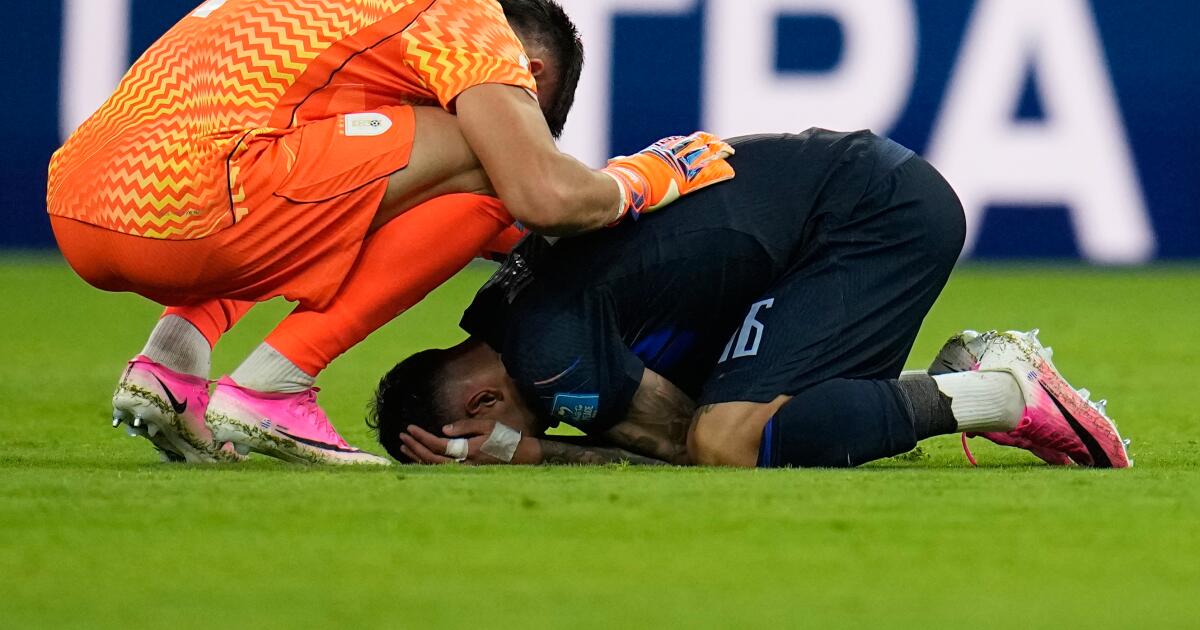
At the end of the match, Uruguay’s Agustín Canobbio was sent off after committing a hard foul on Spanish defender Pau Cubarsí in the 95th minute, prompting several Uruguayan players to protest the decision by U.S. referee Ismail Elfath.

For Bielsa and Uruguay, this marks the end of an era in which many believe the Argentine coach lost control of the locker room and his relationship with the media became strained because of his eccentric and explosive personality, but, above all, a lack of wins.

Cape Verde will face Argentina in the round of 32 on Friday in Miami. Spain will face the second-place finisher in Group J, which will be determined late Saturday by the match between Algeria and Austria. The game will be played at SoFi Stadium.

The match was the fourth and final World Cup game played in Guadalajara. Before the game began, a minute of silence was observed in memory of the victims of the earthquakes in Venezuela. So far, Venezuelan authorities have reported that more than 900 people have died and that thousands are missing.
Source link

Guadalajara protesters accuse Hyundai of hiding behind World Cup

While Mexico defeated South Korea at Guadalajara Stadium on Thursday in front of an elated crowd, protesters outside expressed a very different view of the World Cup’s impact on the city.

Community leaders, climate advocates and workers took to the streets to protest what they describe as “greenwashing through sports” by one of the official sponsors of the World Cup amid allegations of irregularities in its supply chain.

The protest organizers argue that Hyundai-Kia should hold its supplier, Ternium, accountable and issue it a “red card.” Protesters accuse Ternium of human rights violations, including alleged links to the disappearance of two environmental activists.

The demonstrations began with a rally at 5 p.m. in Plaza de la Liberación. Participants sought to draw attention to cases of missing persons in Guadalajara, stating they went missing after protesting Ternium’s iron ore mining activities.

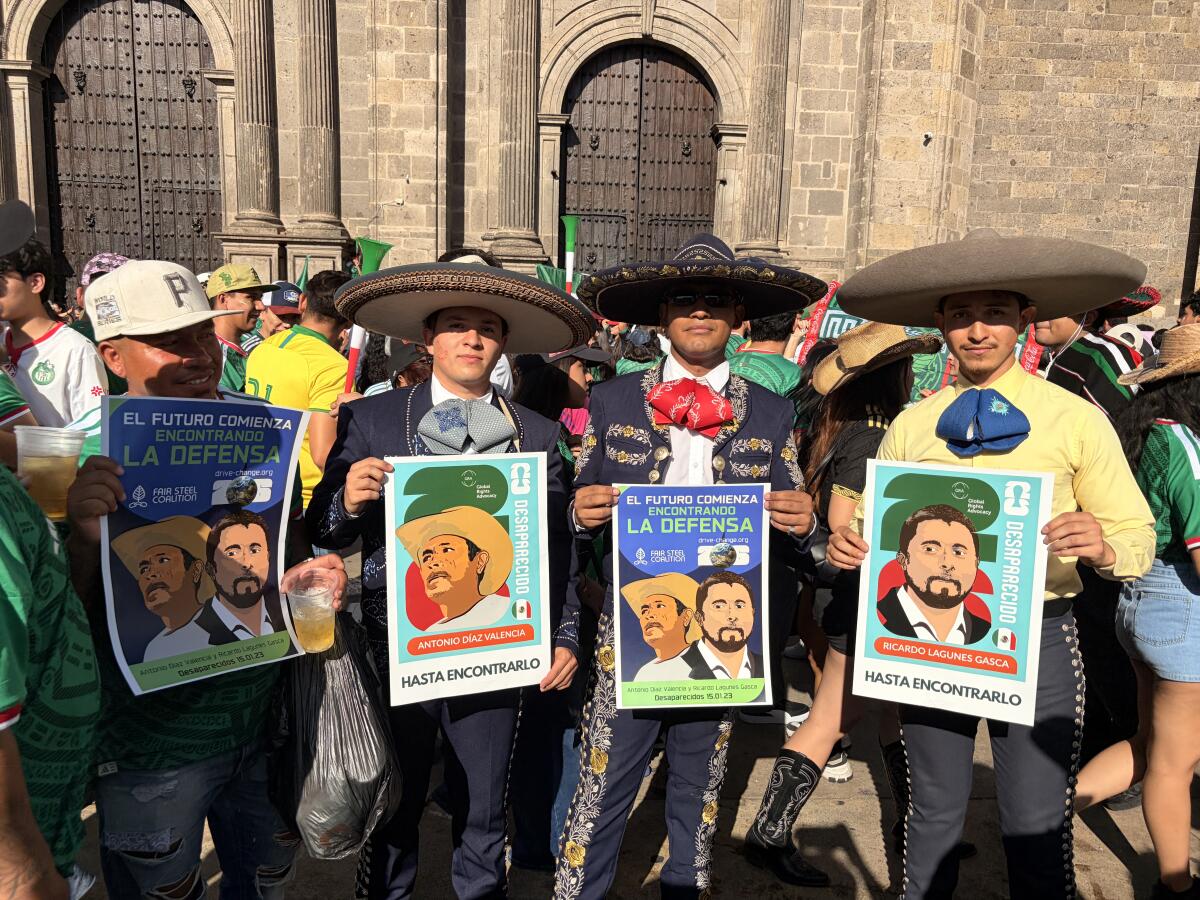
Mariachis hold posters commemorating the disappearance of two environmental activists in Guadalajara

Mariachis hold posters commemorating the disappearance of two environmental activists in Guadalajara: Ricardo Lagunes Gasca, a lawyer and human rights defender, and Antonio Díaz Valencia, a Nahua community leader and activist.

(Courtesy of Fair Steel Coalition)

A 2025 report by the environmental group Mighty Earth criticized Hyundai’s involvement in what it described as a “dirty steel supply chain,” as the South Korean automaker is one of Ternium’s main buyers of iron ore for use in steel production. Ternium has been the target of repeated criticism from activist groups for its alleged destructive environmental impact and corporate governance policies, as well as for the disappearance of activists Ricardo Lagunes Gasca and Antonio Díaz Valencia, which occurred three years ago in Mexico.

Ternium did not respond to the protesters’ allegations, while Hyundai did so in a statement.

“At Hyundai, we are committed to requiring our suppliers to meet the highest standards, and we enforce a strict Supplier Code of Conduct. Both we and our subsidiaries continue to conduct ongoing training, audits, and due diligence processes throughout the supply chain to identify and address potential issues across all our global operations,” said Michael Stewart, Hyundai’s director of communications.

Protesters carried signs bearing the names and photographs of environmentalists who disappeared.

More than 130,000 people have disappeared in Mexico in the past 20 years, according to the National Registry of Missing and Unlocated Persons. The kidnappings have been linked to run-ins with drug cartels and corrupt government officials, while there have also been cases involving young women who worked at the country’s many factories.

Protesters hold up signs featuring images of missing environmental activists ahead of Mexico's World Cup.

Protesters hold up signs featuring images of missing environmental activists ahead of Mexico’s World Cup match in Guadalajara.

(Fair Steel Coalition)

“[Hyundai] is trying to clean up its image through its sponsorship of the World Cup. But the facts are clear: Hyundai is linked to human rights and environmental abuses in Mexico, Brazil, the United States and other countries. By partnering with steel suppliers like Ternium, its slogan of ‘doing the right thing for humanity’ loses credibility,” said Diana Figueroa, a representative of the Fair Steel Coalition, one of the organizers of Thursday’s protests. She said the disappearance of a half dozen environmental activists in southern Mexico and deadly air pollution in Rio de Janeiro and Monterrey are attributed to Ternium.

The group plans to stage more protests throughout the World Cup.

On July 5, a symbolic soccer match and a concert will be held in Monterrey’s Fundidora Park to protest Ternium as one of the city’s most polluting companies.

On July 9, ahead of a World Cup quarterfinal match in Los Angeles, protests will focus on alleged human rights and labor rights violations in Hyundai’s supply chain, including reports of child labor, labor trafficking and documented prison labor.

Protesters also questioned Hyundai’s use of robots at World Cup venues and the tournament’s impact on local workers, including allegations of labor exploitation and rising housing costs in host cities. The organizations Public Citizen and Jobs to Move America demanded transparency from Hyundai regarding the type of data collected by the robots at World Cup stadiums.

Hyundai, in response to the allegations of data collection, said in a statement that it is focusing on the “Next Starts Now” campaign, in which it is “using mobility, robotics, technology, and engagement programs to connect people with the excitement of the event.”

Source link

Emotional crowd powers Mexico to World Cup win over South Africa

FIFA president Gianni Infantino described Mexico City Stadium as a venue “blessed by the gods” and a “true cathedral of soccer.”

Azteca Stadium, as most people know it, is steeped in soccer history and is now the only venue to host three World Cup opening ceremonies. But the Mexican national team had never much World Cup success at the venue.

On Thursday, spurred on by most of the 80,824 fans in attendance and forwards Julián Quiñones and Raúl Jiménez, Mexico managed to defeat South Africa 2-0 and securing its first opening match victory.

Mexico opened the scoring in the ninth minute when Quiñones capitalized on a defensive error by South Africa and fired a shot down the middle, between the legs of goalkeeper Ronwen Williams. The striker, a top scorer in the Saudi Pro League, immediately ran off to celebrate with the bench, marking the first goal of the tournament. The crowd responded by throwing beer into the air.

Mexico continued to press with numerous chances in the first half, including another shot by Quiñones that hit the post and another great save by Williams, who was South Africa’s best player.

“We were far superior in the first half; we could have been up 3-0,” Mexico coach Javier Aguirre said.

South Africa was reduced to 10 men just as the second half began when Sphephelo Sithole brought down Brian Gutiérrez, who was heading toward the goal unmarked. Brazilian referee Wilton Sampaio showed a red card.

“We played well; there were moments when Mexico didn’t know what to do and our organization was very good,” said Hugo Broos, South Africa’s coach.

It seemed the match was going to be easier for the Mexicans with South Africa short-handed, but fans began to boo the Mexican players after they stopped attacking and appeared nervous.

Seeing his players’ lackluster performance on the field, Aguirre responded with substitutions: bringing on 17-year-old Gilberto Mora, a fan favorite, as well as Luis Chávez, to reshape the midfield.

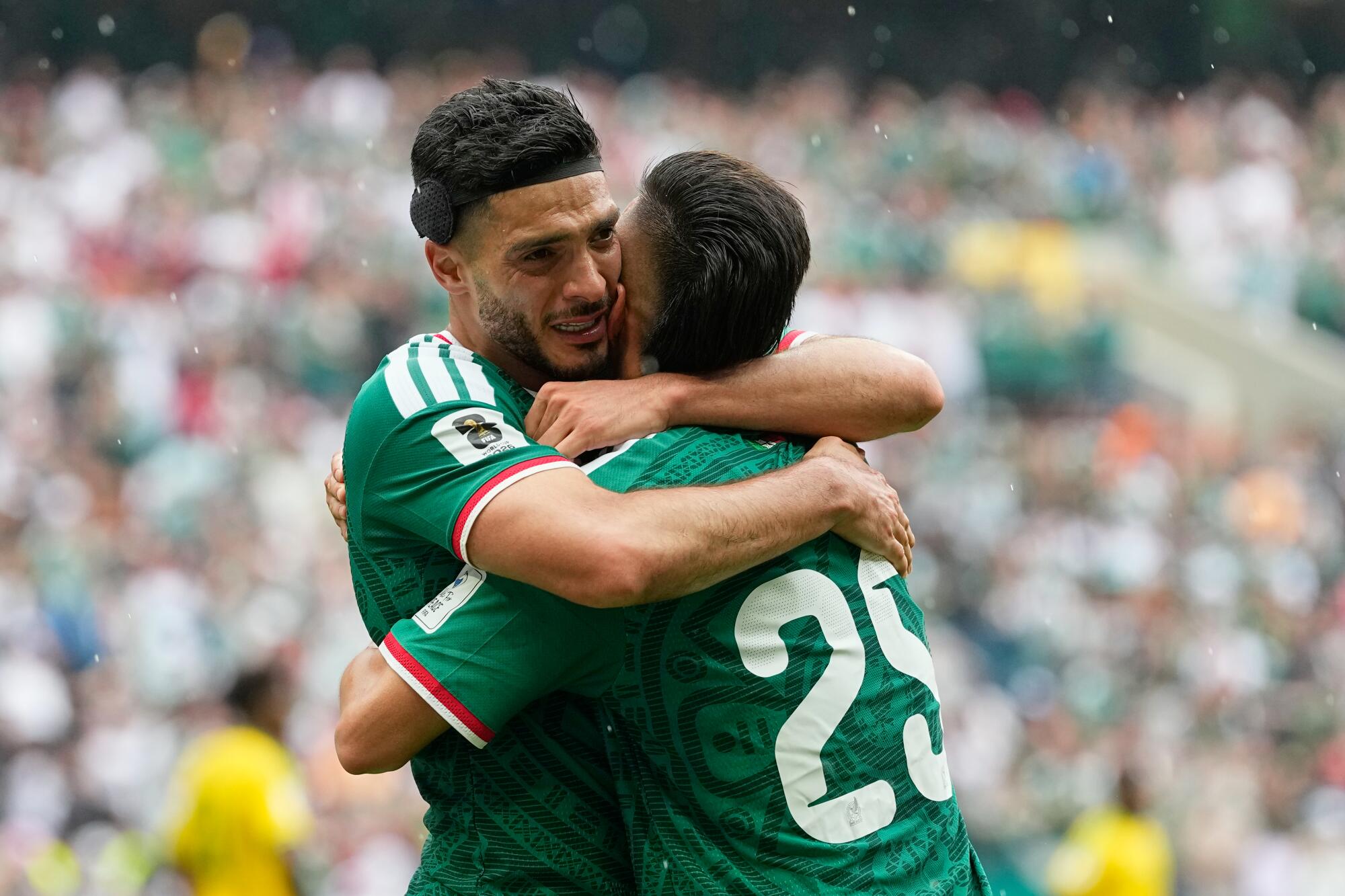
Mexico's Raúl Jiménez cries while hugging teammate Roberto Alvarado after scoring against South Africa in Mexico City.

Mexico’s Raúl Jiménez cries while hugging teammate Roberto Alvarado after scoring against South Africa in Mexico City on Thursday to open the World Cup.

(Natacha Pisarenko / Ap Photo/natacha Pisarenko)

“[It was] the start of the World Cup. It’s an intense atmosphere,” Aguirre said.

“In 25 games, we’ve never had players with cramps — today we had three. It was a very intense, emotional state. It shows that the setting weighed on them a little. Not on everyone.”

Shortly after the substitutions, Roberto Álvarado crossed the ball from the right to Raúl Jiménez, who headed it past South Africa’s goalkeeper, Williams, in the 67th minute.

South Africa was reduced to nine men after Themba Zwane struck Álvarado off the ball. After consulting the video assisted referee, the official gave Zwane a red card.

“I think you can accept the first red card,” said Broos. “I think the second one is debatable. It was a bit harsh on the referee’s part. We have two players who won’t be able to play in the next match.”

After the second red card, Mexico took its foot off the gas again and was met with whistles from the crowd, who were hungry for more goals.

Mexico and South Africa faced off in front of 80,824 fans at Mexico City Stadium to open the World Cup.

Mexico and South Africa faced off in front of 80,824 fans at Mexico City Stadium, more commonly known as Azteca Stadium, on Thursday to open the World Cup.

(David Ramos / Getty Images)

Mexico’s César Montes was sent off in stoppage time for bringing down Khuliso Mudau outside the box as he was heading toward the goal.

With the win, Mexico leads its group with three points and waited to see the result of South Korea versus the Czech Republic in Guadalajara later Thursday. South Africa has zero points. Mexico’s next match is in Guadalajara on June 18 against South Korea, while South Africa faces the Czech Republic in Atlanta.

“We need the next three days to get over the disappointment and fatigue,” Broos said, before addressing his team’s mere two shots on goal. “We have to work on our offense because it wasn’t enough today.”

The match marked the debut of Mora, the youngest player in the World Cup.

“For his first game, he didn’t disappoint,” said Aguirre.

Source link