guadalajara

Guadalajara protesters accuse Hyundai of hiding behind World Cup

While Mexico defeated South Korea at Guadalajara Stadium on Thursday in front of an elated crowd, protesters outside expressed a very different view of the World Cup’s impact on the city.

Community leaders, climate advocates and workers took to the streets to protest what they describe as “greenwashing through sports” by one of the official sponsors of the World Cup amid allegations of irregularities in its supply chain.

The protest organizers argue that Hyundai-Kia should hold its supplier, Ternium, accountable and issue it a “red card.” Protesters accuse Ternium of human rights violations, including alleged links to the disappearance of two environmental activists.

The demonstrations began with a rally at 5 p.m. in Plaza de la Liberación. Participants sought to draw attention to cases of missing persons in Guadalajara, stating they went missing after protesting Ternium’s iron ore mining activities.

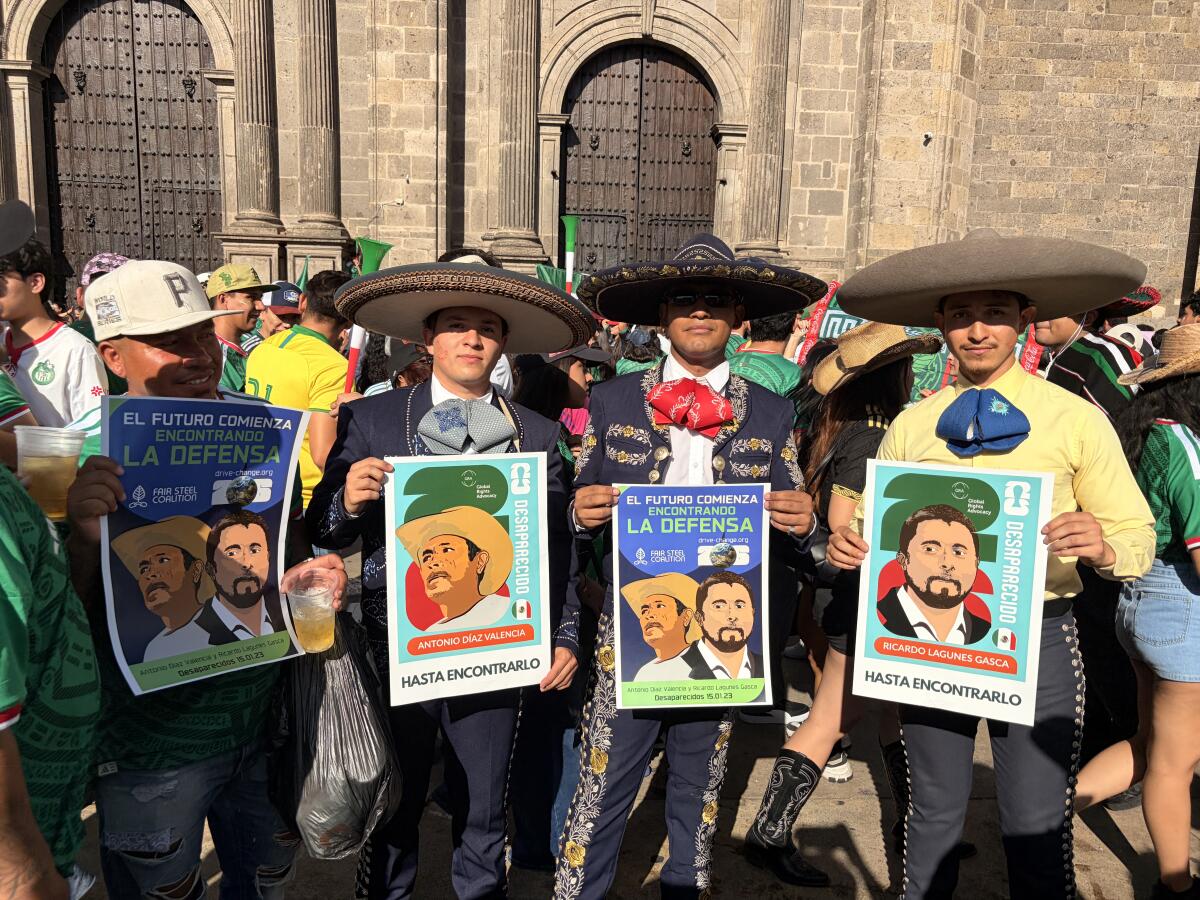
Mariachis hold posters commemorating the disappearance of two environmental activists in Guadalajara

Mariachis hold posters commemorating the disappearance of two environmental activists in Guadalajara: Ricardo Lagunes Gasca, a lawyer and human rights defender, and Antonio Díaz Valencia, a Nahua community leader and activist.

(Courtesy of Fair Steel Coalition)

A 2025 report by the environmental group Mighty Earth criticized Hyundai’s involvement in what it described as a “dirty steel supply chain,” as the South Korean automaker is one of Ternium’s main buyers of iron ore for use in steel production. Ternium has been the target of repeated criticism from activist groups for its alleged destructive environmental impact and corporate governance policies, as well as for the disappearance of activists Ricardo Lagunes Gasca and Antonio Díaz Valencia, which occurred three years ago in Mexico.

Ternium did not respond to the protesters’ allegations, while Hyundai did so in a statement.

“At Hyundai, we are committed to requiring our suppliers to meet the highest standards, and we enforce a strict Supplier Code of Conduct. Both we and our subsidiaries continue to conduct ongoing training, audits, and due diligence processes throughout the supply chain to identify and address potential issues across all our global operations,” said Michael Stewart, Hyundai’s director of communications.

Protesters carried signs bearing the names and photographs of environmentalists who disappeared.

More than 130,000 people have disappeared in Mexico in the past 20 years, according to the National Registry of Missing and Unlocated Persons. The kidnappings have been linked to run-ins with drug cartels and corrupt government officials, while there have also been cases involving young women who worked at the country’s many factories.

Protesters hold up signs featuring images of missing environmental activists ahead of Mexico's World Cup.

Protesters hold up signs featuring images of missing environmental activists ahead of Mexico’s World Cup match in Guadalajara.

(Fair Steel Coalition)

“[Hyundai] is trying to clean up its image through its sponsorship of the World Cup. But the facts are clear: Hyundai is linked to human rights and environmental abuses in Mexico, Brazil, the United States and other countries. By partnering with steel suppliers like Ternium, its slogan of ‘doing the right thing for humanity’ loses credibility,” said Diana Figueroa, a representative of the Fair Steel Coalition, one of the organizers of Thursday’s protests. She said the disappearance of a half dozen environmental activists in southern Mexico and deadly air pollution in Rio de Janeiro and Monterrey are attributed to Ternium.

The group plans to stage more protests throughout the World Cup.

On July 5, a symbolic soccer match and a concert will be held in Monterrey’s Fundidora Park to protest Ternium as one of the city’s most polluting companies.

On July 9, ahead of a World Cup quarterfinal match in Los Angeles, protests will focus on alleged human rights and labor rights violations in Hyundai’s supply chain, including reports of child labor, labor trafficking and documented prison labor.

Protesters also questioned Hyundai’s use of robots at World Cup venues and the tournament’s impact on local workers, including allegations of labor exploitation and rising housing costs in host cities. The organizations Public Citizen and Jobs to Move America demanded transparency from Hyundai regarding the type of data collected by the robots at World Cup stadiums.

Hyundai, in response to the allegations of data collection, said in a statement that it is focusing on the “Next Starts Now” campaign, in which it is “using mobility, robotics, technology, and engagement programs to connect people with the excitement of the event.”

Source link

Emotional crowd powers Mexico to World Cup win over South Africa

FIFA president Gianni Infantino described Mexico City Stadium as a venue “blessed by the gods” and a “true cathedral of soccer.”

Azteca Stadium, as most people know it, is steeped in soccer history and is now the only venue to host three World Cup opening ceremonies. But the Mexican national team had never much World Cup success at the venue.

On Thursday, spurred on by most of the 80,824 fans in attendance and forwards Julián Quiñones and Raúl Jiménez, Mexico managed to defeat South Africa 2-0 and securing its first opening match victory.

Mexico opened the scoring in the ninth minute when Quiñones capitalized on a defensive error by South Africa and fired a shot down the middle, between the legs of goalkeeper Ronwen Williams. The striker, a top scorer in the Saudi Pro League, immediately ran off to celebrate with the bench, marking the first goal of the tournament. The crowd responded by throwing beer into the air.

Mexico continued to press with numerous chances in the first half, including another shot by Quiñones that hit the post and another great save by Williams, who was South Africa’s best player.

“We were far superior in the first half; we could have been up 3-0,” Mexico coach Javier Aguirre said.

South Africa was reduced to 10 men just as the second half began when Sphephelo Sithole brought down Brian Gutiérrez, who was heading toward the goal unmarked. Brazilian referee Wilton Sampaio showed a red card.

“We played well; there were moments when Mexico didn’t know what to do and our organization was very good,” said Hugo Broos, South Africa’s coach.

It seemed the match was going to be easier for the Mexicans with South Africa short-handed, but fans began to boo the Mexican players after they stopped attacking and appeared nervous.

Seeing his players’ lackluster performance on the field, Aguirre responded with substitutions: bringing on 17-year-old Gilberto Mora, a fan favorite, as well as Luis Chávez, to reshape the midfield.

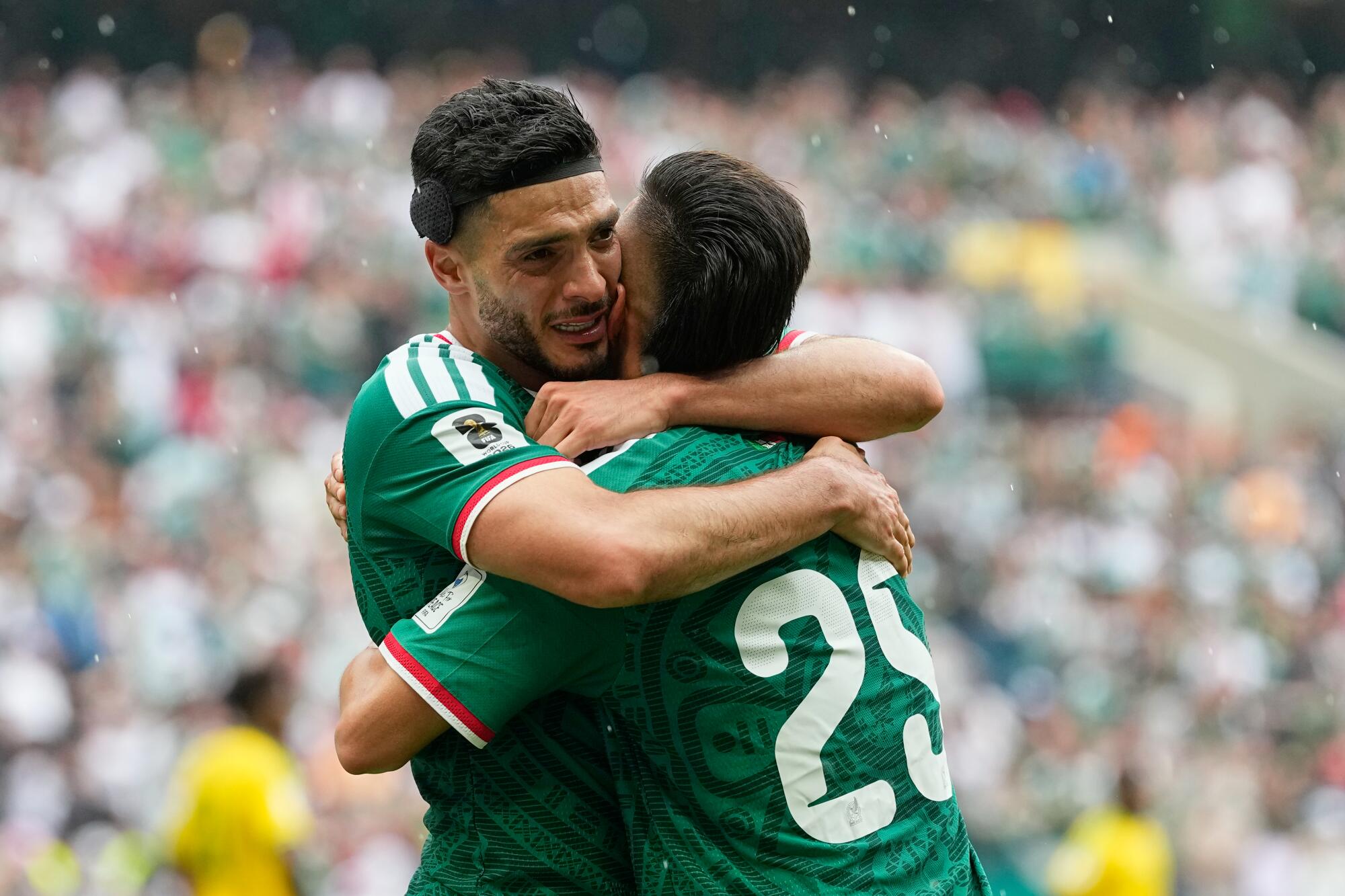
Mexico's Raúl Jiménez cries while hugging teammate Roberto Alvarado after scoring against South Africa in Mexico City.

Mexico’s Raúl Jiménez cries while hugging teammate Roberto Alvarado after scoring against South Africa in Mexico City on Thursday to open the World Cup.

(Natacha Pisarenko / Ap Photo/natacha Pisarenko)

“[It was] the start of the World Cup. It’s an intense atmosphere,” Aguirre said.

“In 25 games, we’ve never had players with cramps — today we had three. It was a very intense, emotional state. It shows that the setting weighed on them a little. Not on everyone.”

Shortly after the substitutions, Roberto Álvarado crossed the ball from the right to Raúl Jiménez, who headed it past South Africa’s goalkeeper, Williams, in the 67th minute.

South Africa was reduced to nine men after Themba Zwane struck Álvarado off the ball. After consulting the video assisted referee, the official gave Zwane a red card.

“I think you can accept the first red card,” said Broos. “I think the second one is debatable. It was a bit harsh on the referee’s part. We have two players who won’t be able to play in the next match.”

After the second red card, Mexico took its foot off the gas again and was met with whistles from the crowd, who were hungry for more goals.

Mexico and South Africa faced off in front of 80,824 fans at Mexico City Stadium to open the World Cup.

Mexico and South Africa faced off in front of 80,824 fans at Mexico City Stadium, more commonly known as Azteca Stadium, on Thursday to open the World Cup.

(David Ramos / Getty Images)

Mexico’s César Montes was sent off in stoppage time for bringing down Khuliso Mudau outside the box as he was heading toward the goal.

With the win, Mexico leads its group with three points and waited to see the result of South Korea versus the Czech Republic in Guadalajara later Thursday. South Africa has zero points. Mexico’s next match is in Guadalajara on June 18 against South Korea, while South Africa faces the Czech Republic in Atlanta.

“We need the next three days to get over the disappointment and fatigue,” Broos said, before addressing his team’s mere two shots on goal. “We have to work on our offense because it wasn’t enough today.”

The match marked the debut of Mora, the youngest player in the World Cup.

“For his first game, he didn’t disappoint,” said Aguirre.

Source link

Nearly 1,900 vanished in and around Guadalajara. Now the World Cup arrives

The highway from the Guadalajara city airport to downtown is newly paved and the city’s famous roundabout has gotten a $4-million facelift. The city is abuzz with renovation projects as Guadalajara prepares to host four World Cup soccer matches in June.

But there’s one thing the 3 million fans expected to flock to the city won’t see — the sites where hundreds of bodies have been found in clandestine graves dug by Mexico’s notorious New Generation Jalisco Cartel. Scores were discovered on the main route leading to Akron Stadium, where the games will be played.

One set of remains was that of a 17-year-old high school student who had gone out to sell his motorcycle to help his unemployed uncle. He disappeared. When his uncle began searching, he disappeared as well. At another site, the bones of a 34-year-old cellphone repairman were found. He was a father of two who’d simply ventured out to shop for used tennis shoes.

According to statistics compiled by the state of Jalisco, between 2018 and March of this year, 1,907 bodies were found in Guadalajara and surrounding cities.

The arrival of the World Cup is an opportunity for Mexico’s second-largest city to shine on the international stage, and the Jalisco state government launched an upbeat campaign highlighting the municipality where games will be played: “Zapopan, the heart of soccer,” the slogan goes.

Families searching for their loved ones sarcastically responded with, “Zapopan, the heart of clandestine graves.”

An aerial view of La Minerva roundabout fountain in Guadalajara

An aerial view of La Minerva roundabout fountain in Guadalajara, Mexico, taken on June 27, 2025.

(Ulises Ruiz / AFP via Getty Images)

Since January of 2025 alone, search groups and authorities have discovered 58 graves with 226 sets of remains inside city limits. Five graves were located within three miles of Akron Stadium.

Three graves with 15 bodies were found within a mile of the city’s iconic La Minerva roundabout, a huge traffic circle featuring fountains, greenery and a towering statue of the Roman goddess Minerva. Others were found not far from Chapultepec Street, a popular tourist destination.

a mother poses with a search card

Liliana Meza, mother of Carlos Maximiliano Romero Meza, who disappeared on Oct. 22, 2020, poses with a search card at the Glorieta de las Personas Desaparecidas in Guadalajara, Mexico, on Friday, May 15, 2026. Founders of the Luz de Esperanza Desaparecidos Jalisco collective created the cards, inspired by World Cup soccer stickers, to draw attention to missing persons cases ahead of the 2026 FIFA World Cup in Jalisco.

(Alejandra Leyva/For The Times)

Though tourists and tourist sites are rarely touched by cartel violence in Mexico, critics say the graves are an embarrassment for state and city administrators.

Amid all the cleanup, little official attention has gone to the growing number of clandestine graves that groups of persistent, family-funded search teams have found in recent months.

Large machinery and backhoes are working nonstop across the city ahead of the games, said Jaime Aguilar, a spokesperson for the group Warrior Searchers of Jalisco, which finds an average of two graves a month. “But when we ask for a backhoe to help in our searches, there is never one available,” he said.

Over the years, secret graves have been discovered in rural areas, at industrial sites, alongside roads, inside buildings and even in the heart of Guadalajara. The Jalisco state government tracks grave discoveries, but an analysis by The Times and Puente News Collaborative shows many have been concentrated in the Guadalajara area.

Flyers with photographs and identifying information about missing persons

Flyers with photographs and identifying information about missing persons, posted by search collectives, have become a common sight along the main streets of the city’s historic center, as seen here on Friday, May 15, 2026.

(Alejandra Leyva/For The Times)

Earlier this year, authorities found a blood-soaked safe house a mile from Akron Stadium where cartel enemies were tortured. One person was found buried there. Within a 10-mile radius, nearly 100 sets of remains were found in 500 trash bags buried in shallow graves.

The graves, and the potential discovery of more, worried Mexican President Claudia Sheinbaum. She feared that FIFA, the international soccer association in charge of the games, might move the Mexico games to the United States or Canada, the other countries co-hosting the games, because of the violence, said one Mexican official familiar with planning for the tournament.

That fear burst into the open in February, when Mexican special forces killed Nemesio “El Mencho” Oseguera Cervantes, leader of the hyper-violent New Generation Jalisco Cartel. Law enforcement officials said Guadalajara is a stronghold for the criminal group.

Cartel members responded to El Mencho’s death by setting fire to cars and buses and blocking major exits from Guadalajara. The city was briefly paralyzed. Gunmen burned 80 convenience stores and a host of pharmacies, flexing their power in the city.

In the days after the violence, FIFA officials met with the Mexican government to review security for the Guadalajara matches. Sheinbaum laid out a plan to send 100,000 security personnel, including Army soldiers and police officers, to stadiums in Guadalajara and the country’s two other host cities, Mexico City and Monterrey. FIFA determined it would not change the World Cup venues.

U.S. law enforcement has been advising Mexico on counter-terrorism methods, including training in repelling drone bombs, a weapon increasingly used by cartels to terrorize communities, attack adversaries and target military convoys. U.S. special forces have been training Mexican military teams to repel attacks at stadiums.

Flyers identifying information about missing persons are displayed throughout Guadalajara's historic center

Fliers with photographs and identifying information about missing persons are displayed throughout Guadalajara’s historic center alongside traditional city scenes and World Cup-related imagery.

(Alejandra Leyva / For The Times)

The Mexican government had already witnessed the Jalisco cartel’s proclivity for brazen killing. In December, some four miles from Akron Stadium, gunmen fired more than 3,000 bullets in broad daylight into the car of a director of a produce distribution center. The gun battle between his security guards and the cartel took place just a few blocks from a police station. It took officers nearly a half hour to arrive at the scene.

In recent years, Jalisco state has become a cartel killing ground, security experts say. Some graves discovered in the Guadalajara area contained a single body, some more than 40. A few had 95 or more.

In 2023, the remains of nine teenagers, chopped up and stuffed in trash bags, were found in a canyon in Zapopan. They had worked for a Jalisco cartel call center where telemarketers scammed Americans of millions of dollars in a time-share scheme. The teenagers are believed to have upset their employer.

Traffickers recruit young people, including minors, to serve as foot soldiers in their bloody quest to control drug-trafficking routes across Mexico. Some of those teenagers were lured by ads promising good-paying jobs, only to discover they were being funneled to a Jalisco cartel training camp an hour outside Guadalajara. There, as a test, Mexican security officials said, recruits were forced to kill fellow recruits.

Plaza Liberacion, the city's main public square

Plaza Liberacion, the city’s main public square, with flyers with photographs and identifying information about missing persons, on Friday.

(Alejandra Leyva/For The Times)

The cartel has recruited more than 45,000 minors across Mexico in recent years, said one Jalisco state representative.

While some of Guadalajara’s upscale neighborhoods have escaped the violence, families across the metropolitan area have seen hundreds of children disappear, some to reappear, dead, on cartel battlefields across Jalisco and in the states of Sinaloa and Michoacán, searchers said.

The Jalisco state government lists more than 16,000 reports of missing people — the most of any Mexican state. Nationwide more than 130,000 people are reported missing.

Despite the preparations and the buzz among the nation’s vast population of soccer fans, World Cup fever has not caught on among families of the disappeared and the search teams that each week fan out across Guadalajara, looking for new graves.

Natalia Leticia García’s son disappeared in 2017. She began her own search and launched a group to help find other victims. Eight years later, García’s group has located 26 graves. Some finds have been bags full of severed heads, others holding just arms. It is a cartel tactic, she said, to make it harder to piece together remains.

“It is cruel,” García said. Her son, César Ulises Quintero García, remains missing.

Fisher is a special correspondent. This article was co-published with Puente News Collaborative, a bilingual nonprofit newsroom that covers stories from Mexico and the U.S.-Mexico border.

Source link