Sweden’s Gripens Are Doing Big Things With A Tiny Footprint In Poland
Russian cruise missiles enter Polish airspace during a major attack on Ukraine. NATO fighters scramble. Two Swedish Gripens join Polish F-16s in the response, tracking airborne threats over Poland. One Swedish pilot attempts to intercept an object believed to be a Russian Kh-101 cruise missile and has conditional NATO authorization to engage. But exceptionally difficult weather prevents positive identification, and the pilot holds fire.
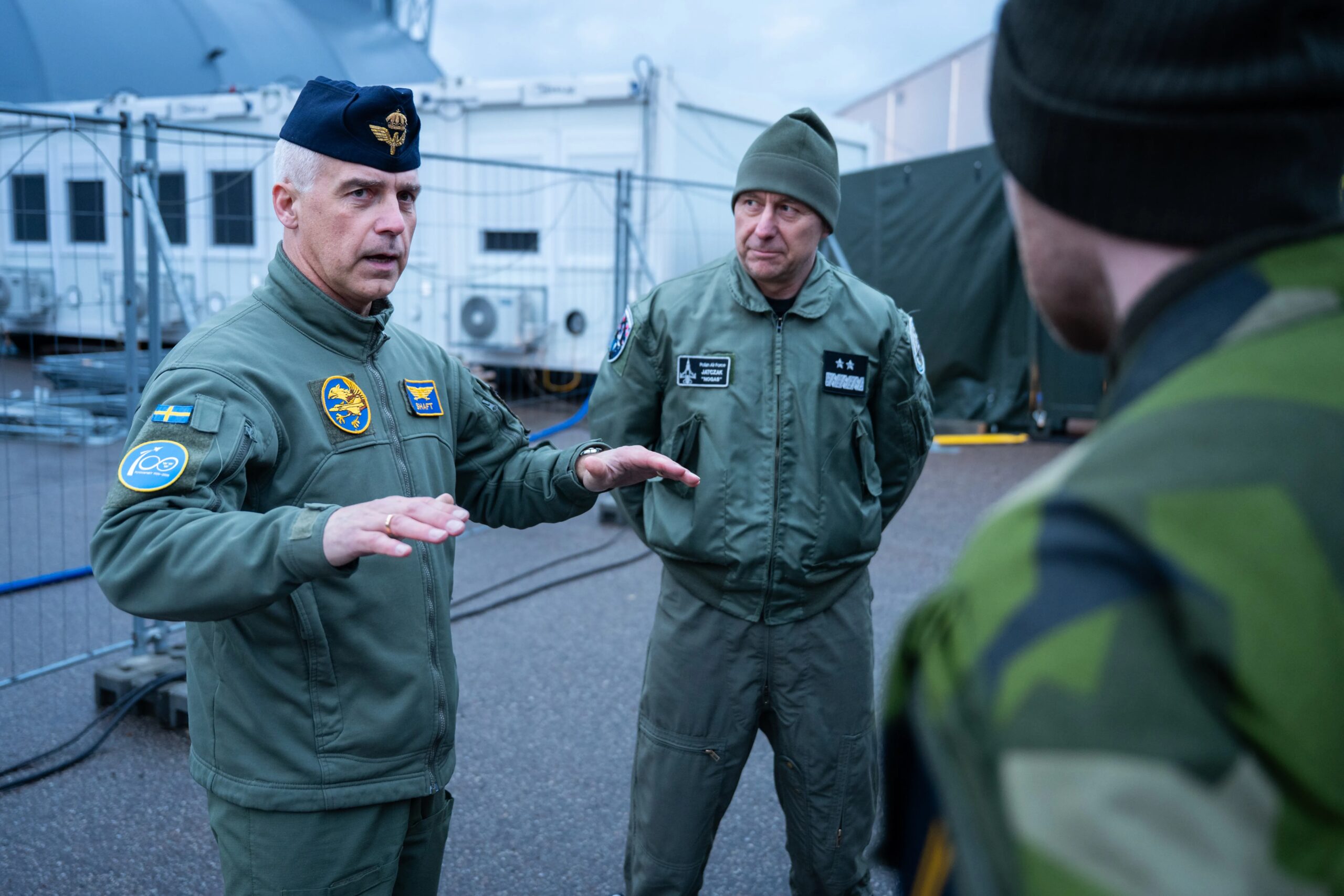
The incident on November 20 highlights the operational value of Sweden’s small forward presence at the airbase of Mińsk Mazowiecki, outside Warsaw. Just two days earlier, TWZ made an exclusive visit to the base, where Sweden is supporting NATO air operations with a forward team of just eight personnel. The Gripens themselves remain primarily based in Sweden, but the small forward support element provides an additional operating location that can help sustain missions on very short notice and give the Swedish fighters greater flexibility as they scramble to defend NATO’s eastern flank.

The operation is a practical illustration of Sweden’s effort to extend its long-established dispersed fighter operations concept across NATO — not as a future capability waiting to be validated, but as an operational approach continuously evolving through real-world missions.
“The events of the past few days have demonstrated the operational value of the concepts we have been developing,” Major General Jonas Wikman, chief of the Swedish Air Force, tells TWZ. “In both Poland and Finland, Swedish fighters have responded rapidly and decisively alongside our allies, while maintaining our national alert commitment.”

“In Poland, we conducted a demanding air defense mission lasting several hours under very challenging conditions. Our small forward support element was instrumental in enabling us to sustain that operation.”
Wikman is particularly proud of the personnel involved, describing the professionalism, judgement, and resolve demonstrated by Swedish personnel in the air and on the ground.
“We are not developing these concepts for some future scenario. We are using them in real-world operations today, learning from every mission and continuously improving our ability to defend our shared airspace. That is what being ready means to me.”

Expanding the Swedish model deeper into NATO
Sweden has spent roughly 60 years building its air arm around the ability to operate fighters from locations beyond their normal air bases, including road strips, civilian airports, and the strategic island of Gotland. The approach is focused on moving aircraft and support personnel quickly, limiting their exposure and avoiding dependence on a small number of large, fixed installations. They are truly masters of dispersed operations, and everything is designed to operate with a minimal logistics and manpower footprint. It turns out that this Cold War concept of operations is more relevant today than it has been in decades.

Now, Sweden is adapting that model to NATO operations, while other air forces are replicating it out of necessity.
“We are really ambitious about our NATO operations, our integration into NATO, and our role as a security provider within the alliance,” Wikman says.
The Swedish Air Force has already deployed fighters to NATO missions in Iceland and Poland, while also maintaining national commitments. Wikman describes the broader effort as an evolution of Sweden’s dispersed operations concept, incorporating the flexibility associated with the U.S. Air Force’s Agile Combat Employment (ACE) while extending the ability to operate from locations across allied territory.

The scale of the current Polish deployment marks a significant change from an earlier operation at Malbork, where Sweden sent more than 100 personnel.
Wikman wanted to reduce that footprint substantially, challenging the wing commander to determine how little personnel and equipment were actually required to support the mission.
The result was a forward team of just eight personnel.

Rather than establishing a substantial forward operating base, the team uses familiar Swedish equipment and procedures, bringing what is required to support aircraft operating from Sweden. The approach is intended to be repeatable, reducing the preparation and logistical burden associated with deployments and making it easier to shift support between different NATO directions.
Wikman believes the concept can make operations more flexible, allowing Sweden to sustain commitments in different locations without having to build a large support organization for each one.
The Missed Refueling Base
The forward location in Poland is described as a Missed Refueling Base, or MRB. Originally established as a contingency option, it has proven sufficiently useful to become routinely used for forward Gripen operations, including for scheduled turnarounds (landing, basic service/refuel, and departure) of the jets.
Gripens normally operate from Swedish bases, even when patrolling over Polish skies, and can use air-to-air refueling to extend their time and reach. The MRB provides another option if an aircraft needs to land, whether because of an unexpected issue or as part of a planned operation.

A problem with the refueling probe, for example, could prevent an aircraft from receiving fuel in the air. Having a forward location available means the aircraft can recover without necessarily having to return to its home base in Sweden.
But its broader value is not simply emergency recovery.
The location extends operational reach, flexibility, and the number of options available to commanders. Aircraft can land, refuel, and receive limited maintenance, and even rearm during a crisis, with the tiny forward team providing a means of sustaining operations without deploying a full squadron support infrastructure.

The Swedish approach is built around the idea that an operating location does not need to replicate a home air base to provide significant operational value.
The Gripen itself is famously designed for rapid servicing. Wikman says an aircraft in the air-to-air role can be refueled and rearmed in less than 15 minutes using one officer and five conscripts. That combination of aircraft design, procedures, and personnel is central to the Swedish model.

Tankers, turnaround and surviving the targeting cycle
The MRB also ties into Sweden’s thinking about how fighters will operate in a high-intensity conflict.
Air-to-air refueling remains valuable, but Wikman stresses that Sweden must be able to conduct operations without depending on tanker availability. Tankers could be heavily tasked, unavailable, or threatened in a contested environment.
The objective is not to abandon aerial refueling, but to ensure it is not a single point of failure.

“We intend to do the quick refueling within the enemy targeting cycle,” Wikman says, describing the importance of being able to land, refuel, and get back into the air quickly, frustrating an adversary’s efforts to detect and successfully attack those same aircraft while they sit on their airfield.
Sweden is also developing procedures for hot rearming, allowing weapons to be replenished as aircraft are turned around without the engine shutting down. Wikman expects this process to take less than 10 minutes, potentially around five or six minutes, although the procedures continue to evolve.

The challenge becomes more complex as the distance between operating locations and logistical support grows.
As Sweden develops the ability to disperse fighters and operate farther from its main bases, it must also develop the logistics to sustain aircraft, personnel, fuel, ammunition, and maintenance across those same distances. Extending operational reach without extending the supporting supply system would ultimately limit the value of the concept.

That is an important area for continued development within NATO, particularly as nations seek to make dispersed operations sustainable rather than simply achievable for short periods.
Finland, Poland and national QRA simultaneously
The Polish deployment is taking place alongside Swedish support for air defense operations in Finland and Sweden’s own national quick reaction alert (QRA) mission.
In Finland, Sweden has trained Finnish maintenance personnel at each wing to support Gripen hot refueling. The Finnish personnel have also received virtual-reality training equipment to help them maintain their skills.
Wikman describes the Finnish arrangement as more bilateral in nature, while the Polish deployment is part of Sweden’s effort to establish a repeatable way of operating across NATO. At the same time, the involvement of the Gripens speaks to the situation in Poland, where jets are scrambling from Sweden to deal with growing airspace incursions by Russian drones and cruise missiles. They execute this mission alongside Polish F-16s and other NATO fighters based, even if temporarily, in Poland and the wider region.
At the same time, Sweden is maintaining its national QRA commitment. Wikman said the effort is centered on Ronneby, in southern Sweden, but draws on aircraft and pilots from other wings, including Luleå, close to the Arctic Circle.

“More or less three directions: Finland, Poland, and our national QRA at the same time, which is a new kind of record for us,” he says.
For a relatively small air force with six fighter squadrons, sustaining those commitments is a significant undertaking. Of those squadrons, more than one is also pretty busy with introducing the new Gripen E version. The smaller Polish footprint is intended to make that kind of activity more manageable, allowing personnel to rotate without maintaining a much larger deployed contingent.
The approach also allows Sweden to concentrate on generating fighter sorties while relying on forward support locations to provide flexibility when operational circumstances demand it.
Lessons from Ukraine
Wikman sees a close connection between Sweden’s approach and the way Ukraine has had to operate its air force under sustained Russian attack.
He says the Swedish and Ukrainian air forces are aligned in their thinking about dispersed operations, and that the relationship has shifted rapidly from one of support to partnership. Ukrainian experience is now feeding back into Swedish thinking.
“This fits Ukraine perfectly,” Wikman says, pointing to the value of movement, dispersal and the ability to continue operating despite an adversary’s efforts to target air bases.

Wikman draws a distinction between preparing for a conflict and conducting one under fire.
“They are fighting the fight. We prepared the fight.”
Ukraine’s need to keep aircraft moving between locations and avoid predictable operating patterns has demonstrated the importance of dispersal in practice. For Sweden, those lessons reinforce an approach it has developed over decades, while also highlighting the need to make it work with allies and partners.

Indeed, the Gripen has frequently been promoted as a particularly suitable fighter for Ukraine because its design and support concept are built around these kinds of operations, including the ability to operate from austere locations with small ground crews and rapid turnaround. Kyiv is scheduled to receive its first of up to 16 Gripen C/D fighters early next year, with longer-term plans calling for more advanced Gripen Es to join the Ukrainian Air Force, too.
For now, the Polish Gripen deployment is a modest operation in terms of personnel and equipment, but that is precisely the point. Sweden is demonstrating how a small support element, backed by aircraft and deeper maintenance capacity at home, can extend the reach of its fighters without recreating a full air base abroad.
And now, with Swedish Gripens responding to real airspace threats over Poland, the value of that approach is no longer theoretical.

The longer-term challenge will be sustaining the model across different NATO locations, with host-nation support, ammunition access, fuel, maintenance, and common procedures needed for more demanding operations.
For Wikman, however, the process is already underway.
Sweden is not waiting for the next conflict to determine how its dispersed fighter operations will work across NATO. It is learning, adapting, and refining the concept while flying the missions that make it necessary.
Contact the author: thomas@thewarzone.com