Greece will ban social media for children under the age of 15 from next year, Prime Minister Kyriakos Mitsotakis announced on Wednesday, making it the latest country to follow Australia’s landmark move.
In a video message posted on TikTok, Mitsotakis said
Weekly insights and analysis on the latest developments in military technology, strategy, and foreign policy.
For nearly four weeks now, a very stealthy high-altitude, long-endurance (HALE) surveillance and reconnaissance drone commonly and unofficially referred to as the RQ-180, or an evolution thereof, has been seen flying around Larissa Air Base in Greece. New, remarkably detailed videos of the uncrewed aircraft that have recently spread on social media offer insights into its sensor package and other aspects of the design. Just yesterday, TWZ also published an in-depth feature exploring the likely role of the ‘RQ-180’ in the ongoing conflict in Iran and how it ties to a secret Cold War drone program that was, in many ways, its progenitor.
The very large and very stealthy flying wing-type drone was first spotted in the skies around Larissa Air Base, also known as Larissa National Airport, in the city of the same name in Greece, back on March 18. Local spotter Efthymios Siakaras shared two new video clips offering especially good views of the uncrewed aircraft in flight, one on Sunday and another on Monday, which our friends over at The Aviationist were first to report on. Similar to the stealthy RQ-170 Sentinel being dubbed the “Beast of Kandahar” after it was first spotted in Afghanistan in the late 2000s, many are now also calling this drone the “Lady of Larissa.”
🇺🇸🇬🇷 O drone de reconhecimento furtivo americano RQ-180, de uso secreto, foi avistado pela segunda vez ontem, pousando em Larissa, na Grécia.
Esta é a melhor imagem até o momento da aeronave altamente secreta e ainda não confirmada.
Of the features visible in the latest footage of the Lady of Larissa, the most notable are a pair of large electro-optical sensor apertures underneath its central fuselage, right behind the main landing gear bay. The two windows are noticeably angled to the left and right. Behind those transparencies would be a large multi-spectral sensor system that can look down to the ground below and out at long slant angles towards the horizon from the aircraft’s very high perch. By having one window on each side, the RQ-180 could run racetrack patterns some distance from its target while providing continuous coverage. If a sensor is housed under each window, it could collect intelligence over much larger swathes of terrain at any given time.
As TWZ has noted for years, the RQ-180 would, with near certainty, carry a powerful radar with ground moving target indicator (GMTI) and synthetic aperture radar (SAR) modes as its primary sensor, along with electronic intelligence collection capabilities. Optical camera systems were always another possibility, one that seems to have proven true now.
“At its most basic, GMTI allows battle managers to see the enemy’s ground movements in real-time and then quickly adapt their game plan to counter those enemy forces before they can ever attack, or even pose a threat to friendly forces. GMTI is also a critical capability for detecting changes in force posture, establishing patterns of enemy movements over time, and identifying new targets of interest. Modern GMTI products can also be looped into a ‘kill web’ for rapid targeting purposes.“
“Some of this is also achieved through the aforementioned SAR mode, which basically provides a satellite-like image of a target area using radar. It also has the ability to see some things optical systems cannot, and, like GMTI, it can work under nearly all atmospheric conditions, day or night. When paired with GMTI, SAR can be used to help positively identify targets, as well as gain better situational awareness about the targets being tracked.“
A generic example of GMTI tracks overlaid on top of a SAR image. Public Domain
“Passive electronic intelligence collection that allows for radiofrequency-emitters to be quickly detected and geolocated via onboard antennas and interferometry-based computing is another part of the equation. Long-range optical sensors can also provide higher-fidelity intelligence and spot movements of infrared signatures over large areas. You can imagine how fusing all these capabilities together, combined with advanced networking, on a single platform could be incredibly potent. Basically, detecting a target or target group of interest, and then training advanced sensors on it to rapidly build up a high-quality understanding of what is going on and even to provide real-time targeting data to ‘shooters’ would be this aircraft’s bread and butter.“
The drone’s electro-optical system and radar, together with the rest of its sensor suite, could offer a secondary air-to-air surveillance capability, as well.
As an interesting aside, Scaled Composites’ Proteus high-altitude test aircraft has previously been seen flying with an extremely similar-looking sensor suite with an oddly angled aperture housing. The high-flying Proteus has a long history of being used to test and evaluate new sensors and other advanced capabilities. Scaled Composites is also a wholly-owned subsidiary of Northrop Grumman, widely understood to be the prime contractor behind the RQ-180.
When we saw pics of that EO aperture on Proteus years ago I said to Joe, “well that’s sure to be for the 180!” https://t.co/iGT83KX4JC
In addition, the underside of the drone’s central fuselage, which is where the main array for the aforementioned radar would go, has a very pronounced bulge. This would house a rotating radar or a two-sided one so that the aircraft can scan the same area while traveling in either direction. Supplemental conformal arrays, or even load-bearing ones, could also be positioned all around the aircraft, along with communications antennas, electronic warfare gear, and electronic surveillance measures hardware.
The new views of the drone flying around Larissa underscore just how widely positioned its tricycle landing gear is, along with its very broad wingspan. As we’ve noted previously, a landing gear configuration like this allows for a large volume for payload and good stability on the ground.
It is worth pointing out that there looks to be a foreign object debris (FOD) deflector fitted around the wheel of the nose landing gear. In general, the radar absorbent coatings and the composite skins of stealthy aircraft are very sensitive. What might look to be relatively minor surface damage at a casual glance can have significant negative impacts when it comes to radar cross-section, which is critical for the aircraft’s mission effectiveness and survival. From what we can see, the drone will be sitting very low on its gear when on the ground. This only increases the potential for foreign objects to get kicked up and hit its belly during takeoff and landing. This is especially true for the low-hanging ventral bulge where sensor apertures are, right behind the nose gear. So, this debris guard makes total sense.
The trailing-link style nose landing gear otherwise has a two-wheel configuration very much in line with that of the B-21 Raider bomber, but in a scaled-down form. This is not all that much of a surprise, as the B-21 shares a general planform with the RQ-180. The Raider’s development was likely heavily influenced by the RQ-180, or a progenitor of the flying wing uncrewed aircraft we are seeing today.
A close-up look at the nose landing gear on a preproduction B-21 Raider bomber. USAF
The drone’s main landing gear looks extremely similar to what is found on F-15 fighters. Borrowing existing, proven components for experimental or low-production aircraft like this is a time-honored tradition. The use of an F-15’s main landing gear points to a high gross takeoff weight. The maximum takeoff weight of the latest F-15EX variant is 81,000 pounds, according to Boeing, and the F-15 has a much smaller, single nose wheel. For comparison, the high-flying Global Hawk drone’s maximum takeoff weight is 32,250 pounds, per the U.S. Air Force, and it has distinctly less robust landing gear to match.
A look at one of the US Air Force’s new F-15EX fighters, offering a good look at its main landing gear. USAFThe less robust design of the RQ-4 Global Hawk’s landing gear is plainly visible in this stock picture of one of the drones. USAF
At the same time, the Lady of Larissa would not necessarily need to make use of all of that capacity, or it could even have a bit higher gross weight, and various additional factors could have influenced the choice of landing gear. The overall design is likely to be light for its overall size to maximize range, endurance, and high-altitude performance. With its reconnaissance and surveillance mission sets, there would be no need for a payload bay structure to carry heavy weapons. This, along with the lack of any need to support a crew, would allow the aircraft to be absolutely packed with fuel.
While its similarities to the B-21 are glaring, the Lady of Larissa is even more optimized for high-altitude flight than the Raider, which itself is a step beyond in altitude performance over the B-2. You can read all about this in our past feature here. The drone’s overall massive flying wing shape and its very clean, laminar flow-like sculpting, along with wings that look designed to allow the RQ-180 to loiter at relatively extreme altitudes, support its penetrating, persistent reconnaissance mission set.
Furthermore, the most recent videos of the Lady of Larissa offer new looks at the control surfaces in action. Like what is found on the B-21 and Northrop’s preceding B-2 Spirit bomber, the drone has flaperons along the trailing edges of the wings and along its diamond-like empennage. There may also be a central variable geometry ‘beaver tail’ section, something also found on the B-2, but not on the B-21, although this could just be the inboard flaps being slightly extended.
The B-2’s ‘beaver tail’ control surface can be seen here in this picture of one of the bombers.USAF
Much remains to be learned about the drone’s design and capabilities, as well as why it is operating out of Greece and how long it has used Larissa as a forward base. Why such a sensitive asset continues to be seen flying in the middle of the day is also curious. After the highly exotic uncrewed aircraft was first spotted at Larissa, reports said that it had landed there after experiencing some kind of technical issue, though this remains unconfirmed. The drone could have diverted there after taking off for a mission from another operating location, even one potentially inside the United States. All that being said, as we’ve noted in the past, Larissa does look to have unique facilities that seem very well suited for hosting an aircraft like this, and that were only built in recent years.
It may be that it simply has no place to hide any longer, and more flexibility is being exercised as to when it can and can’t depart and land from wherever it’s operating from. This could also mean the Pentagon may be more willing to acknowledge its existence in the not-so-distant future.
As mentioned at the start of this story, TWZ just yesterday laid out a detailed case for why the RQ-180 would be very relevant for helping hunt Iranian mobile missile launchers. That is a mission set that likely evolved from work on a previous secret Cold War-era stealthy drone program called the Advanced Airborne Reconnaissance System (AARS), also known by the codename Quartz. There are many other roles it could execute in relation to Operation Epic Fury, as well.
Overall, we have gotten our best look at the so-called RQ-180. We now know it is capable of radio-frequency and electro-optical sensing, and we have a bit better idea of its overall size and mass. This is a very large unmanned system that is smaller in size than the B-21, but far larger than RQ-170. A very cursory guess supports a wingspan of something on the order of 130 feet or larger, but again, that is just a guess. This aircraft is clearly optimized to fly at least at Global Hawk altitudes (upwards of 60,000 feet) and possibly higher, approaching that of the U-2, giving it a huge line of sight to target areas. Being such an efficient-looking design and being so large with so much internal volume, it likely measures its endurance in days, not hours.
The airline and tour operator has shared advice for passengers on social media
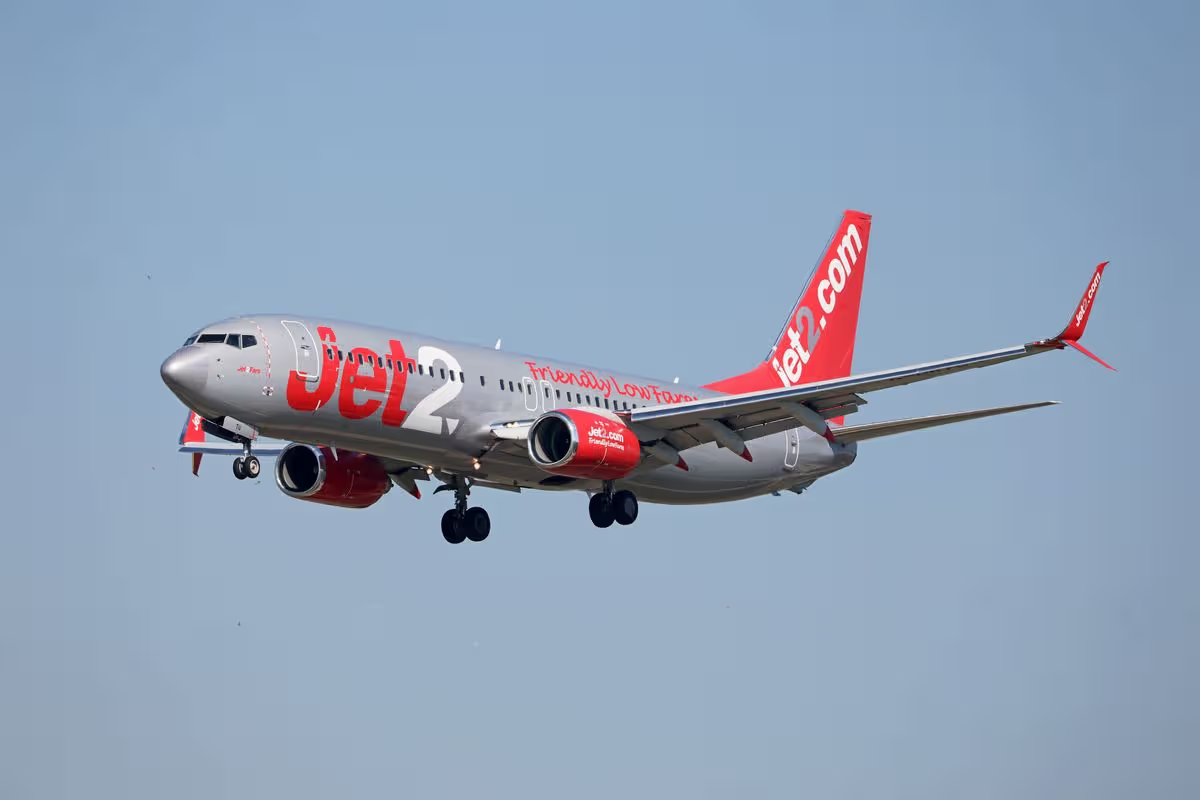
Jet2 shared a message about bookings on social media (stock photo)(Image: Getty)
Jet2 has issued an update for passengers worried about disruption to their spring travel plans. With the Easter holidays here at last, many families have booked European getaways over the next few weeks. However, some passengers are worried about possible cancellations.
Greece faced travel disruption this week after a deadly storm hit parts of the country, and Crete was enveloped in a Saharan dust storm. Passengers have also been warned of possible jet fuel shortages caused by the Iran war.
One passenger who shared their concerns with Jet2 has been told that all flights are currently planned to go ahead as normal. Taking to X, a customer named Liz Hughes asked Jet2 for guidance ahead of an upcoming trip to Corfu later this month.
Liz wrote: “We have return flights booked Man-Corfu 13-20 Apr. Should we be worried about cancellations?” A Jet2 employee named Lily responded to the question on Friday (April 2).
Replying from the @Jet2tweets account, Lily said: “Hi Liz, all flights are planned to go ahead as normal. If anything were to change regarding your booking, we would be sure to reach out to you directly to make you aware, and discuss the options available to you. Thanks, Lily.”
Content cannot be displayed without consent
The news comes as Ryanair boss Michael O’Leary has recently said passengers could face severe disruption in early May if the Middle East conflict continues. Speaking on Sky News Michael O’Leary said: “Fuel suppliers are constantly looking at the market.
“We don’t expect any disruption until early May, but if the war continues, we do run the risk of supply disruptions in Europe in May and June, and we hope the war will finish sooner than that and the risk to supply will be eliminated.”
Oil prices have surged since February due to Iran’s block on tankers passing through a key shipping passage, the Strait of Hormuz. The Business Secretary has said there are no supply chain issues for jet fuel “at this moment.”
Peter Kyle told Times Radio: “I was looking immediately after the conflict started, where we interact in order to get resilience into our society, into our economy, we’ve been working with all these key sectors, identifying sectors where there may well be challenges down the track. We have no (fuel) supply chain issues at this moment at all.”
UK airlines are not experiencing disruption to their supply of jet fuel, according to an industry association. An Airlines UK spokesperson said: “UK airlines are currently not seeing disruption to jet fuel supply and continue to engage with fuel suppliers and Government to monitor the situation.”
Passengers should act now before flights get more expensive
Steffan Rhys Deputy Content Hub Director
10:35, 29 Mar 2026Updated 10:40, 29 Mar 2026
The cost of air passenger duty goes up on Wednesday
Passengers thinking of booking flights from the UK should book before Wednesday if they want to avoid an imminent cost increase. Air passenger duty (APD) is going up on April 1, making flights more expensive. As the duty forms part of the cost of each airline ticket, carriers say the adjustment is likely to result in higher fares on some routes, Majorca Daily Bulletin reports.
The amount of air passenger duty per person depends on several things, including ticket class and how far the country’s capital city is from the UK. The amount goes up significantly if you sit in anything but basic economy and if you fly to a country whose capital is more than 2,000 miles away from London.
Travel expert Simon Calder explains that the levy “is unique to the UK and a topic of much controversy”. He adds: “Chancellor Rachel Reeves has imposed an above-inflation increase from April 1, 2026 and one in line with the retail prices index a year after that. By the summer of 2027, a family of four flying premium economy to Orlando will pay over £1,000 in tax for leaving the UK in anything better than basic economy.”
Four different categories of destination
UK domestic flights
Band A: Countries where capital city is 2,000 miles or less from London — this covers all of Europe
Band B: Capital city is 2,001-5,500 miles from London — includes most long-haul destinations
Band C: Capital city is over 5,500 miles from London — includes Bangkok, Singapore, Hong Kong, Tokyo, Buenos Aires and Australia.
What are the rates?
From April 1, 2026, they will all rise to the following:
UK domestic: £8 (economy) or £16 (anything but economy)
Band A: £15 or £32
Band B: £102 or £244
Band C: £106 or £253
Before April 1, 2026 the rates are as follows:
UK domestic: £7 or £14
Band A: £13 or £28
Band B: £90 or £216
Band C: £94 or £224
So you can see, the increases are not huge but could add significant costs to the price of a holiday for a family of four to somewhere that is more than 2,000 miles away.
APD does not apply to children under 16 travelling in basic economy but is payable for all children over two travelling in premium classes.
How much APD will I pay?
A family of four with childrenbetween two and 15 will pay the following APD from April 1, 2026:
UK: £16 in basic economy, £64 in premium economy or better.
Europe: £30 or £128
Most long-haul destinations: £204 or £976
Ultra-long-haul destinations: £212 or £1,012
But a family of four with children aged 16 and over will pay the following APD from April 1, 2026:
UK: £32 in basic economy, £64 in premium economy or better
Europe: £60 or £128
Most long-haul destinations: £408 or £976
Ultra-long-haul destinations: £424 or £1,012
As you can see, the year-on-year increases are not that significant for shorter flights, but can add up more if you are taking older children on longer flights. But if you feel that you want to save every pound possible, if you get your flights booked before Wednesday then you’ll save on APD.
In 1821, the Greeks rose up against the Ottoman Empire which had occupied Greece for almost 400 years, leading to the war of independence.
Bishop Germanos of Patras raised the Greek flag at the monastery of Agia Lavras, inciting the Peloponnese to rise against the oppressors.
While the exact date probably may not have been March 25th, it is acknowledged to have occurred in late March and it was gradually associated with the religious Feast of the Annunciation.
On this day in the Orthodox calendar, the archangel Gabriel appeared to the maiden Mary and informed her that she was pregnant with the divine child.
The first modern Greek state was founded in 1828 under the name “Hellenic State” and consisted of the Peloponnese and part of Central Greece. The first governor was John Kapodistrias who founded schools and orphanages and helped make great advances in the development of the Greek economy and education.
Kapodistrias is still honoured in Greece today; the Greek euro coin of 20 cents bears his face.
Brits heading to Greece have been urged to check the latest travel advice as tensions linked to the Iran conflict raise wider security concerns across the region
The conflict in Iran has disrupted air travel across the globe(Image: ANIK)
Brits planning a Mediterranean getaway are being urged to check official travel guidance before heading abroad. Experts say no trip can ever be guaranteed completely safe amid growing tensions linked to the Iran conflict.
The latest reminder comes from the Foreign, Commonwealth & Development Office, which publishes travel advice for British holidaymakers. Its guidance for Greece stresses that travellers should read all advice carefully before departure.
On the UK Government travel advice website, officials warn: “No travel can be guaranteed safe.” It urges visitors to research destinations carefully and make sure they have comprehensive travel insurance before travelling.
The guidance also highlights passport rules that travellers must meet before entering the country. Greece follows Schengen Area rules, meaning passports must have been issued within the last 10 years and remain valid for at least three months after leaving the region.
British tourists can visit Greece without a visa for short trips. According to the government, travellers can stay in the Schengen area for up to 90 days within any 180-day period for tourism, family visits or business meetings.
However, new border procedures are also on the horizon for travellers heading to Europe. The European Union is introducing its Entry/Exit System, which will require visitors to register biometric details such as fingerprints or a photo when entering the bloc.
The system is expected to become fully operational from April 10. Officials warn the process could add several minutes to border checks for each passenger.
It comes as tensions continue to grow in the Middle East following the ongoing conflict involving Iran. The crisis has raised wider regional security concerns across parts of the eastern Mediterranean.
Neighbouring Cyprus, which lies roughly 800km from mainland Greece and around 300km from parts of the Middle East, has already been monitoring the situation closely. The island has previously served as an evacuation hub for foreign nationals during regional crises.
According to reports cited by international media and the United Nations, the latest escalation has fuelled fears of broader instability across the region. Military exchanges between Iran and its rivals have already heightened security alerts across several neighbouring countries.
The UK has also stepped up its military presence in the region. The HMS Dragon has been deployed to Cyprus as a precautionary measure. The Royal Navy says vessels may be deployed to support British nationals and regional security as required.
Despite the geopolitical tensions, Greece remains one of Europe’s most popular holiday destinations. Data from the Greek National Tourism Organisation shows the country welcomed more than 36 million international visitors in 2024.
Officials say the key message for travellers is to stay informed. Checking the latest government advice and ensuring documents meet entry requirements can help avoid problems when travelling abroad.
GREECE is the latest holiday destination seeing a drop in holiday bookings amid the Iran crisis.
In a statement released this week, On The Beach confirmed a number of popular holiday destinations including Greece had seen a drop in demand as a result of growing tensions in the Middle East.
Sign up for the Travel newsletter
Thank you!
On The Beach has reported that travellers are not booking holidays to GreeceCredit: Alamy
The announcement came as the online package holiday provider made a statement that it was suspending its profit forecast.
The group said: “Whilst the group has limited exposure to destinations in the Middle East, it has experienced a significant slowdown in demand following the onset of conflict in the region, particularly to destinations such as Turkey, Greece, Cyprus and Egypt.
“The timing of when the conflict will end and the shape of recovery in demand to these destinations are unknown.”
Despite this, the Government currently has no warning against travel to Greece.
And there are other companies, such as TUI, that have seen increased interest in Greece (along with Portugal and Spain)as “customers opt for familiar destinations”, reports The Times.
Taking to Reddit, travellers currently in Greece have shared what it is like.
One person commented: “I’m in Athens currently and it’s very crowded, also it feels perfectly safe.”
Another person said: “I live in Peloponnese, southern tip on the coast of Greece.
“We’ve been hearing a ton of military planes flying around us the last few days.
“They are definitely preparing for the worst but we are not scared at all.”
Earlier this month, the RAF Akrotiri base on Cyprus was hit by an Iranian drone.
As a result, there was a temporary closure of Paphos Airport, with flights being cancelled.
Despite this, Cyprus remains on the safe to travel list with the Foreign Office warning: “Regional escalation poses significant security risks and has led to travel disruption.”
Current guidance includes monitoring local and international media and signing up for local information alerts and resources.
Current Government advice lists Greece as safe to travel toCredit: Alamy
However, similar to Greece, Cyprus has also seen a drop in tourism.
Local businesses have expressed how people are “thinking twice” about visiting, with a number of hoteliers saying that bookings are down across March and April.
Cyprus’ foreign minister Constantinos Kombos told the BBC: “I don’t think that anyone should be in two minds, given the fact that the situation, as I have been describing right now as we speak, has been perfectly normal.
“All activity is normal. Air traffic is going back to 100 per cent what it was before the incident.
“So I don’t think this is something that should be affecting people’s decisions.
“And the security factor in terms of people feeling that everything is being done that is humanly possible to protect both citizens, residents, and visitors to Cyprus.”
Protesters in Athens have marched to the US Embassy to condemn the US-Israeli attacks on Iran, joining protests held worldwide over the escalating conflict.
BRITISH holidaymakers have been caught up in the Iran crisis, with thousands stranded abroad and even more fearing for their upcoming trips.
But if you haven’t booked your holiday yet, should you be doing it now to avoid any price hikes?
Sign up for the Travel newsletter
Thank you!
Your holiday to Spain and Greece is likely to cost more this summerCredit: AlamyAirlines are already hiking flight fare prices, and this is likely to continueCredit: Alamy
In response, airlines such as Qantas, Scandinavia’s SAS and Air New Zealand have all raised flight prices already.
Some airlines such as Ryanair, easyJet, British Airways and Virgin Atlantic, are less affected as they have secured some of their fuel at fixed prices for a set amount of time – called hedging.
Ryanair boss Michael O’Leary said the rise in jet fuel “won’t affect our costs and it won’t affect our low fares,” something easyJet also echoed.
But flights elsewhere are likely to go up in the next year or so, as the conflict continues.
Most airlines in America do not protect themselves against jet fuel price increases, meaning Brits are likely to see more expensive transatlantic fares.
According to research from Skift this could cost US airlines as much as $24billion in extra fuel costs – working out to 11 per cent increases on flights.
Not only that, but the closure of the Strait of Hormuz – one of the world’s most important shipping routes – is also having a knock-on affect and could lead to shortages.
James Noel-Beswick, head of commodities at market intelligence firm Sparta Commodities, told the BBC that it was very likely” that prices will increase this summer.
He added: “I think we’re weeks away from maybe flight cancellations or delays due to lack of jet fuel, rather than months.”
So, what can Brit holidaymakers do?
Qantas has already said they are raising pricesCredit: EPA
If you were planning on booking a package holiday, many tour operators allow you to lock in a cheap price, and simply pay a deposit, with the full balance coming later.
Jet2 allows you to book a holiday with a £60pp deposit while TUI has a number of £0 deposit schemes.
Loveholidays has deposits from £19pp, as well as a “Best Price Promise” that refunds the difference if your holiday is cheaper within seven days of booking, plus an extra £5 per person.
Destinations like Spain – already one of the most popular holiday destinations for Brits – are likely to see even more demand this year along with Greece due to being seen as ‘safer’ holiday destinations.
This means you might see a jump in price more than usual as well.
Dubai is still on the “only essential travel” list so holidays to the UAE city are currently suspended, along with Jordan also on the travel ban list.
Even destinations like Egypt and Turkey are being affected, with a number of Sun readers concerned about holidays to both.
The Sun’s Head of Travel on which holiday destinations to go to instead this year
The Sun’s Head of Travel Lisa Minot, explains: “There’s no doubt the current crisis in the Middle East is going to have a seismic impact on our holiday habits.
“Reports of travellers stranded in the UAE and across the globe will certainly prompt those looking to travel long haul to look at alternative ways to fly – with direct flights to places like Thailand, the Maldives and Japan sure to be very popular.
“Closer to home, the situation will sadly likely impact destinations like Turkey, Egypt, Cyprus and possibly even Greece.
“And with soaring fuel costs, tour operators will be looking to price alternative destinations competitively.
“But there are other options – our traditional resorts in places like Spain and Portugal are good, safe bets.
“Comparison giant TravelSupermarket has crunched the numbers for this summer and declared Spain’s Costa Calida one of the best-value destinations for this summer.
“Dubbed the ‘warm coast’, this region stretching along the south eastern region of Murcia is one of Spain’s most underrated coastlines with 150miles of beaches, crystal clear waters and the unique Mar Menor lagoon, Europe’s largest saltwater lake.
“Also worth exploring arethe likes of Montenegro, Albania and even North Macedonia for cheaper hotel and restaurant costs as well as traditional favourite Bulgaria.
Long haul holiday destinations are likely to see a spike in prices too, as Brits try to avoid booking connecting flights that go via Dubai, Doha and Abu Dhabi.
Some popular countries include Thailand, Vietnam, the Maldives and Bali, all of which usually fly via the Middle East.
There are alternative stopover destinations, usually via Turkey, Singapore or Hong Kong – but the soaring demand is likely to see these cost more this year too.
And with longer flight times? More jet fuel, so even more costs being passed on.
DEALS IN GREECE & SPAIN
Keen to book your next holiday ASAP? There are some great packages available to snap up right now.
*If you click on a link we will earn affiliate revenue.
Greece
Little Prince Apartments, Corfu
TUI offer a 7-night self-catering stay from 31 May including return flights from London Gatwick from £246.14pp.
Palm Beach Hotel, Kos
Jet2 Holidays offer a 7-night half board stay from 21 July including return flights from Glasgow from £561pp.
Sylvia, Crete
TUI offer a 7-night stay with breakfast from 30 July including return flights from Cardiff from £772.80pp. This offer includes one free child’s place.
Dedalos Beach Hotel, Crete
Booking.com offer a 5-night half-board stay from 1 June from £394pp, flights not included.
Trianta Hotel Apartments, Rhodes
TUI offer a 7-night self-catering stay from 2 August including return flights from Glasgow from £638pp. This offer includes one free child’s place.
Spain
Inter2, Salou
Jet2 Holidays offer a 5-night all-inclusive stay from 29 May including return flights from London Gatwick from £491pp.
Medplaya Hotel Monterrey, Girona
Booking.com offer a 5-night all-inclusive stay from 8 June from £157.50pp, flights not included.
Tabaiba, Costa Teguise, Lanzarote
TUI offer a 7-night self-catering stay from 13 July including return flights from London Gatwick from £447.12pp.
El Churra, Murcia
Jet2 Holidays offer a 5-night stay with breakfast from 24 May including return flights from Edinburgh from £548pp.
Poseidon La Manga Hotel & Spa, Murcia
Booking.com offer a 5-night half-board stay from 8 June from £231pp, flights not included.