governor

Specter of an all-GOP governor race spurs push to remake open primary

Voters in California may get a chance to remake the state’s open primary system in two years.

Political consultant Steve Maviglio filed an application Friday with state officials that seeks to alter California’s voting system by reverting to a traditional primary. Under the proposal, the top candidates from each party would advance to the general election in November.

The current system allows the top two candidates, regardless of party, to move on to the runoff. That has led to instances in which two Democrats or two Republicans have faced off in the general election.

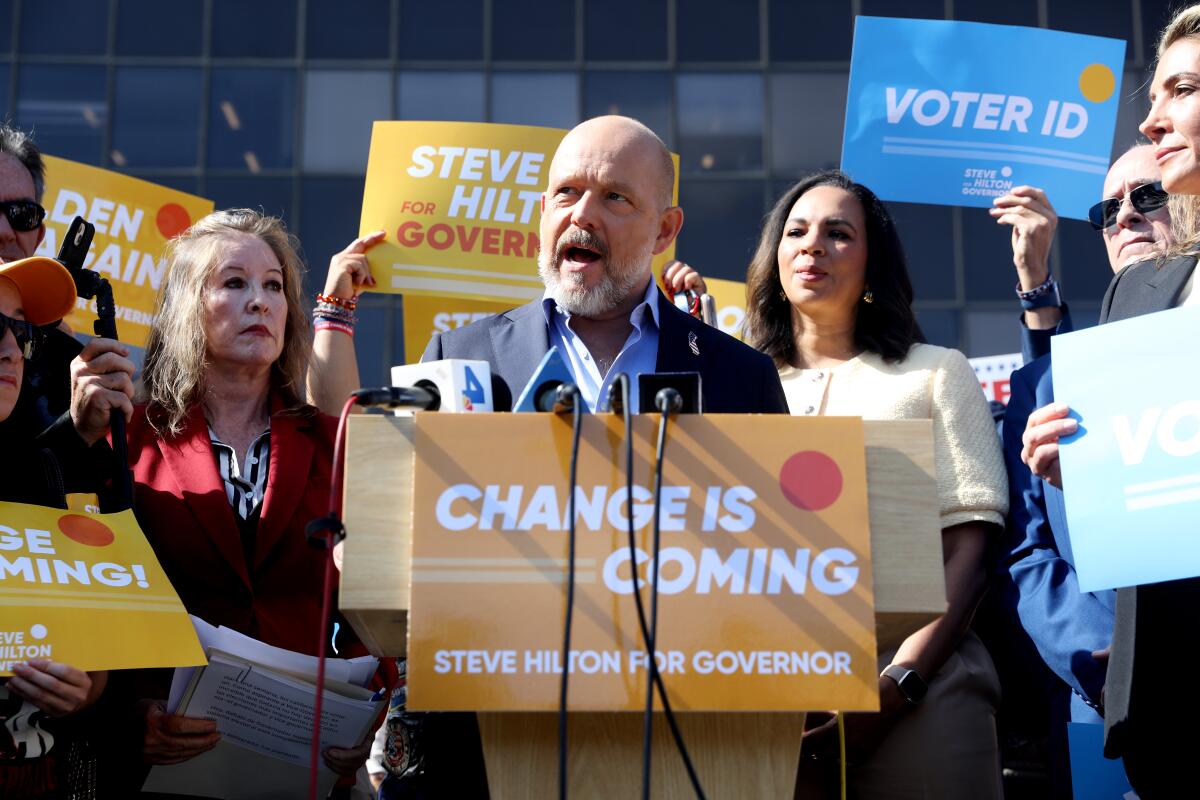
The state’s gubernatorial election, for example, has prompted concern that two Republicans could shut out the Democratic candidates. Riverside County Sheriff Chad Bianco and former Fox News commentator Steve Hilton have polled high in various surveys and are facing a large field of Democrats.

Democratic voters vastly outnumber Republicans in California, yet some political consultants said they feared there were so many Democrats running that voters wouldn’t coalesce around one candidate and the field would be split. Those fears have eased somewhat in recent months as some Democratic candidates advance from the pack.

The state’s top-two primary system has been in place since California voters passed Proposition 14 in 2010. The goal was to help end partisan gridlock in Sacramento and force candidates in primaries to appeal to a wider range of voters, rather than just those in their own party.

Proposition 14, as well as the state’s once-a-decade redistricting process, has led to some dramatic races, including the 2012 face-off between Democratic Reps. Brad Sherman and Howard Berman for a congressional seat in Los Angeles’ San Fernando Valley. Amid aspersions and attack ads, the pair nearly came to blows at a community debate.

Maviglio described the ballot measure as a simple repeal of Proposition 14, and said he was inspired by the governor’s race.

“It was extremely scary to envision the November ballot for governor with Republicans on it,” Maviglio said.

The New York Times first reported on the ballot measure proposal.

A news release from Maviglio states that the proposed repeal of Prop. 14 “is fueled by concerns that California’s primaries are disenfranchising a majority of California voters by limiting choice to candidates from one party.”

A website for the effort includes criticisms of the current primary system by Democratic Party Chair Rusty Hicks and Ron Nehring, former chairman of the California Republican Party.

Maviglio’s ballot initiative proposes to appear on the 2028 ballot and take effect in 2030.

Talk of changing Proposition 14 has been swirling in Sacramento for months.

Secretary of State Shirley Weber told reporters at an unrelated news conference last week that she had voted years ago against Proposition 14. She questioned whether it had actually succeeded in creating more diversity.

“I did not like the open primary,” Weber said. “I didn’t think it would solve any problems. They had a list of problems it would solve, and none of those have been solved.”

Source link

In California governor race, single-payer healthcare is a litmus test. There’s still no way to pay for it

When Gavin Newsom ran for California governor in 2018, his support for a state-run single-payer healthcare system was considered a risky move and earned him hefty labor endorsements.

Today, leading Democrats in the wide-open race to succeed Newsom have embraced single-payer healthcare as a political necessity, an answer to voters fed up with rising premiums and other spiraling healthcare costs.

But with no clear front-runner, they are sparring among themselves in debates and political ads over who is most committed to a government-run model. No candidate has outlined how California would fund comprehensive health coverage for its 40 million residents, leaving voters unable to discern which candidate has a concrete plan for the nation’s most populous state.

Healthcare and political experts said the concept of single-payer has shifted from progressive pipe dream a decade ago to today’s mainstream talking points in a state where Democrats outnumber Republicans nearly 2 to 1. Democrats have pledged the model as the best way to lower costs in an attempt to woo voters worried about affordability as ballots arrive for the June 2 primary. The top two Republicans, meanwhile, have dismissed government-run healthcare as a “disaster” and “socialism.”

“In many ways, single-payer healthcare has become a progressive litmus test,” said Larry Levitt, a former White House policy advisor and a healthcare expert at KFF, a health information nonprofit that includes KFF Health News.

Few voters fully understand the term single-payer, let alone expect the next governor to achieve it, Levitt said. Rather, he added, the term has become more of a signal to voters about a candidate’s approach to healthcare reform.

Xavier Becerra, the former U.S. Health and Human Services secretary, who for decades backed single-payer healthcare in Congress, has come under criticism from opponents for a nuanced but clear shift away from single-payer. It came after Becerra secured an endorsement from the California Medical Assn., a powerful group representing doctors and a longtime opponent of single-payer healthcare bills in California.

At a May 5 debate put on by CNN, Becerra declared his support for “Medicare for All,” a proposal for a federally run system that’s been stalled for years, but he declined to say whether he’d pursue a California-led effort. He said his immediate focus would be on mitigating the drastic federal cuts expected to hit low-income and disabled enrollees in Medi-Cal, the state’s Medicaid program, which covers more than a third of residents.

Becerra is counting on voters not to distinguish between the often-confused terms single-payer, Medicare for All, and universal coverage, noting during the debate that “Californians don’t care what you call it, so long as they have affordable healthcare.”

“A lot of people aren’t clear what single-payer is, and they need a metaphor to understand it,” said Celinda Lake, a Democratic strategist and one of the lead pollsters for former President Biden’s 2020 campaign.

Billionaire activist Tom Steyer, who’s touted his self-funding as a signal he can’t be bought, has emerged as the race’s most vocal advocate of single-payer after opposing it during a short-lived 2020 presidential bid. As governor, Steyer has said, he would pass legislation backed by the California Nurses Assn. that has failed to come to fruition under Newsom’s tenure. Pressed on how he would cover the estimated $731.4-billion cost, Steyer told KFF Health News that “God is going to be in the details.”

At a forum last year, former U.S. Rep. Katie Porter said she didn’t believe achieving such a system was realistic in the near term, but the Orange County Democrat later told party delegates that she would “deliver single-payer.” Former Los Angeles Mayor Antonio Villaraigosa and San Jose Mayor Matt Mahan, Democrats who are trailing their competitors in the polls, don’t support single-payer. The top two vote-getters — regardless of party — advance to the November general election.

Some of the most seasoned politicians have failed to deliver single-payer. Newsom, who campaigned on the promise of being a “healthcare governor,” dialed back his ambitions upon taking office, choosing instead to pursue “universal access” to health coverage under a series of Medi-Cal expansions and efforts to contain healthcare spending.

A bus with the message "All Aboard For A California You Can Afford" and "Tom Steyer for Governor" on its side is parked.

The campaign bus for billionaire activist Tom Steyer, who has made single-payer healthcare a central pillar of his run for governor, in downtown Oakland.

(Christine Mai-Duc/KFF Health News)

Vermont, which remains the only state to pass a single-payer healthcare law, reversed course when leaders there couldn’t identify a funding source.

To enact single-payer, California would need permission from the federal government to redirect billions of dollars from Medicaid, Medicare and other funding that currently flows to the system — approval not likely to come from the Trump administration.

More than half of adults nationally say healthcare costs will have a major impact on whom they vote for in November, according an April KFF poll.

Danielle Cendejas, a Los Angeles-based Democratic consultant who works with state legislative candidates, said single-payer healthcare increasingly appears on candidate questionnaires from small-business advocates as well as hyperlocal Democratic clubs, in state legislative races and national union endorsements. What most California voters want to hear, Cendejas said, is how candidates plan to give them more immediate relief from higher premiums, expensive drug costs and long waits to access care.

The high price tag doesn’t faze Jennifer Easton, a 63-year-old Democrat from Oakland, who said other countries with similar models have proved they can lower costs. She said she supports a single-payer health system because it’s clear to her that Americans have reached the limits of working within the existing system. But she isn’t expecting any of the current candidates to succeed in implementing one, and she hasn’t decided whom to support.

“No one can in four years,” she said. Seeing a candidate enthusiastically support the concept gives her a good idea of their philosophy. “It is, if we’re lucky, a 20-year, 25-year plan.”

Rob Stutzman, a Republican political consultant who advised former Gov. Arnold Schwarzenegger, said while Americans may be supportive of single-payer in polls, focus groups suggest that approval drops quickly when voters realize it could mean losing their current doctor or insurance plan.

At the CNN debate, Steve Hilton, the Republican candidate President Trump has endorsed, said Californians would end up with subpar patient care and “taxes sky high to pay for it,” like in his native United Kingdom. Instead, Hilton suggested the state stop providing “free healthcare for illegal immigrants who shouldn’t even be in the country in the first place.”

Mai-Duc writes for KFF Health News, a national newsroom that produces in-depth journalism about health issues and is one of the core operating programs at KFF—an independent source of health policy research, polling, and journalism.

Source link

Enter the Spin Doctors : THE CAMPAIGN OF THE CENTURY: Upton Sinclair’s Race for Governor of California and the Birth of Media Politics, By Greg Mitchell (Random House: $27.50; 582 pp.)

Sigal’s most recent book is “The Secret Defector” (HarperCollins). He teaches journalism at USC

“We don’t go in for that kind of crap that you have back in New York–of being obliged to print both sides. We’re going to beat this son of a bitch Sinclair any way we can. . . . We’re going to kill him.”

The speaker: Kyle Palmer, Los Angeles Times political editor, to Turner Catledge of the New York Times.

The time: 1934, when socialist writer Upton Sinclair, who had just swept the Democratic primary for governor of California, threatened to beat handily the GOP candidate, Frank Merriam, in the November election.

Kyle Palmer, the pope of Southern California right-wing politics, was neither kidding nor exaggerating. Nor was he exceptional in his venom toward Upton Sinclair and his mass movement, End Poverty in California (EPIC). According to Greg Mitchell in his fascinating and valuable study, EPIC “was nothing less than a roundabout route to socialism.” On this point, “Political pundits, financial columnists, and White House aides, for once, agreed: Sinclair’s victory represented the high tide of radicalism in the United States.” This tide had to be pushed back, or California would suffocate under the weight of Sinclair’s “maggot-like horde” of supporters, as the Los Angeles Times called EPICers.

In 1934, a year racked by general strikes and epidemic unemployment, the maverick pamphleteer-novelist Sinclair–author of muckraking tracts like “The Jungle” and the most widely translated American writer abroad–was a menace not only to the so-called Vested Interests. Down deep, he embodied a revulsion felt by many Californians toward the capitalist system. EPIC’s program of production-for-use-not-profit, land colonies, barter exchanges and cooperation versus competition was a potentially deadly blow to the American Dream. It was subversive because it spoke to the misery of desperate, Depression-ruined Americans yearning for relief from the day-to-day savagery of a skewed, inefficient system that seemed to be failing everybody but the very rich. At its height, EPIC enrolled 100,000 members from San Diego to Sacramento, and its newspaper sold 2 million copies.

In “The Campaign of the Century,” Greg Mitchell has chosen to focus not on EPIC itself but “on the cataclysmic response to Sinclair’s emergence as the Democratic nominee.” Thus we learn relatively little about EPIC or about Sinclair, but a lot about the nuts and bolts of the “most astonishing . . . smear campaign ever directed against a major candidate.” Our present-day “media politics” with its emphasis on image over substance, was born in the ferocious, fraudulent anti-Sinclair campaign, says Mitchell.

A subtext of Mitchell’s book is how strongly adherents felt about Sinclair and EPIC. They “came from every strata, although nearly all were white. It was not . . . a poor people’s movement. Most of the activists were middle-class and middle-aged . . . Many were down-on-their-luck businessmen.” Any given EPIC club might include “Utopians, technocrats, Townsendites, progressive Republicans, New Deal Democrats, ex-Socialists and secret Communists, all united by a belief in a perfectible society.” No EPIC, aside from clerical staff, earned a cent from the movement. “Members paid a dollar, penny, or a collar button” to join; “Some EPICs hocked the gold fillings in their teeth to raise money.” Although broad-based and decentralized, “EPIC was far from democratic” and indifferent to unions. And Sinclair’s portrait occupied a holy place in many homes.

In any other state, EPIC might never have flown. But California’s populist tradition, open-mindedness (or wackiness), absence of party bosses or deep ethnic loyalties meant that a challenge to established authority was as relatively easy to mount as it was difficult to organize a counter-revolution. At first, the state’s wealthy were so rattled that their political representatives were caught completely off balance by Sinclair’s spectacular rise. Only loonies had expected him to win the primary, and nobody had been crazy enough to predict he would outpoll all six of his opponents together.

But like a great octopus, California’s Republicans and conservative Democrats, equally terrified of EPIC, slowly thrashed up from the murk of politics-as-usual to deal with the “enemy within.” “The prospect of a socialist governing the nation’s most volatile state,” says Mitchell, “sparked nothing less than a revolution in American politics.”

Spurred by “fear and desperation,” ad men like Albert Lasker and especially Clem Whittaker, hired conservative guns, broke the old rules and “virtually invented the modern media campaign.” Whittaker and his associate Leone Baxter introduced the radical idea that free-lance outsiders like themselves, not party chiefs, would “handle every aspect of a political campaign.” Whittaker’s “cozy relationship” with California’s 700 newspaper publishers meant that local editors were happy to run his press releases “as news stories–even as editorials.” The anti-Sinclair “lie factory” twisted and distorted; but worst of all, his enemies quoted from Upton Sinclair’s own works, in which he had attacked everything from wedded bliss (“marriage plus prostitution”) to religion (“a mighty fortress of graft”) and the Boy Scouts. After his defeat, Sinclair confessed wearily and with justice, “I talk too much. I write too much, too.”

By most accounts, Sinclair was a decent, generous, puritanical man of genuine sweetness. What his blurted half-jokes and honest indiscretions failed to supply, Hollywood and Madison Avenue concocted by way of movie propaganda and, probably even more effectively, radio shots–like an anti-Sinclair “One Man’s Family”-type series. Film studio bosses, alarmed by Sinclair’s not-very-serious threat to socialize movie production, colluded with what a Scripps-Howard reporter called a “reign of unreason bordering on hysteria.” Big-time screenwriters like Carey Wilson and directors like Felix Feist (later of “Peyton Place” fame) were enlisted or dragooned to produce Goebbelsesque films, often using faked footage, that drilled home the message: EPIC equals Armageddon. Studio workers were forced to contribute to Frank Merriam’s campaign. Very few Hollywood stars had the guts to refuse. (Holdouts included James Cagney and Jean Harlow.)

Law ‘n’ order also came to the rescue of the anti-Sinclair forces. Election officials, GOP activists and local district attorneys intimidated EPIC supporters away from the polls by challenging the credentials of at least 150,000 voters and threatening to arrest them. All across the state preachers thundered, “Go and Sinclair no more!” and Aimee Semple McPherson, hungry for respectability after her recent kidnaping hoax, turned against Sinclair, despite the pro-EPIC sympathies of her flock.

Finally, the Democrats themselves carved up EPIC. At first friendly to Sinclair, President Roosevelt, needing conservative support for his faltering New Deal, cut a deal with the Republicans. In return for Frank Merriam converting to a pallid form of New Dealism, the party dumped the divisive Sinclair. Frightened Democrats and “third party” anti-EPICers formed around a candidate named Haight, who may have drawn off enough votes to beat the insurgent–but not by all that much. Final results: Merriam 1,100,000; Sinclair 900,000; Haight 300,000. In defeat, Sinclair received twice as many votes as any previous Democratic candidate for governor.

EPIC soon disappeared in a backlash of internal Red-baiting. (The communists and socialists opposed EPIC, but the Communist Party also tried to take it over.) Sinclair stopped muckraking to write the “Lanny Budd” series of best-sellers. Waves of fright and self-interest quickly covered over EPIC’s writing in the sand. Today, who remembers it?

Later, Sinclair insisted that the EPIC campaign had “changed the whole reactionary tone of the state.” EPIC was “the acorn from which evolved the tree of whatever liberalism we have in California,” claimed state Supreme Court justice Stanley Mosk, a Sinclair supporter in ’34. And as a direct result of EPIC and the studio bosses’ much-resented bullying, “politics in Hollywood moved steadily to the left over the next few years.”

Of course, the Right learned, too. “A number of men who would become legends in California politics, on both sides of the ideological fence, virtually cut their teeth on the ’34 campaign,” writes Mitchell. These included Earl Warren (Merriam’s campaign manager), Asa Call, Edmund G. (Pat) Brown (sending what encoded messages to his son today?), Murray Chotiner, Augustus Hawkins, Cuthbert Olson–a whole generation of pols whose experience taught them just how powerful the rich, who own the media, can be when aroused.

Lessons for liberals are harder to come by in this sizzling, rambunctiously useful book. If we take note of this nation’s recent rash of insurgencies–from Carol Moseley Braun to Ross Perot–maybe one lesson is that nothing good ever completely dies, it just goes to sleep for a while.

BOOK MARK: For an excerpt from “The Campaign of the Century,” see the Opinion section, Page 6.

Source link

‘Cálmate, Antonio’: The most fiery moments from the governor’s debate

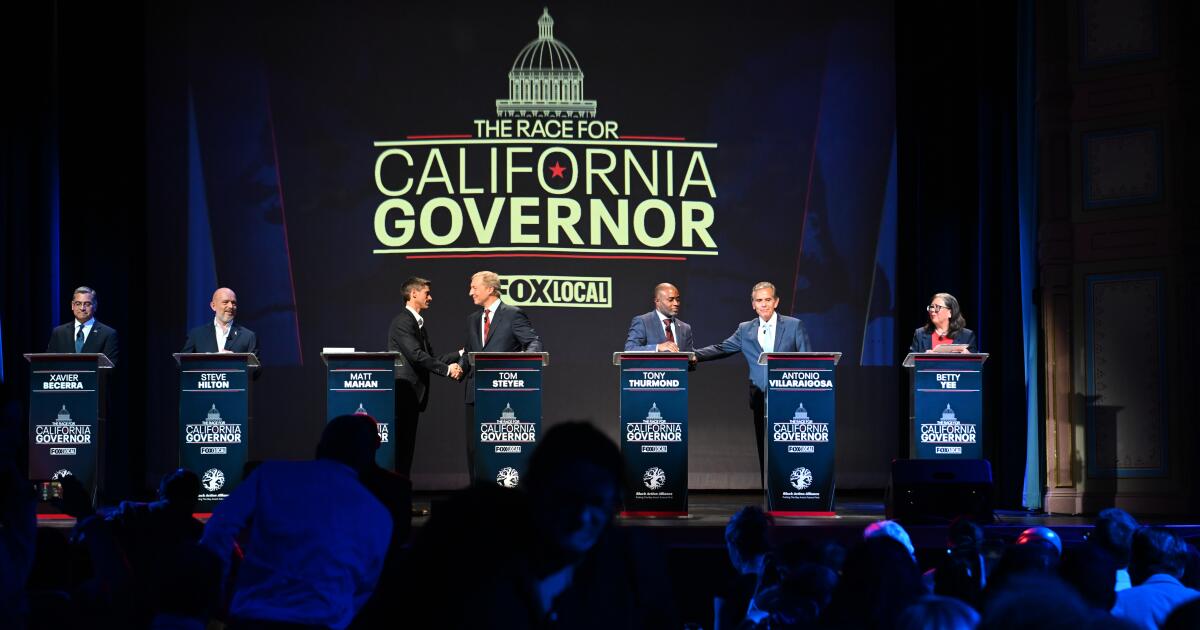
The top candidates in California’s wide-open race for governor took the stage Wednesday night in a Los Angeles debate that began politely but quickly devolved into another raucous clash.

Former Biden Cabinet member Xavier Becerra and billionaire Tom Steyer, both Democratic frontrunners, were primary targets of the political attacks — Becerra for his record as U.S. Health and Human Services secretary and Steyer over his past investments, including in private prisons that housed immigrant detainees.

San José Mayor Matt Mahan started off the debate by lashing out at both Republicans and Democrats.

“We do not need the leadership that MAGA candidates on this stage are offering that’s divisive. We don’t need the leadership of a billionaire who’s now against everything he made his money in, or a career politician who has failed again and again to deliver results,” Mahan said, taking shots at conservative commentator Steve Hilton and Riverside County Sheriff Chad Bianco, Steyer and Becerra, respectively.

Mahan had good reason to go on the attack. The moderate Democrat has struggled to meet early expectations that he would emerge as a top-tier candidate.

The California Democratic Party’s latest poll, released Monday, showed Hilton and Becerra tied at 18%, and Bianco, a Republican, with 14%. Steyer received the backing of 12%, while support for the other top Democrats in the race — former Orange County Rep. Katie Porter, Mahan, former L.A. Mayor Antonio Villaraigosa and state Supt. of Public Instruction Tony Thurmond — were in the single digits. Thurmond did not meet the polling threshold to qualify for the televised debates this week.

Sanctuary state policy leads to kerfuffle

In a tense exchange on immigration and the state’s sanctuary laws, Porter said, “We ought to enforce our sanctuary laws everywhere so we don’t have crazy cowboys taking the law into their own hands.”

It was a shot at Bianco, who has criticized the law that blocks local law enforcement from assisting federal immigration agents.

“Tell that to the crazy mother who lost her child,” Bianco said, referring to a case in his county involving a 14-year-old who was hit and killed by a driver who he said had two prior DUI arrests and was in the country illegally.

“Sir, I don’t need any lectures from you about being a mother,” Porter, a single mother of three and the only woman on the debate stage, shot back.

“You might,” Bianco said, prompting a nasty look from Porter and groans and boos from the studio audience.

The one-hour clash followed another Wednesday evening debate, among candidates for Los Angeles mayor, part of a doubleheader hosted and broadcast by NBC4 and Telemundo 52 in Los Angeles. Both took place at the Skirball Cultural Center and were moderated by NBC4 News anchor Colleen Williams, chief political reporter Conan Nolan and Telemundo 52 News anchor Enrique Chiabra.

Republicans and Democrats divided on immigration

Democrats were in lockstep on most issues related to immigration, including opposing Immigration & Customs Enforcement raids and supporting the sanctuary law that prohibits police from coordinating with the federal agency.

Republicans said the controversial state law, which was approved in 2017 during President Trump’s first term, has hurt public safety.

“I have someone in my jail right now … he’s convicted of a felony, but the three prior convictions for DUI, he was released from jail,” Bianco said. “He was deported on two of them, [came] back into the country, and then he killed a 14-year-old boy with another DUI. So we have to wait until somebody dies before we deport criminals who are in our jail.”

Villaraigosa countered that the law allows for violent criminals to be deported and that thousands have been by state and local law enforcement agencies.

Hilton, a British national who became a U.S. citizen in 2021, declared himself “the candidate of the legal immigrant community” and said the governor’s job is to enforce laws, whether they agree with them or not.

All the Democrats said they would restore full Medi-Cal coverage for undocumented immigrants, which has been rolled back due to budget constraints, while Republicans said they would not.

Courting Latino voters

One of the many undercurrents of Wednesday’s debate was the ongoing tussle between Becerra and Villaraigosa. Both have been competing for California’s pivotal Latino vote, and the former Los Angeles mayor’s attacks have become increasingly aggressive as Becerra has ascended in the governor’s race.

At about 40% of the state’s population, Latinos are California’s largest ethnic group but also among the groups least likely to vote, casting just 21% of ballots in the 2022 primary election.

Mindy Romero, director of the Center for Inclusive Democracy at USC, said Becerra’s surge in momentum could boost Latino turnout, “but I don’t see any evidence right now that actually tells us that will happen. The thing about primaries, unfortunately, is that turnout is always low. Even in a competitive primary like this.”

On Wednesday, Villaraigosa launched a new digital ad highlighting a former member of the Biden administration questioning Becerra’s record as U.S. Health and Human Services secretary.

He highlighted the issue during Wednesday’s debate after the moderates asked the candidates how they would address homelessness in California.

“Mr. Becerra, are you proud that you pushed out 85,000 migrant children? They were, according to the New York Times, they were maimed, they were exploited,” Villaraigosa said. “Some were even killed. You said those are MAGA talking points, it’s a MAGA hoax. Tell that to the children who died.”

“So I’m not sure what that had to do with homelessness, but cálmate, Antonio, cálmate,” Becerra responded, urging his opponent to “calm down.” He accused Villaraigosa of parroting the unfounded attacks that Trump deployed against former Democratic Vice President Kamala Harris in the 2024 presidential election.

“We protected kids. We did not let them be abused,” Becerra said. “Stop lying.”

Speaking of homelessness

The Democrats and Republicans on stage were sharply divided on the best way to address California’s ongoing homelessness crisis.

People living on the streets are “pawns in the homeless industrial complex,” Bianco said, adding: “This is not and has never been about homes. This is about drug and alcohol addiction.”

Mahan, Villaraigosa and Becerra touted their records building housing and expanding mental health services, saying those will help reduce homelessness. They, along with Porter, also called for more oversight of state homelessness spending.

Hilton said the issue is one of the state’s biggest failures and blamed the Democrats — the party that has controlled state government for the past 16 years.

“Some of these Democrats are on this stage, they talk as if we’re in some parallel universe where Democrats haven’t been running this state for the last 16 years of one-party rule,” he said.

Democratic shift on nuclear plants, high-speed rail

A series of lightning-round questions highlighted some subtle shifts on traditional Democratic policies as candidates aim to make the state more affordable.

Democrats led the charge to decommission nuclear power plants in California over concerns of potential environmental and health catastrophes, but as the state struggles with energy affordability, all the Democrats (and both Republicans) said they would support further extending operations at the state’s only remaining nuclear plant, Diablo Canyon in San Luis Obispo County.

Most of the Democrats also said they support finishing a high-speed rail line from Bakersfield to Modesto, despite the massive cost overruns and delays, but said the project should be done cheaper and more efficiently. Hilton and Bianco want to scuttle the project.

And all Democrats except Steyer said they would vote against a proposed billionaire tax that will likely be on the November ballot mostly to backfill federal cuts to healthcare coverage. Although most of the Democratic candidates aside from Mahan say they support higher taxes on the wealthy, they have raised issues with the details of the proposal, including the fact that it is a one-time tax.

Source link

Top takeaways from fiery, at times ugly, California governor debate

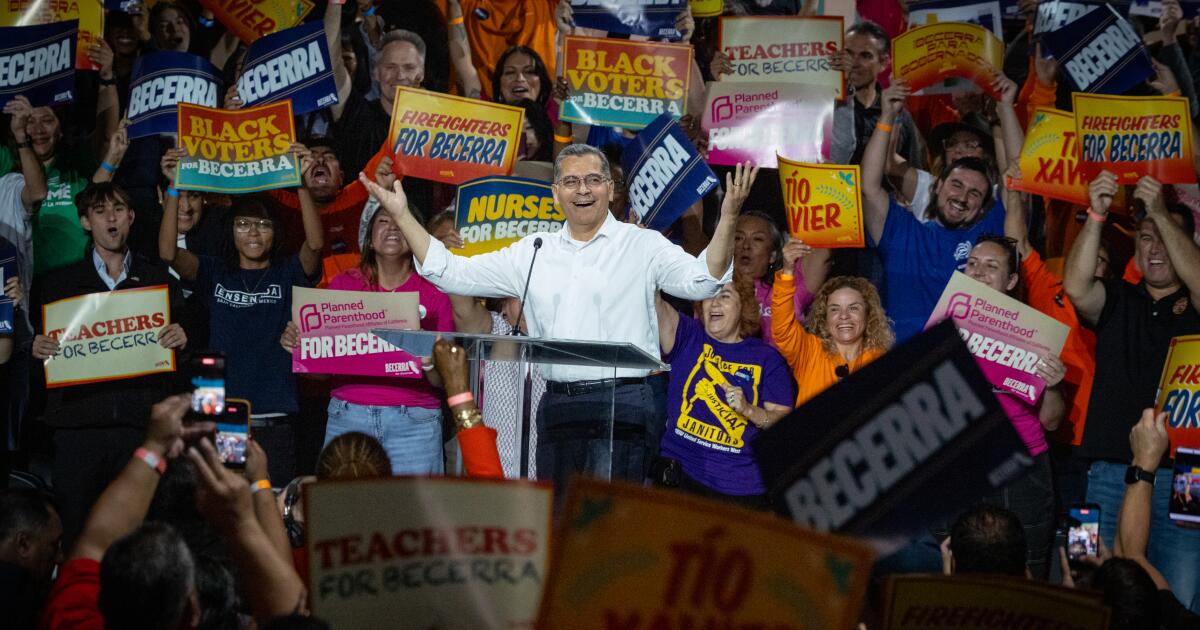
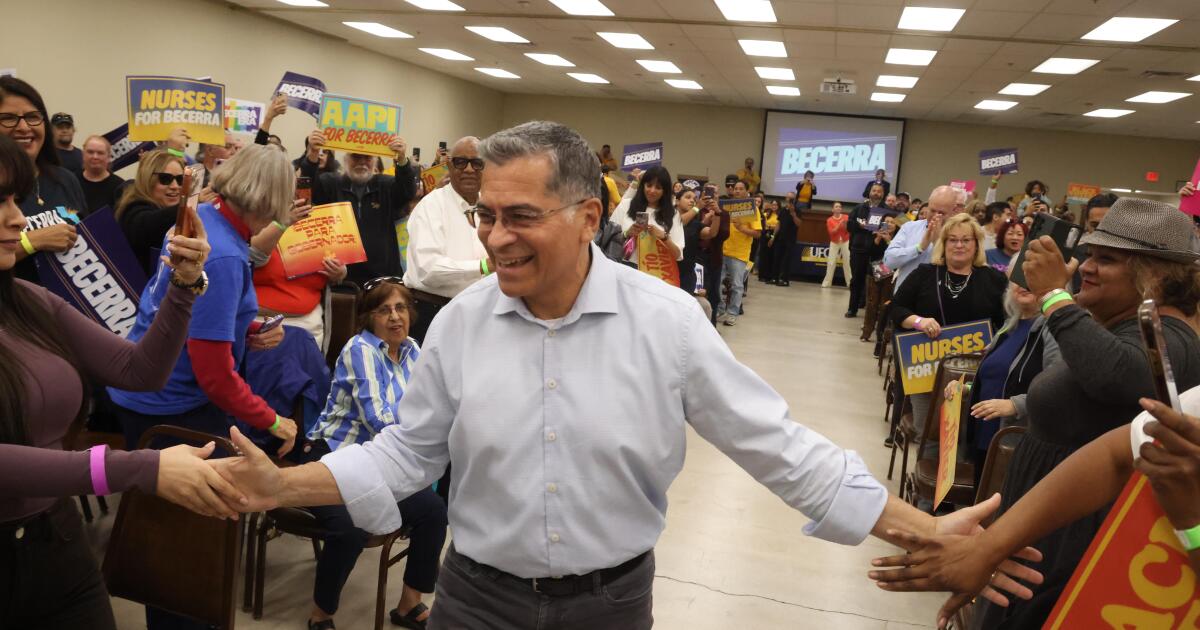
Democrat Xavier Becerra’s rapid rise in California’s race for governor made him a ripe and constant target during a combative nationally televised debate Tuesday evening, his first real test in a high-stakes election that remains highly volatile.

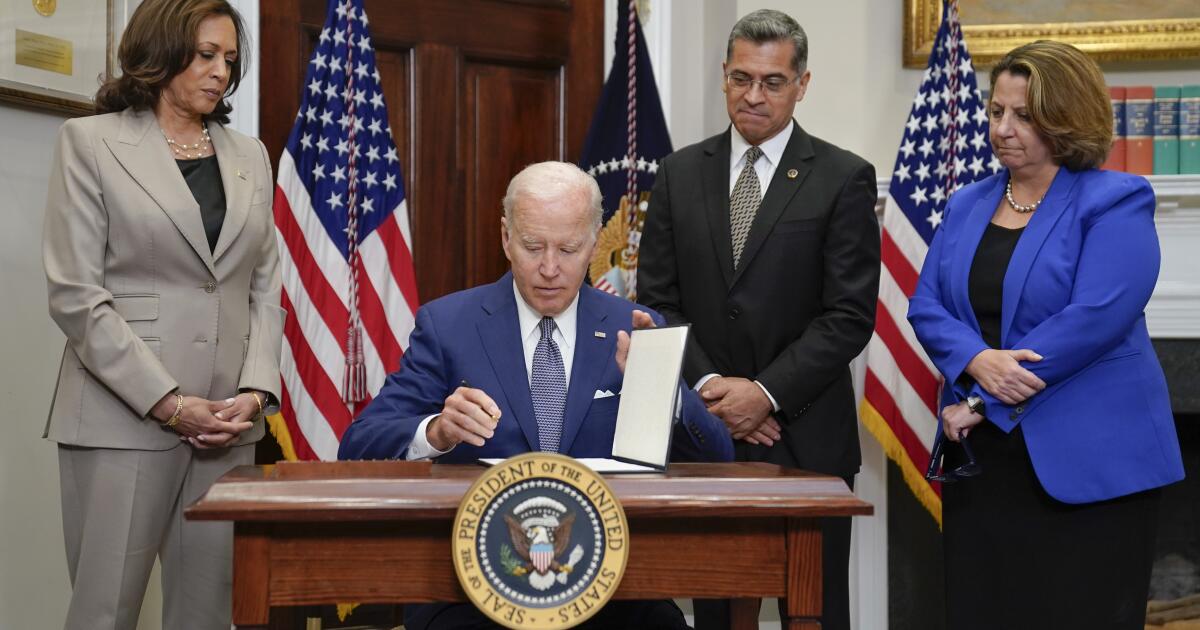
Becerra was ripped throughout the two-hour CNN debate, primarily by his Democratic rivals, who accused him of dodging questions about his stance on single-payer healthcare, falling short as a Biden Cabinet secretary and pocketing a campaign donation from Chevron.

“I think everyone’s invoking my name. It’s nice to hear my name quite a bit,” said Becerra, who served as the U.S. secretary of Health and Human Services during the Biden administration. “I will tell you this: Distorting the facts in your quest to be governor is never good, but using Trump lies to try to damage your opponents is worse, and that’s what we see happening.”

As ballots land in California voters’ mailboxes, the state’s seven top gubernatorial candidates clashed over immigration, President Trump, tax policy, political temperament and a hodgepodge of scandals, mudslinging and other unsavory actions that have risen to the forefront of the hotly contested race.

The snarky, sometimes petulant exchanges reflect how unsettled the race to replace termed-out Gov. Gavin Newsom is, as well as California’s outsize economic and political gravitas on the national and international stage.

Shortly after the debate began, former Orange County Rep. Katie Porter chastised her fellow candidates for their unceasing attacks.

“I can’t believe [the] interrupting and bickering and name calling and shouting and disrespect for everyone up here who’s stepping into public service that anyone wants to talk about my temperament,” said the former Democratic Congress member from Irvine.

Here are the top takeaways from a two-hour debate that somehow seemed even longer:

Becerra takes his lumps

Beccera, who has surged in the weeks before the June 2 primary, faced a barrage of attacks from his Republican and Democratic rivals about his oversight of unaccompanied immigrant minors during his tenure at the Health and Human Services Department and his relationship with a longtime adviser who, along with other consultants, skimmed about $225,000 from one of Becerra’s dormant campaign accounts.

Becerra is not accused of wrongdoing and has been painted as a victim in the prosecutor’s court filings. Still, conservative commentator Steve Hilton, a Republican, suggested Becerra knew about the scheme, and former Los Angeles Mayor Antonio Villaraigosa, a Democrat, questioned why Becerra paid an unusually high fee to one of the consultants named in the indictment.

“It doesn’t pass the smell test,” Villaraigosa said.

Becerra also was accused of changing his position on single-payer healthcare, a top priority of liberal voters that aims to create a healthcare system run and funded by the federal government.

Though Becerra has long supported single-payer healthcare, he recently assured members of the California Medical Assn. — one of the most influential medical lobbyinggroups in California, which has endorsed him — that he would not support it as governor, according to a KQED report.

When asked directly about this, Becerra said “those reports were inaccurate. I continue to be for Medicare for all.”

Becerra sidestepped repeated questions from Porter about whether he supported a state-sponsored single-payer healthcare system in California, saying that he wants to cover “everyone with something like Medicare for all.”

“Covering everyone with something is not single-payer. It’s not even federal Medicare for all. But you won’t say whether you support California having its own state-run single-payer system,” Porter said.

Single-payer healthcare is a telling issue

Democratic billionaire Tom Steyer also has taken heat for changing his position on the issue. The hedge fund founder turned environmental warrior opposed single-payer healthcare during his 2020 presidential bid and now supports a statewide single-payer system called CalCare. He is endorsed by the California Nurses Assn., one of CalCare’s biggest supporters.

A recent analysis by UC researchers estimates CalCare would cost $731 billion to implement in 2027 — a price tag that’s $14 billion larger than all anticipated healthcare spending in California next year.

Villaraigosa said creating a state-sponsored single-payer healthcare system — with a price tag larger than the entire state budget — is a “pie in the sky” proposal. He said he considers healthcare a human right but said a system such as CalCare would require approval from the Trump administration — and that’s not going to happen.

As a former British citizen, Hilton said he is the only candidate who has experienced government-run healthcare.

“As a patient, it nearly killed me,” he said. “That’s another story we don’t have time for. As a policymaker, you end up with the worst patient satisfaction, costs that you can’t afford, taxes, sky-high to pay for it. It is a total disaster.”

Race remains a toss-up

The 2026 gubernatorial contest has been an undulating, unpredictable whirlwind. Unlike every governor’s race for more than a quarter of a century, there is no clear frontrunner, leading to a sprawling field of candidates with notable resumes but little recognition among California’s 23.1 million registered voters.

On Monday, the state Democratic Party released its latest voter survey, which found Hilton and Becerra tied at 18%, and Bianco with 14%. Steyer received the backing of 12%, while support for the other top Democrats in the race — Porter, San José Mayor Matt Mahan, Villaraigosa and State Supt. of Public Instruction Tony Thurmond — was in the single digits. Thurmond did not meet the polling threshold to qualify for Tuesday’s debate or an NBC/Telemundo face-off taking place on Wednesday.

Tuesday’s debate with the leading candidates took place at East Los Angeles College and was hosted by CNN, the first time national media has paid such attention to a California statewide contest since 2010.

Partisan divide on immigration

On the debate stage in Los Angeles, a city that was targeted by Trump administration immigration raids, Bianco criticized California’s sanctuary state laws, which prevent local law enforcement from assisting with federal immigration enforcement.

Villaraigosa defended the undocumented immigrants residing in California, saying they are vital to the economic success of the state. He also accused Bianco of not understanding how California’s sanctuary state policy works — with the former Los Angeles mayor telling him that California has turned over thousands of undocumented immigrants convicted of crimes to federal immigration officials.

Bianco dismissed Villaraigosa’s comment immediately.

“I want Mr. Villaraigosa to tell the mother of the 14-year-old in my county that is dead because of an illegal immigrant that had been deported three times because of DUIs that sanctuary state policy keeps us safe. I don’t think she’s going to agree with you,” Bianco said.

Democrats Porter, Steyer, Mahan and Becerra accused the Trump administration of “terrorizing” Latino communities and targeting people for deportation based on the color of their skin.

Steyer said he would prosecute ICE agents “and the people who send them,” including former Homeland Security Secretary Kristi Noem and Trump advisor Stephen Miller, for illegal racial profiling.

Agreement on need for housing

On the issue of housing, the candidates agreed that California has fallen short of providing enough homes to make the state affordable. Mahan, the mayor of San José, said he has reduced the city’s homeless population by making it easier to build ADUs in people’s backyards, and by reducing red tape for additional types of housing.

Villaraigosa said he built more market-rate, affordable and workforce housing when he was mayor of Los Angeles than anyone else on the stage.

Hilton pressed for building single-family homes in areas of the state with space, rather than forcing more housing into places where residents don’t want them.

Steyer said, “Californians can’t afford to live here,” and there has to be a greater conversation about building more housing, and faster. He also said that cities and counties “do not want new housing” because they can’t afford to pay the health and education costs associated with more residents, and he will solve that issue by closing tax loopholes for big businesses.

Still, housing, homelessness and affordability — top-of-mind issues for California voters — overall received scant attention during the debate, even though CNN debate moderators Kaitlan Collins and Los Angeles-native Elex Michaelson pressed the candidates on the state’s incessant problems with affordability.

Steyer did use the affordability issue to criticize Becerra, currently his greatest political threat, for taking a campaign contribution from Chevron.

“Being in bed with oil companies is a mistake,” Steyer said. “Xavier Becerra has taken the max amount of money from Chevron, and he has said they’re good guys that we need. The truth of the matter is the oil companies are ripping us off at the pump. They’re polluting our air and they’re burning up the climate.”

Becerra responded that it was “a rich response from a guy who made his billions investing in fossil fuels and oil companies, in coal companies.”

“Now he makes the billions, and he has spent more than every other candidate combined in this campaign, using those profits to now try to buy his seat in the governor’s office,” Becerra said.

Where they stand on the proposed billionaire tax

A notable area of policy disagreement among Democrats is a proposal to levy a one-time 5% tax on the wealth and assets of billionaires. Supporters of the measure say they have gathered enough signatures to qualify it for the November ballot.

If approved, the funds would mostly pay for healthcare cuts approved by the Trump administration last year.

Porter said that, although she wants to increase taxes on the state’s wealthiest residents, she doesn’t support the proposal because it is a “one-time tax” that won’t solve the state’s underlying budget issues.

“Yes to a progressive tax code, yes to the wealthy paying more, but this tax is about cheap political points,” Porter said.

Steyer said he would vote for the tax, but he agreed that state leaders ought to go further, including by taxing corporate interests more.

Bianco agreed with Porter that the billionaire tax is a bad idea.

Villaraigosa said California relies too much on the its wealthiest residents to fill state coffers, which leads to “feast and famine” in its budgets. He said businesses and high-earners are leaving the state, and that a plan to tax the wealthiest Americans needs to be enacted at the federal level.

Republican vs. Republican

The two Republicans on stage appeared content to spend their time blasting the Democrats rather than each other.

Bianco was asked if he thought that Republican voters could trust Hilton.

“You’ve called Hilton unethical and dishonest and said that he swindled his way into the Republican side,” Collins said, citing an article from the Atlantic.

“I would never use the word swindled, but the context — yes, I have said that,” Bianco said after some back-and-forth about the particulars of his criticisms. “Have Steve and I disagreed? Absolutely we have.”

He avoided directly criticizing Hilton but said he was the only person on the stage “that their entire existence in their job revolves around honesty, integrity.”

Hilton swerved, saying voters cannot keep voting for the same thing — Democratic leadership — if they want to see change in the state.”

Times staff writers Dakota Smith and Doug Smith contributed to this report.

Source link

Louisiana Republicans eliminate Democrat’s elected position

Louisiana Republicans eliminated an elected position days before an exonerated man who overwhelmingly won the New Orleans-based clerk seat was set to take office.

Republican Gov. Jeff Landry on Thursday quietly signed into law legislation abolishing the long-standing Orleans Parish clerk of criminal court position, according to Louisiana Secretary of State spokesperson Trey Williams.

Republicans say wiping away the office is a consolidation effort meant to make the local judicial system more efficient and cut costs. But Democrats condemn the change as government overreach, arguing that it infringes on a predominantly Black parish’s decision at the polls.

Calvin Duncan, who spent nearly 30 years behind bars for a crime he did not commit, easily won election to the criminal court clerk position in November, beating the incumbent and earning more than two-thirds of the vote. He had been set to take office Monday and has asked a federal judge to allow him to take office as scheduled.

“It’s a sad thing to see the state government repeating what happened to Black public officials during Reconstruction,” Duncan said. “They will do what they do, and I will do whatever I have to do to vindicate the voters of New Orleans and make sure that what happened to me never happens to anybody else.”

Landry did not immediately respond to requests for comment.

Duncan, a Democrat whose murder conviction was vacated in 2021 after evidence emerged that police officers lied in court, has vowed to help fix the system that once failed him.

Duncan, 63, and his supporters say he is being targeted by the most powerful Republicans in the state, including those who have denied his innocence, even though Duncan’s name is listed on the National Registry of Exonerations.

“We’re doing something because powerful people don’t like him,” Rep. Mandie Landry, a New Orleans Democrat, told lawmakers during a legislative committee hearing in April. Landry, who is not related to the governor, described the Republican efforts as “atrocious” and worries what they could mean for other elected positions in the state.

Law consolidates two court clerk positions

Republicans say the legislation consolidates the civil and criminal court clerks’ offices in Orleans Parish, putting it in line with all other parishes in the state, which have a single clerk’s office. The civil clerk position would remain and absorb the criminal clerk’s role.

Eliminating the clerk position saves the state about $27,000 and the city $233,000, according to the office of the legislative auditor, which added that the long-term costs of consolidation are “unknown.” The legislation also shifts about $1.17 million in state expenditures to the parish. The civil and criminal court clerks have separate physical offices and different case management systems.

The governor told the Associated Press that eliminating Duncan’s elected office was about improving government efficiency and “cleaning up a system in Orleans Parish that has been plagued by dysfunction and corruption for years.”

The consolidation is part of a broader GOP effort during the ongoing legislative session to overhaul the judiciary in New Orleans — including bills that propose abolishing several other elected judicial positions in the parish. However, those jobs would be eliminated further down the line, allowing officials to serve out their terms.

The bill’s Republican author, Sen. Jay Morris, who represents a district several hours from New Orleans, said the goal was to implement the clerk consolidation before Duncan takes office, preventing him from starting a four-year term. Morris acknowledged that he expects lawsuits to be filed because of this law but believes the change to be constitutional.

“It’s unfortunate for Mr. Duncan, I concede that,” Morris told lawmakers in April. “He seems very nice, but we don’t make policy around here for just one person.”

Concerns of disenfranchisement

Although conversations have revolved around Duncan, many also raise concerns about how the change potentially could disenfranchise voters — a heightened worry in a deeply red state that has been central to efforts to weaken the Voting Rights Act, including the case at issue in a landmark Supreme Court ruling last week. Orleans Parish is a Democratic hub with a predominantly Black electorate.

“Mr. Duncan was elected by 68% of the vote in a city that’s majority African American. This is the will of the people, and what your bill attempts to do is usurp the will of the people,” Rep. Edmond Jordan, a Democrat, told Morris.

Well before the legislation reached the governor’s desk, Duncan said he could see the writing on the wall. Ahead of the outcome, Duncan’s advocates held a ceremonial swearing-in for him. Hundreds of people gathered on the steps of the Orleans Parish criminal courthouse to support him.

Duncan told lawmakers that along the campaign trail last year, he spoke with many people who told him they typically abstain from voting in elections. “Now, this bill tells people exactly what they had believed — that their vote doesn’t count,” he said.

Cline and Brook write for the Associated Press and reported from Baton Rouge, La., and New Orleans, respectively.

Source link

Advice on when best to cast your California primary ballot

For the next week or so, in homes all over California, ballots will be arriving for the June 2 primary.

Since 2020, a ballot has been mailed to every active registered voter in the state — more than 23 million, by last count. The time to choose is drawing nigh.

In addition to the race for governor, Californians will vote in contests for seven other statewide offices, the Board of Equalization — which oversees the property tax system — and a great many congressional, legislative and local races, including the primary for Los Angeles mayor.

What’s a voter to do?

If you’ve waited your entire life for a candidate like Republican Chad Bianco, the Riverside County sheriff running for governor, or you’ve been jonesing to cast a gubernatorial ballot for Democrat Katie Porter from the moment she whipped out her famous whiteboard, the choice is easy. Fill out that ballot and toss it in the mail, stat! No postage needed.

“Don’t mess around,” said Paul Maslin, a veteran Democratic campaign strategist. (His candidate for governor, Betty Yee, quit the race late last month, so he’s a neutral observer at this point.)

“If you have pretty good inkling what you want to do,” Maslin urged, “vote.”

But if, like many, you’re not wed to a particular candidate, what then? If you’re worried about mailing in your ballot and then having some awful, Eric Swalwell-like revelations surface, or if you fret about wasting your vote by supporting someone who drops out before June 2, then what?

There are no do-overs in a California election. Once you’ve cast your ballot, you’ve made your choice. That’s it, however sorry you may be.

Which is why Republican strategist Rob Stutzman, who’s worked in California politics for decades, urged voters not to mail their ballot too soon. Like Maslin, he’s unaffiliated with any of the gubernatorial campaigns.

“It’s a slow-developing race,” Stutzman said of the contest for governor, the marquee attraction on the June ballot. “These are still relatively little-known candidates. There’s going to be a lot more campaigning to go in the weeks ahead. [So] unless you feel really strongly about somebody, I’d hang on to that ballot and see what happens over the next several weeks.”

Then again, with all the talk of clamping down on mail-in ballots and concerns about processing delays by a stretched-thin Postal Service, is there a danger of waiting too long to vote? What if your ballot arrives past the deadline to be tallied?

In March, the U.S. Supreme Court strongly signaled a likelihood it would require mail ballots to be received by election day if they are to be counted as legal. As it stands, California accepts mail-in ballots that were cast before the end of election day, so long as they arrive no later than seven days after.

The court seems unlikely to issue its ruling before the June primary — but that’s not guaranteed.

So is there a sweet spot, somewhere between voting in haste and having your ballot go to waste?

The Official Voter Information Guide, produced by California’s secretary of state, urges those voting by mail to “return your ballot … as soon as you receive it.”

But Kim Alexander, head of the nonpartisan California Voter Foundation, falls into the wait-a-bit camp. “Don’t vote too early,” she counseled, “because this is a very dynamic election.”

Once you’ve made up your mind, her best advice is to mail your ballot at least a full week before election day, which is May 26, to ensure it arrives on time to be processed and counted. If someone wants to drop their ballot off in person, either at a vote center or secure drop box, Alexander suggests doing so by May 30, which is three days before the election.

“The good news,” she said, “is that under a new state law … all county election offices will be open at least six hours on Saturday, May 30, for voters to come vote in person or to turn in their vote-by-mail ballots.”

Voting in person is an option right up until 8 p.m. on election day, even if you received a ballot in the mail. That applies everywhere in California, save for three sparsely populated, rural counties — Alpine, Plumas and Sierra — which conduct their elections entirely by mail. Bring your unused vote-by-mail ballot to your local polling place and swap it for a polling-place ballot you can use instead.

For procrastinators or those wanting to wait until election day to mail their ballot, they run the risk that it won’t be postmarked until after June 2. That means it won’t be counted, regardless of when it arrives at their county elections office.

“Voters who want to hold out as long as possible … ought to be planning to turn their ballot into a drop box or a voting site and not use the mail at all,” Alexander said.

Having spent decades working to make voting easier and elections safer and smoother, Alexander knows that voting by mail has made many people miss “the election day experience.” (Things like bringing the kiddos into the voting booth, or posing for selfies with an “I Voted” sticker.)

Her suggestion is to find other ways to mark the occasion.

“Help somebody else go and vote,” Alexander suggested, “or volunteer to help with an organization” running a get-out-the-vote operation.

“If you want to help election officials get ahead on the vote count” — a source of repeated upset as the country awaits California’s lagging results — “you can be part of the solution by getting your own ballot in just a little bit earlier.”

All of which sound like fine ideas. That way you can celebrate election day and make sure your ballot isn’t cast for naught.

Source link

Ukraine drone attack hits Russian Baltic port, governor says | News

Ukrainian forces also strike two shadow fleet tankers near port of Novorossiysk, President Volodymyr Zelenskyy says.

Ukrainian forces have launched a drone attack on the Russian Baltic Sea ⁠⁠port of Primorsk, the governor says, as Kyiv and Moscow accuse each other of killing civilians in overnight air raids.

There was no oil spill caused by Sunday’s attack on Primorsk, a major oil-exporting outlet, but it caused a fire in the town that was extinguished, Leningrad Governor Alexander Drozdenko said. More than 60 drones were downed overnight over the northwestern region, he added.

Recommended Stories

list of 3 itemsend of list

Primorsk, ‌‌one of Russia’s largest export gateways, has the capacity to handle one million barrels per day of oil.

It has been hit multiple times in recent months as Ukraine has stepped up attacks on Russian energy infrastructure and other targets and United States-brokered talks to end the Ukraine war have stalled.

Ukrainian ⁠⁠President Volodymyr Zelenskyy said his country’s forces also struck two shadow fleet tankers in waters at the ⁠⁠entrance to the Russian Black Sea port of Novorossiysk.

“These tankers had been actively used to transport oil – not anymore,” Zelenskyy said on Telegram. “Ukraine’s long-range capabilities will continue to be developed comprehensively – at sea, in the ⁠⁠air, and on land.”

The two neighbours have been launching hundreds of explosive-packed drones at each other on a near-daily basis throughout the four-year war.

Other Russian regions also reported drone attacks on Saturday and Sunday. Moscow Governor Andrei Vorobyov ⁠⁠said on Saturday evening that a 77-year-old man ⁠⁠died in a village in a drone strike.

Sergei Sobyanin, the mayor of Moscow, said four drones were downed on their way to the Russian capital.

Vasily Anokhin, the governor ‌‌of the western region of Smolensk, said three people, including a child, were injured on Sunday in a drone attack on an apartment block.

Attacks in Ukraine

Russian drone strikes on Ukraine killed at least three people across the country, local officials said on Sunday.

Attacks on southern Ukraine’s Odesa region, home to key export terminals, killed two people, including a truck driver at a port, Governor Oleh Kiper said on social media.

“Enemy drones hit three residential buildings, and two more were damaged. … Facilities and equipment for the port infrastructure were also damaged,” he said.

Elsewhere, Russian strikes on the front-line region of Kherson in southern Ukraine also killed one person, officials said.

Russia fired 268 drones and one ballistic missile in the overnight attacks, Ukraine’s air force said.

In eastern Ukraine, Russian troops were ‌‌inching ‌‌towards the city of Kostiantynivka in the Donetsk region, Ukraine’s top army official said on Saturday.

Source link

Mexico’s Sinaloa state governor resigns amid US drug trafficking charges | Crime News

Ruben Rocha Moya again denies allegations he shielded cartel, says taking ‘temporary leave’ to defend self.

The governor of Mexico’s Sinaloa state has temporarily resigned days after being charged by United States authorities in a sweeping drug trafficking indictment that has further strained relations between the two countries.

In a brief video statement posted late Friday, Ruben Rocha Moya again denied any wrongdoing, but said he was taking “temporary leave” to defend himself against the US allegations.

Recommended Stories

list of 3 itemsend of list

The indictment unsealed by US prosecutors earlier this week claimed that Rocha Moya and nine other officials directly aided the Sinaloa drug cartel in its smuggling operations in exchange for political support and bribes.

That support included members of the powerful cartel kidnapping and threatening opposition candidates in the 2021 election and stealing paper ballots cast for those running against Rocha Moya, the indictment charged.

Rocha Moya is a member of President Claudia Sheinbaum’s progressive Morena party.

“My conscience is clear,” Rocha Moya said in the video message. “To my people and to my family, I can look you in the eye because I have never betrayed you, and I never will.”

Juan de Dios Gamez Mendivil, the mayor of the Sinaloa state capital Culiacan who was among the other officials charged by the US, also announced he would step down on Saturday. He has denied the allegations.

Sheinbaum has also pushed back on charges, which come at a time when she has sought to navigate tense relations with the administration of US President Donald Trump.

On Thursday, she said her government had not been provided with any concrete evidence to back up the claims, suggesting the information laid out in the indictment was insufficient.

“My position on these events is as follows: truth, justice and the defence of sovereignty,” Sheinbaum said.

She added that if “clear and irrefutable evidence” is presented, the US still must proceed “in accordance with the law under our jurisdiction”.

Sheinbaum maintained her government will not “shield anyone who has committed a crime”.

“However, if there is no clear evidence,” she added, “it is evident that the aim of these charges by the [US] Department of Justice is political.”

Tense US-Mexico relations

Since taking office in January of last year, the Trump administration has heaped pressure on Mexico to do more to address migration and drug smuggling.

The approach has included Washington imposing a host of tariffs as leverage against Mexico’s government.

The US State Department has also labelled several Latin American drug cartels as “Foreign Terrorist Organisations”, an unorthodox move in line with the administration’s more militaristic approach to Latin America.

The administration has broadly argued that the criminal groups are driven, in part, by efforts to destabilise the US, a claim rejected by many longtime experts.

Sheinbaum has walked a careful line with Trump, increasing cooperation in countering cartels while pledging to protect Mexico’s sovereignty. Notably, she has staunchly opposed the prospect of any US military action on Mexican soil.

But experts have said charging elected officials in Mexico represents a major escalation in the Trump administration’s strategy.

Speaking to Al Jazeera this week, Vanda Felbab-Brown, an expert on non-state armed groups at the Brookings Institution think tank in Washington, DC, said the approach had “long been considered a very big step, almost a ‘nuclear option’”.

She predicted more US indictments were likely to come.

Source link

John Seymour, Anaheim mayor and U.S. senator, dies at 88

John Seymour was the rare politician who didn’t mind harming his career if it meant doing right by his constituents.

As the newly elected mayor of Anaheim in 1978, he angered the city’s Police Department by suggesting the creation of a citizens oversight commission after residents complained that officers regularly harassed and beat them.

The lifelong Republican upset his party’s conservative base in the 1980s as a state senator, when he announced his support for abortion rights and opposition to offshore drilling.

“I’m not going to always be right,” Seymour told reporters in 1990. “Therefore, to expect one to never change a position on an issue … is too much to ask.”

Appointed to the U.S. Senate in 1990 after Pete Wilson was elected governor, Seymour lost his seat to Dianne Feinstein two years later and never ran for public office again. He remains the last California Republican to serve in that role.

“John was a guy who had great courage, he had great goodwill and a damn good mind,” Wilson, who was mayor of San Diego when he first met Seymour in the 1970s, said Monday. “He not only enjoyed a little combat, he was willing to give the time necessary for it.”

Seymour died on April 18 at his home in Carlsbad. He was 88, and the cause was Alzheimer’s disease, according to his son John.

As his party swung to the right, the moderate Seymour had no problem with becoming a political afterthought.

Supreme Court Justice nominee Clarence Thomas with republican senators John Seymour, R-Calif., Larry Craig, R-Idaho.

Supreme Court nominee Clarence Thomas, center, poses with senators on Capitol Hill in 1991. With Thomas, from left to right, are Sens. John Seymour (R-Calif.), Larry Craig (R-Idaho), Bob Dole (R-Kan.), Jesse Helms (R-N.C.), Connie Mack (R-Fla.) and Dan Coats (R-Ind.), right front.

(John Duricka / Associated Press)

“If somewhere in a footnote, history should record my public service, I would hope that they record me as one who cared more for people than for policy, one who was a no-nonsense guy who worked hard for those in need of help, but who wasn’t hesitant to knock heads of bureaucrats in order to get things done,” he told supporters at the kickoff to his Senate campaign in 1992.

Born in Chicago, Seymour settled in Southern California in the 1960s after a stint in the Marine Corps. The UCLA graduate started a real estate business in Orange County as the region transformed from farmland to suburbia. After four years on the Anaheim City Council, he became mayor in 1978.

He quickly established the pragmatic persona that would enable his rise in California politics.

Months after Seymour’s mayoral win, Anaheim police officers stormed a Latino neighborhood and beat up dozens of people in what became known as the Little People’s Park riots. At community meetings, Seymour admitted his shock at learning about the poor relations between the police and many residents.

The mayor described his approach as: “Don’t sweep it under the rug; don’t look the other way. Admit that we have a problem.”

At the same time, Seymour was negotiating with the Los Angeles Rams to move from the Coliseum to Orange County. While other O.C. officials proposed a new stadium, he convinced the Anaheim City Council to convert Angel Stadium into a multipurpose venue that he argued would create “the greatest opportunity for Anaheim since Disneyland and the California Angels.”

The Rams moved to the city in 1980. Two years later, Seymour was off to Sacramento as a state senator.

He became head of the Republican Senate caucus in his first year and bucked the stereotype of an Orange County GOP firebrand by largely eschewing culture war issues in favor of matters like higher pay for teachers and government support for poor parents that sometimes aligned him with Democrats. That made him few friends in his own party, with many finding his personal ambition grating — he once wrote a letter to then-Gov. George Deukmejian asking that he be appointed state treasurer — and a distraction from getting more of their own elected to Sacramento.

Seymour made no apologies for selling himself as a public servant while simultaneously seeking more power.

“I like to do things,” Seymour told The Times in 1987. “I’ve been a doer all my life. I don’t like to sit around sucking my thumb. I like to resolve problems.”

That year, conservative opponents deposed him as caucus chair. They snickered two years later when he announced that while he personally opposed abortion, he now supported a woman’s right to choose.

Sen. John Seymour in 1991.

Sen. John Seymour in 1991.

(Don Boomer / For The Times)

The impetus was a U.S. Supreme Court decision that gave states more leeway to regulate abortion. Since California had legalized the procedure decades earlier, Seymour reasoned that he should respect women’s choices. He spoke with people who were for and against abortion, and with his own family, before going public with his change of heart.

Naysayers accused the state senator of trying to pick up female voters as he was campaigning for the Republican nomination for lieutenant governor against fellow Orange County legislator Marian Bergeson, who opposed abortion. The charge was bogus, according to longtime Seymour campaign advisor Eileen Padberg.

“He didn’t get talked into it — he was an effing Marine,” she said. “He had to be convinced in anything before making a decision. In my career representing hundreds of candidates, John was one of very few who consistently would say about their stances, ‘This is going to kill me, but I gotta do it.’”

Seymour lost the primary to Bergeson. Six months later, he was once again one of the most powerful Republicans in the state when he took the Senate seat Wilson had just vacated to become governor.

Seymour’s son John recalled his father getting the call from Wilson while the family was vacationing in Shasta.

“Dad knew that it was a heavy, weighted responsibility, and that it would affect the family,” John said. “But we kids said, ‘You should do this, if it makes you happy.’”

Seymour became the second Anaheim Republican to serve in the position, after Thomas Kuchel in the 1950s and 1960s.

Wilson told The Times that he originally wanted to keep his friend in Sacramento to help push through his agenda. But the governor figured he needed a trusted voice in Washington even more.

“You’re looking for people who are not only friends but are capable and experienced and understand what’s necessary,” Wilson said. “And I don’t think I was doing him a great favor, because it was a tough time for the state.”

California was weathering its worst recession in decades and a punishing drought. The state’s vaunted defense industry was shedding tens of thousands of jobs with the closure of military bases after the end of the Cold War.

The daunting task didn’t faze Seymour.

“I mean, you gotta be good to succeed in the private sector,” he told The Times in 1992. “But if you’re gonna succeed in getting things done in the public sector, you gotta be better than that! That’s the challenge!”

Seymour spent most of his short time in the Senate in triage mode. He lobbied especially hard for California’s real estate industry, calling himself the “realtors’ senator.” But the diminutive man’s plainspoken demeanor failed to gain traction with California voters — a 1991 Times profile deemed him “the unknown senator.” And his one moment in the national spotlight became fodder for opponents.

In the spring of 1992, Los Angeles erupted in deadly riots after a jury acquitted four police officers who beat Rodney King. As he once did in Anaheim, Seymour went on a listening tour across affected neighborhoods, accompanying President George H.W. Bush.

This time, Seymour was accused of seeking photo opportunities a month before his primary election and being tone-deaf to the riot’s root causes by airing television ads stating, “We can’t be tough enough on lawbreakers.” White House aides ridiculed him in the press as the “Velcro senator.” His Republican opponent, Orange County Rep. William Dannemeyer, labeled him “Senator Flip Flop.”

Seymour easily beat Dannemeyer, then faced Democrat Dianne Feinstein, the former San Francisco mayor whose narrow loss to Wilson in the governor’s race had earned her widespread name recognition. He received only 38% of the vote as Feinstein rode a Democratic wave that swept Bill Clinton into the White House and a record number of women into the U.S. Senate, including Barbara Boxer in California.

California Department of Finance spokesperson H.D. Palmer worked for Seymour at the time and saw his “regular guy” boss give “one of the kindest and most gracious concession speeches I’ve ever heard.”

“Then he went down to O.C. to be with his supporters,” Palmer said. “He was true to his roots.”

Wilson soon appointed Seymour to head the California Housing Finance Agency, which helps first-time home buyers access low-rate loans. He stayed in that role for two years before becoming chief executive of the Southern California Housing Development Corp. The Inland Empire nonprofit, which managed and built affordable housing complexes, is now known as National Community Renaissance, or National CORE.

John, who is the nonprofit’s vice president of acquisitions, said his father had no regrets about leaving politics behind because “housing was his passion. He saw it as a platform for people to grow. He would say, ‘Once you’re housed, you have a big, beautiful horizon to do anything.’”

Seymour did lean on his past to urge skeptical cities and counties to allow affordable housing projects, challenging them to be like him: do the right thing regardless of political cost.

“If in fact you’re going to try to change an environment in which a mayor or city council will do what they know in their hearts is right, you need to offset the political blow,” he said at a housing conference in Cathedral City in 2002. “I challenge you to form a coalition.”

Seymour is survived by his wife of 54 years, Judy; children John, Shad, Jeffrey, Barrett, Lisa Houser and Sarena Talbert; nine grandchildren and eight great-grandchildren.

Source link

California governor debate: Candidates scrap over gas tax, homelessness

The top candidates for California governor clashed over the high costs of gas, housing and homeowner’s insurance in a testy debate Tuesday evening, a fiery exchange that may finally draw voter attention as the June 2 primary election fast approaches.

Former U.S. Health and Human Services Secretary Xavier Becerra, whose campaign blossomed after former Rep. Eric Swalwell dropped out amid sexual assault and misconduct allegations, came under persistent attack during the 90-minute debate but also went on the offensive.

Former Fox News host Steve Hilton, a Republican who leads all candidates in the most recent opinion polls, ripped Becerra for promising to declare a state of emergency to address rising homeowner’s insurance rates, saying the governor lacks that constitutional authority.

“We can’t have a governor who doesn’t understand how the government works,” Hilton said.

Becerra, who served as California attorney general before joining the Biden administration, quickly defended himself, saying he knows the law better than Hilton does.

“We don’t need a talking head from Fox News to tell us how the government works,” he said.

And that was after Becerra got in an early dig at Hilton, who has been endorsed by President Trump, by referring to Trump as “Hilton’s daddy.”

The debate was broadcast and livestreamed by CBS stations around the state. Hundreds of people watched from Pomona College’s historic Bridges Auditorium, a Renaissance Revival-style landmark with Art Deco flourishes that was once among the premier performance venues in Southern California.

With eight major candidates from both parties participating, CBS moderators billed it as “the largest and most inclusive debate of the election.” Becerra and Hilton were joined by Republican candidate Riverside County Sheriff Chad Bianco and Democratic candidates San José Mayor Matt Mahan, former Orange County Rep. Katie Porter, billionaire Tom Steyer, state Supt. of Public Instruction Tony Thurmond and former Los Angeles Mayor Antonio Villaraigosa.

Some takeaways from the debate:

Candidates didn’t shy away from the top issues

Moderators set the theme for the first half-hour of the debate as “affordability,” a top concern among California voters, and almost immediately the candidates began sniping and talking over one another.

Almost all of them vowed to accelerate home construction in California, pivotal to reducing the state’s high cost of housing.

There was no shortage of ideas for other ways to ease the financial burdens facing Californians, but few specifics on how they would deliver on those promises given the state’s complex and arduous legislative process.

Hilton promised to cap the price of gas at $3 per gallon, and Mahan vowed to suspend the state gas tax. Bianco said Democrats have long overregulated and overtaxed Californians, and the state’s supermajority Democratic Legislature would have to get in line with him and end those things if he’s elected.

Becerra said he would reduce prescription drug prices. Thurmond said he would provide down-payment assistance grants to those trying to own their first home.

Barbs traded over climate-caused emergencies

Anchors and reporters from local CBS stations moderated the debate, including Los Angeles anchor Pat Harvey, Sacramento anchor Tony Lopez, Bay Area anchor Ryan Yamamoto and national investigative correspondent Julie Watts. They were joined by Sara Sadhwani, an assistant professor of politics at Pomona College and a member of California’s independent redistricting commission.

Moderators pointed to the surge in catastrophic wildfires across the state in recent years due to climate change, as well as the threat of earthquakes, and asked the candidates how they would respond to future emergencies.

As he did throughout most of the debate, Bianco responded by bashing California’s Democratic leadership, which he said created most of the ills facing the state.

Bianco said the root causes of fire disasters in the state are “not because of climate change” but due to “failed environmental activist policies” that prevented fire departments from clearing highly flammable brush around communities for years.

Mahan, after touting his actions as a Silicon Valley mayor during emergencies, quickly pivoted to take shots at Becerra and his role as U.S. Health and Human Services secretary during the pandemic.

He said Becerra had “never met a crisis that he couldn’t ignore” and accused Becerra of failing to deal with COVID-19, monkeypox and the surge of unaccompanied minors at the U.S.-Mexico border during the Biden administration.

Becerra responded by saying that his agency dealt with the crises by working with all 50 states and the federal government to quickly roll out vaccines and other resources.

“You’re not wearing a mask, are you, Matt? You’re not worried about catching monkeypox, right?” Becerra said.

Steyer also came under attack when he starting discussing his plans to “make polluters pay” for the effects of climate change. Porter criticized the former San Francisco hedge-fund founder for making millions off the oil and gas industry, and using those profits to fund his campaign for governor. Steyer has spent more than $143 million of his own money on his campaign, according to fundraising disclosures filed with the California secretary of state’s office.

“How about profiteers pay? You pay the lowest tax rate on this stage, and yet you made the billions that you’re using to fund your campaign off fossil fuels,” Porter said to Steyer.

Steyer responded that he is a “change agent” candidate opposed by special interests and pointed to campaign committees funded by utility and other industry groups opposing his bid. PG&E, the California Chamber of Commerce and the California Assn. of Realtors have put more than $29 million into a pair of committees to fund attack ads against the billionaire.

Republicans focus on blaming Democrats

Just weeks before the June 2 primary, the race to replace term-limited Newsom remains wide open, with many voters still undecided.

Republicans Hilton and Bianco have led numerous public opinion polls while the large field of Democrats have split the vote, leading to fears among Democrats that the party could get shut out of the general election, despite outnumbering Republicans nearly two-to-one among the state’s registered voters. In California’s open primary, the top two finishers advance to the general election, regardless of party affiliation.

The two Republicans avoided overtly attacking each other at the debate but were regularly the targets of other candidates on the stage.

Becerra, speaking about federal healthcare funding cuts approved by President Trump and congressional Republicans last year, referred to the president’s endorsement of Hilton. “The first thing we have to do is stop Steve Hilton’s daddy,” Becerra said.

Hilton responded jokingly that his father, who was the goalie for the Hungarian national ice hockey team, hadn’t weighed in on the race. And he said Becerra’s comment pointed to what is wrong with California politics — a fixation on Trump despite Democrats controlling the state for more than a decade.

“We’ve had the same people in charge for 16 years now, and it’s such a disaster and such a high cost of living for everyone, and the highest poverty rate in the country and the highest unemployment rate in the country, and the worst business plan,” Hilton said. “All these things going wrong, they can’t do anything except blame Trump. Let’s see how many times you hear that tonight.”

Bianco grew visibly frustrated several times over the debate’s format and his opponents’ answers. At different points, he compared the event to “The Twilight Zone” and called it “the hour and a half that [viewers] are never going to get back.”

Pressed on what he would do differently if elected, the Riverside sheriff also focused on criticizing Democrats and accusing them of lying.

“We have a group of of 20-ish-year-old kids and we’re just sitting here lying to them about broken Democrat policies in California for the last 20 years, and we’re going to sit here and blame a president who’s been president for a year. This is absolutely ridiculous,” he said.

Hilton has seen a bump in his polling numbers since he was endorsed by President Trump earlier this month. A CBS News/YouGov poll of more than 1,400 registered voters released Monday showed Hilton leading with 16%, followed by Steyer with 15%, Becerra with 13%, Bianco with 10%, Porter with 9%, Mahan and Villaraigosa with 4% and Thurmond with 1%. The largest group of voters — 26% — was undecided.

Nixon reported from Sacramento and Mehta reported from Claremont. Times staff writers Kevin Rector, Dakota Smith and Blanca Begert contributed to this report.

Source link

Dirk Kempthorne, former Idaho governor and U.S. Interior secretary, dies at 74

Former Idaho Gov. and U.S. Interior Secretary Dirk Kempthorne has died at age 74, his family said in a written statement Saturday.

Kempthorne died Friday evening in Boise, the statement said. No cause was given. He had been diagnosed with colon cancer last year.

“Beyond his public service, he was a devoted husband, father, and grandfather whose greatest joy came from time spent with family and the people he met along the way,” his family said. “He had a rare gift for truly seeing others — remembering names, stories, and the small details that made each person feel known and valued.”

Kempthorne, a moderate Republican, was elected mayor of Boise in 1985 at age 34, and he was credited with revitalizing the downtown by securing an agreement to build a convention center and promoting other development. He served seven years before winning the U.S. Senate seat vacated by Sen. Steve Symms in 1992.

During his time in Washington, he authored legislation — signed by Democratic President Clinton — to end unfunded federal mandates on state and local governments.

Rather than run for reelection in 1998, he entered an open election for governor, trouncing his Democratic opponent by garnering more than two-thirds of the vote.

President George W. Bush appointed him Interior secretary in 2006, a position he held until the end of Bush’s presidency — and during which he lived on a houseboat docked in the Potomac River.

“Dirk was one of the finest public servants I ever knew because he was one of the finest men,” former President George W. Bush said in a written statement Saturday. “He was considerate, smart, and capable. Dirk loved our lands and waters, and as Secretary of the Interior, he was an effective steward of our natural resources.”

He protected polar bears

Environmentalists often found Kempthorne too accommodating to industry, citing his efforts to push oil and gas development in the Gulf of Mexico and off Alaska. More than 100 conservation groups opposed his nomination as Interior secretary, saying that as a senator he had voted to eliminate federal money for recovery of the endangered wolf, to open the Arctic National Wildlife Refuge to oil and gas exploration, and to sell off federal public lands.

Yet in 2008, he bucked other advisers in the White House by insisting that the polar bear should be listed as a threatened species under the Endangered Species Act because of the loss of sea ice in the Arctic. He was prepared to resign over it when Bush decided to back him.

“As Governor, Dirk left an enduring mark on our state,” Idaho Gov. Brad Little said in a written statement. With the partnership of his wife, Patricia, Kempthorne “championed children and families, strengthened public education, and led transformational investments in our transportation system that will benefit Idahoans for generations.”

After leaving the federal government, he became the chief executive of a trade association of life insurance companies.

He helped Afghan refugees

In a 2023 question-and-answer session with the George W. Bush Presidential Center, Kempthorne recalled helping evacuate nearly 400 U.S. citizens and Afghan allies from Afghanistan two years earlier, as many were being sought by the Taliban following the U.S. military’s chaotic withdrawal. Kempthorne and others worked frantically for months to raise money and garner the support of diplomatic channels to charter buses and an Airbus A340 to help resettle the evacuees in the U.S. and Canada.

At one point, with the flight fully booked, the organizers received a list of more people who needed to leave urgently.

“That night, at a total loss for answers, alone, I knelt in prayer,” Kempthorne recalled. “I said, ‘Dear God, we cannot leave these people behind, please give a path forward.’”

He said he then had a vision of Mother Mary holding the infant Jesus. It gave him an idea: The babies on the flight didn’t need their own seats, as their parents could hold them. The organizers confirmed that with the airline and were able to add an additional 50 people to the flight, Kempthorne said.

Kempthorne was born in San Diego and grew up in Spokane, Wash. His father was a regional representative for Maytag, the appliance company. His mother, a homemaker, once worked as a secretary for the Legislature in Nebraska, her home state.

Kempthorne attended San Bernardino Valley College in California before transferring to the University of Idaho, where he served as student body president and met Patricia, his future wife. After graduation he worked as executive assistant to the director of the Idaho Department of Lands before joining the Idaho Home Builders Assn. as the executive vice president.

Kempthorne is survived by his wife, as well as their children Heather and Jeff and their families.

Johnson writes for the Associated Press. Johnson reported from Seattle.

Source link

Florida redistricting and a rocky special session put DeSantis back in the Republican spotlight

Ron DeSantis was once the future of the Republican Party, a battle-tested conservative twice elected as governor of Florida. Then Donald Trump steamrolled him on his way back to the White House.

Now, more than two years after DeSantis ended his presidential campaign and endorsed Trump, the governor has called a special legislative session on redistricting and other issues that will put him back in the national spotlight and maybe remind Republicans that he could lead the party one day.

But there are also plenty of risks involved for the 47-year-old governor, and they became immediately apparent after lawmakers convened Tuesday.

DeSantis is pushing state lawmakers to redraw Florida’s congressional map as part of a coast-to-coast redistricting battle ahead of November’s midterm elections. His proposal, released the day before the session began, would make it easier for Republicans to win up to four more seats, equivalent to Democrats’ potential gains from last week’s referendum in Virginia.

The governor also wanted lawmakers to adopt new regulations for artificial intelligence and loosen vaccine requirements. However, his proposals quickly hit a roadblock when House Speaker Daniel Perez, a Republican but not a DeSantis acolyte, told members that he would not advance any legislation on those issues.

Perez said the governor’s maps are on a fast track, with a House vote expected Wednesday, but some Republicans are worried that a gerrymandered map will backfire and make it easier for Democrats to pick up seats, something that would be a black eye for DeSantis.

He already faces tough prospects on the national stage, even with Trump constitutionally barred from running for a third term in 2028. DeSantis has had a relatively low profile during Trump’s second presidency and would likely have Vice President JD Vance and Secretary of State Marco Rubio, another Floridian, to contend with in a Republican primary.

“The window for Ron looks reasonably narrow at this point,” said Whit Ayres, who served as DeSantis’ pollster in his first campaign for governor in 2018.

DeSantis’ office did not immediately respond to a request for comment on Tuesday. But the governor has at least embraced the national redistricting fight. When House Minority Leader Hakeem Jeffries (D-N.Y.) last week dared Florida Republicans to go ahead with their special session, the governor punched back with the kind of aggressiveness he showed in the early days of his failed White House bid.

“I will pay for you to come down to Florida and campaign,” DeSantis said of Jeffries. “I’ll put you up in the Florida governor’s mansion. We’ll take you fishing.”

DeSantis wants four more Republican seats

DeSantis unveiled his proposed congressional map to Fox News on Monday even before it had been widely circulated among lawmakers. He argued that the 2020 census shortchanged the state’s population, making it necessary to redraw the lines.

The governor’s map, if approved, would reshape districts in Democratic areas around Orlando, Tampa Bay, Miami and Fort Lauderdale. The changes could cost Democratic Reps. Jared Moskowitz and Debbie Wasserman Schultz, among others, their seats.

The current maps yielded a 20 to 8 Republican tilt in 2024. DeSantis’ version would aim for an advantage of 24 to 4.

DeSantis first announced the special session in January, months after Trump started pushing Republican-run states to redraw their congressional boundaries. What followed has been a tit-for-tat battle, with each party looking for an edge in the midterms.

The Virginia referendum celebrated by Democrats is facing a court challenge. Another legal battle is playing out in Wisconsin, where Democrats also hope to pick up another seat or two.

There’s no guarantee that new maps will play out the way parties hope. For example, Texas based its revised lines largely on Trump’s performance in 2024, theoretically redistributing the president’s voters across more districts to pull them into the Republican column. But Trump’s popularity has waned since his reelection, including among Latino voters who figure prominently in the state.

Florida could face a similar conundrum. Creating more majority-Republican districts but with thinner margins could dilute GOP advantages and give Democrats more opportunities to win seats, especially if there’s an anti-Trump backlash at the polls this year.

Karl Rove, a former top political advisor to President George W. Bush, warned that if Florida Republicans get too aggressive, “they may lose a seat or two.”

Brian Ballard, an influential Florida lobbyist who has been DeSantis’ top fundraiser, said it’s worth remembering that DeSantis was the muscle behind the current map that expanded Republicans’ advantage in the state.

“He’s incredibly smart and capable,” Ballard said. “And he doesn’t get enough credit for that map. He’s done this before.”

Florida legislative leaders are not rubber stamps for DeSantis

As it did Tuesday, the Florida House has grown more willing to buck the governor in recent sessions. Perez and Senate President Ben Albritton made clear for weeks that they were not drawing their own proposals and would react only to what DeSantis put forward.

Albritton sent multiple memos to senators reminding them of Florida’s state constitutional limits on redistricting and the requirement that it not be done as a blatantly partisan act.

Perez sidestepped questions Tuesday about whether the maps violate those requirements, which Florida voters approved by a nearly 2-to-1 margin in 2010. Democrats and political advocates have promised legal challenges.

Beyond redistricting, DeSantis was effectively asking House members to approve AI and vaccine proposals that they refused even to advance out of committee earlier this year.

On AI, DeSantis wanted to require tech companies to ensure children cannot interact with chatbots without parental permission. He also wanted to prevent AI from generating harmful material for minors. That proposal put DeSantis at odds with Trump, who wants the federal government to be the regulator of AI technology. Perez said he sides with the president, calling AI a “national security issue” that is “bigger than just one state.”

On vaccines, DeSantis wanted to add a conscience-based exemption to public school vaccine requirements, similar to the existing religious exemption. That aligns him with the anti-vaccine portion of the Trump base that was instrumental in making Robert F. Kennedy Jr. the U.S. Health secretary.

Perez countered that vaccine requirements in the U.S. “have been working for decades” and said he remains uncomfortable with “children being in school without measles and mumps and polio and chickenpox vaccines.”

Political observers are watching — even at the White House

Ballard downplayed any political concerns for DeSantis. What may seem to some as strained relations with certain Republican legislative leaders, he said, is simply measuring DeSantis against the opening years of his tenure.

“I mean, he went from batting a thousand to maybe batting .600,” Ballard said, using a baseball analogy for the governor who played the sport while attending Yale. “That isn’t failure.”

During the last Republican presidential primary, DeSantis initially gave conservative establishment figures and key donors an option other than Trump, who grew frustrated by the challenge and mocked the governor as “Ron DeSanctimonious.”

But Trump seemingly forgave DeSantis when he dropped out of the race and endorsed Trump following his victory in the Iowa caucuses. He even promised to call DeSantis by his actual name.

There’s more bad blood within the White House, though. Chief of Staff Susie Wiles, a Floridian, managed DeSantis’ razor-thin 2018 victory, only for the governor to have a falling-out with her.

Wiles did not respond to a request for comment. But Ayres said he’s certain she’s paying attention.

“Donald Trump has a long memory, and Susie Wiles has a longer one,” he said. “And that doesn’t bode well for Gov. DeSantis to be Donald Trump’s Republican successor.”

Barrow writes for the Associated Press. Scott Bauer contributed to this report from Madison, Wis.

Source link

Here’s what to watch for in Tuesday’s California governor debate

Contenders in the race to be California’s next governor will meet on stage Tuesday night for the second of three planned debates before the June 2 primary.

Last week’s meet-up in San Francisco didn’t provide the fireworks or memorable moments the candidates, and many voters, were hoping for — but it did manage to remind us all that ballots will hit mailboxes in coming days and decisions must be made.

Ahead of the forum at Pomona College in Claremont, a trio of our Times columnists — Gustavo Arellano, Mark Z. Barabak and Anita Chabria — weigh in with a cheat sheet on what to look for, what to expect and why it matters.

Chabria: I’ll start us off with the obvious — let’s hope Tuesday gives us at least one breakout candidate who comes with some fire and vision.

After last week’s debate, there was lots of social media posturing about who won and who trolled whom the best. But as one of the six people who actually watched, I can tell you it was mostly bland with no clear winner.

That’s in large part because many of the Democrats have only slivers of daylight between their policies, and ditto for the two Republicans.

So my hope is that at least a single candidate ups their game and comes to voters with not just attacks, but something that inspires, something that sets them apart. This far into the race, that hope is slim, but I’m keeping it alive.

What are your hopes and dreams — and maybe fears — going into this?

Barabak: I know I sound like a broken record. (Google it, kids.) Anita, you and I, in particular, have gone round and round on this one. But I don’t feel a particular need for inspiration from the guys and gal that are running for governor. If I want inspiration, I’ll go back and reread the Rev. Martin Luther King Jr.’s “Letter From Birmingham Jail.” Or listen to a Grateful Dead show from May of ’77.

Give me someone who can work with the Legislature, and as difficult as it may be, President Trump, to get stuff done.

Pursue a “California First” agenda, to borrow a phrase. Put voters and their interests ahead of ego, careerism and personal ambition. Start by pledging, if elected, to serve a full four-year term and not run for president so long as they’re serving as governor.

Of course, that kind of promise can be broken. (See then-Gov. Pete Wilson, who made that vow when he sought reelection in 1994, then turned around and — unsuccessfully — sought the White House in 1995.)

At least we’d have them on the record.

Arellano: I’m all for this morass of democracy. A small part of me wants two Republicans to make it into the general election because the California Democratic Party deserves a meteor-like extinction event. No GOP statewide elected official since Schwarzenegger. Supermajority in Sacramento for most of a decade.

And what do they have to show for their one-party rule? This.

But then I hear Chad Bianco and Steve Hilton mewl, and I’m suddenly hoping alongside Anita that someone vanquishes their foes with an unassailable vision. Problem is, I think all the candidates have reached their ceiling. The only one who has any chance of showing us something new is Xavier Becerra, who needs to drop his Dudley Do-Right shtick for a second and channel the inner cholo we all know is in him.

Instead, he was at a fundraiser in Fullerton over the weekend with professional Latinos — you should’ve been kicking it with my cousins in Anaheim who were watching their Dodgers slaughter the Cubs, loco, because they’re the ones who’ll make or break you.

Chabria: How the first potential Latino governor is failing to excite Latino voters is exactly what I’m talking about. If you don’t give voters something to be excited about, they don’t vote, and our fragile democracy needs every voter it can get.

But if we are forced to vote on nuance, let’s do it informed. Here are some questions I hope these candidates have to answer:

For San José Mayor Matt Mahan, funded in the mega-millions by tech bros, it’s not enough to promise to regulate artificial intelligence, or billionaire influence, for that matter. Tell us what those regulations look like and tell us how you reconcile your own politics with those of big donors such as Joe Lonsdale, co-founder of Palantir, who has called Gen Z the “loser generation.”

For billionaire investor Tom Steyer, who has said he will reform Proposition 13 (which limits property taxes) for corporate land owners: What assurances do homeowners have that they won’t be next?

For former Rep. Katie Porter, polling third among Democrats, the clock is ticking — is there a point where you will drop out and endorse a fellow candidate if you can’t break through? Same-ies for state schools superintendent Tony Thurmond and former L.A. Mayor Antonio Villaraigosa, who are included in this debate but polling in the single digits.

And I agree with you, Gustavo, Becerra is coming across as resolutely bland, but to Mark’s point, he’s using that to position himself as drama-free and experienced. So in an era when fraud and abuse are the words of the day, how does Becerra explain not catching fraud in his own office?

Mark and Gustavo, what are the topics you hope candidates will be grilled on?

Arellano: Slight correction, Anita — California already had a Latino governor: Romualdo Pacheco, the lieutenant governor who replaced Newton Booth in 1875 when the latter became a U.S. senator. Pacheco — a Latino Republican! — served all of 10 months before becoming a Congress member.

See, Californians? Political musical chairs is as much a part of our state as free-spending oligarchs — but enough about Steyer.

Issues? Immigration, of course. I want each one to address the state’s undocumented immigrants for 90 seconds in whatever matter they choose. Water: Believe in climate change or not, but our supply is shrinking faster than the gubernatorial chances of Thurmond. And since I believe that the more random the question, the more you learn about who a candidate truly is: What’s the best song about California, and why? Anyone who says “California Girls” or “California Gurls” deserves disqualification, even if both songs rock.

Barabak: Not an issue, per se. What I’d like to see is a bit of backbone.

The next governor is going to have to make some tough decisions, especially around spending priorities and/or cuts to the state budget. Inevitably, the next governor is going to make some people unhappy. And I’m not talking about just those members of the opposite party, or folks who didn’t vote for them.

So I’d like each of them to name an issue where, for the good of the state, they’re willing to take on their friends and allies, knowing they’ll be displeased. If you’re a Democrat, name something you would do that would, say, tick off organized labor. And for Republicans Bianco and Hilton, what’s an area where you’re willing to say to Trump, “Sir” — the president imagines everyone bowing and calling him sir — “you’re dead wrong about this and California needs to go its own way, whether you like it or not.”

Arellano: Good luck seeing any candidate buck their masters. I think we need to lower our expectations way, way, well, lower. So a simple question to conclude: Who needs to do the most tonight besides Mahan’s beard? I think it’s my fellow Orange Countian, Katie Porter. She’s now to the right of Steyer and left of Becerra, which means she needs to peel off supporters from both of them and grab undecideds if she wants to advance. Not sure how she can pull that off — but if anyone can bring necessary fire, it’s her.

Chabria: Porter definitely has a lot on the line.

One standout moment for her, Steyer or Becerra — good or bad — could tilt this very-much-undecided race — not so much because people will be watching, but because it will fuel the social media and advertising sure to follow. These next two debates are high-stakes, not just to avoid a Biden performance, but to do something, anything, that fires up momentum.

Politics ain’t beanbag, as the old saying goes, and it’s time to bring the heat. So in the spirit of Gustavo’s song request, I’ll leave it with these lyrics from the Rivieras (or the Ramones, if you prefer): We’re out there having fun, in the warm California sun.

Barabak: Not to be the pooper at the party but I think we shouldn’t overstate the import of tonight’s debate. For one thing, as Anita suggested, the audience will be exceedingly small — minuscule, even, relative to the state’s 23 million registered voters.

We know, from experience, that most folks will take away what they do based not on the debate itself but rather the coverage of it and whatever soundbites, memes, chatter and advertising it produces — and that’s only to the extent people are paying attention.

So, yes, what’s said and done in Pomona, will matter some. But we’re still five weeks away from election day, and I suspect many folks will be waiting at least another week or three to start focusing on the race and finally make up their minds.

I’ll end with something that Jerry Garcia sang: All good things in all good time.

Source link

Google co-founder Sergey Brin confronted Gavin Newsom — then launched a political war

In a treehouse nestled in redwoods north of San Francisco, Gov. Newsom stood cold and hungry as Sergey Brin, the world’s fourth-richest man, and his wellness-influencer girlfriend told him they were leaving the state.

It was late in the evening at a Christmas party hosted by crypto titan Chris Larsen — featuring singer Janelle Monáe and a towering abominable snowman with glowing red eyes — when Brin and his partner, Gerelyn Gilbert-Soto, confronted Newsom about a new proposal to tax billionaires in California, according to people who’ve spoken with the governor. Such a levy could hit Brin’s stake in Alphabet Inc. and his $272.6 billion fortune.

Newsom, who opposes the wealth tax, was still telling people about the lengthy exchange at the party months later, complaining of a lingering cold the pair had given him, according to the people, who asked not to be named discussing private conversations with the governor.

Brin, meanwhile, followed through. He left the state, bought a lakeside mansion in Nevada, and started bankrolling a billionaire political uprising in California.

Newsom, through a spokesperson, declined to comment on the interaction. “The governor has been very clear with everyone, no matter who they are, that this effort will do serious damage to the state, including for public safety workers and schools, at the expense of one special interest group,” Izzy Gardon, a spokesperson, said.

A representative for Brin didn’t respond to requests for comment.

Brin’s political push reflects a broader awakening among California’s ultrawealthy. Over the past six months, the proposed billionaire tax and a heated governor’s race have drawn tech titans and business leaders more directly into the state’s affairs — a space many of them have traditionally kept at arm’s length.

Prior to this year, Brin’s last contribution in a California election cycle was 2010 when Arnold Schwarzenegger was governor and the Google co-founder largely backed climate causes. He’s now spent more than $58 million in the last four months, including an extra $9 million disclosed late Friday, but more importantly has helped mobilize a network of fellow tech titans in a push to sway state issues.

“The wealth tax was a wake up call, it was a fire that just lit up Silicon Valley literally in a matter of weeks,” said Steven Maviglio, a veteran Democratic strategist. “I’ve never seen anything like it.”

Altogether, ultrawealthy donors have injected more than $270 million into California’s political scene in this election cycle. Outside of the wealth tax, billionaire Tom Steyer is emerging as a top Democratic candidate for governor after the downfall of former Representative Eric Swalwell following allegations of sexual assault. Steyer, a former hedge fund manager, has spent more than $140 million in his election bid, crowding TV airwaves with ads and labeling himself a “class traitor” with a campaign modeled after Vermont Senator Bernie Sanders.

Ballots for the June 2 primary election start going out next week. Brin and a cohort of the ultrawealthy including Coinbase CEO Brian Armstrong and venture capitalists Vinod Khosla and John Doerr have plowed millions into supporting Matt Mahan, a Silicon Valley mayor, with a back-to-basics agenda and a penchant for taking on the state’s Democratic establishment.

That money has helped Mahan buy airtime and attracted controversy, but his polling numbers remain stuck in the single digits while Steyer’s well-funded progressive campaign is gaining favor with voters. Brin has also backed Republican Steve Hilton, who’s currently leading polls.

“You have two polar opposites going on. You have a billionaire running who has actually fully adopted an agenda that the vast majority of voters agree with: Taxing billionaires, funding healthcare, fighting back against ICE,” said Lorena Gonzalez, head of the state’s largest union group, the California Federation of Labor Unions. “And then you have billionaires pushing a candidate whose talking points are apologetic to the tech industry.”

The billionaire political activism in California mirrors larger shifts in Silicon Valley and the nation. President Donald Trump has given tech billionaires broad access to the White House, inviting Brin and other industry captains over for dinner and to join advisory boards.

Back in September, Trump singled out Gilbert-Soto as Brin’s “really wonderful MAGA girlfriend” at a White House dinner also attended by Mark Zuckerberg, Tim Cook and Sam Altman. She has publicly supported Republican Steve Hilton for California governor, a candidate Trump endorsed and Brin has also donated to.

In California, Brin’s newfound political action was catalyzed by the wealth tax proposal, which would levy a one-time 5% tax on billionaires to help offset federal healthcare cuts. In a Signal group chat earlier this year with other Silicon Valley elite, Brin floated the idea of raising hundreds of millions of dollars to influence California politics, according to a person who saw the message.

Brin left California for Nevada ahead of a Jan. 1 residency deadline for the proposed wealth tax. He moved to a $42 million mansion on the Nevada side of Lake Tahoe, featuring two glass-walled funiculars.

Shortly after leaving California, Brin contributed $20 million to a new group dedicated to fighting the tax while also pushing pro-business and housing affordability policies, Building a Better California, making him the single largest contributor. He added $37 million over the spring, as the group quickly started supporting a trio of anti-wealth tax measures that could nullify a billionaire tax if it gets passed in an election. One of the measures, the so-called Transparency Act, has enough signatures to qualify for the November ballot, its backers claimed on Monday.

Building a Better California “remains fixed on long-term reforms supported by most Californians: housing affordability, stable funding for education, infrastructure investments, and government accountability,” a spokesperson said.

Joining Brin in the effort were other billionaires, including former Google CEO Eric Schmidt, Stripe CEO Patrick Collison and venture capitalist Michael Moritz. Peter Thiel, who also left California ahead of the New Year’s Day deadline, gave $3 million to a separate committee opposing the wealth tax.

“They don’t trust California anymore,” said David Lesperance, a tax attorney who specializes in relocations and has helped move five families out of the state because of the wealth tax threat.

Brin and his fellow billionaires helped push up the costs to gather the more than 870,000 signatures required to qualify a ballot measure. This forced the union behind the wealth tax, SEIU-UHW, to spend more on their efforts.

Now, the union says it has succeeded in getting the signatures it needed, which will likely force the business leaders opposing it into further spending.

“A very small group of the most controversial billionaires on the planet tried to stop Californians from being able to save their local emergency rooms and hospitals — but our current signature tally proves frontline healthcare workers will prevail in bringing this commonsense proposal to voters,” said Suzanne Jimenez, SEIU-UHW’s chief of staff. “When our growing coalition files these signatures, David will have won the first round against Goliath.”

Other billionaires have bankrolled their own political initiatives, including Larsen, who set up his own network of influence groups with names like Grow California and Golden State Promise.

Many in Sacramento are skeptical that Brin and his fellow ultra-rich will succeed in swaying California state politics. They point to the failed candidacy of former eBay executive Meg Whitman, who spent around $144 million of her own fortune to become governor, or even venture capitalist Tim Draper’s longshot initiative to split California into six separate states.

“They’re trying to extrapolate from their own industry, which might have been fabulously successful, that they know something about political advertising, when they don’t,” said Garry South, a veteran Democratic strategist. “They think, ‘Hey, I’ve got money I can throw it around,’ and they don’t really do their homework.”

Political consultants describe their frustration with some wealthy tech donors, who often view their political giving through an investment lens, promising big checks and not following through if they don’t see momentum. That’s led to questions about whether the California billionaire activism would continue if Mahan’s governor bid fails and the wealth tax passes.

Even Larsen, who’s worth around $13 billion, has expressed anxiety that not enough business leaders are stepping into politics. “It’s a lot of talk, and they’re happy, but we don’t see the firepower we need to take on the SEIUs,” he said, referring to the state’s largest union.

Newsom, for his part, acknowledges that many of the state’s wealthiest residents are willing to donate significant sums of money, but want to do it on their own terms and not through a tax.

“Some will never give a penny away,” he said at a Bloomberg News event in January, not long after his encounter with Brin in the treehouse. “Some I respect. Some I don’t.”

Kamisher and Carson write for Bloomberg.

Source link

Becerra’s surge in California governor race draws fresh attention to candidacy, long government record

After winning his first race for Congress in 1992, 34-year-old Xavier Becerra credited a wave of community supporters in Los Angeles, many Latino, for backing his upstart campaign, saying he hoped his win was proof that grassroots politics was more valuable than “heavy dollars.”

More than 30 years later, Becerra, 68, is again an upstart candidate — this time for California governor. Again he is facing monied competition — including from chief Democratic rival Tom Steyer, a self-funded billionaire — and relying on Latino and other grassroots support.

California gubernatorial candidate Xavier Becerra speaks during a campaign event in Los Angeles on April 18.

California gubernatorial candidate Xavier Becerra speaks during a campaign event in Los Angeles on April 18.

(Jae C. Hong / Associated Press)

“You are the people power that it takes,” he told a crowd of supporters at a recent “Fighting for the California Dream” town hall in Los Angeles. “California wasn’t built by billionaires. It was built by your families. It was built by our families.”

That Becerra is still fighting in the race — and drawing new people to his events — reflects a remarkable and hard-to-explain turnaround for a campaign that appeared all but dead less than a month ago, then bounded back into contention after Rep. Eric Swalwell dropped from the race and resigned from Congress amid sexual assault allegations.

Before Swalwell’s collapse, Becerra’s biggest splash in the race came in March, when USC excluded him and other low-performing candidates from a planned debate. The criteria left every candidate of color out, and after Becerra and others complained, the forum was canceled.

A California Democratic Party tracking poll, released in early April before the Swalwell scandal broke, showed Becerra near the bottom of the field with 4% support among likely voters. In a party poll taken after it broke, Becerra’s support jumped to 13% — the biggest increase of any candidate.

Certainly some of Swalwell’s supporters shifted to Becerra, but political observers are still pondering why so many did — and not to Steyer, former Orange County Rep. Katie Porter or other Democrats with single-digit support, such as former L.A. Mayor Antonio Villaraigosa or San José Mayor Matt Mahan.

Whatever the answer, Becerra’s surge has sparked fresh interest in his candidacy. It also has raised questions about his time as California attorney general, when he sued the first Trump administration more than 120 times, and U.S. Health and Human Services secretary, when he backed the Biden administration’s strict COVID-19 rules and oversaw the agency’s response to a massive influx of unaccompanied minors at the southern border.

It has also put a growing target on Becerra’s back — including at Wednesday night’s gubernatorial debate, when rivals criticized him as a “D.C. insider” with poorly detailed plans for the state — and sparked hope among many Latinos that California will elect one of them as governor for the first time in state history, sending a strong message of resistance to the intensely anti-immigrant Trump administration.

Of course, Becerra faces hurdles. Steyer, a hedge fund founder who has donated more than $130 million to his own campaign, has been ahead of him in polling, as have two Republicans: Silicon Valley entrepreneur and former Fox News host Steve Hilton, who has President Trump’s endorsement, and Riverside County Sheriff Chad Bianco. Only the top two candidates in the June 2 primary advance to the November election.

Still, Becerra now has a path to victory, one that did not exist even a month ago, and new funding. Many Democratic voters remain undecided, and many — shocked by the Swalwell scandal — are looking for another Democratic front-runner to back.

In an interview with The Times, Becerra said he’s the man for the job, because “California needs a work horse, not a show horse.”

Los Angeles mayoral candidates gather for a portrait in 2000.

Xavier Becerra, left, gathers with other candidates for Los Angeles mayor in 2000.

(Gary Friedman / Los Angeles Times)

Rising wave of Latino political power

A Sacramento native and the son of a Mexican immigrant mother and a Mexican American father, Becerra graduated from Stanford Law School and served as a deputy to California Atty. Gen. John K. Van de Kamp before being elected in 1990 to the California Assembly.

In 1993, Becerra entered Congress on a rising wave of Latino political power and the heels of a fractious presidential election in which former White House aide Pat Buchanan challenged President George H.W. Bush in the Republican primary on a stridently anti-immigrant, “America First” message — one Trump repurposed in both 2016 and 2024.

It was a defining political moment for Latinos across the country, and for Becerra personally, said Fernando Guerra, founding director of the Center for the Study of Los Angeles at Loyola Marymount University.

“He certainly has been and is part of the incorporation of Latinos into California history and California politics, and it really begins in the early ’90s,” Guerra said. “His rise and political career is really a reflection of the rise and political incorporation of Latinos.”

In 1994, Becerra helped oppose Proposition 187, a state initiative to deny undocumented immigrants access to public education and healthcare. In 1996, he sharply criticized the passage of the Personal Responsibility and Work Opportunity Reconciliation Act, which cut federal benefits for many legal immigrants. By 1997, Becerra — just 39 — was chair of the Congressional Hispanic Caucus and the first Latino member to serve on the powerful House Ways and Means Committee.

By 2016, Becerra, 58, was the highest-ranking Latino in Congress when then-Gov. Jerry Brown tapped him to replace a Senate-bound Kamala Harris as California attorney general. There, Becerra played a key role in defending the Affordable Care Act, known as Obamacare, against Republican attacks.

In early 2021, Becerra was confirmed to serve as President Biden’s health secretary, another first for a Latino and a critical post given the COVID-19 crisis, and remained in that role until Trump’s second inauguration.

Xavier Becerra removes a face mask during a hearing

Then-U.S. Health and Human Services Secretary Xavier Becerra arrives for a hearing to discuss reopening schools during the COVID-19 pandemic in 2021.

(Greg Nash / Associated Press)

Criticism and praise

In a rush of endorsements in recent days, Becerra’s supporters have lauded his executive experience, calling him a “proven leader” who, amid constant threats from the Trump administration, is “ready to fight back on day one.”

Becerra’s critics also have pointed to his leadership record, but to highlight what they contend are glaring failures.

Steyer spokesman Kevin Liao alleged Becerra was “absent, ineffective, or too late” in responding to COVID-19 and other public health crises as health secretary, and that California “cannot afford incompetence, or someone who disappears when things get hard.”

The remarks echoed others made during the pandemic, including by Eric Topol, who is executive vice president of Scripps Research in La Jolla, a professor of translational medicine and a cardiologist. During the pandemic, Topol accused Becerra of being “invisible” in the fight to control it. In a recent interview, he said he still believes that.

Topol said the Biden administration’s COVID response was defined by poor data collection and “infighting” among agencies such as the National Institutes of Health, the Centers for Disease Control and Prevention and the Food and Drug Administration, including on vital issues such as when Americans should receive booster shots and how long they should isolate after infection.

Becerra “basically took a very absent, low profile — didn’t show up, didn’t harmonize the remarkable infighting,” Topol said. “The buck stops with him.”

Dr. David A. Kessler, the Biden administration’s top science official on COVID-19 and now a professor of pediatrics and epidemiology at UC San Francisco, fiercely defended Becerra, crediting him with rolling out some 676 million vaccines and steering the nation out of a wildly unfamiliar health crisis with substantial success — what Kessler called a “historical achievement” that proved government “can do big things.”

Kessler said Becerra rightly assessed that the country needed to hear from medical experts, not politicians, and so deferred at times to the doctors, epidemiologists and vaccinologists he smartly surrounded himself with and trusted — but he was never absent. “He enabled us. He was there. Anything I needed, he helped deliver,” Kessler said.

Becerra said there were a lot of people involved with the COVID-19 fight, including a White House team launched before his confirmation as health secretary. Still, it was his agency that ultimately led the response, and helped bring the pandemic to an end, he said.

“At the end of four years, when we had put some 700 million COVID shots into the arms of Americans and pulled the country and our economy out of the COVID crisis, it was HHS — and I was the secretary of HHS,” he said.

Becerra’s rivals in the governor’s race also have attacked him for how he responded to an influx of unaccompanied immigrant minors during the pandemic. They allege Becerra rushed their release to relatives and other sponsors while ignoring concerns from career health staff that some of those placements weren’t safe — resulting in thousands of kids being lost to the system, forced into child labor or trafficked.

The criticism stems in part from a sweeping New York Times investigation that found the health department couldn’t find some 85,000 children it had released, that Becerra had relaxed screening processes for sponsors and that placement concerns from career health staff went ignored or were silenced.

The investigation by reporter Hannah Dreier found that thousands of the 250,000 or so migrant children who arrived in the U.S. between early 2021 and early 2023 had “ended up in punishing jobs across the country — working overnight in slaughterhouses, replacing roofs, operating machinery in factories — all in violation of child labor laws.”

Atty. Gen. Xavier Becerra holds a news conference in Border Field State Park in San Diego in 2017.

Atty. Gen. Xavier Becerra holds a news conference in Border Field State Park in San Diego in 2017.

(Francine Orr/ Los Angeles Times)

It found there were many signs of “the explosive growth of this labor force,” and that staff had repeatedly flagged concerns about it in reports that reached Becerra’s desk. It also reported that, during a staff meeting in the summer of 2022, Becerra had pressed staff to move children even more quickly through the process, comparing them to factory parts.

“If Henry Ford had seen this in his plants, he would have never become famous and rich. This is not the way you do an assembly line,” Becerra said, according to a recording of the meeting obtained by the newspaper.

Danni Wang, another Steyer spokesperson, said children “were handed to gang members, traffickers, and abusers because [Becerra] stripped the background checks that had protected them for years.”

Becerra said the controversy is one he has addressed publicly for years, including in multiple congressional hearings. He said his team worked diligently to properly vet sponsors and do right by the thousands of children in their care, despite Congress failing to provide the budget needed to restore a system of licensed care facilities that the first Trump administration had dismantled.

“It was a wreck. They had closed facilities, they had fired the licensed caregivers. And remember, this was during COVID, [when] you didn’t want anyone to be near each other,” he said. “How do you take care of thousands of kids in a center that could house maybe 50 kids?”

He said he led an aggressive push to stand up temporary facilities — including in places like the San Diego Convention Center — while rebuilding the licensed care facilities Trump had dismantled and working to place kids into the community as quickly and safely as possible.

Ron Klain, who served as Biden’s chief of staff for the first two years of the administration, said Becerra helped lead the administration out of the crisis by being “an outspoken advocate” for the children in its care.

“Xavier was very, very insistent in meetings and very outspoken on the risk that some of these people [the kids] were being placed with were not the proper people to place them with, and pushed hard for more rigor in the process,” Klain said.

Becerra also has faced criticism and questions related to the federal indictment of his former chief of staff Sean McCluskie, who pleaded guilty to conspiracy to commit fraud after authorities accused him of stealing some $225,000 from Becerra’s dormant state political campaign account.

Becerra was not implicated in the scandal — which he’s previously described as a “gut punch” — and said he did everything he could to ensure McCluskie and others were held accountable once it came to light, including by providing “testimony and documents” to the FBI and federal prosecutors.

Hilton has said the scandal, which also implicated a former aide to Gov. Gavin Newsom, showed that “corruption has become totally ingrained and systemic” under Democratic rule in California.

Looking ahead

Experts said Becerra’s long resume will help him stand out in a race with less experienced competitors and no household names — and that Californians electing a Latino for the first time, as the Trump administration conducts one of the largest ever deportation campaigns, dismantles immigrant rights and targets people on the street based largely on their looking and sounding Latino, would be a major political moment.

Becerra said his extensive experience should matter to voters, because such experience will be necessary in the pivotal and no doubt chaotic Trump years ahead, when “pizzazz and dazzle” will matter less than steady competence from “someone who’s actually been in the midst of that hurricane” before.

“It helps to have gone through these things. I’ve been there, I’ve done that, and I’ve done it successfully,” he said. “I’ve proven that, whether it was taking on Donald Trump toe to toe as the [attorney general], whether it was getting us out of COVID working closely with the White House to deploy the resources and get that done, we made it happen.”

Source link

Explosion in southwest Colombia kills at leat seven, state governor says | Crime News

Authorities in Cauca region demand ‘decisive’ government action after deadly explosion on Pan-American Highway.

At least seven people were killed, and 20 were wounded following a suspected explosive attack in the southwestern province of Cauca, Colombia, according to regional authorities.

Governor Octavio Guzman said that an explosive was detonated on the Pan-American Highway in the El Tunel sector of Cajibio on Saturday. He condemned what he called an “indiscriminate attack” against the civilian population.

Recommended Stories

list of 3 itemsend of list

“There are not sufficient words for the pain we feel,” Guzman said in a social media post, demanding a “decisive, sustained” response from the government against the “terrorist escalation”.

A video shared by the governor appeared to show the aftermath of the bombing, with ambulances on site and mangled vehicles and debris covering the road.

“Cauca cannot continue facing this barbarity alone,” he added, stating that other actions had also been carried out in El Tambo, Caloto, Popayan, Guachene, Mercaderes, and Miranda.

The deadly incident comes after a series of attacks on Friday, attributed to criminal groups formed by dissident members of the FARC rebel group, who split with the group following a landmark peace agreement with the government in 2016.

On Saturday, Minister of Defence Pedro Sanchez was convening a security council in Cali to assess the regional security situation when the latest attack occurred.

President Gustavo Petro responded to the deadly explosion by saying that powerful criminal groups are seeking to control the population through fear.

While details of the attack are still emerging, Petro appeared to blame a drug trafficker and FARC dissident leader known by the alias Ivan Mordisco.

“I want the maximum worldwide pursuit against this narco-terrorist group,” Petro said.

Source link

Houston eases limit on cooperation with ICE after pressure from governor

A Houston city ordinance that limited police officers’ cooperation with federal immigration agents was amended on Wednesday after Texas’ governor threatened to take away millions of dollars in public safety grants.

Houston, Austin and Dallas — three of the state’s biggest cities and Democratic strongholds — are being confronted by GOP Gov. Greg Abbott with threats of losing public safety dollars over policies that dictate how law enforcement interacts with federal immigration authorities. The three cities are being threatened with the loss of about $200 million in public safety funding, including tens of millions expected to cover security at World Cup matches this summer in Dallas and Houston.

Two weeks ago, the Houston City Council passed the ordinance, which eliminated a requirement that Houston police officers wait 30 minutes for agents with U.S. Immigration and Customs Enforcement to pick up someone with a nonjudicial administrative warrant. If ICE agents didn’t show up in time, police officers took a detained person’s information and then released them.

But Abbott warned city officials that the new ordinance and its limitation on cooperating with ICE agents violated the terms of $110 million in state grants Houston had received for police and security during the World Cup games the city is hosting in June.

Texas Atty. Gen. Ken Paxton had also filed a lawsuit against Mayor John Whitmire and members of the City Council over the ordinance, accusing them of violating a 2017 state law that prevents cities from adopting policies that limit the enforcement of immigration laws and that also banned “sanctuary city” policies in the state. There is no strict definition for sanctuary policies or sanctuary cities, but the terms generally describe limited cooperation with ICE.

After more than two hours of discussion during its weekly meeting, the Houston City Council voted 13 to 4 to make changes to the ordinance. Whitmire said he had consulted with Abbott’s office about making changes that would prevent Houston from losing its funding.

The amended ordinance deletes language that highlighted that administrative warrants — versus warrants signed by a judge — that ICE agents use to take individuals into custody are not enough for officers to arrest or detain an individual.

Houston Mayor John Whitmire speaks during a City Council meeting on Wednesday.

Houston Mayor John Whitmire speaks during a City Council meeting on Wednesday.

(Raquel Natalicchio/AP)

“We have no alternative for Houston to survive, prepare for [the World Cup], patrol these neighborhoods,” Whitmire said. “We’ve got to have today the restoration of the $114 million.”

Andrew Mahaleris, a spokesperson for Abbott, said the governor expects any policy Houston police adopt has to comply with the city’s certification that it will fully cooperate with the Department of Homeland Security.

“This vote is a step in the right direction after Houston leaders put public safety at risk with reckless policies that undermined law enforcement,” Mahaleris said in a statement.

Councilmember Abbie Kamin, one of three members who had pushed for the ordinance, voted against amending it, saying that doing so was giving in to bullying tactics from state leaders.

“If we roll over now to a bully, what will he come for next?” Kamin said.

Councilmembers Edward Pollard and Alejandra Salinas, who also pushed for the ordinance, said they remained hopeful the changes approved Wednesday would not violate individuals’ constitutional rights and wouldn’t result in people being held on nonjudicial warrants.

Nikki Luellen, an advocate for criminal justice reform for the ACLU of Texas, called the amended ordinance “a green light for deeper collaboration between ICE and the Houston Police Department.”

Martha Castex-Tatum was one of several council members who had supported the ordinance but voted in favor of amending it in order to protect the city’s finances.

“For some people, this may feel like surrender. It’s not. It’s real stewardship,” Castex-Tatum said.

Dallas officials have said they are committed to ensuring public safety.

Austin Mayor Kirk Watson, a moderate Democrat, said the local policy complies with state law. He said Abbott’s threat to cut nearly $3 million in Austin would cut trauma aid for police officers and sexual assault victims.

“We don’t have the time and will not play into this political theater,” Watson said.

Austin officials have since indicated they could try to negotiate with Abbott.

The debate in Houston and other Texas cities comes during fraught times. Whitmire and other local leaders in many of Texas’ left-leaning urban areas have tried not to draw the federal government’s attention amid the aggressive immigration crackdown by President Trump’s administration.

Lozano writes for the Associated Press. AP writer Jim Vertuno in Austin contributed to this report.
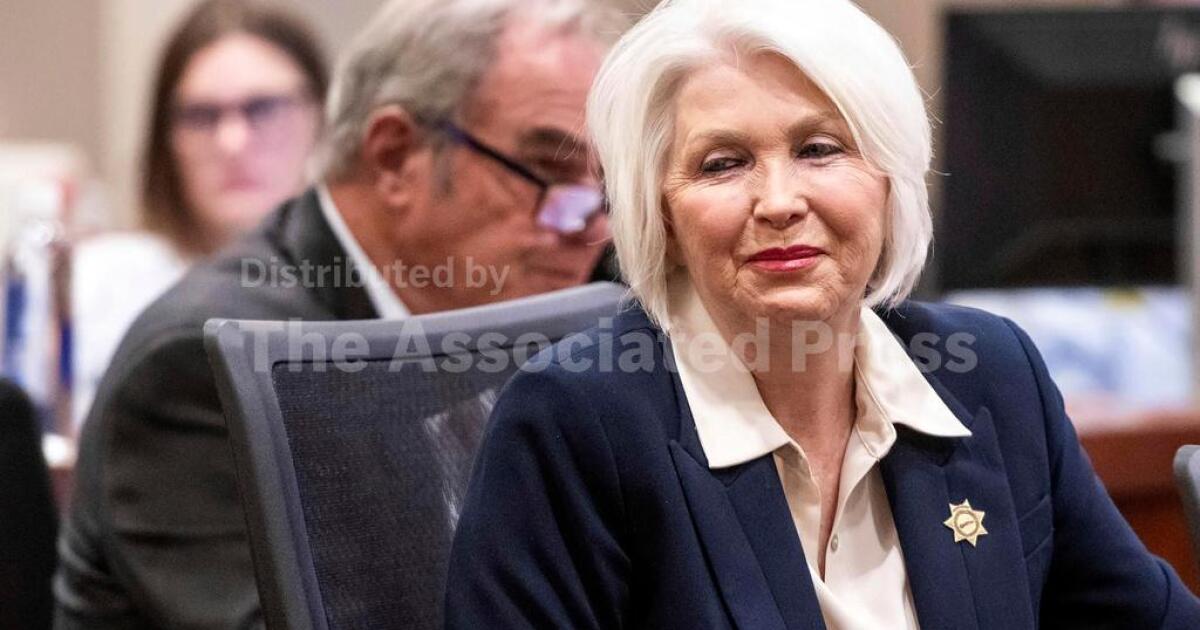
Source link

Democrats win in Virginia but it won’t be the final say in a national redistricting competition

Democrats on Wednesday celebrated an election win in Virginia that could put them slightly ahead in the national redistricting competition that President Trump triggered in an attempt to preserve his party’s House majority in this year’s midterms, but it will not be the final round.

Now that it’s been approved by voters, the new Virginia map will have to clear additional legal hurdles. On Wednesday, the state attorney general’s office said it would immediately appeal a ruling earlier in the day from a judge in rural southern Virginia who ordered that the results of Tuesday’s vote not be certified.

Ultimately, the Virginia Supreme Court will decide whether Democratic lawmakers violated procedural rules when they referred a constitutional amendment to the ballot authorizing the new U.S. House districts that could help Democrats win as many as four additional seats in the state. If so, that could invalidate the map voters narrowly approved Tuesday.

What happens next in Florida also will matter.

The state’s Republican-controlled Legislature is to meet in a special session next week that GOP Gov. Ron DeSantis called in part to draw a new map to expand the party’s congressional majority there. The U.S. Supreme Court is scheduled to issue an opinion by the end of June in a Louisiana case that could overturn a key provision of the Voting Rights Act and lead to redrawn political maps across the South, though almost all of those could not happen until 2028.

After voters passed the Virginia amendment, Democrats could tentatively claim that they netted 10 seats nationally from the mid-decade redistricting, compared with the nine that Republicans claim. Even if things swing again in the GOP’s favor, the net result of Trump’s campaign would be at best an incremental increase in the number of GOP-leaning House seats at a time when his approval rating is dropping and Republican anxiety over losing control of Congress in November is rising.

“We have successfully blunted Trump’s attempt to completely hijack the midterms,” said John Bisognano, president of the National Democratic Redistricting Committee.

Many Republicans agreed.

“The GOP will now lose net seats across the country. If you’re going to pick a fight, at least win it,” Ari Fleischer, who was a spokesman for President George W. Bush, posted on the social media site X after the Virginia vote. “All this was foreseeable and avoidable. We should not have started this fight.”

Adam Kincaid, executive director of the National Republican Redistricting Trust, argued that it is too soon to declare one party a victor.

“It’s an ongoing process with many legal challenges pending, and it’s far too early for sweeping statements on the final outcome,” he said.

Trump on Wednesday tried to undermine the Virginia result by leveling groundless accusations of fraud similar to ones he made after losing the 2020 presidential election. He called the Virginia vote “RIGGED” and “Crooked” in a post on his social media site and added, “Let’s see if the Courts will fix this travesty of ‘Justice.’”

Redistricting spread from Texas to other states

Redistricting is typically done every 10 years after each census, unless ordered by a court. But last summer, Trump pushed a redrawing in Texas, prodding the state’s Republican-controlled Legislature to add up to five winnable House seats for his party. Trump then began pressuring other Republican-run states to follow. Missouri, North Carolina and Ohio have since created more GOP-leaning seats in addition to Texas.

Democrats began to fight back, even though they were more constrained because several Democratic-controlled states had maps drawn by independent commissions rather than lawmakers and governors.

To counter Texas, California’s Democratic governor, Gavin Newsom, pushed the Democratic-controlled Legislature to place a redistricting initiative on last fall’s ballot. After voters overwhelmingly approved it, the measure will replace a commission-approved map with one that could gain Democrats five seats.

Democrats reclaimed the Legislature and governor’s office in November in Virginia and swiftly moved to replicate California’s move with an even more aggressive redistricting plan. It replaces a congressional map imposed by a court after the last census that had resulted in a 6-5 edge for Democrats with one that could allow Democrats to win as many as 10 seats.

“We are not going to let anyone tilt the system without a response,” state Senate President L. Louise Lucas said at a news conference Wednesday.

Courts could still have a say on redistricting

In Washington, U.S. House Democratic leader Hakeem Jeffries of New York warned Florida Republicans, who have been openly nervous about redrawing their district boundaries and potentially spreading their core voters too thin before an election that appears to be trending against them.

“Our message to Florida Republicans right now is, ‘F around and find out,’” Jeffries said.

House Majority Forward, the nonprofit arm of the super political action committee aligned with House Democrats, has spent nearly $60 million to push back against Republicans’ redistricting efforts. Some $40 million of that was on the Virginia campaign.

Another obstacle in Florida is an anti-gerrymandering constitutional amendment that was approved by state voters in 2010. It is likely that any new Florida map would trigger significant litigation, although six of the state Supreme Court’s seven justices were appointed by Republicans.

Nicholas Stephanopolous, a Harvard law professor, said a challenge for DeSantis is that the Florida amendment forbids drawing lines for purely partisan purposes, so he has to find some other excuse for revising the map. “Even with that sort of acquiescent state supreme court, I don’t think it’s a done deal,” Stephanopolous said.

The Virginia move comes with its own legal issues. Republicans have challenged the process that Democrats used to place the measure on the ballot and the state Supreme Court opted to wait for the vote before even scheduling arguments in the case. It is unclear when a ruling could come.

Wednesday’s ruling stopping certification came from a separate case that Republicans filed with the same lower court judge, whose initial ruling against the initiative was put on hold by the state supreme court.

“The ballot box was never the final word here,” Terry Kilgore, the Virginia House Republican leader, said in a statement after Tuesday’s vote. “Serious legal questions remain about both the wording of this referendum and the process used to put it before voters.”

The biggest legal wild card is held by the U.S. Supreme Court. Its conservative majority could throw out a requirement under the Voting Rights Act that in areas with a large minority population, mapmakers draw districts that are more favorable to the election of minority candidates.

That provision has led to the creation of several majority-minority congressional seats, especially in the South. Without it, Republicans in conservative states could shrink the number of U.S. House seats winnable by Democrats even further.

But it’s unlikely that any state other than Louisiana, which brought the lawsuit the high court will rule on, would be able to adjust its congressional lines in time for November even if the court eliminates that provision, known as Section Two. That’s because the November election is already officially underway in most states and candidate filing deadlines — and, in some cases, primary elections — have already passed.

Riccardi and Lieb write for the Associated Press. AP writers Lisa Mascaro and Leah Askarinam in Washington contributed to this report.
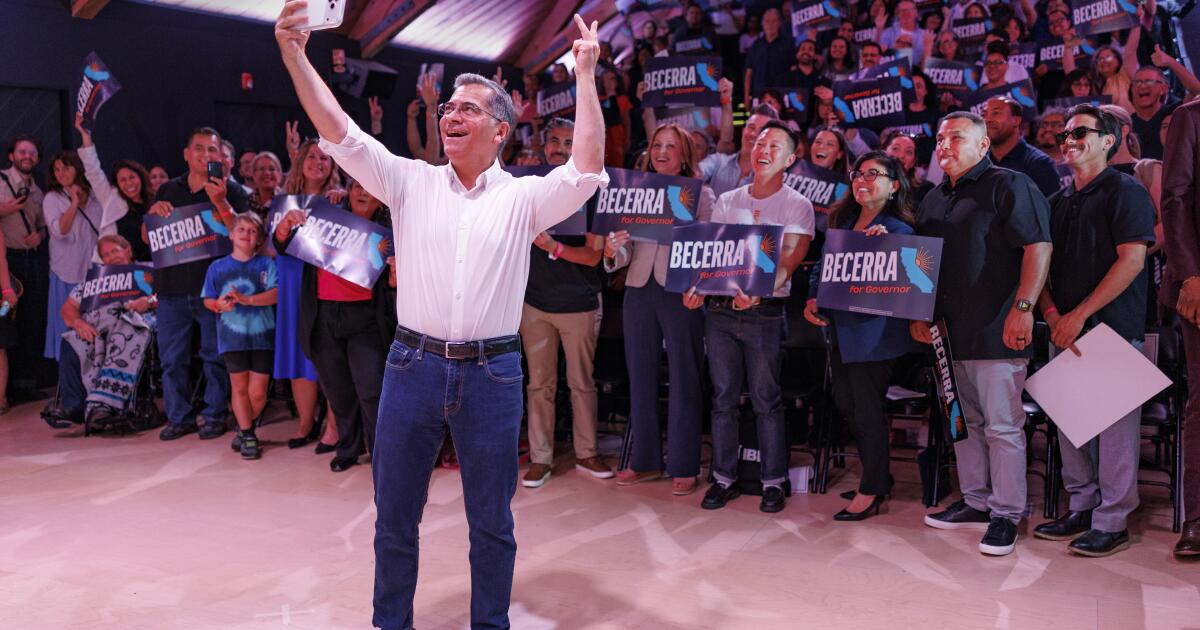
Source link

As primary election nears, top candidates for California governor debate tonight

With the California governor’s race quickly approaching, six candidates will face off Wednesday evening in the first debate since former Rep. Eric Swalwell dropped out of the race in the aftermath of sexual assault and misconduct allegations.

The debate takes place at a critical moment in the turbulent contest to replace termed-out Gov. Gavin Newsom. Ballots will start landing in Californians’ mailboxes in less than two weeks, and voters are split by a crowded field of eight prominent candidates. The debate also takes place after former state Controller Betty Yee ended her campaign because of a lack of resources and support in the polls.

Two Republicans — Riverside County Sheriff Chad Bianco and conservative commentator Steve Hilton — and four Democrats — billionaire Tom Steyer, former Biden administration Secretary Xavier Becerra, former Orange County Rep. Katie Porter and San Jose Mayor Matt Mahan — will take the stage at Nexstar’s KRON4 studios in San Francisco. Former Los Angeles Mayor Antonio Villaraigosa and state Supt. of Public Instruction Tony Thurmond, both Democrats, were not invited to participate because of their low polling numbers.

As the candidates strive to distinguish themselves in a crowded field, the debate could include fiery exchanges about the role of money in politics and potential heightened attacks on Becerra, who has surged in the polls since Swalwell dropped out. With the debate taking place on Earth Day, environmental issues are also likely to be raised.

The Wednesday night gathering is the first televised debate in the gubernatorial contest since early February. Last month, USC canceled a debate hours before it was set to begin over mounting criticism that its criteria excluded all major candidates of color.

The 7 p.m. debate is hosted by Nexstar and will be moderated by KTXL FOX40 anchor Nikki Laurenzo and KTLA anchor Frank Buckley. It can be viewed on KRON4 (San Francisco), KTLA5 (Los Angeles), KSWB/KUSI (San Diego), KTXL (Sacramento), KGET (Bakersfield) and KSEE (Fresno). NewsNation will also air the debate.

Source link