GOP

Analysis: Trump loomed over midterms and GOP suffered for it

The protracted uncertainty over control of Congress reverberated through both major political parties on Wednesday, as Democrats basked in the relief of the red wave that wasn’t and Republicans became increasingly clear-eyed that the lingering influence of former President Trump had hamstrung their party.

President Biden’s emphasis during the campaign season on the extremism of “MAGA Republicans” had been greeted skeptically by many. In the Democratic Party’s better-than-expected showing, though, he saw vindication of his appeals for civility and normalcy.

“This election season, American people made it clear: They don’t want every day going forward to be a constant political battle,” Biden said at a White House news conference. “The future of America is too promising to be trapped in endless political warfare.”

Amid high inflation and Biden’s lackluster approval numbers, Democrats’ hopes had hinged on voters being more put off by Trump’s imprint on the Republican Party — be it the divisive candidates he endorsed, the political violence that festered from his lies about election fraud, or the reversal of federal abortion protections made possible by justices he appointed to the Supreme Court.

“We knew going into the cycle that there was going to be an opportunity to rally a moral majority that is an anti-MAGA coalition,” said Tory Gavito, president of Way to Win, a progressive donor network. “When I say that, I include everyone from [GOP Rep.] Liz Cheney to [democratic socialist Sen.] Bernie Sanders. Think about that spectrum of the middle to the left coming together to say Republicans are just too damn extreme.”

If recent history is any guide, Trump’s not going anywhere. The once and likely future presidential candidate is unpopular, but he continues to exercise outsized sway over the Republican base, and could hobble the party for the next two years and beyond.

“While in certain ways yesterday’s election was somewhat disappointing, from my personal standpoint it was a very big victory,” Trump said on his conservative social media network, Truth Social, pointing to the record of candidates he endorsed. “219 WINS and 16 Losses in the General – Who has ever done better than that?”

The specter of the former president hampered the GOP’s ability to frame the midterm as a referendum on Biden, said Ken Spain, a GOP strategist and former spokesman for the party’s House campaign arm.

“Trump was always a looming shadow over this election, more than Republicans probably wanted to admit,” he said. “This essentially became a choice election between an unpopular president and an even more unpopular Trump.”

There were signs that patience was running thin among Republican power brokers. Notably, Trump’s much-beloved New York Post, the tabloid owned by conservative media magnate Rupert Murdoch, featured Florida Gov. Ron DeSantis on its cover Wednesday with the headline “DeFuture.” DeSantis is widely considered Trump’s biggest threat for the 2024 GOP presidential nomination.

Republicans still had a chance of winning both chambers of Congress as vote-counting continued Wednesday. House Minority Leader Kevin McCarthy (R-Bakersfield) projected confidence that his party would win the five additional seats necessary to take the majority there, and announced his intention to run for speaker of the House.

Whether he secures a majority may come down to his home state. California’s 11 competitive races remained unsettled as of Wednesday evening, with results trickling in slowly, as is common with the state’s methodical ballot-counting procedures.

Republicans had targeted incumbent Democratic Reps. Katie Porter and Mike Levin in Orange County, as well as an open seat in the Central Valley, as possible pick-ups. But Democrats were also watching the returns for the potential to oust vulnerable GOP Reps. David Valadao of Hanford and Ken Calvert of Corona.

Republican Sen. Ron Johnson of Wisconsin notched a close win over Democratic challenger Mandela Barnes, giving Republicans a 49-48 advantage in the Senate, with races in Georgia, Arizona and Nevada yet to be decided.

With neither candidate in Georgia winning more than 50% of the vote, the race will go to a Dec. 6 runoff, like the one that decided Senate control in 2020. A 50-50 split in the Senate would let Democrats maintain control with Vice President Kamala Harris’ tiebreaking vote.

Republicans made some successful pushes into blue territory; in New York, for example, they appeared likely to win four Democratic-held House seats. Rep. Sean Patrick Maloney, a New York Democrat who led his party’s efforts to keep the House, conceded his own race Wednesday morning to Mike Lawler, a Republican state assemblyman.

Still, the night was distinctly underwhelming for a party that contemplated a blowout win in the House and an assured majority in the Senate.

“Definitely not a Republican wave, that’s for darn sure,” Sen. Lindsey Graham (R-S.C.) said Tuesday night on NBC as he predicted a narrow win for Republicans in the Senate.

Paradoxically, a small Republican majority in the House would likely give Trump more leverage there, as McCarthy would have to depend on continued support from acolytes of the former president, such as Rep. Marjorie Taylor Greene, to exercise the GOP’s majority power.

Biden, speaking at the White House on Wednesday, said he had not had much occasion to interact with McCarthy but planned to talk with him later in the day. The president promised to work with Republicans in Congress, but noted pointedly that the American people had also sent the message that they wanted the GOP to show similar cooperation.

The president was happy to point out that his party had defied expectations, noting that “while the press and the pundits [were] predicting a giant red wave, it didn’t happen.”

National exit polls gave a glimpse into why Republicans fizzled. The surveys showed inflation was a top concern among voters. But abortion ranked second. That, and the relative weakness of Trump-backed candidates, helped Democrats stay in the fight.

Many voters appeared willing to swallow their disappointment with Biden. An NBC exit poll showed Democrats narrowly winning — 49% to 45% — among voters who “somewhat disapprove” of Biden’s performance.

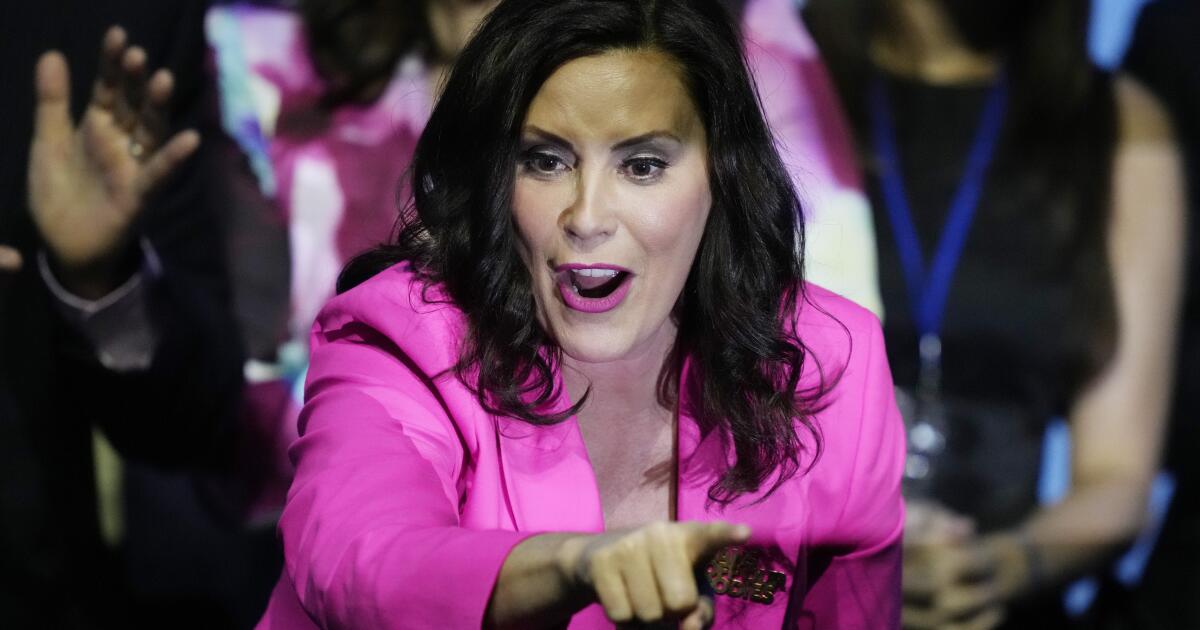
Results in Michigan underscored the extent of the Republican Party’s disappointments. Democratic Gov. Gretchen Whitmer, whom Trump had attacked relentlessly, defeated his endorsed candidate, Tudor Dixon, and Democratic incumbents held on to the state’s attorney general and secretary of state posts and gained control of the Legislature as well.

The GOP failed to oust Rep. Elissa Slotkin, a vulnerable Democrat in a Michigan swing district that barely backed Biden two years ago. Elsewhere in the state, a Trump-backed candidate — who in the primary beat Rep. Peter Meijer, a Republican who had voted to impeach the former president — lost in the general election, costing Republicans a seat in the surprisingly tight battle for control of the House.

Michigan voters also approved a ballot measure striking down a 1931 ban on abortion, and voters in Kentucky rejected an initiative that would have amended the state constitution to make clear it did not protect abortion rights.

The Republicans’ loss of a Senate seat in Pennsylvania could prove the most consequential if Democrats keep the chamber. Lt. Gov. John Fetterman defeated Mehmet Oz, a television doctor and first-time candidate backed by Trump. Fetterman, still recovering from a stroke, painted the untested Oz as an elite carpetbagger.

Many of the gubernatorial candidates Trump backed also lost or were in danger of losing as of Wednesday afternoon. DeSantis’ double-digit win in Florida, as well as his strong coattails for Republicans in the House, served as a stark contrast. But Trump has said he will run again even if party leaders prefer DeSantis. Opinion polls, at least for now, show the former president as the prohibitive favorite to capture the party’s nomination.

Jason Miller, an advisor to Trump, told the BBC on Wednesday morning that he was urging Trump to postpone an announcement that he will run again from next week — as he has been teasing — to December, to avoid distracting from a potential Senate runoff in Georgia. But Miller said he remained 100% certain that Trump would run.

“Many of the people who are championing Ron DeSantis for president are the same people who were skeptical of President Trump ever since he came down the escalator in 2015,” Miller said, recalling Trump’s improbable announcement for the 2016 race.

Miller predicted that Trump would “have his hands full” but would ultimately win the nomination again.

Mason reported from Los Angeles and Bierman from Washington. Times staff writer Erin B. Logan contributed to this report from Washington.


Source link

Here’s how the GOP could scheme to keep control of the House

For Democrats or, for that matter, anyone who believes in checks and balances, things are starting to look up.

President Trump’s days of untrammeled war-making, law-breaking and generally doing whatever he damn well pleases may finally be drawing to a close. Public opinion, history and, especially, the surging price of gasoline and groceries, all point to a Democratic takeover of the House in November’s midterm election.

There’s a direct correlation between a president’s approval rating and the way his party performs at the midpoint of his term. Anything below 50% favorability portends political trouble; right now Trump’s positive standing in polls hovers around a dismal 40%.

Then there’s the history part. Since World War II, the party out of the White House has gained an average of more than two dozen House seats in midterm elections. Democrats need to pick up just three to take control beginning in January.

(While the Republican grip on the Senate seems weaker than just a few months ago, the GOP is still favored to hang onto the chamber in November.)

There is, however, a looming threat causing nervousness among Democrats and their allies as they contemplate a celebratory fall, a landmine of sorts buried deep in the congressional election process.

Let’s acquaint ourselves with Article 1, Section 5 of the Constitution.

The pertinent language written by the Framers states, “Each House shall be the Judge of the Elections, Returns and Qualifications of its own Members.” In other words, it’s up to the House and Senate to acknowledge and abide by the will of voters as expressed in the election returns.

What could possibly go wrong?

Well, if you let your paranoia run wild, quite a lot. If the election outcome is close — and probably it would have to be very close — Republican lawmakers could theoretically seize on phony claims of fraud and effectively nullify the results of enough contests to deny Democrats control of the House.

There’s plenty of skepticism that would or could ever take place. But if it were to happen, hello, national crisis!

Normally, we could count on the occupant of the White House to humbly submit to the election returns, even if it’s a “shellacking” as President Obama called his walloping in the 2010 midterm election, or a “thumpin’ ” as President George W. Bush described his electoral spanking in 2006.

Not Trump.

This president has amply demonstrated the lengths to which he’ll go to overturn an honest election, siccing a violent mob on lawmakers certifying his 2020 defeat, telling endless lies and using the Justice Department to confiscate ballots and intimidate innocent election officials and others Trump deems his enemies.

He strong-armed Texas into a highly unusual, highly partisan redrawing of its congressional boundaries, an effort to net five seats and lengthen the odds against a Democratic takeover.

The move appears to have backfired, spurring voters in California and, last week, Virginia to redraw their state’s political maps to more than offset Texas and boost Democrats in November. (The Virginia results are being contested in court.)

A gathering of Virginia voters in front of television screens

Voters attend an Arlington Democrats redistricting vote watch party during a special election Tuesday in Virginia. A measure to redraw the state’s congressional map was narrowly approved.

(Valerie Plesch/Bloomberg via Getty Images)

That failure doesn’t take away Trump’s malign intent. And in the supine Speaker Mike Johnson, he has the perfect handmaiden to undermine the midterm vote.

In 2020, Johnson was the lead author of a Supreme Court brief seeking to overturn the results in four states that Joe Biden had indisputably won. That speaks to Johnson’s probity and integrity.

How would subversion of November’s election take place?

One theory goes like this: When the balloting is over, Johnson could appoint a House committee packed with Trump’s acolytes to investigate alleged voting irregularities. (And if you think Trump won’t be bellowing the words “rigged” and “fraud” in the face of defeat, you’ve either been in a coma or living on another planet for the last decade.)

Those hearings and the “evidence” they turn up could then be cited by election officials in key states — collaborators, if you will — as a reason to delay the certification of election results and block the seating of majority-making Democrats in the next Congress. In their place, the theory goes, Republicans could vote to fill those seats with GOP candidates who lost at the polls, keeping themselves in control.

Derek Muller, an election law expert, suggests that scenario is little more than a fever dream of doomsday devotees and overly nervous Nellies.

He said he’d be very surprised if all the election results weren’t certified by Jan. 3, when the new Congress convenes, given the legal remedies available to prevent stalling and undue delay. And, Muller said, there is no assurance Republicans would march in lockstep behind a plan to prevent the seating of Democrats.

Thwarting a duly elected Democratic majority “involves extraordinary coordination and precedents that have never occurred, with a unique convergence of factors,” said Muller, who teaches law at Notre Dame — though, he added, if control of the House came down to, say, a single seat “all bets are off.”

Far-fetched? Perhaps. Some of the spun-up theories surrounding November’s election do sound a bit like a product of political science fiction.

But what kind of president picks a fight with the pope? Plunges the world into crisis by unilaterally going to war with Iran with no exit plan? Demolishes the East Wing of the White House on an egotistical whim?

If Trump, an inveterate norm-buster, sees a way to keep his grip on unchecked power, don’t put anything past him.

Source link

GOP Renews Drive to Drill in Arctic Wildlife Refuge

As President Bush was out promoting his stalled plan to allow drilling in an Alaskan wildlife refuge, the leader of a Senate committee said Wednesday that he would try a new strategy to navigate the proposal through Congress.

Senate Budget Committee Chairman Judd Gregg (R-N.H.) said he would add into a budget bill a measure to allow companies to drill for oil and gas in Alaska’s Arctic National Wildlife Refuge.

Because Senate rules treat the budget measure differently from other legislation, successfully attaching the drilling provision to it means it could pass with support from 51 senators. That would end opponents’ chances to block the drilling measure with a filibuster. A filibuster would force supporters to find 60 votes.

In 2003, Senate Democrats and several Republicans blocked a proposal for drilling in the refuge by a vote of 52 to 48. The GOP has gained four seats in the Senate since then, giving them 55.

Traveling to Ohio, Bush toured a technology development institute and made his first major speech on energy in his second term, calling on Congress to adopt his energy policy.

“We have had four years of debate about a national energy bill,” Bush said. “Now is the time to get the job done.”

The president called for greater reliance on coal and nuclear power, as well as for greater efforts at conservation and the modernization of the energy infrastructure. He said the U.S. could achieve all of that while remaining a good steward of the environment.

The energy bill before Congress includes a number of politically popular features, such as requiring greater use of ethanol, an alternative fuel made from corn. It also has measures that supporters say would strengthen the nation’s electric grids and prevent fuel shortages and price spikes, such as those that occurred during California’s electricity crisis in 2000 and 2001.

Bush’s speech comes at a time when gas prices have been rising — to an average of nearly $2 per gallon nationwide as of Monday, according to Energy Department figures. Retail prices on average are 26 cents higher than at this time last year. Prices in California are nearly $2.23 on average.

The president said that “higher prices at the gas pump and rising home heating bills and the possibility of blackout are legitimate concerns for all Americans. And all these uncertainties about energy supply are a drag on our economy…. To meet America’s energy needs in the 21st century, we need a comprehensive national energy policy.”

White House Press Secretary Scott McClellan told reporters that Bush remained opposed to tapping the Strategic Petroleum Reserve as a way to increase supply and cut prices. Some Democrats have called for releasing oil from the reserve, which they say could be replaced after prices decline.

Speaking about plans to drill in the Arctic refuge, Bush said the Department of Energy believed the effort would yield 10 billion barrels from “a small corner” of the reserve — “just 2,000 acres,” or roughly the size of the airport here in Ohio’s capital. By using innovative techniques, he said, such development would have “almost no impact” on the land or local wildlife.

He noted that no nuclear power plant had been ordered since the 1970s, and declared: “It’s time to start building again,” adding that decades of experience and advances had proven the reliability and security of nuclear power.

Bush, whose environmental policies have been condemned by groups such as the Sierra Club, renewed his push for energy legislation just as Congress was preparing to take up one of his most controversial initiatives: opening a portion of the Arctic National Wildlife Refuge to oil and gas exploration.

“The votes are extremely close,” Senate Minority Leader Harry Reid (D-Nev.) said. He called Gregg’s maneuver to attach the drilling approval to the budget bill an aberration of the budget process.

By contrast, Sen. Pete V. Domenici (R-N.M.), chairman of the Senate Energy and Natural Resources Committee, welcomed Gregg’s approach. He told the Budget Committee, of which he is also a member, that “the cleanest energy development in the world” was proceeding in the North Slope, near the Arctic reserve.

Energy legislation has been one of Bush’s priorities virtually from the day he took office, during the California energy crisis. An energy bill that included measures to promote conservation and production passed the House in 2003, but fell two votes short of overcoming a filibuster in the Senate.

A significant hurdle to passage of an energy bill is a dispute over whether it should limit manufacturers’ liability in lawsuits over the controversial fuel additive MTBE, or methyl tertiary butyl ether.

Senators from states contaminated by the fuel additive — including California’s Democratic senators and New Hampshire’s Republican senators — have objected to the provision, complaining it could force their taxpayers to pick up the tab for cleaning up the contamination.

But House Majority Leader Tom DeLay, whose home state of Texas has been a big producer of the fuel additive, has insisted on the liability shield.

*

Chen reported from Columbus and Simon from Washington. Times staff writer Joel Havemann in Washington contributed to this report.

Source link

Black Clergy Courted by GOP

Seldom have black ministers been more popular. Historically wooed by liberal politicians as conduits to African American communities, they are now the darlings of conservatives as well.

In the last year, conservative groups have flown a delegation of ministers, including a dozen from Los Angeles, to Washington to chat about racial profiling with Atty. Gen. John Ashcroft and hobnob with conservative scholars at the Heritage Foundation.

California Republican lawmakers have flown ministers of primarily black mega-churches and community chapels, storefronts and sanctuaries to Sacramento for “Pastors Days” and hosted hundreds of them at conservative community-renewal conferences.

A handful of Republican legislators trawl the length of the state, stopping in Berkeley, Los Angeles and San Diego, where they preach conservative remedies to poverty, unemployment and the spread of AIDS. African American pastors turn out by the hundreds to hear them.

“Not bad, when white Republicans can come to Los Angeles, host a meeting for 400 black pastors, and some Latinos too, without anyone really knowing about it,” boasts state Sen. Tim Leslie (R-Tahoe City). “In fact, just weeks ago I spent the night there–in the ‘hood” as the guest of one minister’s family.

Many African American ministers, whose congregants voted overwhelmingly Democratic in the 2000 presidential election, say they are not yet converted–but make it clear they are listening.

“Of course I know the Republican Party has an objective and an agenda–it’s trying to win favor with the black community through the pastors,” said Bishop Frank Stewart of Zoe Christian Center in Los Angeles. “But I don’t think that’s negative…. They’re saying some things that are interesting to me.”

There is deep desperation on both sides of this would-be relationship.

Stark demographic changes make it clear that if the state Republican Party does not diversify, it will go the way of the dinosaur. Latinos in California supported Democrat Al Gore in 2000 by a 2-to-1 margin. Nationally, 90% of blacks and a majority of Latinos and Asians voted for Gore, while white men voted 62% in favor of Bush and white women were split almost evenly.

Courting minorities “is our No. 1 priority,” said Pamela Mantis, deputy director of outreach for the Republican National Committee.

So the GOP goes on the road. Last year, the RNC held African American outreaches in Memphis, Philadelphia, Atlanta and Arkansas, and earlier this month hosted blacks and Latinos in Mississippi. In mid-April, the party will hold an event targeting Haitian Americans in Miami.

“The African American community has felt abandoned by our party for the last 40 or 50 years,” Mantis said, “and the other side, the Democrats, took advantage of that.”

The desperation on the black ministers’ side is the belief by some that they are taken for granted by the Democrats, and that liberal solutions to urban problems have done little to improve their communities.

Some are drawn to conservative notions like the privatization of Social Security, President Bush’s initiative to give faith-based organizations greater access to federal funding, school vouchers and opposition to abortion.

“My vote is now definitely up for grabs,” said the Rev. James Price of Long Beach Christian Center. Republicans “have definitely said things that make me listen.”

He said he decided he favored privatizing part of Social Security, which would allow individuals to make their own investment choices, during the pastors’ trip to the Heritage Foundation.

“My desire is to bring biblical truths to my congregation and we’re supposed to be good stewards of things that we have,” he said. “Timothy says, in Chapter 5.8, that he who does not provide for his own and those of his household is worse than an infidel and has denied the faith.”

Last month, African American pastors from around the country gathered at a hotel near Los Angeles International Airport for the conservative Coalition on Urban Renewal and Education’s annual convention.

The coalition is a nonprofit organization founded by black welfare mother-turned-conservative author Star Parker, best known for her book “Pimps, Whores and Welfare Brats.” It paints liberal Democrats as pimps who buy off black leaders in exchange for their support of a welfare culture. Published in 1997 with a forward by Rush Limbaugh, the book rocketed her to national prominence in conservative circles.

Parker, who now lives in San Clemente, says she enjoys the Republican Party’s praise but questions its support. “Republicans, as a party, are unwilling to acknowledge social problems regarding race,” Parker said. “When I do [conservative] radio shows, racial profiling will come up, they’ll ask me: ‘Well, racial profiling isn’t a big problem, is it?’ And when I say ‘Well, actually it is … ‘ there’s silence.”

Parker organized the black ministers’ visit to Washington last year. Using donations to her nonprofit, she paid for 47 ministers from Los Angeles, Houston, Philadelphia and Chicago to visit Capitol Hill. She also has organized conferences for pastors featuring conservative stars such as Jack Kemp, Dick Armey, Newt Gingrich and Alan Keyes.

“I start with pastors because they’re socially conservative,” Parker said. “I really don’t care about the politics of it all. I’m interested in seeing my community healed.”

The Rev. Eugene P. Pack, assistant pastor at the Praise and Worship Center in Houston, attended the coalition’s conference to learn more about Bush’s faith-based initiative, which the president hopes will allow churches with social service agencies to gain a greater share of federal dollars.

Pack, who with his wife runs a family assistance and crisis pregnancy center in Houston’s struggling 3rd ward, said he had long ago embraced a conservative message and the Republican Party.

“I tell folks, if you read the platform you’ll find out the majority of you are already Republicans,” Pack said. “You just don’t know it.”

Not the Rev. Johnny Hunter of North Carolina, another conference guest. Hunter, the national director of the Life Education and Resource Center, left the Democratic Party several years ago over its pro-choice stand but said he simply could not become a Republican.

“I just can’t do it,” he said. “There are some issues of social justice that really need to be addressed.”

Historically, the last time the Republican Party actively identified with African Americans was during Abraham Lincoln’s presidency. And winning over a pastor does not necessarily mean the flock will follow.

Most black people–63%–say pastors are the most important leaders in the African American community, according to the Barna Research Group Ltd., a Ventura company that tracks cultural trends and Christianity. Yet the African American vote is the only one in the nation that has no correlation between high church attendance and acceptance of the Republican Party, the research firm says.

Among California Republican legislators, the most enthusiastic envoys to black churches have been Leslie and Sen. Ray Haynes (R-Riverside).

Their efforts began about two years ago. Senate Republican Leader Jim Brulte (R-Rancho Cucamonga) hired consultant Tony Lowden, who had worked on recruiting ministers for the Democratic Party, to launch a similar fact-finding mission for Republicans. When Lowden returned, he told Brulte, Haynes and Leslie the time was ripe for them to step in.

Haynes and Leslie say they keep their black pastor events in Sacramento low-profile to avoid any hint of insincerity. Haynes goes so far as to say he is not recruiting blacks for the party, merely building relationships in minority communities and staying true to conservative problem-solving methods.

Haynes said he was surprised by the black churches’ industriousness. “Those pastors are doing more with the hundreds of dollars that they get than we’re doing with millions we dump into bureaucracies.”

Now, after their immersion in black neighborhoods, Haynes and Leslie are conversant in a litany of services of interest to many African Americans, from convict employment programs to mortgage lending opportunities.

None of this is enough to win the many ministers who continue to view the GOP as racially hostile.

“They’re the same people who didn’t want us to come to their schools and now they want to pray with us? I think for myself and I’m just not hearing that,” said the Rev. M. Andrew Robinson-Gaither of Faith United Methodist Church in South-Central.

Gaither went on pastors’ trips to Washington and Sacramento and says he is open to a conservative solutions. But, “I would not want Social Security privatized. I don’t think we should legislate abortion, and then their whole approach to the economy is that business can do no wrong. But business abuses us as much as the government does. As for welfare reform, what about the welfare we give to corporations?”

David Bositis of the Joint Center for Political and Economics, an organization that researches public policy issues of concern to African Americans, said the GOP’s dilemma is how to woo black conservatives without alienating white ones .

Even where black conservatives agree with mainstream conservatives, they do so for different reasons, Bositis said.

Take school vouchers. Bositis’ research shows that the majority of African Americans want school vouchers, but do so out of “desperation,” he said. “Their children are going to schools that are broken.”

White conservatives, as often as not, would use vouchers to move their children away from other kinds of children–such as black ones, Bositis said. “And those are two entirely different things.”

Party officials recognize that an accommodation has to be reached, if only for practical reasons. In 2000, Gore won 71% of the big-city vote. An example was Michigan, where he narrowly won the state’s electoral votes even though Bush won most counties. The reason: Gore took heavily black Detroit, winning 94% of the African American vote.

The GOP does not need the majority of blacks to vote Republican, Bositis said, just a few more. Doubling its national share to 20% would dramatically change its fortunes.

Bositis recently sat down with party leaders, who sought his advice about winning greater black support.

“I believe they really want to do it, but I told them it was going to be a long process, hard to accomplish,” he said. “It’s not necessarily impossible, just extremely difficult.”

Source link

A Civil Rights Ruling Dear to South’s GOP

There is no little irony in the U.S. Supreme Court’s recent holding that racial redistricting is permissible as long as race is not the sole or dominant factor. With the Senate equally divided and Republicans holding a razor-thin advantage in the House of Representatives, the court’s ostensibly liberal ruling, one backed by civil rights organizations and opposed by the court’s four conservatives, could not be more dear to the hearts of Southern Republicans. The 5-4 decision will buttress GOP efforts to retain control of Congress by making the election and reelection of Republicans in the South easier after congressional districts are redrawn to reflect the 2000 census.

The strategy of racial redistricting, or creating “minority majority” congressional districts, was put into full play after the 1990 census. Racial gerrymandering isolates blacks, who vote overwhelmingly for liberal Democrats, in awkwardly shaped districts that often cut across the entire width of some states, particularly in the South. In turn, white conservative voters are placed in surrounding districts, which virtually guarantees the election of Republicans in those districts. As a result, although more minorities may be elected to Congress, fewer Democrats and more Republicans end up in the House of Representatives.

During the first Bush administration, the Department of Justice hit upon racial redistricting as a way to both increase minorities’ representation in Congress and elect more Republicans at the expense of the Democrats. The 1965 Voting Rights Act requires that all redistricting in Old South states not dilute black votes. Somewhat perversely, the department parlayed this standard into an affirmative action policy to benefit Republicans. By forcing Southern state legislatures to redistrict along racial lines, it slightly increased the number of minority-majority districts while greatly boosting the number of those disposed to vote Republican.

The Congressional Black Caucus welcomed the Bush administration’s innovative compliance with the Voting Rights Act, but white Democratic politicians in states like Virginia, North Carolina and Georgia were left in a no-win situation. On the one hand, they could not argue, at least vehemently in public, against the creation of such minority-majority districts without inviting charges of racism. On the other, they faced losing seats in districts that lacked their most reliable supporters.

Make no mistake, this affirmative action strategy worked for Republicans. Following the 1990 census, 26 new minority-majority districts were created. More blacks and Latinos were elected to Congress. But so were Republicans like Newt Gingrich; in 1994, the Grand Old Party won control of the House in large part because of their wins in the South.

Ever since, the Republican National Committee has pushed its self-serving version of affirmative action to maintain party hegemony in the South. Although not widely known, the committee has even developed computer programs and models–so-called “Max Black” plans–to help Southern legislatures draw racially gerrymandered districts for distribution to black politicians.

Ironically, during the last decade, the Supreme Court’s five most conservative justices voted to strike down such districts. The lead case, Shaw v. Reno (1993), involved a challenge to North Carolina’s 12th Congressional District. As redrawn in 1992, it was overwhelmingly black and slithered, snake-like, about 160 miles along Interstate 85, from Charlotte to Winston-Salem and to Durham. Writing for the court in that case, Justice Sandra Day O’Connor was joined by Chief Justice William H. Rehnquist and Justices Antonin Scalia, Anthony M. Kennedy and Clarence Thomas. She held that “bizarre,” ’tortured” and “irregular” minority-majority districts run afoul of the 14th Amendment’s equal protection clause.

O’Connor’s bare majority hung together in rejecting other racial gerrymandered districts in the 1990s. But she never completely ruled out race as a factor in redistricting. By contrast, Scalia and Thomas, the court’s most conservative justices, have held that race-based redistricting is never permissible.

The more liberal members of the court–Justices John Paul Stevens, David H. Souter, Ruth Bader Ginsburg and Stephen G. Breyer–steadfastly dissented. They argued for judicial self-restraint and deference to politics in determining the shape and composition of congressional districts.

The court’s latest ruling on North Carolina’s 12th Congressional District is its fourth. Redrawn three times since the 1993 case, the district is currently about 40% black and more compact, stretching across only one-third of the state, from Charlotte to Winston-Salem.

But this time, O’Connor abandoned her more conservative colleagues and joined with the more liberal dissenters. Race may be considered in redistricting, according to the court’s new majority, but only as long as it’s not the “predominate factor.” In other words, race may be a factor in redistricting but not the sole factor, and blacks apparently may not constitute a majority in the district.

With congressional redistricting underway, the decision in Hunt v. Cromartie could not be more timely. But it is certain to be a hollow victory for liberal Democrats, because, as O’Connor knows, it signals Republicans to press ahead with their brand of affirmative action in racial redistricting to hold onto their control of the House.

It’s noteworthy that the ruling turned on the vote of the justice with the most political experience and, arguably, the vote of the most political justice on the court. Before her appointment in 1981 by former President Ronald Reagan, O’Connor served on state courts and in Arizona’s state legislature, where she must have learned something about the politics of redistricting.

Moreover, she is at the court’s center stage, casting the pivotal vote on such hotly contested political issues as abortion and affirmative action. Recall, too, that on election night in November at a cocktail party, O’Connor reportedly became upset when news organizations initially announced that Vice President Al Gore had won the presidency. Her husband explained that she had planned to retire if Bush was victorious. Time will tell whether O’Connor will give President George W. Bush his first opportunity to make his mark on the Supreme Court.

Source link

NEWS ANALYSIS : Clinton Sees Chance to Win the Budget Battle : Politics: President hopes GOP proposals will cause a public backlash. That would pave way for a compromise.

Amid the din of battle over the federal budget, President Clinton summoned Democratic congressional leaders to the White House last week and gave them an unexpectedly upbeat message: With a little discipline and a little luck, they might win this fight yet.

“The Republicans are very disciplined and very good,” Clinton warned his war council around the Cabinet Room’s long mahogany table, according to people who were present. “But we’re making headway.”

Congress’ drive to cut the budget this spring was launched by triumphant GOP leaders, confident that they had a mandate from voters to slash government programs and shrink the federal budget deficit to zero.

But after three months of rhetorical battle, Clinton believes that he has begun to turn the Republicans’ issue around–into a major political opportunity for himself.

The budget battle is “the centerpiece” of Clinton’s work this year, said White House Chief of Staff Leon E. Panetta. “It will determine a lot about the priorities of the country; it will determine a lot about our economy in the future; it will determine a lot about the role of government.”

It will also determine a lot about how voters view Clinton as the election year of 1996 approaches. “It . . . will better define who the President of the United States is, and I think that’s helpful,” Panetta said in an interview.

Transforming budget-cutting from a liability into an asset would be a startling turnaround for a President whom Republicans succeeded in painting as a “tax-and-spend Democrat” only last year. But public opinion polls read raptly by White House aides suggest that the voters are moving Clinton’s way: An ABC News-Washington Post poll last week found that while respondents by a wide margin once trusted Congress over Clinton to deal with the deficit, the President has nearly closed the gap.

Clinton’s biting attacks on GOP plans to shrink Medicare, education and veterans programs have helped lift his approval rating in the poll to 51%, its highest level in a year.

White House strategists said they were not worried that the House Republicans passed their GOP budget plan last week, as was long expected. More important, they said, was that Clinton apparently succeeded with his threat to veto a GOP spending-cut bill, since the GOP leadership acknowledged that they probably wouldn’t have the votes to override a veto. It showed that the President can still make himself relevant.

Clinton is betting that House Speaker Newt Gingrich (R-Ga.) and other GOP leaders overestimated the public’s desire for cutting government–especially once the public realizes that the savings would come not only from unpopular programs, such as welfare and foreign aid, but also from middle-class benefits.

Political strategists note that Clinton’s argument may attract some swing voters–especially white women older than 35, one of the President’s critical demographic targets. Making up more than one-fourth of the electorate, they largely voted for Clinton in 1992, abandoned the Democrats in 1994–and could be key to his prospects in 1996.

At the same time, Clinton and his aides believe that they must eventually seek a budget compromise with the Republicans–if only to avoid the charge that the President has become irrelevant to the process of shrinking the government, a goal most voters still want.

“Preserver of the Big Government status quo is not a place you can end up in a fight this big,” one presidential adviser said.

So Clinton, Panetta and other aides have devised a two-part strategy to try to stop the GOP juggernaut and turn the budget battle to their advantage.

The first phase has been to shift the topic away from the deficit, force the public to confront the kind of cuts the Republicans want and paint the GOP as heartless vandals who would loot Medicare and student loans to give tax cuts to the wealthy.

“Less government? That’s not the issue. The issue is: Do you want your kids to go to college?” Labor Secretary Robert B. Reich said.

If that tactic works, and Republicans retreat from their proposed spending and tax cuts, then the Administration wants to sit down and try to negotiate a compromise, a budget “that might be nobody’s first choice but that is really quite a good budget,” said Alice Rivlin, director of the Office of Management and Budget.

But Clinton doesn’t want to begin those negotiations until “his leverage is at a peak,” Panetta said, meaning the President wants to continue whipping up public opposition to GOP budget cuts and threatening to veto a budget he doesn’t like, at least for a while.

“The Republicans are beginning the budget triage, amputations and decapitations, and for the moment the Democrats are happy to sit in the surgical theater and watch the blood flow,” said Ross K. Baker, an expert on Congress at Rutgers University.

Already, however, Panetta and other Administration officials have begun sending signals to Capitol Hill about the kind of deal Clinton might eventually want to make.

“Yes, we want additional deficit reduction,” Panetta said. “But in order to engage, the Republicans have to back off these huge tax cuts, they have to recognize that any Medicare or Medicaid savings have to be done in the context of [health care] reform, and they have to be willing to protect education as a key investment.” Almost everything else is “on the table,” he said.

One key concession the White House has quietly offered: Clinton is willing to drop most or all of his proposed $500-per-child tax credit–the core of his long-promised “middle-class tax cut”–if Congress agrees to make college tuition tax-deductible.

Those early signals suggest to some members of Congress, including some worried liberal Democrats, that Clinton may be willing to give up quite a lot–except for his major concerns on Medicare, Medicaid and education–for the chance to claim a victory.

When bargaining can begin in earnest depends mostly on the GOP’s tolerance for pain. Aides say Clinton will stay on the attack for at least three weeks as Republicans pass their budget resolutions and begin making decisions on the discretionary portion of the budget.

But White House officials hope that the solid Republican line will begin to fracture as members of Congress read the mood of their constituents. Some in Congress predict a turning point could come as early as the Memorial Day recess, which begins Saturday, but others warn that it might be September before negotiations start.

The White House strategy is not assured of success, of course. At least three problems loom:

First, Clinton has succeeded only partially in changing the focus of the debate from deficits to middle-class benefits. By a wide margin, the public still says it wants a balanced federal budget, with no deficit. The President’s dirty little secret is that he doesn’t think a balanced budget can be achieved in the foreseeable future at reasonable cost.

In fact, the public is inconsistent on these issues. Large majorities say they want to balance the budget, but equally large majorities say they are opposed to significant cuts in Medicare, Medicaid, student loans and other education programs.

Second, Democrats aren’t entirely unified behind Clinton’s strategy, which is why the President spent much of his meeting in the Cabinet Room last week appealing for more discipline.

Some strains were already evident in the closed-door session, participants said. House Minority Leader Richard A. Gephardt (D-Mo.) urged Clinton to give the Republicans no quarter, but Sen. John Kerry (D-Mass.) said: “It’s not enough to complain; we need to say where we go from here.”

Third, and most important, the Republicans may not cooperate. “Democrats have no standing to say anything about what we are doing in the House and the Senate,” House Budget Committee Chairman John R. Kasich (R-Ohio) said last week. Gingrich and Senate Majority Leader Bob Dole (R-Kan.) often disagree with each other, but they agree on one point: They don’t want Clinton to win credit for their hard work in fashioning a leaner federal budget. So they may be tempted to pass a budget bill of their own design and dare Clinton to veto it this fall.

That would lead to a messy confrontation that could require the federal government to halt routine operations until a solution is found.

“I don’t think anyone comes out a winner” in an impasse like that, Panetta said. “I don’t think the President wins; I don’t think Republicans or Democrats win.”

Source link