Good Health

After Lindsey Graham’s death, questions linger about aging politicians and health transparency

The sudden death of Sen. Lindsey Graham, a top ally of President Trump and one of Washington’s best-known politicians, is renewing focus on the country’s aging lawmakers.

Graham, a South Carolina Republican who had turned 71 just two days before dying on Saturday, was far younger than many of his Senate colleagues and appeared to have been in good health. He suffered a tear in his aorta, according to a preliminary report from the medical examiner.

It was the second time in less than a month that emergency personnel were dispatched to the home of a U.S. senator. In early June, Mitch McConnell of Kentucky, the former Republican Senate leader, was hospitalized for undisclosed reasons.

After weeks of increasingly dire speculation about his health, he finally revealed on Sunday that he had fallen and suffered from mild pneumonia. He released a photo, complete with a copy of the day’s newspaper.

Graham’s death and McConnell’s hospitalization have come amid an ongoing reckoning about the nation’s aging leaders, two years after the disastrous presidential debate that sparked widespread panic among Democrats about then-81-year-old President Biden’s capacities and accusations of a cover-up.

Some politicians have continued to obscure details about their health challenges, asking for privacy despite their public positions, and fueling conspiracy theories.

“I think we need some transparency,” Sen. John Cornyn (R-Texas) said Monday. “I wish Sen. McConnell and his team would have done that earlier. I think it would have resolved a lot of questions.”

McConnell is admitted to a hospital

McConnell, who at 84 is only the third-oldest member of the Senate, was admitted to the hospital on June 14 with barely any explanation. Aides said he was “receiving excellent care” but offered no details about his condition.

The dearth of information fueled a wave of speculation about his prognosis, with Laura Loomer, a Trump ally and conspiracy theorist, claiming on social media that a “high level source close to the White House” had told her he was “officially brain dead.”

But McConnell, who will retire from Congress at the end of January after serving as the longest-ever Senate leader, said in a statement that he is on the mend. He said a fall had led to his hospitalization and that he was “briefly unconscious” and treated for mild pneumonia.

“You all know how folks of my generation often hesitate to share the vulnerability that comes with growing older,” he said. “Even in the public eye, I feel that same instinct — I can’t help it.”

That wasn’t enough to put speculation to rest. On social media, many refused to believe the veracity of a photo his office released that included the front page of the sports section of the Washington Post.

Conspiracy theories about McConnell’s health are “a symptom of our times,” said Sen. Rand Paul, a Republican who is also from McConnell’s home state of Kentucky. Paul said people should “give him a break.”

“People think they have a right to know everyone’s medical problems,” he said, “but I don’t know, where does it begin and where does it end?”

Trump’s medical reports offer limited details

The oldest person ever elected president, at age 78, has long offered only the rosiest picture of his health.

“Everything checked out PERFECTLY,” he boasted after his last physical in May, adding that he took yet another cognitive test aimed at detecting early dementia and has “aced them all.”

His past medical reports have been criticized for offering limited detail and including statistics that some health professionals have viewed with skepticism.

When he first ran for president in 2016, Trump declined to release his health records, breaking with longtime precedent. He instead offered a four-paragraph note from his doctor declaring that he would be “the healthiest individual ever elected to the presidency.” Rep. Ronny Jackson (R-Texas), White House doctor during Trump’s first term, later drew headlines when he extolled the president’s “incredibly good genes.”

When he was infected with COVID-19 in the midst of his 2020 reelection campaign, Trump’s doctors and aides withheld key details of his treatment and tried to downplay the severity of his illness.

And after an attempted assassination at a Pennsylvania rally, Trump aides kept the public in the dark for days, declining to discuss the extent of his injuries or release medical records after assuring he was “fine.”

Kean Jr. goes absent for months

The obfuscation extends beyond the septuagenarian and octogenarian set. New Jersey Republican Rep. Tom Kean Jr. spent four months missing without explanation before he finally disclosed late last month that he had been in treatment for depression.

He said in a brief floor speech after his return that he had remained silent about his condition because he is a “private person by nature.”

He won an uncontested primary during his absence, despite missing more than 100 votes in the House, and is running for reelection.

The approach stood in contrast to Sen. John Fetterman, a Pennsylvania Democrat, who disclosed his hospitalization for clinical depression the day after he was admitted to Walter Reed National Military Medical Center for treatment. He also suffered a stroke while running for office.

Biden’s stumbles doom his reelection effort

Biden’s halting gait, frail appearance and frequent verbal stumbles eventually doomed his 2024 reelection campaign. After a debate in which he frequently lost his train of thought, he chose to withdraw from the race, sparking an unprecedented swap at the top of the Democratic ticket that ultimately paved the way for Trump’s return to office.

Many others have refused to retire. California Sen. Dianne Feinstein, a Democrat, died in office in 2023 at the age of 90, after years of declining health, including a bout of shingles. Though she returned to the Senate after her illness, she appeared frail and confused at times. It was later revealed that her office had failed to disclose in real time that she had contracted encephalitis while recovering.

Longtime Republican Rep. Kay Granger of Texas spent the final months of her more than two decades in Congress, when she was in her early 80s, suffering from what her office called “unforeseen health challenges” that made travel to Washington difficult.

Eleanor Holmes Norton, 89, the longtime House delegate for the District of Columbia, announced earlier this year that she would not run for reelection amid questions about her competency.

Colvin writes for the Associated Press. AP writers Mary Clare Jalonick and Lisa Mascaro in Washington contributed to this report.

Source link

UK travellers issued food warning amid ‘explosive’ diarrhoea outbreaks

Certain holiday destinations have seen a rise in cases of a nasty infection

British travellers have been issued a food warning amid an outbreak of a bug that causes “explosive” diarrhoea. Mexico and the US are among some of the holiday destinations that have seen a rise in cyclosporiasis.

Cyclosporiasis is an infection caused by a microscopic parasite called Cyclospora. This is typically spread by eating food or drinking water contaminated with human faeces containing the parasite.

Symptoms can include “watery diarrhoea” and “explosive bowel movements”, and can last several weeks. In an update provided on its website, Travel Health Pro explained that “most” UK cases have been linked to visits to Mexico.

It said: “Cyclospora is a parasite found in some tropical and subtropical countries. In the UK, infections are most commonly linked to summer travel abroad.

“Cyclospora has been found in Central and South America, South and Southeast Asia, and most UK travel-related cases and outbreaks have been associated with visits to Mexico.”

The US Centres for Disease Control and Prevention (CDC) also recently published data showing there had been 843 confirmed cases of cyclosporiasis in the US between May 1 and July 9 this year. No deaths have been reported, and 86 people were admitted to hospital, the CDC said.

As part of its advice, Travel Health Pro provided guidance on eating while abroad. It said: “People usually become infected by eating or drinking food or water contaminated with human faeces. Foods most commonly linked to Cyclospora include fresh produce such as soft or unpeeled fruit, lettuce, green salads and herbs like coriander or basil.”

It continued: “You can reduce your risk of Cyclospora infection by following good food and water hygiene, even if you are staying in a luxury hotel or high-end all-inclusive resort.” To do so it said you should:

  • Wash your hands regularly with soap and clean water; use alcohol hand gel only when handwashing is not possible
  • Where there is no clean water supply, drink only bottled or boiled tap water (this includes brushing your teeth)
  • Avoid ice in drinks
  • Avoid fresh produce that may not have been washed with bottled or boiled water, including berries, salads, vegetables and herbs like basil or coriander
  • Choose fruit that you can peel yourself, such as bananas and oranges
  • Eat food that has been freshly cooked and is served hot
  • Remember that smoothies, juices and other drinks may contain raw fruit, herbs or vegetables

Symptoms

Travel Health Pro said: “Not everyone infected with Cyclospora will become ill. If you do get symptoms, they will usually start about a week after consuming contaminated food or drinks.”

Symptoms of Cyclosporiasis include:

  • Watery diarrhoea
  • Fever
  • Stomach cramps
  • Loss of appetite and weight loss
  • Tiredness and muscle pain
  • Bloating and excess wind
  • Feeling sick

It said: “Cyclospora infections are usually mild and resolve themselves. However, symptoms can sometimes last for several weeks and return even after a person seems to have recovered. People with a weakened immune system, including those living with HIV, may be at greater risk of severe illness.”

The CDC added: “Cyclospora infects the small intestine (bowel) and usually causes watery diarrhoea with frequent and sometimes explosive bowel movements.”

When to seek help

Travel Health Pro says you should do the following if you become ill abroad:

  • Drink plenty of “safe” fluids, such as bottled water, or tap water that has been thoroughly boiled and cooled
  • Use oral rehydration solutions so that you do not become dehydrated
  • Get early medical advice if you have a weakened immune system or are at higher risk of complications
  • Seek medical help if your symptoms are severe or do not improve

If you are back in the UK, you should ask for an urgent GP appointment or get help from NHS 111 if you have diarrhoea and you’ve recently travelled abroad and:

  • The diarrhoea is severe and has lasted for more than three days
  • You have bloody diarrhoea or bleeding from your bottom
  • You have a high temperature (fever)
  • You are dehydrated
  • You have a weakened immune system or other condition

The NHS said: “If you’re still abroad, get medical advice where you are as soon as possible.”

Source link

Dr Amir Khan asks does ‘anyone else have this’ after diagnosing himself

Dr Amir Khan has opened up about his own mental health, saying he has a “full-blown case”

A doctor has asked if “anyone else has this”, revealing he’s diagnosed himself with a form of anxiety. Doctor Amir Khan, who is known for his appearances on ITV, opened up about something called anticipatory anxiety.

In a video uploaded to social media platform Instagram, the medical professional shared more about his experience. Speaking to his more than one million followers, he said: “I’ve diagnosed myself with something called anticipatory anxiety and I need to know if anyone else has this.”

He explained how this phenomenon causes his brain to prepare for the “worst case scenario”, which in reality, doesn’t happen. “You know, when you’ve got like a meeting coming up or you’ve got an awkward conversation with someone you just don’t want to have,” Dr Amir said.

“It could be, I don’t know your boss at work, a friend, a family member, literally anyone – a meeting normally for me. Well then my brain decides we’re not just going to have one conversation in my head with these people, we’re gonna have 47, it just replays conversations in my head and what they’re going to go like.

Content cannot be displayed without consent

“I’ll imagine them saying something awful. So I prepare my perfect comeback, then they say something even worse in my head, so I then prepare for that.

“Then I imagine myself calmly standing my ground, walking away with dramatic dignity, probably to a soundtrack that only I can hear. By the time I’ve finished, I’ve won an argument that never actually happened.

“Then the real conversation comes along and they’re lovely, they’re polite, we agree on things. The meeting lasts like just six minutes, so then it’s just a chat. And I come away thinking, ‘Why on earth did I spend two days emotionally preparing for that?’

“Well, that is anticipatory anxiety, and I have a full-blown case of it all the time.” He said this occurs when your brain starts worrying about something before it’s happened and because your brain’s threat system is trying to protect you, it “often throws in a bit of catastrophizing as well”.

Dr Amir said: “It’s trying to help me it, believes that if it rehearses every possible disaster, I’ll be ready for anything. But in reality most of those disasters, just don’t happen.

“So all that’s really happened is I put myself through stress, once in my imagination and then once again in real life, except the real life version usually turns out absolutely fine.” He added: “Please tell me this isn’t just me.”

He was met by support in his comment section with one person saying: “Omg Amir this is me! I drive myself mad doing it. Glad I’m not alone. Thanks.”

Another commented: “Yes! Amir you most definitely are not alone, this is so me.” And one person replied: “I do this too, it can be exhausting.”

Anticipatory anxiety is a recognised form of anxiety. On its website, Anxiety UK says: “Anticipatory anxiety is where a person experiences increased levels of anxiety by thinking about an event or situation in the future.

“Rather than being a specific disorder in its own right, anticipatory anxiety is a symptom commonly found in a number of anxiety-related conditions, such as generalised anxiety. Anticipatory Anxiety can be extremely draining for people as it can last for months prior to an event.

“The worries people experience specifically focus on what they think might happen, often with catastrophic predictions about an event. The nature of negative predictions about the event will be the difference between an anxiety level that is incapacitating or merely uncomfortable.”

The NHS lists common symptoms of general anxiety as:

  • Feeling tired, restless or irritable
  • Feeling shaky or trembly, dizzy or sweating more
  • Being unable to concentrate or make decisions
  • Trouble sleeping
  • Worrying about the past or future, or thinking something bad will happen
  • Headaches, tummy aches or muscle pain
  • Dry mouth
  • Pins and needles
  • Noticing your heartbeat gets stronger, faster or irregular, or you get short of breath when you start feeling anxious

It says that if you cannot tell if shortness of breath is from anxiety or if you are worried about any other symptoms, you should see a GP.

Source link

Dr Amir Khan says this is why women have belly fat – and it’s ‘normal’

This is a “natural” part of being a woman, he said

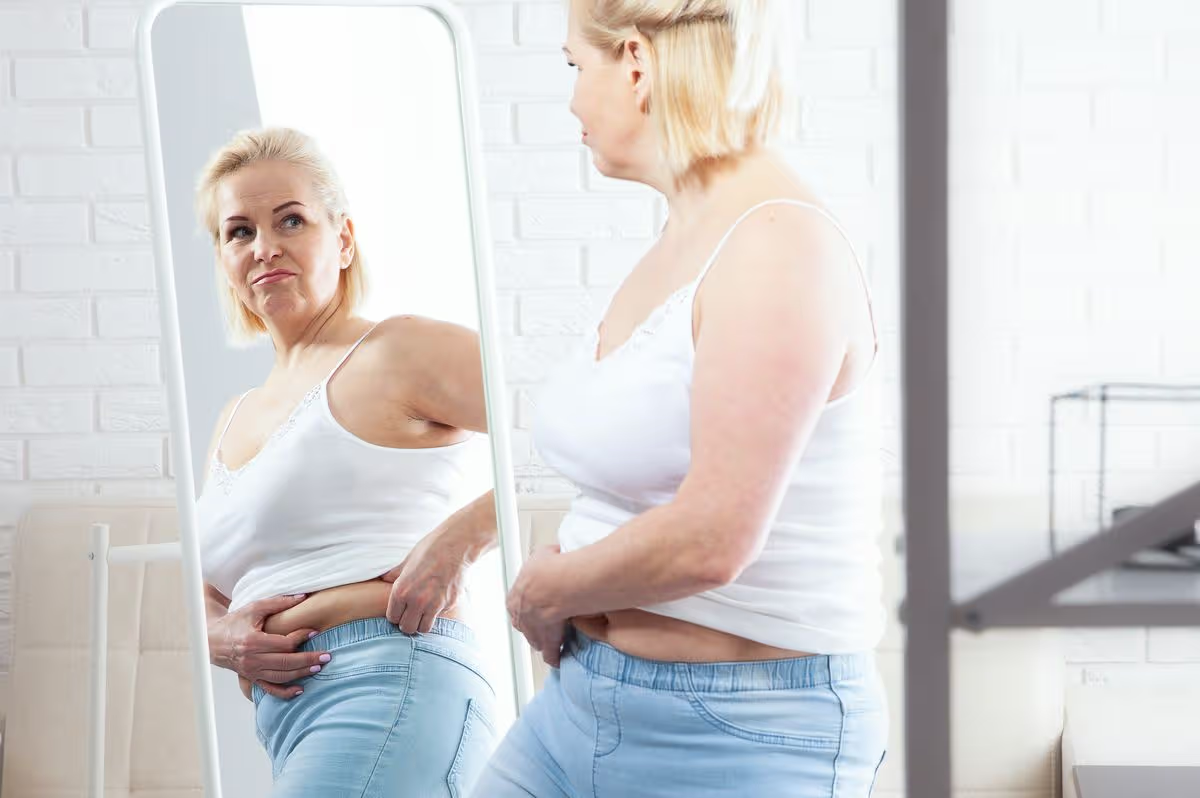
A doctor has revealed why women start to put on belly fat as they age, stating it’s a “normal” part of life. According to the expert, women can expect to see their weight fluctuate when they get older.

In a clip from his podcast No Appointment Necessary, shared to his Instagram page, Dr Amir Khan issued some reassurance about weight before and after the menopause. He explained how fat is distributed on the body differently as a result of this hormonal change.

Menopause is a natural life stage that typically affects women between the ages of 45 and 55. It happens when hormone levels in the body drop to a point where periods cease completely.

Forgotten immune organ can predict how long you’ll live, landmark trial crushes ‘undruggable’ cancers, and blood test can spot signals of Alzheimer’s early – all this and more in our latest science newsletter

As a consequence of these hormonal shifts, the body can experience a broad range of symptoms that can impact both physical and mental health. These include hot flushes, mood swings, and brain fog.

Content cannot be displayed without consent

However, it can also affect how your body stores fat. On the podcast, his co-host Cheery Healey said: “Lots of women find that when they go through perimenopause and menopause, they gain weight.”

Dr Amir responded: “So, before the menopause, fat distribution in women is usually around the hips, thighs, and buttock area. And that fat distribution is completely normal and healthy and women should have fat there, you don’t want to lose it.”

He explained why. “It’s really good for your fertility,” he said.

“It’s really good for your overall health. It is expected and needed.”

But after menopause, you might notice that you are more prone to weight gain around the tummy. Dr Amir continued: “After the menopause, as the hormones shift, things change.

“And that fat usually deposits around the tummy area and the hips as well and so people can refer to it as a ‘meno belly’. It’s not really a great term but it is just the shift of weight, really.”

He added: “Normal, natural, not the end of the world, part of being a woman, an adult woman.” His advice is supported by the NHS website, which says: “Weight gain during perimenopause and menopause is common.

“It often happens around the stomach and upper body.”

Other symptoms of menopause

The other symptoms of menopause, as listed by the NHS, include:

  • Changes to your periods
  • Hot flushes and night sweats
  • Sleep problems
  • Mood changes, poor memory and brain fog
  • Vaginal problems such as dryness, a burning feeling, irritation or itching in and around the vagina
  • UTIs (urinary tract infections)
  • A faster, slower or more noticeable heartbeat (palpitations)
  • Weakening bones (loss of bone density), which can lead to osteoporosis
  • Feeling the need to pee more or not being able to control when you pee (urinary incontinence)
  • Headaches and migraines that are worse than usual
  • Muscle aches and joint pains
  • Hair thinning or hair loss
  • Skin changes, including dry and itchy skin
  • Reduced sex drive (loss of libido)
  • Sensitive teeth, painful gums or other mouth problems

The health body says you should contact your GP if:

  • You think you have symptoms of menopause or perimenopause and want to know what your options are
  • You have symptoms like a fast heartbeat (palpitations)
  • You still have periods but your bleeding pattern has changed and you’re bleeding more, not less, than before
  • You have not had a period for 12 months or more, and you have any vaginal bleeding

The most commonly prescribed treatment for menopause symptoms is hormone replacement therapy (HRT).

Source link

‘Extreme’ health risk warning for popular Brit holiday destination

People visiting these islands could be at risk of high UV levels

People have been urged to take certain precautions as the ultraviolet radiation risk at a popular holiday destination area has been raised to “extreme”. Health officials in the Canary Islands have elevated the UV risk across several of the islands.

According to the Canary Islands Health Department, UV radiation levels are presently classified as “very high” across all islands. And Fuerteventura, Lanzarote and Gran Canaria have reached the highest “extreme” warning category.

Prolonged exposure to ultraviolet radiation can lead to serious health complications, including DNA damage, severe sunburn, allergic skin reactions, eye conditions and a heightened risk of skin cancer, including melanoma. Health experts also caution that UV exposure can suppress the immune system and even trigger the reactivation of viruses such as cold sores.

The alert particularly impacts those who spend lengthy periods outdoors, whether for work or leisure, as well as individuals with fair skin, light eyes or a family history of skin cancer. Children and older adults are also regarded as especially at risk.

As reported by Canarian Weekly on May 21, health authorities are strongly advising people to avoid direct sunlight between 11am and 5pm wherever possible, seek out shaded areas and wear protective clothing, wide-brimmed hats and approved sunglasses with UVA and UVB protection. The application of SPF 50 sunscreen is highly recommended, even on overcast days.

Authorities also issued a reminder to parents that babies under one year old should never be exposed directly to sunlight, as their skin is particularly sensitive and incompatible with most sun creams. The Canary Islands consistently record some of the highest UV radiation levels across Spain throughout the year, owing to their geographical position and climate.

How to apply sunscreen

The NHS warns that most people do not apply enough sunscreen. As a guide, adults should aim to apply around six to eight teaspoons of sunscreen if you’re covering your entire body.

READ MORE: Drivers in England urged to put ‘light coloured’ towel in their car from FridayREAD MORE: 5 UK areas issued with amber heat health alerts as heatwave warning upgraded

If sunscreen is applied “too thinly”, the amount of protection it gives is reduced. If you plan to be out in the sun long enough to risk burning, sunscreen needs to be applied twice:

  • 30 minutes before going out
  • Just before going out

Sunscreen should be applied to all exposed skin, including the face, neck and ears, and head if you have thinning or no hair, but a wide-brimmed hat is better. Sunscreen needs to be reapplied liberally and frequently, and according to the manufacturer’s instructions.

This includes applying it straight after you have been in water, even if it’s “water resistant”, and after towel drying, sweating or when it may have rubbed off. It’s also recommended to reapply sunscreen every two hours, as the sun can dry it off your skin.

Further to this, the NHS recommends you should do the following to stay safe in the sun:

  • Spend time in the shade between 11am and 3pm
  • Never burn
  • Cover up with suitable clothing and sunglasses
  • Take extra care with children
  • Keep babies under six months out of direct sunlight
  • Use at least factor 30 sunscreen – make sure to use enough and re-apply frequently

Source link