Weekly insights and analysis on the latest developments in military technology, strategy, and foreign policy.
The U.S. Army says it has successfully completed a live-fire test of a hypersonic warhead using a cannon-based launch system at Yuma Proving Ground, Arizona, a demonstration that could provide a cheaper and faster way to evaluate the terminal performance of future hypersonic weapons. The gun in question is the Heavy Artillery Test System (HATS), or a modification of it, from the canceled Strategic Long Range Cannon (SLRC), a huge artillery piece intended to be able to hit targets out to a range of 1,000 miles or more. This suggests that the program could still provide value, this time in the test world.
According to the latest issue of The Outpost, the in-house news organ of the Army’s Yuma Proving Ground, the test marks the first successful live-fire demonstration of a full-scale hypersonic warhead launched from what it describes as a “cannon base test system.” Rather than relying on an expensive flight test of an operational hypersonic missile, the approach uses a gun to accelerate the warhead to high speed before impact, allowing engineers to study its lethality under controlled conditions. Hypersonic velocity means speeds of Mach 5 and above.
The concept has been under development for roughly two years as a way to create what the Army calls “a high throughput, alternative method for assessing terminal effects at velocity and scale.” While the release does not disclose the velocity achieved during the test, or exactly when it occurred, the underlying idea is straightforward. Hypersonic weapons derive some of their destructive effect from the enormous kinetic energy they carry into a target, as well as, at least in some cases, a relatively small warhead. A large-caliber gun offers a comparatively inexpensive way to reproduce at least part of a hypersonic weapon’s terminal conditions without expending an entire missile or firing from an airborne launch platform, costing millions of dollars.
A full view of the live-fire test of a hypersonic warhead using the Heavy Artillery Test System (HATS) at Yuma Proving Ground, Arizona. U.S. Army
The effort brought together researchers from Lawrence Livermore National Laboratory and the Army Combat Capabilities Development Command Armaments Center (DEVCOM-AC), which developed a specialized launch package capable of surviving the extreme acceleration generated inside the gun barrel. Engineers also incorporated a DEVCOM-AC electronic safe-and-arm fuze while analyzing the internal ballistic forces the warhead would experience during launch. The extreme acceleration of being fired out a cannon is one major difference a warhead or test article would have to endure compared to being mounted on an actual missile and that must be accounted for.
Before the live-fire event, the team conducted an inert proof-of-concept firing that validated the overall approach. Army officials said those results led to a series of design refinements before progressing to a live warhead.
A model of a Strategic Long Range Cannon concept, in black, situated between models of more traditional tracked self-propelled howitzers. The SLRC, or a modification of it, was used for hypersonic warhead testing at Yuma. U.S. Army
The service offered a detailed description of the final firing sequence.
After instrumentation checks and target preparation were completed, crews positioned the launch package, armed the fuze, and loaded the warhead and propelling charge. Personnel then withdrew to protective bunkers while test officials monitored telemetry.
As the article describes it, the test director issued the command to fire, followed by “a massive boom” that echoed across Yuma Proving Ground. Once the dust settled, engineers reviewed high-speed camera footage before confirming the shot had achieved all of its objectives. According to the Army, the silence was “quickly broken by loud cheers confirming a complete success.”
Beyond the immediate test, the Army reckons the capability could significantly increase the pace of hypersonic weapons development. Instead of relying exclusively on limited and expensive missile flight tests, engineers could use cannon-launched surrogates to generate impact data earlier and more frequently during development. The release says the demonstration has already attracted interest from multiple hypersonic programs that are considering incorporating the methodology into future test campaigns.
Although not mentioned in the article, the “cannon base test system” seen in the accompanying photo is the Heavy Artillery Test System (HATS) that was developed under the Strategic Long Range Cannon (SLRC) program before that was axed, when Congress directed the Army to stop funding the weapon in its fiscal 2022 appropriations act.
The section on the Strategic Long Range Cannon in the Army’s 2022 Fiscal Year budget proposal. U.S. Army
At the time, the service said it wanted to move funds into a more general account that it could use to help mature various advanced technologies.
The Army also said that it planned to complete various research and development and testing of SLRC components in the 2021 fiscal year. This included work on the very large rocket-assisted projectile that was supposed to give the cannon its 1,000-mile-plus range, as well as “system integration and technology maturation for SLRC to include designs for long lead prototypes to be used in upcoming major system level demonstrations.”
A graphic showing a notional SLRC design that emerged in 2021, with the gun on a “platform” style mount attached at the front to an 8×8 Oshkosh M1070 Heavy Equipment Transporter System (HETS) tractor and at the rear to a three-axle trailing section. The Yuma test involved a static gun mounting. U.S. Army
Returning to hypersonic testing, other alternatives to end-to-end missile flights include rocket sleds, which have long been used to replicate high speeds to test different technologies.
Back in 2022, as you can read about here, the U.S. Air Force successfully recovered a reusable rocket sled after traveling at a recorded speed of 6,400 feet per second, or just about Mach 5.8, beyond the hypersonic threshold, at Holloman Air Force Base, New Mexico.
This was the first time the Air Force successfully recovered a reusable rocket sled after traveling at such a speed. Being able to recover reusable sleds after traveling at hypersonic speeds allows for the collection of critical post-testing data, which is particularly important for hypersonic weapons testing.
Roughly 10 miles long, the Holloman High-Speed Test Track (HHSTT) is the only track capable of recovering sleds that hit hypersonic velocity via high-speed braking.
The Air Force also began the Hypersonic Readiness program (HSR) in 2020, which focused principally on fielding a hypersonic nine-inch monorail sled test with high-speed braking capability.
A reusable rocket sled travels at 6,400 feet per second on a monorail before being recovered as part of the Hypersonic Sled Recovery effort at the High-Speed Test Track at Holloman Air Force Base, New Mexico, in 2022. U.S. Air Force
In general, hypersonic testing, a major priority across the U.S. military, is intended to push weapons and their components to the limits of what they can withstand. Test articles are subjected to the extreme heat, pressure, and mechanical loads associated with sustained flight at speeds above Mach 5 to determine whether materials, structures, and subsystems can survive the operational environment.
If the new gun-based approach proves broadly applicable, it could offer one answer to a persistent challenge in hypersonic development: generating meaningful terminal-effects data without consuming scarce and costly prototype missiles.
Exactly how closely the cannon-launched tests replicate the conditions experienced during an actual hypersonic weapon’s flight, and what velocity envelope the Army has achieved, remain unclear. Those details may ultimately determine how valuable the new test capability becomes across the Pentagon’s growing portfolio of hypersonic weapons. At the same time, any help in accelerating hypersonic weapons development would likely be of high value as China, in particular, has gained a clear lead in this critical new capability set.
Special thanks to X user @lfx160219 for alerting us to this story.
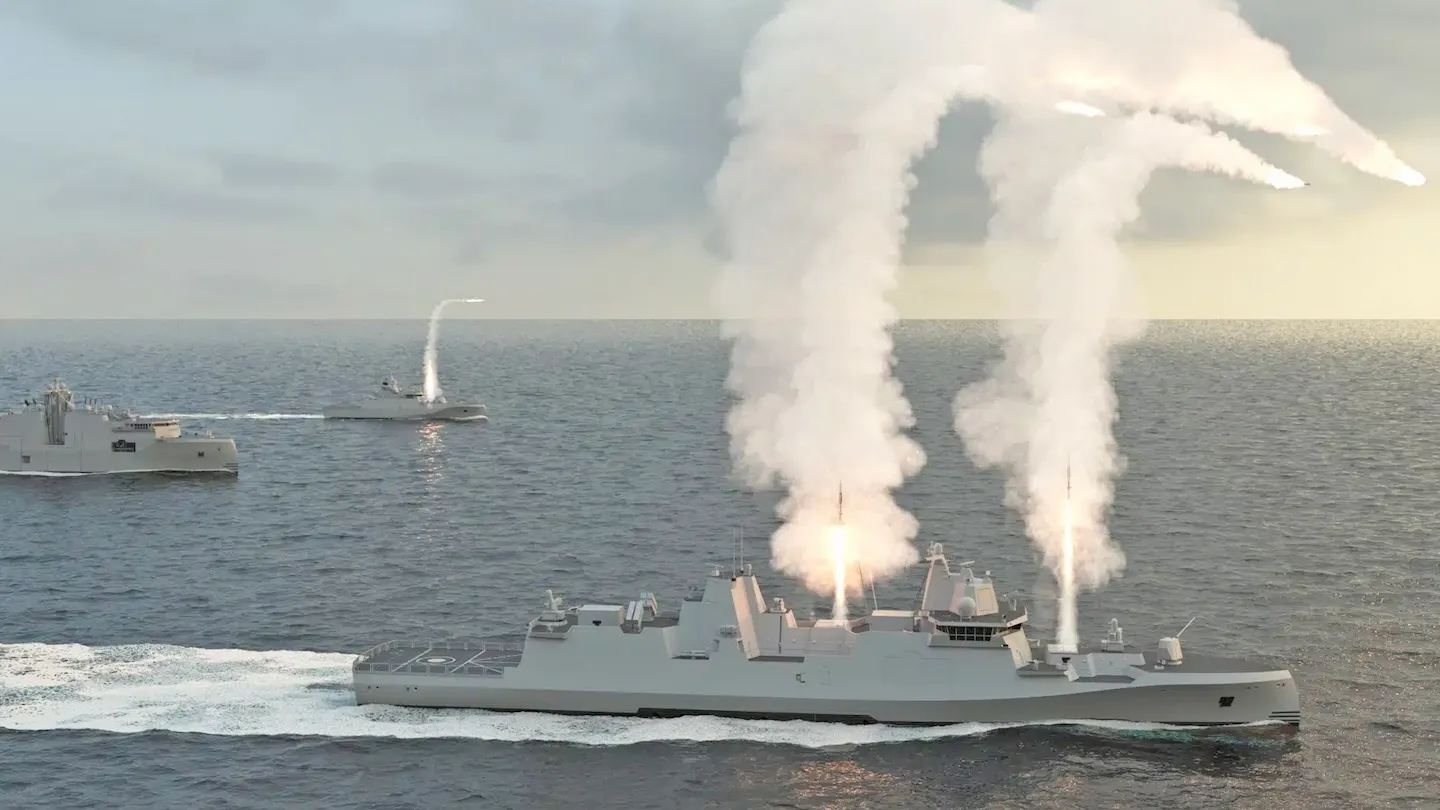
German defense contractor Rheinmetall has unveiled the GMF 140, a new 140-meter guided-missile frigate aimed at NATO and allied navies seeking a next-generation surface combatant with integrated air and missile defense, anti-submarine warfare, and long-range strike capabilities. Better known for armored vehicles, artillery, air defense systems, ammunition, as well as naval munitions and electronics, the new warship marks Rheinmetall’s entry into an entirely new segment of the defense market.
The 6,000-ton-plus vessel is being positioned for export, with Rheinmetall planning to offer the design “initially as part of a procurement project in North America” before pursuing opportunities with other allied navies.
Designed for operations in contested maritime environments, the GMF 140 combines area air defense, ballistic missile defense (BMD), anti-submarine warfare (ASW), and strike capabilities in a single platform optimized for blue-water operations while retaining the flexibility to support expeditionary, littoral, and coalition missions.
“The GMF 140 has been specifically developed for the requirements of NATO and allied navies seeking a highly capable, affordable, and interoperable next-generation surface combatant,” Rheinmetall said in a statement.
A rendering showing the GMF 140 (nearest) in action. Rheinmetall
A key feature of the design is its integration of U.S.-sourced combat systems and sensors. Rheinmetall says the frigate is designed around the AEGIS combat system and can accommodate multiple U.S.-sourced radar options capable of detecting, tracking, and engaging conventional air threats, hypersonic weapons, and ballistic missiles.
For customers seeking an alternative combat management architecture, the company says the GMF 140 can also be configured with Lockheed Martin’s CMS330 combat management system, providing an open and scalable architecture capable of integrating both U.S. and European sensors and weapons.
The ship is equipped with 64 strike-length Mk 41 vertical launch system (VLS) cells, allowing it to employ a wide range of air defense, ballistic missile defense, and land-attack missiles. For air defense, for example, 64 VLS cells would give the option of up to 256 Evolved Sea Sparrow Missiles, which come in quad packs, although a typical load-out would provide a far more balanced inventory of larger, longer-reaching anti-air missile and strike weapons, such as the Tomahawk cruise missile and Standard family of surface-to-air missiles.
Mk 41 VLS cell configurations and weapons. Lockheed Martin
Additional armament includes anti-ship missiles, torpedo launchers, a 5-inch (127mm) main gun, laser weapon systems, close-in weapon systems (CIWS), and secondary guns. In the concept artwork, the warship appears to have a U.S. Navy-standard Mk 45 main gun, as well as a SeaRAM CIWS mounted fore and aft, again in line with a pitch to the North American market.
Rheinmetall says the ship incorporates a low-signature hull, integrated acoustic management measures, hull-mounted and towed sonar systems, and facilities to support embarked helicopters and uncrewed systems from either U.S. or European suppliers.
The company says the design is intended to address growing demand from navies modernizing their fleets in response to evolving security challenges in Europe, the North Atlantic, and the Indo-Pacific. It also comes with a small crew complement for its size: each vessel will have a core crew of just 90, with the option to add another 35 if and when required.
Concept artwork of the GMF 140 underway. Rheinmetall
The new frigate’s wave-piercing bow is somewhat reminiscent of that seen on the smaller French Frégate de Défense et d’Intervention (FDI), or defense and intervention frigate. The bow of that vessel, which gives an appearance approaching that of a reverse bow, or inverted bow, is something we have discussed in the past. Both warships also have a dramatic chine that extends from the bow along the entire hull line.
The French Navy frigate, the Amiral Ronarc’h, part of the FDI class. Naval Group
The GMF 140 is approximately 460 feet long and has a displacement of more than 6,600 tons.
This puts it at the upper end of the modern frigate category, close to the boundary between a large frigate and a small destroyer. Its displacement should provide the volume and electrical power margins needed to support large radar arrays, future directed-energy weapons, additional electronic warfare systems, and growth in computing capacity. This capacity is especially important as navies adapt toward integrated air and missile defense against increasingly complex threats, including hypersonic weapons and ballistic missiles.
While the Type 26 was primarily designed around anti-submarine warfare and the FREMM family has evolved into multiple variants optimized for either ASW or general-purpose missions, the GMF 140 has been conceived from the outset as a fully integrated air and missile defense combatant capable of contributing to fleet-level ballistic missile defense while retaining robust ASW and long-range strike capabilities.
It is also notable that, rather than relying on proprietary national systems, Rheinmetall has built the GMF 140 around widely fielded U.S. and NATO technologies, including AEGIS, U.S.-sourced radar options, and the Mk 41 VLS. That approach reduces integration risk for navies already operating U.S.-made weapons and sensors while also improving interoperability during coalition operations.
The GMF 140 design reflects a broader trend among NATO navies toward heavily armed, multi-mission frigates that increasingly blur the traditional distinction between frigates and destroyers, at least in terms of missions. Rather than serving primarily as escorts, these ships are expected to provide area air defense, contribute to integrated missile defense networks, prosecute submarines, and deliver long-range precision strikes as part of distributed maritime operations.
While Rheinmetall is positioning the GMF 140 for the export market rather than domestic procurement, it should be noted that the German Navy recently canceled its planned F126 frigates, which, at 545 feet long and with a displacement of up to 11,000 tons, would have been physically the biggest surface warships to join the German Navy since World War II. You can read more about this ambitious program here.
The ill-fated F126 frigate in an artist’s concept. Damen
Instead, Germany opted for a smaller, lower-risk design optimized for anti-submarine warfare, and based on the proven A-200 frigate design from the German shipbuilder TKMS. This will be known as the F128.
Rheinmetall’s GMF 140 represents a different answer to that challenge. Rather than trading capability for affordability, it aims to deliver a heavily armed, highly interoperable frigate with robust integrated air and missile defense, long-range strike, and anti-submarine warfare capabilities in a single platform.
At the same time, the GMF 140 also marks a significant departure for Rheinmetall. While the company has long been a major supplier of naval weapons, sensors, ammunition, and mission systems, it has not previously competed as a prime contractor for a major surface combatant. As Rheinmetall’s first attempt to enter a highly competitive global market with a complete warship design, this necessarily comes with a degree of risk attached for any potential buyers.
Curious angle on this pitch. Not sure I see either Canada or the US as a serious prospect.
On top of that any Rheinmetall/NVL pitch as the most glaring weakness faces a complete absence of previously designed and built combatants (that arent OPVs).https://t.co/Irxs26fDyo
There is also the question about where these vessels would be built. Earlier this year, Rheinmetall acquired Naval Vessels Lürssen, which includes various German shipyards, of which Blohm+Voss in Hamburg would be the most likely candidate, having a long history of building surface combatants.
Rheinmetall’s reference to a procurement project in North America is interesting, pointing to either Canada or the United States.
As it stands, Canada has already selected the River class destroyer (based on the Type 26), so Rheinmetall would be relying here on a future tranche or a follow-on requirement.
In the United States, the Constellation class frigate program was terminated last year, and it was announced that the National Security Cutter design will serve as the basis of a new U.S. Navy frigate program that is named FF(X). Introducing an entirely new design into that program would seem highly unlikely, but the appearance of the GMF 140 does suggest that Rheinmetall has identified a gap in the market between the new FF(X) and the Arleigh Burke class destroyer, with a VLS capacity and level of capability matching that.
As allied navies weigh the balance between capability, cost, and procurement risk over the coming decade, it will be interesting to see whether more navies also move toward a more affordable, lower-risk frigate, as Germany has done, or bigger designs like the GMF 140 that seek to retain destroyer-like capabilities in a frigate-sized hull.
Second-quarter revenue jumped 93 percent but Palantir’s ties to Israel and role in military technology are controversial.
Published On 4 Aug 20264 Aug 2026
United States artificial intelligence and data analytics giant Palantir Technologies has reported “otherworldly” quarterly results, sending its shares more than 14 percent higher in after-hours trading, as its growth shows no signs of slowing despite mounting criticism over its close ties to the US and Israeli governments and concerns about its growing role in artificial intelligence and warfare.
Palantir Technologies reported a revenue of $1.94bn for the second quarter, up 93 percent from a year earlier, and raised its forecast annual revenue to between $8.15bn and $8.158bn, up from $7.65bn to $7.662bn earlier. It said strong demand from both commercial customers and government agencies drove the surge.
Recommended Stories
list of 3 itemsend of list
“This quarter was otherworldly: our US commercial revenue grew 149 percent year-over-year, our overall revenue grew 93 percent year-over-year,” Chief Executive Alex Karp said. “Demand for AI sovereignty has now been unleashed.”
In a letter to shareholders, Karp wrote: “Our business is compounding at a rate and scale that we have never before witnessed.”
Palantir holds multibillion-dollar contracts with US government agencies, including the US Army. Revenue from its US government business rose 90 percent year on year to $809m, even as the company has faced growing opposition over its role in President Donald Trump’s immigration crackdown, which critics say has resulted in unlawful deportations and killings.
Founded in 2003 by technology entrepreneurs including Karp and multi-billionaire Peter Thiel, Palantir opened its first office in Israel in 2015 and has since expanded its work with the Israeli military.
Following what Palantir described as a “strategic partnership” with Israel in January 2024, the company significantly expanded its operations supporting Israel’s military campaign in Gaza and operations in the occupied West Bank.
According to Open Intel, a platform tracking corporate involvement in the genocidal war on Gaza, Palantir has actively recruited former members of Israel’s elite Unit 8200 cyberintelligence division. The group says Palantir’s software integrates intercepted communications, satellite imagery and other datasets to help generate military targeting lists for Israeli forces.
In a statement to Al Jazeera earlier this year, Palantir UK reiterated the company’s support for Israel.
The company has also secured major contracts with the United Kingdom’s government. In January, the UK’s Ministry of Defence awarded Palantir a $323m (240-million-pound) contract. A separate $444m (330-million-pound) NHS contract awarded in November 2023 has also attracted criticism, with campaigners raising concerns about the handling of sensitive health data and the heavy redaction of contract documents.
Palantir has also faced scrutiny over its vision for the future of artificial intelligence. In The Technological Republic, a recent book co-authored by Karp and the company’s head of corporate affairs, Nicholas W Zamiska, the authors argue that technology companies have a responsibility to build advanced military AI capabilities. Critics have described the philosophy as a form of “techno-fascism”.
A warehouse east of Moscow belonging to Russia’s largest online retailer, Wildberries, was set ablaze after being struck by Ukrainian drones overnight, the second such attack in two days. File photo by Stringer/EPA
Aug. 3 (UPI) — A warehouse east of Moscow belonging to Russia’s largest online retailer, Wildberries, was set ablaze after being struck by Ukrainian drones overnight, the second such attack in two days.
The company confirmed via its Telegram press service early Monday that the logistics center in the town of Khryastovo in Vladimir province, 12 miles southwest of Vladimir, the regional capital, was on fire and had been evacuated.
“Fire crews are working at the scene. Preliminary reports indicate there are no casualties. Logistics operations have been rerouted; the acceptance of deliveries and the dispatch of orders are being handled at other facilities,” the company said.
However, around three hours later the state-run TASS news agency reported three people had been injured in the Wildberries attack, saying it was part of a wider, deadly, airborne assault targeting 10 Russian regions, Crimea and the Black Sea with hundreds of drones.
Sergey Aksyonov, the governor of occupied Crimea in an online update condemned what he called another “barbaric attack by the enemy” overnight that killed three people and injured two others, all civilians.
The Russian Defense Ministry said air defenses downed 131 Ukrainian fixed-wing unmanned aerial vehicles over the Belgorod, Bryansk, Voronezh, Kaluga, Kursk, Lipetsk, Oryol, Smolensk, Tula and Krasnodar Regions between 8:00 p.m. on Sunday and 7:00 a.m. on Monday, Moscow time.
The strike on the Wildberries facility came a day after a blaze at one of the company’s fulfilment centers in Novosemeykino in Samara province, 600 miles southeast of Moscow, after it was hit amid large-scale drone strikes the Ukraine General Staff claimed its forces carried out overnight Saturday and into Sunday.
The attacks caused fires at Engels air base, on the left bank of the Volga River in Saratov province, where Tu-95MS and Tu-160 strategic bombers are stationed, and an oil refinery in the Saratov city. The governor of the region said two people were killed.
The Lyudinovskaya oil depot in Kaluga province to the southwest of Moscow, was also struck, according to the general staff.
Over the past two weeks, Ukrainian forces have repeatedly struck Wildberries’ logistics operations across western and southern Russia.
On July 18, eight employees were killed and more than 60 were injured after warehouse complexes in the Tambov and Moscow regions were attacked.
At least 15 workers at two of the firm’s facilities in the southwest of the country were injured in drone strikes on July 22, according to the company’s CEO and regional officials, and a fulfilment center in Kolyedino was hit and warehouses in Belye Stolby near Moscow were destroyed on July 21.
Kyiv alleges the company forms part of the Russian military’s supply chain, providing it with dual-use products such as two-way radios, body armor and components for drones.
South Korean computer chip maker SK Hynix has raised $26.5bn (£19.8bn) in its New York share offering, marking the largest ever listing by a foreign firm in the US.
The company, a key supplier to artificial intelligence (AI) chip giant Nvidia, said on Thursday that it had sold 177.9 million American depositary shares for $149 each. The shares are set to begin trading on Friday on the Nasdaq.
Its share price has more than tripled in South Korea this year, which along with Samsung Electronics has helped boost the benchmark Kospi index by more than 70% over the same period.
SK Hynix is one of the world’s leading memory chip makers. The industry has been given a major boost by the hundreds of billions being spent on AI.
Shares in rivals Samsung Electronics and Micron have more than doubled in recent months.
The US listing gives SK Hynix easier access to huge amounts of potential investment from the world’s biggest economy, which has fewer barriers than South Korea, said Seoul National University finance professor Jaewon Choi.
Traders are closely watching the listing as a “yardstick to test the water” for whether investor enthusiasm for memory chip makers will continue, Choi said.
The AI boom has triggered a rush of companies raising money on the the stock market.
In June, GrokAI owner SpaceX became the world’s biggest ever listing as it raised $85.7bn.
Meanwhile, AI developers Anthropic and OpenAI are preparing to go public, with valuations of more $1tn.
Demand for SK Hynix’s offering was reportedly over seven times more than the number of shares available, highlighting the strong investor appetite for a key company in the AI supply chain.
Each American depositary share is equivalent to a tenth of a Seoul-traded common share, SK Hynix said.
The offering gives US investors a way to buy SK Hynix shares without having to trade via an overseas stock exchange.
The company has pledged major investments to develop South Korea’s chip making and AI capabilities in the coming years.
The country’s government is likely to be counting on SK Hynix’s US listing to raise funds that can support the firm’s domestic investments, said Hanyang University business professor Yun Youngjin.
But the Nasdaq listing carries some risks, especially if investors move money towards the US and away from South Korea’s stock market, Yun added.
In June, the country’s government unveiled plans for more than $880bn of investments in partnership with SK Hynix and Samsung.
Both SK Hynix and Samsung have stock market valuations of more that $1tn, joining growing group of firms which includes tech giants Nvidia, Apple, Microsoft and Google-owner Alphabet.
A giant eight-metre dragon swept around the Tower of London in a dramatic display. The mythical beast was marking a spin-off from popular show Game of Thrones
Dragon soars over the Tower of London
A giant eight-metre dragon soared above the Tower of London to mark the launch of the third series of Game of Thrones spin-off House of the Dragon on HBO Max. An eight‑metre model of Syrax was brought to life using production scans from the hit show.
Built by German aeronautics firm Airstage, the dragon features 23 moving parts and moved using impellers built into its legs to create lifelike motion. The model weighs 13kg and took three months to build by a 14‑strong team using foam, carbon fibre and aluminium. The dragon was crafted from vacuum-formed Depron foam around a carbon fibre and aluminium frame.
The model was finished with detailed airbrushing for a lifelike look and took the team nearly 3,000 hours to complete.
A special evening reception following the flight was hosted by Harriet Rose and attended by stars of the show Kieran Bew, Tom Bennett, Clinton Liberty, who play Dragonseeds Hugh Hammer, Ulf White and Addam Of Hull, recruited as Dragon Riders by Rhaenyra (Emma D’Arcy) in the series, and Abubakar Salim, who plays Alyn of Hull.
Nils Schlenther, chief operating officer at Airstage, said: “This is one of the most intricate flying models we have ever created.
“After months of R&D and complex construction, the team studied the movement of Syrax and underwent over seven test flights to ensure her flight was as close as what we see in the show as possible.
“We have been constantly refining and getting the motion as realistic as possible and so the crowd’s reaction was amazing to see as we know we got it right for the fans.”
The event celebrated the return of House of the Dragon after nearly a two-year wait.
The show is based on George R.R. Martin’s Fire & Blood and is set 200 years before the events of the hit show Game of Thrones, telling the story of House Targaryen.
The eight-episode season will air new episodes weekly on HBO Max, leading up to the season finale landing on screens Sunday 9th August.
Anna Kimber OBE, deputy governor of the Tower of London, said: “The Tower of London has stood at the heart of some of the most dramatic chapters in our history for nearly 1,000 years.
“While dragons may belong to the world of fantasy, the themes at the heart of House of the Dragon – power, ambition and the struggle for the throne – have strong echoes in the stories that played out within these walls.
“We’re delighted to welcome this spectacular stunt to the Tower, where history and fantasy will meet for an unforgettable moment.”
A FREE UK beach festival dubbed a “giant family playground” returns this weekend to an iconic seaside town.
Tens of thousands of visitors are expected to descend on the beachfront to enjoy a programme of live music and workshops.
Sign up for the Travel newsletter
Thank you!
A free UK beach festival returns this weekend, with tens of thousands of visitors expected to attendCredit: InstagramThe festival includes a host of workshops, music performances, and live events to celebrate the summer solsticeCredit: Instagram
A huge, free beach festival is set to return this weekend (June 20 to June 21) with tens of thousands of visitors expected to attend.
The First Light Festival takes place annually in Lowestoft, Suffolk, and features more than 200 performances across 24 stages.
The creative festival also offers visitors a wide-ranging programme of workshops, wellbeing sessions, crafting, dance, science, storytelling and family adventures for a fun-filled weekend.
Taking place over the summer solstice, the festival is a celebration of the first sunrise of midsummer.
This year, visitors will be able to attend a “special Indian Sunrise raga” at dawn on Sunday, June 21.
The festival covers an expansive area of the South Beach, spreading along the seafront, promenade and nearby Kensington Gardens and East Point Pavilion.
Converting the seafront into a “giant family playground”, festival-goers will enjoy events such as dance parties, science discoveries and circus skills workshops.
There are also camping options for those looking to stay overnight, including a glamping experience in well-equipped campervans.
Visitors are able to enter the First Light Festival for free and without a ticket.
However, after 9.30 pm, any festival-goers looking to attend one of the Sundown Events happening on Saturday night after the free programme of beach events ends will need to purchase a ticket.
The festivities began on Friday, June 19, with a selection of live theatre and music events to kick off the celebrations, and there are many more activities to get involved in as the weekend progresses.
A huge Big Bang Boogie parade takes place on Saturday, June 20, starting at the East Point Pavilion at 11 am and travelling along the seafront towards the main Sunlight Stage.
Other activities include a grounded movement ring, rocketry experience, and a traditional Punch and Judy show.
Visitors can also explore a selection of dance workshops, aerial displays and even get to see objects from the Natural History Museum.
Returning for its sixth year, the festival also has a huge impact on the town itself.
Chairman of Lowestoft Vision business improvement district, Danny Steel, told the BBC that the midsummer festival was “massive” for Lowestoft.
He explained: “We get about 30,000 people come to the First Light Festival over the weekend, and if all of those people spend £35 in Lowestoft, that’s £1m extra into the Lowestoft economy.”
Chief executive officer of the First Light Festival, Genevieve Christie, said the festival is about “coming together” as a community and gives people the chance to “experience things in real life”.
The festival also aims to put Lowestoft on the map as a holiday destination.
She explained: “All of our work is about raising the profile of Lowestoft, actually as a place to come on holiday, to be a tourist.
“We’ll be looking forward to 2028, when we’ll be operating the new cultural centre in Lowestoft, and our whole idea there is to bring the spirit of the festival into the town.”
Amazon.com (AMZN) is facing a possible lawsuit from the US Federal Trade Commission that may lead to billions of dollars in civil penalties, over claims the e-commerce giant misled advertisers, Bloomberg reported, citing sources.
Venezuela has signed an agreement with General Electric Vernova aimed at boosting electricity generation as the country seeks to improve a power system plagued by years of outages. Officials say the deal could add 5 gigawatts of capacity over four years.
The show that has had everyone clamoring for tickets this spring, Joe Mantello’s cobweb-clearing production of Arthur Miller’s “Death of a Salesman,” won, as expected, for best revival.
Mantello, who received a Tony for his direction (his third such award), swept away the cliches that have accumulated around this American classic to reveal a “Salesman” like none we’ve experienced before. The Loman family home isn’t depicted in a literal fashion but instead fluidly suggested in a warehouse space that allows the actors to move unfetteredly between past and present. (The physical production was honored with awards for Mikaal Sulaiman’s sound design, Jack Knowles’ lighting and Chloe Lamford’s scenic design.)
Laurie Metcalf, confirming her standing as the First Lady of the American Theater, won for her portrayal of Linda Loman, a more formidable than usual interpretation of Willy’s stalwart wife. Metcalf, who endowed her characterization with a sharp-edged autonomy and transfixing gravitas, added another Tony to her two previous acting wins (“Three Tall Women,” “A Doll’s House, Part II”).
Joe Mantello wins the Tony for his direction of “Death of a Salesman.”
(Evelyn Freja / For The Times)
Nathan Lane was in a tight race with John Lithgow, who won for his ruthlessly uncompromising portrayal of a wrathful and dyspeptic Roald Dahl in Mark Rosenblatt’s “Giant.” Lane’s Willy leaves a lasting memory in “Salesman,” but it would be hard to imagine “Giant” having the same impact without Lithgow, who provides a terrifying human foundation to this explosive play about a writer’s political commitments tipping over into toxic antisemitism. (The performance slips into a sinkhole of animus in the uncanny way of one of Dahl’s recognizably terrifying, psychologically plausible stories.) In his almost but not quite valedictory acceptance speech, the 80-year-old Lithgow acknowledged that this Tony win, his third, comes 53 years after his first — and feels every bit as satisfying.
Aya Cash and John Lithgow in “Giant.”
(Joan Marcus)
Rather than a slight to Lane, Lithgow’s win is a sign of the dramatic depth that characterized this otherwise squirrely season. Indeed, Lithgow’s performance was as thrilling to experience as that of British powerhouse Lesley Manville, who won for her portrayal of Jocasta in Robert Icke’s modern reworking of “Oedipus.” The play was categorized by the Tony committee as a revival, but it’s really an original drama — one that gave rise to one of the most enthralling productions of the year.
In a season lifted up by Bess Wohl’s magnificent “Liberation” and capacious enough to include a first-rate “Salesman,” a searing “Oedipus” and a smartly contentious “Giant,” it should be no surprise that there were more great performances than statuettes to dole out.
The pontiff praises Madrid as a beacon of inclusion as about 1.2 million people gather for Sunday mass.
Published On 7 Jun 20267 Jun 2026
An oceanic crowd has filled the streets of the Spanish capital Madrid with chants, cheers and applause to greet Pope Leo XIV on the second day of a weeklong apostolic journey to mainland Spain and the Canary Islands.
The Vatican and local organisers said about 1.2 million people braved the heat to be present in the landmark Cibeles Square on Sunday in what is expected to be the largest event during his visit to the country.
Recommended Stories
list of 3 itemsend of list
Throngs of people pressed along barriers near the square – best known as the rallying point for Real Madrid football fans celebrating the club’s titles – waving flags and shouting “Long live the pope”, as Leo arrived in his white popemobile for the event. Some tossed flower petals marking his arrival.
“May Madrid continue to be a welcoming and inclusive city, where social life is inspired by true human values,” the pontiff wrote in the guestbook as he was handed the key to the city by its mayor.
Faithful attend a mass held by Pope Leo XIV at Plaza de Cibeles, during his apostolic journey in Madrid, Spain [Mohammed Salem/Reuters]
Leo began his trip on Saturday, meeting migrants and the homeless and attending a vigil with about 600,000 young people in Madrid. His June 6-12 visit also includes stops in Barcelona and the Canary Islands, where he will meet migrants and refugees who risked their lives crossing there from West Africa.
He said he hoped the visit, his first to a European Union country outside Italy, would set an example to the world about respecting “every human being” and urged leaders to stop dividing electorates.
“I am delighted that he is praying for us migrants and for our safety,” said Andrea Margarita, a 72-year-old Peruvian who arrived in Spain six months ago, as she waited in the crowd in a wheelchair with her daughter.
After mass, Leo was scheduled to hold a private meeting with fellow members of his Augustinian religious order in the afternoon before meeting figures from the world of entertainment, sport and culture at a concert venue in central Madrid.
Pope Leo XIV leads the mass in the Plaza de Cibeles in Madrid [AFP]
Snowboarding made its Winter Olympics debut in Nagano 1998 with halfpipe and giant slalom.
Riders competed against the clock before the head-to-head parallel giant slalom version on identical, side-by-side courses was introduced four years later in Salt Lake City.
Three-time Winter Olympian Alex Payer said: “PGS is one of the only formats where everything is truly equal – same course, same conditions, same start, same chance. That fairness is rare in sport.
“If you take it out of the Olympic programme, you take away one of the purest expressions of competition we have.”
Among the sports bidding to replace them in the programme for the Games, which are scheduled for 1-17 February 2030, are freeriding and ice climbing.
Freeriding allows skiers and snowboarders to choose their own off-piste course from top to bottom and also perform tricks as they descend.
They are judged on elements of their descent including the difficulty of the course, jumps and performance.
In ice climbing, competitors climb up a frozen waterfall or glaciers with a speed version favourite for inclusion.
There had been speculation that cyclo-cross would be also be aiming for inclusion but last month IOC president Kirsty Coventry said that “no summer sports and no seasonal crossover events” would be part of the programme.
Anthropic, which operates AI chatbot Claude, did not disclose the size or the terms of the offering.
Published On 1 Jun 20261 Jun 2026
Artificial intelligence giant Anthropic has confidentially filed for an initial public offering (IPO) in the United States, teeing up what could become a watershed moment for Wall Street’s AI frenzy.
The move, announced on Monday, sets up a high-stakes test of whether investor appetite for the AI revolution that has reshaped white-collar work around the world can match the sky-high expectations surrounding the booming sector.
Recommended Stories
list of 4 itemsend of list
Anthropic, which operates AI chatbot Claude, did not disclose the size or the terms of the offering. Confidential submissions let companies advance IPO preparations while shielding sensitive financial details from rivals and the public.
Anthropic last raised $65bn at a post-money valuation of $965bn in late May, putting it ahead of rival OpenAI. The company said at the time it was making annualised revenue of $47bn from selling its technology to people and organisations using Claude to write code and do other work and personal tasks on their behalf.
The crucial step towards a listing comes on the heels of SpaceX’s mega-IPO, which is on course to rewrite the record books as the Elon Musk-led company pursues a $75bn offering at a $1.75 trillion valuation.
Anthropic was formed in 2021 by ex-OpenAI leaders, and now both AI firms, along with Elon Musk’s rocket and AI company SpaceX, are all expected to become publicly traded. All three are also still losing more money than they make, fuelling concerns of an AI bubble.
OpenAI and Anthropic have become the face of the AI boom that has redrawn corporate strategies, sparked a global arms race for computing power and talent, and turned AI-linked companies into some of the market’s most richly valued firms.
Anthropic’s rapid rise in early 2026 rattled markets, triggering sharp sell-offs in software and IT stocks as investors worried its increasingly autonomous AI tools could upend traditional business models and accelerate disruption across industries.
“OpenAI and Anthropic are in a race to go public before capital runs out,” said analyst Gil Luria from the investment firm DA Davidson.
“The other reason for Anthropic to try to beat OpenAI out to the public market is that they will get to set the agenda for how a frontier model reports financials and do so in a way that is favourable to their financial model.”
OpenAI is also preparing to confidentially file for a US IPO in the coming weeks, adding to a wave of blockbuster listings anticipated in the year ahead.
A market milestone
As many blockbuster listings race towards public markets, companies from SpaceX to AI giants are competing for a finite pool of investor capital.
“The combined demand for capital from SpaceX, OpenAI and Anthropic will be so considerable that it is likely to create disruptions in the capital markets, so going early will be a great advantage,” Luria said.
The listing would represent one of the most consequential stock market debuts in years, potentially reshaping benchmark indexes, investor flows and the broader narrative driving US equities.
At close to a $1 trillion valuation, Anthropic would vault into the top tier of the S&P 500, alongside a handful of elite companies that dominate global equity markets.
An Anthropic debut would be a major boost for the long-sluggish IPO market, though experts and bankers warn an offering of such scale could drain liquidity and investor attention from smaller listings.
After Arsenal‘s first league title for more than two decades was confirmed, tens of thousands of supporters rushed to Emirates Stadium to celebrate.
“I knew we were a sleeping giant that we needed to awaken in some way.” Kroenke said.
“We haven’t had a team, a squad like this in the social media age. Social media evolved and the Twittersphere and everything else around it.
“The instantaneous information, the ‘Banter Era’ – I’m aware of all this. I turned 46 last week.
“I’ve grown up around this and I’ve seen it all from my own perspective. I think that’s what I’m so proud to see. There was almost a time when you were a closeted Arsenal fan.”
But this success does not mean the end of the journey for Kroenke and his vision for the club, with the Gunners playing Paris-St Germain in the Champions League final on Saturday.
“I think I can think back and say that our stated goal was winning the Premier League, because if you can put yourself in contention for the Premier League, you’re in contention for everything else.” Kroenke said.
“Should we get a great result on Saturday, it’s not going to change or affect who we are. When you win something, the sun’s still going to come up the next day.
“You’ve got to get back to work and there are many teams trying to gain on you, including some historically great ones around the Premier League.
“So, we’re going to look to strengthen because we know that teams around us are going to get better. If you’re not trying to continually evolve and improve, you’re standing still.”
ONE of Britain’s biggest holiday park operators is offering to cover the cost of customers’ fuel to get to their sites as prices continue to skyrocket.
With oil prices hitting their highest since 2022 due to ongoing tensions in the Middle East, petrol, diesel, and plane fuel costs are being passed on to consumers.
Sign up for the Travel newsletter
Thank you!
Research found 15.4 million Brits have changed holiday plans this year due to rising costsCredit: SWNS
TOP 10 COSTS PUTTING BRITS OFF SUMMER HOLIDAYS
General expenses while away
Flights
Eating out
Food and drink while away
Fuel to get there
Attraction tickets
Airport parking
Luggage fees
Parking/tolls
Train fares
As a result, Hoseasons is offering to pay back the money spent travelling to their sites via its newly launched ‘Fuel Cover’ scheme this summer.
It follows research which found 15.4 million Brits (28 per cent) have changed holiday plans this year due to rising costs.
Nearly six in 10 of the 2,000 adults polled said the hidden costs of going away, including travel, fuel and expenses while there, are putting them off booking a trip this summer.
Simon Altham, chief operating officer for the brand, which commissioned the poll, said: “UK breaks remain a hugely popular option for families looking for flexibility, value and quality time together, giving people the chance to properly switch off and reconnect closer to home.
“We know rising travel costs are becoming a bigger consideration for many holidaymakers this summer.
“Fuel, in particular, can quickly add to the overall cost of a trip, especially for families travelling during peak holiday periods.
“That’s why we wanted to help ease some of that pressure and support people continuing to take the UK breaks they were already planning this summer.”
The study also found, 7.6 million (27 per cent) of those planning a UK break admitted they would travel shorter distances for a UK getaway this year.
Those travelling by car expect to spend an average of £68 on fuel for their next UK holiday journey.
Rising costs are also influencing where people travel, with 28 per cent now more likely to choose a UK break over going abroad.
Among those still looking to get away, 26 per cent have set a lower overall budget for their trip, while 23 per cent are looking for self-catering accommodation.
A similar proportion (23 per cent) said they’re actively seeking cashback or money-saving deals before booking.
Despite the financial pressures, the research carried out through OnePoll found 56 per cent of those planning to holiday this year are still likely to book a getaway this summer.
And 61 per cent believe holiday companies need to do more to encourage people to book trips in the current climate.
Hoseasons customers can claim back up to £75 in fuel costs through its new Fuel Cover initiative per booking between 20 May and 30 August for travel before 30 September. Bookings must be made by phone and quoting the code “FUEL75”.
Simon Altham from Hoseasons added: “Travel costs are one of the biggest considerations for holidaymakers at the moment.
“Fuel, in particular, can quickly become one of the biggest extra costs for families travelling during peak holiday periods.
“That’s why we’ve designed the offer to ease some of the pressure and help families make the most of their summer breaks.”