Voters cast their ballots for a dizzying number of officials across multiple tiers of government.
Published On 4 Oct 20264 Oct 2026
Polls have opened in Bosnia and Herzegovina for a general election to choose new leaders at the national and regional levels, in a vote that could affect the country’s European Union membership bid.
On Saturday, about 3.4 million voters are choosing the three members of the country’s multiethnic presidency, lawmakers for the national Parliament and heads of institutions for the country’s two entities: the Federation of Bosnia and Herzegovina (FBiH) and Republika Srpska, which is dominated by ethnic Serbs.
Recommended Stories
list of 3 itemsend of list
Bosnia’s complex web of governing institutions was created by a United States-brokered peace agreement in 1995 in an effort to manage the ethnic divisions between Muslim Bosniaks, Orthodox Serbs and Catholic Croats that gave rise to the 1992-95 war.
A voter identifies himself using an optical scanner at a polling station during the general election in Sarajevo, Bosnia and Herzegovina, October 4 2026 [Hazim Aljovic/EPA]
The major parties’ repeated focus on war-era rhetoric and division was frustrating for some voters, activist Adi Selman of the Karton Revolucija protest group told the AFP news agency.
“I don’t think these new elections in Bosnia will change anything,” the 34-year-old said in the northern Bosnian town of Tuzla, ahead of the vote.
“The choice is limited to political parties that have already been around for 30 years and basically pick up votes by harping on about war, tensions, divisions and the past.”
“Bosnia and Herzegovina is dead; it is an impossible country,” Republika Srpska’s former president, Milorad Dodik, told the final rally of his right-wing Alliance of Independent Social Democrats (SNSD) in the entity’s capital Banja Luka late on Friday.
EU membership bid
In the FBiH, Bosniak parties are pushing for a stronger central state, with incumbent Bosniak presidency member Denis Becirovic pledging a renewed path to the EU and NATO.
The EU granted Bosnia candidate status in December 2022, but accession negotiations scheduled for 2024 were delayed as Brussels demanded the country pass stronger anticorruption laws and reform its judicial system.
A voter feeds a paper ballot into an optical scanner at a polling station during the general election in Sarajevo, Bosnia and Herzegovina, October 4 2026 [Hazim Aljovic/EPA]
Croat nationalist parties are also pushing for electoral reform, demanding a greater say in choosing the Croat member of the presidency in the entity they share with the more numerous Bosniaks.
Meanwhile, Russia is accused of slowing down the country’s path towards joining the EU, while also holding close ties with the SNSD, which favours secession for Republika Srpska.
This general election is the first in the country in which new electronic tools are being used to scan ballot papers and carry out biometric fingerprint verification in a move to reduce fraud during the election.
Polls close at 7pm (17:00 GMT) and first results are expected later on Sunday.
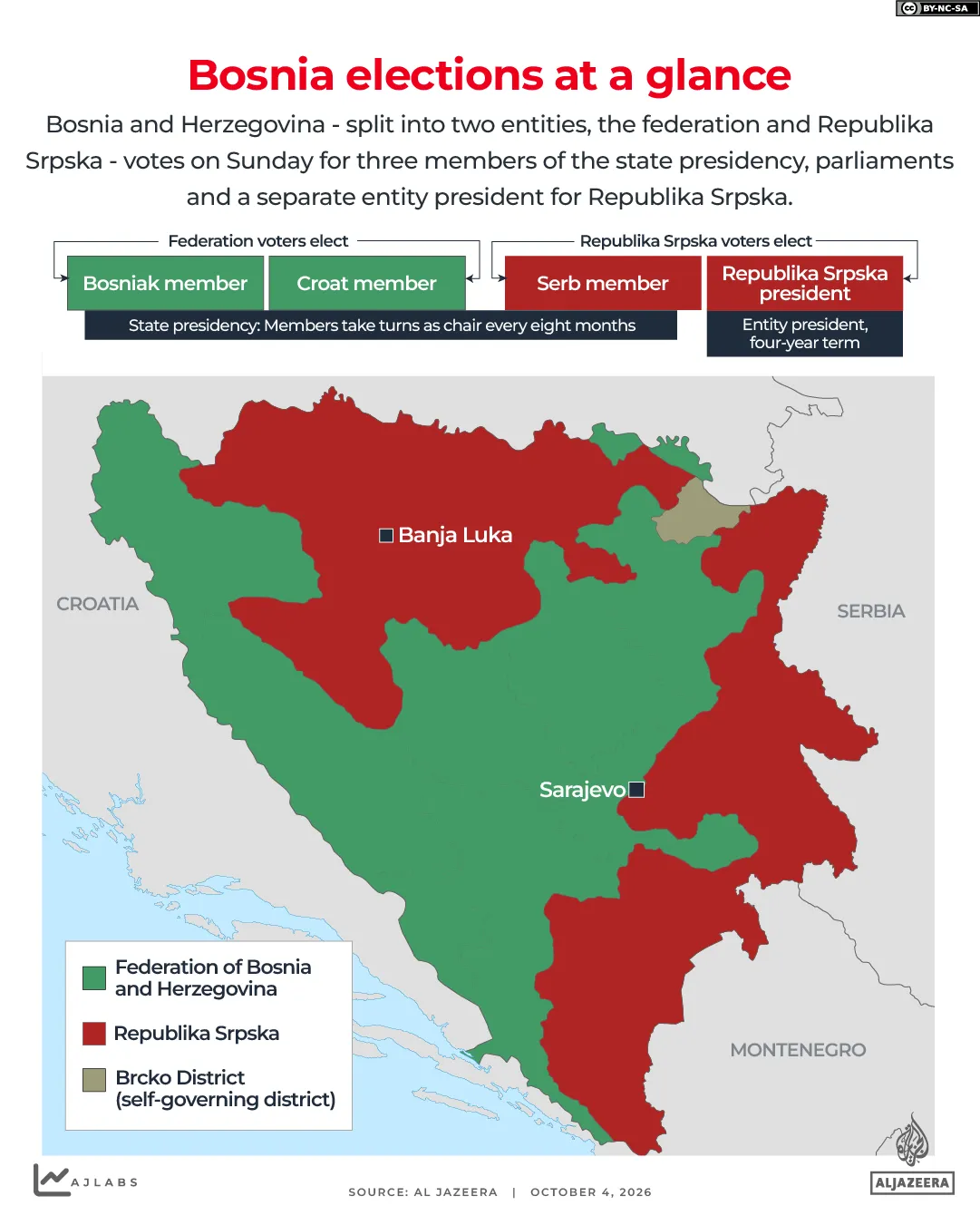
Bosnians are heading to the polls to choose the next government at all three of the state, entity and canton levels. It may seem complicated, but for a country divided into two entities – the Federation of Bosnia and Herzegovina and Republika Srpska, along with Brcko District – this is nothing new.
When do Bosnia’s elections take place?
The general elections are scheduled for Sunday, October 4. More than 3.4 million people are eligible to vote.
[Al Jazeera]
What’s different about this election?
This year, new election technology will be used. Voters will be identified using biometric devices, while ballot papers will be scanned rather than simply placed in ballot boxes.
The use of scanners, however, does not mean voting will be fully electronic. Votes will still be cast and recorded on paper, but verification and counting should be faster and more transparent, while voter identification should be more accurate.
Who is running for the Presidency?
Candidates for the Bosniak representative include current Presidency member Denis Becirovic of the Social Democratic Party (SDP), Bakir Izetbegovic of the Party of Democratic Action (SDA), Semir Efendic of the Party for Bosnia and Herzegovina (Stranka za BiH), and Fahrudin Radoncic of the Union for a Better Future of BiH (SBB).
Izetbegovic, the president of the centre-right SDA, the biggest Bosniak party in the country, is running for his third term after being defeated by Becirovic in 2022.
Three candidates will run for the Croat seat in the Presidency: Darijana Filipovic of the Croatian Democratic Union of Bosnia and Herzegovina (HDZ BiH), Slaven Kovacevic of the Democratic Front (DF), and Zdenko Lucic, a candidate supported by a coalition of five Croat parties.
The current Serb member of the Presidency, Zeljka Cvijanovic from the right-wing Alliance of Independent Social Democrats (SNSD), is running for a second term. During her term on the country’s top state body, which began in November 2022, just a few months after Russia’s war in Ukraine started, she maintained close and continuous cooperation with Russia and its president, Vladimir Putin.
SNSD is led by Milorad Dodik, the former president of Republika Srpska, best known for his separatist moves and for challenging the Constitution of Bosnia and Herzegovina and the decisions of former High Representative Christian Schmidt.
Cvijanovic will face Marinko Bozovic of the Serb Democratic Party (SDS) and Nebojsa Vukanovic of the List for Justice and Order.
[Al Jazeera]
Who else is on the ballot?
Voters will be choosing representatives for 14 governments, as well as members of the country’s three-member Presidency.
Each entity has its own president, assembly, prime minister and ministers. The Federation of Bosnia and Herzegovina is further divided into 10 cantons, each with its own government.
For all this to happen, the Central Election Commission (CIK), the main body responsible for overseeing the voting process, earlier said that 75 political parties and four independent candidates were registered and eligible to participate.
How are Presidency members chosen?
When registered voters go to the polls, they do not elect one president, but choose one of three members of the country’s collective head of state. They are the representatives of the three constituent peoples – Bosniaks, Croats and Serbs.
The Bosniak and Croat members are elected from the Federation of Bosnia and Herzegovina, while the Serb member is elected from Republika Srpska.
This is because the majority of Bosniaks and Croats live in the Federation, while most Serbs live in Republika Srpska.
The election of the Croat member has weighed on Bosniak-Croat relations for years and has often been used as a reason for political blockades.
Parties gathered around the centre-right Croatian Democratic Union of Bosnia and Herzegovina (HDZ BiH) are demanding changes to the Election Law, saying they want to prevent Bosniak voters from influencing the election of the Croat member of the Presidency.
But that would also require changes to the Constitution, which allows all citizens in the Federation to choose whether they want to vote for the Bosniak or the Croat member.
[Al Jazeera]
What about citizens who live outside their constituent group’s voting area?
A Serb living in the Federation, or a Bosniak or Croat living in Republika Srpska, who wants to run would not be able to do so, nor can they vote for those they consider to be their own representatives.
That is one of the many paradoxes of Bosnia and Herzegovina’s electoral system.
How is the state-level government chosen?
Citizens elect representatives to the Parliamentary Assembly, which consists of two houses.
Forty-two representatives will be elected to the House of Representatives.
Two-thirds are directly elected from the Federation of Bosnia and Herzegovina, and one-third from Republika Srpska.
A quorum consists of a majority of all members elected to the House of Representatives.
The second chamber – the House of Peoples – has 15 delegates and is elected indirectly through the institutions. It consists of Bosniaks, Croats and Serbs – five from each group.
What happens with the entities?
The election of entity-level authorities works somewhat differently.
In Republika Srpska, citizens directly elect the National Assembly, as well as the entity president and vice presidents.
They do not directly elect the government – it is confirmed by the National Assembly.
In the Federation of Bosnia and Herzegovina, citizens directly elect the House of Representatives of the Federation Parliament and the cantonal assemblies.
Those cantonal assemblies then elect delegates to the Federation’s House of Peoples.
The president of the Federation, the entity government and the cantonal governments are formed after the elections, through parliamentary majorities and political agreements.
Why is it a challenge to form the government?
It is difficult not only because the electoral system is complex, but also because of the lack of agreement among representatives of the three different ethnic communities.
Frequent blockades and obstruction make decision-making difficult at all levels, even though many politicians invoke the politics of compromise.
Elections in Bosnia and Herzegovina, therefore, are not only about who wins, but about whether a system designed to represent everyone can serve its citizens.
Why are the elections important?
New election technologies might reduce potential fraud, but much more will be needed for the country’s path towards the European Union.
The outcome of the election could unblock, or further slow down, the adoption of key laws needed for the country’s progress towards EU membership.
The EU granted Bosnia and Herzegovina candidate status in December 2022 and opened accession negotiations in 2024.
However, the country’s progress has since been assessed as very limited and slowed by political blockades.
These elections will also be a test for the ruling coalition, which promised to focus on social and economic issues amid the rising cost of living.
When are the results?
The first preliminary results are traditionally published by CIK late on election night, on October 4, and are updated every few hours.
In the days after the elections, CIK gradually enters votes from the remaining polling stations, mobile voting teams, as well as ballots received by mail and from diplomatic and consular missions.
The official results will be known no later than November 20.
California’s general election takes place on November 3. Here is information Times reporters gathered about the races:
L.A. mayor election
L.A. City Council elections
Other L.A. city elections
Community college elections
L.A. County elections
Judge elections
Governor’s race
California statewide propositions
Other statewide races
U.S. House elections
How to vote
Sign up for the L.A. Times California Politics newsletter
Deeply reported insights into legislation, politics and policy from Sacramento, Washington and beyond. In your inbox twice per week.
By continuing, you agree to our Terms of Service, which include arbitration and a class action waiver. You agree that we and our third-party vendors may collect and use your information, including through cookies, pixels and similar technologies, for the purposes set forth in our Privacy Policy such as personalizing your experience and ads.
Get the lowdown on L.A. politics
Sign up for our L.A. City Hall newsletter to get weekly insights, scoops and analysis.
By continuing, you agree to our Terms of Service, which include arbitration and a class action waiver. You agree that we and our third-party vendors may collect and use your information, including through cookies, pixels and similar technologies, for the purposes set forth in our Privacy Policy such as personalizing your experience and ads.
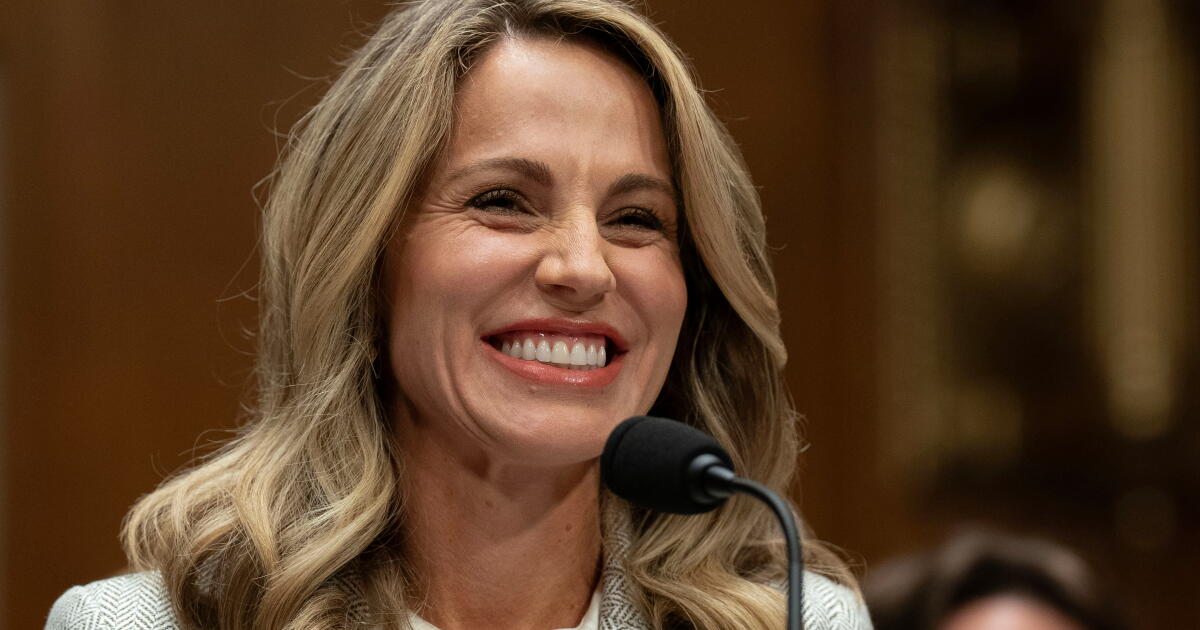
WASHINGTON — Dr. Nicole Saphier, President Trump ‘s third nominee for surgeon general, moved a step closer to confirmation after a Senate committee voted to advance her nomination on Wednesday.
Saphier, a radiologist and former Fox News Channel contributor, was advanced out of the Senate Committee on Health, Education, Labor and Pensions on a 12 to 11 vote to serve as surgeon general after she was grilled at her confirmation hearing earlier this month about her stance on childhood vaccines.
She expressed support for vaccines and told lawmakers she didn’t believe they cause autism. The Trump administration has sought to revisit claims about a link between vaccines and autism, although widespread scientific consensus and decades of studies have firmly concluded there is none.
Timothy Westlake, who was nominated to serve as assistant secretary for mental health and substance use at the Department of Health and Human Services, was also advanced out of committee on the same en bloc vote.
It was not immediately clear when the officials would face a full Senate vote for their confirmation, but they are expected to be approved.
During her confirmation hearing, Republican Sen. Bill Cassidy pressed Saphier to declare whether she believed there was a link between vaccines and autism. Saphier responded that she does “not believe childhood vaccines cause autism,” adding that “the MMR vaccine is our greatest tool for combating measles,” in response to a question by Cassidy over whether parents should give children that shot.
MMR stands for measles, mumps and rubella, and the president recently called for the shots to be spaced out, against the guidance of medical groups.
The surgeon general position carries limited policymaking power but serves as a loud megaphone as the nation’s top communicator to Americans on public health issues.
Cassidy, who led the inquiry into Saphier’s views on vaccines, ultimately voted in support of her nomination.
Sen. Bernie Sanders, the ranking member of the Senate HELP committee, said ahead of Saphier’s vote that he would vote down her nomination because in part Saphier “has questioned the need for the hepatitis B vaccine at birth, when the data science has been clear.”
“We need a surgeon general who will tell the truth about vaccines, not someone who misleads the public,” Sanders said. At her confirmation hearing, Saphier said the universal birth dose of hepatitis B was safe and effective.
Chris Klomp, who was nominated to serve as deputy secretary of the Department of Health and Human Services, was advanced out of the Senate Finance Committee last week on a 15 to 12 vote. He was questioned during the same hearing as Saphier about his duties associated with the role as the current chief counselor of the Department of Health and Human Services under the leadership of Health Secretary Robert F. Kennedy Jr. as well as about his vaccine stance.
In protesting Klomp’s nomination at the Senate Finance Committee, Sen. Ron Wyden said Klomp “tried to create the impression that he will be the adult in the room on vaccines. Yet, as we sit here today, the vaccine chaos that we’ve come to expect from Robert Kennedy’s HHS continues.”
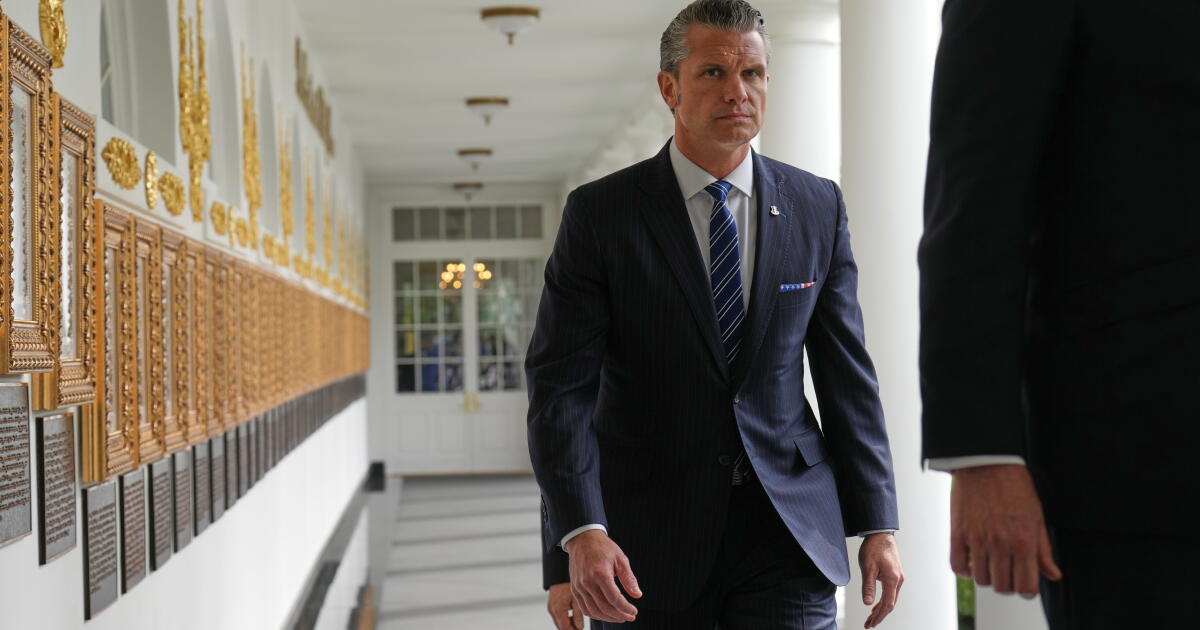
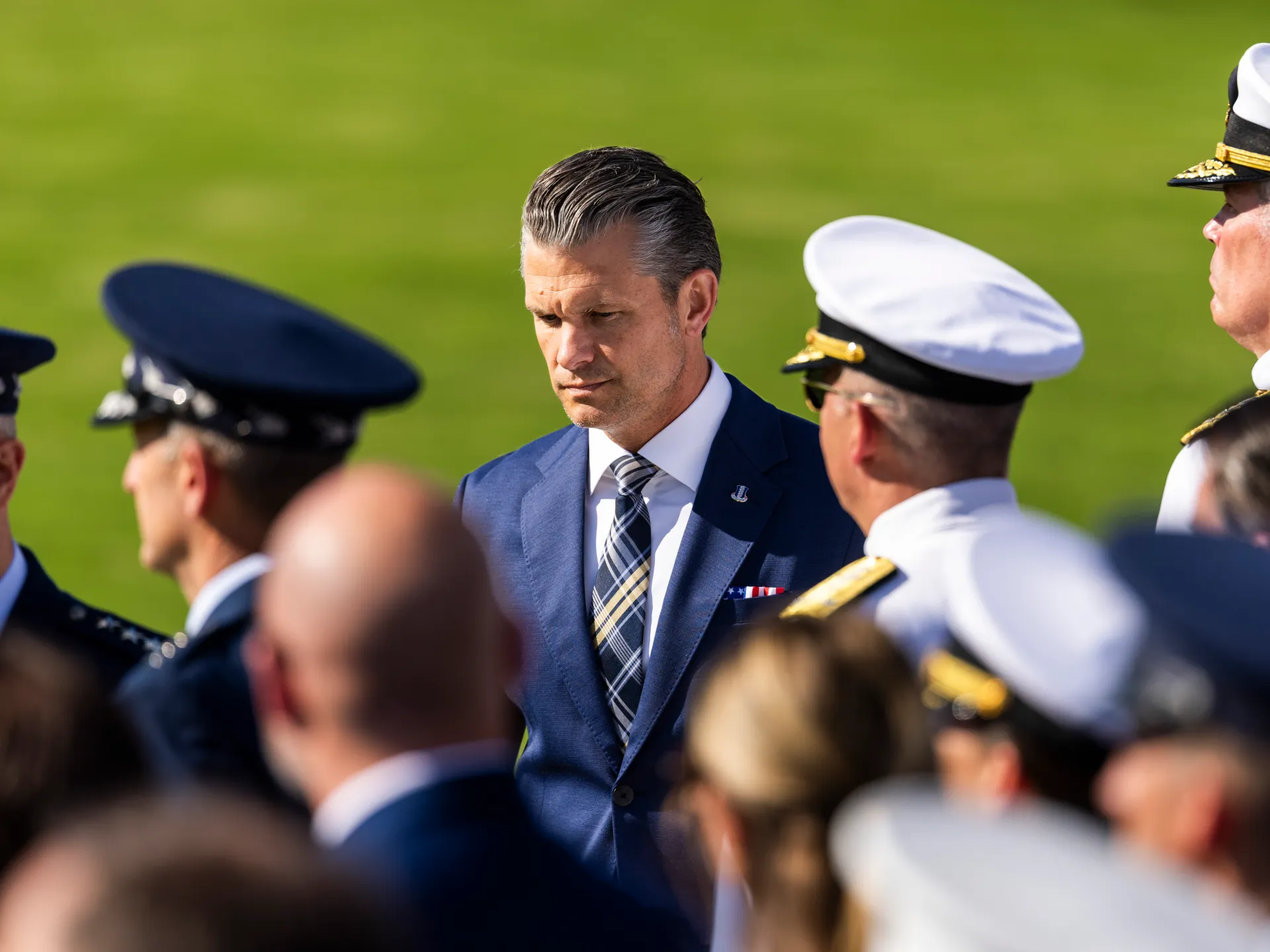
QUANTICO, Va. — Defense Secretary Pete Hegseth confirmed Wednesday that the U.S. military will cut 20% of its generals and admirals as he delivered what he is calling his “State of the Force” address.
Hegseth was speaking to junior officers and enlisted leaders at the Marine Corps Base Quantico in Virginia, the second year in a row that he has given such an address. This time, the U.S. military is seven months into a war with Iran with no clear end in sight, has captured Venezuelan leader Nicolás Maduro and killed more than 200 people in strikes on alleged drug trafficking boats in Latin America, among other actions worldwide.
The speech is not a usual fixture among Pentagon leaders. While Hegseth’s predecessors regularly addressed troops and top officers, they traditionally have done so in small or private settings.
The Pentagon chief, however, again focused on how he has drastically retooled the U.S. military by targeting what he calls “woke” culture — through a rollback of diversity programs, a review of ground combat units with female troops and a new screening program for “testosterone deficiency” among male personnel.
Pentagon officials had previewed that Hegseth would announce more cuts to the number of generals and admirals. He directed all military services to double the 10% reduction he ordered last spring for roughly 800 flag and general officer positions, making it a total 20% decrease to be completed by Jan. 1.
“I call it accountability and long overdue,” he said.
Several senators viewed Hegseth’s move as nothing short of a “purge” of the military’s top ranks that will take years to rebuild.
“He’s got some kind of like deep-seated grievance about leadership in the military,” said Sen. Mark Kelly, D-Ariz., the former Navy combat pilot and NASA astronaut, who has been critical of Hegseth. “He’s purging a generation of great leaders of the military, and it’s going to take a generation to recover from it.”
Republican Sen. Mike Rounds of South Dakota, a member of the Senate Armed Services Committee, said he wanted to understand Hegseth’s reasoning behind the decision.
“If it’s simply a matter of eliminating a very heavy top, there may be some validity to it, but I want to see it first,” Rounds said.
Hegseth and President Trump already have fired or pushed to retire more than two dozen military leaders since taking office, including the Army’s top uniformed officer, Gen. Randy George, a move that angered both Republicans and Democrats in Congress. The purge also has included a number of senior officers who are women or people of color.
Previous leaders who were ousted include Joint Chiefs Chairman Gen. CQ Brown; Chief of Naval Operations Lisa Franchetti; and Vice Adm. Shoshana Chatfield, the U.S. military representative to the NATO Military Committee.
Although Hegseth never gave specific reasons for those firings, most were tied to the belief that they endorsed or spoke openly in support of diversity, equity and inclusion programs, which have been targets of Hegseth and Trump.
As part of last year’s cuts, Hegseth also ordered the active duty military to shed 20% of its four-star general officers — the highest-level leaders — and the National Guard to shed 20% of its top positions, but it is unclear if all those cuts have been made. The new cuts could include any one-star general or above, or an officer of equivalent Navy rank.
When Hegseth first announced the effort to trim the highest levels of the military ranks, he argued it was intended to remove “redundant force structure to optimize and streamline leadership.” In a memo released in May 2025, he said the aim was to free the military from “unnecessary bureaucratic layers.”
The number of general officer positions in the military is set by law, but it is possible to let positions remain unfilled by not submitting replacements to Congress.
Hegseth’s efforts have extended well beyond personnel changes among the top ranks. He oversaw Trump’s ban on transgender troops while announcing new directives for “gender-neutral” or “male-level” standards for physical fitness.
Toropin and Finley write for the Associated Press. AP writers Lisa Mascaro and Meg Kinnard contributed to this report.
United States Defense Secretary Pete Hegseth plans to cut the number of positions in the US military reserved for generals and admirals by 20 percent, raising concerns about political interference in the military’s leadership amid strained relations with senior Pentagon officials.
An announcement is expected on Wednesday when Hegseth gives his “State of the Force” address to junior officers and enlisted personnel at Marine Corps Base Quantico in Virginia.
Recommended Stories
list of 4 itemsend of list
The Pentagon has presented previous cuts as a way to reduce bureaucracy. But analysts say Hegseth’s latest changes may be aimed at sidelining experienced commanders, discouraging dissent and appointing more officers loyal to President Donald Trump to the ranks.
So is the US military too top-heavy, and what could the cuts mean? Here’s what we know.
What is Hegseth planning?
Citing Pentagon officials, The Associated Press news agency has reported that Hegseth will double the 10 percent reduction in top-ranking personnel ordered last year, bringing the total decrease to 20 percent by January 1, 2027. The plan affects roughly 800 general and admiral positions across the one- to four-star ranks.
Congress sets statutory limits on the number of generals and admirals. A Congressional Research Service report recorded 848 active-duty generals and admirals in September 2025, below the authorised maximum of 857.
Cutting positions does not necessarily mean immediately dismissing everyone occupying them. An official told the Reuters news agency that some roles would be eliminated, while others would be assigned to lower-ranking officers.
Why are top-ranking military positions being removed?
The argument for reducing senior ranks predates Hegseth’s tenure, with supporters saying fewer layers of command would reduce administrative work and give officers closer to operations greater authority.
Walter Ladwig, a political scientist specialising in US foreign policy at King’s College London, said there is a credible case for reform. “Since the end of the Cold War, the overall size of the force has declined significantly, but we haven’t seen a corresponding reduction in the number of flag officers,” he told Al Jazeera.
“At the same time, we’ve seen headquarters and staffs proliferate.”
Trump and Hegseth have already fired or pushed into retirement more than two dozen military leaders since Trump took office in January 2025.
Those removed include General Randy George, the US Army’s top uniformed officer, in April, and Admiral Lisa Franchetti, the chief of naval operations, in February 2025. The administration also dismissed the only two women serving as four-star officers, alongside other senior female officers.
In February 2025, Trump also fired Air Force General CQ Brown as chairman of the US Joint Chiefs of Staff as part of a wider shake-up of top military leadership.
Other departures have been of civilian leaders. Army Secretary Dan Driscoll resigned in late August after reported disagreements over Hegseth’s handling of senior military personnel.
The dismissals, alongside blocked promotions, have raised questions about how the administration selects commanders and whether professional disagreements could jeopardise careers. Robert Ralston, a lecturer in political science and international studies at the University of Birmingham in the United Kingdom, said the proposed reductions should be weighed alongside these earlier decisions.
“These cuts appear to be part of a broader, sustained effort by Hegseth to fill the ranks based on political, rather than meritocratic, considerations,” he told Al Jazeera.
“Politics is driving these decisions, in my view.”
What political fallout could there be from this?
Democratic Senator Mark Kelly of Arizona criticised Hegseth’s changes at the Pentagon. “The US military doesn’t need more testosterone; it needs better leadership at this point,” Kelly told MS NOW’s Morning Joe programme last week.
“The consequences of firing all these admirals and generals are that we’re losing a portion, a good portion, of a generation of great leadership.”
David Galbreath, professor of war and technology at the University of Bath in the UK, told Al Jazeera that resistance from Congress and military leaders could complicate the changes.
He pointed to the opposition that arose to President Jimmy Carter’s plans to withdraw US ground troops from South Korea as an example of how military and congressional pressure can constrain a president.
“I suspect that after the election, we are likely to see a much more confrontational Congress with investigations and impeachments of Hegseth,” he said.
Whether that prediction comes true will likely depend on November’s congressional elections and whether the Republican Party retains control of both chambers of Congress.
What criticisms have been made of Hegseth?
Hegseth’s tenure at the Pentagon has been marked by controversy and tensions with senior officials. In March 2025, he shared details of forthcoming strikes on Yemen in a Signal chat group which inadvertently included The Atlantic’s editor-in-chief.
A number of US media reports about the dwindling supplies of weapons in the Middle East prompted his department to investigate leaks and restrict journalists’ access earlier this year. The New York Times reported in August that about 50 Joint Staff military and civilian officials had undergone polygraph tests amid growing mistrust inside the Pentagon.
Hegseth has meanwhile made ending what he calls “woke” culture a central priority, introducing new physical fitness requirements and abolishing diversity policies.
Ralston said the combination of dismissals and blocked promotions could damage morale and the military’s future leadership. “His relationship with senior military leaders has been adversarial, his scuttling of promotions has undoubtedly damaged morale, and will have long-term consequences for leadership pipelines within the Department of Defense,” he said.
King’s College’s Ladwig also described Hegseth’s relationship with senior Pentagon leaders as unusually confrontational but cautioned against interpreting every proposed cut as a power struggle.
“When a military is under civilian control, it means that the elected government has the right to determine defence priorities and reorganise the armed forces accordingly,” he said.
But Ladwig warned that the changes could encourage officers to hold back their professional recommendations when advising senior politicians. “That might create incentives for military officers to censor themselves rather than provide candid professional military advice, particularly if being politically aligned with the administration is seen as a path to success,” he said.
“This is a very worrisome pathology, and it’s the kind of thing that produces ineffective militaries in dictatorships.”
Pentagon official says the plan will be announced in the defence secretary’s ‘State of the Force’ address in Virginia.
Published On 30 Sep 202630 Sep 2026
United States Defense Secretary Pete Hegseth will cut the number of positions reserved for generals and admirals by 20 percent, a Pentagon official has told Al Jazeera, in a change that will affect leadership across the Army, Navy and Air Force.
Hegseth is expected to announce the decision on Wednesday during a visit to the Marine Corps Base Quantico in Virginia, where he will deliver his “State of the Force” address in front of junior officers and enlisted officials, the official said.
Recommended Stories
list of 3 itemsend of list
The Associated Press news agency, citing Pentagon officials, reported that Hegseth will direct all the military services to double the 10 percent reduction that he ordered last year to the roughly 800 flag and general officer positions. This would make it a 20 percent total decrease and is to be completed by January 1, 2027.
Fox News reported the new reductions could include any one-star general or above or officer of equivalent Navy rank.
The Washing Post reported that the cuts could affect the careers of “hundreds of current and rising military leaders following scores of firings and denied promotions”.
US President Donald Trump or Hegseth have fired, or pushed into retirement, more than two dozen military leaders since taking office in January 2025, including the Army’s top uniformed officer, General Randy George, in April.
The administration also fired the only two women serving as four-star officers, along with several other senior female officers. Other top officials have left through retirements and resignations, including the Army secretary, Dan Driscoll, who resigned this month after repeated clashes with Hegseth.
When the defence secretary first announced the effort to trim the highest levels of the military ranks, he argued it was intended to remove “redundant force structure to optimise and streamline leadership”. And in a memo released in May 2025, he added that his aim was to free the military from “unnecessary bureaucratic layers”.
At this time last year, Hegseth also declared an end to “woke” culture and announced new directives for troops that included “gender-neutral” or “male-level” standards for physical fitness.
Senator Jack Reed, a Rhode Island Democrat and ranking member of the Senate Armed Services Committee, expressed concern over Hegseth’s latest move in a statement. He said eliminating senior leadership positions must be done in consultation with Congress and warned that the planned cuts “should alarm every American”.
“Congress has been clear with the Secretary that he must consult this body and explain his reasoning for senior officer removals and promotion holds. To date, we have not received satisfactory answers,” Reed said.
“Our military is conducting major operations around the world, and the force is already under strain,” he added.
The number of general officer positions is set by law, but positions can be left unfilled if the administration does not submit nominees to Congress.
A top U.S. Air Force acquisition officer says work to set up a full production line for the F-47 sixth-generation fighter is getting closer and closer on the horizon. Prime contractor Boeing is in the midst of a nearly $2 billion expansion to its facilities in St. Louis, Missouri. The F-47 program otherwise continues to progress along an aggressive schedule, with a first flight still being targeted for 2028 and the goal of production jets entering operational service in the early 2030s.
Air Force Brig. Gen. Timothy Helfrich, the service’s Portfolio Acquisition Executive for Fighters and Advanced Aircraft, provided an update on the F-47 program during a virtual talk hosted by the Air & Space Forces Association’s Mitchell Institute for Aerospace Studies yesterday. Boeing won the Air Force competition to produce the F-47 in March 2023, and at least one pre-production example is being built now. The Air Force’s stated plan now is to acquire at least 185 of these jets.
“We have an imperative, I would call it a strategic asset, which is fighter production capacity,” Helfrich said during his opening remarks. “We only have so many production lines, and so we have to get the very most out of those that we can while planning for CCA [Collaborative Combat Aircraft drone] production, and pretty soon F-47 production.”
A rendering of the F-47 sixth-generation fighter. USAF
“There are only three active fighter production lines, right? We got F-35 down in Fort Worth, the F-15EX in St. Louis, and F-16 in Greenville,” Helfrich elaborated later on in the discussion in response to a question about steps the Air Force is taking to maintain sufficient operational capacity across its fighter fleets, in general. “So we need to grow the existing production lines, and we need to – or at least maximize what we can get out of those existing production lines, and we need to add production lines.”
“We’re not too far away from an F-47 production line, which will be additive to the production capacity,” he added.
Since 2023, Boeing has been working to substantially expand its production and other facilities in St. Louis by more than one million square feet. The company has repeatedly shied away from explicitly linking the $1.8 billion construction project to the F-47 program, but there have been clear signs of a connection for years now.
An undated aerial view of work to expand Boeing’s facilities in St. Louis. PARIC Corporation
“The project’s first phase includes plans to erect and renovate 1.1 million ft.2 of facilities on the 110-acre Brownleigh and 75-acre Northern tracts adjacent to St. Louis Lambert International Airport, according to planning documents released by the airport authority in 2023,” Aviation Week reported in 2025. “Phase 1 includes the construction of a 880,000-ft.2 aircraft assembly building on the Brownleigh [site], plus a 185,000-ft.2 hangar, 80,000-ft.2 radar cross-section test facility, open aircraft shelters, hush house, maintenance building, fuel calibration building and fire house totaling 90,000 ft.2 on the Northern tract.”
At that time, parts of the new facility were reportedly expected to open in 2026 ahead of the completion of the full project in 2030.
A post across Boeing’s social media accounts in July highlighted continued progress with this construction. This included the completion of roof and exterior panels and the installation of hangar doors at a section of the site dedicated to “Advanced Combat Aircraft Assembly,” as well as the “first steel column installed for the Central Utility Plan” in the North Tract area.
Progress you can see. Built for what’s next. Momentum continues on our St. Louis expansion:
✅ Advanced Combat Aircraft Assembly: roof and exterior panels complete, hangar doors installed ✅ North Tract: first steel column installed for the Central Utility Plant
“Momentum continues on our St. Louis expansion,” Dan Gillian, Vice President and General Manager of Air Dominance at Boeing, also said in July, according to Flight Global. “We are expanding our defence footprint while supporting next-generation capabilities.”
All of this is in line with Brig. Gen. Helfrich’s comments yesterday about a full production line for the F-47 steadily taking shape now. This, in turn, fits squarely with the aforementioned aggressive timeline the Air Force is pursuing for the program overall. Accelerated work on the F-47 has been aided by years of flight testing in secret of advanced demonstrator aircraft.
There is also a question of whether Boeing’s expansion of its production capacity in St. Louis could also be tied to the Navy’s F/A-XX next-generation carrier-based fighter program. Boeing has been facing off against Northrop Grumman in the F/A-XX competition with a design that looks related, at least to some degree, to the F-47.
A rendering of Boeing’s proposed F/A-XX design. Boeing
The F-47 and F/A-XX programs have become very closely intertwined in other ways. In 2025, the Pentagon moved to freeze F/A-XX, explicitly over concerns about competition for industrial base resources with F-47. This would include production line capacity. Congress subsequently intervened to keep the Navy effort going, but a final winner still has yet to be announced.
Just earlier this month, Air Force Gen. Dale White, the service’s Direct Reporting Portfolio Manager for Critical Major Weapon Systems, reiterated concerns about industrial capacity. White’s comments came in response to a question about potential challenges in building F/A-XXs at the same time as F-47s at a media roundtable at the Air & Space Forces’ Air, Space and Cyber Conference at which TWZ was in attendance. The general also acknowledged that these concerns were “not unique” to F/A-XX and F-47.
During the virtual talk yesterday, Brig. Gen. Timothy otherwise touted continued progress on the F-47 program.
“The F-47 is going to be the world’s first sixth-generation fighter, and I can’t wait to fly it [sic; see it fly] this administration,” he said. “That’s a commitment that I made, that we are on track to do.”
The “administration” referred to here is President Donald Trump’s second term in office, which will come to a close in January 2029. With this deadline in mind, the Air Force has openly said in the past that it is aiming for a first flight of the F-47 in 2028. Beyond that, the stated goal is to be operating the jets operationally sometime in the early 2030s.
A stock picture of a US Air Force F-22 Raptor. USAF
When the jets do enter service, “one of the things that we know F-47 is going to bring is more survivability and lethality than anything that’s ever been delivered before. And going into that highly contested environment, you have to meet certain levels of survivability if you want to execute there,” Helfrich noted yesterday. “Beyond just the survivability and lethality that we know is going to come, there’s also an adaptability that the F-47 will bring.”
“The F-47 will come out of the box with full open architecture,” he continued. “Amongst other great things, it brings the ability to upgrade rapidly, faster than the threat if needed. That is what is going to be required in that kind of environment. Other things it’s going to bring, it’s going to be much more survivable than our fifth-gen platforms, as well as have a combat radius of over 1,000 nautical miles, which you’re familiar with. That’s a long way, which is needed for that kind of environment. You need to be able to execute and persist there.”
“Especially in these highly contested environments, no one’s going to be fighting alone. So we need to make sure that we are integrating,” he added. “There’s some ability to get lift from one platform to another, right? Whether it’s a mission system, it’s communications, it’s open architectures, we’re seeing that integration pay dividends, so that we are integrated from day one.”
This kind of integration and cross-platform commonality in mission systems will be particularly relevant for F-47s acting as airborne controllers for CCA drones. Brig. Gen. Helfrich’s comments above also came in the midst of a discussion about future operations involving both F-47s and B-21 Raider bombers.
Many questions do still remain about plans for the F-47 and its design, including what engines will power the aircraft when it first enters service. In July, TWZ published a deep-dive feature about what is known about the aircraft to date, which you can find here.
In the meantime, the Air Force and Boeing are continuing to push ahead with laying the groundwork for full production of the F-47 as the jet gets closer to its first flight in the coming years.
The 81st United Nations General Assembly (UNGA) concluded on Monday with artificial intelligence (AI), the Israel-Palestine conflict and the US-Israel war on Iran dominating world leaders’ addresses during the general debate.
UN Secretary-General Antonio Guterres, in his final address before his term ends, warned that the future of the world would be shaped by four tests: AI, climate change, wars and inequality.
Recommended Stories
list of 3 itemsend of list
“Across all four tests, the decisive issue is power. Power over force, money, energy, technology, rules and the future. That is why the UN Charter – and the work of the United Nations – matter more than ever,” Guterres said.
Speeches ranged from calls to reform the UN to appeals for upholding international law, as the global body has been undermined by the unilateral foreign policy pushed by United States President Donald Trump.
Here are the biggest takeaways from this year’s summit:
Palestine
The situation in Palestine was a key issue among members amid Israel’s ongoing genocidal war on Gaza despite the so-called “ceasefire” and escalating settler pogroms in the occupied West Bank.
France, Canada, Iraq, the United Kingdom and others called for Palestinian sovereignty during their speeches.
“What credibility do we have if we continue to remain inactive in the face of Gaza,” French President Emmanuel Macron said in his address.
“Some boast of a supposed peace, but this peace hasn’t reopened humanitarian routes for a single second,” he said, adding: “Must we stand by and watch this spectacle that shames us all?”
Macron, British Prime Minister Andy Burnham, his Canadian counterpart Mark Carney and Saudi Foreign Minister Prince Faisal bin Farhan Al Saud chaired a meeting at the UNGA on Palestinian statehood, which is being actively undermined by Israel. Israeli Prime Minister Benjamin Netanyahu’s government has accelerated construction of illegal settlements and provided impunity to settlers in the occupied territory.
At the same time, the US-led Board of Peace unveiled a 66-project reconstruction blueprint with proposed funding of $2.4bn for the Gaza Strip on the sidelines of the UNGA.
However, the board’s plan excludes the UN agency for Palestinian refugees (UNRWA), saying it has no role in the future of Gaza. The decision was described by Palestinian political analyst and playwright Ahmed Najar to Al Jazeera as aligned with Israeli efforts to “marginalise and ultimately dismantle the agency, removing it not only from Gaza’s present but from its future”.
Dozens of delegates left the hall in protest as Netanyahu delivered his speech, in which he declared that Israeli forces would continue fighting against Hamas and Iran.
Trump defends military action on Venezuela, Iran
In his address, Trump emphasised that while others spoke of peace, he “made peace”.
Trump defended his actions in abducting the then-Venezuelan President Nicolas Maduro in January and said, since his military operation, hundreds of political prisoners had been freed in the South American country and that Caracas had signed the largest oil deal in history last month, covering “65 billion barrels of oil, which will benefit both Venezuela and the United States enormously and help drive down the cost of energy all over the world”.
“It was perhaps the biggest deal ever made. To the victor belong the spoils – you’ve all heard that,” Trump boasted.
Trump reiterated that he would never allow Tehran to have nuclear weapons and that the 12-day war in July 2025 had “obliterated their nuclear programme beneath mountains of rubble” as the ongoing US-Israel war on Iran had sunk “159 ships of their navy” to the bottom of the sea.
“I have a big decision to make – will a deal be made with Iran that lets them rebuild and create a far greater country than it ever was before … or do I annihilate the Islamic Republic and do it quickly, never giving them a chance to kill and destroy people and countries again,” he said, adding: “I believe we make a deal right after the elections.”
Popular Iranian officials
During sideline talks and one-on-one meetings, Iranian officials were in demand.
In his speech to delegates, President Masoud Pezeshkian emphasised that Iran had only “defended ourselves” amid attacks on his country and killings of Supreme Leader Ayatollah Ali Khamenei, scientists and children.
“We are not terrorists, our innocent people have been the targets of cowardly attacks and aggressions imposed upon our country,” he said.
Pezeshkian added Iran would not accept that peaceful nuclear technology is held exclusively in the hands of a few countries.
“We will not bow our head and give up the right that is inherently ours,” he said.
Meanwhile, on the sidelines of the summit, Foreign Minister Abbas Araghchi met his counterparts from India, Qatar, Turkiye, Pakistan, Ukraine and other countries.
He also met US Special Envoy Steve Witkoff and Trump’s son-in-law Jared Kushner in a four-hour meeting mediated by Qatar.
AI dominance
World leaders used their time at the podium to call for a global approach to using AI as interest in the technology grows, but fears that it could escalate if unchecked are also growing.
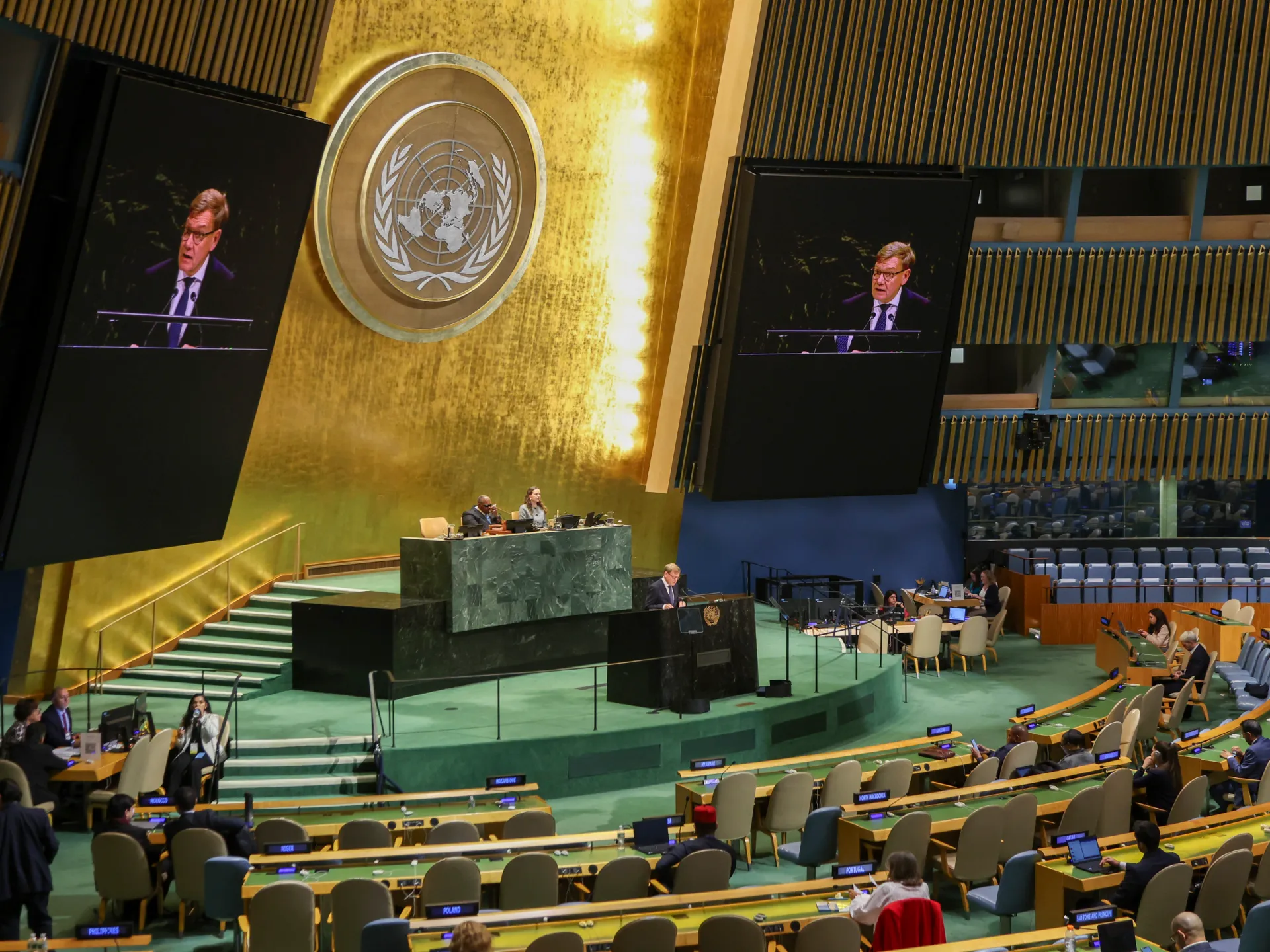
In his address, Finnish President Alexander Stubb said AI was the “most consequential technology in the history of mankind”.
“It will impact science, the economy, politics, security, and the very essence of our humanity. Humans can and should be in the driver’s seat. We have a choice: we can compete, cooperate or slow down. For me, cooperation is the best way forward,” he said.
While discussions are moving away from a good-versus-bad dichotomy, officials disagreed on approaches.
While Guterres and the European Union called for safety standards and international rules, Trump said AI innovation should not be constrained by international regulation, adding that the US should control its AI sector.
Xi skips the UNGA
Chinese President Xi Jinping skipped the UNGA despite being in the US for a summit with Trump. He sent Vice President Han Zheng to attend.
Xi rarely attends the UNGA. He had sent Premier Li Qiang in his place last year. In 2024, Foreign Minister Wang Yi attended the annual gathering.
Without mentioning Iran in his address, Han reiterated Beijing’s position that “sovereignty and security of countries in the Middle East, including the Gulf, should be respected”.
“China calls for advancing the governance of the West Bank and the post-conflict reconstruction of Gaza in accordance with the principle of the Palestinians governing Palestine. It also calls for bringing the Palestinian question back onto the right track of the two-state solution at an early date,” he said.
Han also called for a “people-centred approach and develop AI for the positive and for good, narrow the digital divide, and promote development that is universally beneficial”.
The California attorney general will help oversee healthcare giant Kaiser Permanente’s medical arbitration system to ensure it operates fairly under legislation Gov. Gavin Newsom signed late Sunday.
Patients, their families and lawyers have complained that Kaiser’s private and confidential system of handling medical malpractice complaints is designed to favor the health plan over those bringing the claims.
Under legislation known as Assembly Bill 1770, the attorney general will decide what actions justice officials should take to ensure private arbitrations required by any health plan are handled fairly and in line with state law.
To do that work, the state plans to add as many as four deputy attorneys general, a legal analyst and three legal secretaries, according to a legislative analyst’s report.
“We look forward to continuing to resolve claims through an independently administered system that provides a fair and efficient process for members and patients,” Kaiser Permanente said in a statement Monday.
Roughly 1 of every 4 Californians get healthcare from Kaiser. To join the plan, each one had to check a box, agreeing to use arbitration to settle any dispute.
Many companies and other organizations, including some hospitals and physician groups, require customers or patients to take their complaints to private arbitration rather than to court.
But unlike most other companies, which send claims to large arbitration firms, Kaiser created its own system.
Under Kaiser’s system, once a neutral arbitrator is selected, either party can opt to disqualify that person without cause. There is no limit on the number of disqualifications.
While the health plan designed the system to be fair, patients and their lawyers have alleged that Kaiser’s greater knowledge of arbitrators’ past rulings and its ability to veto arbitrators gives it an advantage to pick favorable judges.
Critics also say the hourly fees paid to arbitrators provide them with a financial incentive to rule in Kaiser’s favor so they will be selected for future cases. Most of the arbitrators are retired judges.
The bill was authored by Assemblyman Robert Garcia (D-Rancho Cucamonga), a longtime Kaiser member.
Support for it was led by Stephen Martinez, a retired aerospace engineer from Bellflower, who with his wife, Lindalee Iverson, spent $350,000 to bring two arbitration cases against Kaiser. The arbitrator ruled against the couple in both cases.
Iverson died of cancer in 2023.
Martinez told legislators at a hearing this year how his wife had found a lump in her breast and asked for an appointment with her longtime caregiver at Kaiser to examine it. Instead she was sent to a physician assistant, who dismissed it, he said. Later, it was found to be cancer that had spread.
A chief breast surgeon at Kaiser and another surgeon who had retired from that job both testified that the Kaiser physician assistant failed to follow the health system’s guidelines.
Kaiser’s expert argued that the physician assistant did an appropriate exam and that his low suspicion of breast cancer was reasonable. The neutral arbitrator sided with the health plan’s expert.
Martinez has spent years trying to get legislation to make the system more fair.
“I’m elated,” Martinez said of Newsom’s signing of the bill, which was named Lindalee’s Law. “It’s been a long road.”
According to the annual report prepared by the independent administrator of Kaiser’s system, the “most common” complaint the office heard last year was about the neutral arbitrator.
“Most complained that the arbitrator was biased, partisan, unjust, and in Kaiser’s favor,” the report said.
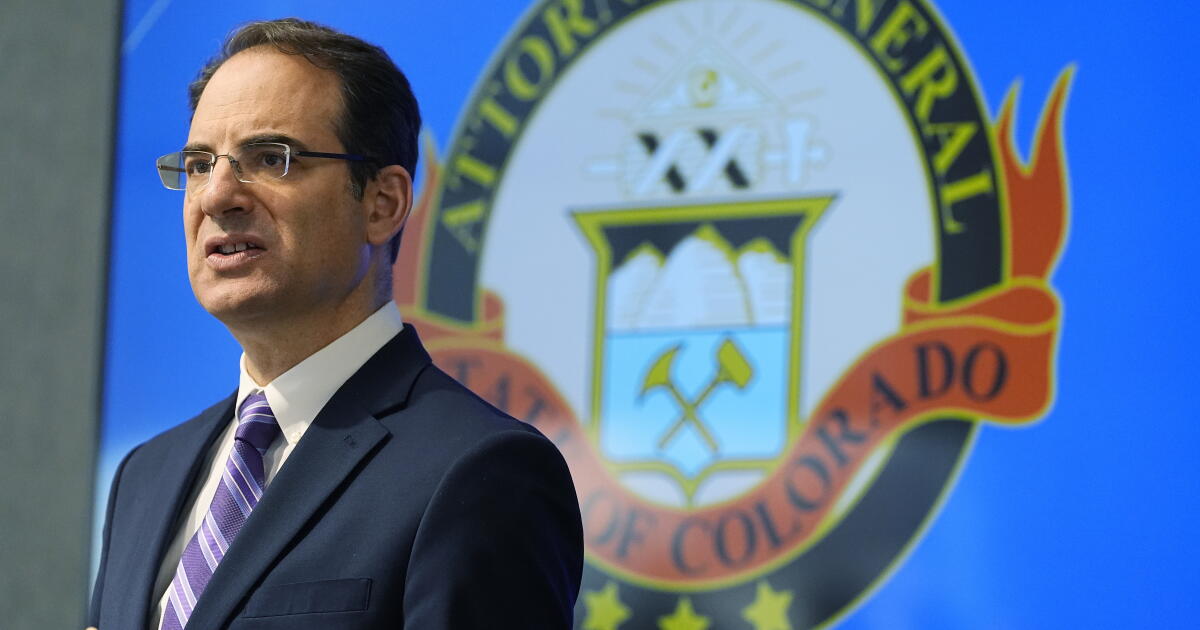
DENVER — The office of Colorado’s attorney general is a perch 10 stories above downtown Denver. From his aerie, Phil Weiser has a sweeping view of the city skyline, the gold-domed Capitol and, occasionally, a red hawk on the wing.
But looking toward November, Weiser sees something darker.
“With this administration what we have seen is it’s important that we not limit our imagination to what … type of harm could happen,” Weiser said during a sunny noon hour in the Mile High City.
For that reason, Colorado’s attorney general and his Democratic peers around the country have spent more than a year strategizing — by phone, via Zoom, sometimes in person — on ways to Trump-proof the midterm election.
They’ve researched history and the law, war-gamed what-ifs, divvied up responsibilities and drafted emergency lawsuits and temporary restraining orders so they can be hurried into court at a moment’s notice.
“We have prepared for a range of contingencies … so that we’re ready to act,” Weiser said.
“We’re not going to be reacting in real time” or pulling all-nighters, he added. “We are going to be following through on plans we’ve made, having looked at what’s possible.”
The efforts of Weiser, California’s Rob Bonta and more than 20 other Democratic attorneys general are part of a mass mobilization aimed at thwarting Trump’s unprecedented efforts to pervert and subvert November’s midterm balloting.
It’s remarkable that kind of man-the-barricades action is needed to preserve and protect the voting franchise in this, the land of the free and home of the brave. But having weighed the threats, Weiser said his greatest fear of election interference comes not from a bad overseas actor or some terrorist group, but rather our own federal government “and what this administration might do.”
So here we are.
To fend off that threat from within, state Democratic parties across the nation are aiming to recruit 10,000 volunteers to guard polling places in the event armed federal agents show up.
Various sponsors have launched education campaigns to explain election rules and offer hotlines for voters who have trouble casting their ballot.
Civil rights groups and democracy-defending organizations have staged their own tabletop exercises brainstorming and rehearsing various scenarios. A group of Democratic U.S. senators has done the same.
“What we’re doing is preparing for the fact that Donald Trump, in 2020, lied about the election in advance, lied about it in the aftermath, went to court … and then he instigated a violent insurrection in this very building,” Marc Elias, a Democratic elections attorney, told MS NOW in a July interview at the Capitol. “So I think we need to take these threats in the 2026 midterm run-up … both seriously and literally.”
In a more courageous, less heedlessly partisan world, Republicans would be working with Democrats to keep the power-drunk Trump in check. (The House and Senate supposedly comprise a separate and equal branch of government, with its own power, prerogatives and such.)
But, as Weiser noted, this Republican-led Congress “has been lacking in backbone, lacking in the role of checks and balances. That has left it to state attorneys general to fill that vacuum, going to court and essentially playing the role of a check on a lawless and often bullying president.”
The nation’s 24 Democratic attorneys general have filed more than 125 lawsuits in Trump’s second term alone, fighting his moves on trade and tariffs, energy and immigration policies and efforts to gut or eliminate programs and whole government agencies. They’ve prevailed in the overwhelming majority of cases that have been adjudicated or settled.
Even before Trump was elected again, some attorneys general began conferring on ways to fight the excesses they anticipated in a second administration. Anyone who didn’t see them coming wasn’t paying attention, said Weiser, who, most likely, will be elected Colorado’s next governor on Nov. 3.
(His victory in Colorado’s Democratic primary stemmed in good part from Weiser’s record battling Trump in court.)
Trump is constitutionally (small “c”) incapable of acknowledging the result of any election he didn’t win. He’s openly urged supporters to “cheat like hell.” Thus, one can only assume malign intent when the president tries to wantonly purge voter rolls, hijack the U.S. Postal service to gum up mail balloting and override the Constitution (capital “c”) by federalizing November’s election.
Some might call such fears melodramatic, or overblown.
Trump’s refusal to accept the outcome of elections “is historic,” the attorney general said. “It is unique. It’s a threat. And it’s why we have to stand our guard.”
Vote, to bring this rogue president to heel. Stay vigilant, to make sure that vote counts.
With world leaders at the UN General Assembly podium this week, play our quiz matching famous quotes to who said them.
Published On 23 Sep 202623 Sep 2026
This week, world leaders converge on New York for the annual United Nations General Assembly (UNGA), where representatives from the 193 UN member states are expected to take to the podium.
Over the decades, that same podium has hosted some of modern diplomacy’s most quoted moments, from Cold War warnings to wartime appeals.
Match each line to the leader who spoke it from the UNGA podium in the 10-question quiz below.
Iran must “end its arming of and support” for the Houthis in Yemen, the foreign ministers of G7 nations have said in a joint statement.
The G7 also condemned “in the strongest terms” Houthi attacks on Saudi Arabia, adding that the recent escalation in fighting against Saudi-backed forces in Yemen represented a threat to regional and global energy security.
Thousands of refugees have fled Yemen in recent days after the Iran-backed group seized territory along the country’s Red Sea coastline, including near the Bab al-Mandab Strait, a critical shipping route for global trade.
The statement comes ahead of the annual UN General Assembly in New York, where senior Iranian officials are due to speak.
“We call on the Houthis to immediately cease all military actions, all threats and attacks against civilian shipping, and to return to the political process in good faith,” said the foreign ministers of the UK, Canada, France, Germany, Italy, Japan and the United States.
It went on: “Their reprehensible actions constitute a dangerous pattern of escalation that risks further exacerbating the conflict, undermining international trade and creating global economic instability.”
“Looking forward, we will continue to support the legitimate Government of Yemen and reaffirm our strong commitment to the unity, sovereignty, independence, and territorial integrity of Yemen,” the ministers said.
Their statement was issued following a meeting on the sidelines of the UN General Assembly.
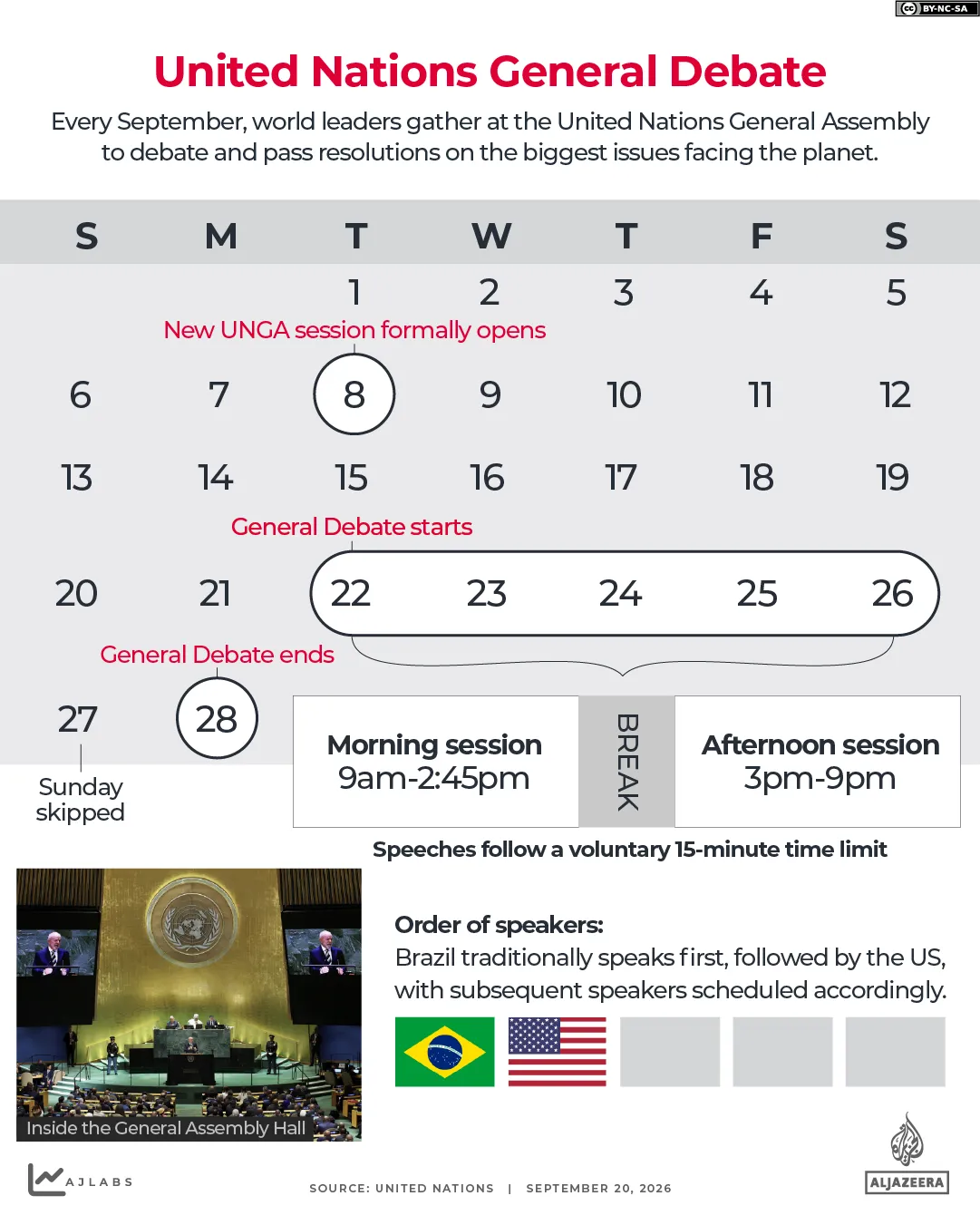
On Tuesday, nearly 130 heads of state and government are expected to begin taking the podium at the annual United Nations General Assembly (UNGA) in New York as the high-level general debate opens.
The debate is the key event of the UNGA’s annual session, which began on September 8, when Khalilur Rahman of Bangladesh took office as president.
In this visual explainer, Al Jazeera looks at what happens at the UNGA, who will speak, and the key moments to watch.
When is UNGA 2026?
The debate opens on Tuesday, September 22, runs through Saturday, September 26, and resumes on Monday, September 28, as no sessions are held on Sunday.
It runs in two daily sessions: from 9am to 2:45pm local time (13:00 GMT to 18:45 GMT) and from 3pm to 9pm (19:00 GMT to 01:00 GMT the next day).
Statements are expected to observe a voluntary 15-minute limit, though many run longer, and meetings continue until all scheduled speakers have spoken.
Who is speaking at UNGA 2026, and when?
The session opens with UN Secretary-General Antonio Guterres, who introduces his annual report and is expected to give his final address, followed by UNGA President Khalilur Rahman, who formally opens the debate.
By tradition, Brazil is always the first country to speak, a practice that began in 1955 when it volunteered to open the debate, when no other country would. The United States, as the host country, usually speaks second, and President Donald Trump is expected to take the podium after Brazil on Tuesday morning, likely around 9:45am local time (13:45 GMT).
For all other member states, the speaking order is determined by the level of representation (head of state, head of government, or minister), expressed preferences, and geographic balance.
The Holy See (Vatican City), the State of Palestine, and the European Union are also invited to participate, with their speaking slots set according to their representation.
Speakers for day one are shown in the graphic below. The speaking schedule for the remaining days will be published in the coming days.
Where is the UNGA held?
The UNGA is held at the UN headquarters, which is located along the East River in Manhattan, New York.
The complex, built between 1949 and 1952, is owned by the UN and is considered international territory. It serves as the main hub for international diplomacy.
The UNGA has not always been held in New York. The first six UNGA sessions took place in different cities, beginning in London and later including Paris. Since 1952, however, nearly all sessions have been held at the UN headquarters in New York.
Some notable exceptions include 1988, when the UNGA met in Geneva, Switzerland, after the US denied a visa to Palestinian leader Yasser Arafat.
This time, for the second year running, the US has denied visas to Palestinian officials, so President Mahmoud Abbas will address the UNGA by prerecorded video after member states voted to allow it.
The Trump administration’s decision has drawn widespread criticism, with the UN asserting that it violates the Host Country Agreement, which obligates the US to allow heads of state and government to travel to New York for annual meetings and other diplomatic business, with full diplomatic immunity.
What is on the UNGA 2026 agenda?
The 81st UNGA has the theme “Restoring trust, managing transformation: a United Nations that delivers for all”, which is set out in the UN’s information note on the arrangements for the high-level week.
Alongside the speeches, the UN has scheduled high-level meetings on climate action and a just transition and on the 40th anniversary of the Declaration on the Right to Development (September 23), on sea level rise (September 24), on pandemic preparedness (September 25), on the 25th anniversary of the Durban Declaration against racism (September 28), and on eliminating nuclear weapons (September 29).
Many speeches are also expected to focus on the wars in the Middle East and Ukraine, artificial intelligence and the UN’s funding squeeze, while diplomats watch the race to succeed Guterres, whose term ends on December 31.
Who will be the next UN chief?
The UNGA formally appoints the secretary-general, but the choice is not expected to be made this week. The UN Security Council (UNSC) is still holding straw polls and must recommend a candidate first.
Guterres’s second and final term ends on December 31, and the race to succeed him is under way. There have been nine secretaries-general since the UN was founded in 1945, all of them men. Several UNSC members have said they want a woman to lead the organisation for the first time.
Seven candidates remain in the running, four women and three men, but more could still enter the race:
Rebeca Grynspan (Costa Rica): Secretary-general of UNCTAD and former vice president of Costa Rica
Carolyn Rodrigues-Birkett (Guyana): Guyana’s permanent representative to the UN and former foreign minister
Ivonne Baki (Ecuador): Diplomat and former minister of foreign trade
Maria Fernanda Espinosa (Ecuador): Former president of the UNGA and former foreign minister
Rafael Grossi (Argentina): Director general of the International Atomic Energy Agency
Macky Sall (Senegal): Former president of Senegal
Olara Otunnu (Uganda): Former foreign minister and ex-UN undersecretary-general
Former Chilean President Michelle Bachelet withdrew on Saturday after winning support from only one of the 15 UNSC members in the latest informal vote. The same vote put Costa Rica’s Grynspan narrowly ahead, with nine of the 15 members encouraging her candidacy, five discouraging it, and one with no opinion. Guyana’s Rodrigues-Birkett came second, with eight votes to encourage, six to discourage and one with no opinion, diplomats and sources close to the process said.
The UNSC must settle on one candidate with no veto from its five permanent members before recommending them to the UNGA.
When did each nation join the UN?
The UN was established after World War II, growing from 51 members in 1945 to 193 today, with two non-member observer states: Palestine and the Holy See (Vatican City).
The aim of the UN was to prevent future conflicts, promote international peace and security, foster cooperation among nations, protect human rights and support social and economic development worldwide – goals that many critics say it is increasingly failing to deliver on.
Each member has one vote in the UNGA, whose resolutions are generally nonbinding recommendations. That sets it apart from the 15-member UNSC, where five permanent members hold a veto and decisions can be legally binding.
Use the table below to find out when each country joined the UN.
The newly released picture from General Atomics’ Aeronautical Systems, Inc. division (GA-ASI), seen at the top of this story, shows an FQ-42 in flight together with an F-35A Joint Strike Fighter and an F-15E Strike Eagle. The company has also disclosed the delivery of another Vengeance drone to the Air Force, this time to the service’s main drone operations hub at Creech Air Force Base in Nevada.
“The FQ-42 that arrived at Creech will continue regular test and evaluation operations with the Air Force aimed at experimentation with the new aircraft,” according to a press release GA-ASI put out today. “Previous efforts with Vengeance and other GA-ASI jets, including [the] XQ-67A Off-Board Sensing Station and MQ-20 Avenger – have found the trio of combat jets flying in various scenarios that push the boundaries of combat aviation. GA-ASI’s jets have flown semi-autonomously and autonomously with various AI pilots and under collaborative control of human fighter pilots operating F-22 Raptor and F-35 Lightning II jets.”
From top to bottom, General Atomics MQ-20 Avenger, XQ-67 OBSS, and YFQ-42 drones. GA-ASI
As mentioned, the Air Force is steadily working to broaden the scale and scope of testing involving the FQ-42 and FQ-44 to include more and more operationally relevant scenarios. Both types are set to make their first appearance at a large-force employment (LFE) exercise in December, offering a valuable new opportunity for deeper and more realistic integration with crewed fighters.
The Air Force otherwise continues to lay the groundwork for future CCA operations, including through a major round of testing at Creech in July, which TWZ was first to report on. The service is heavily focused now just on figuring out how the drones will be deployed, launched, recovered, supported, and otherwise operated on a day-to-day basis. A dedicated test squadron called the Experimental Operations Unit (EOU), established at Nellis Air Force Base in Nevada, has been leading those efforts.
Work is also underway to demonstrate tactical capabilities, such as the FQ-44 launching an AIM-120 Advanced Medium-Range Air-to-Air Missile (AMRAAM) for the first time earlier this year.
New test footage: first missile shot from YFQ-44A.
YFQ-44A executed an end-to-end, beyond-line-of-sight strike against a simulated target.
“We’re on path right now to do our air-to-air shot coming up here in the near future,” Mike Shortsleeve, Vice President for Strategy Business Development at GA-ASI, told TWZ‘s Jamie Hunter on the floor of the Air & Space Forces Association’s (AFA) 2026 Air, Space & Cyber Conference last week.
Last week, GA-ASI separately announced a new demonstration of semi-autonomous air-to-air combat capability involving crewed F-5AT Advanced Tiger jets belonging to private adversary air contractor Tactical Air Support, Inc. and an unspecified “CCA test aircraft.” The company did use a picture of an Avenger drone to illustrate the press release. The F-5s and the CCA surrogate were equipped with infrared search-and-track sensors (IRST) during the testing.
The stock picture of an Avenger drone that General Atomics used to illustrate its press release last week. General Atomics
“The live exercise proved that a CCA and a manned fighter can collaborate to fuse sensor data from AMS-GRA-compliant sensors to track, engage, and eliminate an airborne target while using a Beyond Line of Sight (BLOS) data link to accomplish seamless coordination between the two aircraft,” according to the GA-ASI release.
“The demonstration utilized BLOS communication between the CCA and the airborne F-5, enabling the Advanced Tiger to send data about targets from an AMS-GRA-compatible system. These commands were relayed to the CCA’s TacACE [Tactical Autonomy Ecosystem software] system,” the release added. “This flight showed that many companies’ platforms can interoperate using the plug-and-play government reference architectures ecosystem. The U.S. Air Force isn’t locked into using a single vendor or system.”
IRSTs are especially valuable for helping spot stealthy targets with features designed to reduce their radar cross-sections since they detect and track infrared emissions. By extension, IRSTs are also immune to radio frequency electronic warfare jamming. As passive sensors, they do not emit their own signals that could alert a target to the fact they are being tracked, either. IRSTs can still be used to cue or otherwise be linked to other sensors, including active electronically-scanned array radars. Fusing data from multiple sources can provide higher fidelity tracks of multiple targets, as well as improved situational awareness overall.
An Avenger drone with a podded IRST sensor under its wing. General Atomics
Air-to-air combat is expected to be the primary mission set, at least initially, for Air Force CCAs. At the same time, an air-to-ground role for the FQ-42 and FQ-44, and/or other future CCA-type drones the Air Force might acquire, is emerging on the horizon. Anduril has already fit-checked a variety of air-to-ground ordnance on Fury.
As it stands now, the Air Force is looking to have its first operational CCAs in service toward the end of the decade. The service is also presently aiming to have a total fleet of at least 500 CCAs of all types by 2032.
“If we can’t be ready, then certainly you’re not going to have the forces that you need and the numbers that you need going forward. This signifies that mass is certainly important again, but also autonomy is just as important,” General Atomics’ Shortsleeve told us last week in talking about the Air Force’s CCA fleet size target. “So the ability to have these autonomous systems, whether they’re bringing in additional weapons, sensing capability, whatever it is, all of those working in a collaborative environment, whether it’s manned, unmanned teaming, or unmanned and unmanned capabilities, that right there is what’s going to help the warfighter in the future.”
FQ-42 Vengeance fighter drone update from General Atomics
“And when we say autonomy, it’s not just strictly this is going to go off and do its own thing. It’s going to be directed,” he added. “Whether it’s on the ground, in the air, [it] makes no difference to the system itself. It’s going to work hand-in-hand [with humans]. So that human-machine teaming, that’s what they’re really focusing on. There is figuring out how to best use this capability in the advancement of actually having to employ it in [the] real world.”
Though just flying in formation is very different from collaboration with a high degree of autonomy, the new picture of the FQ-42 together with the F-35A and the F-15E is a window into the future teamed operations the Air Force is hoping to build.
California Atty. General Rob Bonta and Paramount Skydance Chief Executive David Ellison have reached an agreement to end the state’s antitrust fight, paving the way for Ellison to complete his $111-billion purchase of Warner Bros. Discovery, said a person familiar with the matter.
The two sides have agreed to resolve antitrust claims that Bonta and 11 other state attorneys general brought in late July, said the source, who was not authorized to comment publicly on the settlement.
As part of the deal, Paramount agreed to pay a penalty if the company fails to make good on a promise to distribute 30 films per year in theaters and to spend $1.5 billion on film production in Hollywood over the next five years, said the source who was not authorized to comment.
Representatives of Paramount and Bonta did not respond to a request for comment.
A federal judge must approve the agreement. Paramount would then be poised to quickly finalize its purchase of Warner Bros. Discovery — a blockbuster combination that will reshape Hollywood by collapsing two historic film studios with rights to Batman, Harry Potter, “Top Gun,” and Bugs Bunny and by combining the HBO Max and Paramount+ streaming services.
In addition to CBS, Paramount would own dozens of cable television channels, including CNN, TBS, HGTV, Food Network and Comedy Central.
The road to a resolution was fraught. Bonta abruptly canceled a negotiation session with Paramount in late August after potential deal terms leaked. Then, after talks restarted and the settlement began taking shape, several powerful Bonta allies, including New York Atty. Gen. Letitia James and Connecticut Atty. Gen. William Tong, signaled their displeasure with proposed deal terms.
They felt the deal points didn’t go far enough to mitigate the potential clout Paramount would wield over the film and television industries if it was allowed to swallow its larger industry rival, according to three people familiar with the matter but not authorized to comment.
Ellison’s goal had long been to complete the Warner takeover by the end of September — before midterm Congressional elections and prior to a key deadline for Paramount to increase its payout to Warner Bros. Discovery shareholders. Ellison received a boost from California Gov. Gavin Newsom, Los Angeles Mayor Karen Bass and Xavier Becerra, the Democratic nominee for California governor, who pressed Bonta to end the dispute rather than take the case to trial in Oakland in March.
Newsom said he took “seriously” Paramount’s threat to leave the state. He advocated for a settlement behind the scenes, according to two people close to the matter who were not authorized to comment.
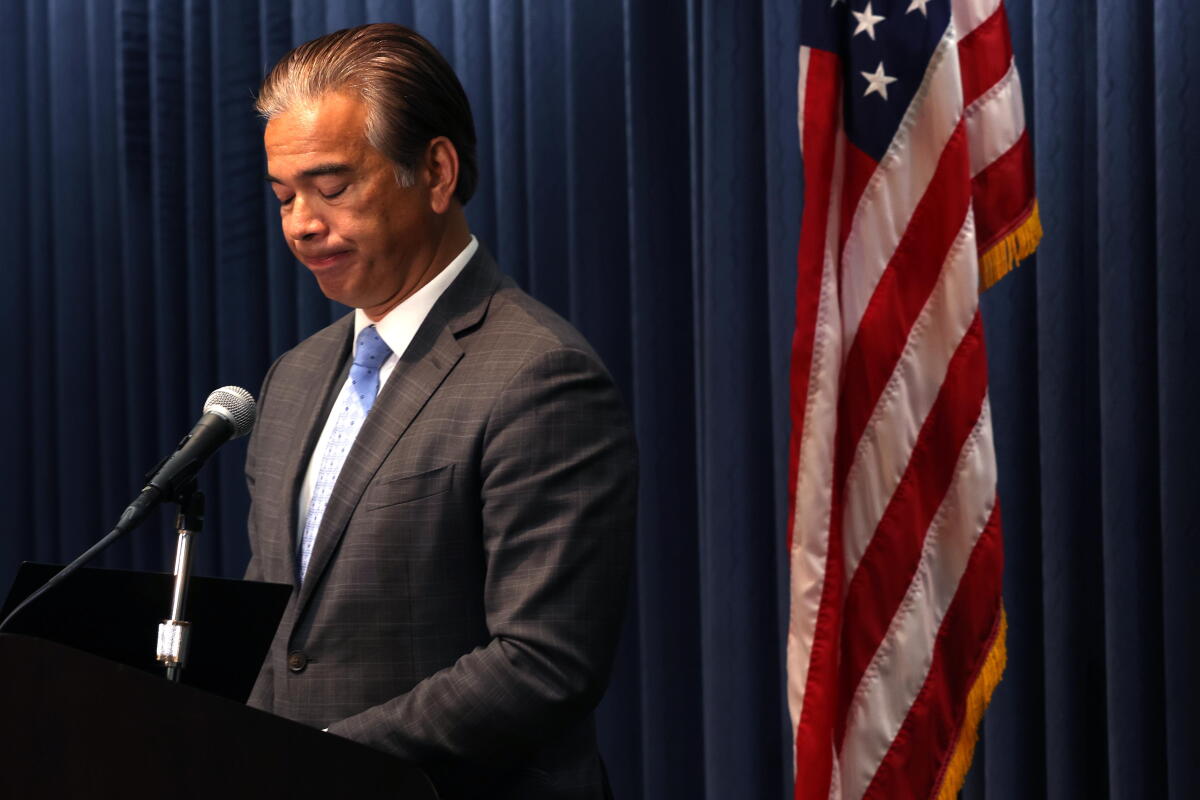
State Attorney General Rob Bonta in 2025. (Genaro Molina/Los Angeles Times)
(Genaro Molina/Los Angeles Times)
Ellison was highly motivated to strike a deal because his company’s expenses will soon accelerate. Beginning Oct. 1, Paramount is on the hook to pay Warner investors a “ticking fee” of 25 cents per quarter, per share until the deal closed. That obligation is expected to add $7 million a day to the cost of the $31 a share that Paramount agreed to pay Warner shareholders when it won the bidding war back in February.
Paramount’s takeover will be heavily leveraged. The company’s bankers have lined up nearly $80 billion in debt to finance the merger. Ellison’s father, billionaire Larry Ellison, late last year agreed to backstop the $47-billion in equity needed to complete the acquisition. Royal families from Saudi Arabia, Qatar and Abu Dhabi have agreed to chip in $24 billion for an equity stake by assuming some of Ellison’s financial commitments.
Late last week, the Federal Communications Commission approved Paramount’s request to allow the foreign investors to own nearly 50% of the merged company. The Ellison family, however, will retain its voting control.
Paramount has promised Wall Street that it would make more than $6 billion in cost cuts. A recent Los Angeles County economic report predicted the merger could lead to an estimated 4,500 workers in the Los Angeles region losing their jobs as Ellison works to combine the two companies.
The truce comes after Paramount received clearances from regulators around the world, including the European Commission, Canada and the U.S. Justice Department.
Larry Ellison separately announced plans to switch the headquarters of his software behemoth Oracle to Nashville from Austin, Texas (after Oracle relocated from Silicon Valley six years ago).
Paramount also enlisted major Hollywood unions, the Directors Guild of America and the International Alliance of Theatrical Stage Employees, and prominent cinema chains to drop their opposition to the deal.
Bonta’s suit had leaned heavily into potential harms to theatrical distribution and lawyers for the states had been banking on theater executives’ testimony at trial.
The parties also were facing a key court hearing Thursday. Paramount was poised to ask U.S. District Judge Araceli Martínez-Olguín in Oakland to make the states and the Writers Guild of America post a $1.88-billion bond that would cover some of Paramount’s delay-related deal costs should the company eventually prevail.
The states and the WGA, which also sued to block the merger, have balked at the request, which was designed by Paramount to create fissures within the coalition of states by raising doubts about the strength of their case.
Paramount’s high-profile lobbying campaign reached a crescendo in late August after Paramount called out activist-actor Mark Ruffalo, accusing him of resorting to “antisemitic tropes” to argue against the merger.
Prominent Jewish groups rushed to Paramount’s aid. Ruffalo, who frequently works with HBO, denied the allegation, saying he had a 1st Amendment right to speak against the deal as well as Oracle’s business ties to Israel. Numerous Jewish artists came to Ruffalo’s defense, saying his free speech rights were being squelched.
Bonta abruptly canceled a settlement conference, accusing Paramount of leaking confidential information.
“If you want to have an adult, legitimate, serious settlement discussion — no problem,” Bonta said during an Aug. 25 appearance in Los Angeles. “But if you want to play games, we’ve got better things to do.”
The states’ 37-page lawsuit, filed in the U.S. District Court for Northern California, claimed the Paramount-Warner combination would violate the U.S. Clayton Act, a century-old antitrust law to prevent mergers that weaken competition and raise costs for consumers.
The states, which also included Nevada, Colorado, Oregon, Washington, New Jersey and New Mexico, had argued the tie-up of two legacy movie studios would give Paramount-Warner too much marketshare in two categories — wide-release movies and potential blockbusters.
Paramount Skydance CEO David Ellison has pressed to get his blockbuster deal done before his company must make higher payouts to Warner Bros. Discovery shareholders and before the mid-term elections, which could change the makeup in Congress.
(Mark Schiefelbein / Associated Press)
The states also said Paramount-Warner would control nearly 30% of the cable television channel space with more than 50 networks.
Paramount has been facing a June 4 deadline to complete the deal — or owe Warner Bros. Discovery a $7-billion breakup fee. Paramount has already paid $2.8-billion to cover a termination fee paid to Netflix after the streamer withdrew from the auction in February.
WASHINGTON — Atty. Gen. Todd Blanche is blurring traditional boundaries between politics and federal law enforcement with recent speeches at political events that mark a sharp departure from norms meant to protect the Justice Department from the appearance of partisan bias.
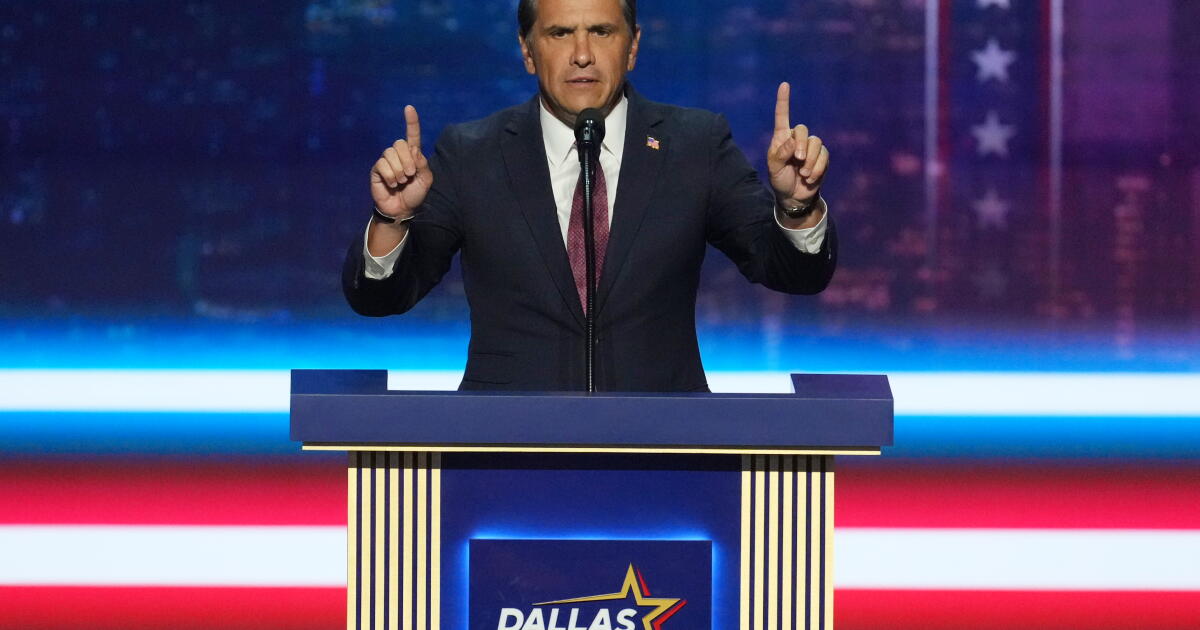
Blanche took the stage this week at an event for a Republican Senate candidate in North Carolina days after speaking at a GOP midterm convention, where he praised Trump and touted the administration’s tough-on-crime approach.
Blanche’s participation at the rallies has drawn scrutiny from critics who say it threatens to undermine public faith in law enforcement decisions that are supposed to be made free of political interference. It has added to critics’ concerns about Blanche’s loyalty to Trump and White House influence on Justice Department matters against the backdrop of investigations into numerous perceived foes of the president.
“It lends credence to the arguments that the Justice Department is hopelessly politicized,” said Richard Painter, who was a White House ethics lawyer in the George W. Bush administration. “And that’s not where we want to be right now.”
Blanche has brushed aside norms
Attorneys general have typically stayed away from political rallies and at arm’s length from the White House to prevent the appearance of law enforcement interference in elections and to protect the perception of impartiality in prosecutions.
Blanche, a former personal lawyer for Trump, has brushed aside such norms and fiercely defended the president’s interests in the department, which brought two criminal cases against Trump under President Joe Biden. Blanche has rejected allegations that the Trump administration has politicized the agency and accusations that the White House is improperly involved in department matters.
Blanche has used his speeches at the rallies to promote the administration’s efforts to bring down violent crime, illegal border crossings and drug trafficking as Republicans put their tough-on-crime policies at the center of the midterm elections. In another unusual move, he held a press briefing at the White House this week, fielding questions from reporters on a host of matters including the Iran war.
At an event Wednesday in North Carolina for Republican Senate nominee Michael Whatley, Blanche told the crowd, “More of your family, more of your friends, more of your community members, more of your loved ones are safer than they were just two years ago.”
“And that’s President Trump and Vice President Vance delivering on a promise that they made to you,” said Blanche, calling Trump “the greatest president of our generation.” His speech also veered into topics outside his law enforcement portfolio such as the stock market, inflation and wage growth.
Blanche says he is not endorsing candidates at political events
The Justice Department said Blanche’s appearances at political events are made in his personal capacity, and noted that his speeches have addressed the administration’s efforts broadly but do not get into agency policies or official business.
“His appearances are reviewed and cleared by the Department’s ethics officials,” spokesperson Kiersten Pels said in an email Thursday. “Travel expenses are reimbursed by the Attorney General in accordance with federal law, regulations, and policies.”
In a recent interview with The Associated Press, Blanche dismissed criticism about his appearance at a Long Island event where Trump sought to boost Republican candidates in closely contested races.
The watchdog group Public Citizen filed a complaint accusing Blanche of violating a law that limits political activity by government workers by participating in that event alongside Nassau County Executive Bruce Blakeman, the Trump-endorsed Republican challenging Democratic Gov. Kathy Hochul.
“I will always say yes to speak when the president of the United States asks me to,” Blanche told the AP last month. “I was there purely thanking cops, law enforcement, for doing their jobs. The idea that that’s turned into somehow criticism is laughable.” Blanche said he was not endorsing political candidates but instead “talking about the great work that President Trump is doing.”
Federal law and Justice Department policy limit political activity
The Hatch Act prohibits government officials from using their official positions to influence elections. That includes supporting candidates while acting in their official capacities. Watchdog groups have long complained that the law isn’t a strong deterrent and enforcement has been inadequate and uneven.
The Justice Department under Biden in 2022 tightened its restrictions on employees’ attendance at political events after then-Massachusetts U.S. Attorney Rachael Rollins attended a fundraiser that featured first lady Jill Biden. Attorney General Pam Bondi, who was fired by Trump in April, later rescinded those restrictions.
Rollins’ attendance at the fundraiser sparked an outcry from Republican Sen. Tom Cotton, who sought an investigation and wrote a letter asserting that U.S. attorneys are supposed to act as nonpartisan law enforcement officials rather than as partisan politicians. Rollins resigned in 2023 after the Justice Department’s internal watchdog accused her of broad misconduct.
Before those changes, longstanding department policy had allowed political appointees — who are hired under presidential administrations rather than making long careers at the agency — to attend political events in their personal capacities if they participated “passively” and obtained prior approval.
Biden’s attorney general, Merrick Garland, barred their attendance at fundraisers and other campaign events altogether, saying it was necessary to ensure that politics “both in fact and appearance” won’t affect how the law is enforced or inquiries are carried out.