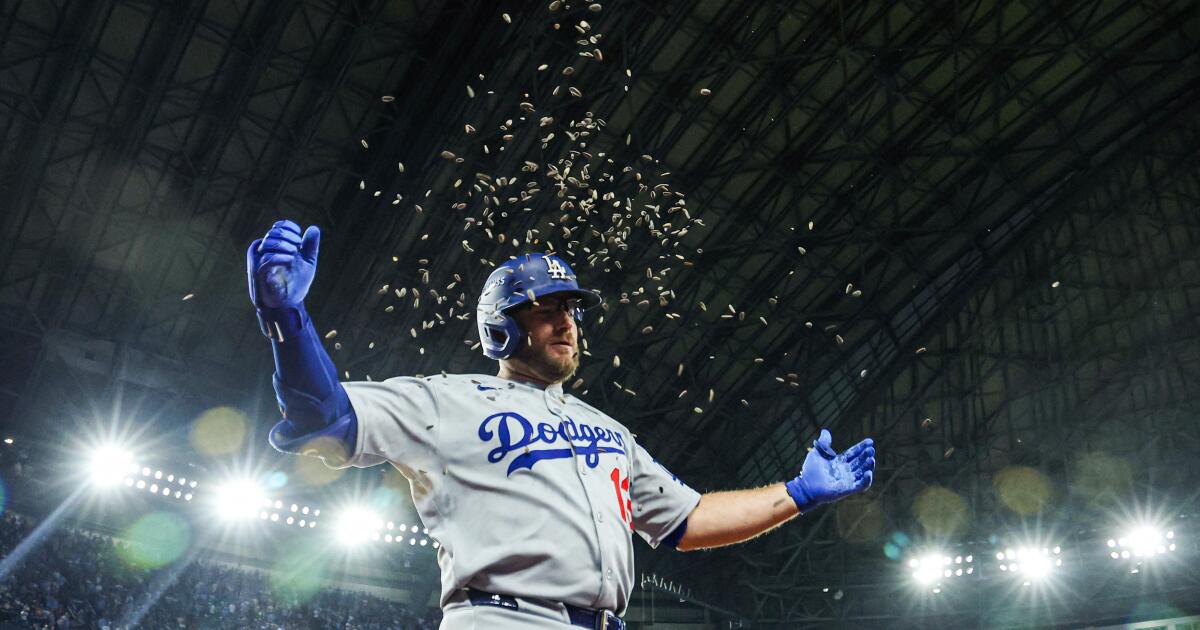
Hi and welcome to another edition of Dodgers Dugout. My name is Houston Mitchell. Looks like the Dodgers found a new closer for Christmas.
The new closer
Well, the Dodgers did what many did not expect: give another long-term, big-money deal to a closer. They have agreed to a deal with former Mets closer Edwin Díaz on a three-year, $69-million deal. There will be $4.5 million deferred each year and the value of the contract as tabulated for luxury tax purposes will be $21 million per year. It’s a record for annual value for a reliever, breaking the record held by….. Díaz.
Díaz was considered by most to be the top reliever on the market. Last season with the Mets, he was 6-3 with a 1.63 ERA and 28 saves. In 66.1 innings, he gave up 37 hits and walked 21 while striking out 98. He turns 32 in March. He had three blown saves and allowed six of 15 inherited runners to score.
If there is a red flag here, it is that his fastball velocity has dropped from an average of 99 mph in 2023 to 97 mph last season. Which is still pretty fast of course.
You’ll forgive me for not doing somersaults over the deal yet. It could turn out to be an amazing signing. However, as we saw last season with Tanner Scott, relievers are like a box of chocolates: You never know what you are going to get. Díaz has a much better record of success than Scott did. But we’ve seen over the last few seasons what can happen with a signing (Scott, Kirby Yates), decline in form (Blake Treinen) or injuries (Evan Phillips, Michael Kopech, Brusdar Graterol).
But the Dodgers did need bullpen help, and they signed the best reliever on the market, so it’s hard to find fault in that.
And an analysis, which includes discussion of a possible salary cap, from Bill Shaikin here.
Fernando misses the Hall
The Contemporary Baseball Era Committee for the Baseball Hall of Fame met Sunday. It was a 16-member committee, and there were eight candidates to consider: Barry Bonds, Roger Clemens, Carlos Delgado, Jeff Kent, Don Mattingly, Dale Murphy, Gary Sheffield and Fernando Valenzuela.
The only person elected: Kent, wh was named on 14 ballots (you had to be on 12 for election).
The others:
Nine votes Carlos Delgado
Six Don Mattingly Dale Murphy
Fewer than five Barry Bonds Roger Clemens Gary Sheffield Fernando Valenzuela
The committee made a big mistake in not electing Fernando, and really embarrassed itself by not giving him even five votes.
When you look at the numbers, Fernando is at best a borderline candidate. He won a Cy Young and Rookie of the Year award, but won only 173 games in his career.
However, when you consider what he meant for the sport in addition to his accomplishments as a player, he qualifies. The three players who created more baseball fans than any other are Babe Ruth, Jackie Robinson and Fernando. The fact the Dodgers have a massive Latino following can be traced back to Fernando. He created fans in other cities. He opened MLB to an almost entirely untapped market.
But, some people look only at the numbers. Fernando should be in the Hall. So should Maury Wills. Unfortunately, it’s looking increasingly unlikely that either will make it.
And congratulation to Jeff Kent, who played for the Dodgers but will go into the Hall as a Giant. So, not that big of a congratulations. His election enhances the candidacy of another former Dodger: Chase Utley.
New book
Last week I told you about a new book by Ross Porter, the longtime Dodger announcer who used to do the “Ask Ross Porter” feature in this newsletter. The book, “The Ross Porter Chronicles — Volume 1: The Dodger Years,” is a compendium of interviews he has done over the years with Dodgers, including Steve Garvey, Davey Lopes, Bill Russell, Ron Cey and Sandy Koufax.
Reaction was overwhelming, and as a result, they sold out of signed books. However, if you still want a signed copy to give to someone as a Christmas present (it would make a great gift for a Dodger fan), you have an alternative. You can order the book at Amazon. Make sure you have it shipped to you before Dec. 21. Ross will be signing books in person on Dec. 21 from 1-3 p.m. at Northridge Sports & Memorabilia, 9514 Reseda Blvd,, Unit 14.
Anyone who buys the book on Amazon can bring it to the signing, and Ross will sign it for free. He’ll also sign any Dodger items you bring.
It’s a great chance for you to meet a Dodger icon. Ross is 87. The icons from our Dodger childhood won’t be there forever. If you have a chance to go out there, I highly recommend it.
Have a comment or something you’d like to see in a future Dodgers newsletter? Email me at houston.mitchell@latimes.com. To get this newsletter in your inbox, click here.
When I first started playing “Dungeons & Dragons” as a tween, my friends christened me with a new good-natured nickname: gamer geek. While we could spend hours in front of a screen with the latest “Zelda” title, the dice-focused tabletop role-playing game was viewed with suspicion, a ’70s-era invention that belonged to a certain subset of nerd.
Times have changed.
Today, “Dungeons & Dragons” enjoys mainstream recognition, and live game sessions from the likes of Critical Role and Dimension 20, the latter of which last summer enjoyed a date at the Hollywood Bowl, have only further cemented its wide appeal. Now a heavily improvised theatrical production, “Dungeons & Dragons: The Twenty-Sided Tavern” has come to the Montalbán Theatre in Hollywood.
The show, which ran off-Broadway in 2024 after years of development, is celebratory, a victory lap for a game that has endured more than half a century. It invites participation, with actors performing the action inspired by the dice rolls and allowing the audience to influence the direction of the show by making choices via a smartphone.
Alex Stompoly, left, and Anjali Bhimani in “Dungeons & Dragons: The Twenty-Sided Tavern,” a production that invites audience participation.
(Andromeda Rodriguez)
“Twenty-Sided Tavern” brought me back to days and nights crowded around my family’s living room table. My father was an executive with TSR, Inc., the company that created “Dungeons & Dragons” — there were glass dragons on our fireplace mantle, pewter dragons on our bookshelves, painted dragons on our walls and even a metal dragon that hung from a necklace I wore too often (and that probably didn’t help me with getting dates). As a junior high kid, the game was a refuge, a creative tool where I could envision characters, worlds and fantastical scenarios.
There was a lot of math, too, and quite a bit of rules, not to mention addendums to rules and fine print to those rules, but I discovered early on a key to its personal appeal, one that likely makes many hardcore followers of the game cringe: Story comes first, the rules a distant second. In fact, I discarded any directive that got in the way of a more fanciful tale.
It pleased me that “Twenty-Sided Tavern” does as well. When my showing the other week began not with beholders and battles but instead a yarn about trying to flirt with and seduce a dragon, I couldn’t help but smile. For the best “D&D” games, no matter how serious, tense or dramatic they may get, are always a bit silly, or at least they are to me.
“I know we hear about toxicity in gaming all the time, but when I picked up my first ‘D&D’ set that my brother gave to me when I was 8 years old, what was open to me was not just a world of storytelling,” says Anjali Bhimani, a co-producer of the production as well as a regular performer in it. “It was a world where a halfling could kill a red dragon, where it didn’t matter where you came from. There was always a seat for you at the table.
Anjali Bhimani in a production of “Dungeons & Dragons: The Twenty-Sided Tavern.” The actor views the game as a storytelling tool.
(Andromeda Rodriguez)
“I think the sense of belonging that tabletop RPGs and ‘Dungeons & Dragons’ can provide is so, so, so powerful, and I think it really is a means to just bring people together in a way that a lot of other media can’t,” she adds.
“Twenty-Sided Tavern” does have some constraints. It is, after all, staged in a theater. But it also throws the traditional rules of theater by the wayside. Expect, for instance, to be on your phone most of the show. We’ll lightly direct the production, voting, for instance, to explore a castle’s catacombs or the mysterious woods. Many will cheer a good dice roll, and it wasn’t out of the norm at my matinee for the audience to shout suggestions or requests. When, for instance, said storyline about romancing a dragon became a bit risqué, a woman kindly reminded the cast that there were children present. It was toned down, but not before an actor made a joke about the show being educational.
“This doesn’t have to be a stuffy, fourth-wall drama,” says Michael Fell, the show’s creative director. “We can create a sense of community. As much as there is a script — there kind of is — we aim to have engagement with the audience every two pages. That means they’re calling out a name, asked to come on stage or it’s just an election on your phone where you make a choice or play a small mini-game. No engagement on the phone ever lasts more than nine seconds.”
In “Twenty-Sided Tavern,” there are three core actors playing and acting out the game, one dungeon master and a sort of tavern keeper helping to keep score and track of the story. There’s a setup at a bar and a quest involving a threat to the town, but each show is unique. The cast may swap roles, the audience may concoct a monster — my group envisioned a giant, destructive slice of pumpkin pie — and settings will shift based on audience vote, done via smartphone.
It’s a little bit like theater as sport.
“This is gamification of live entertainment. Part of what I’m doing is mirroring what happens in sports entertainment, but in a live theatrical setting,” says David Carpenter, the founder of Gamiotics, which co-developed the show and powers the smartphone tech behind it. “This show has surprised me for years, but one of the early surprises was the entire audience losing their mind when someone rolls a 20. It’s like someone scoring a touchdown. The audience goes nuts because they didn’t see it coming.”
Anjali Bhimani, left, Will Champion and Jasmin Malave appear ready for battle in a production of “Dungeons & Dragons: The Twenty-Sided Tavern.”
(Andromeda Rodriguez)
Like the game, “Twenty-Sided Tavern” theorizes that stories can be at their most powerful when they are not passive, when we as audience members have a role to play and invitation to interact.
Carpenter is curious how far the audience choice can be pushed to shift a narrative. He talks in the future of experimenting more with moral or ethical decisions. There are none in “Twenty-Sided Tavern,” where occasionally the audience may influence an action in a way similar to a dice roll. We’ll tap, for instance, to fill up a meter on a screen, and where it lands may indicate a success or a failure. Here, the smartphone gamification is used to prod a narrative rather than define it, a reminder to me that “D&D” is in some ways a story creation tool.
“There are stories that we have told in tabletop games that I have played that I never would have imagined coming up with in the writers’ room because the dice told the story that they did,” says Bhimani.
‘Dungeons & Dragons: The Twenty-Sided Tavern’
The large-scale audience participation of “Twenty-Sided Tavern” naturally invites a jovial, party-like atmosphere. It succeeds in extending a hand to the audience, welcoming us into what can be a complex, daunting fantasy world. It argues that “Dungeons & Dragons” is for all, much as I did as a junior high kid who made it something of a mission to convert my name-calling friends with the hopes of showing them the joys of gathering with little more than paper, pencils, dice and an imagination.
“It’s still somewhat intimidating to a lot of people because they think, ‘I have to know all these rules and learn all these spells and read all these books,’” Bhimani says. “Coming to the ‘Twenty-Sided Tavern,’ it’s about telling a great story. Yes, we roll dice. Yes, there are spells. But ultimately, that’s just scaffolding to tell a beautiful, improvised story.”
I remember when I played weekly games in high school, my friends used to joke that I, as dungeon master, would “lose” because I did everything in my power to keep everyone’s character alive and playing, wanting to see a narrative to a conclusion that didn’t end in anyone’s death. They wondered if I was running the game incorrectly because they always succeeded. Yet I saw “Dungeons & Dragons” as a wholly collaborative endeavor, and I felt that way again watching “Twenty-Sided Tavern,” an ode to the idea that “Dungeons & Dragons” is best when shared.
And a reminder, too, that there is no wrong way to play it.
Tour operators are already saddling up, offering Three Lions fans the ‘ultimate match-day adventure’ with packages to watch England play in the World Cup 2026 in Texas
Cowboy driving cattle as England fans get chance to have same experience at 2026 World Cup(Image: Getty Images)
England fans heading to the 2026 World Cup are being tempted with special sporting packages which combine the first game with a trip to a Rodeo and a taste of the ‘Wild West’.
With the Three Lions playing their first match in Texas tour operators are already looking at laying on bespoke holidays to give supporters a ‘once in a lifetime’ adventure. Just a few miles down the road from the game against Croatia in Dallas on June 17 is the city of Fort Worth. There England fans can enjoy some incredible experiences and even become cowboys for the day on special ranches. Two tour operators in Cheshire are already trying to tempt some fans with the ‘ultimate match-day adventure’.
England’s two super fans Neal Weekes and Fil Sollof have already they would be up for a bit of Wild West Texan fun. A spokesman for one firm said: “Calling All England Fans! The World Cup is coming to Dallas this June and your ultimate match-day adventure starts in the Wild West heart of Texas!
“Forget the usual city break – why not catch England’s group stage in the iconic Dallas (Arlington) stadium and stay in Fort Worth, just a quick ride away? This isn’t just football, it’s a real slice of American adventure…take it from me – Fort Worth is full of surprises and stories to tell!
Rodeo in Texas as England fans look at travel options next year
“Picture this: Wandering the brick streets of Fort Worth’s famous Stockyards, where cowboy boots tap to live country music Sipping legendary Texan moonshine after the match Dining at incredible steakhouses and buzzing local restaurants Exploring unique museums, rodeos, and the welcoming square I’ve fallen in love with on my own visits.
“With rich history, welcoming southern charm, and that genuine cowboy feel, Fort Worth is the perfect home base for your World Cup adventure. I’ll make sure you get the best flights, hotels, and local tips for an experience you’ll never forget.
England superfans Neal Weekes and Fil Sollof will be flying out to attend their seventh World Cup together
“Ready to join the Three Lions in Texas style? Drop me a message for match-day packages, handpicked Fort Worth stays, and all the insider info you need for cheering England on in true cowboy fashion!”
Tottenham fans Weekes, 60, and Sollof, 60, will be flying to the US to attend their seventh World Cup together. He laughed: “This sounds brilliant. We always try and do something a bit different around the England matches. It was camels in Qatar!
“A bit of ‘Wild West’ sounds great – it will be a bit different from going to west London to watch Spurs play Chelsea in the ‘80s. But certainly safer Think my bull riding days are over but some cowboy stuff sounds fun. This is going to be a great World Cup.”
All that talk about the left hand of Justin Herbert, and it’s the right foot of Cameron Dicker that made the difference.
Dicker kicked five field goals Monday night to lift the Chargers to a 22-19 overtime victory over the Philadelphia Eagles in a wild, turnover-filled game at SoFi Stadium.
On a night when the teams combined for eight turnovers — including a career-high four interceptions by Philadelphia’s Jalen Hurts — the game fittingly ended with an interception. Tony Jefferson latched onto a pass that was tipped by fellow Chargers defensive back Cam Hart, snuffing out the Eagles’ last chance.
Share via
Sam Farmer breaks down what went right for the Chargers in their 22-19 overtime win over the Philadelphia Eagles on Monday night at SoFi Stadium.
So Dicker’s 54-yard field goal with 6:24 remaining in the extra period provided the margin of victory, just as it was Dicker who forced overtime with a 46-yarder in the waning moments of regulation.
“What a team we have,” Chargers coach Jim Harbaugh said, practically shouting at the postgame podium. “That’s my reaction — what a team we have. They refuse to lose.”
It was practically do or die for a banged-up team that needed to win at least two of its final five games for a realistic chance at the playoffs. Now, the Chargers (9-4) need to win at least one of a brutal four-game stretch — at Kansas City and Dallas, at home against Houston, and a finale at AFC West-leading Denver, which has won 10 in a row.
Opportunity awaits, but it’s among the NFL’s toughest stretch runs.
That said, the Chargers are a tough team. They proved that throughout the near-constant reshuffling of their offensive line, the loss of their top two running backs — one of whom returned Monday night — and the injury to Herbert, who underwent surgery last Monday to repair a fracture in his non-throwing hand.
Harbaugh deemed the performance, “Great with a capital G.”
Despite a week of outside speculation about his availability, Herbert conceded after Monday’s game that he knew even before surgery that he wasn’t going to miss a game. He played with a small cast on his left hand and was even using that bandaged appendage to stiff-arm defenders. He was his team’s leading rusher with 10 carries for 66 yards.
“It felt like we were in a movie where the quarterback is doing these things and you get to the point where you go, ‘OK, this is getting a little unrealistic,’” Harbaugh said. “That’s what it felt like to me.”
Nonetheless, Herbert absorbed a beating. He was sacked a career-high seven times and hit 11 more, and didn’t have a healthy left arm to break his fall, so more than once he was violently slammed to the turf.
“He definitely sets the standard,” Chargers guard Mekhi Becton said of the quarterback. “For him to get surgery a week ago and be back on the field today, it’s contagious, for sure. It makes you want to go hard for him.”
Philadelphia was in prime position to forge another tie in overtime. The Eagles (8-5) answered Dicker’s fifth field goal by driving to the Chargers’ 41, the outer edge of kicker Jake Elliott’s range. They wanted to get a little closer, however, so the offense stayed on the field for a fourth and four.
Chargers quarterback Justin Herbert tries to get rid of the ball while being sacked during the first half Monday.
(Robert Gauthier / Los Angeles Times)
That’s when Chargers defensive lineman Odafe Oweh was flagged for a neutral-zone infraction, giving the visitors a first down. A couple of completed passes and the Eagles had a first down on the 17 — and that’s when Hurts was intercepted for a fourth and final time.
Hurts had just two interceptions in his first 12 games this season. At one point in the second quarter, he had both an interception and a fumble on the same play. His pass over the middle was picked off by Da’Shawn Hand, who subsequently fumbled. Hurts got the ball back but he too fumbled, and the Chargers wound up with it.
“This was a Super Bowl QB, so we have a lot of respect for what he’s done,” Jefferson said of Hurts, who was Most Valuable Player in the victory over Kansas City last February. “But we wanted to come out and showcase our brand of football.”
All the Chargers defenders were awarded a game ball, as was defensive coordinator Jesse Minter.
Herbert got one as well.
“I just think about the guys in that locker room,” he said. “They do it for us. So many guys fight through things worse than what I’m going through. It’s the least I can do to show up and give my best.
“I draw a lot of inspiration from those guys, and hopefully I can have an impact on them too.”
The quarterback showed his grit — decidedly not a left-handed compliment.
Chargers quarterback Justin Herbert grimaces in pain after being tackled by Philadelphia Eagles cornerback Quinyon Mitchell in the second half Monday night.
Clayton Keller had a goal and an assist, and Dylan Guenther also scored for the Mammoth in their sixth loss in eight games. Karel Vejmelka finished with 23 saves.
Kempe got the Kings on the scoreboard 7:50 into game after he got a pass from Fiala, skated in on Vejmelka and put a backhander past the goalie for his 10th goal of the season.
Armia made it 2-0 at 10:08 as he took a long stretch pass from Fiala and beat Vejmelka from between the circles.
Guenther pulled the Mammoth to 2-1 with a one-timer from the high slot off a pass from Clayton Keller on the power play 34 seconds into the second period. It was his 11th goal of the season.
Kopitar restored the Kings’ two-goal lead at 3:27 of the third on a rebound in front.
Keller pulled the Mammoth back within one with 7:47 remaining, but Armia sealed the Kings’ win with an empty-netter with 1:38 to go.
Up next for the Kings: at Seattle on Wednesday night.
Leo Carlsson scored two goals and rookie Beckett Sennecke had a goal and an assist in the Ducks’ 7-1 victory over the road-weary Chicago Blackhawks on Sunday night.
Jacob Trouba, Mason McTavish, Alex Killorn and Frank Vatrano also scored for the Pacific Division-leading Ducks, who have won three of four. The Ducks took charge with a four-goal second period that featured a franchise-record 27 shots on Chicago’s net, capped by Carlsson’s 15th goal on a fluttering deflection for a 5-0 lead.
Ville Husso made 19 saves for the Ducks, who beat Chicago for the first time in three tries this season. Ryan Strome, Cutter Gauthier and Chris Kreider had two assists apiece.
Arvid Söderblom stopped 46 shots — 39 in the first two periods — in a standout effort for the struggling Blackhawks, who will be eager to get out of Southern California after losing 6-0 to the Kings on Saturday. Tyler Bertuzzi scored for Chicago, which has lost eight of 10 after a 10-5-4 start to the season.
Connor Bedard had an assist for his 40th point in 29 games. Carlsson, drafted one pick after Bedard in 2023, has 38 points in 29 games.
Trouba opened the scoring in the first period with an undefended slap shot after an egregious Blackhawks turnover. The veteran defenseman has five goals in his last 23 games — which is more than he scored in his previous 165 games over parts of four seasons with the Rangers and Ducks.
Sennecke set up McTavish’s power-play goal to open the second period before scoring his eighth goal on a beautiful dangle. The 19-year-old forward — who wasn’t a sure thing to make the Ducks’ roster in October — has played his way into the Calder Trophy race with nine goals and 15 assists in his first 29 games.
Anaheim’s 27 shots in the second surpassed the club record set Jan. 1, 1994.
Chicago avoided a second straight shutout with Bertuzzi’s goal on a power play moments later. Bertuzzi has scored 12 of his 15 goals on the road.
Up next for the Ducks: at Pittsburgh on Tuesday to open a five-game trip.
The National Baseball Hall of Fame is peppered with players who finished long, distinguished careers by donning a Dodgers uniform, their performance dwindling as their age increased. Greg Maddux, Rickey Henderson, Juan Marichal and Eddie Murray are among those who leap to mind.
An exception was Jeff Kent, who Sunday received 14 of 16 possible votes by the Contemporary Baseball Era Committee, the only player among eight on the ballot with enough for induction into Cooperstown.
With unmatched power as a second baseman and an unrelenting approach to his craft, Kent was a Dodger for the last four seasons of his 17-year career, solidifying his Hall of Fame credentials statistically while also serving as a curmudgeonly leader on a roster crowded with young stars such as Matt Kemp, Russell Martin, Andre Ethier and James Loney.
“It’s a moment of satisfaction of the things I did right in my career, the things I consistently stuck to,” he told MLB Network. “The hard work, the gratification of playing the game the right way. I love the game.”
The son of a motorcycle police officer and a product of Huntington Beach Edison High, Kent became emotional during a news conference at the 2005 MLB Winter Meetings when it was announced that he’d signed a two-year, $17 million contract with the Dodgers.
“This is the third time I’ve tried to get with the Dodgers,” he said at the time. “I want to be on a team with the potential to win because I’m running out of time. This team has that mentality.”
The Dodgers never won a World Series during Kent’s tenure, but he quickly fell into the role of a veteran leader, making himself available to the media after tough losses to shield younger players from the glare.
He said what was on his mind, sometimes to a fault, once suggesting that legendary Dodgers broadcaster Vin Scully “talks too much.”
Maybe that’s why Kent getting the Hall of Fame nod from a list of candidates that included all-time home run leader Barry Bonds, 354-game winner Roger Clemens, 509-home run slugger Gary Sheffield, 1980s stars Don Mattingly and Dale Murphy, and Dodgers icon Fernando Valenzuela was unexpected.
Even Kent was surprised.
“The emotions are overwhelming — unbelievable,” Kent said. “I didn’t even expect it. For me, there were so many quality guys that the committee had to argue through and vote for. I’m grateful that they considered me and gave it a shot at putting me in.”
Valenzuela, Bonds, Clemens and Sheffield each had fewer than five votes, meaning they will not be eligible the next time their era is considered in 2031. They can be nominated once more at that time, but will not be eligible for consideration if they again fall short of five votes.
All of the candidates already had been spurned by the Baseball Writers Assn. of America. Seventy-five percent of the votes are necessary for induction, and Kent never received even 50% during his 10 years on the BBWAA ballot that ended in 2023.
“The time had gone by, and you just leave it alone, and I left it alone,” Kent said. “I loved the game, and everything I gave to the game I left there on the field. This moment today, over the last few days, I was absolutely unprepared. Emotionally unstable.”
Kent was named National League most valuable player in 2000 with the San Francisco Giants, the team with which his career is most associated. He batted a career-best .334 with 33 homers and 125 runs batted in that season and drove in more than 100 runs in each of his six seasons batting behind Bonds.
He said he plans to enter the Hall of Fame wearing a Giants cap.
“The turning point in my career was with Dusty Baker, the manager I got with in San Francisco,” said Kent, who played in college at California. “He motivated me to get the peak performance out of me.”
Kent finished with 377 career homers, 351 as a second baseman, the most ever for the position. He also is the only second baseman to collect more than 100 RBIs in eight seasons.
As a Dodger, he hit 75 homers and batted .290 in more than 2,000 plate appearances. His last manager with the Dodgers was Joe Torre, who described Kent’s impact on the franchise.
“He’s one of those players whose actions are supposed to make you understand what he thinks,” Torre said. “It’s the old pro thing.”
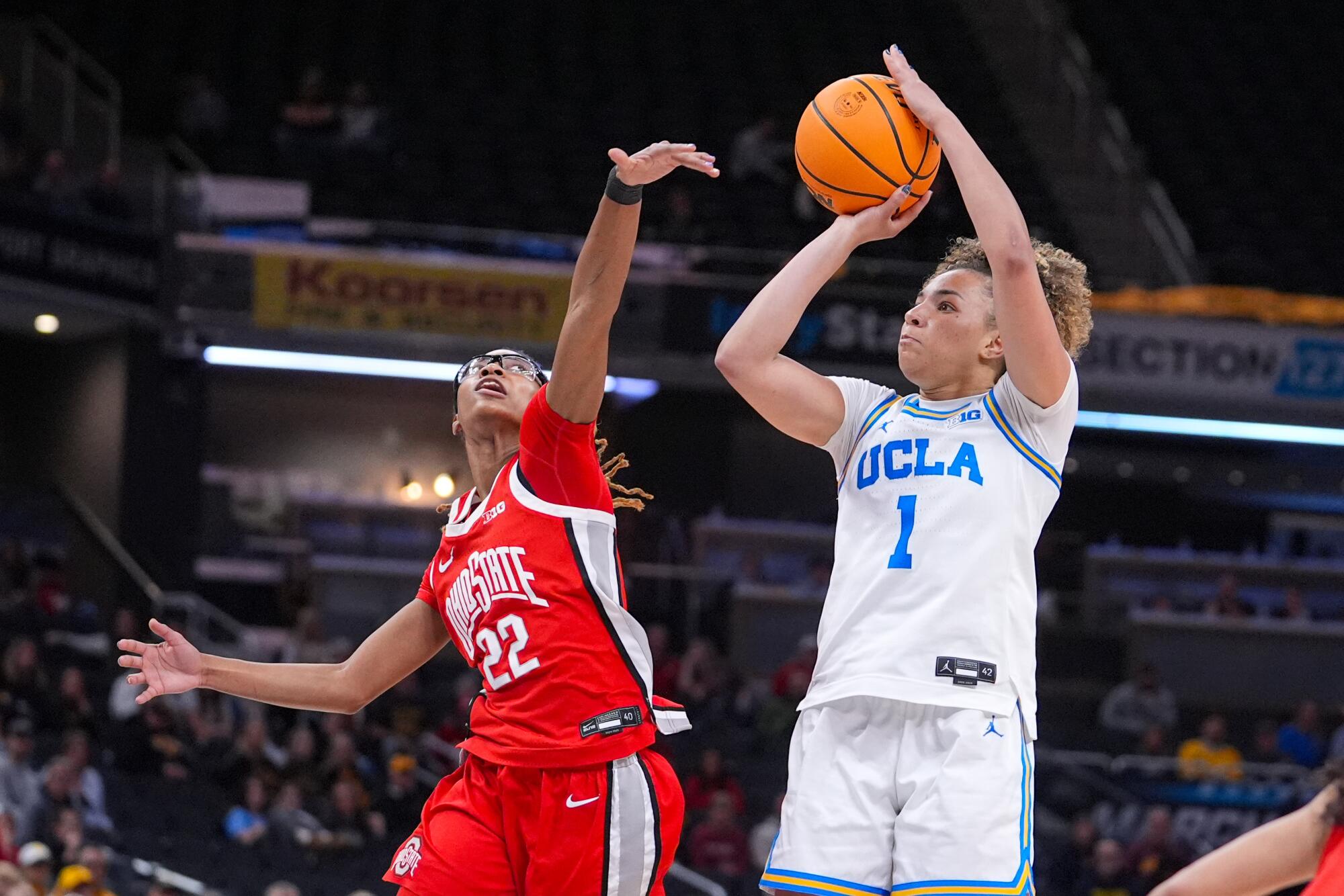
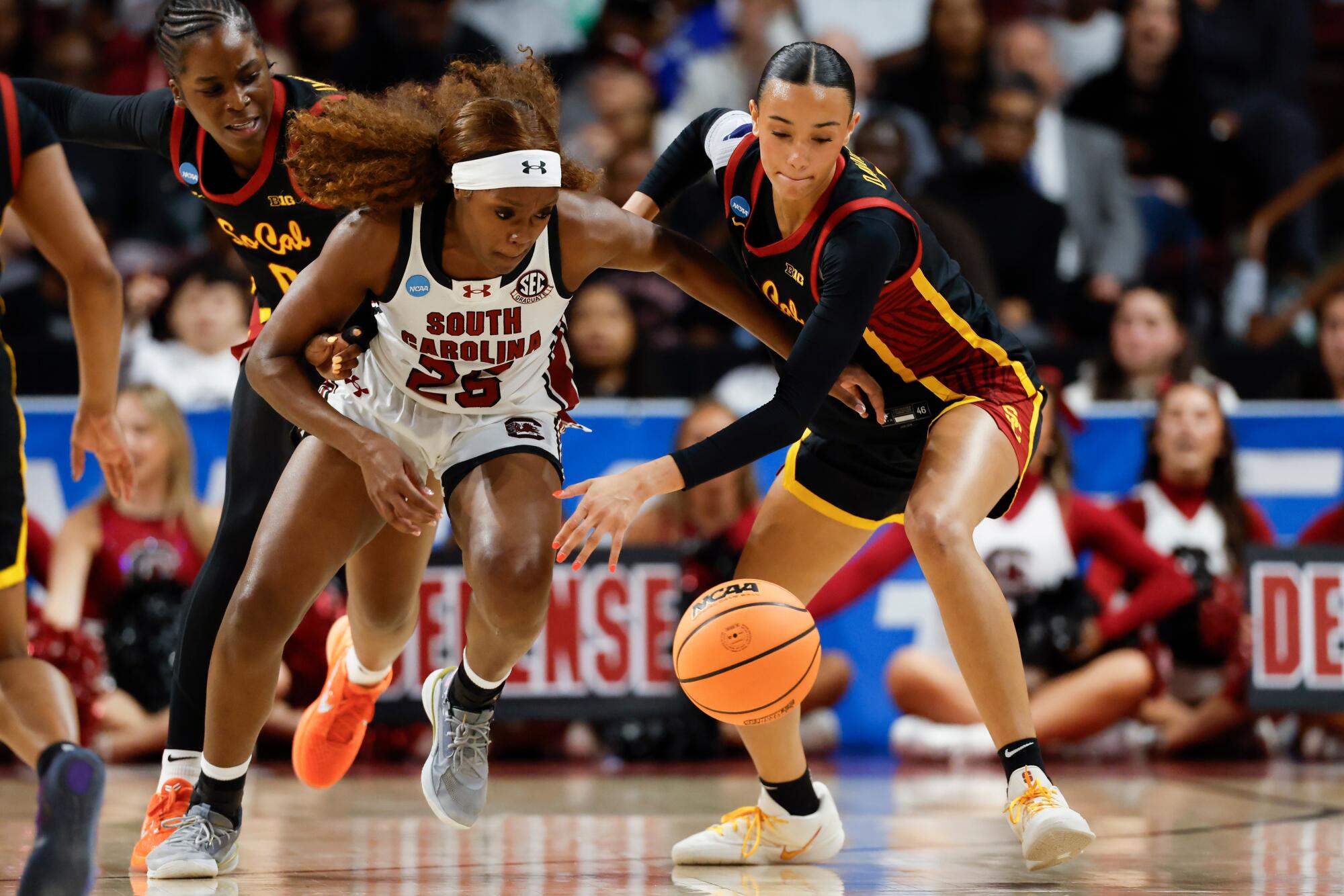
Jazzy Davidson glanced up at the basket, with less than two minutes remaining in USC’s Big Ten opener against Washington, and considered her options. Nothing had fallen all night from three-point range for the Trojans. It took 25 minutes Saturday just to see one three-pointer drop, and only two had dropped the entire night.
But the mere threat of the freshman pulling up from range, even on a night defined by defensive struggle, was enough to give Davidson the space she needed. She raced past her defender and toward the basket, lifting up for a finger roll lay-in that would propel USC past Washington for good in a 59-50 victory.
It was coach Lindsay Gottlieb’s 100th win with the Trojans.
All game long, No. 16 USC (7-2 overall, 1-0 Big Ten) and No. 21 Washington (8-1, 0-1) had battled, neither team ever managing to mount a double-digit lead. The Trojans seized the lead in the third quarter, but every effort to pull away was squashed by the Huskies.
A late flurry from a familiar face in former Trojan guard Avery Howell, who scored 11 points after the half, would keep Washington within striking distance until the final minutes.
But USC refused to back down. With under five minutes, Londynn Jones forced a turnover, dove for a loose ball and started a breakaway that was finished by Kara Dunn. Kennedy Smith hit a turnaround jumper in the paint on the next trip down. And then with less than two minutes, Davidson took off through the lane, extending the lead to five.
It was a furious end to what had otherwise been an ugly night offensively. USC finished 23 of 60 from the field after starting two of 17. It never quite found its stride from deep, either, hitting just two of 17 also.
Davidson would lead the way with 22 points, while Smith was the only other Trojan in double figures with 13.
Nothing fell for USC early on, setting the tone for a tough defensive battle. For the first 8:31, the Trojans were held scoreless. They missed their first 11 shots. Davidson missed her first five attempts.
But as its offense struggled early, USC’s stifling defense did its part to muddy up the game. After one quarter, neither team was shooting better than 16%. They combined to score just 12 points in the first 10 minutes.
USC would finally shake off the slow start in the second, as Davidson and Smith found their stride, shooting five of six in the quarter. The Trojans climbed back accordingly and tied the score just before the half.
They’d fly out into the lead a few minutes after that, never quite letting Washington catch up.