Francisco

Trump says he wants to send federalized troops to L.A., San Francisco

When President Trump ordered immigration raids in Los Angeles last June, only a handful of those arrested were violent criminals. The sweeps split families, cost businesses millions of dollars and drove many undocumented residents into hiding.

Activists protested the Immigration and Customs Enforcement actions, prompting the president to deploy thousands of federal troops in what he called a security operation. A federal judge called it unlawful and said the deployment caused “greater harm” to the city.

Now, Trump wants a redo.

At a Cabinet meeting Thursday, he called on the mayors and governors of several blue cities and states to allow troops to “come in and stop the crime,” pointing to purported successes in Washington, Memphis and New Orleans.

“Crime is down 75% in a short period of time,” Trump told his top advisors. “We could do that for L.A. and we could do that for, frankly, San Francisco.”

The president framed the deployments as both a crime-fighting and immigration enforcement tool, saying that federal authorities can remove people from cities in ways local officials cannot.

“We can do it much more effectively, because [local leaders] can’t do what we do,” Trump said. “All the time, people come up to me … and they say ‘thank you so much.’ I know immediately what they’re talking about. They’re able to walk to work.”

Trump also said this week that he would consider deploying the National Guard at airports to assist with mounting security delays amid a 40-day partial government shutdown.

The renewed call comes after a series of controversial federal interventions in cities across the country. In Washington, Trump has repeatedly touted a visible security presence near federal buildings, crediting it with improving public safety, though local officials and analysts have debated how much of any decline in crime can be attributed to his order.

Three Marines stand together wearing protective gear.

U.S. Marines stationed outside the federal detention center in downtown Los Angeles in June.

(Allen J. Schaben / Los Angeles Times)

In January, Trump threatened to invoke the Insurrection Act to deploy troops to Minneapolis during the civil unrest that followed the fatal shooting of Renee Good by a federal immigration agent. The Pentagon prepared active-duty troops for a possible deployment, but they were ordered to stand down following the shooting of a second Minneapolis civilian, Alex Pretti, the same month.

Immigration sweeps in Los Angeles targeted workplaces, neighborhoods and churches, stirring widespread panic and forcing many undocumented residents — including those with long-term residency and native-born children — into hiding. As a result, businesses reported sharp declines in revenue and customer traffic. A county analysis found that 82% of surveyed businesses experienced negative impacts, with some losing more than half their income amid workforce shortages and traffic reductions.

During the fallout, Mayor Karen Bass condemned Trump’s deployment of some 4,000 California National Guardsmen and 700 U.S. Marines.

“Deploying federalized troops on the heels of these raids is a chaotic escalation,” she said. “The fear people are feeling in our city right now is very real — it’s felt in our communities and within our families, and it puts our neighborhoods at risk. This is the last thing that our city needs.”

The president called the occupation off after U.S. District Judge Charles Breyer ruled that control of the California National Guard should be returned to the governor, rejecting the federal government’s authority to maintain control indefinitely. A similar Supreme Court ruling effectively ended federalized deployments throughout the country.

“The judges are really hurting this country,” Trump said Thursday. “Frankly, the justices — the Supreme Court — has really hurt our country, too.”

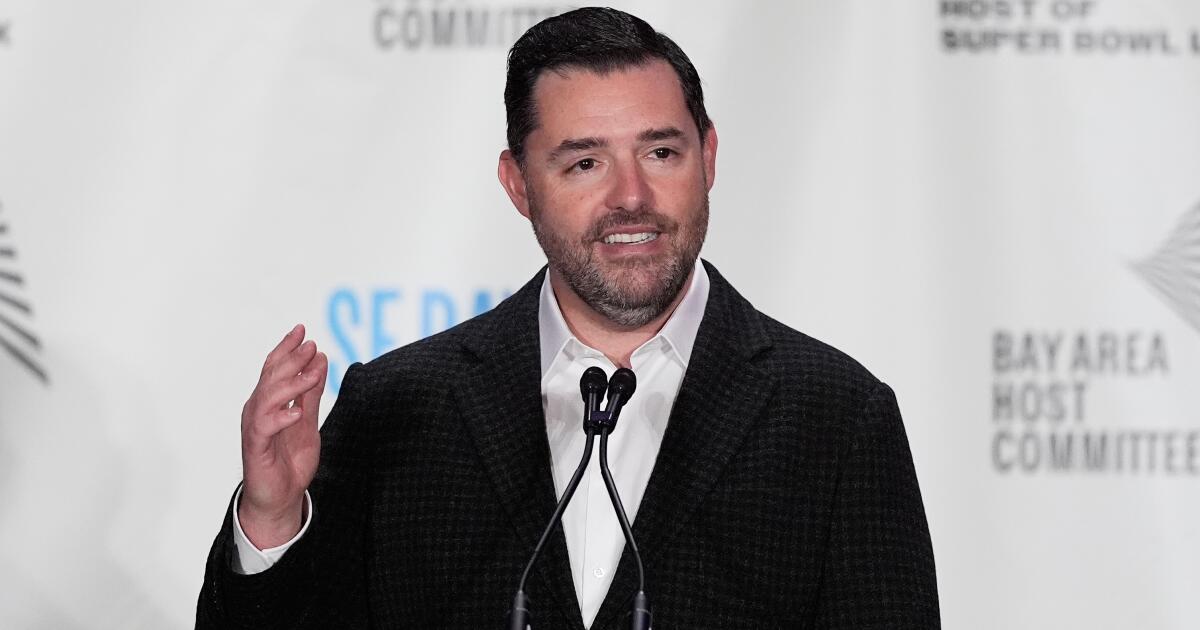
At the meeting, Trump also narrowed his comments on San Francisco and its mayor, Daniel Lurie.

“San Francisco was a great city, could quickly become a great city again,” Trump said. “But we can do it much more effectively.”

Last year, Trump considered carrying out similar federal law enforcement operations in the city. He backed off after a somewhat conciliatory phone call with Lurie, in which Trump said the mayor asked him “very nicely” to call off the deployment. Afterward, he agreed to give the newly elected mayor “a chance” to address crime in the city.

“In San Francisco, crime is down 30%, encampments are at record lows, and our city is on the rise,” Lurie said in a statement Thursday. “Public safety is my number one priority, and we are going to stay laser focused on keeping our streets safe and clean.”

A spokesperson for Lurie’s office said the two have not spoken since that October conversation, indicating Trump’s latest remarks do not reflect any new request or ongoing negotiations. Even so, the president struck a measured tone toward the San Francisco mayor on Thursday. He said Lurie is “trying very hard” but insisted federal intervention would get the job done faster.

Whether any Democrat-led city will take Trump up on that offer remains to be seen. City leaders have previously resisted federal deployments, arguing they undermine local control and risk inflaming already tense situations.

The White House did not respond to questions about whether any current plans exist to redeploy federalized troops to California cities.

Times staff writer Melissa Gomez in Los Angeles contributed to this report.

Source link

America’s first ‘bullet train’ revealed as high-speed rail track promises to cut LA to San Francisco trip in half

AMERICA’S first bullet train which will slash travel time between Los Angeles and San Francisco has been revealed.

The highly anticipated rail project will make the trip just two hours and 40 minutes – compared to nearly six hours by car.

California High Speed Rail Authority has released renderings of its new high-speed bullet trainCredit: California High Speed Rail Authority
A rendering of the interior of one of the stations along the routeCredit: California High Speed Rail Authority
California High Speed Rail Authority has released a rendering of the proposed new Fresno stationCredit: California High Speed Rail Authority

Once completed, the bullet train scheme will provide speedy trips between the Bay Area and the Los Angeles region.

It will also connect the communities in between — Gilroy, Merced, Fresno, Bakersfield, Palmdale, and others — to the state’s largest job centers and innovation hub, said the California High Speed Rail Authority on February 28.

Many have been awaiting the project to be completed, as the past decade of construction has been focused on an initial segment in Central Valley.

There are five planned stations in the Central Valley: Bakersfield, Fresno, Merced, Madera and Kings/Tulare.

Newly-released renderings show the stations will feature plenty of modern twists, with spacious canopies and open concourses.

The stations’ architectural designs are set to incorporate natural materials like stone and wood.

If plans go according to schedule, the area could open as soon as 2032.

The Central Valley’s initial operating segment is expected to transition from civil construction to laying out tracks and installing systems later this year.

California’s ambitious but long delayed high-speed rail line is on track, say bossesCredit: California High Speed Rail Authority
If work proceeds as scheduled, the first phase could be operating in the Central Valley by 2032Credit: California High Speed Rail Authority
The project is designed to eventually shuttle riders across nearly 500 miles between San Francisco and Los AngelesCredit: California High Speed Rail Authority

But there has yet to be a confirmed project opened date for the route between San Francisco and Los Angeles due to delays in planning and funding.

The overall projected cost for Phase 1 delivery, between San Francisco and Los Angeles/Anaheim, dropped by $1.7 billion.

The High-Speed Rail Authority has just released its Draft 2026 Business Plan for public review and comment.

“The authority has entered a new era of construction: laying track across the Central Valley and electrifying the corridor,” the plan said.

“With the southern railhead in Kern County ready ahead of schedule, deliveries of steel, concrete ties, and ballast material can begin, and work can commence.

“The authority has set construction milestones for the 119-mile Central Valley segment and developed a procurement schedule to keep the project on pace for completion of the Merced – Bakersfield early operating segment in 2032.”

The project has created thousands of jobs, with rail bosses partnering with California colleges and universities to build a skilled local workforce, it added.

There is 119 miles of construction underway in the Central ValleyCredit: California High Speed Rail Authority
The California high-speed rail will deliver fast, reliable, zero-emission train service connecting the state’s major economic regions and the Central ValleyCredit: California High Speed Rail Authority

President Donald Trump has previously slammed the project as a “train to nowhere.”

“The Railroad we were promised still does not exist, and never will,” Trump warned on Truth Social last July.

“This project was Severely Overpriced, Overregulated, and NEVER DELIVERED.”

Democratic Gov. Gavin Newsom wants lawmakers to reauthorize the state’s cap-and-trade program through 2045.

He also wants to ensure that high-speed rail receives $1 billion a year from it.

Last December, California dropped a lawsuit officials filed against the Trump administration over the federal government’s withdrawing of $4 billion for the project.

The U.S. Transportation Department slashed funds for the bullet train.

Gov. Newsom slammed the federal government’s decision as “a political stunt to punish California.”

Source link