Food

I stayed a UK hotel that’s one of Europe’s ‘best resorts’ – my honest review

Mar Hall Hotel and Resort near Glasgow underwent a £20m refurbishment and was voted in the top 20 resorts in Europe by Condé Nast Traveler readers – and I recently stayed there

Many tourists are drawn to Scotland for the Highlands, Loch Ness and whisky — not necessarily the outskirts of Glasgow. However, I recently discovered a charming corner of Scotland is just a stone’s throw from the baggage claim.

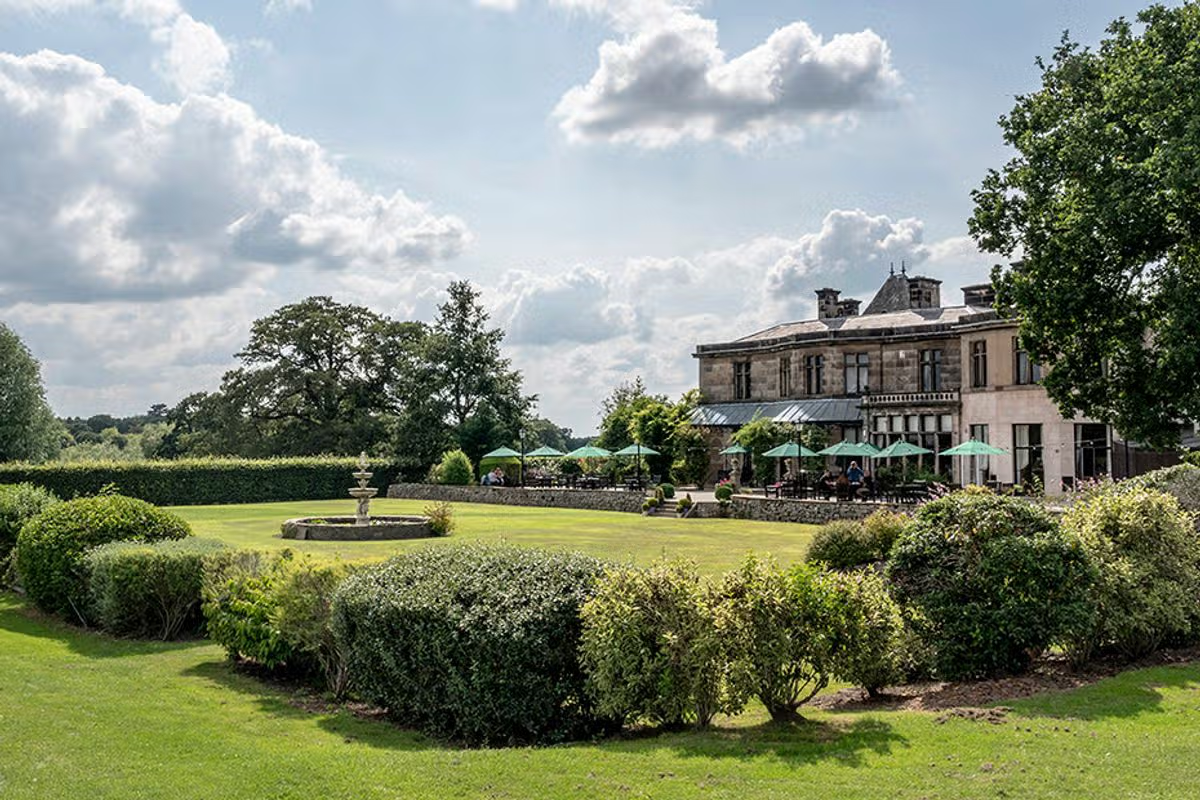
The phrase “airport hotel” isn’t one that ignites much enthusiasm. They’re more often a necessary inconvenience than a destination, but just outside Scotland’s largest city lies the newly refurbished Mar Hall Hotel and Resort. Let’s be clear, this isn’t so much an ‘airport hotel’ as it is a hotel near an airport. The five-star resort has recently undergone a £20million makeover under new management.

Despite being no more than 30 minutes from my flat, it feels like an escape to the country. Arriving at 3pm, which is sunset during the depths of winter here, the sun casts a golden hue over the Clyde and the gently rolling hills and trees beyond. Toto, I don’t think we’re in Glasgow anymore.

The new Mar Hall

At the grand old age of 180, Mar Hall has had several incarnations. Originally commissioned by the 11th Lord Blantyre as the latest Erskine house estate, it was later transformed into a hospital for soldiers returning from World War 1 with amputations.

Fast forward to 2025 and Mar Hall finds itself under fresh ownership once more. For Glaswegians such as myself, an evening spent in a lavish period property offers a welcome escape from everyday life. For those travelling from further away, it provides an exceptionally luxurious introduction to Scotland.

Despite the hotel’s new proprietors being Dubai-based — and its Instagram-ready aesthetic — Mar Hall’s makeover feels unmistakably Scottish. During a tour of the recently renovated establishment, Jim Hamilton from Graven, the interior design company behind the transformation, told me he grew up locally and still lives minutes away.

The quintessentially Glaswegian design house Timorous Beasties provided wallpapers and fabrics, while Glasgow’s Artpistol gallery sourced much of the artwork displayed throughout, including pieces from recent Glasgow School of Art graduates.

Noting how Mar Hall has transformed from “home to hospital to hospitality”, Jim said they aimed to maintain that sense of homeliness and care in its latest incarnation.

One of the callbacks to its Victorian roots is the potted palm trees flanking the entrance hall — a nod to an era when exotic plants were a symbol of sophistication and worldliness. The attention to detail extended to the very walls. A series of four large paintings depicting Scotland’s seasons, commissioned from Scottish artist Nichol Wheatley, are set within custom wall panelling, reflecting the style of the period.

The aesthetic is a bold mix of vibrant colours and patterns: it’s Victorian, but with a 2025 twist. Your gaze is constantly drawn upwards through the lofty spaces towards the stunning vaulted ceilings above. The overall effect is lavish and chic, yet inviting. Whilst it is a five-star resort, the staff are incredibly friendly, making me feel perfectly at ease.

The rooms

It’s nearing December and the hotel has been fully decked out for the festive season. The receptionist, who offers a typically warm Scottish welcome, pauses before the doors to the Gallery, clearly excited to show me the grand room at the heart of the hotel.

For a moment, I worry about having to feign excitement for this kindly lady, but when she swings open the doors, I’m genuinely taken aback. It’s even more impressive in person than online.

To reach one of the hotel’s 74 rooms, guests walk through the Gallery with its plush seating, fireplaces and marble bar. I’m handed the keys to the Erskine grand suite for the night, priced at £1,125 per night, kitted out with a regal sitting room and grand piano.

The sitting room and bathroom, featuring a rolltop bath, offer views over the golf course, River Clyde and picturesque woodlands beyond, in that order. The bespoke bookcases are so perfectly illuminated — as is everything in the hotel — that when I meet Jim, I can’t resist asking if he would design my flat pro bono.

The festive decorations extend to the rooms. I’m thrilled to discover a Christmas tree in the lounge, sparkling next to a handwritten note and dish of treats welcoming me to Mar Hall. It’s enough to make anyone feel warm and fuzzy.

The bedroom, with its luxurious four-poster bed and impeccably luxurious bedding, lulls me to sleep shortly after I start watching a cheesy Netflix Christmas film. It’s a pity I can’t spend more time savouring a hotel room of this standard.

Mar Hall only reopened in May this year, but I hear Kylie Minogue has already stayed in these suites twice.

The food

Before dinner, I enjoy a drink in the Slàinte bar, which is delightfully cosy with a crackling fireplace and a Christmas tree. For dinner, smoked salmon, beef, and sticky toffee pudding are the mainstays of ‘fancy dining’ in Scotland and rightly so. I’m pleased to see all three on the menu.

Layering local smoked salmon on a bed of horseradish and a crunchy cracker was a real treat. The blade of beef was as tender as expected, with dauphinoise and honey-roasted carrots making for a perfect mouthful. The only critique I’d have is that the pudding could have done with more toffee sauce, as is often the case.

The unexpected highlight, however, were the warm fig bread rolls – they’ve been on my mind ever since. And all throughout, the service struck a good balance between being attentive and unobtrusive.

Breakfast in the Dining Room offers a continental selection with a variety of hot options including full Scottish breakfast, sausage egg roll, eggs Benedict, and porridge. I chose the ‘rise & shine crumpet’, a tasty combination of Argyll smoked salmon with scrambled egg.

Location and facilities

Mar Hall is set within a 240-acre estate, just a 25-minute drive from Glasgow city centre or a mere 10 minutes from Glasgow Airport. However, it’s not easily reachable by public transport.

The 18-hole Earl of Mar golf course is conveniently located just outside. Like the hotel, it boasts picturesque views of the River Clyde and the Kilpatrick Hills.

The spa features a swimming pool, saunas and steam rooms. Other amenities include a gym, games room and private screening room.

Final thoughts

Mar Hall’s new owners have invested millions into the hotel with the aim of making it a world-class destination. Resort director Andy Roger shared plans for a clubhouse featuring a second restaurant and a state-of-the-art indoor-outdoor spa.

However, it faces tough competition just an hour up the M8. This year, Mar Hall made it into the top 20 resorts in Europe as voted by readers of American luxury travel magazine Condé Nast Traveler. The number one spot on the list? Gleneagles. This iconic resort is a Scottish summer camp for the rich, offering seven eateries, three golf courses and a spa, along with horse riding, shooting, fishing, off-roading and more in the hills of the Perthshire resort.

While it may not be a full-service millionaire’s playground, I’m already excited about returning. Mar Hall tops my list for a pampering staycation with my husband or for afternoon tea with out-of-town visitors. Once the spa is refurbished, I know it’ll be a huge hit with locals.

The more time I spent at Mar Hall, the less I wanted to leave, and that’s the sign of a great hotel.

Booking details

Rooms and packages can be booked through Mar Hall’s website. Rooms start from £292.

Source link

EU dairy sector hit with retaliatory Chinese tariffs of up 42.7%

Dec. 22 (UPI) — Beijing unveiled tariffs as high as 42.7% on imports of European Union dairy products on Monday, saying the subsidies Brussels provided to producers in the 27-country bloc were the cause of “substantial damage” to China’s dairy industry.

The import taxes of between 21.9% and 42.7%, which come into force Tuesday following a 16-month-long anti-subsidy probe by China’s Ministry of Commerce, will affect France’s famous Roquefort, other blue, fresh and processsed cheeses as well as whole and unsweetened milk and cream.

“The investigating authority has preliminarily determined that imported dairy products originating from the European Union were subsidized, causing substantial damage to the relevant dairy product industry in China, and that there is a causal relationship between the subsidies and the substantial damage,” the ministry said in a statement.

It said that the highest levy would be applied to the products of firms that had failed to cooperate with the investigation with firms that had been cooperative only subject to a rate of 28.6%.

Firms named in the ministry list hailed from across the bloc with France, the Netherlands and Belgium heavily represented. Italian and Spanish producers also feature. Most companies were hit with a rate of 28.6% or 29.7%.

The Netherlands’ Friesland Campina and its subsidiary in neighboring Belgium were both hit with the top 42.7% rate along with an “Other EU Companies” grouping, which is not specified. It is unclear if this group is all EU companies not named in the document that export to China.

The EU criticized the action, saying it was neither justified nor warranted.

The move came just over a year after the EU hit China’s massive EV sector with import tariffs of as high as 36.3%, alleging unfair competition due to subsidies provided to the industry by the Chinese government.

Among the big three EV makers — BYD, Geely and SAIC — BYD and Geely were slapped with duties of 17% and 19.3% respectively, along with a 21.3% tariff on other “cooperating companies.”

The top rate was applied to SAIC together with other EV makers deemed not to have cooperated with the EU’s investigation.

The EV tariffs also saw Beijing launch anti-competition probes into Europe’s brandy and pork products industries, leading to accusations the EU was dumping surplus pork production in the Chinese market.

In September, Beijing imposed short-lived tariffs of between 15.6% and 62.4% on EU pork and pig by-product imports, but revised them down to between 4.9% and 19.8% on Tuesday.

Source link

Inside the railway themed cafe where your food is delivered by train

ARE you a big train fan? Well, there is one UK spot where you can even get your meal delivered by a miniature train.

Found in Newenden in Kent is the Nibbles Railway Cafe – known for its miniature model trains that deliver meals and drinks to guests at their tables.

Nibbles Railway Cafe is known for its miniature model trains that deliver meals and drinks to guests at their tablesCredit: Nibbles Railway

The family-ran spot serves up homemade dishes, which are then carefully placed on a model train which chugs around the cafe to deliver the meal to the customer.

And if you don’t want to leave your furry friend out, then you don’t have to as there are four bookable ski gondolas outside, which are dog friendly.

From 8am to 11:30am each day, the cafe serves breakfast which includes The Nibbles Breakfast with one fried egg, two rashers of bacon, a Cumberland sausage, baked beans and a tomato for £11.90.

Lunch is then served from 12pm to 1:30pm each day and options include jacket potatoes from £6 and paninis from £7.

Read more on travel inspo

HAPPY DEAL

Disney free food deal that ‘saves THOUSANDS’ – our experts see if it’s worth it


TAKING OFF

I’ve visited 50 countries & this much-loathed budget airline is the world’s best

You could also grab a flame grilled burger from £5.95.

Lattes cost from £2.95, but you could also opt for a smoothie or milkshake.

One recent visitor said: “It was certainly a novel experience to have our drinks delivered by a model train.

“We came for breakfast and an excellent breakfast it was.

“Amply sized, served by very friendly welcoming staff and very good value for money.

“Even though the food was great, it was the trains that stole the show.

“Can certainly recommend and we will be back.”

Another added: “Our grandchildren had a lovely time and ate all their dinner which is always result!

“Definitely worth a visit if you want something a little different.”

Lots of visitors have documented their visits on social media, with some TikTok videos nearing 200,000 views.

The cafe is open Thursday to Monday, 8am to 3pm and booking is essential.

In the area you can also head off on a walk along the River Rother to Bodium Castle, which is around three and half miles away.

The path follows the river, allowing walkers to see the countryside and you will also pass the Castle Toll earthworks.

Bodium Castle dates back to the 14th-century and is surrounded by a moat.

The cafe serves breakfast and lunch, five days a weekCredit: Nibbles Railway

It costs £12 to enter and visitors can explore its towers and exhibitions.

Also nearby in Northiam is Great Dixter House & Gardens – a 15th-century manor house surrounded by pretty gardens.

It costs £17 per adult and £5.50 per child to visit.

If you fancy staying in the area, head to The White Hart, which costs from £85 per night.

One recent guest said: “My wife and I recently stayed for three nights at this pub.

“We had a wonderful and very relaxing time. The room was very nice, with a very comfortable bed.

“We will definitely be back again, and will 100% recommend it to friends and family.”

If you are looking for more quirky spots to grab a bite to eat, here’s the UK’s weirdest pub that’s ‘built in a shoe’ with Egyptian coffin, secret bar… and a Minotaur.

Plus, inside incredible time-warp café transporting customers back to 1940s Britain – and it even has an outdoor toilet.

In the local area, you can also go for a walk along the riverCredit: Nibbles Railway

Source link

UN-backed experts say Gaza food supplies improving but 100,000 still in ‘catastrophic conditions’

UN-backed food security experts have found improvements in nutrition and food supplies in Gaza since the ceasefire but say 100,000 people were still experiencing “catastrophic conditions” last month.

In August, the Integrated Food Security Phase Classification (IPC) found that half a million people – about a quarter of Gaza’s population – were living in areas suffering from famine.

Since a fragile ceasefire came into force in October, the UN and other humanitarian agencies have been able to increase food getting into Gaza.

Israel’s foreign ministry said the report was “deliberately distorted” and “doesn’t reflect the reality in the Gaza Strip”.

The latest IPC analysis suggests that a month ago, half a million Gazans were still facing emergency conditions and more than 100,000 were still under the highest level of food insecurity – IPC Phase 5 – experiencing “catastrophic conditions”.

It projects that number will continue to decrease but stressed the situation remains “highly fragile”.

IPC Phase 5 signifies the most extreme level of food insecurity , labelled “Famine” for an area or “Catastrophe” when referring to households. The report said no areas in Gaza were now classified as “in Famine”.

Israel rejected the original findings of famine by the IPC – which monitors and classifies global hunger crises – and has continued to criticise its methodology.

Cogat, the Israeli military body which controls Gaza’s crossings, said the number of trucks with food aid entering each week went beyond what the UN had determined it needed.

“The report relies on severe gaps in data collection and on sources that do not reflect the full scope of humanitarian assistance,” the body said in a statement.

The IPC said acute malnutrition was at critical levels in Gaza City and serious in Deir al-Balah and Khan Younis.

In the coming months the situation is expected to remain severe but the number of people facing the most severe conditions is predicted to fall to 1,900 by April, according to the report.

But it added that if there were renewed hostilities the entire Strip would be at risk of famine.

Israel’s Prime Minister Benjamin Netanyahu said earlier this month that the second phase of the US-brokered peace plan – which would see Israel withdraw troops further from Gaza and Hamas disarm – was close but key issues still needed to be resolved.

The IPC said key drivers of food insecurity included restricted humanitarian access, displacement of more than 730,000 people and the destruction of livelihoods – including more than 96% of crop land in Gaza being destroyed or inaccessible.

Israel imposed a total blockade on aid deliveries to Gaza at the start of March this year, which was eased in May, saying it wanted to put pressure on the armed group Hamas to release hostages remaining in Gaza at the time.

Ahead of this IPC report Cogat said the body had not engaged with the US or Israel and its methodology, “reinforcing a false narrative, driven in part by Hamas-sourced claims, while ignoring the actual humanitarian conditions on the ground”.

It also denied Israel was preventing winter and medical supplies from entering the territory and that there was a shortage of drinking water.

Unwra, the UN agency for Palestinian refugees, said while the report stated Gaza was no longer in famine, the situation remained “critical”.

“Overall living conditions in the Gaza Strip are still catastrophic, made worse by the winter weather,” it said in a statement, adding there must be “sustained, expanded, and consistent humanitarian and commercial access”.

Source link

The £89 all-inclusive holiday with hotel, flights, food AND drink included

WE all know Wowcher is good for offers, but did you know you could go on holiday for just £89 and it is all-inclusive?

Holidays really can add up – by the time you book flights, airport transfers, and accommodation, you may have already spent hundreds.

You could head to Tunisia for two nights for £89 and it’s all-inclusiveCredit: Wowcher
The hotel features two outdoor pools and direct beach accessCredit: Wowcher

Then add in the costs when you are there, like eating and seeing paid-for attractions.

Often, holidays aren’t cheap.

But this is what makes all-inclusive so appealing, as it takes away that stress.

And Wowcher now has deals as cheap as £89 for an all-inclusive break away.

Read more on travel inspo

LUCKY DIP

I tried Wowcher’s £99 Mystery Christmas Market – everything you need to know


TAKING OFF

I’ve visited 50 countries & this much-loathed budget airline is the world’s best

For example, you could head to a four-star all-inclusive resort in Tunisia.

The package includes return flights, two nights at a four-star hotel and all your meals and drinks.

The hotel is the Occidental Sousse Marhaba, which has recently been refurbished according to Wowcher.

At the hotel, guests will find two outdoor pools, a wellness centre, direct beach access, kids’ pools, on-site bars, and a sauna and hammam.

Rooms at the hotel include en-suite bathrooms, Wi-Fi, and either have a garden or sea view.

When it comes to food and drink, you get your daily meals, snacks and drinks included.

One recent guest said: “Lovely hotel, good choice of food, staff very pleasant.

“Evening entertainment was good. We paid extra for a sea view and it was well worth it.

“Five min walk through the grounds to the beach. Has a lovely pool.

“You can book trips out by speaking to the lovely Lee who explains the trips in detail. We did the Sahara Explorer, it was amazing.

“Would return to this hotel. Sousse is a beautiful place.”

In Sousse, visitors can explore the medina, which is a UNESCO World Heritage SiteCredit: Alamy

Nearby you can explore the medina of Sousse, which is a UNESCO World Heritage Site.

There are a number of souks as well, such as Sousse Medina Souk.

One recent visitor said: “Needs at least a couple of hours to soak up the atmosphere and wander.

“I love wandering around a souk. This one is easy to navigate and not overlarge.

“Also very pretty in parts as this is a very ancient medina area, where people have been trading and living since ancient times.”

History lovers should head to the Ribat of Sousse, a small fort that was built in the eighth century and has a tower boasting panoramic views.

Or head to the Sousse Archaeological Museum where there are mosaics to exploreCredit: Getty

Or head to the Sousse Archaeological Museum, where you can explore a collection of mosaics and statues, as well as sit in a pretty courtyard.

There is one date left in January, from January 18 to 20.

But there are several dates still available in February, including February 1 to 3, 8 to 10, 23 to 25 and 25 to 27.

Or for £99, you could head off on February 24 for two nights.

Prices then rise from March onwards.

Alternatively, you could head to Majorca for two nights for £99 all-inclusiveCredit: Wowcher

Alternatively, you could head to Majorca in Spain, staying at the Bluesea Mediodia for £99 for two nights.

The hotel includes meals, snacks and unlimited drinks and your flights will be from either London Gatwick, London Stansted, London Luton, Manchester, Birmingham, Bristol or Edinburgh.

At the hotel, there is a swimming pool, restaurants and beach access.

One recent guest said: “Considering the price and the services offered, I was very satisfied!

“The hotel is in an excellent location, very close to the beach. The food is varied and can satisfy both those with simple tastes and those who are more demanding.

“The rooms have air conditioning, which is a great plus during hot days.”

The hotel is located just 16 minutes from PalmaCredit: Wowcher

The hotel is just a 16-minute drive from Palma, so is a great spot for exploring the city, but also soaking up sunshine on the coast.

Dates available for the £99 offer include January 19 to 21, and the 26 to 28.

Or if you travelled in February, you could go on the 4 to 6, 23 to 25 or 25 to 27.

Prices then rise from March onwards.

For more getaway inspiration, there’s an all-inclusive hotel that’s just been named best in Europe with ten swimming pools, free childcare and Jet2 flights.

Plus, 10 winter sun holidays for all budgets – with 7 nights from £193pp.

The offer is only applicable on specific datesCredit: Wowcher

Source link

European city is the best place in the world for food

New research analysed nearly 500,000 ratings across more than 17,000 cities globally, with Italy claiming all three top positions.

When it comes to culinary delights, people often dream of indulging in pasta in Italy, savouring sushi in Japan or relishing tacos in Mexico. Indeed, for many holidaymakers, their trips seem to revolve around the local cuisine.

Now, a study by TasteAtlas has revealed the top destinations for foodies worldwide. The team analysed nearly half a million ratings from 17,073 cities listed on its database.

Interestingly, many of the top-rated locations are conveniently located not too far from the UK, with the majority of the top 10 situated in Europe.

Naples clinched the coveted top spot, thanks to its status as the birthplace of pizza, lasagna and macaroni. However, this picturesque city wasn’t the only Italian destination to make the cut, reports the Express.

Milan bagged second place, owing to its signature dishes such as risotto and panettone. And let’s not forget that Milan is also the home of Campari, perfect for those looking to wash down their meals with a refreshing tipple.

Italy dominated the top three, with Bologna securing third place. The city is renowned for its spaghetti bolognese, ragu and tortellini.

Despite the heavy Italian presence, other popular cities like Paris, Vienna and Mumbai also made it into the top 10.

However, the UK didn’t manage to secure a spot in the top 30, alongside other notable absences including Hong Kong, Barcelona, Ho Chi Minh, Bangkok, and Amsterdam.

Here are the top 30 best cities for food:

  1. Naples
  2. Milan
  3. Bologna
  4. Florence
  5. Mumbai
  6. Rome
  7. Paris
  8. Vienna
  9. Turin
  10. Osaka
  11. Madrid
  12. New York
  13. Genoa
  14. Nice
  15. Lima
  16. Jakarta
  17. Kyoto
  18. Gaziantep
  19. Ferrara
  20. New Orleans
  21. Catania
  22. Singapore
  23. Venice
  24. Istanbul
  25. Tokyo
  26. San Francisco
  27. Lisbon
  28. Guadalajara
  29. Chicago
  30. Philadelphia

Source link

22 Kids and Counting Sue Radford’s lavish Christmas food shop including 60 Yorkshires

With Christmas just around the corner, it’s going to be a busy time in the Radford household as mum-of-22 Sue has opened up about festive dinner plans

22 Kids and Counting star Sue Radford has revealed her Christmas food shop and fans are floored.

The proud mama of 22 children, Sue became a household name with the rest of the family back in 2012, when she let cameras into her home with husband Noel for the very first time.

Sue and Noel are parents to Christopher, Sophie, Chloe, Jack, Daniel, Luke, Millie, Katie, James, Ellie and Aimee, as well as Josh, Max, Tillie, Oscar, Casper, Alfie, stillborn in 2014, Hallie, Phoebe, Archie Bonnie and Heidie.

Since shooting to fame over 10 years ago, the Morecambe-based family have rarely remained off screens, with the latest series of Channel 5’s 22 Kids and Counting airing earlier this year.

And with Christmas just around the corner, it’s fair to say it’s going to be a busy time in the Radford household. In a clip from the latest episode, Sue revealed that she is hosting Christmas dinner for her entire family. And this includes Father Chloe, her partner Jake and their two-year-old daughter Mila.

During the instalment, Sue headed to her local Asda to stock up on food for her large family in the festive season. Piling her trolley high with groceries Sue said: “We’ve got pigs in blankets, so there’s 60 there.”

Sue added: “We’ve got 3kg of Brussels sprouts. I absolutely hate Brussels sprouts, but everybody else loves them.” She then picked up 4kg of carrots, 7.5k of potatoes and with it being Christmas, Sue stocked up on two large turkeys. Heading to the freezer aisle, Sue said: “Think I’ll probably try and get about 60 Yorkshires.”

Reacting to Sue’s food shop, one person on Facebook said: “I would just do beans on toast, would stress me out.” A second added: “Me too imagine cooking for them all, be my worst nightmare.” A third said: “So much food.” Another penned: “I can’t imagine cooking all that.”

It comes after Sue and Noel introduced their new four-legged family member in October – and fans were left gushing over the update.

Taking to their joint Instagram, the pair shared several photos of their adorable new dog. In the caption, they wrote: “Hi everyone I’m Mavie I’m a cream long-haired miniature Dachshund I’m settling in really well and everyone loves me.”

Animal lovers Sue and Noel have owned several dogs over the years. They have a border collie Lola, three French bulldogs Bluebell, Ivy and Mabel, and three miniature dachshunds Cookie, Minnie and Dolly.

22 Kids and Counting airs on Channel 5.

Source link

‘I went to most overrated Christmas market and one thing left me baffled’

While I continue on my journey to achieve Christmas nirvana by exploring the plethora of festive markets around Great Britain, there’s one beloved Christmas market that I’m just not a fan of.

Going to Christmas markets is like an Olympic sport, and I, for one, am a self-proclaimed gold medallist.

I tend to find myself coming alive in the last two months of the year, as my hot chocolate-addled brain looks for its next fix complemented by Christmas lights and cheesy music. As Christmas chaos tightens its vice-like grip around unsuspecting UK residents, scores of us find ourselves Googling the million-dollar question: ‘Best Christmas markets in the UK?’

While I continue on my journey to achieve Christmas nirvana by exploring the plethora of festive markets around Great Britain, there’s one beloved Christmas market that I’m just not a fan of. Let’s just say — I’ve never met a Christmas market I didn’t like. Till I met the Southbank Christmas Market, that is.

While ‘absolutely hated’ is a strong phrase, ‘generally disappointed’ is not. And that’s how I felt about London’s Southbank Centre Winter Market. After hearing loads of complimentary things about it from my friends (and the internet) for ages, I decided to bundle up one fine Thursday evening and head on over to the ‘magical Christmas market on the River Thames’.

When I say the market ended before it started, I am not exaggerating. Southbank’s famed Christmas market had some seven odd stalls when I last visited (okay yes, I am exaggerating — it’s called a creative licence, look it up). And no, I refuse to add the scores of restaurants down the road — which earnestly dress themselves up in festive cheer and provide a jolly good time to visitors — to the count. I’m talking about the actual Southbank Christmas market, which actually is really quite tiny. I visited the market for the first (and last) time with my partner and our friend — all of us popping our Southbank Christmas Market cherry at the same time — and, as it goes with every ‘first-time’ virginity-losing story, we were all left wondering: is this it?

Having made the (never-ending) trek from East London, upon arriving, we felt like we were being Punk’d. Where were the rows of food and drink stalls? The gamut of overpriced souvenirs designed to entrap the unsuspecting tourist? The tat passing off as ‘must-haves’ this fashion cycle? It felt like someone clocked all the happiness Christmas markets brought to seasonally depressed individuals — and decided to suck every drop of joy straight out of them.

Because what’s the point of setting up a Christmas market if you can’t cause customers utter confusion over which bratwurst stall to go for? Why couldn’t I get four different shops selling the exact same patterned ceramic bowl and evil eye hangings at grossly varying price points? What is the point of this life, if I don’t buy mulled wine from 5 different stalls for a thousand million pounds each, as I happily hand them over all of my life’s savings?

There’s no point. And that’s why you won’t see me returning to the Southbank Christmas Market anytime soon. Except this Friday, because a spirited discussion with my colleagues before writing this article has already convinced me that I need to give it another shot (of overpriced Baileys, woohoo).

Source link

Bolivia moves to amend legal coca cultivation law

A woman shows coca leaves during an event for the National Day of Acullico (chewing of the plant) in Santa Cruz, Bolivia, in January. Then-Bolivian President Luis Arce said his countrymen have shown the world that the coca leaf ‘is not cocaine, File Photo by Juan Carlos Torrejon/EPA

Dec. 17 (UPI) — The government of President Rodrigo Paz said it will push to revise Bolivia’s legal framework for coca leaf cultivation after official data showed that planted areas exceed authorized limits and continue to expand.

According to the 2024 Coca Crop Monitoring Report by the United Nations Office on Drugs and Crime, presented in La Paz, Bolivia ended 2024 with about 34,000 hectares of coca crops, a 10% increase from the previous year.

That figure exceeds by 12,000 hectares the cap set by the 2017 General Law of Coca, which authorizes 22,000 hectares for legal cultivation.

Coca leaf is recognized in Bolivia’s Constitution for traditional, medicinal and cultural uses, but part of the production is diverted to cocaine manufacturing, the report said.

Earlier this month, the World Health Organization decided to keep coca leaf on its list of controlled substances, citing the risk to public health posed by its easy conversion into cocaine.

Against that backdrop, the Office on Drugs and Crime urged the Paz administration to strengthen control strategies, particularly in protected areas, and to update data on domestic demand for licit consumption.

Vice Minister for Social Defense and Controlled Substances Ernesto Justiniano said the government plans to amend the law, but said new parameters will depend on a fresh study to determine how much coca is needed for traditional use in Bolivia, according to local newspaper El Deber.

“Bolivia has more coca than it needs for traditional uses. Crops have not stayed at 22,000 hectares. By 2024, they were at 34,000, and in the next report, we will probably be close to 40,000 hectares because very little was eradicated this year — barely 1,700 hectares,” Justiniano said.

He said he recalled a study released in 2013 estimated that 14,700 hectares were sufficient for legal consumption, but that the limit was raised to 22,000 hectares in 2017 — a decision the new government now questions as lacking “technical justification,” the outlet ERBOL reported.

At the same time, the government said the eradication of illegal coca crops will again become a central pillar of its anti-drug strategy, with a focus on what it calls surplus production feeding drug trafficking.

To prepare the new study on domestic demand for coca leaf, authorities said they will invite representatives from coca-growing groups, academic institutions and other sectors to ensure transparency of the data.

Officials expect that once the findings are released, negotiations will begin with coca growers from the Chapare, a coca-producing region in central Bolivia.

Justiniano said farmers there blocked eradication efforts this year, mainly in the tropical Cochabamba region, an area widely regarded as the political stronghold of former President Evo Morales.

Source link

Travel experts’ top food and drink places in Scotland

IF you’re off to Scotland on a £9.50 Holiday, here’s something to excite your taste buds.

Surrounded by sea and with rolling fertile lands, this beautiful country produces much of its own food, from seafood to hearty haggis.

Surrounded by sea and with rolling fertile lands, Scotland produces much of its own foodCredit: Getty
From seafood to hearty haggis, and famous Scottish breakfasts from places like The Bandstand Bar & Restaurant in Nairn, travel experts have picked their fave spotsCredit: Trip Advisor

It’s also home to over 150 malt and grain distilleries, with countless whisky-tasting opportunities for those who like a tipple.  

You can’t miss the opportunity to sample haggis, neeps and tatties (turnips and potatoes), traditional fish and chips or Scottish porridge.

And you can’t go wrong by starting the day with a full Scottish breakfast, with The Bandstand Bar & Restaurant in Nairn highly rated for theirs.

Another local speciality is Cullen Sink, a warming, thick soup made of smoked haddock, potatoes and onions, which you can sample at somewhere like Garden Cafe Pitlochry

And that’s just the start. We’ve spoken to Scottish locals and holiday park staff to find out the best places to eat and drink – from sea-view restaurants to community-run cafes by the beach. 

Here are some places to check out on your upcoming £9.50 Holiday…

Best cheap eats

Morvyn Cattanach, General Manager at Sandylands Holiday Park in Ayrshire recommends Doon the Beach, a community cafe just behind Stevenson Beach.

She said: “It’s a cabin that they’ve done out as a cafe – a wee hidden thing that people might not know about.

“It’s the perfect place to get a cup of tea after a walk on the beach. And it’s really budget friendly – we got two soups, two drinks and a bag of dog treats for £10.”

In the Highlands, Milk Bar cafe and The Auctioneers pub, both in Inverness, are highly rated for their good value food and drink. 

Best dog-friendly cafe

If you have a pooch in tow, Morvyn Cattanach recommends heading to the coastal town of Irvine.

She said: “There’s a lovely cafe called GRO right next to the harbour where you can take your dog. It’s a great breakfast and brunch place – my favourite is avocados and eggs on toast (£9.80).”

The menu also features a “doggy section” with everything from sausages (£3) to “puppuccinos” (£2.50) for hounds. 

The inn at the Moulin Hotel, which has a traditional brewery and cosy fireCredit: Trip Advisor

Best local pubs

Christopher Hill, Administration Manager at Tummel Valley Holiday Park in Perthshire, says Pitlochry is the place to find a variety of great pubs.

He said: “My favourites are The Old Mill Inn, Victoria’s and The Auld Smiddy Inn.

The Old Mill has a great setting, with a watermill outside and a nice beer garden.

The Auld Smiddy is a traditional pub with great food and a kids’ menu. There’s also the inn at the Moulin Hotel, which has a traditional brewery and cosy fire.”

Best for families

Adele Murray, a Scottish blogger originally from Aberfeldy in Highland Perthshire, says: “One of my family’s favourite pubs is Ailean Chraggan – or “The Crags” as locals call it – in Aberfeldy.

“It’s great for families, with a beer garden and outdoor play area. The Scottish Mussels are delicious and come from the west coast (£9.50 as a starter, £18.95 as a main), but I’ve also eaten pigeon and duck here – the food is great.”

The children’s menu includes garlic ciabatta (£3.50), mac and cheese (£6.25) and more.

Meanwhile, The Tree House in Ayr is a good option for families, with a genuinely good children’s menu and a laid-back vibe.

They also offer activity packs to keep kids entertained, and regular offers like steak nights for less than £15.

Ailean Chraggan – or “The Crags” as locals call it – in AberfeldyCredit: Trip Advisor

Best place for whisky tasting

The Scottish Sun Travel Editor, Heather Lowrie recommends The Blair Athol Distillery in Pitlochry, the Highlands.

She said: “It’s one of the oldest working distilleries in Scotland.”

One-hour tours cost from £19. Heather added: “Blair Castle, home to the Atholl family for over seven centuries with its spectacular grounds, is just seven miles away and worth a look.

“You can even go segwaying there with Segway Ecosse and take in Hercules Garden, Diana’s Grove and St Brides Kirk.”

Further north, Lossiemouth in Moray is another good option for sampling the country’s finest malts, with plenty of bars, cafes and restaurants in the town.

Heather said: “Whisky drinkers will love it as it’s in the famous Speyside whisky area, and close to a few of Scotland’s most famous distilleries including Glenfiddich, Macallan and Tamdhu.” 

Best restaurant

Overlooking the Moray Firth, Sun Dancer is a modern bar and restaurant – the perfect place to watch the sunset beside a panoramic window.

Make the most of one of the offers, like “boozy brunch” Saturdays (£35pp for two courses and four cocktails, pre-booking essential).

Meanwhile, The Bistro in Ayr is a traditional Scottish restaurant that is highly rated for its dishes, which range from duck leg croquettes (£7.95) to hand-pressed burgers (£16) and butcher’s cut steak.

The Scottish Sun Travel Editor, Heather Lowrie recommends The Blair Athol Distillery in Pitlochry, the HighlandsCredit: Trip Advisor


Source link

Delizioso! Six of Italy’s tastiest local food delicacies – and where to try them | Italy holidays

Last week’s announcement that Italian cuisine has been added to Unesco’s intangible cultural heritage list came as no surprise to anyone familiar with that country’s obsession with food. Unesco called Italy’s cooking a “communal activity” in which “people of all ages and genders participate, exchanging recipes, suggestions and stories”.

It might have added people of all walks of life, too, because in Italy being a foodie is not the “preserve” of the chattering classes. I’ve heard building workers in a low-cost trattoria gravely discussing what starter and wine best complement a certain lunch dish, and a shabbily dressed nonna at Turin’s Porto Palazzo market enthusing over a variety of carrot available only at her favourite stall.

And in this land where the salami will change from one valley to the next, many people take an endearing pride in foods from their region, village, even family. So, in no particular order, here is a selection of local delights from the Alps to Sicily.

Star baker, Verona

Panettone is now a British fixture alongside mince pies, but in fair Verona, the Christmas confection is pandoro, a soft, leavened cake made in a star-shaped tin, without the dried fruit that many dislike. It usually has a dusting of icing sugar to resemble the nearby alpine peaks. Pandoro, however, is a factory version of the older, round offella – made with sourdough matured for days, it has a denser crumb and comes topped with almonds. Try it at Antica Offelleria Verona, which uses a “mother” that is more than a century old.

Prosperity pulses, Umbria

The patchwork fields of Castelluccio di Norcia, where flowering lentils are grown. Photograph: Andrea Federici/Alamy

Christmas foods vary around Italy, but on New Year’s Eve lentils are a must. With their round, flat shape, they’re supposed to resemble coins and mean a wealthy year. The best lentils in Italy (some say the world) are the small, tender and quick-cooking ones from the high Castelluccio plain in southern Umbria, near Italy’s pork capital, Norcia. Castelluccio village and Norcia are still struggling after the 2016 earthquake, and make tourists very welcome. Conjure prosperity with a sausage and lentil dinner at Granaro del Monte, close to Norcia’s basilica, which finally reopened just over a month ago.

Dairy delight, Puglia

Fresh burrata cheese heads. Photograph: Vladimir Gerasimov/Alamy

For years it has been rare to open a menu anywhere and not find a starter involving burrata. But while this soft cheese feels luxurious, it originated in hard, thrifty lives near the ancient city of Andria in Puglia. Snowed in and unable to get their milk to market in the early 1900s, the Bianchino brothers were apparently casting around for a way to use it up. They mixed cream with scraps left from making mozzarella and stuffed them in a casing made of the same stretched-curd cheese – never imagining the wobbly pouches would later grace tables from Stockholm to Sydney. Today, Andria is known for the freshest burrata and cow’s milk mozzarella, and many Puglians, such as my friend Savio, won’t eat these cheeses anywhere else in Italy, as they’re best enjoyed within 24 hours. Buy at Caseificio Olanda, with its “milk museum”, on the outskirts of Andria.

Bread of heaven, Sardinia

Crispy pane carasau topped with tomato sauce, cheese, and poached egg. Photograph: Ivan Canavera/Alamy

Looking like an oversized poppadum, pane carasau is a crispy flatbread also called carta musica (manuscript paper). Double cooked so that it keeps, it was carried by shepherds spending months in high summer pastures and is one of Europe’s oldest breads: traces were found in 3,000-year-old nuraghe (stone tower) excavations. It is also delicious. Shards of pane carasau sprinkled with olive oil and sea salt are as moreish with drinks as any kettle chip – and much better for you. In Fonni, the highest town in Sardinia, the Sunalle bakery has made pane carasau for as long as anyone can remember. Panefratteria in Cagliari tops the flatbreads with tomato sauce, pecorino cheese and a poached egg.

Onions that won’t make you cry, Calabria

Tropea sweet red onions at a local market. Photograph: Dan Rentea/Alamy

Also dating back millennia, sweet red onions grown around the seaside town of Tropea were probably brought to Italy by the Phoenicians. But Calabria has made the cipolla rossa its own, claiming you can eat them raw like an apple. Their sweetness comes not from a high sugar content but a natural lack of pungent pyruvic acid. Fresh onions are available from May through summer at the Saturday market in Tropea. When you tire of them in salads and sandwiches, stew them with olive oil, salt and a few chilli flakes to make cipollata calabrese – for cucina povera (poverty cooking) that feels anything but.

Fish in a barrel, Lombardy

Missoltini at Tremezzina, Lake Como. Photograph: Alamy

From cheese and charcuterie to pickles, many delicacies arise from humans’ need to preserve food. So it was with missoltini, a freshwater answer to anchovies produced on the shores of Lake Como. Agoni, a kind of shad, are cleaned, salted, hung to dry for 10 days then packed in a barrel with bay leaves. They are traditionally eaten grilled with polenta, which modern palates may find rather strong and salty. I love them as an umami nugget in pasta or risotto recipes, or topping crisp crostini with honey and vinegar. Fishmonger and restaurant Da Ceko in Lecco does an excellent pumpkin salad with raisins and missoltini.

Source link

Brits’ top 30 holiday blunders are revealed including getting sunburnt, missing flight and ordering wrong food

ARE you a “Just-in-case Jetsetter” or a “Chill Improviser” when it comes to travelling abroad?

A new travel quiz aims to uncover what type of traveller you are, by asking a series of trip-related questions.

Travelers at Gatwick South Terminal in the international arrivals area, with signs for Wetherspoon and Pret A Manger visible.
Triple checking your passport is one way Brits say they avoid travel dramasCredit: SWNS
People and luggage at a check-in board displaying flight information and advertisements at Stansted Airport.
86 percent of people have experienced a travel mishap on holidayCredit: SWNS

Other outcomes include “The master planner” and “The social explorer”.

It comes after a poll of two thousand adults who go on holiday revealed Brits’ biggest travel blunders including getting lobster red sunburn (26 per cent).

Going exploring and winding up completely lost (24 per cent) and spilling my drink all over myself or even an unsuspecting stranger (14 per cent) also made the list of blush inducing mishaps.

Misreading a menu and ordering something unexpected (12 per cent) and accidently boarding the wrong train or bus (nine per cent) also made the top 30 list.

MOVE ON

One of Europe’s top holiday destinations will pay half your rent if you move there


FLIGHTMARE

Chaos at major UK airport as dozens of flights DELAYED before Christmas

The study was commissioned by ibis to support the launch of its new social media miniseries, the Go Getters.

Jean-Yves Minet, global brand president of ibis, said:  “Everyone travels differently. Some people prepare for every possibility, and others prefer to go with the flow – but no matter your style, the odd mishap is part of the experience and the story you tell when you get home.

“This research shows just how universal those moments are.

“We focus on making travel feel simple and stress-free, whether you’re the spontaneous type, or somewhere in the middle.

“What matters most is feeling confident on the move and being able to enjoy the journey, even when it does not quite go to plan. Sometimes the magic is in the mayhem – it certainly makes for the best story.”

The research found as many as 86 per cent have experienced some kind of mishap on holiday, with 11 per cent experiencing a mishap during most or all of their trips.

And while 68 per cent said other people had had a little laugh at their blunders, 77 per cent did manage to see the funny side too eventually.

When a holiday blunder strikes, 44 per cent would try to fix it, while 22 per cent said they would laugh it off straight away.

But while 56 per cent think a few travel dramas are all part of the adventure, 77 per cent believe they are pretty good at planning to avoid them in the first place.

Buying travel insurance (56 per cent), triple checking their passport is there (48 per cent) and continually applying sun cream (43 per cent) were among the key hacks to avoid disaster.

Followed by double checking the locks and keys (36 per cent), packing a first aid kit (31 per cent) and keeping a watchful eye on the weather forecast (30 per cent).

The research, carried out via OnePoll, also revealed 31 per cent want to travel more in 2026 than they did this year, with 35 per cent claiming the experience is more important than just ticking somewhere off their list.

When it comes to planning these trips, they prioritise location (61 per cent), as well as price (59 per cent) and reviews (44 per cent).

While 64 per cent think the key to affordable travel means getting the best value for money and smart planning and budgeting (40 per cent).

Jean-Yves added: “Everyone has had a moment on holiday that didn’t quite go to plan.

“These findings show just how common they are, and how quickly most people turn them into moments of connection, laughter and shared stories.”

THE TOP 30 BIGGEST HOLIDAY MISHAPS:

  1. Got badly sunburnt
  2. Got lost
  3. Spilled a drink all over myself or someone else
  4. Misread a menu and ordered something unexpected
  5. Couldn’t connect to Wi-Fi when I needed it most
  6. Got hit with unexpected roaming charges
  7. Mistakenly boarded the wrong train or bus
  8. Lost my luggage
  9. Missed a flight
  10. Going over the luggage allowance and having to repack at the check-in desk
  11. Missed a scheduled tour or activity
  12. Said the wrong thing in a local language leading to confusion
  13. Asking a stranger to take a photo of you – and discovering later that my head’s cut off or they only took one blurry shot
  14. Getting off at the wrong stop because you thought “next station” meant this one
  15. Bought something I couldn’t bring home
  16. Walked into the wrong hotel room
  17. Jet-lag errors – Waking up ready for breakfast… only to realize it’s still the middle of the night
  18. Got trapped in a bathroom
  19. Dropping towel/swimwear off balcony
  20. Putting my valuables in the hotel safe then immediately forgetting the code
  21. Luggage mix-up, picking up the wrong suitcase at the airport
  22. Had my suitcase break and all my clothes tumble out
  23. Had an argument with a stranger over reserving a sunbed
  24. Tripped or slipped while taking a selfie
  25. Turned up at the airport on the wrong day
  26. Fell in the pool fully clothed
  27. Dropped or lost my phone in the sea/pool
  28. Swimwear going AWOL (losing them) on a waterslide
  29. Locked myself out of my room in swimwear
  30. Travelled to totally the wrong destination

Source link

‘I’m a family travel expert – you need to add Istanbul to your bucket list now’

From majestic mosques to tasty treats, mum of two Hannah Britt reveals why the juggernaut of a city is a Turkish delight for all ages

Choosing where to travel with children can be tough. But when I tell you that you need to add Istanbul to your family travel bucket list, it’s no lie. I’m a mum of two and as a family of four we like to travel extensively. And when choosing where our wanderlust will take us, there needs to be something for each of us to enjoy. So I’m pleased to report that Istanbul in Turkey ticked boxes for all of us: me, John, five year old Molly and one year old Poppy. From mouthwatering food to incredible historic sites – and a brilliant fairytale sweet shop – we fell in love… and I think you will too. Istanbul has it all. Here’s why…

When to go

As with all of Turkey, Istanbul can reach searing temperatures in summer. And as sightseeing as a family in the heat can be a bit, well, testing, I would advise that the best time to check it out with little ones in tow is between October and May. We went in October half term. Temperatures rose no higher than around 20 degrees. While we couldn’t swim in an outdoor pool or the Bosphorus, it was really pleasant to walk around in T-shirts and jeans.

READ MORE: I’m a family travel expert – here’s how to spend 48 hours in Lisbon with kids

Is it safe?

When chatting about Istanbul with friends before we went the same question kept coming up: is it safe? And I’m pleased to report that whether day or night the city felt very safe indeed. There is beefed up security at the entrances to places like the Grand Bazaar market, tourist sites like the Basilica Cistern and many upmarket hotels. But the city has a relaxed vibe to it – people are friendly and absolutely love children. Istanbul welcomed us with open arms.

Where to stay

You want… to be in the thick of it

Four Seasons Sultanahmet

Right in the heart of the old city, the five star Four Seasons Sultanahmet is just steps away from the Blue Mosque, main square, endless shopping – and you can see the Hagia Sofia from the hotel’s open air rooftop bar. With delicious food and drink on offer, the rooftop welcomes children to enjoy the views too, which are particularly spectacular at sunset. Hearing the call to prayer ring out around the city gives you goosebumps.

Elsewhere, for the foodies, there’s fine dining eatery Avlu; a lovely little coffee shop in the foyer, which does a good flat white; and exceptional in-room dining. With kids in tow on our travel, when deciding what and where to eat I choose ease… and the extensive room service menu, quick service and good food, provided exactly that for us. Rooms themselves at the FS Sultanahmet are spacious, luxurious and have everything you could possibly want, from Diptyque toiletries to expensive sheets and artisan robes.

The hotel doesn’t have a pool, but a shuttle takes guests for free to nearby Four Seasons at the Bosphorus to use the two they have there. Staff on site couldn’t do more to help their guests, and remember names and coffee orders in the morning. Children are welcomed with open arms, and are gifted toys on arrival. A play tent was set up in the room too, which was a lovely touch and provided lots of fun. But the best bit? The building used to be a prison! My five year old absolutely loved that she was ‘staying in jail’. Prices from around £650.

You want… pools

Those two pools I mentioned… well they belong to Four Seasons’ other location in Istanbul: Four Seasons at the Bosphorus. Set, as the name suggests, right on the strait that runs through the middle of the city, it allows for glorious views over the water from many of the rooms. A renovated 19th century Ottoman palace, the grand five star hotel is pretty impressive to look at itself too. The word splendor springs to mind. Rooms are beautiful, light and airy with squishy window seats and gargantuan beds. One night, during our stay, there was an incredible thunderstorm. We turned all the lights off, snuggled up on a window seat, and watched the sky for hours. Magic. In both Four Seasons locations, nappies, bubble bath, wipes and more were supplied in a handy – and much appreciated – basket of baby essentials.

One for the water babies, FS Bosphorus has an outdoor pool (although this was too cold for us to frequent in October) and an indoor pool, which welcomes children around the clock. Molly loved this, and the hot tub. When it comes to food, seafood restaurant Aqua is completely divine, as is Middle Eastern-inspired Ocakbasi. With tired children, though, the in-room dining options available were sublime. An extensive menu for both adults curious to try the local cuisine… and little ones hankering after a margarita pizza… were catered for.

Toys on arrival delighted the children, in-room games provided screen-free entertainment after a day of sightseeing, and a seemingly never-ending array of tasty treats appeared in the room. Prices from around £650.

What to do

Hagia Sofia

Cavernous. Majestic. Awe inspiring. The Hagia Sofia (Holy Wisdom) is the biggest must-do of Istanbul. A monumental building with a rich history, it was originally built as the greatest church of the Byzantine Empire in 537 AD, later converted into an Ottoman mosque after 1453, then a secular museum in 1934, and reconverted into a mosque in 2020, making it a significant cultural landmark representing centuries of religious and architectural evolution. It’s famous for its massive dome and stunning mosaics. As a working mosque, it is fascinating to behold, especially for the children. Visitors can walk around the gallery on the upper level to take it all in.

Blue Mosque

At a mere 400-odd years old, the Blue Mosque (Sultan Ahmed Mosque) is almost new in comparison to the Hagia Sofia – but the stunning building is also steeped in history. An iconic 17th-century imperial mosque, it’s famous for its stunning blue tiles, six minarets, and grand domes, blending traditional Islamic and Byzantine styles to create a masterpiece of Ottoman architecture, serving as both a historical landmark and an active place of worship.

Basilica Cistern

The Basilica Cistern was one of the places that took us most by surprise – it’s absolutely amazing. A massive, ancient (Roman) underground water reservoir built by the Byzantines in the 6th century to supply the Great Palace, it’s famous for its forest of marble columns, eerie lighting, Medusa head bases, and atmospheric setting that makes it a major tourist attraction. The cool location has served as a dramatic filming location for several major films – most famously the James Bond movie From Russia with Love (1963) and Inferno (2016) starring Tom Hanks.

Grand Bazaar

The Grand Bazaar (Kapalıçarşı) in Istanbul is one of the world’s oldest, largest, and most famous covered markets. A historic labyrinth of over 4,000 shops across 61 streets, selling everything from carpets, ceramics, and jewelry to spices, Turkish delights, and souvenirs, it attracts millions of visitors annually as a major cultural and commercial hub in the city’s heart. It’s known for its vibrant atmosphere, historic architecture, and the tradition of bargaining, making it a quintessential Istanbul experience. We bought spices to take home, and a stunning handcrafted bowl.

Turkish delight

No trip to Istanbul would be complete without a haul of Turkish delight. A traditional Middle Eastern confection made from a gel of sugar, starch (usually cornstarch), and water, it’s often flavored with rosewater, citrus, or mastic, and sometimes filled with nuts like pistachios or walnuts. These small, soft, jelly-like cubes are typically dusted with powdered sugar or coconut to prevent sticking and are served with coffee or tea as a sweet treat. Oh so very moreish – there are shops everywhere you look to try and buy.

Where to eat

Calakasik, Kadikoy

Kadikoy is one of Istanbul’s coolest neighbourhoods, with antique shops aplenty. And for the hungry, there’s Calakasik. A very unassuming-looking ‘local’ looking restaurant, it’s relaxed, lively and serves absolutely incredible Turkish food – canteen style. Come hungry and choose lots of dishes to share – try the zeama, kebabs and peka.

Deraliye Ottoman Cuisine

Michelin Guide 2025 recommended, Deraliye serves authentic, historical Ottoman palace dishes, featuring rich flavors from Turkish, Balkan, Middle Eastern, and Central Asian traditions, with unique recipes including goose kebab, stuffed fruits like apples/quince with minced meat, unique grape leaf wraps (sarma) with cherries, and traditional dips (muammara, babaganoush) alongside grilled meats, pastries, and rich desserts like Katmer . I had an exceptional lamb kebab, with onions, grilled tomatoes and peppers and rice. The kids had meatballs and loved them.

Muutto

An anatolian tapas bar sat by the side of the Bosphorus in a new development at Galataport cruise ship port. When there isn’t a boat, it’s a lovely place for a shop and a stroll, with loads of bars and eateries lining the waters edge. Serving modern Anatolian tapas (mezze) and street food, Muutto offers creative twists on traditional Turkish dishes like potato bravas, stuffed meatballs, octopus, lamb wraps, and unique items such as liver with halloumi, alongside homemade drinks and a focus on fresh, flavourful small plates for lunch and dinner. Even the dips were a work of art.

*For more on planning a trip to Türkiye, see Go Türkiye

*Return flights with Turkish Airlines or SunExpress from Manchester to Istanbul start from around £185 per person (checked November 2025). Flights take approximately 4 hours and 15 minutes.

READ MORE: I’m a family travel expert and these are the best things to do in Fethiye, south west Turkey, with kids

Source link

Costa Rica, Israel sign trade pact for agriculture, industrial products

Israel and Costa Rica have signed a free trade agreement, but it must be ratified by Costa Rica’s Legislative Assembly in the face of opposition by pro-Palestinian groups. File Photo by Abir Sultan/EPA

Dec. 12 (UPI) — Costa Rica and Israel finalized a free trade agreement this week that eliminates more than 90% of tariffs between the two countries, mainly on agricultural and industrial products. The deal also is expected to improve prospects for trade in services, technology and specialized investment.

Costa Rica’s Ministry of Foreign Trade said the pact with Israel — which it described as a leader in innovation, cybersecurity, clean technologies, agrotechnology, digital services and semiconductors — creates a favorable framework for expanding trade, attracting capital and strengthening bilateral production chains.

The agreement must be ratified by Costa Rica’s Legislative Assembly, a process expected to be contentious due to criticism from pro-Palestinian groups calling for a freeze on ties with Israel.

Activist groups collected about 12,000 signatures from Costa Ricans and delivered them to the government in November, urging it to halt the agreement on the grounds that Costa Rica would become “complicit” in genocide, local outlet Semanario Universidad reported.

Although current trade between the two countries — estimated at about $60 million — represents only a small share of each nation’s total exports, Costa Rican business groups welcomed the agreement, saying it will allow the country to strengthen specific niches where it has a competitive advantage or needs key inputs.

“In the current context, it is very important to diversify the sources of investment and the destinations of our products, particularly in a high-potential market such as the Middle East,” Ronald Lachner, president of the Association of Free Zone Companies of Costa Rica, told El Observador.

Costa Rican Foreign Trade Minister Manuel Tovar said the agreement “represents a strategic opportunity to position Costa Rica as a competitive supplier in high-technology sectors, quality agribusiness and specialized services.”

Israeli Economy and Industry Minister Nir Barkat said Costa Rica is “a natural trading partner for Israel — an advanced OECD country with a deep commitment to free and open trade.”

“The free trade agreement is expected to strengthen the growth trend in Israeli exports, deepen business cooperation and help reduce the cost of living in Israel by lowering import prices,” he said. “The agreement reflects the policy we are pursuing: opening new markets, diversifying trade destinations and strengthening the engines of growth of the Israeli economy.”

With the agreement’s entry into force, Costa Rican exports are expected to reach between $50 million and $60 million in 2026, driven by products such as green coffee, pineapple, honey, kosher and halal meat, medical devices, advanced manufacturing and digital services.

Beyond the exchange of goods, the free trade agreement aligns with Costa Rica’s national strategy to attract investment in high-technology sectors. Israeli investment in Costa Rica has shown a sharp increase, rising from $1 million in 2023 to nearly $20 million in 2024.

The scope of the agreement goes beyond tariff reductions. It includes plans to open a Trade and Innovation Office in Jerusalem in early 2026. The office is intended to facilitate joint projects in semiconductors, medical technologies, advanced agriculture and specialized tourism.

Israel’s ambassador to Costa Rica, Michal Gur-Aryeh, said the two economies are complementary.

“Israeli technology will contribute to Costa Rican productivity, making it more profitable and competitive, while Israel will gain access to Costa Rica’s wide range of products,” she said.

Source link

‘A gesture of love’: Italy’s cuisine joins UNESCO’s cultural heritage list | Arts and Culture News

A UNESCO panel backed Italy’s bid, recognising Italian cuisine as a social ritual that binds families, communities.

Italian cuisine, long cherished for its deep regional traditions, has been officially recognised by UNESCO as an “intangible cultural heritage” – a designation the country hopes will elevate its global prestige and draw more visitors.

“We are the first in the world to receive this recognition, which honours who we are and our identity,” Italy’s Prime Minister Giorgia Meloni said in a statement on Instagram on Wednesday.

Recommended Stories

list of 4 itemsend of list

“For us Italians, cuisine is not just food, not just a collection of recipes. It is much more, it is culture, tradition, work, and wealth,” Meloni said.

The vote by a cultural panel of UNESCO – the United Nations Educational, Scientific and Cultural Organization – meeting in New Delhi capped a process Italy launched in 2023, with the government portraying the country’s culinary tradition as a social ritual that binds families and communities.

‘Cooking is a gesture of love’

UNESCO did not single out any famous dishes or regional specialities. Instead, the citation focused on how much Italians value the everyday rituals around food: the big Sunday lunch, the tradition of nonnas teaching kids how to fold tortellini just right, and simply sitting down together to enjoy a meal.

“Cooking is a gesture of love; it’s how we share who we are and how we look after each other,” said Pier Luigi Petrillo, part of Italy’s UNESCO campaign and a professor at Rome’s La Sapienza University.

In its announcement, UNESCO described Italian cuisine as a “cultural and social blend of culinary traditions”.

“Beyond cooking, practitioners view the element as a way of caring for oneself and others, expressing love and rediscovering one’s cultural roots. It gives communities an outlet to share their history and describe the world around them,” it added.

The UNESCO listing could deliver further economic benefits to a country already renowned for its cooking and where the agri-food supply chain accounts for about 15 percent of the national gross domestic product (GDP).

It could also bring some relief to traditional family-run restaurants, long the backbone of Italian dining, which are facing a harsh economic climate in a market increasingly polarised between premium and budget options.

The Colosseum is illuminated during a special light installation
The Colosseum is illuminated during a special light installation, after Italy won a place on UNESCO’s cultural heritage list [Remo Casilli/Reuters]

Honouring cultural expressions

Italy is not the first country to see its cuisine honoured as a cultural expression.

In 2010, UNESCO inscribed the “gastronomic meal of the French” on its intangible heritage list, calling out France’s tradition of marking life’s important moments around the table.

Other food traditions have been added in recent years, too, including the cider culture of Spain’s Asturian region, Senegal’s Ceebu Jen dish, and the traditional cheese-making of Minas Gerais in Brazil.

UNESCO reviews new candidates for its intangible-heritage lists every year under three categories: a representative list; a list for practices considered in “urgent” need of safeguarding; and a register of effective safeguarding practices.

At this year’s meeting in New Delhi, the committee evaluated 53 proposals for the representative list, which already includes 788 entries. Other nominees included Swiss yodelling, the handloom weaving technique used to make Bangladesh’s Tangail sarees, and Chile’s family circuses.

A woman spoons onto a plate some "spaghetti alla Carbonara" during a cooking competition on the eve of the Carbonara Day
A woman spoons ‘spaghetti alla Carbonara’ during a cooking competition [Andrew Medichini/AP Photo]


Source link

Christmas market is most photographed and with £2 Pints it’s also the cheapest in Europe

If you’re looking for the best Christmas market to visit this month then the good news is Hoppa has done the research for you and worked out the cheapest place to get into the Christmas spirit.

The airport transfer specialists have been analysing dozens of European winter getaway destinations, looking at the average cost of accommodation, reading the Tripadvisor reviews and adding up the price of a pint.

And the European spot that is the most cheap and cheerful this Christmas is…Prague! I must say I have to agree with them as I was lucky enough to travel to the picturesque city of Prague two years ago in the run up to Christmas and it probably is the most Chrismassy place I’ve been to.

With its stunning buildings, cobblestone streets, and historic Old Town Square, Prague is a pretty great place to visit all year round – especially in December when the Christmas lights are twinkling and locals are chanting traditional Czech carols.

READ MORE: Christmas market resembles Beauty and the Beast with cobbled lanes and £2 mulled wine

It has an iconic Gothic Church, a 20-Metre Christmas tree and is circled by dozens of wooden chalets selling everything from Trdelník (chimney cake) to Czech Marionettes (hand painted ornaments) and puppets.

And alongside a very good-looking Christmas market, you can expect to find a rather impressive 4,811 attractions to keep you amused. Scoring 7.5 out of 10, the average cost of a 3-star hotel in Prague is just £74 and the average cost of a pint is £2.17 according to secretldn.com

There are also some great restaurants where you can sit down and enjoy very reasonably priced food and drink while you people watch. You can expect to pay around 250-400 CZK (approx. £8 to £14) for a dinner with drinks, with street food being even cheaper.

And there’s so much choice – from classic dishes like Goulash, Svíčková (beef in cream sauce) or Vepřo knedlo zelo (pork, dumplings, sauerkraut) to mulled wine and roasted nuts.

In fact, the Christmas market is so picture-perfect, it’s been named the most photographed Christmas market in Europe, according to various media outlets and Prague City Tourism.

There’s still plenty of time to visit – the market runs annually from late November through early January, transforming the square into a fairy-tale scene dominated by the soaring Gothic towers of Týn Church and the Astronomical Clock.

One of the best things is that it might only be a two-hour flight from the UK but once your feet firmly land in the Old Town Square, you feel like you’ve stepped into the past. And you can get there for as little as £27 return (if you book it far enough in advance) leaving plenty leftover for a few £2 pints of Czech lager.

The 10 most affordable European winter getaway destinations:

  1. Prague, Czech Republic
  2. Bansko, Bulgaria
  3. Sofia, Bulgaria
  4. Budapest, Hungary
  5. Tallinn, Estonia
  6. Kraków, Poland
  7. Tirana, Albania
  8. Belgrade, Serbia
  9. Bratislava, Slovakia
  10. Vilnius, Lithuania

READ MORE: Where to shop Amanda Holden’s satin Christmas pyjamas that fans are ‘obsessed’ with

Source link

Hidden gem town is ‘food capital’ with monthly artisan market

The Yorkshire town is renowned for its foodie credentials, with independent shops and eateries producing unique and acclaimed products – all sourced locally from the area

Horsemarket Road in Malton, Yorkshire. A typical rural town setting with stone and pastel coloured buildings.  Planters hold colourful flowers and people are in the street.
The beautiful town has been named the ‘food capital of Yorkshire’(Image: jackcousin via Getty Images)

Food lovers travel from far and wide to sample the culinary delights of this market town, renowned for its locally sourced produce and skilled artisan makers.

Throughout Malton, you’ll find an abundance of independent shops and eateries crafting distinctive and sometimes award-winning products. Numerous local restaurants and pubs serve up mouth-watering dishes prepared with ingredients sourced from the surrounding area – including seafood from the nearby coast, meat from the moorlands and organic vegetables.

Experience it all at Malton’s Monthly Food Market, where visitors can sample everything from artisan breads to locally crafted beers. Beyond the food, the town also hosts a vibrant marketplace brimming with gifts, homeware, clothing and antiques, ideal for a leisurely browse. The market runs every Saturday from 9am until 4pm, making for a perfect day trip.

Malton, North Yorkshire, UK -April 22, 2023.  Street view of small and independent shops and stores in the North Yorkshire market town of Malton, UK
It hosts a monthly food market full of locally sourced goods(Image: Teamjackson via Getty Images)

The town offers restaurants serving nearly every type of cuisine, from Italian to Indian and classic English pub fare, but topping TripAdvisor’s rankings in Malton is the welcoming pub, The Royal Oak. One recent guest described their visit, saying: “Visited on a very dark, rainy evening and found a lovely, cosy pub with great food and fantastic service.

“The friendly pub atmosphere was made by a great landlord and happy local clientele. Wish we lived closer; would definitely recommend.”

Another highly praised establishment in the town is Forty Six, offering an array of small plates and delectable cocktails. One satisfied diner raved: “This is by far the best place to eat in Malton. The food is great; the staff are first class. I have visited a few times over the last few months and will be visiting again soon.”

Malton, North Yorkshire, UK -April 22, 2023.  Street view of small and independent shops and stores in the North Yorkshire market town of Malton, UK
There’s an array of pubs, cafes and bakeries to chose from (Image: Teamjackson via Getty Images)

For those with an insatiable appetite for culinary exploration, Malton Food Tours provides guided tours allowing you to savour a variety of flavours. You’ll get the chance to meet the passionate individuals behind the food, pop into artisan shops and eateries, and sample the produce firsthand on the second Saturday of every month.

Beyond its beloved gastronomic scene, Malton serves as an ideal base for exploring the breathtaking Yorkshire coastline and the nearby North York Moors National Park. History buffs will also enjoy a trip to the Eden Camp Modern History Theme Museum, a former prisoner of war camp that offers a fascinating journey back in time.

Visitors have praised it as “educational” and “interesting”, with one individual describing it as a “brilliant place full of history and knowledge of what happened in the war”. They added: “Another place we visited on our week in Yorkshire and another great place of history of the war.

“Each hut had so much insight into what happened during the war – a place I would highly recommend to visit.” Spanning 33 huts, visitors can gain a sense of life during the Second World War and appreciate its historical significance, all thanks to the family who made the decision to open this site to the public three decades ago.

Source link