folarin balogun

U.S. looks to make more World Cup history in round of 16 vs. Belgium

Mauricio Pochettino’s team continues to do things in this summer’s World Cup that no U.S. team has ever done before.

Its three wins are the most in a single tournament. So are the 10 goals in four games. It has the best goal differential ever and its two shutouts ties a record.

Yet all that means absolutely nothing to the players.

“They’re great milestones,” captain Tim Ream said. “But I don’t think anybody’s even once mentioned the different things that we’re doing. We’re focused on what we’re doing daily on the training ground, because that puts us in the best possible position to to put these performances.

“So yeah, not aware or even worried about records that we’re breaking.”

Well, except for maybe one.

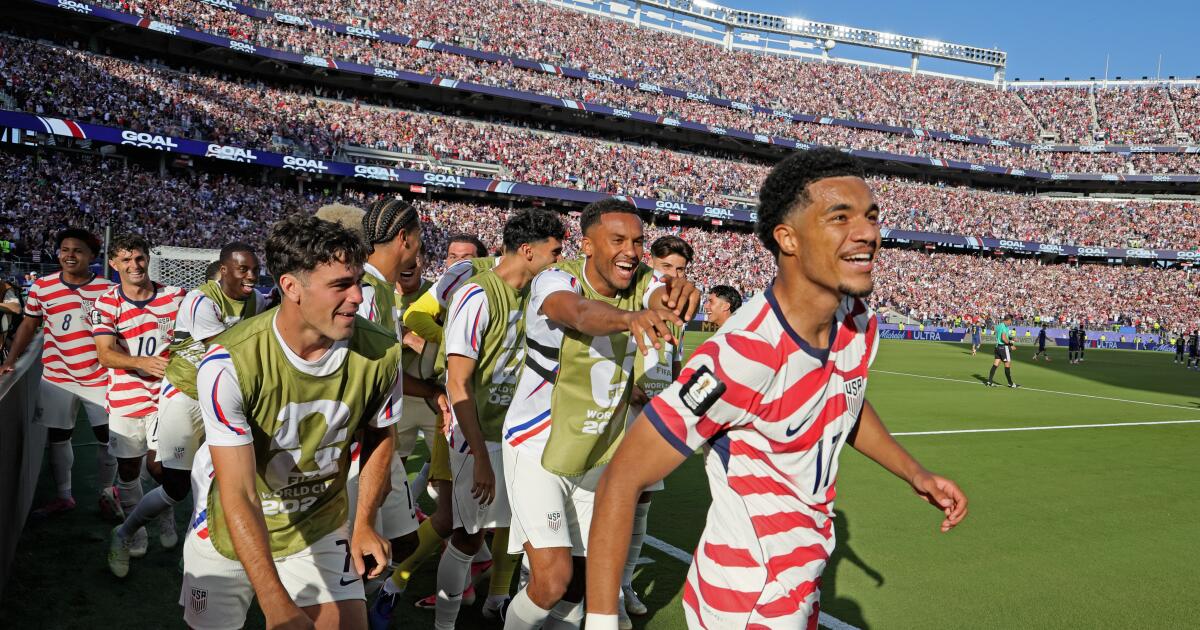
With Wednesday’s gritty 2-0 over Bosnia and Herzegovina, a game the U.S. finished with just 10 men, the Americans won a game in the World Cup knockout stage for just the second time. That sends them on to a round-of-16 meeting with Belgium on Monday in Seattle where a win would be — you guessed it — historic.

“It’s cool and it’s great and it’s an accomplishment,” midfielder Weston McKennie said of the records. “But at the same time, we have high expectations for ourselves. That’s what we expect of ourselves, what we expect of our team.

“We just want to focus on Belgium now and continue to try to make history.”

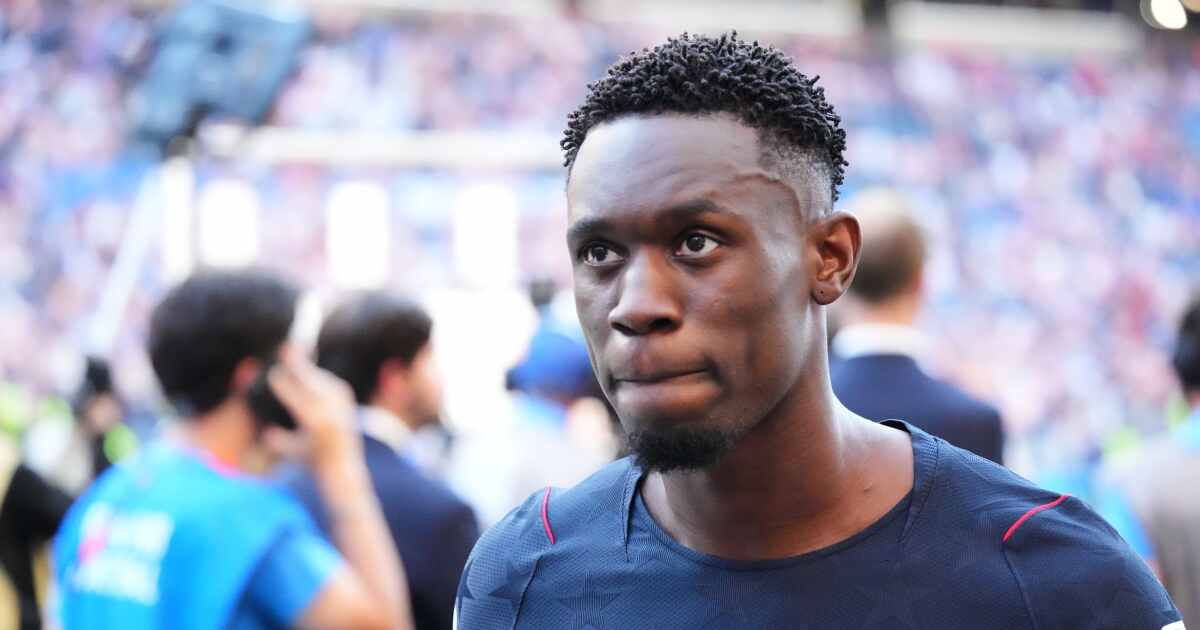
That chore got a good deal more difficult because of an unwanted team record that was also set Wednesday. When Folarin Balogun scored a goal late in the first half then drew a red card early in the second, he became the first American — and third player ever — to get one of each in the same World Cup knockout game.

“Cool record,” defender Chris Richards said.

But while the goal, Balogun’s third of the tournament, proved to be all the U.S. needed to beat Bosnia, the red card — which cannot be appealed according to U.S. Soccer — means he’s suspended for the game with Belgium.

“It’s just so unfortunate, honestly,” Christian Pulisic said. “Looking back at it, it seems so harsh. I just told him he’s done so much for us, and now we’ve got his back.”

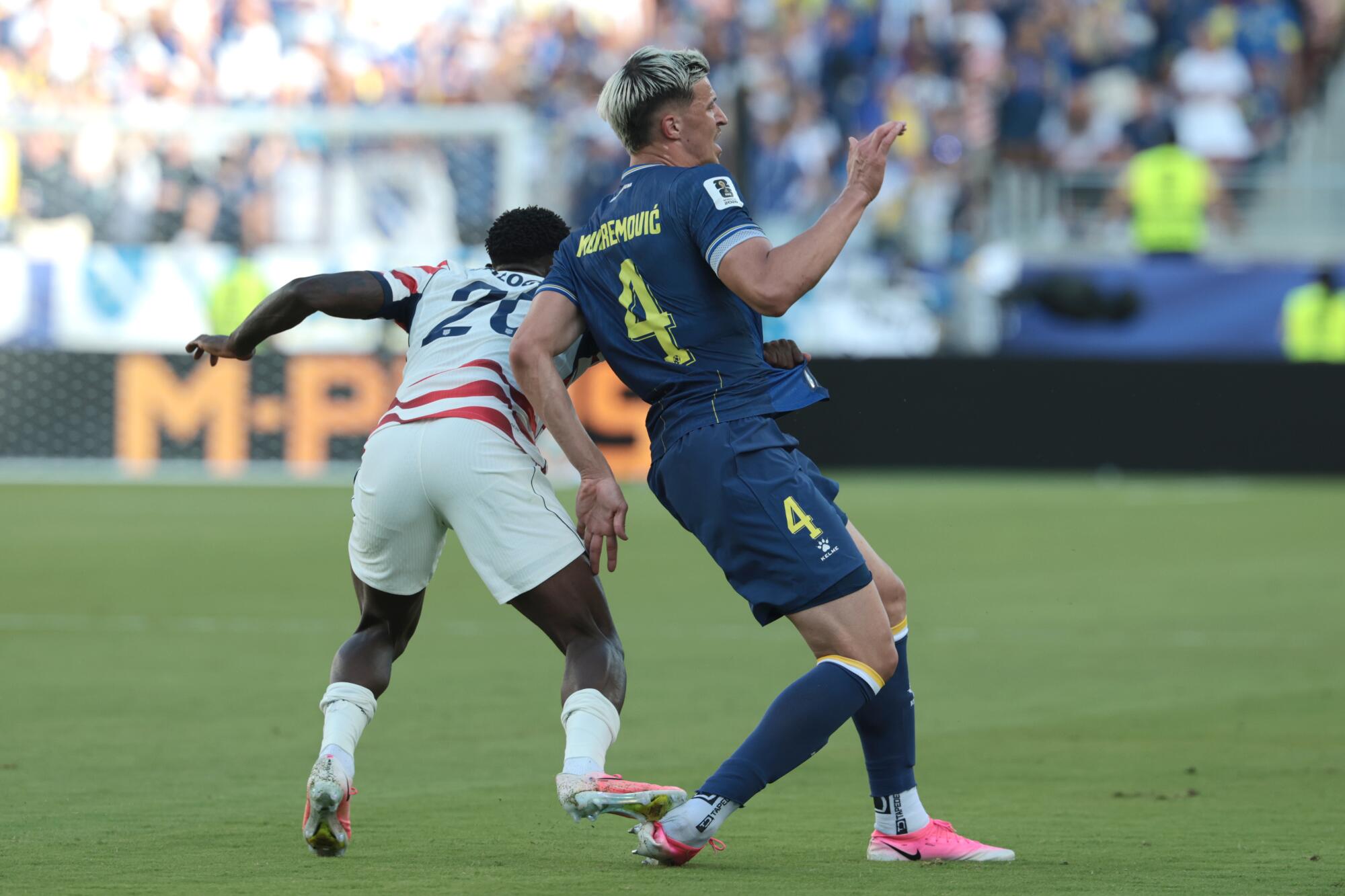
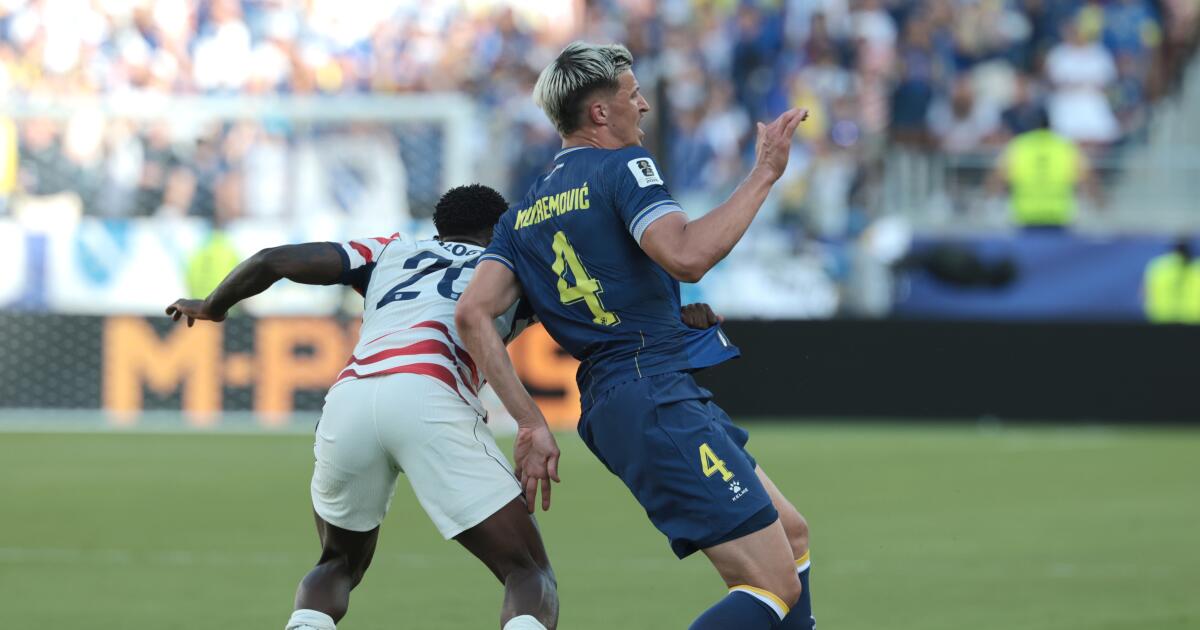
The red card came in the 64th minute with the U.S. protecting a 1-0 lead built on Balogun’s goal just before the intermission. The American striker was battling hulking Bosnia defender Tarik Muharemovic for a loose ball when he inadvertently raked Muharemovic’s right calf with his studs up, then landed on his ankle, twisting it awkwardly.

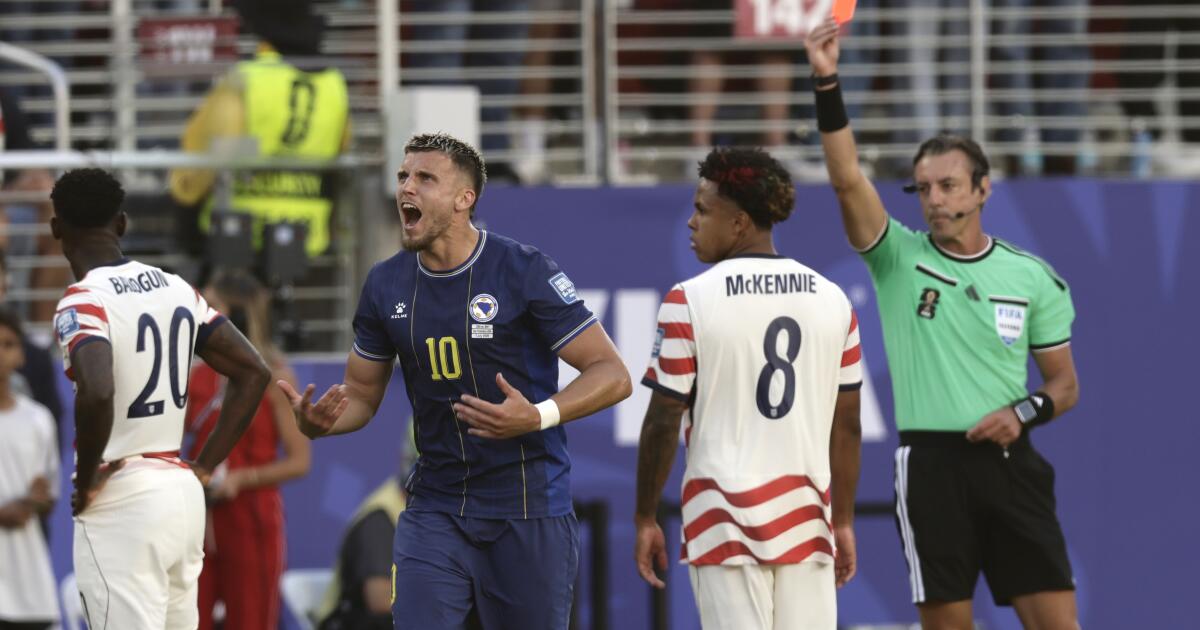
Brazilian referee Raphael Claus did not flash either card before stopping play at the behest of the video assistant referee. But after consulting a slow-motion reply, Claus gave Balogun a red card for a dangerous challenge.

“For me, never is this a red card,” said Pochettino, now the winningest U.S. coach in World Cup history. “Watching after on TV, never was [it his] intention to step up on the player. That was a normal action in football.”

Maybe. But Claus sent Balogun off just the same, leaving the U.S. to protect a one-goal advantage for the final 30 minutes while playing a man down. It was probably the sternest test the Americans have faced in the tournament.

“It would be easy to have an excuse if they did score,” McKennie said. “But that’s not the type of team we are.”

For Ream, the challenge was actually no challenge at all.

“Would it be weird if I downplayed this and said [I] wasn’t even fazed by it?” he said. “It didn’t feel like we were down a man. We were still able to carve out chances and we were still able to keep hold of the ball. Everybody knew their roles.

“It felt really calm and felt really, really easy and simple for us in that moment.”

And that allowed another hero to shrug off the pain of his own wounds and step up big.

Early in the second half a Bosnian player stomped on Malik Tillman, shredding his boot and cutting his right foot (but not drawing a red card). During the hydration break, Tillman was able to change shoes and in the 82nd minute, his white sock turning red with blood, he found himself standing over a free kick just outside the Bosnian penalty area.

“I’ve been dreaming about this game. I’ve been dreaming about, yeah, maybe taking a free kick and scoring,” said Tillman, who bent the ball off the gloved right hand of Bosnian keeper Nikola Vasilj and into the net for his first World Cup goal. “I trained for this in our practices and then it actually came true.”

So did the team’s dreams of reaching the round of 16, only now they’re arriving without their leading scorer, who will have to watch the Belgium game from the stands. Balogun’s absence, however, creates opportunity for others, with Haji Wright and Ricardo Pepi the most likely candidates to take his place.

And if this U.S. team has proven anything, it’s proven that it loves nothing more than embracing opportunities to prove people wrong.

“We’re going to miss him for the next game but we know that if it’s Pepi or Haji, whoever, is going to step up next and they’re going to do the job just as well as he did,” Richards said of Balogun. “One thing about this team is we’re really a big family and we’re shown it this whole tournament.

“Coming in, there was a lot of question marks about our whole team in general. Game by game we started to put ourselves right. Because we knew we had it the whole time.”

Source link

Justice for U.S. star Folarin Balogun, red card for VAR

What do you mean U.S. forward Folarin Balogun got red-carded? For that?

As a nation, we’re pretty new to all this. And this VAR abomination we’ve all now been introduced to? Thanks, we hate it.

Soccer’s video assistant referee system is worse than the NBA’s tedious in-game reviews. Worse than the existential NFL question of whether it is or is not a catch. Dumber than not being able to argue obvious balls and strikes in a pre-ABS baseball world.

Worse than all those things put together.

And now that we witnessed it burn the U.S. men’s soccer team in its rousing 2-0 round of 32 World Cup victory over Bosnia and Herzegovina on Wednesday, all of us newly accredited soccer experts in America are ready to declare war on VAR.

In a physical fixture filled with shoving and shouldering, pushing and pummeling, blood and guts, after 60-plus minutes of letting ’em play, Balogun’s off-balance misstep got him kicked off the pitch.

A match of no-calls — including, initially, this gnarly moment of incidental contact between Balogun and Tarik Muharemovic — and the United States found itself down a man for most of the second half at Levi’s Stadium.

The unfortunate accident will rob Americans — both those on the pitch and those glued to screens at home or at a watch party — of their top scorer (Balogun has three goals in three matches) in a round of 16 showdown with Belgium on Monday in Seattle.

The young man was doing LeBron James’ silencer celebration after scoring a goal one moment and being tagged with soccer’s equivalent of a Flagrant 2 the next — because of how one moment was assessed on tape delay.

Delay being the operative phrase. No one loves late calls, but soccer has some late calls. Examined in super-slow motion. And, as the United States’ Tyler Adams pointed out: “When you slow everything down, it’s only going to look worse.”

And Balogun didn’t mean it! That’s a better defense in some situations than others — including this one. Per letter of the law.

ESPN’s resident refereeing expert, Andy Davies, a former Select Group referee with more 12 seasons on the elite list provided this summary judgment: “With both players challenging for ball, the contact from Balogun on Muharemovic, while it looked bad in slow motion, was purely accidental and an unfortunate result from two players challenging for possession of the ball in a normal football movement.”

Also, Davies: “VAR made their recommendation to the referee based on slow-motion and still replays, which is not aligned with VAR protocols, as these should be used for only point-of-contact purposes in a red card tackle situation.”

Let me tell you something you already knew: FIFA is inconsistent.

Malik Tillman’s exquisitely placed, curving free kick for a goal in the 82nd minute might have been Messi-esque, but the call on Balogun? Not Messi-esque.

In a group play match against Algeria, Lionel Messi, the Argentine superstar, seemed to rake his studs along Aïssa Mandi’s right calf and ankle. That time, a foul was called. VAR had a look. And despite the rules stating that a challenge from behind with studs-on-calf contact and a level of force should be a red card — no card was administered. Can’t have Messi missing games.

The armchair referee system, so far from unassailable, is also unappealable — to U.S. coach Mauricio Pochettino’s dismay.

“For me, never is this red card,” Pochettino said. “Watching after on TV, never was [it] intention[al] to step up on the player. That was a normal action in football that happened by accident.

“That is why for me it’s never a red card.”

But you don’t have to take his word for it.

On Fox, former French footballing legend Thierry Henry said: “You need to adopt some type of common sense. He never went to hurt nobody. He went to get the ball, and where do you land after? You have to land somewhere.”

Commentator Ian Darke weighed in with a post on X: “Reckless and yellow would have covered it.”

Trust your own eyes.

In an attempt to eliminate human error, this great sport has introduced human error. But it feels more egregious than a bad call in the run of play because it’s justice — or injustice — meted out arbitrarily, unevenly and after the fact.

Look, I’m sure the world doesn’t want to hear any of our star-spangled opinions about how to improve the beautiful game — but in this, we’re united.

There’s a universal sentiment: Give VAR the red card.

Source link

U.S. advances with thrilling win over Bosnia despite red card

Folarin Balogun was still learning to walk the last time the U.S. won a knockout round game in a World Cup. On Wednesday, he helped lead the Americans to another with his goal in the waning seconds of the first half, sparking a 2-0 win over Bosnia and Herzegovina that sends the team on to the round of 16 of this summer’s tournament.

The other goal came from Malik Tillman in the 82nd minute. The Americans have scored multiple goals in every game of the tournament for the first time ever, also setting a national record with 10 goals overall in the tournament.

The U.S. will face Belgium in the next round Monday in Seattle. Belgium advanced with a 3-2 win over Senegal in extra time.

Balogun wasn’t around to see the finish though, drawing a straight red card for stomping on the right ankle of Bosnian center back Tarik Muharemovic in the 61st minute, a foul Brazilian referee Raphael Claus confirmed via a video review. That forced the Americans to see Wednesday’s game out with just 10 players.

“For me, never is this red card,” U.S. coach Mauricio Pochettino said. “Watching after on TV, never was [it] intention[al] to step up on the player. That was a normal action in football that happened by accident.

“That is why for me it’s never a red card.”

Claus disagreed, which could prove costly against Belgium because the card comes with a one-game suspension the U.S. cannot appeal.

“It’s just so unfortunate, honestly,” teammate Christian Pulisic said. “Looking back at it, it just seems, it seems so harsh. I just told him he’s done so much for us, and now we got his back. So that’s it.”

Balogun put the U.S. in front to stay just before the intermission. The sequence started with Bosnian defender Stjepan Radeljic sliding in front of a Tillman pass, deflecting it forward toward Muharemovic. But Muharemovic got his feet crossed, allowing the ball to carom to Balogun who did the rest, sweeping the ball into the net with his left boot from about 15 feet.

The goal was Balogun’s third of the tournament, tying him with Landon Donovan (2010) for most by an American in a single World Cup since 1930. The lead was the Americans’ first at halftime in a World Cup knockout game since 2002, when they beat Mexico in the round of 16.

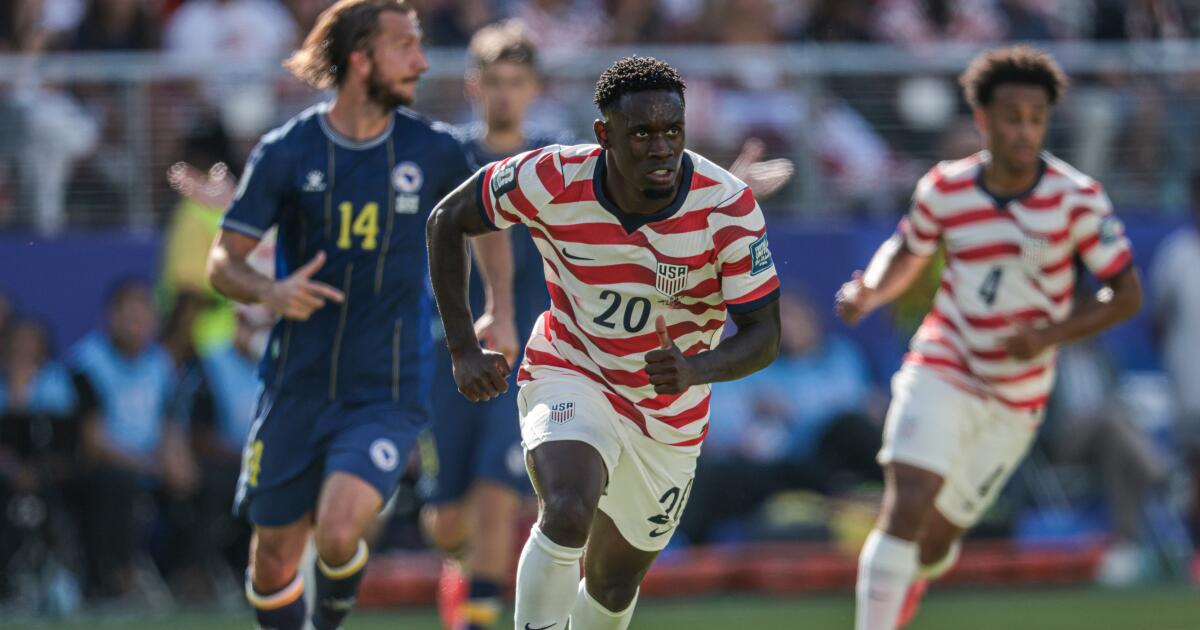
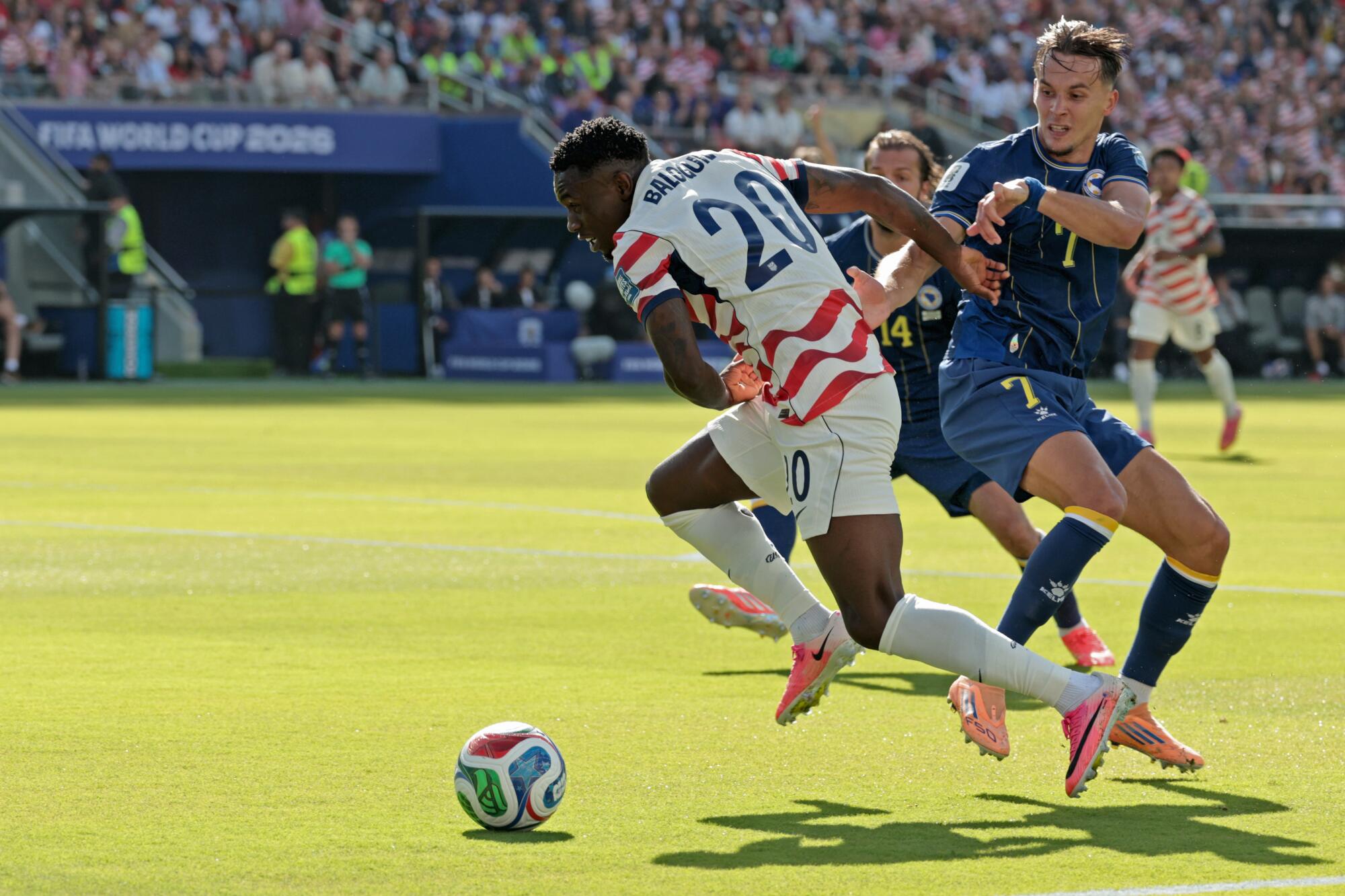
Folarin Balogun and Bosnia-Herzegovina defender Amar Dedic in action during the first half.

Folarin Balogun and Bosnia-Herzegovina defender Amar Dedic in action during the first half.

(Robert Gauthier / Los Angeles Times)

It looked to be a precarious lead when Muharemovic crumpled to the ground with about 30 minutes in regulation time. Claus did not show a card but after the VAR official suggested he take a look at a slow-motion replay, he came away from the monitor and reached for the red, making Balogun the first American to get a red card and score a goal in the same World Cup game.

“I think it’s a yellow card,” midfielder Tyler Adams said. “I think when you slow everything down, it’s only going to look worse.”

A few minutes after Balogun left, the game paused for the second-half hydration break, which proved to be a lucky break for the U.S. Tillman had his right foot stomped on early in the half, ripping his boot and leaving his foot bloodied. The break came him a chance to change shoes.

In the 82nd minute, he swung that new right shoe at a free kick from the top of the box, bending it off the gloved right hand of Bosnian keeper Nikola Vasilj and in the net. That brought another first, according to OptaJack, which said Tillman was the first U.S. player to score on a direct free kick in a competitive match since Jozy Altidore in 2017 Gold Cup final.

“I’ve been dreaming about this game. I’ve been dreaming about maybe taking a free kick and scoring a free kick,” said Tillman, who practices set pieces endlessly after training sessions. “And then it actually came true.”

Until Wednesday, the U.S. hadn’t beaten a European team in 13 tries, a slump that included draws with Wales and England in the 2022 World Cup and six losses in as many games under Pochettino.

The last UEFA country it did beat? Bosnia and Herzegovina, in December 2021.

“Details decided the game,” Vasilj said.

After the red card “we started controlling the game,” he continued “and they canceled that with the second goal. We had our moments and you could feel something was coming. The only thing missing was the goal.”

Staff writer Mirjam Swanson contributed to this report.

Source link

World Cup: U.S. cannot appeal Folarin Balogun’s red card suspension

The U.S. cannot appeal Folarin Balogun’s red card and ensuing suspension for the Americans’ round of 16 match against Belgium, U.S. soccer officials confirmed.

FIFA rules governing the 2026 World Cup, first cited by the Athletic, state that “a sending-off automatically incurs suspension from the subsequent match. The FIFA judicial bodies may impose additional match suspensions and other disciplinary measures.”

The only instance in which the U.S. could appeal is if FIFA’s disciplinary committee decides to suspend Balogun for more than one game after reviewing the incident.

Broadcast commentators and fans immediately questioned the decision after Balogun was shown a red card during the U.S.‘s win over Bosnia-Herzegovina on Wednesday at Levi’s Stadium.

Balogun crashed into Bosnia’s Tarik Muharemović, landing his foot on top of Muharemović’s during the physical match. Muharemović hit the pitch, howling in pain, and was treated on the field. The referee used the video assistant referee to review the play and determined it merited a red card.

U.S. fans accustomed to appeals in the NBA and NFL suggested that an appeal include video of Lionel Messi receiving no discipline for stepping on an opponent’s calf earlier in the tournament.

The red card on the field, however, remains the final word barring any extra games added to Balogun’s suspension.

Source link

U.S. defeats Australia, clinches spot in World Cup knockout round

The World Cup is only a little more than a week old, but it’s already a historic one for the U.S.

With Friday’s 2-0 win over Australia, the U.S. matched its best World Cup performance ever with two victories. Their six goals match the most the U.S. has ever scored in the group stage and its goal differential of plus-five is also its best ever in the tournament. The U.S. also clinched a spot in the round of 32.

Most impressive of all, however, is how the U.S. achieved most of that without their best player, Christian Pulisic, who had an electric first half in the U.S. opener against Paraguay but hasn’t seen the field since. And while Pulisic, who is nursing a calf injury, was missed Friday, he wasn’t needed, with the U.S. outpossessing, outpassing and outshooting Australia by wide margins.

The Americans hardly needed any help, but Australia gifted the U.S. its first goal anyway when defender Cameron Burgess deflected in a cross from Folarin Balogun in the 11th minute. The sequence started with Antonee Robinson pushing the ball forward for Balogun from just inside the halfway line. Balogun ran onto the ball then turned on the jets, making a dash up the left wing before turning toward the penalty area and bending a pass toward Sergiño Dest in the six-yard box.

Australian goalie Patrick Beach, guarding the post, reached out his left hand but missed the ball, allowing it to strike Burgess’ left foot and carom into the roof of the net igniting a red, white and blue-clad crowd of 66,925 inside Seattle Stadium (Lumen Field) and tens of thousands more who gathered outside the stadium and at viewing parties spread throughout the city.

The first U.S. score in its opener with Paraguay came on an almost identical own goal, with Paraguayan midfielder Damián Bobadilla getting his right foot on a pass Weston McKennie had aimed at Balogun.

Australia tried to deal with the Americans’ superior speed and technical abilities by getting physical, rough play that German referee Felix Zwayer largely allowed. But Australia paid dearly for that just before the intermission when Alex Freeman, who was leveled by Australia’s Paul Okon-Engstler moments earlier, climbed off the turf to head in a loose ball to give the U.S. a 2-0 lead at the break.

A look at how the U.S. scored its goals in a 2-0 win over Australia.

That sequence started with a free kick following a foul by Burgess. Robinson left-footed the ball to an unmarked Dest at the top of the box, a shot that was blocked in the wall, then arced toward the goal. Freeman and Balogun raced Beach to the ball, with Freeman getting there just ahead of the Australian goalie to nod it in.

The goal was originally negated by an offside that was quickly overturned by the VAR official.

Australia tried to make a game of it in a second half that turned increasingly chippy, but the U.S. defense held firm.

The U.S. — and Pulisic — have five days to prepare for their group-stage finale with Turkey on Thursday at SoFi Stadium, where the potential for even more history awaits.

U.S. fans react after a 2-0 win over Australia at Seattle Stadium (Lumen Field) on Friday in World Cup Group D play.

U.S. fans react after a 2-0 win over Australia at Seattle Stadium (Lumen Field) on Friday in World Cup Group D play.

(Ted S. Warren / Associated Press)

Source link

U.S. players aim to build on electric World Cup win over Paraguay

The U.S. men’s soccer team isn’t only trying to win games in this World Cup. It is trying to win hearts and minds as well.

“We want the game to grow,” star midfielder Christian Pulisic said. “We want to get Americans excited to watch this game, to watch our team. That’s obviously a big goal of ours. And being successful would give that the best boost.”

The Americans certainly got a great start Friday, opening the second World Cup played on U.S. soil with a dominant 4-1 win over Paraguay. It was one of the most complete performances the American men have had on the sport’s biggest stage, with Folarin Balogun scoring twice, Pulisic setting up two goals, and just one momentary lapse on defense separating goalkeeper Matt Freese from a shutout.

The U.S. passed well, defended well and, most important, was clinical and dangerous in front of the net, finishing well.

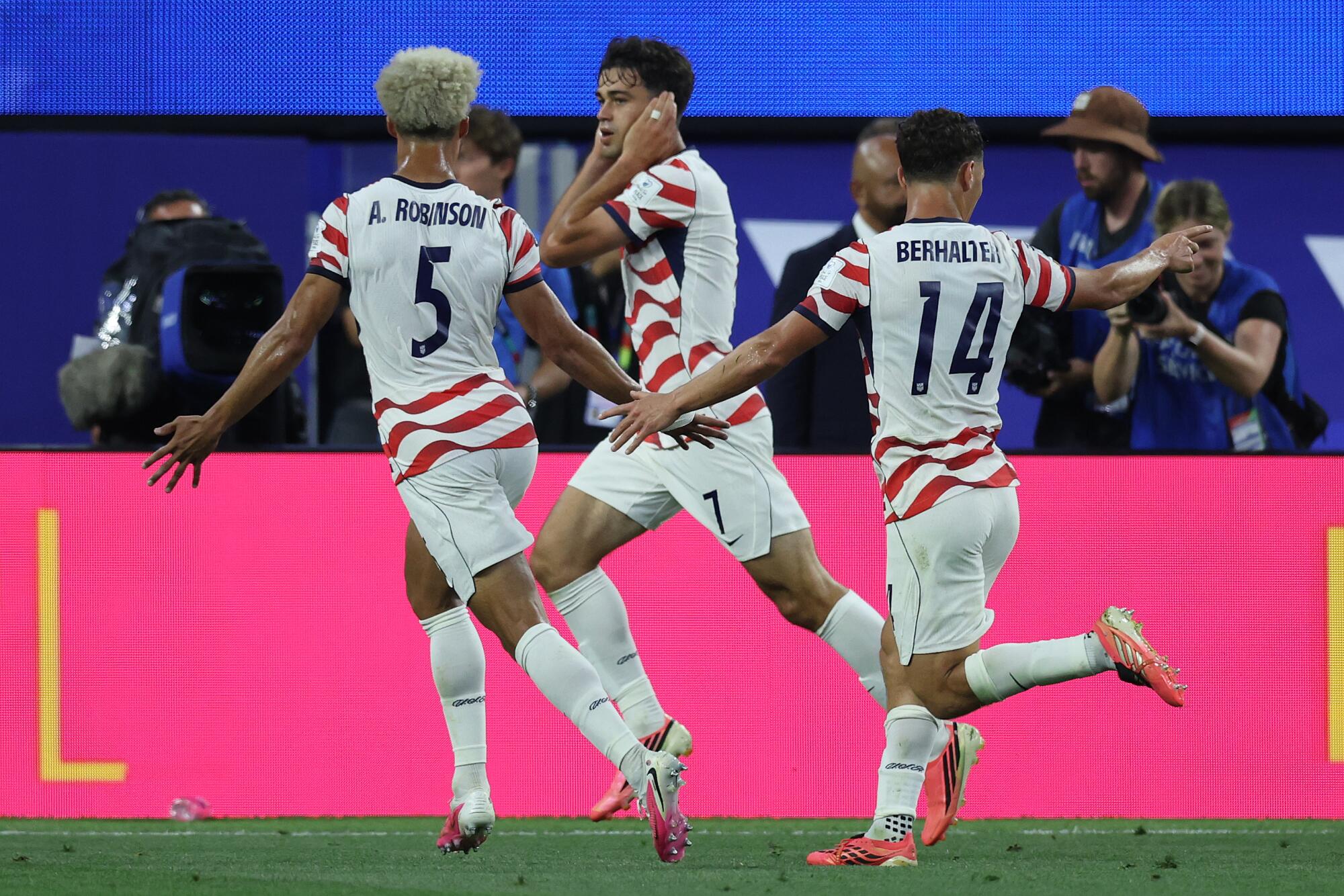
U.S. midfielder Giovanni celebrates with Antonee Robinson and Sebastian Berhalter after scoring during a World Cup game.

U.S. midfielder Giovanni celebrates with Antonee Robinson and Sebastian Berhalter after scoring against Paraguay.

(Robert Gauthier/Los Angeles Times)

“It was a real statement,” Balogun said. “And that’s what we wanted. I’m very delighted with the overall performance.”

The effort was warmly received by a sold-out crowd of 70,492 at SoFi Stadium, with record-setting crowds watching on TV throughout the country.

Fox Sports announced 15.99 million watched the win, making it the most-viewed U.S. World Cup match on English-language television.

And the Spanish-language broadcast drew a total audience of 8.9 million across Telemundo, Peacock and Telemundo’s streaming platforms. It was the most-watched U.S. World Cup match on Spanish-language television network platforms, harking back to the 1994 World Cup, the first played in the U.S. that also attracted record TV audiences.

At 38, captain Tim Ream is the only member of the team who was alive in 1994, but he and his younger teammates repeatedly have been reminded of the impact that tournament had on soccer in the U.S. That 1994 team won just one game, though, scored just two goals and didn’t make it past the round of 16.

This team is convinced it can do better — on and off the field.

Fans cheer after U.S. beat Paraguay to open the World Cup Friday at SoFi Stadium.

Fans cheer after U.S. beat Paraguay to open the World Cup Friday at SoFi Stadium.

(Kelvin Kuo/Los Angeles Times)

“It’s trying to be an inspiration for the next generation and grow the game,” midfielder Tyler Adams said. “I think we have the opportunity to do that.”

Part of that is kick-starting the kind of interest in soccer that briefly swept the country during the first U.S. World Cup 32 years ago. And this team certainly energized fans Friday.

“Having this crowd around us, seeing the red, white and blue, it’s awesome,” Pulisic said. “It’s really pushing us forward. We just hope it continues like that.”

It will if Pulisic and Co. continue playing like that.

The U.S. controlled the ball for nearly an hour of the 90 minutes, completed more than twice as many passes as Paraguay and took almost twice as many shots. It was a game that was as attractive and inviting as it was one-sided, one that might turn the most skeptical viewer into a fan.

It was, midfielder Weston McKennie said, the kind of game that could push the U.S. closer to becoming a proper soccer nation.

American midfielder Weston McKennie out runs two Paraguay defenders during a World Cup match at SoFi Stadium Friday.

American midfielder Weston McKennie outruns two Paraguay defenders.

(Kelvin Kuo/Los Angeles Times)

“Because it’s a World Cup and it’s in America, people came out,” McKennie said. “We’re OK with that. There’s a lot of people that maybe have never come out to support us. But hopefully today, with this performance, they can connect with us.

“You feel this electricity in the stadium and the passion. That’s one thing that’s going to change soccer here.”

Pulisic and McKennie helped put the U.S. in front to stay in the seventh minute, although the goal was credited to Paraguayan midfielder Damián Bobadilla, who got his right foot in front of a McKennie pass intended for Balogun and deflected it into the net for an own goal. Pulisic made the whole sequence happen, however, pushing the ball between a pair of defenders before poking it on to McKennie in the center of the box.

Balogun scored twice in the final 20 minutes of the first half, one-timing a perfect pass from Pulisic in from the penalty spot in the 31st minute, then running on to a perfectly weighted through ball from Malik Tillman and avoiding two defenders to line a left-footed shot into the top left corner five minutes into stoppage time.

The brace was the first of Balogun’s international career and came in his World Cup debut before a crowd of family and friends, a cheering section he saluted from behind the goal line after scoring.

“I had to sort through a lot of ticket [requests.] It’s a dream night, you know? I’ve not been able to take it all in,” said Balogun, whose brace marked the first multigoal game by an American in the World Cup since 1930.

And that wasn’t the only history the U.S. made Friday. Defender Chris Richards, whose status for the opener was in doubt after he tore two ligaments in his left ankle a month ago, completed all 83 of his passes, the most without a miss in a World Cup game since 1966.

Mauricio pulled one of those goals back for Paraguay in the 73rd minute, before Gio Reyna closed the scoring with his first World Cup goal deep in stoppage time.

Pulisic, who said he took a kick to his left calf in the first half, was replaced by Sebastian Berhalter to start the second. Pulisic showed no signs of injury while talking with reporters after the match, and coach Mauricio Pochettino is hopeful the injury will not limit Pulisic during the next match Friday against Australia.

For the U.S., the commanding win over Paraguay was just the start. The best, the players promise, is yet to come.

Fans fill SoFi Stadium during the U.S. World Cup win over Paraguay on Friday.

Fans fill SoFi Stadium during the U.S. World Cup win over Paraguay on Friday.

(Kelvin Kuo/Los Angeles Times)

“Today was a great starting point for us,” McKennie said. “But we know that’s just a start and this is something we don’t want to over-celebrate. Because we want this to be the normal for us.

“We have two more games to go in the group. Hopefully we improve.”

Added Pulisic: “There’s so much more we want to accomplish.”

And not all of that will take place on the field.

Source link

World Cup: U.S. offense shines in win over Paraguay

It was a game eight years in the making. The first World Cup match on American soil in more than a generation and the start of a tournament that has the potential to alter the direction of soccer in this country for the next generation.

And the U.S. seized on every bit of that opportunity Friday, with Christian Pulisic setting up two goals and Folarin Balogun scoring twice in his World Cup debut, sparking an impressive 4-1 victory over Paraguay in a game that was far more one-sided than the score indicated.

The U.S., which needed a big effort to start the tournament, was on the front foot from the start, going in front to stay in the seventh minute — although it was Paraguayan midfielder Damián Bobadilla who got credit for the goal after stepping in front of Balogun and deflecting in a cross from Weston McKennie.

Pulisic, the American star who is under intense pressure to perform in this tournament, set up the goal, pushing the ball between a pair of defenders before poking it on for McKennie in the center of the box. Bobadilla then did the rest, inadvertently sticking his right foot in front of the ball and bouncing it by Paraguayan keeper Orlando Gil.

Balogun appeared to double the lead coming out of the hydration break midway through the opening half, but the goal was negated by an offside call. That only delayed the second goal, however, with Balogun making it 2-0 by one-timing in a perfect feed from Pulisic from the penalty spot in the 31st minute.

Balogun added to the U.S. advantage just before the intermission, running on to a perfectly weighted through ball from Malik Tillman, stepping through a challenge from Omar Alderete entering the penalty area and turning around Paraguayan captain Gustavo Gómez before left-footing a shot into the top left corner to complete his first brace for the national team.

Gil was just a spectator on the play, with no chance to best the save. The goal marked the first time Paraguay had given up three scores in a World Cup game — much less one half — since 2002 and it came at the end of what was arguably the best opening 45 minutes a U.S. team has played in the tournament in decades.

Gio Reyna scored the fourth U.S. goal on the final play of the game.

Pulisic left in favor of Sebastian Berhalter to start the second but the U.S. continued to dominate in every way it was possible to dominate, controlling the ball for nearly 60 of the 90 minutes and completing more than twice as many passes. Paraguay’s first shot on goal didn’t come until the 73rd minute when Mauricio, a halftime substitute, took advantage of a slow-reacting U.S. defense to pull a goal back.

U.S. coach Mauricio Pochettino also got a solid game out of center back Chris Richards, playing for the first time since tearing two ligaments in his left ankle a month ago.

The Americans will face Australia in the second of three group-stage games next Friday in Seattle, where a draw will all but guarantee them a spot in the round-of-32, something Pulisic said should be just the first objective for this team.

This World Cup is the largest and most ambitious sporting event in history, with three host countries — Canada and Mexico, in addition to the U.S. — and a record 48 teams playing 104 games in 16 cities spread across four time zones. A long run by the American team, playing on home soil, could excite a nation and give soccer the kind of boost it hasn’t seen since 1994, the last time a World Cup was played here.

It could also change the narrative of a tournament whose run-up was clouded by outrageously high ticket prices, travel bans, the threat of ICE raids at tournament venues and the war in the Middle East, the first to pit a World Cup host against a World Cup qualifier.

And the U.S. portion of that tournament opened with pomp despite those circumstances, with Thai pop star Lisa, Nigerian recording artist Rema and Brazilian singer Anitta headlining a 10-minute mini concert staged before a massive replica of the World Cup trophy set over a blue map of the U.S. Katy Perry mounted a stage of her own an hour later to debut her song “Wonder” as the flags of the 48 participating countries circled around her.

President Trump did not attend the game, just as Mexican president Claudia Sheinbaum skipped her country’s opener Thursday in Mexico City and prime minister Mark Carney missed Canada’s first game Friday in Toronto. Secretary of State Marco Rubio took Trump’s place in the Hollywood-heavy crowd of 70,492 that packed SoFi Stadium, one which included Tom Cruise, David and Victoria Beckham, Halle Berry, Rob Lowe, Becky G, Jaime Foxx, Paris Hilton, Bill Gates, Justin Trudeau and Kareem Abdul-Jabbar.

That crowd was a sea of blue and red — the U.S. and Paraguay share the same colors — but the cheering was primarily for the Americans since Paraguay rarely mounted a threat.

Source link