fixes

Column: Becerra on cruise control, Hilton offers contrived fixes for California’s problems

Look, Xavier Becerra could cruise to a South Pacific island and bask on the beach until election day and Californians would still choose him as their next governor.

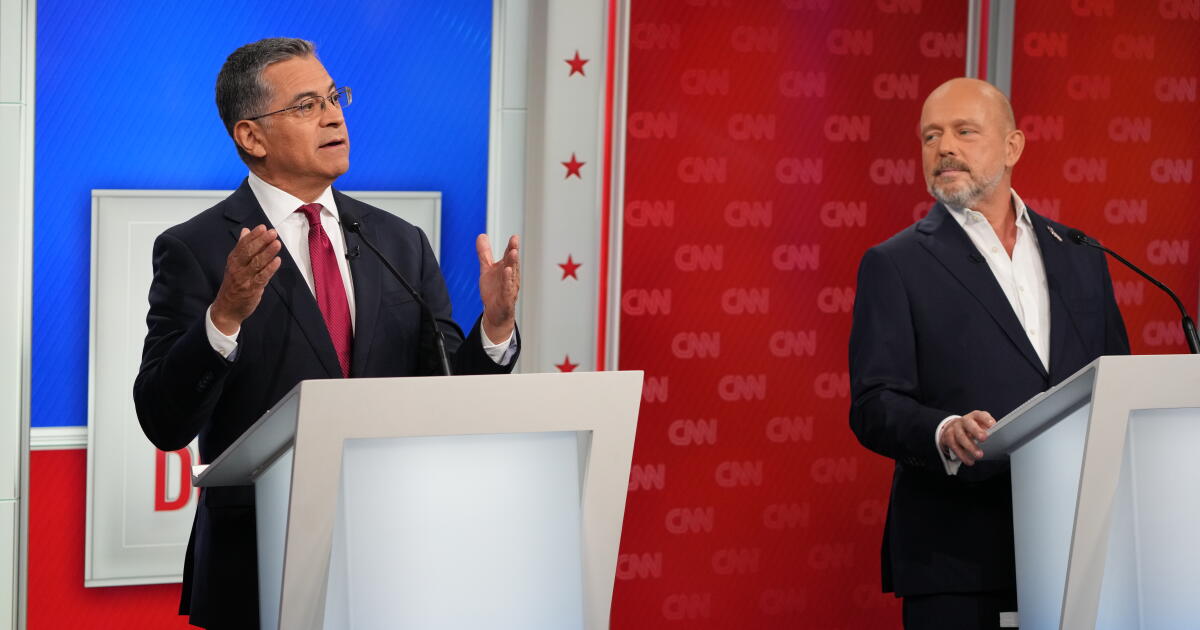
So, last week’s televised CNN debate between Becerra and Republican Steve Hilton really had no election significance, although it was important for the Democratic frontrunner in other ways.

Who won the debate? Becerra, because he came across as calm, collected and capable of governing this troubled state — certainly very few voters’ ideal candidate, but the only real choice for most Californians.

There’s simply no way Becerra can lose on Nov. 3 because his only opponent is a Republican. Californians will not elect a Republican governor in this polarized era, particularly one endorsed by the reviled President Trump.

Moreover, Hilton’s only previous political experience was as an advisor to a British prime minister and his sole claim to U.S. notoriety was as a Fox News TV host–not exactly resume boosters in California.

Becerra — with public office experience spanning more than three decades — held a growing 25-point lead in a recent poll by the UC Berkeley Institute of Governmental Studies.

He’s a shoo-in simply because he has a “D” beside his name in this state where Democrats outnumber Republicans nearly 2-to-1 and despise the GOP president.

Californians haven’t elected a Republican to statewide office in 20 years — and that’s Hilton’s main pitch to voters.

You’re reading the L.A. Times Politics newsletter

Expert columnists cover the insights, legislation, players and politics you need to know.

“The definition of insanity is doing the same thing and expecting a different result,” the GOP candidate asserted during the debate, as he does several times a day.

Turning to Becerra, Hilton said:

“You’re the candidate who is supported by the machine in Sacramento — the unions, big business, all these people that for 16 years have given us the highest cost of living in the country, made it impossible to build anything, given us the highest unemployment rate, the highest poverty rate….

“And that’s why we’ve got to try something different this time instead of voting for more of the same.”

OK, fair point. But try what exactly? That’s where Hilton stalls or veers erratically.

He’d build “10 new cities.” Build them where exactly? He doesn’t say.

He definitely doesn’t want to construct new apartment buildings in the suburbs “when we have got so much space that we could be building on in California.”

Like out in Southern California deserts or Central Valley farm fields — requiring two-hour commutes to urban jobs?

And where does the water come from for these 10 new cities as the West scrambles for what’s left of diminishing supplies? But unfortunately there was no discussion of that during the debate.

One debate exchange that caught my attention was about vaccines. Hilton seemed to be carrying the torch for whacko anti-vaxxer Robert F. Kennedy Jr., Becerra’s successor as U.S. health secretary in the Trump administration.

Debate co-moderator Dana Bash recalled what Hilton said previously about children’s vaccinations: “The government should have nothing to do with these fundamental and vital decisions.” And she asked whether he’d push to eliminate California’s vaccine requirements.

“No,” Hilton replied. “I’m pro vaccine.” But then he seemed to wander all over the stage looking to have it both ways.

It’s a “very, very emotional issue for a lot of parents,” he said, adding there’s “data around the world” showing that where vaccine “mandates are lower… you actually have higher [vaccination] compliance, where parents don’t feel that they’re being bullied into doing something that they don’t want to do. And that’s what I want to see here.”

But he ultimately said,“I’d follow the law.”

In California, the law requires all children without medical exemptions to be vaccinated for several diseases — including polio, measles, mumps, chickenpox, hepatitis B and whooping cough — before they’re admitted to school.

That’s a blessing. When I grew up, practically every kid at some point was bedridden with one or more of those dangerous ailments. Then some saviors invented vaccines.

“We had nearly eradicated measles,” Becerra said, responding to Hilton. “When I left HHS, you rarely heard of a case of measles…. Today, children are dying of measles. Today, the spread of measles has reached a proportion we haven’t seen since the 1960s.

“That’s what happens when vaccine deniers take over.”

Becerra achieved all he needed to in the debate. He didn’t screw up. He kept cool and actually was fairly quick on his feet in replying to Hilton’s attacks, while planting a MAGA hat firmly on the Republican’s head.

He missed an opportunity to accomplish more, however — like making Californians feel really good about voting for him, rather than merely because he’s the only Democrat left standing in the contest to replace the termed out Gov. Gavin Newsom.

Voters might like to hear what Becerra’s vision is — if he has one — for the California he wants to build.

What does he have in mind besides just defending California against Trump? That’s a given. How’s he going to lower our living costs? Upgrade public education? Prevent wildfires? Details, not platitudes.

Rather than relaxing on his lead, Becerra should be constantly moving around the state, introducing himself to Californians and — more importantly — listening to their problems and ideas. To his credit, he’s doing that this week.

“The debate was boring and uneventful, but Becerra won it,” says Republican consultant Rob Stutzman. “He is perfectly vanilla and that makes it really hard to pin him down in an attack.”

“We got the genuine Xavier Becerra. That’s exactly who he is,” says veteran Democratic strategist Garry Sragow, a longtime political ally. “Thoughtful, committed and very decent, but does not go very high on the charisma meter.”

In California right now, a candidate’s charisma rates much lower than a simple “D.”

What else you should be reading

The must-read: Voter ID proponents accuse California Democrats of lying about Trump’s support for Prop. 39
Eyes of the World: Will or won’t they? Newsom and Harris weigh 2028 contest — and possible collision
The L.A. Times Special: Voter guide to the 2026 California general election

Until next week,
George Skelton

—
Was this newsletter forwarded to you? Sign up here to get it in your inbox.
Source link

Column: Voter ID ballot measure fixes a problem that doesn’t exist

What’s so wrong about requiring every Californian to show a government ID before they’re allowed to vote? That’s what Proposition 39 backers ask. And it’s a fair question.

Here are some valid answers:

  • It would make California’s already notoriously slow vote count even more pokey.
  • It would be an added hassle for citizens attempting to exercise their voting right.
  • It would cost taxpayers a bundle, perhaps hundreds of millions of dollars each year.
  • It’s another solution by politicians to a problem that really doesn’t exist.

Practically everyone, regardless of political affiliation, must understand by now that there simply is no evidence of widespread — significant, meaningful — voter cheating in California or anywhere else in America. This despite conspiracy-theorists’ fruitless searching and President Trump’s lies about “rigged” elections.

It’s my belief that the main reason Republicans placed Proposition 39 on the California ballot was to boost GOP voter turnout in the Nov. 3 election. And recent independent polling shows that the measure does appeal strongly to Republicans — but not Democrats, who are united in opposition.

The proposition appears to be headed for defeat, largely because Democratic voters in this deep blue state equate it with the discredited president. Trump has turned into poison for Republican candidates in competitive races and any cause that reminds people of him.

You’re reading the L.A. Times Politics newsletter

Expert columnists cover the insights, legislation, players and politics you need to know.

That’s why the Proposition 39 campaign last week released a new major TV ad that essentially asks voters to ignore the president.

This is how conservative consultant Jon Fleischman summarized the ad’s message to Democrats in his blog: “You can hate Trump and still back Voter ID.”

Proposition 39 would mainly do two things:

  • Require voters to show some government-issued identification each time they vote in person, such as a driver’s license or passport. Don’t have one? The state would issue a free ID card to any voter who asked.
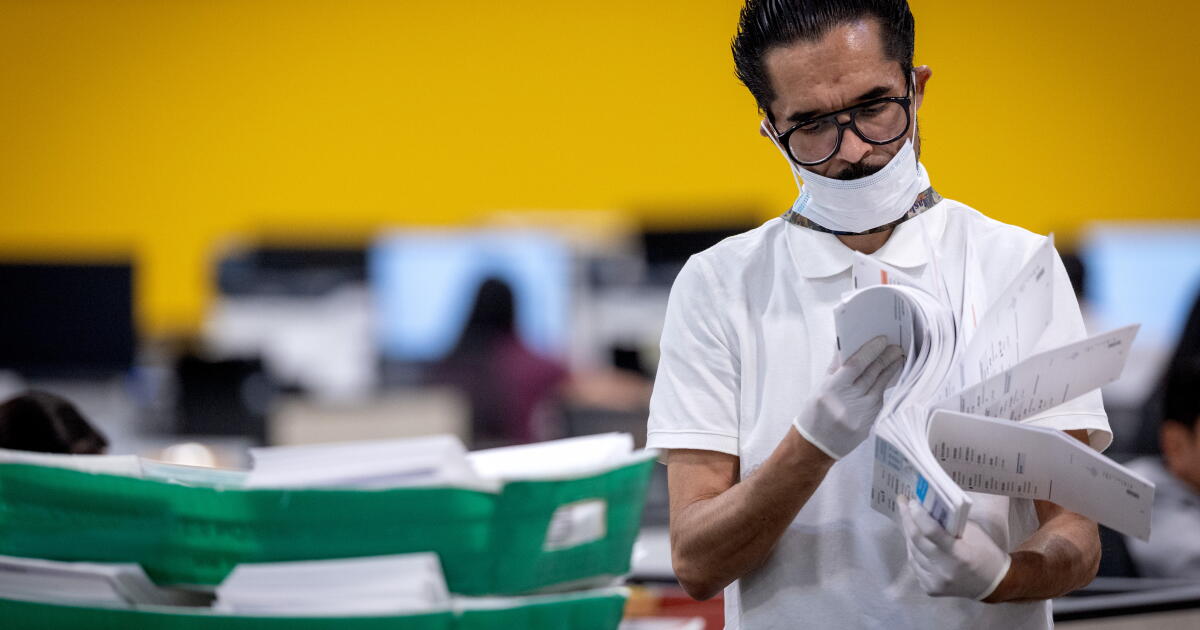
  • Californians who cast mail ballots — more than 80% of voters — would be required to write the last four digits of a government ID number on the return envelope. The number would be determined when initially registering to vote.

The measure also would impose some basically noncontroversial mandates that make sense separately. It would require election officials to maintain accurate voter registration files, weeding out people who have moved or died and verifying citizenship. But counties already do that pretty well.

The contrived bogeyman for election fraud scaremongers is the undocumented immigrant community. But these people, living on the edge and hiding from the government, aren’t going to risk deportation by trying to vote in an election they couldn’t care less about. And political candidates aren’t going to waste their time and money on them. Their targets are the large numbers of apathetic legal voters who sit out elections.

Currently, Californians must provide identification when registering and swear under penalty of perjury — a felony — that they are U.S. citizens. And they must record their signatures when registering and scribble it on the back of the ballot envelope when voting by mail.

Requiring me to add a four-digit number on the back of my “absentee” ballot envelope means I’d have to register all over again to record the PIN. And then remember it every election. A pointless pain.

Assemblyman Carl DeMaio (R-San Diego), a conservative firebrand, instigated and authored Proposition 39. “I do believe that voter fraud is a real problem. Absolutely,” he told me.

But he said the proposition has two main goals: 1, to clean up voter files and make sure ballots are properly validated and counted. 2, to increase public confidence in the voting process. “We have a perception problem,” he says. “Voters have low trust” in the election system.

Republicans mistrust a lot; Democrats not so much.

A California poll released last week by the UC Berkeley Institute of Governmental Studies showed that 84% of Republican voters had a “major concern” about voter fraud. Only 21% of Democrats did.

Can anyone doubt who’s driving the Republicans’ anxiety? The bellicose president. “Mail-in voting means mail-in cheating,” Trump has reiterated. “It’s terrible what’s going on.”

This from the hypocrite who mails in his ballots.

Fortunately, Proposition 39’s crafters left mail ballots pretty much alone, except for requiring a nuisance PIN on the ballot envelope.

That “absolutely” will slow down vote counting, says Assemblywoman Gail Pellerin (D-Santa Cruz), who heads the Assembly Elections Committee and was the longtime chief elections official of Santa Cruz County. Under Proposition 39, officials not only would need to check voters’ signatures against those on file, but also their PINs.

And voting in person would drag while people dug for an ID and an official checked it, Pellerin says. Some people are bound to be denied their voting right by mistake, she asserts.

Tony Quinn, formerly a GOP redistricting consultant and a longtime political analyst, points out that a disproportionately high portion of in-person voters are Republicans. Proposition 39 is “imposing a burden on them,” he says. “I don’t think the authors realize who’s voting in person these days. They sense illegal aliens.”

The UC institute poll showed Proposition 39 being supported by 39% of likely voters and opposed by 52%. It was backed by 92% of Republicans, but Democrats were 80% against. And they outnumber Republicans by nearly 2-to-1 in California.

The proposition also trailed in a poll by the Public Policy Institute of California: 43% yes, 55% no.

In the PPIC poll, Republicans said 39 was by far the most interesting proposition on the ballot.

Trump’s influence? Among the paltry 27% of voters who approve of his job performance, 88% support Proposition 39. But of the 72% who disapprove of the president, 73% oppose the measure.

Trump is toxic.

Proposition 39 is more government regulation for no good reason.

What else you should be reading

The must-read: Tax the rich? California voters are divided, according to new poll
Law & Order: Ballot seizure by Riverside County sheriff was ‘unlawful,’ California Supreme Court rules
The L.A. Times Special: High cost of living tops voter concerns, Becerra remains front-runner in governor’s race, new poll shows

Until next week,
George Skelton

—
Was this newsletter forwarded to you? Sign up here to get it in your inbox.

Source link