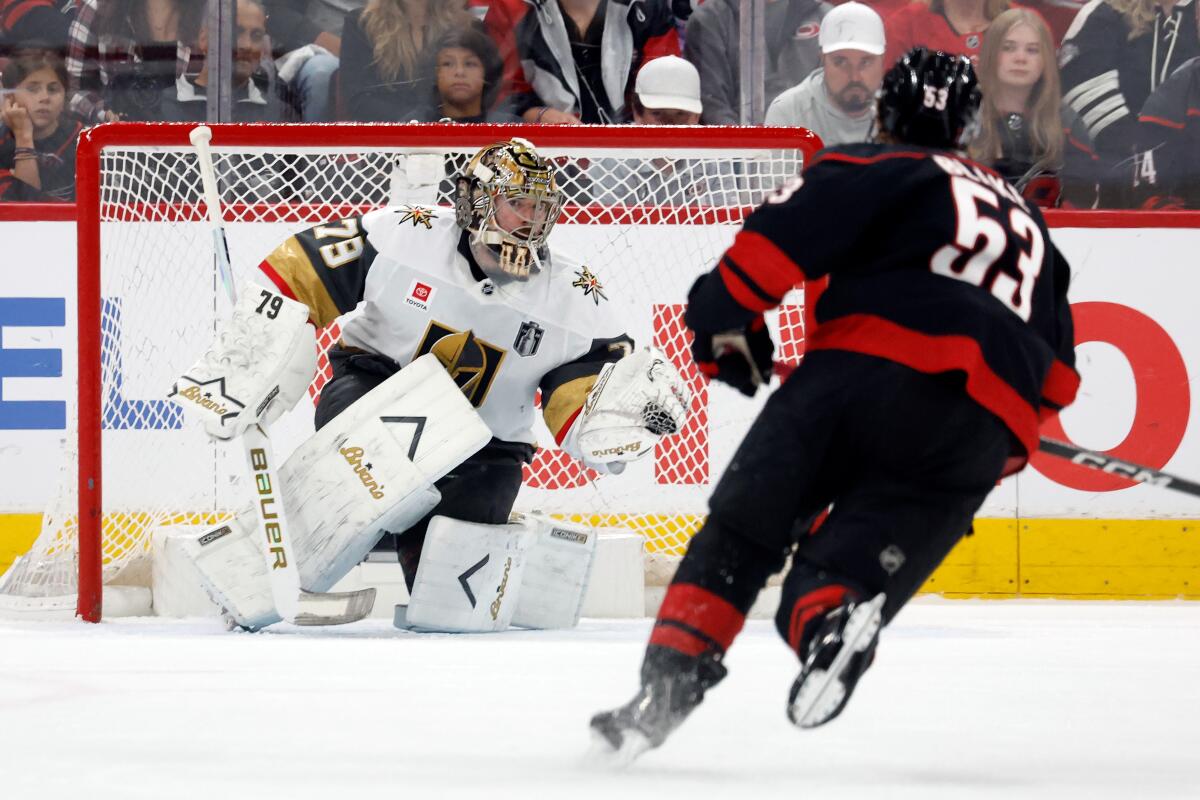
RALEIGH, N.C. — Andrei Svechnikov scored twice and Sebastian Aho added a second-period goal in a breakout game for Carolina’s top-line performers, helping the Hurricanes beat the Vegas Golden Knights 4-2 on Thursday night to move one victory away from the Stanley Cup.
Captain Jordan Staal added his fifth goal in the series on a night when Carolina overcame multiple hiccups from these playoffs, from a shaky power play to being outplayed in the second period of this series.
And there had been the waiting game for Aho and Svechnikov — two roster mainstays in an eight-year postseason run — to find a better offensive groove.
It all came together in Game 5, with Svechnikov’s short putaway at the post on the power play giving Carolina a 4-1 lead midway through the third period. And unlike most multi-goal leads in what has been a wild and thrilling series, this one held up, with Brandon Bussi finishing with 22 saves in his second career postseason start.
That gave the Hurricanes a 3-2 lead in the best-of-seven series. Game 6 is Sunday night in Las Vegas, with the Hurricanes playing for the chance to hoist the Stanley Cup for the first time since coach Rod Brind’Amour captained them to the title in 2006.
It has been a tough series for Vegas goaltender Carter Hart.
(Karl B DeBlaker / AP)
Pavel Dorofeyev scored twice for Vegas, finding the net for the first time since Game 1 of the Western Conference Final sweep of Presidents’ Trophy winner Colorado. Carter Hart entered this one as the first goaltender in Stanley Cup Final history to give up at least four goals in each of the first four games, then did it again to continue a difficult series while finishing with 20 saves.
Vegas had twice before been in a 2-2 series in these playoffs, in the first round against Utah and the second round against the Ducks. Both times, the Golden Knights won Game 5 and then closed out the series in Game 6.
This time, they’ll have to win on home ice to force the series back to Carolina for a Game 7 on Wednesday night. And they’ll have to take two in a row against a Hurricanes team that hasn’t suffered consecutive losses since mid-January.
Vegas played much of the night without center William Karlsson, who was being checked out on the bench for an apparent upper-body injury. Karlsson skated to the tunnel midway through the second period and didn’t return.
NEW YORK — Donald Trump is set to be the first sitting U.S. president to attend an NBA Finals game, bringing strict security measures that will require New York Knicks fans to navigate an extensive safety perimeter around Madison Square Garden and an expected lengthy wait to get inside the building.
The security for Game 3 between the Knicks and San Antonio Spurs and the scene around the arena more closely resembled New Year’s Eve in Times Square, and for fans, it might seem more akin to a trip to the airport. They were asked to get to the game two hours early and will be required to provide a ticket to get past various checkpoints along with passing through a TSA-style magnetometer.
Trump’s appearance led the New York Police Department and Secret Service to establish a multi-block security perimeter around the arena, cancel a watch party outside and institute a no-bag policy for ticket-holders. Fans had gathered around the Garden to watch games during this playoff run, during which the Knicks have won 13 games in a row to reach the final for the first time since 1999 and move two victories from their first NBA title since 1973.
“The NYPD in coordination with the Secret Service made the decision for Game 3, where we have a presidential visit, that we could not support watch parties right outside of the Garden,” Police Commissioner Jessica Tisch said at a news conference Monday. “We are looking forward to bringing back watch parties for Game 4. But I think New Yorkers are used to presidents coming to town, and they understand that that generally means lockdowns of areas and that’s what you’re going to see tonight at the Garden.”
Trump has attended several major sporting events in his time as president, and the security measures have created major hassles for fans.
Thousands of fans missed the start of last year’s U.S. Open men’s singles final between Carlos Alcaraz and Jannik Sinner because of lengthy security lines. Even though the U.S. Tennis Association pushed back the start of the match by a half-hour, many fans still couldn’t get in because added measures meant that they had to go through screening not only when they arrived at the Billie Jean King National Tennis Center but again in front of the steps into Arthur Ashe Stadium, where Trump watched from a suite.
Asked his thoughts on Trump attending, Knicks center Mitchell Robinson said: “Cool, I guess. We can still get out there and play (no matter) who’s here and who’s not.”
Mayor Zohran Mamdani and other dignitaries are also expected to be at the game Monday night.
It was already hard enough for Knicks fans to get inside Madison Square Garden because of astronomical ticket prices. The get-in price for a ticket is higher than the average cost of monthly rent in New York, surging over $6,000. The best seats are tens of thousands of dollars. Mamdani said he bought his ticket for about $1,000 directly from Madison Square Garden.
The difficulty of seeing the game in-person has prompted fans to crowd bars, streets and watch parties all over the city. The watch party near the Garden has become a major event all through the playoffs, but with Trump attending, that event will be moved a few blocks away outside the security perimeter, at Bryant Park.
“We improvise,” said Knicks guard Jose Alvarado, who is a New York native. “We’re New Yorkers. We’re going to find a way to watch a game, and that’s what we’re doing.”
Whyno writes for the Associated Press. AP writer Brian Mahoney contributed to this report.
If you buy books linked on our site, The Times may earn a commission from Bookshop.org, whose fees support independent bookstores.
At the recent glitzy PEN America Literary Gala at the Natural History Museum in New York City the evening’s MC, B.J. Novak, declared that the crowd was there to celebrate more than just freedom of speech — they were there for “literary glamour.”
“Writing is glamorous,” he declared. “Reading is glamorous.”
For Novak, bestselling novelist Ann Patchett — who has also worked tirelessly on behalf of independent booksellers and in support of her fellow writers, and was one of the event’s honored guests — epitomizes that allure. “I think it’s great that Ann Patchett is a smoke show. She doesn’t have to be,” he quipped. “It’s just cool that she is.”
With “Whistler,” Patchett’s 10th novel, she definitively proves that the “smoke show” moniker, if at all relevant, is icing on the cake. This exquisite writer has once again delivered an incandescent work of fiction — sweet, but never sentimental, infinitely wise and suffused with love. It’s also an ode to New York City itself.
“Whistler” is narrated by protagonist Daphne Fuller, a 54-year-old English teacher married to Jonathan, a restlessly retired doctor and hospital administrator who dotes on his wife and whom he regards as “extraordinary.” When we first encounter the couple, they’re roaming the Metropolitan Museum of Art — which, one gets the sense, they know by heart. As Daphne ponders the sculpture “Two Horses,” by Charles Ray, Jonathan spots an elderly stranger eyeing his wife, casting glances in her direction. The stranger follows them from room to room fixated on Daphne. Jonathan’s curiosity is piqued, and he slips away from his wife’s side to get to the bottom of why they’re being followed — which is revealed to be the novel’s inciting incident.
Turns out that stranger is no stranger at all. He is Eddie Triplett, a long-lost stepfather whose divorce from Daphne’s mother, Abigail, remains an unhealed wound. Running into Eddie now for the first time in more than four decades, Daphne is startled by the rush of emotion she feels: “I hadn’t known there was something in me to break,” she reflects, “but there it was and break it did. I stepped into an open crack in time and fell backwards.”
Eddie, as it happens, is but one of Daphne and her sister, Leda’s, three dads. By the time Abigail marries her third husband, mild-mannered Lucas, and the couple go on to have three sons, Daphne has grown a protective shell. These facts are narrated with detachment by the protagonist herself. As she and Eddie gently unspool their memories and together fill in the blanks, their bond deepens. The “falling backwards” Daphne experiences in Eddie’s company — traversing time — soothes, softens and delights her.
As the novel unfolds, what becomes ever clearer is that Daphne and her author are undeniably similar, though Patchett has observed: “I am normally careful to make sure there is a big wall between my life and my fiction.” In “Whistler,” she throws that caution to the wind. Easter eggs are scattered throughout. Like Daphne, Patchett is married to an older man — also a doctor — whom she adores. She too had three dads, as she chronicled in a 2020 New Yorker piece aptly titled “My Three Fathers.” Patchett and her heroine also appear to share this enviable trait: They navigate life with grace, generosity and utter competence. IRL, Patchett returns emails on the day she receives them, is an outspoken advocate for free expression, is generally renowned for her good deeds. She’s also widely known for her many devoted friendships, though she doesn’t suffer fools. You’d want to be her ride or die. As you would … Daphne’s.
In an interview 10 years ago, Patchett observed that it wasn’t until she read a piece by Jonathan Franzen, “in which he insisted that the novelist had to do what scares him most, and for him, that had been writing about his family,” that she considered following that path in her fiction. “I thought ‘oh nothing would scare me more. I would happily ride down the Amazon in a canoe and deal with snakes’ ” (as she did for “State of Wonder”) “ ‘than face my family.’ ” In 2016 she wrote “Commonwealth,” which drew on her personal experience of divorce and dysfunction, themes she revisits in “Whistler.” But in “Whistler,” it’s as if Patchett herself is in the reader’s ear. (And, by the way, should you pick up the audio version of the book, she narrates and is literally in your ear.)
Patchett has said she had an ulterior motive for writing “Whistler.” She’d been in the midst of writing a different book, a novel about a Wyoming rancher and her horse, Whistler, but it wasn’t clicking. As she pressed on over the better part of a year, a second idea came to her “like a fever dream.” She immediately filed away the messy work-in-progress and began writing a fictional ode to a cherished friend, former publishing executive Jim Fox, to whom “Whistler” is dedicated. Fox had died two years before, on his 85th birthday, and Patchett was still grieving. Her aim, with “Whistler,” she has said, is to put down on paper how much they loved each other. Fox is reborn as Eddie Triplett in the book, a charming and erudite book editor who radiates joie de vivre and is among the loves of his stepdaughter Daphne’s life.
Patchett’s literary style isn’t of the show-offy variety packed with dazzling sentences and edge-of-your-seat cliffhangers. The drama is quiet. Her words accrue and gain power through their spareness and clarity, and a level of character development that forges an easy intimacy with the reader. There’s also a sly wit and sagacity that have become Patchett signatures, honed to perfection in “Whistler,” whether wrestling with the legacy of family trauma, or the human struggle to accept the transitory nature of it all. Or, as Patchett’s mother once admonished after the failure of her daughter’s first marriage: “Stop trying to make everything permanent. It doesn’t work.”
While Patchett has clearly drawn on actual events and individuals to produce this luminous work, she exhibits the expert novelist’s knack for following a plot where the imagination takes it. I don’t recommend consuming “Whistler” in one enormous gulp. I dipped in and out, savoring scenes, reflecting on them, occasionally shedding a tear. In other words, I didn’t want it to end.
Haber is a writer, editor and publishing strategist and co-founder of the Ink Book Club on Substack. She was director of Oprah’s Book Club and books editor for O, the Oprah Magazine.
It’s no secret that vinyl records’ resurgence has hit a new plateau, outselling CDs for the first time since 1987 as of 2022, according to a report from the Recording Industry Assn. of America. Three years later, its year-end report flaunts another statistic: Vinyl record sales surpassed $1 billion in 2025 — the first time since 1983.
But there’s an inevitable downside to anything that’s partially made of liquid dinosaur bones. Modern vinyl records are crafted with PVC resin, which makes up more than 75% of an average disk The synthetic polymer itself is made of chlorine and fossil fuel-derived feed stock.
To put its harm in perspective, a first-of-its-kind report from Vinyl Alliance, published in June 2024, found that 50% of a record’s carbon emissions come from this resin. The carbon footprint of a single LP was estimated to be roughly equal to the pollution a gas-powered vehicle emits over a three-mile trip. It adds up quick, considering that 46.8 million new records were sold last year.
Thankfully, it’s not all grim.
Organizations like Music Declares Emergency and the Music Climate Pact initiative are coming together to address the issue. A campaign by the groups — in collaboration with record labels and distribution teams at Secretly Group, Exceleration Music, Warp Records, Ninja Tune and Beggars Group — features titles pressed on 100% reclaimed material.
The release, set in tandem with World Environment Day on Friday, boasts marquee titles such as Elliott Smith’s “Roman Candle,” Bon Iver’s “For Emma, Forever Ago” and Dinosaur Jr.’s “You’re Living All Over Me.”
“What we found talking to a lot of our artists and to customers is that … they are concerned about the environment, and they want to find ways to reduce their footprint,” says Ben Swanson, co-founder of both Secretly Group and the Independent Record Pressing plant in Bordentown, N.J., where the LPs are made. “It’s about 16% less footprint than the traditional piece of vinyl.”
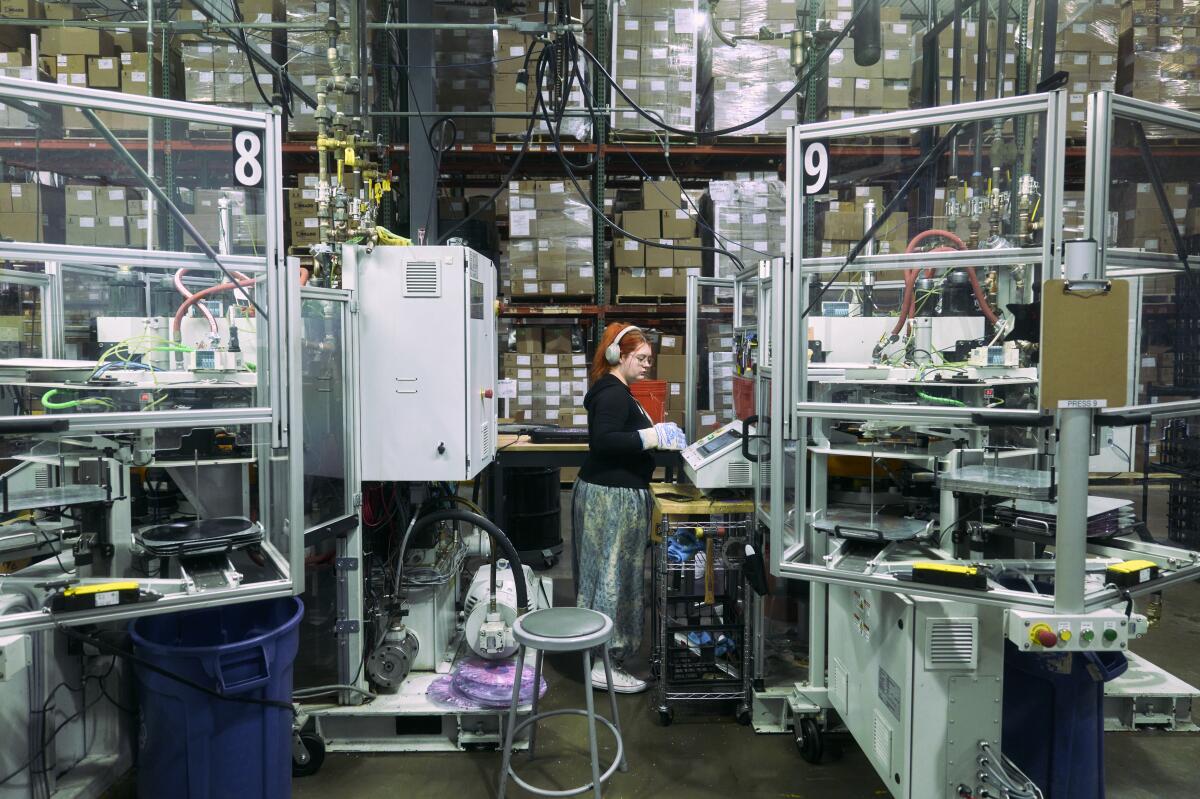
Soren Smith working at Independent Record Pressing in Bordentown, N.J., on May 26, 2026.
(Dutch Doscher / For The Times)
Largely, it’s been people like Swanson who have fully committed to the cause. He says that during the height of the COVID-19 pandemic, in an “activist moment,” several labels signed onto the Music Climate Pact, declaring their intention to reduce their emissions and be better stewards of Earth.
“It had almost no teeth to it,” Swanson explains. “A lot of people signed it, posted something on Instagram, and it sat there for a few years. For us, it was pretty frustrating … it felt very perfunctory.”
His work continued, along with a few others, thanks to support from Murmur, an organization designed to support labels and industry names, effectuating the commitments made when the Music Climate Pact was signed.
“We’re more doers than sayers,” Swanson says. “We’ve really been experimenting with what we’re calling ‘Revinyl’ — post-industrial, pre-consumer, recycled vinyl as a means to reduce our footprint at IRP.”
This is what some of Friday’s release is made of — all the trimmings, tidbits and overstock that would otherwise end up in landfills or on the factory floor. For the time being, it certainly won’t solve the climate cost of vinyl records, but it helps to mitigate it.
Between 2024 and 2025, total units produced at Independent Record Pressing increased by 41% while emissions — which also benefited from lower-carbon transportation — decreased by 34%.
“The idea is, if you can make those records 16% more efficient and also show fans of those records … that it is viable, maybe it makes it a little bit easier next year when we go out to ask other artists to jump on board,” Swanson explains. “We’re not making records that are just going to go sit on the shelf — these are records we’re continually repressing all the time anyway.”
Similarly, Ian Stanton, head of sustainability at Beggars Group, was among the first to sign the pact in 2021. His role was created five years ago to give indie labels a voice in light of minimal resources and capabilities. Though these roles do exist at larger labels, he says they have “slightly different drivers.”
When it comes to records, the pure plastic pollution that comes from them is also a concern. When old records make it to a landfill, they’re not only likely to outlive the site, but can also leach plasticizers, a Keele University report found.
“Vinyl is not like a single-use plastic; we don’t throw it away after one listen. We treasure it, we pass it on through generations, and people have a real connection with it,” he says. “But like any other product, there are ways of making it more sustainable.”
He refers to certain plastics, such as shrink wrap, as the most “visible” aspect of vinyl record pollution to consumers. From a collector’s point of view, shrink wrap can actually increase the value of a record. Though there has been discourse over the years around whether this can actually damage the sleeve, many sellers champion an “in the shrink” label as they mark up prices.
Splatter-patterned records arrive at the trim station at Independent Record Pressing in Bordentown, N.J., on May 26, 2026.
(Dutch Doscher / For The Times)
Other visible aspects, such as the paper sleeves in which the records are housed, are also harmful. However, Swanson says that swapping those for recycled materials outputs a relatively negligible difference in emissions impact, largely due to the process behind producing them.
For the time being, vinyl records made from reclaimed materials are the best that companies like Swanson’s can do, though they’re are always on the lookout for other, viable options for improving their footprint. As an example, they’re actively experimenting with how existing record material can help them.
What can the beat-up, worn-out records at your local thrift store do to dodge a landfill and keep the Earth spinning? As it stands, not much.
Stanton lists an array of challenges, including outdated materials, modern production regulations and contaminants.
“I suppose what we need with PVC for records is a really high-quality, contamination-free material to get that sound reproduction,” he explains. “When you bring in stuff from that post-consumer environment, you’ve got to make sure there’s no contamination in there, because you’re going to end up with sound quality issues.
“It’s all in process,” he adds.
For now, they look to fix the most immediate problems first, such as freight emissions, where Beggars Group has converted the vast majority of its shipping operations to sea freight, a far less harmful alternative compared with air freight.
“We want to look at the full life cycle … not only thinking from the cradle to the grave, but from the point where the raw materials are extracted at the beginning,” Stanton says. “This life cycle analysis now looks at all different environmental indicators on this — the chemical usage, the water usage, and the end-of-life impacts on that side of things.”
Nelly Korda’s bid for a U.S. Women’s Open title began Thursday with a foot fault.
The No. 1-ranked player opened her round at Riviera wearing a pair of golf shoes provided to her by LeBron James, Nike Victory Pro 4s with white uppers, gold swooshes, red-and-navy details and an American flag pin on the laces.
Snazzy as they looked, the shoes were a little loose fitting for Korda, who swapped them for a more familiar pair after she played the first six holes at one over par. She never really found her groove and finished the opening round with a two-over-par 73.
“Just hit it really poorly off the tee,” said Korda, who immediately headed to the practice range after meeting with the media following her round. “Found myself in a lot of trouble on the wrong side of a lot of these pins. I just felt like I was kind of just grinding to make safe pars. It wasn’t a great day. I hit it really good Monday through Wednesday, so I have honestly no idea where this came from.”
For others, Riviera — playing host to the major championship for the first time — was as comfortable as an old shoe.
Korea’s Sei Young Kim worked her way to the top of the leaderboard with a 67, making back-to-back birdies on the 10th and 11th holes, then three in a row on Nos. 6, 7 and 8.
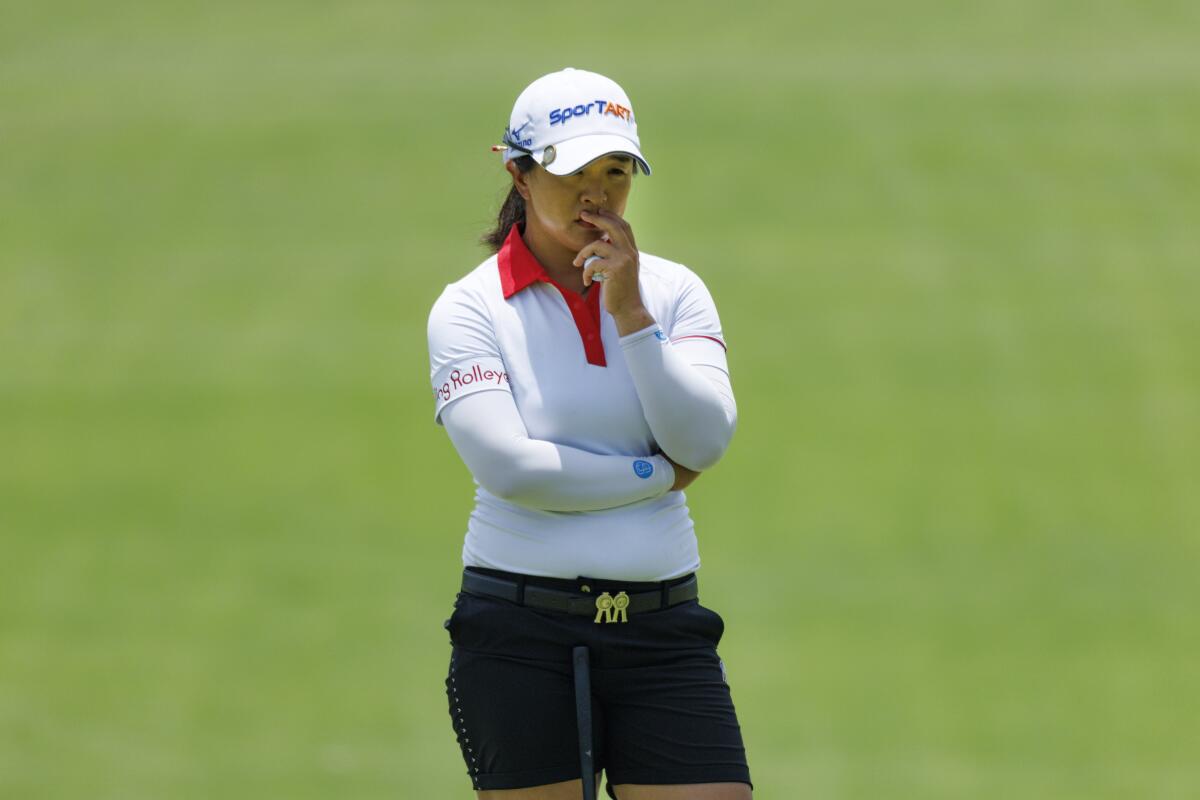
Sei Young Kim eyes her putting line on the ninth green during the first round of the U.S. Women’s Open at Riviera Country Club on Thursday.
(Gina Ferazzi / Los Angeles Times)
According to Elias Sports Bureau, Kim ended a personal streak of 43 consecutive major championship rounds shooting 70 or higher. It was the longest active streak of its kind entering this week.
“The U.S. Open is not regular — not the same as a regular tournament,” Kim said. “So you need to be really patient instead of attacking the pin. So I really try to follow what my caddie says.”
Some caddies have an even closer relationship with their players. On the bag for Michelle Wie West is her husband, Jonnie West, son of late NBA legend Jerry West. Wie West retired three years ago after the Open at Pebble Beach, but came out of retirement to use her last year of exemption to play on this iconic course, celebrating its centennial.
Wie West opened her round with a flourish, crushing her tee shot 293 yards down the left side. Although she missed the green on her approach, chipped up for a short birdie putt but missed it.
Wie West, once one of the biggest stars in the game, qualified for the USGA amateur championship at age 10, the youngest player to do so. She turned professional shortly before her 16th birthday and won five times on the LPGA Tour, with her only major victory coming at the U.S. Open in 2014.
Now a mother of two, Wie West said part of her motivation to return for this tournament was so her daughter, Makenna, who turned 6 this week, will have memories of her playing.
Michelle Wie West, right, and caddie Jonnie West, her husband, discuss an approach shot during a practic round Wednesday.
(Harry How / Getty Images)
“It’s everything,” Wie West said of that inspiration. “Being able to share this with her — even the last couple of months, just practicing. We talk a lot before she goes to bed, and I tell her what I do when she’s at school. ‘I had a tough day at practice. This is what I overcame.’”
Makenna is almost a sounding board.
“My daughter is like the best sports psychologist I’ve ever had, honestly. … I’m going to try to live by the words I tell my daughter. I always tell her before a game or tournament, ‘I don’t care about the results. All I care about is a good attitude and that you try your hardest.’ That’s my No. 1 goal this week.”
Still in search of her first major victory is Gaby López, whose 68 on Thursday put her just behind the leader. She grew up in Mexico City and said Riviera has a familiar and comfortable feel.
“It’s all high elevation [there] and flies way less here,” she said. “But the same kikuyu [grass] and the ball sits up, and you just have to be ready to hit some flier shots off the fairway.
“That rough, you can get lucky at times. … It’s so sticky it’s hard to get it out, especially when you’re going to have no spin. So you just have to be very specific where you’re going to miss it if you don’t hit the fairway.”
Lopez has started hot in the U.S. Open before, although she wasn’t pleased with those results. She was four under through her first nine holes in 2017 before going two over in her second nine. She shot a 70 that day and was tied for 13th after the opening round, but wound up missing the cut.
Her approach this year is simple and straightforward.
“Right now let’s be smart, let’s be focused on what you want to achieve,” she said, “and at the end of the day, let’s put yourself in a position that you can have a shot on the back nine on Sunday.”
L.A. Mayor Karen Bass made what sounded like a victory speech Tuesday night.
Councilmember Nithya Raman made what sounded almost like a concession speech.
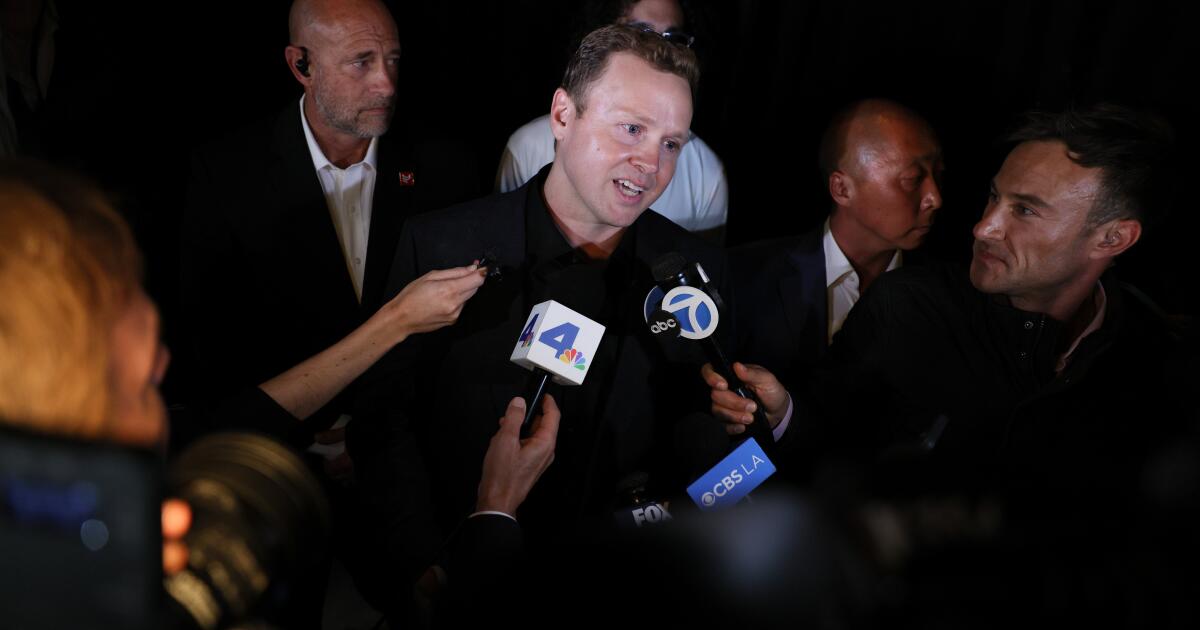
And former reality TV star Spencer Pratt relayed a message from the heavens.
“Well, obviously God wanted five more months of me exposing all the failures of our mayor, so it’s gonna be a fun ride,” Pratt said. “I hope she’s ready.”
Assuming Pratt holds on to one of the two spots in the Nov. 3 general election as the final votes are tallied in the next few days, the smart money will be on Bass, for reasons I’ll get into in a moment.
But the supreme being and patron of all pontiffs has to be considered a wild card. This is the first time, to my knowledge, that an incumbent mayor in the City of Angels would be running against a challenger whose campaign manager is God Almighty.
So here we go. We could be in for one of the more remarkable electoral adventures in city history, with a complete novice and MAGA conservative going up against a liberal career politician in a deep-blue city and state full of people who are tired of hearing excuses from Democrats. (If Raman ends up ousting Pratt, my apologies for jumping to conclusions. But it’s not my fault. The devil made me do it.)
If you intend to follow closely, as of course you should, maybe you can help me count the number of times Pratt plays the faith card. I went to St. Peter Martyr School and attended the church by the same name, and I don’t recall ever hearing a nun or a priest drop God’s name as often as Pratt does.
In fact, I just watched a clip of Pratt talking to Fox News TV host and Donald Trump disciple Kayleigh McEnany, and over the course of 1 minute and 52 seconds, he mentioned God or Jesus 10 times.
“Thankfully, I married an angel who was very connected with Jesus and has brought me to the light,” Pratt said of his wife and former reality TV co-star Heidi Montag. “It’s been very empowering to just pray and just be on his path and just say, ‘God, if you want me to save these animals, save these humans and protect my city, just keep putting me in the place where I can do that.’”
Is he running for mayor or cardinal?
Look, I totally respect your average true believer. But I’m not entirely comfortable with a mayor who might be sitting around City Hall waiting for signs and smoke signals rather than knowing what to do on his own.
God has a lot on his plate. He might be busy multiplying fishes and loaves so people don’t go hungry thanks to the president’s tariffs and warmongering. Is he going to rush to answer a prayer for guidance about underfunded parks or broken sidewalks in Los Angeles?
How did we get here, you ask?
Well, Pratt is an AI creation, in a way. A composite of sorts. You combine the forces of social media, political rebellion, second-rate celebrity obsession and the Peter Principle, and here’s a little Trump puppet walking around L.A. like he’s the chosen one.
Add to that the very real essence of his appeal to some voters:
Los Angeles has problems. Big problems that don’t get fixed quickly enough or at all, and Pratt represents the angry voter who wants to know why City Hall can’t do better and where all the money went. He’s absolutely right when he says we shouldn’t have people living on the streets, using drugs on the streets and dying on the streets.
But if Pratt is in the general election rather than Raman, we’re in for a national media circus rather than a summit on solutions. Raman is well-versed on matters of relevance and could have pushed back against Bass in substantive, detailed ways. On the other hand, as Pratt has fairly argued, Raman headed City Council’s homelessness committee, so isn’t she partly to blame for the failures she tried to pin on Bass?
As for Pratt’s policy chops, he has not responded to my offers of a get-together. Absent that, and given his careful avoidance of local reporters who know their stuff, I read his platform on his campaign website and I can tell you that while he touches on many of the right issues — public safety, fiscal integrity, homelessness — attention to detail and depth of knowledge are not God-given strengths.
Maybe Pratt can actually deliver on his promise of a “treatment-led recovery model that addresses mental illness and addiction as the primary drivers of chronic homelessness.” But that would require an act of God (which I suppose is possible given their relationship), because those matters are primarily under the direction of the county, not the city.
This is the main problem here. Bass was beatable, and could have been pushed by a serious challenger to do better.
In the last election, Rick Caruso gave her a scare. That was partly because he had some depth on the issues, he was a successful businessman and philanthropist, he had served on the police commission and the water and power board, he had built relationships across the city and, along with his family, he had poured time and millions of dollars into underserved communities.
In this election, it looks as though Bass could get lucky and face off against a guy who lost his house in the Palisades fire, saw a few homeless encampments through his car window, and decided he wanted to be mayor. Some might have questioned his hubris, but only before learning that he was on a mission from God.
If you’re keeping count, that’s nine mentions of God so far in this column.
One more for the tie, with an eye toward five more months of campaign fodder.
Brooke McCree, a 22-year-old recent UCLA graduate, is the first to admit she’s been going to the movies a lot less.
Back when Regency operated the local Village and Bruin theaters in Westwood Village, she would often take advantage of the student discount and see as many movies as possible. But in the two years since the theaters closed, she said moviegoing for many UCLA students has become inaccessible.
“At UCLA, it’s been rough because I’ll have to walk really far or take the bus [to the movies]. There’s nothing really nearby,” said McCree, who recalled fond memories of seeing movies like “Madame Web” and a “Hunger Games” prequel in a dense crowd of excited college students. “I was pretty devastated when it initially closed.”
There is still hope for the Village Theatre, which recently received a breath of new life thanks to some of Hollywood’s biggest names.
The event was reportedly the first of a limited number of premieres and screenings planned for this summer to support a 12-month renovation set to begin this fall.
A representative for Reitman declined to comment on the plans.
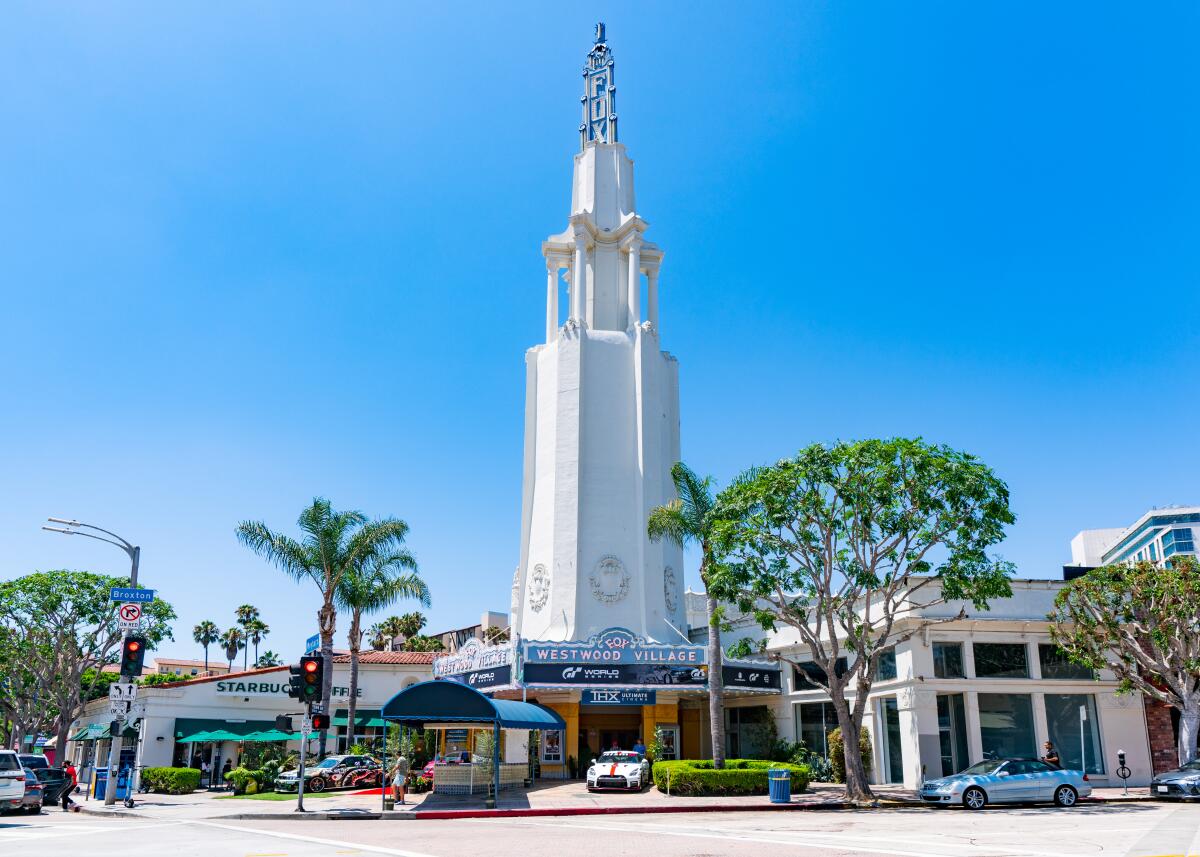
Nissan GT-R NISMO sports cars are seen outside the Fox Westwood Village Theatre, promoting the “Gran Turismo” movie in 2023.
(AaronP / Bauer-Griffin / GC Images )
The $25-million restoration, which organizers previously told The Times would be completed next year, includes plans for a restaurant, bar, gallery and a multipurpose space in the lobby for filmmakers and hosting premiere-related events.
Last year, the coalition of directors announced that American Cinematheque would operate the theater, hosting special screenings of new releases and repertory titles and conversations with filmmakers. The film non-profit already runs Santa Monica’s Aero Theatre and co-programs both the Egyptian Theatre in Hollywood and the Los Feliz 3.
Historically, the neighborhood has been a tricky market for businesses, said Jonathan Kuntz, a former lecturer at the UCLA School of Theater, Film and Television. He worked in the area for nearly 40 years and saw much turnover among local businesses due to high rents and inadequate parking.
“We’ve had some great things, like bookstores and eateries that have flourished sometimes for a decade or two, but it faded out,” Kuntz said. “[The theater] will certainly help Westwood if it is a success.”
For that to happen, Kuntz said, 1400-seat theater will need to screen a regular supply of films to a diverse customer base, including nearby students that have long been among its most frequent customers.
Many current UCLA students are already eagerly anticipating the theater’s reopening, said Ingrid Fan, a senior at the university majoring in public affairs.
“It’s been a bummer to have it closed for so long,” said Fan. “My friends and I always talk about how we just wish it opened sooner.”
While the theater’s renovation timeline won’t be complete before she graduates, she’s certain that other students will make good use of it when it reopens.
“Westwood is a college town, and we are always looking for a new source of community. It’s a space a lot of students would definitely flock to,” Fan said.
Broxton Avenue in Westwood Village during one of UCLA’s First Thursdays community events.
(Myung J. Chun / Los Angeles Times)
A historic movie hub
The university and its surrounding village, including the theater, were developed simultaneously throughout the 1920s and 1930s. Designed by Percy P. Lewis, the Westwood Village Theatre originally opened as a part of the Fox Theatres chain in 1931.
Despite launching during the Great Depression, the Westwood Village Theatre had a prime location working in its favor.
Westwood was imagined as a satellite town in West L.A. that would eventually support the growing UCLA campus. The neighborhood became known as the third major movie theater hub, behind downtown and Hollywood. In the 1920s, when the Chinese and the Egyptian theaters opened on Hollywood Boulevard, Westwood was next in line as a booming premiere destination.
“It was much more convenient to those folks than going to downtown Los Angeles, or even to Hollywood,” Kuntz said.
This was an era of moviegoing when premieres were essential to a movie’s box office success, drawing substantial marketing opportunities. The volume of films being produced at the time made it necessary to have multiple premiere-ready theaters around L.A., Kuntz said.
A “Terminator” poster is unveiled at the world premiere of “Terminator 3: Rise of the Machines” in 2003.
(Robert Mora / Getty Images)
Over its 95-year history, the venue has been remodeled a handful of times, including in the 1950s when television became a mainstream medium. Soon, multiplexes emerged, which put the Westwood Village location at a disadvantage. To this day, the theater can only show one film at a time.
In the 1970s, the venue joined the Mann Theatres chain, and in 1988, it was designated a historic cultural monument.
The ticket booth at the Regency Bruin theater in Westwood Village all boarded up, as seen on the afternoon of Nov. 3, 2020.
(Carolina A. Miranda / Los Angeles Times)
Regency continued to operate the two locations until its lease ended in 2024. Although the group of Hollywood directors was quick to bid on the Village (the Bruin was not included in the deal), the theater has remained closed since then, with the exception of the recent Billie Eilish premiere.
“A lot of people in Hollywood want to preserve at least some of what made classic Hollywood successful, like the big screen experience,” Kuntz said. “These folks are the ones who could afford to buy a movie house or two, program it and keep that tradition alive.”
L.A. Times staff writers Josh Rottenberg and Meg James contributed to this report.
COLLEGE STATION, Texas — As Augie Lopez trotted around the bases late Monday night, the small contingent of USC fans could finally be heard at Blue Bell Park. With one towering blast to right field, the Trojans’ designated hitter silenced Texas A&M’s rowdy 12th Man.
Lopez’s three-run home run helped push the Trojans over Texas A&M 7-1 to reach the NCAA super regional for the first time in 21 years.
Lopez silenced most of the sellout crowd of 7,042, making it easy to hear USC fans serenading him during the College Station Regional Final.
“Augie! Augie! Augie!” USC fans chanted after Lopez returned to the dugout. After the win, he was named the regional’s most outstanding player.
It took a while, but the offense showed up to propel USC (47-16) to the Chapel Hill Super Regional against North Carolina.
Until Lopez’s blast, Texas A&M right-hander Clayton Freshcorn had slowed down a USC offense that had scored 48 runs combined while winning three consecutive games out of the losers’ bracket, including 14 on Sunday night against Texas A&M (41-16), to force the winner-take-all final.
USC right-hander Grant Govel, who had thrown 89 pitches over 5⅔ innings on Friday, retired the first seven Aggies before Bear Harrison hit a solo home run to left-center field in the third.
The Aggies ran out a threat in the fourth. Chris Hacopian drew a leadoff walk. Ben Royo kept the inning alive with a two-out single to left. Jorian Wilson followed with a single to shallow right-center field. Second baseman Abbrie Covarrubias was positioned perfectly to field the ball in the outfield, but his throw to first wasn’t in time.
Fortunately for the Trojans, Adrian Lopez alertly threw home to easily nail Hacopian by several feet to end the inning.
Covarrubias tied the score 1-1 with an RBI single to left-center in the fifth. One out later, Covarrubias stole second. Augie Lopez broke the tie with a single to right-center.
Two innings later, Lopez crushed his three-run blast.
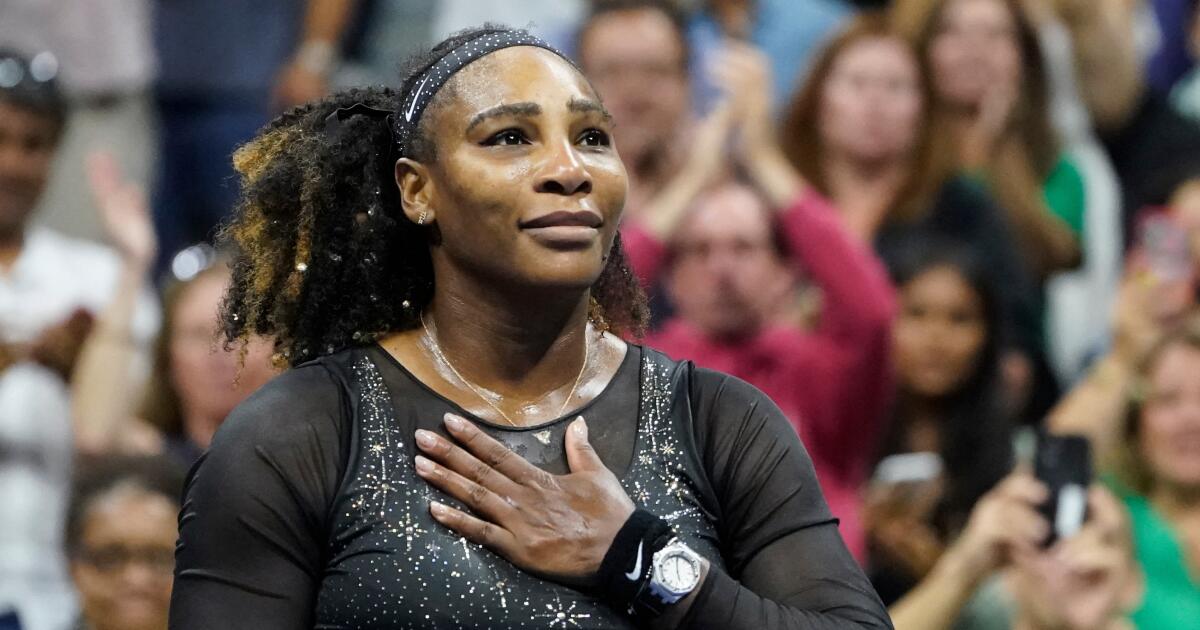
Serena Williams is returning to competitive tennis after all.
Months after insisting on social media, “Omg yall I’m NOT coming back,” the 23-time Grand Slam singles champion announced Monday that she’ll play professionally for the first time in almost four years at the HSBC Championships at the Queen’s Club in London.
Williams, 44, has been given a wild-card entry into the doubles draw of the WTA 500 event, which begins June 8.
“Queen’s Club feels like the perfect place to begin this next chapter,” Williams said in a statement released by the tournament. “Grass has given me some of the most meaningful moments of my career, and I’m excited to be back competing on one of the sport’s most iconic stages.”
Williams teased the announcement earlier Monday by posting a video on social media that featured her phone‘s notifications going off constantly while she seemingly was practicing on the court.
“Good news travels fast,” Williams wrote on the post.
Tournament director Laura Robson said during TNT Sports UK’s coverage of the French Open on Monday that Williams’ playing partner will be Canadian teenager Victoria Mboko, who is ranked No. 9 in WTA singles. Williams has won 14 Grand Slam titles and three Olympic gold medals in doubles with her sister Venus Williams as her partner.
It is not clear whether Williams will participate in any other events. Wimbledon, a Grand Slam event Williams won seven times in singles, begins June 29 in London.
Williams’ last professional match was a loss to Australian Ajla Tomljanovic in the third round of the U.S. Open on Sept. 2, 2002. She registered as retired with the International Tennis Integrity Agency the next day.
Last December, however, Williams reentered the agency’s drug-testing pool. According to the ITIA website, retired players “may not return to sanctioned events unless they have made themselves available for out-of-competition testing for at least six months prior to the event in question.”
The move led to much speculation about a possible Williams return, leading to her social media post denying any such intentions.
Martina Navratilova, the 18-time Grand Slam champion who is the oldest woman to win a tour-level singles match — she was 47 when she won a Wimbledon match in 2004 — expressed excitement for Williams’ return.
“Serena brought the game to another level and it is incredible for the sport that she’s pushing the boundaries and coming back,” Navratilova said in a statement released by the WTA. “To many of the younger players, they never had the opportunity to play her; some may have never watched her on television, so this will be a new and exciting experience.”
Saint Mary’s has achieved the seemingly unthinkable — the Gaels have eliminated UCLA, the nation’s top-ranked team, from the NCAA tournament.
With two outs in the 10th inning, Makoa Sniffen drove in Cody Kashimoto on a walk-off single off UCLA reliever Easton Hawk to lift Saint Mary’s to a 6-5 comeback win Sunday in a Los Angeles Regional elimination game at Jackie Robinson Stadium.
The Gaels (36-26), who also stunned the Bruins (52-8) in the regional opener on Friday, made the Big Ten champions just the second NCAA No. 1 overall seed — after Vanderbilt in 2025 — to be eliminated from the regional round since the current format was established in 1999.
“Obviously, this weekend, we just did not play up to our standards,” UCLA coach John Savage said. “I really felt it was a struggle, for whatever reason — all three games, really. But it’s nothing to take away from this team. You win 52 games [and are] preseason [No.1], and you never leave that spot; it’s really remarkable and a lot of credit to our captains, to our seniors, to the entire program … I just can’t say enough about the people that I’m around and that I’ve coached.”
Against all odds, Saint Mary’s is still alive and playing Cal Poly in the regional final on Sunday night.
“Felt like 12 rounds with the heavyweight champ,” Saint Mary’s coach Eric Valenzuela said of the Gaels’ wins over UCLA. “So proud of our group, the fight.”
Favored to win their first national title since 2013, the Bruins led the Gaels 5-4 entering the ninth and needed just three outs to continue what had been the program’s best season ever.
But Tanner Griffith led with a base hit off UCLA reliever Cal Randall and — after being moved to second following a sacrifice bunt from Diego Castellanos — catcher Ian Armstrong brought Griffith home with an RBI single to right field off Hawk.
Saint Mary’s reliever David Roberts retired the Bruins in order in the 10th. Hawk then struck out Brayden Gutierrez before Kashimoto hit an infield single. Griffith advanced Kashimoto to second on a groundout to first. Two batters later, Sniffen’s hit to left field gave Kashimoto just enough time to beat a throw to the plate, sealing the Gaels’ win.
Randall and Hawk pitched in all three of UCLA’s regional games. Savage saluted the entire pitching staff — highlighting Angel Cervantes’ development as a freshman — but added that Logan Reddemann’s absence had a “major effect” on the staff. The ace right-hander hadn’t pitched since April 17 because of arm soreness.
“It had a ripple effect on the starters, had a ripple effect on the bullpen,” Savage said of Reddemann’s absence. “The effect it had on roles, the effect it had on usage [was a] major deal. No excuses, because [we] still won. But at the same time, it looked a little different and it felt a little different, and at the end, I think it really hurt losing a potential first-rounder the last six weeks.”
The Big Ten coach of the year took the time to acknowledge the Bruins’ junior class for sticking with the program throughout its ascent, admiring the “all kinds of players” he expects to be selected in July’s MLB draft.
Savage, though, was particularly emotional when discussing the eventual departure of shortstop and back-to-back Big Ten player of the year Roch Cholowsky, who is widely expected to be a first-round pick.
“Cholowsky just meant so much to the program,” Savage said. “He just had such an impact on the program. He had such an impact on people. Had impact on a fan base. Had impact on the community. Just such a winning, winning player. It’s hard to watch a guy like that leave … but it’s what he’s all about. He’s all about the right things.
“He’s a Bruin through and through. And at the end of the day, you couldn’t ask for a better player or a better person than Roch.”
Led by Cholowsky and eight other All-Big Ten selections, with the best team ERA (3.27) throughout the regular season, the Bruins had lost merely six times before the regional and had won every series.
But after losing two games to Saint Mary’s, as regional hosts for a second consecutive year, UCLA has no choice but to go back to the drawing board in preparation for 2027.
“I feel for them,” Savage said of his clubhouse. “It’s the college game … anything can happen. We didn’t play well enough this weekend.”
Philadelphia’s Edmundo Sosa sauntered out of the box, motioning with one hand in a pump-wave in front of 51,794 Dodgers fans. The left fielder, who had taken over for Brandon Marsh in the top of the sixth, connected on a four-seam fastball that Dodgers reliever Tanner Scott left too far over the plate for a two-run home run that put the Phillies ahead.
The Dodgers had been playing with fire all night, but they couldn’t regain momentum after Scott’s struggles, losing to the Phillies 4-3 to set up a Sunday series rubber match.
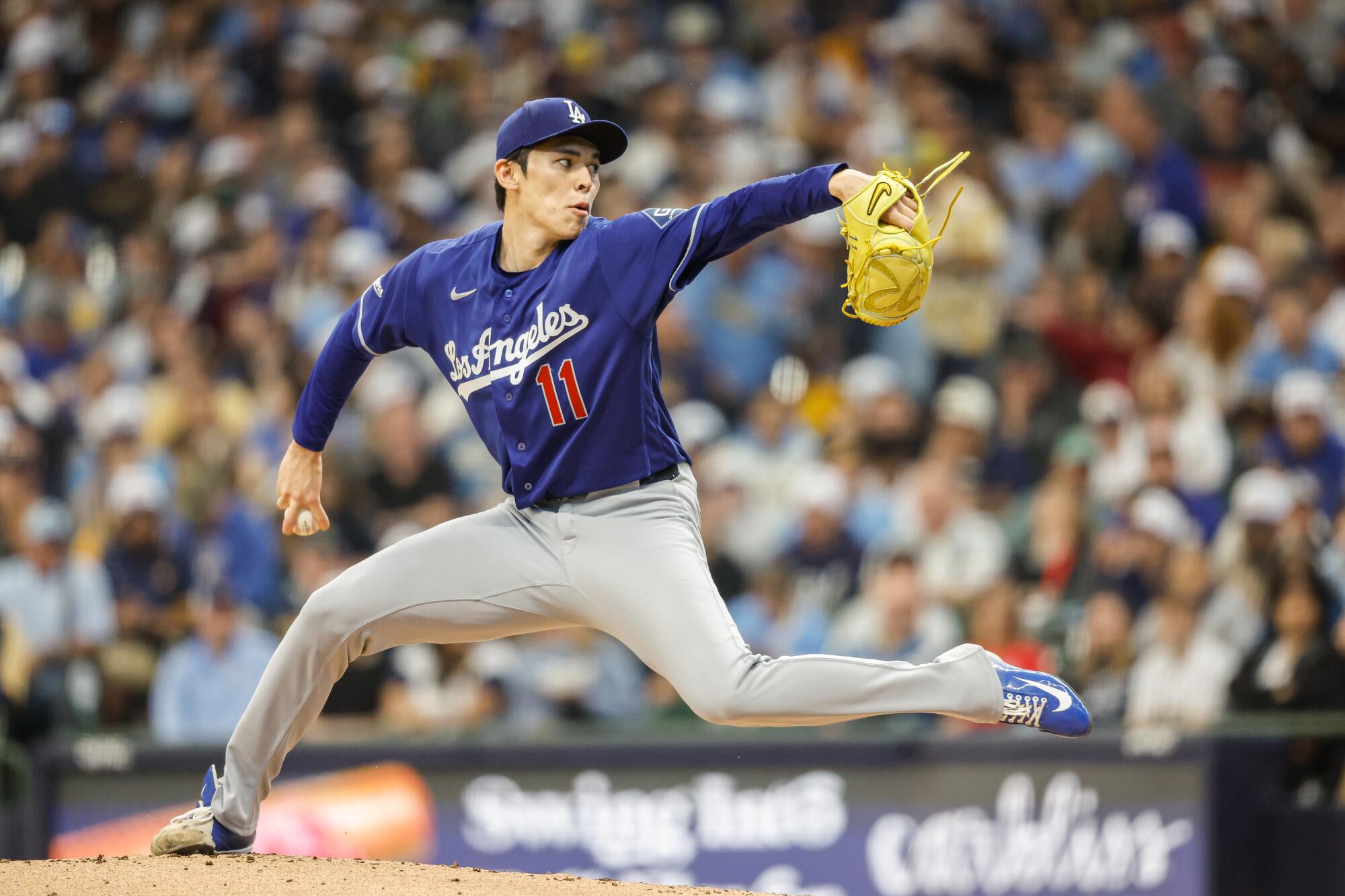
The Dodgers (37-21) started strong, with pitcher Roki Sasaki giving up just three hits and one earned run over 5⅓ innings.
Sasaki’s elevated velocity posed early concerns for the Dodgers as he struggled more with his command. The right-hander crossed the 100-mph threshold for the first time this season on two pitches: a 100.4mph four-seam to J.T. Realmuto and another fastball, this time 100.1mph, to Kyle Schwarber.
Three of his four pitches — the four-seam, slider and splitter — averaged at least 1.2 mph faster than his yearly average. As a result, he struggled with location. Neither his slider and splitter hit the zone more than 45% of the time. Even his fastball hit the strike zone a mere 55%.
Dodgers manager Dave Roberts warned about this scenario when Sasaki’s fastball had only reached an upper limit of 99.5 mph.
“I think now the velo is certainly in a good spot,” Roberts said before the game. “I do believe that if he wanted to throw 100 miles an hour, he could do that, but it wouldn’t be where he needed to throw it.”
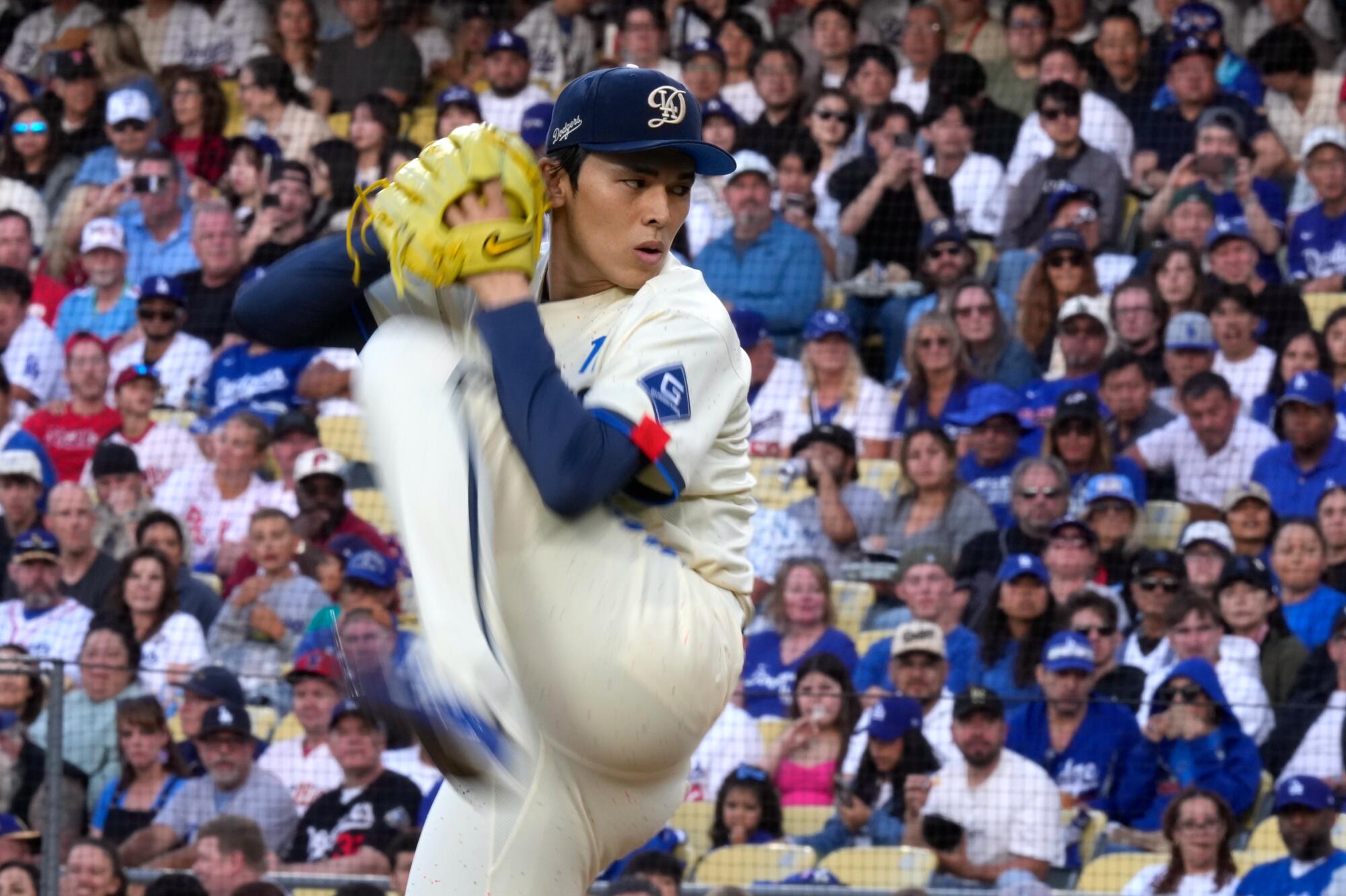
Dodgers starting pitcher Roki Sasaki delivers during the first inning Saturday against the Phillies.
(Mark J. Terrill / Associated Press)
Still, the Phillies (30-28) struggled to generate consistent momentum despite Sasaki’s location problems. Phillies third baseman Alec Bohm hammered a four-seam fastball that skimmed the top of the strike zone over the center field wall. The rest of the Phillies lineup ended most of their at-bats with little luck, striking out seven times and walking only once.
Roberts pulled Sasaki with runners on first and second in the sixth. Left-hander Alex Vesia walked Bryce Harper but escaped a one-out, bases-loaded jam by striking out Sosa and forcing Alec Bohm into a ground out to third.
By then, the Dodgers had already established a lead. Alex Call put them on the board in the second on a poked single through the gap between second and short. In the fourth, Call reached third on a double and throwing error from Adolis García. Santiago Espinal hit a sacrifice fly to deep center field, driving in Call.
Mookie Betts also found his footing after he went 0 for 3 on Friday. The shortstop struggled in the first four games of the Dodgers’ homestand, batting .200 across 15 plate appearances. Against the Phillies on Saturday night, Betts laced two singles and a double.
Andy Pages scored on a close play at the plate after Betts singled to shallow right field in the seventh. Although catcher J.T. Realmuto missed tagging Pages’ foot, the Dodgers center fielder’s cleat didn’t appear to touch the plate. After a long review, the safe at home call stood.
But the Dodgers’ good fortune didn’t last. Scott gave up an RBI single to Bryce Harper, and it was like the Phillies could sense exactly when the reliever’s pitches crossed over the zone. Scott (1-2) then gave up the home run to Soto before going down in order on three groundouts in the ninth.
“Dress shabbily and they remember the dress; dress impeccably and they remember the woman.” ― Coco Chanel
Apropos of Paris. Apropos of the French Open.
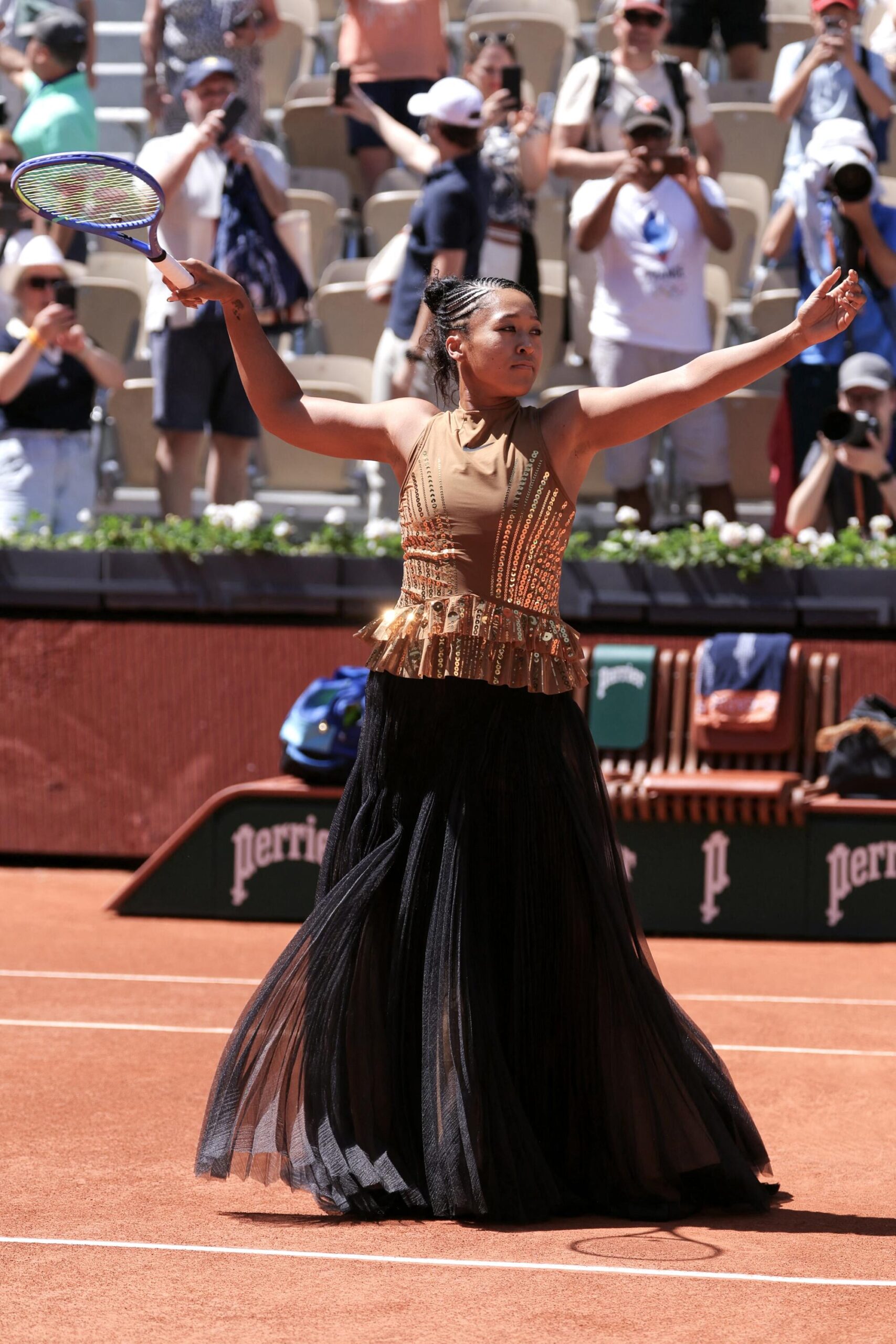
That’s all the context necessary to appreciate Naomi Osaka removing a ceremonial black skirt and sleeveless beaded bodice ahead of her opening match at the Roland-Garros Complex this week, revealing a sequined gold playing dress.
Osaka was playing all right. With sensibilities. With tradition. With her opponents, who she summarily dispatched with victories in the first and second rounds.
Naomi Osaka arrives on Court Suzanne-Lenglen to play her singles match against Laura Siegemund.
(THOMAS SAMSON/AFP via Getty Images)
And it was clear the four-time Grand Slam champion was playing with all of us when she said of her dress, “It’s very couture. You know the Eiffel Tower at night when it’s sparkly? I kind of think I look like that a little bit.”
Countless LinkedIn pages spout something about residing at the intersection of sport and fashion. Osaka locates that intersection at tennis tournaments worldwide, looks both ways and boldly steps into the street.
Last year at the U.S. Open she adorned her ponytail with red roses and attached a Labubu to her tennis bag that she named Billie Jean Bling.
At the Australian Open in January, she entered the court in a tie-dye turquoise and green palette with flowing tendrils. Her face was concealed by a veil, a wide-brim hat and a white parasol that she said was inspired by an image of a jellyfish that excited her 2-year-old daughter.
Naomi Osaka walking onto the court in a jellyfish-inspired ensemble ahead of her first-round match at the 2026 Australian Open in Melbourne.
(Quinn Rooney/Getty Images)
It’s all great fun. Yet continued fashion statements depend on her performance on the court. Osaka wins, she earns another grand entrance. She loses, nobody cares what she wears on the ride home.
At the U.S. Open, Osaka shined, reaching the women’s singles semifinals. Seeded as an also-ran at No. 23, she upset Coco Gauff and Karolina Muchova before falling in a tight three-set match to Amanda Anisimova.
Seeded No. 16 in Australia, she won two matches before withdrawing because of an abdominal injury suffered during her three-set victory against Sorana Cîrstea.
Fast forward to the French Open. Osaka advanced to the third round for the first time in seven years Thursday with a 7-6 (7/1), 6-4 win against Croatia’s Donna Vekic and will take on teenager Iva Jovic on Saturday.
What she will wear walking in is anybody’s guess. An effortless chic aesthetic courses through Paris. Advancing to the French Open round of 16 for the first time would require the opposite, Osaka toiling through another step in her return to form after giving birth to her daughter.
And creating another opportunity to have fun with fashion.
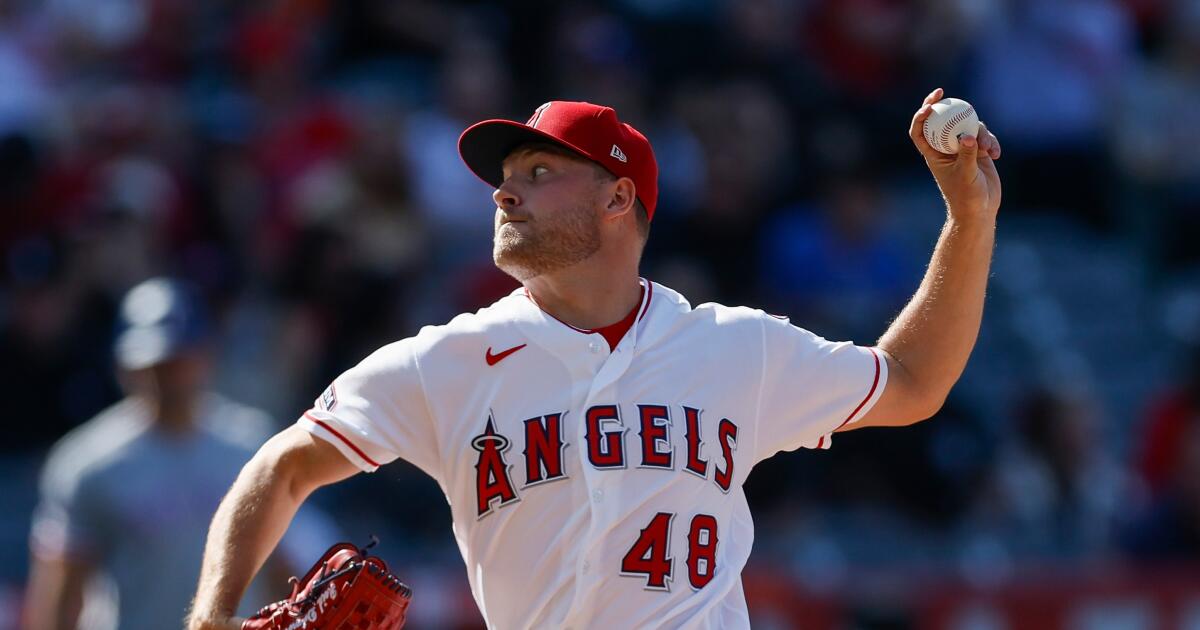
Reid Detmers had a career-high 14 strikeouts and pinch runner Donovan Walton touched home on an errant throw in the ninth to give the Angels a walk-off 2-1 win at Angel Stadium and their first three-game sweep of the season.
With one out and runners on first and second in the ninth, third baseman Oswald Peraza grounded into a fielder’s choice at second. Rangers second baseman Justin Foscue bobbled the ball and first baseman Jake Burger couldn’t cleanly field his throw, allowing Walton to advance from second to score the game-winning run.
The Angels’ dugout erupted as Walton scored.
“That was amazing,” Peraza said. “I went up there and just put the ball in play, and not trying too much. I’m happy for the sweep. And yeah, amazing.”
The win sealed the Angels’ fourth series victory and second three-game winning streak of the year.
Detmers (1-5) entered on a three-game skid and finished dominantly after yielding a second-inning home run to Burger.
The left-handed pitcher ultimately gave up one hit and one run through eight innings — his first time pitching through eight innings in 2026 and first time since his no-hitter as a rookie in 2022 — while setting a new personal best with 14 strikeouts to zero walks.
“I mean, you realize it, but you don’t really think much of it,” Detmers said when asked if he was aware of his strikeout count. “It’s more just, ‘How can I get this next guy out?’ Like I said a little bit ago, just stick with the process, don’t overthink stuff. There’s not a whole lot that goes into it, to be honest with you …”
In front of an announced crowd of 36,903 on “Little League Day” in Anaheim, the 26-year-old used 96 pitches to lower his ERA from 5.07 to 4.57 in the win.
Rangers left-handed starter MacKenzie Gore (3-4) dueled, too, giving up one hit, two walks and one run through six innings.
“Gore was really good today,” Detmers said. “His stuff was really good today. He kept us off balance and got out of a couple of big situations.”
But the Angels’ offense, finishing with four hits, found a way to make do without solely relying on the long ball.
Mike Trout started the Angels’ scoring in the third with a two-out single to score Sebastián Rivero from second and tie the score at one.
The Angels’ run support behind Detmers was far from ideal. But Angels manager Kurt Suzuki is proud of his team’s effort in what was a pitcher’s duel.
“Like we talked about, you put the ball in play, things happen,” Suzuki said. “You never know what can happen when you put the ball in play. And you know, [Peraza] showed right there with the speed and putting it in play … forcing the issue a little bit.”
After Detmers and Gore sat down, Gavin Collyer (0-1) earned the loss, and Angels right-handed reliever Sam Bachman earned his first win of the year after striking out Rangers right fielder Brandon Nimmo to get out of a two-out, bases-loaded jam in the ninth.
Glad his team won, Detmers considers Sunday’s game his second-best career performance after his no-hitter. Suzuki, who was Angels teammates with Detmers during his no-hitter from four seasons ago, also chimed in.
“Yeah, I mean, never discredit a no-hitter, right?” Suzuki said. “A no-hitter is special. But for him, I think what made [Sunday] … he was better was the strikeouts, right? It was not many balls put in play, that’s for sure … He struck out 14 guys, [and] to do it under 100 pitches, that’s even more impressive. That means you’re getting in, getting out of there really quick. So, I think … just probably the best start he’s had.”
Despite the recent uproar among fans frustrated with the Angels, whose 20-34 record is tied for worst in MLB with the Rockies, the Angels aim to stay hot.
“Well, as you know, we need more wins,” Peraza said. “[We’re] working very hard every day for that result.”
MILWAUKEE — Teoscar Hernández backpedaled up the line as he watched the flight of his deep fly ball down the left-field line.
It clanged off the left-field foul pole to give the Dodgers the lead for the first time in a game they’d win 11-3.
“It was big,” Hernández said after going three for four with six RBIs, tying a career high. “We took the lead, and that was the best thing. We put less pressure on [starter Roki] Sasaki, so he could keep pitching the way he was pitching after the first inning. So it was a great [fourth] inning.”
The Dodgers’ offense, led by Hernández, came alive after a quiet first game of the series.
His heroics in the comeback victory — which also included a record-setting performance from the bullpen — were a high point in his offensive turnaround the last two weeks.
“I just think that he’s heightened his focus,” manager Dave Roberts said. “I think that his at-bat quality has been considerably better. I don’t think he’s wasting at-bats.
“For me personally, early on, I think that there was a couple of at-bats per night that he was just giving away. And now the last eight days, something like that, I don’t see him giving away any at-bats. And the production has reflected that.”
Hernández’ first hit of the game was made all the more dramatic by the rut the Dodgers started in.
Dodgers pitcher Roki Sasaki throws during the first inning of a win over the Brewers on Saturday in Milwaukee.
(Jeffrey Phelps / Ap Photo/jeffrey Phelps)
Sasaki, coming off his best start of his MLB career against the Angels last week, ran into trouble right away against the Brewers.
Six pitches in, he’d already given up back-to-back doubles en route to the first run. To make matters worse, his own error extended the inning. He got the Brewers’ Andrew Vaughn to chase a low splitter for a swinging bunt up the third-base line. Sasaki barehanded it cleanly but threw behind Vaughn. As the ball caromed off the retaining wall in foul territory, another run scored.
A fielder’s choice and a walk later, pitching coach Mark Prior strode out of the dugout for a mound visit. The Brewers played “Message in a Bottle” over the loudspeakers.
Sasaki answered his own SOS, with some help from his defense. He struck out Jake Bauers. And then in a 2-2 count to Sal Frelick, Sasaki threw a fastball up and out of the zone. Frelick got on top of it to line a single off the end of shortstop Mookie Betts’ glove as he leaped after it.
The single drove in a third run, but center fielder Andy Pages scooped up the ball and caught Gary Sánchez trying to go from first to third on the play, ending the inning.
Then Sasaki held the Brewers scoreless for the next four innings, retiring 10 straight as he bided time for the offense to make up the deficit.
The Dodgers’ Freddie Freeman slides safely past the Brewers’ Gary Sánchez to score a run during the eighth inning Saturday in Milwaukee.
(Patrick McDermott / Getty Images)
“It seemed a little like Groundhog Day that first inning, how it started,” Roberts said. “But for Roki to find a way to get out of it with three runs, and then settle in, settle down — his stuff got better in the third, fourth and fifth innings, and I told him that. Young pitchers, to understand that even if you get hit in the mouth early, you gotta find a way to keep going, so you don’t blow up your bullpen.”
Freddie Freeman got the Dodgers’ fourth-inning rally started with a leadoff double. Then Pages drove him in by roping his own double into the left-field corner, trimming the Brewers’ lead to two runs.
When Kyle Tucker drew a one-out walk, he gave Hernández the chance to put the Dodgers ahead with one swing. He took it.
“I’m just hitting the ball in the air, hitting it hard,” Hernández said. “That’s what you want as a hitter, and I think that’s what’s been the difference between the last two weeks [versus] the weeks before.”
He entered Saturday with a 1.001 OPS since the beginning of last homestand, compared to a .667 OPS up to that point.
Going into a three-city road trip last week, Hernández said refusing to dwell on poor results, especially in big situations, had been key.
“It was more like getting confidence and getting to trust myself again,” Hernández said. “And then just go out there and trust my swing, trust the work, and just trying to select better pitches to hit.”
In addition to coming up in the big situation, Hernández also contributed to the Dodgers’ late rallies, as they batting through the order in both the eighth and ninth innings to tack on seven runs.
The Dodgers’ bullpen shut down the Brewers for four innings. The performance from Alex Vesia, Kyle Hurt, Tanner Scott and Jonathan Hernández extended the bullpen’s scoreless streak to 36 consecutive innings, eclipsing the Dodgers’ previous record of 33 innings in 1998.
“The biggest thing is that they’re attacking in the hitters, they’re pounding in the strike zone, and when they need a pitch for a double play, they executed really well,” Teoscar Hernández said. “In ‘24 they helped us a lot, ‘25 too, and this year is not going to be different. They’re built for this, and they’re ready for it.”
Injury update
Dodgers third baseman Max Muncy’s right wrist was sore Saturday, as expected after he was hit by a 95.5-mph sinker the night before.
“We’re going to kind of give him a rest day to try to get that swelling out, and then see where he’s at [Sunday],” Roberts said. “And like I said, he’ll be down for the weekend, and then we’ll kind of see where we get to on Monday.”
Depending on how he’s recovering, the Dodgers could send Muncy to get a CT scan when they’re back in Los Angeles.
Dodgers utility player Kiké Hernández (left elbow surgery recovery) is expected to join the team Monday in Los Angeles. Roberts plans to write him into the starting lineup when Rockies left-hander Kyle Freeland starts against the Dodgers.
Taylor returns
A day after word spread former Dodger Chris Taylor had opted to retire, he reportedly changed his mind and joined the Minor League Baseball injury list with a left forearm fracture.