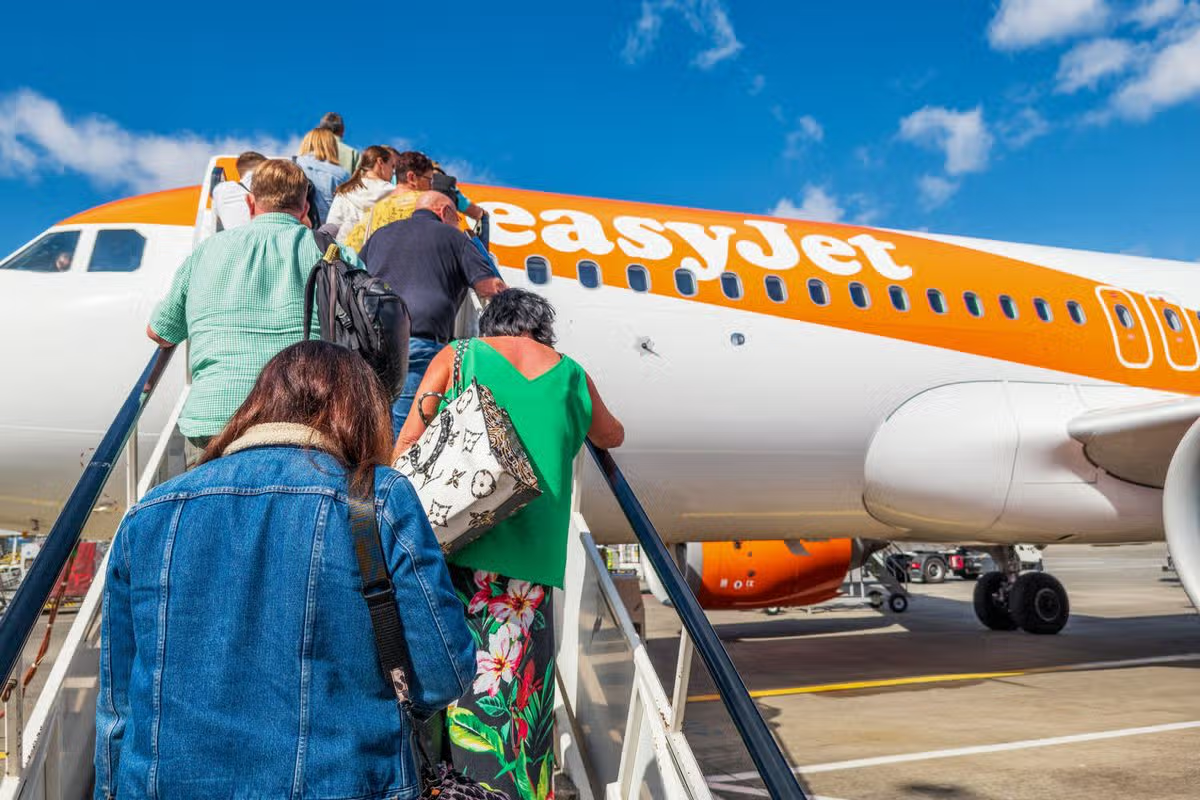
Fee

Holiday destination ditches its £40 tourist fee for Brits just in time for summer trips

The Electronic Travel Authorisation fee for British holidaymakers travelling to this holiday hotspot has been scrapped, saving Brits around £40 and making the tropical destination even more accessible this summer

Travelling to a tropical holiday destination has just become even more appealing, as Brits no longer need to fork out a tourist fee.

British holidaymakers planning to discover the stunning country of Sri Lanka won’t have to worry about shelling out an extra tourist fee, as it was abolished from Monday, 25 May. The Sri Lankan government confirmed it had made its Electronic Travel Authorisation (ETA) free for UK visitors, scrapping the $50 fee (around £37) in an effort to draw more tourists to the South Asian nation.

The change has come into force for the UK, along with 39 other countries. Brits planning a trip to Sri Lanka will need to apply for a free ETA, which is a type of visa, prior to departure, and will be valid for 30 days.

Those wishing to extend their time in Sri Lanka can apply online via the country’s official Immigration portal. The Foreign, Commonwealth and Development Office confirmed: “You do not need a visa if you are transiting through Sri Lanka by air, if the connecting flight is within 24 hours of your arrival. Check with your airlines about transit times.”

However, the FCDO also cautioned: “If you overstay the period of your ETA (30 days), you risk being subject to immigration procedures that may include temporary detention, a fine, deportation at your own expense, a travel ban or refusal of entry to Sri Lanka in the future.”

To enter Sri Lanka, British travellers must also confirm their passport has an expiry date of at least six months beyond their arrival date. Should the passport fail to meet this requirement, holidaymakers risk being turned away at the border, reports the Liverpool Echo.

While travel to Sri Lanka faced restrictions earlier this year owing to the Middle East conflict, there is presently no Foreign Office guidance advising against travel to the nation for Brits. That said, they do caution that there have been “global travel impacts due to escalation in the Middle East.”

The FCDO outlined: “Escalation in the Middle East has caused widespread travel disruption, including airspace closures, delayed and cancelled flights. Your travel plans may be affected, even if your destination is not in the Middle East.

“Some flights from Colombo to the UK via Middle Eastern hubs may be delayed, postponed, or rerouted. British nationals in Sri Lanka should check the latest updates from their airlines and consider alternative carriers or routes where necessary.”

The FCDO advises that tourists should do the following things before they travel:

  • Check travel advice for any countries or territories you are transiting through
  • Check for the latest updates from your airline or tour operator
  • Review your travel insurance policy for coverage
  • Monitor local and international media for the latest information and sign up for travel advice email alerts

For further details, visit the Foreign Office travel advice page.

Source link

Bipartisan bill proposes $130 fee for electric vehicles

May 19 (UPI) — A bipartisan bill in the U.S. House is proposing a new $130 fee for registering an electric vehicle to help pay for transportation infrastructure.

The Five-Year Surface Transportation Reauthorization bill was introduced on Sunday by Reps. Sam Graves, R-Mo., and Rick Larsen, D-Wash. As proposed, it would require an annual $130 registration fee for electric vehicles and $35 for plug-in hybrids.

Graves said in a statement that the bill “ensures that electric vehicle owners begin paying their fair share for the use of our roads.”

Currently, the Highway Trust Fund is used to pay for county roads, bridges, railways and other infrastructure projects. The fund is filled by taxes on gasoline.

“The ‘user pays’ principle has been fundamental to how we fund our nation’s surface transportation system for as long as I’ve been in Congress,” Larsen said in a statement. “I support that principle and worked to make sure that this new fee on EVs is fair and not punitive.”

Albert Gore III, executive director of the Zero Emission Transportation Association, said the fees would penalize electric vehicle owners. The organization estimates that the fee is higher than what is collected on the gas tax on a per-consumer basis.

The federal gasoline tax is about $0.18 per gallon. It has not changed since 1993.

“I don’t argue that the number should be zero, but the number should be fair,” Gore said.

Congress eliminated electric vehicle subsidies last year, totaling about $7,500 per vehicle, as part of an effort to peel back sustainability and environmental efforts enacted under the Biden administration.

Fees on electric vehicle owners are in place in at least 41 states,

Vice President JD Vance speaks during a news conference on anti-fraud initiatives in the Indian Treaty Room of the Eisenhower Executive Office Building at the White House on Wednesday. Photo by Daniel Heuer/UPI | License Photo

including Colorado and New Jersey, ranging from $50 to $260.

Source link

Brittany Hampton, Courtney Mays and Dex Robinson on styling athletes

Over the last five years, there has been a significant shift in how fashion and sports intersect, both on and off the court, with athletes’ influence extending beyond the court and into culture at large. Why now? And how has athlete style evolved?

These were some of the questions that three prominent athlete stylists — Brittany Hampton, Courtney Mays and Dex Robinson — unpacked last week at the panel “Game Changers: Where Sport Meets Style.” Moderated by Image contributor Darian Symoné Harvin and co-organized with the Only Agency, the event took place at the private members club Gravitas, a hub for folks at the intersection of sports, business and luxury in Beverly Hills. Gathered in the swanky yet intimate upstairs bar and events room, guests sat in plush chairs and sipped pink vodka cocktails and flipped through Image’s May sports and arts issue ahead of it hitting the newsstands. An also-plush takeaway? Stress balls in the shape of footballs, courtesy of the Only Agency.

The evening could’ve kept going — Hampton, Mays and Robinson had so much to say about an industry that is still widely misunderstood and filled with gatekeeping. The below edited version of the conversation gives you a glimpse into the demanding yet deeply fulfilling world of styling athletes.

Darian Symoné Harvin: Athletes often are not sample size. How do you source clothes and work with brands? Are they supportive? Anything you would tell brands if you could?

Courtney Mays: Size inclusivity is a huge thing. Because, especially when you’re talking about the W[NBA], you’re talking about women who are sometimes a men’s size 13 shoe, who are sometimes a 36-inch inseam. And although we’re using this platform to talk about larger issues, sometimes the larger issue is: I’m here and I’m a plus-size woman. Sometimes you have to use your presence to talk about those things, if you’re not verbally saying that, [and] you have to get the brands to stand behind you.

Stylist Courtney Mays

“We’re making sure that that Old Navy looks like Bottega,” said Courtney Mays, “so that at the end of the day you feel like the superstar that you are. We’re really curating the moment.”

Brittany Hampton: It’s also important for everyone that’s in the room to know that stylists can’t always get the ask that you guys may be asking for. If I have a seven-foot athlete, which I do have on my roster, and he’s, you know, he’s massive — he wears a 16-and-a-half shoe. There may only be a few brands [with his size]. There are going to be certain things that I may even have to pull out of his own closet. And then it still means, “Well, why do we have to give you that budget for that?” And it’s like, well, because I had to have an assistant go get that piece from his closet, have it dry-cleaned, have it picked up, then have it delivered to set. It’s still a process, there’s value in the work that we put in. We’re trying our hardest.

DSH: From a tunnel walk to a press run to a campaign, how do you break down your budget and your fee?

Dex Robinson: Each stylist approaches fees and pricing a different way, right? Also depends on how you were groomed or how you came into the situation. I was an assistant for years before I ever said I was a stylist, and even then I kind of treaded lightly before I was like, “I am a lead stylist.” I was someone’s assistant, and that’s when I asked all the questions that I needed to ask about what my fees would be. I knew the structures, I knew the things, so I wasn’t asking my peers, “Oh, how do I charge for this?”

BH: I do want to jump in and state for the people in the room that may or may not know we’re speaking in terms of expenses. The current budgets that they are talking about are particular to clothing expenses. That does not allot to our fees. We have labor that is very imperative, labor that goes into us doing market research, that goes into us having assistance across cities most of the time. I live in Los Angeles. None of my clients live in Los Angeles. So let’s say my client is currently in the playoffs and lives in Cleveland, but I’m pulling from both New York and Los Angeles, then we’re meeting in Cleveland to have a fitting with him, and that all takes a tailor of this, of that, etc. Now, having tunnel looks is one thing, but then also having a campaign is something completely different. We also then have to be very strategic about brands that we’re pulling from. And we are using our own cards!

CM: A lot of times, we are giving our own money down to say, “I’m taking this half a million dollars’ worth of wardrobe out of your store, and I’m promising you that I’m going to bring it back in a certain amount of time.”

DR: It’s a more lengthy exercise to get people to let you borrow clothes versus [when] the [clients] just pay for this stuff and I don’t have to worry about it after. I would much rather let them have it in their wardrobe and I figure out what to do with it after. And I’m not like, “Oh, you wore this one time,” and just throw this out. No, we gonna cut the arms off of this. We gonna turn this into some shorts.

Stylist Dex Robinson

When asked for one piece of advice for aspiring stylists, Dax Robinson encouraged people to first do their research. “Being fashionable does not make you a stylist … it takes years of perfecting a craft to become a stylist.”

But then to pull from a [showroom], that’s a whole ‘nother situation. That’s not really a money exchange, that’s more of a publicity exchange. And again, it’s still based off your name or your client.

CM: That’s when it’s important to get the shot. We live in a social media world. When we work with brands and we work with designers, we work with PR firms — what they’re looking for is that image. Not only the tunnel walk, but maybe it’s the walk out of the hotel or that paparazzi shot.

So we’re also partnering with photographers, saying, “Hey, our clients are going to the opening of LACMA. We need to capture the moments before.” Just like all the celebrities, they go to the SAG Awards, whatever, and they have these beautiful editorial shots before they even hit the red carpet. Why? Because they invested in a photographer to come to their home, to their hotel room, and say, “Let’s use 15 minutes before you walk out the door, get this BTS, get this shot, and we’re going to make it look beautiful.” Because we want to build the relationships with the brands of the clothing that we’re wearing.

DSH: What I love about what you’re saying is that it’s not only the tunnel, it’s not only the press run, it’s not only the campaign. It’s like, how are you creating this world around who the athlete is? To me, that’s exciting. It’s when you get into the creativity.

Let’s say that you receive a cold email from someone who wants to work with you. What kinds of questions do they ask that lets you know that they’re informed or they mean business? What lets you know, “Oh, they’ve done their homework a little bit, and they’re not just going to toss me around as a possibility”?

BH: We are brand architects, and because you guys are reaching out to us about a particular client, our job is not to just create a character, right? We don’t just create characters. We work with athletes. We understand that we have to know that athlete before they even walk in the room, and we have to understand their identity, understand their brand, and then build that with you [the brands] before we can even do the job right. There’s nothing more that I love than being on a call with a full production team for a full hour for a commercial. Because we actually want to know: One, what’s going into that player. Two, what they look like. Three, what they’re going to be doing, if there’s a double or if they’re going to be active — our talent is very performative, they’re performance-based first, and so we have to remember that when we’re dressing them.

Stylist Brittany Hampton

Brittany Hampton on the role stylists play beyond the tunnel walk: “We’re not just bringing them a rack of clothes. We’re truly there to help build their identity and then who they’re about to become.”

CM: I feel like those conversations need to happen at the onset of working with a new client, with the agent, with the manager, with the assistant so that you can understand what the broader goal is for that client. A lot of times when people hire stylists, whether it’s per project or for a longer stint, a season, I think it’s like, “Oh, they just need clothes.” Like, I just had a job. [Her team] was like, “It’s the opening of the WNBA season. She needs clothes tomorrow.” Like an idiot, I took it: I really want to work with this girl. I’m gonna just send her a box. And I knew that was the dumbest thing I could have ever done, because I’ve never met her in person. I didn’t have the right sizes, and I think it ruined the relationship, because I didn’t have any context. So the fact that I couldn’t execute in 24 hours is sticking with me. I should have said no, because that is not my job — to go shop for you at the mall. My job is to really have a conversation about what your goals are, what your fit is, what brands do you love, what do you want to do when this basketball thing is over? I think that part and those conversations are important.

BH: It’s also important to have emotional intelligence. As we are the people that work with athletes on a consistent basis, we have to understand their bodies, but we also have to understand that they win games, they lose games. And half the time we are picking up their energy. We’re not just bringing them a rack of clothes. We’re truly there to help build their identity and then who they’re about to become. Sometimes you don’t get that lucky and get to have someone for that long, but the relationship building and creating that trust is something that’s so important, which is why those factors matter, like hiring someone maybe a month in advance and setting up those calls between the client and the stylist. Even if we just get on the call and we just want to shoot the shit and we’re like, “What colors do you like? What size do you like? What are brands that you love? Who do you look up to in terms of fashion?” Because some of these kids like it, and some of them absolutely don’t know.

DR: Well, that [direct relationship] might not be the reality depending on how big your client is sometimes, too. I’ve worked with people where they had to have that middleman for a little bit until they felt comfortable. So it wasn’t a situation where you could do that direct situation until they were ready. It’s also a different situation for me as a male, because guys don’t like being around other guys, so that’s why [women] dominated [the styling landscape] for years. Think about it. Like, as a guy, your mom is your first stylist. And then when you get a shorty you may say, “Yo, babe, I look nice. I’m good.” Guys really feel confident with a woman saying, “You look nice.” Not, “Yo, bro.” And then, even for me, a lot of the bigger guys I worked with, it was really their wives that was like, “You know what? My man can’t dress. I need you to come in.”

CM: That’s still the case. It’s somebody’s girlfriend or wife or agent. Like, “Please help.”

DSH: I want to talk about the people who you all work with when you are on set. I’m thinking particularly about glam. I’m curious about the makeup, hairstyle and grooming conversation that you are having, and why it matters.

Moderator Darian Symoné Harvin

“What you’re saying is that there’s a level of love that you have to put into it, and it’s not just about the clothes, but about the person,” reflected moderator Darian Symoné Harvin. “What do you like off the court? Where do you want to be? Where do you want to show up, right?”

CM: I feel like the stylist always becomes the creative director. We’re the hype man. We’re the one that’s talking to the hairstylist to say, “OK, she’s wearing this dress, we got to do XYZ, LMNOP.” We’re talking to the hairstylist. We’re talking to the photographer. We’re saying, “OK, we need a green backdrop instead of a yellow.” And I feel like that’s why we’re asking for certain rates; it’s not just me going to Old Navy to get y’all some jeans. And even if I am, because sometimes [Old Navy is] cute, we’re tailoring it. We’re making sure that that Old Navy looks like Bottega, so that at the end of the day you feel like the superstar that you are. We’re really curating the moment.

DSH: What advice would you give if you were sitting across a coffee table with a stylist who says, “I want to get into styling athletes”? What’s the one honest piece of advice you would give them?

BH: We can’t do everything. There are hundreds and hundreds of athletes across the board, and although we all came from a world of gatekeeping, it’s just not that anymore. Like we all have to share relationships. We have to continue to boost one another up. There’s been jobs where I’m like, “I can’t take that. Can you take that? Would you want that? This could be a good girl for you.”

DR: I think that a lot of people think because they’re fashionable, that means they should be a stylist. And I think being fashionable is just that. Being fashionable does not make you a stylist. I think it takes a sharpened eye. I think it takes understanding skill and proportion. I think it takes years of perfecting a craft to become a stylist. I think that people should just do research. I think that people should assist people. I think that when you come into a space and you don’t assist people, [maybe] you can easily attain a client, but retaining them is going to be hard, and I think that’s a difference, right? I wish a lot of the younger people that came into the space were more open to being a student first and not trying to become a professor.

CM: I also think that what we do is such an intimate thing. We’re getting people dressed. We’re in their homes, we’re in their hotel rooms. We’re with their families. Come as your authentic self and know that you have to do your best professionally — but also there’s a level of love that you have to put into it, and it’s not just about the clothes, but about the person, and about their goals and their aspirations. Make sure that you become a part of those conversations in a real, authentic way.

BH: It’s not just transactional. This is truly our passion. And we want to continue to work and just push for every person that comes after us.

Image May 2026 TOA x Image "Game Changers"

Source link

Cracked L.A. sidewalks are a symptom of a bigger breakdown

When I wrote last week about one of my favorite mountain ranges — L.A.‘s sidewalks — I immediately began fielding questions.

People wanted to know about the scoring system that awarded just 15 points, out of 45, to John Coanda and his wife, Barbara, who uses a wheelchair because of ALS. The Mar Vista couple had applied to the city’s Safe Sidewalks program to have some busted-up sidewalk in front of their home repaired.

With several sidewalk hazards on both sides of their block, Barbara can’t safely make it down her street. So how is it possible that under L.A.’s “Sidewalk Repair Program Prioritization and Scoring System,” their meager 15 points means they could be waiting “in excess of 10 years” for help?

I have the answers.

The Coandas got 15 points for being in a residential zone. But they didn’t meet the requirements for getting two additional awards of 15 points. They do not live within 500 feet of a bus or transit stop. And they had not been in the sidewalk repair backlog queue for more than 120 days.

It is not clear, however, that moving up to a score of 30 will bring out city work crews in less than 10 years. Knowing what I know, I wouldn’t bet on it.

The scoring system exists because in a lawsuit settlement 10 years ago, the city agreed to spend $1.4 billion over 30 years to repair damaged sidewalks and other infrastructure failures that impede the mobility of people with disabilities.

But there’s a backlog. A huge backlog, in the thousands. At my request, the city disclosed on Friday that it’s receiving about twice as many new disability-access repair requests each year as it’s addressing. In addition, the backlog for disability access requests and from residents applying for a sidewalk repair rebate program stands at roughly 30,000, with about 600 repairs being made each year.

As I said in a previous column, L.A. might indeed be all buttoned up by the ‘28 Olympics, but that would be 3028, not 2028.

Cracked sidewalks, to be clear, are but a symptom of a deeper, decades-long breakdown at City Hall. Basic services have been sacrificed to pay for employee compensation and pension costs the city can’t afford, with homeless services adding to the budget crisis.

By the way, I heard from one reader in response to my suggestion last week that if you can’t wait 10 years or more for the city to fix a broken sidewalk, you can apply to the rebate program, which will cover a portion of repairs. Don’t bother, said Lori Lerner Gray, who owns a house in Silver Lake and applied two years ago, but finally gave up.

“There is a massive waiting list and it’s a very complicated procedure just to try to get on it, let alone speak with anyone to help,” Gray said. “Once you finally get into the program, it’s impossible to proceed because of permits, engineering reports and finally you are required to bring the entire area to ADA compliance on your own dime.”

She said she was told she’d have to pay to relocate a utility pole.

And sidewalks aren’t the only infrastructure problem, as other readers noted. The city is way behind on filling potholes, repaving streets, installing curb ramps, making park improvements and replacing broken lights. I recently wrote about all the blight around City Hall, including the graffiti-tagged monument and fountain that has been inoperable for most of the last 60 years.

Oren Hadar, a Mid-City resident who writes about housing and transportation on his The Future Is L.A. website, reported last year in a Times op-ed that city streets were falling apart because the city had switched from repaving entire roads to doing what it called “large asphalt repair.”

With the switch, the city avoided federal requirements to upgrade curb ramps on repaved streets, Hadar said. He told me that when he travels to other cities near or far, “I’m always jealous of everything. Sidewalks are in better shape or there are better bike lanes. … You could go to even Santa Monica or Culver City. You don’t have to go far to see infrastructure that’s better.”

Other major cities have had formal infrastructure plans for years, while L.A. has ducked and dithered. Finally, earlier this month, Mayor Karen Bass introduced the city’s long-awaited CIP (capital infrastructure program), and offered a brutal assessment of what went wrong.

“For too long,” she said in the executive summary, “information has been scattered across departments, buried in lengthy reports and budgets, and difficult to fully understand. These challenges have had real consequences, contributing to decades of underinvestment in our built environment.”

The summary reads like an indictment of City Hall leadership and the manner in which public spaces have deteriorated. With Bass running for reelection, voters have to decide whether her role in those failures is grounds for dismissal, or her campaign-season pitch for a new day should help earn her a second term.

The report, with backing by members of the City Council, cited “fragmented systems and data silos,” “no shared vision across city departments,” “growing maintenance deferrals,” “slow, inefficient capital planning,” no “project intake standards,” “highly decentralized and uncoordinated grants,” “resource planning and staffing misalignment,” and “opaque capital planning process.”

Way to go, team.

You could take many of those same critiques and apply them to the haphazard way in which city and county leaders have addressed homelessness.

However, the city’s infrastructure plan does offer a framework for assessing the damage and prioritizing projects, and using charter reform to create a public works director position with greater authority. None of this will happen quickly, and given the budget crunch, you might be wondering how any of this would be paid for.

The suggestions in the report include bonds, a parcel tax, grants, fees on tickets to concerts and sporting events, fees on taxi and rideshare trips, and much, much more. None of this will be popular, especially if the public is unconvinced that city leaders can be trusted with more money.

Urban planner Deborah Murphy, chair of the city’s pedestrian advisory committee, noted that L.A. has gotten grants or state funding in the past for specific projects and then, because of staffing shortages or other stumbles, failed to hold up its end of the deal.

“It kind of ruins our reputation for getting future money,” Murphy said.

Jessica Meaney, executive director of Investing in Place and a longtime advocate for the infrastructure plan, is thrilled that the city has finally taken this step.

“But the key question is: who is actually in charge of making it happen?” she asked.

It’s critical, Meaney suggested, for city leaders to push for charter reform that puts infrastructure authority under a newly empowered public works director. If the city gets this right, she said, implementation of the infrastructure plan “could finally show Angelenos the true scale of deferred maintenance, make trade-offs visible, and create a road map for better sidewalks, streets, parks, and accessibility.”

If the current fragmented authority remains in place, Meaney said, the headline would be:

“No one is in charge of your sidewalk and City Hall is determined to keep it that way.”

steve.lopez@latimes.com

Source link

Taxes, program cuts and Newsom’s legacy on the line in budget negotiations

One of Gavin Newsom’s top goals as he winds down his final year as California governor is to leave the state with a balanced budget.

After years of the state spending more money than it brings in, it’s Newsom’s last opportunity to fix a chronic deficit or dump the problem on the next governor.

How far he goes to solve the state’s structural spending imbalance will define his legacy as a steward of trillions in taxpayer dollars. As a potential candidate for president in 2028, he could also have a political incentive to do as little as possible.

“Any cuts you make are going to cause people to scream,” said Darry Sragow, a veteran Democratic strategist. “Any increases in taxes are going to cause people to scream and in terms of what’s best for a presidential run, it would be nice if people weren’t screaming.”

As California’s 40th governor, Newsom expanded publicly funded healthcare to income-eligible undocumented immigrants, increased state-subsidized child-care slots and provided free meals for schoolchildren among a wishlist of progressive wins since he took office in 2019.

His achievements have helped struggling Californians live in an increasingly unaffordable state and given him bona fides to tout to voters if he launches a bid for the White House.

But the state could never afford to pay for existing services and the new programs that Newsom and Democratic lawmakers enacted, according to an analysis of ongoing state spending since before the pandemic released by the Legislative Analyst’s Office last week.

Spending from the state’s principal operating fund has grown about $100 billion since Newsom’s first full fiscal year in office in 2019-20, mostly due to the growing cost of existing programs that he inherited. State spending has outpaced California’s strong revenue growth by about 10%, creating a perennial budget shortfall — a structural deficit — that Newsom and the Democratic-led Legislature solve with largely temporary fixes each year.

Instead of making across-the-board program cuts or raising taxes to align spending with revenue, Democrats have tapped into reserves designed to preserve social services for the state’s most disadvantaged communities during economic downturns.

While the California economy remains stable and state revenue has increased, Newsom and lawmakers have taken $12.2 billion from the rainy day fund. Democrats have borrowed $28 billion more from other state funds to cover their spending in recent years, according to the LAO.

“Taken together, these trends raise serious concerns about the state’s fiscal sustainability,” Legislative Analyst Gabriel Petek wrote in a review of Newsom’s January budget proposal.

Fiscal watchdogs have warned that the spending trends will leave California in a precarious position if the stock market tanks and tax receipts bottom out.

Personal income taxes are driving higher-than-expected revenue now, which analysts attribute to an artificial intelligence boom on Wall Street, and suggest the state could have no deficit in the upcoming year. In January, the Newsom administration anticipated significant operating deficits in the years ahead: $27 billion in 2027-28, $22 billion in 2028-29 and $23 billion in 2029-30.

The LAO, the Legislature’s nonpartisan fiscal advisor, said the state has already solved $125 billion in budget problems over the last three years with mostly short-term solutions.

“This issue is really whether they’re going to take seriously the structural deficit that is several years in the making now, where the spending has outpaced revenue, and to address that, they’re going to either have to make some fairly deep cuts or raise revenue and or both,” said former state Controller Betty Yee, who worked as a budget aide under Gov. Gray Davis and recently dropped her own campaign for governor. “But they have to be real. I think resorting to these one-time solutions has really exacerbated the problem.”

How Newsom wants to address the state’s financial challenges will be revealed on May 14 when he is expected to present his revised budget plan in Sacramento. His January budget proposal did not include any significant reductions or cuts to programs.

H.D. Palmer, a spokesperson for the California Department of Finance, said the governor is looking to solve the budget problem with more than a temporary fix.

“Although he is still finalizing his proposal that he’ll put forth to the Legislature, as he has said, he wants those solutions to be durable, and he wants them to have an impact beyond a single fiscal year,” Palmer said.

To stabilize California’s budget, Democrats will probably have to raise taxes or fees to generate new revenue and cut programs, according to the LAO. At least 40 cents for every dollar in revenue is dedicated to education under the state Constitution, requiring policymakers to find between $30 billion and $60 billion annually in additional revenue to cover projected shortfalls in 2027-28 and beyond if relying on new taxes alone.

President Trump’s cuts to healthcare are adding to the problem.

HR 1 will add $1.4 billion in state costs to the general fund. Newsom’s January budget proposal did not include a plan to help millions of low-income Californians who are expected to lose access to healthcare under the federal cuts.

To temper those cuts in California, other groups proposed a new tax on billionaires that appears poised to qualify for the November ballot.

Spearheaded by Service Employees International Union-United Healthcare Workers West, the initiative would apply a one-time 5% tax on taxpayers with assets exceeding $1 billion. If approved by voters, the tax would generate roughly $100 billion, which would fund healthcare programs.

The measure has divided unions and Democrats at the state Capitol.

Newsom has criticized the initiative, citing concerns that increasing taxes on the wealthy will have the opposite intended effect and drive the highest earners out of California. Under a progressive tax structure, the state budget is dependent on income taxes paid by the ultra-rich on earnings largely from capital gains.

Larry Page and Sergey Brin, the co-founders of Google, have already purchased residences in Florida, along with others looking to escape the tax if it goes through in November. Billionaires launched their own ballot measure campaign to undercut the tax proposal.

State lawmakers are also considering avenues to raise revenue, which include repealing a “water’s edge” tax break. Under the change, multinational companies would no longer be allowed to shield the income of their foreign subsidiaries from state taxes. California loses about $3 billion in revenue from the tax break each year.

In its budget plan released in April, the state Senate proposed a new fee on the largest corporations in the state to provide $5 billion to $8 billion annually for Medi-Cal.

The upper house said 42% of Medi-Cal enrollees are full-time workers who are not enrolled in their company’s healthcare plan because their wages are low enough to qualify for state-subsidized healthcare. As a result, corporations aren’t paying for healthcare for many of their employees and instead taxpayers are picking up the bill through Medi-Cal.

SEIU California, the powerful state union council representing over 700,000 workers, endorsed the plan. The union said Trump’s tax policy will reduce corporate taxes by $900 billion, while 3 million Californians lose healthcare.

“In this urgent moment, California’s workers need to see our leaders show us what they’re made of,” said Tia Orr, executive director of SEIU California. “The Senate is showing the courage to demand corporations pay their fair share, rather than making working people pay with their lives.”

The change is being described as a more politically palatable “fee” and not a tax.

“We explored multiple revenue options, and this was the one that felt more narrow, it felt more focused, and it also felt like it was directly going for the subsidy that’s being lost because of the Trump HR 1 cuts,” said Senate President Pro Tem Monique Limón (D-Goleta), who leads the upper house of the Legislature.

Limón said her caucus believes it’s important to address potential revenue streams because of the depth of federal healthcare reductions.

“If we don’t address the structural deficit, we are looking at severe cuts,” she said. “You are looking at people without health insurance. You are looking at hospitals closing down. You are looking at medical providers not being able to take more patients. You are looking at our emergency rooms over capacity, with not enough medical providers. I mean, you’re looking at a place that’s really, really, really difficult, and we feel like we have to, at least, look at what are viable options that are conditional on these cuts coming.”

Newsom has not commented publicly on the Senate’s plan. As governor, he’s been reluctant to embrace new taxes and fees.

Newsom could reject all the proposals for new taxes or fees and continue what he’s done before: take advantage of higher-than-expected tax collections, shift funds around, delay program implementation and borrow money to knock the deficit down to zero, or forecast a surplus, for his last budget year that begins July 1.

If he doesn’t take on California’s larger budget imbalance, then the problem would be the next governor’s to solve. A stock market crash, or economic recession, could force his successor to make drastic cuts across the board with limited reserves to support programs.

Kicking the can again would cement Newsom’s fiscal legacy as a governor who championed bold headline-making policies that bolstered the safety net for low-income Californians, but who failed to provide a solution to pay for his agenda.

“Not only has he not come up with a plan, he has pretended we don’t need one,” said Patrick Murphy, a professor of public affairs at the University of San Francisco.

Newsom’s interest in running for president could seemingly discourage him from slashing the budget and raising attention to the state’s financial woes, Sragow said. Newsom is setting himself up as a potential front-runner for his party. He has said he remains undecided about officially launching a 2028 campaign.

As a Democrat from California, his opponents would automatically label him as financially irresponsible and tax-happy. Calling out the massive budget problem on the horizon, raising taxes and making painful cuts will give them ammunition.

“There’s a long list of things that he’s going to be charged with, and this is likely to be one more,” Sragow said. “But I guess the question is, is he going to be charged with a political misdemeanor or a political felony?”

Former state Sen. Steve Glazer said Newsom is standing on political quicksand either way. State budget projections are based on assumptions about the future that often don’t bear out, leaving his choices exposed to criticism that he went too far, didn’t do enough, and everything in between.

“Whatever the governor decides to do in his May revise and in his final budget, it’s fraught with political risks, because it can be manipulated so easily by all sides,” Glazer said.

If Newsom ignores the spending problem, his successor could blame him for California’s financial woes when they take office in January and provide their own outlook of the state’s fiscal future. At the time, Newsom could be trying to convince America to make him the nation’s next president.

Murphy said Newsom has championed major policies and been reluctant to back off them later when revenue doesn’t pencil out.

In terms of spending, he’s governed similarly to the men who led California before him, with the exception of Jerry Brown, who cut programs to reduce a deficit he inherited in his second stint in the governor’s office and left Newsom with a surplus.

“It’s not all that different than most of the governors have done, which is finding it very hard to say no and finding it very hard to take on a tough choice of going to the ballot to ask for more money or raise taxes,” Murphy said.

On taxation, Newsom is perhaps most similar to former Gov. George Deukmejian, who opposed general tax increases for most of his administration.

Deukmejian left a budget disaster for his successor, Gov. Pete Wilson. Deukmejian publicly claimed he passed a balanced budget in his final year and blamed an economic downturn for the problems Wilson encountered.

When Wilson announced a record $13-billion budget deficit early in his first year in office in 1991, he said the Persian Gulf War, an economic downturn and natural disasters added to a structural deficit in the budget.

The Legislature and Deukmejian, Wilson said, had “papered over” the problem.

Source link

Passengers urged to avoid Ryanair’s ‘expensive £160 fee’ by ‘double checking’

It could cost up to £160 if people do not notice this problem before it is too late

Passengers flying with Ryanair have been warned against making one of the most expensive mistakes, which could leave them facing three-figure bills just before take-off. The mistake can be prevented by carefully checking a small detail when booking a flight with the carrier.

In the rush to snap up a bargain, tiny keypads on mobile phones or a simple typing error mean travellers could easily misspell their name when booking a Ryanair journey. However, this could set them back as much as £160 to correct.

As of April 2026, the charge remains in place and is listed on the Ryanair website. Aside from the £100 missed flight penalty, the name fee is one of the highest charges Ryanair passengers can face.

The budget airline operates a policy for amending passenger information that provides a brief window of opportunity should an error occur. However, this limited timeframe comes with specific terms and conditions, according to the Express.

Ryanair says: “Name changes are allowed on all bookings, with full changes possible online up to 24 hours before departure or at the airport up to two hours before, subject to a fee. Free corrections include swapping first and last names within 48 hours of booking or changing up to three characters per name once, up to 48 hours before departure.”

If travellers only spot the mistake after getting to the airport, it could cost up to £160. The policy was previously flagged by Martin Lewis’ MSE team in an article about the most effective ways to dodge Ryanair’s additional charges.

The budget carrier is known for imposing penalties on travellers who go against their policies when booking, including mistakes that can happen entirely by accident. Correcting a minor misspelling – such as jumbled or missing letters – is free of charge, but only if passengers act within two days of making their booking.

Travellers must also have booked directly through Ryanair, not a third party service. Beyond the 48-hour window, passengers will be hit with a £115 fee for a name change, rising to £160 if done at the airport, according to MSE.

Each airline’s policy varies, so check whether your airline charges to fix these mistakes; some may amend small typos for free if reported as soon as possible. The important thing is making sure that the name on your passport matches for boarding, and errors can lead to being denied a place on your holiday.

The MSE team suggested there is a rather drastic workaround to avoid the charge if it’s too late to make amendments without paying £115 or more. Given the typically low price of Ryanair flights, cutting your losses and starting a new booking could actually be the cheaper option.

MSE said: “If you notice errors after 48 hours, it may be cheaper to make a completely new booking, rather than amend an existing one. It won’t always be cheaper, but it is worth checking the cost of a new flight to see if it’s less than the change fee.”

Ryanair confirmed on its website that certain passengers needn’t worry about being stung by the name change fee. Bookings made under a maiden name can be updated at no extra cost.

It said: “If you booked your flight using your maiden/married name, and you update your name in the passport before the date of travel, we will make the name change on your booking for you free of charge. You’ll need to have proof (a copy of your marriage certificate).”

Source link

Jada Pinkett Smith asks court for Bilaal Salaam to pay legal bills

Jada Pinkett Smith is asking a judge to make Bilaal Salaam cover the $49,000 in legal fees she racked up fighting claims he made in a December lawsuit.

According to a motion filed April 20 and obtained by The Times, Pinkett Smith is asking that Salaam pay $49,181.23, consisting of “reasonable attorneys’ fees incurred” in connection with Pinkett Smith’s successful special motion to strike Salaam’s complaint, “plus further fees and costs associated with this motion.”

Salaam — Will Smith’s former best friend of 40 years who also goes by Brother Bilaal — filed a lawsuit against the “Bad Moms” actor in December, alleging emotional distress and seeking $3 million in damages.

Salaam claimed that in September 2021, he attended a private birthday party for Will Smith at the Regency Calabasas Commons. According to his lawsuit, he was in the lobby of the movie theater when Pinkett Smith approached him with about seven members of her entourage and threatened him. Salaam’s suit claims that Pinkett Smith told him he would “end up missing or catch a bullet” if he kept “telling her personal business.” She also allegedly pressured him to sign a non-disclosure agreement.

In November 2023, Salaam appeared on the “Unwine With Tasha K” podcast and alleged that he walked into Duane Martin’s dressing room and saw Will Smith having a sexual encounter with the “All of Us” actor. He also made claims about Pinkett Smith’s sexual habits.

Pinkett Smith swiftly responded during an appearance on “The Breakfast Club” and said that Salaam started the rumors as part of a broader “money shakedown” and that his claims were “ridiculous and nonsense.”

“It’s not true and we’re going to take care of it,” she said. “We’re about to take legal action.”

Salaam beat Pinkett Smith to the courthouse and sued her in December, but Pinkett Smith asked the judge to toss the case in February.

According to the motion filed this week, the former “Red Table Talk” host argues Salaam should pay her hefty legal bills because she “prevailed on her anti-SLAPP motion” and the court struck all allegations relating to media statements “that formed the basis for Plaintiff’s three causes of action, as well as additional allegations regarding a cease-and-desist letter.”

Source link

Ryanair proposes new fee targeting 1 type of passengers on flights

Budget airline Ryanair has suggested a controversial new fee targeting one type of passengers on early morning flights – and the idea has divided opinion among travellers

Budget airlines such as Ryanair are often an excellent choice if you need to travel across the UK and Europe without emptying your bank account for the ticket fee. However, they frequently impose a range of ‘hidden’ charges should you wish to add special extras to your standard ticket.

From airport check-in charges for travellers who don’t check in online, to amending the name on your booking, or missing your flight, it all carries an additional cost that can add up quickly. And Ryanair is no stranger to threatening to bring in further fees, as they regularly turn to social media to float ‘ideas’ for new passenger charges – though these seldom become reality.

Potential new charges that have been shared on their social media channels include a denim fee for travellers who choose to wear jeans while on the aircraft, to a ‘toilet use’ charge. The possibilities, it appears, are genuinely limitless – and frequently prompt mixed reactions from passengers who are swift to devise ‘hacks’ to dodge the various fees.

Now, the carrier has unveiled what could be one of its most controversial proposals yet – charging talkative passengers on early morning flights. The company turned to Facebook to float the concept in a tongue-in-cheek message.

“We’ll be charging yappers on our 6am flights very soon,” they posted. Despite how absurd it may appear, some travellers seemed entirely supportive, as they were keen for a peaceful and quiet flight when having to board early. One user wrote: “A charge we can all stand by.”

Another chimed in: “Here’s a deal, if we get on board and say we don’t want a scratch card, then we are left in peace for the rest of the flight by your in-air street traders who do most of the yapping.”

Ryanair is well known for selling scratch cards on its flights, with a portion of the proceeds going to charity.

However, others were quick to turn on the airline, questioning whether this fee would also apply to the cabin crew themselves. One user hit back, asking: “Does that include the ones yapping on the PA system about scratch cards and duty free?”

“That would be your crew selling us perfumes first thing in the morning,” another user added.

Ryanair fees to be aware of

While Ryanair frequently pokes fun at its own extra charges, there are some very real fees that passengers ought to familiarise themselves with – as being caught off guard could land you with a steep bill at the departure gate.

Failing to check in online means you can expect to be charged £55/€55 to ‘cover the extra cost’ of checking in at the Ryanair desk. If your flight is departing from Spain, however, this drops to £30/€30. Instead, travellers are urged to check in for their flights via the Ryanair app or website prior to arriving at the airport. Those who have pre-booked a seat can check in up to 60 days before a scheduled departure, while others may check in 24 hours before a flight. Generally, check-in closes two hours before departure.

You’ll also need to ensure your luggage meets the size requirements for cabin bags, as this is where numerous passengers come unstuck, finding themselves hit with a £60 fee per bag. Previously, bags had to be 40x25x20cm, but as of last year, passengers can bring a bag of up to 40x30x20cm. This small item can be a laptop bag, handbag, rucksack, or any item that fits within the dimensions to fit under the seat in front of you.

For an additional charge, which differs depending on route and availability, passengers can bring a second cabin bag of up to 10kg in weight. This bag can be up to 55x40x20cm in size and passengers will need to be able to load this into the overhead locker themselves without any assistance from the cabin crew.

For more information about Ryanair’s extra fees, you can read more on their website.

Source link

Travel expert’s passport warning as Brits risk £160 fee or being denied boarding

There’s a simple passport and booking mistake that could see holidaymakers pay up to an extra £160 per passenger, just to correct it, or be denied boarding at the airport

An easy passport mistake could see holidaymakers denied boarding at the airport or charged a fee.

Jetting off abroad is always exciting, but there are a few key pre-planning checks everyone should make to ensure a smooth, safe journey. From ensuring the passport is in date, securing valid travel insurance, checking any travel advice on the Foreign Office website, to understanding the country’s entry requirements and the European Union’s (EU) new Entry/Exit System (EES).

Then comes the fun part: booking a luxurious hotel or resort, planning a desirable itinerary, finding the best flights, and heading to the airport. Yet, amid the anticipation, there’s a simple mistake with passports and flight bookings that could cause major disruption to anyone’s travel plans, and it’s easily avoidable.

READ MORE: Jet2 issues Spain warning over four popular destinationsREAD MORE: All holidays cancelled with no refunds as major UK travel company goes bust

Gavin Lapidus, Company Director at eShores, a UK-based travel agent, warned that a traveller’s name on a passport must match the name on their booking. This can be an issue for shortened or nicknames, name changes, including for those who are married, and any spelling mistakes.

If the name on their booking does not match the passport, holidaymakers could “be denied boarding, experience delays at security or check‑in, or be charged a fee to correct the name”, Gavin exclusively told the Mirror. “Airline policies vary, so it’s important to triple‑check name details before booking.”

The travel expert further advised: “Travellers should never use shortened names, nicknames, or aliases when booking flights. For example, booking under ‘Bob’ instead of ‘Robert’ can result in being denied boarding if it doesn’t match the passport exactly. Always use your full legal name as it appears on your passport to avoid delays or additional fees.”

Gavin also warned about the cost of correcting a spelling mistake. “Minor spelling errors can sometimes be corrected, often for a fee. However, full name changes are usually not allowed,” he explained.

“If you spot an error, contact your airline as soon as possible, as acting quickly improves your chances of having it fixed. Be prepared to show valid identification and expect potential charges.”

For easyJet passengers, they can amend their title or correct spelling mistakes via the airline’s website or mobile app free of charge. However, if anyone needs to change the name on the flight booking, easyJet will charge £60 per passenger per flight when amended online, or £65 with the customer service team.

Meanwhile, Ryanair will charge £115 per passenger for a name change when made online, or £160 through an agent. For Jet2, if a name change is made 15 days before the departure date, it will cost £50, but 14 days or less will set a passenger back £150.

For Brits who are married but have not yet changed their maiden name on their passport, Gavin further advised: “If a traveller has recently married, the name on the booking must still match the name shown on the passport. There is no legal obligation to change your surname immediately after marriage.

“If your passport is still in your maiden name, you can continue to travel using it until it expires, as long as your flight booking is made in the same name. You can update your passport at any time using your marriage certificate.”

Do you have a travel story to share? Email webtravel@reachplc.com
Source link

Follow three-week passport rule or risk increased £239 fee

British travellers planning trips abroad must check their passports at least three weeks before departure

Brits heading abroad should carefully check their passports at least three weeks before they travel. Missing certain critical problems could land you with a £239 bill.

Travellers must make sure their passports are valid and in good condition before they set foot on a plane. Any problems could see you turned away at the gate.

To sort this out, your passport will need to be replaced straight away, and putting this off could prove costly as standard passport renewals can take up to three weeks.

Following a price rise earlier this month, a standard passport will set you back £102. However, if you’ve left a passport problem until just days before your trip, you’ll be forced to shell out £239.50 for the one-day express service.

GOV.UK warns: “If your passport is damaged you must replace it. You may not be able to travel with it.”

The HM Passport Office will consider a passport damaged if:

You cannot read any of your details

  • Any of the pages are torn, cut or missing
  • There are holes, cuts or tears in the cover
  • The cover is detaching
  • There are stains on the pages (for example, ink or water damage)

Regarding your passport’s expiry date, the requirements will differ depending on where you’re headed. Some countries insist on at least six months remaining on your passport upon arrival, while others only require three.

For a full breakdown of passport requirements by country, visit the Government website here.

Applying for a passport online

To apply online, head to the Government website here. Key requirements include a digital photograph, a valid payment method (credit or debit card), and your existing passport if you’re renewing.

Furthermore, applicants must supply proof of their identity and citizenship. The application fee for adults stands at £102, while children’s passports are priced at £66.50.

For anyone requiring assistance with the online application, local Post Office branches provide support services. Their staff are able to:

  • Take your digital photo
  • Help with completing the online application

Be mindful that this service carries an extra charge.

Postal applications

Paper passport applications are available from your local Post Office. Keep in mind that postal applications generally take longer to process than online ones.

They’re also more expensive than online applications, setting you back £115.50. You’ll be required to submit a completed application form alongside your supporting documents, two photographs, and the relevant fee.

Post Office staff can assist in making sure your form is properly completed – though you’ll need to supply your own photos. Payment can be made using cash, debit or credit cards.

Fast-track applications

If the standard three-week processing period is cutting it too close with your holiday plans, several quicker options are available for securing a passport. According to the Government website: “You can pay to get a passport urgently if you think the standard service will take too long.”

To take advantage of these fast-track services, you’ll need to secure an appointment at a passport office:

  • The same-day premium service carries a charge of £239.50 (or £253.50 for the 54-page frequent traveller passport)
  • The one-week express service costs £192 for an adult passport (or £206 for the 54-page frequent traveller passport), and £156.50 for a child’s passport (or £170.50 for the 54-page version)

For further information, visit the Government website here.

Source link