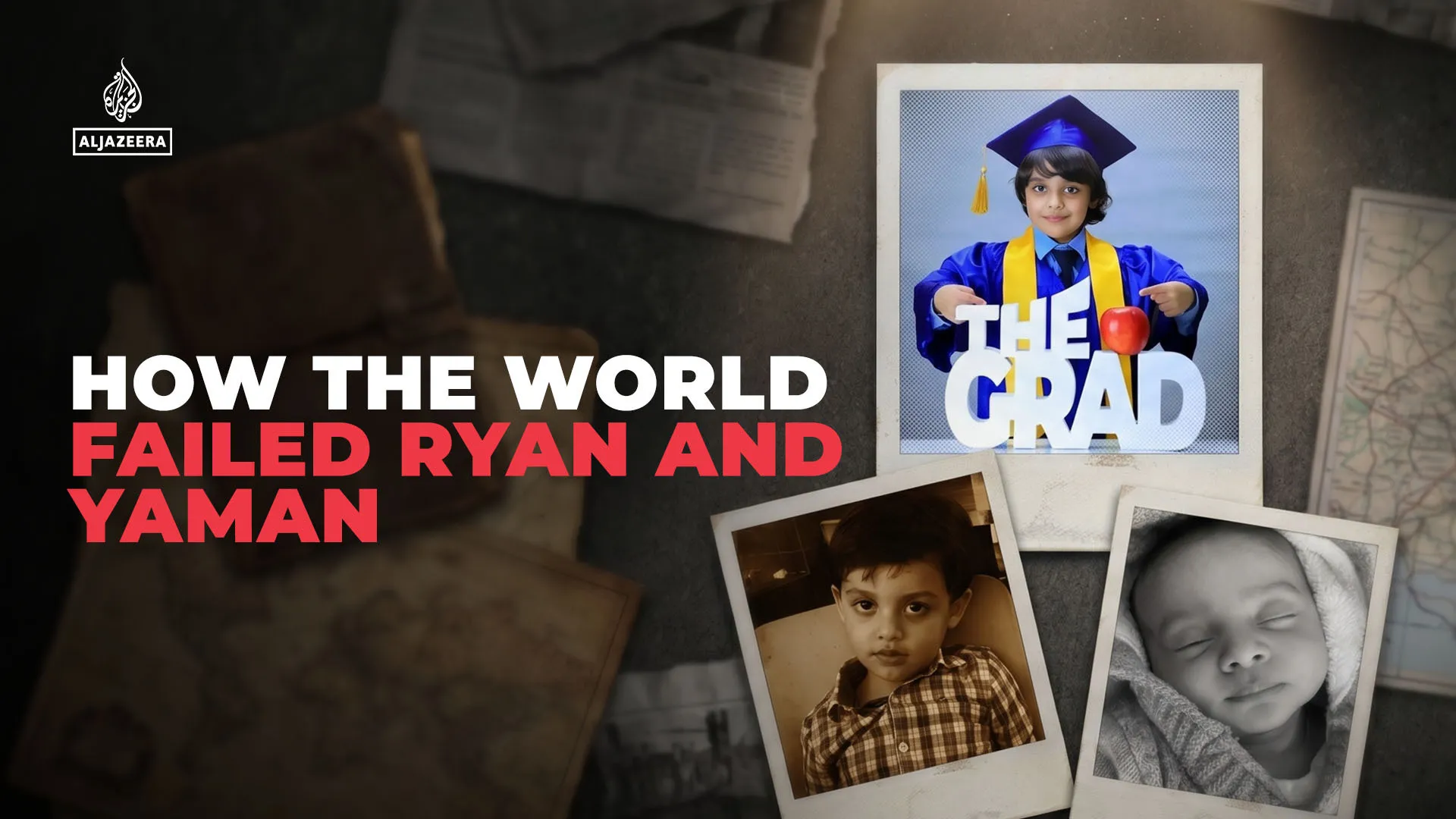
Palestinian journalist and mother Aya Shamaa wrote about how an Israeli strike killed her children, newborn Ryan and seven-year-old Yaman. Like countless mothers in Gaza, she saw her children as gleams of hope amid a fragile ceasefire. Narrated by Al Jazeera’s Al Anoud Al Aqeedi.
While it might be true that the cases are progressing, families of the missing argue they are moving at a snail’s pace.
Since early December, Fault Lines has spent time with families who are pushing for accountability and pleading with the government to learn what happened to their loved ones.
In some cases, they have spent years without receiving any direct response.
“It gets harder every time my nephew asks when his father will come home and I don’t have any answers,” said Rosario Villon, whose brother, Jonathan Villon, has been missing for almost a year and a half.
The 31-year-old father of three was last seen on December 9, 2024, when he left to pick up groceries in his hometown of Guayaquil.
Addressing a vigil for Jonathan last December, Rosario explained the toll his disappearance has taken on her family.
“Seeing my mother cry for her son, not knowing what to do next to bring him home — it isn’t easy,” she said.
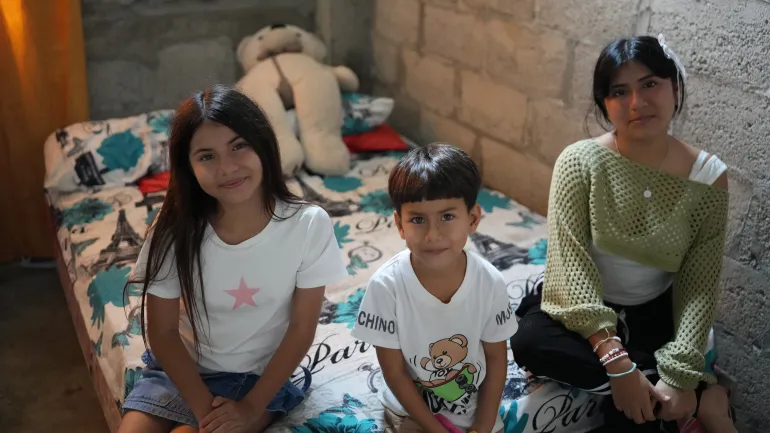
Jonathan Villon, who disappeared in the custody of Ecuadorian soldiers, leaves behind a partner and three children, pictured here [Fault Lines/Al Jazeera]
Fault Lines has reviewed footage of the day Jonathan was detained. Security cameras show soldiers patrolling Jonathan’s neighbourhood, Nueva Prosperina.
A neighbour’s mobile phone video also captures the moments after Jonathan was forced into the truck’s bed, under a wooden bench. The truck then drives off, and he has not been seen since.
The family recorded the licence plate numbers of the municipal vehicle the soldiers were using, but the military has refused to respond to requests about Jonathan’s case.
“We have the evidence, we have videos, we have the licence plates of the truck, and they won’t give us a concrete and exact answer. What happened to my husband?” asked Jonathan’s partner, Yadira Bohorquez.
Lawyers representing the family say the military simply declared that it had no operations in that area on that date, despite the video evidence.
“The case of Jonathan Villon is completely paralysed by the refusal of the Ministry of Defence to cooperate in handing over information that the Prosecutor’s Office has already requested,” said Fernando Bastias, a lawyer with CDH Guayaquil, a human rights nonprofit representing the family.
Sokoto, Nigeria – Each time her curious seven-year-old child returned home from school with homework, 28-year-old Habiba Abubakar knew it was time to take him to her neighbour, whom the child called “aunt”, even though they were not related by blood, who had been his saviour every time he wanted to stand in front of his class and receive a standing ovation.
But that changed in 2021, when Abubakar enrolled herself in the Women Centre for Continuing Education (WCCE) in Sokoto State, northwest Nigeria.
“I’ve always felt ashamed when Muhammad told me that they’ve been given another assignment,” she told Al Jazeera.
This frustration, coupled with her enthusiasm for learning English, pushed her to return to the classroom 13 years after she left.
Now, the mother of four said she helps all the children with their assignments.
The interruption in Abibaker’s studies is not uncommon across northern Nigeria, especially in rural communities, where girls are more likely to drop out of school due to cultural practices, such as early marriage, or poverty, which forces parents to make gender-biased decisions by enrolling male children over females.
UNICEF reported that more than half of the girls in the region are not attending school.
Jennifer Agbaji, a social accountability professional and the executive director at Basileia Vulnerable Persons Rights Initiative (BVPRI), a Nigerian nonprofit dedicated to advancing the rights of women, girls, and other vulnerable populations through education and leadership development, viewed the initiative as a positive and necessary intervention.
Nonetheless, she said second-chance education should not be limited to classroom-based learning alone.
“If access to education depends solely on physical attendance, many women who face mobility, childcare, economic, health, or security challenges may still be excluded.”
How the system works
WCCE, commissioned by the then-military governor of Sokoto State, Navy Captain Abdul Rasheed Adisa Raji, was founded in 1997 to provide adult education and vocational skills to women in the state.
Since then, Nuraddeen Ladan Dogon Daji, a physics teacher, told Al Jazeera that the centre has trained many students, some of whom now practise professions, such as teaching and nursing, helping to address the country’s shortage of skilled professionals.
Unlike other public schools, where pupils spend six years, the centre designed a three-year curriculum for its primary section, from adult one to three.
In the secondary sections, students spend three years each in the junior and senior levels.
In their final years, they also sit for the mandatory Junior Leaving School Certificate of Education (JLSCE) and Senior School Certificate of Education (SSCE) examinations.
To help these students realise their dreams, the centre also offers free education, benefitting from the state government’s effort to reduce the number of out-of-school children.
This has helped students like Abubakar, who, following her divorce, relied heavily on her father’s support to stay in school.
“We used to pay 5,000 naira ($3.5) per term, but were later told to stop because the state government has given us a chance to study for free,” Abubakar told Al Jazeera from her home in the Kofar Atiku neighbourhood.
But free tuition does not eliminate all costs. Students still have to pay for transport, books, and other daily expenses.
The challenges
According to Agbaji, beyond poverty and early marriage, there are several structural barriers, including restrictive gender norms that prioritise domestic responsibilities over education.
She said many women lose confidence after years away from formal education, and in some communities, education is still viewed as an investment for boys rather than a lifelong right for women.
In her opinion, these norms often combine to make re-entry into education difficult, even when opportunities exist. In her journey to becoming a nurse, Fatima Attahir, who left school after primary school 12 years ago, found it necessary to go back to the classroom and start afresh.
To support herself while studying, she helps with her family’s trading activities when she is not in class.
She said that although some of her friends already saw the decision as time-consuming, she is not satisfied with the system’s duration.
“I wish the primary section was also up to six years,” she said.
“Because to become a nurse, I need to have a solid background in the core subjects.” Some of the students Al Jazeera spoke to said their greatest challenge is juggling academic activities with household responsibilities.
Before her divorce, Abubakar said she would wake up earlier than usual to prepare breakfast, clean the house, and get herself and her children ready for school.
“When I finally set my foot in class, I was already tired, and as the lectures went on, I would start slumbering because I hadn’t had enough sleep.” She said the pressure became worse when her youngest child frequently fell ill, sometimes forcing her to leave class before lectures ended.
After her divorce, transport costs became another obstacle. “Since I was no longer married, my parents were the ones paying for the transport fares, but when they couldn’t, I would not go to school because I couldn’t afford it myself,” she said.
Later, her father gave her 10,000 naira to start making and selling local snacks and small chops.
The small business now helps her cover transport costs and other school-related expenses. Abubakar still credits the neighbour who used to help her son with homework before she returned to school.
When transport costs became difficult to afford after her divorce, her parents stepped in when they could, while her father later provided the capital that helped her start a small business and continue her studies.
Her experience is not unique.
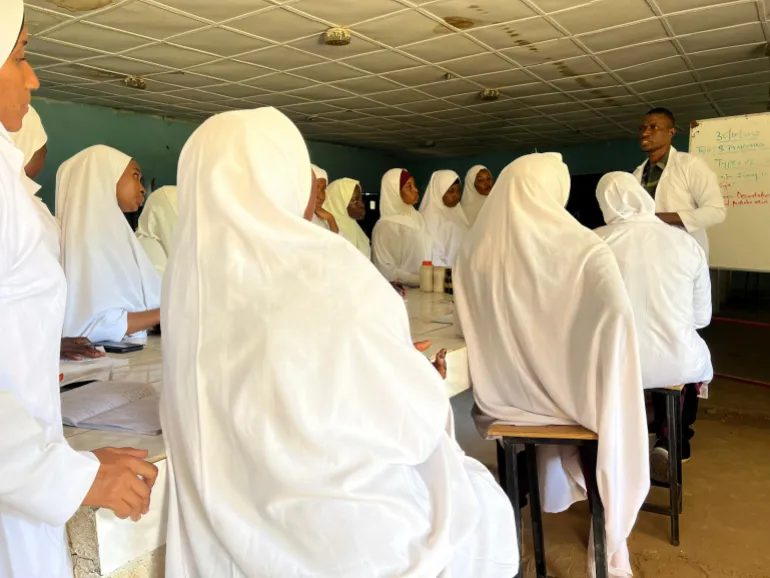
A classroom session at the Women’s Centre for Continuing Education in northern Nigeria [Abdulaziz Bagwai /Al Jazeera]
Another student, Hafsat Aliyu, said she leaves her two-year-old child with her in-laws whenever she attends classes to avoid disrupting lessons.
Her husband pays for books and other occasional school needs, while she sells local pastries during break time at the centre to earn money for daily transport and personal expenses.
During examination periods, she studies late into the night after completing household chores and putting her children to bed.
“My husband does his best, but I thought it was time for me to get a source of income, too,” she said.
“Now, I pay for my transport and a few other daily needs.”
However, the physics teacher, Dogon Daji, said that in his seven years of teaching at the centre, a recurring challenge among students is the pace of learning.
“I’ve taught young people, and the level of their understanding is quite different,” he said.
But he added that there are still outstanding students among them; one recently won this year’s Usmanu Danfodio Week, an annual quiz competition organised for secondary school students in the state.
On the other hand, the vocational section of the centre, which was designed to equip students with practical skills such as tailoring and soap-making, now offers only tailoring.
Students are required to provide tools, such as scissors, including those whose interests may lie in other trades.
The way forward
Agbaji acknowledged that for Nigeria to bridge the gender disparity in education, the country must adopt a lifelong learning framework that recognises education as a continuous right and opportunity.
UNICEF reports that more than half of girls in northern Nigeria are out of school, among the highest rates in the country [Abdulaziz Bagwai/Al Jazeera]
This requires increased investment in adult education, digital and remote learning platforms, community-based education, and flexible pathways for women who missed formal schooling, because the long-term consequences are significant.
She added that many women pursuing second-chance education continue to balance childcare, household responsibilities, and income-generating activities, often relying on family and community support networks to remain in school.
“Educational exclusion perpetuates poverty, limits economic opportunities, increases vulnerability to abuse and exploitation, and restricts women’s participation in governance and public service. It also affects future generations because children of educated mothers are generally more likely to enrol in and complete school,” Agbaji clarified.
More than two years ago, Gaza resident Hanin Muhammad accompanied by her 39-year-old sister Sabreen, a kidney transplant recipient, was flown to the Iraqi capital Baghdad for medical treatment. But Muhammad has since been confined to the Private Nursing Home Hospital inside Baghdad’s Medical City complex, thousands of miles away from her home in Gaza, as her travel documents have been confiscated by Iraqi authorities.
“My six children are in Gaza, and I am entering my third year without seeing them,” 40-year-old Muhammad told Al Jazeera.
Recommended Stories
list of 4 itemsend of list
Her family home in Rafah was destroyed by Israeli forces, forcing her children to be displaced into makeshift tents located between Rafah and Khan Younis.
“I check on them through other people because they lack internet connection. I am begging anyone to intervene so we can get back to Egypt, register, and see our children,” she said. Currently, Palestinians can go in and out of Gaza only using the Rafah crossing, which opens into Egypt.
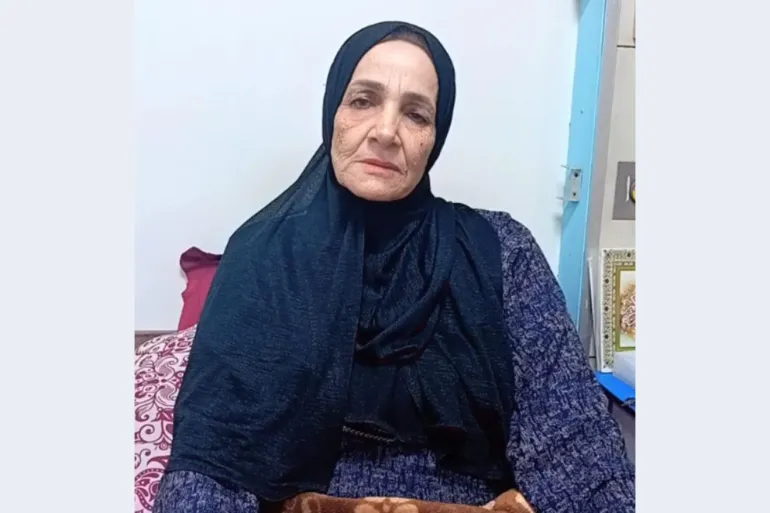
Samah Abdul Moati, 65, an oncology patient stranded in Baghdad, lost two sons in the war and says she no longer cares about her treatment, wishing only to return to her family [Courtesy of Samah Abdul Moati]
Muhammad, who travelled to Iraq as a medical companion to her sister, is part of a forgotten cohort of 46 Palestinians evacuated to Iraq, comprising 21 patients and 25 family escorts.
According to health authorities tracking the group, the clinical breakdown of the patients highlights the severity of their conditions, which include five oncology patients, four suffering from blood disorders, one cardiac patient, one kidney disease patient, and 10 patients wounded in the ongoing genocidal war that has killed nearly 73,000 Palestinians and wounded more than 172,000.
The group was flown to Baghdad in March 2024 on a military aircraft in coordination with the Iraqi and Egyptian governments, with a symbolic presence from the Palestinian Embassy in Cairo.
These rare evacuations highlight a much broader medical crisis back home. According to Gaza’s Health Ministry, more than 20,000 patients and wounded people are currently waiting to travel abroad for medical treatment.
Zaher al-Waheidi, head of the ministry’s Information Unit, reported that 1,200 children in Gaza now suffer from spinal cord injuries and paralysis directly resulting from Israeli attacks, while some 4,000 children require urgent treatment abroad.
Despite the overwhelming need, official data provided by al-Waheidi shows that only 154 children have been allowed to leave Gaza since the Rafah crossing, the enclave’s only gateway to the outside world, partially reopened in February amid heavy Israeli restrictions.
The crisis is equally dire for newborns: in 2025, more than 4,000 women had premature deliveries, and at least 4,800 babies were born with low birth weights – double the pre-war figure. Last year alone, 457 infants died in their first week of life.
For the handful who made it out, like the group in Iraq, the promised sanctuary quickly devolved into a cage defined by confiscated documents, restricted movements, and systemic neglect.
Confiscated documents and suspended lives
Upon their arrival from Egypt’s Heliopolis Hospital, the promised short-term recovery windows evaporated. Evacuees state that their primary identification and travel documents were immediately seized.
“When we left Egypt for Iraq, the Iraqi authorities took our identification papers from the Egyptians, and we haven’t seen them since,” Muhammad told Al Jazeera.
“When we asked for them, they told us they were held by Iraqi Intelligence and the Ministry of Foreign Affairs. We demand them back, but no one answers us.”
The Palestinian Embassy in Baghdad issued new passports for those lacking them, but according to Muhammad, these documents remain unstamped by the Iraqi government and are functionally useless. She noted that without the official stamps, they cannot travel anywhere.
This administrative vacuum has completely frozen the lives of the companions. Noor Ibrahim, a pseudonym for a young woman who arrived as an escort for her cancer-stricken aunt, is stranded along with four of her aunt’s children.
“I have been engaged for four years, and my fiancé and family are in Gaza,” Ibrahim told Al Jazeera. “We left on the promise that it would be a temporary six-month treatment trip, but now, two years have passed.”
She expressed deep frustration as she is stuck inside the medical complex, emphasising that she just wants to return to Egypt, from where she can travel to Gaza to complete her marriage and start her life.
The stress of the confinement has also severely exacerbated underlying health conditions. Ibrahim noted that while her aunt received the necessary cancer treatment, she has developed various other undisclosed health complications in Iraq, and her psychological state is exhausted from leaving her husband and family behind in war-ravaged Gaza.
Retaliation and dire conditions
For the Palestinians living inside Baghdad’s Medical City complex, daily life has become a grind of material deprivation and psychological distress. The evacuees are completely cut off from any monetary stipends, leaving them entirely dependent on the hospital for basic shelter and local citizens for additional charity.
This picture taken on December 24, 2023, shows a view of the Baghdad Medical City hospital complex overlooking the Tigris river in the centre of Baghdad [File: Ahmad Al-Rubaye/AFP]
Samah Abdul Moati, 65, who battles leukaemia, liver cancer, and an arm injury, is accompanied by her injured 43-year-old son and her daughter-in-law. She painted a grim picture of their daily life.
“The hospital brings food every day, but no one can eat it because it is unfit for consumption,” Abdul Moati told Al Jazeera. “We are surviving on the grace of local well-wishers who don’t fail us. But we don’t care about the treatment any more – we just want to return to our children.”
Abdul Moati’s situation is compounded by unfathomable grief: two of her sons were killed in the war, two others have platinum implants from injuries, her husband is fighting cancer in a Gaza intensive care unit with no one to care for him, and her daughters and orphaned grandchildren are living in tents for displaced people.
“The hardest feeling is that I am trapped between the hospital walls while my heart is outside with my family and my people,” Abdul Moati said. “My husband is in the intensive care unit alone, and my children and grandchildren are in tents under the cold and fear.”
Compounding their alienation, evacuees who have tried to protest or publicise their predicament faced swift administrative blowback. When they demanded their right to travel five months ago and spoke to the media, hospital management retaliated by locking down the ward and banning them from even visiting the hospital garden.
Muhammad revealed that they were only allowed out after journalists wrote about their situation, adding that officials continuously throw them from one department to another without providing any straightforward answers.
Bureaucratic runaround
The spokesperson for the Iraqi Ministry of Health, Saif Albadr, did not answer repeated calls from Al Jazeera.
While the head of public relations at the Health Ministry, Ruba Falah Hassan, told Al Jazeera that the case is “political.”
“Frankly, this is a political issue, not health-related.. I’m not authorised to talk about it,” she stated.
The newly appointed Iraqi government spokesperson, Haidar Al-Aboudi, told Al Jazeera that he “will look into the matter”.
For the Palestinians stranded in the Medical City, they maintain that they lack the financial means to buy commercial airline tickets even if their papers are returned, meaning they desperately need a coordinated effort by a charity or government body to facilitate their travel back to Egypt.
“I am not asking for a luxury or an exception,” Abdul Moati pleaded in her final remarks.
“I am asking for a simple human right: that my family does not remain divided between life and death. Open a safe path, facilitate our family reunification, and let me return to my family before it is too late.”
Bembou Silaty, Guinea – Mamadou Aliou walks through the small village of Bembou Silaty in northwestern Guinea carrying an irresolvable contradiction.
The 38-year-old works in the environmental health and safety department for a bauxite mining company, yet he is also an activist striving to improve life in his community, which often means criticising the actions of another mining company in the area.
Recommended Stories
list of 3 itemsend of list
“Before these companies arrived, we cultivated our land, and it sustained us,” Aliou told Al Jazeera.
“We could cover our daily needs, especially food. But now, when a piece of land is registered and belongs to a mining company, you have nothing there any more.”
The foreign-linked mining companies are part of the global scramble for Guinea’s bauxite. The West African nation holds the world’s biggest reserves of the ore, which is the source material for alumina and ultimately aluminium, a metal essential for car and aircraft frames, windows, wind turbines, and solar panels.
Over the past three decades, Guinea has multiplied its bauxite production tenfold. More than a dozen projects of bauxite production are currently ongoing in the country, according to the online cadastre.
As the global energy transition demands ever more aluminium, it has placed Guinea in a strategically crucial position. Approximately 75 percent of the bauxite exported by the country over the past decade has ended up in China, which produces 60 percent of the world’s aluminium.
Companies from Russia, the United States, and the United Arab Emirates have also established themselves in the country to secure the ore. In Bembou Silaty, an Indian company that began operations in 2019 now holds an exploitation concession until 2034.
Located in the prefecture of Telimele (Kindia region), Bembou Silaty has undergone a transformation since bauxite was discovered on its land about five years ago.
Yet, on the ground, many lament the cost: Contaminated water, loss of farmland, and a steep decline in agricultural productivity.
Mamadou Aliou, left, speaks to another resident in Bembou Silaty [Nuria Vila Coma/Al Jazeera]
‘No land, no money’
In the traditional bauxite heartlands of Kindia and Boke, the main roads are in notably good condition, a cut above the rest of the country. Steady jobs in technical roles or transport logistics have created economic opportunities for some Guineans.
Yet Bembou Silaty remains a quiet, peaceful village without electricity, and farming methods that are untouched by mechanisation.
Less than 2km (1.2 miles) away, however, the lush green landscape and mild climate of the rainy season give way to the electric-powered site of the Indian mining company.
There, excavators and trucks laden with bauxite constantly traverse the wide, unpaved roads, built to accommodate the heavy traffic, in a noisy, busy zone where the mining economy bulldozes its way forward.
People working in technical roles at the mine can earn up to about $300 a month.
For other locals who make a living from farming, most don’t have a regular wage and rely on the yield from their crops.
Across Guinea, an estimated half of the population depends on agriculture for their livelihood.
Locals in Bembou Silaty say every hectare claimed by mining is a hectare lost to farming, in a country that spent more than $500m importing rice in 2024.
“They give you compensation for your land, but it’s not enough, and in the end, it’s mismanaged,” Aliou said.
“Within a month or two, someone who received 50 or 100 million Guinean francs ($5,700-11,400) has nothing left. No land, no money. They have to start over, from below zero.”
Locals who still own land continue to grow rice, cassava, peanuts and cashews in the village, but they have ever less space and agricultural productivity is falling.
The village women have set up an association, “Allawalli” (which means “God help us” in Fula), to work cooperatively.
Resident Fatoumata Binta Bah and her family lament having lost their land [Nuria Vila Coma/Al Jazeera]
‘Not enough’
Walking through the alleys of Bembou Silaty, a few houses stand out.
They are made of cement, which withstands the rains better than the more common mud-brick homes, though many remain unfinished.
Locals say they were built with compensation money.
Fatoumata Binta Bah, a neighbour of Aliou’s, comes from a family of farmers. They once cultivated cashews, their livelihood.
Then the Indian mining company started up operations and offered them less than 50 million Guinean francs (about $5,700) for their land. That compensation, paid as a lump sum, seemed like a decent amount of money, she says.
But now, the money is gone, and their new house is still incomplete.
“The land they took from us was productive. That’s what we lived on,” said Bah, 20, as she prepared tea over a fire in the family courtyard.
“In the end, it wasn’t enough,” she lamented.
The Indian company did not respond to Al Jazeera’s questions on the purchase of land.
Meanwhile, on the outskirts of the village, surgical holes drilled into the ground mark where mining companies have tested for bauxite – a reminder to the farmers that the impact on the land is felt even before extraction begins.
In a recent report, Djami Diallo, the Guinean minister of the environment and sustainable development, stated that each year, certain companies had their impact studies and evaluation reports rejected for failing to comply with environmental standards.
Three or four companies in Boke, Kindia’s neighbouring region that is considered the bauxite capital in the country, were said to be affected. But the minister acknowledged that “just because companies do not meet the conditions to obtain the compliance certificate does not mean that everything stops.”
Locals carry water from a communal tap in Bembou Silaty [Nuria Vila Coma/Al Jazeera]
Clean water, the greatest challenge
Not all homes in Bembou Silaty, a community of about 5,000, have indoor toilets and plumbing. In the centre of the village, there are communal latrines for those who do not have facilities available in their homes. Showers can be taken in the same place, using a bucket and water collected from the spring.
One small gain for the community since the mining company’s arrival is a new water point in the village. The tap serves nearly all the residents. Even Aliou uses it to fill buckets for his household – for cooking and drinking – though he says he knows the water contains iron, as contamination occurs.
Still, he considers himself luckier than his friends in the neighbouring village of Koussadji Dow, who rely on now-brown, contaminated river water.
Tala Oury Sow, a trader and farmer, washes her cooking utensils in the murky river water – a daily struggle.
She starts speaking softly, surrounded by neighbours, but her voice rises to a shout.
“Do you think we can live like this?
“We had hoped the mining company’s arrival would improve things, but it has gotten worse,” she protested.
“Since the mining companies came, we’ve had this problem with the water. The children get sick, and the parents too,” added Mariama Kindi Diallo, a farmer, in her courtyard.
“The doctors tell us not to drink the rain or river water. There are no roads, no school, no phone signal. What are we supposed to do? We are asking for help to have a dignified life,” she pleaded, as her family and neighbours nodded in agreement.
The Indian company did not respond to requests for comment on these issues.
Guinea’s capital, Conakry [Nuria Vila Coma/Al Jazeera]
‘We need refineries here’
To escape the increasingly difficult conditions in villages like Bembou Silaty, some people leave the rural areas and head to the capital, Conakry.
Bauxite mining so dominates Guinea that one can chance upon a driver of one of the trains hauling ore from the mines to the port of Kamsar.
Alpha, who did not want his real name published, works for a United States-backed company and provides a window into the immense volume of resources being exported.
“We operate six trains of 150 wagons each day,” he said, explaining that the annual target for 2025 was to export 17.5 million tonnes of bauxite.
“The government wants to change things, because the profits we make in Guinea right now are small. We need refineries here to increase the state’s revenue,” he added.
Alpha lives near the coast, where his job has allowed him to build a house for his family and achieve a standard of living unattainable for most of his compatriots.
The government of Mamady Doumbouya, which came to power in a 2021 coup, is attempting to reorganise the mining sector. It is pressing investors to process bauxite within Guinea, ensuring a portion of the value stays in the country.
Processing bauxite into aluminium can multiply its price by 37 times.
Instability in Iran amid the US and Israel’s war has contributed to rising aluminium prices, which surpassed $3,600 per tonne in April.
Doumbouya is set to lead the country for the next seven years, after winning the December 2025 elections with nearly 87 percent of the vote. While opponents view him as illegitimate, many Guineans agree on the need to reform the mining sector.
Achieving this, however, requires a huge increase in electricity generation – power that is non-existent in villages like Bembou Silaty and unreliable even in Conakry, where blackouts are frequent when fans and TVs are switched on at night.
Guinea is working with neighbouring Senegal on a solution: Using Senegalese gas to generate enough electricity to process its bauxite on African soil. Currently, both countries export raw materials, while jobs and wealth are created elsewhere.
A train carrying bauxite is seen in Conakry, Guinea [Nuria Vila Coma/Al Jazeera]
Following the bauxite route
More than 3,000km (1,900 miles) away, across the ocean, Spain is also a part of the Guinean bauxite story.
Parets del Valles, a municipality of 18,000 people less than 30km (19 miles) from Barcelona, represents the journey’s end.
From the town centre to its industrial outskirts, businesses specialising in aluminium are plentiful: Aluminium distribution, carpentry, and window fitting, much of them serving household needs.
For Spain, Europe’s largest consumer of Guinean bauxite, more than 90 percent of its imports come from Guinea-Conakry.
The aluminium produced there, mainly in the country’s north, feeds the automotive industry and serves both industrial and domestic purposes.
Parets is another world compared with the bauxite’s point of origin in Guinea.
In Spain, there is light, hot water, paved roads – all the base elements of a decent life. It’s why many say growing numbers of West Africans are arriving in Parets and across the Valles Oriental region. This is part of a broader trend in Catalonia and Spain, according to the Spanish National Statistics Institute (INE): The Guinean population has quadrupled in Spain since 2000 – from 2,700 to 11,000 people – and in Catalonia from 1,000 to 4,000.
These figures don’t include those who go unregistered.
Increasingly, more boats are leaving directly from Guinea, towards the Canary Islands and on to mainland Europe. According to Frontex, the European Union border security agency, more Guineans arrived in the Canary Islands, Spain, in 2023 (2,324) than in the previous 13 years combined. In 2024 and 2025 combined, another 6,000 Guineans arrived.
Migrants, predominantly men from Senegal and increasingly from Guinea, come alone, settling where they have contacts and job prospects. The newest arrivals, often very young, spend long hours with their mobile phones as their sole companion – the only tether to the country they left behind.
Many left, following the bauxite trail, hoping to find something more in the places where their resources are both enjoyed and exploited.
As Aliou, back in Bembou Silaty, says: “If you compare the bauxite we export with what we get in return, the difference is enormous. We gain almost nothing. Just enough to survive.”
This article was produced in collaboration with the Catalan association SETEM Catalunya, promoted by the Connect for Global Change consortium and Lafede.cat, and with financial support from the European Union and the Government of Catalonia (Generalitat de Catalunya)
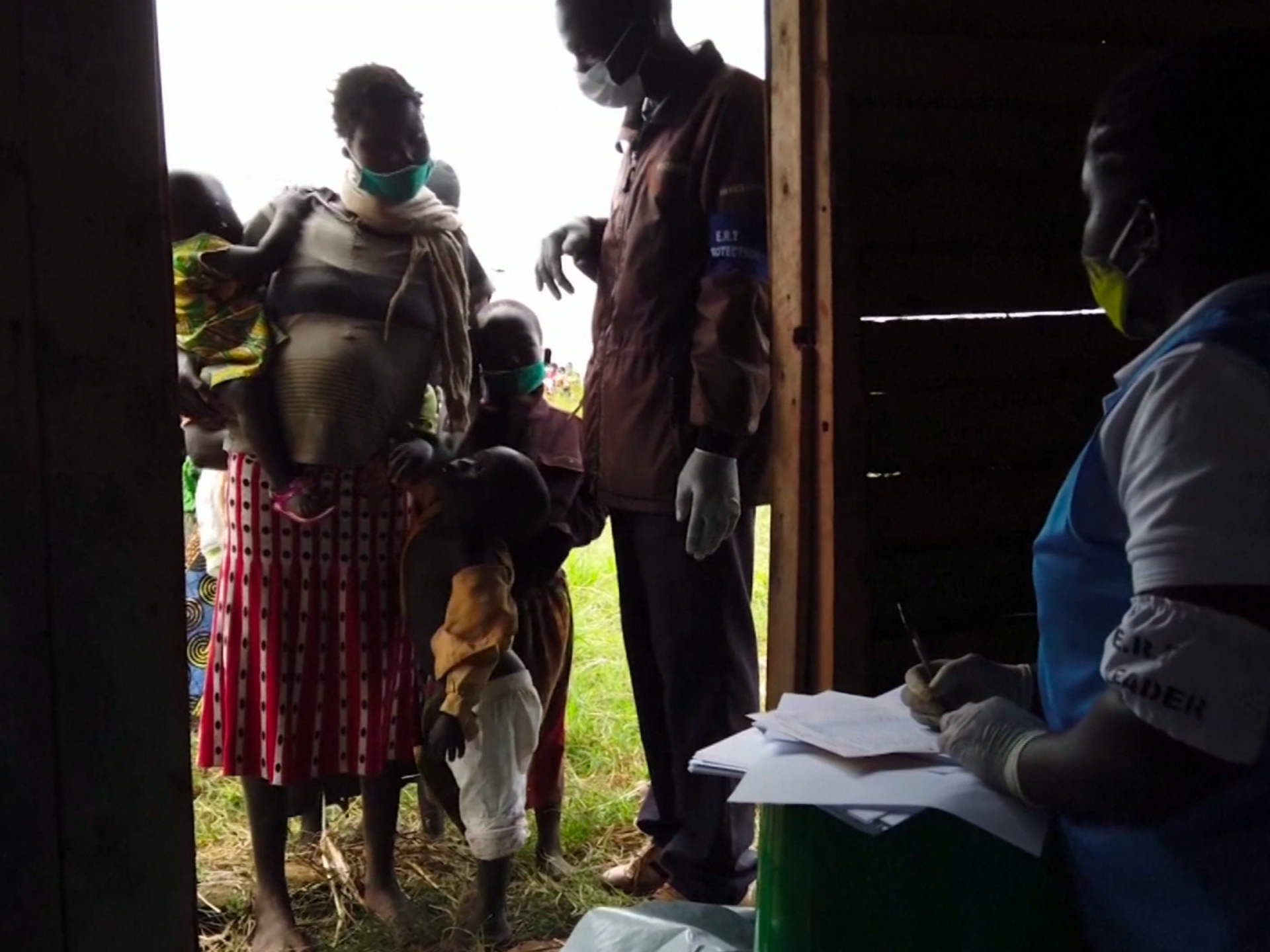
Women in eastern Democratic Republic of the Congo are disproportionately impacted by Ebola as shortages of protective gear amid funding cuts accelerate the spread of disease. Al Jazeera’s Imogen Kimber reports how these caregivers to the living and the dead are most at risk.
Belgian defender Thomas Meunier caused debate recently after saying that France has the footballing talent to put out three teams capable of winning the World Cup.
Could Les Bleus, who are co-favourites with Spain in this summer’s World Cup, really lift the title with their second- or third-string team? Maybe not, but their talent is certainly Mariana Trench-deep.
Recommended Stories
list of 4 itemsend of list
Consider this: According to transfermarkt.com, a lineup of French players that didn’t make the 26-man cut would rank in value among the top five teams – ahead of Portugal, Brazil, the Netherlands and reigning champions Argentina.
Lucas Chevalier 30 million euros ($35m); Pierre Kalulu 32 million, Jeremy Jacquet 55 million, Leny Yoro 50 million, Adrien Truffert 25 million; Boubacar Kamara 40 million, Eduardo Camavinga 50 million; Dilani Bakwa 28 million, Senny Mayulu 40 million or Khephren Thuram 40 million, Mousa Diaby 28 million; Junior Kroupi 40 million. = 418 million [38 million average]
So, how did Les Bleus get to this point?
It started with frustration after French teams consistently fell short on the biggest stage from the 1930s to the 1970s. The solution, national team manager Georges Boulogne said in the early 1970s, would be for the French Football Federation to create training academies known as Centres de Formation.
“France had not won any trophies, and it was decided they needed to create a new structure,” INF (Institut National du Football) Clairefontaine administrator Franck Bentolila told Al Jazeera.
The government backed the programme, viewing it as promoting French ideals through sports, as well as a recipe for winning trophies.
A total of 16 centres were set up, the first opening in 1974 with the main site in Vichy. It recruited widely, drawing young players from the entire country, plus overseas departments. The centres laid a foundation, preparing players for professional careers and the national team.
The record was initially mixed. In the 1980s, France won the European Championship and Olympic Games titles (both in 1984) and reached two World Cup semifinals, but then failed to qualify for the 1990 and 1994 World Cups.
But by 1998, everything fell into place, with the so-called “Black-Blanc-Beur” squad winning the World Cup at home. The multiethnic group represented the changing nature of French society, as well as validating the federation’s development programme. Bentolila said coach Aime Jacquet dedicated the victory to “all the amateur clubs and academies – it’s also your trophy”.
“The [1980s] period with [Michel] Platini, [Alain] Giresse, [Jean] Tigana, had a lot of talent, but we don’t win a World Cup,” Bernard Lama, a goalkeeper who captained the national team in the 1990s, told Al Jazeera.
“The difference with our generation, all the guys were from academies. And we were hungry to win a title. And, also, we had one exceptional talent with Zinedine Zidane.”
France went on to lift the 2018 World Cup and were runners-up in 2006 and 2022.
Zinedine Zidane lifts the trophy after France’s victory over Brazil in the 1998 World Cup Final [Ben Radford/Allsport via Getty]
“You have people coming from overseas – Africa, French Guyana, Martinique – they give us two things, music and sports,” Lama said.
“And, now, there is a sub-generation coming from overseas, and they are French. [Ousmane] Dembele, [Desire] Doue, they are French, they are not naturalised, they grew up in France, the majority around Paris.
“And they are hungry, you understand, for a lot of reasons. But, also, it’s not only a question of work; the first thing is they have talent.”
Lama sees a danger in football, more broadly, of players becoming overly drilled and “robotic”, but France has many exceptions who can give them an edge.
“We are lucky to still have these players who are capable of making the difference,” Lama said. “Maybe that is why we are so good, we have players like [Kylian] Mbappe, Dembele, Doue. They hate to lose and, physically and technically, they can make the difference, individually.
“And that is the force of the national team, and also PSG, our capacity to score. Today, we have maybe four or five guys – [Maghnes] Akliouche, [Rayan] Cherki, a different kind of talent. When you have that explosion of talent, it gives the coach more solutions, offensive solutions.”
Most national team members, no matter their background, have gone through the academies, but their development starts long before that.
“It’s cultural,” Bentolila said. “In America, when you are young, you have a basketball in your hands, or a football in your hands. In France, you have a football at your feet when you are a baby – and free access to facilities.”
That part of the formula sounds similar to many countries. Is there a secret to French development, or are they just doing it better than most?
“The secrets,” said longtime coach and scout Stephane Nado, “are a combination of hard work, structure and organisation.”
Nado said: “The player is the centre, the heart, of the project. The player will receive education. And we will not take them away from their family. It is important for them to keep their roots, important psychologically. This is why France is one of the best in the world at developing players for export.”
Training at Clairefontaine blends street game skills with organisation, including “lots of 1 vs 1, 2 vs 2”, Bentolila said. “You have to fight. You’re good at dribbling and first touch, now you organise possession, 5 vs 2. As soon as you get the ball, you have to have good control. We do that a lot.”
Clairefontaine is now focusing on younger age groups, ceding responsibility for older players to clubs. And development is expanding beyond the centres and established club academies, Bentolila said.
“Paris and Sao Paulo are the best areas in the world for talent,” Bentolila said. “Why? Private academies. It is an amazing situation. Kids, eight- and nine-year-olds, playing every day. Amateur coaches offer not a meal, but a snack at 4 o’clock. Then, they do homework and training sessions. When they are 12 years old, they play like Mbappe.
“In Paris, you have amateur clubs nobody knows, and they can beat [the youth teams of] Barcelona and professional clubs. They are better than PSG, Paris FC. So many players – they play anywhere, any time, eight years old against 10 years old. They are like soldiers, they fight every day, and they are good because they play under pressure.”
In the 1980s, Les Bleus were dubbed “The Brazilians of Europe”. It’s taken a while, but France appears to have lived up to the moniker. And they’ve gone about it their own way.
“Brazilian coaches [used to] tell me, ‘In our country, we are poor, but we can succeed in football or music. So, we start the day with football,’” Bentolila said.
“In France, we go to school, first, and, after, practise football. We do it every day and, like Brazil, we play a lot, and play well.”
A digital register of land ownership in the West Bank is seen as an escalation of Israel’s occupation.
Published On 29 May 202629 May 2026
Occupied East Jerusalem, Palestine – A controversial Israeli plan to digitally register property ownership in the occupied West Bank is a “dangerous colonial occupation step that represents a direct assault on the historical and legal rights of the Palestinian people to their land and property”, the Palestinian Land Authority has said.
The Palestinian Jerusalem Governorate and the Colonization and Wall Resistance Commission (CRRC) have urged Palestinians in the West Bank not to engage with any Israeli “entities, committees, platforms, or procedures” of lands and property.
Recommended Stories
list of 4 itemsend of list
Israel reportedly launched the online “Land Registry and Settlement of Rights” platform on which it plans to “update” property ownership in the occupied West Bank on Wednesday this week.
The Jerusalem Governorate and the CRRC have called on the international community, the United Nations, the International Criminal Court and all international human rights and legal institutions to “take their urgent responsibilities to stop these illegal procedures and hold the occupying state accountable for its continuous violations against the Palestinian people, their land, and their resources”, they said.
Moayad Shaaban, head of the CRRC, which is part of the Palestine Liberation Organization, said the move reveals “the occupation’s transition from traditional policies of field control to digital and administrative colonial engineering aimed at imposing permanent legal realities on the occupied Palestinian territory”.
‘Annexation’ by land registry
In May 2025, the Israeli Security Cabinet launched a new, aggressive land settlement process throughout the West Bank, with the aim of “completing the legal and administrative annexation of the occupied territories through fully registering the lands under Israeli authority”, the Jerusalem Governorate said.
Then, in July 2025, Israel’s parliament approved a symbolic measure calling for the annexation of the occupied West Bank. The move was first tabled in 2024 by Israel’s far-right Finance Minister Bezalel Smotrich, who himself lives in an illegal Israeli settlement.
On February 15, 2026, the permanent acquisition and registration of approximately 58 percent of Area C – the part of the West Bank over which Israel exerts total control – began.
(Al Jazeera)
Under that decision, Palestinian land registration in the Israeli “Tabu” – the land registry extract – began for the first time since the occupation of the West Bank in 1967. It is a final measure that will be difficult to challenge in Israeli courts, the Israel Hayom newspaper reported in February.
With the onset of land settlement, the Israeli Land Registry unit will take over the regulation and registration of land ownership in Area C. It also has the power to issue sales permits and to collect fees. Israel aims to complete the full settlement of 15 percent of the West Bank by the end of 2030.
Some 700,000 Israeli settlers already live in the West Bank and East Jerusalem, as illegal settlement has expanded under the government of Prime Minister Benjamin Netanyahu.
Rights groups say settlement approvals, along with rising settler violence against Palestinian communities, have accelerated since Israel launched its genocidal war on Gaza on October 7, 2023.
WHO can blame Paul McCartney for glancing in the rear-view mirror on his latest record?
At 83, the likely lad from Liverpool, who became a Beatle and Britain’s best-loved songwriter, is due a moment of reflection.
Sign up for the Showbiz newsletter
Thank you!
Paul McCartney’s new album The Boys of Dungeon Lane was recorded over the past five years, between touring and other commitmentsCredit: UnknownMacca at his album playback in Studio Two, Abbey Road, wearing Beatles socks. And he won’t need Father McKenzie to darn them!Credit: Unknown
He looks at it this way: “As a writer, you often write about things in the past, even if it’s just yesterday.”
Or even, as Macca can’t resist saying, if that past “always seems so far away”.
“That’s another nice idea. I think I might have done that one,” he adds in acknowledgment of his immortal Beatles ballad Yesterday.
His 20th solo studio album, The Boys Of Dungeon Lane, finds him casting his mind back to innocent times before The Beatles changed his life for ever.
Five of the 14 tracks visit the simple pleasures of youth — As You Lie There, Days We Left Behind, Down South, Home To Us (a first ever duet with Ringo) and Salesman Saint — and, as you’ll discover, each comes with a captivating back story.
Here, the master storyteller, whose previous character studies include Eleanor Rigby, The Fool On The Hill and She’s Leaving Home, turns the spotlight on himself for what might just be his most personal song cycle yet.
On The Boys Of Dungeon Lane, Sir Paul makes you believe in HIS yesterdays.
Asked why much of his latest work deals with memories, he replies: “I think writers, including me, ask themselves that.
“When you think about, say, Charles Dickens, what’s he going to write about except stuff he knows and stuff he remembers? Then he can gussy them up.”
And do recent Beatles and Wings reissue projects have an impact on the way he fashions a song these days?
“No,” answers McCartney emphatically. “The thing that pulls it all together is me — it’s my brain making music.
“I don’t think, ‘Wow, oh yeah, let’s do this. This is a Beatles idea, or this is a Wings idea’. I don’t think like that. It’s all current. It’s me. This is what I do.”
Listen to The Boys Of Dungeon Lane and you’ll understand what he’s getting at.
Despite first picking up a guitar nearly 70 years ago, he’s still making eclectic, freewheeling music, brimful of ideas, even if many lyrics are bathed in nostalgia.
The album was recorded over the past five years, when time permitted between touring and other commitments, in the company of in-demand American producer Andrew Watt, known for his work with Ozzy Osbourne, Post Malone, Lady Gaga, Miley Cyrus and, ironically, The Beatles’ chief Sixties chart rivals, the Rolling Stones.
“We just enjoyed it,” says Macca of his sessions with Watt. “We were like a couple of Boys Of Dungeon Lane — little boys in a sandpit — and we were having fun.”
Paul and Beatles drummer Ringo Starr are still closeCredit: GettyMacca riffing with producer Andrew WattCredit: Unknown
So, with the help of telling observations from the man himself, given to me by his team, let’s take a deep dive into the key tracks.
As You Lie There begins proceedings in memorable style with an intimate spoken word passage delivered over minor key acoustic strums.
McCartney intones: “I used to walk past your house. Every night I’d look up at your window. The light was on. I saw your silhouette on the blind. Do you think of me? Do I ever cross your mind?”
The song, with its squalling rock refrain, recalls a teenage crush from the time Macca lived at 20 Forthlin Road in the Allerton area of south Liverpool, in the house where he and John Lennon first discovered their spark of creative chemistry.
“Up in one of the windows, there was a girl I fancied called Jasmine,” he says of his tale of unrequited love. “But I didn’t know how to approach her. I never spoke to her.
“The joke was, she did show up later that year and knocked on the door. I was indisposed — I was on the toilet — so I missed Jasmine.”
Aside from the sweet story behind the lyrics, As You Lie There is important because it is the song that kickstarted the whole process, just as the world was emerging from the Covid pandemic.
McCartney says: “The album really started when my manager said, ‘Would you like to meet Andrew Watt?’
“I knew he was an active young producer, and I liked some of his stuff. I said, ‘Yeah, great’. He said, ‘Well, it’s just a cup of tea. Go down to his studio’.”
The pair hit it off and what began as that cuppa at Watt’s basement studio — located in his Beverly Hills residence once owned by Charlie Chaplin — soon turned into something much more significant.
Macca described his songwriting process, how he would try “to find
a really weird chord”, to give him “a little inspiration”.
To his delight, he realised that Watt, a big guitar collector, “had figured that if I was coming down, it would be handy to have a left-handed guitar.
“I struck this mad chord,” he continues. “I still have no idea what it is, then I changed one note, then another. Suddenly we had a three-chord sequence and Andrew said, ‘We should record this’.”
As the song took shape, they considered bringing in Chad Smith of Red Hot Chili Peppers on drums but Watt suggested that McCartney, a more than proficient drummer, should play them himself.
He says: “I really enjoyed drumming to it, so I put down the drum track, then obviously the bass.
Paul first picked up a guitar nearly 70 years ago, but still make eclectic, freewheeling music, even if many lyrics are bathed in nostalgiaCredit: GettyPaul during filming of ‘Magical Mystery Tour’ in 1967Credit: Redferns
“Then Andrew put the guitar lick down, because he’s a good guitar player. And over a few days, we made As You Lie There. That started the journey.”
The “journey” included recordings in various LA studios as well as Macca’s own Hog Hill Mill in Sussex and his old Beatles stomping ground, Abbey Road.
Of all the ensuing songs, first single Days We Left We Behind sets the tone — and is also significant for yielding the album title.
“This is very much a memory song for me,” says McCartney. “I was just thinking about those days I left behind.”
Whenever he goes to Liverpool these days, to visit the city’s Institute for Performing Arts (LIPA) for instance, he notes that “the back entrance to the airport is in Dungeon Lane”.
He remembers trips down that lane “as a little kid, because I used to wander off, just on my own, with my little bird book”.
It was the keen ornithologist’s gateway to stunning Mersey Shore, an area teeming with wading birds just a short distance from suburban Speke where he lived between the ages of five and 13.
“Speke is quite working class,” says McCartney. “We didn’t have much at all but it didn’t matter because all the people were great and you didn’t notice it.
“It’s my wife Nancy’s favourite track on the album. When we play it to people, we say, ‘You don’t need to cry’, and then you look up and see that they are.”
When asked how he settled on the album title, Macca says you could ask the same question about Sgt. Pepper’s Lonely Hearts Club Band.
“It’s just some words I like. We were thinking Along The Mersey Shore could be good. But then I liked The Boys Of Dungeon Lane — it’s a bit more, ‘What’s that about?’ ”
McCartney says Days We Left Behind “involves a bit in the middle about John and Forthlin Road”. (The McCartney family moved there in 1955).
It suggests that he and his much-missed songwriting partner in The Beatles “wrote a secret code, to never be spoken”.
This leads us to the folkie Down South which, says Macca, is “another one about reminiscing”.
“I often think about John and George,” he continues. “We used to hitchhike in the days before The Beatles. It was in the days when you could — now I warn my grandkids, ‘Don’t do it’, because there are too many nutters out there.”
He remembers: “I got a tip from someone who said, ‘You start off in Chester — because that’s where all the lorries are and they’re all going straight down south. That’s a good place to get your first lift’.”
With Harrison, seven months his junior, coming along for the ride to places like Harlech in Wales, it was a perfect chance to do some “bonding” with his future bandmate.
And speaking of bandmates, what about the rousing Home To Us, which, for good reason, is the only track McCartney doesn’t play the drums on.
During one of his breaks from sessions with Watt, he “talked to Ringo about Andrew”.
“Then Ringo went round to Andrew’s studio and drummed a bit. Next time I saw Ringo, he said, ‘Well, he didn’t do anything with it.’
“I asked what he’d expected and he said, ‘Well, you know, a track’.”
When Macca finally heard his old mucker’s efforts, he suggested to Watt: “We SHOULD make a track and send it to Ringo. So, we did.”
On writing the Home To Us lyrics, he reveals: “This song is done totally with Ringo in mind. I’m talking about where we came from.
“In common with a lot of people, you come from nothing and you build yourself up. Ringo was the one who came from the most ‘nothing’ in The Beatles.
“He was from the Dingle and that was well hard. He used to get mugged coming home from work.
“Even though it was crazy, it was ‘home to us’ and I made the song around that idea.” At first, Ringo only sang a few lines of chorus, but Macca rang him and said he’d “love to hear him sing the whole thing”.
“Next, we took my first line, Ringo’s second line and we had a duet — something we’d never done before.
“We also wanted backing vocals, and I had the idea it would be nice to hear girls. Chrissie Hynde and Sharleen Spiteri are mates — and they did it.”
The last of McCartney’s memory songs is the most poignant, Salesman Saint, which pays tribute to his midwife mother Mary who died when he was only 14 (the “mother Mary” of Let It Be) and his salesman/amateur musician father Jim.
He says: “This song is me remembering my mum and dad. I was born in World War II and I often think, ‘Bloody hell, it’s tough enough having a baby now but imagine if we were all conscious that bombs could be falling any minute’ — and Liverpool was getting heavily bombed.
“I was thinking about them bringing up this kid in those circumstances. My dad happened to be a cotton salesman, and my mum was a nurse. They did it. They managed it and they brought up me and my brother [Mike].
“Got us to doctors, got us to school and did all these things under those circumstances. At the end of the song, there’s music I’m trying to make from their era.”
So now you’ve heard about all the songs inspired by McCartney’s youth but there are NINE more tracks to digest. So here, in Macca’s own words, are his thoughts on those:
Lost Horizon: “This one came about when our dearly beloved and now sadly deceased studio manager, Eddie Klein, was logging some old cassettes of mine.
“He asked me if I remembered Lost Horizon and I said, ‘No’. He said, ‘It’s good, you should listen to it’. So, we remade it faithfully to the cassette version — just with a more modern sound.”
Ripples On A Pond: “It’s a love song. Like a few of the songs, we started this in my studio in Sussex. I said to Andrew, ‘You’re supposed to be a pop producer and we’re making all these records that don’t sound like that to me so, come on, let’s pop this one up!’ ”
Mountain Top: “My wife is a real live music fan and if there’s anything on she’s like, ‘Can we go?’ So, we go to Glastonbury every year and I started fantasising about some young girl tripping — she’s magic mushroomed out. The things you write songs about!” (Nancy delivers the closing spoken words.)
We Two: “A lot of Beatles records were made on a four-track Studer machine, including A Day In The Life. It’s such a classic now. I’ve got one in the studio and we use it sometimes. Andrew loves all these recording legends of the past. I showed him the Studer and he said, ‘Can we use it now?’ Luckily, it’s in full working order so we did We Two on it. It’s a little love song.”
Come Inside: “Going to side two now. We start it off with a rocker love song. It’s straightforward — but with verve.”
Never Know: “When I was in LA, I always liked the idea of Laurel Canyon and that scene. The days of Joni Mitchell, the Eagles — all that hanging out, getting stoned and playing guitars. So that was the vibe that started off Never Know.”
Life Can Be Hard: “I had a little instrumental chord sequence during Covid — and there was a little baby in the house, my wife’s niece’s new baby and it was a thrill. For a lot of people, Covid was terrible if you weren’t with family.
“Anyway, this baby used to like these chords, and it became a song. Life can be hard, but that’s when we put it together again. It’s a positive message.”
First Star Of The Night: “I was on tour and had a day off, which was precious. We were in Costa Rica and it rained hard — all day heavy, tropical rain. I was thinking about being out by the pool, but you really couldn’t go out.
“I thought, ‘I know, I’ll write a song’. I had my guitar with me. So, this starts out, ‘Even when it’s raining’, but then I switched it to, ‘Even when it’s raining inside’, just to give myself somewhere to go with the song.”
Momma Gets By: “The last track on the album and it’s totally imaginary. I was thinking of Porgy and Bess’s world. It’s basically about a woman who you can see is the strength in the family.”
Finally, Macca is asked how he hopes listeners will respond to his new album.
He replies: “Well, I hope they fall in love with the songs and the performances. I hope it takes them to a place of joy.”
Whether it’s Penny Lane, Dungeon Lane or Memory Lane, Paul McCartney will transport you there.
Roll up! Roll up! He is your magical not-so-mysterious tour guide.
PAUL McCARTNEY
The Boys Of Dungeon Lane
★★★★★
Whether it’s Penny Lane, Dungeon Lane or Memory Lane, Paul McCartney will transport you there with his new albumCredit: AP

![UNICEF reports that more than half of girls in northern Nigeria are out of school, highlighting deep gender gaps in education. [Abdulaziz Bagwai /Al Jazeera]](https://i0.wp.com/occasionaldigest.com/wp-content/uploads/2026/06/1000872132-1-1780347186.jpg?w=640&ssl=1)
![A classroom session at the Women Centre for Continuing Education in northern Nigeria. [Abdulaziz Bagwai /Al Jazeera]](https://i0.wp.com/occasionaldigest.com/wp-content/uploads/2026/06/1000872131-1-1780347183.jpg?w=640&ssl=1)
![Samah Abdul Moati, 65, an oncology patient stranded in Baghdad, lost two sons in the war and says she no longer cares about her treatment, wishing only to return to her family. [Courtesy of Samah Abdul Moati]](https://i0.wp.com/www.aljazeera.com/wp-content/uploads/2026/06/WhatsApp-Image-2026-06-01-at-8.37.47-PM-1780388719.jpeg?w=640&ssl=1)