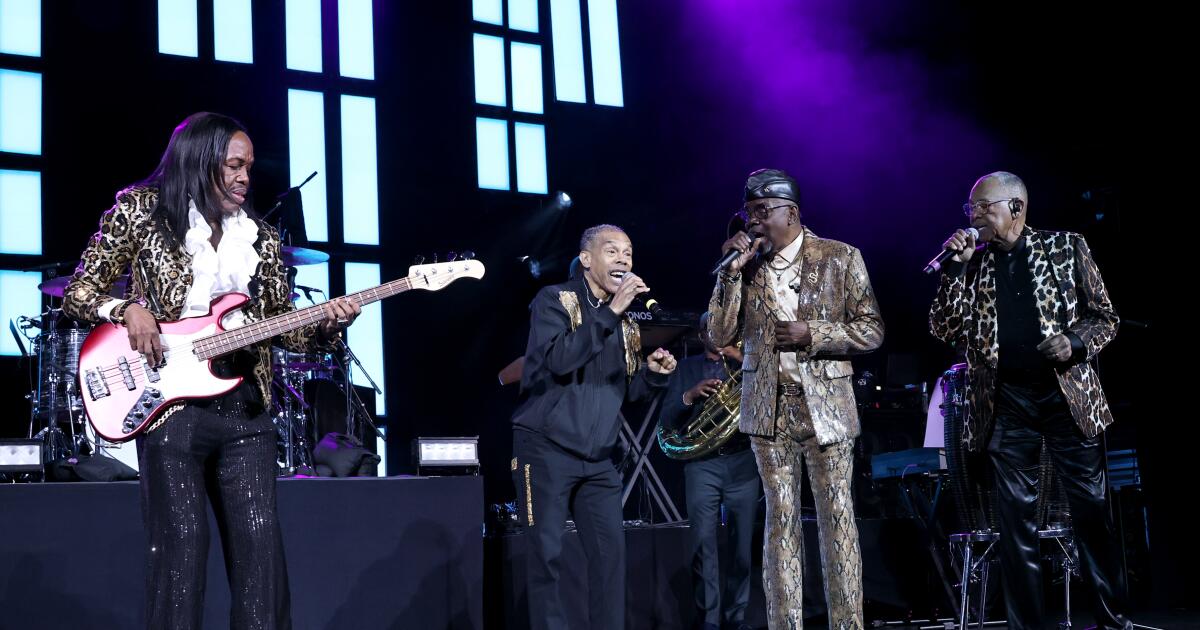
For San Francisco fans of Lionel Richie and Earth, Wind & Fire, the party at Chase Center ended before it even started.
Earth, Wind & Fire abruptly called off its concert at the NorCal venue on Thursday, notifying fans in a social media statement that the cancellation was “due to a medical emergency involving a member of our band.” A spokesperson for the San Francisco Fire Department confirmed to The Times that personnel were dispatched at 5:30 p.m. to respond to a medical emergency at Chase Center. One person was transported to a hospital via private ambulance, but the individual’s identity was not disclosed. TMZ reported that the Fire Department responded to a “cardiac incident.”
A representative for Earth, Wind & Fire did not provide additional details. The band said in its post that it has rescheduled Thursday’s show for a later date to be announced soon and that tickets will be valid for the new date. “We sincerely apologize for the unexpected change and appreciate everyone’s understanding,” the band said.
Live Nation announced Richie and Earth, Wind & Fire’s joint Sing a Song All Night Long tour in January. The tour kicked off in June but quickly hit a snag when Richie also suffered an unspecified health issue while on the road. Richie, 77, postponed a stop at Chicago’s United Center and another show at the Schottenstein Center in Columbus, Ohio, after he brought his first tour stop to an abrupt end.
The Grammy-winning hitmaker of “Hello” and “Say You, Say Me” unexpectedly stopped the concert at the Grand Casino Arena in St. Paul, Minn., after taking a seat on stage multiple times during his performance of “Dancing on the Ceiling” and telling his audience he felt “dizzy,” according to videos shared on social media.
“When you are feeling dizzy, sit your a— down,” he joked, according to video a fan posted to TikTok. “When you are feeling strange about yourself, sit your a— down.”
TMZ reported at the time that the singer-songwriter was hospitalized after the health scare. Paramedics reportedly met the artist backstage and transported him to a nearby hospital out of precaution. In a statement following the incident, Richie thanked fans for their support and informed them, “I’m doing well, and I’m grateful for all of you.”
The Sing a Song All Night Long tour is slated to continue Saturday at Acrisure Arena in Palm Desert. Richie and Earth, Wind & Fire are scheduled to play the Intuit Dome in Inglewood on Sunday. The tour ends Aug. 14 at the Moody Center in Austin, Texas.
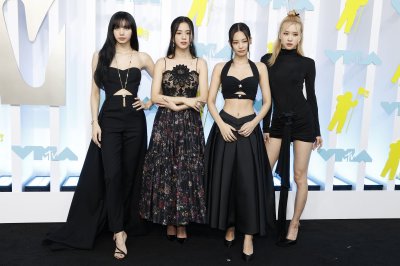
K-pop group BLACKPINK will hold a fan event in Seoul for the tenth anniversary of its debut, sources said Friday. In this August 2022 photo, members (L-R) Lisa, Jisoo, Jennie and Rose arrive at the 2022 MTV Video Music Awards in Newark. File Photo by John Angelillo/UPI | License Photo
K-pop girl group BLACKPINK will celebrate the 10th anniversary of its debut with a small-scale meet-and-greet for fans in Seoul, bringing all four members together for a rare domestic fan appearance, industry sources said Friday.
The quartet is scheduled to attend the event Saturday, the date of its debut in 2016, at the National Museum of Korea with 40 selected fans, according to the sources.
YG Entertainment, the group’s agency, said details of the event would be provided individually to those selected to attend.
Earlier this week, BLACKPINK unveiled the “BLACKPINK Heritage Collection,” a collaboration with Mu:ds, the museum’s merchandise brand in commemoration of the band’s 10th anniversary.
The group also worked with the museum in February for a project that included cultural-heritage programs and activities linked to the group’s music to mark its comeback.
It will be the first time that all four have appeared together for fans in South Korea since July last year, when the group held a stop of its “Deadline” world tour in Goyang in the northwestern suburbs of Seoul.
Since debuting under YG Entertainment in 2016, BLACKPINK has become one of the most influential acts in global pop, turning each release into a chart-topping hit, and extending its reach into fashion, luxury branding and advertising.
Its 2022 album “Born Pink” made history as the first by a female K-pop act to top the U.S. Billboard 200, while also reaching number one on the British Official Albums Top 100.
In February, the group returned with its third EP, “Deadline,” its first group project in more than three years, which debuted at No. 8 on the Billboard 200.
Copyright (c) Yonhap News Agency prohibits its content from being redistributed or reprinted without consent, and forbids the content from being learned and used by artificial intelligence systems.
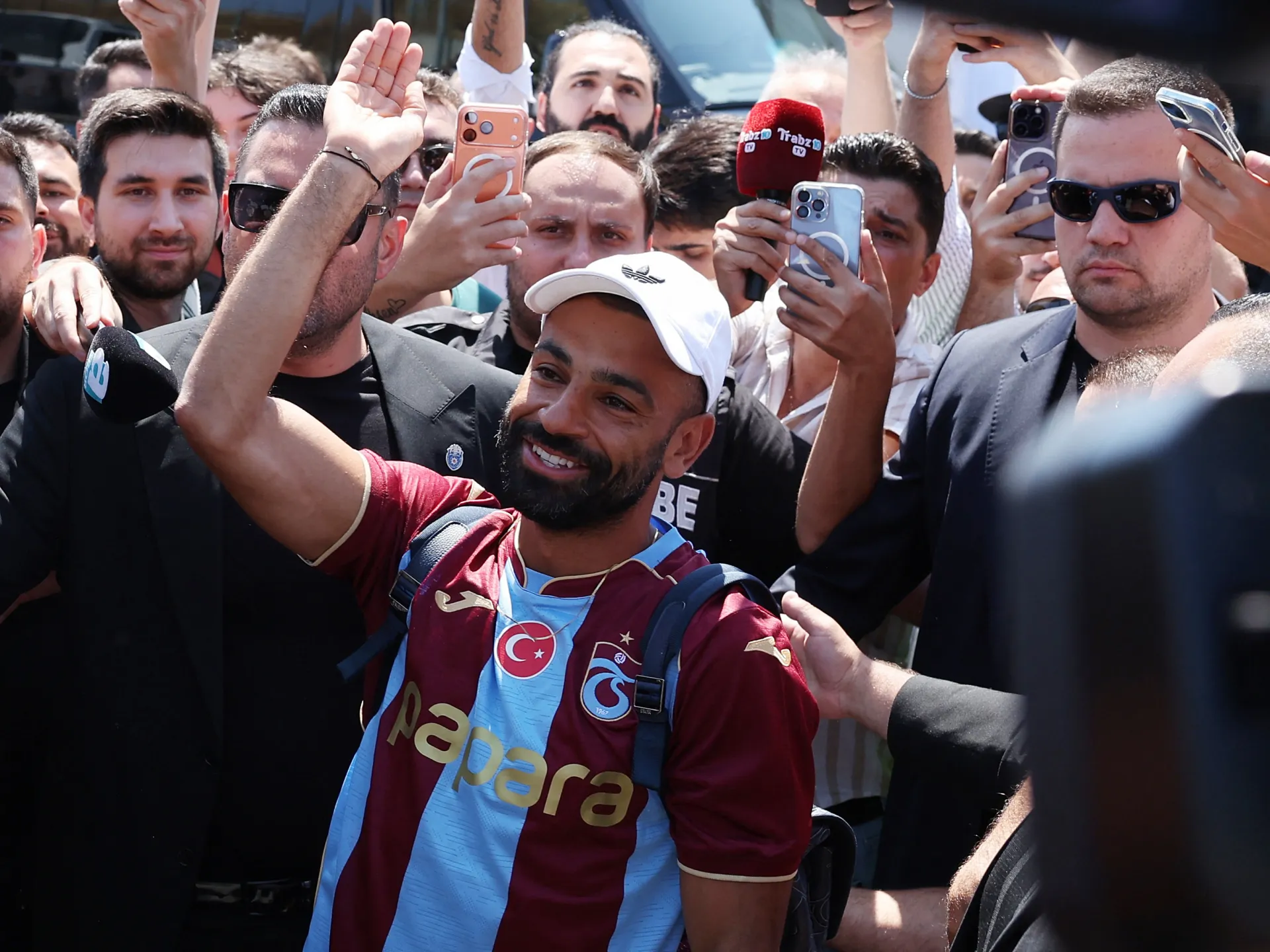
Egyptian football star Mohamed Salah has been greeted by hundreds of fans upon arriving in Istanbul wearing Trabzonspor’s burgundy-and-blue kit ahead of his expected move to the Turkish Super Lig club.
The manager of the team that most needed Tarik Skubal sat in his office Sunday at Angel Stadium. The Milwaukee Brewers, the team that opened play Sunday with the best record in the major leagues, did not get Skubal.
“L.A. is America’s team,” Brewers manager Pat Murphy said.
Not based on the cries from across America, from fans outraged that the Dodgers helped themselves to the best available talent yet again to baseball insiders mystified that the Detroit Tigers could not land a better return for Skubal than the three prospects the Dodgers swapped, or at least taken a couple more days to pursue a better return.
“Was I rooting for the Dodgers to get Skubal? Personally, no,” Angels pitcher Brent Suter said. “I was hoping another team that hadn’t won the World Series the past couple of years was going to get him.”
Suter pitched for the Brewers for seven years.
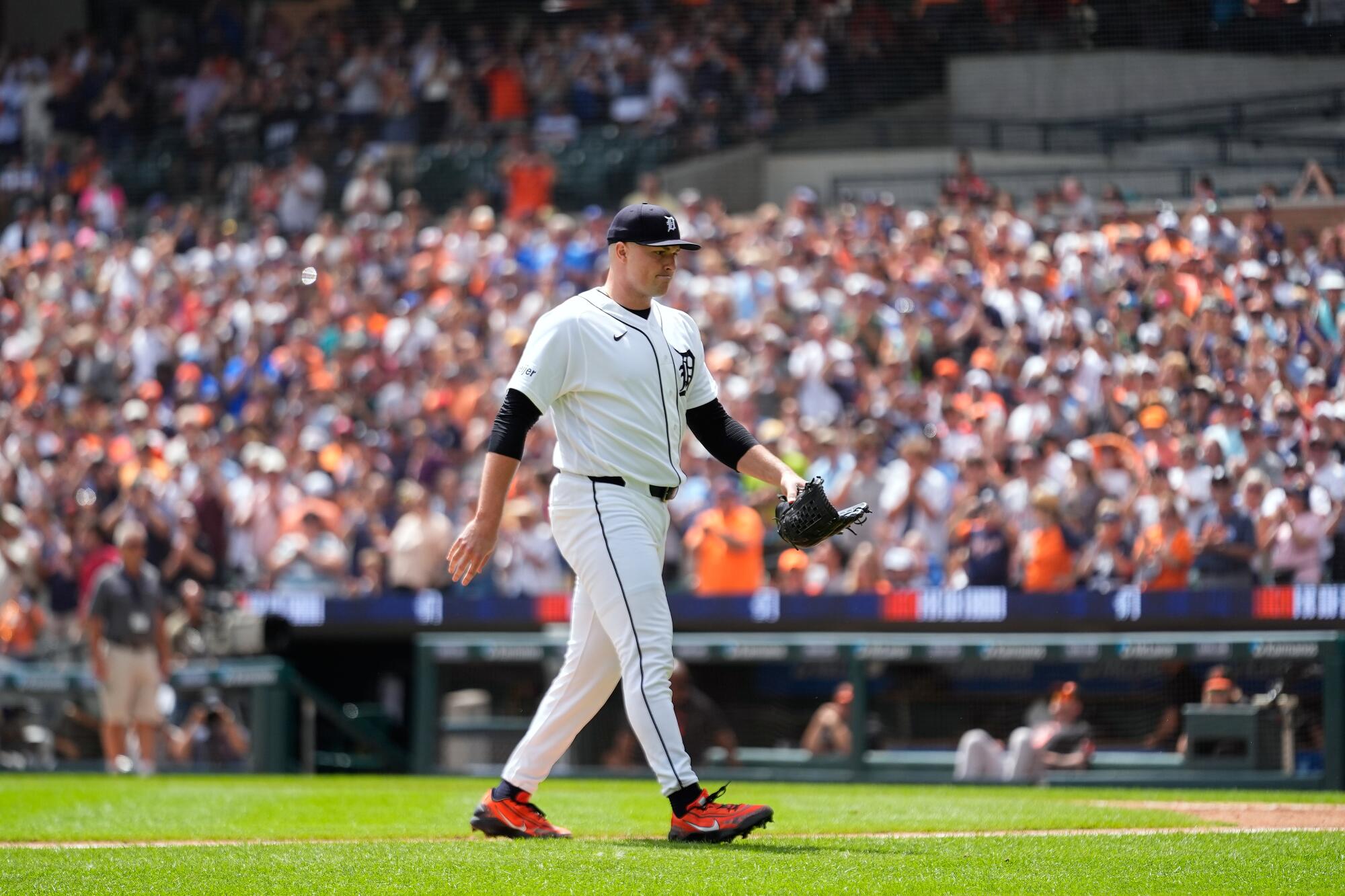
Pitcher Tarik Skubal walks to the dugout during a matchup between the Tigers and the Orioles Wednesday in Detroit.
(Paul Sancya / Associated Press)
“They have a loaded farm system,” he said. “I thought they were going to get him.”
In last year’s NLCS, the Brewers started an opener twice, Freddy Peralta once and José Quintana once. In a five- or seven-game series this October, the Brewers could have started Jacob Misiorowski twice and Skubal twice.
That could have mitigated the Dodgers’ huge advantage in slugging. The Dodgers have seven players in double digits in home runs. The Brewers have four.
But any and all statistics obscure the larger point: If you’re a Brewers fan, when is your year?
The Brewers never have won a World Series. They are in line for their eighth playoff appearance in nine years.
Sustainable success is nice, and difficult to achieve. Much credit to the Brewers, who play in baseball’s smallest market.
But the point of the game is to win the World Series. If you’re not going all in when you have the best record in the majors for the second consecutive year, when are you going all in?
If not now, when?
“I know we made our efforts, too,” Murphy said. “I trust the way we operate. I understand the way we operate.”
Milwaukee Brewers infield players celebrate after defeating the Angels Saturday at Angel Stadium.
(William Liang / Associated Press)
This is all the more maddening in Milwaukee because, in 2008, the Brewers tried their best. That July, they traded four prospects for Hall of Fame pitcher CC Sabathia. Only one, outfielder Michael Brantley, developed into a productive major leaguer. That’s the norm, not the exception, in multiprospect trade packages.
As it turned out, the Brewers lost in the first round of the playoffs, and Sabathia did not survive the fourth inning of his lone postseason start. Then he signed with the New York Yankees. So what? The Brewers went for it, and their fans believed.
After the trade for Skubal, Fangraphs increased the Dodgers’ chance to win the World Series from 25% to 31%. That still means a two out of three chance the Dodgers do not win.
“He’s an amazing player,” Suter said, “but it doesn’t mean a guaranteed World Series. It doesn’t guarantee anything.”
I could not believe the number of fans that reached out to say small-market teams could not match the Dodgers’ proposal because they had little chance to re-sign Skubal as a free agent.
The Brewers, with small-market resources, touted former Angels infielder Luis Rengifo as a significant winter free-agent signing. The Dodgers countered with Edwin Díaz and Kyle Tucker.
“L.A. is America’s team and has all the big names,” Murphy said. “Now they just added to that, with maybe the best pitcher in the game, certainly one of the greats in this era.”
If the Brewers and Dodgers meet again in October, Murphy will only be too happy to tell us who the underdog is.
“It’s going to be David and Goliath,” Murphy said. “We haven’t earned that right yet. We haven’t got there yet.
“If we get there, I’m sure the narrative will be pretty similar: the haves and the have-nots.”
Murphy wanted to make one thing perfectly clear: Fans across America might despise the Dodgers, but he does not.
“They’ve got a bunch of great dudes,” he said. “Freddie Freeman, Mookie Betts, Teoscar [Hernández]. I don’t know [Shohei] Ohtani. He doesn’t even know who I am. But I feel like Ohtani is a great dude. I can just tell by his presence.
“How can you not love [Max] Muncy? Doc [manager Dave Roberts] is my good friend. [Coach Dino] Ebel, we’ve got his whole family playing for the Brewers.”
The Brewers made first-round picks of Ebel’s sons Brady and Trey over the past two years, paying $5.55 million in signing bonuses. The Ebel boys are top prospects. They can look forward to a long stay in Milwaukee.
“I would choose to be Latina in every lifetime,” Kali Uchis said from her Saturday night closing set at L.A.’s EDM music festival Hard Summer. “Where are my Latinos at?”
The crowd responded with a resounding roar.
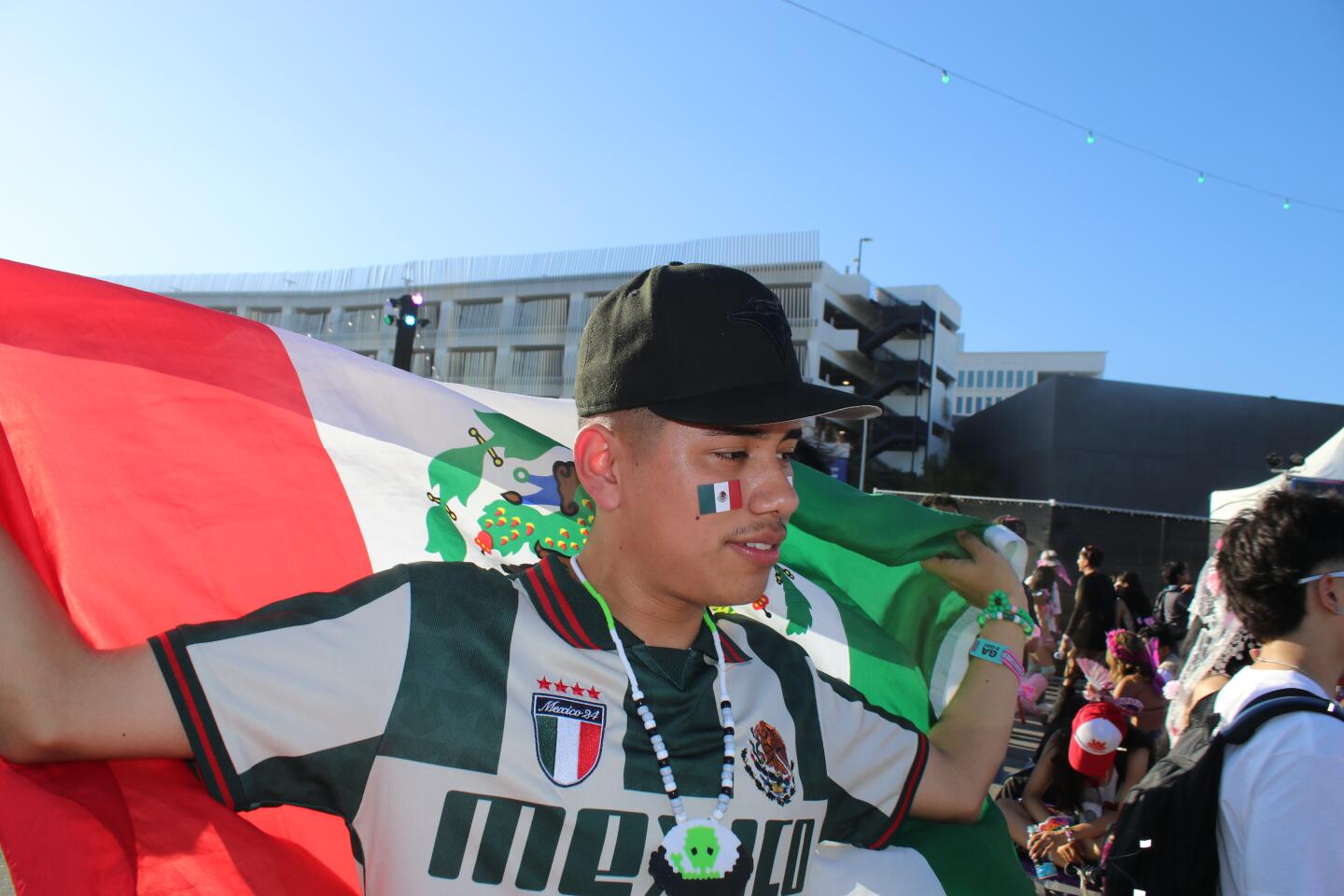
Throughout the day, fans crossed the grounds in bright Latin American soccer jerseys, the eye-catching complementary greens and reds of Mexico and the rich blue of El Salvador dotting the crowd. They held up flags, piñatas and tall signs pasted with images of Dr. Simi and “Dragonball Z” hero Goku — used to mark one’s place in the sea of people.
“Electronic music is for the beach and for Latinos,” said Dominican dembow artist and Hard Summer act Tokischa. “It’s for us. We love to dance, to feel sexy. And electronic music does that.”
1/3
Hard Summer attendees, like Jason, wore Mexican flags as accessories in Inglewood on Saturday, Aug. 1, 2026. (Katerina Portela / De Los)
2/3
Latino Hard Summer ravers added a spin to festivalwear with vibrant jerseys, flags, and accessories in Inglewood on Sunday, Aug. 2, 2026. (Katerina Portela / De Los)
3/3
Chris Mondaca couldn’t contain his excitement as he danced to Miguelle and Tons’ set at Hard Summer on Sunday, Aug. 2, 2026. (Katerina Portela / De Los)
Hard Summer first launched in downtown L.A. in 2007 — yet no Latin artists received top billing. Between Justice, Peaches and hip-hop group 2 Live Crew, the festival became a summit for English-language acts in the electronic and hip-hop genres. Yet last year’s lineup included Colombian reggaeton artist Feid as headliner, along with DJs Deorro, Funk Tribu and Sara Landry, who boosted the Latino community’s presence at the event.
This year at Hollywood Park in Inglewood, Colombian American crooner Kali Uchis headlined the main stage after a day of memorable sets by Argentine singer Six Sex, Mexican producer duo R∅z and Mexican American DJ Bolo.
“The underground DJ scene [in Southern California] is beautiful, but I will say: a few years ago, there was not a lot of Latino representation in the big festival lineups,” said Edgar Avalos, known as Bolo. “I feel like there are more opportunities for Latinos in these lineups. And I want to create an environment for Latino ravers to feel like they’re welcome in this space.”
Saray Zamora, Dafne Carbajal, Ailynn Sanchez , Cecilia Garrido and Celest Garrido decided to go to Hard Summer themed in their family’s home country flags in Inglewood on Saturday, Aug. 1, 2026.
(Katerina Portela / De Los)
The Mexican American DJ and L.A. native Deorro was an inspiration to Avalos, who describes him as “one of the first to break through on major lineups.” Following Deorro’s example, Avalos felt inspired to start his own record label Vibraza for Latino artists and to advocate for their inclusion in festivals — which includes not just onstage visibility, but career opportunities offstage too.
“I feel like there’s a huge bubble, a lot of dope emerging acts within the Latino dance community,” Avalos said. “It’s a blessing to be a part of the crew that’s putting [Latino DJs] on the map.”
According to Luminate’s 2026 data report, electronic dance music dominated the first half of 2026 as the largest growing genre in the U.S. Meanwhile, nearly 1 in 10 streams in the U.S. were songs in Spanish — and casual monthly listenership of Latin music in the States climbed to a peak of 54% of streams in the first quarter of this year.
“[Latino electronic] music makes you feel like … when you’re in the streets, you’re dancing, you feel proud, you let go of certain things or norms,” said Francisca Cuello, known as Six Sex. “Something about being Latino represents a cultural release and an understanding of fun that fits so well with electronic music at night.”
Cuello performed her new album, “Ultra,” as her pouting femme-bot persona who waxes poetic about eroticism over thumping techno beats. She said she was shocked by the number of people who sang the music back to her, despite the album having only been released earlier this summer.
“I never set out to make electronic music, but it’s what called to me,” Cuello said. “To be so far from my country and to connect with people in a country so different from mine, like the U.S., it’s such an honor.”
1/3
Hilary Joy fans herself and jumps at one of the last Hard Summer DJ sets of the night in Inglewood on Saturday, Aug. 1, 2026. (Katerina Portela / De Los)
2/3
Many of the Latina festivalgoers at Hard Summer wore colors of their home country’s flags or ribbons in their hair, as Alejandra Tadeo chose to do in maximalist braids on the way to Roz’s set in Inglewood on Saturday, Aug. 1, 2026. (Katerina Portela / De Los)
3/3
Saiah Landaverde said they were most convinced to go to their first Hard Summer for the Latino artists, like Six Sex, on the lineup. They danced with their friend Josh Roque at Roz’s set in Inglewood on Saturday, Aug. 1, 2026. (Katerina Portela / De Los)
Festival attendee Azareal Hernandez-Moreno said she was most excited for the Hard Summer lineup this year because “it’s for us.”
“I feel like it’s a big moment for these artists to perform at such a big festival,” said Hernandez-Moreno. “[They] get to represent where they’re from. It means something to us as Latinos, as fans.”
Atop the Beatbox Art Car — a Hard Summer stage for emerging acts, which is approximately 20 feet tall and built to resemble a rainbow boombox — DJ Spiñorita mixed house, Latin dance and original funk for her audience. Donning a slicked-back hairstyle, Virgen de Guadalupe top and thick golden hoop earrings that reflected the penetrating rays of the sun, Spiñorita nodded and lifted her arms as ravers mouthed lyrics of “El Sonidito” back to her.
1/4
Hard Summer attendee Angel Rosario dances along to a DJ set by VTSS in an El Salvador jersey in Inglewood on Sunday, Aug. 2, 2026. (Katerina Portela / De Los)
2/4
Heidy Menendez dressed up in blues and whites to represent El Salvador as she held up a Spanish meme totem that reads, ‘If you know this is how I get, why do you invite me?’ at Roz’s Hard Summer set in Inglewood on Saturday, Aug. 1, 2026. (Katerina Portela / De Los)
3/4
Latino Hard Summer ravers added a spin to festivalwear with vibrant jerseys, flags, and accessories in Inglewood on Sunday, Aug. 2, 2026. (Katerina Portela / De Los)
4/4
Miami-based Ecuadorean Peruvian DJ Milushka in the media hub of Hard Summer on Sunday, Aug. 2, 2026. (Katerina Portela / De Los)
Spiñorita, who is Angela Ramirez by day, said that the L.A. rave scene is one of support and community among Latina artists, who run events for themselves year-round.
“We’re out here and brown and proud of it,” Ramirez said. “We’re putting in the work to make fundraisers for social issues and giving back to our community. Raving and DJing helps to heal trauma and helps us to open up.”
Earlier that day, R∅z sparked crowds of fans to run to their stage as they brought out música mexicana star Peso Pluma. The artist reached out to the crowd as he rapped in Spanish, fans jumping and raising their phones to take pictures and document the moment.
“Viva Mexico!” said R∅z’s Hugo Lara, as cheers rang and flags waved before him.
“I think that because the demographic here is very Latino, we’re all supporting each other,” said Frida Mitre, a Hard Summer attendee. “It was very heartwarming when [Kali Uchis] asked if we were out here, especially because we’ve been going through a lot.
Mitre said one of the sets she was most excited for was Tokischa — “for being so herself.”
Dominican-born rapper and musician Tokischa in her green room at Hard Summer in Inglewood on Saturday, Aug. 1, 2026.
(Katerina Portela / De Los)
“I was born and raised — lived my entire life — in the Dominican Republic,” said Tokischa, just after her high-octane performance. “Where my music plays, it reaches Dominicans there. In the crowd, I saw some Dominican flags. I raise that really high. I just want to see my community having fun.”
As the sun lowered on Sunday, and most Latino artists had finished for the day, local DJ Bianca Oblivion began spinning records jubilantly in her Mexican flag corset, grinning in the afterglow of a landmark weekend.
“It’s a really cool moment to be a Latino DJ,” she said. “Whatever people’s idea of what Latino music is … is not limited. We’re constantly crossing genres and cultures. We’re on the rise.”
The World Cup was a riveting first chapter. The 39-day tournament brought more than 560,000 fans to SoFi Stadium for eight matches, 250,000 fans to 10 official fan zones and a projected $892 million in economic impact across L.A. County, according to LASEC.
The expanded World Cup, with 48 teams and 104 matches over 16 venues in three countries, is only a logistical qualifying match compared to the 2028 Olympic and Paralympic Games. The first Olympics in L.A. in 44 years will welcome 11,198 athletes across 51 sports from more than 200 countries competing over 20 days. The 2028 Paralympics will come to L.A. for the first time with a 23-para sport schedule that will begin competition before the opening ceremony for the first time.
Despite the difference in scale, John Harper, chief operating officer of LA28, called the successful World Cup’s local matches “an immense learning opportunity for us in a lot of ways.”
Attending World Cup matches as a fan and behind-the-scenes observer, Harper was impressed by the transportation services provided by L.A. Metro. The agency said it provided more than 212,000 rides directly to and from SoFi Stadium and 15 parking and transit hubs in L.A. and Orange counties through an enhanced service. Harper was encouraged by the interagency work between different public partners that helped the eight matches go off without a major hitch.
But the biggest lesson was in the spirit of the fans who packed watch parties, streets and bars.
“It really demonstrated the power of sport,” Harper said. “Not only the energy in the stadium, but the energy in the city and L.A. being such a diverse city, you really saw the world come to life on the streets of L.A.”
The World Cup exceeded expectations, Schloessman said, delivering economic effects, local supplier opportunity and community engagement. LASEC hosted fan areas at 10 different locations, highlighted by the tournament-opening festival at the Coliseum. The City of L.A. hosted seven free “Kick It In the Park” watch parties. Sports bars and restaurants overflowed with customers who drank beer taps dry.
“It was just this six-week interlude of time when people liked each other and people were having fun together,” Schloessman said.
LA28 hopes to create a similar, harmonious energy during the Games with sports parks at major sports zones. Areas where multiple venues are clustered together, such as L.A. Live, Exposition Park, Long Beach, Inglewood and Carson, will have dedicated areas for pin trading, sport trials, entertainment zones and sponsorship activations.
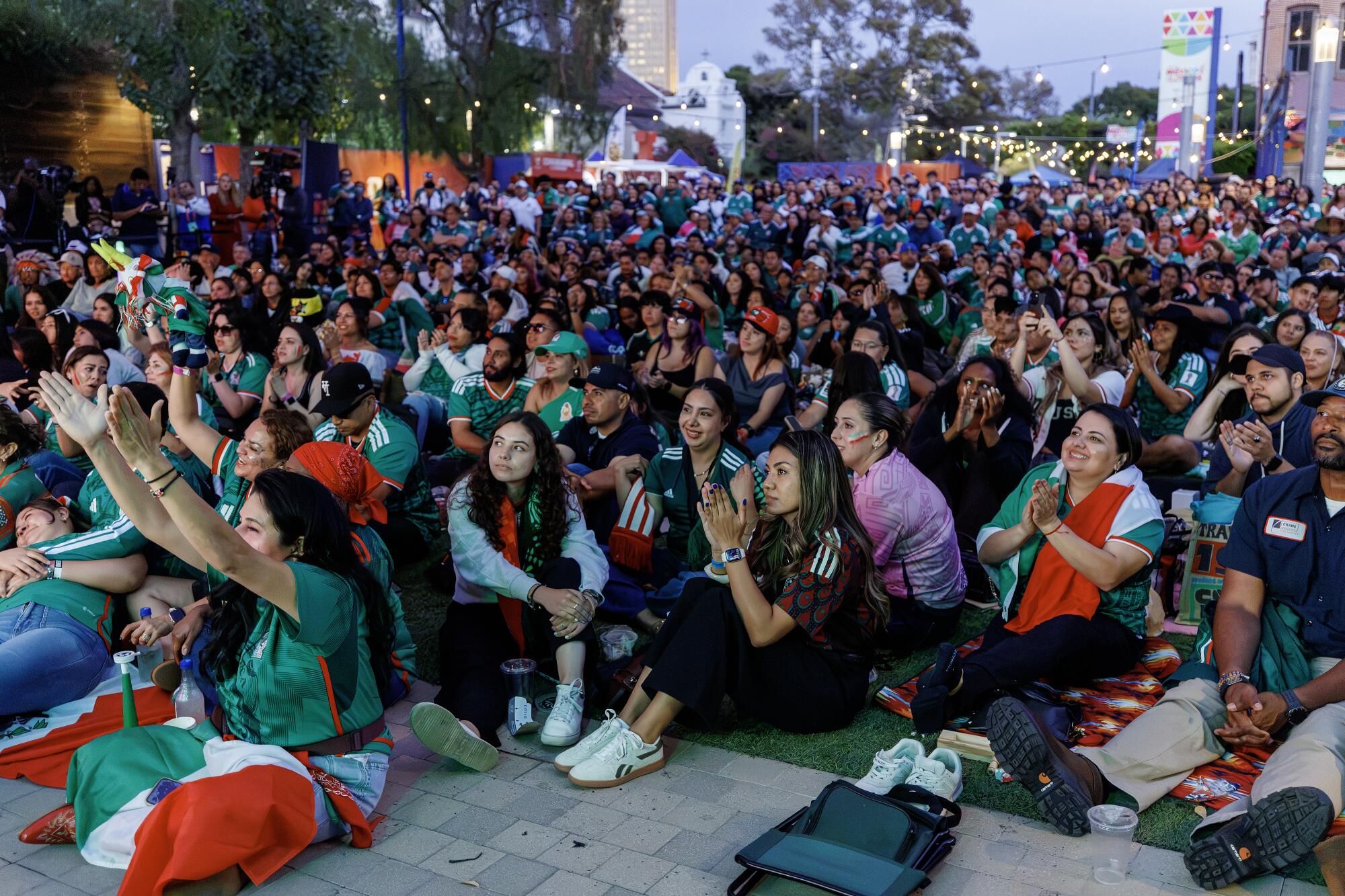
Fans cheer during a watch party at LA Plaza de Cultura y Artes during a World Cup match between Mexico and Ecuador on June 30.
(Gina Ferazzi / Los Angeles Times)
While LA28 will be responsible for hosting official live sites for the Games, local communities can organize their own Games-time activities. LASEC worked with local organizations and businesses leading up to the World Cup to promote opportunities, including watch parties, meetups or themed decorations while still adhering to strict rules regarding FIFA broadcasts and logos. LA28 will provide similar guidance leading up to the Olympic and Paralympics Games.
“It is our responsibility, with the organizers, with the authorities, to create an Olympic experience for as many people as possible,” said Pierre Ducrey, International Olympic Committee sports director, who was impressed by the atmosphere of a FIFA fan event in Kansas City where he attended a match featuring his native Switzerland facing off against Argentina. “Whether they have a ticket to be in the stadium or they don’t, we want to create special moments for them that they can remember.”
LA28 sold more than 4 million tickets in its first ticket drop, and after last week’s presale, the second drop will resume Aug. 10. With 14 million tickets available, the 2028 Games could break the sales record set by Paris 2024, which sold 12 million tickets between the Olympics and Paralympics.
The biggest World Cup ever also boasted the highest attendance, but some of the tournament’s best parties came outside of stadiums.
Santa Monica put screens on every block of the Third Street Promenade for World Cup watch parties where patrons were allowed to carry alcoholic beverages within a specific area of the open-air mall. More than 40,000 people walked through a fan hub on the Santa Monica Pier. The city closed down more than a mile of downtown Santa Monica during the World Cup final for a block party that attracted 20,000 people.
And, Santa Monica Mayor Caroline Torosis proudly emphasized, it was free.
“I think major global events have an extractive history,” Torosis said. “We are trying to change that. We are also trying to use it as an opportunity to showcase the city itself. So how do we benefit our local community but also reintroduce Santa Monica to the region?”
Santa Monica balked at the chance to host competitions for the 2028 Games. Talks to host beach volleyball near the iconic pier broke down in 2025, six months after a study indicated that being a venue city could result in a net loss of $1.45 million, while not hosting the competition could still generate $10.65 million in profit because of the city’s status as a popular tourist destination.
Santa Monica already has deals in place to host hospitality houses for several countries in 2028, including France and Switzerland. Broadcast partners will set up studios on the city’s iconic pier. With plans for watch parties and other accessible celebrations for fans, Torosis envisions Santa Monica being “the place to be” during the Games.
“We are prepared for the influx of people that are going to be in the city,” Torosis said. “I think that FIFA was a great dry run.”
Inglewood was at the center of the World Cup with eight matches at SoFi Stadium. The city got an economic boost from an estimated 625,000 fans, including thousands who traveled to support their national teams without a match ticket, Inglewood Mayor James T. Butts Jr. said.
Fans from all over the world, sporting their country’s colors, flooded Market Street for the city-hosted Wood Cup festival to begin the tournament. Packed prematch marches stunned organizers who were unfamiliar with the tradition. While SoFi Stadium’s name was changed to “Los Angeles Stadium” per FIFA’s sponsorship rules, broadcasters still emphasized they were in Inglewood.
“It really gave a boost to community pride that Inglewood is now an international city,” Butts said.
Inglewood will remain the setting for the mega-event story. SoFi Stadium, in addition to hosting a second Super Bowl in five years, is the scene for the 2028 Olympic opening ceremony — which will be shared with the Coliseum — as well as Olympic swimming and the Paralympic opening ceremony. Neighboring Intuit Dome will host the Olympic basketball tournament.
The consistent stream of global events doesn’t faze Butts. In a city that will have hosted an NBA All-Star Game, eight World Cup matches and another Super Bowl in less than a calendar year, the Olympic chapter is already written.
“We do it time and time again,” Butts said. “This is what we do.”
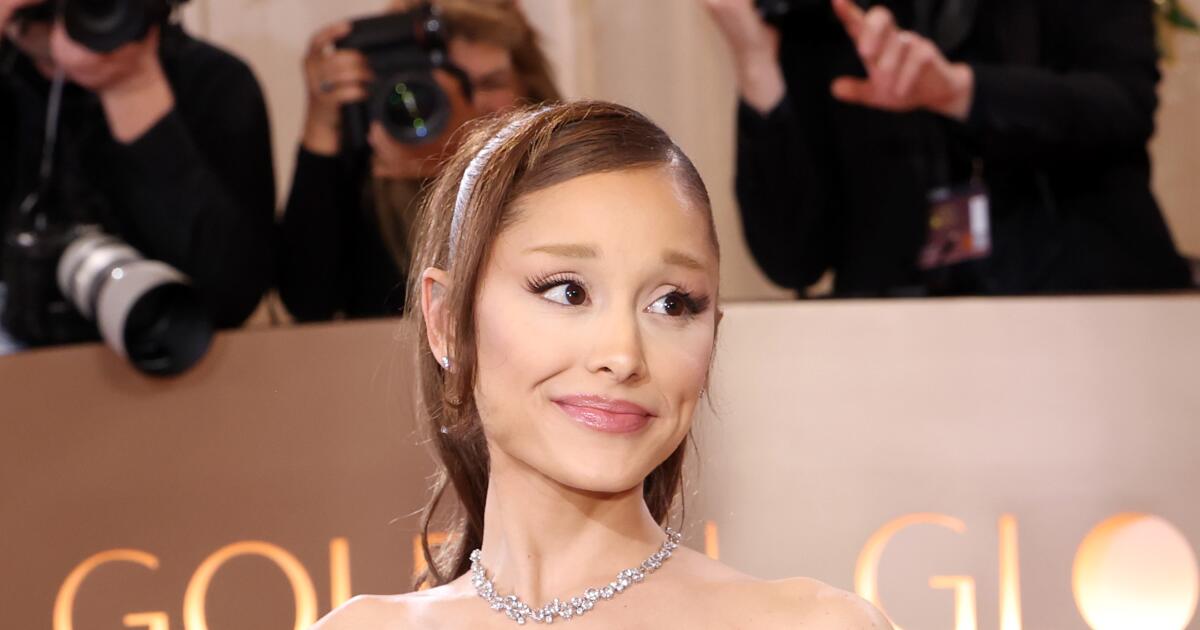
ARIANA Grande stopped her concert in Chicago last night to address her fans following the news she’ll take a step back from public life after her current tour.
The 33-year-old is halfway through her Eternal Sunshine world tour and her reps confirmed this week a “much-deserved” break when it wraps in September.
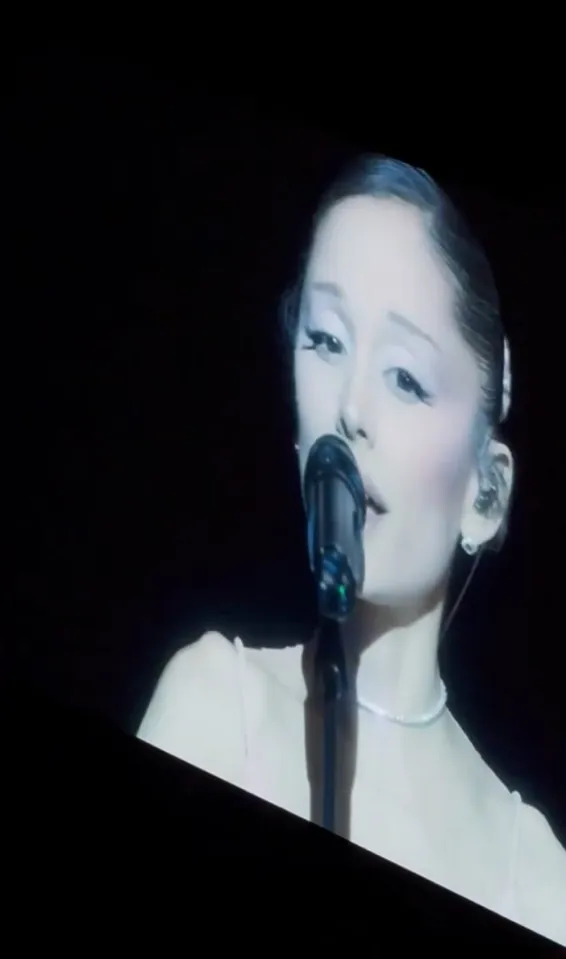
Ariana stopped her concert last night to address the news she’ll take a step back from public life after her tourCredit: XIt comes amid speculation and comments over her appearance, with one online activist claiming the singer was ‘possibly dying right in front of us’Credit: REUTERS
During her show last night, Ariana read out a statement from her phone and said: “The announcement that was made yesterday was not a reactive or impulsive thing.
“It is something that I had decided. It’s a plan that I had quietly made a long time ago, and it’s a decision that was made from a thoughtful and empowered place, and I want you to know that many, many things can be true at the same time.
Sign up for the Showbiz newsletter
Thank you!
“I want to share this because I heard that my fans were worried that negativity was ruining things for me.”
Ariana continued: “This is not what that is and I just want to make that very, very clear. Nothing can be ruined.
“Multiple things can be true at the same time. Boundaries can need to be set. Human beings can need a break sometimes.
“And also, this can be and will continue to be the greatest experience of my professional and creative life.”
Yesterday her reps said: “Ariana will be taking a step back from visibility after she completes the Eternal Sunshine Tour.
“She looks forward to finishing the tour and ending it on a high note, both healthily and happily, and then taking a much-deserved break from public-facing work and appearances, which has led to endless, ongoing public scrutiny.
“This tour has been a beautiful experience for her. She loves her fans and has loved every minute of this tour so much.”
And she will not appear on the red carpet with Robert De Niro and her other co-stars to promote their new movie Focker-in-Law.
The three-time Grammy winner’s decision to step back comes amid speculation and comments over her appearance, with one online activist claiming the singer was “possibly dying right in front of us”.
Ariana Grande delivered a four-minute speech to more than 20,000 of her fans in Chicago on Monday night amid reports that she’s stepping away from the public eye due to online scrutiny.
During the first of three sold-out shows at Chicago’s United Center, the “Break Free” singer stopped the concert to address the widespread speculation surrounding her weekend announcement that she’d be stepping away from the public eye when her Eternal Sunshine tour concludes on Sept. 1.
Grande read the prepared statement from her phone, telling the audience that she didn’t want to get nervous and forget.
“Sometimes when a story comes out that’s not directly from me, things can get a little blown out of proportion,” she said. “So I just wanted to speak to my fans directly tonight because I love you so much.
“So basically, the announcement that was made yesterday was not a reactive or impulsive thing. It is something that I had decided. It’s a plan that I had quietly made a long time ago, and it’s a decision that was made from a thoughtful and empowered place, and I want you to know that many, many things can be true at the same time. I want to share this because I heard that my fans were worried that negativity was ruining things for me, but I just have to say, that could not be more the f— opposite.
“This is not what that is and I just want to make that very, very clear. Nothing can be ruined. Multiple things can be true at the same time. Boundaries can need to be set. Human beings can need a break sometimes. And also, this can be and will continue to be the greatest experience of my professional and creative life.
“I have one more thing to say,” she continued. “No matter what noises exist out there, nothing will ever be able to distort my reality or be more real to me, or louder to to me, than this love that we share, or than how it feels to make art with the people that I love and respect. Absolutely nothing will change that or distort that for me. And I want you to know that. I love you, and this is what I will always take with me and carry with me because the rest of that s— is not mine to carry, so I don’t carry it. I needed to get up here and differentiate that from my truth for you all, because I love you, and this tour has been the most healing, beautiful, corrective, magnificent, special experience and so has putting out [the album] “Petal.” It’s been extraordinary.
“I wish that words were enough to articulate just how much I love you all.”
A representative for Grande on Sunday announced her upcoming hiatus in a statement shared with multipleoutlets.
The announcement coincided with news that the Grammy-winning and Oscar-nominated star would be dropping out of Stephen Sondheim’s West End revival of “Sunday in the Park With George,” in which she was set to star next summer opposite Jonathan Bailey.
Grande “looks forward to finishing [her current] tour and ending it on a high note, both healthily and happily,” the statement said.
Grande will then take “a much-deserved break from public-facing work and appearances, which has led to endless, ongoing public scrutiny.”
The announcement followed the Friday release of Grande’s eighth studio album, “Petal,” and the accompanying music video for the title track in which the pop star takes out a panel of her critics with a chainsaw. In response to the video, fans and foes alike flooded the comments section with remarks about Grande’s appearance and apparent weight loss.
The Times’ pop music critic Mikael Wood wrote of the album, “[T]he pop superstar opens the spigot on what she’s described as an ‘unfiltered rage’ to blast any number of feckless exes, a prying public obsessed with her body and her personal life — and not least herself for allowing anyone the power to hurt her in the first place.”
On her new album, “Petal,” the pop superstar opens the spigot on what she’s described as an “unfiltered rage” to blast any number of feckless exes, a prying public obsessed with her body and her personal life — and not least herself for allowing anyone the power to hurt her in the first place.
“Tell me who’s to blame — is it the people or myself?” she wonders against the icy synth stabs of the title track.
Her answer, delivered as a sneering little aside: “Yeah.”
“Petal” marks a dramatic shift from Grande’s previous LP, 2024’s “Eternal Sunshine,” a tender and melancholy electro-pop collection that laid out a kind of emotional philosophy of heartbreak. She recorded the new album with the same team — the hit-making writer-producers Ilya Salmanzadeh and Max Martin — but here they go for a murkier, more percussive sound to match Grande’s dark mood.
Tolling electric guitar accompanies her in “Freak” as she muses on “all of the life I’ve been denied,” while “Oh Well” puts a jittery U.K. garage beat under her sneering farewell to an unnamed antagonist: “Good luck on your way to hell.” In “Hate That I Made You Love Me,” which debuted at No. 1 on Billboard’s Hot 100 when Grande released it as “Petal’s” lead single, she sings, “I’ve held your projections when you’ve felt so insecure,” over a trudging groove that moves like a funeral march.
These downcast observations arrive at what would seem to be a professional high point for Grande, who recently wrapped her extended stay in the “Wicked”-verse and who’s in the middle of a tour that’s drawn adoring fans to arenas across the country.
But perhaps that’s the point: Almost every song on “Petal” can be interpreted two ways — as a story about a broken relationship between two people or as a tale about the toxic connection between an idol and her audience. (More than once did this record make me think about Taylor Swift’s “The Tortured Poets Department.”)
“My pain is music — do you hear me everywhere?” Grande asks in “Warning Signs (Interlude),” which climaxes with a pithy diagnosis of pop stardom in the parasocial age: “You don’t deserve me / You know you don’t, you never have / But I want you to feel me / I wish someone could hear me.”
Complaints about celebrity can be pretty tedious, of course; sometimes it feels as though famous pop singers have forgotten how to write about anything other than life in the social-media fishbowl.
Yet “Petal” gets some creative traction from how Grande chooses to use her voice; instead of belting, she rarely rises above a whisper, which gives a spooky, slightly creepy quality to her thoughts on being endlessly scrutinized. The airiness of her singing provides some comedy too in a hard-edged song such as “Like I Do,” where after noting that “all that s— talk keeps me well-fed,” she tells whoever needs to hear it, “No one f— you like I do.”
Having gotten all this off her chest, Grande finishes the album by allowing in some light: Over a zippy new wave arrangement, “Bad Thing (Bunny Hop)” ponders the renewing energy of a fresh romance — or maybe a rekindled old one — while the glistening “Nowhere, Nobody” has her taking deep breaths with a lover she’s convinced might finally give her what she needs.
“Convinced” is probably the wrong word.
“Hard to believe in a perfect ending,” she admits, “But that’s all right.”
I can’t answer the first question, although I wouldn’t bet against a three-peat.
As for the second question, if I were former Dodgers owner and aerial tram godfather Frank McCourt, I’d fasten my seat belt, because the gondola is about to hit some heavy turbulence.
The gondola would slice through a section of L.A. State Historic Park, wipe out dozens of trees and trample a space that was carefully designed with years of community input. And the mounting opposition now includes seven former state park officials and four former members of the state Park and Recreation Commission.
The former staffers have sent “don’t you dare” letters to the commission, and one of them argued that the view of the downtown skyline would be cluttered and commercialized.
“Gondola cars encased in digital ads, flying 26 feet overhead every 25-30 seconds would irreparably impair the vista, and the sense of calm and escape from urban life,” wrote former state parks director Ruth Coleman.
The four former commissioners have signed a joint letter arguing that the gondola proposal “would enable a private development to permanently and irreparably shrink, degrade, and destroy the integrity of a state park.”
They’re speaking up now because the state is considering an amendment to the park’s general plan that would allow for “consideration and review of the proposed Los Angeles Aerial Rapid Transit (LA ART) gondola project.”
That was McCourt’s brainchild, back in 2018, and he’s a guy with lobbying muscle and friends in high places. McCourt later handed off the project to an environmental group, but the idea is still to deliver fans to Dodger Stadium, where he has financial interests.
A hearing on the matter is expected in the fall, and it’s sure to be a cage fight. Last December, throngs of supporters and foes squared off at a raucous Metro board meeting. The board ultimately green-lighted the gondola, which the L.A. City Council has almost unanimously opposed. So the showdown scheduled for this fall could be at least as interesting as the World Series.
For the record, I’m not anti-gondola. They’re fun, right?
But I’m not buying the proponents’ claim that this is a public transit project. They say several thousand people would soar up to Chavez Ravine and help relieve the miserable traffic in and out of parking lots, which McCourt took part ownership of after selling the team back in 2012 for a cool $2 billion.
But how much is gained if gondola riders ditch the free shuttle buses that now run to the ballpark from Union Station?
Then there’s a much bigger question, which my colleague Bill Shaikin explored in 2022: Is the gondola phase one of a plan to develop stadium property into some kind of Dodgertown commercial extravaganza?
Unclear, but let’s not be naive.
A Dodgers executive told Shaikin the Dodgers support the gondola project, although they are “really not involved” in it. But we’re talking about fabulously wealthy people whose only real job is figuring out how to make more money.
Team McCourt has suggested the gondola will be built with private money, perhaps from selling advertising rights, and that rides will be free to Dodger ticket holders.
But how would any of that pencil out with Dodger Stadium closed most of the year, and with gondola traffic chipping away at revenue from parking fees that start at a monstrous $40?
There’s something they’re not telling us, and if you think there’s no threat of taxpayers getting dinged one way or another at some point, you’ve either been hit in the head by a line drive or you’ve had too many $18 beers at Dodger Stadium.
If you want more details on the history of the gondola gambit, I suggest you check out all the reporting by Shaikin, who has been on the case for years, and offered up a far better idea than a gondola: Make it easier for fans to walk or bike to the ballpark.
But let’s get back to L.A. State Historic Park.
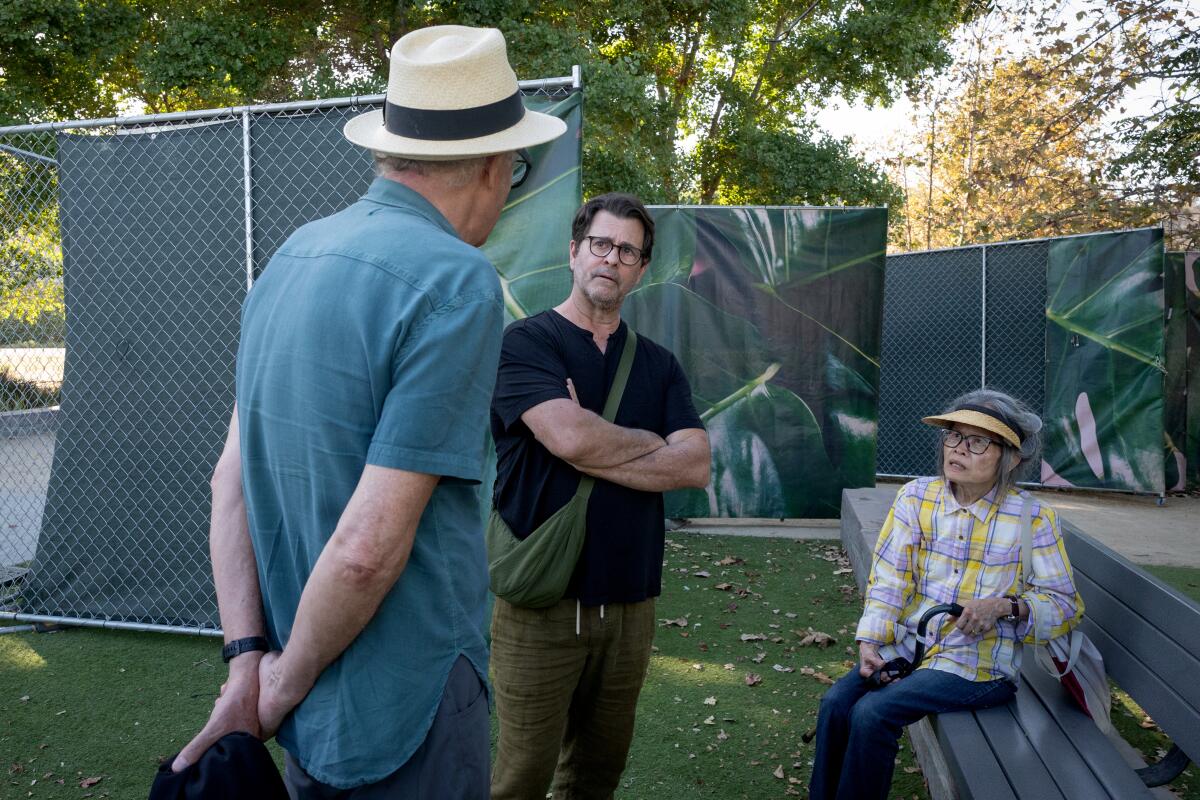
Much of the early gondola opposition was from Chinatown residents who didn’t like the idea of living under what would resemble an amusement park ride. But on Wednesday evening, I met with some people whose focus is the impact on the park.
“All of these trees would be gone,” said Sean Woods, a former state parks employee who penned one of the letters to Sacramento, and who was involved in some of the 65 public meetings and workshops at which community members helped with the design and mission of the park.
We were in a shady spot, where the gondola would run parallel to the existing Metro train tracks. There’d be supporting towers on park property, with cables dangling overhead, and a gondola station just outside the park. The gondola would occupy only a small slice of the 32-acre space, but it would be a visible distraction from every inch of the park.
“I think it’s a betrayal of California State Parks’ commitment to the communities that surround this park, that fought dearly for this park,” Woods said.
He was reflecting on a time when the former railyard was destined to become a giant industrial warehouse complex. And this followed the history of Chinatown having been relocated to make way for Union Station, and residents of Chavez Ravine being relocated to make way for Dodger Stadium.
Jon Christensen, Sean Woods and Susan Lai chat at Los Angeles State Historic Park.
(Eric Thayer / Los Angeles Times)
Joining us was Susan Lai, who along with Woods represents Friends of Los Angeles State Historic Park.
Lai is small in stature, but she swings for the fences.
“This is called a historic park for a reason,” she said, “and McCourt … has no historical connection to the park, no community connection to the park, and no cultural connection to the park.”
Lai is steeped in the archaeology of the park, the Gabrielino establishment here, the Zanja Madre irrigation line that served the early pueblo.
As we strolled, she told me this is another case of politically connected profiteers trying to impose their will on the local community, and she won’t stand for it. Lai is carrying a torch lit by her husband, Collin, who died last year at the age of 96 after years of fighting to make the park a reality.
“She’s brought an extra fire to this whole effort, and really inspired a lot of young people,” said Jon Christensen, gondola foe and co-founder of the Los Angeles Parks Alliance.
Christensen led Lai, Woods and me to the top of a grassy hill. When the park opened in 2006, I thought it seemed too flat and shapeless, too hemmed in by Broadway and Spring. But it later expanded, the trees filled in and the whole park grew on me as a place to see and feel Los Angeles.
I loved two things most of all.
The unstructured activities enjoyed by a broad mix of people picnicking on the grass, napping under a tree, kicking a ball around or doing what 10 guys were doing Wednesday evening — playing a game of Frisbee football in the meadow below us.
And the unfettered skyline view, which could soon be lost. And consider the optics: Dodgers fans soaring over a public park enjoyed by families who might need to hit the lottery to afford tickets to a game.
It was almost Dodger game time, and if the gondolas were up and running, they’d be close enough overhead that you could hit one with a tomato.
Netflix and AMC Global Media, the network that originally aired the zombie series, inked a new five-year co-streaming deal, according to a press release on Thursday. Both companies will be able to show the original “The Walking Dead” series and its six spinoffs on Netflix and AMC+. The deal is valued at $500 million, AMC Global Media said in its second-quarter earnings report.
“This deal creates a global destination for this universe — all shows, all episodes — making the franchise more accessible than ever to fans around the world. In addition, the co-exclusive agreement allows us to bring the original series to AMC+ for the first time early next year,” Kristin Dolan, the company’s chief executive, said in a statement. “This agreement is a fantastic result for our companies, for the fans and for this timeless IP.”
AMC Global Media is renting the franchise, not selling it. The five-year licenses run separately for each show, with start dates that vary based on territory and the expiration of existing streaming deals. The rights to “The Walking Dead” revert to AMC Global Media when the term ends.
The company also keeps global rights to run the “Walking Dead” universe on its own services throughout. Dolan told investors the agreement would supply what she called “a meaningful source of cash flow for years to come,” framing it as evidence that the company’s library still commands premium prices even as its cable business shrinks.
The agreement will extend the franchise’s reach on Netflix in places like the U.K., Italy, Australia and New Zealand — making episodes available beginning in 2027.
“The Walking Dead” premiered on the AMC network in 2010, introducing audiences to the high-stakes world of a zombie apocalypse. In 2011, the series began streaming exclusively on Netflix in the U.S. The show aired for 11 seasons and became one of AMC’s most influential shows. Other popular programs from the network include “Mad Men” and “Breaking Bad.”
“Audiences have discovered and loved ‘The Walking Dead’ on Netflix for nearly 15 years and the show continues to attract new fans,” Lori Conkling, Netflix’s vice president of licensing, said in a statement.
The deal landed alongside a rough quarter. AMC Global Media reported second-quarter revenue of $547 million, down 9% from a year earlier, and a loss of 51 cents a share, compared with 91 cents in profit in the same period last year. Operating income fell to about $16 million from $64 million.
Netflix’s second-quarter earnings showed mixed results. The company‘s revenue rose 13% to $12.6 billion; its net income was $3.4 billion, up 9% from a year ago; and its advertising business is on track to reach $3 billion in revenue this year, double the amount in 2025.
The same filing offered some details on Netflix’s acquisition of InterPositive, the AI post-production startup founded by Ben Affleck, for $587 million in cash in March.
BUENOS AIRES — After a bruising World Cup defeat gave way to what many Argentines saw as a sweeping wave of hatred against their country, Argentine President Javier Milei on Thursday signed an emergency decree empowering the government to deny entry to or expel foreigners who incite discrimination or violence against Argentines because of their nationality.
The measure adds new grounds to Argentina’s immigration law, allowing authorities to bar, deport and revoke visas of people found to have promoted hatred against Argentines in spoken or written statements or who have desecrated national symbols.
“In light of recent displays of hostility toward the Argentine Republic and Argentines, the national government reaffirms that the defense of the nation, its citizens and its symbols is non-negotiable,” the president’s office said. “Anyone who attacks the Argentine Republic is not welcome in our country.”
The move marks a sharp shift for a country that has long prided itself on welcoming immigrants. Argentina’s Constitution explicitly encourages immigration, and for decades the country has offered foreigners broad civil rights and relatively easy access to legal residency, public education and healthcare.
Milei’s office cast the decree as a response to weeks of criticism from celebrities, opposing fans and social media users after controversial refereeing decisions fueled speculation that FIFA had tilted the tournament in favor of the reigning champions and superstar Lionel Messi.
Condemnations of occasionally aggressive Argentine fans and the team’s roughhousing on the pitch soon broadened into attacks on Argentine society as a whole, amplifying long-standing criticism that Argentines view themselves as culturally and economically superior to their Latin American neighbors. Online petitions to expel Argentina from the World Cup drew hundreds of thousands of signatures.
The backlash intensified when Argentina players and staff became involved in a post-match brawl with Spanish opponents after the World Cup final.
FIFA, global soccer’s governing body, on Wednesday opened disciplinary proceedings against the Argentine Football Assn. over the scuffle, as well as over alleged racist abuse and fan misconduct. Players also faced a FIFA investigation into their parading of a banner that asserted Argentina’s claim to the British-controlled Falkland Islands after the team’s semifinal victory over England.
Milei, a close ally of President Trump’s, has described the torrent of criticism as an “anti-Argentina campaign.” He alleged without evidence last week that the left-wing governments of Brazil and Mexico and the U.S. Democratic Party had financed the effort to stigmatize Argentina to discredit his libertarian government.
His accusations and insults triggered a diplomatic crisis with neighbor Brazil, which recalled its ambassador to Argentina last weekend.
Thursday’s decree says the punishments don’t apply to ideological disagreement or political, academic or civic criticism protected under Argentina’s Constitution.
But it leaves unanswered how officials will distinguish protected speech from prohibited hate speech, whether immigration authorities will review foreigners’ social media activity and how aggressively the new powers will be enforced against tourists and longtime residents.
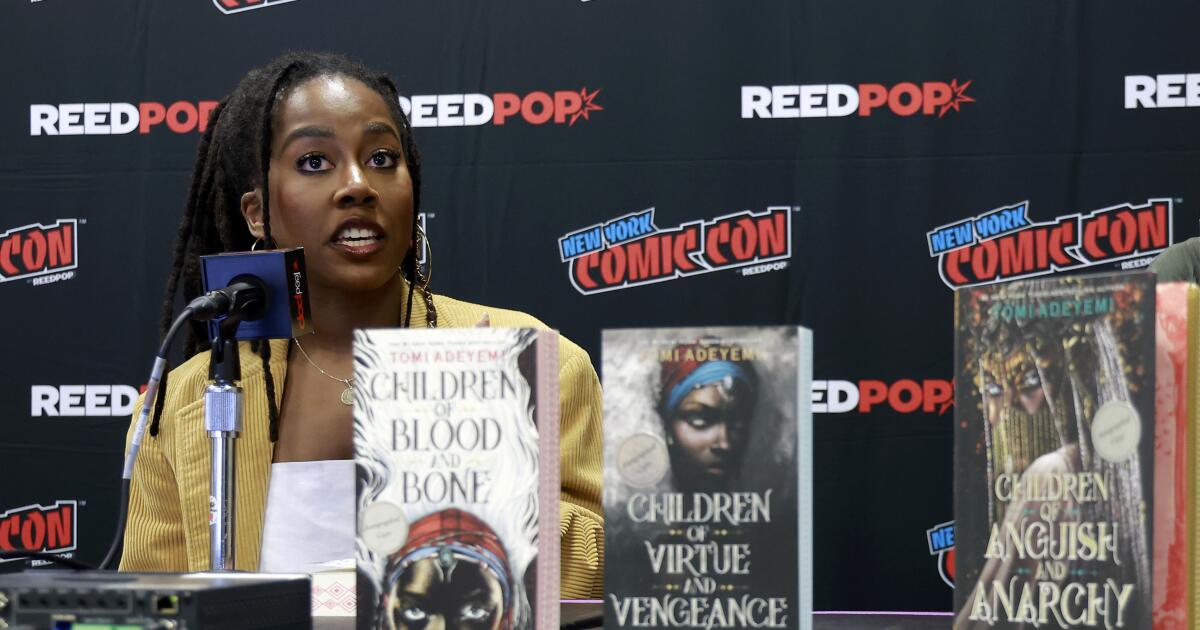
On the heels of the trailer reveal for the big-screen adaption of “Children of Blood and Bone,” the book’s author is claiming in a new video that an on-set ordeal traumatized her — and fans have been left with more questions than answers.
On Wednesday, Tomi Adeyemi upped the ante when discussing the ongoing behind-the-scenes drama that’s overshadowed the new film. Although the author, in her latest video on the falling-out, hinted at a painful ordeal that unfolded on set, fans are still scratching their heads as to what exactly happened and who was involved.
“I’m gonna post this so ideally I won’t have to talk about this anymore,” she said in a five-minute, 40-second video posted to social media. “And what I’m about to share is not a secret to the people involved. It’s a reality that I’ve had to live with for about a year and a half, and everyone involved, at least at the highest level, has been made aware of this reality, and they haven’t done anything to make it better. If anything, they’ve only antagonized me, and I accept that, but I also accept if I don’t say something, I think it’s just going to be worse.
“I’m not gonna speak on what I endured to make it through the young adult trilogy, and I’m not going to speak about everything that I also suffered through to make the adaptation a reality,” she continued. “I’m actually only going to speak about what happened after I left that set of my own film adaptation, hyperventilating and sobbing, and there are many witnesses, so it’s not really a secret.”
The author continued that, when she returned to America from an overseas filming location, she suffered “such severe somatic pain and so many panic attacks” that she knew she would never be able to watch the film.
“But as it is being marketed, and as I am still being antagonized behind the scenes, which is where I hoped all of this would stay, it’s become apparent to me that reality needs to at least be made known so that you guys can understand how this film — which I worked on to make it a little better for us to be alive — is also the worst thing I have ever had to live through, and I don’t wish to speak on it anymore.”
Adeyemi concluded that she never wants to hear about the film adaption again, and then she seemingly threw shade at director Gina Prince-Bythewood, whom she co-wrote the screenplay with, saying, “I don’t have anything to say about the people who made it. I do not care anymore. I’m trying to move on. This video might make it worse, but I don’t know how it can be any worse.”
Representatives for Prince-Bythewood and Paramount Pictures did not immediately respond to The Times’ request for comment.
Earlier this month, the Nigerian American author posted a since-deleted video on TikTok that also left her followers puzzled in which she said there was a reason she stopped promoting the forthcoming film. Although she didn’t spell out the reason, she posted a screen shot of a February 2025 text exchange with one of the film’s stars, Amandla Stenberg, in which she told the actor not to use her name in interviews and then blocked her.
Stenberg, who is African American and Danish, had been at the center of a casting controversy due to claims that colorism was at play when she landed the role of Princess Amari. (Read more about the controversy here.)
On Monday, Paramount held a “Children of Blood and Bone” trailer launch event at the Brooklyn Academy of Music in New York City. In a discussion moderated by “Master of None” actor Lena Waithe, Prince-Bythewood and the A-list cast talked about the making and almost-not-making of the film, and Prince-Bythewood seemed to reveal her stance on the fallout over Stenberg’s casting.
The director said her big-screen adaptation was “beautifully inspired by Nigeria and also inclusive of the whole diaspora. We wanted all of us to be able to see ourselves within this, just our complete and utter humanity, all the beautiful hues.”
In the comments section under Adeyemi’s Wednesday video, frustrated fans asked the author to be more transparent while others suggested maybe a non-disclosure agreement was hindering her ability to offer any specifics on the incident.
“Children of Blood and Bone” is slated to hit theaters Jan. 15.
The checklist to launch an independent minor league baseball team is long and daunting. Can you find a place to play? How do you find enough players, and make enough money to pay them? How can you persuade a community to support a home team?
Here’s a new one: If minor league baseball is all about affordability, how do you compete against a nearby major league team that might undercut you on pricing?
This astounding dilemma is brought to you by the Angels, and their combination of a consistent focus on affordability and a consistently bad team.
Zach Neto is the best player the Angels have drafted and developed since Mike Trout — that is, in the past 17 years — and the team is considering whether to trade Neto ahead of next week’s trade deadline. That might make the team better in the long run, but almost certainly not next year.
And, next year, the Angels will have competition for the Orange County baseball dollar, a few exits down Interstate 5. On Tuesday, the Irvine City Council approved a five-year agreement under which a yet-to-be-named minor league team would play at the sparkling ballpark within the city’s Great Park, starting next May.
“We might not, on certain days, be the cheapest ticket in town,” said Paul Freedman, co-founder of Innovation Baseball Partners, the company for which the Irvine team is the fourth in its portfolio of minor league teams, all based in California and all competing in the Pioneer League, where players are limited to no more than two years of professional experience.
No ticket prices have been announced for the Irvine team. Jamie Rosenberg, another IBP co-founder, told the Irvine City Council that the IBP team in Long Beach charges roughly $10 to $15 for general admission, with a $2 special every Tuesday.
“The idea is to make this an accessible, affordable entertainment option for the community,” Rosenberg said.
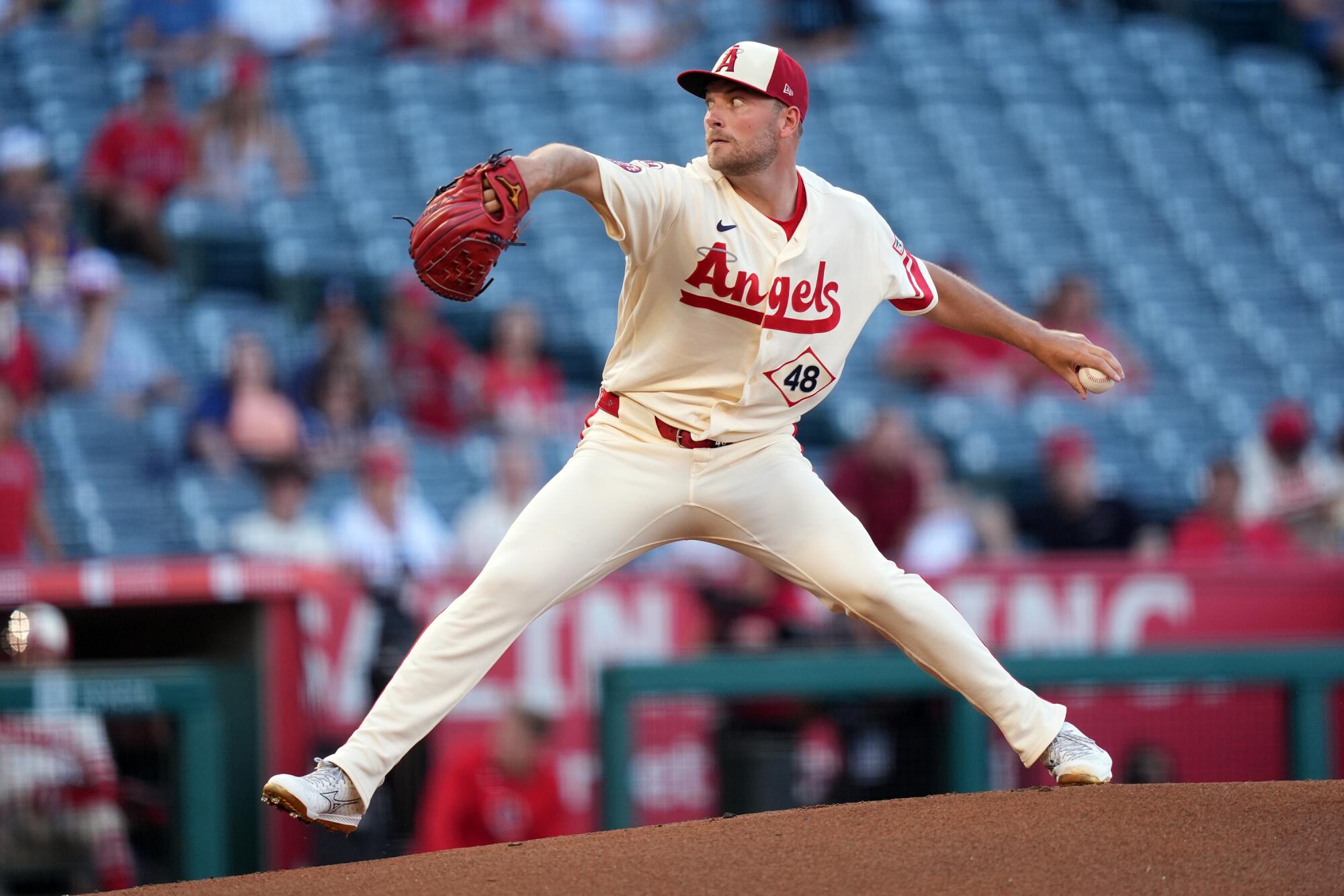
Angels pitcher Reid Detmers throws from the mound against the Houston Astros in front of a sparse crowd Tuesday at Angel Stadium.
(Scott Strazzante / Associated Press)
On Tuesday, three hours after Rosenberg spoke, the Angelsplayed the Houston Astros at Angel Stadium. On StubHub, you could buy a ticket for $2.
“I think Angel fans would hope the team gets better and maybe those prices would go up,” Freedman said, “but what we’re confident in is that we’re going to have a value experience.”
On Tuesday and every other day at Angel Stadium, the Angels proudly display a sign advertising a collection of what the team calls its “family value merchandise.” A T-shirt or a cap can be yours for $9.99, and a souvenir baseball with the team logo sells for $7.99.
“We really focus on a family of four,” Freedman said. “Can a family of four afford a night out?”
The Angels offer a family package — four tickets, four hot dogs, and four drinks — for $44.
You may remember what Angels owner Arte Moreno said in spring training: “The number one thing fans want is affordability.”
That infuriated Angels fans, of course, since their team has baseball’s longest playoff drought — 12 years, counting this one. Freedman says the fans of his teams want affordability too, but he cautioned against stretching the comparison too far.
For one, Trout plays in Anaheim. You can see a future Hall of Famer there all summer, and stars from around the league, and you can see the Yankees and Red Sox and Dodgers every year.
“We’re not ever going to replace the majesty of going to see the Dodgers with Shohei [Ohtani] playing,” Freedman said, “but we can create an environment that’s more fun.”
For two, whatever $2 tickets you might find in Anaheim put you in the vicinity of the top of a foul pole. All the tickets in Irvine put you right behind home plate, because there are barely 1,000 seats.
And, for fun, Freedman and his partners are planning to become the first American team to integrate elements of the Asian fan experience into the game presentation.
“We want to be doing things you haven’t seen in an American baseball game before,” he said, “and we want to put a fair price on that, one that is reasonable and allows us to operate our business.”
The traditional minor league team operates far from the shadow of a major league team. The Pioneer League, for instance, has teams in the California towns of Modesto and Marysville, and in Idaho Falls and Missoula, Mont.
The Irvine launch will be different and challenging — and, yes, fun. But success depends on paying customers, and nothing attracts customers like a trial offer.
EDDIE MARSAN is to play Harry Redknapp in a film about one of football’s most incredible stories, I can reveal.
The actor, a Spurs fan, will put his allegenices to one side when he takes on the role of the West Ham favourite when he was their assistant boss in 1994.
Eddie Marsan is to play Harry Redknapp in a film about one of football’s most incredible storiesCredit: AlamyHarry invited a loudmouth Hammers fan to play up front for the Premier League outfit after hurling abuse at players from the standsCredit: Darren FletcherHarry went into the stands and got him to play, with angry fan Steve Davies going on to score and helping West Ham to a 4-0 winCredit: Steve BaconSteve came on as West Ham were struggling against non-league Oxford City in the pre-season friendlyCredit: Steve Bacon
The film by Sir Ridley Scott re-tells the moment Harry actually invited a loudmouth Hammers fan to play up front for the Premier League outfit after hurling abuse at players from the stands — and he went on to score.
Eddie plays gaffer Harry in Halftime Hero, alongside Anson Boon as angry fan Steve Davies.
Sign up for the Showbiz newsletter
Thank you!
West Ham were struggling against non-league Oxford City in the pre-season friendly when Steve was told to put on a kit and prove he could do better . . . and did.
A source said: “Eddie has been cast as Harry in Halftime Hero and will be filming his scenes in the coming weeks.
“As a huge football fan, Eddie knows this tale well and to take on such a prominent part in a film about such a huge moment in the game is hugely exciting for him.”
Like me, Sherlock Holmes actor Eddie is a Tottenham fanatic, so it will be a dream role to play Harry, who went on to manage Spurs years later.
It’s just a shame he’s going to have to wear a West Ham coaching kit to do it.
I revealed last month that Ridley’s production company was working on the film about Harry’s famous game, which has become part of football folklore.
Steve was told to put on a kit and prove he could do better . . . and he went on to scoreCredit: Steve BaconThe film by Sir Ridley Scott re-tells the incredible momentCredit: GettyThe fan was subbed on after criticising star player Lee ChapmanCredit: Andrew Styczynski – The SunLoudmouth Steve was rewarded for his abuse – with a spot in the teamCredit: Andrew Styczynski – The Sun
Steve could be heard heckling striker Lee Chapman and repeatedly branded him a “donkey” for his poor performance.
Harry went into the stands and got him to play, with Steve going on to score and helping West Ham to a 4-0 win.
The historic moment was never caught on camera, so now Anson, Eddie and Ellie Bamber — who plays Steve’s girlfriend — are bringing it to life.
Harry has spoken fondly about the wild episode over the years, admitting he told the stadium announcer that he was bringing on a “great Bulgarian” called “Tittyshev”.
Steve previously said: “It was the greatest moment of my life.
“After that, I was exhausted.
“I was on 30 cigarettes a day back then.
“I had a couple of cigs and a couple of beers in the first half.”
Good on you, Steve.
Me, I’m Jase relaxing
Jason Orange was seen enjoying a peaceful afternoon in a park in Cheshire on MondayCredit: Eamonn & James Clarke
TAKE THAT have just finished their hit Circus Tour, but there’s been no clowning around for former member Jason Orange.
The ex-boybander, who quit the group in 2014 to lead a quieter life, was seen enjoying a peaceful afternoon in a park in Cheshire on Monday.
He now has a successful property portfolio and has declined offers to rejoin the group.
And judging by how zen he looks here, I can’t say I blame him.
LEIGH-ANNE PINNOCK is feathering her nest with a few quid from her fans by becoming a mumfluencer as she prepares to give birth to her third child.
The Little Mix star has started a page where fans can subscribe for £5 a month for “behind the scenes content” and a “private community” to find out what’s going on with her pregnancy.
Announcing the move, Leigh-Anne said: “I’m excited to announce I’ve started a Patreon to share more of my pregnancy, bump updates, everyday life and all of the things in between as I prepare to be a mum of three.
“This is going to be a complete safe space to be open and honest, share advice and give you a little more insight into life right now.”
Leigh-Anne, who will perform at Brighton Pride on Saturday, already has twin daughters with her footballer husband Andre Gray.
Kaia and Homer channel parents
Kaia Gerber and Homer Gere looked like proper Hollywood stars at the premiere of new Disney+ thriller series The ShardsCredit: APHomer’s old man, Richard Gere, married Kaia’s mum, Cindy Crawford, in 1991Credit: GettyKaia said of Homer: ‘I’d never met him but I was really, really excited to meet Homer and he’s such a wonderful actor, my god’Credit: GettyCindy Crawford wed Richard Gere in 1991Credit: Hulton Archive – Getty
KAIA GERBER and Homer Gere looked like proper Hollywood stars at the premiere of new Disney+ thriller series The Shards – maybe because of their A-lister parents.
Kaia’s supermodel mum Cindy Crawford wed Homer’s old man, Richard Gere in 1991, although the golden couple divorced four years later and went on to have kids with new partners.
Now, their actor offspring are appearing opposite each other in the Shards, which launches next week.
Speaking on the red carpet, Kaia said of Homer: “I’d never met him but I was really, really excited to meet Homer and he’s such a wonderful actor, my god.
“This is his second thing he ever did and he has this confidence and charisma – he’s so magnetic to watch.
“He made my job much easier because of how talented he is.”
Looking forward to tuning in.
Niall hits the clubs
Niall Horan hit the greens at Royal Lytham & St Annes in Lancashire before the AIG Women’s Open this weekendCredit: R&A
IT’S tee time for golf nut Niall Horan ahead of his Dinner Party Live Tour.
The ex-One Direction singer hit the greens at Royal Lytham & St Annes in Lancashire before the AIG Women’s Open this weekend.
He will soon be heading out on the road, kicking off his tour at Birmingham’s Utilita Arena on September 22.
But the long spells playing shows across the UK, Europe, Australia and North America until next May won’t stop him hitting the greens.
He said earlier this year: “It’s Niall’s golf tour with music, especially in the States.
“Florida is great.
“There’s so much good golf in Florida, and we’ll hit random places in Ohio.
“If we do 30-something shows, I’ll try to get in ten rounds.”
TULISA HAS MAXED OUT ON LOVE
Tulisa’s romance has gone up in smokeCredit: SplashTulisa had been dating medicinal cannabis kingpin and influencer Maximillian WhiteCredit: Instagram
Tulisa was also on there before meeting billionaire Maximillian but insisted she was a “spectator” and said: “I never like or message anyone first . . . just letting you know.
“I’ve only gone on one date from there, and that was because of a recent rebound.”
Live a little, Tulisa.
ELLIE MUSIC OF LOVE FOR HER BEAU
Ellie Goulding’s new record will feature at least one song about falling for Beau MinniearCredit: Getty
IT has been dubbed her “divorce album” but Ellie Goulding’s new record will feature at least one song about falling head over heels for her new beau, called, err, Beau.
I first revealed their romance last July when I told how she had jetted off to Italy with actor Beau Minniear, when they stayed at the Four Seasons in Florence together.
Now Ellie, who gave birth to their daughter Iris in March, has written a song about how she was swept off her feet by him during the trip to that very hotel.
On the track, titled 4 Seasons, she sings: “Daydreaming, faint feelings, f**k around at the Four Seasons. I think that I might be falling in love with you.
“I need it, wanna keep it. We mess around, put the damn key in. I think that I might be falling in love.”
The song will be on her sixth album, I Know Too Much, which will be released on September 4.
And from what I’ve heard so far, it’s going to be another brilliant record.
The hit film was accompanied by Prince’s album and song of the same name, with the projects being released in 1984.
The news of the stage musical was announced on the 42nd anniversary of its release and will launch next spring.
ARIANA SUES SONG HACKERS
Ariana Grande has alleged that two unidentified hackers broke into devices from people she had worked with to get songs and footage of herCredit: Getty
ARIANA GRANDE has understandably seen red and filed a lawsuit against hackers who leaked unreleased tunes.
The Thank U, Next singer has alleged that two unidentified hackers broke into devices from people she had worked with to get songs and footage of her which was sold for “significant sums of money” on the dark web.
Legal papers have been lodged in Los Angeles to try and unmask those responsible.
The documents claim: “In 2023 alone, 45 unreleased songs belonging to Ms Grande were hacked, stolen, and leaked.
“Since her music debut in 2011, hundreds of similar leaks have taken place.”
And it sounds like Ariana, whose new album Petal will be out on Friday, won’t stop pursuing them until they’re in prison.
Spoiler alert: This post contains details from the new film “Spider-Man: Brand New Day.”
Apparently Tom Holland isn’t the only “Spider-Man: Brand New Day” creative with a bad habit of accidentally spoiling movies.
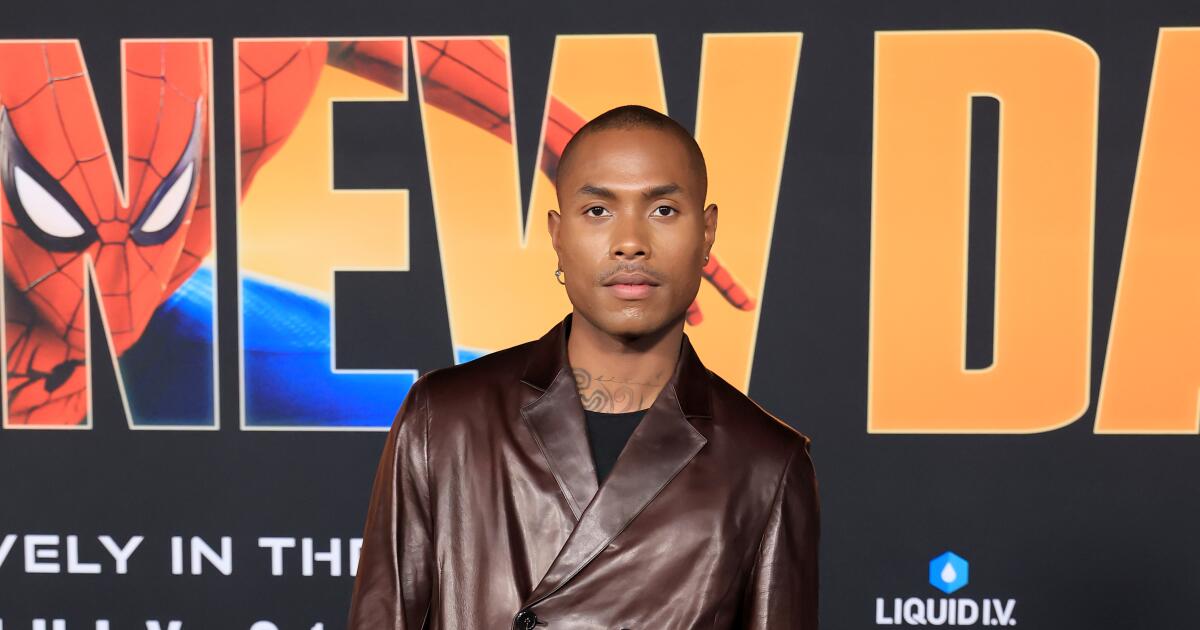
Grammy winner Steve Lacy joined the festivities during the film’s Hollywood premiere on Monday, detailing more than just his original song for the latest “Spider-Man” flick. The “Oh Yeah” and “Bad Habit” singer also allegedly spilled the beans on “Stranger Things” alumna Sadie Sink‘s “Spider-Man” character, which Marvel has kept tightly under wraps. Lacy delivered the accidental reveal while speaking with Twitch star Valkyrae, who hosted the film’s official red carpet stream. During Monday’s carpet, Valkyrae asked Lacy to name his favorite character from the movie “without spoiling anything,” according to video shared on social media.
“Jean. I like Jean,” he responds, “she’s the villain but, like, there’s a reason to her madness.” After Valkyrae asks whether his answer was a spoiler, Lacy seemingly tones down his enthusiasm for the character. “I like her character. I don’t know why.”
Lacy didn’t quite link Sink with this mystery Jean. Still, it’s worth noting that Sink’s role has been the subject of much speculation, with fans suspecting she would play Marvel-verse X-Men telekinetic and telepath Jean Grey. Sink would be the third actress to play the role, after Famke Janssen and “Game of Thrones” alumna Sophie Turner. (Another Marvel universe Jean is Jean De Wolff, a Spider-Man ally who was a police detective and captain.)
“Spider-Man: Brand New Day” will also see Tom Holland, Zendaya and Jacob Batalon reprise their roles and also features Mark Ruffalo and Jon Bernthal among others. Holland recently starred alongside Zendaya and Bernthal in Christopher Nolan’s “The Odyssey.”
The trailer, released in March, shows Peter/Spider-Man (Holland) reeling as he struggles to reconnect with his friends. To his dismay, MJ (Zendaya) has a new man in her life. As in the previous films, Peter attempts to balance his personal woes with superhero struggles — but he’ll have another Avenger in his corner. The clip shows Ruffalo’s Bruce Banner (a.k.a. the Hulk) guiding Peter through an “enormously dangerous” physical evolution and teases several baddies, including Bernthal’s antihero Punisher.
Sink has been all-in on the “Spider-Man: Brand New Day” press tour, managing to keep tight-lipped about her role. Earlier this month, Marvel shared playful videos of Sink somewhat discussing her role to help stave off eager fans’ curiosity. In one clip, she provides “Spider-Man” fans with three incredibly helpful clues: She does not play Spider-Man, she does not play Aunt May (who perished in “Spider-Man: No Way Home”) and she is definitely in the latest movie.
When it comes to spoiling “Spider-Man” and other Marvel films, it often seems like the call is coming from inside. Over the years, Holland has gained a reputation for his loose lips, spoiling plot details from “Spider-Man” and “Avengers” films.
Maybe accidental spoilers are just par for the course?
“Spider-Man: Brand New Day” hits theaters, with showings on Thursday leading into Friday’s release.
Growing up in Inglewood, Andrew Hernandez heard plenty about the Olympics. Since L.A. was awarded the Games almost a decade ago, the 18-year-old watched preparations slowly improve the infrastructure of his hometown. He still never thought he would ever be able to attend.
Until now.
LA28 and the Rams donated 1,000 free tickets to 10 nonprofit organizations Monday, giving local youth such as Hernandez a seat at Olympic flag football or swimming competitions in 2028.
The tickets are the first gifts from LA28’s community ticket program, which launched in November with a $5 million inaugural donation from the Rams. When Rams coach Sean McVay delivered the news to members of the nonprofits at Rams training camp Monday, kids’ jaws dropped as the group broke into applause.
Hernandez, a member of South L.A.-based Brotherhood Crusade, posed in the group behind a giant commemorative Olympic ticket.
“Having grown up in Inglewood, you don’t really have the funds to [go to sporting events],” Hernandez said. “So if it wasn’t for programs like this or the Rams giving out tickets, a person like me, I would have never had imagined I’d be in a stadium watching the game. It’s opened my eyes.”
In addition to Brotherhood Crusade, A Place Called Home, After School All-Stars, Al Wooten Jr. Heritage Center, Boys & Girls Clubs of Metro L.A., Heart of Los Angeles, Project Blue, Social Justice Learning Institute, Swim Up Hill and YMCA of Metro L.A. were selected by the Rams and LA28 for their investment in local youth and their presence in communities near Olympic venues.
“The local organizations receiving these tickets today are groups that we work closely with year-round to uplift and support our neighbors all across the Los Angeles region,” Rams president Kevin Demoff said in a statement. “This investment ensures that the people and nonprofits that commit themselves to Los Angeles are able to experience this once-in-a-lifetime event right in their hometown.”
The Boys & Girls Club Metro L.A. started increasing awareness about the Games about three years ago. Members, ranging from 6 to 18 years old, participated in youth Olympic events and met Olympic and Paralympic athletes. But as excitement for the Games grew, many kids were already saying they couldn’t afford to go. They asked Kim Washington, the club’s vice president of philanthropy and marketing, whether they could at least watch events on TV at the club.
“Having this opportunity to have tickets for these kids and families, it’s going to be beyond their wildest dreams,” said Washington, who volunteered in the opening ceremony at the 1984 L.A. Olympics.
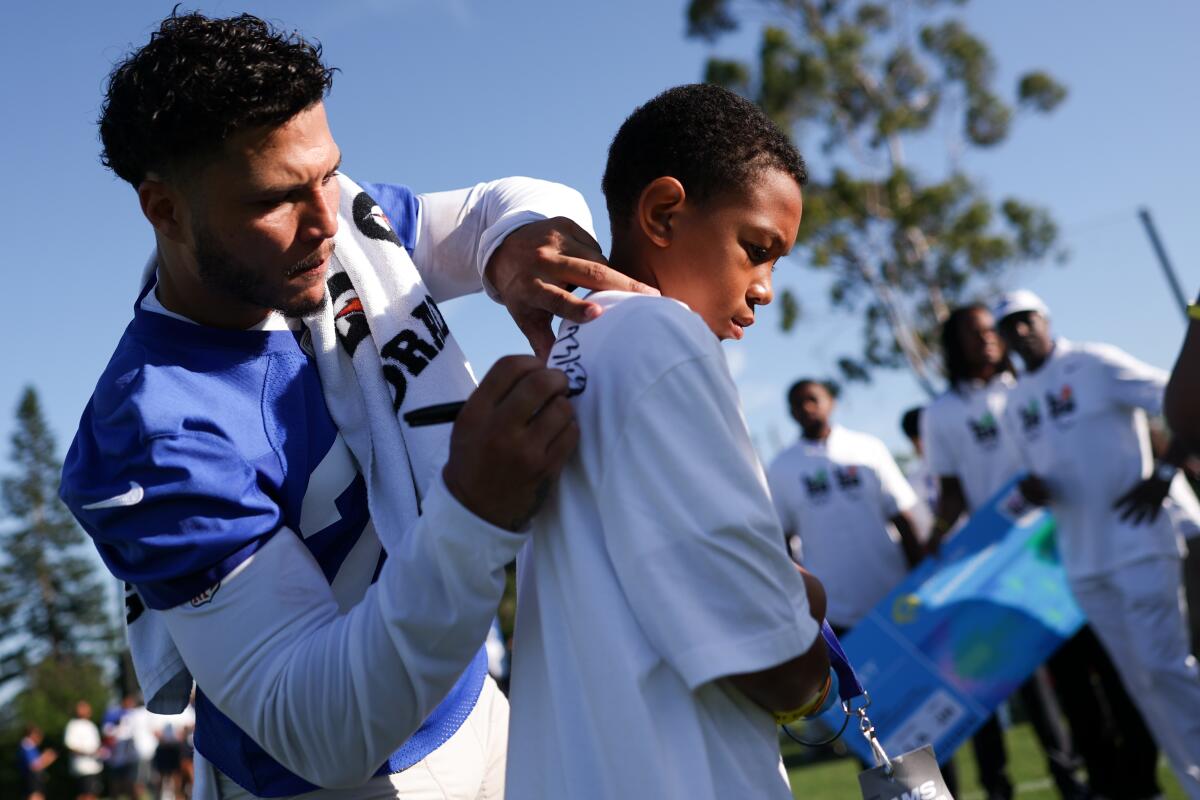
Rams running back Blake Corum, left, signs a T-shirt during an L.A. Olympics ticket donation ceremony at Rams training camp on Monday.
(Eric Thayer / Los Angeles Times)
Each organization will distribute tickets directly to members. The donated tickets are for two of the most in-demand Olympic sports. Flag football is making its Olympic debut and was among the new sports that sold out through its ticketing availability during the first ticket drop. Swimming, one of the marquee sports of the Summer Games, will take place in SoFi Stadium, which will be transformed into the largest Olympic swimming venue in history.
Paralympic swimmer Jamal Hill founded Swim Up Hill with a goal to teach underprivileged children how to swim. The 2021 bronze medalist primarily works with second to fourth-graders, with a significant number coming from the L.A. Unified School District. Some have already voiced ambitions to become Olympians or Paralympians.
“You see something happen, something that you consider magnificent or magical … it says, ‘Wow, now I want to do this,’” Hill said. “Whether or not you end up doing that, it puts you on a path of just thinking bigger, going above and beyond, having the incentive of self-driven goals that just ultimately build better community members.”
After selling a record 4 million tickets in the first drop this year, Olympic tickets go back on sale this week. Fans who registered for the ticket lottery with a Visa credit card received information Monday about time slots to purchase tickets during the Visa presale that runs July 29-31. Email notifications for time slots in the second drop that begins Aug. 10 and lasts until Aug. 20 will hit inboxes between Aug. 6-7.
When Olympic tickets went on sale in April, fans were shocked and frustrated at high prices, a 24% service fee and limited availability for key events. LA28 has tried to keep tickets affordable, but hearing that nearly half of the tickets are under $200, including the service fee, and 75% are under $400 is still a steep price for many fans. Half of the 1 million tickets priced at $28 were scooped up during the locals presale in April, but more will be made available in the next drop.
Individuals, organizations and community leaders interested in participating in LA28’s community ticket program can access more information at la28.org. The Rams’ initial $5-million donation is expected to fund several more ticket donations to local organizations in the coming months.
Although he grew up near SoFi Stadium, Hernandez, who will be a freshman at San José State in the fall studying civil engineering, had never attended a major live sports event until this year. Through Brotherhood Crusade, he went to a Rams game. It only made him more excited for future opportunities.
“It almost helped me with my goals,” Hernandez said. “I’m like, ‘You know what, I want to be in that space again.’ I want to be able to afford a ticket and go to games. That’s kind of why I want to go to college, want to get an engineering degree, and make sure that maybe I can take my kids one day to a Rams game. The next time the Olympics come back, I can be able to get my own ticket and go.”
Dear Dave Roberts: I was totally disgusted to see you at the Dodgers’ White House ceremony pandering to Trump. As far as I was concerned, you made a complete fool of yourself. I’m sure many Dodgers fans were equally horrified with your behavior.
Susan Stann Temecula
Today’s visit to the White House was baseball, not politics. It was a boost for MLB, not columnists who try to be political hacks with personal bias. If the hacks or detractors listened to the references it was all about achievement in what the team did to win. The Dodgers are part of the entertainment industry which annually draws maybe a billion fans or more and certainly billions of dollars. The hacks and detractors will not be convinced otherwise but if you line up any 50,000 fans at a game, you will see a positive vote for the privilege of going to the White House. Baseball wins, sports wins, the entertainment industry wins, and America wins. Boo the hacks and the ignorant detractors.
Bill Koury La Cañada
Dave Roberts justifies his appearance with Donald Trump because it is a “baseball tradition” that should be honored.
I didn’t hear him protesting to uphold other baseball traditions such as banning Black players from baseball, not having designated hitters, or starting with a runner on second base in extra innings.
Traditions come and go. It seems Mr. Roberts traded his moral compass for a trip to the White House lawn.
David Griffin Westwood
In my dreams Dave Roberts says, “Nope, not gonna go to the White House. If they want to fire me, let ‘em.” Dream on.
Jay James Pico Rivera
I will suggest the nuclear option. The Dodgers should never again visit the White House. No matter who is president.
Jon Bon Jovi’s “Forever” tour stop was cut short after the singer said he needed to cool it.
Nearing the end of his nine-show residency at Madison Square Garden on Thursday, the 64-year-old rock icon apologized to fans when he had to pull the plug nearly an hour early.
Just before launching into “Livin’ on a Prayer,” he told the audience in a raspy voice, “I am the most grateful man in the world right now because I know I’m letting you down, and it’s not like me to do that. I feel f— great, but I’m gonna do one more song. I’m gonna need your help. I might have to cool it because I’m f— hurt.”
He performed the 1986 megahit, with the audience belting the chorus in his place toward the end. Bon Jovi then said, “I’m sorry, I’ve got to go. Stay tuned.”
“I’ve got to cool it,” he continued. “It’s just not going to get any better. Don’t throw away your ticket stubs. I’m gonna figure something out, OK? Just hold onto it, we’ll figure out how to reschedule.”
Bon Jovi embraced his band mates in a group hug before heading off stage.
Representatives for the “Bad Medicine” rocker told The Times that the concert ran for 90 minutes before ending.
“Jon Bon Jovi spoke from stage and told fans he has been battling a sinus infection, which led to the show’s early ending,” the statement continued. “As part of the Bon Jovi residency at Madison Square Garden, Jon has said numerous times that it has been a joy to return to live shows for the band.”
Bon Jovi’s “Forever” tour is the first since the namesake frontman had surgery to repair a vocal cord injury in 2022.
The tour kicked off July 7 at the New York City venue and then will head overseas for a series of international stadium dates, including stops at Scottish Gas Murrayfield Stadium in Edinburgh on Aug. 28, Croke Park in Dublin on Aug. 30, and a three-night stand at Wembley Stadium in London on Sept. 4, 6 and 9.
In 2024, Bon Jovi spoke on a Hulu panel in support of his docuseries “Thank You, Goodnight” and revealed that one of his vocal cords was “atrophying.”
“I pride myself on having been a true vocalist,” the musician said. “I’ve sung with Pavarotti. I know how to sing. I’ve studied the craft for 40 years. I’m not a stylist who just barks and howls. I know how to sing.”
“So when God was taking away my ability, and I couldn’t understand why — I jokingly have said the only thing that’s ever been up my nose is my finger — you know, so there’s no reason for any of this,” he added.
The same year, he told The Times that his voice was a “work in progress.”
“I’m an athlete coming back from an injury — Kobe Bryant with his Achilles torn off. Before I got on the plane this morning, I was at vocal therapy. The goal is 2½ hours a night, four nights a week,” he said.
In June, he told People that he was fully recovered. “It was longer than I’d ever expected, but it had to be right. We never lost faith.”
In 2025-26, the WSL replaced the Sunday 18:45 kick-off time with more noon matches, but this also proved unpopular.
“For an away day it’s horrible,” explains Arsenal fan Major. “You’ve got fans leaving at three o’clock in the morning or you’re going the night before and having to pay for a hotel.”
The revised time also clashes with grassroots football, played widely on a Sunday morning. It is a barrier for the younger generation to attend games.
Regular breaks throughout the season are an issue too. Earlier this year, former England defender Anita Asante suggested extended gaps between league games hampers momentum and rhythm for fans.
Another complaint from supporters is accessibility.
While Premier League-level grounds like Emirates Stadium and Everton’s Goodison Park are well equipped, smaller venues are less accommodating.
Jones, a wheelchair user, was frustrated by the lack of Blue Badge parking information when trying to attend London City’s away trip to Tottenham Hotspur.
“A lot of the issues I experience are with communication,” she says. “Every club has an accessibility section on their website but for Tottenham it is only for the Tottenham Hotspur stadium, not Brisbane Road [where Tottenham women play].”
Jones told BBC Sport the onus was on her to seek further information via email, to which she received a reply stating Blue Badge parking had sold out. Only after she spoke to Tottenham’s disability co-ordinator did she learn the venue did not have Blue Badge parking as it was in a residential area.
To compound matters, the wheelchair accessible allocation was on the opposite side of the ground to the away section, leaving Jones isolated.
Tottenham Hotspur told BBC Sport information for the venue is available on the website via the ‘Ask Spurs’ chatbot. However, after an internal investigation, they are making improvements.
Brisbane Road-specific guidance has since been added to their event day accessible parking section on ‘Ask Spurs’, while a matchday-specific guide is in the works.
A spokesperson for the club confirmed: “We’re working on a full Brisbane Road matchday guide for the website for next season to give parity with our Tottenham Hotspur Stadium information.”
In Japan, fans come up with a song for each player and sing it happily and relentlessly. Nootbaar played in the major leagues, not in the Japanese league, so he was not sure he would get a song until he came up to bat.
“I don’t know how everybody in the stadium knew how to do it,” the St. Louis Cardinals outfielder said Wednesday at Angel Stadium. “Everybody was chanting it. It was pretty awesome.”
Japan’s Lars Nootbaar, center, played for Team Japan in the 2023 World Baseball Classic.
(Eugene Hoshiko / Associated Press)
In Japan, baseball games are nine innings of songs and chants, drums and noise sticks. No excessively caffeinated in-game hosts. No scolding video commands to make some noise. The joyful sounds are organic, and they come from the fans.
Nootbaar attended Yoshinobu Yamamoto’s last game in Japan and absolutely raved about the energy in the stadium. Does he believe that kind of fan experience would translate to an American ballpark?
“I don’t see why not,” Nootbaar said. “It would probably have to start small, but it would be cool to integrate that.”
We’re starting small, and soon. A minor league team plans to launch in Irvine next year, and the entrepreneur behind it is pitching it as a way to provide fans with a taste of Asian baseball.
“We’re going to really lean into some of the innovation in fan experience that you’ve seen in Korea and Japan,” said Paul Freedman, co-founder of Innovation Baseball Partners.
“We’ll be the first, to our knowledge, to bring that as the fan experience of an American baseball team.”
The team would play in the Pioneer League, the independent league in which Freedman and his partners previously launched teams in Oakland and Long Beach. In Oakland, the ballpark is a pop-up. In Long Beach, the team plays at 70-year-old Blair Field.
The defending champions of Korea’s league last year held spring training in Irvine. More Koreans live there than in any city in the United States besides New York or Los Angeles.
Asian food will be available at the games, as will hot dogs.
On Tuesday, the Irvine City Council is scheduled to consider a five-year contract with Innovation Baseball Partners, under which the team could sell naming rights to the Great Park stadium and would split the revenue with the city 50-50. The agreement also provides a framework for potential expansion of the stadium from 1,300 to 3,000 seats.
Don Wakamatsu, who runs baseball operations for Freedman’s teams, was the first Asian-American manager in major league history and managed Hall of Famer Ichiro Suzuki with the Seattle Mariners.
Ichiro won’t be playing in Irvine — the Pioneer League limits players to no more than two years of professional experience — but Wakamatsu plans to tap into his network to ensure the team has an Asian manager or coach and a nucleus of Asian players.
Wakamatsu described Freedman’s model of minor league teams as “somewhere between conventional baseball and the Savannah Bananas” and believes the Asian style could take hold in Irvine.
“If we can truly capture some of that excitement and fan interaction,” Wakamatsu said, “I think we’ll get a deeper connection with the players.”
To help launch the Irvine team, Freedman tapped two Korean-Americans: Martin Kim, a onetime interpreter to former Dodgers pitcher Hyun-jin Ryu and international business development executive with the Dodgers and Major League Baseball; and Yugina Yun, an Orange County-raised sports executive that said she “begged” to join the team as its operations director.
“The element that we’d really like to bring forth is the idea that fans in the stands can impact a team,” Yun said. “We want them to feel like they’re a part of the culture from the ground up.
“We’re not manufacturing the experience. They are.”
If you watched the World Baseball Classic, or for that matter the World Cup, you don’t have to be sold on this. On the night before the World Cup final, Argentinian fans took over Times Square, singing and chanting and waving banners.
A sign outside this year’s WBC finals in Miami listed 16 “permissible instruments” (bongos, cowbells and tambourines welcome) and eight “prohibited instruments” (no airhorns, please). In Tijuana, where Dodgers icon Justin Turner is playing this season, airhorns buzz constantly, and games feature skits between innings.
“I think there is a lot of attention to how different cultures have taken America’s pastime and created experiences around it that are different than we have here,” Freedman said. “We’re excited to bring some of that back home.”
Waving a Mexican flag with a vaquero sombrero on, El Malilla made history at Coachella last year as the first reggaeton Mexa act on the lineup.
To keep the momentum going, the rising Mexican star had planned for his first U.S. tour to take place last summer. After the Trump administration ramped up the ongoing ICE raids around the same time, El Malilla decided to put the safety of his fans first and postpone the tour.
“With what was happening with Mexicans and immigrants — the big problem being ICE — I decided to pause the tour, because I didn’t feel comfortable exposing my fans to that kind of situation,” El Malilla says over Zoom from his home in Valle de Chalco. “For me, it was important to bring this tour to the U.S., but in a safe way without putting anyone in harm’s way.”
After wrapping up the Mexican leg of his “Tu Maliante Bebé” Tour, El Malilla, who was born Fernando Hernández Flores, is now preparing to bring his show to the states. The 19-show trek will kick off July 24 in Palm Springs, followed by a concert at The Novo in Los Angeles the next day.
Mexican artist El Malilla.
(Joss Andreu)
“The Novo is very important for me because it’s going to be my biggest venue for this U.S. tour,” he admits. “To see how Los Angeles has adopted me, embraced me, and shown me love, I’m going to feel like I’m home.”
Following his Coachella debut, El Malilla has pushed reggaeton from Mexico into the mainstream. He imbues the genre with Mexican swagger, slang and sex appeal in his explosive hits such as “B de Bellako,” “Mami Tú” and “Balenciaga” featuring corrido singer Luis R. Conriquez.
Since then, El Malilla has expanded the scope of reggaeton Mexa following collaborations with Puerto Rican pioneers such as Jowell y Randy and Colombian superstar J Balvin. The perreo heartthrob is also tapping into new genres for his upcoming sophomore album. In an interview with The Times, El Malilla opened up about leading the reggaeton Mexa movement and what to expect from his tour.
How do you feel about representing Mexican culture and reggaeton Mexa with this tour in the U.S.? I feel very happy to bring a bit of our culture, our slang, our sound and our essence to the U.S. for my fans that haven’t had a chance to see a show of mine. Something that’s very crazy for me is when I performed in Chicago last year, there were people with signs that said they were from different places in Mexico like the State of Mexico. It made me very nostalgic to know that I’m also from the State of Mexico and we’re here. It’s important for me to represent our roots. Get ready, because I’m coming with perreo sucio. [Laughs.]
What do you think when you fans always ask for you to take off your shirt at your concerts? It makes me laugh because when I sing “Rodillas,” people start screaming for me to take off my shirt. My show lasts like two hours and that’s barely the first song. I enjoy it, because I consider El Malilla to be a showman. I love to be onstage and have fun with my fans. Though some people might see me as a sex symbol, I don’t see myself that way, but to each their own.
What does it mean for you to be breaking down barriers for reggaeton Mexa? It makes me very happy. I’ve been thinking about that recently. When would you think that an iconic pop star like Danna would collaborate with an iconic chacalón [Mexican slang for “bad boy”] like myself? That never crossed my mind before, but now in 2026, our reggaeton, our essence and our sound has become important in Mexico and even more so on a Latino level. Now everything is possible. There [are] no longer barriers for reggaeton Mexa, or for Mexican singers. Today, your biggest dream is possible.
Who else would you love to collaborate with in the future? Lately, I’ve spent more time in the U.S. and I’ve been soaking up more English music. I discovered that I really like The Weeknd. A collaboration with him would be crazy! I returned to Coachella this year to sing with Cachirula & Loojan … and to be able to see Justin Bieber live was incredible. I would love to collaborate with him. On the Latin side, I would love to collaborate with Nsqk, De La Ghetto, Ñengo Flow or a reggaeton pioneer like DJ Blass.
What’s the process been like working on your next album? I spent a year and a half working on this album. I enjoyed that process so much. Music has given me so much that this album is my way of repaying music for all the blessings it’s given me. You’ll be surprised at what I’m capable of. This is a Malilla that’s now 26 and a little more mature. It’s a more experimental and professional Malilla. I had never made a bolero song and I dared to do that this time. I did my research by listening to Luis Miguel, José José and singers and genres that I wasn’t used to listening to. I found love for those genres and singers. It was a very fun and cool way for me to explore different genres.